New Mars Forums
You are not logged in.
- Topics: Active | Unanswered
Announcement
#26 Re: Terraformation » Bipolar Mars Terraform Plan » 2025-12-09 11:55:44
To append to the just previous post.
The heat in the "10 Foot Sea's" may increase too much. If you are dealing with fresh water then the water at the floor of the sea could be at as much as 39 degrees F, before turnover would happen. The water just under the ice would be 32 degrees F.
(3.88888889 to 0 C)
So we do not want to melt too much more of the ice above if we think that 10 feet is ideal.
So, if you have a nuclear reactor, you could use its electricity to run heat pumps to pull heat out of the bottom water. That could be used to heat things like habitats and Industrial Processes.
While you could melt the "10 Foot Sea's" with nuclear reactor water, the "10 Foot Sea's" will really be solar thermal heat storage.
First you generated chemicals that organisms could consume. Then the organisms gave off waste heat. The span of (3.88888889 to 0 C)
represents a mass storage of heat that a Heat Pump system could extract.
If you have saltwater things can get to be different. In fact it is possible to store much higher heats with salt gradients, but on the whole ice water may be very useful.
Ending Pending 
#27 Re: Terraformation » Bipolar Mars Terraform Plan » 2025-12-09 11:20:14
To follow up on the previous post I have introduced a "10 Foot" sea. This in part is to annoy metric people. As it happens 1 foot of water on Mars exerts approximately 10 millibars of water column pressure. So, for Mars as this is important, I see a measurement of this sort as useful. Metric people are a little to arrogant anyway. Cheeze eaters! I like cheese also though.

Flat areas under a Mars ice slab could be "Diked" off using earthen berms.
A layer of water perhaps 10 feet deep could be melted. The pressure under the ice and dirt above it would be perhaps a bit more than a "Bar".
The water would be kept just as liquid, that warm only. So, Arctic in nature.
But diving bells could be warmer, perhaps comfortable for swimming or washing perhaps.
The "10 Foot Sea's" would allow transport of materials and would help to expose useful minerals. The "10 Foot Sea's" would also support life using chemicals, fiber optic light, and perhaps other artificial lighting.
Chemicals could include Oxygen, Nitrogen, CO2, Acetate, Methane, and Hydrogen. Those last two need to be prevented from coming out of solution, by limiting their amount.
The consumption of these chemicals will produce heat of biological origins.
So, this could be biologically productive.
Some useful microorganisms might be supported, and perhaps some macro-algae.
Articles:
https://link.springer.com/chapter/10.10 … -33208-2_4
Quote:
Crucial part of the Arctic marine ecosystem
Polar macroalgae are a crucial part of the Arctic marine ecosystem, playing a significant role in primary production and supporting various marine species. They are adapted to the harsh conditions of the polar regions, including extreme temperatures and limited light availability during the Polar Night. These algae have developed unique adaptations such as low metabolic activity, lipid storage, and the ability to form resting stages to survive periods of darkness. They also have the capacity to grow new tissues in darkness, which allows them to resume growth rapidly once light returns. This ability to adapt and thrive in challenging environments makes polar macroalgae vital for the health and sustainability of the Arctic marine ecosystem.
So, very likely to provide chemicals for these life forms, Solar powered methods to generate the chemicals will work well. The water could be charged to the limits with Oxygen to get over periods where light is lacking. The chemicals like Acetate might be stored to have for such periods of time as well.
The "10 Foot Seas" then could provide much that could be useful to a Mars settlement process.
Ending Pending
#28 Re: Terraformation » The Moon » 2025-12-09 09:23:51
A video that talks about AI data centers in space: https://www.youtube.com/watch?v=bne1Z_8j3uU
Quote:
Elon Just Confirmed His Mystery AI Was Real
Brighter with Herbert
The progression seems to be:
1) SpaceX or other capable.
2) Starlink
3) Sun-Synchronous Data Centers in space.
4) Moon
5) Mass Driver.
Sounds pretty good, I am rather comfortable with #1-#4.
#5 might be a teething problem.
Anthrofuturism has some videos about mass drivers: https://www.youtube.com/@Anthrofuturism
Here is one of their videos, I feel I should review some more: https://www.youtube.com/watch?v=WxXbgalpheQ
It is actually quite beyond my paygrade. I am just not that mentally capable. Not so far at least. So, fine, if they figure out how to make a Mass Driver for the Moon, I will be delighted.
As a backup plan, I would like to speculate on an alternative that maybe would work.
1) SpaceX or other capable.
2) Starlink
3) Sun-Synchronous Data Centers in space.
4) Moon
5) Matter and Energy Projectors.
6) Retrieval of Deimos/Phobos/Asteroid mass to CIS Lunar Space.
For Matter Projectors, I would include:
a) Mass Drivers, if possible.
b) Electron Beam (Electrons have mass).
c) Lunar Lasers could project Photons which have inertia, I believe.
I wish....
d) Neumann Drive (As a matter projector).
e) Magdrive (As a matter projector).
I have already hoped that it might be possible to beam atoms of a conductive material from the surface of the Moon to impact on a orbital target device.
I do worry that the beam may spread too much.
The hope is that something like Iron atoms might vacuum welt to the target rather than to erode it. Silicon would be another material of interest, as well as Aluminum.
A question would be, can you use electron beams to manipulate this process?
https://www.space.com/space-exploration … ravel-tech
Perhaps the beams could push or contain the atom projections. Or perhaps if the target was charged to a very high (-) charge, it might attract the atoms.
I don't know these things.
If electrons could push a spacecraft to interstellar missions, perhaps then perhaps electron beams could push the targets to help maintain the orbits of them.
The atoms projected might also push the orbit of the targets that they would hit and we hop would weld to.
It this would work, then you would have matter to help make data centers with, and would also have matter in orbit that you could use to drive a spaceship to asteroids, using Magdrive or Neumann Drive.
At the asteroids with small gravity wells you might gain more Iron Silicon, Aluminum for propellants. But I would hope things like Hydrogen and Carbon that might be brought back to CIS Lunar Space. These may also be available from Demos and Phobos.
This would help integrate those moons into an early solar system economic structure.
Ending Pending
Perhaps however Carbon and Hydrogen might be available to CIS Lunar space instead.
Ending Pending
#29 Re: Human missions » Why Artemis is “better” than Apollo. » 2025-12-08 11:56:48
I hope you don't mind the intrusion.
It looks like China and Blue Origin will be able to "Top" Falcon 9 within a period of time. Just knowing something can be done allows them to skip many of the mistakes that SpaceX had to endure.
I am wondering if when the HLS is satisfied, SpaceX could adapt its reentry methods to the 2nd Stage of Falcon 9.
It would be a diversion. And Merlin Engines are not as good. But there may be many more Spaceports that an upgraded Falcon 9 could operate from. And if they had landing barges for Starship/Superheavy, they also could use them for the Falcon 9.
Not all payloads are Starship sized anyway.
They have the Heat Shield almost figured out and the flaps are pretty much understood. But I expect that a Falcon 9 2nd Stage would have to do a "Hover Slam" landing like the 1st stage does.
Maybe they could upgrade the 2nd stage to Metha-Lox???
Granted, it is a diversion but the competitors don't have these skills yet.
Ending Pending
If they made is correctly then it could also be lofted to orbit by Starship itself at times and be a 3rd Stage "Starboat".
Ending Pending
#30 Re: Terraformation » Bipolar Mars Terraform Plan » 2025-12-08 10:53:52
Void the evil has rebelled against (th) and is revising site selection. Back to this: https://www.space.com/30502-mars-giant- … y-mro.html
Image Quote: 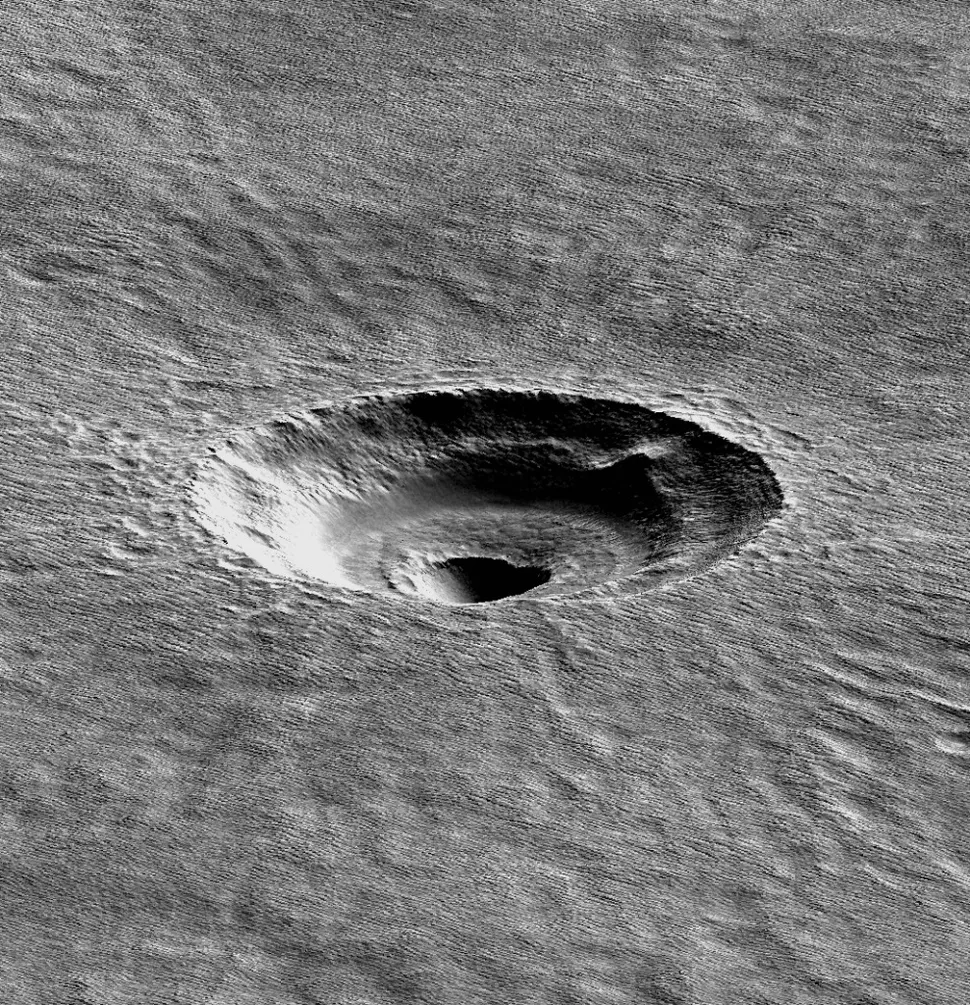
This ice slab seems to have "Splosh Craters".
Thise may allow for an Amphitheatre Solar Collection Scheme.
This scheme which might be applied to Korolev Crater could also be applied to some degree here: 
Unlike Korolev, there is not a pool of ice in the center, but the crater itself seems to be carved out of a giant slab of ice.
We might place solar devices on the south facing inner rim. This could be solar panels or a collection of mirrors.
Yes, solar power on Mars is not as good as on Earth, but it exists. The other options that might come into play might be Nuclear, Geothermal, or Orbital Solar.
Orbital Solar only makes sense as if we are to make Mars to some degree a "Second Earth", The Earth soon will be likely to have massive orbital solar installations to support data centers, and to some limited degree perhaps to transfer power to and from the surface of the planet.
Some very important specs for the ice sheet are listed here:
The ice the scientists found measures 130 feet (40 m) thick and lies just beneath the dirt, or regolith, or Mars.
"It extends down to latitudes of 38 degrees. This would be like someone in Kansas digging in their backyard and finding ice as thick as a 13-story building that covers an area the size of Texas and California combined," Bramson said.
Kansas is close to the latitude of Spain, which is a place which will have winter sunshine, and is likely suitable for solar energy.
While Mars has dust problems/storms, it also does not have snows, or hail that we know of and the atmosphere is thin. We would not expect many clouds to block the sun.
When solar works at this location it should work well.
An interesting solar setup for Mars could involve Heliostat mirrors, Solar Panels to receive light from the mirrors, and a heat pump to extract heat from the solar panels to keep them cool/cold.
It is evident on Earth at this time that Heat Pumps could generate heat as much as 180 Degrees C. Expectations are that they will do better in the future. While during day time both Electricity and industrial heat could be obtained, at night heat could be rejected by the heat pumps and solar panels.
The Ice Slab Scheme needs things to be solved, but might offer some level of promise: 
And keep in mind that this ice slab is the size of California and Texas.
We do not know what the regolith under the ice is like, perhaps sometimes it is rubble, (Icy or Dry), or a lava layer maybe with a lava tube, or Sandstone.
A Starship landed successfully in a VOID, without crash or cave-in then will instantly be much more protected from the Martian environment.
Once the VOID was sealed up it may even be possible to pressurize the VOID.
Some VOIDs could grow mushrooms, or maybe even Apple Trees.
Ending Pending
#31 Re: Not So Free Chat » Chat » 2025-12-07 17:48:30
#32 Re: Not So Free Chat » Peter Zeihan again: and also other thinkers: » 2025-12-07 17:45:30
This seems to be good clean fun: https://www.bing.com/videos/riverview/r … &FORM=VIRE
Quote:
TRUMP vs EUROPE!: The New Cold War Begins | With Joaquin Flores and Blaine Holt
YouTube
CRYPTO RICH POLITICS
1 views
2 hours ago
I need to hear it again. I sounded really interesting in my car. Explaining current reality.
Ending Pending
#33 Re: Science, Technology, and Astronomy » Genetics » 2025-12-07 12:07:53
An interesting re-conception of humans:
https://www.youtube.com/watch?v=tI2BfoWDP4I
Quote:
Neanderthals Were Not Replaced
Highly Compelling
I am in agreement, to a large extent.
I have long considered that it was wrong to consider that the "Pure" "Homo-Sapiens" from Africa were the only true humans.
And I agree that the majority of genes which were common between Eurasian and African gene pools should not be called "Homo-Sapiens".
They belonged to the Neanderthals and Denisovans as well.
I think that European upper class arrogance, presumed that people who seldom went into the sunlight to do farm work, being pale to the level of being unhealthy, would be the blessed form that coming from Africa, were then the very bestest!
I think that even if African genetics had ceased to exist, with the invention of greater technology over time, the need for a Neanderthal body form would have relaxed. Heavy bones, massive muscles, and the need for lots of animal fats would relax, as the means of obtaining survival became less demanding per cold and the hunting of large animals.
People building better buildings and better clothing, could relax gradually from the need for extreme biology. Brain improvement over time and accumulated knowledge would have led to the creation of better shelter and clothing.
Ending Pending
#34 Re: Terraformation » Bipolar Mars Terraform Plan » 2025-12-07 09:54:34
So, at the core of this would be "Inflated, Frozen, Mud-Balloons".
Quote:
With an electric power source you might maintain proper temperatures using heat pump technology.
Probably the walls of the arch need to be much thicker than what I show here.
The Mud would be composed of dirt, water ice, and fibers. The fibers could be organic grown, or mineral wool, or plastic fibers of manufacture.
Regolith might be about 3.0 specific gravity, I think.
On Mars, about 100 feet of water can give a pressurization of about 1000 millibars. I believe that that is about 30 meters.
Ice is less dense so perhaps you need about 110 feet of ice to pressurize to 1000 millibars.
But dirty ice, will weigh more, depending on content. I intend to have a dominantly find regolith mix, with the minimum of ice to bind it together.
I will intend to include some fiber in the frozen mud mix.
I will go with the 3.0 number, so about 33 feet of mud will give 1000 millibars of pressure, if that were so.
There are certain pressure minimums.
Less than 100 millibars might be suitable to some non-vascular life such as Algae perhaps.
100 millibars is perhaps close to the tolerance for most vascular crops. It is not enough to sustain human life though.
250 millibars of Oxygen is probably about the minimum for human life to be sustained.
333 millibars of Oxygen may be more suitable for human life.
I think a mix of O2/N2 at 500 millibars or more would be better for human life.
Quote:
I will go with the 3.0 number, so about 33 feet of mud will give 1000 millibars of pressure, if that were so.
So, 16.5 feet for 500 millibars.
11 feet for 333 millibars.
8.25 feet for 250 millibars.
I would propose this sort of construction primarily to support agriculture, and to give extra space for human do things like walk around and run around.
The three sorts of agriculture I am aware of at this time are:
-Photosynthesis, natural light.
-Photosynthesis, artificial light. (LED's, Fiber Optics).
-Chemosynthesis.
The use of O2 and Acetate is the process of decay product simulation, supporting life.
Using an electrolyze process, O2 and Acetate are produced from CO2 and water.
These simulated decay world products apparently will support Yeast, Algae, and Mushroom life rather well, and vascular plants less well.
My hope is that by adding 1%, 5%, 10% lighting the vascular plants will do well. Artificial lighting is more expensive than natural light, but on Mars we cannot have natural light as you have to at least have a greenhouse glass.
O2/Acetate is less expensive than natural photosynthesis.
So, the balance of O2/Acetate dominant with a small amount of artificial light may be of an acceptable cost. Keep in mind that it is possible that fiber optics might work.
Ideally then you could grow crops which may provide not only foods but useful fibers.
Now, if someone wants to make glass domes, that is fine. But I am looking to provide bulk agriculture at a reasonable cost.
The mud domes will be filled with air, to help avoid collapse.
The domes may have a protective vapor barrier over them and may be shaded by solar panels as well.
The domes may have a poly type film inside of them to help hold air pressure and to help avoid freeze drying.
The domes may have additional supports if they can be afforded, made of stones, Plastics, and metals. Perhaps domes inhabited by humans may have this expense.
The domes will have a plastic dome inside of them that allows heat pumps to move heat away from the mud domes into a more interior space under such a plastic dome.
The domes may have water/ice pools inside or might have soils. Maybe soils to grow mushrooms, or soils to grow vascular plant crops.
I think it should be noted that Mars probably has lots of building materials for frozen mud domes.
Ending Pending
Frozen Mud Domes, do not prevent the creation of tunnels and vaults in the solid rock below: https://newmars.com/forums/viewtopic.ph … 19#p233319
This would be an extra safety feature.
Ending Pending
#35 Re: Not So Free Chat » Peter Zeihan again: and also other thinkers: » 2025-12-07 09:44:33
Continuing with the 4th Shale Revolution from the last post: https://zeihan.com/the-fourth-shale-rev … ajor-tech/
Search Quote:
The Fourth Shale Revolution refers to a significant technological advancement in the oil and gas industry, particularly in the U.S. This revolution is driven by ExxonMobil's introduction of a new type of proppant, which is a lightweight synthetic version made from petroleum coke. This proppant is designed to enhance well productivity by allowing for deeper penetration into rock formations and increased suspension in low-viscosity fluids, potentially leading to up to a 20% uplift in well productivity. This innovation is expected to reshape the energy landscape, similar to the previous revolutions in shale technology that focused on natural gas and liquid oil extraction.
I feel that it is important that if an income from Hydrocarbons is to occur on the planet, we should prefer that that income goes to the "Good-Guys" as much as possible.
We should want to starve evil entities of such an income, if that is reasonably a thing that can be done. And yes, as an American, of course I consider "Good" to be an American potential, and an ideal. So, then those who try to spread their "Not-Good", ideas by Verbal and Violent means, and those who intend to reform the world including the USA to something not "Good", are our enemies.
We are allowed to have our preferences, and if we are empowered we should support our preferences.
As for alternative energy, I welcome it.
I would like the Petrochemical industry to transition to making material goods more and fuels less, as it becomes economic to do that.
Ending Pending
#36 Re: Terraformation » Bipolar Mars Terraform Plan » 2025-12-06 21:40:23
(th) Made a request. I tried to comply. Since I am confused as to what was desired, I will put the existing work to satisfy his original request here. https://newmars.com/forums/viewtopic.ph … 66#p235966
Quote:
This on this macro-scale will be my design:
Rather than to put a convex dome into a crater, I prefer on the macro Scale to visualize the greater structure as concave to the sky.
I wish also to include this sort of thing on a smaller scale: https://newmars.com/forums/viewtopic.php?id=7514
Quote:
With an electric power source you might maintain proper temperatures using heat pump technology.
And from the just prior post this:
https://depositphotos.com/photo/a-grass … 48046.html
Image Quote:You would have to be able to grow some sort of vascular land plant, "Grass", and make artificial "Sticks" using those plants and some sort of glue.
My objective is to produce large amounts of structure using relatively low-grade materials to convert into resources.
But high-grade materials will also be used where it has merit.
It is late.
Ending Pending
#37 Re: Not So Free Chat » Void Postings » 2025-12-06 10:51:49
I will consider participating. I had a look at the site, and I am not sure of water/ice availability, or radiation protection. I will presume Ice availability and will take the radiation problem as a challenge. I will hope to dominantly use bulk materials like soil and ice as primary construction materials.
This on this macro-scale will be my design: 
Although I show only the concave face pointing to the sky, sub-elements may be convex pointing to the sky.
I intend to be able to have arrays of mirrors that can concentrate solar energy to various points/towers.
Also, a power grid could involve laser/tuned solar panels that also can carry information.
Choose a spot on the site and I will participate.
Ending Pending
#38 Re: Not So Free Chat » Peter Zeihan again: and also other thinkers: » 2025-12-06 08:12:09
A "Fourth" Shale Revolution: https://www.bing.com/videos/riverview/r … &FORM=VIRE
Quote:
The Fourth Sale Revolution: Supermajor Tech || Peter Zeihan
YouTube
Zeihan on Geopolitics
357.8K views
Key word is "Proppant".
There is some notion I encountered on line that suggested that "Breakeven" price could be $45.00/Barrel. (Probably best case I think).
So, adding capacity each year.
So, I am also a fan of RethinkX which is about an electric economy more based on wind and solar.
And we apparently are going to have data base demand to satisfy. Even expanding into space. So, the energy sector is going to stay big, it looks like.
As I recall when I first encountered his materials, Peter Zeihan did not think that we would be able to do the "Electric Economy" for lack of materials. Things seem to have improved now. Aluminum and Sodium Batteries for instance.
The need for global commerce to obtain materials and the possession of a major market plus the avoidance of hookers seems to me now to be the most important aspects of the present situation.
The grooming of money so that "Good" money can be more dominant than "Bad" money. The avoidance of the emergence of "Mischief" money.
I give high marks to this administration and terrible marks to the previous administration.
"Mischief" money is typically money that is obtained without virtuous behaviors, and which is then applied by people of poor character to warp healthy societies.
Two significant camps for this are Old World Oil Money, and Money from Harmful Drugs. These are prominent at this time.
It has occurred to me that it is not only the drugs that have a harmful effect, but the conduction of money to the wicked that matter. Americans ar partially guilty for consuming and so then buying those drugs, but it is those who obtain money while not doing a good service, who entirely carry the blame for how evil money is spent.
Many would be eager to say that Americans are responsible for the drug trade for being the consumers of it. But during the Opium wars will you also say that it was the Chinese who were similarly responsible? Does that excuse the entities that support the illegal drug industry?
Oil and natural gas, also have cases of "Mischief" money. The better the USA satisfies it's own market the less of that there will be around the world.
Money easily obtained in some "OPEC" countries can often become "Mischief" money if the Verbal and Violent are allowed access to it.
So, to make a better world, the less "Mischief" money the better.
Globalization encourages "Mischief" money, and funnels it into the hands of those who only do evil deeds with their words, minds, and hands.
So, in the case of "Mischief" money LESS IS MORE!
Ending Pending
#39 Re: Terraformation » The Moon » 2025-12-05 11:14:28
OK, this is mostly welcome!
https://www.msn.com/en-us/travel/news/a … sz#image=1
Quote:
Alien life on the moon? New findings say maybe
©Shutterstock
For decades, the moon was seen as a barren, bone-dry world with no atmosphere, no liquid water, no magnetic shield, and extreme swings in temperature. The idea that it could ever support life seemed far-fetched. But recent discoveries are changing that view.Thanks to new space missions and advanced analysis of lunar rocks and soil, scientists have found surprising signs of water—not just on the surface, but deep within. Some studies suggest the moon’s interior may hold as much water as Earth’s upper mantle, urging scientists to rethink its history and potential.
In this gallery, explore the latest discoveries that are transforming our understanding of the moon and revealing its unexpected potential to support life, whether in the distant past, the present, or the possibilities of the future. Click on for more.
Quote:
Our old friend in the sky
©Getty Images
For as long as we’ve looked up at the night sky, the moon has felt like an old friend, mysterious and full of wonder. It has inspired our stories, guided our dreams, and reminded us how deeply we long to reach beyond our own world.
Quote:
Water’s role in the moon’s birth
©Getty Images
Scientists believe the moon was born from a massive impact about 4.5 billion years ago. While it’s unclear how much water survived that violent event, new models suggest that some water molecules may have been trapped in the debris, eventually becoming part of the moon itself.
Quote:
How water may have reached the moon
©Getty Images
Evidence of water found in lunar basalt samples at concentrations of several hundred parts per million has scientists weighing two possibilities: either water survived the moon’s violent formation, or it arrived soon after through asteroid impacts.
Quote:
The moon’s fiery beginnings
©Getty Images
After it formed, the moon was likely covered in a deep ocean of molten rock. As this magma cooled, it released gases into space, creating short-lived atmospheres that may have helped shape the moon’s early environment.
Quote:
The moon’s ancient atmosphere
©Getty Images
New research suggests the moon’s volcanic activity may have created a temporary atmosphere that lasted around 70 million years. An earlier, thicker atmosphere, formed after the moon’s molten phase, could have lingered even longer.
Quote:
Where water might have lingered on the moon
©Getty Images
Instead of lingering on the surface, water may have been more stable underground. Scientists believe it could have collected in tiny pockets within the thick, broken rock layer created by ancient asteroid impacts, similar to subsurface environments found on Earth.
Quote:
Could the moon have had oceans?
©Getty Images
In the final stages of the moon’s molten phase, known as the lunar magma ocean, significant amounts of water were present. If just 500 parts per million of that water escaped as gas, it could have formed a surface layer up to one kilometer (0.6 miles) thick.
Quote:
Water in the moon’s molten past
©Getty Images
But without a thick atmosphere to hold it in place, much of that water would likely have escaped, especially after asteroid impacts. Still, it shows just how much water might have been there.
Quote:
A glimpse at lunar habitability
©Getty Images
According to Dirk Schulze-Makuch, an astrobiologist at Washington State University and the study’s lead author, if the early moon had both liquid water and a thick atmosphere for extended periods, its surface could have been briefly suitable for life.
Quote:
One theory of life’s origins
©Shutterstock
One theory suggests that once the basic ingredients for life came together, it may have taken less than 10 million years for cyanobacteria, simple, oxygen-producing microbes, to appear.
Quote:
Life may have sparked quickly
©Shutterstock
If the theory holds true, the leap from nonliving matter to a living system might have happened much faster than expected, possibly in just a few thousand years. To put it simply: if life can form quickly, then it’s possible the moon once hosted it.
Quote:
The mystery of life’s first spark
©Getty Images
On the other hand, some scientists argue that we still don’t fully understand how life began on early Earth, especially how it learned to replicate. Because of that, it’s nearly impossible to pin down how long the process might have taken.
Quote:
Could life have reached the moon?
©Getty Images
Another theory suggests life may have arrived from elsewhere, carried by meteorites flung across space during the Solar System’s chaotic early years, when giant impacts were common.
Quote:
Could life have reached the moon?
©Getty Images
During the moon’s early history and even later, the theory posits that meteorites launched from Earth by massive impacts likely landed on the lunar surface. Some of these space rocks may have survived the crash, possibly carrying traces of life with them.
Quote:
Could life have reached the moon?
©Shutterstock
Since life may have existed on Earth as early as 4.28 billion years ago, it’s possible that microbes hitched a ride to the moon on meteorites. And if the moon had even a thin atmosphere at the time, it could have slowed those impacts, giving the microorganisms a better chance of surviving the journey.
Quote:
Life’s building blocks from afar
©Getty Images
Of course, a livable environment needs more than just water and an atmosphere. While it’s unclear whether the moon had its own organic compounds, scientists believe they could have arrived from Earth, carbon-rich asteroids, or other sources.
Quote:
Searching for signs of ancient life
©Getty Images
If the moon ever had habitable environments, would any traces remain today? Unlike Mars, the moon doesn’t show signs of water-shaped terrain; there are no river channels or crater rims softened by flowing liquid. So far, the evidence is elusive.
Quote:
Ancient lunar water may have left no trace
©Getty Images
After four billion years of relentless exposure to solar wind, cosmic radiation, and micrometeorite impacts, it’s unlikely that any surface features shaped by early water have survived on the moon, at least based on current evidence, satellite data, and the lunar soil samples collected during past missions.
Quote:
Lava layers may hold water secrets
©Getty Images
While surface evidence may be scarce, scientists have found limited signs of oxidation and hydrothermal activity in lunar rocks. A promising next step is to search for water in ancient soil layers trapped between lava flows from the moon’s volcanic peak.
Quote:
Shared hydration history of Mars and the moon
©Getty Images
Interestingly, scientists believe that early Mars may have formed clay through water released by cooling magma. If that happened on Mars, the same process may have occurred on the moon, too.
Quote:
Lunar samples may still hold water clues
©Getty Images
Even if the early moon had far less liquid water than Mars, scientists haven’t ruled it out entirely. Future studies of lunar samples could still uncover signs that water once flowed across the moon’s surface.
Quote:
The moon’s brief window for life
©Getty Images
Based on current data, if the early moon had liquid water and a substantial atmosphere for millions of years, its surface was likely at least temporarily habitable and may have held the basic building blocks needed for life to take root.
Quote:
A distant possibility
©Getty Images
Whether life ever began on the moon or arrived from elsewhere is still highly speculative. Answering that question will require courageous and sustained lunar exploration in the years ahead.
Exploring ancient lava layers
©Getty Images
Quote:
The goal for future lunar exploration will be collecting samples from paleoregolith—ancient soil trapped between lava flows from the moon’s volcanic peak. These layers could reveal whether hydrated conditions or other signs of habitability existed during that time.
Quote:
Testing life in simulated lunar conditions
©Getty Images
To explore the moon’s potential for life, scientists could run experiments in Earth-based simulation chambers that mimic early lunar conditions.
Quote:
A new home for lunar and Martian missions
©Getty Images
One example of innovation in space habitation is Eurohab, an inflatable habitat designed for missions on the moon or Mars. Developed by Peter Weiss and Jean-Jacques Favier, co-founders of Spartan Space, the concept is part of CNES’ "Tech The Moon" program and is backed by the European Space Agency (ESA).
Quote:
Earth labs ready to test lunar life
©Getty Images
Many research institutions already have the facilities and tools to simulate early lunar conditions, and they can be adapted to test whether microbes could survive in the moon’s ancient environment.
Quote:
Simulating lunar life in Earth labs and orbit
©Getty Images
Moon-analog tests are already underway aboard the International Space Station, including the BIOMEX project, which studies how life responds to space-like environments.
Quote:
Secrets waiting to be discovered
©Getty Images
Whether life once flickered beneath its lava flows or drifted in from distant worlds, the answers still rest in its ancient soil. As we continue to explore, the moon might still surprise us, adding a new chapter to its story and changing how we see life beyond Earth.Sources: (NASA) (Euronews) (Astronomy Magazine) (Futurism)
So, let's find out.
So, I Forsee a contest between the Pioneer Nature and the Slaver Natures. The Slavers will try to use this as an impediment to Pioneer expansion into the solar system as they see all humans, especially trust cultures with talents as their food. They do not want their food to leave the planet and be out of reach.
So, we are just going to have to explain to them that we could make their lives very not nice.
Ending Pending
#40 Re: Terraformation » Plutoids and Rogue Planets, Titanformation process, a cold treasure? » 2025-12-05 10:54:52
I suppose I may be annoying you Calliban, but if you could design a dome shaped frame that is reusable, then a mix of fine ice particles and Mars soil could be piled on it. And a organic fiber such as from a plant or Mycelium from mushrooms, might be added. A microwave warming process used with a method to tamp the melting mixture would allow a freeze dome.
When completed, shading might be added to the outside using solar panels as an option.
You could then remove the original frame for reuse.
Then you might put a poly film dome inside of that dome.
Then inside of that dome you might put habit or farm methods, such as ponds for Algae, or a Mushroom farm, or even farming with vascular plants.
With an electric power source you might maintain proper temperatures using heat pump technology.

https://modernfarmer.com/2022/07/artifi … synthesis/
Quote:
Consumption
Cultivating Crops, No Sun RequiredResearchers have discovered a new way to grow plants using artificial photosynthesis, requiring no sunlight at all.
#Plants & Crops
by Shea Swenson· July 28, 2022
Electricity from nuclear reactors also very welcome.
Maybe this could be tried in the Arctic, Antarctic, and Alpine areas on Earth.
Ending Pending
#41 Re: Terraformation » Plutoids and Rogue Planets, Titanformation process, a cold treasure? » 2025-12-04 21:13:07
I enjoyed the video. When I was younger I used to seek out information about the Inuit, the Norse, and the Polynesians.
As I recall, the Igloo was a temporary shelter.
They would have an oil lamp, perhaps made of carved soapstone: https://en.wikipedia.org/wiki/Qulliq
Image Quote:  I think a woman maintained it.
How they managed keeping it lit or relighting it I don't strongly recall. That would help to retain heat.
They may have fixed a blanket or skin above them in the igloo. I seem to recall that. Not 100% certain.
They usually would not have endured the coldest winters such as Yakuts does, Yakuts is a continental climate where often the Inuit would be near the sea.
Rather than bring their outer coats into the interior of the igloo, they would brush the snow off of them and store them in the cold of the entrance as I recall. This was to keep them dry.
>>>>>>>>>>>>>
I agree that there is much to learn. In space generally where there will be water, it will be cold.
A multi-layer scheme can work. Something like Icecrete for an outer structure, with some protection to it from ice evaporation, and then
an inner structure.
But we can combine these sensible notions with some modern technology. I would consider grass huts if you could grow something like grass, and heat pumps instead of oil lamps. Where heat pumps will not consume Oxygen and yet could pull heat out of the "Igloo" air, and pump it into a "Grass Hut".
For flooring perhaps Patio Bricks with something like Styrofoam under it.
Nuclear Reactors to churn out electricity also very desirable. Solar as an additional contribution.
Thanks,
Ending Pending
There is a new discovery about the metabolism of the Inuit. They have something similar to the Denisovans. They can eat a lot of animal fats to keep warm. Neanderthal may have been similar. I think that their diet might not be good for us.
And that might have been the secret of the replacement of Denisovans and Neanderthals. If fatty food was not available, they would starve more than people who had our diet.
https://blog.everythingdinosaur.com/blo … rvive.html
Quote:
Extinct Human Cousin Helped the Inuit Survive According to New Paper
So, it might be sensible to give such an inheritance though gene grafting to many people who will go into space, provided that technology could generate a large supply of healthy fats to eat. This might allow for less life support heating. It might be possible at the same time 'Tweek" sensory structures to not feel cold at a lower temperature.
Similarly adaptations to thin air might be considered, from Tibet, the Andes for low Oxygen content, and those people who have an enlarged spleen who dive a lot, for temporary lack of Oxygen.
]https://www.zmescience.com/science/biol … en-042432/
Quote:
‘Sea nomads’ evolved abnormally large spleens to dive to unheard-of depths
Natives of Indonesia can dive up to 70 meters thanks to a genetic adaptation.Tibi PuiubyTibi Puiu November 17, 2022 in Biology, News
A A
I think that possibly a biomechanical artificial spleen might be considered.
Ending Pending
#42 Re: Terraformation » The Moon » 2025-12-04 09:35:01
Isaac Arthur has another video to give: https://www.youtube.com/watch?v=PAzvCn4fch4
Quote:
Developing a Cis-Lunar Economy
Isaac Arthu
I think the materials is rather good.
I would say at this time we will want to get hints at Moon biology at this point if we are going to have a permanent or temporary base on the Moon. Human health data in 1/6 g would be the most valuable, but you could leave robots to nurture Earth organisms in 1/6th g for longer term data.
It could be that 1/6th g with space medicine is enough to prolong human health to years in orbit. If so then it might not be necessary to make synthetic gravity at a full 1 g.
The great hope is that the Moon after all has vast amounts of water ice and maybe even some Carbon compounds in the poles.
https://interestingengineering.com/scie … water-moon
Quote:
Ancient volcanoes may be the source of water found on the moon
If we dig deep enough we may found the water produced by the volcanic eruptions.By
Loukia Papadopoulos
Science
May 29, 2022 10:10 AM EST
I see a more recent article in post #254 is now "Not Available".
Is it a new secret or a withdrawn claim?
Here is the title of that "Not Available" article:
NASA Study Finds Water On Moon—Billions Of Tons Signal ‘Game-Changer For Colonization’
Story by Ally Webb • 4d •
4 min read
Here is my quote from that post:
If there is water ice in such quantities, then I am hopeful for CO2 deposits as well.
I am afraid that this tilts primary purpose to the Moon for a while.
Well the deeper buried water may or may ot exist.
Sorry? Not at all. It is seeming to be a wonderful gift.
It seems that the North pole has twice as much water ice as the south pole does, which contradicts prior thinking.
Farms on the Moon! Resources for missions to Mars!
Here is an article from 2024 which is available: https://mashable.com/article/nasa-moon- … -discovery
Quote:
NASA just found unexpected loads of water ice on the moon
"More widespread than we thought."
By
Mark Kaufman
on
October 10, 2024
Quote:
Previous lunar reconnaissance has located ice preserved in profoundly cold craters in or near the moon's south pole, the aptly named "permanently shadowed regions," or PSRs. That's a primary reason why NASA's return to the moon, called the Artemis program, will land near these craters. This new research, published in the peer-reviewed Planetary Science Journal, found significant ice in more distant craters.
"We find that there is widespread evidence of water ice within PSRs outside the south pole, towards at least 77 degrees south latitude," NASA researcher Timothy P. McClanahan, who led the research, said in a statement.
Anyway the upgraded assessments are why I have changed my mind about "Squandering" the water on the Moon to make rocket propellants.
Reality about the matter needs further discovery.
Back to Isaac Arthurs video. The hope would be to use Lunar resources to eventually expand to Deimos/Phobos/Mars.
Something that needs to be said: "Pioneer cultures and Slaver cultures will handle information differently from each other.
A Pioneer culture, such as historically the USA has been, will welcome discovery of the ability for humans to expand into space. A Slaver culture is likely to try to hide such information as they are parasitic on peoples of Hand and Eye abilities. A Slaver culture, can use Hands and Eyes to do brutal things to those they wish to enslave, but primarily their power exists in telling lies about reality, to create capture methods so that they can extract wealth from their captives.
So, probably our reality will contain some amount of lies from the children of the Father of Lies. It at least helps for the people of a Pioneer culture to realize this.
"
So, either Deimos and Phobos will have water ice and maybe Carbon or not. We are being given conflicting information.
But beyond this we think from information that 40% of the asteroids at about 2.1 AU are Carbonaceous in nature.
>>>>>>>>>>>>>>>>>>>>>
Elon Musk is reported to have commented on Von Neumann Machines and Optimus robot recently: https://www.nextbigfuture.com/2025/11/o … probe.html
Quote:
Optimus Will be the Von Neumann Probe
November 29, 2025 by Brian Wang
What does Elon mean when he says Optimus Will be the Von Neumann Probe?Elon is suggesting that Tesla’s Optimus humanoid robot could become the key physical universal constructor at the heart of a real von Neumann probe.
So, imagine a future where the ratio of humans to robots in the near asteroid belt is 1 human to 10,000 or more robots. The production of materials useful to that locality and to our Moon seem probable.
Where we measure everything as to be fostered from Earth resources now, with robots, we can gain materials in space and use solar energy to bring things to our Moon. It only requires the manipulation of objects by robots primarily, and the means of transport.
For delivery of hard objects, it may be that the method of the post #255 of hard landing may be sufficient. Another method would be to hover a tanker ship over a cold shadowed crater and discharge it's burned propellants to condense as ices on the Lunar surfaces. Of course you could do a soft landing as well for a higher price.
Categories of materials of low value, may be Iron and Oxygen. Higher value materials are Nitrogen, Carbon, Hydrogen, and perhaps refined Aluminum.
So, for propellants we might prefer Iron and Oxygen as those can relatively easily be extracted from the Moon.
An Ion Electric drive such as Magdrive or Neumann Drive might be suitable for Iron. For Oxygen expelling Oxygen ice from a Mass Driver might work. Or perhaps an Oxygen "Wetted" Capacitive Ceramic engine with Laser pulses might do. That is if you could make a film of Oxygen cling to a Ceramic and then hit that film with a laser pulse to boil it off of the Ceramic surface. IF the wavelength is tuned correctly then it may be reactive to the Oxygen and hopefully less so of the Ceramic surface.
If in transit, your cargo was largely water ice, Carbon, and Nitrogen, then you might split the water, using the Oxygen as propellant, and then bond the Hydrogen to either the Carbon or Nitrogen to produce Hydrocarbons or Ammonia.
Then once reaching Lunar Orbit perhaps the Plastics, Tar, or lighter Hydrocarbons and Ammonia, could be distributed as a delivered product and be used in CIS Lunar Space or the surface of the Moon.
Ending Pending
#43 Re: Human missions » Why Artemis is “better” than Apollo. » 2025-12-03 12:32:51
Yes, what I suggested is contingent on there being large amounts of ice and very little CO2.
https://www.snexplores.org/article/ice- … tion-water
Quote:
Space
Ancient volcanoes may have left ice at the moon’s poles
The eruptions may have produced several temporary atmospheres that held water vapor
So we have a bit of a logic tree.
If Ice and No CO2, then lift H20 to Moon orbit refill station, and bring Carbon to Lunar orbit. (Starship needs Methane).
If Ice and CO2 (Dry Ice) on the Moon, make O2 and Methane and bring to orbit of the Moon to refill Starship.
An alternative would be to have a Hydro-Lox Booster that might give Starship a kick from the Moon.
We need to have facts about available resources as I know you have always maintained.
Ending Pending
#44 Re: Life support systems » New Food Sources. Precision Fermentation, Cellular, Synthetic » 2025-12-03 11:45:53
In relation to the previous post: https://www.youtube.com/watch?v=3WeNfzqz24U
Quote:
Farmers Couldn't Believe This Farm Robot Until They Saw How It Worked - This Is Farming in 2025
Inside Discovery
2.06K subscribers
It would be good if we could grow vegetable substitutes on Trees as wall: https://farmfoodfamily.com/vegetables-t … -on-trees/
So, rather than plowing land, perhaps some of these would be substitutes, if you have robots that can reach high into trees and pick the "Vegetables".
Ending Pending
#45 Re: Life support systems » New Food Sources. Precision Fermentation, Cellular, Synthetic » 2025-12-03 09:22:21
Robots that can pick fruit cause me to wonder about apple orchard/grasslands for land that goes feral.
A sort of savannah: https://en.wikipedia.org/wiki/Aspen_parkland
Image Quote: 
Managed for fruit trees and perhaps something like tall grass prairie.
So, this would be no till, and robots would keep it from becoming overrun with brush. So they could do weeding. Fruits from trees could be harvested by robots in bucket lifts or the equivalent.
The "Grass" could be harvested as well. Possibly some of it subjected to pyrolysis to produce hydrocarbons.
Berry Pickers: https://www.youtube.com/watch?v=Ygazi3wzCnc
Quote:
Berry Picking Robots: Wish Farms is going all in on AI and automation
Tampa Bay 28
They said that 1 robot could do the work of 25 human workers.
A upper body of a humanoid robot on a hydraulic lift might do the fruit picking and the pruning. It could probably work all day and night as it would likely have infrared/low light vision.
While Apples might be a good start, other food bearing trees might be wanted.
A groomed savannah might be a better place to raise children than an inner city.
Ending Pending
#46 Re: Human missions » Why Artemis is “better” than Apollo. » 2025-12-03 09:16:44
I like your evaluation Dr Johnson.
I think that Starships that land and stay on the Moon may have value, and those the loiter in orbit of the Moon may have value.
If it is true that the Moon has lots of water from ancient volcanism, then if Starship stopped off in orbit of the Moon and Carbon might be supplied by some efficient freighter, then a Hydro-Lox, Moon vehicle could act as a tanker to bring water to Lunar Orbit, where a space station might generate propellants for the Starship.
The Starship could bring freight to Lunar orbit and get refilled to either return to Earth, or go to another destination.
The Tanker could bring water up and freight down.
Ending Pending
#47 Re: Terraformation » Terraforming Earth » 2025-12-02 11:06:05
A way to power desalination on the ocean floors could be wave power: https://symphonywavepower.nl/
The desalination process done with: https://genviss.in/deep-sea-desalinatio … gy-future/
Quote:
Deep-Sea Desalination: The Ocean-Floor Tech That Could Revolutionize Clean Water Access
Leave a Comment / Technology, Water Management / By Tirth Harshi
Water. It covers over 70% of the Earth’s surface, yet only a tiny fraction of it is safe to drink. As the world faces growing concerns over freshwater scarcity, especially in coastal and arid regions, scientists and engineers are diving deep—literally—to find sustainable solutions. One of the most intriguing developments in recent years is deep-sea desalination —a revolutionary method that turns ocean pressure into an ally, offering a new way to produce fresh water with minimal energy and infrastructure.This isn’t a concept pulled from a sci-fi movie. It’s already being tested in parts of Norway, California, and Japan, and could soon change how we approach water treatment in countries like India. But how does it work, and why should we care?
I believe that this method is less likely to create a toxic brine concentration, so will do much less damage to the environment than previous methods of desalination.
So, at least the continental shelfs might support this, and water sent to shore might be sent by vapor tubes to high mountain passes in eastern California, and condensed into water to let fall into the Great Basin.
https://en.wikipedia.org/wiki/Sierra_Nevada
Image Quote: 
Or maybe the vapor tubes could pass south of those mountains.
Of course you could pump water but that is a pretty big task.
A vapor tube could have an internal pressure low enough that solar energy could easily keep the steam from condensing. You would need a pumping device to pull the low pressure steam out of the vapor tube at the termination point inside the Great Basin. This could be solar powered as well and only function when the sun shined.
The low pressure steam might be thin, but of a very high velocity to increase throughput.
But if you wanted to do high pressure hot steam that might be an option as well.
Ending Pending
#48 Re: Terraformation » Bipolar Mars Terraform Plan » 2025-12-02 09:58:35
I have decided to invite myself sideways into a conversation about bricks and domes on Mars.
I think that a first consideration is site selection. A primary "Want" as vast amounts of water. So, that probably will be a giant ice slab.
So, in order to have a decent foundation for a brick dome, you are going to need to dig a hole in the ice to get to the relatively solid regolith below the ice.
With an abundance of ice available, my suggestion is to go ahead and make your dome of brick or other available materials and then cover it over with a mix of ice and regolith.
This is an interesting brick resource, but you would need to get lime and ash: https://www.youtube.com/watch?v=TjdfFgGbsvc
Quote:
Strength of Frozen Mud
The strength of frozen mud is significantly influenced by the freezing temperature and the presence of ice crystals. As the freezing temperature decreases, the shear strength of frozen mud increases, with a complex exponential relationship between cohesion and internal friction angle. The application of confining pressure also enhances the shear strength of frozen mud, making it more robust under shearing forces. However, the brittleness of frozen mud can lead to brittle failure when subjected to external forces, highlighting the importance of careful handling and consideration of freezing conditions in engineering applications.
DIY Home Improvement Forum
So, of course what I am suggesting is a cold dome. A shell of brick or other useful materials and then to add a soil icecrete layer on top of that. I would hope to incorporate water ice, soil, and plant fiber.
NASA has already studied "Ice Houses" on Mars, so, I am not that stupid on this.
https://www.spacexarch.com/mars-ice-house/
Quote: 
I am not trying to make a transparent structure though, so I have stronger hopes of success.
So, perhaps what you might do after you have created your thin dome would be to sprinkle created particles of soil and ice mix onto the dome and to lay "Straw" mats down intermittently over layers of that. Perhaps some ash would help, burnt straw?
Perhaps some sort of microwave process to melt it deeper down while compressing it with some sort of a plate like ram.
My guess is that this could be an excellent radiation shelter and could hold air pressure.
The dome will be cold inside, but could you make "Grass-Huts" inside of it?
Perhaps Adobe brick walls and a "Grass" roof.
https://depositphotos.com/photo/a-grass … 48046.html
Image Quote: 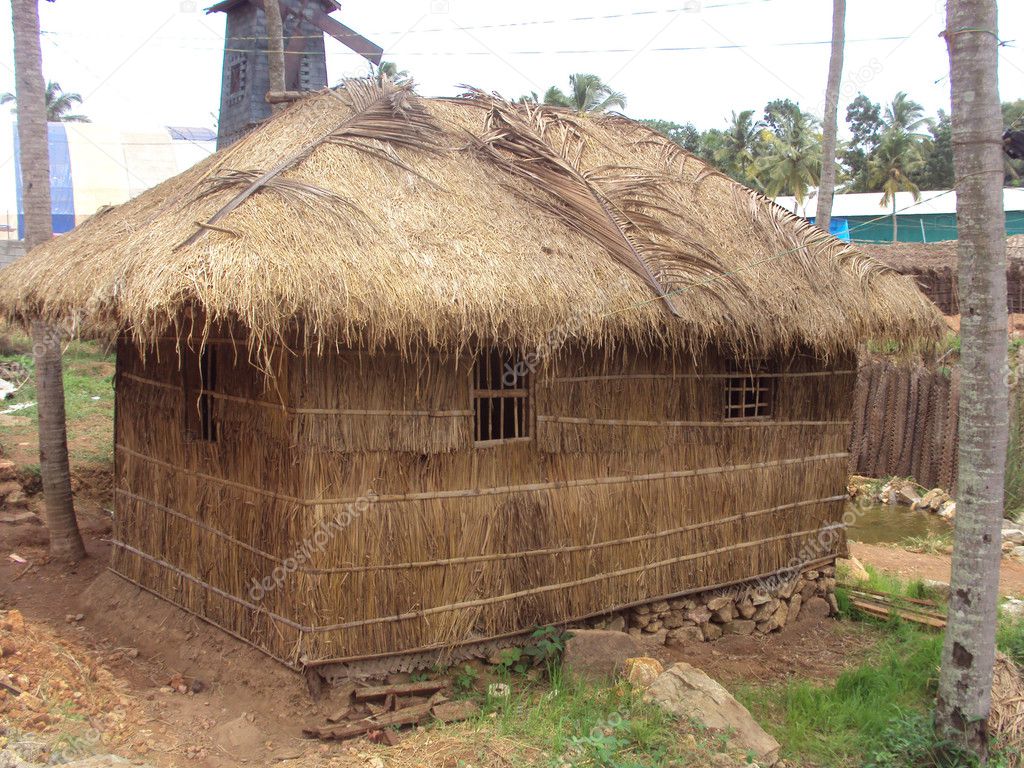
You would have to be able to grow some sort of vascular land plant, "Grass", and make artificial "Sticks" using those plants and some sort of glue.
So, I am hoping for some sort of plant that can provide fibers that might be grown using Acetate and Oxygen. We don't know if that is going to work out yet or not. We can hope for it.
The form of the "Dome" could be circular or Quonset, I feel.
While it would be nice to have various other "Modern" materials, for Mars, it would also be nice to have many bulk material options.
As far as heating the "Grass Huts", I think a limited amount of heating could be absorbed by the dome and the dome floor without sublimating the ice from the dome, particularly if a vapor barrier is placed over it.
But it might be a good idea to heat your huts using a heat pump to pull heat out of the air in the dome.
So, the dome might be cold like a windless winter day, but the insides of the grass huts could be very comfy.
Ending Pending
#49 Re: Terraformation » The Moon » 2025-12-02 09:01:28
I have run across an idea for orbital recycling that is specific to the Moon and for me at least, something new. It is a form of hard crash delivery of scrap to the Moon.
https://www.youtube.com/watch?v=QdYoVM_y6Bs
Quote:
Orbit Recycling: 500 Dangerous Derelicts → 1,000 Tonnes of Free Lunar Aluminium in 10 Years
Space Startup News
This brings up some interesting ideas. What about the ISS? Could it be pushed to a higher orbit and then later, when Starship is developed better could the ISS be crashed into a Moon crater? Yes, there will be international issues, but salvage might be international in character.
That is a lot of processed material, and I don't think it necessarily makes sense to push it into the atmosphere.
A query says 420 to 450 tons.
Of course, until a Starship was ready you would have to keep it from breaking apart in a higher orbit.
Other space junk concepts like Neumann Drive and Magdrive might work in conjunction with this concept.
This opens some other options as well. They mention sending Falcon 9 upper stages. I would wonder if they could refill those with Starship in LEO, and send them on their own, perhaps with a cargo of copper?
I would also venture that it might make sense to lift Falcon 9 2nd Stages to LEO using Starship. Refuel them at a special station and send them to the Moon. The materials of them are valuable. They might deliver something to the Moon orbit prior to crashing?
Perhaps the 2nd Stage could be upsized to fit into a Starship Payload bay?
Yes, Merlin Engines, with a different fuel, but one that may not boil of as much. Imagine sending super sized Falcon 9 2nd stages to Moon orbits, using Neumann Drive or Magdrive. Refilling them in Lunar Orbit and using them as landers. Maybe hard landers with stuff like Copper.
But perhaps SpaceX could make a Aluminum 3rd stage for the Starship system that might use old raptor engines.
Copper is a material hard to get on the Moon. And they have explained the value of Aluminum.
The future competitor Neutron upper stage could be a similar story.
So, I have previously suggested that Starship could do the Expendable/Not-Really option where an "Expendable", Starship could be made into space station materials or propellants for Neumann Drive or Magdrive.
This might go beyond that. However Starship is largely Stainless Steel with some copper. Not as valuable perhaps as Aluminum on the Moon.
Ending Pending
#50 Re: Terraformation » Terraforming Earth » 2025-12-01 13:29:24
This is my sort of thing: https://www.youtube.com/watch?v=rfH1JIO-qjM
Quote:
U.S. Is Releasing the Pacific Ocean into Nevada to Create an Inland Sea
Fresh Tech
222K subscribers
Salt is a problem of course.
I recall that a drop of water that enters the Great Basin could fall as rain and snow 7 times before leaving the Great Basin.
Here is some sort of a notions:
I will believe this when they prove it.
https://soldesal.energy/
Water Sponge: https://www.msn.com/en-us/weather/topst … cz#image=7
Salt/Brine can be toxic. But if you handle it correctly you might generate electricity using salt gradients while distributing the salt to levels not toxic.
Easy to say, not so easy to do.
I would say that if you many salt lakes, you then partially cover them with floating platforms with solar panels. Or even solar thermal electric.
So, going through all the work of watering Nevada, why not discourage the evaporation from the lakes/seas.
Perhaps 95% of the lake surfaces would be made cactus like, to inhibit evaporation. The shorelines could then be left open, and perhaps some channels for boats. Maybe 5% of the lake surface?
In realty, if you can limit evaporation to 4 inches a year, the lakes might be self-filling from natural rain.
If you made Boring Tunnels up to the mountain passes of California, you could run steam up them, and then condense the water and then let it run down the interior surface of the mountains.
An advanced society might pull this off some day.
I have suggested underground tunnels with sea water in them. The salt from the Great Basin might be distributed into them for a time.
Rainfall in Nevada: https://www.currentresults.com/Weather/ … tation.php
By the way if you put 95% cover above the reservoirs of the Colorado River, then I feel that good things can be done with the water conserved.
Ending Pending
FYI, the Salton Sea has exited many times naturally when the Colorado River changed channels.
Ending Pending