New Mars Forums
You are not logged in.
- Topics: Active | Unanswered
Announcement
#76 Re: Life support systems » Flash Recycling, Salt Mining » 2026-02-14 16:28:41
Thanks Calliban. I added "Salt Mining" to the topic title as this material seems to possibly be related.
https://newmars.com/forums/viewtopic.ph … 64#p238064
Quote:
Ceres is a place that has very low gravity but not microgravity. So, perhaps it would be a good place for this: https://www.bing.com/videos/riverview/r … &FORM=VIRE
Quote:Why Asteroid Mining Fails… Until You Go Closed-Loop (SEM TECH vs. the Problems)
YouTube
Rowow
1.3K views
1 week agoSo, then perhaps the gravity is enough for nearly Earth-Like processes, and then also you could have centrifuges if you need more.
I think this could be better then trying to process Bennu or other rubble piles.
Quote:
SEM TECH (Salt Electro Mining Technology) is a closed-loop approach to asteroid mining that generates and regenerates its chemistry on-site using electrolysis and a salt-based feedstock. This method is designed to be efficient and cost-effective, addressing the challenges of asteroid heterogeneity and difficult-to-separate mineral forms. SEM TECH is particularly effective for carbonaceous asteroids, as it directly addresses the issues highlighted in a major 2025 paper on carbonaceous asteroids. The technology is flexible and can accept a wide range of feedstocks, making it a promising solution for asteroid mining.
YouTubeHere is some more materials from the same source: https://www.youtube.com/@Rowow
Mars will have salts so perhaps good for Mars also.
The Mare materials might have some Chlorine: https://www.jstage.jst.go.jp/article/ge … 20chlorine
Quote:
Abstract
The last liquids of the lunar magma ocean, known as urKREEP, should be highly enriched in volatiles, such as water, fluorine, and chlorine. We find chlorine-rich glasses in two pristine KREEP basalts from the Moon and calculate the volatile contents of the urKREEP component, and use this to estimate the fluorine and chlorine content of the lunar magma ocean. The Cl/Nb and F/Nd of KREEP imply that the lunar magma ocean was depleted in fluorine and chlorine by an order of magnitude compared to the Earth’s mantle. The extremely dry nature of most lunar samples is simply a result of partial melting of magma ocean cumulates that had already lost their volatiles to the urKREEP layer. The volatile-rich KREEP component may have helped lower the solidus of high-temperature magma ocean cumulates that were melted to form the Mg-suite rocks of the highlands, and also aided the dissemination of the KREEP signature into the upper crust. The chlorine-rich KREEP glasses also demonstrate that the large chlorine isotope anomaly found in lunar samples is likely an early lunar signature.
So, yes it looks like you have to do some work to have substantial amounts of Chlorine on the Moon, but some rocks have more of it.
Kreep it seems does.
Ending Pending 
.
#77 Re: Terraformation » Ceres » 2026-02-14 16:18:23
Ceres is a place that has very low gravity but not microgravity. So, perhaps it would be a good place for this: https://www.bing.com/videos/riverview/r … &FORM=VIRE
Quote:
Why Asteroid Mining Fails… Until You Go Closed-Loop (SEM TECH vs. the Problems)
YouTube
Rowow
1.3K views
1 week ago
So, then perhaps the gravity is enough for nearly Earth-Like processes, and then also you could have centrifuges if you need more.
I think this could be better then trying to process Bennu or other rubble piles.
Quote:
SEM TECH (Salt Electro Mining Technology) is a closed-loop approach to asteroid mining that generates and regenerates its chemistry on-site using electrolysis and a salt-based feedstock. This method is designed to be efficient and cost-effective, addressing the challenges of asteroid heterogeneity and difficult-to-separate mineral forms. SEM TECH is particularly effective for carbonaceous asteroids, as it directly addresses the issues highlighted in a major 2025 paper on carbonaceous asteroids. The technology is flexible and can accept a wide range of feedstocks, making it a promising solution for asteroid mining.
YouTube
Here is some more materials from the same source: https://www.youtube.com/@Rowow
#78 Re: Terraformation » Bipolar Mars Terraform Plan » 2026-02-14 12:40:18
I am wondering about Shad Balls as a tool in space, such as for Mars but other places as well.
https://en.wikipedia.org/wiki/Shade_ball
Quote:
Shade balls are small, black, polyethylene spheres designed to float on the surface of large water bodies, primarily reservoirs. Their primary purposes include:
Slowing evaporation: They help reduce water loss by covering the surface of the water.
2
Preventing chemical reactions: Shade balls block sunlight, which can cause harmful reactions among chemical compounds in the water.
1
Water conservation: Initially used for specific purposes, they have become a tool for conserving water in drought-prone areas.
2
Protecting water quality: They safeguard water supplies from environmental factors that could compromise quality.
1
Deployment example: In 2015, 96 million shade balls were deployed in Los Angeles to combat drought.
1These floating orbs play a significant role in water management and conservation efforts.
Image Quote: 
I think it may be that rather than spherical; these might be polygon. Perhaps they could seat against each other face to face.
At least for Mars, I have felt that ice covered reservoirs may be the easiest place to establish a functioning biome on places like Mars.
But Perhaps Ice with Shade Balls embedded may be even better.
These could be mass created by some industrial process primarily using water and CO2, I think.
The materials for these devices are likely available in abundance on Mars.
https://www.bpf.co.uk/plastipedia/how-i … -made.aspx
Quote:
Hydrocarbons
Plastics are primarily made from hydrocarbons derived from fossil fuels such as crude oil, natural gas, and coal. They can also be derived from natural, organic materials like cellulose, salt, and coal. The main ingredients in plastics include carbon, hydrogen, oxygen, nitrogen, sulfur, and chlorine. These materials undergo a process called polymerization to form the polymers that make up various types of plastics.
British Plastics Federation
+2
So, a reservoir on Mars might include an icy raft of plastic Shade Balls.
I think this may have greater flotation than ice and be more thermally insulating. It may be that is the Shade Ball layer is thick enough the iicy Shade Ball layer may transition into liquid water.
But a layer will be required above this, probably flat, and including sublimation of ice by the dry thin air of Mars.
It may be that above this, a layer of soil may be useful.
Then to put above this would be solar equipment of various sorts, and perhaps rectennas, to receive orbital power.
The water will probably have at least some salt in it. I am interested in various sources for the water. It is possible that Uranium Salts could be harvested by some future technology.
https://discoveryalert.com.au/uranium-s … tion-2025/
Quote:
Seawater Uranium Extraction: Technologies and Commercial Viability
By
Muflih Hidayat
on November 20, 2025
Image Quote: 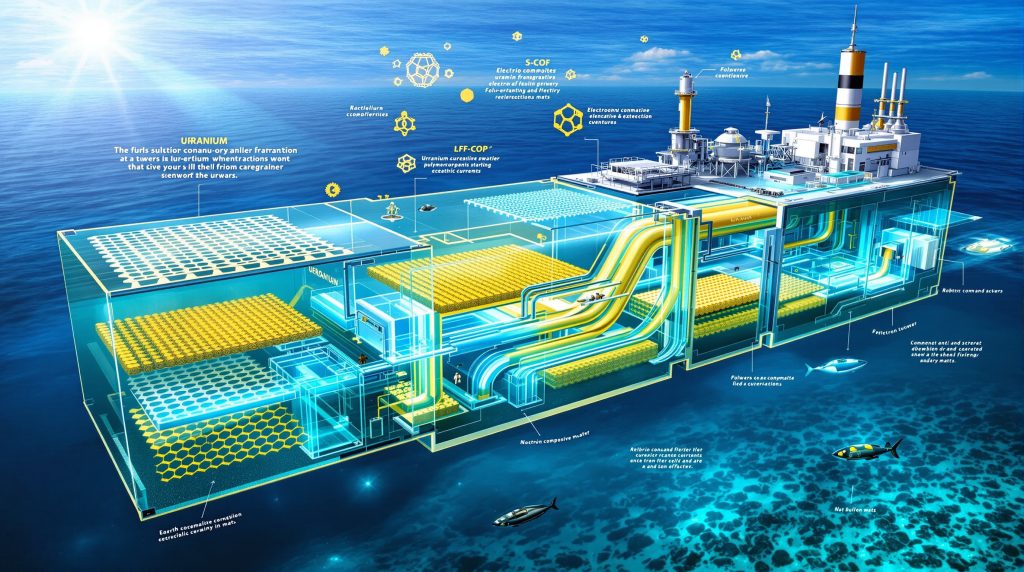
Quote:
Copilot Search Branding
Extracting Uranium from Seawater: Ocean Mining Guide
Uranium extraction from seawater is a promising method to access a vast resource of dissolved uranium, with recent advancements improving efficiency and reducing costs.
Overview of Uranium in Seawater
The oceans contain an estimated 4.5 billion tons of dissolved uranium, which is over 1,000 times the amount found in terrestrial deposits. However, the concentration of uranium in seawater is extremely low, approximately 3 micrograms per liter, making extraction challenging.
22 Sources
Extraction Methods
Electrochemical Extraction: Recent research has developed new materials and methods for electrochemical extraction, which can effectively capture uranium ions from seawater. For instance, a team created a coated cloth that attracts uranium ions more efficiently than previous methods, utilizing a structure with many microscopic nooks to increase surface area.
1
Innovative Techniques: Chinese researchers have introduced a new electrochemical method that uses two copper electrodes to extract uranium, achieving 100% extraction from seawater-like solutions within 40 minutes. This method is noted for being more energy-efficient and cost-effective compared to traditional techniques.
1
Advanced Adsorption Materials: Various advanced strategies, including hydrogel adsorption and porous adsorbents, are being explored to enhance uranium extraction capabilities. These materials are designed to selectively capture uranium while minimizing the impact of competing ions present in seawater.
1
Other substances such as Chlorine, Sodium and Lithium??? might be available by similar methods.
Fossil icy permafrost might serve as an asset. This can line a body of water and prevent its water from sinking into the deeps of Mars. So, this might allow for long lived larger bodies of water particularly near the poles of Mars.
It has been said that lots of water on Mars has settled down into cracks far below the surface. We should not want more of the water to do that. So permafrost is helpful. Even under large bodies of water, it may persist for some time.
For smaller bodies of water, we might look to Buffalo ponds of North America.
https://en.wikipedia.org/wiki/Buffalo_wallow
Quote:
Furthermore, the wallowing action caused abrasion of hair, natural body oils and cellular debris from their hides, leaving the debris in the water and in the soil after the water evaporated. Every year debris accumulated in the soil in increasing concentration, forming a water-impenetrable layer that prevented rain water and runoff from percolating into the lower layers of the soil. Ultimately the water remained for long periods, which attracted more wildlife.
Challenges and Future Prospects
Despite the potential, extracting uranium from seawater faces significant challenges, including the dilution of uranium and the presence of competing ions, which complicate the extraction process. Industrial-scale operations would require large offshore installations capable of processing millions of cubic meters of seawater daily.
1
The ongoing research aims to improve the efficiency and reduce the costs associated with these extraction methods, making it a viable option for supplementing uranium supplies for nuclear power generation in the future.
2In conclusion, while extracting uranium from seawater presents technical challenges, recent advancements in extraction technologies offer promising solutions that could transform the nuclear fuel landscape.
To seal ponds and canals, we might simulate the hair and oils and organic matter mentioned in the quote above.
So, if power satellites sun synchronous, could send power to Mars, the polar areas could be included. And as I have suggested before laser systems might make the polar ice caps of Mars like Swiss Cheeze. Structures that could hold Oxygen and also perhaps robots.
The water extracted could be used to fill bodies of water covered in the manner I have suggested.
The basic water body can then hold substructures such as diving bells, filled with air or partitions filled with water of altered properties, friendly to living things.
I think the use of Chemosynthetic and artificial light are obtainable. It might also be possible to pipe light into the water below the shade balls, using fiber optics. Perhaps at an average amount around that of 5% of that of Earth.
These bodies of water and ice tunnels would offer pressurized and warmed spaces for humans and also robots to function to over time further improve Mars to be suitable to a solar civilization.
Ending Pending
Greenhouse gasses released from these bodies of water then may assist in terraforming Mars. Perhaps increasing the air pressure by as much as 2.5X.
Ending Pending
#79 Re: Not So Free Chat » Peter Zeihan again: and also other thinkers: » 2026-02-14 11:49:46
I thought this was interesting: https://www.bing.com/videos/riverview/r … &FORM=VIRE Quote:
U.S. Navy's Ray Gun Tech Exposes Iran’s Missile Grid — Sensors Flicker Under Fire
YouTube
Warfare Hits Economy
63 views
I will not at all try to pretend that I have military competency.
However, I do like what happens when inventions flip-flop advantages.
My impression was that competitors had come close to making Aircraft Carriers obsolete.
And the idea of drones both air and surface water, are relatively cheap and can overwhelm our very expensive rocket type weapons.
But this seems to turn the situation on its head. This then may allow those who have such Laser systems to prohibit unfriendly drones, and yet allow, perhaps drones from the Laser owners side. So, for now if this is all true, then our cost of insertion of power by navy drops very low relative to what was otherwise going to become the case.
Of course then if the other side eventually has the same, this is perhaps neutralized. But the USA has a better economy to afford better toys then most others.
Ending Pending
I think this is very important because I consider that the Middle East is a burned-out civilization and a vampire. It has glowing embers of intelligence still, but mostly power and economics is dominated by Verbal and Violent types. By allowing verbal skills to displace other skills they degrade their capabilities. Fortunately, this makes it harder for them to play vampire and conquest people who are less deteriorated then them.
So, there is hope for the human race after all. We may not be eaten by the vampires of verbal and violent religious power.
Ending Pending
#80 Re: Terraformation » Ceres » 2026-02-13 12:39:40
In relation to the prior few posts, it is apparent that if you might play this game in the hill sphere of Jupiter, taking apart Callisto and Ganymede, if you like.
A Laser Beam from a energy source, even if attenuated over distance might be refocused by the concave mirror. So, then this would be a form of Solar Moth perhaps.
Solar Moth: https://www.bing.com/videos/riverview/r … &FORM=VIRE
So, perhaps indeed continually pulling desired types of mass into the inner solar system.
Ending Pending
#81 Re: Terraformation » Ceres » 2026-02-13 11:09:22
Space Elevator for Earth?
The title of this is strange. No Elon Musk is found. Mining will not be zero cost.
https://www.bing.com/videos/riverview/r … &FORM=VIRE Quote:
The Space Elevator: Elon Musk’s Radical Solution for Zero-Cost Mining
YouTube
Industrial Reveal
3 hours ago
I believe that space elevators have been suggested for multiple worlds. To me Ceres seems like a likely place to try it first. Although for Ceres, you could use rockets and mass drivers rather well instead.
The diversion of SpaceX to the Moon to run parallel to other Moon bugs, will allow rapid invention to build robot swarms. Also, the tech to run robots as avatars, can also be developed.
Once you have that for the Moon, you can likely use it on Deimos/Phobos/Mars and in the asteroid belt, particularly Ceres as a possible choice.
The Finns are an interesting source of thinking. I believe that they are more like the Yamnaya than many Europeans, so they handle reality differently. And they needed a certain form intelligence to make a living in the north woods.
They came up with this: https://www.sciencealert.com/could-huma … anet-ceres Image Quote: 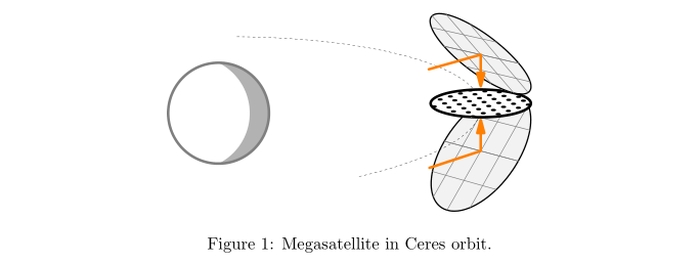
They feel that Ceres will have Nitrogen in a weaker gravity well. And of course, it will have Carbon and water, and minerals.
Many people might want to go nuclear at Ceres, but some people have discussed solar: https://space.stackexchange.com/questio … eroid-belt
Quote:
The distance of Mars to the Sun is 1.5 AU (distance Earth to Sun), so the area of a solar panel should 2.25 times larger than in Earth orbit. The dwarf planet Ceres is at 2.76 AU and a solar panel should be 7.65 times larger. But Dawn did a very good job at Ceres, the power of the solar panels was 10 kW at 1 AU and only 1.3 kW at 3 AU. See en.wikipedia.org/wiki/Dawn_(spacecraft) –
Uwe
CommentedSep 21, 2025 at 11:47
Of course there would be two types of solar. Orbital and Surface.
Interesting facts about Ceres: https://facts.net/nature/universe/35-facts-about-ceres/
#25:
Ceres has a day length of about 9 hours, meaning it rotates relatively quickly.
So, you would not need as much energy storage with a surface installation as for Earth or Mars, both because of rapid rotation and no clouds.
The gravity being slight, sun following robotic solar installation on the surface should not be that hard.
You can try solar cells with mirrors or heat engine in orbit. Heat engines may not work as well on the surface as Ceres will emit some heat.
The size of the hill sphere for Ceres is very large proportional to the size of Ceres itself. So you could likely have lots of orbital solar power.
And that would tend to be 24/7 without clouds, and without atmospheric attenuation.
Hill Spheres: https://en.wikipedia.org/wiki/Hill_sphere
Image Quote: 
The hill sphere for Ceres is larger than that for Mercury.
So mirrors in orbit and on the surface will likely be able to provide massive amounts of power.
If robot swarms can be developed for the Moon, they will probably include a handful of humans. Such swarms sent to Ceres could build the place up a great deal. There would be a distribution of materials and massive supplies of energy.
A Space Elevator System might not be required, but Ceres would be a great place to try it out before trying to do it for the Moon, Mars, or Earth.
They might mass produce the devices in this post #183: https://newmars.com/forums/viewtopic.ph … 26#p238026
Quote:
I am thinking that the device might be put into a "Stored" setting for a push, perhaps from a mass driver of tether or power beam:
Now, I think I have something for this. If we could toss snow at this thing using a Mass Driver. Then perhaps we can give it a heck of a push. We can include ice of water, Co2, and Oxygen. The Oxygen might be magnetic, which is what we want.
SpaceX intends to make a Mass Driver for the Moon, so if they can then this might be possible.
This opens up some interesting options.
Pause...............
IF you sent Oxygen Ice dust only, then you might create a chemical reaction on impact. If you added some CO2 then that might suppress it and the CO2 will have more inertia than the Oxygen Ice powder. If you add Water ice powder, the effects are uncertain.
But the impact should push the convex face of the mirror assembly and may erode it and might vaporize on impact.
Of course, a regular type of mass driver might push the devices to several hundred km/hour first.
You might also use pusher plate detonations to push the craft similar to a Orion Nuclear starship. Here, I am thinking of chemical explosives. Adding water or CO2 to the explosion might be useful.
For most of these options you may need a rather substantial mirror structure. But that may be OK, as the mirror structure is to be plastic and aluminum which you may want to deliver to another location, such as Earth/Moon, or Deimos/Phobos/Mars.
You might stop by a metal asteroid to pick up some materials on the way.
Some flight assistance might come from electron beams also, perhaps, at a distance.
Along the way the device might reconfigure to be as this from post #183:
So, anyway after the boost the device would be Unfolded to look like this:
And having been pushed closer to the sun the mirrors concave feature be used to power a burn-as-you-go Hydro-Lox propulsion system based on a tank of water.
Upon arrival to the destination the device can be rendered into metals, Plastics, Carbon Parts, and Water and Methane perhaps.
If you had mass production these could arrive at more inner planets continually to support desires and needs for a solar economy.
Ending Pending
#82 Re: Not So Free Chat » Politics » 2026-02-13 10:56:50
Robert, and oftherock,
Quote:
this ageing reality also highlights the corruptness of the system.
for every old fart taking up a high ranking position, all the way to his deathbed.there are many skilled, younger ones.
being undervalued.
That's not nice.
I cannot speak for poorly developed Alpha males and Karens that are elder, but you are quite welcome to the stress.
If we believe the stories that are currently told about a future abundance, then it is not going to be a big problem to share the work load. As for me, I want very little of it. But I do need some $$$.
I grew up in a mining town. It was not blue jeans, but dirty blue Jeans. So, definitely low brow, and lower middle class with exceptions of some arrogant people.
I don't need that much, so far not too bad for medical costs.
You also will get older, or nature will sort you out of reality.
Crystaline Intelligence: https://www.bing.com/videos/riverview/r … &FORM=VIRE
Quote:
Crystallized Intelligence - Explained in 3 Minutes!
YouTube
Helpful Professor Explains!
3.1K views
Apr 17, 2024
AI insights
Key moments in this video
This site is a outlet for me. I do not care to accumulate stress as at my age stress would be a killer.
You can have all the jobs. Wallow in the stress and then grow a brain and think better of it.
Ending Pending
#83 Re: Life support systems » Flash Recycling, Salt Mining » 2026-02-12 23:01:59
How weird. Within a few minutes of my post #1, this video showed up on Utube:
https://www.bing.com/videos/riverview/r … ORM=VAMGZC Quote:
A new way to make steel competitively at room temperature
YouTube
Rowow
1.8K views
So, the video seems to answer hot to separate the Iron from the acid with the Chlorine in it.
Ending Pending
#84 Life support systems » Flash Recycling, Salt Mining » 2026-02-12 22:11:39
- Void
- Replies: 4
This topic could be moved or altered as the moderators may desire.
https://www.bing.com/videos/riverview/r … &FORM=VIRE Quote:
Flash Recycling: The Circular Economy Weapon Against China
YouTube
Dr. James Tour
90 views
The main focus of the video is recycling, but have the impression that the methods may be used on the Moon and Mars.
https://tech.news.am/eng/news/5704/chlo … ature.html
Does the Moon have Chlorine? Quote:
Yes
Yes, the Moon does contain chlorine. Recent studies have shown that lunar rocks, particularly those collected during the Apollo missions, exhibit elevated levels of chlorine, indicating that the Moon has a chemical composition that includes chlorine. This chlorine isotope fractionation suggests that the Moon's history involved significant processes, such as volcanic activity and meteorite impacts, which contributed to its chemical composition.
Quote:
Researchers link this difference to the presence of metal chloride vapors, which were likely concentrated only above the near side. These vapors may have formed due to degassing during basaltic eruptions, as well as from meteorite impacts that induced chemical changes in the rocks. On the near side, these processes led to enrichment of the surface with chlorine and other volatile elements.
https://en.wikipedia.org/wiki/Spodumene
In the video Spodumene is said to have 5% Lithium and it seems their process can extract it.
And of course, Mars has Sodium Chloride.
I I understand the video correctly Chlorine can bond with some metals like Iron and very strongly lower the boiling point of the metals, such as Iron.
https://en.wikipedia.org/wiki/Iron(III)_chloride
Quote:
(anhydrous)
37 °C (99 °F; 310 K) (hexahydrate)[1]
Boiling point
316 °C (601 °F; 589 K) (anhydrous, decomposes)[1]
280 °C (536 °F; 553 K) (hexahydrate, decomposes)
So, I am guessing it can displace Oxygen from Iron Oxide???
But then how do you separate the Iron and Chlorine?
I am thinking that the desire is to reuse the Chlorine repeatedly.
But I have not found a reference as to how to separate the Iron and Chlorine. It may be difficult.
It may be the electrolysis of some kind could be used: https://en.wikipedia.org/wiki/Chlorine_production
Of course, Chlorine is dangerous.
I think that I read that Kreep has Chlorine in it.
https://lunarpedia.org/w/KREEP#:~:text= … 0zirconium.
Quote:
KREEP is an acronym used in geochemistry to represent a mixture of K- potassium, REE- rare earth elements, and P- phosphorus. It is not only the main source of these elements on the moon, but also many other trace elements such as uranium, thorium, fluorine, chlorine, and zirconium.
It is quite possible that I have misunderstood some of the presentation but, it seems like it could provide some critical resources in outer space.
Since SpaceX has a stronger interest in the Moon, this seems important.
Ending Pending
So much fun!
Ending Pending
#85 Re: Terraformation » Ceres » 2026-02-12 21:01:20
Here is something to have a look at, I think: 
A dome rests on a small world like Ceres. Its walls have compressive strength, and it also has tensile cables anchored into its walls.
It is inflated like a Shell world with a form of air.
It could actually be warped into a torus that encompasses the equator of the host world.
Part dome, part shell world, part space elevator, part world house.
Probably you can wear wings and fly at least in the microgravity area.
Any comments?
Ending Pending
#86 Re: Not So Free Chat » Peter Zeihan again: and also other thinkers: » 2026-02-12 19:31:18
In case you may think I am biased against Ukraine:
https://www.youtube.com/watch?v=DwVLMZvpVUw
Quote:
Peter Zeihan - Russia’s Final Collapse Begins Right Now
The New Front
I am not an enemy of Russia, but they have to row their own boat if they can.
Ending Pending
#87 Re: Terraformation » Ceres » 2026-02-12 15:07:15
I have wondered from time to time if the Earth's Moon and Ceres would be a good partnership. Attention to the Moon has increased, Including SpaceX. If indeed a mass driver system can be made for the Moon, then we will have vast riches of common materials in the Earth/Moon hill sphere.
But now I think I may have a method as well to get the other materials we may want from Ceres or other asteroids, to the Earth/Moon system and also Deimos/Phobos/Mars.
From: "Index» Terraformation» The Moon"
https://newmars.com/forums/viewtopic.ph … 23#p238023
https://newmars.com/forums/viewtopic.ph … 24#p238024
https://newmars.com/forums/viewtopic.ph … 25#p238025
From post #474:
I think this might do it!
Perhaps now I am not as interested in photon sailing. The Aluminum coated Mylar mirror may be more substantial in thickness than that.
For a world like Ceres, we might have Carbon Space Elevators that conduct electricity from orbital power stations of some sort.
These ships then would be mass produced. You still could use the mirror as a sail if you pushed it with some kind of a particle beam.
the device would likely behave like a higher thrust Electric Rocket. So, after a boost to go more into the inner solar system the mirror would focus power on the solar panels and the electric power would be used to split water into Hydrogen and Oxygen, and that would be burned immediately to provide thrust. You would modify your boosted elliptical orbit to be more circular around the sun and might drop your ship ahead of the dimple of the hill sphere of Earth/Moon or Mars. So then to perhaps get a bit of ballistic capture effect.
You could arrive with a bit of water still in your tank. The mirror would have Carbon, Hydrogen, Oxygen, and perhaps Nitrogen in its chemistry. The Aluminum on it surface might also be recoverable. The water in the water tank and the water tank itself would also be a source of materials to recycle. And of course, all the other parts of the device.
So, Tesla/Xai/SpaceX with robotic labor could mass produce these ships to fly to Earth/Moon or other terrestrial planets.
Ending Pending
So, I am thinking about ways to boost the structure to a more inner sun orbit from Ceres. Various options may work.
For the moment I will explore particle beams.
I am thinking that the device might be pot into a "Stored" setting for a push, perhaps from a mass driver of tether or power beam:
Beamed power or particle beams might be involved: https://en.wikipedia.org/wiki/Beam-powered_propulsion
Quote:
Mass beam systems
Another beam-pushed concept uses pellets or projectiles of ordinary matter. A stream of pellets from a stationary mass-driver is "reflected" by the spacecraft, cf. mass driver.[17] The spacecraft neither needs energy nor reaction mass for propulsion of its own. For craft at sub-relativistic velocities, mass beams would be more efficient than photon beams. Nordley and Crowl point out, "A photon must travel at the speed of light and until relativistic velocities are reached, a reflected photon carries away almost as much energy as it started with. A massive particle’s velocity, however, can be tuned so that the reflected mass is left almost dead in space relative to the beam generators, having surrendered almost all of its kinetic energy to the starship."[18]
Electrons have mass. Other particles are possible.
I don't know if a Neumann Drive or Magdrive could be focused enough to push the device.
I think mass beams are rather a new notion, at least to me.
Actually, if you wanted to go low tech you might simply use Stored Hydro Lox for the boost.
So, anyway after the boost the device would be Unfolded to look like this: 
As you got closer to the sun you might move the water tank - power supply - Thrusters closer in to the mirror to reduce the amount of focused light.
In any case, as I see it now, if SpaceX and others can indeed do Mass Drivers for the Moon and also synthetic robot labor, then I think that the mass production of such methods could be very beneficial to a solar system civilization.
Ending Pending
#88 Re: Terraformation » The Moon » 2026-02-12 13:09:53
Thermal Super Critical CO2 engine as an alternative to solar panels. Sure, whatever works best.
Potato Patato.
Ending Pending
#89 Re: Terraformation » The Moon » 2026-02-12 12:45:39
I think this might do it!
Perhaps now I am not as interested in photon sailing. The Aluminum coated Mylar mirror may be more substantial in thickness than that.
For a world like Ceres, we might have Carbon Space Elevators that conduct electricity from orbital power stations of some sort.
These ships then would be mass produced. You still could use the mirror as a sail if you pushed it with some kind of a particle beam.
the device would likely behave like a higher thrust Electric Rocket. So, after a boost to go more into the inner solar system the mirror would focus power on the solar panels and the electric power would be used to split water into Hydrogen and Oxygen, and that would be burned immediately to provide thrust. You would modify your boosted elliptical orbit to be more circular around the sun and might drop your ship ahead of the dimple of the hill sphere of Earth/Moon or Mars. So then to perhaps get a bit of ballistic capture effect.
You could arrive with a bit of water still in your tank. The mirror would have Carbon, Hydrogen, Oxygen, and perhaps Nitrogen in its chemistry. The Aluminum on it surface might also be recoverable. The water in the water tank and the water tank itself would also be a source of materials to recycle. And of course, all the other parts of the device.
So, Tesla/Xai/SpaceX with robotic labor could mass produce these ships to fly to Earth/Moon or other terrestrial planets.
Ending Pending
#90 Re: Terraformation » The Moon » 2026-02-12 12:05:13
So, while Deimos/Phobos/Mars may be early sources of hydrocarbon materials to supply to the Earth/Moon hill sphere, I think the big players will eventually be Ceres and the other not quite as large Asteroids.
The list of exceptional asteroids comes to mind again: https://en.wikipedia.org/wiki/List_of_e … _asteroids
Image Quote: 
Many of these including Ceres have what is needed.
Energy will be no problem as mirrors can pump the energy concentrations up to what is suitable.
So, if you can make many solar sails out of Hydrocarbons with a thin Aluminum coating, you can then sail them to the Earth/Moon hill sphere on photons, I expect. But they will start with slow acceleration without a boost.
I guess you could do a boost or a tow.
Depending on method the sails will be either deployed or bundled on launch. High sudden acceleration such as a mass driver would require bundling and then unfurling.
A slower method could be to push it with a laser or particle beam.
A somewhat more traditional method would be to tow it with a big tank of water, and a power source, perhaps cracking the water into Hydrogen and Oxygen in small quantities along the way. Perhaps the solar sail with an Aluminum coating could serve as a concentrating mirror at this stage and give solar concentration to solar panels so that the water could be cracked and burned.
Once the assembly got deeper into the sunlight and all the water was consumed, it might change over to sailing on Photons.
So, this might work well from Ceres as we expect that Ceres has massive amounts of water available.
So, you need to construct transformable solar sails in mass at Ceres, and also water tanks, solar panels and what else is needed.
And by this means then to move these materials into the Earth/Moon hill sphere.
The sails themselves would be rendered into Hydrocarbons and Aluminum. I presume that the tank and solar panels would be also rendered as useful. It would be very likely to pick up valuable metals along the way and incorporate them into the trip to be distributed to the Earth/Moon hill sphere.
Eventually similar for other inner planets as well.
Ending Pending
So, the whole Asteroid Belt is usable for this, and after that the moons of the outer planets.
#91 Re: Human missions » space x going to the moon instead of mars » 2026-02-12 11:44:15
I expect that any rocket company in the USA now will be pressed by the government to develop their systems as well as they can because foreign entities will be doing it also as well as they can. Who gets the best cost first wins at least for a time.
Mass to orbit is more important than crew to orbit. Dragon does crew to orbit well enough.
Ending Pending
#92 Re: Life support systems » Bogs and Bog, Floating Island Technology, and Roller Solar. » 2026-02-12 10:48:59
So, I guess I will chase this around some more.
https://exclav.es/2023/08/24/sunshine-maps-revisited/
Image Quote: 
The three ways that power could be sent to the Earth's surface that I am aware of are:
-Orbital Mirrors.
-Microwaves.
-Lasers.
Typically, the idea is to beam power to where it is needed. This would often be to cloudy areas though, which in some cases would be counterproductive.
But places like the Great Basin in North America, might be thought of as a sort of window in the sky.
And of course if you have looked into this topic, you know that I am interested in Cisterns and Carbon Capture (At a profit), for places like the Great Basin.
Carbon Capture at best has been to do power to Gas or other fuels. At worst it is a hairshirt intended to make the population of western nations poorer.
If you have a cistern in the desert that is associated with productive Carbon Capture, then it may be sensible also to beam space power to it, as there is less in the nature of cloudy skies. It is more like a window with shades open.
This is the type of behaviors I would like to see more of: https://globalenergyprize.org/en/2025/0 … di-arabia/
Quote:
Cooling gel doubling the service life of solar panels was created in Saudi Arabia
12.06.2025 in News, Science and Technology
Saudi researchers have developed a novel cooling gel that enhances solar panel performance and extends their lifespan. This hydrogel, made from sodium polyacrylate and lithium chloride, absorbs moisture at night and cools the panels through evaporation during the day.
The technology improves solar panel efficiency by 12% and increases their service life by doubling.
2
It operates without the need for electricity or material replacements, making it a low-cost solution for solar energy.
2
Field tests in Saudi Arabia and the USA confirmed its effectiveness, with stable cooling and improved energy conversion efficiency.
2This innovative approach represents a significant advancement in solar energy technology, particularly in hot and humid climates.
They should be proud!
Now, what if you had these solar panels on top of a floating island, and pulled the evaporating moisture into a cold condenser?
I have made this variation on the covered pond: 
Instead of holding heat on the bottom hold cold.
So, perhaps not relying entirely on rainwater, but absorbing moisture into the gel at night. Then the gel cools the solar panels during the day, and if you capture the moisture coming off you can perhaps condense it into cold salt water.
In reality if you wanted to go extreme, the water at the bottom of the pond might be as cold as Don Juan Pond in Antarctica.
https://en.wikipedia.org/wiki/Don_Juan_Pond
Quote:
With a salinity level of 45.8%, Don Juan Pond is the saltiest of the Antarctic lakes.[1][2] This salinity causes significant freezing-point depression, allowing the pond to remain liquid even at temperatures as low as −50 °C (−58 °F).
Such very cold very salty water would suck almost all water from the air. But it would take a lot of energy to pull the temperatures down that far.
Water as salty as the Arctic Ocean and nearly as cold would be more sensible. With a layer of less salty warmer water on top, it would be well insulated.
And you could glow Algae or perhaps even Macroalgae in it.
I am thinking heat pumps of course. Presuming that batteries can store energy efficiently then you could run a heat pump at night and dump heat into the night sky, cooling the bottom water. In the drawing I have distinguished between solar panels and radiators.
The gel in the solar panels might absorb moisture from the night air and also be cooled at night, and then during the day could cool the solar panels, and release the moisture. The moisture might be collected then and condensed into the cold salty water, which might be presented to it in a condensing device.
I did say batteries for night power, but it might be that power might be beamed down at night. This might contradict the moisture gathering function, but maybe it could be on and off to cycle many times during a night.
Of the power might be beamed down nearby to the covered cistern.
The water is salty of course, but could be distilled to provide fresh water. But in that case the grey water would need to go back into the cistern.
So, the objective of capturing Carbon to build cistern structure might make sense, where substances like plastic and Carbon parts might be created from Carbon pulled from the atmosphere. During the process of condensing moisture into the cold salt water that cold salt water may absorb CO2 from the air.
Ending Pending
#93 Re: Terraformation » The Moon » 2026-02-12 08:34:58
With the shift to the Moon by SpaceX, then this may be useful: https://en.wikipedia.org/wiki/Lunar_resources
Quote:
Overview
Lunar materials could facilitate continued exploration of the Moon, facilitate scientific and economic activity in the vicinity of both Earth and Moon (so-called cislunar space), or they could be imported to the Earth's surface where they would contribute directly to the global economy.[1] Regolith (lunar soil) is the easiest product to obtain; it can provide radiation and micrometeoroid protection as well as construction and paving material by melting.[8] Oxygen from lunar regolith oxides can be a source for metabolic oxygen and rocket propellant oxidizer. Water ice can provide water for radiation shielding, life-support, oxygen and rocket propellant feedstock. Volatiles from permanently shadowed craters may provide methane (CH
4), ammonia (NH
3), carbon dioxide (CO
2) and carbon monoxide (CO).[9] Metals and other elements for local industry may be obtained from the various minerals found in regolith.The Moon is known to be poor in carbon and nitrogen, and rich in metals and in atomic oxygen, but their distribution and concentrations are still unknown. Further lunar exploration will reveal additional concentrations of economically useful materials, and whether or not these will be economically exploitable will depend on the value placed on them and on the energy and infrastructure available to support their extraction.[10] For in situ resource utilization (ISRU) to be applied successfully on the Moon, landing site selection is imperative, as well as identifying suitable surface operations and technologies.
Scouting from lunar orbit by a few space agencies is ongoing, and landers and rovers are scouting resources and concentrations in situ (see: List of missions to the Moo
I have developed an interest in Photon Solar Sails because they can be made of the materials that are in short supply for our Moon.
I discuss it a bit here: https://newmars.com/forums/viewtopic.ph … 09#p238009
"Index» Interplanetary transportation» Multi-Ship Expeditions, Starboat & Starship, Other", post #261.
So, the sails could be composed of Hydrocarbon solids, and include a thin film of Aluminum. Some may include a bit of Nitrogen.
Mercury, some small Earth Crossing Asteroids, Deimos/Phobos/Mars, 40% of asteroids at 2.1 AU, most asteroids at ~3.0 AU, and some moons of outer planets may provide the ingredients for this.
Venus will have the hydrocarbons, and Nitrogen, but Aluminum would have to be sourced from crossing asteroids, I think.
These devices would be their own Cargo. Usually, we think of a device as being distinct from its Cargo.
The propellant is photons, so @Mercury, the best propellants 4X to 8X?. @ Bennu/Ryugu/Etc. about Earth level 1X?. @ Deimos/Phobos/Mars, >.5X. @ 2.1 AU then q bit less than .25X. @3.0 AU then >.25X.
Mercury and Deimos/Phobos/Mars both look good chemically, and have some photon energy, but Deimos/Phobos/Mars is much more accessible. Deimos/Phobos/Mars, has both aerobraking and also mass in near microgravity.
https://ntrs.nasa.gov/api/citations/201 … 009085.pdf
Quote:
The presence of carbon on the moons of Mars, particularly on Deimos and Phobos, is a subject of ongoing research and debate. The moons are believed to have a carbonaceous composition, with the possibility of hydrated minerals and mafic minerals like olivine and pyroxene. However, the exact nature of their carbon content remains uncertain. The moons' surface materials, including dark components and minerals produced by space weathering, suggest a carbon-rich environment. The presence of dark components could also account for the reduced hydrated band observed on the moons without the need for dehydration or OH-implantation on anhydrous surfaces.
NASA
+5
If the two moons do not have Carbon, then it is available from Mars. It is likely that they have some as during the formation of Mars and afterwards materials from the asteroid belt may have impinged on them.
We have reason to be concerned by the Captor Cultures. They may try to use the issue of interplanetary life to thwart early expansion into space. They may also cook the data to skew the truth about resources available.
I think I can identify the Captor Culture Components.
-Elitists in the west, Epstein types.
-Communists.
-Religious Extremists, including but not exclusive to Islam.
All of these seem to regard "We the People" as escaped human property.
We can perhaps trace much of this to OPEC + Russia, the historical money inertia.
For these groups "We the People" are something to own. The communists, in saying they want their dictatorship to own the means of production, is the same as to own the people who produce.
So, I think we can get our radar of thinking on them now pretty well.
The Europeans are mostly thralls of the Elites and the OPEC + Russia money. They are so deeply soaking in lies that they cannot see the truth. In America, it is almost as bad.
So, we had a world where Fracking was evil. Industry is evil, unless China does it. Russia is always evil so of course you can't stop them from making and selling hydrocarbons. OPEC/ Who ever told them they have to keep their oil in the ground. But Canada has to keep Alberta's oil in the ground. Venezuela is special as being OPEC and sucked into Communism.
You in the science and space communities owe us. You have pandered to the power and money, singing their evil hymns. It seems very probable that you are a part of the enslavement process inflicted on western peoples and Japan and the like. The space treaties are very similar to the efforts by plantation owners to tell slaves that the Indians will kill them if they run away.
Having said that I do have concern for any possible life, on other worlds. We need to have some care about it. But you need to be responsible guardians of the light, not participants in the enslavement of the human race to please those who are parasitic and the consumers of the lifeforce of the productive people.
Ending Pending
#94 Re: Interplanetary transportation » Multi-Ship Expeditions, Starboat & Starship, Other. » 2026-02-11 18:21:31
I have been focusing on the new SpaceX direction to the Moon first and as its own purpose as well.
Elon Musk seems to be of the opinion that the Moon will be found to have sufficient Hydrogen and Carbon for a civilization.
I think it is more likely than not.
But I have also been thinking about photon sailing. I wondered if it would be possible to make a fabric out of Carbon that could sail on the suns photons. It probably is possible, but I don't know about performance. Things already contemplated might be a better option.
It turns out that out Moon and many of the inner asteroids may lack some of the materials needed to create solar sails, but every other world in reach seems to have them.
Mercury, Venus, Deimos/Phobos/Mars, and about 40% of the inner asteroid belt objects may have what is needed.
The point is if solar sails sail in order to bring their substances to be used in the Earth/Moon, orbits, and on the Moon, they may compliment what can be found on the Moon.
https://en.wikipedia.org/wiki/Solar_sail
Quote:
Mylar or polyimide
Solar photon sails are typically made of lightweight materials such as Mylar or polyimide, which are highly reflective and designed to maximize reflectivity while minimizing weight and maintaining structural integrity in the harsh space environment. These materials are chosen to ensure that the sails can capture sunlight effectively and provide continuous thrust as long as sunlight is available.
Wikipedia
+1
My understanding is that a plastic film such as mylar is given a think coating of Aluminum to make it reflective.
The chemical formula for Mylar?
https://www.xometry.com/resources/sheet/what-is-mylar/
Quote:
C10H8O4
The chemical formula of Mylar is based on polyethylene terephthalate (PET), which has the formula C10H8O4. Mylar is made from stretched PET, which consists of repeating units of ethylene terephthalate linked through ester bonds. Additionally, PET is a type of thermoplastic polyester that is widely used for its durability and versatility.
https://en.wikipedia.org/wiki/Polyimide
Quote:
A classic polyimide is Kapton, which is produced by condensation of pyromellitic dianhydride and 4,4'-oxydianiline.[1]
I think that Kapton may have the usual suspects but may also have a small amount of Nitrogen in it's chemical structure.
The point is if a factory could be established that could make solar sails at a non-Earth/Moon location these might be able to fly to the Earth/Moon orbits and be rendered into what the Moon somewhat at least lacks.
If coming from Mercury, then a mass driver from Mercury would have to supply a factory in orbit. The sunlight would really push the sails.
IF coming from Deimos/Phobos/Mars, or the Asteroid Belt, then some sort of boost method might be used to start the flight and then the sails would use photon propulsion to finish the flight.
So that would be a way to mix the Organics of other worlds with the materials of our Moon.
I think that could work out, particularly if the process was mostly robotic.
Ending Pending
#95 Re: Human missions » space x going to the moon instead of mars » 2026-02-10 15:48:18
As I look at it again, I think there is great wisdom in going to the Moon first.
Robots is one reason. With AI data bases in space and various types of robots. Earth<>Moon time latency is relatively low. Eventually we will want a collection of robots that can replicate an event. You could tell them please build "One of these". "Put it at that location".
IF you start with Mars, then your time latency to train this is many times more than to do it for the Moon. But on the Moon you can reset an error and retrain in a shorter time.
Once you have an AI/Collection of Robots, that knows how to build a certain thing such as a building or solar structure, then that should be replicable on Mars or other worlds.
Further, with Moon robots we can more completely survey the Moons resources than the time and effort to do the same for Mars.
The Moon over time since the Apollo events has gradually been rehabilitated from a total death world to something that has a greater resemblance to Mars. We probably should explore how far that goes.
For instance, if we could find a source of Carbon that is sufficient that would be very important on the Moon.
Having developed advanced AI/Robotic systems we could send them to many places in the solar system and tell them to set things up for us. Creating such AI/Robotics will likely happen easier on the Moon than Mars.
Ending Pending
#96 Re: Interplanetary transportation » Multi-Ship Expeditions, Starboat & Starship, Other. » 2026-02-10 12:10:59
This is something that I have pondered for some time: 
Can you land a cylinder like a Starship?
So, you might have to use some active cooling for this but I would like to see a version where the "Locomotive" only lands back on Earth.
That would be the propulsion systems including the propellant tanks and engines.
The "3rd" stage could also be equipped to land on Earth or Mars but more likely would not be.
So, this version would not be expected to land any cargo on Earth or Mars, using the "Locomotive".
An enlarged version of the Stoke Space 2nd stage might be hosted though.
Or you could make a Stainless-Steel Moon ship with it's own engines.
Or you could make something out of Carbon for the "3rd" stage, perhaps getting assistance from Rocket Lab Neutron Rocket build methods.
I see it as being a plus as you need to retain less propellants to land, and the tower does not need to catch as much mass. Or if you land on a barge at sea the "Stack" is not as tall or heavy.
But can you enter the atmosphere with a Cylinder shape?
Ending Pending
#97 Re: Science, Technology, and Astronomy » Humanoid and other robots. » 2026-02-10 11:52:41
https://www.youtube.com/watch?v=i6q-WyRPUm8
Quote:
Elon Changed His Mind: Moon Before Mars! Here's Why!
Brighter Tesla
So, me being old, this is good. I am more likely to see it achived.
Ending Pending
#98 Re: Terraformation » Bipolar Mars Terraform Plan » 2026-02-10 11:03:16
So, the idea of Methane as a transferred commodity on Mars.
Cast Basalt Pipes?
https://www.miningequipmentsupplies.com … ast-basalt
Quote:
Cast basalt pipes are highly durable, wear-resistant piping solutions made from volcanic rock, ideal for transporting abrasive materials in various industrial applications.
What is Cast Basalt?
Cast basalt is a naturally occurring volcanic rock that is melted, cast, and annealed to form a hard, crystalline material. This process results in a product that exhibits exceptional abrasion resistance and corrosion resistance, making it suitable for demanding environments. The Mohs hardness of cast basalt is around 8, which is significantly higher than that of steel, rubber, or polyurethane.
miningequipmentsupplies.com.au
Properties of Cast Basalt Pipes
High Abrasion Resistance: Cast basalt pipes are designed to withstand the wear and tear caused by the transportation of abrasive materials such as coal, ash, and slurry. This property extends the lifespan of the pipes and reduces maintenance costs.
2
Corrosion Resistance: The material is resistant to many acids and alkalis, making it suitable for use in chemical processing and other corrosive environments.
2
Temperature Resistance: Cast basalt can endure temperatures up to approximately 400 °C, which is beneficial in high-temperature applications.
13 Sources
Applications of Cast Basalt Pipes
Mining and Mineral Processing: Used for transporting abrasive materials like coal, ash, and minerals, cast basalt pipes are common in mining operations and power plants.
2
Material Handling: These pipes are ideal for bulk material handling systems, including chutes, hoppers, and cyclones, where wear resistance is critical.
2
Power Generation: Cast basalt lined pipes are often utilized in fossil-fuel power stations for ash slurry transport, providing a reliable solution for high-abrasion environments.
24 Sources
Manufacturing Process
The manufacturing of cast basalt pipes involves crushing volcanic rock, melting it, and then casting it into the desired pipe shape. This process ensures that the pipes maintain their structural integrity and wear-resistant properties throughout their service life.
cumi.com.au
+1
Conclusion
Cast basalt pipes are a cost-effective and durable solution for industries that require high resistance to wear and corrosion. Their unique properties make them suitable for a wide range of applications, particularly in environments where traditional materials would fail. For industries dealing with abrasive materials, investing in cast basalt piping can lead to significant long-term savings and improved operational efficiency.
If you had a tar-like substance as a joint compound, then you could establish a methane pipe network all over Mars.
There appear to be consumable ice deposits on Mars and perennial ice deposits.
The Polar Ice Caps are Perennial, possibly Korolev Crater is Perennial.
The others are fossil and therefor consumable, not naturally renewable.
On Mars, rather than irrigating with water which can freeze, I suggest pipelines for Methane.
More difficult would be parallel pipelines for Oxygen or Synthetic Earth-Like Air.
Power beamed from orbit to the ice deposits could make it possible to synthesize the Methane and Oxygen/Synthetic Air.
Methane piped to a location can allow the creation of water, and so then what is needed for a particular resource access. You can always get Oxygen from the CO2 of the atmosphere of Mars. But for a greater cost you might pipe in Oxygen or Synthetic Air.
So, for the situation of Methane leaks, this would be supportive of the terraforming of Mars.
Beamed power might also contain signal, so it might be involved in AI about Mars.
Orbital AI may need some extra radiation shielding. Hydrogen from Mars and Oxygen from Deimos or Phobos could provide water for that, or regolith from the two moons. But some AI might be embedded into the Mars regolith, I suppose.
It may be posible to access deep burried ice on Mars: https://www.esa.int/Science_Exploration … _s_equator
Image Quote: 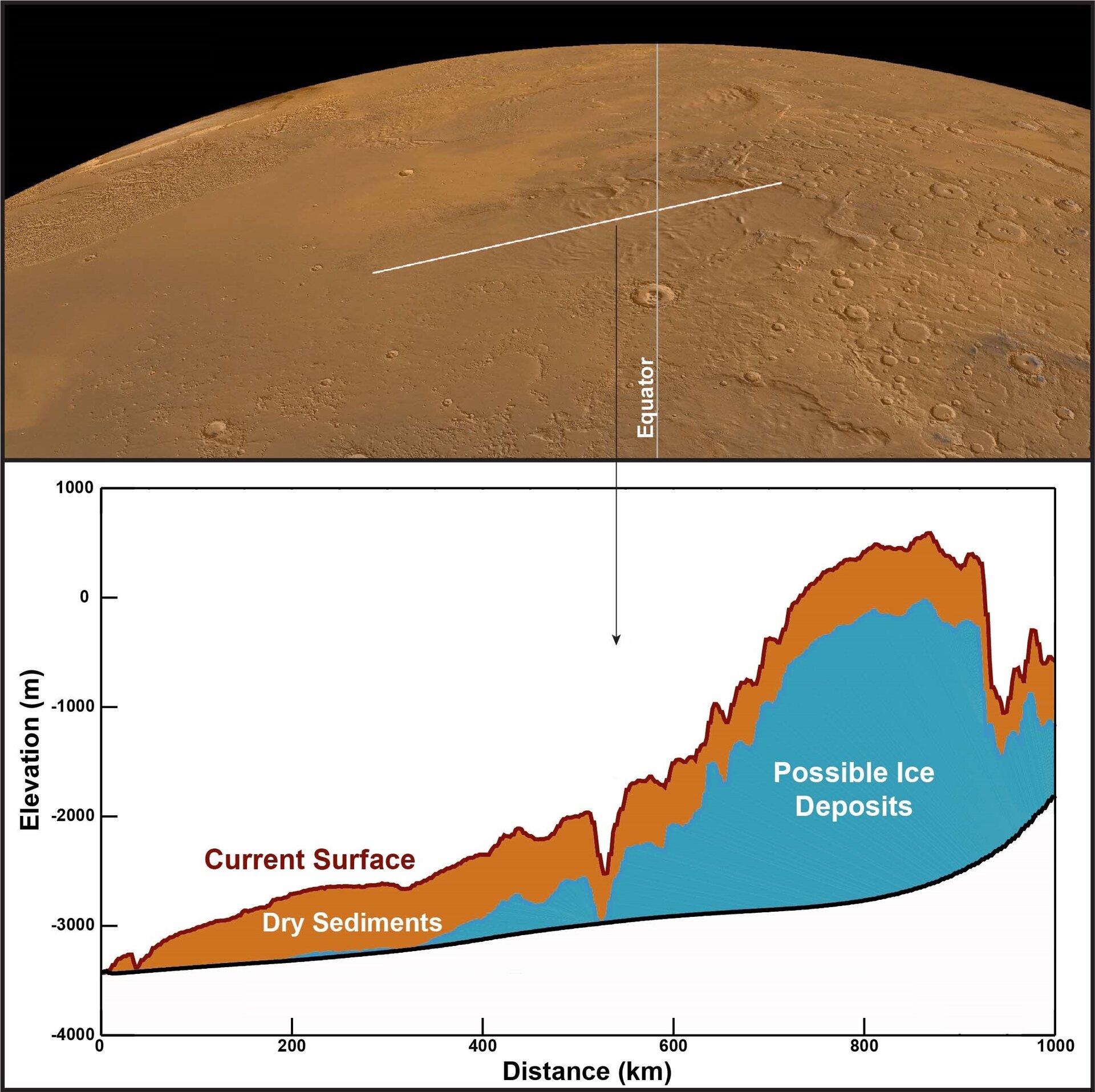
Could power beamed down from orbit power electrical current flow into the ice mass to melt it?
So, you can make electric conductors from Carbon from the atmospheric CO2. So, maybe space two electrodes on the surface by a number of km, then impose electric power between them. At first, perhaps not too conductive in the ground, but salty brine may develop along the lines of conduction.
So, then to generate an Artesian Flow of water. So, then an argument on the surface between artesian water flow up into a body of water and evaporation from the ice on top of that water.
Putting poly vapor barrier on top of the ice and regolith on top of that. Not too much regolith. It has to not weight the ice down too much.
But then as a lake grows you could throttle the amount of electric flow, to control the amount of artesian water flow.
So then to build a Methane and O2/Air production facility. The water supply should last for quite a while.
The water extracted, the "Lake" will descend into a pit that gradually forms.
Water at Candor Chaos might be done this way first. It is much closer to the surface. But we do not know how deep it is.
Sun-Synchronous power platforms in orbit will be able to deliver power to various ice bodies on Mars including near the equator and at the poles.
Ending Pending
#99 Re: Not So Free Chat » Peter Zeihan again: and also other thinkers: » 2026-02-10 10:57:39
This is pretty big, I think: https://www.youtube.com/watch?v=oFqqlX3kekY
Quote:
Meloni Said NO to Brussels! Italy’s Secret Phone Call to Washington Shocks EU.
So, then Poland, ect. also perhaps.
To balance things out after all, I expect.
Ending Pending
#100 Re: Life support systems » Bogs and Bog, Floating Island Technology, and Roller Solar. » 2026-02-09 23:01:04
Suppose a sea in a dry land with it mostly covered. I have previously suggested rotating solar floating islands.
But for Mars and let's speculate 100% cover, maybe for the Salton Sea, a 98% covering. Perhaps just some beaches on the shoreline.
Evaporation 98% inhibited??? Not known. You could have rotators or not.
On Mars rotating floating islands would leave water open to boil or evaporate into the thin atmosphere. Even if the Atmosphere becomes 2.5 times as thick as it is it would be so. You could live with that if you had enough makeup water. But Mars would be more suitable to fixed robotic solar arrays. That is the gravity is .38 that of Earth, we don't expect hail, and the winds are not much of a threat. Dust is a problem in both worlds but much worse on Mars. We would expect to have cleaning robots to groom the solar arrays all the time, I expect.
On Mars we might have something like floating islands, only as spinning hovercraft. A hover platform could be sun following by periodic jets of air under its skirt and an actuation to spin to follow the sun. Simply compressing Mars atmosphere and a lift and spin event every so many minutes during the day. Such hover platforms would not have to be over water reservoirs but could be.
OK, then I think means to have a little sea will exist on both Mars and as similar we might look at the Salton Sea.
I have speculated before that if you covered 98% of the Salton Sea with floating platforms that inhibit evaporation, the Salton Sea would swell up and deepen until the salinity was compatible with some forms of salt tolerant creatures.
It always amused me that people may talk about putting artificial lights into a presumed sea on Europa, but will not think it wise for Mars or indeed for the Salton Sea.
But let's imagine 5% light. Then add Oxygen and Acetate. Now can you grow Macroalgae??? That is a maybe. But you could grow microalgae it seems.
Your 5% light could come though fiber optics or windows or artificial lights.
In post #18 I have a drawing: https://newmars.com/forums/viewtopic.ph … 07#p237907
Quote:
This is sort of where I am going with it:
So, in places like Ther Great Basin, you might reduce water losses to 10%/5%/1%, to be able to keep reservoirs inflated with water from local sources, or imported water.
In the top view there is a floating Solar Rotator. It can cool the solar panels with a heat pump during the sunshine, and push heat into the very briny water at the bottom of the pond (Pink).
The Static Cover, (Orange), has radiators that can reject heat into the night sky of a desert to generate power.
The side view has a (Green) top layer that can have pontoons of the least salty water, which support a Anaerobic process of H2/CO2.
The Blue Layer being perhaps less than two times as salty as the ocean, might support some forms of living things living on Oxygen/Acetate and perhaps a little artificial light.
The pink layer would be warm or hot, but less than the boiling point of water, probably.
In the future it will make much more sense to inflate these with local river water such as the Colorado River, then to do irrigation on Dry Land Farming.

You don't have to do all of it but you might.
The solar panels and the floating cover will reject some of the heat of the day.
But you could use heat pumps during the sunshine to maintain salt gradients and temperatures. You might cool the solar panels during the day with a cool fluid flow and push heat into the bottom pink layer.
During the night you might pull heat from the pink layer and flow it though the panels to reject heat and to generate electricity.
All the time you could grow Algae of some kind in the blue layer.
Or if you prefer, forget the heated bottom layer and just have temperate temperatures at the bottom of the Salton Sea, and grow Macroalgae, (If it is possible) as vegetables.
Salt is always accumulating in the Salton Sea, but if you allow the sea to keep expanding you can keep the level habitable.
But at some point perhaps you flow it to another basin in the Great Basin and keep expanding. Rather than irrigating crops with the Colorado River perhaps you just keep building more covered seas.
And of course, I consider this how we may first get productive farmland on Mars.
Ending Pending