New Mars Forums
You are not logged in.
- Topics: Active | Unanswered
Announcement
#1 Re: Terraformation » Bipolar Mars Terraform Plan » Today 11:47:25
Here is another video about cementing sand with sea water and electricity: https://www.youtube.com/watch?v=2BBLH51XhTo
Quote:
Electricity Turns Sand Into Solid Stone. No Cement Required. Could Concrete Become Obsolete?
The Buried Vault
My notion in this is to revive the seas of Mars as covered bodies of water, and to make Diving Bell type structures using the above technology.
So, to make pressurized space using native raw materials.
Pause (For some time)................
#2 Re: Civilization and Culture » Jevons Paradox and Social Amplifiers and Reach » Today 10:35:56
I wish to appropriate materials from RGCLARK as they fit with this topic, I feel. But I do not what to interfere with a more
professional dialog, which I presume is desired at the location of that topic. https://newmars.com/forums/viewtopic.ph … 01#p238501 Quote:
Still, there are advantages to launching the expendable version. SpaceX has given the expendable payload of the Starship V3 as 300 tons. Industry experts estimated and Elon has confirmed a build cost, i.e., the cost to SpaceX, of ca. $90 million. This is a per kg cost of ca. $300/kg, nearly a tenth of the Falcon 9 cost.
I agree, but as it might already be known, I have plans for the "Expended" Starship: https://www.humanmars.net/2019/08/cutaw … rship.html Image Quote: 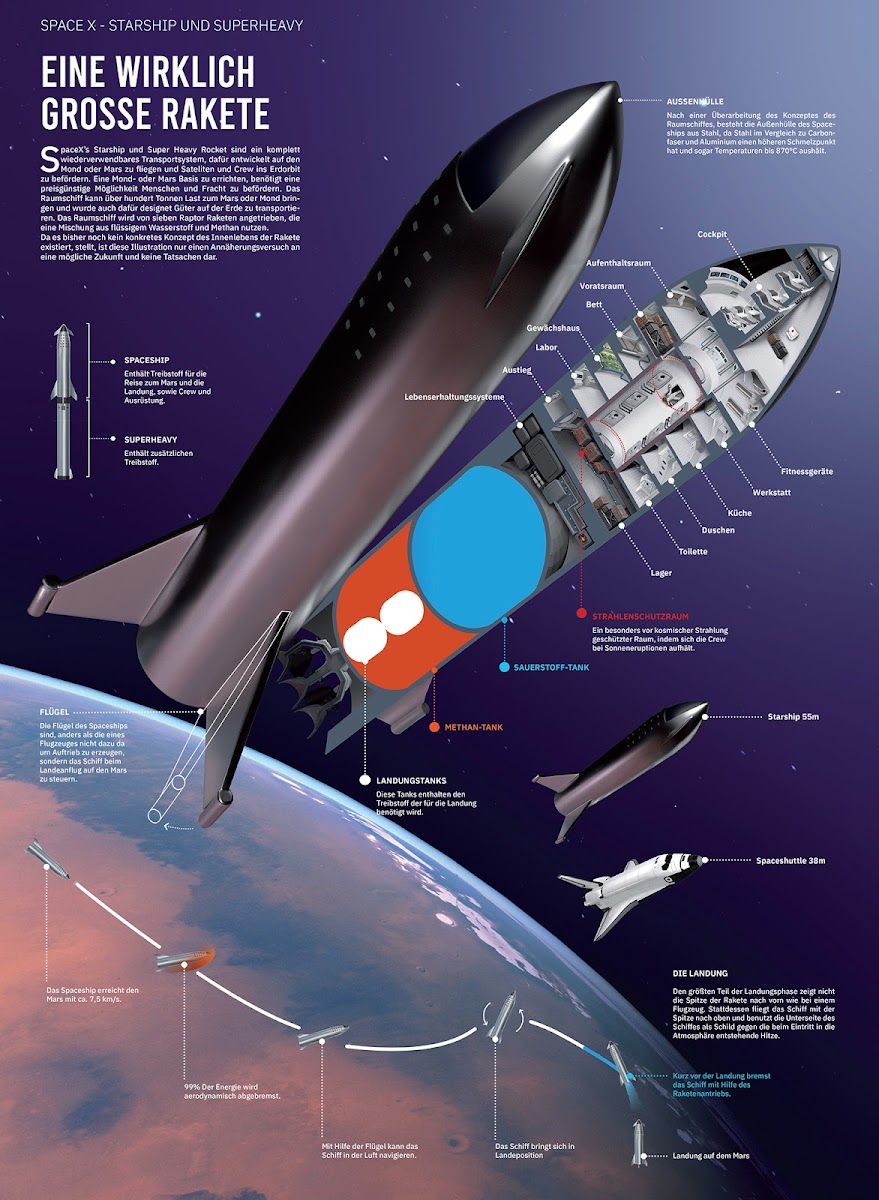
The above diagram is pretty good for my purposes.
If you broke the Starship, Expendable into two parts, you could use the upper part in LEO+ and refill and fly the lower part to land on the Moon. You might remove or replace some of the raptors prior to the launch to the Moon.
You might have a specialized landing pad that would minimize the need for legs, and upon landing of the device, it could be tipped and placed on a wheeled device to move it to a desired location to place on a prepared ground.
While these might in some cases be upgraded to host humans, they also might be workshops and safe places for robotic devices at night.
With regolith piled on top perhaps as sintered arches, a thermal capacitor or if you like battery could be created. The interiors might not be pressurized. Cart-type rovers might just roll inside for the nighttime; Humanoid robots might climb stairs to go up to a higher deck. A door might be rather simple just to help retain heat at night.
Electric power within might help the robots endure the night. If these hosted workshops, then the robots could do useful work at night if electric power is sufficient. Doing work would help keep the places heated.
You could make long strings of these things. You could move to higher and higher levels of clean as you moved inward from one section to another.
I see this as a way to accelerate the arrival of the ability to manufacture Satellites on the Moon and a Mass Driver to send them into space.
Back to the upper part of the Starship in LEO+, it could be made into many different things and even the scrapping of it could be very useful for the notions of Sun Synchronous Data Bases in orbit.
So, this is an "Expendable, Not-Really" plan.
Ending Pending 
#3 Re: Terraformation » The Moon » Today 09:03:01
A video about power on the Moon: https://www.bing.com/videos/riverview/r … &FORM=VIRE Quote:
Lunar Power Grid: Cables, Lasers or Orbit?
YouTube
Space Startup News
6 views
3 hours ago
Nice to see that there are plans in the works.
Ending Pending
#4 Re: Civilization and Culture » Jevons Paradox and Social Amplifiers and Reach » Yesterday 10:26:28
I saw a video about orbital data centers. It was interesting, but I feel it was flawed. The author presumed that the satellites might last 6 year and then be disposed of by dumping them into the atmosphere.
I suspect that this is what I would call the "Cyclic Thinking Flaw".
I think this flaw, is a flaw now but was not before. Farming was Cyclic, with the seasons.
Even Egypt had seasonal water flows. Although it used technology to irrigate, it developed hierarchy, which in my opinion caused specialization and limited mental resources, and froze the culture.
If by some mysterious source, boats perpetually appeared upstream in the river, and flowed down the river and were composed of various materials including metals, then an industrial feature would be added to the Egyptian culture, and the agricultural economy would have some part of the governing power.
The flow of mass from a world is unnatural also. But with the invention of Rockets, it has the potential to be perpetual. From the Earth and eventually with other means as well from other worlds such as the Moon.
Our problem with "Cyclic Thinking Flaw" is that the descendants of "Farmer" thinking, will not be able to comprehend accumulation of Mass in unnatural locations.
We have reached a point where a continual "River" of Mass can be emitted by a world to orbital locations.
The farmer mentality eventually formed hierarchy where some people started farming other people. This leads to stupid rulers that mostly understand communication skills and violence. The pesante are not valued for anything except to be easy to extract wealth from using communications and if needed violence. Any resistance to such wealth flows may get your culled from the peasant gene pool.
It has become clearer to me from items from the internet, the thoughts of others, that in the conflict within the Anglosphere and connected regions, has two major forces. One has been called by some people, "The City of London". The other is the USA.
After WWII, in the 20th Century, it appears that the "City of London" won. The USA was running out of OIL, and manipulations across the planet endangered imports of Oil. We became convinced that we needed to deindustrialize. Until Fracking was invented, we were stuck in that, and the City of London was able to begin culling American resistance to Pesantization.
I think that now our resistance is the result of the Greens promoting ridiculous cultural concepts, which were intended to reduce breeding of industrial peoples especially in Europe and North America. We have finally rejected that "Cup of Vomit" that they tried to make us drink from.
Now we have this river of mass that is traveling into orbits, and may possibly get another river of matter flowing form the Moon.
We must understand that the "City of London" (Not entirely a geographical concept), depends on degrading the industrial classes and managing the decline, in order to extract wealth from the decay process.
So, with that historic pattern, our need is to nurture the emergence of a new industrial economy against the consumption of it desired by the "City of London".
At first, at least that may make sense as AI grows in power. But I don't know what the result later on. An elevated humanity or an extinct humanity.
I am not thinking that anyone as low as a human knows how this turns out.
Ending Pending
#5 Re: Terraformation » Rubble Pile Sinter/Glass Jar/Double Cone, Ceres » Yesterday 09:25:38
I don't strongly agree with this, but if the human race has the material wealth to do this, it could be done. You would not be mandated to only make one type of structure in space.
https://www.youtube.com/watch?v=xu4P4qioCG8
Quote:
Earth is Full? How Humanity Will Build Mega-Cities in Space!
Industrial Reveal
The concept was very valuable in its time, to promote thinking.
But to make large swaths of farmland, is perhaps not necessary for human satisfaction.
Very few of us live in such a way.
But it might be nice to stay in something like this from time to time like a vacation event.
Things needed such as Nitrogen, water, and Carbon might be best obtained at a location like Ceres, but Venus, and Mars are possibiliti9es.
The authors of this article have promoted that notion: https://www.sciencealert.com/could-huma … anet-ceres Quote:
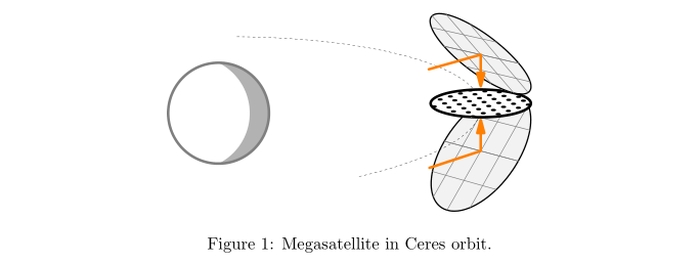
But the review of the O'Neill concept is nice, if a bit outdated.
Ending Pending
#6 Re: Not So Free Chat » Peter Zeihan again: and also other thinkers: » 2026-03-11 13:03:06
https://www.prometheanaction.com/the-mi … h-11-2026/
Quote:
The Midweek Update - Trump Breaks the UK's Middle East Shipping Empire - March 11, 2026
Trump moved on three fronts to break Lloyd's insurance blockade — but the bigger story is the Khamenei family money trail leading straight to London, and why Bolton, Carney, and the old imperial order are all standing outside the fence looking in.Susan Kokinda
Susan Kokinda
I am interested in various notions of what reality is. I am still thinking about it. I will be happy to be corrected.
Ending Pending
#7 Re: Civilization and Culture » Jevons Paradox and Social Amplifiers and Reach » 2026-03-11 11:01:24
In my mind, I followed a path outward to increasing amplification and increasing reach.
It has occurred to me that that path might eventually make the so-called civilization of our solar system able to jump onto an interstellar comet and inhabit it. Granted others have though similar things. Beyond sending spaceships out to extra-solar worlds, that could be a high achievement that could be attained.
So, that is a very far reach to "Take over" 3I/Atlas for instance: https://en.wikipedia.org/wiki/3I/ATLAS But perhaps a larger one.
From there, perhaps to grab solar system comets, and perhaps not so much to crash them into a world, but to convert them into structure and to conserve substances of value. But for some of them, you could crash them into a world like Mars, or Venus, or Mercury.
And that would put you at a point where you might extract the volatiles and other substances captured into orbits of worlds like Mars or Venus or Mercury.
And falling back a bit more from that, could you make very large Spaceships in the Asteroid belt and fly them to orbit other worlds?
So, then end up at start on Earth and reverse order.
Data Centers and other platforms in orbit of Earth>Moon>Deimos/Phobos/Mars>(Materials to orbit)>Asteroid Belt>Supersized Spaceships>Callisto>(Supersized Spaceships)>Outward, even working with comets.
So, I think we are on the right path.
We just have to stop the Anti-Humanists from interfering.
Ending Pending
#8 Re: Civilization and Culture » Jevons Paradox and Social Amplifiers and Reach » 2026-03-11 09:39:09
I am going to offer some things that I think are true, and others that I simply hold as speculation/theory that is under further consideration.
There may be a parallel between Subtractive vs. Additive Space, and Subtractive vs. Additive Social regulating. The reason this may matter is that if we are stuck in a Subtractive form of Social Regulation, we might also naturally apply Subtractive thinking to space where we should not do so.
An example of space environment that may have features of Subtraction and of Addition could be the asteroid belt. We think that the asteroid belt was added to during an earlier point in the formation of the solar system, and we think it is tending to be subtracted from since then. As objects collide they either shatter and the dust might be pushed outward by the solar wind and sunlight. Also, objects that may wander near aa sizable world may be added to that world, and so subtract from the asteroid belt.
In Earth orbits, subtraction is typical. So, any mass added may be conserved, but any mass added to it may be expected to decay over long stretches of time even with the best conservation efforts. So, the answer is then to get more mass to those orbits from a proximate world, such as the Earth, or Moon.
In human psychology, I think we are struggling to emerge from a psychology of "Managed Decline". I am not the first to mention it. I believe that the expansion of the so-called west, lead to the Baby Boom, and the response was that the management decided to "Eat the Children". To squeeze more out of them and to throttle down the birth rate.
I do not necessarily find fault with their diagnosis of what they could do or should do. But they need to readjust at this point. The social programs that they promoted to discourage successful mating and child rearing events is not appropriate to what is to come.
The idea of breeding a superior race by applying cruelty is stupid anyway. The results of the application of cruelty will be unsuitable to civilization. They might wish to have a race tuned for the situation of the 20th century, is stupid in itself as we do not now live in the 20th century.
I feel that the movie "Gravity" illustrates wrong thinking: https://en.wikipedia.org/wiki/Gravity_(2013_film)
The idea of managed decline is not to build a society, but to consume it and be the winner while others lose.
Instead of a movie about cleaning up the problems, they are still in the mode for the last Sacellum. Perhaps about 80 years.
In that time period the west had a bump in population that could be "Eaten" by the rulers, and a contraction of resources available for them.
It is not that that sort of management is always wrong, but it is wrong to insist that it is they only pathway that is appropriate in all time periods.
We are gaining new methods to amplify human power and our reach is expanding. But we will need to be careful to push back the zombies from the previous era, who only see this potential expansion as requiring an increase in decay rates by any means possible.
So, what is coming in reach are methods to suppress the Kestler Syndrome, and methods to use space resources below the Van Allen Belts and beyond.
So, we need to understand that any effort to build a future will be in some danger from those who find decay a source of their nutrition.
Ending Pending
#9 Re: Terraformation » Bipolar Mars Terraform Plan » 2026-03-10 10:32:40
OK, this will be better than the "Urea" bricks.
https://www.earth.com/news/fighting-coa … lly-works/
Quote:
Jolting coastal sand with electricity
Now, engineers have found that a trickle of electricity – just a couple of volts, about what a toy flashlight uses – can lock loose coastal sand into a rock-like mass.The current coaxes dissolved minerals already floating in seawater to crystallize between grains of sand, gluing them together almost instantly.
In lab tests, the sand stayed put after only a few days of stimulation and showed strength on par with quarried stone.
Clams and mussels turn seawater’s calcium into sturdy shells without breaking a sweat. Researchers copied that natural chemistry, but replaced metabolic energy with an external battery.
At 2-3 volts, calcium carbonate forms; nudge the voltage to 4 volts and magnesium hydroxide and hydromagnesite join the mix.
These minerals are tougher than standard concrete and can withstand repeated wetting, drying, and salt spray.
Spark of creativity
“Over 40% of the world’s population lives in coastal areas,” explained Alessandro Rotta Loria of Northwestern University, who led the study. “Because of climate change and sea-level rise, erosion is an enormous threat to these communities.”He explained that erosion of coastal sand already causes “billions of dollars in damage per year worldwide” through the loss of land and the disintegration of infrastructure.
Current approaches to mitigate erosion involve building protection structures or injecting external binders into the subsurface.
“My aim was to develop an approach capable of changing the status quo in coastal protection – one that didn’t require the construction of protection structures and could cement marine substrates without using actual cement,” Rotta Loria continued.
It has been my opinion that on Mars large ice masses such as the polar ice caps could be melted internally using lasers, and so yielding melt water to create lakes and seas in.

This also could likely be done nearer to the equator where sufficient ice exists.
Ancient salt deposits likely exist under the soils where once upon a time bodies of water existed.
So, using the electric process it might be possible to build things under the water.
And in the tunnels in the ice, robots could exist.
Ending Pending
#10 Re: Civilization and Culture » Jevons Paradox and Social Amplifiers and Reach » 2026-03-10 10:20:08
This is my second post on this topic today: https://www.bing.com/videos/riverview/r … ORM=VAMGZC Quote:
Automated Optimus Bots: Tesla Robots Mining the Moon for SpaceX
YouTube
Industrial Reveal
It is an interesting work. However using Chlorine which can be recycled, it appears that Iron, and I think Oxygen, could be extracted from regolith at much lower temperatures per "Salt Mining".
See this topic: https://newmars.com/forums/viewtopic.php?id=11305
Quote:
Index» Life support systems» Flash Recycling, Salt Mining
These web sites have useful resources to offer as well:
https://www.youtube.com/@Anthrofuturism
https://www.spacestartupnews.com/
Ending Pending
#11 Re: Civilization and Culture » Jevons Paradox and Social Amplifiers and Reach » 2026-03-10 09:23:52
Isaac Arthur only touches briefly on orbital solar. Even so, this is an interesting video: https://www.bing.com/videos/riverview/r … &FORM=VIRE
Quote:
Why solar energy is about to explode
MSN
Isaac Arthur
He does talk about orbital solar thermal power.
Some members here will be more compatible with that than with solar panels. And I have to agree that recycling Solar thermal Power Plants to new Solar Thermal Power Plants looks more doable than to recycle solar panels to new solar panels in orbit. So, as far as an orbital junk industry would be concerned, that looks pretty good. CO2 as the fluid used, I presume, but then you have to get the Carbon from somewhere.
Early on, I expect that solar panels will be used in singular Sun Synchronous, orbits. But on becoming aged they might be recycled to make things like Solar Thermal Power Plants.
I have already mentioned elsewhere, why I think it would be nice to have One-Time Starships made in part of Aluminum. The same may be true for Carbon. If the build process for Neutron of Rocket Lab is as good as they claim, then it might also be used for that. And Neutron 2nd stages might also be a source of Carbon in orbit.
So, that makes Earth an early source of Carbon. The Moon is not likely to be a major source of Carbon for orbits.
I would think maybe Bennu, Ryugu, Deimos, Phobos, and Mars could be considered. But they are hard to access for those materials.
I have taken a look at Trojan Asteroids of Earth. They are also hard to access because of the inclination of their orbits. Of two, the larger on though is said to be Carbonaceous.
https://en.wikipedia.org/wiki/Earth_trojan
Quote:
Copilot Search Branding
Like
Dislike
Images
Videos
Earth has two known Trojan asteroids, 2010 TK7 and 2020 XL5, which share its orbit around the Sun and are located at the L4 Lagrange point.
Overview of Earth Trojan Asteroids
Trojan asteroids are celestial bodies that share an orbit with a planet, clustering around stable gravitational points known as Lagrange points. For Earth, these points are located 60 degrees ahead (L4) and behind (L5) in its orbit around the Sun. Currently, only two Earth trojans have been discovered:
2010 TK7: This was the first Earth trojan discovered in 2010. It orbits at the L4 point and is approximately 400 meters in diameter. It is expected to remain in this stable orbit for about 10,000 years.
2
2020 XL5: Discovered in December 2020 and confirmed as an Earth trojan in early 2021, 2020 XL5 is significantly larger, measuring about 1.2 kilometers in diameter. It also resides at the L4 point and is predicted to remain stable for several millennia.
33 Sources
Significance of Earth Trojans
Earth trojans are of great interest to astronomers because they can provide insights into the early solar system and the building blocks of planets. They are composed of material that dates back to the formation of the solar system, making them valuable for understanding planetary formation and evolution. Additionally, the discovery of 2020 XL5 suggests that there may be more Earth trojans yet to be found, which could potentially serve as targets for future exploration or resource utilization.
NSF - National Science Foundation
+1
Future Exploration
The existence of Earth trojans opens up possibilities for future space missions. If more trojans are discovered, especially those with lower orbital inclinations, they could become more accessible than the Moon for exploration missions, potentially serving as bases for further solar system exploration.
NSF - National Science FoundationIn summary, Earth trojans are fascinating celestial objects that not only enhance our understanding of the solar system but also present opportunities for future scientific exploration.
Wikipedia
https://en.wikipedia.org/wiki/(614689)_2020_XL5
Obviously, it needs more study. But its size and the potential that it is carbonaceous are interesting.
With Starship and Optimus, perhaps it could be mined, and industrial facilities could be set up where it could export things to the Earth/Moon.
Anyway, it is a possibility with future technology.
Ending Pending
#12 Re: Civilization and Culture » Jevons Paradox and Social Amplifiers and Reach » 2026-03-10 02:57:37
Being Value
Doing Value
In orbit: Being Value: 1kg Gold, 1kg, Steel, 1 kg Aluminum, 1 kg Silicon, etc.
In orbit: Doing Value: Those masses, involved in wealth creation.
Because In Orbit Being Value could be translated into Doing Value, it could be speculated on, just like precious metals in a vault.
But their Doing Value Potentials, would make that speculation different than on Earth. The Gold might not be as valuable as the other materials.
Does, space junk and potential space junk have "Being Value".
The radiators from the International Space Station may have being value, if they could be converted to a new "Doing Value".
Atmospheric Drag is a rent that must be paid. Low orbits have higher rents. It costs more to preserve any value.
But higher orbits have a greater up-front cost.
But lower orbits have less time latency with the ground.
Electrodynamic Tethers are not massless drives, they expel the Earth.
#13 Re: Civilization and Culture » Jevons Paradox and Social Amplifiers and Reach » 2026-03-09 08:07:03
The Social Amplifier, Falcon 9 has provided reach to attain Starlink.
Starlink, requires a better Social Amplifier, Starship. Machines/Robots will reduce the labor cost for Starships.
Starship, as a Social Amplifier, will increase Reach to allow for Orbital Data Bases, under the Van Allen Belts and later above the Van Allen Belts and beyond.
Expanded Reach will make more raw materials / resources available to the so called "Civilization"/"Us".
The raw material "Sunlight" makes an expanded set of "Tokens" available for consumption.
>>>>>>>>>>>>>
Mas to orbit is like a bank account, I feel.
Previously, mass to orbit is mostly subject to early decay. LEO objects almost always end up as burning up in the atmosphere or placed in "Graveyard" orbits where they become unavailable for further service.
Where Reusable Starship is a desired and needed capability, One-Time Starships may have large value as well.
Robots may make Onetime Starships worth the effort.
This is a contradiction of words for actual circumstances that may be projected.
A Reusable Starship robs orbits of Mass that could be indefinitely reused in orbit.
A One-Time Starship's mass might be reused indefinitely in orbits.
That is a funny thing to understand.
Ending Pending
#14 Civilization and Culture » Jevons Paradox and Social Amplifiers and Reach » 2026-03-09 07:40:22
- Void
- Replies: 8
(I will comply with moderator authority if they wish to apply it.)
Jevons Paradox:
https://en.wikipedia.org/wiki/Jevons_paradox
Copilot Search Branding
Like
Dislike
Jevon's Paradox
The Jevons Paradox occurs when improvements in resource efficiency lead to increased, rather than decreased, total consumption of that resource.
Definition and Mechanism
The Jevons Paradox is an economic phenomenon where technological improvements that increase the efficiency of a resource's use result in a rise in total consumption of that resource, rather than a reduction. Greater efficiency lowers the effective cost of using the resource, which can stimulate demand if the resource is price elastic. This increased demand can outweigh the savings from efficiency, leading to higher overall consumption.Social Amplifiers, in my opinion come in the form of human and non-human forms.
Wikipedia
+2The process typically follows this sequence:
Technological Progress: A new invention or method makes a resource more efficient.
Price Drop: Less of the resource is needed per unit of output, reducing the effective cost.
Increased Demand: Lower costs encourage more frequent use or new applications.
Net Increase: Total consumption rises despite per-unit efficiency gains.
22 Sources
Historical Origin
The paradox was first described by William Stanley Jevons in 1865 in his book The Coal Question. Jevons observed that as steam engines became more efficient, Britain’s coal consumption increased rather than decreased. The improved efficiency made coal a cheaper and more attractive energy source, which expanded its use across industries.
Wikipedia
+2
Modern Examples
Energy Efficiency: More efficient cars, appliances, or LED lighting can lead to higher overall energy use because the lower cost encourages greater usage or additional installations.
2
Digital Technology: Improvements in computing efficiency and AI can increase demand for data processing and storage, raising total energy consumption.
1
Water Use: Water-saving technologies may paradoxically increase total water consumption if they reduce the perceived cost of water use.
12 Sources
Implications for Sustainability
The Jevons Paradox highlights that efficiency alone may not reduce resource consumption. To mitigate its effects, efficiency improvements should be paired with policies that maintain or increase the cost of resource use, such as green taxes, cap-and-trade systems, or conservation regulations. Behavioral economics also explains that humans respond strongly to lower costs, often prioritizing immediate financial incentives over long-term environmental concerns.
sustainability-directory.com
+1
Key Takeaway
While efficiency gains are important, the Jevons Paradox demonstrates that without complementary measures, technological improvements can unintentionally increase resource consumption, challenging assumptions that efficiency automatically leads to sustainability.
Wikiped
Social Amplifiers, in my opinion come in two forms:
1) Hunan services (Compelled or induced).
2) Biological/Animal or Machine/Robot services. (Mostly Compelled).
Reach, in my opinion, is when a new Social Amplifier expands the reach of a society.
Reach may put additional resources into the sphere of human/amplifier/reach actions.
This is what prompted me to create this topic this morning: https://www.youtube.com/watch?v=1IqAXwOXZmA
Quote:
For $2/hour Elon Musk Is Going to Replace Humans
Farzad
I will give what I think is a very close example of this in the next post:
#15 Re: Terraformation » Bipolar Mars Terraform Plan » 2026-03-08 03:13:22
Urea Brick: https://www.bing.com/videos/riverview/r … &FORM=VIRE Quote:
This Bacteria Turns Sand Into Solid Stone. No Heat Required. Why Do Building Codes Reject It?
YouTube
Natures Lost Archive
This attracts me because they indicate that some of this might be done underwater.
As you might know, some of my notions involve creation of covered bodies of water on Mars. The byproduct Ammonia would not be that much of a problem, maybe even an asset.
Ending Pending
#16 Re: Human missions » Mars Direct 3 is a Mars mission architecture developed by Miguel Gurre » 2026-03-07 20:43:20
I think the plan is still very good.
but what some people are missing about the slowdown to Mars, is it may ultimately accelerate a Mars success.
Starship has its own Starlink as a customer, and will likely have the military as a customer. They will have their data centers as customers, and other people data centers as customers. And NASA is already a customer for Starship technology..
Human activities on the Moon will probably develop heavy equipment and robot construction groups.
And smaller ships might be developed.
So, when SpaceX starts churning out large numbers of Starships the cost for them will be low, and the maturity of the hardware will be advanced.
Better a Moon base and a Mars colony delayed by 5 years that succeeds than a failure from haste.
Ending Pending
#17 Re: Terraformation » Orbital Platforms » 2026-03-07 08:10:52
What I read about orbital Data Centers:
https://cdn.geekwire.com/wp-content/upl … Center.pdf
https://en.wikipedia.org/wiki/Space-based_data_center
Quote:
Between 500 km and 2,000 km
The proposed orbital data centers are expected to operate at altitudes between 500 km and 2,000 km. This range allows for a narrow orbital shell, enabling efficient solar energy capture and minimizing the need for batteries or other systems. The satellites will be designed to remain solar-powered for more than 99 percent of their operations, which is crucial for the longevity and efficiency of the data centers.
GeekWire
+1
So this includes Low Earth Orbits but not Very Low Earth Orbits:
https://en.wikipedia.org/wiki/Low_Earth_orbit
Quote:
Copilot Search Branding
Like
Dislike
Images
Videos
Low Earth orbit (LEO) is the region of space within approximately 2,000 kilometers (1,200 miles) above Earth where satellites and spacecraft orbit at high speeds, completing an orbit roughly every 90–128 minutes.
Definition and Altitude
LEO refers to orbits around Earth with altitudes typically between 160 km and 2,000 km (100–1,200 miles) above the surface, though most satellites cluster around 800 km (500 mi) for operational efficiency. The lower limit is constrained by atmospheric drag, which can cause rapid orbital decay below about 160 km, while the upper limit is set by the beginning of the inner Van Allen radiation belt. LEO is the closest orbital region to Earth, making it ideal for high-resolution imaging, low-latency communications, and human spaceflight.
Wikipedia
+3
Orbital Mechanics
Objects in LEO travel at an average velocity of 7.8 km/s (17,500 mph), which allows them to remain in orbit due to the balance between gravitational pull and centrifugal force. Orbital periods range from 90 minutes to about 128 minutes, meaning satellites can circle Earth 11–16 times per day. The required launch delta-v to reach LEO is around 9.4 km/s (5.8 mi/s), making it the most energy-efficient orbit for satellite deployment.
Wikipedia
+3
Types of LEO Orbits
LEO can be circular or elliptical and have various inclinations relative to the equator:
Equatorial LEO (ELEO): Low-inclination orbits that benefit from Earth's rotation, reducing launch energy requirements and providing rapid revisit times over low-latitude regions.
1
Polar and Sun-synchronous orbits (SSO): High-inclination orbits that pass over nearly all parts of Earth, useful for global imaging and environmental monitoring.
2
Very Low Earth Orbit (VLEO): Orbits below 450 km (280 mi) that require advanced technologies to counteract atmospheric drag.
13 Sources
Applications
LEO hosts the majority of artificial satellites, including:
The International Space Station (ISS): Orbits at ~400 km (249 mi) and circles Earth about 16 times per day.
2
Earth observation satellites: Benefit from proximity for high-resolution imaging.
Communication constellations: Such as Starlink, which use LEO to provide low-latency internet coverage globally.
2
Scientific and experimental missions: Including microgravity research and technology demonstrations.4 Sources
Challenges
Satellites in LEO face atmospheric drag, especially below 300 km, which can lead to orbital decay. The region is also becoming increasingly crowded, raising collision risks and necessitating careful tracking of objects. Radiation exposure is lower than in higher orbits, but still a consideration for long-duration missions.
Wikipedia
+1
Summary
LEO is a critical orbital region for modern space operations due to its proximity to Earth, low energy requirements, and versatility. It supports human spaceflight, satellite communications, Earth observation, and scientific research, while presenting challenges such as orbital congestion and atmospheric drag that must be managed for sustainable operations.
Wikipedia
+2
So, I was surprised that "The International Space Station (ISS): Orbits at ~400 km (249 mi) and circles Earth about 16 times per day." is in a VELO orbit, (Below 450 km).
So, Data Centers in higher orbits will require less re-boosting from atmospheric drag. So, Magdrive and Neumann Drive may be sufficient.
So, then other than a very large passage of time or stupid behaviors, metal and other mass delivered to 1000 km orbits might persist for centuries for reuse at that location. This is unlike our existing history, where "What goes up, must come down".
And this then may make unusual boosting methods valuable. If you could lift mass from a 400 km orbit to a 1000 km orbit by such a means it may be a valuable asset to have. I suggest tethers and also laser assisted propulsion. Tethers could work from an induced reaction with the Earth's magnetic field.
Laser assisted propulsion could involve Magdrive or Neumann Drive, where the solar panels receive power from laser beams, those beams emitted by power stations higher in orbit. This reduces the dry mass of the solar panels required on the Magdrive or Neumann Drive tugs.
I have already suggested a situation where instead of expelling fairings to drop into the atmospehre, some 2nd stages could retain them into a Low Earth Orbit. Then the Magdrive or Neumann Drive tugs with laser assistance could move them to a higher orbit for consumption.
This might be done with a 1 use Starship. The one-use Starship might use the fairings to get a payload in its fairing volume to a low orbit, then that fairing would be popped off and given to a tug to move to a higher orbit, maybe a Sun-Synchronous Data-Center orbit.
The Starship propulsion unit then could be refilled and it's cargo attached to it's sides. Then it might go to the Moon and either drop it's payloads from a small altitude or land with them.
The Engine section might be reused, or tipped over to help make habitation structure on the Moon.
The fairing of the Starship might remain Stainless Steel, but maybe could be changed to Aluminum. (Not for a Starship that has to aerobrake).
Such a fairing if of Aluminum, (Or Stainless Steel), might be used for propellant for a Magdrive or Neumann Drive tug, but also upon delivery to a Data Center orbit might be converted into radiators and other structures.
There would still be a desire to get stuff from the Moon, perhaps using a Mass Driver system in part, but maybe Iron and Oxygen are the easiest to get from the Moon. And you might want to get Silicon as well, which may not be that easy.
That is what I think at this time.
Ending Pending
#18 Re: Terraformation » Orbital Platforms » 2026-03-06 21:40:48
The idea of making convertible Starships has some appeal to me. Of course, it might not be the most productive pathway to data centers in sun-synchronous orbits, but I kind of like the idea.
Unless the fairing section we converted to be Aluminum, then most of the metal in syn-synchronous orbit would be Steel.
Magdrive and Neumann Drive can run on any conductive material unless it has a low melt point, I understand so Steel might be OK.
But the problem with those types of propulsion is that they are energy pigs, but they do have a high efficiency for the mass expelled.
Space Startup News has an evaluation of them: https://www.spacestartupnews.com/2026/0 … ropulsion/ Quote:
Goodbye Xenon, Hello Cheap Metal: Why Neumann Drive Could Dominate Space Propulsion
I have toyed with some notions and would like to adapt this one to the Data Center concept: 
Ignore the legs for now. If a Starship were given a detachable upper section of fairings, made of Stainless Steel or Aluminum, then the bags I show might be carried up, uninflected to LEO, in the fairings. Then the bags would be inflated with bags of materials for 3D printers or Alloys. And then filled with Urethane foam. Attached to the sides of the ship in LEO. Then the Ship being refilled might travel to the Moon without the fairings.
The Fairings left in LEO, could be appropriated by the nest ship that is to be a data center. It could carry the fairings to sun-synchronous orbit, and then it might be converted into propellants for Neumann Drive or Magdrive.
So, that would be for station keeping for the data centers.
Ending Pending
#19 Re: Terraformation » Orbital Platforms » 2026-03-06 10:02:00
Continuing with the previous post, of course the Starship might be poised 90 degrees from what I showed.

So, either way you have a chassis of Starships Stainless Steel which also has some radiator qualities, in a Sun Synchronous orbit.
IF Earth "Civilization" remains sensible for 1000 years, you can keep reusing that mass that had an original cost, for much of that time, all of that time, or perhaps more than that time. That is then an valuable asset into the future.
From time to time you might change out the data center "Chips" and other parts, and also the solar panels.
Old Solar panels could be put into a very large solar array somewhere even if they are only 60% as good as they originally were.
Eventually all of the mass might be recycled in various ways.
I think this can be done for Syn Synchronous data centers. I don't know if the Starlink Satellites can be recovered to a higher orbit for a reasonable price. It would be good if they could be.
Ending Pending
#20 Re: Terraformation » Orbital Platforms » 2026-03-06 09:08:16
I have been wondering for a while, how hard would it be to use a Starship of some sort as a data center?
I think that an Expendable-Not-Really Starship, if outfitted with solar panels as a sunshield, and poised in the sunlight could have a cold side that data devices could be bonded to.
The basic idea: 
So, some projections seem to be that a onetime Starship might lift 250 tons of cargo eventually. I think this could be worthwhile as long as the Super Heavy is not expended.
So, in LEO, the Solar Panels might be deployed by robotic systems, and perhaps the Raptors pulled and send back to the surface. An Electric Rocket motor(s) added, and some amount of a propellant. Then the Data Center features included to it and then it would fly itself to Sun Synchronous and then start using some of the electric power to power the data center aspects.
This may require one or more reusable Starships to give 100 to 200 tons more resources for each Starship flight with recovery.
So, of course in this case your radiator is Starship tank and fairing walls, which are currently Stainless Steel. You could add Aluminum radiator fins to those surfaces, but that is more mass.
I do not expect that the two main tanks will be kept pressurized, perhaps a smaller tank could hold actively cooled Argon.
Or perhaps Neumann Drive or Magdrive would be used.
I guess better minds may do something else, but I though the idea at least may disserve a look.
Ending Pending
#21 Re: Terraformation » Orbital Platforms » 2026-03-05 10:08:08
Here is a video about a data center that has been tested, apparently: https://www.bing.com/videos/riverview/r … &FORM=VIRE
Quote:
88,000 Satellites?! Starcloud CEO Interview (Philip Johnston) ?️
YouTube
HyperChange
6 views
19 hours ago
I only partially understand, I expect but I will do dialog based on the little I know, with considerable uncertainty.
I am presuming that the mass of these devices might be divided into 5 basic parts.
1) Chips
2) Shielding from radiation
3) Solar Panels
4) Radiators
5) Connective Structure.
My understanding is that the data centers in sun synchronous orbits will have less atmospheric drag than Starlink Satellites will. Data Centers will be in a higher orbit, so orbital decay rates should be much lower.
Items #1 and #3 are the ones that may become outdated soonest, I think.
Items #2, #4, and #5 might be strongly reusable/repairable.
#1 replaced are perhaps to become basic junk materials.
#3 replaced, might be put into a solar power platform, even if they do not perform well anymore, I think.
My understanding is that solar panels on Earth may still be 60% efficient after 100 years of use. So, perhaps after they would be scavenged off of a data center satellite, they might have a second use in a solar power platform. That is my speculation.
@2, #4, and #5 may be reusable long term (Or not).
Here is a video about Mass Drivers on the Moon: https://www.youtube.com/watch?v=8DUydTgyGQ0&t=16s
Quote:
The Lunar Mass Driver Orbital Supply Chain
ANTHROFUTURISM
But before that, I suggest something that maybe would be sensible.
I am speculating that you could make a one-Launch Starship with Aluminum as the upper part, but still using Stainless Steel for the propulsion systems, more or less. The Aluminum Fairing might be popped off and recycled to perhaps make radiators or other structures for Satellites.
The propulsion section might be refilled and used to move cargo to the Moon. The cargo might be strapped onto it's sides and dropped from a low altitude or retained all the way to landing.
I have already elaborated on the above paragraphs previously elsewhere, so I will not do much more about it here. I will suggest that release air bags, might have sub-bags in them with materials that could be used in a 3D printing process, to make machine parts and tools on the Moon. Powder or chips of a metal inside of cushioning bags inside of a major sized air bag system.
By dropping this prior to landing, the landing legs of the Starship Propulsion device do not have to be as sturdy and might involve less dry mass consumption.
Ending Pending
#22 Re: Terraformation » Orbital Platforms » 2026-03-04 20:59:35
OK, I have elaborated a bit more: 
A bit like a fishing rod that can pivot on the bottom of the solar array. Forward<>Backward or Left<>Right, or clockwise or counterclockwise.
This may help it dodge space junk below it, or to come close to the object that is to be netted. The netting apparatus may have small thrusters, to fine adjust quickly the netting event.
Like a fishing rod the cable can let out line with a drag function, to keep the line from snapping. And like a fishing rod after the event in in control the netted object could be pulled in.
So, I am thinking that the data center elements may orbit just a few 10's of kilometers below the orbit of this service device.
If the service device and the data centers were both in circular orbits, then the net will be moving at a slower speed than the data centers as it depends as part of the catching and service device. So actually, the timing has to be such that the pendulum has moved the net to it's maximum pendulum speed in a forward direction, to overtake the data center.
Here is further elaboration: 
Ideally fetched materials will be reusable part to part, but of course some old stuff might be made into something else, if nothing else then radiation shielding.
>>>>>>>>>>>>
A second fetch method would be to beam power to a Neumann Drive or Magdrive to bring large junk objects up to the service station. For instance expended 2nd Stages of Terran-R or Rocket Lab, or maybe even Falcon 9's.
So, I feel eventually it makes not sense to drop mass that was lifted to orbit to burn up in the atmosphere. It's value in orbit is larger than its value as dust in the atmosphere.
So, mass will accumulate in orbit of Earth and perhaps the Moon, even before mass can be extracted from the Moon.
Ending Pending
#23 Re: Terraformation » Orbital Platforms » 2026-03-04 12:29:54
And regarding the previous 3 posts, you could have unwind slack spooled that you could let out to reduce the shock of a netting event, over time.
A video that explains "Tokens", (Which I did not know): https://www.youtube.com/watch?v=n5O8Shej7bg
Quote:
"Just The Beginning" The Single Unit Driving The Entire AI Economy
Farzad
So, all the stuff they intend to invest in satellites will eventually become junk to repair/recycle.
Ending Pending
#24 Re: Terraformation » Orbital Platforms » 2026-03-04 11:40:33
OK, then referencing the two initial posts, perhaps you include a net that can travel up and down the pendulum tether.
Granted, you also could do a rotavator, but I think that might be more difficult to use with a giant solar power platform.
Then I antihate that you would have electrodynamic tethers that extend upwards and which draw the solar panels upwards against the decay of orbit from air molecules and the snatching process.
Ending Pending
#25 Re: Terraformation » Orbital Platforms » 2026-03-04 11:13:20
What about a pendulum Tether or a spin Tether.
If you have a Tether lowered from a platform higher up, you could put a rocket on the bottom of it.

So, my idea is that since the end of the tether will be traveling at less than the speed of a circular orbit, at that altitude. So, then with a pendulum, can you snatch a satellite on the forward swing which adds speed?
You might also put a rocket engine on the end of the tether, to push it, grab a satellite, and then pull both the rocket and satellite in???
Ending Pending