New Mars Forums
You are not logged in.
- Topics: Active | Unanswered
Announcement
#176 2022-10-18 06:45:37
- tahanson43206
- Moderator
- Registered: 2018-04-27
- Posts: 25,626
Re: Ceres
For Terraformer re Mars_B4_Moon #175
Right down your alley!
(th)
Offline
Like button can go here
#177 2023-08-06 12:35:27
- Mars_B4_Moon
- Member
- Registered: 2006-03-23
- Posts: 9,809
Re: Ceres
Scientists “excited” about sample from asteroid Bennu arriving in September
https://interestingengineering.com/scie … roid-bennu
A group of Canadian scientists is eagerly awaiting for a sample from the asteroid Bennu that will come September 24 seven years after NASA's OSIRIS-REx spacecraft blasted off Earth to go collect the package.
The craft will now drop a capsule into the Earth's atmosphere containing matter plucked from the surface of Bennu, an asteroid dating from the early history of the solar system.
Calathus: A sample-return mission to Ceres
https://www.sciencedirect.com/science/a … 6520307931
GAUSS -- A Sample Return Mission to Ceres
https://arxiv.org/abs/1908.07731
some older articles From 1 year ago
'Why this Ceres mission could change the search for alien life'
https://web.archive.org/web/20220709055 … alien-life
Ceres’ surface has cold regions that can trap water ice
https://www.spaceflightinsider.com/miss … water-ice/
Offline
Like button can go here
#178 2024-07-03 14:29:10
- Terraformer
- Member
- From: The Fortunate Isles
- Registered: 2007-08-27
- Posts: 4,010
- Website
Re: Ceres
If a sub 1mb atmosphere is desired, held in place by a magnetic field, we should be able to source the mass from Ceres itself. A 100 microbar atmosphere, suitable for screening out micrometeors, would only require 36kg per square metre. Thats a 4cm layer of water across the entire planet that would need to be exposed, at which point it will sublimate and (hopefully) be retained by the magnetic field, at least the oxygen. Such an atmosphere would also screen out a lot of radiation that would be expected to damage the worldhouse roof.
Maybe giving Ceres an atmosphere, albeit a very thin one, will turn out to be a relatively modest task?
Use what is abundant and build to last
Offline
Like button can go here
#179 2024-07-03 17:38:47
- Calliban
- Member
- From: Northern England, UK
- Registered: 2019-08-18
- Posts: 4,365
Re: Ceres
The presence of water on Ceres makes this sort of thing much more achievable.
In fact, Ceres may be key to terraforming Mars, as it is 10% water by mass. Suppose we mount mass drivers on the surface of Ceres. We launch packages of water ice in the opposite direction to Ceres orbital travel, so a portion of the orbital speed is cancelled out. They are given just enough velocity to reduce ther perogee such that it crosses Mars orbit. Eventually, these ice packages will collide with Mars exploding in its upper atmosphere. This will supersaturate the upper atmosphere with water vapour. In addition to creating a strong greenhouse effect, solar UV will break the water into hydrogen and oxygen. The former would rapidly escape Mars, with the oxygen being trapped and accumulating within the atmosphere.
We would need to deliver 7.2E17kg of water to the Martian atmosphere to produce a minimal breathable surface oxygen concentration. That is 82 million tonnes per hour, for 1000 years.
Last edited by Calliban (2024-07-03 17:46:11)
"Plan and prepare for every possibility, and you will never act. It is nobler to have courage as we stumble into half the things we fear than to analyse every possible obstacle and begin nothing. Great things are achieved by embracing great dangers."
Offline
Like button can go here
#180 2024-07-03 18:00:30
- Terraformer
- Member
- From: The Fortunate Isles
- Registered: 2007-08-27
- Posts: 4,010
- Website
Re: Ceres
That would require strip mining Ceres down to... maybe 600m? Quite significant relative to its size, but could be combined with a paraterraforming project quite well.
A far smaller fraction of that would enable an ozone layer and provide the minimum necessary for advanced plant life  I can certainly live with that. Though tbf using solettas to drive Martian water into the atmosphere would be a lot easier.
Use what is abundant and build to last
Offline
Like button can go here
#181 2024-07-03 20:42:51
- Void
- Member
- Registered: 2011-12-29
- Posts: 9,796
Re: Ceres
I am going to request your tolerance Terraformer, and Calliban.
I do regard this topic is yours Terraformer.
I have been considering a different type of shell method for large asteroids. The hill sphere of Ceres is interesting.
https://en.wikipedia.org/wiki/Hill_sphere Image Quote: 
You can see that the Hill Sphere of Ceres appears to be bigger than that of Mercury.
If a shell were made nearly the size of the hill sphere of Ceres for Ceres, then some method to keep Ceres centered within it may be desired.
If left to no other device, I might suggest magnetic repulsion to keep the Dwarf Planet centered. But I think that a thin atmosphere might give assistance to that desire.
https://en.wikipedia.org/wiki/Gas_kinet … 20molecule.
Quote:
Viscosity
The viscosity of gases is the result in the transfer of each molecule of gas as they pass each other from layer to layer. As gases tend to pass one another, the velocity, in the form of momentum, of the faster moving molecule speeds up the slower moving molecule.
So, I am imagining that the gas density in the interior of the shell would be below the viscous flow level in pressure.
These are things that i have a partial understanding of: https://www.leybold.com/en-us/knowledge … %3E%3E%20d.
Quote:
How to calculate flow rate and types of flow in vacuum physics
I am perhaps looking for a contained molecular flow to, in part, help center the shell around Ceres.
I do not want the shell directly connected to Ceres by cables or towers. Rather, I want an air bearing. The force of the spin would be unfavorable if it had the spin of Ceres. The shell may well fly apart in that case.
Instead, it may be desirable to simulate tidal locking to the sun, with the shell.
But there would be other factors, such as the solar wind and the Photon wind.
But to return to the molecular air bearing on the inside of the shell, if an impactor punches a hole in the shell, only molecules which are traveling in a path from the situation of a bounce would pass though the hole. There would not be a viscous outflow of gas. Robots could continuously repair the shell to reduce that factor as well.
But the solar wind could be a source of gasses if you had openings situated on the sunward side. Or I think it may be possible to make some method to capture the solar wind into the shell.
Composition of the solar wind: https://en.wikipedia.org/wiki/Solar_wind
Quote:
The composition of the solar wind includes12345:
Charged particles: electrons, protons, and alpha particles.
Helium (alpha particles) makes up about 8% of the solar wind.
Trace amounts of heavy ions and atomic nuclei: C, N, O, Ne, Mg, Si, S, and Fe.
The solar wind is a flow of completely ionized gas expanding outward from the Sun's corona.
Anyway, I previously noticed something about the solar wind and Phobos. There is some reason to suppose that the (+) particles of the solar wind may be passing into the interior of Phobos, and it seems that the leeward side of Phobos is of a (-) charge. I may well be reaching too far, but it seems that the leeward side of Phobos is (-) because the heavy atomic Ions cannot get into that space as quickly as do the electrons.
https://screenrant.com/mars-moon-phobos … ime%20ever.
A hope would be to extract electric power from this situation if possible, with a large shell around an asteroid.
And the sunward side with sunlight on it all the time would also perhaps be a source of energy.
The shell would perhaps be substantial enough to support transport devices such as trains, and also to host habitats.
The asteroid could be minded very deeply perhaps even getting into the core in the case of Vesta, I hope.
I don't know but it may be possible to have a more substantial air pressure near the surface of the asteroid, perhaps viscous in nature, attenuating with increased altitude.
I have mentioned air bearing effects and magnetism as methods to keep the shell and the asteroid appropriate so that the asteroid is centered in the shell. But if the shell is larger than the hill sphere it may be possible to hang weight on cables from the sunward side of the shell to keep the shell from being pushed out of place by the solar wind and the photon wind.
It may be that more than one shell could be used. One inside of the Hill Shell could be tied to Ceres and have higher pressure inside of it.
The sunward face of the Hill Shell could have optics to direct sunlight to the asteroid or a more inner shell.
The leeward side of the Hill Shell being very cold, it may be possible to condense escaping gasses of some types on it.
Done
It may be possible to release some Oxygen into the Hill Shell and to conduct the solar wind inside, and to create water, which might condense on the underside of the hill shell in the leeward side.
The solar wind would also inject some Helium and then some trace gasses as well.
Done
Last edited by Void (2024-07-03 21:27:55)
Be careful what you wish for.
Offline
Like button can go here
#182 2024-07-04 04:28:47
- Calliban
- Member
- From: Northern England, UK
- Registered: 2019-08-18
- Posts: 4,365
Re: Ceres
A 1 microbar equivelent atmosphere on Earth would equate to a column density of 0.01kg/m2. Ceres is outgassing at a rate of ~10^26 molecules per second.
https://www.nature.com/articles/nature12918
If we put in place a mechanism for trapping this gas, a microbar atmosphere would accumulate in about a century. Rocket exhaust would add to this. An artificial magnetosphere created by buried superconducting loops could do this job. The magnetosphere would also deflect solar particles released by coronal mass ejections. Neither the atmosphere or magnetosphere will deflect more than a small fraction of cosmic ray particles. To filter out heavy primary radiation, we would need at least a millibar equivelent column density, or 10kg/m2. That is 1000x more than 1 microbar.
But that might happen surprisingly quickly. As we start mining on Ceres and disturb the crust, hydrated material will be uncovered and will sublime. Rocket traffic will release carbon dioxide and water vapour. Pressurised structures will leak. As Void makes clear, solar wind particles will also be trapped by the magnetosphere.
Last edited by Calliban (2024-07-04 04:46:00)
"Plan and prepare for every possibility, and you will never act. It is nobler to have courage as we stumble into half the things we fear than to analyse every possible obstacle and begin nothing. Great things are achieved by embracing great dangers."
Offline
Like button can go here
#183 2026-02-12 15:07:15
- Void
- Member
- Registered: 2011-12-29
- Posts: 9,796
Re: Ceres
I have wondered from time to time if the Earth's Moon and Ceres would be a good partnership. Attention to the Moon has increased, Including SpaceX. If indeed a mass driver system can be made for the Moon, then we will have vast riches of common materials in the Earth/Moon hill sphere.
But now I think I may have a method as well to get the other materials we may want from Ceres or other asteroids, to the Earth/Moon system and also Deimos/Phobos/Mars.
From: "Index» Terraformation» The Moon"
https://newmars.com/forums/viewtopic.ph … 23#p238023
https://newmars.com/forums/viewtopic.ph … 24#p238024
https://newmars.com/forums/viewtopic.ph … 25#p238025
From post #474:
I think this might do it!
Perhaps now I am not as interested in photon sailing. The Aluminum coated Mylar mirror may be more substantial in thickness than that.
For a world like Ceres, we might have Carbon Space Elevators that conduct electricity from orbital power stations of some sort.
These ships then would be mass produced. You still could use the mirror as a sail if you pushed it with some kind of a particle beam.
the device would likely behave like a higher thrust Electric Rocket. So, after a boost to go more into the inner solar system the mirror would focus power on the solar panels and the electric power would be used to split water into Hydrogen and Oxygen, and that would be burned immediately to provide thrust. You would modify your boosted elliptical orbit to be more circular around the sun and might drop your ship ahead of the dimple of the hill sphere of Earth/Moon or Mars. So then to perhaps get a bit of ballistic capture effect.
You could arrive with a bit of water still in your tank. The mirror would have Carbon, Hydrogen, Oxygen, and perhaps Nitrogen in its chemistry. The Aluminum on it surface might also be recoverable. The water in the water tank and the water tank itself would also be a source of materials to recycle. And of course, all the other parts of the device.
So, Tesla/Xai/SpaceX with robotic labor could mass produce these ships to fly to Earth/Moon or other terrestrial planets.
Ending Pending
So, I am thinking about ways to boost the structure to a more inner sun orbit from Ceres. Various options may work.
For the moment I will explore particle beams.
I am thinking that the device might be pot into a "Stored" setting for a push, perhaps from a mass driver of tether or power beam:
Beamed power or particle beams might be involved: https://en.wikipedia.org/wiki/Beam-powered_propulsion
Quote:
Mass beam systems
Another beam-pushed concept uses pellets or projectiles of ordinary matter. A stream of pellets from a stationary mass-driver is "reflected" by the spacecraft, cf. mass driver.[17] The spacecraft neither needs energy nor reaction mass for propulsion of its own. For craft at sub-relativistic velocities, mass beams would be more efficient than photon beams. Nordley and Crowl point out, "A photon must travel at the speed of light and until relativistic velocities are reached, a reflected photon carries away almost as much energy as it started with. A massive particle’s velocity, however, can be tuned so that the reflected mass is left almost dead in space relative to the beam generators, having surrendered almost all of its kinetic energy to the starship."[18]
Electrons have mass. Other particles are possible.
I don't know if a Neumann Drive or Magdrive could be focused enough to push the device.
I think mass beams are rather a new notion, at least to me.
Actually, if you wanted to go low tech you might simply use Stored Hydro Lox for the boost.
So, anyway after the boost the device would be Unfolded to look like this: 
As you got closer to the sun you might move the water tank - power supply - Thrusters closer in to the mirror to reduce the amount of focused light.
In any case, as I see it now, if SpaceX and others can indeed do Mass Drivers for the Moon and also synthetic robot labor, then I think that the mass production of such methods could be very beneficial to a solar system civilization.
Ending Pending
Last edited by Void (2026-02-13 12:14:07)
Be careful what you wish for.
Offline
Like button can go here
#184 2026-02-12 21:01:20
- Void
- Member
- Registered: 2011-12-29
- Posts: 9,796
Re: Ceres
Here is something to have a look at, I think: 
A dome rests on a small world like Ceres. Its walls have compressive strength, and it also has tensile cables anchored into its walls.
It is inflated like a Shell world with a form of air.
It could actually be warped into a torus that encompasses the equator of the host world.
Part dome, part shell world, part space elevator, part world house.
Probably you can wear wings and fly at least in the microgravity area.
Any comments?
Ending Pending
Last edited by Void (2026-02-12 21:03:28)
Be careful what you wish for.
Offline
Like button can go here
#185 2026-02-13 11:09:22
- Void
- Member
- Registered: 2011-12-29
- Posts: 9,796
Re: Ceres
Space Elevator for Earth?
The title of this is strange. No Elon Musk is found. Mining will not be zero cost.
https://www.bing.com/videos/riverview/r … &FORM=VIRE Quote:
The Space Elevator: Elon Musk’s Radical Solution for Zero-Cost Mining
YouTube
Industrial Reveal
3 hours ago
I believe that space elevators have been suggested for multiple worlds. To me Ceres seems like a likely place to try it first. Although for Ceres, you could use rockets and mass drivers rather well instead.
The diversion of SpaceX to the Moon to run parallel to other Moon bugs, will allow rapid invention to build robot swarms. Also, the tech to run robots as avatars, can also be developed.
Once you have that for the Moon, you can likely use it on Deimos/Phobos/Mars and in the asteroid belt, particularly Ceres as a possible choice.
The Finns are an interesting source of thinking. I believe that they are more like the Yamnaya than many Europeans, so they handle reality differently. And they needed a certain form intelligence to make a living in the north woods.
They came up with this: https://www.sciencealert.com/could-huma … anet-ceres Image Quote: 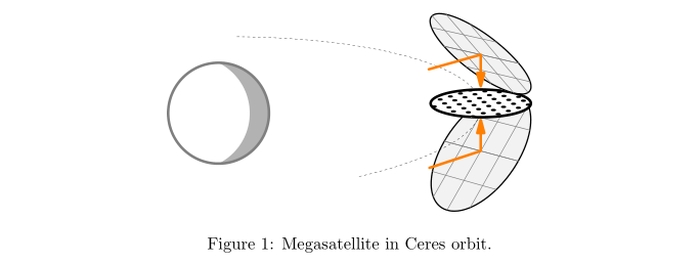
They feel that Ceres will have Nitrogen in a weaker gravity well. And of course, it will have Carbon and water, and minerals.
Many people might want to go nuclear at Ceres, but some people have discussed solar: https://space.stackexchange.com/questio … eroid-belt
Quote:
The distance of Mars to the Sun is 1.5 AU (distance Earth to Sun), so the area of a solar panel should 2.25 times larger than in Earth orbit. The dwarf planet Ceres is at 2.76 AU and a solar panel should be 7.65 times larger. But Dawn did a very good job at Ceres, the power of the solar panels was 10 kW at 1 AU and only 1.3 kW at 3 AU. See en.wikipedia.org/wiki/Dawn_(spacecraft) –
Uwe
CommentedSep 21, 2025 at 11:47
Of course there would be two types of solar. Orbital and Surface.
Interesting facts about Ceres: https://facts.net/nature/universe/35-facts-about-ceres/
#25:
Ceres has a day length of about 9 hours, meaning it rotates relatively quickly.
So, you would not need as much energy storage with a surface installation as for Earth or Mars, both because of rapid rotation and no clouds.
The gravity being slight, sun following robotic solar installation on the surface should not be that hard.
You can try solar cells with mirrors or heat engine in orbit. Heat engines may not work as well on the surface as Ceres will emit some heat.
The size of the hill sphere for Ceres is very large proportional to the size of Ceres itself. So you could likely have lots of orbital solar power.
And that would tend to be 24/7 without clouds, and without atmospheric attenuation.
Hill Spheres: https://en.wikipedia.org/wiki/Hill_sphere
Image Quote:
The hill sphere for Ceres is larger than that for Mercury.
So mirrors in orbit and on the surface will likely be able to provide massive amounts of power.
If robot swarms can be developed for the Moon, they will probably include a handful of humans. Such swarms sent to Ceres could build the place up a great deal. There would be a distribution of materials and massive supplies of energy.
A Space Elevator System might not be required, but Ceres would be a great place to try it out before trying to do it for the Moon, Mars, or Earth.
They might mass produce the devices in this post #183: https://newmars.com/forums/viewtopic.ph … 26#p238026
Quote:
I am thinking that the device might be put into a "Stored" setting for a push, perhaps from a mass driver of tether or power beam:
Now, I think I have something for this. If we could toss snow at this thing using a Mass Driver. Then perhaps we can give it a heck of a push. We can include ice of water, Co2, and Oxygen. The Oxygen might be magnetic, which is what we want.
SpaceX intends to make a Mass Driver for the Moon, so if they can then this might be possible.
This opens up some interesting options.
Pause...............
IF you sent Oxygen Ice dust only, then you might create a chemical reaction on impact. If you added some CO2 then that might suppress it and the CO2 will have more inertia than the Oxygen Ice powder. If you add Water ice powder, the effects are uncertain.
But the impact should push the convex face of the mirror assembly and may erode it and might vaporize on impact.
Of course, a regular type of mass driver might push the devices to several hundred km/hour first.
You might also use pusher plate detonations to push the craft similar to a Orion Nuclear starship. Here, I am thinking of chemical explosives. Adding water or CO2 to the explosion might be useful.
For most of these options you may need a rather substantial mirror structure. But that may be OK, as the mirror structure is to be plastic and aluminum which you may want to deliver to another location, such as Earth/Moon, or Deimos/Phobos/Mars.
You might stop by a metal asteroid to pick up some materials on the way.
Some flight assistance might come from electron beams also, perhaps, at a distance.
Along the way the device might reconfigure to be as this from post #183:
So, anyway after the boost the device would be Unfolded to look like this:
And having been pushed closer to the sun the mirrors concave feature be used to power a burn-as-you-go Hydro-Lox propulsion system based on a tank of water.
Upon arrival to the destination the device can be rendered into metals, Plastics, Carbon Parts, and Water and Methane perhaps.
If you had mass production these could arrive at more inner planets continually to support desires and needs for a solar economy.
Ending Pending
Last edited by Void (2026-02-13 12:18:20)
Be careful what you wish for.
Offline
Like button can go here
#186 2026-02-13 12:39:40
- Void
- Member
- Registered: 2011-12-29
- Posts: 9,796
Re: Ceres
In relation to the prior few posts, it is apparent that if you might play this game in the hill sphere of Jupiter, taking apart Callisto and Ganymede, if you like.
A Laser Beam from a energy source, even if attenuated over distance might be refocused by the concave mirror. So, then this would be a form of Solar Moth perhaps.
Solar Moth: https://www.bing.com/videos/riverview/r … &FORM=VIRE
So, perhaps indeed continually pulling desired types of mass into the inner solar system.
Ending Pending
Last edited by Void (2026-02-13 12:42:33)
Be careful what you wish for.
Offline
Like button can go here
#187 2026-02-14 16:18:23
- Void
- Member
- Registered: 2011-12-29
- Posts: 9,796
Re: Ceres
Ceres is a place that has very low gravity but not microgravity. So, perhaps it would be a good place for this: https://www.bing.com/videos/riverview/r … &FORM=VIRE
Quote:
Why Asteroid Mining Fails… Until You Go Closed-Loop (SEM TECH vs. the Problems)
YouTube
Rowow
1.3K views
1 week ago
So, then perhaps the gravity is enough for nearly Earth-Like processes, and then also you could have centrifuges if you need more.
I think this could be better then trying to process Bennu or other rubble piles.
Quote:
SEM TECH (Salt Electro Mining Technology) is a closed-loop approach to asteroid mining that generates and regenerates its chemistry on-site using electrolysis and a salt-based feedstock. This method is designed to be efficient and cost-effective, addressing the challenges of asteroid heterogeneity and difficult-to-separate mineral forms. SEM TECH is particularly effective for carbonaceous asteroids, as it directly addresses the issues highlighted in a major 2025 paper on carbonaceous asteroids. The technology is flexible and can accept a wide range of feedstocks, making it a promising solution for asteroid mining.
YouTube
Here is some more materials from the same source: https://www.youtube.com/@Rowow
Last edited by Void (2026-02-14 16:25:11)
Be careful what you wish for.
Offline
Like button can go here
#188 2026-02-20 11:03:12
- Void
- Member
- Registered: 2011-12-29
- Posts: 9,796
Re: Ceres
I am further looking at large asteroids here, like Ceres or somewhat smaller. Here are the exceptional asteroids again: https://en.wikipedia.org/wiki/List_of_e … _asteroids
Image Quote: 
Most of these are heavy with volatiles, Ceres being the largest.
I think that the path that leads us to the Moon and Deimos/Phobos/Mars, gets us to a point where these asteroids will be in reach.
The hardware that can open some of the worlds will be able to open all of them.
Reviewing this again.... https://www.sciencealert.com/could-huma … anet-ceres
Image Quote:
The people who thought this up anticipated that Ceres can offer Nitrogen, which is an important feature, hard to come by in a shallow gravity well, in reach of humans.
Two material creation ideas seem like they might fit in this:
1) Pee-Bricks, (Urine-Bricks): https://www.bing.com/videos/riverview/r … &FORM=VIRE
Quote:
How Do You Make Bricks Out of Urine?
YouTube
Engineering TV
2.1K views
Again: https://www.bing.com/videos/riverview/r … ajaxhist=0
Quote:
Bricks Made From Pee?! This Will Blow Your Mind!
YouTube
Next Gen Reality
5.2K views
I would imagine you could perhaps add other "Foods" for the microbes.
2) Mycillium are another option: https://www.smithsonianmag.com/smart-ne … ia%20cells.
Quote:
New, ‘Living’ Building Material Made From Fungi and Bacteria Could Pave the Way to Self-Healing Structures
Researchers are developing the biomaterial as a more environmentally friendly alternative to concrete, but any wide-scale use is still far away
Margherita Bassi
Margherita Bassi - Daily CorrespondentApril 24, 2025
OK, so I regard both processes as compatible with permanent magnets. I would like to embed such magnets into such materials to influence separated portions of a structure to linger with the whole structure and not become a collision hazard.
Other worlds in the asteroid belt may do, but imagine shaft type mining on Ceres and using virtually all of the extracted materials to build structures in orbit. You get the tunneled-out spaces and a very large amount of orbital structure. A robot work force could exist in the tunneled spaces, and of course in the orbital structures as well.
"Blocks" made of these materials could be linked together to make structures.
Thermally stable inside and also radiation protected inside.
Electric power will not be a large issue as Ceres has a large hill sphere relative to its size: https://en.wikipedia.org/wiki/Hill_sphere
Image Quote:
Various kinds of synthetic gravity may be possible.
Previously disks and cylinders have been considered, I like a double cone jar: 
The above drawing is a "Cut-Away" I show one major "Double Cone" in the center, with a rotator, and four smaller attached "Double-Cones".
#1 might be used as a greenhouse. #3 might be used as a radiator.
the rotator inside of the major double-cone jar, can be throttled up or down as per spin rate. During high spin rate, the air will be pumped out of the gap between the spinner and the spinner and the Jar. But periodically air from inside of the spinner can be let out into the gap, after the spin rate has been reduced. So, spin gravity would be periodic.
During a low rate of spin access to other double cones can be facilitated.
A double-cone jar perhaps made of Urine-Bricks, may have bands of a tensile material wrapped around it to allow it to hold the force of internal air pressure. The cracks between bricks, can be sealed, but indeed an air retaining balloon could also be used to retain air pressure.
So, vast collections of "Double-Cone" structures could be connected together.
If it is not desired to cycle spin rate and air pressure, then you might put a "Spin Airlock" between connections of "Double Cones". It would spin to match the rate of the double cone structure it was mated to and then Uconnect and connect to the partner double cone.
So, then a vast amount of habitat could be created in orbit of Ceres or some other asteroid.
Obviously eventually the materials of Callisto and Ganymede may be of similar interest.
Some of these structures could be converted into "Cycling Spaceships". They would be so massive, that I would not want them to fly by another world. They would simply be in association with a "Host World" like Ceres, but would be on a elliptical orbit where the low end goes inward to the sun and the high end comes back like a boomerang, reputedly to the "Host World".
Such a Boomerang platform might cross the asteroid belt in part, or might reach to Mars orbit, or to Earth/Moon orbit or even father in.
Spaceships launching from the inner solar system would need to match their orbit to offload passengers. A Boomerang Platform would perhaps do two orbits for each Ceres orbit, and so then be in the asteroid belt location of Ceres one time and be on the opposite side of the sun the next time.
Ending Pending
Last edited by Void (2026-02-20 12:21:01)
Be careful what you wish for.
Offline
Like button can go here