New Mars Forums
You are not logged in.
- Topics: Active | Unanswered
Announcement
#51 Re: Science, Technology, and Astronomy » Genetics » 2026-02-24 09:13:38
I have been wondering why the Romans who spoke an Indo-European language, had a lot of trouble conquering those to the north of them? That is to an extent. It is weird to my mind that perhaps the more Yamnaya inheritance a population had, they harder it was for them to create a income generating province.
https://en.wikipedia.org/wiki/Roman_Empire
Quote: 
So, although they must have had some Yamnaya heritage themselves, provinces they created needed to be profitably farmable, and have a population of people that they could control. The populations they might easiest control would be the descendants of the ancient farmers of the Anatolia origins, I speculate. At some point they abandoned England as it was not paying off.
So, agriculture with passive captive peoples was their paycheck. The Farmers provided the passive captive peoples. All they had to do was decapitate a society and then install their approved flunkies. The Yamnaya blood might not easy to domesticate.
The "Little Ice Age" came significantly after that time: https://www.bing.com/search?q=How+did+t … pc=EDGEXST Quote:
Widespread crop failures and famines
How did the little ice age affect northern Europe, Poland
The Little Ice Age significantly impacted northern Europe and Poland during its period. The region experienced colder and longer winters, which shortened the growing season by several weeks. This led to widespread crop failures and famines, as the harsh conditions made farming untenable. The price of grain rose almost universally, resulting in social unrest and rebellions. Glaciers in the Alps and northern Europe expanded, engulfing towns and farmlands, which further exacerbated the situation. The effects of the Little Ice Age were profound, affecting not only the agricultural economy but also the social and political stability of the regions.
Smith Coll
So, I speculate that periodic farming collapse may have favored a less obedient Yamnaya heritage over the relatively passive Anatolian farmer heritage.
England was worth the trouble for a time, but Pictland was more trouble than it was worth. https://en.wikipedia.org/wiki/Picts
Image Quote: 
The Greeks do not seem to have had an identical pattern.
https://en.wikipedia.org/wiki/Ancient_Greece
Image Quote: 
It may or may not mean something, but the Greeks seem to have had an almost equal exposure to the Black Sea as the Mediterranean Sea.
The Greeks may have been a bit more Yamnaya and less farmer than the Romans became at one point.
I regard the area of the Caspian Sea and Black See as a genetic and cultural mixing Zone.
I think that India has one, and that North America and South America have one as well.
As a nursery for accumulation of useful attributes, I think these zones are rather good.
But I think that the farmer cultures, breed such attributes out of the population, to create a submissive surf class and a psychopathic ruling class. Neither of the two classes retain the desired skillful attributes in my opinion.
But farming is necessary to maintain large populations and so-called civilizations.
So, a farmer "Civilization" may burn-out, and then become subject to more capable people moving sideways on the map and taking over.
A farmer "Civilization" also may burn out as it may damage its soils over time and may exhaust the local mineral and forest resources.
From my point of view, the Middle East is burnt out.
Greenland burned out as well, the soils wore out and wood perhaps not available as much, then the "little Ice Age".
I am still working on this.
Ending Pending 
#52 Re: Science, Technology, and Astronomy » Genetics » 2026-02-23 09:51:47
One or two articles, then my speculations:
https://www.youtube.com/watch?v=W7qaAQVQ3gE
Quote:
The True Genetic Roots of the Yamnaya People Finally Explained
Epic Discovery
https://sciencenews.dk/en/100-ancient-s … population
Quote:
100 ancient skeletons reveal dramatic turnover of Denmark’s population
Tech Science
22. feb 2024
4 min
Professor in evolutionary genomics and biodiversity Morten Erik Allentoft
Written by Kristian Sjøgren
So, what follows is my speculation and may or may not have some truth in it. Of course I will say true and false from my perspective as I think I witnessed it.
I think a very important feature is "Power Amplifiers".
If you had/have better power amplifiers you can then compete better among the contest of genes.
Stone and wood tools were the only non-human power amplifiers.
However, a human tool was also a power amplifier.
For instance, one human may seek to domesticate and tame another human to serve their purposes.
So, there are human and non-human power amplifiers, and to be able to master any of them is an advantage to increase the probability of the survival of genes, and perhaps memes.
Nature does not value intelligence except that that intelligence can access power amplifiers.
So, in farmer communities, the process of subordinating lower-class people to be a tool for farming, might lead to smaller brains, because the ruling lines will confiscate the best of the produce. Vegetable diets it seems are less able to sustain large brain size.
Presuming that brain size is associated with mind power that can access power amplifiers, then efficiency would breed for smaller less expensive brains, and a vertical stratification of a society. The lower classes would hover on the edge of starvation on average, and the upper classes might try to keep the breeding within their ranks in order to keep the ability to master other people as their power amplifiers.
This would lead to specialization as the humans as farm animals would only retain those stone age traits which would be useful for being a peasant, and the upper classes would only retain the power of verbal persuasion and perhaps at times the power of violence to convince their domesticated humans to obey.
So, two specialists that lost their generalist traits.
The Yamnaya, from the Steppes, were tall, perhaps because of cold of the north which may favor larger bodies, but also because mastering horses and grazing animals may require a minimum human physical strength and the ability to control another creature.
They also had the power amplifier of the wagon, which was a complex tool, requiring mental skills that perhaps neither specialist group of the farmers would be as good at.
The Yamnaya Males would have significant advantages. Some might be the power of killing members of an upper class, and then taking over control of the dead people's peasant class. But also, a ruler of a farmer community might recognize power in a Yamnaya, and might try to broker a agreement with such Men. So, perhaps arrange a marriage.
That might be part of the story.
To be honest I like the story of the Yamnaya after all. I have always disliked the farmer process of breeding two specialized idiot populations from one intelligent stone age population.
It turns out that the Yamnaya, were a result of the merging of hunter gatherers from the Steppes and the Caucasus Mountains.
The western Hunter gatherers could only retreat into the woods, I suspect, but the Steppes and Mountain skills might have forged a human breed that could kick farmer butt.
Today, my idea is that the old European elites are annoyed by America, as we do not wish to be their farm animals.
I think that could explain a lot. The Europeans having a farm animal major population, ruled but elite imbecilic.
America has been a refuge for some of the outliers of the world, including Europe. Those who do not fit with the ruler/surf game.
And the wilderness treatment of the past 500 years on this continent, may have favored a divergence from the ruler/surf game.
We have outer space ahead of us, (Maybe). That is quite a wilderness, it seems.
And we do not need to use humans as farm animals. The generalist mind may prevail, except what does AI do? I don't know if anyone knows.
I think we should consider expanding the gene pool by getting genes out of the dirt. The Dorset people were apparently exterminated by the Innuit, I am interested in them.
The point is humans will not be doing sugar cane plantations anymore. We do not need specialists suitable to the old farmer world.
I am not talking about present day farmers. Rather I refer to "People Farmers".
Ending Pending
#53 Re: Interplanetary transportation » Multi-Ship Expeditions, Starboat & Starship, Other. » 2026-02-22 10:12:45
So, far up until now for the greater part orbital reuse of space junk is not significant. So, rockets have been focused on the payload.
I don't know that it will ever emerge, but a non-cargo mass to orbit concept might emerge eventually. That is if the 2nd stage materials are regarded as having sufficient value for reuse, 2nd stages without payloads might be considered.
For instance, a non-reusable Starship might be built so that it has no payload but increased dry mass. The economic circumstances for this may never emerge, but I just want to contemplate such a thing. In the case of Starship, we are largely considering Stainless Steel as the material, but if you increase the amount of dry mass you allow, you might substitute other materials with a lower performance so that the Starship was not as Mono-Material in nature.
And this would only make sense, if the value of the materials in orbit were sufficient. This could be true, if you intended to help build hardware with a good payoff such as Starlinks and Data Centers.
I guess we might think of the current Starship under development as a High Breed Racehorse. Tuned to do the almost impossible.
But what I am suggesting is a Mule, not showy, but of economic importance.
So, although it is hoped to get some stuff from the Moon, this might get stuff to orbit earlier, and perhaps of materials not obtainable from the Moon.
And as the 2nd stage is intended for a one-time launch from the surface of the Earth, it can be built without the constrictions that reuse imply.
So, you might get away with including more Aluminum, Lithium, and Carbon for example. These substances are lighter anyway. You might make the propellant tanks still largely of Stainless Steel but then might make much of the rest of the ship of other materials which often may be lighter.
As for the Raptors, perhaps those would be returned to the surface of the Earth, with 2nd stages that are capable of return. Reusable Starship and the 2nd stage of Stoke Space look like possibilities.
Some suggestions have it that a onetime Starship could lift 250 tons of payload. So, perhaps you lift 250 tons of what you need, and then you take the ship apart.
The propellant tanks might be put into space stations as pressurized volume. Of course, they then need actional mass to make them habitable. The Avionics and engines to be brought down to Earth perhaps. Then the rest of the dry mass and the cargo mass, may be recycled. It seems that Aluminum might be the most easily recycled. Perhaps the upper part of the ship if of Aluminum, could be converted into radiators for Data Centers.
Anyway, I think that the Superheavy, once established as useful and reliable, might be largely as it is now, of Stainless Steel. And I think it might be usable to lift 2nd Stages for other rocket vendors who may or may not have Stainless Steel as the major component.
I am thinking of sized-up versions of Terran-R (Aluminum), Rocket Lab (Carbon), and Stoke Space 2nd Stage (Stainless Steel???).
Anyway as conversation, it is not wrong to ask these questions about such possibilities. At least I think that it is OK.
Ending Pending
#54 Re: Not So Free Chat » Peter Zeihan again: and also other thinkers: » 2026-02-21 20:50:17
America is much more aquatic than the Russians for good reasons. Are we a Duck or a Swan?
At least we are not a Goose. AKA Flying Carp.
It makes very little sense for the Russians to have a Navy, but they are in love with the idea it seems.
But they are quite the thing for Eurasian/Asian Land Wars.
I think it was always wrong to think that an industrial superpower was a danger in the near Russian area. Per Peter Zeihan, trans and trucks are just not the equal to water transportation, if you can have water transportation.
The British fetish to chase the Russians around and try to get us do so as well, is not suitable to our needs.
You need to consider that it is possible that the aristocrat greens now believe that they can survive a nuclear war between America and a major Asian power. In their infantile dreams they may think that 9/10ths of the human race can be killed off while the hide in their plush bunkers. Then they come out and rule the remnants.
We are not interested in that plan.
Ending Pending
#55 Re: Terraformation » Rubble Pile Sinter/Glass Jar/Double Cone, Ceres » 2026-02-21 20:14:49
Quote:
Previously disks and cylinders have been considered, I like a double cone jar:
The above drawing is a "Cut-Away" I show one major "Double Cone" in the center, with a rotator, and four smaller attached "Double-Cones".
#1 might be used as a greenhouse. #3 might be used as a radiator.
the rotator inside of the major double-cone jar, can be throttled up or down as per spin rate. During high spin rate, the air will be pumped out of the gap between the spinner and the spinner and the Jar. But periodically air from inside of the spinner can be let out into the gap, after the spin rate has been reduced. So, spin gravity would be periodic.
My logic for synthetic gravity in a double cone is that the ring with highest gravity is not likely to be required all day long for a human. At least I suspect that.
People do not spend 24 hours a day standing and straining in a 1 g gravity. If much of your day is at 1 g, you might have your bedroom somewhere with lesser gravity.
But time will tell. It seems likely that some humans of some kind will live some of the time on the Moon, and we will get some information on physical reactions to 1/6 g for humans and test biology. That may tell us important things.
I see the double cone as being intermediate between the torus, and the cylinder. I have shown where a Torus could be put into the Double Cone Structure.

So, you could put the typical spokes into it like a Starford Torus, but I think it is just easier to walk up the incline to get to the null gravity points on each apex of each cone.
Ending Pending
So that living in orbit of Ceres might not seem a grim thing, I have added a possible method of greenhouse. Very low gravity and at least somewhat lighted.

Ending Pending
#56 Re: Terraformation » Rubble Pile Sinter/Glass Jar/Double Cone, Ceres » 2026-02-21 12:17:31
A mixture of matter and energy and means of manipulation makes Earth valuable.
Ceres/Asteroid Belt, are the other place that I see as being similar.
But the difference is the gravity wells.
Deimos/Phobos/Mars are interesting as well, but energy is perhaps not as good and the gravity well for Mars is still somewhat significant.
Mars does have Nitrogen but not so much to spare. If Ceres does have Ammonia, then it has a very useful asset.
Energy for Ceres could be though microwaves or lasers, and possibly space elevators.
If Space Elevators could not carry cargo, they might conduct electricity.
But with a low gravity, and a small tilt in axis, ground solar installations might be practical also.
I am sure that Deimos/Phobos/Mars will not be ignored, but if they did not exist, another way to handle things, would be to join our Moon effort to a Ceres/Asteroid Belt effort.
I sort of think that for that it might be that ships will be built at both locations.
Our Moon could use a bulk of what Ceres has, but Ceres could support a lot of artificial habitat.
Ending Pending
#57 Re: Interplanetary transportation » Multi-Ship Expeditions, Starboat & Starship, Other. » 2026-02-21 09:11:32
I was inspired by a utube video in part about how NASA uses hydrogen containing compounds as radiation shielding on Orion, and that Starship can afford to carry some of that such as Poly........
Anyway, I am looking a little further about external cargo on ships such as foam filled bags. And multi-use of components.

An advantage of external cargo foam bags, is that they might be filled in LEO, and so not have normal constraints on fairing size for lift to LEO.
On the Left a Nose-Bag composed of several parts, might give radiation shielding and also ride on the nose.
I have previously thought of solid rocket boosters that would be used to propel a ship to the Moon (In part), and in the right drawing show how the burned out solids could perhaps be used as landing legs. Some of the padding of the Nose-Bag might then be attached to those as cushioning feet.
Probably this requires the means to make these metamorphic changes in Lunar orbit prior to a landing attempt.
The Nose-Shield may be of value for traveling through the Van Allen Belts, and also if there is a solar eruption in flight. Also helpful for reducing total astronaut exposure to radiation.
Upon landing it may be that the Landing feet could be removed and used as a resource for radiation protection or some other need.
Ending Pending
#58 Re: Terraformation » Rubble Pile Sinter/Glass Jar/Double Cone, Ceres » 2026-02-20 21:28:59
The thing that I think could be of importance is that not that long after Starships are working with the Moon and Deimos/Phobos/Mars, it will be very possible to be working with small worlds like Ceres.
With robotic mater manipulation, and robots building robots, if satisfactory build methods can be developed then I think that at a fast rate their will be habitation of vase amounts creatable from worlds like Ceres.
Imagine a robot action tunneling into Ceres, 50 km deep. Rendering materials, and then they being used to make shelter for intelligent activities. In the tunnels on Ceres the Robots could be quite functional at temperatures below 0 C, I am speculating. They will not need nearly as much lighting as we do. Humans could be there in special spaces, but in orbit of Ceres it may be rather easy to provide g forces suitable to various needs.
Quote:
I want to clone a post here as I want to expand on it beyond Ceres: https://newmars.com/forums/viewtopic.ph … 79#p238179 From "Index» Terraformation» Ceres", Post #188.
Quote:
Previously disks and cylinders have been considered, I like a double cone jar:
The above drawing is a "Cut-Away" I show one major "Double Cone" in the center, with a rotator, and four smaller attached "Double-Cones".
#1 might be used as a greenhouse. #3 might be used as a radiator.
the rotator inside of the major double-cone jar, can be throttled up or down as per spin rate. During high spin rate, the air will be pumped out of the gap between the spinner and the spinner and the Jar. But periodically air from inside of the spinner can be let out into the gap, after the spin rate has been reduced. So, spin gravity would be periodic.
The "Double-Cone-Shell" may be thick enough to protect from the radiation environments.
https://www.nasa.gov/wp-content/uploads … elding.pdf
Quote:
2 to 3 metres
To protect from radiation on the Moon, a lunar base will need to be shielded by 2 to 3 metres of regolith. This thickness is necessary to reduce the annual radiation doses from an unshielded level to a safer target. The regolith, which is the moon's surface layer of rock and dust, serves as a blanket of protection against cosmic rays and solar particles. The specific amount of regolith required can be estimated using a radiation shielding calculator, which takes into account the density of the local soil, the mass attenuation coefficient, and the surface area to be covered.
NASA
+1
So, this may be very large blocks of Urine-Bricks, perhaps in forms that will resemble Lego's.
https://en.wikipedia.org/wiki/Lego
Image Quote: 
Perhaps with a bit of magnetism in them but perhaps also actually glued together in some way.
You could put a metal shell around the double cone structure if you liked, and then wrap it in high tensile materials such as steel bands, and/or Carbon wrap of some kind.
Perhaps some protective materials over that to deal with impactors.
When you had a lightweight rotator inside of one of these, you could calculate that if there is a breach in the spinner, the air loss, being absorbed by the protective outer shell, would not allow a lethal vacuum exposure. Your ears might pop, but you could survive without serious injury.
Some people might say "Where are the windows". Well, if you want to look out at space, perhaps at Ceres, you could have a window somewhere for that, perhaps in attached smaller double cone #2 or #4.
#1 might be arranged so that you had some sunlight ported into it.
It is quite possible that an almost infinite amount of double cone structures could be connected to each other in orbit of Ceres. You might have rings of them around the little dwarf planet.
So, I argue that the potential for Cere may be very large.
And then it looks like fustian power is going to appear some time not too far from now.
Although you could do double cone structures in the hill sphere of Jupiter, using solar, fusion would be quite a boost as well.
Look at the size of the Hill Sphere of Jupiter and some of the other outer worlds: https://en.wikipedia.org/wiki/Hill_sphere
Image Quote: 
It is apparently true that for the orbits of Io, Europa, and Ganymede, the radiation is lethal to quite a challenge, but for Callisto it is said to be not too bad. I am going ot guess that some parts of the magnetic field of Jupiter are better than that of for Callisto.
In any case, Callisto being ~2X as bad as Earth/Moon???? It would be a workable situation. And probably Ganymede could be mined as well, I expect.
It is thought that Ceres and Callisto may have Nitrogen, perhaps in the form of Ammonia.
https://en.wikipedia.org/wiki/Callisto_(moon)
Quote:
Ammonia on Callisto is a topic of interest in the context of its potential for terraforming.
Callisto's surface is rich in carbon dioxide and molecular oxygen, which are essential for life, but it also contains ammonia.
1
The moon's atmosphere is primarily composed of carbon dioxide, and the presence of ammonia could be significant for sustaining life, as it may help convert carbon dioxide into nitrates, which are necessary for biological processes.
2
The idea of terraforming Callisto involves creating a stable atmosphere with heavy inert gases, which could be achieved by filling the atmosphere with nitrogen and possibly ammonia.
2
The potential for ammonia on Callisto suggests that it could be a suitable candidate for supporting life, especially with the right conditions for conversion and stabilization.
1Thus, ammonia plays a crucial role in the potential for life on Callisto, particularly in the context of its terraforming efforts.
2 Sources
Nitrogen is of course of interest for artificial atmospheres, and for the Urea that might be used with microbes to make giant blocks.
https://en.wikipedia.org/wiki/Urea
Image Quote: 
https://www.spacereference.org/asteroid … st%20point.
Quote:
Ceres's spectral type G (Tholen) / C (SMASSII) indicates that it is likely to contain water, iron, nickel, cobalt, nitrogen, and ammonia. Ceres's orbit is 1.58 AU from Earth's orbit at its closest point.
It would expect lots of Carbon as well.
Ending Pending
#59 Re: Terraformation » Rubble Pile Sinter/Glass Jar/Double Cone, Ceres » 2026-02-20 14:48:57
I want to clone a post here as I want to expand on it beyond Ceres: https://newmars.com/forums/viewtopic.ph … 79#p238179 From "Index» Terraformation» Ceres", Post #188.
Quote:
Previously disks and cylinders have been considered, I like a double cone jar:
The above drawing is a "Cut-Away" I show one major "Double Cone" in the center, with a rotator, and four smaller attached "Double-Cones".
#1 might be used as a greenhouse. #3 might be used as a radiator.
the rotator inside of the major double-cone jar, can be throttled up or down as per spin rate. During high spin rate, the air will be pumped out of the gap between the spinner and the spinner and the Jar. But periodically air from inside of the spinner can be let out into the gap, after the spin rate has been reduced. So, spin gravity would be periodic.
I regard the double cone shape as of interest, as it might be made of large compressive blocks of materials, and yet wrapped in tensile materials to hold it together. One method to make the blocks is in a form where regolith can be glued together using a Urea-Microbe method.
I think that the blocks could be glued together with something like tar, and that a balloon inside could further assure air tightness.
An internal spin gravity device could be relatively light weight, like an aircraft structure. It would only have full gravity in a ring at it's largest perimeter, and only when at full speed.
The block structures not themselves spinning could be attached to others of their kind to form very large assemblies.
If facilities at locations similar to Ceres could mass produce these, then some of them could be put into elliptical orbits around the sun to merge with major terrestrial crossing asteroids, and to then consume them.
Some of these might then eventually be made synchronous to a world that has a largely circular orbit around the sun. So they would do repeat returns like a boomerang.
Ending Pending
.
#60 Re: Terraformation » Ceres » 2026-02-20 11:03:12
I am further looking at large asteroids here, like Ceres or somewhat smaller. Here are the exceptional asteroids again: https://en.wikipedia.org/wiki/List_of_e … _asteroids
Image Quote: 
Most of these are heavy with volatiles, Ceres being the largest.
I think that the path that leads us to the Moon and Deimos/Phobos/Mars, gets us to a point where these asteroids will be in reach.
The hardware that can open some of the worlds will be able to open all of them.
Reviewing this again.... https://www.sciencealert.com/could-huma … anet-ceres
Image Quote: 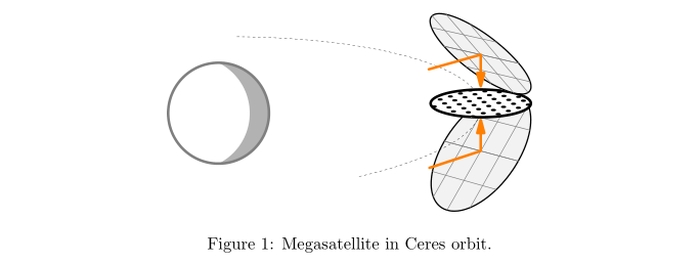
The people who thought this up anticipated that Ceres can offer Nitrogen, which is an important feature, hard to come by in a shallow gravity well, in reach of humans.
Two material creation ideas seem like they might fit in this:
1) Pee-Bricks, (Urine-Bricks): https://www.bing.com/videos/riverview/r … &FORM=VIRE
Quote:
How Do You Make Bricks Out of Urine?
YouTube
Engineering TV
2.1K views
Again: https://www.bing.com/videos/riverview/r … ajaxhist=0
Quote:
Bricks Made From Pee?! This Will Blow Your Mind!
YouTube
Next Gen Reality
5.2K views
I would imagine you could perhaps add other "Foods" for the microbes.
2) Mycillium are another option: https://www.smithsonianmag.com/smart-ne … ia%20cells.
Quote:
New, ‘Living’ Building Material Made From Fungi and Bacteria Could Pave the Way to Self-Healing Structures
Researchers are developing the biomaterial as a more environmentally friendly alternative to concrete, but any wide-scale use is still far away
Margherita Bassi
Margherita Bassi - Daily CorrespondentApril 24, 2025
OK, so I regard both processes as compatible with permanent magnets. I would like to embed such magnets into such materials to influence separated portions of a structure to linger with the whole structure and not become a collision hazard.
Other worlds in the asteroid belt may do, but imagine shaft type mining on Ceres and using virtually all of the extracted materials to build structures in orbit. You get the tunneled-out spaces and a very large amount of orbital structure. A robot work force could exist in the tunneled spaces, and of course in the orbital structures as well.
"Blocks" made of these materials could be linked together to make structures.
Thermally stable inside and also radiation protected inside.
Electric power will not be a large issue as Ceres has a large hill sphere relative to its size: https://en.wikipedia.org/wiki/Hill_sphere
Image Quote:
Various kinds of synthetic gravity may be possible.
Previously disks and cylinders have been considered, I like a double cone jar: 
The above drawing is a "Cut-Away" I show one major "Double Cone" in the center, with a rotator, and four smaller attached "Double-Cones".
#1 might be used as a greenhouse. #3 might be used as a radiator.
the rotator inside of the major double-cone jar, can be throttled up or down as per spin rate. During high spin rate, the air will be pumped out of the gap between the spinner and the spinner and the Jar. But periodically air from inside of the spinner can be let out into the gap, after the spin rate has been reduced. So, spin gravity would be periodic.
During a low rate of spin access to other double cones can be facilitated.
A double-cone jar perhaps made of Urine-Bricks, may have bands of a tensile material wrapped around it to allow it to hold the force of internal air pressure. The cracks between bricks, can be sealed, but indeed an air retaining balloon could also be used to retain air pressure.
So, vast collections of "Double-Cone" structures could be connected together.
If it is not desired to cycle spin rate and air pressure, then you might put a "Spin Airlock" between connections of "Double Cones". It would spin to match the rate of the double cone structure it was mated to and then Uconnect and connect to the partner double cone.
So, then a vast amount of habitat could be created in orbit of Ceres or some other asteroid.
Obviously eventually the materials of Callisto and Ganymede may be of similar interest.
Some of these structures could be converted into "Cycling Spaceships". They would be so massive, that I would not want them to fly by another world. They would simply be in association with a "Host World" like Ceres, but would be on a elliptical orbit where the low end goes inward to the sun and the high end comes back like a boomerang, reputedly to the "Host World".
Such a Boomerang platform might cross the asteroid belt in part, or might reach to Mars orbit, or to Earth/Moon orbit or even father in.
Spaceships launching from the inner solar system would need to match their orbit to offload passengers. A Boomerang Platform would perhaps do two orbits for each Ceres orbit, and so then be in the asteroid belt location of Ceres one time and be on the opposite side of the sun the next time.
Ending Pending
#61 Re: Not So Free Chat » Peter Zeihan again: and also other thinkers: » 2026-02-19 12:33:54
Is this right??? Well, I admit that looking back in time, it seems as if when push comes to shove, the Europeans and their masters, would rather undercut America than to accept it as more than a servant who shovels poo in their pony barn.
They would rather scuttle the fleet than allow us to become what we can become, is my sense of a possible truth.
https://www.bing.com/videos/riverview/r … &FORM=VIRE
Quote:
Europe Chooses SUICIDE Over Trump’s Peace (Kokinda & Blaine
YouTube
Rich Does Politics
33 views
But I will keep looking to see if I am wrong about it.
Ending Pending
#62 Re: Interplanetary transportation » Multi-Ship Expeditions, Starboat & Starship, Other. » 2026-02-19 09:54:12
Per the just previous post: 
So, the idea is that the tubular legs will double as solid rocket boosters.
The solids will burn to empty while pushing the assembly towards the Moon.
After they burn out, they deploy to be angled, and the hinges are of compressible metal mesh??? Shock absorbing.
as shown in the right-side picture.
The Drop-Bags were dropped prior to landing ejected sideways by some means.
Ending Pending
#63 Re: Interplanetary transportation » Multi-Ship Expeditions, Starboat & Starship, Other. » 2026-02-19 07:44:41
I want to bring something here from also: "Index» Business Proposals» Data Centers (Including Off World)"
https://newmars.com/forums/viewtopic.ph … 30#p238130
https://newmars.com/forums/viewtopic.ph … 35#p238135
The physical logic for Earth is in contrast with the physical logic of the Moon.
Since the focus in space is at least for a time shifted to the Moon, the logic of hardware will be different.
For Mars, Starship made of Stainless Steel, also works as you need the heat shield. But for the Moon Aluminum or Carbon might be attractive.
Granted, there is some good logic in sending a Starship to stay on the Moon. If it came to the Moon with cargo and would then be converted to some use on the Moon as habitat. Putting a regular Starship with full faps and heat shield, on the Moon is possible, but not that adaptive.
There are two logics for the binary world Earth/Moon. (We are not allowed to call Earth/Moon a binary planet, but I thin binary world is allowed).
It is hoped that over time, activity on the Moon will shift to use of local resources as much as possible.
But at least for initial setup, you might have a "Startup Method". While it might be impressive if you could make a gun out of rocks, it may be more practical to bring one, at first. I understand that guns are not the tool of importance on the Moon, but from a historical notion of the pioneer, this logic is obvious. Eventually you may make tools out of rocks, but at first it may be better to bring the starter tools, to accelerate Lunar development.
Blue Origin and others have plans to make a variety of "Tools", like solar panels out of Moon rocks. But these may be low quality, at least without brining special chemicals to the Moon.
NASA wants to bring a nuclear reactor to the Moon, and of course it will be a long time before nuclear fission reactors can be made from the rocks of the Moon. Imported Nuclear reactors would be a good initiation tool, but have entanglements in National and International relationships.
SpaceX/Elon Musk\G. Shotwell, seem to want to rely on solar panels on the Moon, but do not specify import or Insitu for the method to render them into existence on the Moon.
I am looking to expand the utility of delivery methods to the Moon both for full import method or a hybrid. A Hybrid method may include bringing, some of the materials to make and energy producing device to the Moon. I often look for such a option.
Looking at Starship, I also am thinking of external cargo. I am looking at "Drop Cargo" as one such method. Typically we think of Moon Cargo as being carried inside of a Starship. But a Lunar Starship could have pairs of cargo attached to its outsides, that would be dropped just prior to landing the ship.
The Starship has vastly more engine power than what it needs to land on the Moon. At least that is what I understand.
I am looking at such drop cargo as a startup pathway to get very useful materials to the Moon with a lower cost: https://newmars.com/forums/viewtopic.ph … 24#p238124
Quote:
So, "Airbags" filled with Urea-formaldehyde, might be dropped from a landing ship just prior to landing.
If done wrong, this might lead to a collision on landing, if the cargo bounces back at the ship as it is landing.
But if done correctly, you reduce the dry mass of the ship just prior to landing, and so reducing the landing method rigors. (Landing Legs).
Such a content of "Urea-Formaldehyde" could have many uses on the Moon. Easy use would be to make a radiation shield for a Starship placed on it's side. You may be able to mix to materials with Lunar Regolith to make such a radiation shield.
Various other pathways would exist for this material to be useful. You could extract the component chemicals, and perhaps produce some Urea and water. Then use that to cement regolith into solid objects, using microbes.
The Carbon and Hydrogen could be reformed to sponsor Mushroom growth and also mycelium to again glue regolith into blocks. Or Mushrooms and mycelium to make things not including regolith.
But also other things could be included into the foam inside of the "Airbag". Chlorides of Metals and other substances perhaps. Maybe in small packets inside of the foam.
We may hope to get Chlorine from Moon rocks, but as with many things, at least at first bringing the substance makes for a faster startup of capabilities on the Moon. The Metals of other substances might serve to "Dope" things like Solar Calls to make on the Moon.
I am under the impression that "Salt Mining" using Chlorine could allow a lower temperature extraction of Iron from regolith. The Chlorine supposedly can be recycled to go ahead and get more Iron in that manner.
I think that the above process may liberate the Oxygen which is tied to the Iron. Another method to extract Oxygen from Iron in Regolith is to use Hydrogen and Heat. This process is said by some to be regenerative, as Lunar regolith does contain small amounts of Hydrogen, and the process may recover that as well as the Hydrogen initially available.
It can be noted that the "Airbag" foam will contain Carbon and if salts are added will include substances allowing Iron to be made into Steels for some kind.
My impression is that Aluminum may be harder to extract from the Lunar Regolith.
So, I am interested in the Terran-R rocket for that reason. My impression is that the Terran-R will be made primarily of Aluminum, and will not have the ability to re-enter the Earth's atmosphere without burning up. We are going to have to limit the amount of materials that we burn up in the atmosphere, and the Terran-R is still a useful object, (Probably) once in LEO.
If Starship could refill the Terran-R, it could likely go part-way to the Moon at least from LEO. I don't have the numbers on tankage for it.
But we could "Wish" to get it to the Moon with at least a drop cargo. The Drop-Cargo being the Foam filled airbags I have previously mentioned.
Even without putting landing legs on the Terran-R, if it has the fuel and does not malfunction it may be able to get such airbags close to the surface of the Moon, release them and then crash. IF you put landing legs on a Terran-R, perhaps they could be propulsive. As drop tanks or perhaps, solid rockets.
For instance, if Starship could bring solid rocket legs to LEO and they be attached to the Terran-R, the legs can burn to help get the assembly to the Moon. The shells empty of propellant may still serve as crushable landing legs. The landing legs might be of Aluminum, but that is not typically preferred.
Here is a depiction of a possible instance of such a use: 
In LEO, a Starship brings the solid booster landing legs to attach and the drop foam bags. Perhaps another Starship refills the Terran-R.
The Terran-R burns the landing legs to empty, using its engine to steer, (I hope).
The Assembly prepares to land on the Moon. At a suitable altitude the "Drop Bags" drop. The Terran-R attempts to land using its Metha-Lox engine(s), and uses the burned-out leg boosters as crushable landing Legs.
Hard to say if the Terran-R ever is reused after that or becomes a source of useful metals.
So, a partnership between two types of ships makes sense to me.
Ending Pending
#64 Re: Exploration to Settlement Creation » Utilizing Ice Caves » 2026-02-18 20:09:56
From post #3 again....
A whole labyrinth of rooms could fill much of an ice slab. And finished materials may make the walls, floors and ceilings suitable. I am thinking mostly for various types of robots.
Power and cooling could come though conduits from the surface, using Carbon Conductors, heat pumps/radiators, the environment could be very suitable for robots.
If Mars then had a sun-synchronous web of satellites for power and AI, much of the time these facilities could be power up most of the time.
Various methods of cooling would be available for the robots. Productivity should be huge. Humans might also might also live in special habitats both on and under Mars and in Mars orbits.
So, Mars has some bulk resources which could be developed for a very good profit.
Ending Pending
#65 Re: Business Proposals » Data Centers (Including Off World) » 2026-02-18 12:54:50
I have thought about this some more, there can be some question about orbital and Lunar markets for scrap materials and reuses.
Just to keep a narrow focus, Suppose SpaceX and Relativity Space would form a partnership to some degree.
Terran-R 2nd stage is to be of Aluminum, I believe, and of course Starship is to be Stainless Steel and that with the full recovery mass as sell, if it is to land back on Earth. Recovery equipment includes Header Tanks, Heat 'Shield, and Return Propellants, and features for a Landing Method.
Terran-R not to be recovered would have none of that and would be of Aluminum. Even so it is to be able to lift 33 1/2 Tons to LEO. What if Starship could refill it with Methane and Oxygen?
As Ii see it, a Starship/Terran-R partnership could work very well for the Moon. Lots of options once you are in LEO.
For instance, how many Starship tankers would it take to fill a Terran-R? If needed, could you put drip tanks on the Terran-R once in LEO?
Once you have a Terran-R in orbit, perhaps you could add Drop Tanks to it, that also serve as landing Legs?
Now as far as power goes, as far as I have seen, a 2nd stage is way overpowered to land on the Moon. At least true for Lunar Starship.
And if you like you can attach cargo to the outside of the Terran-R once you are in LEO.
So, in this case you might have a Starship that brings landing legs that also are drop tanks up to the Terran-R. It might also bring extra cargo to attach to the outside of the Terran-R. Then you might need at least one Starship Tanker to fill the Terran-R and it's Drop Tank Landing Legs.
In this case then the Starship would not go to the Moon. The rigged-up Terran-R would and would land with its Cargo and Drop Tanks.
The Terran-R and Drop Tank Legs being of Aluminum, would be of value on the Moon, as it is easier to recycle Aluminum than to get it out of the regolith of the Moon, I expect.
OK, I tried to get the dry and wet mass of the 2nd stage, But I think I got bad numbers.
But I think the idea is not a bad one.
An alternative would be to have a Starship escort the Terran-R 2nd Stage to Lunar Orbit, and use the Terran-R as a repeat lander.
Some of my thinking on this is that it looks like Iron will be relatively easy to get out of Lunar Regolith, but Aluminum may be harder. Recycling used Aluminum, on the Moon from landers that did a useful task, seems like an option to look into.
Of course I have gotten some of this thinking from Space Startup News. https://www.spacestartupnews.com/
Ending Pending
#66 Re: Business Proposals » Data Centers (Including Off World) » 2026-02-17 21:47:29
It appears that Relativity Space is having a second life, for the purpose of supporting data centers in space.
https://www.youtube.com/watch?v=6gxrFD-Hx3U
Quote:
Is Relativity Space Doomed… or About to Change Everything?
Space Startup News
33.5 tons to orbit, and it seems only the 1st stage to be reusable. That is about 50% more than a Falcon 9 launch.
Aluminum instead of Stainless Steel.
Large Scale 3D printing abandoned.
I can see some hidden merits in this one. If I do so, it is not to discredit the SpaceX Stainless Steel concept. It is that a variety of methods may actually serve best, in my opinion.
Space Startup News maintains that old 2nd stages could be crashed onto the Moon for a low price and the metals be salvaged particularly Aluminum. So, in that case a 2nd Stage that cannot be returned to space may have more value than is typical. Typically the device has to be disposed of as garbage. This way it could be a recycled resource.
You actually could put it to two other uses.
1) As a Lunar Lander.
2) As materials for radiators for data center satellites.
The ship might be refilled by Starship or Blue Origins ships, to then serve for the Moon. To then become scrap eventually when it fails.
Ending Pending
#67 Re: Interplanetary transportation » Multi-Ship Expeditions, Starboat & Starship, Other. » 2026-02-17 13:02:39
This has a little entrainment value: "Utube SpaceX's Brilliant Solution to Build A Colony: Starship Mars Cycler!, 2h ago"
https://www.youtube.com/watch?v=H59x0ycdZws
The article supports cyclers at first and then says that maybe it will be possible to send people to Mars in a one-month period.
Both ideas have appeal but are easier to say than to do.
The idea of the Mars Cycler has been around for some time: https://en.wikipedia.org/wiki/Mars_cycler
Image Quote: 
Quote:
A Mars cycler is an elliptical orbit (green) that crosses the orbits of Earth (blue) and Mars (red), and encounters both planets at the points where it crosses their orbits, although not necessarily on every orbit. (Not to scale.)
In the video earlier in this post they seem to suggest that the Moon could "Host" materials for the cycler, be the major supplier for materials for it. This could make sense, if indeed someone can make a mass driver to launch Satellites as it seems SpaceX/Xai hope to do.
Chemical burn fuels are scarce for it though, from the Moon. Oxygen is possible. Metal propellants as well.
But I noticed that the green path in the diagram for the cycler seems to brush the Asteroid Belt.
Here is perhaps a good article: https://pages.astro.umd.edu/~dphamil/HO … than_0.pdf
It does look to me that the Cycler would not only be useful for Earth<>Mars, but also might be useful to access the inner Asteroid Belt.
So, would it be possible to make a Host Station in a relatively circular orbit that has the proper timing to intersect a cycler at aphelion?
Such a station being fairly near the inner asteroid belt might feed from it.
This is what they might feed on: https://www.nasa.gov/solar-system/aster … roid-belt/ Quote:
The 138 new asteroids range from the size of a bus to the size of a stadium — a size range in the main belt that has not been observable with ground-based telescopes.
Threre may be a distribution of types: https://en.wikipedia.org/wiki/C-type_asteroid
Quote:
They lie most often at the outer edge of the asteroid belt, 3.5 au (520 million km; 330 million mi) from the Sun, where 80% of the asteroids are of this type,[2] whereas only 40% of asteroids at 2 au (300 million km; 190 million mi) from the Sun are C-type.[3] The proportion of C-types may actually be greater than this, since C-types are much darker (and hence less detectable) than most other asteroid types, except for D-types and others that lie mostly at the extreme outer edge of the asteroid belt.
So, perhaps between encounters with a cycler they might either have a robot bring a small object to process to them or they might wander to it to process it. In this then the size of stations would grow and also the number of stations.
At 2 AU the sunlight is to be 1/4 that of what it is in Earth orbit. So, mirrors should work fine to concentrate the sunlight.
Into this I will add a Deimos/Phobos/Mars Semi-Cycler. In my view this would be a platform that can slide into orbit of Mars repeatedly using ballistic capture. It will need propulsive methods to assist it in this. But it can launch and then do a flyby of Earth or maybe a 2.0 AU, space station, before passing by Earth again and then reparking in Mars orbit.
The purpose of it parking in Mars orbit would be to take on supplies, and repairs periodically. On launch it's intention would be to seek the orbit of a cycler with Propper timing, and to add supplies to it. It might do a pass of a 2.0 AU space station, but I don't yet have that thought out well enough to say.
The 2.0 AU stations might send materials to Mars by various means, for supply to the Semi-Cyclers.
Ending Pending
#68 Re: Terraformation » The Moon » 2026-02-17 10:10:22
This morning, I am thinking about additive and extractive activities on the Moon.
I think that the boring company may do well on most worlds, but perhaps not so much on the Moon as for the relative lack of things like water for it. I will be happy to be wrong about that if eventually method is proven available.
I can think of a number of extractives methods that have recently come into my view;
-Salt Mining with Chlorine and the distillation of the product.
-Laser Sublimation methods.
-I also think that the https://www.quaise.com/ geothermal methods.
I think that some of these could be improved, (Possibly) using chemicals such as Chlorine, in cycles of Oxidation/Chlorination and reduction, (Using Carbon and Hydrogen perhaps).
We will want chemicals on the Moon and at first some of them will be hard to find and process in bulk on the Moon.
While it is a good idea to try to use local resources, I think that also it would be good to figure out how to efficiently and at reasonable cost import ingredients that are easier to provide to the Moon by some effective/efficient methos with utility.
I have previously thought of things like Iron Oxide. But that is not needed for the Moon but is more likely to be taken from the Moon.
In an additive method(s), we may want Urea and Hydrocarbons, to get microbes to make large solids by including regolith and water.
Now I looked at Urea. I would like to crash it into the Moon. The idea of Moon creasing substances of value can be supported by "Space Startup News", as per crashing old space junk on the Moon.
https://www.spacestartupnews.com/
There is a claim from this source, that space junk could be crashed on the Moon using a lower expenditure of delta-v, and the scrap could be of value.
So, I will use that. I will try to produce a practical import method that saves propulsion energy and may provide for needs.
We are familiar with "Airbags". Some people have had trouble grasping the concept of a "Self-Purposed" Airbag in the past.
A "Self-Purposed" "Airbag" would be one that uses its cushioning properties to cushion it's own impact not to protect the impact of another device.
If we have made an Airbag to impact on the Moon at a reasonable speed, we might put Urea grains inside of it. I guess they would be a cargo, and also as likely to bounce around, could "Time Delay" an impact event.
A solid piece of rock can create only a limited, dissipation of impact energy over a limited time interval. Some of it's energy dissipation can dissapated by it's compressive and fracturing nature. If it makes regolith splash, then it provides to energy dissipation time delay by that method.
An Airbag might dissipate energy over an extended time interval, by various methods. But to describe that too much now is to lead attention away from the device I want to propagate in your mind.
I will establish the concept by saying, fill the air bag with Urea foam, and salt that foam with metal Chlorides. Chlorides of metals that are wanted on the Moon but hard to come by.
Quote:
Urea-formaldehyde foam insulation (UFFI) was widely used in the 1970s for its energy efficiency benefits, but it has since been associated with health concerns due to formaldehyde emissions.
What is UFFI?
Urea-formaldehyde foam insulation (UFFI) is a low-density foam insulation made from a mixture of urea and formaldehyde resin, compressed air, and a foaming agent. It was primarily used in the 1970s to insulate homes, particularly in Canada, where it was injected into wall cavities to fill gaps and improve energy efficiency. UFFI is characterized by its off-white or yellowish color and hardens quickly after application.
All Clear Environmental
+1
Historical Context
UFFI gained popularity during the energy crisis of the 1970s as a cost-effective solution for improving home insulation. However, concerns arose regarding the release of formaldehyde gas during the curing process, leading to health risks. By 1980, the Canadian government banned the use of UFFI in residential construction due to these concerns, although it continued to be present in many homes built or retrofitted during that time.
Beth and Ryan Waller
+1
Health Concerns
The primary health concern associated with UFFI is the gradual release of formaldehyde, a known irritant and potential carcinogen. While emissions decrease over time, certain conditions, such as high humidity or poor ventilation, can lead to increased levels of formaldehyde in the air. Symptoms of exposure may include respiratory issues, eye irritation, and allergic reactions.
All Clear Environmental
+1
Identifying UFFI in Homes
If you suspect that your home may contain UFFI, look for the following signs:
Injection Holes: Homes insulated with UFFI may have visible injection holes on the exterior walls.
Foam Appearance: UFFI can appear as crumbly, tan, or brown foam behind outlet covers or switch plates.
Unusual Odors: A musty or chemical smell in sealed rooms may indicate the presence of UFFI.
22 Sources
What to Do If UFFI is Present
If you suspect UFFI in your home, it is advisable to avoid DIY inspections or removal. Instead, hire a certified professional to conduct an inspection and air quality testing. They can safely assess the situation and recommend appropriate actions if necessary.
Beth and Ryan Waller
+1
Conclusion
While UFFI was once heralded as an innovative insulation solution, its association with health risks has led to its decline in use. Homeowners should be aware of the potential presence of UFFI in older homes and take appropriate measures to ensure safety and air quality.
https://en.wikipedia.org/wiki/Urea-formaldehyde
https://activerain.com/blogsview/140744 … on--part-1
Image Quote: 
I believe that this material has much of what is wanted on the Moon, especially if you salted it with metal chlorides.
https://en.wikipedia.org/wiki/Urea
Image Quote:
https://en.wikipedia.org/wiki/Formaldehyde
Image Quote: 
Most of the atoms in the structure are of significant value on the Moon. The Oxygen is not, but it is needed for the structure of the foam, which is useful to the hoped for impact survival of the devices.
The impact results may be affected by the temperature of the impacting device and the temperature of the surface of the Moon where it impacts.
Also, the nature of the surface that it impacts onto.
For instance, it might hit a trampoline of some kind, or a net. Or a hill of fine dust, that has been provided. You might make a surface softened by feeding gas Oxygen into the pile of dust. A method of fluidization. Or you might fire an explosive device embedded in the pile of dust to fluidize it for a short period of time.
The device might be sent from LEO, with limited navigation and braking abilities. Or it might be dropped from the sides of a ship while the ship lands.
You might be able to shoot some kind of a particle beam at the device from the surface of the Moon to slow it down. Perhaps the output of a Mass Driver, or Magdrive(s), or Neumann Drive(s}.
And then finally you might use it as a landing legs substitute for hardware you wanted to land on the Moon.
What about the Chlorine Salts:
https://en.wikipedia.org/wiki/Chloride
Quote:
Chlorine salts, commonly known as chloride salts, are chemical compounds that contain the chloride ion (Cl⁻) and are formed through the reaction of chlorine with metals or other elements.
What are Chlorine Salts?
Chlorine salts are ionic compounds that consist of positively charged cations and negatively charged chloride anions. The most well-known example of a chlorine salt is sodium chloride (NaCl), commonly known as table salt. Chloride salts are typically soluble in water, although some, like silver chloride (AgCl) and lead(II) chloride (PbCl₂), have limited solubility.
Wikipedia
+1
Common Examples of Chlorine Salts
Sodium Chloride (NaCl): The most familiar chloride salt, used extensively in food seasoning and preservation.
Potassium Chloride (KCl): Often used as a salt substitute in food and as a potassium supplement in medicine.
Calcium Chloride (CaCl₂): Used for de-icing roads, as a drying agent, and in food preservation.
Ammonium Chloride (NH₄Cl): Used in fertilizers, as a food additive, and in some medicinal applications.
Properties and Uses
Solubility: Most chloride salts are soluble in water, making them useful in various applications, including food preservation and chemical processes. However, some chlorides, like silver chloride, are only slightly soluble.
1
Electrolyte Function: Chloride ions play a crucial role in maintaining fluid balance and are essential electrolytes in biological systems.
1
Industrial Applications: Chlorine salts are used in a variety of industries, including food processing, pharmaceuticals, and chemical manufacturing.1 Source
Formation of Chlorine Salts
Chlorine salts are typically formed through the reaction of chlorine with metals or through neutralization reactions involving hydrochloric acid. For example, when sodium reacts with chlorine gas, sodium chloride is produced as follows:
2 Na
+
Cl
2
→
2 NaCl
2 Na+Cl
2→2 NaCl
In summary, chlorine salts are vital compounds in both nature and industry, with sodium chloride being the most recognized example. Their properties and solubility make them essential in various applications, from food preservation to chemical manufacturing.
Wikipedia
+2
The substances received, might be used to 3D print regolith, or break it down, and get various products.
Microbes can use Urea and Water and some other organics to cement regolith.
Hydrocarbons might be used to grow Mycelium products.
Chlorine extracted can be used in salt mining.
Metals from the Chlorides can be used to makes alloys of Lunar metals.
Substances included might facilitate drilling into the Moon using Lasers and/or other power beams. Maybe "Our gyrotron-powered drilling".
If you add Chlorine, you might get a gas to flow out with Iron in it??? As in Salt mining.
If you add Hydrogen or Carbon/CO, you may get an extraction of Oxygen from the dril location a reduction of the rock.
If you then add these in alternation you may better drill the rock.
But of course, your process has to not eat your drilling equipment.
I think that is quite a lot for one morning.
Ending Pending
#69 Re: Terraformation » Rubble Pile Sinter/Glass Jar/Double Cone, Ceres » 2026-02-16 09:31:32
I think my drawing in the previous post leaves much to be desired.
Quote:
This drawing will probably be rather challenging to interpret:
Imagine a torus without spokes, and a hub shaft joined together by ropes.
To minimize it more imagine that the torus is actually like a cable tray that an electrician would lay cables in.
https://electricalampere.com/types-of-cable-trays/
Image Quote:This ring is were the strongest synthetic gravity is to be, but you don't have to make the whole thing into pressurized space.
Instead, you put two or three capsules space out equidistant from each other on the ring-tray. It is walkable but only pressurized in the capsules.
I am reducing the substance of the device, to start with, adding the notion of expansion being available later.
The "Hub-Shaft" might just be a long pipe to start with. You might put docking ports at each end.
Think of the shaded area as an edge-on view of a "Stanford Torus. Then imagine a cone tent pitched on each face of it.
https://en.wikipedia.org/wiki/Stanford_torus
Image Quote: 
The "Hub" becomes the central tent pole for both tents.
This may not be the ideal way to go, but I am trying it out to see if it may have value.
This is how an Eloy thinks: (Image Quote): 
But a Morlock deals with heavy and also intricate machinery and gets in the dirt.
The Eloy of the western society seeks the ability to manipulate Morlocks to make the do the dirty parts of existence. So, then the picture above is the Outer Space version of the Eloy plantation. But space will require machines and industry.
I have encountered suggestion that the British display this contrasting polarity of existence. The gentlemen farmers hated industry for being dirty and they only wanted green plantations with obedient servants. To glorify themselves, they determined that it was their skill set that was the most important. In recent years they have sought to get rid of industry as a competitor for social power. But their way of doing things is a consumption not a production. Their types always accumulate debt trying to live above their means.
So, our upper-class science thinkers tend to be stained by association with the Eloy. But it is understandable why presentations are made to appeal to the Eloy's. The Eloy's, in realty are very skilled with language and violence.
But I am not a Marxists or a silly Socialist. My purpose is not a vengeance, but to translate this into practical means of production. It is not assured that I have done it or will do it but my purpose is to work in that direction.
In trying to set up a self-replication of machines from the dirt, I am looking for a practical progression from a seed to a tree, if I were to try to explain it to Eloy with limited machine and dirt capabilities.
The habitats of the imagination of my youth, 70's approximately was very much about windows and sunlight. I think technology is developing in the direction of Electricity and Machines. Windows and sunlight may hav their place, but I am not thinking that they will yield a high productivity, for the amount of effort required to be expended.
More, another time.
Ending Pending
#70 Re: Exploration to Settlement Creation » Utilizing Ice Caves » 2026-02-15 19:55:55
Continuing with this, I think adaptation to mid latitude ice slabs, relics on the equator, and even polar ice caps may be a possibility.
So, I think what is under them in general will be 1) lava flows, 2) uncemented regolith, and 3) cemented regolith, perhaps resembling sandstone.
1) So, in the case of Lava Flows, there might be Lava Tubes partially or totally collapsed. Any of such situations may have special value.
https://en.wikipedia.org/wiki/Martian_lava_tube
Image Quote: 
Image Quote: 
Such Lave tubes of collapse trenches or skylights, covered by a thick layer of it could be of some unusual value. It might be possible to pressurize them due to the weight of ice above them. In the case of a skylight or collapsed tube you perhaps could fill it with building made of advanced building materials.
2) In the case of uncemented soil under the ice you could do standard underground methods with the ice being protective above.
3) in the case of cemented soil, then you might be dealing with sandstone or mudstone. It is unknown if their are cemented rock types under the ice slabs of Mars. It does seem reasonable that volcanic ash might also be cemented together as well. But the sandstone identified is where the winds have eroded down to it, such as in Gale Crater, Mount Sharp, I believe. But sandstone under ice slabs might be very useful to carve habitats and workshops into, if such exists.
It may be possible to increase the atmospheric pressure of Mars, and warm the planet up a bit, but I suggest that it might not be wise to try to melt these giant ice slabs, if it can be avoided. I see them as a useful resource.
I think it would be very hard to warm Mars to resemble Earth completely. It is said that it would take 1 bar of CO2, or 2 bars of Earth Atmosphere to warm Mars that much.
That is unreachable by our current standards of ability. Even if you gave Mars a 1/3 bar atmosphere of almost pure Oxygen, it would be a very cold planet.
At least until humans and their robots can achieve magic like powers, it would be unwise to ignore the blessing that ice slabs and bodies could be on Mars.
But eventually I do believe that transparent pressurized domes will be possible. Those could be placed where there is no ice slab or body.
But I think that it will be a long time before they are made really prevalent. on Mars. But it could come eventually.
Ending Pending
#71 Re: Terraformation » Rubble Pile Sinter/Glass Jar/Double Cone, Ceres » 2026-02-15 15:45:12
02-15-2026: Change title from "Rubble Pile Sinter/Glass Jar" to "Rubble Pile Sinter/Glass Jar/Double Cone Tent"
Double Cone Tent, Working with rubble in orbits.
Orbital Artificial worlds have so far generally been Torus, Cylinder, and Sphere.
I have recently considered a cone as an option that is between Torus and Cylinder in character.
But now I am looking at a double cone tent as a starter device.
It is related to this concept from others.
This is some of the inspiration for it: https://www.frontiersin.org/journals/as … 45363/full
Image Quote: 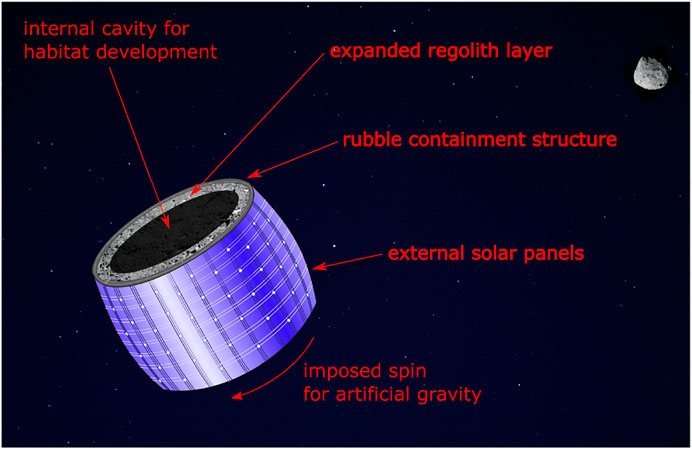
One problem I see with the concepts I have seen, is that they have to start big. You cannot do a little and then work your way up.
But I feel that with a double cone you might start modest and then work your way up.
In the concept I have there is a Ring/Torus and a Shaft/Hub and joining tensile bands and even then webs of fabric like a tent, where over time you can make the structure more substation, as is desired and convenient.
This drawing will probably be rather challenging to interpret: 
Imagine a torus without spokes, and a hub shaft joined together by ropes.
To minimize it more imagine that the torus is actually like a cable tray that an electrician would lay cables in.
https://electricalampere.com/types-of-cable-trays/
Image Quote: 
This ring is were the strongest synthetic gravity is to be, but you don't have to make the whole thing into pressurized space.
Instead, you put two or three capsules space out equidistant from each other on the ring-tray. It is walkable but only pressurized in the capsules.
I am reducing the substance of the device, to start with, adding the notion of expansion being available later.
The "Hub-Shaft" might just be a long pipe to start with. You might put docking ports at each end.
In this scheme you only have to provide radiation shielding maximum around the capsules on the ring.
In my drawing I show that as brown.
The tent is inflated by spinning. At that point under a rather low spin you can add the fabric to be the walls of the tent.
Then you can spin it up more.
Although a cable lift might be good for people and things to move from the capsules to the hub shaft, it may be possible for a human to walk up the angled walls to the hub from a capsule.
It can be understood that I am looking at ways to keep humans heathy to work in orbits near Deimos and Phobos or some rubble pile asteroid.
I am trying to minimize the needed starter mass.
Humans most likely will direct robots to extract and process materials from the two moons or an asteroid.
In truth a Starship, or collection of Starships spun about might do better as a start. But I am exploring the double cone as a habitat in space for humans. The idea is to start with a minimal frame and make it more substantial over time.
So, please have patience.

I have added a solar and a radiator disk. I am hoping to make this behave more like a Standford Torus than a single cylinder.
I don't want it doing gyroscopic flip-flops. I don't know if it will work or not yet.
I am trying to find a method to build a useful structure largely from the two moons materials, using methods including this: https://newmars.com/forums/viewtopic.php?id=11305
"Index» Life support systems» Flash Recycling, Salt Mining"
I expect that the Chlorine and Hydrogen has to come from Mars, but it can be recycled, to a large degree.
I am hoping for lower temperature method to extract Carbon and Iron and other substances from the regolith to create Carbon and Iron/Steel and other parts for the device.
The remainder of the regolith can then be incorporated into things like radiation shielding.
Over time a completed torus ring and a completed shaft/hub could be the direction of upgrades.
Left over rubble having the easy materials extracted might be incorporated into Urea-Concrete-Simulant created by microbes or incorporated into blocks of materials bonded by Mycelium growth.
The idea of getting iron/steel, using lower temperatures is attractive.
A first double cone structure could be rather inglorious, but then as it may serve to protect humans and robots to build grander ones, it might be a useful pathway to build substantial and very protective structures of similar nature.
Although I want to try to get them to be of a nature of not doing gyroscopic flip flops, I do think that over time they would be part of a common structure that they would rotate inside of.
When a more substantial version was made, the cones would be strong enough to hold a low pressure ~333 millibar O2 atmosphere, and the Torus and Hub would be able to hole an higher pressure N2/O2 atmosphere in them.
Well, I will put it to bed for now. Maybe others or I some time can do better.
Ending Pending
#72 Re: Exploration to Settlement Creation » Utilizing Ice Caves » 2026-02-15 12:13:54
I have added a poly film tunnel to help control sublimation and to help make distinction between the temperature control of the ice above and the dirt/rock floor below. 
Even on Mars, by natural convection, some night cooling will occur as like an ice cave on Earth. But we intend the poly tent to limit the sublimation of the tunnel ice. But we might like the regolith floor to dry out some. Where desired we could put a vapor barrier down and then put the sifted sort of regolith we desire on top of that, and it could be dry.
If the ice in places does sublimate away, we can squirt some low temperature water steam at it to refill the developing cavities.
I suspect that we could make supports out of Carbon or Steel, or from arches of created stone. Created by the Urea method.
I suggest that a form of precision fermentation or biological cellular process could make the materials such as Urine and/or cells.
Perhaps a culture of cancer cells growing forever fed with nutrients. Precision fermentation making urea?
https://www.cnet.com/science/mars-explo … and-urine/
Quote:
Mars explorers might make concrete-like materials from their own blood and urine
Gross. Blood, sweat, tears, urine and Martian dust could be a magic formula for building on the red planet.
If you had a form, you could put regolith mixed with these biological materials and let the microbes convert it into "Stone Arches".

I have added a artificial urea stone arch as support for the ice, and a heated pressurized habitat.
To heat your habitat you might use a heat pump, perhaps pulling heat out of the Martian air. As for the air in the poly enclosure in the tunnel you might regulate it. A tent is added over the entrance to better regulate the air exchange. Methods to regulate the temperature to be suitable to pull heat from the air in the tunnel to heat the habitat seem a possible option. Finding a sweet spot that is assistive to that, and makes the structure stable as per ice sag.
Energy is likely to be from various sources including nuclear fission, local solar, orbital solar beaming, and perhaps nuclear fusion.
It turns out that Carbon can make excellent power conductors.
Suggested references:
"Index» Life support systems» Carbon is the New Metal--- Also biological materials source."
https://newmars.com/forums/viewtopic.php?id=11299
We may not even need green plants at all, with precision fermentation, cellular farming, and Mushrooms.
"Index» Life support systems» New Food Sources. Precision Fermentation, Cellular, Synthetic"
https://newmars.com/forums/viewtopic.php?id=11196
Food, again.
"Index» Life support systems» Bogs and Bog, Floating Island Technology, and Roller Solar."
https://newmars.com/forums/viewtopic.php?id=11288
Unusual solar methods, and also food type methods.
"Index» Life support systems» Tunnel Arch Build Method"
https://newmars.com/forums/viewtopic.php?id=11188
A way to make multi-block arches.
And we need to pay attention to the fact tha this ice slab is said to be as big as Texas and California.
That means that you have ages of time to expand this system. Making more tunnels gives you more water and more shelter.
And there are other ice bodies similar methods might be applied to.
I said that you don't need greenhouses, not that you could not have greenhouses as well.
Ending Pending
#73 Exploration to Settlement Creation » Utilizing Ice Caves » 2026-02-15 11:28:26
- Void
- Replies: 4
Subject to moderator approval, we might explore this.
For Mars and other worlds, such as Ceres, the process of extracting ices can create a useful cave. Recent discovery indicates to me that these may be suitable to utilities desirable.
As a first example you might create a garage from a cave you created by extracting ice perhaps for its water. Such ice caves will have radiation protection.
So, a garage might be in the Mid Latitudes perhaps in a slab of ice that is perhaps >110 feet thick.
This is an oldie but perhaps a goodie: https://www.space.com/30502-mars-giant- … y-mro.html
Quote:
"It extends down to latitudes of 38 degrees. This would be like someone in Kansas digging in their backyard and finding ice as thick as a 13-story building that covers an area the size of Texas and California combined," Bramson said.
In Antarctica, Penguins make nests from stones, I believe.
https://iere.org/why-do-penguins-make-n … -of-rocks/
Quote:
Penguins make nests of rocks primarily to protect their eggs from flooding, provide insulation, and demarcate their territory. They gather rocks from barren, rocky landscapes, especially in harsh environments like Antarctica. The rocks help absorb heat and prevent eggs from becoming waterlogged, while also serving as a buffer against extreme temperature fluctuations. Additionally, rock nests help define individual territories within breeding colonies, reducing conflicts among penguins.
iere.org
So, this could be a basic bulk option that Mars can offer. Ice with dirt on top of it and rock at its base: 
So, having done this, you can have the penguins advantage and that of a burrowing animal to some extent. You also can consume the water that was extracted from the ice.
But as depicted this is going to be unstable as per concerns about sublimation, and buildup of heat.
The tunnel entrance can be polar facing as a start.
Sublimation is not the only concern; there could be tunnel sagging and collapse. The gravity on Mars is .38 that of Earth but we need to address all the concerns, with economy.
Thanks Calliban for post #2. I appreciate your attention. I will continue with post #3.
#74 Re: Terraformation » Creating a (small) Lunar atmosphere » 2026-02-14 19:08:07
Can you tolerate some dialog on this Terraformer?
I presume that in one case, an atmosphere like that can hang around if it behaves like the atmosphere of Venus per the forces that will take it away. And it will not do it as well as Venus.
The alternative is to impose a protective magnetic field which I presume would help, but would be expensive.
I am wondering if the O2 compressed into tanks could be lofted to orbit by some means and serve as reaction mass by some method.
If to burn with Hydrogen, then what of the exhaust? If flung out of a spaceship, perhaps by a mass driver, then what of the exhaust?
I wonder what happens to gasses released from spacecraft in Earth orbit.
More often it is flung out in a retrograde direction, as the main grunting is to push mass to a prograde direction. And I am punting here....
If the exhaust exits at the same speed as the ship is traveling, then it should drop strait down to the Earth's atmosphere. I don't expect that it travels that fast though.
All sorts of patterns are likely I presume. But if it ends in an elliptical orbit, it may brush the Earths' atmosphere at the low end and rejoin the atmosphere. This may be true for Hydro Lox. The Earth's magnetic field may slow down the materials if they are ionized, I presume. Another pathway to rejoin the Earth's atmosphere.
Of course I have my fantasy about throwing Oxygen Ice cubes out of a ship to propel it. If they somehow, could exit a ships mass driver at the same speed in a retrograde direction as the prograde direction of the ship, will they drop strait down to the Moons presumed atmosphere.
It don't know if this would ever lead to practicality, but in such a use case, you might be able to reuse much of the Oxygen many times.
This might help to justify a Lunar magnetic field. But of course, I expect an Oxygen ice cube to vaporize quite quickly if it is in the sunlight in a vacuum around the Lunar orbits.
Any ideas?????????
Ending Pending
#75 Re: Life support systems » Carbon is the New Metal--- Also biological materials source. » 2026-02-14 17:55:59
I ran into a video about using mushrooms for structures on Mars: https://www.bing.com/videos/riverview/r … ORM=VAMGZC Quote:
Radiation-Proof Mushroom Houses on Mars? NASA's Phase III Breakthrough Explained
YouTube
Space Startup News
1.1K views
I have recently read that high efficiency electrolysis of water is possible with Alkaline water without the use of Iridium, but perhaps with Nickle or other metals.
It has occurred to me that this topic dealing with the creation of Carbon Solids from things like Methane, the production of Hydrogen and Oxygen can be another path to useful things.
Precision fermentation, possibly using consuming CO2 and Hydrogen will produce Methane as a byproduct.
Methane can make Carbon Solids, and simple Carbon Solids could grow Mushrooms/Mycelium, I believe.
So, by involving non-biological and biological paths, various options may exist.
You could split water and keep the Oxygen as a propellant, and then do precision fermentation using CO2 and H2>>>Methane
For Rocket Fuel.
Or....
Then Split the Methane into Carbon and H2>>>back to the Precision fermentation.
Mix Carbon Solids with soil and then grow Mycelium on the Mix to produce structure and/or mushrooms for food.
So, with this process, (I think), you don't have to have biomass to grow Mycelium/Mushrooms, but could perhaps use non-Biological Carbon production to get structure and food.
And your precision fermentation can also produce things like synthetic milk.
https://en.wikipedia.org/wiki/Precision_fermentation
Quote:
Precision fermentation can produce a variety of foods and ingredients, including:
Dairy proteins (e.g., casein, whey).
2
Egg proteins (e.g., ovalbumin).
2
Lipids (e.g., alternatives to palm oil).
2
Enzymes and flavor compounds.
2
Nutritional factors like vitamins and antioxidants.
2This technology allows for the production of high-quality ingredients with minimal environmental impact, making it a promising approach for sustainable food production.
2
So then you might be able to get foods from precision fermentation and mushrooms.
Possibly cellular agriculture also to make artificial meat????
The point is you might bypass photosynthesis altogether, perhaps.
If you can base your foundations on CO2/H2/O2 + Energy >Food + Methane +Oxygen and Methane gives you Carbon and H2. You have a lot of what plants can do for you.
Over time with bioengineering Mushrooms might be improved per human food needs as well and for structures.
I hope I am correct in this.
Ending Pending