New Mars Forums
You are not logged in.
- Topics: Active | Unanswered
Announcement
#26 Terraformation » Orbital Platforms » 2026-03-04 09:31:43
- Void
- Replies: 9
The moderators can instruct me to modify these materials, and I expect I will comply.
I am putting the topic here as I get harassed less in the Terraform section than anywhere else.
I am at this time thinking of the Earth orbital environment, but I don't think we have to restrict the topic to only that.
SpaceX and others are suggesting the upgrade of the Starlink and other similar systems in orbits.
SpaceX and others are suggesting data center networks in sun synchronous orbits.
I am thinking of adding in the concept of service devices to "Service" the satellites in orbit.
I am thinking about solar Power Platforms, that have tethers that reach up into the lower Van Allen Belts, and down into the orbits that Syn Synchronous Satellites may be in.
So, something like this might be put into a Sun Synchronous Orbit to process slowly as to intercept Data Center Satellites: 
I am very willing to be corrected, this is rather sudden and I may have made mistakes in my thinking.
Two, solar platforms with electrodynamic tethers between them up and down, may provide a method to assist in the fetching of Data Center Satellites into such a device for servicing.
Perhaps an electric rocket device will "Fetch" one and then bring it to the center of Mass and then an elevator will conduct it to the service area.
The two platforms will have multiple tethers between them as they will be somewhat like flat solar facing collections of solar panels and the supporting structures. Some of the tethers will be electrodynamic, so the structure will be able to maintain itself in orbit against the thin atmosphere, reacting to the Earth's magnetic field.
Obviously, some consideration about space junk is needed. So, to avoid the Kestler Syndrome, this device may be assistive in helping to clean up the junk. But also, how to make the platform compatible with the data center orbits and avoid collision with them?
I have also shown tethers extending into the Van Allen Belt, the lower belt where the protons are. I have wondered if we could use it to preform transmutation???
Mercury to Gold is of interest. Granted it may be radioactive Gold, but in orbit, it may be of industrial use.
I agree that it is farfetched, but I got favorable responses on my "Smart Phone" and negative responses on my computer when browsing.
I would appreciate it if people would not trash this whole post because one item is questionable. We have several magnetic fields of interest in our solar system, Mercury, Earth, Jupiter, Saturn, Uranus, and Neptune. And Mercury>>>Gold may not be the only possibility.
Tethers that dip deep into the Magnetic field of Jupiter might be interesting places to try to obtain the results of transmutation.
https://www.iflscience.com/marathon-fus … gold-80132
However transmutation is it's own concern. The main idea here is a service center for Sun Synchronous Satellites.
In this concept, I am also very interested in stranded 2nd stages and space junk.
An example might be Terran-R and perhaps Rocket Labs Neutron 2nd Stage.
https://www.relativityspace.com/terran-r
I am interested in recovering them to a more permanent orbit, perhaps using Neumann Driver or Magdrive.
I am anticipating that if you have solar platforms in space, then you might beam power using lasers to a tug to fetch these pieces of space junk.
https://newatlas.com/energy/star-catche … ing-record
Quote:
The concept of beaming laser power to satellites has been explored since the 1960s, with recent advancements leading to the development of systems like Star Catcher Industries' Star Catcher Network. This network aims to beam concentrated solar power directly to client satellites' existing solar panels, enabling them to generate two to ten times more power on demand without the need for retrofitting. Star Catcher's technology has set a new world record for wireless power transmission, demonstrating the potential for a scalable energy network in space.
Interesting Engineering
+2
Quote:
What Star Catcher is working on is similar to DARPA, which holds the previous beaming record of 800 W set in June 2025. Instead of generating microwaves, a grid of solar panels power an optical multi-spectrum laser that can be aimed at a client satellite. These carefully controlled wavelengths are optimized to best suit the target solar panels.
Put simply, this would be like holding a huge magnifying glass on the target spacecraft, greatly increasing the efficiency of the panels without having to enlarge or even modify them. According to the company, the increase in power generation would be between two and 10 times using off-the-shelf panel components.
I think that the Terran-R 2nd stage has a fair amount of Aluminum, and the Neutron 2nd Stage will have Carbon. Both are useful. They will also have Meth-lox engines and propellant tanks that may be useful.
Perhaps Lunar landers could be made from those items.
In the future, I think it would be idea to have a Lunar Starship that only lands and stays on the Moon with a lot of Cargo, and a small Mini-Ship that can carry humans up and down from the Moon. Perhaps based on Terran-R and/or Neutron parts.
Ending Pending 
#27 Re: Not So Free Chat » Ask Robert Zubrin *Official Thread* » 2026-03-02 20:03:35
I respect Dr. Zubrin. Here is his video against a AI and Moon focus: https://www.bing.com/videos/riverview/r … &FORM=VIRE Quote:
Dr. Robert Zubrin: Abandoning Mars could be Elon Musk’s biggest mistake
YouTube
Ellie in Space
88 views
7 hours ago
I think he may be a little too worried. I think the actual intent is to make space AI viable from Earth launches, and then later to experiment with the possibilities of the Moon. This will allow a lot of hardware to be tested which may relate eventually to a Mars application. But by running parallel to the Artimus accords, many other nations will sponsor some of that hardware.
I also suspect that Elon Musk has another card up his sleeve for Mars, I choose not to say what it would be.
But it is important to listen to Dr. Zubrin as well, is one of the clever and aware people.
Ending Pending
#28 Re: Terraformation » Rubble Pile Sinter/Glass Jar/Double Cone, Ceres » 2026-03-02 11:07:21
The idea of artificial worlds has quite a lot of history.
I recall as a boy reading a book that suggested that asteroids could be melted and inflated like glass bubbles with gasses.
Then https://en.wikipedia.org/wiki/Gerard_K._O%27Neill and company suggested mass drivers on the Moon to shoot packets of Lunar regolith to a L4 or L5 location, as I recall. Image Quote: 
Apparently, they felt that an economic case could be made for beaming power from space to the Earth.
Recently Anthro-futurism: https://www.youtube.com/@Anthrofuturism has made a case for moving useful mass from the Moon to a span between the bottom limits of the Van Allan Belts, to LEO: https://www.youtube.com/watch?v=8DUydTgyGQ0&t=16s Quote:
The Lunar Mass Driver Orbital Supply Chain
ANTHROFUTURISM
These will not be emissions of Lunar Regolith but creations of processed materials with on board propulsion capabilities. They seem to intend to bring some resources, and the propulsion systems are expected to be materials repurposed.
It seems that Elon Musk/SpaceX intend to make Satellites and loft them in a similar fashion from the Moon to Sun Synchronous orbits.
Before they do this from the Moon they will send such Satellites to Sun Synchronous Orbits as Data Center elements.
In any case this leads to the question of materials recycling as these devices will over time malfunction and also become out of date.
Star links are dumped into the atmosphere in a planned way if possible, at this point. The Sun Synchronous Data Center Elements will be in a higher orbit.
So, I presume that it makes more sense to rebuild, recycle, repurpose these as they go out of service, rather than to dump them into the atmosphere. This may become true for Star links eventually as well, I think.
These devices will probably include a power supply, likely solar in nature, radiators, Data Chips assembly, and perhaps radiation shielding, as parts.
Space Startup News: https://www.spacestartupnews.com/ seems to opinion that Aluminum is a very recyclable material. So, I am going to guess that radiators will be highly recyclable. Other parts such as chips and solar panels, probably less so, might be melted to make some radiation shielding, at least.
If there is going to be a recycle center in LEO+ orbits, then I kind of like a two Starship scheme.
1) You want 1 reusable Starship, and
2) You want a modified expendable (Not Really) Starship.
#1, might be mostly for propellant delivery to LEO.
#2, might have an Aluminum upper Fairings mounted on the Stainless-Steel propellant tanks. No flaps, heat shield, header tanks, Landing Propellants.
#2 would bring Satellites to LEO and then be refilled by #1. Then #2 would travel to Sun Synchronous Orbit.
If you are going to have a recycle center for old Satellites, then it also might be able to render a Expendable (Not Really) Starship as well.
So, the Starship could be rendered into useful parts, and so recycled and also old Satellites.
Propulsion for the rendering space station might be Magdrive or Neumann Drive. I understand it needs lots of electricity. But you could have power satellites in orbit that could beam power to the rendering space station so that its mass can be kept to a reasonable limit.
It could propel itself using that beamed power and some of the waste mass from Expendable (Not Really) Starships and old Satellites.
So, this may be a way to begin creating larger space habitats as well.
Ending Pending
#29 Re: Not So Free Chat » Heatlth Extension/Life Extension, on Earth or for Space » 2026-03-01 16:12:54
Mouse medical achievements often don't transfer to humans but:
https://www.bing.com/videos/riverview/r … &FORM=VIRE Quote:
BREAKTHROUGH 100% Life Extension Achieved in Mouse Study
YouTube
Longevity Science News
5.1K views
1 day ago
It is a maybe in my estimation.
By using the bodies systems to clean and rebuild. It has already been said that nature does not care that much about you after the time of fertility is passed, except that you might serve your descendants genes, or close relatives' genes.
But in general perhaps the math of natural evolution prefers high replacement rate to rebuilding.
But if this has merit of course it will catch on.
Ending Pending
#30 Re: Not So Free Chat » Peter Zeihan again: and also other thinkers: » 2026-03-01 09:49:26
This perhaps continues the recent dialog: https://www.bing.com/videos/riverview/r … &FORM=VIRE Quote:
EXCLUSIVE: The Case For Merging Tesla And SpaceX
YouTube
Brighter with Herbert
610 views
1 hour ago
So for the moment the merger is being talked about by some, not sure it will happen as suggested.
Ending Pending
One take-away from "Larry" I think is that this business model does not require a reusable Starship to be economically fit. I presume that the 1st Stage needs to be reusable though, like for Falcon 9.
Ending Pending
And I say if the Starship is not reusable you still might have the option of Disposable-Not-Rally. IF the two header tanks were filled with Argon instead of Oxygen and Methane, then if you had a Electric tug, you might tow the expended Starships to a higher orbit to be scrapped, rather than to toss them into the Pacific.
The expended Starships might be converted to space Stations, or perhaps hardware for other things, like perhaps somehow to integrate with data center efforts.
It is a different game to reuse the mass you sent to orbit in orbit. Otherwise, you are dumping ships into the pacific
We may also involve Magdrive or Neumann Drive. These may be practical if you have beamed power in space. We think of beaming power from orbital satellites to a Neumann Drive or Magdrive, but in reality you might be able to beam power up from the surface of the Earth to a Tug that tows Starships from LEO to just below the Van Allen Belt.
Some weather conditions may allow it.
Ending Pending
I would speculate that a pair of ship, one tanker and one light weight expendable might be ideal.
The light weight expendable, might have it's upper part made of lighter materials like Aluminum. So, it would bring a load to LEO, and then a Tanker would refill it, and it could carry data center Satellites to Sun Synchronous and release them. Then a recycle center would overtake the expendable ship and salvage it into useful materials to help maintain the data centers.
Ending Pending
#31 Re: Terraformation » Rubble Pile Sinter/Glass Jar/Double Cone, Ceres » 2026-03-01 08:36:51
I think that there will be a difference in how materials can be acquired into orbit from various worlds.
1) Rubble Piles, likely can simply have materials removed with special crafted machines.
2) Very small worlds, like Ceres might dominantly use space elevators.
3) Small worlds like the Moon and Callisto might use mass drivers maybe rotavators. Or at greater expense, rockets.
#1 includes some terrestrial crossing worlds, Demos, Phobos, and the Main Asteroid Belt, the Greek Asteroids and the Trojan Asteroids.
#2 includes Ceres, Vesta, and other exceptional asteroids. https://en.wikipedia.org/wiki/List_of_e … _asteroids
#3 Includes our Moon, Mars, Callisto, Ganymede, Mercury.
Wields beyond the orbit of Jupiter may tend to be ice bound with less exposed rocky materials. Although Titan might have dunes of comet dust, (Or not).
#1 could export raw materials, rocks more or less.
#2 could export raw materials and finished materials.
#3 probably has to export finished materials Like Satellites and Rocket Stages with on board propulsion methods.
So, Earth is not 1, 2, or 3. The Moon is #3.
Deimos and Phobos are #1, and Mars is #3.
The asteroid belts include #1 and #2.
So, although the Moon can be an asset with very large effort, Deimos and Phobos, can offer raw materials to orbit with relative ease. Although Mars is a grunt, small amounts of what Deimos and Phobos lack can probably be extracted from them.
To get to the asteroid belt is to get the full spectrum of materials to orbits, relatively easy and in bulk.
I favor the sinter shell with a rotator in it to give synthetic gravity. Here is how the bearings could be handled: 
I think current advanced train technology could handle it. The relative speed at the shown positions of rails, as bearings will be slow enough, I think. Like a washing machine, it the rotator gets out of balance the speed of the rotator can be reduced, until the load is corrected.
In the prior post I have shown a junction of two sinter jar devices, but 3, 4, 5, and 6 at a junction might be possible.
So, Phobos and Deimos could be converted into enormous platforms with large inertia from which perhaps Mass Drivers might launch loads.
Bringing Ammonia and Methane up from Mars to compliment the materials of the two moons of Mars.
The rotor could be spun up from standstill while vacuum pumps evacuate the area between the sinter shell and the rotor. In the event the rotor has to be slowed down, a careful refilling of the vacuum with air might help facilitate that.
Ending Pending
I am hoping that Demos/Phobos/Mars & the Asteroid Belt, may be able to send materials to the Earth/Moon orbits and to the Moon.
Ending Pending
#32 Re: Terraformation » Rubble Pile Sinter/Glass Jar/Double Cone, Ceres » 2026-02-28 21:05:50
Here I have exaggerated the linking passage between two spinners which are hosted inside of sinter shell.

As I indicated on the drawing I exaggerated the size of the connecting passage.
Each spinner red or blue has an inflatable spin lock. Actually, inflating each spin lock which pulling vacuum on their outsides will cause the to bow out a bit, and you could put some kind of bushing/seals to limit the leakage though the connecting tunnel from the place of doors.
So, I have described the spinners as starting and stopping, and they might do so, but don't have to because if the mechanisms are working properly, could move from one spin lock to the "Doors" area to the other spin lock through "closable to be airtight doors".
In a case where there is a massive leak of air into the vacuum (Grey Color), the volume of vacuum is sufficiently small (We intend) that the depressurization will not be a major medical issue.
The Sinter-Shell(s) which are to be stationary, are to be corseted by tensile strength using things like Steel bands, or Carbon band/net, so that the Sinter-Shell can endure pressurization in that event. The Sinter-Shells may also have a balloon like air retaining liner as well.
So, great arrays of these things might be linked together, and people might pass between them relatively safely.
(I hope)
Ending Pending
#33 Re: Terraformation » The Moon » 2026-02-28 20:40:19
https://www.youtube.com/@Anthrofuturism Put out a nice video: https://www.youtube.com/watch?v=8DUydTgyGQ0
Quote
The Lunar Mass Driver Orbital Supply Chain
ANTHROFUTURISM
Two of three possible purposes for this sort of thing are mentioned.
1) Orbital power beamed to Earth.
2) The Lunar Mass Driver Orbital Supply Chain (What this video is about)
A 3) Option which is data centers in space are not worked on.
But it is a very good video, and I learned a bit more about what is possible/practical and why.
Ending Pending
#34 Re: Terraformation » Rubble Pile Sinter/Glass Jar/Double Cone, Ceres » 2026-02-28 16:15:59
I want to consider a "Carbon Wrapped Sinter Jar", as habitat. Nod to Tesla and E. Musk.
I have had my eye on Deimos/Phobos/Mars as a good place to make orbital civilizational structures as well as on Mars.
I have looked Urine Bricks as a substitute, but this case might work well for the sinter method.
I think similar structure on the Moon might be suitable also.
Tensile wrapping a sinter jar, can be supported by this video: https://www.youtube.com/watch?v=EE-AGrN4JDs
Quote:
Elon Musk's New Motor Just Ended the EV Race Before It Even Started
Nexovery
369 subscribers
(I wanted to post the video somewhere, and this will do).
https://scitechdaily.com/turning-lunar- … sintering/
Quote:
Turning Lunar Dust Into Space Bricks for Moon Bases Using Microwave Sintering
Sintering: Sintering objects on the Moon involves using lunar regolith, the surface soil of the Moon, to create strong, homogeneous building materials. This process, known as in-situ resource utilization (ISRU), allows for the construction of lunar infrastructure without the need for transporting materials from Earth. The Moon's regolith, composed of silicates, oxides, and tiny bits of metallic iron, can be heated and sintered using microwave sintering, which is particularly energy-efficient and can be performed during the lunar night. This method has been tested and is being developed for use in lunar landing pads and other infrastructure on the Moon.
I am interested in extracting some materials from the regolith before sintering the "Tailings" into a sintered Jar.
Various methods are available. Salt Mining apparently is one good one: https://newmars.com/forums/viewtopic.php?id=11305
"Index» Life support systems» Flash Recycling, Salt Mining"
We might hope to extract the Iron from regolith using a method in this video: https://www.bing.com/videos/riverview/r … ORM=VAMGZC Quote:
A new way to make steel competitively at room temperature
YouTube
Rowow
1.8K views
A recent probe to Deimos suggests that it is made of Mars basalt. Previously it was thought that Carbon would be present. In any case there should be some Iron.
In any case Mars, itself can provide Chlorine, Carbon, and Hydrogen to the process if necessary.
If the above method will not be practical then you could roast the dust of Phobos and/or Deimos in Hydrogen and extract a concentrate of Iron magnetically.
So, there will be several processes. I expect that Iron and some Oxygen will be extracted at least.
Then you might sinter the "Tailings" into a "Double-Cone-Jar". On our Moon, perhaps you could sinter it into single cone jars that perch on the surface. If you import Carbon, you might wrap those in Carbon or Steel tensile materials.
The Jars might start thin but have more materials added to them over time. Perhaps to be thick enough to block radiation sufficiently. Perhaps 2 to 3 Meters Thick, perhaps?
You probably would need to protect the outside from impactors and thermal shocks with some sort of materials.
The double or single cone jars are not the only shapes that could be used, but I start with them as it seems sensible that all parts of them can be wrapped with tensile bands or webs of some sort.
Inside of the jars, I would expect to have a balloon type envelope to help hold in air, even if the jar cracks.
From post #29 again:
Quote:
Previously disks and cylinders have been considered, I like a double cone jar:
The above drawing is a "Cut-Away" I show one major "Double Cone" in the center, with a rotator, and four smaller attached "Double-Cones".
#1 might be used as a greenhouse. #3 might be used as a radiator.
the rotator inside of the major double-cone jar, can be throttled up or down as per spin rate. During high spin rate, the air will be pumped out of the gap between the spinner and the spinner and the Jar. But periodically air from inside of the spinner can be let out into the gap, after the spin rate has been reduced. So, spin gravity would be periodic.
My logic for synthetic gravity in a double cone is that the ring with highest gravity is not likely to be required all day long for a human. At least I suspect that.
People do not spend 24 hours a day standing and straining in a 1 g gravity. If much of your day is at 1 g, you might have your bedroom somewhere with lesser gravity.

Although you could, I do not intend that the "Jars" will spin themselves but have spinners inside of them.
Part of a day, you might have a high spin and evacuate the air from the gap between the jar and the spinner. Part of the day you might lower the spin to tolerate full air pressure in that gap. So, during that period people could pass between Jars, fairly easily.
The number of attached Jars could be extremely large, perhaps even encircling a worlds orbit, if you could compensate for tidal forces in that orbit.
For this reason, I see Mars colonization to be as much about the surface of Mars as in the orbits of Mars.
Such schemes like this could work for the Asteroid Belt, Mercury, and the orbits of Jupiter.
And if bulk materials can be extracted from out Moon, and volatiles can be brought in from the more outer solar system, then this could work for the Earth/Moon.
But Deimos/Phobos/Mars, looks like the easiest place to do it the soonest.
Ending Pending
#35 Re: Terraformation » Rubble Pile Sinter/Glass Jar/Double Cone, Ceres » 2026-02-28 11:22:45
Types of synthetic gravity I think can be useful:
-Standard Earth Gravity Simulation. 1 g.
-Up/Down sensed gravity. The Moon apparently is not enough for this. so >1/6th g and less than or equal to 1 g.
-Health Gravity could be less than 1g. We don't know yet.
-Sanitary Gravity. (Do disgusting emissions clean by falling to the floor?)
-Microgravity (Needed for many products to be produced. (We presume at this point).
I think that two primary structures of a double cone nature can be valuable to build and use.
1) Radiation Shelter, which also may provide additional protections.
2) Radiator.
I have already explained #1 to some extent.
But a Sanitary Gravity version amuses me. This might be where you have a low velocity spinner, that can self sanitize with the low gravity and does not require a vacuum jacket to spin in. I like to think of the gravity of Ceres as a possible target.
Because the gravity is so low, the interior is more of a 3D habitation than a surface habitation. There could be gardens in this.
Because it is 3D, you can more effectively use the entire volume of the radiation shield. Because it has a spinner inside of the radiation shell, some amount self-cleaning is imposed.
This would be a place where you might fly or operate like a monkey in a jungle.
I have suggested a floor appliance for this in this post: https://newmars.com/forums/viewtopic.ph … 23#p238323
Very funny, I think, a Shoe with robot fingers, maybe a lobster flaw grasper, eyes, and a robot brain. Capable of taking voice instructions, and also responding to toe movements. Perhaps connected to the brain with Neuralink.
From post #29:
So that living in orbit of Ceres might not seem a grim thing, I have added a possible method of greenhouse. Very low gravity and at least somewhat lighted.

The spinner and also the outer shell will both be pressurized. The spin rate will be slow enough that this could be tolerated. We only want a little synthetic gravity.
I have provided that there might be some window or fiber optic method to move sunlight into the interior. However, honestly, I prefer the idea of artificial lights. We are getting better at that, and we also understand that humans need red light and just a little UV. So, it will not be office building blue light only.
Since the interior is going to be more 3D than 2D in function, much may be packed inside, and we may need a heat removal method.
Here is a cut-away view of two options: 
The interior of the radiator may be Oxygen filled as it is a useful and yet very common gas to obtain. Perhaps at 1/3 bar.
Robots within the radiator will have patching abilities to implement on short notice.
Here is how the radiator wall might be implemented: 
The Chevron Radiator fins may shed heat into the vacuum and offer some protection from impactors. Patching robots may respond quickly to patch a leak, it is hoped.
The tubing coils would allow a fluid to conduct heat to the radiator wall. And you might use a heat pump process to "Amp" this up a bit.
The radiator is a reserve oxygen supply, and even an emergency refuge. The Oxygen within will help to redistribute heat in the walls, if you add in forced convection fans to the process.
>>>>>>>>>>>>>>>>>>
We do not yet know how humans will adapt to the space environment.
Sitting in a chair or resting on a bed is a bit like being exposed to low or micro gravity.
I will suggest something really weird now. Let's suppose you could sleep while you exercise in a 1 gravity field simulation.
So, then 8 hours of brain sleep while you exercise, and then you could do 16 hours of body rest while you were awake.
OK, let's modify that. 1 hour brain sleep exercise, and 7 hours resting sleep, maybe standing in a 1 gravity field.
Then 16 hours in low gravity, maybe more than microgravity.
Weird to think of, but maybe something Aliens might have arranged for themselves.
I think this is good materials for Sci-Fi Stories.
Oh No! My computer brain is making me do stupid things while I sleep and only lets me wake up occasionally.
Ending Pending
I am presuming you would have a computer augmentation to your brain system. It could take you out while your brain was induced to sleep, and exercise your body.
#36 Re: Not So Free Chat » Peter Zeihan again: and also other thinkers: » 2026-02-28 11:16:16
I see your immune system is active. That is not necessarily a bad thing.
As for my assessment of future events, "I DON'T KNOW" explains it efficiently.
I am elder and retired, and for me it is potential entertainment on my way to my termination of existence in this world.
I already do not drive this world at all, if I ever did.
I will see what happens, until I don't see what happens.
That's about it.
I dipped my toe into some low-level programming before I retired. I was tempted to continue with it as a Hobie, but I anticipated that everyone in the 3rd world would want to make money coding. And I was while employed responsible for the software of my department. So it was less a toy than a stressful task.
I did know that Excel could write macro code, so I figured, coding would eventually make me outdated. I was very correct.
I am along for the ride, until my dirt nap comes.
I hope things will go well, but history says very likely monkeys at the steering wheel will also make some things wrong.
Ending Pending
#37 Re: Not So Free Chat » Peter Zeihan again: and also other thinkers: » 2026-02-27 13:54:15
This is a cultural item, I guess, and I don't want to start another topic for it, I will put it here. The Cyber-cabs will be a form of transport robot.
https://www.bing.com/videos/riverview/r … &FORM=VIRE Quote:
Tesla Just Made the Biggest Bet in Industrial History
YouTube
Farzad
11.7K views
I am sure there will be denial and cultural resistance/disruption for this.
I expect that if it works on in one part of the USA or one country in the world, it will eventually become almost universal.
It is a curious matter that some kids may never get drivers licenses or learn to drive.
As for you, you will have to see what you care to believe about it and what you eventually get forced to believe.
I think that the old guard is already having some level of allergic level reaction to it.
Ending Pending
#38 Re: Science, Technology, and Astronomy » Humanoid and other robots. » 2026-02-27 09:17:41
I have had an amusing thought. "Foot-Hand-Shoes".
Shoes with fingers, may be possible, by adapting robot hands that are under development at this time.
Or lobster claws shoes: https://earthlymission.com/vadoma-ostri … rodactyly/ Image Quote: 
Hand or Ostridge/Lobster robot shoes. With a brain in each shoe and eyes as well. Able to respond to toe movements and perhaps verbal commands.
With Neuralink, you might also be able to wirelessly communicate with them.
Of course, these might be valuable in low gravity environments.
And of course they might be useful for humanoid robots that were to work in such low gravity environments as well.
I have some liking of the gravitation of Ceres for orbital gardens in synthetic gravity.
Such robotic feet may be of value in such environments, and also very amusing.
Ending Pending
#39 Re: Terraformation » Rubble Pile Sinter/Glass Jar/Double Cone, Ceres » 2026-02-27 09:06:23
I guess I could put this here as reference, from a Grandparent Mind Inheritance for all of us: https://www.youtube.com/watch?v=JGoiWdkuKr8 Quote:
A 30-Metre Wheel Spinning Every 8 Seconds: The Dizzying Truth About this 1929 Spinning Space Station
Space Startup News
Pending Ending
#40 Re: Life support systems » Bogs and Bog, Floating Island Technology, and Roller Solar. » 2026-02-27 08:07:44
Well, I think this item from the Electric Viking might fit in to some version of what I have suggested in the previous two posts: https://www.bing.com/videos/riverview/r … &FORM=VIRE Quote:
Solar Waves: The Modular Solar System That Changes Everything
YouTube
The Electric Viking
2.4K views
10 hours ago
Perhaps it could be blended with what I have attempted to think about, and also perhaps also associated with an irrigation system: 
Presumably if cleaning happened at night the gel on the rear side of the panel might absorb some of the evaporation from that process.
Another option in some locations would be to air cool the soil in the wintertime, using the buried piping. Winter air pushed through the pipe might allow to formation of a "Semi-Permafrost". But of course, in buried pipes you would have to avoid bursting pipes with expanding freezing water.
During the day, when there might be excess solar energy, you might run the convection fan to push cold winter air though the underground piping.
When spring would come then you might push humidified air from the solar panel gel into the pipes, again in such a pattern to avoid pipe damage.
Even if you had frozen the soil to some depth, over the winter, in Alaska, it is not uncommon to grow gardens on top of permafrost. It could complicate things though.
And of course finally you might involve your underground piping it a heat pump process somehow. I am just saying you might. By pulling heat out of the ground you might heat some buildings.
Heating buildings might cool the ground. IF you had a closed air circulation system then you might not lose moisture from the soil doing this. But when the time came to collect the moisture from the gel cooling the solar panels, you would then use more of an open-air flow.
Heating an industrial process using ground heat might be a more practical option.
OF course the more complex a system becomes the more expensive. But with more complex robots to make hardware, the costs of hardware might go down.
If you were cooling the soil with a heat pump method, then you would not have to push it to the freezing point.
And if you have irrigation water available, with a system like this you might get the best use of it.
The solar panel system explained by the Electric Viking apparently can collect rainwater as well.
Ending Pending
#41 Re: Life support systems » Bogs and Bog, Floating Island Technology, and Roller Solar. » 2026-02-26 11:08:56
Having a further look at the previous post, perhaps I will have to change the title of this topic, but for now, I will not.
I have turned my eye further towards arid lands and grasslands. These will tend to have greater differentials of day/night temperatures, which on Earth like a future partially terraformed Mars may have value.
https://skybrary.aero/articles/cold-sem … limate-bsk
Image Quote: 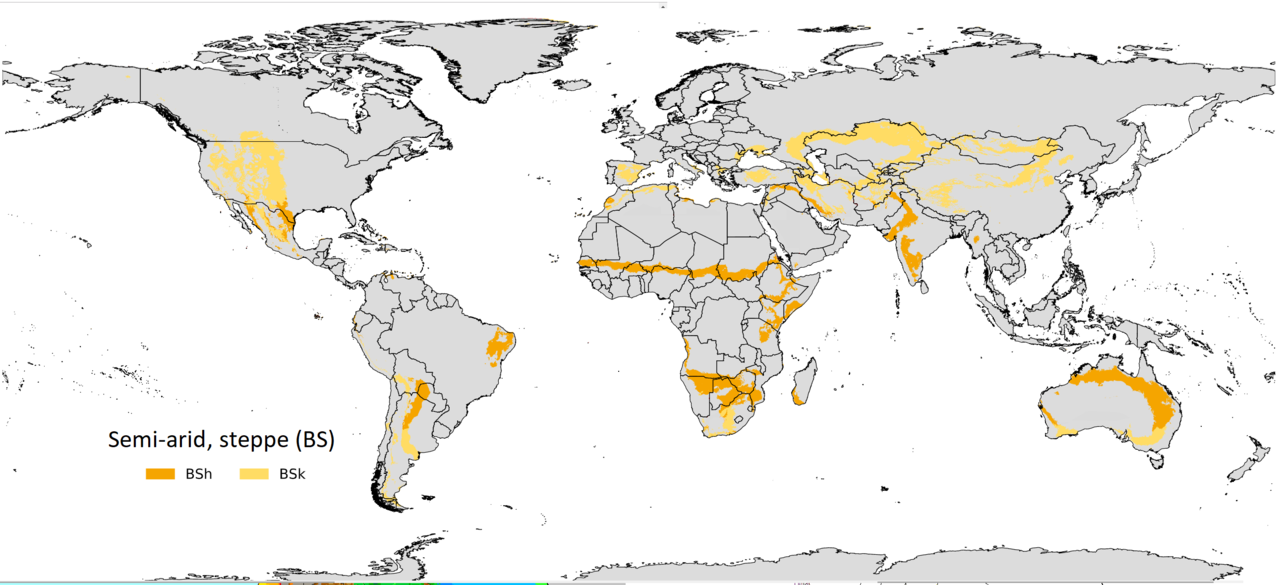
The map seems to indicate that North America has a large portion of land that is not quite desert, but may have some amount of useful moisture more than a desert.
This could be very useful, if an atmospheric condenser technology would become practical economically.
The climate is likely to have sunshine, and cold nights, and moisture to condense. Additionally winter cold can move through much of its continental climate.
These tend to be the regions of North America with lower populations, except for Canada, where you have to find your better hope of farming where you can.
So, as areas where solar energy may have advantages, atmospheric condensation may also be in association with that:
The notion is to add to the already listed benefits.
-The gel absorbing moisture from the air at night,
-Gives it up to the air during the day.
-Using forced convection, the moist air is conducted through a pipe network that is also the supports for the solar panels.
-The ground being shaded and cool may condense the moisture into liquid water, which leaks out of the pipe in the soil to water plants.I anticipate as others do that robots will lower the cost of hardware, perhaps justifying this method.
Didn't think of it before but the plants, seeking CO2 will give up moisture to the gel, the soil will as well.
Some prarie lands might also benefit from the method: https://slidetodoc.com/fire-ecology-of- … ms-ranged/
Some other maps are here: https://fity.club/lists/suggestions/Sem … imate-Map/
Image Quote: .png)
Using cold, moisture might be better managed.
The solar panels will experience the cold of night, and so with the gel may capture moisture.
The soil being shaded by the solar panels, and being cooled with night air, and winter air, may be a reservoir of cold.
If the moisture in the gel exits the gel to cool the solar panels, it might be conducted to the cold in the ground. And so become another sponge for moisture. During the night when the gel may be absorbing moisture from the air, the ground and vegetation growing on it may give up moisture from the ground that the gel may absorb.
By putting up solar panels, the surface area of the arid area is increased, but the amount of total sunlight is not increased. (Unless you send more from space).
More surface area means more cooling potential, and normally could mean more evaporation of exposed moisture, but the cooling gel may reduce net evaporation by capturing dew and near dew moisture from the air.
The cooling gel was apparently conceived of in Saudi Arabia: https://globalenergyprize.org/en/2025/0 … di-arabia/ Quote:
Cooling gel doubling the service life of solar panels was created in Saudi Arabia
12.06.2025 in News, Science and Technology
I expect that it increases efficiency as well by cooling the solar panels.
https://synthorum.com/articles/cooling- … fficiency/
Quote:
About 1,170 results
Innovative Cooling Methods for Solar Panel Efficiency
Yes, cooling solar panels can significantly increase their efficiency, with potential improvements in energy output ranging from 10% to over 20% depending on the cooling method used.
Impact of Temperature on Solar Panel Efficiency
As the temperature of solar panels rises, their efficiency typically declines. This is due to the thermal dynamics of photovoltaic cells, which can lead to reduced energy output when temperatures exceed optimal levels. Effective cooling strategies are essential to mitigate overheating and maintain higher efficiency levels.
synthorum.com
Cooling Methods and Their Benefits
Passive Cooling: This method relies on natural heat dissipation without additional energy input. Techniques include airflow management and shading, which can improve efficiency by about 10%.
1
Active Cooling: This involves using pumps and fluids to actively dissipate heat. Active cooling methods can increase solar panel efficiency by 15% to 20% or more, depending on the system and environmental conditions. For example, evaporative cooling can lower panel temperatures by 10–15°C, particularly effective in arid climates.
1
Advanced Techniques: Innovations such as phase change materials (PCMs) and heat pipes can enhance heat transfer and maintain uniform temperature distribution, further improving performance with minimal energy consumption.
1
Hybrid Systems: Combining different cooling methods, such as air and water cooling, can maximize efficiency gains, especially in large-scale solar installations.
11 Source
Conclusion
Implementing effective cooling strategies is crucial for optimizing solar panel performance. By maintaining lower operating temperatures, solar panels can produce more energy, thus enhancing their overall efficiency and longevity. As solar technology continues to evolve, integrating advanced cooling solutions will play a vital role in maximizing energy output and improving the sustainability of solar energy systems.
synthorum
So, I think that if piping could double as support frame for solar panels, this might be useful.
My hope is that with more advanced robotics, the cost of such pipe/frames will be deflated over time.
I intend to adapt this to solar collectors on water at a later time, as I need to move on with my day now.
Ending Pending
#42 Re: Life support systems » Flash Recycling, Salt Mining » 2026-02-26 05:40:05
Posting again about "Salt Mining": https://www.youtube.com/watch?v=UMI_ITPgirI
Quote:
Saltwater + Electricity Can Extract Precious Metals (SEM TECH Explained)
Rowow
I am thinking about regolith rubble created by the solar system over billions of years, and also remnants of saltwater oceans on other planets such as Mars.
The evaporites, on Mars are likely covered over with wind borne deposits, and perhaps by ice layers.
If this tech does work as well as the advocate claims in the video, then the solar system will have much to offer.
Ending Pending
#43 Re: Science, Technology, and Astronomy » Genetics » 2026-02-25 17:16:54
I like that this is getting towards rational. Not quite perfect but much better than notions of the past.
https://www.youtube.com/watch?v=GnMuL5rBoXw
Quote:
What DNA Researchers Now Know About PALE SKIN Proves It's Genetics Are More Complex Than We Thought
Ancestry Decoder
I do not think that sunlight only and vitamin D are the only part of the issue.
The vitamin D issue is also modified by wearing clothing and by staying indoors. When it is cold, if you can afford to you stay indoors more and you wear clothes if you can. This blocks even the sunlight you get in the winter.
India and Europe are different in other ways. If you have to work outside in India, and the work is going to overheat you may expose more skin.
This then gives less permission for the skin to turn lighter.
And is pigment worth the trouble? Is it even possibly a burden? Why do cave creatures lose pigment? I guess it must not be worth it to have it in a sunless environment.
https://sciety.org/articles/activity/10 … .14.664374
Quote:
Evolutionary adaptations to their cave-dwelling lifestyle
Why do cave animals lose pigment?
Cave animals lose pigment as a result of evolutionary adaptations to their cave-dwelling lifestyle. The loss of pigmentation is a hallmark adaptation of cave-dwelling animals, which includes features such as reduced eyesight or blindness, and frequently with attenuated bodies or appendages. This adaptation is characterized by the morphological changes that allow these animals to thrive in the constant darkness of caves. The loss of pigmentation is generally considered to be an evolutionary tradeoff, as these characters are no longer useful in the dark environment. Instead, improved secondary sensory structures are selected for, allowing for better navigation and survival in the cave environment.
Sciety
So, I speculate that even if humans could generate vitamin D, as very distant ancestors are said to have been able to do, decreased exposure to sunlight may have promoted a skin lightening anyway.
Pigment is either a burden for the body to make, or might even be toxic to some degree, but more helpful than harmful in sunny exposures.
The burden issue is demonstrated by pale cave creatures. (The best part is no part). So, they get rid of it. But the toxic issue, I have no evidence for, just speculation.
I think it is best to understand that skin tones are not Majic, but simply things that can be understood.
But as they said you also do need access to some sort of genetic method to lose pigment to have lighter skin.
Ending Pending
#44 Life on Mars » Ocean Nodules on Mars » 2026-02-25 16:13:37
- Void
- Replies: 0
https://en.wikipedia.org/wiki/Manganese_nodule
Quote:
Polymetallic nodules
Polymetallic nodules, also known as manganese nodules, are small, hard, round rocks that naturally form at the bottom of the ocean. They are found in nearly every ocean on Earth and can cover many thousands of square miles of flat, sandy seafloor known as abyssal plains. These nodules form deep water, usually between 13,000 and 19,000 feet (3,960-5790 m) below the surface, and typically measure just shy of one to three inches (2-8 cm) in length. They are very porous, meaning they are full of tiny holes, with empty space making up at least 25 to 60 percent of their total volume.
Smithsonian InstitutionPolymetallic nodules are formed by the precipitation of metals such as manganese and iron from seawater. These metals accumulate around shell fragments or shark teeth, creating a concentric layer of iron and manganese hydroxides around a core. The formation of these nodules takes millions of years and involves a series of redox oscillations driven by both abiotic and biotic processes.
Smithsonian MagazineThe discovery of "dark oxygen" in the ocean's Clarion-Clipperton Zone has revealed that these nodules may be natural "geobatteries," splitting seawater into hydrogen and oxygen through an electrochemical reaction on their surfaces. This process occurs at depths where the lack of light makes photosynthesis impossible, suggesting that "dark oxygen" plays an important role in the deep-sea ecosystem.
WikipediaPolymetallic nodules are not only significant for their potential economic value but also for their role in the deep-sea ecosystem. They support diverse microhabitats and contribute to the production of oxygen in the ocean's abyss.
Wikipedia
I am not sure if I believe in the "Dark Oxygen" notion. I need to know where the energy comes from. Electrical ground currents maybe?
But if Mars had a long lived mostly Northern Ocean, then maybe these were formed.
I expect that wind deposits would have covered them up. The South Hemisphere being more elevated and gravity and wind doing their work.
But there could be a twofer in this, as to find them is to get the resource and to also perhaps find evidence of prior life, even perhaps life that used Oxygen.
https://en.wikipedia.org/wiki/Mars_ocean_hypothesis
Quote:
Copilot Search Branding
Massive Mars water discovery gives clues to the Red Planet’s past | by Robert Lea | Predict | Medium
Mars is believed to have once harbored a vast ocean, potentially covering half of its northern hemisphere, with evidence suggesting it existed around three billion years ago.
The Mars Ocean Hypothesis
The Mars ocean hypothesis posits that a significant portion of Mars was covered by a primordial ocean of liquid water, often referred to as the Paleo-Ocean or Oceanus Borealis. This ocean is thought to have filled the northern lowlands of Mars, particularly the Vastitas Borealis region, approximately 4.1 to 3.8 billion years ago. Evidence supporting this hypothesis includes geographic features resembling ancient shorelines and the chemical properties of Martian soil and atmosphere.
Wikipedia
Recent Discoveries
Recent studies have provided compelling evidence for the existence of this ancient ocean. For instance, researchers have identified delta structures in the Valles Marineris canyon system, which resemble those found on Earth where rivers flow into oceans. These findings suggest that rivers once fed into a large body of water on Mars, supporting the idea that the planet was once a "blue planet" with conditions potentially suitable for life.
Smithsonian Magazine
+1
Size and Depth of the Ocean
Estimates indicate that this ancient Martian ocean could have been as large as Earth's Arctic Ocean, covering about one-fifth to half of Mars. Some regions may have reached depths greater than 1.6 kilometers (about 1 mile). The presence of liquid water on Mars would have required a denser atmosphere and a warmer climate than what is observed today, raising intriguing questions about the planet's potential to support life in its early history.
NASA
+2
Implications for Life
The existence of a primordial ocean on Mars has significant implications for astrobiology. It raises the possibility that life may have evolved on Mars when it was wetter and more hospitable. Current research continues to explore the remnants of this ocean and its potential to harbor life, either in the past or in subsurface aquifers that may still exist today.
Smithsonian Magazine
+1In summary, the evidence for an ancient ocean on Mars is growing, with ongoing research shedding light on the planet's watery past and its implications for understanding the potential for life beyond Earth.
Granted the water pressures would not be as large as for our oceans but maybe an alien planet made nodules by similar but not identical conditions.
It might also be true that if indeed the Mars ocean was being split into O2 and H2, the H2 was contributing to a greenhouse effect and the Oxygen was significant enough to stimulate "Advanced?" life.
With or without nodules, the drying up of that ocean may have precipitated mineral deposits of some kinds.
We have had seas dry up from time to time. Maybe we could determine probabilities from that evidence on the Earth.
As I said before most of the ocean bottom will be covered now by wind carried deposits, I expect.
Ending Pending
#45 Re: Life support systems » Bogs and Bog, Floating Island Technology, and Roller Solar. » 2026-02-25 12:20:07
This material is a bit supportive of materials in this topic: https://www.msn.com/en-us/lifestyle/lif … r-AA1WO7dU
Quote:
Scientists make groundbreaking discovery about plants grown under solar panels: 'These things can work together'
Story by Sarah Winfrey • 3d •
2 min read
Solar panels not only provide shade, but also potentially increase the surface area of the "Surface".
I think that the situation could be improved even more.
https://globalenergyprize.org/en/2025/0 … di-arabia/
Quote:
Cooling gel doubling the service life of solar panels was created in Saudi Arabia
12.06.2025 in News, Science and Technology
Quote:
Hydrogel composite
Saudi Arabian gel to cool solar panels
The Saudi Arabian gel for cooling solar panels is a hydrogel composite that absorbs moisture overnight and provides evaporative cooling during daylight hours. This innovative technology, developed by researchers from King Abdullah University of Science and Technology (KAUST), consists of polyacrylic acid sodium salt (PAAS) and lithium chloride (LiCl) hydrogel composites applied to the rear side of solar modules. The material absorbs moisture from the air at night using LiCl, and then slowly releases it during the day to cool the panels through evaporation. This method does not require electricity or any replacements, making it a low-cost and efficient solution for extending the life of solar panels and improving their efficiency. The system has been tested in both laboratory and outdoor settings, demonstrating its effectiveness in reducing the temperature of photovoltaic panels and increasing their power output.
Ассоциация
The notion is to add to the already listed benefits.
-The gel absorbing moisture from the air at night,
-Gives it up to the air during the day.
-Using forced convection, the moist air is conducted through a pipe network that is also the supports for the solar panels.
-The ground being shaded and cool may condense the moisture into liquid water, which leaks out of the pipe in the soil to water plants.
I anticipate as others do that robots will lower the cost of hardware, perhaps justifying this method.
Didn't think of it before but the plants, seeking CO2 will give up moisture to the gel, the soil will as well.
Ending Pending
#46 Re: Science, Technology, and Astronomy » Genetics » 2026-02-25 11:30:28
Two pathways to the perfect genome. (Hint: I despise both).
1) Excluding bad genes.
2) Blending to a perfect genome.
So, then by either extreme, you create the perfect genome and clone only it. Everyone the same. I guess it has to be a hermaphrodite.
Some cultures tend to seek identicalness by exclusion. Get rid of the outliers. This might approximately be the NAZI, except they planned to have a master race, (Presumably of hermaphrodites), and subject races.
I recall reading that America had promoted the "Golden Man" at some time, that was a perfected mix of everything. Here again the notion that you could get all the best genes into one package and clone it to replace all other individuals may be stretching the idea, but again I think you would need hermaphrodites.
And what is which this perfect golden skin tone?
For the above logic, I was in favor of diversity. But then I found out the concept would be changed to get rid of so called white people.
So, I am still in favor of genetic diversity by not determined by idiots.
The contests of yesterday that determined the genes that survived, managed to get us here. The collective talents of the world, for the moment suggest that there is a hope for expansion into space.
But the contests of yesterday, may have thrown out things that may be wanted in space. We do not know. But if genes are dead from the living gene pool, we may not be able to find out.
I am not the first one who has suggested that we might review the genome of the Neanderthals, and so then, I guess the Denisovans.
First, we might think to try closer relatives. Those old genes last will more likely survive in high latitudes, or in mountains.
I am interested in the Dorset. https://en.wikipedia.org/wiki/Dorset_culture
Image Quote: 
Quote:
The Dorset were first identified as a separate culture in 1925. The Dorset appear to have been extinct by 1500 at the latest and perhaps as early as 1000. The Thule people, who began migrating east from Alaska in the 11th century, ended up spreading through the lands previously inhabited by the Dorset. It is not fully known whether the Inuit and Dorset ever met. Some modern genetic studies show the Dorset population were distinct from later groups and that "There was virtually no evidence of genetic or cultural interaction between the Dorset and the Thule peoples."[1]
Inuit legends recount them encountering people they called the Tuniit (in syllabics: ᑐᓃᑦ, singular ᑐᓂᖅ Tuniq). According to legend, the first inhabitants were giants, taller and stronger than Inuit but afraid to interact and "easily put to flight".[2]
So, this is conversation, not action.
But the Innuit themselves are said to retain some Neanderthal trait for a special metabolism or have acquired similar on their own..
Food has been a limitation, so this has been an undesirable trait, but should not be now. One article suggests that the Innuit brain may have a special collection of skills. If forced into another way of life those traits might be lost.
Some people think that agriculture caused the human brain size to shrink. Not enough nutrition, and toxins in the vegetables.
This should not be a problem in the future, (If the correct pathways are taken), as Precision Fermentation and Cellular Agriculture, and Gene manipulations of food crops, should bring us back to optimum nutrition for brains, and not require that we eat animals.
So, my notion is that a future in space could be a situation of sensible diversity, and abundance.
Even genetics that may not provide the best intelligence will likely be assisted by AI.
Will AI kill us? Who knows.
But a stupid school system that sorted people by stupid contests should probably be replaced with something better, until an event like that might occur.
Ending Pending
#47 Re: Terraformation » Bipolar Mars Terraform Plan » 2026-02-24 21:13:43
So, regolith on Mars is one thing, sand another, clay another thing as well.
https://www.jsg.utexas.edu/news/2025/06 … ient-life/
Quote:
Copilot Search Branding
NASA's Perseverance rover begins main Mars missions | Popular Science
Thick clay deposits on Mars, formed in stable environments with standing water, suggest the planet may have once harbored conditions suitable for ancient microbial life.
Formation of Clay on Mars
Recent studies indicate that thick layers of clay, some reaching hundreds of feet in depth, are widespread on Mars. These deposits formed approximately 3.7 billion years ago in environments that were likely stable and rich in liquid water. The clay layers are primarily found in low-lying regions adjacent to ancient lakes, rather than in areas with fast-moving water, which suggests a calm and conducive environment for life.
The University of Texas at Austin
+2
Geological Significance
The presence of clay is significant because it requires water to form, making these deposits potential time capsules for ancient life. The stability of these clay-rich areas would have minimized destructive erosion, allowing for the accumulation of mineral-rich layers over billions of years. This stability is crucial for preserving any traces of microbial life that may have existed during Mars' wetter past.
Earth.com
+3
Implications for Life
The findings suggest that the clay deposits could have provided ideal habitats for microbial life, if it ever existed on Mars. The combination of abundant water and stable terrain would have created favorable conditions for life to develop and persist. Researchers emphasize that these clay layers might also hold clues about the planet's ancient climate and geological processes, which differ significantly from those on Earth due to the lack of tectonic activity on Mars.
The University of Texas at Austin
+3
Conclusion
In summary, the study of clay on Mars reveals that these deposits are not just geological features but also potential indicators of past life. The stable, water-rich environments where these clays formed could have supported microbial life, making them a focal point for ongoing research into the history of life on the Red Planet. As scientists continue to analyze data from Mars missions, the understanding of these clay deposits will deepen, potentially unlocking more secrets about Mars' ability to support life in its ancient past.
Traditionally we think of using high temperatures to set clay into pottery or bricks.
It is thought that some Mars soil can be compressed into bricks.
But I am wondering if bio-welding might be possible of course I mentioned it in the previous post.
While I suggested piling fresh created permafrost as a form to make a shell over, perhaps a dry pile of regolith might be used, if you put down a vapor barrier on top of it and a tent over it that could holed some pressure temporarily.
Once again, the vapor pressure calculator may be helpful: https://endmemo.com/chem/vaporpressurewater.php
If I understand the Urine Brick process room temperatures may be sufficient for the microbes.
So for 20 C > 23.2977 mbar
So the tent above the work area might be put to a pressure of 25 millibars if that is correct.
So methods to anchor it to the ground using stakes and cables, perhaps and perhaps piling regolith on its perimeter. And then simply compressing Martian atmosphere into it.
I don't know if that would satisfy the needs of the microbes or not. You might mix the clay with foods for the microbes I suppose you could start with a urine simulant. Pack layers of clay down, perhaps mixed with a sand like material if available. Perhaps also putting down several layers of mesh of plastics, metals, Carbon, Mineral Fibers???
For radiation concerns you might make it 2 or 3 meters thick. But Mars has some atmospheric shielding for radiation and you might also stack loose regolith on top of it anyway.
In a vertical direction you would need about 100 feet of water or 110 feet of water ice to compress to 1 bar on Mars.
But presuming that regolith is at least 3 times as heavy then you need about 1/3 of that.
IF the air compression inside the dome is to be 1/2 bar of an N2/O2 mix, then 1/6th of 100 feet. (Very rough estimating).
So, about 5.05968 meters, I guess.
So, if the dome is 3 meters thick then you could put 2 or 3 meters of regolith on top of it. As it would be a dome or an arch, it should not collapse under the weight and the weight should allow a atmosphere of 500 mbar inside of it.
In some cases, I would like to figure out how to build such things under thick ice layers or at the bottom of covered water reservoirs.
I still don't know if Urine Bricks can be made with Clay.
Ending Pending
#48 Re: Not So Free Chat » Peter Zeihan again: and also other thinkers: » 2026-02-24 12:35:52
Keep in mind that when I study something like this, I do not have 100% trust. I have been stupid before about converting to a line of thinking, it is always possible that I am in danger of stupid again now.
https://www.youtube.com/watch?v=77BOh0Pqjfs
Quote:
Trump DESTROYS Globalism: The End of The Empire
Rich Does Politics
The moderator is from the Indian sub-continent, which is both good and bad potentially. It is good to get thinking from another mixing zone, but it is also possible that bad thinking might be intentionally injected into our cultures. I have not seen that yet, but I am on guard against that possibility.
Seems like a nice guy, but of course the devil could fool me quite easily as well I expect.
Ending Pending
#49 Re: Terraformation » Bipolar Mars Terraform Plan » 2026-02-24 11:16:15
I have been working on the notion of "Stone" habitats in orbit. I have considered Ceres or perhaps other assets in the asteroid belt to be good places to try to do it.
I have wondered if it could be done in orbits of Mars, where you may have to lift Ammonia from Mars surface to orbit and then also use the materials of Phobos and Deimos.
And I still wonder about that. But now, I would like to think of adapting it to the surface of Mars.
Here is the orbital materials which might be translatable to that idea: https://newmars.com/forums/viewtopic.ph … 67#p238267 Post #30 of "Index» Terraformation» Rubble Pile Sinter/Glass Jar/Double Cone, Ceres"
To be blunt, can we make a sone igloo?
Presuming that Mars surface materials have been processed, perhaps to get certain things out of them such as Iron, then the tailings might be incorporated into "Stone Domes".
I know everybody wants pretty glass domes with Unicorns in them, but I want a workhorse dome, not a Unicorn.
I presume that you have to get down to bedrock for the dome. Then I suggest piling up regolith. If you had a good source of water, could you cast permafrost? Granted, Mars wants to dry it out, but drying out takes time. You have a good source of water and can keep the permafrost moist. You make a mound. You put a temporary tent over it. That will help keep the moisture in.
You then can use a microwave to melt just the outer few inches of the permafrost into mud. You add bacterial foods such as urine/urea. You let the bacterial or other microbes cure it into rock. You may have only one patch of the mound actively warm at a time. You add more layers, starting at the base and moving up. The Mars soil may be clay-like in places so this might be workable.
But the microbes have to work in rather cool temperatures, otherwise te permafrost mound will melt.
If this works, then after you have created a dome with a thickness of 2-3 meters, you may then enter the permafrost though a planned entrance of some kind and melt the mud that is interior to the dome and remove the mud as water vapor and regolith.
I think I can already improve on this.
Make your permafrost mound as a form, then put a layer of insulating Styrofoam on top of it. Enclose this in a tent, then begin placing a clay-like mud on top of the Styrofoam and keep it warm with microwaves, keep it moist and add foods for the microbes. You may only warm one patch of the dome at a time, to keep the permafrost mound frozen.
You may add things like a mesh of some substance, something similar to rebar and so on, to increase strength.
The enclosing tent has to be somewhat pressurized, otherwise a water phase is hard to establish at a temperature suitable for microbes.
Perhaps after the dome is made, you might pile dry regolith on top of it to thermally insulate it and to provide counterpressure to allow the interior of the dome to be pressurized.
Ending Pending
#50 Re: Terraformation » Rubble Pile Sinter/Glass Jar/Double Cone, Ceres » 2026-02-24 10:00:00
A problem with building a shell out created "Stone", is reaction to temperature changes.
One solution would be to keep relatively constant temperature inside the shell.
The other is to build in methods to tolerate the cracking which this structure may be prone to. You might actually build in planed cracks and put caulking in them of some kind???
The rock shell will be wrapped in tensile materials such as Steel Bands and Carbon Materials, I think. Outside of that some kind of thermal insulation that also handles impactors.
Then you might have a balloon insert inside of the rock shell.
It might be possible to make an entire rock shell inside of a form, if you had a form that large.
You would pressurize the insides just a bit, and then bring in regolith tailings, (Presuming you extracted some minerals). Then bring in water and Urea. Mix it up and splat it onto the interior walls and let the microbes do their work. Rinse and repeat.
https://nextnature.org/en/magazine/stor … rick-urine
Quote:
This bio-brick is made out of urine mixed with sand and bacteria
Helen Swingler
October 30th, 2018The world’s first bio-brick grown from human urine has been unveiled by University of Cape Town (UCT) master’s student in civil engineering Suzanne Lambert, signalling an innovative paradigm shift in waste recovery
The bio-bricks are created through a natural process called microbial carbonate precipitation. It’s not unlike the way seashells are formed, said Lambert’s supervisor Dr Dyllon Randall, a senior lecturer in water quality engineering.
In this case, loose sand is colonised with bacteria that produce urease. An enzyme, the urease breaks down the urea in urine while producing calcium carbonate through a complex chemical reaction. This cements the sand into any shape, whether it’s a solid column, or now, for the first time, a rectangular building brick.
For the past few months Lambert and civil engineering honours student Vukheta Mukhari have been hard at work in the laboratory testing various bio-brick shapes and tensile strengths to produce an innovative building material. Mukhari is being co-supervised by Professor Hans Beushausen, also from the civil engineering department. Beushausen is helping to test the products.
The development is also good news for the environment and global warming as bio-bricks are made in moulds at room temperature. Regular bricks are kiln-fired at temperatures around 1 400°C and produce vast quantities of carbon dioxide.
The strength of the bio-bricks would depend on client needs.
“If a client wanted a brick stronger than a 40% limestone brick, you would allow the bacteria to make the solid stronger by ‘growing’ it for longer,” said Randall.
“The longer you allow the little bacteria to make the cement, the stronger the product is going to be. We can optimise that process.”
Images: The various stages of the making of the world’s first bio-brick created from human urine in a process not unlike the way seashells are formed.
Foundational work
The concept of using urea to grow bricks was tested in the United States some years back using synthetic solutions, but Lambert’s brick uses real human urine for the first time, with significant consequences for waste recycling and upcycling. Her work builds on foundational research by Jules Henze, a Swiss student who spent four months working with Randall on this concept in 2017.
“It’s what I love about research. You build on the foundations of other work,” said Randall.
The various stages of the making of the world’s first bio-brick created from human urine in a process not unlike the way seashells are formed.
Fertilisers as by-productsIn addition, the bio-brick process produces as by-products nitrogen and potassium, which are important components of commercial fertilisers.
Chemically speaking, urine is liquid gold, according to Randall. It accounts for less than 1% of domestic waste water (by volume) but contains 80% of the nitrogen, 56% of the phosphorus and 63% of the potassium of this waste water.
Some 97% of the phosphorus present in the urine can be converted into calcium phosphate, the key ingredient in fertilisers that underpin commercial farming worldwide. This is significant because the world’s natural phosphate reserves are running dry
Zero waste
The fertilisers are produced as part of the phased process used to produce the bio-bricks.
First, urine is collected in novel fertiliser-producing urinals and used to make a solid fertiliser. The remaining liquid is then used in the biological process to grow the bio-brick.
“But in that process, we’re only after two components: carbonate ions and the calcium. What we do last is take the remaining liquid product from the bio-brick process and make a second fertiliser,” he explained.
The overall scheme would effectively result in zero waste, with the urine completely converted into three useful products
“No-one’s looked at it in terms of that entire cycle and the potential to recover multiple valuable products. The next question is how to do that in an optimised way so that profit can be created from urine.”
There are also logistics to be considered; urine collection and transport to a resource recovery. Randall has discussed these opportunities in a recent review paper on urine. Another of his master’s students is investigating the transport logistics of urine collection and treatment with some very promising results.
Social acceptance is another consideration.
“At the moment we’re only dealing with urine collection from male urinals because that’s socially accepted. But what about the other half of the population?”
In the run-up to unveiling the bio-brick, both students expressed optimism about the potential of innovation in the sustainability space.
“This project has been a huge part of my life for the past year and a half, and I see so much potential for the process’s application in the real world. I can’t wait for when the world is ready for it,” Lambert said.
“Working on this project has been an eye-opening experience. Given the progress made in the research here at UCT, creating a truly sustainable construction material is now a possibility,” Mukhari added.
Randall said the work is creating paradigm shifts with respect to how society views waste and the upcycling of that waste.
“In this example you take something that is considered a waste and make multiple products from it. You can use the same process for any waste stream. It’s about rethinking things,” he said.
Quote:
Making bricks using urine and microbes involves a natural process called microbial carbonate precipitation. Here’s how it works:
Ingredients: The process typically uses urine, sand, and bacteria that produce urease, which breaks down urea in urine into calcium carbonate.
2
Production: The urine is mixed with sand in molds, and the bacteria work to create a solid brick at room temperature, eliminating the need for high-temperature kilns.
2
Environmental Benefits: This method not only creates bricks but also recycles nitrogen and potassium, which can be used as fertilizers, thus reducing waste.
2
Strength: The strength of the bricks can be enhanced by allowing the bacteria to "grow" the solid longer, similar to how shellfish shells are formed.
2This innovative approach demonstrates a sustainable use of waste materials, promoting environmental sustainability in construction.
I am a little concerned about the "Fertilizer" conversation in bold print.
I was thinking manufactured Urea might be used, not human urine. Manufactured Urea will not automatically have all the mentioned components of Human Urine.
Also, they talk about "Sand", and regolith is not necessarily a good substitute. But it may be OK.
It may be that Urine is not the only substance to add to the mix.
While forming it, I think that tensile mesh could be added in layers as well. Screening of some Metal or Carbon. Although the bacteria may consume a part of those as well.
Stainless Steel, Aluminum, Carbon mesh?
Probably you might embed the equivalent of rebar in it as well, if you wanted to.
Anyway, for now, it is conversation. Maybe someday it would be habitats.
Ending Pending