New Mars Forums
You are not logged in.
- Topics: Active | Unanswered
Announcement
#101 Re: Human missions » space x going to the moon instead of mars » 2026-02-09 11:39:08
Yes a boost though the Van Allen Belts is a need. But Elon Musk is even thinking of making devices from Moon materials.
And the reason to use ion thrust as solar power is that during flight the solar power drives the flight. When arrived it provides communications and compute. You don't need atmospheric entry. You may not dip that low into the hill sphere of Mars even. (Not sure).
I have been conservative in saying Argon for propellants, but Neumann Drive and Magdrive may provide propellants from the Moon.
The point is fs you do a data center and star-link for Earth you almost surely will do it for Mars.
And it is likely that you could fly them to Mars orbit from Earth/Moon.
You could likely gang them together for transit and break them apart upon arrival to Mars.
A gang of ships Satellites could share power and be serviced for repair by robots in flight to Mars.
I am simply trying to look inside the head of Elon Musk / SpaceX.
Ending Pending 
#102 Re: Terraformation » Bipolar Mars Terraform Plan » 2026-02-09 11:04:18
In this drawing from the previous post, there is a possibility that ice tunnels in ice masses may be able to store air.

I am presuming that lasers starting at the base of an ice mass could melt sideways with a bit of up-angle. On Mars, the gravity is .38 that of Earth and the ice is likely colder than that of Earth's poles. The tendency to sag for such ice tunnels may be lower.
It may also be possible to make braces from Carbon or some other materials to help keep them from sagging. And you may pressurize the tunnels as well, perhaps that would reduce sag.
So, during a global dust storm, presuming orbital power is cut off you would have a major air supply.
You may also be living in rock tunnels that are containing residual heat. They may be down in the rock below either ice or water.
So, then you have heat and Air, and presumably you have stored food, either frozen or dried.
You may have nuclear reactors as well, of course.
>>>>>>>>>>>>>>>
I have suggested wind fences made of solar panels in the past. But I also suggest ice pits. That is if you have a body of ice that you can pull water from then you can leave pits that dust might become trapped in.
There are many high latitude ice slabs and some in the mid-latitudes.
https://www.astronomy.com/science/massi … d-on-mars/
Image Quote: 
Quote:
In a study published today in the journal Science, researchers using the Mars Reconnaissance Orbiter (MRO) investigated eight steep and eroded slopes (known as scarps) at various locations across Mars. At each of these locations, they found thick shelves of relatively pure water ice located as little as 3.3 feet (1 meter) below the planet’s surface. Furthermore, some of these massive ice deposits were found to be more than 330 feet (100 meters) thick.
Lets imagine a trenching machine that would eat into the ice slab, leaving a trench. Perhaps it would receive power form orbit. It would take the water vapor from the ice and make Oxygen and Hydrogen. Then from the Atmosphere, Oxygen and Carbon. Then Methane. Then if you had pipelines you could transport the methane across planet. Pipes might be of Cast Basalt???
There would be Methane Leakage, but who cares, it is a greenhouse gas.
The trenches could be across the wind patterns or might be serpentine in nature so as to catch dust, and to store it where dust devils cannot suck it up.
So, perhaps this method could over time reduce the dust load available to Global Dust Storms and so altering the climate to be more favorable to human use.
Ending Pending
Here is a cross section drawing of a "Dust Capture Trench".: 
The ice that would be exposed by trenching would need to be covered by some type of suitable materials after the trenching. Perhaps just regolith may do, or maybe a vapor barrier under the soil is desired.
Ending Pending
#103 Re: Human missions » space x going to the moon instead of mars » 2026-02-09 10:51:20
That makes sense to me.
If they can make Starlink work, and if they can make sun-synchronous data satellites work, both will probably be able to fly to Mars using electric propulsion. Maybe not Krypton, but perhaps Argon.
If they want them to arrive sooner, they can give them some kind of a boost from chemical or nuclear thermal orbital systems.
Both Earth and Mars have Argon, I believe in their atmospheres. If these systems can work for Earth then perhaps they can work for Mars. It seems reasonable to me.
If they do both bottom-up and top-down for Mars I think that could work.
They could send Mars adapted robots for the bottom-up portion and then send to orbit the Star-links and the Data Center Satellites.
The radiation environment may be a question for the satellites. Mars does not have the magnetic field, but perhaps the materials of Deimos and Phobos could provide crude methods to more greatly shield the data processing devices, if that is the case.
Using mirrors to shine on solar panels at Mars, may improve the energy to radiation ratio. Mirrors might increase secondary radiation, but they would make more energy available to the processors. The Mirrors may be an advantage at Mars orbits as the sun's radiation may be attenuated. But increased secondary radiation may be a problem. As for GCR, I don't know what the balance would be.
There is talk about self healing solar panels which might self heal similar to how Roman concrete did so. So, the panels might be able to operate for 100 years??? Anyway Argon refilling might be possible from Mars as well.
So, if they can operate Humanoid and other robots in part using orbital assets, the robots could set up initiation of large infrastructure.
This is not to say that a few human visits could not occur before a permanent stay would be possible.
Ending Pending
#104 Re: Not So Free Chat » Peter Zeihan again: and also other thinkers: » 2026-02-08 13:18:18
More of this stuff: https://www.youtube.com/watch?v=TXhi0dOfz6c
Quote:
Silver DESTROYED: How London's Elite Engineered The Crash
Rich Does Politics
I am not able to swim in their ocean. I do not know how real it is.
But it is interesting. They link Frances attacks of "X" to very important matters.
It is surprising when Poland and Italy look like American's friends, and the UK and France act like enemies to our interests.
Ending Pending
#105 Re: Terraformation » Bipolar Mars Terraform Plan » 2026-02-08 12:07:19
Now, I am convinced that I have a good plan for human expansion to Mars.
We are informed it seems that SpaceX and others intend to add sun synchronous satellites that may be data centers, to their inventory in space.
Now, I think it is relatively likely that the same could be done for Mars. And you don't need a Mass Driver to get materials from Phobos and Deimos.
https://en.wikipedia.org/wiki/Sun-synchronous_orbit
Query: "Can Mars have sun synchronous Satellites?"
Quote:
Yes
Yes, Mars can have sun-synchronous satellites. These satellites would orbit Mars in a way that matches the planet's solar orbit period, ensuring they pass over the same spot on Mars at the same local time every day. This synchronization is particularly useful for missions that require precise timing, such as weather observation or studying the Martian surface.
Wikipedia
+1Wikipedia
Sun-synchronous orbit - Wikipedia
Query: "Can Synchronous Satellites orbit over the polar areas?"
Quote:
Yes
Yes, Sun-synchronous satellites can orbit over the polar areas. These satellites are designed to pass over the same part of the Earth at approximately the same local solar time, which is particularly beneficial for polar monitoring and environmental monitoring. Sun-synchronous orbits are a type of polar orbit, and they are specifically arranged to ensure that the satellite's altitude and inclination are carefully balanced, allowing it to maintain a constant angle with respect to the sun. This results in consistent lighting conditions, which is crucial for applications like Earth observation and environmental monitoring.
So, I presume that power can be beamed to the polar areas of Mars. Either Laser or Microwave. The atmosphere being thin may be a plus. Dust Storms of course would be a minus.
So, rather than melting the ice caps from the outside down, this would melt the icecaps from the inside out to form covered seas and lakes.
Lasers pointed into the ice from the bottom edge can form melt water streams internal to the ice caps. The water running down can fill reservoirs. The reservoirs could host biological activity.
I have suggested the use of Ice Dams, but in many cases the weight of the ice caps has created a dip in the crust surrounding them.
The tunnels left behind after laser melting may have a use, and it can be possible to have habitat in the water or tunneled into the rock below the water basin.
Byproducts of such "Farming" would likely include greenhouse gasses by intention or not.
So, you start with a covered water basin as your first artificial biome, and then expand to a situation where some open water is permitted, when the air pressure is higher.
It may be noted that waste heat can be used to keep the reservoirs melted. Waste heat also could be radiated to the sky to generate electricity.
Water losses will simply freeze out on the ice caps, so they are not permanent water losses.
Eventually even the outside may become terraformed enough to allow some surface life.
In the meantime you would have lots of habitat in orbit with synthetic gravity as well as these reservoirs.
Agricultural methods may be similar to what is mentioned in this topic: https://newmars.com/forums/viewtopic.php?id=11288
"Index» Life support systems» Bogs and Bog, Floating Island Technology, and Roller Solar."
Ending Pending
#106 Re: Life support systems » Bogs and Bog, Floating Island Technology, and Roller Solar. » 2026-02-08 09:53:59
Referring to the electrolysis methods mentioned in the previous post, I presume simulated decay products like Acetate can be produced, along with Oxygen.
It seems likely to me that some organisms' east products of decay. Obviously, Fungi and Yeast. But some Algae and maybe some plants also do so. This could explain in part how some organisms would survive an extinction disaster. Lots of dead materials decaying, and residual Oxygen in the air and water. I saw in one search that the decay of Macroalgae not only produces Acetate but also some other products. Perhaps those also might be used to grow other organisms.
So, as fuels to grow things we have Hydrogen, Methane, Acetate, and perhaps some other things.
As a segway, I have an idea for utilizing Hydrogen, underwater. Since it is in my mind I will make a drawing.

Hydrogen has multiple problems with handling. In this case I imagine a flexible Hydrogen bag inside of a flexible agriculture bag.
The Hydrogen is expected to leak out of the Hydrogen over time and feed organisms as a food/fuel. The Host bag that it is inside of will have water suitable to some type of living organisms, and the needed nutrients provided and either Oxygen dissolved in the water or CO2 dissolved in the water.
If the case is CO2, then the microbes might likely product Methane, and also might do some tasks, like:
-Precision Fermentation
-Cellular Farming
-Mineral processing related to mining.
I imagine we might expect free floating organisms and organisms making a biofilm. A robot to "Weed" this situation might be desired.
In the case of the Salton Sea, then the lake may provide shelter. The assembly may be in relatively shallow water.
This could be done on the bottom of lakes or on the continental shelf. In shallow areas some light would get though, perhaps helpful to signal organisms what to do.
The growing of Macroalgae in such bags might be useful. I don't know if they would be able to utilize dissolved Hydrogen or not. Of course they would need Oxygen and not CO2. They might be provided both Hydrogen and Acetate and perhaps some other decay product simulation.
And we do not know if some organisms can consume Methane under water. It seems reasonable that they might because Methane Seeps and so on.
Macroalgae consuming dissolved Methane? Well, it might be possible. Don't know.
While open water might blead a little light into relatively shallow bottoms, it might also be possible to pipe light down with fiber optics or alternately produce a little light with LET's. These might be useful on Mars.
Anyway even if you have toxic water like the Dead Sea, you might put these things into it and grow crops. You may have problems anchoring them down in such buoyant water though.
Can we do a "Wetter" Nemo's garden? https://www.nemosgarden.com/
Image Quote: 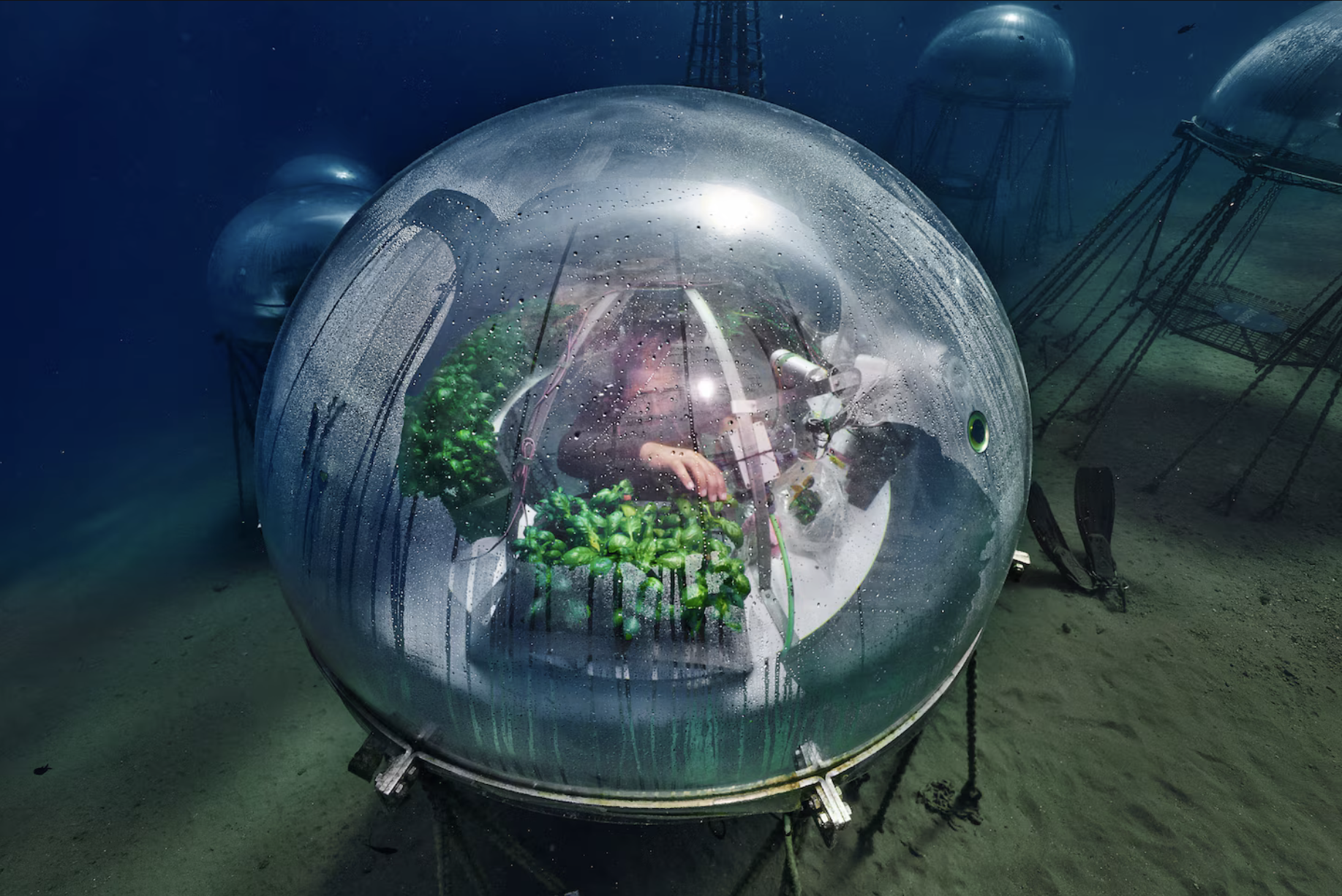
These underwater domes are filled with air, and are hard to anchor down, and will have significant differential air pressure to hold against.
But a mostly water filled situation may be easier. Macroalgae might be an option.
A Wet Version: 
So, this could utilize both photosynthesis and chemosynthesis with Acetate, Methane?, Hydrogen?
To some extent Macroalgae being domesticated could be a sort of Vegetables in the diet of people.
The risk of Hydrogen explosions may be low, as the air pocket on top is small, and we hope that the organisms within will consume the Hydrogen that leaks though the Hydrogen bag. But there could be some risk. But the volume of the explosion may be low.
The air pocket might also allow humans to work inside of the structure, but the gasses would need monitoring and perhaps robots would do as well.
This would be frost free agriculture, and with unusual circumstances so that normal pest species for the crop would be inhibited from damaging it.
Ending Pending
So, for instance you might switch to this kind of agriculture and allow the Aral Sea to fill back up with water.
https://en.wikipedia.org/wiki/Aral_Sea
You could put floating solar over the deeper parts and this agriculture in the shallower parts. Floating Solar may reduce evaporation, perhaps allowing the sea to expand even more.
Ending Pending
#107 Re: Life support systems » Bogs and Bog, Floating Island Technology, and Roller Solar. » 2026-02-08 08:31:26
Processes that split molecules will be important in this.
Water Electrolysis and Turquoise Hydrogen are two methods. Turquoise Hydrogen can produce Carbon Solids.
I found and lost a reference to a Utube video about "Utube, Australian electrolysis method using capillary tubes".
Apparently high efficiency and not needing Iridium.
Here is a similar video: https://www.youtube.com/watch?v=oGcIVmNwGmM
Quote:
The Electrolysis Bubble Free Breakthrough
jimboot2
There apparently are several types of Turquoise Hydrogen: https://modernhydrogen.com/company/stud … -hydrogen/ Quote:
Reference
Turquoise Hydrogen
Hydrogen, often championed for its potential in cleaner energy, combusts cleanly without releasing carbon dioxide (CO2). Turquoise hydrogen, specifically, is a key player as a bridge to a 100% renewable energy-powered world.This page provides a look into turquoise hydrogen and its role in hard-to-decarbonize industries.
Galvorn is a Carbon product that could be a result of Turquoise Hydrogen production: https://dexmat.com/why-galvorn/making-galvorn/ Quote:
From disordered carbon nanotubes to aligned high-performance fibers.
carbon-nanotubes
Galvorn is made using very pure, high-quality carbon nanotubes (CNTs). We use solvents to mix the disordered CNTs into a solution. Then our proprietary fluid phase process aligns the carbon nanotubes and increases their packing density into single filament fiber tow or films. The alignment and packing on the molecular level are key to achieving Galvorn’s high-performance properties.
Quote:
Scientifically designed for carbon-negative impact
Galvorn embodies carbon into a useful high-performance material. Its production process has significant efficiency advantages over traditional metals and carbon fiber. In addition to having a near 1:1 feedstock-to-product conversion, the production process is fundamentally less energy intense. Additionally, the feedstock carbon nanotubes (CNTs) are produced from methane, splitting CH4 into CNTs and hydrogen. With hydrogen as a byproduct, Galvorn can support the clean energy transition through production and utilization.
So, these processes should be good on Earth, Mars and many places in space.
Ending Pending
#108 Re: Science, Technology, and Astronomy » Humanoid and other robots. » 2026-02-07 13:41:05
Data Centers in space will be important for robots, including cars and humanoids: https://www.youtube.com/watch?v=N68li3iPx54
Quote:
Why Tesla Shareholders Will LOVE a SpaceX MERGER (FIRST ANALYSIS)
Jo Bhakdi
50.1K subscrib
Ending Pending
#109 Re: Life support systems » Bogs and Bog, Floating Island Technology, and Roller Solar. » 2026-02-07 13:01:11
This is sort of where I am going with it: 
So, in places like Ther Great Basin, you might reduce water losses to 10%/5%/1%, to be able to keep reservoirs inflated with water from local sources, or imported water.
In the top view there is a floating Solar Rotator. It can cool the solar panels with a heat pump during the sunshine, and push heat into the very briny water at the bottom of the pond (Pink).
The Static Cover, (Orange), has radiators that can reject heat into the night sky of a desert to generate power.
The side view has a (Green) top layer that can have pontoons of the least salty water, which support a Anaerobic process of H2/CO2.
The Blue Layer being perhaps less than two times as salty as the ocean, might support some forms of living things living on Oxygen/Acetate and perhaps a little artificial light.
The pink layer would be warm or hot, but less than the boiling point of water, probably.
In the future it will make much more sense to inflate these with local river water such as the Colorado River, then to do irrigation on Dry Land Farming.
The major concern would be that if you made reservoirs that swelled up very large it might induce earthquakes. But this would be a way to lower the sea levels by holding water into dry desert basins.
And of course I intend that these devices will capture a lot of Carbon from the atmosphsere.
Ending Pending
#110 Re: Not So Free Chat » Peter Zeihan again: and also other thinkers: » 2026-02-07 12:45:04
I am not sure how much of this I am in agreement with but it is interesting: https://www.youtube.com/watch?v=Xk-GQGFMuXQ
Quote:
Epstein Files LEAK: Trump Just Toppled The British Govt | Luongo & Krainer
Rich Does Politics
I am not sure they can do this without the approval of some spooky forces, but it is interesting.
Ending Pending
#111 Re: Terraformation » Bipolar Mars Terraform Plan » 2026-02-07 11:03:48
I have not been one who has had faith in space elevators. However, some understandings have prompted me to move to the level of hope for a Space Elevator for Mars.
https://marspedia.org/Space_elevator
Quote:
Copilot Search Branding
Concept art – Artofit
A Mars space elevator is a proposed transportation system that could facilitate travel between the Martian surface and orbit, leveraging Mars' lower gravity to simplify construction compared to Earth.
Concept and Design
A space elevator on Mars would consist of a high-tensile cable anchored to the Martian surface and extending into space, potentially reaching a synchronous orbit and beyond. The lower gravity of Mars (about 38% that of Earth) means that the tensile strength required for the cable is significantly less, making the construction of such a structure more feasible.
marspedia.org
Advantages
Cost-Effective Transportation: A space elevator would allow for continuous transport of cargo and possibly passengers to and from Mars orbit without the need for large rockets, significantly reducing costs associated with space travel.
1
Sustainable Access: Unlike traditional rocket launches, which are limited by fuel and logistics, a space elevator could provide a more sustainable and efficient means of accessing space, enabling more frequent missions and research opportunities.
12 Sources
Current Research and Feasibility
Recent studies have explored the feasibility of deploying a space elevator at the L1 libration point between Mars and its moon Phobos. This design would allow for a cable extending towards both Mars and Phobos, facilitating travel in both directions. Theoretical models have been developed to analyze the dynamics of such a system, including the motion of climbers and the effects of gravitational forces.
Springer
Future Prospects
While the technology to build a Mars space elevator is still in the conceptual stage, ongoing research and advancements in materials science may eventually make this ambitious project a reality. Companies like the Obayashi Corporation have expressed interest in developing space elevators, with plans that could potentially include Mars in the future.
Science TimesIn summary, a Mars space elevator represents a revolutionary concept in space transportation, promising to enhance our ability to explore and utilize the Martian environment efficiently.
The materials of this topic also encourage me: https://newmars.com/forums/viewtopic.php?id=11288
"Index» Life support systems» Bogs and Bog, Floating Island Technology, and Roller Solar."
And the materials of this topic also encourage me: https://newmars.com/forums/viewtopic.php?id=11299
"Index» Life support systems» Carbon is the New Metal"
Processing the materials of the moons of Mars might make for a very significant level of habitation of the orbits of Mars.
Mass Drivers from the peaks of mountains of Mars may contribute as well as also space elevators might.
I have seen it said that solar power in orbit is about 7 times as good as power on the surface of Earth. For Mars this also might be true.
While in the beginning power might be beamed to the surface of Mars by microwave and laser, it may be that space elevators could carry electrical power.
The Oxygen of the moons of Mars could be to some extent added to the atmosphere of Mars. This may act like a "Carrier Gas". That is similar to Nitrogen where it will not condense on the poles of Mars. This may alter then atmospheric processes of Mars. Where Oxygen may be expelled from mass drivers that may propel ships in orbit of Mars, it might be possible to cause most of it to fall into the atmosphere of Mars to be reused. Oxygen and other substances might be lifted up the space elevators for reuse.
It seems that Mars crossing and Earth crossing asteroids wander in from the asteroid belt. I think it may be possible to alter their orbits to be Ballistically Captured into Mars orbit. Then these would also be processed to produce Oxygen and "Metas" in orbit of Mars.
This actually could happen much faster than many people might presume, because the solar power in orbit of Mars would be very large, and also robots may provide an almost infinite pool of labor to fill the desired results.
So, this could create a world that becomes increasable suitable for surface life, and will have massive amounts of habitat in orbit of the planet.
Ending Pending
#112 Re: Life support systems » Bogs and Bog, Floating Island Technology, and Roller Solar. » 2026-02-07 09:44:14
The idea of using large bodies of water as bearings is an interesting one, but they are at times very turbulent. And Mars does not at this time have larger bodies of water. So, I think to use water as a bearing internal to land. And I hope to introduce processes on Earth that might be translatable to Mars.
I don't actually like to pick on little girls, but I am eager to have human civilization depart from "Gretta-Land".
While the Aerobic side interests me, I am also very interested in what the Anaerobic side H2/CO2 can do for us. Problems with Hydrogen are storage, and generation of it from water. It is my impression that it is easier to split Methane than it is to split water.
https://www.pnnl.gov/news-media/new-cle … -emissions
Quote:
Researchers from Pacific Northwest National Laboratory (PNNL) and West Virginia University (WVU), in collaboration with industry partners Southern California Gas Company (SoCalGas) and C4-MCP, have developed a process that converts methane—the primary component of natural gas—into hydrogen while emitting zero CO2. The process also creates carbon solids for manufacturing applications.
So, the above may solve the creation of Hydrogen and the creation of Carbon Solids for structures and machine parts.
The Hydrogen might then be dissolved into pontoons of water to foster the growth of Methanogens which will produce Methane. So, we can rotate the Hydrogen molecules back and forth between these two processes.
Hydrogen solubility in water is rather low, so you might put your compressed Hydrogen tanks inside of the pontoons of water. That way generally Hydrogen that leaks from such a storage will be delivered to the Methanogens over time. The Hydrogen tanks then become "Hydrogen Capacitors".
The Methanogens can be put to work to make things other than Methane.
-Precision Fermentation
-Cellular Agriculture
-Biomining
https://en.wikipedia.org/wiki/Methanogen
https://en.wikipedia.org/wiki/Precision_fermentation
Promising approach to sustainable food production
Precision fermentation with hydrogen is a promising approach to sustainable food production. Aerobic hydrogen-oxidising bacteria (HOBs) convert atmospheric CO2 and green hydrogen into biomass via gas fermentation, a process already used for food-grade single-cell protein production. This method requires minimal land and water, offering a supply chain independent of agriculture and with potential for carbon-neutral production and carbon capture. To expand beyond single-cell protein, HOBs must be engineered into cell factories for precision fermentation. Advances in synthetic biology, metabolic engineering, computational modeling, and bioreactor design are accelerating the development of scalable bioprocesses for gas-based fermentation.
Wikipedia
Quote:
Precision fermentation is a production process in which specific biological molecules are manufactured using microorganisms. It can be used to produce food ingredients that are conventionally sourced from animals and plants, including proteins, lipids, carbohydrates, and other metabolites. Bacteria, yeast, or other cell types produce large quantities of a specific compound which is then extracted and purified from the fermentation broth or cell lysate.[1] For example, milk or egg proteins, dairy fats, functional oligosaccharides, flavour and colour compounds or vitamins.[2]
So, now the atmosphere itself becomes a universal pipeline that delivers CO2 to any surface location on Earth, Mars, or Venus. Of course the Surface of Venus is hopeless, but there is hope at altitude.
So, now we do not suffer if someone burns coal, but we might benefit.
In the case of Earth, we might draw down the CO2 to bring on an ice age, but then beam extra solar power from space, to compensate for the loss of insulation. So, then artificially controlling the climate.
Purposely thawing the North with imported power and letting Antarctica pull water out of the oceans to make ice. And then developing the technology to life on and in the ice of Antarctica.
Simply options, not mandates.
But in an imaginary future we might draw down the oceans to Ice Age levels if that was desired.
For Mars, imported power from space may help to improve the conditions, allowing at least mostly covered lakes and seas.
Here again if you have various sized floating Lilly pad solar installations that cover 90%/95%/99% of the water, and active irrigation, significant bodies of water may be made possible even with a relatively low atmospheric pressure.
Again, harvesting the CO2 you might make Carbon Structures. You would need to replace the CO2 with other gasses over time to maintain the atmospheric pressure.
I suggest processing the moons of Mars and the rocks of Mars to produce more Oxygen for the purpose. Then also moving asteroids into the orbits of Mars to process them as well.
Someday then to import Nitrogen from some source or to recover it from underground if there is some in the deep water in the crust.
For Venus I am hoping that Carbon and/or other structures may be extracted from the atmosphere to make floating structures.
Ending Pending
#113 Re: Life support systems » Bogs and Bog, Floating Island Technology, and Roller Solar. » 2026-02-06 22:06:28
Such ideas are worthy of continuing efforts, I feel.
I am also interested in perhaps extracting minerals from water. I am considering H2/CO2 to power microbes that might do that as well as generating Methane. Then you might get the mineral and the Carbon to make parts from.
Ending Pending
#114 Re: Science, Technology, and Astronomy » Black Holes » 2026-02-06 21:30:08
Exploded Primordial Black Hole?
https://www.bing.com/videos/riverview/r … &FORM=VIRE
Quote:
We Just Saw a Black Hole Explode — It Changes Everything
YouTube
Heriton
12 views
I think I understand a little and wonder.
Ending Pending
#115 Re: Life support systems » Bogs and Bog, Floating Island Technology, and Roller Solar. » 2026-02-06 11:28:15
So, if Carbon is to be a "New Metal", where the production of Carbon parts is enhanced in ability and price, Stainless Steel may have a bit of a competitor.
Don't get me wrong, I can see the value of Superheavy being Stainless Steel, and that reusable Starship needs to be Stainless Steel.
But for craft that do not need to aerobrake, then perhaps in some cases Carbon will be a useful choice. This could include interworld spacecraft and also perhaps a new version of aa expendable Starship.
At some point it might become possible to replace Stainless Steel with Carbon for the upper parts of an Expendable Starship. Pushing it even father, then even the propellant tanks. The engines might be mostly the only parts reused. The ship might go to orbit and be taken apart with the Carbon portions staying in orbit and things like the engines being brought back down with a Stainless-Steel Starship type.
The point is the Stainless-Steel Starship when it is more developed will be a fantastic system, but if you could drop the dry mass for Expendables that might be a good asset also.
But it would be a thing for the future, when the Carbon tech is more developed.
Ending Pending
#116 Re: Life support systems » Bogs and Bog, Floating Island Technology, and Roller Solar. » 2026-02-06 10:25:44
So, for marginal places like brine lakes, or even just desert, two different processes might be done:
1)-Aerobic
2)-Anerobic
1) Aerobic: Acetate/Oxygen
2) Anerobic: Hydrogen/CO2
These can be done in the shade, as plastic tends to deteriorate under sunlight.
The #1 Aerobic, has recently been discovered as possible:
https://www.snexplores.org/article/inno … ts-in-dark
https://www.biotechniques.com/plant-cli … -sunlight/
So, Aerobic can be single cell and multicellular.
The #2 Anerobic as far as I know these are all single cell organisms.
For #1, Yeast is said to be 18x more efficient than photosynthesis.
For #1, Algae is said to be 4x more efficient than photosynthesis.
* It is hard to know if Macro-Algae also work well with Acetate and Oxygen.
* We can hope that multicellular plants might be adaptive to Acetate and Oxygen.
* I have an interest in the domestication of some large plants for this purpose. Macro-Algae such as Sargasso Seaweed, Hydrilla, Duckweed. Duckweed will need an air layer in the flotation bladders.
For #2 as far as I know all the organisms are single cell. I wonder if gene editing could create multicellular that can live on Hydrogen/CO2.
This might scare some people, but there is no natural environment on Earth of any scale where these could go "Feral". IF you could create vegetables that could life off of Hydrogen/CO2.
At any rate, I think that the Hydrogen cycle is more economic as per energy than is the Oxygen cycle. And might be very useful in capturing CO2 out of the environment.
https://onlinelibrary.wiley.com/doi/abs … 719e2f6ea5
Quote:
Copilot Search Branding
Electrochemical Splitting of Methane in Molten Salts To Produce Hydrogen - Fan - 2021 - Angewandte Chemie International Edition - Wiley Online Library
Electrolysis of methane involves the electrochemical splitting of methane to produce hydrogen and solid carbon, offering a cleaner alternative to traditional hydrogen production methods.
Overview of Electrolysis of Methane
Electrolysis of methane is a process that can be used to convert methane (CH₄) into hydrogen (H₂) and solid carbon (C) through an electrochemical reaction. This method is considered more environmentally friendly compared to conventional methods like methane steam reforming, which typically results in significant carbon emissions.
Process Description
Electrochemical Reaction: In the electrolysis of methane, methane is oxidized at the anode, producing hydrogen gas and carbon dioxide. The carbon dioxide can be captured and reduced to solid carbon at the cathode. This separation of hydrogen generation and carbon deposition allows for a cleaner process with minimal emissions.
1
Temperature and Conditions: The process can be conducted at elevated temperatures, such as 500 °C, in molten salts, which helps in reducing energy consumption and avoiding coke formation that can occur in traditional methods.
1
Efficiency: The electrochemical splitting of methane has been shown to have a lower equivalent carbon emission compared to methane steam reforming and requires less energy input than alkaline water electrolysis.
11 Source
Applications and Benefits
Hydrogen Production: The hydrogen produced can be used as a clean fuel for fuel cells or as a feedstock for various chemical processes.
Carbon Management: The solid carbon produced can potentially be utilized in various applications, reducing the overall carbon footprint of methane utilization.
Integration with Renewable Energy: This process can be integrated with renewable energy sources, making it a viable option for sustainable hydrogen production.
22 Sources
Conclusion
The electrolysis of methane presents a promising pathway for producing hydrogen while managing carbon emissions effectively. As research and technology advance, this method could play a significant role in the transition to cleaner energy systems. Further developments in reactor design and catalyst efficiency are essential for optimizing this process and making it commercially viable.wiley.com
So, we can then look at making Carbon products: https://newmars.com/forums/viewtopic.php?id=11299
"Index» Life support systems» Carbon is the New Metal"
So, in this process a byproduct could be Precision Fermentation Products, and also perhaps Cellular Food Production.
I think this #2 Anerobic cycle will be rather energy efficient.
And this solar process would not have to be connected to a grid, although it could be. So, if in a desert, in a brine pool, the sunshine may be as predictable as can be on the Earth, I believe. So,you could run the process mostly when the sun shines, and not so much when it does not shine.
Ending Pending
#117 Re: Life support systems » Bogs and Bog, Floating Island Technology, and Roller Solar. » 2026-02-05 12:28:43
About Microplastics. Of course I like this as it favors my views: https://backreaction.blogspot.com/2026/ … -says.html Quote:
Wednesday, February 04, 2026
Microplastics: What the Evidence Really Says
You’ve probably seen the headlines about microplastics, which claim that the micrometer-scale bits of plastic are everywhere, causing a wide variety of health issues. But while the headlines get more and more extreme, the scientific research on microplastics doesn’t actually support the media’s claims. Let’s take a look.
My own view of the process of civilization is that it turns wine into vinegar. At first the wilderness people create civilization which is sweet. They can do so, because the wilderness has given them "Blue Collar Skills". But they have enough verbal skills as well to share with each other on plans.
The Vinegar stage gives us the "Verbal and Violent" who displace the genes and memes of the more useful people of transition from wilderness to initial "Sweet" civilization.
From there survival of genes and memes depends more and more on predation from the Vinegar people, upon the wealth and life's of the productivity of the transition people.
The Industrial Revolution gave us a reprieve form the total power of the Vinegar people.
And they, the Vinegar People have been struggling to take us as slaves again all along.
So, the made untruth about fracking, and then about plastics, and then microplastics.
Anything to stifle "Blue Collar Power" and to promote green plantation owners where little by little the useful genes and memes can be replaced by "Vinegar" versions.
So, it is so stupid to worry about microplastics, when they come from the fabrics we use and also from things like car tires.
The author above seems to have a very good mind. That is a form of relief from the general "Vinegar" stupidity we usually have to deal with.
https://iee.psu.edu/news/blog/microplas … t-yourself
Quote:
Microplastics originate from various sources, including the breakdown of larger plastic items, synthetic textiles, vehicle tires, and personal care products.
Key Sources of Microplastics
Breakdown of Larger Plastics: Microplastics can form when larger plastic debris, such as bottles and bags, degrade into smaller fragments due to environmental factors like sunlight, friction, and weathering. This process creates what are known as secondary microplastics.
2
Synthetic Textiles: Washing synthetic clothing releases thousands of microfibers into wastewater. These microfibers are a significant contributor to microplastic pollution, as they can enter water systems and eventually the food chain.
2
Vehicle Tires: As tires wear down, they shed tiny particles that contribute to microplastic pollution. It is estimated that tire wear accounts for a substantial percentage of microplastics released into the environment.
2
Personal Care Products: Many personal care items, such as exfoliating scrubs and toothpaste, have historically contained microbeads—tiny plastic particles designed for scrubbing. Although many countries have banned these, they still contribute to microplastic pollution.
2
Household Items: Everyday items like plastic chopping boards and microwavable containers can leach microplastics into food, especially when heated. This highlights the pervasive nature of microplastics in our daily lives.
1
Urban Dust and Road Markings: Microplastics can also be found in urban dust, which is a mix of various particles, including those from road markings and construction materials.
1Conclusion
Microplastics are a widespread environmental issue, originating from a variety of sources, including the breakdown of larger plastics, synthetic textiles, vehicle tires, and personal care products. Their presence in the environment raises concerns about their impact on ecosystems and human health. Understanding these sources is crucial for developing strategies to mitigate microplastic pollution.
Communism and Fascism will not protect you from the "Verbal and Violent" "Vinegars". In fact these are special roads to "Vinegar Hell".
My intentions are to have plastic pontoons that support solar equipment. I intend that the plastics will generally be shielded from things that make them break down, such as Ultraviolet Light.
I microplastics go into the water, I am hoping that they may settle into the sediments of such a body of water.
Anyway the great hope is that space may provide a useful wilderness for our people to provide habitat for their escape from the "Verbal and Violent Vinegars".
This then perhaps to forestall the death of the human mind from the process of the Vinegars.
Ending Pending
#118 Re: Life support systems » Bogs and Bog, Floating Island Technology, and Roller Solar. » 2026-02-05 10:43:45
Here then is a "Water Pontoon" scheme: 
If you were to suppress the wave mixing action of the Salton Sea, you might turn the whole thing into a solar salt pond.
https://en.wikipedia.org/wiki/Solar_pond
Quote:
Solar Salt Pond
A solar salt pond is a large body of saltwater that collects and stores solar thermal energy, providing a sustainable source of heat and power. The process involves evaporating water out of brine using sunlight, leaving behind pure sodium chloride crystals as residue. This method is known for its high purity and is used in various applications, including water softening, cooking, and as a general-purpose seasoning. Solar salt ponds are particularly attractive for rural areas in developing countries due to their ability to harness solar energy for electricity generation and other thermal energy uses.
Wikipedia
+4
Image Quote: 
With most of the body of water, such as the Salton Sea covered in floating island for solar energy and also bio-farming, the waves suppressed, so then mixing suppressed, you intentionally use heat pumps to extract heat from the upper waters and add it to the lower waters. You also induce salt gradients.
Having done this then the upper waters may be suitable for fish to live in as you have pushed some of the salt down to the bottom of the reservoir.
And when convenient you might then extract the heat for some process you desire to maintain. You actually might be able to run a heat engine from it even.
Quote:
Description
When the sun's rays contact the bottom of a shallow pool, they heat the water adjacent to the bottom. When water at the bottom of the pool is heated, it becomes less dense than the cooler water above it, and convection begins. Solar ponds heat water by impeding this convection. Salt is added to the water until the lower layers of water become completely saturated. High-salinity water at the bottom of the pond does not mix readily with the low-salinity water above it, so when the bottom layer of water is heated, convection occurs separately in the bottom and top layers, with only mild mixing between the two. This greatly reduces heat loss, and allows for the high-salinity water to get up to 90 °C while maintaining 30 °C low-salinity water.[1] This hot, salty water can then be pumped away for use in electricity generation, through a turbine or as a source of thermal energy.
This is perhaps a case where at times your heat pumps might extract heat from the solar panels in addition to the electricity generated. Then to heat the bottom water. Then at night the solar panels to behave as radiators, and again if desired to reject heat into the solar panels using a heat pump system. To some extent this may extract energy from the day/night cycle.
A very important sub-part of this is to extract CO2 from the air directly or indirectly from the Salton Sea.
So, then to use it to produce plastics and Carbon products, and to regulate the climate of a planet.
For Mars this may be possible when the entire amount of CO2 available is vaporized into the atmosphere, but certain revisions of method may be needed.
For Mars, it can be expected that the process will leak Hydrocarbons into the atmosphere which would be assistive to further terraform the planet.
Ending Pending
#119 Re: Not So Free Chat » Greenland » 2026-02-04 22:42:10
I will call this video "Interesting": https://www.bing.com/videos/riverview/r … &FORM=VIRE Quote:
'Trump defeated Europe over Greenland. Now Starmer will fall'
YouTube
GBNews
1.2K views
I will view it another time.
Ending Pending
#120 Re: Life support systems » Bogs and Bog, Floating Island Technology, and Roller Solar. » 2026-02-04 21:40:15
So, actually I was a hurry on the last post. I believe that microbes that you might feed CO2 and H2, will create Methane and the other products of their metabolism.
https://news.berkeley.edu/2025/08/14/sc … f-methane/
Quote:
Methanogens
Microbes that eat hydrogen and create methane include methanogens, which are anaerobic archaea that produce methane as a byproduct of their energy metabolism. They thrive in oxygen-free environments such as wetlands, rice fields, and the digestive tracts of animals. Methanogens utilize hydrogen, carbon dioxide, and other organic compounds to generate methane through a process called methanogenesis, which is a form of anaerobic respiration.
University of California, Berkeley
+2
So, energy-wise, I believe that it is easier to split Methane with electrolysis than it is to split water.
So, this anerobic process could be used in Precision Fermentation and also Cellular Agriculture, I believe.
I think the process could be useful in creating Carbon products and also in making plastics.
And I think this could work on Mars with some alterations.
If the ability to build Carbon products is a thing that keeps growing, then Venus would be valuable for both Nitrogen and Carbon, provided that the products would be useful in the atmosphere, or if some method to lift things to orbit on Venus emerges.
And then as you go our in the solar system to the Outer Asteroid Belt, Carbon is plenty, and then also presumed to be in the moons of the outer planets, and part of Pluto and other dwarf planets.
Ending Pending
#121 Re: Life support systems » Bogs and Bog, Floating Island Technology, and Roller Solar. » 2026-02-04 14:08:33
Repeating materials but I hope to show things even better: https://www.youtube.com/live/DVhJQ0WDv2s
Quote:
Carbon is the New Metal
As I understand it they are splitting Methane (CH4) to produce their Carbon products and end up with Hydrogen as a byproduct.
https://en.wikipedia.org/wiki/Precision_fermentation
Quote:
Copilot Search Branding
Precision fermentation - Wikipedia
Precision fermentation is a biotechnology process that uses microorganisms, such as bacteria, fungi, or yeasts, to produce specific biological molecules. This method involves rewriting the DNA of these microorganisms to "brew" ingredients that are molecularly identical to those found in nature, allowing for the production of food ingredients without the need for traditional farming. It is used to create high-value compounds like proteins, enzymes, and biofuels, ensuring high yields and purity. Historically, precision fermentation has been utilized for decades to produce common ingredients like rennet and citric acid.
Wikipedia
+4
Precision Fermentation can be done with Hydrogen and Atmospheric CO2:https://www.biologie.rwth-aachen.de/cms/biologie/forschung/fachbereiche/publikationen/~fmtva/details/?file=1021396&lidx=1
Quote:
Precision fermentation with hydrogen is a promising approach in biotechnology, particularly in food production. This method utilizes genetically engineered microorganisms to produce high-value biomolecules, such as proteins and pharmaceuticals, with high yield and purity. The process involves several interconnected stages, including strain development, upstream fermentation, downstream purification, and final formulation. Precision fermentation is particularly beneficial for producing smaller biologic modalities, such as peptides and antibody fragments, due to its cost-effectiveness and efficiency across various scales.
biologie.rwth-aachen.dePrecision fermentation with hydrogen is expected to play a significant role in sustainable nutrition and the development of next-generation therapeutics. By leveraging microbial fermentation, this technology can create climate-friendly dairy alternatives, next-gen therapeutics, and circular materials, aligning with global sustainability goals.
Pharma's Almanac
Cellular Agriculture may be similar in production.
Biogas could come from either a digester or using pyrolysis.
https://www.motherearthnews.com/sustain … z14aszrob/
Quote:
Make a Biogas Generator to Produce Your Own Natural Gas
Transform grass clippings, food waste and livestock manure into renewable energy via a homemade biogas generator.
By Paul Scheckel
|
Updated on January 3, 2022
X
https://en.wikipedia.org/wiki/Pyrolysis
Quote:
Copilot Search Branding
(PDF) Safety assessment of the process RE‐PET, based on EREMA Basic technology, used to recycle post‐consumer PET into food contact materials
Pyrolysis is a thermochemical process that involves the heating of organic materials in the absence of oxygen, leading to their decomposition. This process produces valuable products such as gases, liquids (like bio-oil), and solids (like char). Pyrolysis is particularly useful for treating various organic materials, including biomass, plastics, and hazardous waste, as it can break down complex compounds into simpler substances. The process typically occurs at high temperatures, often above 500 °C, and is applied in fields such as energy production, recycling, and waste management.
Wikipedia
+4
So, you might have to electrolyze some water as well to keep the Hydrogen content up, but you could run this process inside of plastic bags filled with fresh or salty water that float on top of salty bodies of water.
And you may be able to make floating islands that you can put solar power equipment on to generate the needed electricity.
Those islands might be able to rotate to follow the sun east to west, and the panels may be linked together like window blinds to also follow the sunup and down.
Many salty reservoirs might be possible to build on desert shorelines of the oceans and also inland, in marginal land.
So, the process may generate products from precision fermentation and Cellular Agriculture, and to pull CO2 from the atmosphere.
If so, then it may be practical to burn all the hydrocarbons that can be found and accessed.
Ending Pending
#122 Re: Not So Free Chat » Greenland » 2026-02-04 09:47:55
This is how I analyze reality: 
I do not like the China claim to be part of a "Global South".
I have given both Africa (Sub Saharan), and China, the option to be the top or lower box. If you actually made the cubic "Globe", you could put one of them in each of the two boxes.
I regard the middle east as "Burned Out Territory". Civilization has made them too dependent on the verbal and violent for the method that they earn their wealth. Allowing the wrong types to breed excessively. (My opinion as a theory).
Ending Pending
#123 Re: Not So Free Chat » Copper, Silver, and other Metals » 2026-02-04 09:06:33
Carbon may be a partial option it appears: https://www.energy.gov/sites/prod/files … tors_0.pdf Quote:
Carbon Conductors
for Lightweight
Motors and
Generators
Enabling increased motor efficiency
using a novel high electrical
conductivity carbon nanotube
technolog
I also started this topic: https://newmars.com/forums/viewtopic.php?id=11299
"Index» Life support systems» Carbon is the New Metal"
So, it may be that power lines can be gradually replaced with Carbon and the metals harvested from them.
Ending Pending
#124 Re: Not So Free Chat » Greenland » 2026-02-04 08:35:43
I gave the Anglicans and by default some other religious authorities a reprimand, as if they are actually Christians, they can take it, and will not retaliate. In turn it is somewhat reasonable that they express their concerns about the actions of some powerful people in our country.
I only study the claims of the Promethean action people.
Their descriptions of reality to some extent ring true.
I am reasonably convinced that the underworld and many espionage networks around the world often swim in the same dirty waters.
The first thing that any spy agency does to penetrate another nation, or group is to seek out the criminal elements of that society.
I do at this point think that the "British Invasion" of America was actual, in the 60's and so on. The drugs, the sex, the promoted stars. Most people think that the important thing about Jeffrey Epstein was associated with sex with the wrong female type. But what way to find the holes in the morality of a society, and to get a handhold on events.
The British are criticized for the Opium wars. But it seems that China participates on the assault on America from drug economics now. That is a stain on their claims to being innocent victims.
Troublesome money it is. It becomes obvious that our "Friends" have been stabbing us in the back and collaborating with competitor powers.
For instance, Fracking. Why did the left and the Europeans, do such an outcry against fracking? (OPEC + Russia). Hydrocarbon money, used for mischief.
The Globalists, did not want America to resume energy self-sufficiency. Each of the powers, Islamic or Communist, had characteristics that are hostile to America, but our "Frends" did not want us to have energy self-sufficiency.
It seems as though to control us we needed to be crippled from time to time from betrayals. If we were hobbled we could continue to be their stupid thug.
So, trust is running thin.
For instance, it was a French person who coined the word "Hispanic". This was an effort to damage Anglo interests.
I watch these silly videos about 3rd world people, who are desperate to not be European, even though they look very European in some cases. Often they may be of a large part Spanish.
The world White was instituted so that a group "Black" could be established as well.
These are all tricks to manufacture instabilities in our society. They try to draw a false quorum, for there efforts of hostility to America.
OF course, the Islam and the Communists, and their kindred, having money from the petrochemical industry so as to compete or damage or conquest the USA. But that is old money that is drying up. We are making much of that money, our money.
It was very unkind for G.B. and the West Europeans to have so little consideration for our needs. But it was only human.
America has so far figured out how to balance the state powers and the federal powers. Europe has not and I think it likely that they cannot. So, I think they are unstable. It took a lot of American energy to hold the so called west together.
I believe that America is now in a Eurasian Phase and has concluded its Eurafrican phase. The Nordics, the Poles, Hungarians, and even Russians, have some potential activities with us. The Nordics though have their heads up someone else's bottoms though at this time as I would measure it. We did quite a lot to assist them in their recovery from the world they were in. And then what was this stupid thing they did with 3rd world immigrants.
So, we have to be concerned about malice and stupidity when we are connected up to the Europeans. I think it is necessary for America to hold Europe at arm's length more now.
Ending Pending
#125 Re: Not So Free Chat » Peter Zeihan again: and also other thinkers: » 2026-02-03 16:14:39
Correct Sir!