New Mars Forums
You are not logged in.
- Topics: Active | Unanswered
Announcement
#351 Re: Terraformation » Terraforming Earth » 2025-11-28 19:43:47
In support of the just previous post, I have this material:
https://www.bing.com/videos/riverview/r … ORM=VAMGZC
Mohsin Insights, Japan's Osmotic Power Plant How Saltwater is powering the F...
#352 Re: Terraformation » Terraforming Earth » 2025-11-27 21:13:18
This is interesting to me, about the progress of the Boring Company: https://www.youtube.com/watch?v=_XqPqHQr8OI
Quote:
Elon Musk’s Plan to End Traffic Forever - 90% Cheaper & 10x More Convenient!
BestInTESLA
109K subscribersJoin
I have the idea to use the above with this: https://energy.sustainability-directory … nt-energy/
Quote:
Salinity Gradient Energy
By Sustainability Directory5 April 2025
Both of these are immature but might hold promise both together and separately.
Rather than to convey liquid water through tunnels to salty water, what if you could convey water steam to salty water?
You might do that with a tunnel at 100 degrees C.
But Boring tunnels for hyperloop could operate at lower temperatures and pressures.
Here is a useful tool: https://endmemo.com/chem/vaporpressurewater.php
At 50 degrees C as an example the tunnel pressure could be 123.0665 millibars, or .123 Bar.
So, if you have a source of steam near an abundant body of water you could thrust it though a tunnel and extract it at a remote location where things are dryer.
While steam is not as dense as is water, if you have periodic turbines, you can accelerate the steam flow quite a lot to make up for that.
This then could be an inverse Los Angeles Aqueduct where you might send steam to the Salton Sea.
The brine created at the source which would be the Pacific Coast, might be blended with treated sewer water from Los Angeles, to generate electricity.
The Steam sent to the Salton Sea, could be condensed and used as a consumable, and then again, the partly treated sewage could be reacted with the salty water of the Salton Sea, to generate electricity.
Here then we avoid the need for canals connecting to a foreign country, "Mexico", and may, perhaps push useful water into the Great Basin.
In lifting steam over mountains, a depth of the tunnels of a fraction of a kilometer, may be acceptable. And slopes may not mater so much as they do for liquid water.
In a fantastic world, steam tubes might even reach the Great Salt Lake.
Of course, to do this there would likely need to be very big steam evaporators in the ocean water, likely powered by solar energy. Perhaps mirrors. And the tunnels would have to cross many mountains.
Perhaps if this works it could be done on Mars, to move polar water to desired locations.
Ending Pending 
#353 Re: Terraformation » Terraforming Earth » 2025-11-26 22:23:45
Relating to the two prior posts about the Salton Sea: "https://www.youtube.com/watch?v=8zRFB-xUEcU"
Quote:
Egypt Is Cutting Open the Sahara Desert to Let the Mediterranean In Until It Realizes What It’ll Do
One thing that could be done with salt is drop it to the bottom of the ocean. Possibly damaging the bottom environment.
Perhaps not practical. Imagine a "Salt wheel" like a water wheel.
If you could do it, by some more practical means, extracting the salt from the depression may be energy positive or at least energy assisted.
If it could be done where brine or salt falling down is gradually mixed with sea water, perhaps on exit the exiting mix would be tolerable to sea life.
A very complex thing to do though.
https://en.wikipedia.org/wiki/Qattara_Depression
Image Quote: 
Image Quote: 
Imagine floating solar panels over all of it.
Ending Pending
#354 Re: Terraformation » Terraforming Earth » 2025-11-26 19:44:14
Continuing the last post on the Salton Sea:
A) Query: "How much of Ocean water is salt?"
https://brilliantmaps.com/ocean-salinity-map/
Quote:
About 3.5%
About 3.5% of ocean water is salt, which means there are approximately 35 grams of salt for every liter of seawater. This salinity level is consistent across most of the world's oceans, with variations typically ranging between 34 and 36 parts per thousand (ppt).
The above numbers are weight though; I am also interested in volume.
B) Query: "How much does a liter of salt weigh?"
https://www.aqua-calc.com/calculate/vol … tance/salt
Quote: "Approximately 2.17 grams
A liter of salt weighs approximately 2.17 grams. This is based on the density of salt, which is about 2,170 kg/m³ at 20°C.
Aqua-Calc"
35/2.17 = "Therefore a witch!": https://www.youtube.com/watch?v=rf71YotfykQ
35/2.17 = 16.12903225806452
If I did that correctly then for 1 out of 16.12902335806452 Liters of sea water could be condensed sea salt and the rest be fresh water.
C) Query: "How much of the salton seas water is salt?"
Quote:
60 parts per thousand
The Salton Sea is approximately 60 parts per thousand (PPT) saltier than the Pacific Ocean, which is about 35 PPT. This means that the Salton Sea has a salinity level of around 44,000 mg/L. The salinity of the Salton Sea increases annually due to evaporation and the influx of agricultural drainage water.
So for the Salton Sea, you would have 2 almost two Liters of condensed solid salts.
We had a currently inactive member who considered making islands out of sea salt. It was "Karov".
So, for a Salt Lake, a salt island might be a useful trick. That and not cutting off the water supply to the lake.
So, if you could make containers of plastic and fill them with salt, maybe you could build the Salt Islands. They don't necessarily have to project above the water line.
You could make "Salt & Plastic Anchors" to moor floating solar panels to
https://www.startupselfie.net/2023/10/0 … -tracking/
Quote:
Floating solar panels that track the sun
October 7, 2023
Image Quote: 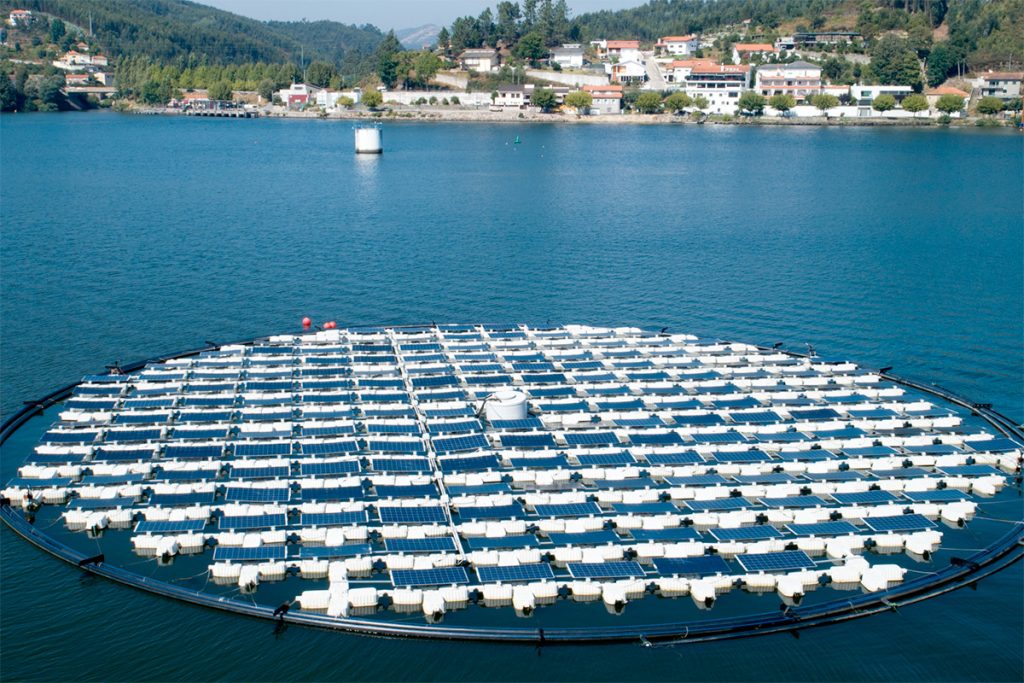
With the shade from this you could reduce evaporation.
Quote:
Benefits and implications
Antonio Duarte, SolarisFloat’s lead technical engineer, rightly observes that renewable energy production, especially solar, will find more adoption on water than on land, primarily because land is a dwindling asset. Floating solar offers an innovative solution without compromising precious land resources.Additionally, Alona Armstrong, an expert from Lancaster University, points out that if executed correctly, floating solar systems can offer not only low-carbon energy but also improve water body conditions by cooling the water and reducing phytoplankton biomass. This multi-pronged advantage is indeed a boon for the environment and energy sectors alike.
According to data reported by the BBC, solar PV capacity has skyrocketed from 72GW in 2011 to 843GW in 2021, now accounting for 3.6% of global electricity generation. With floating solar’s advent, this trajectory is only expected to rise steeply.
I wonder if the reverse side of the solar panels could have a radiating pigment on them which could be turned to the desert sky at night?
https://www.science.org/content/article … ny-surface
Quote:
Cooling paint drops the temperature of any surface
Material that reflects light and sheds heat could put a large dent in AC costs
27 Sep 2018ByRobert F. Service
For the Salton Sea and other salt lakes like it, only part of the salts have to be containerized. Some fish can tolerate salt levels greater than the saltiness of the oceans.
https://pondinformer.com/salton-sea-fish-species/
Quote:
Global web icon
Pond Informer
https://pondinformer.com › salton-sea-fish-species
List of Fish Species in the Salton Sea (Updated) - Pond Informer
In addition, the Salton Sea has a salinity of around 60 parts per thousand, close to double the average salinity of the ocean. As a result, few species of fish can survive in the lake, and most of the aquatic biodiv… See more
The fish are extinct now or are about to go extinct.
So, it seems to me that you might not have to remove that much of the salt to resuscitate the Salton Sea.
I am suggesting making anchors primarily out of Recycled Plastics and Solid Salt.
Query: "What can recycle plastics be made into?"
https://theroundup.org/everyday-product … d-plastic/
Quote:
Copilot Search Branding
Like
Dislike
TerraCycle
Recycled plastic can be transformed into a wide variety of products, including household items, construction materials, clothing, and packaging, contributing to sustainability and reducing waste.
Common Products Made from Recycled Plastic
Household Items: Many everyday products such as storage bins, kitchen utensils, and tableware are made from recycled plastics. For example, plates, cups, and cutting boards are often produced using recycled polypropylene and PET, which are durable and food-safe.
2
Textiles and Fashion: The fashion industry has embraced recycled plastics, particularly in the form of recycled polyester (rPET). This material is used to create clothing, activewear, and accessories, effectively turning plastic bottles into stylish garments.
2
Construction Materials: Recycled plastics are increasingly used in the construction industry. Products like composite lumber, insulation, and roofing tiles are made from recycled plastic, offering durability and weather resistance while reducing the need for virgin materials.
2
Rugs and Carpets: Area rugs made from recycled plastic can contain hundreds of recycled bottles, providing a soft and stain-resistant option for home decor.
1
Packaging: Many companies are now using recycled plastics for packaging, including food containers and wrappers. This shift helps reduce the production of new plastic and encourages sustainable consumer choices.
1
Furniture: Modern furniture, including kitchen cabinets and outdoor furniture, is often made from recycled plastics combined with other materials, providing a sustainable alternative to traditional wood products.
14 Sources
Benefits of Using Recycled Plastic
Environmental Impact: Using recycled plastic helps divert waste from landfills and oceans, reducing pollution and conserving natural resources.
Energy Conservation: The production of items from recycled plastics typically requires less energy compared to manufacturing with virgin materials, making it a more sustainable choice.
1By choosing products made from recycled plastic, consumers can contribute to a more sustainable future and help combat plastic pollution.
1 Source
OK, the Salton Sea is in California, and we know what that comes with.
Unlike putting toxic waste into oil drums and putting them on the bottom of the lake, if the salt anchor leaks, then you pull it up and recycle the plastic into a new anchor and fill that with solid salt, and put it on the bottom of the lake.
Microplastics OH MY!
https://en.wikipedia.org/wiki/Microplastics
Quote:
Sources of microplastics
The existence of microplastics in the environment is often established through aquatic studies. These include taking plankton samples, analyzing sandy and muddy sediments, observing vertebrate and invertebrate consumption, and evaluating chemical pollutant interactions.[54] Through such methods, it has been shown that there are microplastics from multiple sources in the environment.[citation needed]Textiles, tires, and urban dust[55] account for over 80% of all microplastics in the seas and the environment.[9] Microplastic is also a type of airborne particulates and is found to prevail in air.[56][57][58] Paint appears as the largest source of microplastic leakage into the ocean and waterways (1.9 Mt/year), outweighing all other sources of microplastic leakage.[59] Microplastics could contribute up to 30% of the Great Pacific Garbage Patch polluting the world's oceans and, in many developed countries, are a bigger source of marine plastic pollution than the visible larger pieces of marine litter, according to a 2017 IUCN report.[5] Oceanic microplastics are a common source of heavy metals[60] due to the inclusion of coloring compounds containing chromium, manganese, cobalt, copper, zinc, zirconium, molybdenum, silver, tin, praseodymium, neodymium, erbium, tungsten, iridium, gold, lead, or uranium.[61]
Oral intake
Oral intake is the main pathway of human exposure to microplastics.[62] Microplastics exist in daily necessities like drinking water, bottled water, seafood, salt, sugar, tea bags, milk, and so on.[63]65 million microplastics are released into water sources every day.[64] In 2017, more than eight million tons of plastics entered the oceans, greater than 33 times as much as that of the total plastics accumulated in the oceans by 2015.[65] One consequence of this is marine life consumption of microplastics. It is estimated that Europeans are exposed to about 11,000 particles/person/year of microplastics due to shellfish consumption.[66]
Microplastics may enter drinking water sources in a number of ways: from surface runoff (e.g. after a rain event), to wastewater effluent (both treated and untreated), combined sewer overflows, industrial effluent, degraded plastic waste, and atmospheric deposition.[67] Surface run-off and wastewater effluent are recognized as the two main sources, but better data are required to quantify the sources and associate them with more specific plastic waste streams. Plastic bottles and caps that are used in bottled water have been confirmed as sources of microplastics in drinking-water.[67][68]
Microplastics may also have been widely distributed in soil, especially in agricultural systems.[69] They (especially with negative charge) can get into the water transport system of plants, and then move to the roots, stems, leaves, and fruits.[70] Once microplastics enter agricultural systems through sewage sludge, compost, and plastic mulching, they will cause food pollution, which may increase the risk of human exposure.[71] A 2023 study found that microplastics can reduce soil fertility and crop yields by disrupting soil microbial communities and water retention capacity.[72]
Clothing
Quote: Textiles, tires, and urban dust[55] account for over 80% of all microplastics in the seas and the environment.
So, before you get all middle ages about plastic salt anchors, solve the above first.
Probably any shedding will largly stay down in the sediments of the lake, if solar panels stiffel the wind which would stir the water.
Fresh water extracted from the lake might possibly be fee of microplastics, depending on method.
The fish may have microplastics, but life is sometimes about dealing with what you got. My understanding is that most microplastics enter though breathing or drinking water.
I might add that making salt anchors out of recycled plastic should please the greens as it is to sequester Carbon.
And it should please the petrochemical industry as it is to provide a additional market.
How long could you keep making more anchors as salts accumulate in water? Maybe forever.
Other salt lakes/seas might be treated similar to this.
Ending Pending
#355 Re: Terraformation » Terraforming Earth » 2025-11-26 12:30:36
OK, the Saton Sea again: https://www.msn.com/en-us/money/technol … i-AA1R4V1s Quote:
Protevs: The Floating Solar Power Revolution Boosting Efficiency by 40%
OK, first off, salt corrodes, but it also helps things to float.
https://www.startupselfie.net/2023/10/0 … -tracking/
Quote:
The Protevs floating solar power system, developed by SolarisFloat, is a revolutionary innovation that combines floating solar panels with sun-tracking technology. This system, currently installed in Oostvoorne Meer, Netherlands, features 180 modules with dual-axis tracking, allowing the panels to adjust their elevation from 0° to 45°. The PROTEVS+ installation boasts a total installed capacity of 73 kWp with 370 wp modules, achieving an energy production boost of up to 40%. Additionally, water-cooled air enhances solar panel efficiency, resulting in up to 15% increased production. The PROTEVS Single360 variant operates on a single axis and houses 360 PV modules, offering an impressive installed capacity of 147 kWp for 410 W panels, with energy production increased by up to 30%. These innovative solutions are modular, detachable, and scalable, making them suitable for various project needs and environmental considerations
For the "Greens". Suppose you made floats out of recycle plastics. Plastics are fairly stable in salt water, I read, and anyway the Salton Sea is toxic now.
But you might be able to improve the lake by reducing evaporation. These floating islands would do that and generate power.
In actuality, if the environment were not too obnoxious, you could have house boats alongside of these, as they do provide power, and it might be hoped to revive the waters anyway.
If you still the waves with this, then it is possible that you could cause a layer of fresher water to float on top of the more salty bottom water.
But you will have to spank the farmers, if they want to take the extra water conserved.
As it happens it made sense to make the aqueduct to take Colorado River water in the last century. But now, it is kind of stupid to do dry land farming with the river water. If you can expand the lake and put solar power on top of it, you probably could do a bit of aquiculture, as not all the light would be absorbed by the solar panels.
A possibly sensible thing to do would be to distill fresh water from the bine, then use it. (Not for dry land farming!), and then partially improve the water and release into to float on top of the brine of the lake. Microbes in the water would likely finish improving the water.
But you would not want too many nutrients in the water.
I would be curios if salt could be encapsulated as a solid into plastic containers and placed on the bottom of the lake.
As I have said before, I think that a more sensible solution long term would be to dig a canal though Mexico and conduct sea water into the lake generating electricity from turbines, then pumping water back out when the solar energy was productive.
A sort of artificial tide for the lake. But you would not want to pump brine that is too salty out to the gulf of California.
Why would Mexico want this? Well, a base load power supply. Also, perhaps a canal system could even carry freight, such as solid salt to dump out in the pacific at some point.
Quite a lot of people of Mexican descent live in the SW USA anyway, so maybe it is not a wrong plan for them.
Ending Pending
#356 Not So Free Chat » Volcanism and Climate » 2025-11-26 12:15:41
- Void
- Replies: 0
Perhaps it is the news media, but I seem to notice many reports of volcanism around the planet.
I am not going to try to argue that humans produced CO2 does not warm the planet.
But what if on a planetary basis, cooling effects from volcanism is not linear but is periodic. Does the whole Earth start shaking itself up periodically and produce more volcanism around the planet?
My point being, do we really want to reduce the CO2 content in the Earth's atmosphere?
https://climatechangedispatch.com/the-l … eyond-co2/
Quote:
Little Ice Age and CO2
The Little Ice Age (LIA) was a period of regional cooling, particularly pronounced in the North Atlantic region, from the 16th to the 19th centuries. It was not a true ice age of global extent, and the term was introduced into scientific literature by François E. Matthes in 1939. The LIA is conventionally defined as extending from the 16th to the 19th centuries, but some experts prefer an alternative time-span from about 1300 to about 1850. The NASA Earth Observatory notes three particularly cold intervals: one about 1650, another about 1770, and the last in 1850, all of which were separated by intervals of slight warming.
Climate Change DispatchSeveral causes have been proposed for the LIA, including cyclical lows in solar radiation, heightened volcanic activity, changes in ocean circulation, variations in Earth's orbit and axial tilt, and inherent variability in global climate. The Intergovernmental Panel on Climate Change Third Assessment Report (TAR) of 2001 described the areas affected by the LIA, suggesting largely independent regional climate changes rather than a globally synchronous increased glaciation.
Climate Change DispatchThe relationship between CO2 and warming, known as climate sensitivity, determines what future we should expect as CO2 levels continue to climb. New research led by the University of Washington analyzes the most recent ice age, when a large swath of North America was covered in ice, to better understand the relationship between CO2 and global temperature. The study finds that while most future warming estimates remain unchanged, the absolute worst-case scenario is unlikely.
Oregon State University
So, do we want to risk mass starvation some day?
I know the green solution: Kill most or all of the people and nobody will starve.
Anyway, could the Earth be a bit like a geyser? Build up geothermal energy, and then start shaking, triggering events around the planet.
Maybe? Maybe not?
Ending Pending
#357 Re: Terraformation » Solar Reflections from Orbits to a Worlds Dark Spots, Mega Structures » 2025-11-26 11:18:05
Returning to Synthetic Gravity Machines on the Moon: https://newmars.com/forums/viewtopic.ph … 34#p235634
Quote:
I thought I would try something else for Synthetic Gravity on the Moon and Mars:
Query: "Minimum diameter for Artificial Gravity?"
Quote:
Around 2 meters
The minimum diameter for artificial gravity is generally considered to be around 2 meters, which is approximately the height of a human being. However, for practical reasons, it is suggested that the diameter should be larger to ensure comfort and prevent motion sickness. Some estimates suggest that a diameter of about 100 meters would be optimal for maintaining a comfortable environment without causing discomfort.
The same query on my phone suggested 30 meters minimum to produce .6 g, and 224 meters for 1 g with reasonable comfort.
Where my drawing above suggests burial in regolith, this morning instead, I am curious about placing a synthetic gravity machine into a Lunar Lava Tube.
Query: "Size of Lunar Lava Tubes?"
https://en.wikipedia.org/wiki/Lunar_lava_tube
Quote:
Lunar lava tubes are large, hollow structures formed during the eruption of basaltic lava flows on the Moon. They can be as wide as 500 meters (1,600 feet) and may extend tens of kilometers in length. Some tubes have been estimated to be hundreds of meters wide and deep, making them significantly larger than terrestrial lava tubes. These tubes provide potential habitats for future lunar exploration due to their protective features and stable internal climate.
So, it looks like they could host synthetic gravity machines of some type.
But of course, that will be for a cost.
Obviously step 1 is to put adult humans and other test organisms into the natural gravity of the Moon for a prolonged time and find out how well they do. Then as may be justified, perhaps to experiment with some artificial gravity.
And even though I have suggested an air flow path to artificial gravity, I am very open to anything that might work for a good price.
So, in part I am partially replacing the concept of artificial gravity in microgravity and more promoting artificial gravity in Lunar gravity.
To get at a resource then you might not have a nearby artificial gravity. But perhaps depending to some extent on robots you would move useful resources to lava tubes, where you could have various functions.
Also in the Lava Tubes could be factories and Gardens.
But I do wonder about farming inside of dark craters at the poles. These may have some protection from solar radiation. But of course you would need to divert sunlight to shine on such a structure. So, you could have glass greenhouses on the Moon if you provided some protections.
Back to the synthetic gravity machines, I think it might make sense to have people wear heavy things, like perhaps a slightly weighted helmet, perhaps resembling an American Football Helmet. This might be helpful for balance issues, and to compensate for gravity less than 1 g. And then clothing with Aluminum or plastic weights inside of it? Maybe giving just, a little extra radiation protection for if you are not in a lava tube.
But you would not want to increase your inertia too much.
But don't get me wrong. I am enthusiastic about things like those proposed by https://www.vastspace.com/ as well.
The question is open as to how many people might eventually live on the Moon. I am sure that practice on the Moon will give indications over time.
If it is a large number then certain things likely will need import, such as Nitrogen/Ammonia.
But if the Moon can be of value to support data centers, then that could be paid for by giving a valuable service.
Ending Pending
#358 Re: Human missions » Why Artemis is “better” than Apollo. » 2025-11-25 10:59:35
It is so good to see results for Blue Origin. They seem to have a working relationship with Rocket Lab as well. In the current situation they both do not have reusable 2nd stages, (Yet).
An interesting thing would if rocket Lab eventually size up their Neutron, if it works well.
So, it may be interesting to see if two cores SpaceX and Blue Origin, may gather others to their "Sphere of Influence".
I am fairly sure that NASA does not want just one major player.
If I am wrong, then perhaps a Blue Origin moon lander could be hosted by Starship.
If I am right, then I think that perhaps Stoke Space will enter the sphere of influence of SpaceX, and Starship/Superheavy might host a Starboat sized version of the 2nd Stage of Stoke Space, or Superheavy might lift a supersized Hydro-Lox, 2nd Stage of Stoke Space.
So, I am wondering about "In-Flight-Hot-Staging": 
By working with Stoke Space, SpaceX might get a Hydro-Lox 2nd Stage into their tool kit. And possibly with that different heat shield method. Although there is a question about if that heat shield could cope with speeds from the Moon, it perhaps would do OK with coming back from LEO.
And a Stoke Space 2nd Stage might work OK on the Moon. perhaps even landing into a cradle the shape of its heat shield.
I think it is possible that Blue Origin may create a Jarvis being a bit like the Stoke Space 2nd Stage as well.
https://www.bing.com/videos/riverview/r … &FORM=VIRE
Quote:
Stoke Space Second Stage: High Performance and Reusable within 24 Hours of Landing
YouTube
Space Startup News
5.4K views
Just a wish. With all the water which supposedly is not said to exist on the Moon, the 2nd stage might work rather well on the Moon and might support efforts with Starship itself.
Ending Pending
#359 Re: Not So Free Chat » Chat » 2025-11-24 12:34:38
I grew up in the tail end of something not quite that bad.
In a revulsion to that however, it might be possible to overreact.
You need to avoid green pseudo-paganism. (Nature worship).
A process control can push too far one way and then oscillate too far in the opposite direction.
The craving for sunlight indulgence, seems sensible to me, even if damaging. Working in blue light, miserable, no surprise that they might overdo the correction to it.
Now, we believe that red light is beneficial to health, and I believe probably even the very pale should have just a bit of UV from time to time.
So, now we have the opportunity to get the process control better controlled to a more beneficial set point.
Quote:
Red light therapy (RLT) offers various potential benefits, including improved skin health, enhanced wound healing, reduced inflammation, and pain relief.
Overview of Red Light Therapy
Red light therapy utilizes low-level wavelengths of red light to stimulate cellular processes in the body. It is thought to enhance mitochondrial function, leading to increased energy production in cells, which can promote healing and regeneration.
clevelandclinic.org
+1
Key Benefits
Skin Health: RLT is commonly used to improve skin conditions such as wrinkles, acne, and scars. It is believed to stimulate collagen production, enhance skin texture, and reduce signs of aging by promoting blood circulation and cellular repair.
2
Wound Healing: Studies suggest that red light therapy can accelerate the healing of chronic wounds and injuries by promoting new skin growth and improving blood vessel formation.
2
Pain Relief: RLT may help alleviate pain associated with inflammation, such as arthritis and muscle soreness. Research indicates that it can reduce pain and improve function in conditions like temporomandibular dysfunction (TMD) and rheumatoid arthritis.
2
Hair Growth: Low-level laser therapy, a form of red light therapy, has shown promise in treating hair loss, particularly androgenetic alopecia. Clinical studies have reported increased hair density and improved hair regrowth in individuals undergoing RLT.
2
Reduced Inflammation: RLT has anti-inflammatory effects, which can benefit various conditions, including skin disorders like psoriasis and rosacea. By reducing inflammation, it may help improve overall skin health and comfort.
25 Sources
Considerations
While red light therapy shows promise for various applications, it is essential to note that more research is needed to fully understand its effectiveness and optimal usage. Individuals interested in RLT should consult with healthcare providers to determine if it is suitable for their specific conditions.
clevelandclinic.org
+1In summary, red light therapy is a non-invasive treatment with potential benefits for skin health, wound healing, pain relief, and more, making it an area of growing interest in both medical and cosmetic fields.
The danger of abandonment of Industrious behaviors for Pseudo-Paganism, is to give excessive advantage to the Verbal and Violent types, damaging the gene pool as a consequence. (That is my suspicion).
One fun British thing has been "Harry Potter". The witches are verbal over the work of hands, and even violent as they do at times kill each other. But the hands and eyes, where are they?
The witches speak words, and the material universe grants them benefits. Not a good teaching for children, in my opinion.
(But lots of fun).
I believe that the strength of the Roman Empire and those like it was that they understood that certain agricultural areas were worth the conquest. They did not go too far north, as I think that the profit margin was not that good, but the financial burden was excessive to subordinate the northern populations.
It is curious that these areas were overrun by the farmer populations from Anatolia, who would not have spoken Indo-European languages.
But in time the peoples from the Steppes imposed their languages on them.
I think the possible reason was that when the farmers overran/displaced/absorbed the hunter-gatherers, they set up their hierarchy of domesticated witches over the common people.
Here I am taking liberty to use the word "Witch" to describe people who use verbiage and violence to hold the hands and eyes as captive servants. Domesticated is used by me to suggest that at least they have some form of moral structure.
But I think that good farmland that allows Hierarchy of this sort, eventually overproduces "Witches", and underproduces the people of hands and eyes. And it then becomes vulnerable to overthrow.
We have a line of such cities, in the "West" as conceived by the Romans. Dublin<>London<>Paris<>Rome<>Athens<>Egypt. These things were near to the concept of what the Romans might have considered worth the trouble. They never did directly get to Ireland.
But perhaps the soils thin, and the witches overproduce their kind at the expense of useful workers.
South Britain attracted the Romans but was eventually considered more trouble than it was worth.
The Britain and Ireland were about as good as Italy in some ways. I think that Iodine from the Seas may have been favorable to nutrition.
The North does not coddle idiot witches as much as does England.
Here is the developing problem between the USA and the UK. I see that it may be that the Idiots are bringing in witches from other religions to do killings for them.
Here in the USA, we have found a way to connect the south to the north. It works quite well.
I would advise your rulers to be careful where they wave their magic wand. It better not point at us.
Otherwise, you guys should have great possibilities for a much better future.
Ending Pending
#360 Re: Terraformation » Solar Reflections from Orbits to a Worlds Dark Spots, Mega Structures » 2025-11-24 11:01:32
I think that over time, some tricks will be created to assist human presence on the Moon.
Because the Moon appears to have much more water than was thought, the moon effort could be joined to the Mars and beyond efforts.
I think that NASA should be assisted to continue with the Lunar Gateway, but SpaceX and Blue Origin, etc. should be allowed to step away from that effort for a time. Later the two can be joined.
For the moment it looks like SpaceX could use a lightened HLS, with a Dragon Capsule and perhaps two depots, one in orbit of the Moon. I think that this is a good foundation. This depot for a time would be for return of HLS from Lunar orbit to Earth orbit to join back to a Dragon.
At first Depots could bring O2 and Methane to orbit of the Moon.
But Blue Origin and Stoke Space are doing Hydro-Lox ships. Those could become supportive of Starship function.
I suggested already that SpaceX partner with Stoke Space, to make larger versions of the 2nd Stage of the Stoke Space project.
If the ship by Stoke Space works, then make a larger version which could be a 3rd stage carried to orbit in a Starship Cargo compartment.
But also make an even bigger one that could be stacked on Superheavy without Starship.
Once you have these Hydro-Lox ships might exist they could be "Water-Bearers" on the Moon.
At first Lunar orbit Depots may bring both Methane and Oxygen to Lunar orbits to support Starship, perhaps with some Oxygen from rocks.
But then when the Hydro-Lox tankers bringing Lunar water to Lunar Orbit, for a time only Methane might be brought to Lunar orbit.
The Depots would be left in a Lunar Orbit and be converted to a large Space Station that would develop processing capabilities.
Eventually Depots from Earth would be Carbon, not Methane. The Carbon does not have a boil-off problem and the water from the Moon is
not much of a boil off problem.
So, then the station could cook up the propellants that are desired. While at the station you would need to protect from boil-off of produced propellants, in transit you would not have boil-off problems.
Eventually moving Carbon to Lunar Orbit might be transferred to an Electric Rocket System to provide better efficiency.
Such Electric Rockets could be powered by Solar, Nuclear, or even beamed power.
While some Starships might still land on the Moon to make habitat, and some may even at times re-launch from the Moon, those bound for Mars and beyond, might simply stop in Lunar orbit to be refilled before pressing on.
Such a Mars or beyond bound ship also might be given a boost from a Hydro-Lox ship provided propellants from the Moon.
And yes eventually the Gateway could be associated with the complex of capabilities.
Ending Pending
#361 Re: Terraformation » Solar Reflections from Orbits to a Worlds Dark Spots, Mega Structures » 2025-11-23 16:23:51
I thought I would try something else for Synthetic Gravity on the Moon and Mars: 
This is more drive by air flow than magnetic tracks, but it does not forbid the use of magnetic tracks.
Air Flows from 'A' to 'B' to 'C' floating the spinning white spheroid in the grey colored air depiction.
The platen that the "Hover Ship" floats on is curved and the air passage is expanding so that by 'C' I hope the air pressure is quite low.
At point 'A' a pump sucks the air out of the floatation chamber and returns it to 'B".
In general, it is not good to try to spin a Synthetic Gravity machine inside of a pressurized space, but I am hoping to get away with it because:
-The gravity of the world either Moon or Mars supplies some of the total amount, so the speed does not have to be for 1 g.
-At the perimeter of the spinner, in the grey chamber by the time the air gets to the perimeter of the "Hover Ship"'s outside, the air pressure is dropped quite a bit
-The grey volume air will be spinning at a speed somewhere between its outer wall and that speed of the "Hover Ship", so the differential air speed on the outer wall of the perimeter of the 'Hover Ship" will be only a part of the differential between the two walls.
-Our combination of natural and synthetic gravity may be less than 1 g, so not as much of a load as 1 g would be.
In the event of an air pumping failure, then air from the emergency reservoir will fill the grey volume completely with air pressure which is not life threatening.
Humans may be able to enter and exit the "Hover Ship" at point 'B' but might be advised to wear a minimal pressure suit just in case of sudden pressure changes.
While I am suggesting air hovering, I do not exclude the idea of having magnetic rails to carry some of the load of the "Hover Ship".
For Mars the "Air" can easily be a N2/O2 mix. But for the Moon N2 may have to be imported. (Most likely).
Ending Pending
It's a giant air bearing.
Ending Pending
#362 Re: Terraformation » Solar Reflections from Orbits to a Worlds Dark Spots, Mega Structures » 2025-11-23 09:36:51
In regard to new visions of the nature of the Moon, and technological trends, there is the contrast between the apparent current SpaceX vision of progression and that of Japan.
Japan is imagining artificial gravity on the Moon, and perhaps power beamed to Earth from the Moon, as I understand it.
SpaceX seems to be having a look at databases in space which may source resources from the Moon and may in part be on the Moon.
I expect that these two visions will converge over time.
It seems that they Moon may not be as lop-sided in resource distribution as was formerly thought. Much more water ice from ancient volcanism. I have a notion that then there is also more Carbon.
Quote:
Copilot Search Branding
Like
Dislike
月の土壌から驚異の物質「グラフェン」が発見される - デイリーニュースオンライン
Recent discoveries have confirmed the presence of carbon on the Moon, reshaping our understanding of its geology and formation.
Key Discoveries
Graphene in Lunar Samples: The Chang’e-5 mission brought back lunar dust that revealed thin layers of carbon known as graphene. This finding marks the first confirmation of natural few-layer graphene in lunar material, suggesting that carbon may play a significant role in lunar geology and resource planning for future missions.
1
Carbon Emissions: Research using data from Japan's Kaguya lunar orbiter has shown that the Moon emits carbon ions across almost its entire surface. This challenges the long-held belief that the Moon is depleted of carbon and suggests that carbon has been present since the Moon's formation or acquired billions of years ago. The emissions vary by region, with younger volcanic plains emitting more carbon ions than older highlands, indicating that carbon is embedded within the Moon's surface.
2
Potential Resources: The presence of carbon raises questions about its viability as a resource for future lunar exploration. Some studies suggest that while the Moon is generally poor in carbon sources compared to Mars, certain polar regions may contain subsurface carbon-bearing ices that could be utilized for propellant and other applications.
1
Implications for Lunar Formation Theories: The discovery of carbon and its emissions suggests that the Moon's formation model may need to be revised. Previously, it was thought that the intense heat from the impact that formed the Moon would have boiled away volatile elements like carbon. However, the presence of carbon indicates that milder temperatures may have been involved in its formation.
24 Sources
Conclusion
The findings regarding carbon on the Moon not only enhance our understanding of its geological history but also open up new possibilities for resource utilization in future lunar missions. As research continues, the implications of these discoveries could significantly influence lunar exploration strategies and our understanding of planetary formation processes.
I don't want to speculate too much but if ancient water ice is slowly evaporating near the poles, perhaps it releases some form of entrained Carbon, and that stuff bounces around on the surface of the Moon. But the Carbon is greater also in the more recent volcanic areas, so that suggests that the Moons interior may be outgassing a little bit as well.
Here is a concept from Japan about artificial gravity on the Moon: https://english.kyodonews.net/articles/-/51661
Image Quote: 
The reason why I consider that East Asians which have not been conquered by Abrahamic forces to be of value is they think somewhat like us but then again not entirely like us. The hope is that we will be of value to each other.
I like their work but do not strongly understand it.
I will consider circular bullet trains and Standford Torus synthetic gravity on the Moon.
If you had a crater of the correct size, it being circular you could have several maglev trains in circular tracks inside of it. These could stop and go periodically but not at the same time, and people could get on and off as might be useful.
But a Standford Torus, could you put such tracks under it to allow it to rotate in the Moons gravity?
To begin with this would be much lighter as there is no reason to put agriculture or heavy machinery inside of it. Those things could be in structures which do not have synthetic gravity and are under the influence of the Moons natural gravitation.
So, this torus might not be much heavier in structure than a Jet Liner that carries people from place to place on the Earth.
The problems of radiation might be solved in various ways.
3 Main parts:
1) Hub.
2) Spokes
3) Toroid
The 1) Hub, might have radiation protection stacked on top of it.
The 2) Spokes may have minimal protection.
The 3) Toroid may be hosted in a non-rotating protective shell. This may need improvements, but the notion is a start.
Here is a try. Hopefully this could be improved quite a bit: 
The 1) Hub has various regolith protections such as a hole and also a rotating section of contained regolith above it.
The 2) Spokes do not indicate radiation protections.
the 3) Torus has awnings above it which do not rotate.
This is a first attempt and does not satisfy completely. It also leaves parts open to temperature fluctuations.
Perhaps a Dome over all of it is needed. That would be expensive though.
But relative to making synthetic gravity machines in orbits, this may be much less costly.
We will want to know, how healthy an adult can stay in normal Lunar Gravity, to figure out how much of this might be needed.
Ending Pending
This might tell us a lot about what to do on Mars, and the large-scale development of the Moon might accelerate the emergence of the humans and robots into the rest of the solar systerm.
Ending Pending
#363 Re: Interplanetary transportation » Multi-Ship Expeditions, Starboat & Starship, Other. » 2025-11-22 12:22:32
In relation to the just prior post, I think that if you make a crew HLS with minimum cargo capacity, you could afford to put legs on it, and make it relatively topple proof.
Then land it on the Moon and make landing pads for the Cargo Ships. Maybe you could land those on their skirts if they have good landing pads.
So, the alternate Land a Crew, make landing pads. Get your diversity issues cleaned up, as there are sure to be good crew to do the job from various backgrounds.
Leave.
Land several Cargo Ships.
Return the Crew.
Make a Lunar base.
Begin doing deep research, such as extended biology on the Moon and resource acquisitions, and more scientific samples.
Ending Pending
#364 Re: Interplanetary transportation » Multi-Ship Expeditions, Starboat & Starship, Other. » 2025-11-22 11:54:14
I support something like this: https://www.youtube.com/watch?v=2jem-N0fYSs
Quote:
SpaceX's Genius Solution on Dragon to the Moon with Starship Revealed!
GREAT SPACEX
I really think that they should split HLS into a Stubby HLS and a full-sized cargo ship.
More than Stubby they could reduce the cargo capacity of the Stubby HLS and maximize cargo on the cargo ship.
I like their plan where the HLS returns to Earth orbit.
As for the Cargo ships, just leave them on the Moon.
Ending Pending
Depots sent to Lunar orbit then eventually could be made into a Lunar Space Station.
The risks of explosions in refueling in space may be less than for on the surface of Earth, as if you have a Methane leak, you have no air to combust it in. But of course there are dangers anyway. Going to the Moon is risky in any case.
Ending Pending
#365 Re: Not So Free Chat » Guilt and Shame Accounts. » 2025-11-22 11:04:57
Something else that has occurred to me, is women from a prior generation indirectly mate with women from a later generation.
Obviously, men. If they give birth men, this is like sending a genetic signal to future women.
The men are tested by reality. Just surviving past puberty renders the surviving male as more valuable than those who did not survive or become potent.
Of course, women are tested by the environment, but that is interfered with by the burden of childbearing.
This then makes a male that has survived longer perhaps more valuable. But over time of course potency has some decline.
So, a male sent by a female to another female is like sperm, which is tested.
It is pretty obvious, but we have social systems that seem to be very good at teaching retarded notions about reality to citizens.
Understanding the above is important to a society which may want to persist.
Ending Pending
#366 Re: Terraformation » Solar Reflections from Orbits to a Worlds Dark Spots, Mega Structures » 2025-11-22 10:14:55
A discovery of more water on the Moon. Apparently volcanic water.
From another post: https://newmars.com/forums/viewtopic.ph … 01#p235601
Quote:
Void
Member
Registered: 2011-12-29
Posts: 9,015
Well, this is huge!https://www.msn.com/en-us/news/technolo … r-AA1QFaJ9 Quote:
NASA Study Finds Water On Moon—Billions Of Tons Signal ‘Game-Changer For Colonization’
Story by Ally Webb • 4d •
4 min readIf there is water ice in such quantities, then I am hopeful for CO2 deposits as well.
I am afraid that this tilts primary purpose to the Moon for a while.
Sorry? Not at all. It is seeming to be a wonderful gift.
It seems that the North pole has twice as much water ice as the south pole does, which contradicts prior thinking.
Farms on the Moon! Resources for missions to Mars!
Ending Pending smile
Last edited by Void (Today 10:57:35)
OK, first question, how did volcano's expel that water, if the Moon was "Bone Dry"?
Quote:
Scientists traced the origins of this water to ancient volcanic activity, which released water vapor billions of years ago. This vapor settled in the Moon’s permanently shadowed polar craters, where it froze and remained undisturbed for eons. The accumulation of high-resolution data transformed theoretical models into concrete evidence, confirming that significant water resources are locked just beneath the lunar surface.
The Moon is thought to have had an atmosphere, probably during volcanic activity, I would speculate.
Copilot Search Branding
Like
Dislike
Time Sequence Figure of Lunar Lava Plain Formation
Billions of years ago, the Moon had an atmosphere. Intense volcanic eruptions spewed gases above the surface faster than they could escape to space, creating an atmosphere. Currently, the Moon has a thin exosphere, originating from powdery regolith kicked up by impacts and the solar wind.
NASA
+2
https://www.lpi.usra.edu/features/10051 … tmosphere/
OK during the 70 million years that the Moon had an atmosphere, if it was thick enough then there could have been frost, snow, maybe rain on the Moon. If so with ice melting, then there may have been a water table.
Should we consider deep aquifers to be possible?
What about Mars, it has a deep fracture ocean very far down. Could the Moon also have one?
Quote:
One of the most striking findings is the asymmetry between the Moon’s poles. Contrary to longstanding assumptions of symmetry, the northern polar region contains twice as much water ice as the south. Researchers attribute this to differences in volcanic history and crater geometry, which favored ice preservation in the north.
So, plenty of water for everyone.
And perhaps the ability to start missions to elsewhere on the Moon.
Ending Pending
https://www.youtube.com/watch?v=RxAQwMNXlic
Ending Pending
#367 Re: Terraformation » The Moon » 2025-11-22 09:53:53
Well, this is huge!
https://www.msn.com/en-us/news/technolo … r-AA1QFaJ9 Quote:
NASA Study Finds Water On Moon—Billions Of Tons Signal ‘Game-Changer For Colonization’
Story by Ally Webb • 4d •
4 min read
If there is water ice in such quantities, then I am hopeful for CO2 deposits as well.
I am afraid that this tilts primary purpose to the Moon for a while.
Sorry? Not at all. It is seeming to be a wonderful gift.
It seems that the North pole has twice as much water ice as the south pole does, which contradicts prior thinking.
Farms on the Moon! Resources for missions to Mars!
Ending Pending
#368 Re: Terraformation » Solar Reflections from Orbits to a Worlds Dark Spots, Mega Structures » 2025-11-22 08:44:19
I will argue that this is "on-Topic", as my intentions in part are to divert energy to a location on a world that could use it: https://www.youtube.com/watch?v=qk5dt8GEamc
Quote:
The lab under Greenland's ice sheet
Scientific American
441K subscribers
It surprises me that the ceilings stay up without braces. But she does say that the ice is plastic and slowly the ceiling sags towards the floor.
That can be expected.
Worlds of ice that this could apply to:
Mars
Mercury??? (If large amounts of ice at the poles)
Ceres
10 Hygeia
Callisto
Ganymede
Europa
Titan
Many other moons and Dwarf Planets.
For Mars and Mercury, the gravitation is about .38 g which should be relatively less of a contribution to ceiling sag. As well the ice may be colder on Mars, so perhaps a bit stiffer.
While I have an eye on the two poles of Mars, Korolev Crater, would be a pilot project before that, I hope. Easier to get sunlight into and even has quite a lot of sunlight on it's own.
But don't get me wrong, I would like Korolev, Hellas, and the Candor Chaos to be settled, if possible, at similar times.
https://en.wikipedia.org/wiki/Korolev_(Martian_crater)
Image Quote: 
Quote:
The crater floor lies about 2 kilometres (1.2 mi) below the rim, and is covered by a 1.8 kilometres (1.1 mi) deep central mound of permanent water ice, up to 60 kilometres (37 mi) in diameter.[2]
Here is an older drawing from Imgur: 
The south face of the north of the rim of the crater, may be a relatively sunny place. So, of interest for solar power. It already tilts in a favorable way. So, in the long Mars summer, likely quite a lot of solar energy available.
But it is at 73 degrees latitude, so unassisted winters would be very cold and dark.
So, maybe just a bit more south on Mars than Svalbard is on Earth:
Copilot Search Branding
Like
Dislike
Where is Svalbard? Exploring the Archipelago's Unique Location
74° to 81° North
The latitude of Svalbard ranges from 74° to 81° North. More specifically, one source lists it as 79.004959° N, while another provides a general latitude of 78.0000° N. This archipelago is located in the Arctic Ocean, north of mainland Europe.
secretatlas.com
+3
https://en.wikipedia.org/wiki/Svalbard
So, Svalbard (Dark Green), is marginally habitable due to the gulf stream on Earth. Korolev would be at a slightly lower latitude.
Image Quote: 
I agree that without additional energy delivered, from orbit, the place might just not be able to make a go of it. But the intention is to have things like mirrors and perhaps laser and microwave power delivery's from orbit all year around.
So, really you would perhaps have several settlements on the surface of Mars and also settlements in orbit of Mars.
Towards the end of this video, Starboat is described. Capable of traveling 2200 km on 100 tons of propellants?
https://www.bing.com/videos/riverview/r … ORM=VAMGZC
This post from elsewhere gives some specs: https://newmars.com/forums/viewtopic.ph … 65#p235565
Quote:
Starship>200 Tons Payload in reusable mode.
The blurb about Starboat is especially interesting to me. More or less an optional 3rd stage for the Starship system.
-Could be lifted to LEO fully filled with propellants by one Starship.
-Payload to Mars 5-25 Tons?
-2200 km point to point on Mars. (Using 100 tons of propellants)
-50-120 tons of propellants to get back to Earth.
-1/5th as heavy as a Starship.
So, from my point of view there will seldom be a reason to return a full-sized Starship to Earth.
Korolev's ice mass is 1.8 km thick. (1.1 miles).
If you dug silos into the ice, you could land a Starship vertically in them and then put a top over that. Evaporate or melt horizontal tunnels to connect multiple Starships.
This might allow a faster Boot-Up of a significant city on Mars.
https://www.dreamstime.com/stock-photo- … ge62093741 Image Quote: 
You instantly have fair radiation protection, and some protection from the cold. If you dome over the top, your protections increase.
So, this would be like lots of skyscrapers in the ice, joined by horizontal tunnels.
To pressurize the system may be tricky, but not impossible.
To keep the ice walls from caving in, I would suggest some sort of pykrete plaster to freeze to the walls. It may have fiberglass or plastic fibers in it, and maybe a bit of mud.
Maybe some full starships would return to Earth, but their value on Mars may be so much more that most may stay, and Starboat would be used to access Large Ships in orbit of Mars instead.
Ending Pending
#369 Re: Interplanetary transportation » Multi-Ship Expeditions, Starboat & Starship, Other. » 2025-11-20 11:45:59
Most who are here know that I am no Rocketman. My ability to understand orbital mechanics are limited.
However, I have some other useful concepts down.
This post should be regarded as a continuation of the two previous posts. #203 and #204.
In 204 I suggest the possibility of a "Mars Oberth Starship" to assist a Starboat to return to Earth from Mars. As with cycling spaceships, however you face a great danger if your deep space acquisition between the Starboat and the "Mars Oberth Starship" fails.
In early days of Mars this danger might need to be faces.
But if the method is sensible, then what if you had 3 each "Mars Oberth Starship's" doing the Oberth burns, and 3 each Starboats?
your danger is perhaps considerably reduced. If you have one or two Starships that are successful, and any of the Starboats are successful, then you may have survivors.
That may sound dire, but if the Starboats are simply on their own, then they must execute their burns correctly or be in a dire situation anyway.
If one Starboat is off course, there is a chance that a "Mars Oberth Starship's" could have resources to alter course and intercept the "Lost" Starboat.
Anyway as is often true, there can be safety in numbers.
Ending Pending
#370 Re: Interplanetary transportation » Multi-Ship Expeditions, Starboat & Starship, Other. » 2025-11-20 11:14:53
This post relates to the just previous post about Starship V4 and Starboat.
I may have a notion worth at least a look, which may make Starboat a much better option.
I think that if Starboat goes to Mars from LEO, it should be accompanied by a full Starship, landing only.
That is no intention to relaunch the full Starship. So, if the two were docked together in transit, this would greatly increase the comfort and safety of the travelers. Radiation protection may be better as you can impose the bulk of the full starship between the sun and the humans. The major Starship then can become part of a Mars infrastructure upon landing.
The above is all contemplated already.
If we had the assets for it, we might station a full Starship in orbit, to then accompany the Starboat back to Earth to offer similar protections and comforts. But unfortunately it is difficult to stop a Starship in orbit of Mars, and otherwise you end up refilling a whole Starship on the surface of Mars which is a burden we wish to avoid by doing a Starboat in the first place.
But I recalled a "Free Return" which could be used in the event that a mission to Mars had to be aborted prior to landing on Mars.
https://en.wikipedia.org/wiki/Free-return_trajectory
Quote:
Free-return trajectory
Article
Talk
Read
Edit
View historyTools
Appearance hide
TextSmall
Standard
Large
WidthStandard
Wide
Color (beta)Automatic
Light
Dark
From Wikipedia, the free encyclopedia
Sorry to interrupt, but we're short on time to hit our goal.
This Thursday, we ask you to join the 2% of readers who give. If everyone reading this right now gave just $2.75, we'd hit our goal quickly. $2.75 is all we ask.
Give $2.75 Maybe later
November 20: Knowledge is human.
We're sorry we've asked you a few times recently, but it's Thursday, November 20, and this fundraiser matters. We're nearing today's goal, but time's running out. If just 2% of our most loyal readers gave $2.75 today, we'd reach our goal quickly. Most people donate because Wikipedia is the internet we were promised: useful, free to use, and filled with reliable, human-created knowledge. If you agree, consider giving $25 or even just $2.75.
Give $2.75
Give a different amount
Maybe later
I already donated
CloseSketch of a circumlunar free return trajectory (not to scale), plotted on the rotating reference frame rotating with the moon. (Moon's motion only shown for clarity)
In orbital mechanics, a free-return trajectory is a trajectory of a spacecraft traveling away from a primary body (for example, the Earth) where gravity due to a secondary body (for example, the Moon) causes the spacecraft to return to the primary body without propulsion (hence the term free).[1]Many free-return trajectories are designed to intersect the atmosphere; however, periodic versions exist which pass the moon and Earth at constant periapsis, which have been proposed for cyclers.
Earth–Moon
The first spacecraft to use a free-return trajectory was the Soviet Luna 3 mission in October 1959. It used the Moon's gravity to send it back towards the Earth so that the photographs it had taken of the far side of the Moon could be downloaded by radio.Symmetrical free-return trajectories were studied by Arthur Schwaniger of NASA in 1963 with reference to the Earth–Moon system.[2] He studied cases in which the trajectory at some point crosses at a right angle the line going through the center of the Earth and the center of the Moon, and also cases in which the trajectory crosses at a right angle the plane containing that line and perpendicular to the plane of the Moon's orbit. In both scenarios we can distinguish between:[2]
A circumlunar free-return trajectory around the Moon. The spacecraft passes behind the Moon. It moves there in a direction opposite to that of the Moon, or at least slower than the Moon in the same direction. If the craft's orbit begins in a normal (west to east) direction near Earth, then it makes a figure 8 around the Earth and Moon when plotted in a coordinate system that rotates as the Moon goes around the Earth.
A cislunar free-return trajectory. The spacecraft goes beyond the orbit of the Moon, returns to inside the Moon's orbit, moves in front of the Moon while being diverted by the Moon's gravity to a path away from the Earth to beyond the orbit of the Moon again, and is drawn back to Earth by Earth's gravity. (There is no real distinction between these trajectories and similar ones that never go beyond the Moon's orbit, but the latter may not get very close to the Moon, so are not considered as relevant.)
In both the circumlunar case and the cislunar case, the craft can be moving generally from west to east around the Earth (co-rotational), or from east to west (counter-rotational).For trajectories in the plane of the Moon's orbit with small periselenum radius (close approach of the Moon), the flight time for a cislunar free-return trajectory is longer than for the circumlunar free-return trajectory with the same periselenum radius. Flight time for a cislunar free-return trajectory decreases with increasing periselenum radius, while flight time for a circumlunar free-return trajectory increases with periselenum radius.[2]
The speed at a perigee of 6555 km from the centre of the Earth for trajectories passing between 2000 and 20 000 km from the Moon is between 10.84 and 10.92 km/s regardless of whether the trajectory is cislunar or circumlunar or whether it is co-rotational or counter-rotational.[3]
Using the simplified model where the orbit of the Moon around the Earth is circular, Schwaniger found that there exists a free-return trajectory in the plane of the orbit of the Moon which is periodic. After returning to low altitude above the Earth (the perigee radius is a parameter, typically 6555 km) the spacecraft would start over on the same trajectory. This periodic trajectory is counter-rotational (it goes from east to west when near the Earth). It has a period of about 650 hours (compare with a sidereal month, which is 655.7 hours, or 27.3 days). Considering the trajectory in an inertial (non-rotating) frame of reference, the perigee occurs directly under the Moon when the Moon is on one side of the Earth. Speed at perigee is about 10.91 km/s. After 3 days it reaches the Moon's orbit, but now more or less on the opposite side of the Earth from the Moon. After a few more days, the craft reaches its (first) apogee and begins to fall back toward the Earth, but as it approaches the Moon's orbit, the Moon arrives, and there is a gravitational interaction. The craft passes on the near side of the Moon at a radius of 2150 km (410 km above the surface) and is thrown back outwards, where it reaches a second apogee. It then falls back toward the Earth, goes around to the other side, and goes through another perigee close to where the first perigee had taken place. By this time the Moon has moved almost half an orbit and is again directly over the craft at perigee. Other cislunar trajectories are similar but do not end up in the same situation as at the beginning, so cannot repeat.[2]
There will of course be similar trajectories with periods of about two sidereal months, three sidereal months, and so on. In each case, the two apogees will be further and further away from Earth. These were not considered by Schwaniger.
This kind of trajectory can occur for similar three-body problems. The problem is an example of a circular restricted three-body problem.
While in a true free-return trajectory no propulsion is applied, in practice there may be small mid-course corrections or other maneuvers.
A free-return trajectory may be the initial trajectory to allow a safe return in the event of a systems failure; this was applied in the Apollo 8, Apollo 10, and Apollo 11 lunar missions. In such a case a free return to a suitable reentry situation is more useful than returning to near the Earth, but then needing propulsion anyway to prevent moving away from it again. Since all went well, these Apollo missions did not have to take advantage of the free return and inserted into orbit upon arrival at the Moon. The atmospheric entry interface velocity upon return from the Moon is approximately 36,500 ft/s (11.1 km/s; 40,100 km/h; 24,900 mph)[4] whereas the more common spacecraft return velocity from low Earth orbit (LEO) is approximately 7.8 km/s (28,000 km/h; 17,000 mph).
Due to the lunar landing site restrictions that resulted from constraining the launch to a free return that flew by the Moon, subsequent Apollo missions, starting with Apollo 12 and including the ill-fated Apollo 13, used a hybrid trajectory that launched to a highly elliptical Earth orbit that fell short of the Moon with effectively a free return to the atmospheric entry corridor. They then performed a mid-course maneuver to change to a trans-Lunar trajectory that was not a free return.[5] This retained the safety characteristics of being on a free return upon launch and only departed from free return once the systems were checked out and the lunar module was docked with the command module, providing back-up maneuver capabilities.[6] In fact, within hours after the accident, Apollo 13 used the lunar module to maneuver from its planned trajectory to a circumlunar free-return trajectory.[7] Apollo 13 was the only Apollo mission to actually turn around the Moon in a free-return trajectory (however, two hours after perilune, propulsion was applied to speed the return to Earth by 10 hours and move the landing spot from the Indian Ocean to the Pacific Ocean).
Earth–Mars
A free-return transfer orbit to Mars is also possible. As with the Moon, this option is mostly considered for crewed missions. Robert Zubrin, in his book The Case for Mars, discusses various trajectories to Mars for his mission design Mars Direct. The Hohmann transfer orbit can be made free-return. It takes 250 days (0.68 years) in the transit to Mars, and in the case of a free-return style abort without the use of propulsion at Mars, 1.5 years to get back to Earth, at a total delta-v requirement of 3.34 km/s. Zubrin advocates a slightly faster transfer, that takes only 180 days to Mars, but 2 years back to Earth in case of an abort. This route comes also at the cost of a higher delta-v of 5.08 km/s. Zubrin writes that faster routes have a significantly higher delta-v cost and free-return duration (e.g. transfer to Mars in 130 days takes 7.93 km/s delta-v and 4 years on the free return), and so he advocates for the 180-day transfer.[8] A free return is also the part of various other mission designs, such as Mars Semi-Direct and Inspiration Mars.There also exists the option of two- or three-year free-returns that do not rely on the gravity of Mars, but are simply transfer orbits with periods of 2 or 1.5 years, respectively. A two-year free return means from Earth to Mars (aborted there) and then back to Earth all in 2 years.[9] The entry corridor (range of permissible path angles) for landing on Mars is limited, and experience has shown that the path angle is hard to fix (e.g. +/- 0.5 deg). This limits entry into the atmosphere to less than 9 km/s. On this assumption, a two-year return is not possible for some years, and for some years a delta-v kick of 0.6 to 2.7 km/s at Mars may be needed to get back to Earth.[10]
NASA published the Design Reference Architecture 5.0 for Mars in 2009, advocating a 174-day transfer to Mars, which is close to Zubrin's proposed trajectory.[11] It cites a delta-v requirement of approximately 4 km/s for the trans-Mars injection, but does not mention the duration of a free return to Earth.
So, with a relatively passive free return, the Starboat might need to launch from Mars orbit to meet up with a full Starship that is on a 2 year free return loop around Mars. That would doom them to 1.5 years though to get back to Earth.
But if the Free Return Full Starship were bent, by using an Oberth maneuver while passing by Mars, perhaps the trip back to Earth could be modified to be more survivable.
This could be important if it is discovered that some artificial gravity could help human health maintenance a great deal. A coupled Starship and Starboat might give that synthetic gravity.
So, a "Mars Oberth Starship" could swing by Mars and I hope that a Starboat could align with it for a return to Earth.
Of course, if the Starboat ends up alone because of a failure of the "Mars Oberth Starship". The return to Earth could be rather desperate, and marginal in hopes for success. But if the two can meet on a path back to Earth the inhabitants of the Starboat would have a potentially much more favorable transit situation.
The risks are approximately similar to the risks of using a Cycling Spaceship. But you would know before you launched from Mars if the Full Starship was on it's way and if it seemed to be functional during the Oberth burn. You might be able to abort the launch of the Starboat, if the Oberth burn did not go as required.
Copilot Search:
Like
Dislike
Images
Videos
The Oberth effect is a phenomenon in rocketry that describes how a spacecraft can achieve greater efficiency and speed when its engines are fired at high speeds, particularly during maneuvers near a gravitational body.
Definition and Explanation
The Oberth effect is named after the German physicist Hermann Oberth, who first described it in the early 20th century. It states that a rocket or spacecraft generates more kinetic energy when it fires its engines at high speeds compared to when it does so at lower speeds. This increased efficiency occurs because the kinetic energy (KE) of an object is proportional to the square of its velocity, as expressed in the formula \(KE = \frac{1}{2} mv\^2\), where
m
m is mass and
v
v is velocity.
Wikipedia
+1
How It Works
When a spacecraft is in a gravitational well (like near a planet), it can gain additional speed by firing its engines while falling towards the planet. The gravitational pull accelerates the spacecraft, and when the engines are ignited at this high speed, the resulting increase in kinetic energy is greater than if the engines were fired at a slower speed. This principle makes the Oberth maneuver particularly useful for maximizing the efficiency of fuel usage during space missions.
Wikipedia
+1
Practical Applications
Powered Descents: During landings on celestial bodies, firing engines at high speeds allows for more effective deceleration and control.
1
Gravity-Assists: Spacecraft can use the gravitational pull of planets to gain speed. By timing engine burns during close approaches, they can maximize the Oberth effect and achieve significant velocity increases.
2
Multi-Stage Rockets: The Oberth effect is also crucial in multi-stage rocket designs, where upper stages can achieve greater kinetic energy than the total chemical energy of the propellants they carry.
13 Sources
Conclusion
The Oberth effect is a fundamental concept in astrodynamics that highlights the relationship between velocity and propulsion efficiency. By strategically planning engine burns at high speeds, spacecraft can optimize their energy expenditure, conserve fuel, and enhance mission capabilities, making it a vital principle in modern space exploration.
diversedaily.com
+1
Ending Pending
#371 Re: Terraformation » Solar Reflections from Orbits to a Worlds Dark Spots, Mega Structures » 2025-11-20 10:49:57
Well, this is interesting. I suppose that even if you intend to use mirrors in terraforming you might want fusion power in space: https://www.ycombinator.com/launches/Oo … sion-power
Quote:
Zephyr Fusion: In-orbit fusion power
Powering tomorrow's industrial revolution in spaceGalen Burke
Zephyr Fusion
8 days ago
Embed
https://www.zephyrfusion.com
#hard_tech
#aerospace
#satellites
#fusion_energy
TL;DR: Most satellites are limited to kilowatt-scale solar power, constraining high-power applications in orbit. The unlimited vacuum in space allows a dipole magnetic confinement device to form the large plasma confinement regions fusion requires without bulky reactor hardware. With HTS magnets and declining launch costs, compact megawatt-class fusion in orbit is now within reach, unlocking an industrial space economy.
So, of course this might be useable far away from the sun. Competitive with solar power?
I guess we will find out, if it works at all.
Ending Pending
#372 Re: Science, Technology, and Astronomy » Lattice Fusion Lattice Confinement Fusion » 2025-11-20 10:41:53
OK, Cold Fusion again. (I am just reading this not saying it is real): https://engineerine.com/canadas-cold-fu … akthrough/
Quote:
Canada’s Cold Fusion Breakthrough: The Energy Shift No One Saw Coming
Last Updated on November 15, 2025 by Alex Ramirez
Claim:
Multiple experiments confirmed the breakthrough.
A reaction sustained for nearly two full days.
A steady output of excess heat, proving net energy gain.
Helium formation inside the sealed chamber, matching predicted fusion signatures.
No neutron radiation or dangerous byproducts.
A reactor that remained cool throughout the process.
Quote:
Inside the palladium-based lattice, hydrogen atoms are stripped of some of their electrons and forced into dense arrangements. The superconductive environment enables electrons to move as collective waves rather than orbiting individual atoms. This creates partial electron shielding, reducing proton repulsion.
Artificial intelligence continuously monitors atomic spacing, adjusting magnetic confinement with microscopic precision. As the distance between hydrogen nuclei falls, the probability of quantum tunneling increases sharply. When tunneling occurs, two hydrogen nuclei merge into helium, releasing energy as heat.
This heat arises from the mass difference between the hydrogen nuclei and the resulting helium atom. Yet, unlike hot fusion or fission, cold fusion produces no harmful radiation. The process follows a low-energy nuclear pathway that avoids the dangerous emissions associated with other nuclear reactions.
This is nuclear power transformed—clean, safe, and fundamentally different from the reactors of the twentieth century.
They said Hydrogen. Not an isotope? No Neutrons emitted it seems.
OK if it is real I suppose it will not go away.
Ending Pending
#373 Re: Not So Free Chat » Guilt and Shame Accounts. » 2025-11-20 09:41:08
I have decided to take a chance that rational thinking will consider this post.
A long time ago I read a book: "Book: "The evolution of human sexuality, by Donald Symons".
I base much of what I believe about human sexuality on that book.
Copilot Search:
The Evolution of Human Sexuality by Donald Symons
The book "The Evolution of Human Sexuality" by Donald Symons is a comprehensive exploration of human sexuality from an evolutionary perspective. Symons argues that the differences between men and women in sexual behavior and attitudes are innate, and that it is impossible to achieve identical sexualities in males and females. The book is organized into chapters that cover various aspects of human sexuality, including:
Chapter One: Introduces basic evolutionary concepts.
Chapter Two: Discusses the difficulties in applying these concepts to human beings.
Chapters Three and Four: Focus on the female and male sexual natures, respectively.
Chapters Five and Six: Explores intrasexual competition and sexual choice.
Chapter Seven: Examines the desire for sexual variety, emphasizing male sexuality.
Chapter Eight: Integrates earlier material and argues that sexual intercourse is understood as a service or favor that females render to males.
Chapter Nine: Tests the hypothesis that male and female sexuality differ by nature with independent evidence.
Chapter Ten: Recapitulates the book's major themes.
The book has been influential in the field of human sociobiology and is often used as a textbook. It has received both positive and negative reviews, with some critics questioning Symons's explanations and others finding it a classic work on human sexual evolution.
6
I have come to regard the idea of chemical and surgery mutilation of those not yet past puberty and even full adulthood as a crime.
Those who promote it are criminals in my judgement.
Puberty is a special stretch of formation of a human.
Before that girls and boys associate rather well.
At the onset of puberty, girls bond with girls, and boys bond with boys.
Maybe we could call this Homobonding. While it could involve Homosexual activities, it usually does not.
This is actually quite sensible, as during puberty, it is possible to create a pregnancy, and that would be dangerous to individuals with insufficient development. Obviously a danger to a pregnant girl, but also dangerous to both genders, as the additional burden of either the birth of a child is something they are not ready to supply, or the death of the girl, reduces chances of having children later.
At the completion of puberty, typically girls and boys rediscover each other, as it becomes safer to risk a pregnancy. Even boys who have perhaps done.
Homobonding (Things like Sportspals, or the equivalent for Girls)
Homocontaxuality (Touching)
Homosexual (You know)
Activities are likely to become more Heterosexual.
So, I consider it very wrong to prompt children going through puberty to think that they have gender confusion. They probably do, and usually when the finish growing up they will become dominantly Heterosexual.
I consider that those who promote the mutilation of children are either ignorant or may have a malice such as eugenic intentions, or perhaps a desire to cripple a society or a conceit that they can accelerate a social change to create a new reality.
https://en.wikipedia.org/wiki/Accelerationism
Here is a further search for Accelerationism: https://www.bing.com/search?q=Accelerat … pc=EDGEXST
We should be very careful who we consider to be "Experts".
Ending Pending
#374 Re: Interplanetary transportation » Multi-Ship Expeditions, Starboat & Starship, Other. » 2025-11-20 09:13:46
This video talks about a supersized V4 Starship, and towards the end, Starboat (Mini-Starship): https://www.bing.com/videos/riverview/r … ORM=VAMGZC Quote:
Elon Musk Revealed Big Upgrade on Starship V4 Shocked NASA!
YouTube
TECH MAP
1 views
Starship>200 Tons Payload in reusable mode.
The blurb about Starboat is especially interesting to me. More or less an optional 3rd stage for the Starship system.
-Could be lifted to LEO fully filled with propellants by one Starship.
-Payload to Mars 5-25 Tons?
-2200 km point to point on Mars. (Using 100 tons of propellants)
-50-120 tons of propellants to get back to Earth.
-1/5th as heavy as a Starship.
Ending Pending
#375 Re: Terraformation » Solar Reflections from Orbits to a Worlds Dark Spots, Mega Structures » 2025-11-19 09:58:57
So then for the most part the sun is surrounded by a sphere of light that attenuates as it expands.
The Earth has a similar sphere of gravitation dominance which is lighted by the sun's process, and which attenuates considerably less from most sunward to least sunward, except for being in the Earth's or Moon's shadow.
But mass is lumpy and not very distributed. Redistribution and spreading of mass include ideas like Dyson Spheres. These better mixes mass with energy available.
Mass to space currently is from the Earth, but we are contemplating the Moon as a source, and some asteroids over time may make a contribution. Down the road Deimos/Phobos/Mars will make a contribution.
With that mix it may be possible to have a reasonable distribution of types of Mass, which would be helpful.
Of all of this though, I am very interested in "Waste Mass", and the reuses of it.
A Data Center in orbit will likely require high quality forms of mass. But recycled products from it are not likely to be apples to apples. My guess is that for some time it will make more sense to build Data Center structures on Earth or even the Moon, but until sufficient waste mass has accumulated in orbits, the special requirements for the creation of them will not exist in orbits. It would be stupid for the most part to return waste mass to a worlds surface, and even a form of pollution problem, so ways to make something useful from waste mass are going to be important in orbits.
Elon Musk's notion of making Satellites on the Moon and launching them to orbits is very sensible. Much more sensible than to launch a bag of rocks and then plan to make something out of it in orbit. Better to launch a useful machine and get the economic use out of it and then find something useful to do with the waste mass when it becomes obsolete or has a failure of function or utility.
How Mirrors might be made is an interesting question. But the things they might do, could be valuable. As for Deimos/Phobos/Mars, could they compete with the Earth and Moon to make these "Satellites", that Elon Musk is interested in?
Most or all of the Mass would come from Deimos and Phobos, I presume, but some items might come from Mars.
Let's say somehow you did set up a Data Center production facility among these 3 worlds. First of all, unlike mostly empty space which provides sunlight at best we have somewhat distributed mass in the form of Deimos and Phobos. This can be made into radiation shielding at the very least which empty space without waste mass cannot provide.
Pause............
Alright let's reset that formulation. we plan to get materials from multiple sources. Chips from Earth, maybe the Moon. Bulk mass from Deimos and Phobos.
Bulk Mass from Earth seems to require combustion propulsions. We don't have anti-gravity or Space Elevators from Earth.
Bulk Mass from the Moon seems to require a mass driver, maybe tethers/space elevators, but expensive in any case.
Bulk Mass from Demos and Phobos may only require that MagDrive and/or Neumann Drive can propel bulk mass to the Earth/Moon gravity wells. The propellants for these devices are typically conductive materials which include Many Metals, Silicon, and Carbon.
So, now we may have a market for Deimos and Phobos products to support Data Centers for Earth/Moon. And Mars could make a buck providing specialty items to Deimos and Phobos.
And solar power plants build from the materials of these 3 worlds, would only work better as they approached the Earth/Moon.
So, then rather than sending a solar power plant and MagDrive and/or Neumann Drive back to Demos/Phobos/Mars, it along with it's cargo would arrive to Earth/Moon as useful items and eventually would contribute to the accumulation of mass in the orbits of Earth/Moon.
Of course while doing this you would make habitations of Deimos/Phobos/Mars, and so would have learned how to work with rubble piles and with a world with ~.38 gravity, which of course Mercury also approximately has.
I think it could work.
Ending Pending