You are not logged in.
- Topics: Active | Unanswered
Announcement
#1551 Re: Terraformation » Venus » 2025-01-12 20:17:10
Interesting materials. Frankly so much that my ADD kicks in, so I hope I won't offend you.
In addition to what you have proposed, I suggest pyrolysis:
https://en.wikipedia.org/wiki/Pyrolysis
If gobs of biomass could be produced in the clouds, then Algae and Cyanobacteria could be subjected to some of the lower temperature pyrolysis processes with the natural heat of Venus.
From this post, #494, I have this simple suggestion for growing the biomass: https://newmars.com/forums/viewtopic.ph … 08#p229008
Quote:
In the clouds I have this proposal:
In the pyrolysis, article I included above, there appear to be several pathways to various types of fuel.
I might take your idea about LOX, and suggest putting the biomass into a drum, and possibly a low quality fuel would be made available simply by heating the contents of the drum. Possibly a turbine or motor could run off of these fuels with could be syngas, oils, and Carbon. I suppose that in reality you might want to make more refined products.
In addition to LOX as a coolant, you might also have Liquid Nitrogen and Liquid CO2, and those also could be used as coolants on an aircraft, even turning motors as the situation heats up at a low depth in the atmosphere of Venus.
Your surface mining equipment might be able to receive some of these products.
Ending Pending 
#1552 Re: Life support systems » Gold Hydrogen, Geologic Hydrogen, Natural Hydrogen, etc. » 2025-01-12 19:41:55
200 years available?
Hydrogen: https://www.msn.com/en-us/news/technolo … 2663&ei=13
Quote:
A recent scientific discovery could change the course of the global energy crisis: under the earth’s surface there are vast reserves of natural hydrogen, a clean and sustainable resource.
According to a study published in Science Advances, these reserves could be the key to replacing fossil fuels and feeding the world for the next 200 years.
https://storymaps.arcgis.com/stories/55 … 2e60d2c140
Quote:
Story logo
Natural Hydrogen
Natural hydrogen, also known as geologic, native, gold, and white hydrogen, is a primary energy source with vast potential.A story map by a research team at the Energy & Geoscience Institute at the University of Utah
July 17, 2024
Calliban has previously wondered about Mars. If it turns out to be what is hoped for on Earth then perhaps Mars as well, as we now believe that their is a large amount of liquid water deep down on Mars.
I believe that precision fermentation may use H2 and CO2 to produce food.
https://en.wikipedia.org/wiki/Industrial_fermentation
Tony Seba on precision fermentation: https://www.bing.com/videos/riverview/r … &FORM=VIRE
So, CO2 could become an important resource.
And in this pathway, we could find a way to chemicals that will promote plant growth, such as Acetate, then a pathway to some vegetables perhaps. The vascular plants will need at least some light, but they could be modified genetically to grow in the dark for the most part, eventually.
If you don't like GMO then don't have it.
This is going to be a problem for "The merchants of doom".
That will reduce their power to try to set up a globalist dictatorship.
Ending Pending
#1553 Re: Science, Technology, and Astronomy » Deep Space Solar System Exploration Vessel Rotating Crew Quarters » 2025-01-12 14:12:24
If my presence becomes annoying and drags things the wrong way, just tell me, and I will step back.
But the memberships work, have caused me to think I see a convenient convergence of possibilities at this point.
1) I would say that before a Starship is sent to Mars, there is going exist a desire to prove life support in space.
2) You might want to test some animals under synthetic gravity.
3) You might want to test Optimus Robots in such a ship, and perhaps to use teleoperation with them.
4) You might want to be able to use Dragon for limited visits to such a Starship.
So, if you would spin one end over end, it may be able to simulate both 1/6 and .38 g forces.
It would make sense to keep this activity in LEO, so that radiation does not become a huge issue and to make access easier.
The Elevator may make it possible for access to the cabin area airlock, or it might make sense to put ballast on the ships tail end to cause the center of rotation to be at the location of an airlock/docking port.
Maybe this would be done so that a Dragon could facilitate visits to this test device, from another space station like the ISS, if it is still functional.
Humans might stay for a few days, to get a feal for things like body fluids migrations, and perhaps some other factors.
The Optimus when teleoperated either from another space Station or the surface of the Earth, might be able to manage the test animals.
So, you would be testing the ships' reliability, and the Optimus, and the Animals in fractional gravitation. For instance, you may want to test it over long time durations, such as 6 months or 9 months, or a simulated trip to Mars and back.
After all if it is going to go to Mars and back, it has to be very reliable.
And it looks to me that these things are likely to be possible in the next couple of years.
Ending Pending
#1554 Re: Science, Technology, and Astronomy » Nuclear Diamond Battery and radiation belts, Transmutation. » 2025-01-11 18:38:45
There is some talk about a electron with sufficient energy entering into a atom and combining with a proton and so altering the atomic number of the atom and making it into another type of element, maybe an isotope?
Carbon Shielding gets transmuted from a nuclear reactor. But I may have been wrong supposing that the particles in a magnetic field could do similar. I apologize. I don't know for sure if I am wrong, but at this point as I cannot obtain sufficient information, I will have to presume that I have stepped into it. A mistake perhaps.
Such information is kept rather secret from idiots, for good reason, so I do not anticipate that if it is possible that I will obtain any confirmation.
So, I end it. But not the idea of ionizing chemicals to run a artificial biosphere. The secondary radiation could do that, I think.
Ending Pending
#1555 Re: Science, Technology, and Astronomy » Nuclear Diamond Battery and radiation belts, Transmutation. » 2025-01-11 16:57:52
OK, then I will try to give support to the idea.
https://www.bing.com/videos/riverview/r … &FORM=VIRE
I seems that there are some very high energy particles in some of the radiation belts of Jupiter, but I am unable to determine if they are energetic enough to preform transmutation at a sufficient rate. For the moment I will have to plead ignorant.
I do not know if the concept is possible in reality.
So until I know more I fill accept failure.
But I do believe that the belts could do a lesser ionization of molecules that could lead to the creation of chemical energy.
Ending Pending
#1556 Re: Terraformation » Colonizing / terraforming small asteroids » 2025-01-11 16:40:17
I think that is a good plan Terraformer.
I have recently read that James Web found lots of tiny asteroids in the belt. They may tend to be rubble piles and what you suggest could well work with them.
I like it.
Ending Pending
https://www.livescience.com/space/aster … ward-earth
Quote:
Astronomers analyzing archival images from JWST have discovered an unexpectedly vast population of the smallest asteroids ever seen in the asteroid belt between Mars and Jupiter.
So, maybe bite sized, and maybe a jumble of materials. Maybe some platinum metals, Carbonaceous, and then stony materials. They might be like dust bunnies.
You just scoop them up in Terraformers centrifugal can. Then you have a very low gravity field to process the materials in as Terraformer has suggested.
Ending Pending
#1557 Re: Terraformation » Venus » 2025-01-11 16:37:21
I would not have a hard time bypassing Venus, if life is discovered.
Ending Pending
#1558 Re: Terraformation » Venus » 2025-01-11 13:11:41
I don't know if I want to be confined to the terms you dictate (th).
It is my impression that the atmosphere of Venus does not turn over very much vertically. Otherwise, it would have radiated off much of the heat down below.
The atmospheric super rotation higher up causes very strong horizontal winds between the day and night though. I think those rotate once every four days.
If you want to make a vertical structure and can cope with the winds, for vertical strength space elevator materials might do. But they are likely to react with the corrosive atmosphere. Therefore, you might want a protective sheath around your elevator.
In building a vertical structure you are free to include floats appropriate to altitude. So, unlike a space elevator, the structure would not depend downwards so much from a floating island. Neither would it have to have the compressive strength to rise from the surface. Your vertical structure could use tensile and compressive strengths relieved periodically with floats.
To some degree, if you had Carbon tensile structures, you might cloak those in some sort of acid proof plastic materials. Outside of that you might have glass shingles, so that liquids condensing on the outside could flow downward and even be collected to turn a turbine.
If you brought the H2SO4 downward to a hot location you might cause it to decompose into H20 and SO2. And you might let those gasses flow upward, to condense into water which you could allow to flow downward internally to wash the Carbon of acid, The SO2 you could vent.
Clean water flowing downward internally could generate power going down as a liquid, and then you could boil it to turn a turbine and let the gas flow up.
Floats.
But way beyond our level at this time.
Ending Pending
If you had such a "Beanstalk" then water running down could cool some installations on the surface as well.
And you might be able to bring solid materials up and down inside the "Beanstalk".
Ending Pending
#1559 Re: Science, Technology, and Astronomy » Humanoid and other robots. » 2025-01-11 12:29:39
More robot stuff: https://www.youtube.com/c/brighterteslaherbert
Quote:
Brighter with Herbert
@BrighterwithHerbert
•
95.9K subscribers
•
1.4K videos
Get brighter with deep dive interviews of amazing experts!
...more
herbertong.com
and 3 more links
https://www.youtube.com/watch?v=mXMyLhhflYk
Quote:
EXCLUSIVE: Tesla Bot Will Change Walmart FOREVER | Cern Basher
Brighter with Herbert
95.9K subscribers
One thing I am wondering about is could a human & Optimus pair be useful?
That is a human having a apprentice/helper to help get some tasks done. Perhaps you would bring your robot to work a task, and take it home with you after work hours. This would be different than expecting the robot to operate entirely autonomous.
For instance, installing Dry Wall, and taping dry wall might be such a task.
Ending Pending
#1560 Re: Science, Technology, and Astronomy » Nuclear Diamond Battery and radiation belts, Transmutation. » 2025-01-11 12:05:56
I believe that the current output of the device is very small but its lifetime is very long. I would say, that if you had the materials for it, then perhaps they could be ganged together to produce significant energy.
If we were to create a ring of Carbon Dust, I would fear that the materials would get sucked into Jupiter.
If we made a ring of Carbon of larger components, it might be that it would absorb the radiation of the Jupiter.
As I understand it, currently Carbon 14 for nuclear diamonds is taken from Shielding from nuclear reactors.
A different way to access the radiation belts of Jupiter would be habitats encased in very thick Carbon Shells. So, when at the point of orbit away from the Perihelion, the aphelion. Some of these might allow access to moons like Europa and Io as well. https://en.wikipedia.org/wiki/Apsis
While I think we have done a lot with chemistry, it seems to look like we will begin to work with Transmutation.
I don't know if the radiation belts of planets will be suitable for that, but it does not hurt to ask, except for the danger of seeming to be a fool. I will make that easy. Indeed, I am to some extent a fool.
Here is a video about Nuclear Diamond Batteries: https://www.msn.com/en-us/money/other/r … 636f&ei=12
I have had an interest also in Aluminum-26, which I think can be produced by transmuting Silicon.
https://en.wikipedia.org/wiki/Aluminium-26
I am not sure exactly what type of radiation is in the radiation belts of Jupiter.
Our Van Allen belts are primarily of Protons and Electrons. I do not know if they have the ability to do transmutation.
Anyway, if the belts of Jupiter can be useful that way, then if we can put materials into them to transmute, then we might be able to throttle or alter the character of those radiation belts.
If this is possible then perhaps Aliens might do it. Maybe a signal would be generated from that.
Ending Pending
#1561 Re: Terraformation » Interworld Para Terraforming » 2025-01-11 09:32:27
My current view of a likely progression of human activity from Earth does aim at Mars/Phobos/Deimos.
The type of hardware that could do that seems to be centered on things like Starship. But the Starship could access the Moon, as it's own purpose. It is possible that eventually the Moon may be assistive in moving things to Mars/Phobos/Deimos from the Earth, but I don't think it is ready for that yet.
It is possible that Mars/Phobos/Deimos may have enough resources to begin traveling to asteroids. Mars could supply things to stony asteroids that may be lacking. Or it is possible that it would be better to travel to the main belt to get those, and then ship materials to stony asteroids that may have elliptical orbits that cross the orbits of terrestrial planets.
Ceres and other objects about 3 AU out might be places to go to for that, but the inner asteroid belt is closer. It is said that about 40% of the inner asteroids are carbonaceous. These may have some of the materials that are wanted like Carbon, Water, and even a bit of Nitrogen.
But James Web has just detected that there are a lot of tiny asteroids in the asteroid belt. That is of interest.
https://www.space.com/the-universe/aste … nd-jupiter Quote:
James Webb Space Telescope finds smallest asteroids ever seen between Mars and Jupiter
News
By Kiona N. Smith published December 10, 2024
"This is a totally new, unexplored space we are entering, thanks to modern technologies."
So, these may be of interest for a different method of mining.
It appears that these little asteroids tend to get dislodged from a circular orbit and then become a collision hazard in the orbits of the terrestrial planets.
A set of very large platforms might be able to mine these little asteroids, if methods can be invented.
This idea from the Finns is inspiring to me: https://www.sciencealert.com/could-huma … anet-ceres Image Quote: 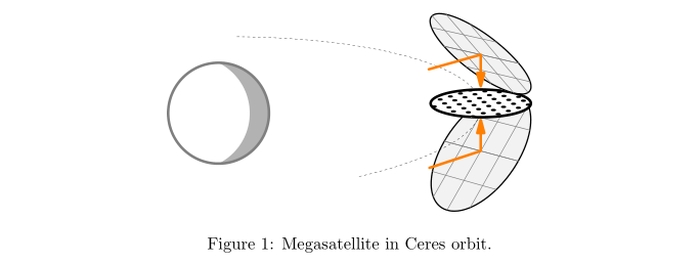
I think it is a good piece of work. It is hoped that Ceres could supply Nitrogen to fill the synthetic gravity cylinders.
I understand that Mars does not have a lot of Nitrogen to spare. So, I have been looking into that problem.
Pause..................

Nothing so special, but a way to conserve Nitrogen.
Humans could hang out mostly in the 2/3 bar chambers with N2/O2, and if needed could then go into the larger O2 at 1/4 or 1/3 bar. They may or may not want suits to wear if at 1/4 bar.
Since telepresence may allow a human to teleoperate a humanoid robot as a second body. Usually that would be the way to access low pressure situations. This should allow the Nitrogen to be conserved and stretched out.
These platforms to mine small asteroids would ultimately send materials to Venus, probably to be air braked into orbit or into the atmosphere. Venus in turn eventually could be a large source of Nitrogen and then also Carbon to send outward as payment.
Perhaps having achieved that much then it might be worked on how to mine the surface of Venus itself.
Some thinking on that has occurred in another topic: https://newmars.com/forums/viewtopic.ph … 03#p229003
So, at that stage of solar system development the Earth/Moon would be sandwiched between either Venus<>Mars/Phobos/Deimos, or Venus<>Asteroid Belt, with Mars/Phobos/Deimos and Earth/Moon inside the sandwich.
And from there then eventually the greater part of the solar system might be developed, I expect.
Ending Pending
#1562 Science, Technology, and Astronomy » Nuclear Diamond Battery and radiation belts, Transmutation. » 2025-01-10 17:45:17
- Void
- Replies: 9
I hate to start a new topic, but could we transmute Carbon in the radiation belts of a planet like Jupiter, and manufacture on a mass basis a power source like this? We would be transmuting Carbon using the radiation belts.
https://www.msn.com/en-us/news/technolo … a9e3&ei=17
Quote:
Scientists create first-of-its-kind 'diamond battery' with lifespan of thousands of years — here's how the tech will be used
Story by Rick Kazmer • 2d • 3 min read
And in doing so can we modify the radiation belts to make them less of a hazaard?
The Carbon might have to come from Callisto and Ganymede perhaps, or the Asteroid Belt.
Ending Pending
#1563 Re: Terraformation » Venus » 2025-01-10 17:30:17
So, then we might start with collecting materials from asteroids to Venus, and then go to "Divers" that could vacuum up dust/dune materials to lift to the clouds. Then eventually true mining on the surface as kdb512 has worked on.
In the clouds I have this proposal: 
So, the tree-like objects would simply be balloons, which would assist in flotation of a platform, and where microbes would grow on the inner wall of the balloons. Nutrients would be sprayed with water onto the inner surface of the balloons. As the biomass would grow, it would sag down to the bottom to be collected.
As balloons would age they would be changed out, and then repurposed to something else.
Quite long in development we could consider "Bean stocks" where you would build from the clouds down to the surface, and would collect condensate from the clouds and drop it to produce hydroelectric power. Absolutely difficult, I expect. But the power would be immense, and after the liquid arrived at the surface you would boil it to produce even more energy. In time the Sulfuric Acid would decompose to H20 and SO2 or SO3, and you would have water, perhaps a bit acid flowing down the bean stocks.
In time better idea will emerge, I hope, but this is a pointer to some possibilities.
Ending Pending
#1564 Re: Civilization and Culture » History, The Frontier and its Consequences » 2025-01-10 12:24:33
I think you are correct in that (th).
In my view our main problems with the vanishing of the Frontier Experience, is the Landlords. They are people who want to collect rents while not providing a value added service. And those types will pollute the sorry telling in order to justify their position of parasitic extraction of wealth.
An example of this could be Arabs, in the expansion under Islam. They promoted high culture by joining several civilizations together, so then there was a blooming. But then they began replacing competent males in the gene pools of those civilizations, and the end consequence was a fall.
They themselves may admit that that was true, at least some of them. This is not to say that it is a fault of Arabs only or Islam, but rather that it was a case of the affliction. In school I was told how very much better the Arabs were than the Europeans, and that they had created so much. But it turns out that to some extent the attributed other civilizations work to themselves, or westerners made the attribution of credit for it in error.
And that leads to the possibility that we have such entities in our ranks that are not from any one ethnic group but have the natural compulsion to become rich and powerful, and if left unchecked they can smother the intellect from our cultures that does exist.
In my opinion when I see academics or ignorant people putting down space efforts, I hold high suspicion that these individuals are among that process that wishes to eat the brains and will kill the light.
The Shortcut mind is a real problem. A Shortcut mind can copy the works of the creative but cannot create very well. They can test very well in a school situation sort of like a magician giving an illusion. But their goal may only be to seek power and wealth. (Like many of us).
There is a place for caution in the hopes of expanding humans and robots into the solar system, but we have to be careful. Many people are Shortcut people.
Nature does not value brains or creativity, unless it promotes survival of a pattern in time.
One experience which may indicate a possibility of the Shortcuts laying groundwork for eating societies brains is when people say that the USA did not go to the Moon. I think that their could be some secretes about that, but I expect that the America haters such as Communists, and Socialists, and other nations would have exposed us as soon as possible if we had been false in going to the Moon.
But just laying the groundwork, could help allow a conquering parasitic culture, to alter the records at some point and tell a false story about us.
Being aware that the "Fakes" are always seeking to replace us in the gene and meme pool, is necessary to hope to avoid the fall of our world. It is not a guarantee, but a hope.
Ending Pending
#1565 Re: Terraformation » Venus » 2025-01-10 11:42:41
So, I am happy to be insufficient on my own for motor concepts for Venus.
We now have notions of ICE Engines or Turbines that could work on Hydrocarbon fuels and LOX.
As I have said before, I think that if a form of plastic film that could be made to endure the UV, and acid conditions would be possible, then in the interior you could have a spray mechanism that would spray water and fertilizers onto the inner surface of a balloon to promote the growth of photo-microbes. And from this you could get Oxygen and biomass that could be converted into fuels.
An aircraft that was part lighter than air and part airplane, could run on those consumables.
A liquid fuel may be appropriate. Anything from Methane to thick oil. These could be used as coolants as also LOX could be as well.
Prior to this I thought of dropping such ships down with Cryogenic fluids, to power turbines. But now the other members have indicated combustion processes being possible.
So, access to the surface may be possible. Could such a device be self digging? It seems that volcanism on Venus has much less water than Earth, so lava flows may be more common than large deposits of volcanic ash. But then a lack of water might reduce the cementing process for volcanic ash.
I will check: https://en.wikipedia.org/wiki/Volcanism_on_Venus
Quote:
Global web icon
Wikipedia
https://en.wikipedia.org › wiki › Volcanism_on_Venus
Volcanism on Venus - Wikipedia
Radar sounding by the Magellan probe revealed evidence for comparatively recent volcanic activity at Venus 's highest volcano Maat Mons, in the form of ash flows near the summit and on the northern flank. See more
Any dune fields on Venus? It seems possible: https://www.newscientist.com/article/21 … d-surface/
If we have ash deposits that have not cemented to rock and also sand dunes, then an aircraft with fuel and LOX could drop down and vacuum up a payload to lift up to the clouds.
While it may be possible to get into true mining operations, this would be a lower hanging fruit, which may remove the need for permanent installations on the surface of Venus. Of course you could not be fussy, you would have to take what was available.
But I think that a vacuum system could work very well in a 93 bar CO2 dominated atmosphere.
This could be primarily volcanic dust. I am hoping that it exists.
https://awesomeocean.com/guest-columns/ … s-surface/
Quote:
Earth’s Underwater Sand Dunes Are Eerily Similar To Venus’s Strange Surface
Quote:
Earth’s Underwater Sand Dunes Are Eerily Similar To Venus’s Strange Surface
Guest Columns
SAND DUNES
Share
Tweet
Featured Image Credit: NASA/History Archive/REX/Shutterstock
By Sarah SharkeyScientists have found a new approach to understand Venus’s sand dunes. By using the sand dunes found on the shores of Earth, we can start the process of understand exactly how the similar surface of Venus was formed.
First of all, how do we know that there are sand dunes on Venus? Back in the 1970s, Venus lander missions provided evidence that there is fine-grained sand like material on Venus. And then in the 1990s, the Magellan spacecraft’s synthetic aperture radar showed that there are sand dune-like structures on the planet’s surface.
So, I think about half of the surface of Venus is supercritical, and perhaps the other half is less so. I am hoping that there is no process that would cement dust particles together in dunes but am not sure, of course.
So, a craft to dive to the surface might be attached to a larger floating platform and ballasted down with a hydrocarbon fuel and LOX. Both of those can serve as coolants. The ship would detach, and glide down to the surface where it would vacuum up dust/dunes. It would have to be careful not to collect too heavy a burden. As the propellants were consumed, buoyancy would improve. Once enough of the dust/dunes were collected it would attempt a powered/buoyant assent back to the floating platforms.
It is possible that at the 10 bar level it could connect to another powered vehicle to be brought to a processing facility at some altitude, perhaps higher, maybe even as high as 1 bar.
So, from my point of view, a Venus development process could start with materials minded from terrestrial asteroids, and then enter the clouds primarily with robots, and then develop this dive vacuum collection method.
Quite a bit in this post, I would not mind getting input from others.
Ending Pending
#1566 Re: Terraformation » Terraforming Earth » 2025-01-09 19:30:36
I found an excentric, more so than me: https://www.youtube.com/watch?v=1nlc6lw7o_U
Quote:
How Desalination Could Create New Superpowers | Samo Burja
Upstream with Erik Torenberg
I guess I enjoy the idea that we can talk about these things. I resent the idea that environmentalists automatically act like they can rule us.
It does begin to make sense that the Los Angelis aqueduct perhaps should be shut down, or maybe even reversed.
It seems like Mars should have no problem generating plenty of fresh water.
Ending Pending
#1567 Re: Terraformation » Venus » 2025-01-09 19:24:07
Thanks for your work kdb512.
Ending Pending
#1568 Re: Terraformation » Venus » 2025-01-09 12:05:46
OK, if you have a thick slurry of Carbon or organic Carbon Dust mixed with Venus atmosphere, the suspension will be much easier than for Earth atmosphere. If you have ceramic ice engines or turbines......
Then can you have liquid metal lubricants? Possibly also liquid metal coolants, maybe also salts.
So, if you could grow algae or cyanobacteria in bags in the clouds, then you could provide your source of fuel.
Others have suggested LOX as the Oxidizer. I am still considering Sulfuric Acid as Oxidizer as it is quite available in the cloud tops.
Burning Carbon/organics, in Sulfuric Acid needs an additional heat input to sustain, but that heat is available on the surface of Venus.
I could be wrong about the Sulfuric Acid, maybe LOX is a better way. But I have read that Carbon and Sulfuric Acid with a heat input will create CO2, SO2, and H20.
If you start with a liquid (Sulfuric Acid) and a solid (Carbon), and the results are all gasses, I expect that that may be able to power a motor. But of course as I have said, I am not sure of it.
Ending Pending
#1569 Science, Technology, and Astronomy » Sunbeam Electron Propulsion, and beamed power Laser, Microwave » 2025-01-09 11:00:53
- Void
- Replies: 3
The query of the topic yields this general response: https://www.bing.com/search?q=Sunbeam%2 … cc=0&ghpl=
I see it as a mind bender. The electron beam should repulse itself and scatter, but because of relativity experienced by the electrons time dilation allows the beam to reach it's target intact enough to push it.
https://phys.org/news/2025-01-relativis … alpha.html
Quote:
January 6, 2025
Editors' notes
Relativistic electron beam could propel probe to Alpha Centauri, study suggests
by Andy Tomaswick, Universe Today
If I understand it the beam can reach out to 100 AU somehow, and the craft may be able to get to 10% of the speed of light.
This of course leads me to ask if it could be used to propel interplanetary craft within out sun's gravity well?
And for instance could you shine a beam like that on a small world, to send power?
Ending Pending
Electrons have mass, I believe so getting them to near the speed of light is a whole lot of energy in the beam, I expect.
https://en.wikipedia.org/wiki/Electron_mass
Quote:
Terminology
The term "rest mass" is sometimes used because in special relativity the mass of an object can be said to increase in a frame of reference that is moving relative to that object (or if the object is moving in a given frame of reference). Most practical measurements are carried out on moving electrons. If the electron is moving at a relativistic velocity, any measurement must use the correct expression for mass. Such correction becomes substantial for electrons accelerated by voltages of over 100 kV.
I believe that the receiver still needs some work.
Ending Pending
I might as well include beamed laser power so: https://www.msn.com/en-us/news/technolo … 8121&ei=14
Quote:
Lasers powered by sunlight could beam energy through space to support interplanetary missions
Story by Skyler Ware • 2w • 3 min read
Ending Pending
#1570 Re: Terraformation » Interworld Para Terraforming » 2025-01-09 10:10:52
This is in a large part about robots but other things as well, so I will put it here: https://www.bing.com/videos/riverview/r … ORM=WRVORC
Quote:
Elon Musk Just Made Bonkers New Predictions
YouTube
Farzad
5.8K views
5 hours ago
Related videos
A very important thing is the suggestion that there could be 5 humanoid robots for every person, in the future.
Ending Pending
On the question of how to distribute wealth. I think that an earlier retirement might be considered as wealth may accumulate sufficiently. Maybe things could be a bit more like the Nordics, providing that the economics would justify it.
As for American debt, for some time I have had a suspicion that such debt at low interest rates may turn out to have been a good thing, as to set us up to enter this new world. If the debt can be managed and also rendered less and less of the productive value of our economy, then it may well, be a mild sickness rather than a fatal one.
As for the parties of people who perhaps have a mental disorder, who continually insist that we are bad people and indeed inferiors. We should not allow them to test their theories.
For instance, the NAZI have the philosophy that continual killing will improve the human race. They seem to have a continuing desire to subordinate any people that they can. I think that they act on the level of insects, craving hierarchy at a level that is detrimental to the interests of the human race. It is not sensible to excessively weed out certain genes, as you never know if you may have use for them in the future. It has occurred to me that there is limited space inside of a person who grew from a certain genome. I am fairly sure that it is not practical to put all "Good" traits into such a genome. And then if you clone your "Perfect" human and everyone has the same genome, you make the human race brittle and not as adaptive as it should be to change.
As for the "Blank Slate" people, who have the philosophy that if they could get control of the human race completely they could teach the human race to be good, perhaps they should perfect themselves before thinking to change the nature of other people. (That is many of the far left who have those ideas).
So, America is quite a long way to the path that may be more desirable.
Ending Pending
#1571 Re: Terraformation » Interworld Para Terraforming » 2025-01-08 22:06:37
in continuation with the previous post, I guess I just what to talk about the apparent common current knowledge about what might be possible with versions of Starship.
With the tanks stretched and improved engines, I now see ~150 tons as possibly the payload for a fully reusable Starship. In expendable mode that goes to ~250 tons. (I am not aware if expendable mode only expends the Starship, or if the Superheavy has to be expended to achieve that).
While tower landings are still under study and development, now I see that at sea barge landings are being considered with legs.
So, in expendable mode, since I don't know the details, a cargo of ~200 tons, and then the dry mass of the Starship in orbit. So, looking on line I see ~120 tons as the listed dry mass of a Starship. But of course this one would not have flaps and motors, or a heat shield, so maybe not that heavy. So, let's say a expendable launch could put ~300 tons of mass in orbit.
Probably it would be desired to send some items back to Earth, such as the engines perhaps.
A cargo could be a liquid propellant, or a metal propellant. Magdrive can use Iron, Aluminum, and Copper, but I would suspect that copper is the better one. Neumann Drive works best with Molybdenum, I have read. So, if space stations were made of Starships, then maintaining orbit could likely be done with one of those. You would not have to lift other liquid propellants for that purpose.
Here is a link to the Magdrive website: https://www.magdrive.space/
If I read it right, it seems to have greater acceleration than typical electric rockets.
Neuman drive seems to be being tested in space, so a little less speculation there: https://www.space.gov.au/news-and-media … d-in-orbit Quote:
Pioneering metal-based propulsion technology
Neumann Drive® is a unique lightweight, high-efficiency solar-electric propulsion system that would help SpIRIT manoeuvre in orbit.In August, SpIRIT was able to demonstrate charging of the Neumann Drive®’s power capacitors by the nanosatellite’s solar panels and batteries. The spacecraft conducted several test firings that demonstrated the ability to use Molybdenum as a solid metallic propellant.
A comprehensive Neumann Drive® testing campaign will continue for the remaining two-year SpIRIT mission.
“There is nothing like proving what you can do in space. Demonstrating our technology in the space environment is not only rewarding but important to delivering assurance and confidence to the global small satellite industry.
~ Herve Astier, CEO, Neumann Space
I know that electric drives are not that great for direct access of Mars, but they could stage a refilling depot to a higher orbit for a Starship to refill from. Magdrive might be powerful enough to use to go to Mars and beyond, if it is developed further.
It is easy to be enthusiastic about both these two drives and the apparent future capabilities of the Starship set of options.
Ending Pending
#1572 Re: Terraformation » Terraforming Earth » 2025-01-08 14:08:23
This is a somewhat more conservative evaluation of "Super Power": https://www.bing.com/videos/riverview/r … ORM=WRVORC
Quote:
Tony Seba’s Vision of “Super Power” // Analysis
YouTube
The Limiting Factor
44.2K views
3 months ago
So, this evaluation suggests that sort of universal "Super Power" will not show up by 2030, but rather 2040.
I think that if energy prices continuously drop then demand will rise.
While reconditioning "Used Water" is an option, I have wondered about using microwaves to heat the oceans surface just a little bit, and so then to cause moisture to move to land. Many deserts are existing because of cold water off of their shores. "Distillation" done by this method would not produce an intense brine, so may be less disruptive of the oceans ecology.
Ending Pending
#1573 Re: Terraformation » Interworld Para Terraforming » 2025-01-08 12:48:09
I have seen multiple articles indicating that SpaceX and others are speculating on making space stations out of Starships.
This could be an alternative to my Shell-ship notions, provided you extracted the engines and returned them to Earth in a LEO Support type Starship.
Here is one article about it: https://www.youtube.com/watch?v=eWIz8WHCyuI
Quote:
"SpaceX Unveils Starship as NASA's Next Space Station with Revolutionary Interior Design for 2025!"
Shinning Star
1.28K subscribers
Ending Pending
#1574 Re: Terraformation » Venus » 2025-01-08 12:26:30
I am under the impression that I shall be accursed should I intrude in "Index» Science, Technology, and Astronomy» Pure Carbon burned with pure Oxygen Analysis" https://newmars.com/forums/viewtopic.php?id=10976
But as the owner has said, there are plenty of topics where speculation is allowable.
I am already aware of pulverized coal burners. A big device like a bearing grinds coal to a dust and then I believe that flue gas is used to carry the dust to a combustion event. This could probably work with "Pure Carbon" as well.
Here is an article: https://en.wikipedia.org/wiki/Pulverize … red_boiler
Another thing I stumbled on was that Carbon can be burned in Sulfuric Acid, producing CO2, SO2, and H20.
The burn process may require an input of external heat, which may not be a problem lower down in the atmosphere of Venus.
So, Sulfuric Acid could serve as an Oxidizer, instead of Oxygen. The Sulfuric Acid may also work as a coolant, I suspect, but handling it would be a real bit of trouble. But Glass may work. Glass and Ceramics we are familiar with are seen as brittle. But is the same true at high temperatures down below on Venus? Perhaps at those temperatures they may have more suitable qualities.
And then we have the Ceramic Engine: https://en.wikipedia.org/wiki/Ceramic_engine
I would look into turbines though, and there is a problem with lubricants, as I think has been mentioned by other members.
I find it hard to understand how you can invent a new thing without speculation. But that is just me, I guess.
Ending Pending
This has prompted me to speculate that if you could create UV tolerant plastic bags. you could grow algae or cyanobacteria in them with very little weight. Such "Balloons" could then support a heavy structure(s) with robots in them. You could then subject the algae or cyanobacteria to pyrolysis, to yield a Carbon rich material to be a fuel.
The Carbon brought down to the surface could be heated to the temperatures normal there. And then you might think to burn it in Sulfuric Acid collected above, and dropped down to the surface for that purpose.
Ending Pending
#1575 Re: Terraformation » Terraforming Earth » 2025-01-08 11:42:49
I understand that some members here will not buy the message in this video. Even so, it is something to have a look at, I think.
https://www.bing.com/videos/riverview/r … &FORM=VIRE
Quote:
Tony Seba: Greatest disruption in history is here, millions of jobs to disappear
YouTube
The Electric Viking
210.7K views
5 months ago
I could still be alive while this may occur, so it is of interest to me.
I will at least venture that sources of energy will increase over time, so may be more plausible as having future value.
So, the concept of "Superpower" as I think it was said, is that you would overbuild your solar panels by 5 times. Then you would only need battery power for perhaps 3-5 days. But if this is what was indicated, then I wonder what could be done with the overproduction on the better days of the year. I think that stored heat and LEDs could be a possible answer. Also water reprocessing would be possible to facilitate with that extra intermittent energy. Even very unuseful water could likely be made useful, if you have the energy and labor at a lower cost.
He says that an enormous amount of land could go back to wild, or as I would have it semi-wild. This would extract a significant amount of Carbon from the atmosphere, where plants growing would capture it above ground and below ground. Land the size of the USA, China, and Australia to go fallow.
Many would say that stored heat and LED gardens would be too expensive. But if robots eventually work for the equivalent of $0.10 per hour some distant time from now, then the cost of such structures would have deflated to a more reasonable affordable level.
As I have said, I am willing to listen to an optimistic forecast, and also pessimistic contrary forecasts.
Ending Pending