New Mars Forums
You are not logged in.
- Topics: Active | Unanswered
Announcement
#1 Re: Science, Technology, and Astronomy » O'Neills vision: Mars instead of moon. » 2026-06-21 13:36:14
This video makes a convincing case that the nation (or corporations) controlling the moon, would pretty much control the future of every other nation on Earth.
https://youtu.be/l3c3LGqQFQQ
The moon provides an enormous resource of materials outside of Earth's gravity well, with only a weak gravity of its own. It is also in Earth orbit and close enough to Earth to make travel to its vicinity relatively easy. Anyone that wants to build at scale in space and access the rest of the solar system, needs access to the resources of the moon. If they control the moon outright, then they essentially rule the world. It is interesting, because the moon is not an interesting place or a place that many people would want to live. But it's location and resources make it all important to the future.
#2 Re: Science, Technology, and Astronomy » Thermal Energy Storage » 2026-06-18 01:00:06
This graphite based thermal battery can store heat at 2000°C.
https://youtu.be/cwDly9pjSJg
This device could have a number of potential applications.
1. For electricity storage, the inner surface of the casing is lined with infrared photovoltaic cells, which convert heat into DC electricity.
2. For industrial heat applications, the storage temperature of 2300K is high enough for most applications. Glass manufacturing requires temperatures >1000°C. Blast furnaces >1200°C. Steel production ~1600°C. Cement production >1200°C. Heat can be transfered efficiently by radiation. There are numerous other direct heat applications at lower temperatures, which could actually work as part of a hybrid scheme using this device.
3. The high operating temperature could make this useful for mobile applications. We could potentially power ships using a bank of these batteries, which would run along the bilge line. An S-CO2 powerplant would then convert the heat into shaft power.
4. A neat side benefit of thermal energy storage is that units can be stacked close to population centres. Waste heat leaking from these devices can then be used to supply district heat networks. This works well in Europe and Asia, where urban settlements tend to be quite dense.
At temperatures above 1200°C, graphite has specific heat of 2.2KJ/Kg.K. Density (room temperature) is 1.6 - 1.8 tonne/m3.
Between 2200 and 1200°C, the heat stored would be:
Q = 1600kg/m3 x 2200J/kg.K x (2200-1200) = 3.52GJ/m3 (978kWh/m3)
A block of graphite 3m aside, could therefore store 1MW-day of energy in the form of high grade heat. Graphite is a relatively cheap material that can be manufactured from any carbon containing material. The blocks can presumably be used for decades. The only limitation that I can see is that high temperature gradients could result in cracking. Provided this problem is managed, graphite thermal energy storage would appear to me to be a cheap and scalable solution. It works best if it can be coupled with a low grade heat load.
#3 Re: Human missions » Starship is Go... » 2026-06-17 08:36:45
Astrobiology will certainly be a valuable output from a long-term lunar programme. I am most interested in the mass driver programme. If this can be made to work, it will bring in a new age of space manufacturing. We can go to Mars in large ships at a fraction of the cost. But the place to build a mass driver is on the lunar equator.
#4 Re: Human missions » Starship is Go... » 2026-06-17 06:33:52
A Million People On Mars
https://www.zerohedge.com/news/2026-06- … eople-mars
A Bonus Plan From Another Planet
Since SpaceX (SPCX 0.00%↑) went public, the stock has been on a tear.
The IPO pop was big. The Monday follow-through was big too. But the most interesting part of the SpaceX story isn’t just the stock action. It’s the scale of what Elon Musk is trying to build.
In an X article published yesterday, Marc Andreessen and Michael McGuiness of the venture capital firm Andreessen Horowitz highlighted the first milestone in Musk’s SpaceX bonus plan: a $7.5 trillion market cap for SpaceX and a self-sustaining city of 1 million people on Mars.
A million people on Mars.
That’s not a normal growth-stock target. It’s not even a normal space-company target. It points to how large the investable space economy could become if even part of that ambition starts to look plausible.
************************
My understanding was that Musk had postponed his 'Humans to Mars' plan in favour of development of a lunar base?
#5 Re: Human missions » Starship is Go... » 2026-06-16 02:52:09
SpaceX valuation hits $3 trillion!
https://www.zerohedge.com/markets/space … market-cap
I have put this in the Starship thread, because Starship is likely to be the main beneficiary. SpaceX appear to be having a lot of trouble building a durable and rapidly reusable heat shield. Hopefully, with this kind of cash injection, the problem can be solved. If indeed it is technically solvable. Developing Starship into a rapidly reusable launch vehicle really is key to every other space ambition that Elon Musk has. Progress has been surprisingly slow.
#6 Re: Not So Free Chat » Chat » 2026-06-14 15:18:53
Meet the nomad prepping for doomsday with sheep!
https://youtu.be/4gEczsNlkGM
This is quite inspiring.
#7 Re: Meta New Mars » Calliban Postings including links to notable contributions » 2026-06-04 13:23:40
I don't know how much aluminium would be needed. It is there to provide shock heating of the bulk propellant and to provide ions once vaporised, through which an electric arc is established. The arc would vaporise the propellant once it is established. Vacuum plating can produce coatings that are literally a few atoms thick. That may be enough. Of course, this kind of arrangement requires that fuel is manufactured. First as ceramic rods and then coated. That is a complex operation that would add weight and complexity to a space craft.
An alternative would be to sort through regolith grains to get some of about the right size. These are then injected into the engine and we use a laser to ablate enough material from the surface to set up a conduction path. That increases the energy requirements of the process, but may be logistically simpler.
#8 Re: Science, Technology, and Astronomy » The use of filler mass in propulsion. Could it help? » 2026-06-04 13:08:17
Almost any material could be used as propellant. The propellant does need some conductive material within it. But once it is heated beyond it's first ionisation temperature, any material is conductive, because it is a plasma with free charge carriers at that temperature. That includes any oxides that we could, for example, mine from the Martian moons. Metals would be preferable, but unless you have a convenient supply of them i.e. as waste, oxides will be the dominant materials available naturally. The problem is that oxides break down into a mixture of metal and oxygen ions.
#9 Re: Science, Technology, and Astronomy » The use of filler mass in propulsion. Could it help? » 2026-06-03 14:56:18
Using inert material for reaction mass is a good idea. The mass driver has been proposed as an engine that could be mounted on a spacecraft and used to accelerate mass for propulsion. Another option that is potentially far more compact, is the arc jet.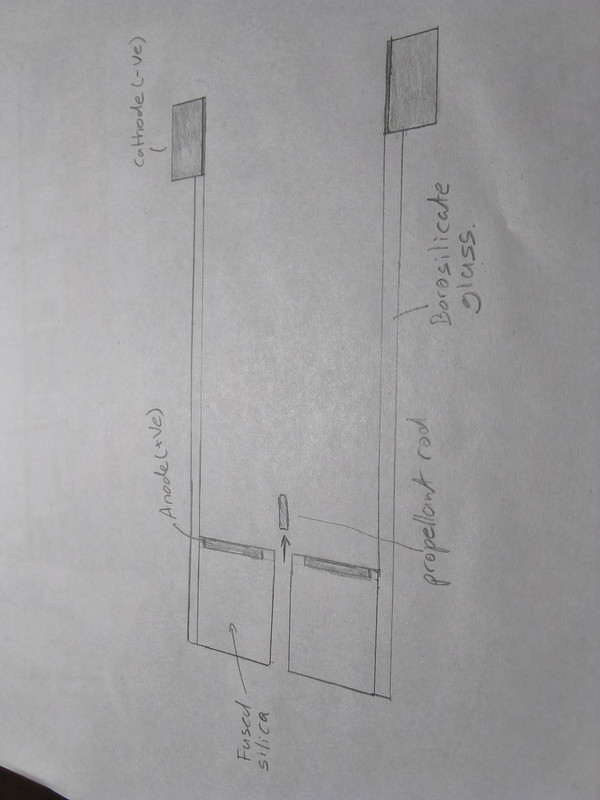
The image shows the concept. We take mixed silicates from, say, one of the Martian moons. This is compressed and sintered into thin rods and then chopped into short cylinders. Next, the cylinders are vacuum plated with a thin film of aluminium. The potential difference between the anode and cathode in the engine will be several tens of KV. The ceramic cylinders are fired through the tube passing through the fused silica block. The anode ring is mounted on the silica block.
As the cylinder enters the chamber between the anode and cathode, the potential difference between the two strips electrons from the aluminium coating and pulls them towards the anode. This heats the aluminium to tens of thousands of kelvin, turning it into a plasma that fills the enclosure. The high speed ejection of the aluminium, compresses the ceramic rod, shock heating it to thousands of kelvin. At this temperature, the material dissociates into plasma. The aluminium and silicate plasma are both electrically conductive at this point. An electric arc flows through the plasma. Electrons are drawn to the anode and positive plasma ions are drawn to the cathode at the nozzle, where they recombine with the electrons. The resultant neutral plasma is expelled at several km/s.
One problem with using silicates as propellant is that hot oxygen ions will tend to chemically attack the cathode. One way of dealing with this is to cover the cathode with a replaceable metallic liner. Maybe something cheap and abundant like iron.
#10 Re: Home improvements » Misc. Home Projects » 2026-06-03 06:42:46
Thanks SpaceNut.
Overall, the mechanical wind power project has not worked very well. I have been able to use it to polish stones. But even in this limited application, it is slow compared to an electric tumbler and its work rate is highly dependant on weather conditions. Some lessons learned:
1. Given the limited power output from a machine of this size, a homemade windmill is only worth building if the majority of materials used to build it are free. Most of the material inputs to my machine were recycled wood and recycled aluminium from old drink cans (for the blades). The bearings, stainless steel thread, screws, epoxy glue and some fastenings were purchased components. Overall, the financial cost of the machine was ~$US500. The time input was huge.
2. From the outset, the machine was intended to generate mechanical rather than electrical power. Electrical generation would have improved the utility of the machine, but would have at least doubled it's cost. However, mechanical power transmission was not successful. Much of the problem was due to difficulty assembling the machine at height, which resulted in the pulley being mounted unevenly on the rotor. The rope frequently slipped off, making power transmission unreliable and requiring constant attention. The rope also suffered excessive wear. Metal rope did not work well either, as it did not grip the pulley properly and caused damage when it slipped off. The rope drive also added a lot of friction. This further reduced the operating window of the machine, as the turning force had to overcome static friction in order for rotation to start.
3. The siting of a small wind machine has a critical impact on its viability. For the machine to work well, it must have open space in front of it for at least a few hundred metres in the dominant wind direction. If your space is surrounded with trees or buildings that attenuate wind at the hub height, performance will be poor. This is a problem in the UK, because most homes are crowded together and only a minority have free space around them. So a wind machine will only be useful in a minority of situations.
4. Building a horizontal axis machine turned out to be a mistake. Without the ability to track the wind (which adds a lot of design complication) the machine is idle a large percentage of the time. When I started the project, my assumption was that facing the machine west south-west, was an acceptable design compromise, because on a time averaged basis, about 80% of annual wind energy comes from that direction. But that decision reduced the operating time of the machine. A vertical axis machine could have operated using wind from any direction. Although vertical axis would be slightly less efficient, the ability to harness wind from any direction without tracking, means that a machine of comparable swept area would generate similar power over the year. However, this power would be spread over more operating hours, which is valuable.
5. The machine was difficult to build and I had to modify the design several times. Modifying the machine meant working at height and on two occasions, I had to lift the rotor out of its cradle. Everything is more difficult when working at height. Designing a machine that allows the rotor to be easily lowered to ground level would make maintenance easier.
6. A vertical axis machine would have been simpler and easier to build. It would also have made mechanical power transmission easier. Instead of the unreliable rope drive, a bevel gear could have attached directly to the rotating shaft at ground level.
7. The machine now incorporates tumbling boxes at the end of (four of) the blades. This eliminates the need for power transmission and eliminates the friction imposed by the ropedrive. However, the machine cannot be used for any task now other than stone tumbling.
8. The machine proved to be under-powered and poorly sited for many of the tasks I wanted to use it for. I estimate that average power is ~300W. However, friction consumed a great deal of power and what remained was generally insufficient and too intermittently available to support other mechanical loads. The power available to a wind machine is proportional to swept area. Doubling the length of the blades would quadruple power output. But the cradle design did not allow that.
At some point in the future, I may try again. If I do, I will choose a different design to the one that I built. It was a pig to build and the results were far more limited than I had hoped.
#11 Re: Home improvements » Misc. Home Projects » 2026-06-02 02:34:12
I have just finished building a stone cutting table saw.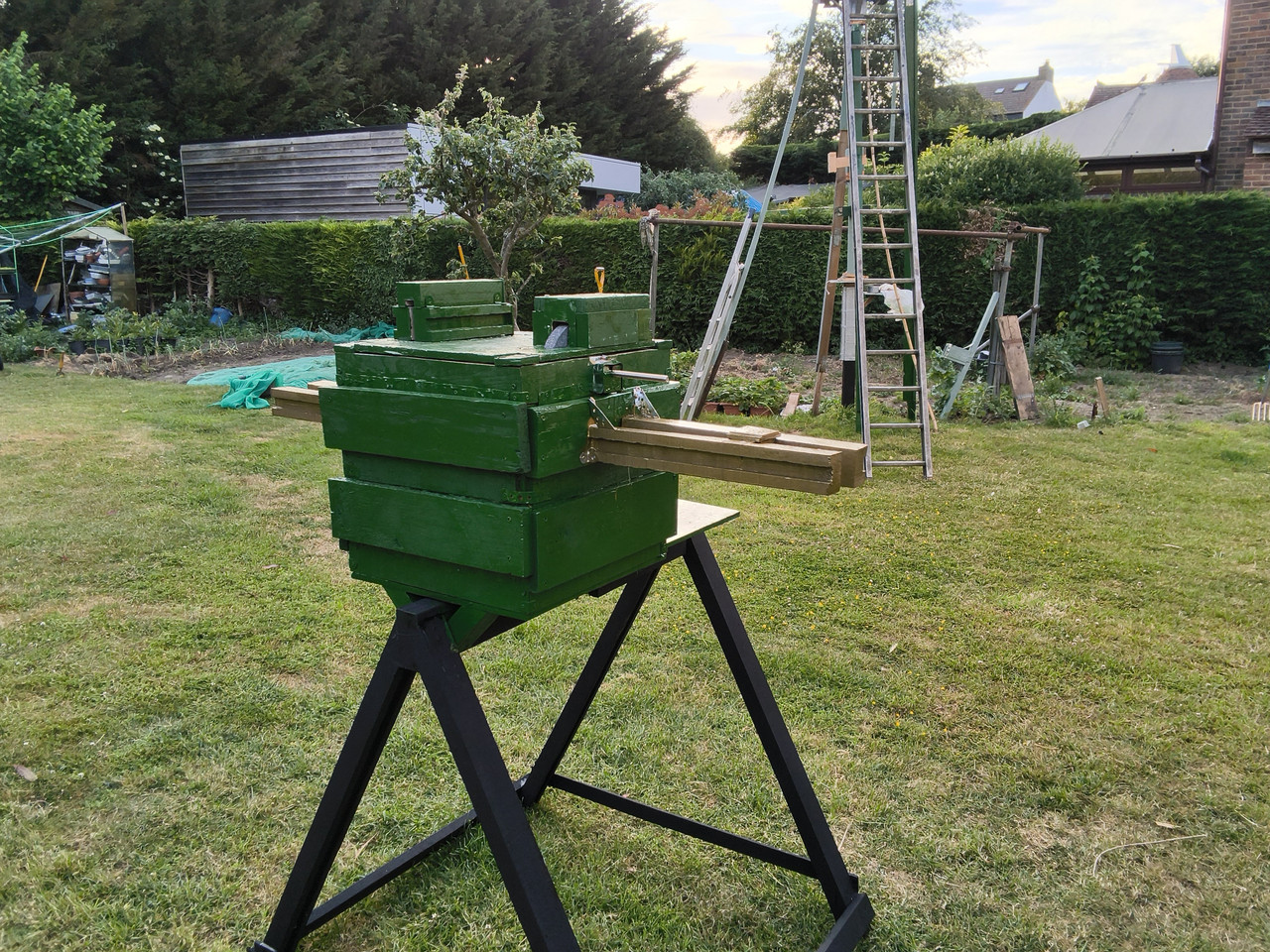
.jpg)
The cutting disc and grinding wheel are both mounted on 10mm threads that protrude out of the sides of the box. I am using a power drill to drive the machine, which will be mounted on the wooden arms that stick out the sides. But in the future, it could be driven by a DC motor powered directly from a solar panel. Or I could put a pulley onto each of the threads and use mechanical wind power to drive it. My existing windmill isn't up to the job, unfortunately. I am using it to polish stones instead. This is a lower power application that is more suited to highly intermittent energy.
#12 Re: Life support systems » Gold Hydrogen, Geologic Hydrogen, Natural Hydrogen, etc. » 2026-06-02 02:08:44
DOE estimates that there is enough hydrogen underground, to power humanity for 170,000 years.
https://oilprice.com/Energy/Energy-Gene … Years.html
Due to its low density and low boiling point, transporting hydrogen is problematic. But if we can find a natural hydrogen deposit that can be tapped relatively cheaply, i.e $1/kg, then it can be used to produce liquid fuel using CO2 extracted from seawater or air. This can be done using a plant that is assembled close to the well head.
2H2 + CO2 = CH3OH
Liquid methanol can be used as a fuel directly, or can be converted into longer chain hydrocarbons through addition reactions. Everything starts with cheap hydrogen. Even if hydrogen sources are relatively remote, they could still be useful for liquid fuel production. Liquid hydrocarbon fuel can be piped across land to sea ports, where it can be loaded onto tankers.
A hydrogen extraction cost of $1/kg, is equivalent to $43/barrel in energy terms. Present oil prices are oscillating around $100/barrel. Capturing CO2, chemically synthesising liquid fuel and transporting the fuel will have additional costs. But if oil prices remain moderately high, synthetic fuel produced using mined hydrogen could provide a substitute for our gradually depleting oil based liquid fuels.
Presumably, the same geological processes that produce geological hydrogen on Earth will also be active on Mars. The low geological activity of the Martian surface should mean that hydrogen is trapped more efficiently. We won't know until we go there and start drilling. But if we do find abundant hydrogen on Mars, it will be a huge boost to colonisation of the planet. It would make the production of liquid fuel, steel and polymers much cheaper than it would be if everything had to be produced using electricity. We could even use the hydrogen to make food by synthesis of acetic acid.
#13 Re: Home improvements » Misc. Home Projects » 2026-05-22 11:24:32
After endless problems with the ropedrive, I decided to disconnect it. I have fitted boxes to contain the sampling pots directly on the ends of one set of blades. This means I don't need to climb too high to access the tumbling boxes.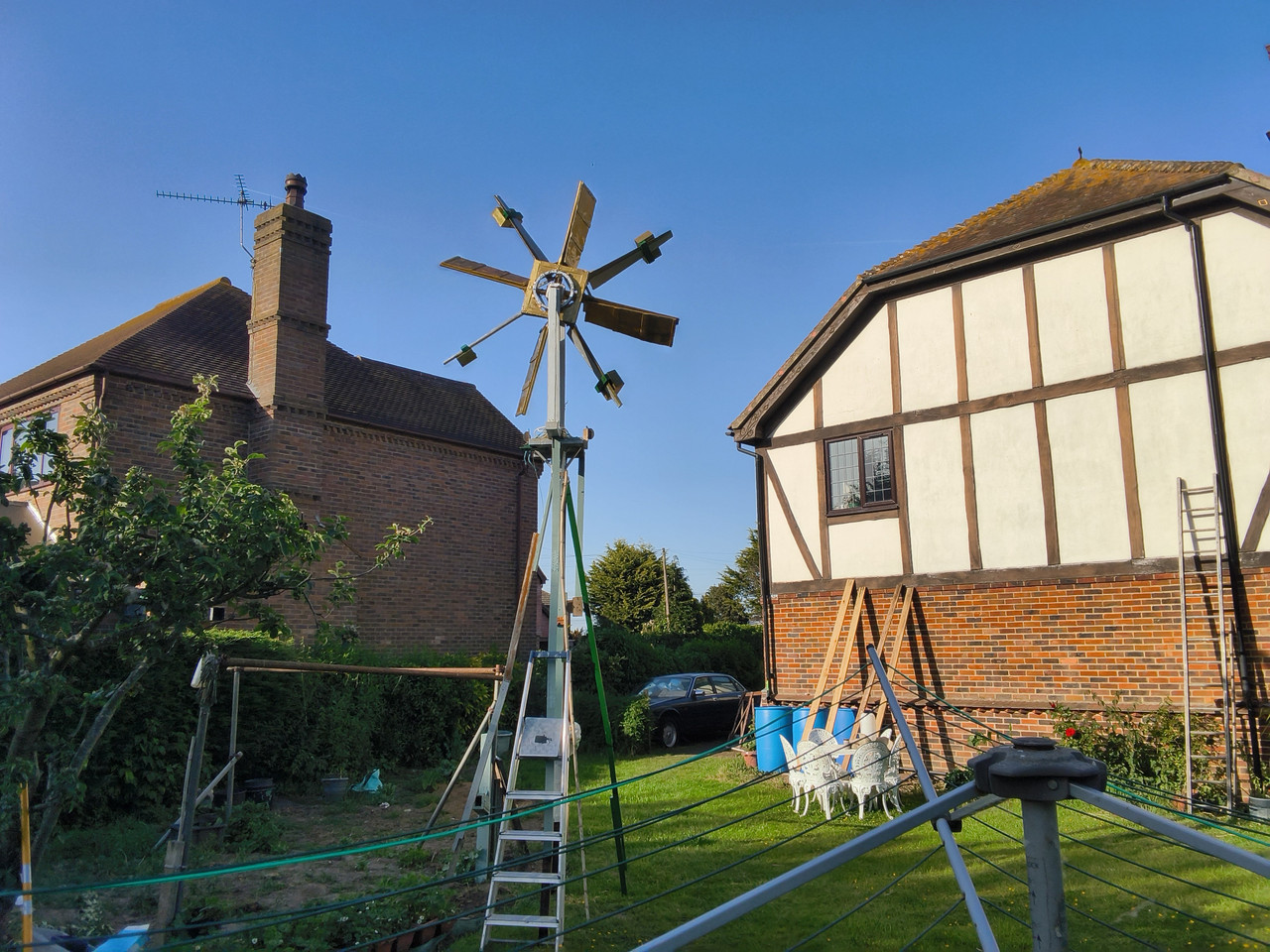
It works a treat! The only problem is that whilst this works OK for tumbling, it is no use for any other mechanical load.
#14 Re: Terraformation » Plutoids and Rogue Planets, Titanformation process, a cold treasure? » 2026-05-15 06:34:35
For a body some 1500km in diameter (63% Pluto diameter) and mass 25% of Pluto, my spreadsheet indicates that a nitrogen atmosphere with a 25KPa surface pressure would lose 1% of its mass every 80 days. For a mass this small, there is no exobase within the gravitational influence of the body, resulting in bulk escape of atmospheric gas. The atmosphere is also very massive, with a column density 89.1 tonnes / m2. So a dense, gravity confined atmosphere would appear to be impractical for a body this small even in interstellar space. Maybe a more complex model accounting for real gas properties will change things. But getting the required data is difficult.
#15 Re: Terraformation » Plutoids and Rogue Planets, Titanformation process, a cold treasure? » 2026-05-14 17:41:16
See here: https://newmars.com/forums/viewtopic.ph … 21#p239321
A Pluto mass body could hold a nitrogen atmosphere with 28KPa surface pressure for geological timescales. This is enough pressure for humans to breathe, although the atmosphere would not be breathable.
#16 Re: Science, Technology, and Astronomy » Kuiper Belt Objects - Generic Topic » 2026-05-14 16:25:57
Void, that is interesting. It suggests that we can likely build temperature gradients within the atmosphere.
I decided to build a spreadsheet to model the atmosphere of a body the same mass and diameter as Pluto. My assumption is that this body is far enough away from any star that the top of the atmosphere is dominated by non-ionised N2 at 40K temperature. The spreadsheet models the decline in pressure vs height using the standard scale height equation. This is based on ideal gas properties, which makes it pessimistic, as nitrogen gas will be more compressible beneath its critical point (126K). This will result in a more compact atmosphere with a higher escape velocity in the exobase. So any results calculated here will be bounding for real gases. My assumption is that the atmosphere is heated from the bottom, with little or no heat arriving at the top.
Some assumptions and starting conditions.
1. The model calculates atmospheric properties at increments of 100m and extends from the surface up to the exobase at 1242.8km.
2. The temperature at the surface is taken to be 68K, which is the saturation temperature of nitrogen at 28.481KPa. This is above the triple point for N2, allowing liquid N2 to flow on the surface. It is also a high enough pressure for human breathing, meaning that habitats will not need to be pressurised.
3. Temperature is assumed to be constant at 68K, until a height of 27.4km. At this point, pressure drops to 12.6KPa, which is the triple point pressure of N2. The assumption is that temperature declines to 63.2K at this point. Temperature remains constant w.r.t height until pressure drops to 10KPa at 34.7km. For pressures <10KPa, I was able to derive an equation for saturation temperature as a function of pressure, based upon the phase diagram for nitrogen. The fitted equation is:
Tsat ~ 7LOG(P/1.93E-5)
Using this equation iteratively, I was able to model a declining temperature vs height, reaching a temperature of 40K at 243km. Beyond this height, temperature is assumed to be a constant 40K until the exobase.
4. The local scale height was calculated using a value of g that was calculated using Newtons universal law of gravitation:
g = GM/((r+h)^2)
Where: g = gravity at height, h, above the surface; G = 6.67E-11; M = Mass of body (kg); r = radius of body (m); h = height above the surface.
The scale height was recalculated for each 100m element within the atmosphere.
Local escape velocity is given by: Ve = (2*g*(r+h))^0.5
Results
The main question that we wish to answer with this exercise is whether such an atmosphere could be stable for any length of time. For a body as small as Pluto, with an escape velocity of ~1.2km/s at ground level, is it possible to sustain an atmosphere with enough pressure for human breathing for a long timescale? This was the question I wished to answer.
The escape velocity at the exobase is only 846m/s. However, at a temperature of 40K, the root-mean-square speed of N2 molecules is only 189m/s, about 4.5x smaller than escape velocity. I used an online tool to calculate the Maxwell-Boltzmann distribution for N2 at 40K. Amazingly, only ~5E-7 of the molecules (i.e. 1 in 2 million) attain a speed of 846m/s. I conservatively doubled this number to estimate the integral of the curve at all speeds higher than this.
The mass flux escaping from the exobase can be approximated by multiplying the number density of escaping molecules in the exobase by their average escape velocity. The pressure at the exobase is 7.39E-9Pa. Solving the ideal gas equation gives a mass density of 6.23E-13kg/m3. Assuming 1 in 1 million of these has sufficient energy to escape, allows escape flux to be calculated:
q = (6.23E-13/1,000,000)*846 = 5.25E-15 kg/m2s.
Multiplying by the surface area of the whole atmosphere at the exobase (7.428E13m2) gives a whole planetary mass loss rate of 0.039kg/s. The total atmospheric mass is 9.18E17kg. It will therefore take 7.46 billion years to lose 1% of the atmosphere via Jean's Escape. I would therefore expect cosmic ray sputtering to be a more important atmospheric loss mechanism than Jean's escape. Suffice to say, the atmosphere should be stable over geological timescales.
Interesting facts:
1. Although the atmosphere is extensive, some 75% of its mass is within 50.2km of the surface.
2. The column density of the atmosphere (mass per unit of surface) is some 51,700kg.m-2. This is ~5x the column density of Earth's atmosphere, yet surface pressure is only 28% Earth sea level. This is a direct consequence of the low gravity of the body. It also suggests that building such an atmosphere is only likely to be achievable if the nitrogen is already in place at or close to the surface of the body and can be vaporised by adding heat.
3. Assuming all heat is radiated into space from the top of the triple point layer, the total radiant heat flux ejected into space is 1.7E13W, or 17TW. Present human civilisation uses some 19TW per year. So the terraformed world could support a large civilisation, but there are clearly limits to population and power consumption before waste heat becomes a problem. If we assume that the bulk of human food is produced via artificial photosynthesis, which turns electrical energy into calories with 20% efficiency, then providing 10MJ of food energy per day requires 50MJ of electrical energy. This in turn, would require the generation of 100MJ of heat in the powerplant. If we assume that each human needs an extra 1kWe for other (non-food) energy needs, then each human will need a continuous 3kWe of power production, implying some 6kWth of nuclear heat production. This implies a maximum practicable population of 2.83bn for this dwarf planet. That is 160 people per square km.
If human beings do find rogue Pluto sized bodies in interstellar space or the Oort cloud, it is possible in principle to terraform these worlds, at least from the point of view of providing surface pressure sufficient for humans to breath. Humans would still need to live within habitats that are hotter than the surface. But these could be thin tent like structures, as there would be no effective pressure difference between the inside of the habitat and the surface. Something like a polymer membrane draped over a steel frame, would be sufficient to separate warm breathable air inside, from cold nitrogen gas outside.
My next iteration of the spreadsheet will explore how small a world would need to be before this terraforming approach is no longer viable.
#17 Re: Science, Technology, and Astronomy » Kuiper Belt Objects - Generic Topic » 2026-05-13 02:14:03
Void, I think you are correct. The bottom of the atmosphere should have a temperature around the boiling point of nitrogen at whatever the pressure happens to be, likely around 70K. The top of the atmosphere will be as cold as we can make it. Warmer gas at the bottom of the atmosphere will rise by convection. It will naturally cool as it expands. Any particulates it the atmosphere will also allow the gas to cool by radiation.
Pluto appears to have enough nitrogen to form a 20-30KPa surface pressure if enough artificial heat is injected at the surface. This would allow cities to be built beneath inflated tent or greenhouse structures, without need for pressure domes. Any ecosystem would still need to be very much artificial. The outside temperature is too cold and has too little sunlight to make natural ecosystems possible. But the atmospheric pressure would make it relatively easy to build large enclosures full of air, as there would be little or no pressure difference between the air inside and the atmosphere outside. The same would be true on Titan.
I had hoped to build a spreadsheet programme that could model the structure of the atmosphere. What is holding me up is the difficulty in finding information on the gas properties of nitrogen at temperature beneath its triple point at 63K. Whilst the bottom of the atmosphere will be warmer than this, the top will be colder. I may make a start with a model that assumes an isothermal atmosphere and see what it looks like.
Clustering of gas molecules beneath the critical point of a gas is a real phenomena. These clusters become nucleation points as the gas condenses into liquid. This happens in Earth's atmosphere and allows water vapour to condense into rain. There is surprisingly little scientific knowledge of how clusters form at the molecular level. But this has a significant impact on atmospheric escape, because clusters of nitrogen molecules will have reduced molecular speed compared to ideal gases. Clustering of gas particles will also make the atmosphere more compact. Clustering helps explain how very small KBOs are able to sustain tenuous atmospheres. If nitrogen behaved as a strictly ideal gas, this would have been lost to space very quickly. But the clustering of molecules reduces average molecular speed and reduces leakage. So even very small bodies can hold on to thin atmospheres for a surprising amount of time. But it only works at low temperatures.
#18 Re: Meta New Mars » kbd512 Postings » 2026-05-11 08:13:58
TH, the link in the original post has gone inactive. One problem with fuel cells is that surfaces are vulnerable to contamination, especially with sulphur. Historically, there have also been issues with weight, cost and fragility of ceramic membranes in SOFCs. If we want to burn coal in an engine, the traditional approach was to gasify the coal with partial combustion with steam, to produce carburretted water gas. This gas can then be burned in a spark ignition engine or gas turbine. This is old technology now. It has been used in road vehicles. It could be used in trains and ships.
In ships, it might find a niche, because such a ship could be powered using coal, raw biomass, crop residues, forestry wastes and even trash. The fuel wouldn't require much processing aside from being chopped into pieces of the right size. Any plant material available would work. This option hasn't been popular up to now because of the logistics of handling solid fuel, the need for pre-burning furnaces on board the ship (which would take up space in the hull), the cumbersome nature of solid fuel injection into furnaces and the lower energy density of biomass fuel. But this is an option that coukd be made to work if the world finds itself enduring a prolonged shortage of liquid fuels.
#19 Re: Science, Technology, and Astronomy » Kuiper Belt Objects - Generic Topic » 2026-05-10 15:53:20
I believe that I have a partial answer for how the small body 2002_XV93 can hold an atmosphere for such a long period of time. I believe there are two reasons:
(1) Although the information available is sketchy, at temperatures beneath the critical point of a gas (126K for N2), molecules begin to stick together as van der waals forces begin binding them into clusters. If pressure remains beneath the liquidus point, these clusters never grow sufficiently large to allow nucleation. However, if gas molecules bind together into quasi-stable clusters, their average molecular speed will be reduced as per kinetic theory of gases. This reduces the proportion of molecules able to exceed escape velocity.
(2) Solar wind, although weak in the kuiper belt, preferentially ionises the upper region of the atmosphere 2002_XV93. This results in a voltage gradient between the top of the atmosphere and the ground. This results in an attractive electrostatic force between the upper atmosphere and surface of the planetoid.
I don't know if these factors were accounted for in estimating the atmospheric lifetime of 2002_XV93. If not, the atmosphere could persist for longer than was predicted. These factors may also help explain why the leakage rate of Pluto's atmosphere was 10,000 times lower than predicted.
In the past, we have discussed the possibility of creating thin atmospheres on smaller KBOs and dwarf planets to improve habitability. These findings, if they can be substantiated, improves the case for that. But clustering only works if the gases remain cold and van der waals forces dominate. This limits the scope of application for this technique.
This is interesting.
https://physics.stackexchange.com/quest … atmosphere
The first post suggests that a body with a radius >50km could retain an exosphere. I am going to put the jean's escape equations into a spreadsheet and see what the results are for different gases and temperatures.
#20 Re: Meta New Mars » Calliban Postings including links to notable contributions » 2026-05-06 09:18:56
I keep getting this message when attempting log-on:
'Bad CSRF hash. You were referred to this page from an unauthorized source.'
Any idea what this means?
#21 Re: Not So Free Chat » Canada / U.S. relations » 2026-05-06 09:00:47
It is news to me that the UK started the 2003 Iraq war. If memory serves, GW Bush made the decision to invade Iraq and depose Saddam Hussein. There were official reasons given about human rights violations, WMDs, etc. But at the time, the US was importing most of its oil and there were powerful interests in the Bush administration that wanted Iraq out of OPEC and open to development by US based oil companies. Britain ended up joining the conflict after Bush asked Blair whose side he wanted to be on when the oil started to run out. There was ĺarge scale opposition to British involvement at every political level in the UK at the time. Blair basically burned his whole career by allying himself with Bush and committing the UK's mediocre military to the war.
The idea that the UK somehow pushed the US into the war just doesn't wash. It was more the other way round, but I don't believe that Bush forced Blair to do anything. It is entirely possible that both men were under the influence of the same deepstate lobbyists. But this is not specifically a British problem. Youtube hosts a lot of conspiracy theorists that talk all kinds of crazy. Some of what they say is true, a lot of it isn't. Seperating truth from tin foil hat nonsense isn't always easy. It requires background knowledge that not everyone has. The worst lies contain just enough truth to make them sound credible.
#22 Re: Science, Technology, and Astronomy » Kuiper Belt Objects - Generic Topic » 2026-05-06 08:06:12
Interesting discovery of atmosphere on 2002_XV93.
https://en.wikipedia.org/wiki/(612533)_2002_XV93
This little world is just 470km in diameter and surface gravity is ~1% Earth normal. So even a thin atmosphere should dissipate quickly. The authors suggest complete escape in 100 - 1000 years, depending upon composition. The source of the atmosphere is most likely an impact exposing buried volatiles, which subsequently sublimate.
By my estimation, the escape velocity of this body is less than 200m/s. Even at the low temperatures present in the Kuiper Belt, I am surprised that an atmosphere could survive as long as 100 - 1000 years. The gases most likely to be present, N2, CO, CH4, also have relatively low molecular mass. If we take nitrogen as an example gas and assume an atmospheric temperature of 50K, the median gas molecule velocity is 177m/s.
https://cfm-calculator.com/calculator.p … ulator.php
That means that around half of the molecules in the atmosphere will be moving at velocity that exceeds escape velocity. How is it that these gases are not lost on a timeframe measured in hours or days rather than years? How could any atmosphere survive for centuries?
******
Additional: I think the reason that the atmosphere can hang around for so long is due to inertial confinement. The particles that escape first are at the top of the atmosphere, where the mean free path starts to exceed the scale height. The particles beneath are confined by collision with particles above them. This deflects them downward, confining them. Even so, it isn't clear to me why the lower layers wouldn't just expand, pushing the upper atmosphere into space. How escape can happen so gradually is not something that I can explain.
#23 Re: Not So Free Chat » Chat » 2026-05-05 08:01:09
It has been colder, cloudier and wetter than usual for this time of year in the UK as well. I think this is an El Nino event effecting the entire northern hemisphere. Kind of depressing, but nothing to do but ride it out.
#24 Re: Meta New Mars » Calliban Postings including links to notable contributions » 2026-05-05 07:58:46
Thanks. It is good to see the forum up and running again.
I think my original e-mail has gone inactive. I will update with a new one this week.
#25 Re: Science, Technology, and Astronomy » Synthetic or Natural Fuel Produced using Solar Power » 2026-05-05 03:38:22
The Chinese are building liquid fuel production at scale for production of jet fuel. They plan to use fusion to power these plants at scale when it is available.
https://youtu.be/RMtyFRGi6h8
There is an acknowledgement that this process cannot beat oil-based fuels on a price basis. But security of supply issues, promted by the Hormuz crisis, give synthetic fuels a premium over oil- based fuels that must be imported.
The two key technologies that make synthetic fuel production possible are carbon dioxide capture from air or water and production of hydrogen from water. After that, producing hydrocarbons is basic chemistry. There are numerous hybrid strategies that could work as well. Synthetic hydrogen could be used to crack heavy oil in places like Canada, turning it into a lighter grade oil that can be pumped to refineries. Synthetic oils can be blended with natural oils in much the same way that tight oil is blended with heavy oil already. Biomass upgrading and plastic waste decomposition are also possibilities.
However it is done, synthetic fuels are gradually making inroads into fuel markets as deglobalisation and depletion result in supply crises for conventional oil. The Chinese appear to be the first country to expand this at scale.