You are not logged in.
- Topics: Active | Unanswered
Announcement
#201 2025-11-15 09:05:49
- Void
- Member
- Registered: 2011-12-29
- Posts: 9,550
Re: Multi-Ship Expeditions, Starboat & Starship, Other.
As always, I have the potential to be wrong.
I have been thinking about an "Upstairs Starship". This would be a Starship which typically does not land on the Earth but maybe at times might land on the Moon.
I am thinking that it would be made of "Ferroaluminum": https://en.wikipedia.org/wiki/Ferroaluminum
The Melting point would be 1250 C, I think, which is lower than Stainless Steel. But it is corrosion resistant.
It would have less weight and less inertia. So aerobraking to aerocapture might be possible. Of course, it would have to be refilled by a "Standard Starship".
The objective would normally be to not dive too deep into the atmosphere before skipping off, to keep peak heating down.
But it would not be forbidden to have supplemental protections such as tiles and active cooling. It might be possible to have ports in the belly what would allow fluids to be injected under the belly. Ideally this cooling method could also be used in navigation though the atmosphere.
The purpose of a machine like this would be to take possession of a package from a "Standard Starship" and bring it to a higher orbit.
This would probably be for freight.
It is possible that it could be in association with a Electric Rocket System.
This then would be a intermediary between a "Standard Starship", and an Electric Rocket System.
So, the "Standard Starship" might refill it with Methane and Oxygen but also perhaps an Argon/Xenon mix. The Electric Rocket System with large solar panels staying out of the atmosphere even at very high altitude would provide shade and cooling power to keep the boil-off problem under control.
Perhaps the Electric Rocket System, would not go as low as the ISS is to reduce drag. (Perhaps).
The "Upstairs Starship", then being linked to the Electric Rocket System could as a hybrid travel to an orbit of the Moon. To come back, the combination might separate at some point so that the "Upstairs Starship" could use air braking to get it down to take payload from a "Standard Starship".
And of course I am hoping that eventually the Electric Rocket System could be switched to a metal propellant such as Neumann Drive or Magdrive might allow.
In that case, refilling could be done at the Moon orbit. Both Metals propellants, and Oxygen.
Ending Pending 
Last edited by Void (2025-11-15 09:22:19)
Is it possible that the root of political science claims is to produce white collar jobs for people who paid for an education and do not want a real job?
Offline
Like button can go here
#202 2025-11-15 10:31:02
- Void
- Member
- Registered: 2011-12-29
- Posts: 9,550
Re: Multi-Ship Expeditions, Starboat & Starship, Other.
https://www.bing.com/videos/riverview/r … &FORM=VIRE Quote:
SpaceX Revealed Starship-Dragon Combination Plan to Reach the Moon Faster than China & BO…
YouTube
GREAT SPACEX
44 views
I think it makes sense to separate the Lunar Space Station effort from the Moon Landing Effort.
Perhaps later then the two could be joined in some way.
In reference to my just prior post here, I am thinking that in the deep future, a "Upstairs Starship" might have its engines in its belly. This would allow it to fire its engines during aerobraking to protect it's belly from excess heat. The engines should be desired to be allowed to fire a reduced temperature mix, such as 90% Methane/10% Oxygen.
But when properly used, it may not be a problem to use the engines to travel towards the Moon, when in a vacuum.
Engines being in the belly, then they would also be suitable for landing on the Moon.
To get this thing to orbit it may need raptors in its tail, but upon reaching orbit those could be removed partially or entirely.
My notion is that this ship would not land on Earth ever again but might do repeated skips on the Earth's atmosphere. As this would take time, so a capsule return of crew would be appropriate.
Having a Starship escort a capsule both to and from the Moon, would give the capsule additional protections such as radiation protection in many cases.
Ending Pending
Last edited by Void (2025-11-15 10:38:41)
Is it possible that the root of political science claims is to produce white collar jobs for people who paid for an education and do not want a real job?
Offline
Like button can go here
#203 2025-11-20 09:13:46
- Void
- Member
- Registered: 2011-12-29
- Posts: 9,550
Re: Multi-Ship Expeditions, Starboat & Starship, Other.
This video talks about a supersized V4 Starship, and towards the end, Starboat (Mini-Starship): https://www.bing.com/videos/riverview/r … ORM=VAMGZC Quote:
Elon Musk Revealed Big Upgrade on Starship V4 Shocked NASA!
YouTube
TECH MAP
1 views
Starship>200 Tons Payload in reusable mode.
The blurb about Starboat is especially interesting to me. More or less an optional 3rd stage for the Starship system.
-Could be lifted to LEO fully filled with propellants by one Starship.
-Payload to Mars 5-25 Tons?
-2200 km point to point on Mars. (Using 100 tons of propellants)
-50-120 tons of propellants to get back to Earth.
-1/5th as heavy as a Starship.
Ending Pending
Last edited by Void (2025-11-20 09:28:24)
Is it possible that the root of political science claims is to produce white collar jobs for people who paid for an education and do not want a real job?
Offline
Like button can go here
#204 2025-11-20 11:14:53
- Void
- Member
- Registered: 2011-12-29
- Posts: 9,550
Re: Multi-Ship Expeditions, Starboat & Starship, Other.
This post relates to the just previous post about Starship V4 and Starboat.
I may have a notion worth at least a look, which may make Starboat a much better option.
I think that if Starboat goes to Mars from LEO, it should be accompanied by a full Starship, landing only.
That is no intention to relaunch the full Starship. So, if the two were docked together in transit, this would greatly increase the comfort and safety of the travelers. Radiation protection may be better as you can impose the bulk of the full starship between the sun and the humans. The major Starship then can become part of a Mars infrastructure upon landing.
The above is all contemplated already.
If we had the assets for it, we might station a full Starship in orbit, to then accompany the Starboat back to Earth to offer similar protections and comforts. But unfortunately it is difficult to stop a Starship in orbit of Mars, and otherwise you end up refilling a whole Starship on the surface of Mars which is a burden we wish to avoid by doing a Starboat in the first place.
But I recalled a "Free Return" which could be used in the event that a mission to Mars had to be aborted prior to landing on Mars.
https://en.wikipedia.org/wiki/Free-return_trajectory
Quote:
Free-return trajectory
Article
Talk
Read
Edit
View historyTools
Appearance hide
TextSmall
Standard
Large
WidthStandard
Wide
Color (beta)Automatic
Light
Dark
From Wikipedia, the free encyclopedia
Sorry to interrupt, but we're short on time to hit our goal.
This Thursday, we ask you to join the 2% of readers who give. If everyone reading this right now gave just $2.75, we'd hit our goal quickly. $2.75 is all we ask.
Give $2.75 Maybe later
November 20: Knowledge is human.
We're sorry we've asked you a few times recently, but it's Thursday, November 20, and this fundraiser matters. We're nearing today's goal, but time's running out. If just 2% of our most loyal readers gave $2.75 today, we'd reach our goal quickly. Most people donate because Wikipedia is the internet we were promised: useful, free to use, and filled with reliable, human-created knowledge. If you agree, consider giving $25 or even just $2.75.
Give $2.75
Give a different amount
Maybe later
I already donated
CloseSketch of a circumlunar free return trajectory (not to scale), plotted on the rotating reference frame rotating with the moon. (Moon's motion only shown for clarity)
In orbital mechanics, a free-return trajectory is a trajectory of a spacecraft traveling away from a primary body (for example, the Earth) where gravity due to a secondary body (for example, the Moon) causes the spacecraft to return to the primary body without propulsion (hence the term free).[1]Many free-return trajectories are designed to intersect the atmosphere; however, periodic versions exist which pass the moon and Earth at constant periapsis, which have been proposed for cyclers.
Earth–Moon
The first spacecraft to use a free-return trajectory was the Soviet Luna 3 mission in October 1959. It used the Moon's gravity to send it back towards the Earth so that the photographs it had taken of the far side of the Moon could be downloaded by radio.Symmetrical free-return trajectories were studied by Arthur Schwaniger of NASA in 1963 with reference to the Earth–Moon system.[2] He studied cases in which the trajectory at some point crosses at a right angle the line going through the center of the Earth and the center of the Moon, and also cases in which the trajectory crosses at a right angle the plane containing that line and perpendicular to the plane of the Moon's orbit. In both scenarios we can distinguish between:[2]
A circumlunar free-return trajectory around the Moon. The spacecraft passes behind the Moon. It moves there in a direction opposite to that of the Moon, or at least slower than the Moon in the same direction. If the craft's orbit begins in a normal (west to east) direction near Earth, then it makes a figure 8 around the Earth and Moon when plotted in a coordinate system that rotates as the Moon goes around the Earth.
A cislunar free-return trajectory. The spacecraft goes beyond the orbit of the Moon, returns to inside the Moon's orbit, moves in front of the Moon while being diverted by the Moon's gravity to a path away from the Earth to beyond the orbit of the Moon again, and is drawn back to Earth by Earth's gravity. (There is no real distinction between these trajectories and similar ones that never go beyond the Moon's orbit, but the latter may not get very close to the Moon, so are not considered as relevant.)
In both the circumlunar case and the cislunar case, the craft can be moving generally from west to east around the Earth (co-rotational), or from east to west (counter-rotational).For trajectories in the plane of the Moon's orbit with small periselenum radius (close approach of the Moon), the flight time for a cislunar free-return trajectory is longer than for the circumlunar free-return trajectory with the same periselenum radius. Flight time for a cislunar free-return trajectory decreases with increasing periselenum radius, while flight time for a circumlunar free-return trajectory increases with periselenum radius.[2]
The speed at a perigee of 6555 km from the centre of the Earth for trajectories passing between 2000 and 20 000 km from the Moon is between 10.84 and 10.92 km/s regardless of whether the trajectory is cislunar or circumlunar or whether it is co-rotational or counter-rotational.[3]
Using the simplified model where the orbit of the Moon around the Earth is circular, Schwaniger found that there exists a free-return trajectory in the plane of the orbit of the Moon which is periodic. After returning to low altitude above the Earth (the perigee radius is a parameter, typically 6555 km) the spacecraft would start over on the same trajectory. This periodic trajectory is counter-rotational (it goes from east to west when near the Earth). It has a period of about 650 hours (compare with a sidereal month, which is 655.7 hours, or 27.3 days). Considering the trajectory in an inertial (non-rotating) frame of reference, the perigee occurs directly under the Moon when the Moon is on one side of the Earth. Speed at perigee is about 10.91 km/s. After 3 days it reaches the Moon's orbit, but now more or less on the opposite side of the Earth from the Moon. After a few more days, the craft reaches its (first) apogee and begins to fall back toward the Earth, but as it approaches the Moon's orbit, the Moon arrives, and there is a gravitational interaction. The craft passes on the near side of the Moon at a radius of 2150 km (410 km above the surface) and is thrown back outwards, where it reaches a second apogee. It then falls back toward the Earth, goes around to the other side, and goes through another perigee close to where the first perigee had taken place. By this time the Moon has moved almost half an orbit and is again directly over the craft at perigee. Other cislunar trajectories are similar but do not end up in the same situation as at the beginning, so cannot repeat.[2]
There will of course be similar trajectories with periods of about two sidereal months, three sidereal months, and so on. In each case, the two apogees will be further and further away from Earth. These were not considered by Schwaniger.
This kind of trajectory can occur for similar three-body problems. The problem is an example of a circular restricted three-body problem.
While in a true free-return trajectory no propulsion is applied, in practice there may be small mid-course corrections or other maneuvers.
A free-return trajectory may be the initial trajectory to allow a safe return in the event of a systems failure; this was applied in the Apollo 8, Apollo 10, and Apollo 11 lunar missions. In such a case a free return to a suitable reentry situation is more useful than returning to near the Earth, but then needing propulsion anyway to prevent moving away from it again. Since all went well, these Apollo missions did not have to take advantage of the free return and inserted into orbit upon arrival at the Moon. The atmospheric entry interface velocity upon return from the Moon is approximately 36,500 ft/s (11.1 km/s; 40,100 km/h; 24,900 mph)[4] whereas the more common spacecraft return velocity from low Earth orbit (LEO) is approximately 7.8 km/s (28,000 km/h; 17,000 mph).
Due to the lunar landing site restrictions that resulted from constraining the launch to a free return that flew by the Moon, subsequent Apollo missions, starting with Apollo 12 and including the ill-fated Apollo 13, used a hybrid trajectory that launched to a highly elliptical Earth orbit that fell short of the Moon with effectively a free return to the atmospheric entry corridor. They then performed a mid-course maneuver to change to a trans-Lunar trajectory that was not a free return.[5] This retained the safety characteristics of being on a free return upon launch and only departed from free return once the systems were checked out and the lunar module was docked with the command module, providing back-up maneuver capabilities.[6] In fact, within hours after the accident, Apollo 13 used the lunar module to maneuver from its planned trajectory to a circumlunar free-return trajectory.[7] Apollo 13 was the only Apollo mission to actually turn around the Moon in a free-return trajectory (however, two hours after perilune, propulsion was applied to speed the return to Earth by 10 hours and move the landing spot from the Indian Ocean to the Pacific Ocean).
Earth–Mars
A free-return transfer orbit to Mars is also possible. As with the Moon, this option is mostly considered for crewed missions. Robert Zubrin, in his book The Case for Mars, discusses various trajectories to Mars for his mission design Mars Direct. The Hohmann transfer orbit can be made free-return. It takes 250 days (0.68 years) in the transit to Mars, and in the case of a free-return style abort without the use of propulsion at Mars, 1.5 years to get back to Earth, at a total delta-v requirement of 3.34 km/s. Zubrin advocates a slightly faster transfer, that takes only 180 days to Mars, but 2 years back to Earth in case of an abort. This route comes also at the cost of a higher delta-v of 5.08 km/s. Zubrin writes that faster routes have a significantly higher delta-v cost and free-return duration (e.g. transfer to Mars in 130 days takes 7.93 km/s delta-v and 4 years on the free return), and so he advocates for the 180-day transfer.[8] A free return is also the part of various other mission designs, such as Mars Semi-Direct and Inspiration Mars.There also exists the option of two- or three-year free-returns that do not rely on the gravity of Mars, but are simply transfer orbits with periods of 2 or 1.5 years, respectively. A two-year free return means from Earth to Mars (aborted there) and then back to Earth all in 2 years.[9] The entry corridor (range of permissible path angles) for landing on Mars is limited, and experience has shown that the path angle is hard to fix (e.g. +/- 0.5 deg). This limits entry into the atmosphere to less than 9 km/s. On this assumption, a two-year return is not possible for some years, and for some years a delta-v kick of 0.6 to 2.7 km/s at Mars may be needed to get back to Earth.[10]
NASA published the Design Reference Architecture 5.0 for Mars in 2009, advocating a 174-day transfer to Mars, which is close to Zubrin's proposed trajectory.[11] It cites a delta-v requirement of approximately 4 km/s for the trans-Mars injection, but does not mention the duration of a free return to Earth.
So, with a relatively passive free return, the Starboat might need to launch from Mars orbit to meet up with a full Starship that is on a 2 year free return loop around Mars. That would doom them to 1.5 years though to get back to Earth.
But if the Free Return Full Starship were bent, by using an Oberth maneuver while passing by Mars, perhaps the trip back to Earth could be modified to be more survivable.
This could be important if it is discovered that some artificial gravity could help human health maintenance a great deal. A coupled Starship and Starboat might give that synthetic gravity.
So, a "Mars Oberth Starship" could swing by Mars and I hope that a Starboat could align with it for a return to Earth.
Of course, if the Starboat ends up alone because of a failure of the "Mars Oberth Starship". The return to Earth could be rather desperate, and marginal in hopes for success. But if the two can meet on a path back to Earth the inhabitants of the Starboat would have a potentially much more favorable transit situation.
The risks are approximately similar to the risks of using a Cycling Spaceship. But you would know before you launched from Mars if the Full Starship was on it's way and if it seemed to be functional during the Oberth burn. You might be able to abort the launch of the Starboat, if the Oberth burn did not go as required.
Copilot Search:
Like
Dislike
Images
Videos
The Oberth effect is a phenomenon in rocketry that describes how a spacecraft can achieve greater efficiency and speed when its engines are fired at high speeds, particularly during maneuvers near a gravitational body.
Definition and Explanation
The Oberth effect is named after the German physicist Hermann Oberth, who first described it in the early 20th century. It states that a rocket or spacecraft generates more kinetic energy when it fires its engines at high speeds compared to when it does so at lower speeds. This increased efficiency occurs because the kinetic energy (KE) of an object is proportional to the square of its velocity, as expressed in the formula \(KE = \frac{1}{2} mv\^2\), where
m
m is mass and
v
v is velocity.
Wikipedia
+1
How It Works
When a spacecraft is in a gravitational well (like near a planet), it can gain additional speed by firing its engines while falling towards the planet. The gravitational pull accelerates the spacecraft, and when the engines are ignited at this high speed, the resulting increase in kinetic energy is greater than if the engines were fired at a slower speed. This principle makes the Oberth maneuver particularly useful for maximizing the efficiency of fuel usage during space missions.
Wikipedia
+1
Practical Applications
Powered Descents: During landings on celestial bodies, firing engines at high speeds allows for more effective deceleration and control.
1
Gravity-Assists: Spacecraft can use the gravitational pull of planets to gain speed. By timing engine burns during close approaches, they can maximize the Oberth effect and achieve significant velocity increases.
2
Multi-Stage Rockets: The Oberth effect is also crucial in multi-stage rocket designs, where upper stages can achieve greater kinetic energy than the total chemical energy of the propellants they carry.
13 Sources
Conclusion
The Oberth effect is a fundamental concept in astrodynamics that highlights the relationship between velocity and propulsion efficiency. By strategically planning engine burns at high speeds, spacecraft can optimize their energy expenditure, conserve fuel, and enhance mission capabilities, making it a vital principle in modern space exploration.
diversedaily.com
+1
Ending Pending
Last edited by Void (2025-11-20 11:36:05)
Is it possible that the root of political science claims is to produce white collar jobs for people who paid for an education and do not want a real job?
Offline
Like button can go here
#205 2025-11-20 11:45:59
- Void
- Member
- Registered: 2011-12-29
- Posts: 9,550
Re: Multi-Ship Expeditions, Starboat & Starship, Other.
Most who are here know that I am no Rocketman. My ability to understand orbital mechanics are limited.
However, I have some other useful concepts down.
This post should be regarded as a continuation of the two previous posts. #203 and #204.
In 204 I suggest the possibility of a "Mars Oberth Starship" to assist a Starboat to return to Earth from Mars. As with cycling spaceships, however you face a great danger if your deep space acquisition between the Starboat and the "Mars Oberth Starship" fails.
In early days of Mars this danger might need to be faces.
But if the method is sensible, then what if you had 3 each "Mars Oberth Starship's" doing the Oberth burns, and 3 each Starboats?
your danger is perhaps considerably reduced. If you have one or two Starships that are successful, and any of the Starboats are successful, then you may have survivors.
That may sound dire, but if the Starboats are simply on their own, then they must execute their burns correctly or be in a dire situation anyway.
If one Starboat is off course, there is a chance that a "Mars Oberth Starship's" could have resources to alter course and intercept the "Lost" Starboat.
Anyway as is often true, there can be safety in numbers.
Ending Pending
Last edited by Void (2025-11-20 11:55:10)
Is it possible that the root of political science claims is to produce white collar jobs for people who paid for an education and do not want a real job?
Offline
Like button can go here
#206 2025-11-22 11:54:14
- Void
- Member
- Registered: 2011-12-29
- Posts: 9,550
Re: Multi-Ship Expeditions, Starboat & Starship, Other.
I support something like this: https://www.youtube.com/watch?v=2jem-N0fYSs
Quote:
SpaceX's Genius Solution on Dragon to the Moon with Starship Revealed!
GREAT SPACEX
I really think that they should split HLS into a Stubby HLS and a full-sized cargo ship.
More than Stubby they could reduce the cargo capacity of the Stubby HLS and maximize cargo on the cargo ship.
I like their plan where the HLS returns to Earth orbit.
As for the Cargo ships, just leave them on the Moon.
Ending Pending
Depots sent to Lunar orbit then eventually could be made into a Lunar Space Station.
The risks of explosions in refueling in space may be less than for on the surface of Earth, as if you have a Methane leak, you have no air to combust it in. But of course there are dangers anyway. Going to the Moon is risky in any case.
Ending Pending
Last edited by Void (2025-11-22 12:01:35)
Is it possible that the root of political science claims is to produce white collar jobs for people who paid for an education and do not want a real job?
Offline
Like button can go here
#207 2025-11-22 12:22:32
- Void
- Member
- Registered: 2011-12-29
- Posts: 9,550
Re: Multi-Ship Expeditions, Starboat & Starship, Other.
In relation to the just prior post, I think that if you make a crew HLS with minimum cargo capacity, you could afford to put legs on it, and make it relatively topple proof.
Then land it on the Moon and make landing pads for the Cargo Ships. Maybe you could land those on their skirts if they have good landing pads.
So, the alternate Land a Crew, make landing pads. Get your diversity issues cleaned up, as there are sure to be good crew to do the job from various backgrounds.
Leave.
Land several Cargo Ships.
Return the Crew.
Make a Lunar base.
Begin doing deep research, such as extended biology on the Moon and resource acquisitions, and more scientific samples.
Ending Pending
Is it possible that the root of political science claims is to produce white collar jobs for people who paid for an education and do not want a real job?
Offline
Like button can go here
#208 2025-12-22 09:54:25
- Void
- Member
- Registered: 2011-12-29
- Posts: 9,550
Re: Multi-Ship Expeditions, Starboat & Starship, Other.
Calliban made a post here: https://newmars.com/forums/viewtopic.ph … 54#p236354
Is it possible that the root of political science claims is to produce white collar jobs for people who paid for an education and do not want a real job?
Offline
Like button can go here
#209 2025-12-22 09:55:38
- Void
- Member
- Registered: 2011-12-29
- Posts: 9,550
Re: Multi-Ship Expeditions, Starboat & Starship, Other.
Calliban made a post here: https://newmars.com/forums/viewtopic.ph … 54#p236354
In this topic: "Index» Interplanetary transportation» Propellant Sourced from Moon"
I made some posts:
https://newmars.com/forums/viewtopic.ph … 77#p236377
GW Johnson gave some cautions: https://newmars.com/forums/viewtopic.ph … 87#p236387
https://newmars.com/forums/viewtopic.ph … 90#p236390
https://newmars.com/forums/viewtopic.ph … 90#p236390
I am moving here to get out of the way and to explore possible ways to augment the Starship processes related to the Moon by using local raw materials on the Moon.
1) The earliest possible assistance with Lunar Raw Materials could come from processing Iron and Oxygen. Magnetic Iron is thought to compose .5% of the Lunar regolith. It may have some Oxygen bonded to it. So, robots could collect it magnetically and it could be processed to yield an alloy of Iron, and Oxygen, I hope. Doing that, then you get two propellants. Oxygen for the Starship to refill on the Moons surface, and an Alloy of Iron (I hope), that could be used in MagDrive, or Neumann Drive, to escort resources to and from Earth orbits and Lunar orbits.
2) The next level would involve Iron and Oxygen again, but in this case the very Oxidized non-magnetic versions of Iron.
As I understand it from Anthrofuturism this may be the low hanging fruit. https://www.youtube.com/@Anthrofuturism
They teach that while we use Carbon to extract Iron (And Oxygen)) from ores on Earth, on the Moon Hydrogen could do similar, and would be regenerative for the Hydrogen. That is is you import Carbon to the Moon and use it to process Iron out of "Ores", you leave some behind with each refining event, in the slag. But apparently with the Hydrogen you can recover what you put in and can accumulate more even because Lunar regolith has some Hydrogen in it.
https://sites.wustl.edu/meteoritesite/i … unar-soil/
Quote:
The iron content in lunar regolith varies significantly depending on the region and sample.
In highland regions, the maximum concentration of metallic iron is estimated at about 0.7 equiv. wt%, while in mare regions, it can reach approximately 1.0 equiv. wt%.
1
The average iron content in lunar soils ranges from 4.7% to 10.9% for highland samples and 14.3% to 19.8% for mare samples.
1
Lunar regolith is primarily composed of iron particles, which can be found in agglutinate glass and on individual soil grains.
1These findings highlight the variability in iron content across different lunar regions and the importance of sample analysis for understanding lunar geochemistry.
2 Sources
So, at that point then you can manufacure water from Hydrogen and then split the water to recover the Hydrogen for reuse, and the Oxygen for breathing or propellant.
And I expect that you can recover the reduced Iron from the Slag.
Then the Slag can be cast into bojects that might be useful for some purpose.
3) At the point where a lot of Hydrogen may become available from a mineral deposit such as Ice, the use of Hydro-lox engines will become practical, provided such Hydrogen does exist in desired quantities. This could make it practical to use the 2nd Stage of Stoke Space on the Moon.
But I feel that we also could have a look at putting Stoke Space Hydro-lox thruster technology onto the Starship.
* So you could take a Starship to a "Chop-Shop" and do some add on.
In my posts elsewhere I suggested that you could put wrap-around Hydrogen tanks to encircle the raptor engine bay. The Starship already has an Oxygen tank so you don't need Oxygen tanks added, unless for some other reason you choose to. Then mou could use the Stoke Space multiple nizzle scheme for a set or wrap around engine nozzles that burn Hydro-Lox. This would broaden the base of the Starship.
Then you might employ one time landing legs assemblies to broaden the footprint more. The one-time leg assemblies would be composed of materials that will be desired on the Moon. Carbon, Plastics, and substances for alloying metals are some candidate materials.
The leg assemblies could be used more than once, I suppose but by leaving the assembly behind it is a delivered cargo of useful materials and you don't have to expend propellants to lift it to orbit again.
So, how this might work is the modified Starship would be filled with Oxygen and Hydrogen but probably not Methane on the Moons surface.
Hydrogen being a troublesome fuel that wants to boil off, the Moons surface could host an active cooling facility for it.
The Hydrogen loaded and the Oxygen loaded, the ship would launch from the Moons surface and intend to consume all of the Hydrogen. It may also9 use Methane in raptors or smaller Metha-Lox engines. All of the Hydrogen would be burned up before all of the Methane was burned up. So, now that you are in Lunar orbit you don't have to worry about the Hydrogen boiling off. It is all used up.
Now that the ship is in Lunar Orbit, it may be refilled with Methane from Earth, perhaps delivered by Neumann Drive or Magdrive.
Now the ship may land on the Moons surface again. Provided that a set of landing legs as described before are attached.
Cargos such as as Oxygen and Iron alloys could be brought up. The Iron Alloys are for Neumann Drive and Magdrive.and perhaps to build structures. The lading legs are the main cargo to deliver to the Moons surface, but other cargo could become downmass as well.
4) When regolith processing becomes sophisticated enough to generate fine Aluminum Powder, and if sufficient Hydrogen resources exist than the use of Alice Rockets may be considered instead of the Hydro-Lox Engines.
https://en.wikipedia.org/wiki/ALICE_%28propellant%29
As I visualize it these could be solid rocket process, and could be filled and attached to the Starship to assist it to orbit. The advantage would be that you don't have to work with Liquid Hydrogen. During launch from the Lunar surface they would burn out and the Raptors would finish the Starship to orbit.
There could be three options of what to do with them when they are burned out.
a) Expend them to crash to the surface. (I don't like that).
b) Expend them to orbit to be converted into Magdrive or Neumann Drive propellants.
c) Keep them attached to the Starship and land the assembly back to the Moon using raptors. Then they could be reused. (I like this best).
5) Make solid rockets similar to Alice but using a paste of LOX and Aluminum powder. I do not know if these could be prevented from exploding, however.
6) Mass Driver of a SpaceX invention.
So these are all "Matter Projection Methods". But I have suggested a possible progression of capabilities that I think may fit into the settlement of the Moon.
Ending Pending
Last edited by Void (2025-12-22 10:52:10)
Is it possible that the root of political science claims is to produce white collar jobs for people who paid for an education and do not want a real job?
Offline
Like button can go here
#210 2025-12-26 08:10:32
- Void
- Member
- Registered: 2011-12-29
- Posts: 9,550
Re: Multi-Ship Expeditions, Starboat & Starship, Other.
I like this: https://www.bing.com/videos/riverview/r … &FORM=VIRE Quote:
Space Tugs and Propellant Stations: Firefly's Blueprint for a Cislunar Supply Network
YouTube
Space Startup News
4 views
I think that the concept of crashing used propellant cartridges onto the Moon to recycle the Aluminum is rather interesting. "Poincare Basin" is mentioned for a crash location at about 8.23 in the video track,
So, the "Backbone" of it at first would be some kind of electric rocket moving Hypergolic propellants to refill stations, it sounds like. But later other liquid propellants that are subject to boil-off might be supported as well.
That makes me wonder if the propulsion method can be combined with that of Starship or other ships using Oxygen and Hydrogen or Methane. I presume that Starship is a major candidate to lift the firefly hardware and propellants to orbit, but then perhaps the Firefly thrust systems could be used to help move Starship from place to place.
That then modifies the travel process if it can be done at that scale.
Endind Pending 
.
Last edited by Void (2025-12-26 08:35:06)
Is it possible that the root of political science claims is to produce white collar jobs for people who paid for an education and do not want a real job?
Offline
Like button can go here
#211 2025-12-26 08:54:18
- Void
- Member
- Registered: 2011-12-29
- Posts: 9,550
Re: Multi-Ship Expeditions, Starboat & Starship, Other.
Looking at Firefly's propellant methods, caused me to think about the Dragon Draco engines:
https://en.wikipedia.org/wiki/SuperDraco
Quote:
SuperDraco engines
The SpaceX Dragon spacecraft utilizes SuperDraco engines for its launch escape system, providing fault-tolerant propulsion. These engines are part of the SpaceX Draco family and are designed to be fired many months after fueling and launch due to their storable hypergolic propellant. The SuperDraco engines combine the functions of both a reaction control system and a main propulsive engine, offering increased reliability for the spacecraft. They are used on crew transport flights to low Earth orbit and were also projected to be used for entry, descent, and landing control of the now-canceled Red Dragon to Mars. The SuperDraco engines are capable of delivering over 100 times the thrust of the original Draco thruster engines, making them a significant advancement in SpaceX's propulsion technology.
Wikipedia
+2
And then there is this, for deorbit of the ISS: https://www.space.com/spacex-dragon-iss … n-revealed
Image Quote: 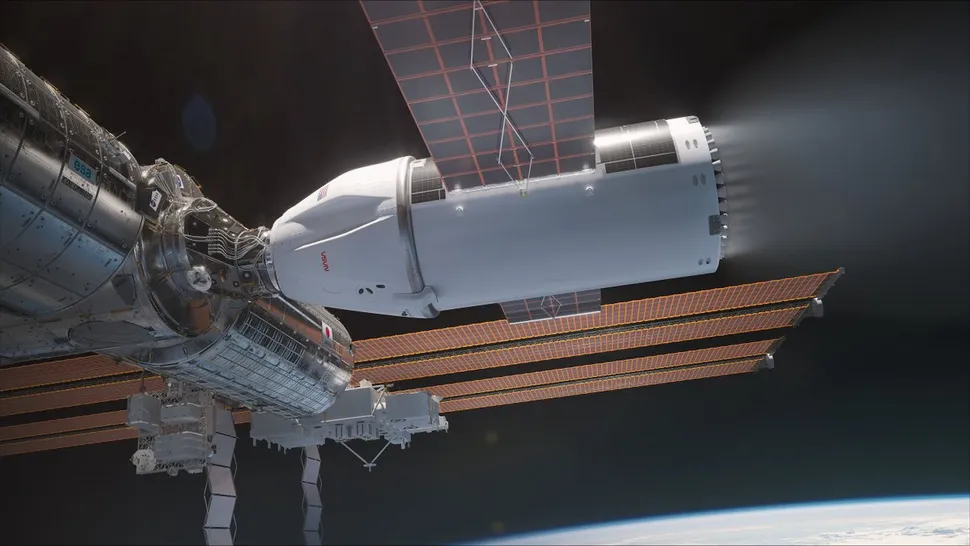
Quote:
artist's impression of a cone-shaped spacecraft, powered by solar arrays, firing its engines while docked to the international space station. the curve of earth and black of space is visible behind
Artist's impression of the SpaceX Dragon variant that will serve as a deorbit vehicle for the International Space Station. (Image credit: SpaceX)
So, you would have Metha-Lox of some vendors, and Hydro-Lox of other vendors, and electric propulsion. and Hypergolic propulsions.
So, that might provide some interesting options.
Ending Pending
Last edited by Void (2025-12-26 09:01:24)
Is it possible that the root of political science claims is to produce white collar jobs for people who paid for an education and do not want a real job?
Offline
Like button can go here
#212 2025-12-30 11:59:57
- Void
- Member
- Registered: 2011-12-29
- Posts: 9,550
Re: Multi-Ship Expeditions, Starboat & Starship, Other.
I have been trying to evaluate the potential of MagDrive. This seems like a good introduction: https://www.bing.com/videos/riverview/r … &FORM=VIRE
Quote:
Scientists Test Revolutionary Space Thruster: Space Metals as a Fuel to Go Where No One Has Gone
YouTube
NASA Space News
32K views
Like other electric thrust systems, this one might suffer from the inertia of the power plant it needs. That could be solar panels or a nuclear reactor.
But if lasers could beam power from a power station to solar cells on the Magdrive, the efficiency can be rather good as I understand it. These solar cells would be tuned for the frequency of the laser beam. So, that could reduce mass and so reduce inertia.
SpaceX is considering one time use tanker Starships to support Lunar Activities. It is said that they can lift 250 to 300 tons of cargo to LEO.
The dry mass of the starship is perhaps 80 to 120 tons. So, maybe estimate 100 tons.
So, that is about 350 to 400 tons of metals to LEO.
And Magdrive is said to have an ISP of about 2000, which might be 5 times as good as raptor?
So, if that were sort of true, then ignoring the complications of Apples/vs/Oranges, perhaps the equivalent of 2000 tons of propellants in LEO while flying just one tanker ship to LEO.
So, a scheme where you might push depots of various propellants to Lunar orbits, and also various orbits of the Earth/Moon, might extend the capability of the Starship system quite a lot.
And if metal propellants can be got from the Moon for a reasonable cost, this would extend things even more.
I wonder if Starships on the Moon, refilled with Oxygen on the Moon and lifting Metal payloads, could then be refilled in Lunar orbit with Methane from Earth. I wonder if that would be worthwhile?
Ending Pending
Last edited by Void (2025-12-30 12:24:19)
Is it possible that the root of political science claims is to produce white collar jobs for people who paid for an education and do not want a real job?
Offline
Like button can go here
#213 2026-01-01 11:05:18
- Void
- Member
- Registered: 2011-12-29
- Posts: 9,550
Re: Multi-Ship Expeditions, Starboat & Starship, Other.
So, I am continuing to be interested in the concepts that Firefly projects, and that of Magdrive and Neumann drive. Those and of course the heavy lift capabilities in development such as SpaceX, Blue Origin, Rocket Lab Plus ULA?
The idea of depots in CIS Lunar Space, is growing. Blue Origin has the notion of actively cooled Hydro-Lox, and some have speculated on low boil off methods for SpaceX Metha-Lox.
I am wondering about stored Jet fuel and water. We already think about generating Oxygen and Methane on Mars from CO2 and Water.
Could you do it in Lunar Orbit, using Jet Fuel and Water? I said Jet fuel, but really, I indicate fuel for Merlin Engines. That fuel and water are low risk for boil off. They are the Low Maintenance companions, I think. Using Magdrive or Neumann Drive you might slowly move depots of them to a Lunar proximity, while having low maintenance costs for the preservation of the fuel and water.
Could you split the Hydrogen off of the water to produce Oxygen and then add that Hydrogen to the "Jet Fuel", to produce Methane?
Perhaps some kind of solar hot process might do that? I know that it might want to produce other Hydrocarbons, but I would have a look at it.
https://en.wikipedia.org/wiki/Jet_fuel
Quote:
Melting point −47 °C (−53 °F; 226 K)
Boiling point 176 °C (349 °F; 449 K)
So, it seems that in CIS Lunar Space, it might be possible to store both the Jet Fuel and Water as gel or ice. Neither one has a very high vapor pressure I expect. I think that makes them low maintenance.
And that brings up some interesting possible options as to if you could push either one of them out of a spaceship in the night side of the Moon during a landing event and then recover the substances before they evaporated. That way your landing legs do not have to be as strong. There could easily be locations on the Moon which will have no Carbon or Hydrogen to make fuel with. Oxygen is fairly ubiquitous on the Moon.
But my primary interest is in a orbital depot in proximity of the Moon where Jet Fuel and water can be refined into various propellants.
Propellants for a Merlin Engine.
Propellants for a Hydro-Lox Engine
Propellants for a Metha-Lox Engine.
I will note that the stored products, "Jet Fuel" and Water will make good radiation protection. So, the Merlin engines perhaps should be respected a little more as you can perhaps use "Jet Fuel" and Water as shielding before you use them for propellants. Yes, you can do that with Methane and Hydrogen also but then you are suffering boiloff and cryogenic burdens.
The Jet fuel might also be subjected to electrolysis, if necessary to produce various materials.
Firefly intends to transport hypergolic propellant as I seem to recall. I think that they could transport "Jet Fuel" and Water.
Also, it may be that water from the Moon will be worth lifting up to Lunar orbit, so then all you would send to Lunar Orbit would be Jet fuel.
In case you are new to this topic this post, #212, describes Magdrive: https://newmars.com/forums/viewtopic.ph … 13#p236713
So, if it can all work as I hope it can this would be a very good tool kit for expanding into Space.
We also might consider if "Jet Fuel" could be transported to Phobos and Deimos, using Magdrive. The two moons almost certainly can yield Oxygen so there would be no need to send water. So a refilling method could be established in Mars orbit, I feel.
Ending Pending
Last edited by Void (2026-01-01 11:35:17)
Is it possible that the root of political science claims is to produce white collar jobs for people who paid for an education and do not want a real job?
Offline
Like button can go here
#214 2026-01-01 11:50:10
- Void
- Member
- Registered: 2011-12-29
- Posts: 9,550
Re: Multi-Ship Expeditions, Starboat & Starship, Other.
This is an amendment to the just prior post #213.
Question? Why would you not make Lunar Landers out of Falcon 9 2nd Stages?
IF Firefly/Magdrive can resupply a fuel depot/maker in proximity to the Moon, you may be able to refill Falcon 9 2nd stages and put legs on them an use them as landers.
I think if you put enough cargo on them then you could throttle the engines so that you don't have to do a hoverslam???
Or so what if you do a Hoverslam and it works that is just fine.
The 2nd stages are made of a Lithium/Aluminum alloy, I believe and so they are relatively light.
You could attach the cargo to the landing legs so that the device will not be topple prone.
The Merlines Carbon up with use, but you would only be using them one time to land. You could reuse those want to LEO, or you could bring fresh ones up with Starship, and ship them to Lunar proximity with Magdrive.
Ending Pending
You could make the Falcon 9 system fully reusable in a way by selling Lunar landings using Falcon 9 modified 2nd stages to land in various places on the Moon for surveying purposes. This could be supported by a Starship that stays in Lunar orbit and then may return to Earth.
Ending Pending :
Last edited by Void (2026-01-01 12:03:23)
Is it possible that the root of political science claims is to produce white collar jobs for people who paid for an education and do not want a real job?
Offline
Like button can go here
#215 2026-01-01 14:52:24
- Void
- Member
- Registered: 2011-12-29
- Posts: 9,550
Re: Multi-Ship Expeditions, Starboat & Starship, Other.
Well (th) I will entertain your query: https://newmars.com/forums/viewtopic.ph … 55#p236755
Quote:
For Void re Falcon 1 landing on the Moon ....
I don't know the answer to this, and would be interested if you can find out.
My question is inspired by your recent post about possibly using Falcon 9 upper stage as a Moon lander.
Can the Falcon 9 upper stage land on the Moon?
How does the Falcon 9 upper stage land on Earth?
If the Falcon 9 upper stage cannot currently land on Earth, what would it take to give it that ability?
Is it technically feasible? I assume it must be because others than SpaceX have landed on the Moon.
In reading my question, I realized you might be thinking of the first stage as a Moon lander,. and that is why you suggested sending the stage to orbit using a Starship?
May I have your permission to revise my question? Can the Falcon 9 first stage land on the Moon?
Does the Falcon 9 use GPS to know it's position when it is landing? Does it use radio signals from the ground at the landing site to help it determine it's position?
Does the software in the Falcon 9 first stage use the force of gravity in computing burns?
Would the software have to be modified?
These are all interesting questions that our readers might appreciate your investigating.
There are really two questions there, because your post specifically suggests the second stage.
Question? Why would you not make Lunar Landers out of Falcon 9 2nd Stages?
(th)
Offline
Like button can go here
Questions from (th):
Can the Falcon 9 upper stage land on the Moon?
How does the Falcon 9 upper stage land on Earth?
If the Falcon 9 upper stage cannot currently land on Earth, what would it take to give it that ability?
Is it technically feasible? I assume it must be because others than SpaceX have landed on the Moon.
At one point Elon Musk was considering making it into a "Mini-Starship". That was abandoned in order to focus on much larger sized Starships. The 2nd Stage of Falcon 9, I believe is of an Aluminum/Lithium Alloy which is lighter than Stainless Steel, except that the heat shield would be much heavier than for Stainless Steel. The 2nd Stage of Falcon 9 would burn up very fast in the atmosphere without a very, very good heat shield. Therefore the Falcon 9 2nd Stage does not land on Earth at all but is either abandoned to a higher orbit, or sent to burn up in the atmosphere.
The Falcon 9 1st stage if it does land does a "Hover Slam". It is a very tricky maneuver where somehow, they can calculate exactly how to throttle the engine down and when to shut the engine off. If they calculate wrong the engine cuts off too soon and the ship crashes. If they cut the engine off too late, the ship rises up again and then crashes. They cannot throttle the engine down enough to simply hover.
Starship and Superheavy can both hover, which is an improvement.
It would not be practical to get the Falcon 9 1st stage into LEO on it's own power. Perhaps some sort of Starship could lift it to LEO, but I am not sure that that would have a value.
The reason I am interested in bringing the Falcon 9 2nd Stage to Lunar orbit and then filling it and then landing it is that is is otherwise a throw away item. Although the Merlin Engines coke up after a while, I am hoping that it would have one more burn in it, if it was a used engine. One more burn to land some robots or other instruments to a location. Maybe supplies to a base. It itself could be valuable at a base for its metals.
Let's suppose that we had a propellants depot in Lunar Proximity. You might use electric rockets to deliver RP-1 and water to it from LEO.
The depot would be capable of cracking the water into Oxygen and Hydrogen, in a quantity suitable to fill one Falcon 9 2nd stage. Then you could land it. (I have not stipulated any use for the Hydrogen Yet).
It would seem that the 2nd stage would have an even worse problem with throttling down the engine to land on the Moon, but that might be corrected by loading it down with a sufficient amount of Cargo. Legs would have to be added to the assembly, I propose that they be made of materials wanted on the surface of the Moon, perhaps of Carbon and Plastics as much as possible.
>>>>>>>>>>>>>>>>>
Another interesting use for such a 2nd Stage would be to boost a Starship back to Earth from Lunar Orbit. Merlins are not as efficient or powerful as Raptors, but there propellant "RP-1" can be stored and transferred much better than Methane.
Water Similarly could be transferred to a Lunar Proximate Depot much easier than Oxygen.
In both the case of RP-1 and Water, the vapor pressures being low at low temperatures you would not need active cooling during transfer by electric rocket. This is a benefit because electric propulsion is slow and if you had to have active cooling hardware on the ship it would be excess mass, and would demand some of the electric energy budget. If you had to spend tha extra electricity, then you have to have larger solar panels or a larger nuclear reactor, which then adds even more mass.
But if you bring RP-1 and water to a Lunar Proximate space station which largely holds position then that station can have a very large power supply which you might manipulate the propellants. In the case of Falcon 9 2nd Stage, the RP-1 just has to be warmed up a bot to be fluid enough to pump, The water can be split into LOX and Hydrogen. Since the Station does not move much it can have a massive power supply with a lot of inertia and can then be used to prevent the boil-off of the LOX.
We might microwave the Hydrogen to provide propulsion for station keeping.
Let's consider "L1" for the Station. https://en.wikipedia.org/wiki/Lagrange_point
Quote: 
Sorry, that is the Sun/Earth L1 not the Earth/Moon L1. I will seek a more appropriate diagram.
This perhaps: https://www.thespacereview.com/article/2882/1
Image Quote: 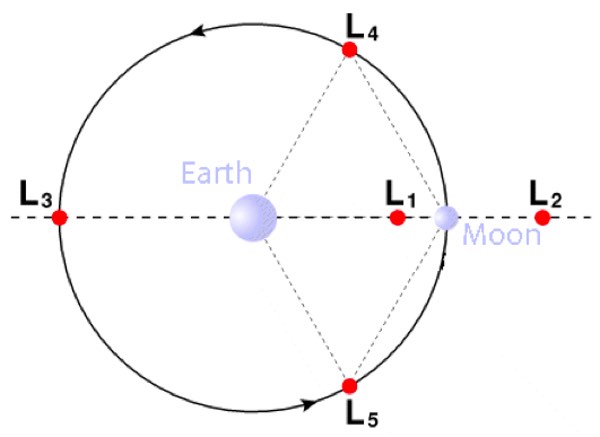
Starship might be able to grab used Falcon 9 2nd stages from LEO, and bring them to a electric tug which would bring them and "RP-1" and water to the station at "L1". The Station at "L1" would warm the "RP-1" for filling the Falcon 9 2nd Stages. It would also crack the water into LOX and Hydrogen. The Hydrogen might be used for Station keeping, being ejectred for propulsion from a VASIMR engine.
https://en.wikipedia.org/wiki/Variable_ … sma_Rocket
Some station keeping is needed at "L1" as it it a bit unstable.
Now this leaves the question, would then Falcon 9 2nd Stage have enough power to go to the Moon and actually land with a payload? Well, I am not sure. If not, then the Station needs to be in the orbit of the Moon, closer into it. In which case the Hydrogen thrust will also be wanted.
>>>>>>>>>>>>>>>>>>>>>>>
For the case of Hydro-Lox spacecraft the same method could be used but just with Water, no RP-1.
>>>>>>>>>>>>>>>>>>>>>>>
In the case of Starship and other Metha-Lox methods, I am hoping that the station can take Hydrogen from the water and use it to cook the RP-1 into Methane. Not entirely confident for that.
But if you did have used Falcon 9 2nd stages you might use them to boost Starship while burning RP-1 and LOX>
But of course, Merlins get Carboned up.
I think that shipping a stable hydrocarbon and water to a processing refilling station might make sense. I already explained why that could be compatible with electric propulsion such as Magdrive or Neumann Drive. You might also ship Carbon or Dry Ice to get the proper balance of Carbon, Oxygen, and Hydrogen atoms to create the various propellants with.
I hope that that helps (th).
Ask for more if you like.
Ending Pending
Ending Pending.
Last edited by Void (2026-01-01 15:55:04)
Is it possible that the root of political science claims is to produce white collar jobs for people who paid for an education and do not want a real job?
Offline
Like button can go here
#216 2026-01-02 09:24:13
- Void
- Member
- Registered: 2011-12-29
- Posts: 9,550
Re: Multi-Ship Expeditions, Starboat & Starship, Other.
Orbital Water Platforms:
Expanding a bit on previous posting, It seems to me that water as a cargo to orbit could be rather ideal to a large extent.
A Starship lifting water, is less explosive than a Starship lifting extra Methane and Oxygen. So, there may be a degree of increased safety at a Earth Launch pad.
Water being liquid at temperatures often compatible with humans also has utility as it can shield from radiation and you also can use it to grow food. Growing food in it gives some complications to then make propellants but it could be done.
In cracking the water to make propellants you would perhaps get an Oxygen imbalance that you could use. Let's say you would split the water to Hydrogen and Oxygen continually. You might use some of the Hydrogen for station keeping or even to move the platform a little bit.
I am presuming that a high temperature thruster could be used to expel a trickling stream of Hydrogen for that purpose. So then you would accumulate LOX into tanks.
So, ignoring other means of transport for the moment and concentrating on Starship, you also be able to bring Carbon in a form usable but of a form that will not cause dust explosions if launch goes badly. Then if you do not want to dump all the Hydrogen produced you may make Liquid Methane from some of it.
So, water and Carbon Feedstock would be relatively benign in nature. And both may be useful for radiation shielding.
But such a platform may service a Stoke Space 2nd stage also, if you elect to make and store Liquid Hydrogen.
Some locations for such platformer might be LEO+, GEO, L1, and Lunar orbits.
Keep in mind that I am thinking that for many of these Magdrive and/or Neumann Drive would be used in transporting bulk cargos like water and Carbon. Neither Water or Carbon will require active cooling, I expect, so that makes the task easier.
https://www.bing.com/videos/riverview/r … &FORM=VIRE
Quote:
Stoke Space Second Stage: High Performance and Reusable within 24 Hours of Landing
YouTube
Space Startup News
5.4K views
"Andromeda"
https://www.stokespace.com/introducing-andromeda/
Quote:
Introducing Andromeda, our rapidly reusable high-performance upper-stage rocket engine
Updated design upgrades performance, simplicity, and rapid reusability.
I have wondered if a "Supersized" Andromeda, might be lifted by SpaceX Superheavy.
But perhaps it is better to keep it small as then the batch of Liquid Hydrogen you have to maintain ot refill an Andromeda, would be of a smaller and more manageable size.
I think that there might be some advantages in refilling a ship in the vacuum of space outside the Earths atmosphere. Perhaps less risk of explosions from Hydrogen spills/leaks.
So, there would be a distinction between ships intended to lift Water, Carbon, Metal Propellants to LEO+ and ships intended to navigate further out.
The further out ships might have smaller propellant tanks, and so less dry mass from the container and from that which is contained. These might refill at LEO+, GEO, L1, and Lunar Orbits, and indeed on the surface of the Moon. They also might not normally land on the surface of the Earth.
While at first all the Water, Carbon, and Metal Propellants will come from the Earth, eventually some may come from the Moon, and then later even from Photos, Deimos, Asteroids, and Mars.
Again Water, Carbon, and Metal Propellants could be kept benign during long trips to the Earth/Moon from those remote locations.
Ending Pending
This alternate Moon formation theory is of some interest. It may suggest a different history and perhaps a different nature of raw materials on the Moon that can be made into resources.
https://www.msn.com/en-us/news/technolo … r-AA1SkA7u Quote:
What really created the moon? Scientists say it’s not just one impact, but this many!
Story by Sarah Jones • 2w •
3 min read
That is interesting, so what if the far side and near side materials are largely from two different objects? And then perhaps some materials from the Earth?
Ending Pending
Last edited by Void (2026-01-02 10:04:03)
Is it possible that the root of political science claims is to produce white collar jobs for people who paid for an education and do not want a real job?
Offline
Like button can go here
#217 2026-01-03 10:22:32
- Void
- Member
- Registered: 2011-12-29
- Posts: 9,550
Re: Multi-Ship Expeditions, Starboat & Starship, Other.
So, I think that a greater awareness of this can be verbalized.
Humans may prefer to cross distances at high speeds, but on Earth such high speeds are supported by slower bulk transfers. The devices for these transfers can be Barges, Pipelines, Railroads, and other slow bulk traffic.
In space due to the perishable nature of humans we have focused on higher speeds for humans and also the bulk materials. We have modified this with concepts of Insitu production on other worlds, but the high-speed movement of bulk cargo, is not a good way to do things.
The Australians have initiated the Neumann Drive, and the British have initiated the Magdrive. My impression is that the USA is now partially involved in both. These drives may be reasonable analogs in space for the means of bulk transfers that we use on Earth. (Barges, Pipelines, Railroads, and other slow bulk traffic) We could still try to use Argon with a pinch of Xenon, but metal propellants are more universal, and more easily stored and obtained, I think.
So, now that we have slow-bulk propulsion methods, we then can begin in basic bulk cargo, and then expand that to less basic.
Basic:
-Metals, Carbon, Silicon (These can be use as propellants also, at least in Neumann Drive).
-Carbon (As a ingredient for Hydrocarbon Fuels).
-Water.
Expanded Basic:
-RP-1 Fuel.
-A water/Peroxide Mix (Needs to not be explosive).
-Other??? (To be determined).
The Basic and Expanded Basic are substances that are relatively low maintenance materials that can be kept inert with minimal efforts.
So, the Neumann Drive and Magdrive devices will mostly be robotic, I expect.
In general, these substances can double to provide radiation protection on platforms that will use solar energy or even nuclear energy to convert the substances into alternate substances such as fuels and Oxidizers.
A system of platforms then might support the higher speed traffic which at times may move humans.
In a prior post I have suggested various places for stations, but a ship on a path would not have to use all of them. They would be options.
Each stop carries risks but also offers assistance.
A Ship from LEO, might be able to stop at a platform in LEO, GEO, L1, and Lunar Orbits, but Maybe it would only stop off at LEO and L1 to refill.
And of course a system like this could be expanded to include other worlds as well.
Pause................
I really hope that a Mass Driver for the Moon, or many of them can be successfully created.
But some people have said "Its the little things that count.
So I have a Space Mollusk concept for little worlds. We can start with Phobos and Deimos, and then maybe some of the Earth crossing asteroids, and then perhaps the nearer main asteroid belt at about 2.1 AU.
I need a drawing......pause.............

So the assembly has periodic uploading of raw materials, into partially completed chambers, and then the chamber is completed, it can be pressurized. The cone has a very low partial gravity applied to allow Filling events.
As each filled segment has its raw materials processed, it converts from a raw material bin into an expanded location of factory production. The next segment is then partial built from the processed raw materials that have become resources.
For larger objects like Phobos and Deimos, a method to fling materials into the new segment on a periodic basis is needed.
For the location in the asteroid belt at 2.1 AU, it may be that tiny asteroids can be captured into a segment, like as if it were a mollusks stomach.
https://www.nasa.gov/solar-system/aster … roid-belt/
Quote:
Copilot Search Branding
Asteroid Belt
Recent observations using the James Webb Space Telescope have revealed a population of tiny asteroids in the main asteroid belt, marking a significant advancement in our understanding of these celestial bodies.
Discovery of Small Asteroids
A team of researchers from the Massachusetts Institute of Technology (MIT) has identified 138 new asteroids in the main asteroid belt, which lies between Mars and Jupiter. These asteroids range in size from that of a bus to a small stadium, representing the smallest asteroids ever detected in this region. This discovery was made possible by repurposing data from the James Webb Space Telescope (JWST), which was originally collected for other astronomical studies.
NASA
+1
Significance of the Findings
The detection of these tiny asteroids provides valuable insights into the formation and evolution of asteroids in our solar system. According to Tom Greene, an astrophysicist at NASA, these small objects likely formed from collisions between larger asteroids in the main belt. Understanding their sizes and numbers helps scientists learn about the history of asteroid collisions and how some asteroids may escape the main belt and potentially become near-Earth objects.
NASA
+1
Implications for Planetary Defense
The findings have important implications for planetary defense. Smaller asteroids, often referred to as decameter asteroids (measuring tens of meters across), are more likely to migrate towards Earth. These asteroids can cause significant damage if they enter the atmosphere, as seen in events like the Chelyabinsk meteor incident in 2013. The ability to detect and track these small asteroids at greater distances enhances our capacity to assess potential threats to Earth.
Space.com
+1
Conclusion
The discovery of these tiny asteroids not only fills a critical gap in our knowledge of the asteroid belt but also aids in the ongoing efforts to monitor and mitigate potential asteroid impacts on Earth. The research highlights the capabilities of the James Webb Space Telescope in advancing our understanding of the solar system.
MIT - Massachusetts Institute of Technology
So, eventually if the segment cross section becomes large enough an object like Bennu might be enveloped inside of it.
https://en.wikipedia.org/wiki/101955_Bennu
Quote:
Dimensions 565 m × 535 m × 508 m (1854 ft × 1755 ft × 1667 ft)[1]
Mean radius 245.03±0.08 m (804±0.262 ft)
Equatorial radius 282.37±0.06 m (926.4±0.197 ft)
Polar radius 249.25±0.06 m (817.74±0.197 ft)
Surface area 0.782±0.004 km2 (0.302±0.002 mi2)
Volume 0.0615±0.0001 km3
Mass (7.329±0.009)×1010 kg
Mean density 1.190±0.013 g/cm3
Equatorial surface gravity 6.27 micro-g[6] (61.5 μm/s2)
My drawing suggests that the walls between segments would be flat, but of course they would be curved, either concave or convex, to be able to hold air pressure. But it might not be necessary to have a human rated air pressure. The air inside might be toxic anyway.
A bulk airlock might move batches of materials from a raw materials segment to a processing segment.
The means of propulsion may very well be Neumann Drive, or Magdrive, or maybe mass driver. After all a mass driver can through things out like excess Oxygen to do a propulsion.
So, then these "Space Mollusks" could export and import substances from other platforms in the solar system.
In order for such a platform to get materials from Phobos and Deimos, they might have a turntable under the raw materials segment, so that they could land on such an object and spin. That of course has to be done correctly to be a gainful event rather than a disaster.
Ending Pending
Last edited by Void (2026-01-03 11:58:28)
Is it possible that the root of political science claims is to produce white collar jobs for people who paid for an education and do not want a real job?
Offline
Like button can go here
#218 2026-01-03 12:55:39
- Void
- Member
- Registered: 2011-12-29
- Posts: 9,550
Re: Multi-Ship Expeditions, Starboat & Starship, Other.
Please note that this post refers also to the prior post that was made today.
The value of Iron Oxide in space.
I wish to add Iron Oxide to the list of materials from the prior post:
So, now that we have slow-bulk propulsion methods, we then can begin in basic bulk cargo, and then expand that to less basic.
Basic:
-Metals, Carbon, Silicon (These can be use as propellants also, at least in Neumann Drive).
-Carbon (As a ingredient for Hydrocarbon Fuels).
-Water.Expanded Basic:
-RP-1 Fuel.
-A water/Peroxide Mix (Needs to not be explosive).
-Other??? (To be determined).
Now:
So, now that we have slow-bulk propulsion methods, we then can begin in basic bulk cargo, and then expand that to less basic.
Basic:
-Metals, Carbon, Silicon (These can be use as propellants also, at least in Neumann Drive).
-Carbon (As a ingredient for Hydrocarbon Fuels).
-Water.
-Iron Oxide.
Expanded Basic:
-RP-1 Fuel.
-A water/Peroxide Mix (Needs to not be explosive).
-Other??? (To be determined).
If you have some Hydrogen and a source of heat, you may reduce the Iron Oxide and make water.
Then you may spilt the water and reuse the Hydrogen in the same manner.
Then if you have a mass driver that can expel Oxygen Ice Cubes, you may use Oxygen as a propellant.
Then you may use the Iron in a Neumann Driver or Magdrive.
So, it is my hope that Iron and Oxygen can be refined on the Moon and contrary to what some might think wise the Iron can be Oxidized.
Then if a Spaceship lifts the Iron Oxide to Lunar Orbit, you have lifted a "Pure" propellant to Orbit.
The cost for this then includes the propellants, the LOX from the Moon and the fuel from ??? (The Moon or Earth, or other).
But if the effectiveness of the Oxygen and Iron propellants is valuable enough then the propellants for the Spaceship may be justified.
Ending Pending
Last edited by Void (2026-01-03 13:04:15)
Is it possible that the root of political science claims is to produce white collar jobs for people who paid for an education and do not want a real job?
Offline
Like button can go here
#219 2026-01-04 10:23:52
- Void
- Member
- Registered: 2011-12-29
- Posts: 9,550
Re: Multi-Ship Expeditions, Starboat & Starship, Other.
Perhaps it is not known yet, for practicality, I am interested to understand if it is possible to extract Oxygen from the Moon to use even at LEO?
There is some feeling that a Mass Driver is needed to make that practical. But a Mass Driver is like and Chicken and Egg puzzle. IF you don't have a process on the Moon to produce a cargo of value then their is no reason for a Mass Driver. But perhaps if you build a productive process on the Moon and don't have a Mass Driver, then what good is that productive process?
So, the I have a hope, of a transport method that is less than an Mass Driver that can service a productive process on the Moon, until a mass driver process is justified.
So, we might consider the products to move to LEO, from the Moon, Iron and Oxygen. We could also consider Iron Oxide.
Oxygen if of considerable value, but if you have to make it as a liquid on the Moon, and then transport it to orbit. Then you have to keep it from boiling off. That then requires excess mass to keep it liquid. But Iron Oxide, may bring the useful substances Oxygen and Iron to LEO.
It will not boil, but we face a problem to overcome, that if your Iron Oxide is in the wrong form you might crated a collision pattern if your transport ship explodes. So, size may matter. Perhaps dust would be swept away. Perhaps large chunks could be salvaged and cleared.
So, Medium size might be the worst. You have to be aware of sabotage. Some people see you are servants that should not be going into space but should be serving their desires. They are slavers. Sometimes they can even be Leftists. Baby Kings, that see their poopy diaper as the best use for you. You are here to change their poopy diapers.
So we want a best process that is not any more vulnerable to Baby Kings than is necessary.
So, if we can bring Iron Oxide to a LEO refinery, where Hydrogen and solar energy, could be used to separate the Iron and Oxygen. So, then you can use the Oxygen for chemical processes, such as breathing and rockets. You can also use Oxygen Ice Cubes for propellants in a certain type of Mass Driver propulsion system. You may use the Iron for building structures, and for propellant for Neumann Drive and MagDrive.
These then can help then to send cargos outward to higher orbits, even to the Moon and beyond.
I do not know if this a virtuous or not. Is it profitable? Well we may want to find out.
We did something like that in the Taconite Mines. We separated magnetic Iron from tailings. Then we had a concentrate That would be glued with clay and baked into pellets. So, then the pellets could be made primarily of Iron, Oxygen, and Silica. It was then suitable to transport and be of a good shape and size for a blast furnace.
On the Moon we may or may not want other substances in the mix than Iron and Oxygen. Pure Iron and Oxygen may be harder to make, but you may or may not want to have the Silicon in LEO.
Silicon has uses though. And Silicon can be used in Neumann Drive, I am not sure it can be used in Magdrive for propulsion.
Anyway, if shipping can be accomplished from the Moon from LEO, that is gainful in result, perhaps eventually when the productive processes on the Moon are large enough, a Mass Driver(s) will be justified, and so the investment money can be justified to build one or more of them.
This is why I have suggested that parallel engines be put onto a Starship. Such parallel engines which may run on propellants, Hydrogen and Oxygen, or Water and Aluminum may be derived from local Lunar Resources.
While it might be said, "Why don't you just have a Hydro-Lox" ship? Well, a possible answer if boil off.
IF you have Liquid Hydrogen on the Moon, you can afford to have massive active cooling for that. But a ship which has both Metha-Lox and Hydro-Lox engines could work like this. The Hydrogen would be filled into the Ship along with Oxygen from the Moon. I presume for now that the Methane comes from Earth. The ship uses both the Methane and Hydrogen engines to lift off from the Moon. All the Hydrgen is consumed. It has a lot of power but now it is gone. You continue with the Methane. You do not need active cooling for the Hydrogen on the ship or in orbit as it has all been burned. The Ship lifted a cargo, perhaps of Iron Oxide, and delivers it to a transport. The ship is refilled in orbit with more Methane and then it goes ahead and lands back on the Moon, using only then Metha-Lox Engines. The empty Hydrogen tanks and Hydro-Lox engines ride along.
Rinse and repeat.
You might use Alice Engines instead of Hydro-Lox engines.
https://en.wikipedia.org/wiki/ALICE_%28propellant%29
Then of course you need nano-powder Aluminum and water Ice.
Ending Pending
Last edited by Void (2026-01-04 10:56:51)
Is it possible that the root of political science claims is to produce white collar jobs for people who paid for an education and do not want a real job?
Offline
Like button can go here
#220 2026-01-04 11:22:50
- Void
- Member
- Registered: 2011-12-29
- Posts: 9,550
Re: Multi-Ship Expeditions, Starboat & Starship, Other.
It may make sense at some point to bring back the "L4" and "L5" locations into our thinking, perhaps even without a Mass Driver(s) on the Moon.
That if from the era of Gerard K. O'Neill: https://en.wikipedia.org/wiki/Gerard_K._O%27Neill
https://www.thespacereview.com/article/2882/1
Image Quote:
"L4" and "L5" are like gravitational bowls as I understand ti.
"L1" and "L2" and "L3" are like upside down gravitational bowls.
You can center mass in the upright ones, and it will tend to stay in a sort of bowl like orbit.
You can center mass in the upside-down ones, but it will tend to move "Downhill" at increasing speeds.
This diagram may help to illustrate, but it is not proportional: 
So, "L4" and "L5" are like bowls, so objects with low speed will tend to orbit inside of them. That way sloppy activities may keep the mess contained. These might also be good places to travel to elsewhere in the solar system.
Ending Pending
Last edited by Void (2026-01-04 11:44:09)
Is it possible that the root of political science claims is to produce white collar jobs for people who paid for an education and do not want a real job?
Offline
Like button can go here
#221 2026-01-04 13:21:35
- Void
- Member
- Registered: 2011-12-29
- Posts: 9,550
Re: Multi-Ship Expeditions, Starboat & Starship, Other.
(th) per: https://newmars.com/forums/viewtopic.ph … 70#p236870
I am glad we have a mutual interest. I did read "The High Frontier" so I understand to some extent what their proposals were.
They hoped to send sacks of Moon regolith by way of a Mass Driver from the Moon to one of the two stable "L" points.
They intended to fine tune the path of the sacks using an electron beam, I believe. Then they hoped to have the sack rip open on a obstacle and the contents to spill into a rotating drum.
Probably not really workable, as it may cause a lot of trouble with equipment where it might get sand blasted.
But you have to start with a concept and try to make alterations until you can make it work, so they disserve lots of credit for their efforts.
I have seen notions that it is possible to accrete planets in an L4 or L5 zone, in this case Sun/Planet. But I would like to try accretion into an L4 or L5 Earth/Moon situation.
We appear to have two candidate Matter Projectors the Neumann Drive and the Magdrive. For sure they will both project Iron, Aluminum, and Copper. The Neumann Drive can project most items in the Element Table, if they are conductive of electricity.
The High Frontier concept intended that bags of regolith flung off of the Moon would slow down as they approached the "L" point. Perhaps to hundreds of miles an hour.
Now I will attempt to adapt that. If we can tame our Matter Projector, to not go full throttle, perhaps we can get the spray to enter L4 or L5 at a reasonable speed. IF we could use the solar wind to slow it down enough, we might get a capture into the orbit of L4 or L5. So, the hope is to get is dusty and then accrete the dust.
Easier to say than do, I am sure.
If we can magnetize the dust, (In the case of Iron), then maybe we can get it to clump together). Possibly an electron beam sweep could magnetize it, just a guess. Where there is a electric flow, there should be a magnetic field.
But to use the Solar wind to break the dust, it needs to be of a small size, But if we can make it clump up perhaps the solar wind will not sweep it out of the "L4" or "L5" zone. We also could think to make a massive magnetic field using superconductors, that device to orbit in a "L4 or L5.
So, in that case if we could get the solar wind to deflect the dust towards the magnetic field, it might spill into it an accrete.
For Iron which is below its curie point in temperature, this might work. For other metals that may have eddy currents, this possibly might work, not sure. I am not inclined to think that we could catch Oxygen or Oxide materials that I am familiar with.
But if we could project Iron from the Moon and Accrete it to a L4 or L5 location that would be huge. Because it would be a building material and can be used as propellant in a Neumann Drive or Magdrive.
I might hope that Steel could be used in a Neumann Drive or Magdrive, and that the particles would be Steel, but I suspect that those alloys would be torn apart. And Steel is typically not very magnetic.
It is possible that we could try to use electrostatics to accrete materials projected to L4 or L5, but I am relatively unsure.
If you wanted to keep either L4 or L5 clean for test equipment like Telescopes you might be able to do that as there are two of them.
Ending Pending
Last edited by Void (2026-01-04 13:43:15)
Is it possible that the root of political science claims is to produce white collar jobs for people who paid for an education and do not want a real job?
Offline
Like button can go here
#222 2026-01-13 13:50:04
- Void
- Member
- Registered: 2011-12-29
- Posts: 9,550
Re: Multi-Ship Expeditions, Starboat & Starship, Other.
This is thinking that I like: https://www.youtube.com/watch?v=PqERiN848DY
Stubby Starship.
TLI booster (Could also be a form of Star-Kicker)
Star-Kicker: The "Locomotive" part of a Starship. (Tanks, engines, etc, but not nose, cabin, cargo holds).
But the 2nd half of the video about satellites might get a bit boring.
In my opinion, after the original setup on the Moon, the system could evolve to include a "Water Station" at "L1".
If you have water on the Moon you might have a "Water Station" on the Moon, one at "L1" and one in association with LEO.
These "Water Stations" would store water and have extensive power systems and could cook Hydrogen and Oxygen from the water to be used in refilling ships.
It is my opinion that a Stubby Starship could have an auxiliary propulsion system which would be Hydro-Lox added in orbit.
This could be a belt of thrusters and a Hydrogen tank that would be strapped onto a Starship, around it's girth, and could be plumbed into the Oxygen tank of the Starship.
Water could be brought up the LEO "Water Station", by Starships. We hope that the Moon will have water in sufficient quantities for a "Water Station on the surface of the Moon. For the "L1" "Water Station", we might hope to deliver water to it using electric rocket systems, at least at first, and possibly from the Moon, later if it turns out to be practical.
So, the Hydro-Lox Auxiliary Power Belt, would be used as a booster option. It would be filled just before launch from LEO, "L1", or the Moon. The Hydrogen would be completely consumed as soon as possible to not have losses from boil off. The "Water Stations" would be able to support anti-boiloff systems as they are not intended to be consuming much propellants to maintain their positions.
The Starship would then operate using the Metha-Lox system. The belt could be ejected in an emergency, but it would be preferred to reuse it.
Types of Electric Rocket to bring water to the "L1" water station could be "Argon with a pinch of Xenon", or the Magdrive or Neumann Drive.
Power supplies for them could be Nuclear, Solar, or Beamed power.
Ending Pending
The "Water Stations" could service Blue Origin, Stoke Space, and others that may use Hydro-Lox.
But those may need to prevent Hydrogen boil-off curing passage to the Moon and back.
Ending Pending
Last edited by Void (2026-01-13 14:17:07)
Is it possible that the root of political science claims is to produce white collar jobs for people who paid for an education and do not want a real job?
Offline
Like button can go here
#223 2026-01-14 10:13:43
- Void
- Member
- Registered: 2011-12-29
- Posts: 9,550
Re: Multi-Ship Expeditions, Starboat & Starship, Other.
This post depends on prior post materials.
For now, I am more equipped to formulate useful questions than to give more solid definitions of answers.
Some people will get hooked on a binary contest Hydro-Lox vs. Metha-Lox. I Don't want to get hung up on that.
Metha-Lox is a good choice for Earth<>LEO, and Mars<>Earth. It is still useful elsewhere, and perhaps even materially supported elsewhere such as Carbon from Phobos or Deimos. But for the moment I want to contemplate a "In Space Backbone based on Hydro-Lox".
So, a question is, what are the possible sources of propellants for that, and what is the relative ease of use?
For the Earth, what is the most useful method to get LOX and Hydrogen in orbital situations? The current scheme for Metha-Lox is to have extra propellants of Methane and Oxygen on "Tanker" starships.
For Blue Origin it could be a similar method involving Hydrogen and Oxygen.
But I think we rapidly get to a condition where tanks of water may be more practical, presuming you have methods to process it somewhere in orbital space. For instance, a "Water Station" in LEO, or one in "L1" or one on the surface of the Moon. I think that those are the three most interesting. And if you wanted to do "Metha-Lox" as well you could also bring a Carbon containing compound with the water. But I am seeing a "Water Economy" in orbit as being simpler, so for now I will give it a Keep It Simple Stupid. (KISS).
As "Up-Mass", from the surface of the Earth to LEO, I think water to be much easier to handle than cryogenics. I think the avoidance of explosive potential, they moderation of substance temperatures, and perhaps the volume issue may be in its favor.
For instance, if you split water into Liquid Hydrogen and Liquid Oxygen, I am not sure, but I think the two substances will take up more volume than water will. And to store or move to "L1" and store, it will be much easier to handle. You could probably store it as ice in plastic bags inside of a cargo hold, if you kept the temperatures down., for transit.
Also water in tanks could support forms of bio-productivity, and also more conveniently serve as radiation shielding.
Pause...........
In prior posts "Star-Kicker" was mentioned, and I mentioned a wraparound "Hydro-Lox" belt for Starship.
Blue Origin might do the warp around "Hydro-Lox" Belt as well.
In the use of "Star-Kicker, it is said that it would be used as a Metha-Lox booster for Starship to go to the Moon, and when empty, "Star-Kicker" would be abandoned to a orbit. Well, when we get good methods of electric propulsion, a tug could go and get it and bring it to a "Water Station".
The wrap around Hydro-Lox belt thruster could be handled in a similar fashion. Once its Hydrogen was exhausted, it could be ejected to a space orbit and then retrieved efficiently by an electric propulsion device, to a water station.
But you could also not eject it and just carry it with you from "Water Station" to "Water Station". Very flexible.
Where I have specified three "Water Stations", LEO, "L1", and Lunar Surface, we could add additional ones such as low Lunar orbit, and geosynchronous orbit. So, then a trip could be segmented even more. For a "Water Station" in low Lunar orbit, it might need low level propulsion to maintain a more constant orbit. It could use electric propulsion methods or simply have a small Hydro-Lox engine. After all it is going to have means to cook up lots of fuel and Oxygen for spaceships.
So, lets presume that the Moon does have lots of water. If we launch a Starship from the Moon with a wraparound Hydro-lox power pack, you load liquid Hydrogen into the power packs Hydrogen tank, and then also fill the Oxygen tank as full as you consider prudent. The Methane tank may have residual Methane in it. Your cargo can be water or Iron Oxide as possibilities.
You launch towards the Low Lunar "Water Station". You exhaust your Hydrogen. At this point you may eject the Hydrogen power pack, or may carry it to the Low Lunar Orbit "Water Station". You refill with fuels, perhaps top off your Oxygen. If you ejected your power pack you might receive a fresh one. The power pack you ejected can be retrieved by a robotic electric rocket and brought over to the "Water Station for reuse in the future.
You Launch again from "Low Lunar Orbit" to go to the "L1 Water Station". Rinse and Repeat..... Moon>Low Lunar Orbit>"L1">Geosynchronous> LEO, or land on Earth.
The reverse orbit for Starship would be Launch to LEO, likely using Metha-Lox and Raptors alone.> To Geosynchronous with Hydro-Lox assistance> To "L1" by similar > To Low Lunar Orbit by Similar > To the "Water Station" on the Moons surface.
Multiple segment travel is more complicated, but it allows you to greatly reduce "Dry Mass" for your propellant tanks.
And under the surface of this you would have electric rocket propulsions more efficiently moving support substances between point in the path. For instance, moving tanks of water or ice, perhaps moving electric rocket propellants.
Types of electric rocket propellants I can think of now are, "Argon/Xenon", "Metals and Carbon" (For Neumann Drive or Magdrive).
If this system were expanded beyond Earth/Moon, it may be that substances would be transferred in a similar fashion along segments of paths to various points. It could result is substances being brought to the Earth/Moon from places like Deimos/Phobos/Mars, or the asteroids.
Ending Pending
Last edited by Void (2026-01-14 10:59:08)
Is it possible that the root of political science claims is to produce white collar jobs for people who paid for an education and do not want a real job?
Offline
Like button can go here
#224 2026-01-15 10:54:51
- Void
- Member
- Registered: 2011-12-29
- Posts: 9,550
Re: Multi-Ship Expeditions, Starboat & Starship, Other.
There are two things I would like to explore further:
1) In-space boosters, uniform and mixed.
2) Expendable, (Not-Really).
Star Kicker would be a Uniform Fuel in-space booster. As described, the booster is one use and then abandoned, but could be used in a Expendable (Not-Really) device.
I have mentioned "Water Stations" and implied that they would be in circular orbits for the most part, but there also could be elliptical examples.
Using Star-Kicker, it seems that a Starship may be able to after the boost be able to continue to the Moon, land, and then come back to LEO.
But as was said, the Star-Kicker would be abandoned in a space orbit for now. But its reuse would be very desirable.
Although a "Water Station" might support Hydro-Lox, it also could perhaps support Metha-Lox. I am expecting that these stations will be resupplied by some type of electric rocket propulsion. I have mentioned Argon/Xenon, Magdrive, and Neumann Drive as possible options.
As the system developed it might have substances like Water, Carbon, and Iron oxide brought to orbit from Earth and to some lesser extent the Moon (Carbon is unlikely for the Moon).
SpaceX is rumored to want to be able to build 10,000 ships a year. Well, some can be made so that upon reaching LEO+, the ship is split into an upper part which can be used as a resource in LEO+, and the "Locomotive" which is the propulsion section, which can be used as a Star Kicker.
With these substances, and perhaps a few more minor substances, the "Water Stations" could synthesize Propellants. Hydro-Lox, Metha-Lox, Iron (For Magdrive and Neumann Drive).
Where electric rockets are efficient most bulk freight would be handled by them where they can operate.
Here is that video where "Star-Kicker" is mentioned: https://www.youtube.com/watch?v=PqERiN848DY
Pause to watch again.............
Let's imagine that Star-Kicker does not use all of its propellants, to boost a Stubby Starship. It then may use the balance of it's propellants to join with a "Water Station". That "Water Station" could be in a circular orbit or a elliptical orbit.
Maybe a circular orbit in geosynchronous, maybe an Elliptical orbit that poised between LEO+ and some higher orbit where a "Water Station" exists in a circular orbit. So, the Star-Kicker could be refilled at a "Water Station", perhaps in an elliptical orbit. When it nets near either the low end of the orbit or the high end of the orbit it may do a burn to join with a circular orbit "Water Station".
An alternative that would take longer is for an electric tug to grab it on its path and bring it to a water station.
For instance, an electric tug bringing resources (Water, Carbon, Iron Oxide, etc.) to a "Water Station" on its way back to the source of those materials might be able to grab a used "Star Kicker" and bring it to a "Water Station".
So both sections of such a ship are put to further uses. The upper portion may become part of a LEO+ Space Station, or might become salvage for other purposes such as metal propellants for Magdrive or Neumann Drive.
The "Locomotive Section" might be more reusable than an Atmospheric or Lunar Starship might be.
So this type of in-space booster is serial in deployment. It is series with the Starship.
But a Parallel booster might be possible as well.
https://www.bing.com/images/search?view … ajaxserp=0
Image Quote: 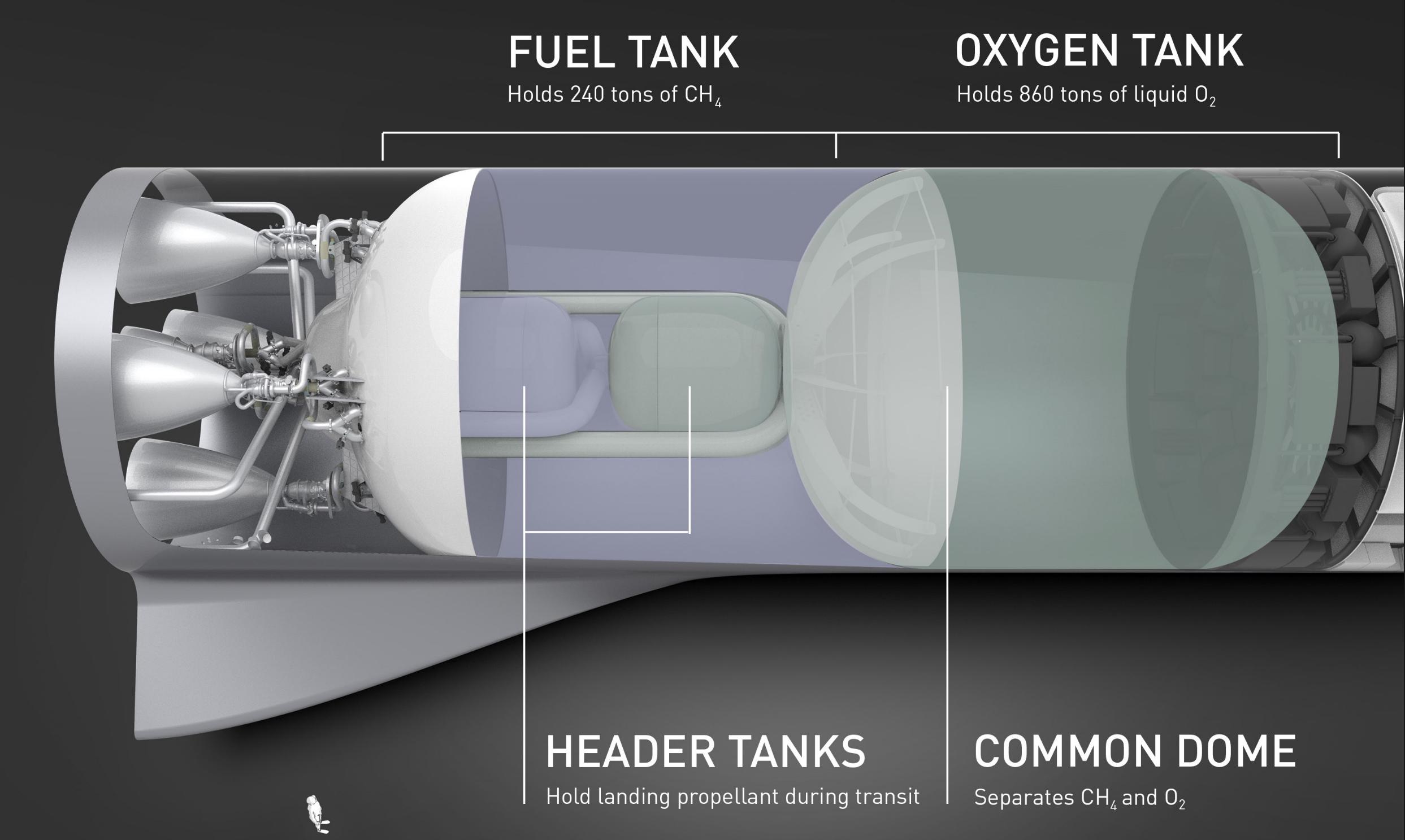

Parallel Booster system using H2:
The Starship O2 tank would service both the CH4 and H2 combustion processes, so would need to be sized appropriately.
Two distinct uses are to land on the Moon and ascend from the Moon, and perhaps to travel from "Water Station" to "Water Station".
The H2 tanks will not be intended for long term filling. You would fill them at a "Water Station", which could be on the Moon or in an orbit.
You would immediately burn off all the H2, and then fall back on CH4 as your fuel.
So, in landing on the Moon, the H2 tanks would be empty and would serve as part of the landing gear. The landing would be done with the CH4, and O2.
The H2 tanks would be designed to absorb damage is the landing was too hard. Of course, then they could not be reused. But if the H2 tanks were in good shape then the H2 tanks could be refilled just prior to launch from the Lunar "Water Station". The Oxygen tank could also be topped off on the Moon. The early part of the launch would burn all the H2, and the rest of the launch would depend on the CH4.
The assembly arriving at an orbital "Water Station" could be refilled with H2, CH4, and O2 as desired.
If needed or desired, after H2 is consumed, the parallel booster could be dropped off of the Starship to reduce dry mass, and perhaps then eventually a electric rocket system would grab it and bring it to a "Water Station.
So, I am sure there are other options that could be developed as well.
Some attention needs to be given to the possibility of material spills. If water, it will evaporate. If solid Carbon, it might become a set of collision hazards. Similar for Iron Oxide. So, size matters. I am not sure what is the best for size of Carbon and Iron Oxide pieces. I think it might be useful to add some magnetic materials to each part and magnetized them. Then a spill of solid parts, might clump together if the spill was relatively passive in nature and not explosive.
Obviously setting up a segmented travel method in space will be a thing that evolves like a living thing, having a seed type start and then expand to greater options.
Ending Pending
Last edited by Void (2026-01-15 12:03:25)
Is it possible that the root of political science claims is to produce white collar jobs for people who paid for an education and do not want a real job?
Offline
Like button can go here
#225 2026-01-15 17:08:58
- Void
- Member
- Registered: 2011-12-29
- Posts: 9,550
Re: Multi-Ship Expeditions, Starboat & Starship, Other.
As amendment to the just prior post, I again mention two other Moon fostered methods that could perhaps be used as parallel boosters to get a spaceship off of the Moon without the boosters themselves using Metha-Lox.
1) Alice: https://en.wikipedia.org/wiki/ALICE_%28propellant%29 If I understand how this works, nanoparticles of Aluminum mixed with ice combust, producing heat and liberating highly expanding Hydrogen. At least for now I think that is how that works.
In any case if the Moon has sufficient water and the production of Nanoparticles from Lunar regolith becomes possible then it may be that such boosters could be strapped onto a ship like a Lunar Starship, to assist it to Lunar orbit. This would reduce the consumption of liquid propellants of the Starship to get to that orbit.
While the Alice Boosters could be expended, on the other hand perhaps they could be brought to the nearest "Water Station" to be repurposed as metal products. Or they might ride back down to the Lunar surface to be refilled and reused. But I think the casings might be heavy, so that might be propellant costly. Not sure.
Here is some support for what I have said: Quote:
ALICE rockets, or Aluminum-Ice Rocket Propellant, are a promising solution for lunar missions due to their unique properties. They are a frozen mixture of nano-aluminum powder and water, which allows for easier ignition and combustion compared to traditional solid rocket propellants. This makes ALICE suitable for on-site production on the Moon, where both aluminum oxide and water are abundant resources. The high propellant density of ALICE decreases the dry mass of the rocket, making it more efficient for lunar missions. Additionally, ALICE's ability to generate hydrogen as a working fluid during combustion can enhance the thrust and efficiency of lunar missions.
Wikipedia
2) A concept which has been investigated is a paste of LOX and nano aluminum as a propellant.
It has some problems as it has to be squeezed like a toothpaste into a combustion chamber and they had to use liquid Nitrogen to keep it from burning back into the propellant tank and causing a uncontrolled fire and/or explosion.
Perhaps Liquid Oxygen could be used, in a heat exchanger to keep the burn at bay.
I am tempted to suggest modifying the Mixture to be LOX, Water Ice particles, and Nano Aluminum. This would introduce some Hydrogen to the expansion of the burn. It may improve performance and conserve water on the Moon. As it is the LOX/nano particles mix will underperform the burning of Hydrogen or Methane but may be good enough for the Moon.
Here is some material from the internet related to #2 above:
https://space.stackexchange.com/questio … ant-source
Quote:
The concept of using a paste of Liquid Oxygen and nano-Aluminum as a lunar propellant has been explored by researchers and organizations. Here are some key points regarding this approach:
Aluminum Powder in LOX: Aluminum powder can be suspended in gelled LOX to form a monopropellant, which has been tested in small rocket engines. The engine was designed to keep the LOX from boiling off and to feed the propellant into the combustion chamber using a piston.
1
Hybrid Rocket Engines: A conceptual design for a hybrid rocket engine using solid aluminum and liquid oxygen has been proposed. This design involves a hexagonal array of aluminum bars fed with LOX for regenerative cooling before reaching the flame at the bar tips.
1
Performance Challenges: Despite the potential, the performance of aluminum and oxygen propellants has been estimated, but actual combustion tests have shown lower than predicted characteristic velocity and specific impulse performance efficiencies due to poor mixing and two-phase flow effects.
1
In-Situ Propellant Production: The idea of using lunar resources for propellant production, including aluminum and LOX, is part of In Situ Resource Utilization (ISRU). This approach aims to eliminate the need for costly imports of propellants and could be a significant boost towards lunar colonization efforts.
1These developments highlight the ongoing research and exploration of using lunar resources for rocket propulsion, with a focus on sustainability and resource utilization.
6
For the Hybrid concept, I wonder if a pre-burner which would mix a smaller part of something like Paraffin to combust with a larger part of LOX could then be fed to burn the Aluminum. That would then introduce Hydrogen into the exhaust which might improve the expansion.
Or perhaps somehow water steam might be injected into the heated Oxygen to introduce Hydrogen.
That might improve the results I would hope.
Ending Pending
Last edited by Void (2026-01-15 17:33:53)
Is it possible that the root of political science claims is to produce white collar jobs for people who paid for an education and do not want a real job?
Offline
Like button can go here