New Mars Forums
You are not logged in.
- Topics: Active | Unanswered
Announcement
#1 2025-12-25 18:08:54
- SpaceNut
- Administrator
- From: New Hampshire
- Registered: 2004-07-22
- Posts: 30,068
Designing insitu Mars equipment garage
Whether the equipment is delivered by a cargo starship or via a Conex box delivery system the end is to protect the supply that is very expensive to provide..
A support structure to protect the equipment and crew so as to be able to work in shirt sleeves.
Designing an in-situ Mars equipment garage involves leveraging local resources (ISRU) to provide robust shielding and a pressurized, sealed environment for maintenance, repair, and storage of rovers and other surface equipment.
Key Design Principles
Radiation and Micrometeorite Shielding: The primary structure must protect sensitive equipment from intense solar and cosmic radiation, as well as micrometeorite impacts. This is typically achieved by covering the habitat with a thick layer of Martian regolith.
Airlock and Pressurization System: A multi-stage airlock system is critical for maintaining internal pressure and preventing the ingress of toxic Martian dust (perchlorates) into the main habitat or garage area.
ISRU Material Use: Construction should prioritize the use of local materials (regolith, basalt) to minimize the payload required from Earth.
Modular and Expandable: The design should allow for phased construction, starting with an initial structure and allowing for future expansion as the mission grows.
Construction Methodology
An autonomous, phased approach is generally proposed for construction before human arrival.
Site Preparation: Robotic systems select and prepare the site, which may involve excavating a cavity or a lava tube to utilize natural shielding.
Autonomous Construction: Autonomous 3D-printing robots build the primary structure using a blend of fused regolith and potentially imported binders or prefabricated components like carbon nanotubes.
Internal Outfitting: Inflatable modules or rigid internal liners (e.g., HDPE plastic to provide an airtight seal) are deployed and connected within the protective shell.
Functional Requirements
Vehicle Maintenance Bay: A large, climate-controlled area for repairing rovers and other large equipment.
Airlock System: A large, vehicle-sized airlock for moving equipment in and out, with systems to remove dust.
Power and Communication: Connection to the base's power grid (e.g., nuclear fission units) and communication networks.
Storage and Workshop: Areas for storing spare parts, tools, and raw materials, including a manufacturing bay for 3D-printing spare parts from metals and plastics.
Structure type is not defined as we must know what type of early equipment type as well as the fuels that they will need to make use of. It is suggested to be a separate attached system with possible machine shop capability.
Other suggestions is to possibly make this the staging start foundry for metals processing.
Offline
Like button can go here
#2 2025-12-25 18:34:45
- tahanson43206
- Moderator
- Registered: 2018-04-27
- Posts: 23,684
Re: Designing insitu Mars equipment garage
This post is reserved for an index to posts that may be contributed by NewMars members.
Index:
(th)
Offline
Like button can go here
#3 2025-12-25 18:45:30
- tahanson43206
- Moderator
- Registered: 2018-04-27
- Posts: 23,684
Re: Designing insitu Mars equipment garage
The idea of needing a garage first showed up in the Airlocks topic.
https://newmars.com/forums/viewtopic.ph … 22#p236522
The problems of dealing with Martian atmosphere and sand carried by the atmosphere will be challenging for human sized airlocks.
The challenge of removing clean air from a garage/hanger sized building and allowing Mars atmosphere to fill the volume will be daunting.
It seems likely to me that vehicles will be serviced by robots (via teleoperation) in volumes shielded from the open atmosphere, but kept at Mars ambient pressure.
The main need will be freedom from grit in the air, and good lighting.
The cost of filling a hanger sized volume with clean air just to service a vehicle will be too high for the average community.
Conceivably a very wealthy corporation or government could indulge in such a luxury.
The time it would take to pump down a large garage or hanger would be lost for maintenance.
I think it far more likely that a sand door will be a basic requirement, good lighting and power for tools, and a system for removing dust from the vehicle will be needed.
(th)
Offline
Like button can go here
#4 2025-12-26 08:35:21
- SpaceNut
- Administrator
- From: New Hampshire
- Registered: 2004-07-22
- Posts: 30,068
Re: Designing insitu Mars equipment garage
For SpaceNut .... Your new topic about garage/hanger volume looks promising. I don't think anyone will be able to fill such a volume with very expensive clean air. Clean air will be reserved for use in habitats, and inside sealed vehicles. I can't imagine anyone being able to afford to take the time to pump down a garage or hanger sized volume just to work on a vehicle.
I think it makes more sense to bring the vehicle into a volume where you can close the huge door and let dust settle to the floor.
Mechanical sweepers might be a way to collect the dust, because vacuums aren't going to work in the thin Mars atmosphere.
Ingenuity showed that large fans ** can ** work on Mars.
It might make sense to blow dust off of vehicles before driving them into a garage or hanger.
Humans may have experience performing maintenance in sand storms. It's not something I've heard much about.
(th)
I would say that the standard double door system needs a second set to be able to do a cleaning room function before entry into the dome.
We would also use a SCUBA system which is similar to those used in Desert Storm.

As seen you get a bottled air system 5000 psi composite tank with a filtered snorkel to airlock air using an air mask.
Offline
Like button can go here
#5 2025-12-26 10:00:30
- tahanson43206
- Moderator
- Registered: 2018-04-27
- Posts: 23,684
Re: Designing insitu Mars equipment garage
for SpaceNut .... Humans have plenty of experience working on vehicles in the out-doors.
It seems to me highly likely that designers will plan for outside maintenance of most vehicles.
However, your topic here calls for a vehicle sized garage, and that means you will need a vehicle sized airlock.
This will be an extremely expensive operation. I don't think you realize how expensive it is going to be.
The airlock door must withstand 1/2 bar of pressure. it cannot leak, But inevitably, it ** will ** leak.
I hope you can get help from your AI friend to solve ** that ** problem, because you (as a mere human being) won't be able to solve it.
You will be installing and running massive air pumps to scavenge every possible atom of precious oxygen and nitrogen, and you will NOT succeed, because you don't have time enough to run those pumps before your customer is going to be hopping mad because of the delay,
The bill to your customer is going to include the cost of the lost gases. Nitrogen in particular will be precious and it will likely have to be imported.
The bill to replace that nitrogen because your customer wants the vehicle ** inside ** for shirtsleeve servicing will be a major part of the item list, along with rags and oil and other supplies.
Regarding the air tank .... OK ... so your service worker would be wearing a standard Mars suit?
If that is the case,then the garage can be unpressurized and just well lit and dust free (or dust managed).
That might work.
(th)
Offline
Like button can go here
#6 2025-12-26 12:05:08
- SpaceNut
- Administrator
- From: New Hampshire
- Registered: 2004-07-22
- Posts: 30,068
Re: Designing insitu Mars equipment garage
A not with a restrictive easily puncturable space suit where cuts can occur killing the mechanic by venture of being in a near vacuum.

For SpaceNut ... re https://newmars.com/forums/viewtopic.ph … 44#p236544
The text you pasted about airlocks looks reasonable, but there are no references.
This forum needs to get in the habit of providing references for every post that might be assumed by a reader to be something other than an opinion.
I like the discussion about multiple stages of air locks. That looks really tedious to me.
The worry about contaminating Mars is understandable for an initial expedition.
It has nothing to do with Calliban's dome airlock. We aren't going to be worried about contamination of Mars.
You have already started discussion because you are (apparently) worried about CO in Mars atmosphere that might enter the habitat.
I have tried to encourage you to guide your AI to produce useful guidance on how to do that. The AI may have found some NASA documentation but I don't see that has much if anything to do with Calliban's dome.
You provided a problem to solve. Now please guide AI to find a solution.
Offline
Like button can go here
#7 2025-12-26 18:38:21
- tahanson43206
- Moderator
- Registered: 2018-04-27
- Posts: 23,684
Re: Designing insitu Mars equipment garage
For SpaceNut ... Post #6 shows an example of a problem posed without a solution.
A not with a restrictive easily puncturable space suit where cuts can occur killing the mechanic by venture of being in a near vacuum.
There are many solutions to this problem. The post could have included at least five that I can think of, and probably a great many more.
Science fiction writers have been dealing with exactly this scenario for decades. Even NewMars members have described solutions but at this point I would have difficulty finding them because this forum is not well equipped for lookups.
Let's stop posting problems without solutions. Readers can decide if the suggested solution works for them.
This forum has the opportunity to provide solutions for readers who are planning to travel to or actually live on Mars.
Humans wear clothing that is made from cloth. Cloth can tear or burn or stretch or fray. So what? A manufacturer of clothing works hard to create products that humans find acceptable for a given purpose, and humans routinely accept whatever risks may be involved.
Occasionally risks may exceed the average person's ability, so groups may step in to provide rules to guide manufacturers.
Regulations for clothing to be worn outdoors on Mars seem to me like a good idea. Some humans don't like regulations. Most humans like having access to products that will perform an advertised function and not kill them. My guess is that most groups on Mars will establish regulations for products manufactured on Mars or imported from outside Mars.
If someone wants to live without regulations, Mars may not be the best choice of a destination.
This topic is supposed to be about building a garage suitable for Mars. Let's return to the topic.
Let's provide solutions.
I'll provide an example:
The door to a large garage on Mars needs to be shaped like a dome. That is the solution.
The problem is that air pressure inside the garage will blow out a flat door.
(th)
Offline
Like button can go here
#8 2025-12-26 18:59:39
- SpaceNut
- Administrator
- From: New Hampshire
- Registered: 2004-07-22
- Posts: 30,068
Re: Designing insitu Mars equipment garage
Do you have the list of construction equipment that will be sent? The the design can not go forward until it is known. If you do then what are the statically type or number and dimensions as these are part of how a structure is designed as the floors need to support the mass without cracking. Plus you still need it to fit size and mass on a flight manifest to Mars.
I proposed a need to help in making the equipment last beyond this initial construction otherwise the Dome fails if any piece breaks.
Oh, I forgot air tools, lift devices and other common shop items. Not to mention spare parts like the tires which will most likely be similar to the current rovers that are on mars or tracks.
Offline
Like button can go here
#9 2025-12-29 08:40:10
- SpaceNut
- Administrator
- From: New Hampshire
- Registered: 2004-07-22
- Posts: 30,068
Re: Designing insitu Mars equipment garage
Offline
Like button can go here
#10 2025-12-30 16:03:52
- SpaceNut
- Administrator
- From: New Hampshire
- Registered: 2004-07-22
- Posts: 30,068
Re: Designing insitu Mars equipment garage
other reference topics that are possible to incorporate into what needs protection.
Offline
Like button can go here
#11 2025-12-31 14:43:47
- SpaceNut
- Administrator
- From: New Hampshire
- Registered: 2004-07-22
- Posts: 30,068
Re: Designing insitu Mars equipment garage
For SpaceNut re a post about tools: https://newmars.com/forums/viewtopic.ph … 78#p236578
The idea of sending tools seems to be related to the idea of sending human workers.
Calliban's plan is to automate the entire process. The tools that would be sent would be ones for which robots are designed. None of the traditional human tools would be shipped to Mars in the scenario of a fully automated construction sequence.
More importantly, the tools must be designed and tested on Earth before a single ship goes to Mars. What that means is that the tools must be designed as the job is designed, and not the other way around. The job to be done will dictate what tools are needed.
Let's determine what physical structures are needed, and the tools to make them will become clear.
Calliban has already provided the essential framework within which design can and will occur.
(th)
Humans are workers and not on a pleasure cruise.
Even the ISS has tools onboard for the crew to make use of.
No garage on earth is able to fix any vehicle with out them even with a computer diagnostic post.
The 3D printing machine can not make a garage if its not to the same plans as a dome of a different size. That requires different programming.
Any specialized robot is only going to be capable of just a limited amount of tasks and may not being able for upgrade to adapt for other tools and programming for other functions beyond its current programmed tasks.
The dome as automated systems that are not adaptive to other tasks. A computer program is for limited sensing or functions to know what those systems are doing and to give alarm if the details are out of spec.

This is not adaptable as it requires more than the initial programming that one might get. If I put an engine in front of it how long would you wait to get the vehicle going when its required to be running.
Now I am way off topic otherwise why bother going to mars to do nothing.
Offline
Like button can go here
#12 2025-12-31 15:17:47
- SpaceNut
- Administrator
- From: New Hampshire
- Registered: 2004-07-22
- Posts: 30,068
Re: Designing insitu Mars equipment garage
For SpaceNut re post about needing human workers on Mars...https://newmars.com/forums/viewtopic.php?pid=236735#p236735
That post contains some "old fogey" predictions.
From my perspective, you are ** much ** too young to be publishing text like that.
The young people we have the opportunity to invite to participate in this forum will not be interested in that kind of limited thinking.
The kind of people we ** should ** be inviting to the forum will be right in the middle of learning how to combine hardware with advanced computing to solve any problem that we can think of here on Earth, and more importantly, any problem that comes up on Mars.
There are teams of bright young people all around the planet, working on adaptive robotics systems. We are just a few years on Earth away from seeing such machines in service. The most likely place we can expect to see them right now are in the US and China, but I'll bet that Europe is not far behind.
Our task is NOT to design for human workers, but instead, to design for automated construction. That means we have to learn new things. Learning is good exercise for the human brain. Hopefully every member of the NewMars forum makes a point of learning something new every day, and on a good day, we might even learn two things.
We humans have to learn how to get rid of old, outdated brain stored data. We need to hang onto the durable information (ike Ohm's Law) and get rid of out dated information about how to shoe horses, unless we are one of few humans left who earns a living shoeing horses.
If you believe that certain tools are developed to the point of perfection, then they might find a place in the Mars manifest. I am thinking of a screwdriver as an example. Screwdrivers must be mated to the kinds of screws that will be shipped to Mars for assembly of equipment. I just read a long history of how the standards we take for granted were created by a single bright individual in England. That single invidividual invented the entire field of measurement and precision that is at the heart of engineering today.
Modern adaptive robots can operate a screwdriver. OK ... send screwdrivers, if they are needed because you've packed screws in your inventory.
I would like to see the Garage on Mars loaded up with specifications for equipment and parts for shipment to Mars.
We don't need more warnings about how difficult the process is going to be. We want to attract young people who don't care how hard the job may be. They just want to get started.
From my perspective, the Garage on Mars topic can and should include objectives, methods and parts lists, and warnings can be printed at the bottom in fine print. Every single aspect of the proposed garage needs to be assembled and tested on Earth. Let's get the process started.
(th)
Of course this is what you are thinking repairs of stuff will be...
Repairing equipment on Mars requires extreme self-sufficiency, relying on on-site 3D printing/fabrication, software fixes, extensive pre-mission training for technicians (often astronauts), standardized modular parts, remote diagnostics via Earth, and robust life support for personnel, with key needs including advanced robotics, materials science (like cold spray for metals), extensive spare parts, power, specialized tools, and a deep understanding of remote troubleshooting for hardware that can't be physically touched.
Here are the core requirements for a hypothetical Mars equipment repair service:
Personnel & TrainingHighly Skilled Technicians: Experts in robotics, electronics, software, mechanics, and potentially geology/chemistry.
Extensive Training: Mastery of complex systems, root cause analysis, and simulation-based troubleshooting.
Physical & Psychological Fitness: Able to handle extreme isolation and demanding tasks.Technology & Tools
3D Printing & Additive Manufacturing: For creating replacement parts, tools, and custom components on-demand.
Automated Repair Systems (MARS): Systems like the Navy's Cold Spray for metal repair.
Robotics & Drones: For inspections, remote manipulation, and difficult-to-reach areas.
Remote Diagnostics: Advanced software for Earth-based engineers to diagnose problems.
Specialized Toolkits: On-site maintenance kits, software loaders, and diagnostic equipment.Logistics & Resources
Extensive Spare Parts: Stockpiled or printable inventory of critical components.
Reliable Power: Consistent energy supply for tools and systems.
Habitat & Life Support: Breathable air, water, food for repair crews.
Secure Data & Communication: For receiving Earth-based support and protecting sensitive info.Procedures & Documentation
Standardized Procedures: Clear protocols for all maintenance tasks.
Digital Manuals & AI Support: Easily accessible repair guides and AI-driven troubleshooting.
Fail-Safe Designs: Equipment built with redundancy and modularity for easier fixes.
In essence, it's about creating a self-sustaining, highly capable, and adaptable workshop on another planet, as direct physical access to Earth-based repair is impossible
We do not even have an inventory of the equipment type that man is going to use on mars.
Do we have a size for the garage?
Will we have lifts so as to do work on the under parts?
Do you have an idea of the filtering system to keep mars dust and regolith out?
Offline
Like button can go here
#13 2025-12-31 17:38:26
- SpaceNut
- Administrator
- From: New Hampshire
- Registered: 2004-07-22
- Posts: 30,068
Re: Designing insitu Mars equipment garage
For SpaceNut re garage on Mars ...
Your recent posts have inspired this thought....
Let's consider creating a standard metal building for equipment maintenance out of the wind and free of sand.
Let's pick a building from the assortment of buildings on Earth. We have many vendors of build-it-yourself metal buildings.
We want the building to be large enough to handle whatever vehicles the various Nations will be sending to Mars in the early years.
Just pick one and see if it weighs less than 40 tons when shipped.
If it does, go to the next step. Can the building hold up to conditions on Mars? My guess is it will, because it is designed for Earth, and Earth is rough on buildings.
Does the building require a concrete foundation? What can we do instead?
GW Johnson has written about floor solutions for Mars. Can we use one of those?
Now to the crucial question: Can a robot or a team of robots assemble the building?
I don't think that has ever happened? Possibly not.
Can it happen? Of course it can. What does it take to make it happen? It should be obvious, but for our readers, I'll spell it out.... It takes a single human being who is obsessed with making it happen. Are there such human beings on Earth today? I think there must be, because there are so many difficult projects under way around the world in 2025.
(th)
Already looked at this question in ]Companion for Mars Expedition Number One; 17 crew members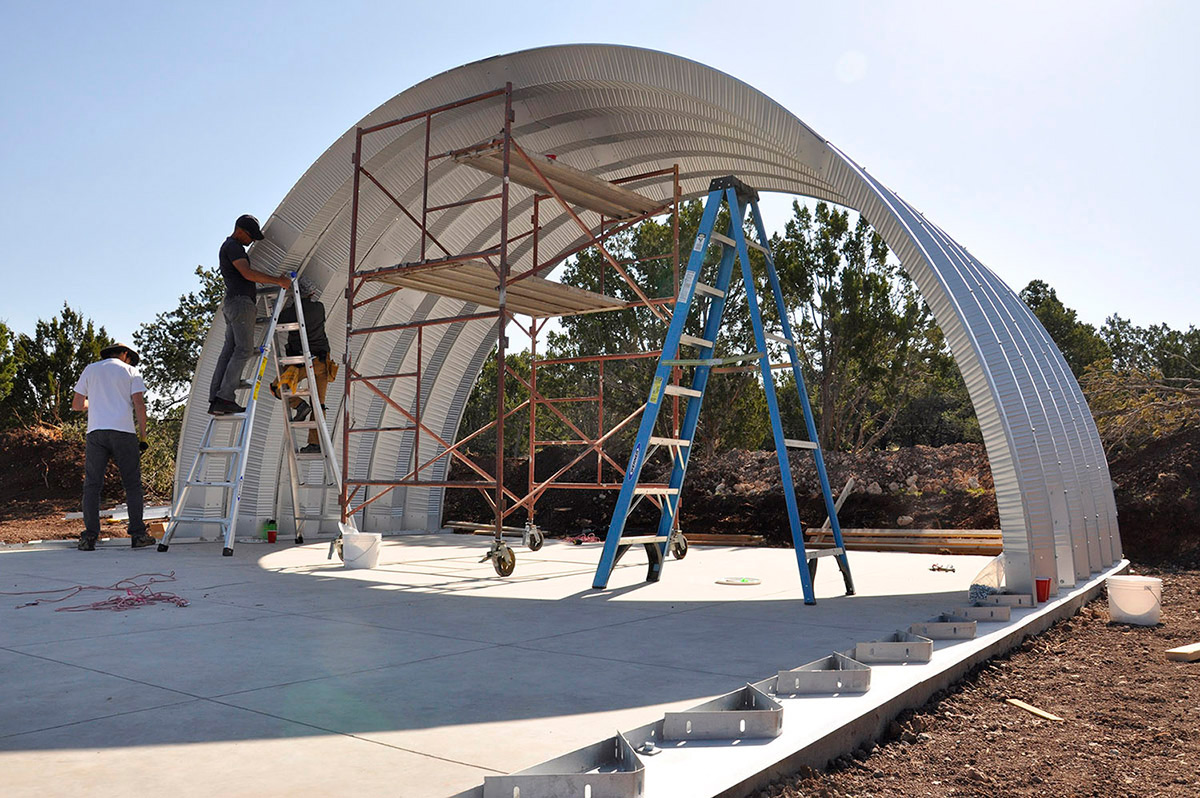
Did not go any further but this one is to small to house all of the equipment, but then again we have the stainless steel shell of a starship to repurpose once we know how large we really do need.
The stainless steel used in the construction of the Starship and Super Heavy booster, including the Block 3 version, has a uniform diameter of 9 meters (30 feet). The steel is typically sourced in rolls that are cut into rings to form the vehicle's tanks and structure.
Key Dimensions and Material
Diameter: The standard diameter for all current Starship and Super Heavy booster versions, including Block 3, is 9 meters (approximately 30 feet).Steel Thickness: The stainless steel used is generally 3.6 mm thick (about 0.14 inches) for many parts of the structure.
Material Type: SpaceX primarily uses a custom variant of 304L stainless steel, which performs well in the extreme cryogenic temperatures of rocket propellants.
Band/Roll Width: The raw steel is often delivered in rolls that are 1.8288 meters (72 inches) wide and then welded together to form the large rings of the rocket's structure.
Block 3 Changes
While the diameter remains the same, the Block 3 iteration introduces changes to the overall height and internal capacity:Super Heavy (Booster): The Block 3 booster is expected to be 72.3 meters (237 feet) tall, a slight increase from the Block 2's 71 meters. It also has increased propellant capacity and uses Raptor 3 engines.
Starship (Second Stage): The Block 3 ship is expected to be part of a taller, 124.4 m (408 ft) stacked vehicle, and is designed to carry significantly more fuel than previous versions.
The consistency in the 9-meter diameter across versions allows SpaceX to use the same manufacturing tooling and launch infrastructure, such as the high bay and launch tower arms
Offline
Like button can go here
#14 Yesterday 10:16:59
- SpaceNut
- Administrator
- From: New Hampshire
- Registered: 2004-07-22
- Posts: 30,068
Re: Designing insitu Mars equipment garage
For SpaceNut re garage on Mars ...
Re https://newmars.com/forums/viewtopic.ph … 41#p236741
Nice! Great Find! Nice Image!
Ok... we have two ways to go... Please do both.
I'd like to see the building you found developed further. That building is plenty large for a great number of vehicles, and you can make it as long as you need.
Please find out what the shipping weight of the entire structure might be. That would include all the panels and the frame and the fasteners.
There might be additional components but just include them. Please don't second guess the builders. They know more than you or I ever well so let's not waste time trying to redo their work. What I want to know is: will that system ship for under 40 tons, and will the panels fit inside a Starship?
*** The second path is to obtain the measurements of the Starship hull and determine what you can make by cutting it in half longitudinally.
If you do ** that ** you may have a structure strong enough to hold a meter or two of regolith, if you anchor the bottom correctly and if you pile regolith against the sides. Please do NOT try to solve ANY of the details yourself. Neither you nor I have ** any ** idea what needs to be done, but we have two fully qualified engineers in the group who do. Let's not waste any of our valuable time worrying about details.
I would like to see two proposals coming out of this topic:
1) Original Quonset hut building
2) Split Starship building(th)
Insufficient size of hut break of topic is still required for a really any chance to prove for mass statements or other. Yes a concrete floor is required and we would still want to berm for radiation protection.
Repurposing a Starship's stainless steel hull on Mars to create structures like a quonset hut is a feasible and likely scenario within SpaceX's proposed Mars colonization architecture. The plan involves using incoming Starships as potential habitats and sources of raw materials for construction on the surface.
Feasibility Analysis
Material Properties: Starships are primarily made of a custom 300-series stainless steel alloy, such as 304L or a proprietary "30X" blend, known for its excellent performance in extreme temperatures (both cryogenic and high heat). This inherent strength and durability in harsh environments is a significant advantage for Martian construction, where temperatures drop to -125°C at night.On-site Processing: While some sources suggest raw steel could be processed and rolled on Mars without full re-melting, the exact details of on-site steel manufacturing technology are still speculative. The plan may involve using heavy-duty robotic equipment to move and orient the entire Starship or sections of it.
Existing Concepts: One proposed method involves landing the Starship and tipping the entire structure on its side to create a large, ground-level living or workspace. Another concept is to use the existing cylindrical hull as a pre-built structural shell, which could then be buried under Martian regolith for radiation protection, similar to the function of a quonset hut.
Logistics and Cost: Transporting building materials from Earth to Mars is prohibitively expensive. Repurposing the structure of the arrival vehicle itself offers a cost-effective and pragmatic solution by utilizing already-present mass. The low cost and rapid manufacturing process of stainless steel on Earth make it a suitable material for the large number of ships needed for colonization, many of which may not return.
Potential Applications for a Quonset Hut Style Habitat
A repurposed Starship hull section could serve several functions in a Mars base:Primary Habitat: By rotating a section of the hull horizontally and sealing the ends, it can form the basic arch shape of a quonset hut, providing a large internal volume.
Storage: The large volume could be used for storing equipment, supplies, or in-situ resource utilization (ISRU) generated propellant components.
Workshops/Labs: Dedicated areas for scientific research or maintenance of robotic equipment.
Shielding: The structure could be covered with Martian soil (regolith) to provide essential protection from solar and galactic cosmic radiation, which is a major concern on the Martian surface.
In essence, using the Starship's hull as the basis for a quonset hut style structure is a strong possibility, leveraging the material's properties and the simple logistics of utilizing existing on-planet resources
Now cutting it in half.
Repurposing a Starship hull for a Mars quonset hut by cutting it once from tip to bottom is a theoretically possible but highly complex engineering and logistical challenge that hasn't been finalized in current mission plans. The primary challenge lies not in the material's properties, but in the practical execution on the Martian surface.
Feasibility Analysis
Material Suitability: The Starship hull is constructed from a proprietary 300-series stainless steel alloy (similar to 304L) designed to be durable, resist corrosion, and actually gain strength in the extreme cold of cryogenic temperatures. These properties make it an excellent potential building material for a Martian habitat, where it would need to withstand a harsh environment and internal pressurization.Quonset Hut Shape: Cutting the cylindrical hull lengthwise would result in two semi-cylindrical pieces, which is the basic shape of a quonset hut. This shape is structurally efficient for supporting loads and containing internal pressure, making the concept sound from an architectural standpoint.
Structural Considerations: An unfueled Starship is less robust than one under pressure. Simply cutting it open could compromise its structural integrity. Modifications would be needed to ensure stability both pressurized (to simulate an atmosphere) and unpressurized on the surface of Mars.
Major Challenges
Logistics and Equipment: The main hurdle is the requirement for heavy-duty, robotic equipment on Mars to perform the cut and maneuver the massive pieces. A fully-fueled Starship has a mass of over 5,000 tonnes, and even an empty one is around 100 tonnes, meaning specialized, large-scale machinery would need to be sent to Mars first to handle the components.Landing and Placement: Current concepts for using Starships as habitats often involve tipping the entire structure on its side or landing it in a pre-prepared trench to align with other surface elements. The user's idea of cutting it once would likely require the ship to be safely landed vertically, then precision-cut, and the two halves repositioned.
Cutting and Welding on Mars: Performing precision cutting and subsequent welding in the harsh Martian environment (thin atmosphere, dust, extreme cold) would require specialized, automated tools and techniques. While stainless steel can be welded relatively easily compared to other aerospace materials, doing so robotically in an off-world environment is a significant engineering challenge.
Heat Shield Management: The windward side of the Starship is covered in thousands of hexagonal heat shield tiles. Cutting through these would be complicated and require a plan for re-sealing or replacing the thermal protection on the new edges.
Backup Systems: As one source notes, using the only available ship as a habitat comes with risk; any major conversion would likely need to wait until a reliable backup habitat is established.
In essence, while the material is a great choice and the shape is practical, the "cut once from tip to bottom" concept is highly dependent on developing and deploying sophisticated, heavy machinery capable of complex, automated construction tasks on another planet.
Not all of the ship is useable
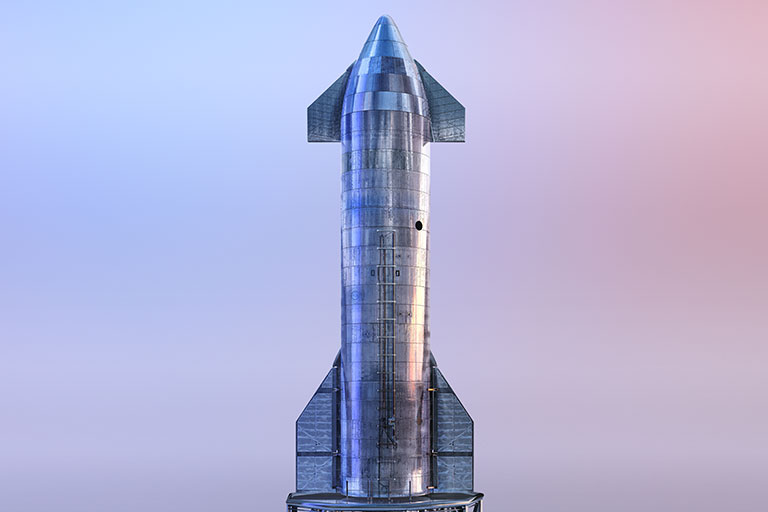
We know its a 9 m diameter but how much is a bit more difficult due to the steering wings. Of course I would fold the shell out after just a first cut and rather than making it 2 half circles a make it a Larger U shaped more like the above image. That would raise the structure upward by the 1/4 circumference measurement to go against the floor.
The useable area seems to be 15 bands of the materials at nominal width for the raw sheet for how tall the starship is. From the rolls used for each band they are 1.8288 meters (72 inches) wide. That would make the straight section approximately 30M give or take.
Of course we still need the end caps to the structure and airlocks to finish the Quonset Hut Shape
Offline
Like button can go here
#15 Yesterday 15:32:26
- SpaceNut
- Administrator
- From: New Hampshire
- Registered: 2004-07-22
- Posts: 30,068
Re: Designing insitu Mars equipment garage
Here is what AI thinks of the concept
While the idea of using a section of a Starship hull as a U-shaped quonset hut on Mars is interesting, it faces significant engineering challenges and is not part of SpaceX's primary plan for early Mars habitats.
Feasibility and Challenges
Intended Use: SpaceX's initial plan for Mars Base Alpha involves using entire, spent Starships as habitats, storage units, and infrastructure, likely in their vertical orientation initially, before moving crews to purpose-built, shielded modules.Structural Integrity and Emplacement: The Starship hull is designed to handle launch and re-entry forces primarily in a vertical orientation. Tipping a Starship onto its side to act as a horizontal quonset-style hut presents major stability and structural challenges on the Martian surface. The hull sections were not designed to support their own weight horizontally in Mars' 3/8 gravity without significant modification and ground support.
Offloading and Maneuvering: Getting the massive hull section to a specific location and tipping it over requires specialized heavy-duty robotic equipment and offloading systems that are still in conceptual stages.
Joining/Sealing: Creating a "U" shape implies cutting a segment and adding end-caps or integrating it with other elements. This would require on-site manufacturing and sealing capabilities to maintain a safe, pressurized environment, which is a major engineering hurdle.
Radiation Shielding: The stainless steel hull alone would not provide sufficient protection from the intense solar and cosmic radiation on the
Martian surface. Habitats will require substantial shielding, likely by burying them in Martian regolith (soil), which is easier with purpose-built modules than with an unwieldy hull section.Habitability and Layout: The circular cross-section of the Starship hull would present challenges for internal outfitting and creating a standard floor plan, as the floor would be curved unless a complex internal structure was added.
Alternative Approaches
Current concepts for Mars habitats leverage different approaches:
Integrated Habitats: Astronauts may initially live inside the Starship itself for short periods before moving to more permanent structures.
Modular Design: Habitat modules that can be launched vertically in the Starship's cargo bay and then offloaded and moved horizontally on the surface.In-Situ Resource Utilization (ISRU): Using local Martian materials, such as 3D-printed regolith, to construct robust, shielded habitats.
In essence, while the Starship hull offers a large, existing pressure vessel, the practical difficulties of converting it into a quonset-style hut on Mars make it an unlikely primary solution compared to other, more feasible engineering approaches being studied by space agencies and private companies
Earth product
Quonset hut metal thickness is specified in gauge and varies widely, typically ranging from 12 to 26 gauge, which translates to approximately 0.4 to 2.8 mm. A lower gauge number indicates a thicker metal.
The specific thickness required depends heavily on the building's intended use and location, including factors like wind, snow, and seismic loads, as well as local building codes.Typical Thickness Ranges
The following list provides common steel gauges used for Quonset huts and their approximate metric conversions:
26 gauge: approx. 0.45 mm
22 gauge (common for smaller residential use): approx. 0.76 mm
20 gauge (for larger commercial buildings): approx. 0.91 mm
18 gauge: approx. 1.21 mm
16 gauge (heavy-duty applications and high snow areas): approx. 1.52 mm
14 gauge: approx. 1.9 mm
12 gauge: approx. 2.7 mm
Building manufacturers will determine the necessary gauge based on engineering standards and local requirements to ensure structural integrity
So if the metal is soft why? Is it due to starships metal thickness?
Starship thickness
Steel Thickness: The stainless steel used is generally 3.6 mm thick (about 0.14 inches) for many parts of the structure.
Offline
Like button can go here
#16 Yesterday 16:25:41
- SpaceNut
- Administrator
- From: New Hampshire
- Registered: 2004-07-22
- Posts: 30,068
Re: Designing insitu Mars equipment garage
The internal pressure has not been given as to how high we would require to make use of outer ware space suit for use. It will need to be determined due to radiation protection requirement. which could be as low as 2 meter of regolith.
The required stainless steel thickness for supporting 2 meters of Martian regolith depends heavily on the specific structural design (e.g., flat plate, arched, corrugated), the grade of steel used, and the underlying support system (e.g., internal air pressure).
For general engineering estimates:Key Variables
Martian gravity is approximately 3.71 m/s², which is about 38% of Earth's gravity.
Martian regolith density ranges from about 1.2 to 2.0 g/cm³ (1200 to 2000 kg/m³), depending on compaction and location.
Stainless steel yield strength (e.g., Grade 304 or 316) is typically around 205-240 MPa.Structural Design Considerations
A simple, flat steel plate would need to be very thick to support a 2m-high, unassisted load, which would be inefficient. In real-world habitat designs, the structure would likely be an arched or corrugated shell, potentially supported by internal air pressure.Example from research: One engineering concept for a Martian habitat suggests that 3mm thick corrugated stainless steel panels (specifically 316L, chosen for mechanical performance at low temperatures) would be strong enough to support a "fairly thick" regolith covering, even if depressurized.
Engineering approach: The exact required thickness must be determined through detailed structural analysis, using methods like finite element analysis, to account for buckling, shear stress, and material fatigue in the Martian environment. This calculation would factor in the specific load distribution and safety margins.
Conclusion
A precise, single number for the "required thickness" cannot be provided without a specific structural design. However, typical conceptual designs for load-bearing applications in Mars habitats use corrugated stainless steel panels in the millimeter range (e.g., 3mm) when leveraging efficient architectural shapes and potentially internal pressure for support. A simple, flat sheet would need to be significantly thicker
Seems that the starship is plenty strong enough. So support ribs are all that is needed.
For SpaceNut ... your post #4056 does not explain what you are talking about.
The hut outside for vehicle maintenance ls not pressurized, so workers have to wear Mars suits.
If you want shirtsleeve you have an entirely different problem to solve. Let's try to keep the two separate from each other.
It is (or should be) relatively easy to simply set up a perfectly normal earth-style Quonset hut.
Why not just DO that? It would be useful and this forum would make a contribution.
It is beyond the capability of this forum to design a pressurized garage for tank sized vehicles on Mars.
It is very much within our capability to design an unpressurized garage to keep dust out and provide light for work, as well as storage for those tools you've recommended for humans to use.
Let's do what we CAN do and leave impossible or nearly impossible tasks for someone else.
(th)
That does not reduce risk and still causes equipment to cold sink into non operational.
Offline
Like button can go here
#17 Yesterday 19:06:23
- SpaceNut
- Administrator
- From: New Hampshire
- Registered: 2004-07-22
- Posts: 30,068
Re: Designing insitu Mars equipment garage
Here is just a portion of risk management.
Key risk mitigation strategies include:
System Reliability and Design: Engineers focus on developing highly reliable systems with extensive ground testing to detect failure modes before launch. Preference is given to "flight proven" systems over new, untested designs to reduce the likelihood of unexpected failures.Redundancy and Spares Management: A primary strategy is providing backup systems and a comprehensive inventory of spare parts (line replaceable units or LRUs). For critical systems like life support, dissimilar redundancy (using different technologies for the same function) may be employed to prevent common cause failures.
Crew Autonomy and Repair Capabilities: Since Earth is too far away for timely resupply or assistance, astronauts on Mars will need significant autonomy. This involves:
Extensive Training: Astronauts are trained to perform complex diagnoses and repairs.
Modular Systems: Equipment is designed in a modular fashion to facilitate easier diagnosis and replacement of faulty components.On-site Manufacturing/Fabrication: Research is ongoing into technologies like 3D printing to create needed parts on Mars using available materials, reducing the reliance on parts shipped from Earth.
Repair Facilities: Dedicated facilities (Repair, Maintenance, and Fabrication Facilities - RMAF) within the habitat are planned to support intricate repair operations.Environmental Considerations: The unique Martian environment, particularly the abrasive and potentially toxic fine dust (regolith), poses specific challenges. Equipment must be designed to resist dust intrusion and abrasion to prevent mechanical failures.
Continuous Risk Management: NASA employs a formal, continuous risk management process that uses data from simulations (like those in facilities such as the Mars Desert Research Station) and past missions to inform risk assessments and develop new countermeasures.
Most failures are going to happen while the equipment is in use. So we are not trekking miles to the failure site. Hoping we have the right stuff to fix it from remote defect detection with just no visible site of the issues.. So we transport the equipment back to the shop which is enclosed so that we can fix it the correct way.
The garage will have access back to the dome through a full airlock system. The entrance to the Quonset shaped garage is going to have the ability to remove regolith and dust before it can be worked on. The atmosphere within the garage does not need to be breathable as they go in with the scuba style tank and mask, in a heavy duty work space covers and Kevlar gloves.
Offline
Like button can go here
#18 Yesterday 19:16:38
- SpaceNut
- Administrator
- From: New Hampshire
- Registered: 2004-07-22
- Posts: 30,068
Re: Designing insitu Mars equipment garage
So here is the
For Mars construction, a tow truck would need extreme durability, autonomous operation, multi-terrain capability (like tractor rovers), in-situ resource utilization (ISRU) for fuel/materials, radiation shielding, and advanced remote diagnostics, focusing on heavy lifting, moving large equipment (like 3D printers), and extracting/processing Martian regolith, rather than just Earth-style vehicle recovery. Key features would include powerful hydraulics, advanced suspension, potential for solar/nuclear power, and specialized tools for handling Martian soil and building materials.
Key Design Considerations for a Martian "Tow Truck" (Recovery/Utility Vehicle)
Autonomy & Remote Operation: Essential due to communication delays; the vehicle must operate independently or be remotely controlled with advanced AI for complex tasks like recovering disabled haulers or moving 3D printing materials.Robustness & Durability: Built to withstand extreme temperatures, dust storms, and radiation, using lightweight but strong materials like advanced composites or Martian basalt.
Power & Propulsion: Needs powerful, long-lasting power sources (e.g., small nuclear reactors or advanced solar) and adaptable tracks or large, resilient wheels for varied terrain.Material Handling & ISRU: Equipped with scoops, manipulators, and processing units to gather, process, and bind Martian regolith (soil) into construction materials like Martian concrete, notes ScienceDirect.com and www.youtube.com/watch?v=OND2hrYnHGs.
Towing & Recovery Systems: Heavy-duty winches, powerful hydraulic arms, and specialized gooseneck/hitch systems (similar to mining tow trucks) for disabled rovers, habitat modules, or large 3D printers.
Environmental Adaptation: Sealed systems, advanced filtration for dust, and radiation shielding for internal components (and potentially crewed cabins if used for support).
Versatile Tooling: Mounts for drills, excavators, 3D printing nozzles, and inspection sensors.Example Functions
Heavy Haulage: Pulling large 3D printers or transporting processed regolith.
Recovery: Extracting stuck rovers or equipment using heavy lifting and towing.Construction Support: Moving construction materials (like regolith bricks or basalt components) and deploying habitats.
In essence, a Martian tow truck would be more akin to a multi-purpose robotic tractor/crane/excavator than a terrestrial tow truck, designed for in-situ resource utilization and large-scale habitat construction, says ScienceDirect.com and www.youtube.com/watch?v=OND2hrYnHGs.
Of course all equipment is modified for Mars.
Offline
Like button can go here
#19 Yesterday 19:37:36
- SpaceNut
- Administrator
- From: New Hampshire
- Registered: 2004-07-22
- Posts: 30,068
Re: Designing insitu Mars equipment garage
For SpaceNut re garage on Mars ...
Why are you adding an airlock to the dome?
The dome won't exist until you build it, and you're going to need that garage outside for a LONG time before there is anything to connect to it.
Why make this more complicated than it needs to be?
All we need is a simple garage with doors to keep the dust out.
The strength to pile regolith on top is a nice bonus but it is NOT necessary. What ** is ** necessary is a shelter where you or your robots can work on machinery with good lighting and protection from Mars sand laden winds.
It is possible for this forum to stop adding bells and whistles?
Let's agree upon a reliable garage and set it aside for when the plans are needed.
You cannot ** plan ** to cut a Starship in half so I vote for just dropping the idea.
What you ** can ** do is find a Quonset hut on Earth and ship it to Mars.
Let's do that.
(th)
Radiation exposure must be reduced not made greater...You need to work in a building space not in the starship...
The airlock that is documented is the size of a larger cygnus or iss module. That can be added to the ground at the base of the starship crewed.
Offline
Like button can go here
#20 Today 01:47:21
- kbd512
- Administrator
- Registered: 2015-01-02
- Posts: 8,380
Re: Designing insitu Mars equipment garage
I think an ad-hoc / in-situ garage implies using a natural terrain feature that can function as a garage, such as a cave, or something carved into a rock face. My assumption is that this garage primarily houses earth moving equipment.
Iron mining requires:
Drill rigs to create blasting holes
Excavators to scoop up the regolith
Drag lines for surface mining
Bulldozers to push piles of regolith around the job site
Haul trucks
To process the regolith into ore:
Rock crushers
Shakers and screens to separate larger rock chips from finer chips
Grinding mills to reduce the rock chips to a fine powder
Electromagnetic ore separators
Heaters to de-water hydrated minerals
Equipment used to drill wells would also be fabricated, repaired, and stored in unpressurized garages.
Offline
Like button can go here