New Mars Forums
You are not logged in.
- Topics: Active | Unanswered
Announcement
Pages: 1
#1 2017-04-25 18:28:56
- louis
- Member
- From: UK
- Registered: 2008-03-24
- Posts: 7,208
Airlocks
Think we've had some discussion of airlocks before but I'd like to revisit it. It's especially important for the sort of mission I envisage - with several separated habs (accommodation hab, iindustrial hab and farm hab) and for later as the colony grows.
But of course traditional air locks are heavy and probably difficult to manufacture in an early colony.
Are there alternatives?
I think we've discussed:
- Kevlar or similar
- Ice
- A large thick granite slab on rollers.
- Mars concrete.
Any thoughts?
Let's Go to Mars...Google on: Fast Track to Mars blogspot.com
Offline
Like button can go here
#2 2017-04-25 21:22:59
- SpaceNut
- Administrator
- From: New Hampshire
- Registered: 2004-07-22
- Posts: 30,813
Re: Airlocks
They rely on a smooth sealing surface of metal or glass typically and some sort of compressable materials such as neoprene. Basically a large O-Ring between the 2 surfaces to be sealed. What make is work is a pump to equal the pressure differential for either direction of travel so as to prevent loss of atmosphere.
Offline
Like button can go here
#3 2017-04-26 03:56:42
- elderflower
- Member
- Registered: 2016-06-19
- Posts: 1,262
Re: Airlocks
Airlock should extend outwards from the hab. This is so that its walls are not under compression due to the external pressure when the air lock is evacuated (as they would be were the airlock to extend inside the hab), but rather are under tension when the airlock is pressurised to Hab pressure with external pressure outside it. It is much easier to design for tensile strength than for compressive as buckling is not then an issue. This will give a lighter structure which may be made from conventional FRP or from carbon fibre. The joint to the hab has to deal with differential loading so must withstand fatigue over a large number of cycles.
Offline
Like button can go here
#4 2017-04-26 04:02:06
- elderflower
- Member
- Registered: 2016-06-19
- Posts: 1,262
Re: Airlocks
You could have a suit which docks to a hab port so you just enter the suit seal it and the port and undock. reverse procedure for return. It would mean lots of ports in case we need to evacuate and you still need at least one big airlock for a stretcher party, equipment and samples.
Offline
Like button can go here
#5 2017-04-26 04:27:12
- louis
- Member
- From: UK
- Registered: 2008-03-24
- Posts: 7,208
Re: Airlocks
I'm really interested in the idea of having air locks that can accommodate a small 2 person rover, maybe say 9 feet long. That way, all the people should be able to walk into the airlock and get into the pressurised rover, wearing probably only some kind of basic MCP suit with emergency oxygen face mask at the ready.
Let's say you had a 10 feet by 6 feet opening to the air lock from the outside, how massive would that air lock have to be if it was made from a conventional metal?
Let's Go to Mars...Google on: Fast Track to Mars blogspot.com
Offline
Like button can go here
#6 2017-04-26 05:12:11
- louis
- Member
- From: UK
- Registered: 2008-03-24
- Posts: 7,208
Re: Airlocks
This link suggests the Space Shuttle airlock system weighed 825lbs.
http://www.asi.org/adb/06/07/04/10/airl … tures.html
That of course is only good enough to get a person through, as I understand it.
Let's Go to Mars...Google on: Fast Track to Mars blogspot.com
Offline
Like button can go here
#7 2017-04-26 16:41:03
- SpaceNut
- Administrator
- From: New Hampshire
- Registered: 2004-07-22
- Posts: 30,813
Re: Airlocks
The Russian unit is attached to a node port with the complete unit is no way that low of a number for the mass of an air lock.
http://www.russianspaceweb.com/shm.html
Drawing of intended unit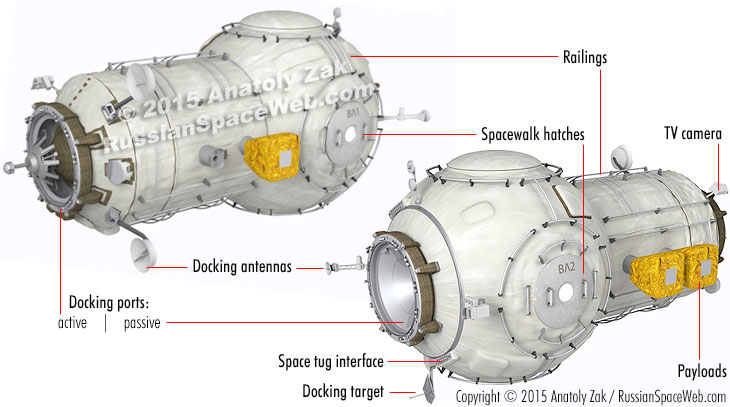
Actual unit does look different...
http://www.spaceref.com/iss/elements/airlock.html
The Joint Airlock was launched on ISS-7A / STS-104 in July 2001 and was attached to the right hand docking port of Node 1. The Joint Airlock is 20 ft. long, 13 ft. in diameter, and weighs 6.5 tons.

Now the commerical airlock was just installed as its not needed to attach the mass of a shuttle so a newer design was created for Space x and Boeing to use.
https://www.nasa.gov/feature/progress-u … ce-station
Its the small round looking cap...
https://arstechnica.com/science/2017/02 … k-in-2019/
The large, half-cylinder-shaped airlock, about two meters in diameter and 1.8 meters long, would become the first permanent commercial addition to the orbiting laboratory. Ars first reported development of the commercial airlock a year ago, but now the company, Nanoracks, has made substantial progress toward flying the device in 2019. In addition to approval from NASA, the company has reached an agreement with Boeing to manufacture and install a “berthing mechanism” that connects pressurized modules of the space station. Boeing’s investment in the $15 million project is significant, as the aerospace giant already holds the primary contract to operate and maintain the station for NASA. As part of the agreement, Boeing will not only assist with integrating the airlock into the station, it will also help develop a customer base to use the airlock.
Offline
Like button can go here
#8 2023-12-01 17:05:31
- Mars_B4_Moon
- Member
- Registered: 2006-03-23
- Posts: 9,809
Re: Airlocks
Europe is Working on a Multi-Purpose Habitat for the Moon
https://www.universetoday.com/164584/eu … -the-moon/
With NASA gearing up to send humans back to the Moon in the next few years with the Artemis missions with the goal of establishing a permanent outpost at the lunar south pole, nations are making efforts to contribute to Artemis and a permanent presence on our nearest celestial neighbor. Recently, the Italian Space Agency, formally known as Agenzia Spaziale Italiana (ASI), has taken steps to establish the first permanent outpost on the lunar surface, known simply as the Multi-Purpose Habitat (MPH). This endeavor was officially kicked by the ASI signing a contract with the French-based aerospace company, Thales Alenia Space, who specializes in space-based systems, including ground segments and satellites used for both Earth observation and space exploration.
Offline
Like button can go here
#9 2025-12-24 18:04:26
- SpaceNut
- Administrator
- From: New Hampshire
- Registered: 2004-07-22
- Posts: 30,813
Re: Airlocks
Offline
Like button can go here
#10 2025-12-25 16:47:50
- SpaceNut
- Administrator
- From: New Hampshire
- Registered: 2004-07-22
- Posts: 30,813
Re: Airlocks
For SpaceNut re post in Airlocks topic ... https://newmars.com/forums/viewtopic.ph … 03#p236503
Thanks for the link to that impressive paper from 2000!
Update: Overnight it occurred to me that your focus on airlock design, operation and maintenance for Mars might become the first step in a sequence leading to practical knowledge for life on Mars. We have practical ideas scattered all over the NewMars archive, but it is scattered among a great number of posts that are exploratory or speculative in nature.
As we enter 2026, we have an opportunity to follow your lead and begin to build a collection of Rules to Live on Mars by.
We also have the opportunity to seriously consider a new Category for the Dome project on Mars. If we decide to proceed with that, we have the potential to accumulate a set of data that a project manager could use to plan the entire operation. I expect it would take more than one Earth year to finish that effort.
(th)
Offline
Like button can go here
#11 2025-12-25 16:49:02
- SpaceNut
- Administrator
- From: New Hampshire
- Registered: 2004-07-22
- Posts: 30,813
Re: Airlocks
I was thinking also about the dome construction equipment repair for when it not in use, So a shirt sleeve repair garage is also needed with an air lock that is vehicle sized as well.
Offline
Like button can go here
#12 2025-12-26 08:44:19
- SpaceNut
- Administrator
- From: New Hampshire
- Registered: 2004-07-22
- Posts: 30,813
Re: Airlocks
A Mars airlock for clean entry focuses on planetary protection by minimizing Earth microbe transfer and Martian dust contamination, often using multi-chamber designs with dedicated suit ports (like NASA's MESA concept) for external donning/doffing, specialized dust mitigation (air showers, wiping), and integrated suit/equipment storage to keep the habitat sterile, essentially acting as a "mudroom" to prevent biological and particulate cross-contamination during crew EVAs.
Key Design Principles for Mars Airlocks:
Multi-Chamber System: Instead of one chamber, systems often propose two or three sections (antechambers) to create distinct zones for suit preparation, dust removal, and entry into the habitat.
External Suit Donning/Doffing (MESA Concept): A key innovation is the Mars EVA Suit Airlock (MESA), where suits attach externally to the habitat. The crew enters the suit from the habitat, then exits the airlock for EVA, keeping suit surfaces away from the main living area.
Dust Mitigation:
Air Showers & Wiping Stations: Integrated systems to blast/wipe dust off suits and equipment before entering the main habitat.
Specialized Ports: Airlocks have dedicated ports for suits, allowing them to be docked and maintained externally.
Integrated Storage: Airlocks function as storage for suits, tools, and emergency supplies (water, rations) to keep them outside the primary habitable zone, as discussed in this concept by Jenkins, accessed via newmars.com.
Planetary Protection Focus: The primary driver is preventing terrestrial microbes from contaminating Mars (forward contamination) and potentially harmful Martian materials from entering the habitat (backward contamination).
How it Works (Conceptual Example):
Before EVA: Astronauts don suits within the habitat, pass through the airlock into the external suit port, and detach.
After EVA: Astronauts re-enter the airlock, attach suits, go through decontamination (air/wipes), remove suits in the inner chamber, and enter the habitat, leaving contaminated gear behind.
These designs aim to reconcile human exploration needs with strict planetary protection requirements, making the airlock a critical interface for keeping Mars clean
Offline
Like button can go here
#13 2025-12-26 12:10:52
- SpaceNut
- Administrator
- From: New Hampshire
- Registered: 2004-07-22
- Posts: 30,813
Re: Airlocks
AI can not always give the same reference content for an easily puncturable space suite where cuts can occur killing the mechanic by venture of being in a near vacuum.
For SpaceNut ... re https://newmars.com/forums/viewtopic.ph … 44#p236544
The text you pasted about airlocks looks reasonable, but there are no references.
This forum needs to get in the habit of providing references for every post that might be assumed by a reader to be something other than an opinion.
I like the discussion about multiple stages of air locks. That looks really tedious to me.
The worry about contaminating Mars is understandable for an initial expedition.
It has nothing to do with Calliban's dome airlock. We aren't going to be worried about contamination of Mars.
You have already started discussion because you are (apparently) worried about CO in Mars atmosphere that might enter the habitat.
I have tried to encourage you to guide your AI to produce useful guidance on how to do that. The AI may have found some NASA documentation but I don't see that has much if anything to do with Calliban's dome.
You provided a problem to solve. Now please guide AI to find a solution.
First AI does not find solutions that is a human function of gained knowledge.
Caliban's Dome has no airlock initially..to exit or enter....
This is something that we are trying to make real... AI is just a tool in the box...
The outer can also have a cleaning port entrance to minimize sand and dust using air spray nozzles to push it away. Think car port...
Offline
Like button can go here
#14 2025-12-29 17:36:57
- SpaceNut
- Administrator
- From: New Hampshire
- Registered: 2004-07-22
- Posts: 30,813
Re: Airlocks
A dome Airlock might look like this from the outside and references no actual ability, just artwork

Offline
Like button can go here
#15 2025-12-30 14:53:39
- SpaceNut
- Administrator
- From: New Hampshire
- Registered: 2004-07-22
- Posts: 30,813
Re: Airlocks
First this is just the outside portion of the airlock which has multiple chambers and it follows with multiple chambers plus more doors. Airlocks are more than 2 doors inside and out....
Offline
Like button can go here
Pages: 1