New Mars Forums
You are not logged in.
- Topics: Active | Unanswered
Announcement
#51 2024-12-11 20:19:59
- Void
- Member
- Registered: 2011-12-29
- Posts: 9,982
Re: Propellant Sourced from Moon
While I mentioned Alice, my purpose was to demonstrate that Aluminum can be a fuel.
Your logic that it might be better to just work with the water is reasonable.
But my resort to Aluminum and Oxygen, is done for the reason to not consume Moon water, when Aluminum and Oxygen may do well enough.
And I suppose I also will hope that there are even better options, although I don't know what they are yet.
But "Good Enough" may be "Good Enough", (Aluminum and Oxygen).
The fixation of persons with Hydro lox on the Moon from Moon water, is evidence of dogma. As soon as a concept is adopted, then it becomes difficult to get persons to update.
For a long time after Apollo, we were told "Bone Dry Moon". I believe that that was because Vampires have always wanted to suck the money out of the dreams of others. And for various reasons they would prefer to feed on the people rather than to raise a thought child to maturation.
For a long time before the SpaceX era, the only hope was that there might be water from asteroids, and then eventually it was slowly emerging that there may be water in the polar areas of the Moon. The Apollo Era having become Dogma by that time, the power brokers could only imagine doing Apollo again. So, they would want to send some people in balloon suits to prance on the Moon, and perhaps, just perhaps be able to tap into the Moon water to make rocket propellants.
But reality is updating, and it is very likely that there will be lots of robotic labor on the Moon. Now on the occasion that justifies it maybe some Moon water and CO2 can be used for rocket fuel. But since we may be able to develop a "Good Enough" method to launch payloads, without consuming the precious Hydrogen and Carbon, then we may conserve it to make things like plastics and food and so on.
Ending Pending 
Last edited by Void (2024-12-11 20:29:24)
Be careful what you wish for.
Offline
Like button can go here
#52 2025-12-20 16:45:28
- Calliban
- Member
- From: Northern England, UK
- Registered: 2019-08-18
- Posts: 4,414
Re: Propellant Sourced from Moon
Why I'm obssessed with the moon.
https://youtu.be/8le1kudhVNQ
Quite inspiring. The moon is the key to building a spacefaring society.
"Plan and prepare for every possibility, and you will never act. It is nobler to have courage as we stumble into half the things we fear than to analyse every possible obstacle and begin nothing. Great things are achieved by embracing great dangers."
Offline
Like button can go here
#53 2025-12-21 11:44:14
- Void
- Member
- Registered: 2011-12-29
- Posts: 9,982
Re: Propellant Sourced from Moon
I like the author(s) of that.
I want to say that I am encouraged that SpaceX is thinking of a mass driver that could launch Satellites, and want them to do what they can in that direction.
But one size may not fit all.
I want to offer the idea of the HLS Power Belt. If HLS is out superhero of a cartoon, if we can strap auxiliary thrusters that use Lunar resources on it, then we may make a Lunar Starship as a viable method t lift mass from the Moon.
We have three options that I can think of Hydro-Lox, Alice, and Aluminum/LOX paste.
While SpaceX is avoiding legs for Starship to get to the Moon, I propose that legs made of Carbon and Plastics that are one time use might be engaged as well.
I see the idea of using electric Ion propulsion to bring them to Lunar Orbit as being sensible.
Have a look at Andromeda's engine: https://www.stokespace.com/introducing-andromeda/
Image Quote: 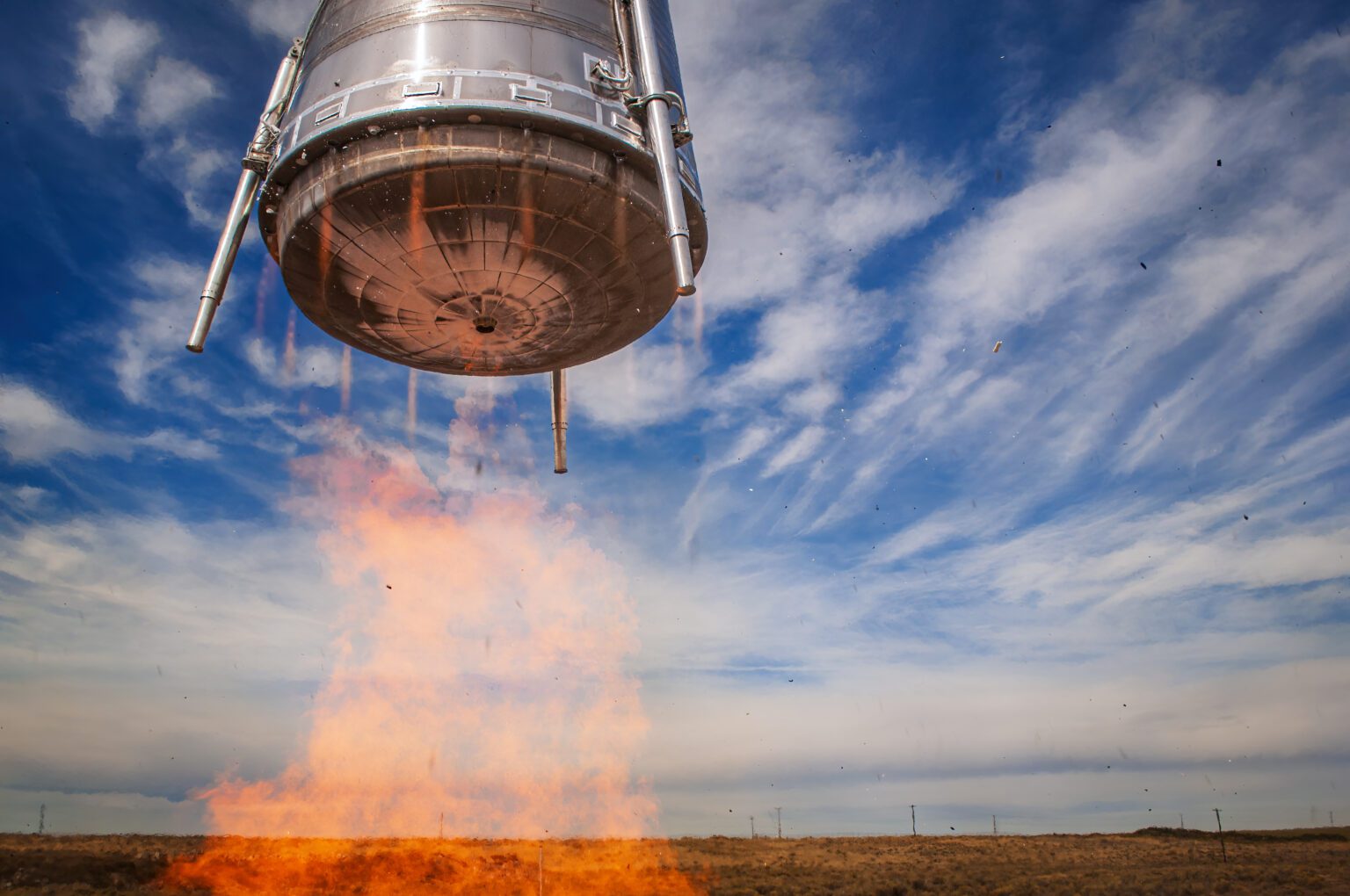
This has a Hydro-Lox engine which could perhaps become a "Thruster Belt" that you could wrap around a HLS.
The point is that this could be strapped around an HLS and could be propelled by H2 and LOX from the Moon, if such does exist.
Once you strap a power belt on the HLS, you leave it on, most likely. So, this then allows HLS to become partially Hydro-Lox, without massive alterations.
This assembly then repeatedly takes cargo up to Lunar Orbits and receives a new dominantly Carbon and Plastic set of landing gear.
Each time it leaves the landing gear on the Lunar surface.
The Carbon and Plastics of the landing gear, plus perhaps some special metals included then support industrial intents on the Moon.
Then perhaps if you want to you can create an "Alice Thruster Belt": https://en.wikipedia.org/wiki/ALICE_%28propellant%29
Quote:
Aluminum-Ice Rocket Propellant, or ALICE, is a rocket propellant that consists of a frozen mixture of nano-aluminum powder and water (i.e. aluminum and ice).[1]
When this thruster belt is to be refilled from the Lunar surface, it will burn itself out and most likely you do not want to detach it from the Lunar Starship. This is because the Lunar Starship is then used to land both itself and the attached "Alice Power Belt" back down to the Moon.
Finally we might be able some day to create a LOX/Aluminum paste engine. for a "Power Belt".
Some research has been done on it: https://space.stackexchange.com/questio … ant-source
And: https://ntrs.nasa.gov/citations/19940017287
While some of their research suggests squeezing a past out of a nozzle, I would be more interested in setting up something like a "Solid Rocket" method. So, then the "Power Belt" would be a burn up to orbit but no ability to land itself. But the Starship could carry it back down.
Adding a power belt to a Starship would broaden its base. Adding a one-time set of landing legs could broaden it more.
Shipments of propellants from Earth to Lunar Orbits might also be included using an electric Ion propulsion method. However, I anticipate that if this would be done it would be Methane only, and the refilling of Oxygen could be done on the Moons surface.
I will make the case that a Mass Driver is a mass projector that involves machinery and energy.
But a Starship with the "Power Belt" kit and the "Landing Legs" kit is also a matter projector that involve machinery and energy.
Perhaps both options may have value.
It is not yet certain that a Mass Driver is practical, I might point out.
Ending Pending
Last edited by Void (2025-12-21 12:10:17)
Be careful what you wish for.
Offline
Like button can go here
#54 2025-12-21 16:31:19
- GW Johnson
- Member
- From: McGregor, Texas USA
- Registered: 2011-12-04
- Posts: 6,301
- Website
Re: Propellant Sourced from Moon
If you have to process tons of regolith to get pounds of water, that is not an easily-recovered or inexpensive resource! Period! We already know about low-concentration resources being bad mining bets, from centuries of prospecting and mining right here on Earth. It's worse in space, where you have to have pressure suits and life support.
An "easily recovered ice resource" would yield a ton of dirty water from only a few to at most only several tons of regolith. That's a buried glacier, not small bits of frost on regolith particles! Maybe there's such a thing on the moon, and maybe not. Nobody yet knows.
There really are very likely buried glacier resources like that on Mars, although we have yet to verify that on the ground. And certainly on some of the icy moons of the outer planets. Plus all the Kuiper belt objects. But maybe not the moon.
Talking about thinly-spread concentrations as if they were cheaply- and easily-recovered items is marketing hype (spelled "marketeering lies"), not technical truth. Don't be taken in by it.
You first go to the moon and prospect to find out what is really there, where exactly it is located, and in what concentrations it exists. Only then can you plan your next steps. It's all about getting real ground truth.
GW
GW Johnson
McGregor, Texas
"There is nothing as expensive as a dead crew, especially one dead from a bad management decision"
Offline
Like button can go here
#55 2025-12-21 18:05:01
- Void
- Member
- Registered: 2011-12-29
- Posts: 9,982
Re: Propellant Sourced from Moon
Well, I am going to completely agree with you that ground truth is needed, but there is this:
https://www.sciencenews.org/article/ice … tion-water
Quote:
About 22,600,000 results
Volcanic eruptions on the Moon have been suggested to have created large ice deposits at the poles. These eruptions, which occurred billions of years ago, released water vapor that could have condensed into ice under the lunar surface. The study by Andrew Wilcoski and his colleagues at the University of Colorado Boulder suggests that volcanic eruptions could have released enough water vapor to deposit ice at the lunar poles, especially in the frigid conditions of the poles. The research indicates that volcanic activity could have contributed to the formation of ice deposits, which may have persisted for billions of years due to the cold environment of the Moon.
Wikipedia
+1
Some articles I have read suggest that the Moon may have erupted vast amounts of water and CO, and that perhaps 41% of the erupted water could be in thick layers of ice at and near the poles. But it might be under several meters or regolith at this point.
But also now we seem to have this: https://www.msn.com/en-us/news/technolo … r-AA1SdiJk Quote:
Starlust
Earth's atmosphere hidden on the moon may prove to be life-sustaining for future astronauts
Story by Raj Naik • 1w •
3 min read
Quote:
Over billions of years, the magnetic field may have acted like a long-distance pipeline, guiding small amounts of Earth's atmosphere along its lines and depositing them into the lunar soil, known as regolith. Lunar soil samples brought back to Earth by the Apollo missions have shown the presence of certain volatile substances like carbon dioxide, argon, water, helium, and nitrogen.
But even absent abundant water, I also suggested propulsions using a paste of LOX and Aluminum powder.
Ending Pending
Last edited by Void (2025-12-21 18:15:02)
Be careful what you wish for.
Offline
Like button can go here
#56 2025-12-21 19:23:52
- Void
- Member
- Registered: 2011-12-29
- Posts: 9,982
Re: Propellant Sourced from Moon
I am all for a mass driver and it seems Elon Musk and Co. are considering it: https://www.youtube.com/watch?v=afybjgW9JEc
Quote:
Elon Musk Just Revealed Starship’s Lunar Secret Weapon—600,000 Tons to Orbit Every Year!
TECH MAP
123K subscribers
I will hope they can make it happen.
But I still think that side engines can be considered of the types I previously mentioned in post #53: https://newmars.com/forums/viewtopic.ph … 77#p236377
Perhaps this could be prior to and auxiliary to the use of a Mass Driver.
Ending Pending
Here, as it happens is an update for Stoke Space: https://www.bing.com/videos/riverview/r … &FORM=VIRE
As I have said I have imaged that the engine nozzle setup could be made into a wrap around add-on for a Lunar Starship, allowing a Hydro-Lox assisted launch from the Moon. This would possibly be useful, if the Moon turns out to have a lot of water ice.
Some rockets do have parallel thrust methods. The Space Shuttle did, Falcon Heavy does.
This however would have multiple engine nizzles wrapped around the engine bay of the Lunar Starship, and of course it would need propellant tanks for them as well. However, the heat shield would not be included.
I have also suggested the use of Alice thrust as an alternative or perhaps a paste of LOX and Aluminum powder.
Ending Pending
Ending Pending
Last edited by Void (2025-12-21 19:38:43)
Be careful what you wish for.
Offline
Like button can go here
#57 2026-10-18 06:32:48
- HG Muller
- Member
- Registered: 2017-06-17
- Posts: 19
Re: Propellant Sourced from Moon
Propellant from rock
Water might be as precious on the Moon as gold is on Earth, so using it for propellant might not be the most prudent thing to do. Of the lighter elements only oxygen is abundant there. It exists in the form of rock, which is composed of oxides of mainly silicon, iron, calcium, aluminum, magnesium. Most of these could be very useful for in-situ resource utilization. So it is likely that in the future we will develop some smelting process to separate these metals from the oxygen. (We can discuss the chemistry later; for now I want to investigate the orbital mechanics.)
The best propellant we developed so far is the hydrogen/oxygen combination (LH2/LOX) The water to which these reacts contains H and O in a (mass) ratio 1:8. The Space Shuttle Main Engines use these in a ratio 1:6, though, because such a 'fuel rich' mix gives a higher exhaust speed (4.46km/s) due to the lower average molecular mass of the exhaust than the mix that would create the hottest exhaust. But even then, 86% by mass of the propellant is oxygen.
So my proposal (which might not be original, but which I have never seen anywhere) would be to bring the hydrogen from Earth, and get the oxygen from the Moon. This would reduce the launch mass of the fuel by a factor 7. And consequently also the mass of the launch vehicle to get it into low Earth orbit. The strategy would be to have a 'tanker craft', shuttling LOX between the Lunar surface and a very elongated elliptical orbit stretching from just above the Earth atmosphere to the orbit of the Moon. Such an orbit has a velocity very close to the Earth's escape velocity at the perigee. A spacecraft heading for deep space could first boost itself into the same orbit, fill up with LOX, and then boost itself to the velocity it needs to travel to the intended target elsewhere in the solar system. It would trade this LOX for some LH2 given to the tanker, which would also retain some of the LOX. This should be enough to let the tanker land on the Moon, with enough LH2 left to deliver the next load of LOX.
The remainder of this story could not be posted due to 'Internal Server Error' each time I tried (as part of this, or as a seperate posting).
Last edited by HG Muller (2026-10-18 06:42:50)
Offline
Like button can go here
#58 2026-10-18 09:18:30
- HG Muller
- Member
- Registered: 2017-06-17
- Posts: 19
Re: Propellant Sourced from Moon
Propellant from rock (part 2)
The following is a 'back of the envelope' estimate of how this could work out. To escape the surface of the Moon needs 2.38km/s. But that would leave you in the same orbit as the Moon around Earth. To dip back down to Earth you would have to undo most of the Moon's orbital velocity of about 1km/s as well, leaving only some 180m/s. The velocity you would have to reach to be left with the desired delta-V for that is about 2.5km/s. M_full/M_empty = e^(v/c) with c the SSME's 4.46km/s gives a mass ratio of about 1.7. So to send, say, 100 ton from the Lunar surface towards Earth, you woul need 70 tons of fuel: 60 ton of LOX, and 10 ton of LH2. The deliverd 100 ton could be 90 ton LOX, and 10 ton empty weight for the structure of tank and engines. Plugging that into the rocket equation
The 10 ton LH2 needed for launch would have to be landed on the Moon first. So the touchdown mass of the tanker will be 20 ton. The descent needs the same delta-V as the ascent, so the required fuel for landing 20 ton is 14 ton: 12 ton LOX and 2 ton LH2. So to prep the tanker for the next run, it has to retain 12 of the 90 ton LOX. It can thus swap 78 ton of LOX for 12 ton of LH2. This saves the spacecraft that filled up more than a factor 6 on the LOX mass it would otherwise have to lift into LEO. That is pretty good, as the LOX would be most of the propellant mass: instead of bringing LH2:LOX as 1:6, it brings propellant as 2:0.
Now unfortunately bringing along cryogenics on long interplanetary flights for use on arrival and for return might not be ideal. And to get into the tanker's orbit you already need a velocity very close to escape; the additional delta-V to get to Mars or the asteroid belt is in the hundreds of m/s (when applied at perigee). While you already had to do 7.9km/s to reach LEO, and an additional 3.2km/s to stretch the orbit to the Moon. It would be nice if you could fill up with LOX before you applied that 3.2 km/s. That would require the tanker to descend to LEO, though. It could use aerobraking to do that, but it would then require an extra 3.2km/s to get back to the Moon.
The rocket equation says a mass ratio of about 2. The tanker set up for the descent to the Lunar surface measured 10 (structure) + 12 (LH2) + 12 (LOX) = 34 ton. To boost that by 3.2km/s thus requires another 34 ton propellant, 5 ton LH2 and 30 ton LOX. That leaves only 78 - 30 = 48 ton LOX to trade, now for 12 + 5 = 17 ton LH2. A profit of less than a factor 3. Bad! (But still a agin...)
To improve that we need to beat the rocket equation. We can do that in the usual way. The exponential growth of the mass ratio is due to the need to use propellant to accelerate propellant, and the answer is: don't accelerate propellant when you don't need to. Just park it before applying delta-V, and pick it up later. If you need 12 tons of LOX to get to the Moon for filling up from the elongated orbit, just leave that 12 ton orbiting there while you aerobreak the tanker with its 78 ton LOX load to get to LEO. Then you only have to accelerate the 22 ton tanker + LH2 by 3.2km/s to get it back to the orbit that stretches to the Moon. This requires some 22 ton of propellant, 3 ton LH2 plus 18 LOX. (Forgive me the rounding...)
So you the tanker can trade 78 - 18 = 60 ton LOX for for 12 + 3 = 15 ton LH2. The savings on LOX mass to be brought to LEO are now a factor 4, for each ton of LOX you need to eject the expedition from LEO you only need to lift 1 ton of LH2 into that orbit. This reduces lifted propellant from 1 + 6 to 2.5 + 0 (LH2 + LOX), still more than a factor 2.
I suppose you could even do a bit better when you also left some LOX is low Moon orbit, rather than having it escape the Moon and then bring it back. But the delta-V between Lunar escape velocity and low-orbit velocity is only some 800m/s.
Offline
Like button can go here
#59 2026-10-18 09:21:25
- HG Muller
- Member
- Registered: 2017-06-17
- Posts: 19
Re: Propellant Sourced from Moon
(seems the previous message refused to post because it contained the word exp for the exponential function, and after replacing that by e^ it worked!)
Offline
Like button can go here
#60 2026-10-18 15:06:46
- Void
- Member
- Registered: 2011-12-29
- Posts: 9,982
Re: Propellant Sourced from Moon
HG Muller,
I liked your post.
I have similar aspirations but have not provided the calculations. My notion is quite similar, but I would think to also consider transferring RP-1 to Lunar proximity. Easier to store and the Carbon might be used to make steel on the Moon. Or could provide Methane and could provide Hydrogen, depending on what engine is to be used. Fuels available from this process would be Hydrogen, Carbon Monoxide, Methane, and even RP-1 itself.
I am also interested in Metal>Plasma propulsion which I think could be used to transfer the RP-1.
Various Metal>Plasma propulsion methods are in development/consideration.
Ending
Quote:
Copilot Search Branding
Like
Dislike
Metal Plasma Space Drives
Metal plasma thrusters are a class of electric propulsion systems that generate thrust by converting solid metal into high‑velocity, quasi‑neutral plasma jets, offering a low‑power, propellant‑independent alternative to traditional ion or Hall thrusters
Benchmark Space Systems
Benchmark Space Systems
+1
.How They Work
A Metal Plasma Thruster (MPT) uses inert solid metal “pucks” (often copper or aluminium) as propellant. Pulsed power—typically from onboard supercapacitors—vaporizes and ionizes the metal into a dense plasma. Magnetic fields then accelerate this plasma to ~17km/s, producing thrust without:Gas or liquid propellants
Neutralizers
High‑voltage grids
Complex plumbing or high‑pressure tanks
Benchmark Space Systems
Benchmark Space Systems
+1This “metal‑fueled” approach removes supply chain dependencies on xenon and simplifies spacecraft design
www.spacebandits.io
www.spacebandits.io
.Key Advantages
No propellant storage: Solid metal is storable and inert
Benchmark Space Systems
Benchmark Space Systems
+1Low power operation: Designed for <100W, suitable for CubeSats and small spacecraft
Benchmark Space Systems
Benchmark Space Systems
+1High thrust density: Pulsed operation enables on‑demand thrust for collision avoidance, orbit maintenance, and defense maneuvers
www.spacebandits.io
www.spacebandits.ioSimplified hardware: No high‑voltage electronics, heaters, or magnetic field systems beyond basic acceleration
Benchmark Space Systems
Benchmark Space SystemsScalable manufacturing: Minimal precision parts, enabling cost‑effective production
Benchmark Space Systems
Benchmark Space SystemsDevelopment Status
Benchmark Space Systems has advanced the MPT from a TRL‑4 proof‑of‑concept (2018) to a TRL‑7 flight‑ready system in just four years, using NASA SBIR funding and iterative “test‑to‑fail” prototyping
Benchmark Space Systems
Benchmark Space Systems
.Magdrive (UK) has flown its Rogue metal‑plasma thruster on a D‑Orbit vehicle in June 2025, proving plasma generation and electrical operation, though no in‑orbit thrust measurement has yet been published
www.spacebandits.io
www.spacebandits.io
.Magdrive’s Rogue unit weighs <3kg, fits a CubeSat, and operates from 0.5W to 150W, with energy stored in supercapacitors
www.spacebandits.io
www.spacebandits.io
.Applications
CubeSat and smallsat propulsion for orbit maintenance and collision avoidance
www.spacebandits.io
www.spacebandits.ioSatellite servicing and logistics where rapid, on‑demand thrust is needed
magdrive.space
magdrive.spaceDefense and stealth missions for unpredictable orbital maneuvers
magdrive.space
magdrive.space
+1Challenges
Thrust measurement: In‑orbit performance data (specific impulse, total impulse) is still pending for some systems
www.spacebandits.io
www.spacebandits.ioPulsed power reliability: Requires robust energy storage and pulse‑forming networks
www.spacebandits.io
www.spacebandits.ioEfficiency: While promising, published in‑orbit efficiency figures are limited
www.spacebandits.io
www.spacebandits.ioIn summary: Metal plasma drives combine the simplicity of solid propellant with the efficiency of electric propulsion, and are moving from lab and ground‑test phases toward flight‑qualified systems. They are especially attractive for small spacecraft needing compact, reliable, and propellant‑independent thrust.
Likely humans will be transferred with liquid fuels, but the liquid fuels might be transferred by Metal>Plasma.
NASA is working on Lithium to go to Mars, but it would be hard to get Lithium on the Moon.
The EU is looking at Magnesium, and it will be possible to get Magnesium on the Moon.
Both Neumann Drive and Magdrive might used Iron, Aluminum, Copper and many other conductive elements on the periodic table.
Ending
Last edited by Void (2026-10-18 15:11:48)
Be careful what you wish for.
Offline
Like button can go here
#61 2026-10-18 15:59:01
- HG Muller
- Member
- Registered: 2017-06-17
- Posts: 19
Re: Propellant Sourced from Moon
One of the things that worry me about non-chemical propulsion technologies is that they typically have quite low thrust. It is obvious that this makes them unsuitable to lift off from a world with gravity. But it also can be a problem when manoeuvring in space. It might seem that under micro-gravity you have all the time in the world, but this is often not true. For example, when leaving LEO for an interplanetary voyage, it is important to build up all your velocity close to Earth. Gradually spiralling away until you are free from Earth, and then continuing to accelerate to reach the desired solar orbit, takes far more delta-V than a short acceleration burst just above the atmosphere. The explanation is that the latter method leaves the ejected propellant deep into Earth's gravitational well, while in the other case it ends up much less deep, or even entirely outside the well. And somehow you have to pay for all that energy left in the ejected fuel.
So the best way to leave LOE with low thrust is only fire the thrusters near perigee, when your velocity is high. If that only accelerates you enough to slightly raise the apogee, you should wait for the next orbit for a subsequent burst of thrust. But that can only accelerate you to escape velocity, after which you will not return anymore, and be left at rest compared to Earth, i.e. following the same orbit around the sun. The remaining velocity required for reaching the target, which could be an order of magnitude higher than what you would have needed just above the atmosphere, will then have to be achieved while ejecting all fuel outside of Earth's well.
So chemical propellants might still be competitive to low-thrust propulsion methods having much larger exhaust velocity.
Offline
Like button can go here
#62 2026-10-19 23:28:46
- kbd512
- Administrator
- Registered: 2015-01-02
- Posts: 8,538
Re: Propellant Sourced from Moon
tahanson43206 asked for an explanation of how it might take far more delta-V to spiral out from LEO to an interplanetary trajectory (such as a TLI or TMI burn) using a low-thrust ion engine vs a high-thrust chemical propulsion engine, so here's my attempt at an explanation:
The gravitational field created by massive bodies, such as planets or stars, extends far into space and only gradually diminishes to a negligible value far away. Over long periods of time, it's not as if gravity losses are negligible just because you're already in LEO. Atmospheric drag is very low, especially in higher orbits, but gravity losses remain significant. From 160-2,000km above Earth's surface, you still have about 90% of Earth's sea-level gravity. You have to travel 300,000-400,000 km away from Earth before lunar gravity becomes more significant than Earth's gravity. I don't recall the exact value, but it's far beyond GEO. The Hill Sphere Boundary is about 1,500,000km away from Earth, so that's how far you have to be from Earth before the Sun's gravitation becomes dominant.
So... What does this gravity loss problem have to do with doubling a low-thrust ion engine's Delta-V requirements, relative to a high-thrust chemical engine, in order to go to the moon:
Acceleration or change in velocity (Delta-V) occurs along a vector, and the Oberth effect allows you to maximize the utility of your acceleration burn along that vector because your thrust vector is almost perfectly aligned with your velocity vector. In an ideal case, your thrust vector perfectly aligns with your velocity vector. Even with high-thrust rocket engines, it's not quite perfect, but it's still pretty close. Unfortunately, a low-thrust engine won't allow you to do that.
A high-thrust impulsive burn benefits from the Oberth effect. An impulsive/high-thrust engine burn, lasting seconds to minutes, incurs very low gravity (velocity) losses compared to a low-thrust ion engine burn that requires weeks to months to achieve escape velocity. Gravity can only alter your trajectory away from a perfectly optimal alignment over a very short period of time.
If you're spiraling out, it's because your low-thrust ion engine(s) can't generate enough near-instantaneous force to capitalize on the Oberth effect, so you end up accelerating along a vector that is far less optimal (not at all aligned with the trajectory you want to be on when the trans-lunar injection burn is complete). You can burn less fuel spiraling out using low-thrust ion engines using a technique referred to as "perigee pumping", where you only fire your ion engine near perigee to raise your apogee, but that takes even more time because most of the time you're coasting rather than continuously accelerating over long periods of time, which is what ion engines do best.
GW will probably explain this much better than I did here, but you asked me to respond, so I did.
Edit:
TA, you were in the Army, so I'll attempt a layman's analogy using a pair of lunar artillery pieces:
We have 2 imaginary artillery pieces on the moon (where there's no atmospheric drag to speak of), one that accelerates the shell so fast that you can point the gun almost directly at the target, while the other requires a high-angle arcing trajectory to reach the target at all because its ability to accelerate the shell is much more modest. The direct-fire artillery piece accelerates the shell so rapidly that gravity only has a very brief window of time to pull the shell back down toward the moon's surface, so it arrives on target within mere seconds, with very little velocity loss due to gravity. The other shell might remain in-flight for a minute or more before it arrives, so gravity is slowing that shell down over a much longer time window, and therefore far more velocity is lost (to the moon's gravitational pull) before it arrives on target. Gravity behaves as an "always active" velocity-loss mechanism, and more succinctly, it's an acceleration vector mechanism that's always accelerating your artillery shell or spacecraft in a direction you don't actually want it to go, because it's "bending" your flight trajectory away from what is "most optimal", which aligns your thrust vector with your velocity vector.
The actual effectiveness of your thrusting is much lower when it takes weeks to months to accelerate to a burnout velocity high enough to break orbit to go to the moon, or anywhere else for that matter. While you're spiraling out, most of the time your thrust vectory is not pointed in the direction you actually want to "fly off into space" along, but you were still accelerating the entire time, and unfortunately, not in the actual direction you wanted to end up.
All that said, the figure of merit for an in-orbit spacecraft attempting to accelerate away from a deep gravity well, to depart along an interplanetary trajectory, is reaction mass acceleration efficiency, represented by Isp.
Our best LOX/LH2 chemical rocket engines have an Isp of 450s. If your dry vehicle mass is 100,000kg and your wet mass is 150,000kg, then the total Delta-V your spacecraft can generate is only 1,789m/s. That's not enough to break orbit from LEO, for a TLI or TMI burn. Virtually all ion engines deliver an Isp of 2,500s or higher. Using ion engines, 50,000kg of propellant will accelerate your 100,000kg vehicle to a final burn-out velocity of 9,941m/s. Yes, your gravity losses are so significant that you need approximately double the Delta-V for a TLI or TMI burn as you would otherwise require using impulsive chemical engine burns that capitalize on the Oberth effect. So, what? You need ~4,100m/s worth of Delta-V to execute a TLI from LEO using an impulsive burn. The 50,000kg of ion engine propellant still allows you to execute a TLI burn because it's more than 8,200m/s. 50,000kg of LOX/LH2 chemical bi-propellant doesn't give you enough Delta-V to even reach GEO, much less go to the moon. Presume your transport vehicle was put in orbit by a Starship, which has a 150,000kg to LEO payload limit. You get to "push" 100,000kg through TLI using ion engines. You can only push 59,000kg to TLI using LOX/LH2 (same 150,000kg wet mass). Bean counters will note that 100,000kg > 59,000kg, so empty space stations, food, water, or other inert cargo is probably best delivered using ion engines.
Aerospace vehicle fabrication and operating costs are directly correlated with payload and performance. A lighter vehicle that does the same job is generally cheaper to build and almost always cheaper to operate. As of yet, there are no "orbital gas stations" you can send your rocket to, to pull over and fill-up if you run out of gas. If the goal is to deliver a very heavy payload to the moon for minimal cost, and you don't care how long it takes to arrive, then use ion engines because your total transportation costs will be much lower. If the payload is alive and actively consuming food/water/air, and requires radiation shielding during transits through the Van Allen belts, then environmental exposure time matters more than delivery cost, so you pay more for a less efficient chemical rocket to get your living payload out of the danger zone as fast as you can.
If you're really savvy, you robotically accelerate your heavy interplanetary transport vehicle to GEO using ion engines while nobody's onboard, you have the crew meet the transport in GEO (because humans are very light cargo to keep alive for <24hrs), and then it only takes a very small Delta-V increment, using chemical rockets or ion engines, to complete the TLI or TMI burn.
Last edited by kbd512 (Yesterday 00:38:17)
Offline
Like button can go here
#63 Yesterday 01:31:01
- HG Muller
- Member
- Registered: 2017-06-17
- Posts: 19
Re: Propellant Sourced from Moon
I don't think that explanation covers the main cause. Which is that on an extended low-thrust 'burn' you are lifting propellant out of the gravitational well, while with a short high-thrust burn at perigee you all eject it at the deepest point of the well you can reach.
It is all a matter of energy conservation. Rocket propulsion is horrible because of the exponential nature of the rocket equation. But it has one strong point: the thrust it provides is independent of the velocity you already have. Which is quite unlike when you are pushing yourself against a stationary object, as everyone riding a bicycle will have experienced. Since energy gained equals force times distance traveled during application of that force, you gain far more energy from a the same burn (in terms of thrust and duration) at high speed (where you travel a lot during the burn) than at low speed. Provided the delta-V is in the direction you were flying.
Another way to look at it is that kinetic energy is proportional to v squared, and (v+dv)2 = v2 + 2*v*dv + dv2. So the energy gained through dv involves a multiplier proportional to v.
One should realize that rocket + contained propellant + already ejected propellant in the absence of drag is a closed system, conserving its total energy. Accelerating the propellant in the engines adds mechanical energy at the expense of the chemical energy that was in the propellant you burn. This chemical energy is initially converted into kinetic energy of the ejected propellant in the frame of reference of the rocket.
E.g. suppose a spacecraft with a mass of 1 ton burns propellant at a rate of 1 kg/s, ejecting the exhaust at a speed of 4km/s w.r.t. the nozzle. This delivers a thrust of 4000 N(ewton), which will accelerate the spacecraft by 4000N/1000kg = 4m/s2 (= 0.4g). A burst of 1s will then increase the velocity by 4m/s. To accelerate the propellant in the engine required m*v*v/2 = 1kg * (4km/s)2 / 2 = 8 MJ(oule).
Suppose the spacecraft is doing this in LEO, where it is already moving with 8000m/s. It's kinetic energy was 1000kg * (8km/s)2 / 2 = 32GJ. After the burst it is 1000kg * (8004 m/s)2 / 2 = 500 * (8000 ^2 + 2*4*8000 + 16) = 32 GJ + 32 MJ + 8kJ. So it went up 4 times as much (ignoring the 8 kJ) as the energy it took to accelerate the propellant in the engine! How is this possible? Where does this extra 24 MJ come from.
Well, that becomes clear when you consider what happened to that 1kg ejected propellant. Before the burn it was in the rocket, and moving at 8km/s. After ejection it only moves by 8 - 4 = 4km/s. So its kinetic energy fell from 1kg * (8km/s)2 / 2 = 32 MJ to 1kg * (4km/s)2 / 2 = 8MJ, i.e. by an amount of 24MJ. Which is exactly the mysterious extra energy gain of the spacecraft.
What we learn from this is that it is quite important where and how the ejected propellant ends up in terms of kinetic and potential energy. The less total mechanical energy is left in the ejected propellant, the more of the energy you spent on accelerating that propellant you will find back in the spacecraft. So always try to eject the propellant as deep in the gravitational well as you can, and in (or exactly opposit to) the direction you are already moving. That will gain (or lose) you the maximum amount of energy.
If it takes much longer than the orbit time to accumulate the desired delta-V because of low thrust, this becomes difficult. A single burst would last into the period where you are already climbing out of the gravitational well. The mentioned technique of perigee pumping would switch off the engine as soon as you climbed a significant distance, waiting for the next perigee passage to fire another burst. This gradually raises the apogee. (Remember the point where you actually apply a delta-V, in this case perigee, will always remain on the orbit, so only the apogee changes.) But reaching escape velocity puts an end to the fun, because there would be no subsequent return to go faster. The additional velocity needed to reach another planet will have to be created outside the Earth's gravitational well.
This is also indicated by the conversion of fly-by velocity to interplanetary cruising velocity. Starting at 11km/s in LEO leaves you (by definition of escape velocity) with zero velocity after escape. But add 100m/s, you will be left with square root (11.1^2 - 11^2) = square root 2.21 = 1.488 km/s. The delta-V was 'amplified' nearly 15 times by applying it close to Earth compared to what you would have to do if you waited until after you fully escaped Earth. That significantly raises the bar for propulsion methods that deliver such low thrust that the required velocity can only be reached long after escape. (Even though the amplification factor decreases as you need more delta-V; with 400m/s above escape it would only be 7.5, etc.)
Offline
Like button can go here
#64 Yesterday 05:03:46
- kbd512
- Administrator
- Registered: 2015-01-02
- Posts: 8,538
Re: Propellant Sourced from Moon
Dr Muller,
An Isp of 2,500s (ion engine) results in a propellant mass of 31.5t to push a 100t payload through TLI (6.7km/s), from a circular low earth orbit.
An Isp of 450s (LOX/LH2) results in a propellant mass of 106.5t to push a 100t payload through TLI (3.2km/s, utilizing the Oberth effect), from an elliptical low earth orbit.
The chemical rocket engine powered spacecraft is carrying 3.38X more propellant mass, despite the fact that the gravity losses from low-thrust ion engine propulsion increase the total Delta-V increment for the ion engine powered spacecraft to ~2.1X that of the chemical rocket engine powered spacecraft utilizing the Oberth effect.
The chemical rocket engine solutions are not remotely mass-competitive with run-of-the-mill ion engines.
Edit:
A Starship can actually deliver a 131.5t payload to a 400km circular orbit. It can't quite deliver a 206.5t payload, so you'd need 2X Starship flights and a period (perhaps 1 to 3 days, maybe a week worst-case) while the refueling tanker or upper stage waits for crew arrival and loses propellant to boil-off (if the fuel is LH2). The low-Isp of chemical propellants is a compounding problem, which starts back on the launch pad, for delivering heavy payloads to orbit and then accelerating them to escape velocity.
If you have a nuclear thermal upper stage with a 1,000s Isp, and also capable of delivering an impulsive burn, then the total fuel mass is only 38.6t of LH2, and that is much closer to achieving mass parity with ion engines.
Last edited by kbd512 (Yesterday 05:52:56)
Offline
Like button can go here
#65 Yesterday 06:21:23
- kbd512
- Administrator
- Registered: 2015-01-02
- Posts: 8,538
Re: Propellant Sourced from Moon
Getting back to the topic of sourcing propellant from the readily accessible top layer of lunar regolith...
If we went to the trouble of extracting the metals- only the top 4-5m of regolith:
Iron: 12-15 trillion metric tons
Titanium: 1.2-1.5 trillion metric tons
Aluminum: 10-13 trillion metric tons
We could make the motor casings from a combination of Iron, Titanium, and/or Aluminum alloys. We'd need to import some materials for the liners and seals. Hot-working the metals does not subject them to re-oxidation, and we get VIM/VAR quality metals for a tiny fraction of the asking price here on Earth, because the vacuum comes f-r-e-e with the moon.
We could make nano-particle Aluminum and Ice solid rocket motors, with a ~300s Isp with high expansion ratio Vacuum nozzles.
We need 2.74km/s Delta-V for direct entry back to Earth or 3.08km/s Delta-V for direct entry to Mars. That means we can have 66% propellant mass fraction vehicles, so we get a whopping 33% payload mass fraction. Payloads consist almost entirely of high-value metals that no longer need to be strip-mined from Earth. There's nothing growing on the surface of the moon, so we're not disturbing any delicate ecosystem by conducting heavy mining operations on the lunar surface.
Edit:
The point wasn't clear, but the solid rocket motor casing would be the payload sent back to Earth or on to Mars, so we recover thick-walled metal casings with some ablative protection materials from Earth's oceans, or dig them out of the Martian regolith after they arrive. At some point I'm sure we'd want to build the giant mass driver Elon Musk wants to build. For starters, if we can make solid rocket motors, we won't need as much materials processing to split and store LOX/LH2, although stripping Oxygen from ilmenite ores won't be easy.
Last edited by kbd512 (Yesterday 06:30:45)
Offline
Like button can go here
#66 Yesterday 07:18:35
- HG Muller
- Member
- Registered: 2017-06-17
- Posts: 19
Re: Propellant Sourced from Moon
An Isp of 2,500s (ion engine) results in a propellant mass of 31.5t to push a 100t payload through TLI (6.7km/s), from a circular low earth orbit.
An Isp of 450s (LOX/LH2) results in a propellant mass of 106.5t to push a 100t payload through TLI (3.2km/s, utilizing the Oberth effect), from an elliptical low earth orbit.
Sure, a better Isp can give you equal delta-V for less fuel, more delta-V for same fuels, or anything in between. I suppose the delta-V you picked to compare are just enough to reach the Moon. The Isp is so much better that you are still off better, though. So the effect I mentioned is already clearly visible: the low-thrust case required more than double the delta-V, to achieve the same. I suppose this is because it assumes a spiral trajectory; with "apogee pumping" you should not need much more than 3.2km/s even in the low-thrust case.
But now look at interplanetary travel: Suppose I use delta-V = 4km/s in LEO. This requires 147t LOX/LH2. Starting 700m/s above escape velocity we will be left with a velocity square-root 12*12 - 11.2*11.2 = 4.31km/s. The ion propulsion would have to realize that after escape, which on top of the mentioned mass ratio would require another factor 1.192, i.e. 1.315*1.192 = 1.568, so 56.8t propellant.
So the ion drive is still better, 156.8t vs 247t, or 57% heavier. But it is not nearly as much better as the more than 5x better Isp appears to promise. When you factor in economic issues, such as the price of the propellant, and the added travel time, it might be cheaper to go for the LOX/LH2.
[Edit] BTW, how did you calculate that 6.7km/s? If I calculated right the delta-V needed for escaping through a spiral trajectory is equal to the velcity in the orbit you start from, i.e. 7.9km/s. Is the missing 1.2km/s because you only have to reach the Moon? In the interplanetary examply we would have no such luck, so that the required delta-V would be 7.9+4.31 = 12.21km/s, and the mass ratio 1.63.
Last edited by HG Muller (Yesterday 08:35:31)
Offline
Like button can go here
#67 Yesterday 11:06:55
- GW Johnson
- Member
- From: McGregor, Texas USA
- Registered: 2011-12-04
- Posts: 6,301
- Website
Re: Propellant Sourced from Moon
Maybe my version of the low thrust problem will make more common sense to everyone.
A rocket at some radius R from a central body can thrust in some direction at the end of that radius. Depending upon the direction of that thrusting relative to the position of the vector R, this can be more or less efficient at increasing the kinetic energy of the rocket (measured as its speed). 90 degrees to the radius vector is most efficient, parallel to it outward is least efficient. This is why ....
... The work done by the thrust force upon the rocket can go into either or both of two pots of energy: kinetic or potential. What goes into potential energy increase does NOT go into kinetic energy increase, meaning no added speed for whatever went into potential energy increase. That component of thrust along the radius vector R is what raises potential energy, working as it must against the gravity of the central body. Only that component of thrust perpendicular to the radius vector R can go into kinetic energy increase!
If you are at the periapsis of an orbit and fire an engine in the prograde direction, then at least initially, your thrust vector is perpendicular to that radius vector R, and all the work of your thrust upon the rocket can go into raising its kinetic energy, at least initially. If your burn time is short, that perpendicularity of thrust & R does not have time to change, and essentially all the work done during the burn goes into increasing kinetic energy, which means you actually get the full speed increase from your burn.
If on the other hand, you have a low thrust engine that barely accelerates the vehicle at all, then over the course of a longer burn time, the vehicle has time to move away from the periapsis point. Everywhere away from there, thrust is no longer perpendicular to the radius vector R, meaning some of the thrust work goes into raising potential energy instead of increasing speed! The lower the vehicle acceleration, the worse this effect becomes! As a rule of thumb, you need around 0.1, maybe 0.2, gee acceleration, in order not to suffer this loss in any measurable way, in typical Earth orbits.
This loss can be suffered even with "high thrust" chemical rockets, if your sized engine thrust produces too small an acceleration, leading to a long required burn time. It is just catastrophic with current electric propulsion technologies, because vehicle accelerations typically fall in the milli-gee to micro-gee range! Satellites maneuvering on orbit with electric propulsion can afford the loss of efficiency ONLY because the specific impulse is high, so the mass of propellant required for a relatively small low-thrust burn is still low enough to tolerate.
As another rule of thumb, I use the dV calculated for high acceleration "impulsive" rockets, multiplied by at least a factor of 2 (!), as the low-efficiency "mass ratio effective" dV to use, when sizing electric propulsion systems. Some say use only 1.5, but I would never bet lives on a factor that low!
GW
PS beware of 3rd-body corrections for your dV's based on the formulas for 2-body orbital mechanics. Third-body effects are quite real, and quite large.
Last edited by GW Johnson (Yesterday 11:12:06)
GW Johnson
McGregor, Texas
"There is nothing as expensive as a dead crew, especially one dead from a bad management decision"
Offline
Like button can go here
#68 Yesterday 11:43:18
- HG Muller
- Member
- Registered: 2017-06-17
- Posts: 19
Re: Propellant Sourced from Moon
That is another way to look at it. But beware: for thrusts are so low that even during a full orbit the orbit hardly changes, the actual trajectory will always remain very close to perpendicular to the radius. The trajectory will be a spiral that only moves out very little per orbit. So you will be pumping kinetic energy all the time.
Nevertheless you suffer the inefficiency that you need dV = initial orbital velocity rather than sqrt(2) - 1 = 0.41 times it. This is because orbital mechanics will continuously convert added kinetic energy to potential energy: you cannot go faster in the same circular orbit, the increased centrifugal force will make the orbit expand, and the climb against gravity for that will go at the expense of your speed.
In such a spiral orbit the speed will decrease all the time, as 1/sqrt(r), (to adjust to orbital velocity at that distance) despite the effort of your engine.
Offline
Like button can go here
#69 Yesterday 13:31:35
- GW Johnson
- Member
- From: McGregor, Texas USA
- Registered: 2011-12-04
- Posts: 6,301
- Website
Re: Propellant Sourced from Moon
I'm not sure, but I think we are saying roughly the same things, just using different words.
GW
GW Johnson
McGregor, Texas
"There is nothing as expensive as a dead crew, especially one dead from a bad management decision"
Offline
Like button can go here
#70 Yesterday 17:55:29
- kbd512
- Administrator
- Registered: 2015-01-02
- Posts: 8,538
Re: Propellant Sourced from Moon
Dr Muller,
My 6.7km/s figure includes a 6.535km/s Delta-V for TLI, plus 3% of total propellant to maintain the spacecraft's orientation using ion engines. It did not include an insertion burn. If your total Delta-V increment is 4km/s (TLI burn + LLO insertion burn) for the high-thrust chemical propulsion option, your Isp is 450s, and you're delivering a 100t payload (an arbitrarily selected "nice round number" representative of real exploration mission capability), then you need a minimum of 147.6t of LOX/LH2 to provide that Delta-V.
For low-thrust propulsion systems starting from a 400km circular orbit, the infinitesimally low-thrust acceleration limit caps the required Delta-V to achieve escape velocity at 7.669km/s. If Isp is 2,500s or greater, then a vehicle powered by ion engines will always be lighter, and not by a trivial amount, than a vehicle powered by conventional chemical rocket engines, because the ion engines require far fewer tons of propellant to deliver a 7.669km/s Delta-V increment than a LOX/LH2 high-thrust rocket engine requires to deliver 3.2km/s. For low-thrust propulsion systems attempting to enter Low Lunar Orbit (LLO), the infinitesimally low-thrust acceleration limit caps the required Delta-V to achieve LLO at 2.3km/s. My worst-case scenario for spiral-out from an ISS-like circular orbit and spirl-in to LLO is 9.969km/s. If my Isp is 2,500s, then I need 50.175t of propellant for the ion engine for both burns, plus 3% for spacecraft orientation, so 51.68t of propellant. LOX/LH2 requires 2.86X greater propellant mass than a run-of-the-mill ion engine. That is definitely NOT mass-competitive with ion engines!
Since we're comparing extreme cases...
For a 100,000kg / 100t payload accelerated by an additional 9.969km/s using LH2 monopropellant VASIMR ion engines:
Isp: 10,000s
Dry Vehicle Mass: 100t
Wet Vehicle Mass: 110.701t
Delta-V: 9,969.7m/s
That is only 7.725% of the total propellant mass consumed by the LOX/LH2 chemical rocket engine(s).
The propellant mass becomes a minor fraction of the vehicle's dry mass. Even though all the other components to power ion engines are relatively heavy, I'll bet they're only modestly heavier than the dry upper stage mass of a LOX/LH2 upper stage holding 147.6t of propellants. Thin film photovoltaics and PPU have become remarkably light. A 5MW VASIMR system's mass estimate is 14,500-16,000kg for the thin film PV, PPU, and engine. This can easily provide a 0.0001g acceleration.
Using 4X RL-10 engines and Al-2219 (NASA's currently favored "hard alloy"; because working with Al-2195 was too costly and obnoxious), our dry stage mass for a stage holding 147.6t of LOX/LH2 is ~12,270kg. The RL-10 is the only upper stage engine we use on a routine basis, so we're going to assert that it's the LOX/LH2 engine of choice for interplanetary missions. We have no others. Maybe ESA has better upper stage engines?
Anyway... We could make both vehicles "equal in mass" by storing the H2 as a gas at 700bar in linerless Type V CFRP storage tanks for the VASIMR engine, but that would let us retain Hydrogen propellant for long-duration missions. RL-10-equipped vehicles cannot do that because the boil-off rate is too high, even with the never-implemented internal combustion engines to maintain tank pressurization and to minimize boil-off. With ULA's ICE-powered integrated vehicle fluids tech and improved insulation, we can extend the on-orbit storage period to about a month, but no longer.
Offline
Like button can go here
#71 Today 01:37:37
- HG Muller
- Member
- Registered: 2017-06-17
- Posts: 19
Re: Propellant Sourced from Moon
OK, thanks for the explanation. This cap of 7.669km/s indeed equals the orbital velocity at an altitude of 400km, so that confirms my reasoning for the infinitesimal-thrust case.
I am not denying that ion drives in many cases can have huge advantages in terms of required mass ratio. I am just pointing out a caveat that due to the low thrust a large part of that advantage can be neutralized, by requiring much larger dV for making the same trip. Eventually increasing the Isp can always overcome this extra requirement. But high Isp is not free in other ways: the power needed to accelerate the propellant increases as the square of the Isp. So very rapidly the choice between unacceptably long burst duration or larger power source will present itself. And the increase in mass of that power source (e.g. more solar panels) must not exceed the savings in fuel mass, or it would defeat the purpose.
Let me give another example where low thrust performs rather poorly:
Suppose we do an interplanetary mission starting from the Moon, (where we build spacecraft fur this purpose), for which we have to escape from Earth with residual speed 3.8km/s. Suppose even in the low-thrust case such a dV can be achieved in a small fraction of the transit time (so it doesn't have to spiral through the solar system all the way out to the target).
You need high thrust to lift off from the Moon. So forget that part, and start from low Lunar orbit. Orbital velocity there is 1.7km/s.
With low thrust we need 1.7km/s to escape LLO, then 1km/s (the Moon's orbital velocity) to spiral away from Earth starting at the orbit of the Moon, and then 3.8km/s to set us on course to the target. In total 6.5km/s.
Now use high thrust: we need dv=0.8km/s to accelerate to 2.5km/s in LLO. That leave us enough velocity after escape from the Moon (which in itself required only 2,38km/s) to cancel the Moon's orbital velocity around Earth enough to dive towards Earth, staying just above the atmosphere. We arrive there with a velocity about 100m/s under escape (so 11.1km/s). Then we fire the engine to boost us to 11.83, a dV of 0.73km/s. After escape we are left with a velocity sqrt(11.83^2 - 11.2^2) = 3.81km/s. Total dV was 0.8 + 0.73 = 1.53km/s. For such delta-V you are still well in the range where (for Isp = 450) the propellant mass is only a fraction of the empty mass, and the exponential nature of the rocket equation hardly manifests itself.
The low-thrust scenario required more than 4 times as much delta-V. With Isp = 2500 compared to Isp = 450 you do have more advantage of 5.55, which is more. So the ion drive would still beat LOX/LH2 in terms of mass ratio. But what area of solar panels would be needed to power the ion drive hard enough that the required delta-V after Earth escape can indeed be made in the part of the interplanetary trajectory that is still close to Earth orbit? (Say within a few weeks.) Those solar panels add to the empty mass, and thus also to the required propellant mass. Having a twice better mass ratio does no good if the empty weight is also twice as large; on the contrary, since the empty mass will also have to be launched from somewhere through high thrust. Bringing 100t to the Moon with only a few tons of propellent is no fun if 90 out of that 100t have to be solar panels powering the ion drive.
Offline
Like button can go here