You are not logged in.
- Topics: Active | Unanswered
Announcement
#1101 Re: Interplanetary transportation » Multi-Ship Expeditions, Starboat & Starship, Other. » 2025-06-02 18:23:20
Dr. Robert Zubrin, Starboat mentioned: https://www.bing.com/videos/riverview/r … 6e9484c505
Quote:
Robert Zubrin - 2025 Humans to the Moon & Mars Summit - May 29, 2025
YouTube
The Mars Society
11 views
I agree with the bulk of his materials. I do however think of a Mars mission(s) and Moon mission(s) as an objective in itself. That is I see that perhaps the relationship between humans and robots as being similar to algae and fungi in a lichen.
So, then a "Lichen" civilization to develop as an objective, and the acquisition of Mars and the Moon and other worlds as the natural result of the "Lichen" objective.
After that all we need is fusion, and we will be able to apply methods developed for Mars and the Moon, to set up expansions into all of the solar system.
Ending Pending 
#1102 Re: Interplanetary transportation » Multi-Ship Expeditions, Starboat & Starship, Other. » 2025-05-31 15:37:26
A dialog with Calaban elsewhere drew a post from me about Basalt and Lunar Oxygen: https://newmars.com/forums/viewtopic.ph … 80#p231980
Quote:
As it happens Asterofuturism just came out with a video on the subject: https://www.youtube.com/watch?v=p230vGS … ROFUTURISM Quote:
Lunar Construction Materials
ANTHROFUTURISM
There is quite a bit of good information in this one.
Using Iron Pyrites apparently was a trick of the Inca's in their stone work. But the article indicates that Sulfur will be in relatively short supply on the Moon. (Not so for Mars).
I have thought that perhaps Iron wool could be used between cast blocks of Basalt. I would expect that might be possible to melt the Iron wool using a coil to induce strong eddy currents in the Iron. It is possible that this might help to bond the blocks. Perhaps a surface preparation of the blocks to give a texture, could make that more effective.
Using Iron Pyrites apparently was a trick of the Inca's in their stone work. But the article indicates that Sulfur will be in relatively short supply on the Moon. (Not so for Mars).
I am also encouraged in the video of statements of desire to move Lunar Oxygen to LEO to support a space effort.
Ending Pending
Ending Pending
#1103 Re: Life support systems » Cast Basalt » 2025-05-31 15:23:24
As it happens Asterofuturism just came out with a video on the subject: https://www.youtube.com/watch?v=p230vGS … ROFUTURISM Quote:
Lunar Construction Materials
ANTHROFUTURISM
There is quite a bit of good information in this one.
Using Iron Pyrites apparently was a trick of the Inca's in their stone work. But the article indicates that Sulfur will be in relatively short supply on the Moon. (Not so for Mars).
I have thought that perhaps Iron wool could be used between cast blocks of Basalt. I would expect that might be possible to melt the Iron wool using a coil to induce strong eddy currents in the Iron. It is possible that this might help to bond the blocks. Perhaps a surface preparation of the blocks to give a texture, could make that more effective.
Using Iron Pyrites apparently was a trick of the Inca's in their stone work. But the article indicates that Sulfur will be in relatively short supply on the Moon. (Not so for Mars).
I am also encouraged in the video of statements of desire to move Lunar Oxygen to LEO to support a space effort.
Ending Pending
#1104 Re: Science, Technology, and Astronomy » Utilizing Superpower (Per Rethink X, Tony Seba) » 2025-05-30 08:42:40
If there were natural tar on Mars, collecting it and moving it to a construction site would be significant trouble in itself.
So, I anticipate manufacturing something like that by doing pyrolysis on organic materials.
Apparently even the Neanderthals did similar: https://www.smithsonianmag.com/smart-ne … 180972994/
My hope is that yeast could be grown using Acetate and Oxygen, and then destructively decomposed, to produce Hydrocarbons, including tar.
My guess is that tar may work on Mars, but that volatiles will flow out of it at a faster rate than on Earth. I could always be wrong. Maybe it will be damaged too fast by the environment of Mars. But I am hoping that a colder environment will encourage its persistence of usefulness.
It is thought by some that Mars soil can be compressed to make useful bricks: https://www.sciencealert.com/it-turns-o … n-concrete Quote:
Martian Soil Can Be Compressed Into Bricks Stronger Than Concrete
Space
28 April 2017
ByPETER FARQUHAR, BUSINESS INSIDER
Could we then coat them with Tar and glue them together into useful structure?
It is inferior in many ways to concrete, so if we can get concrete, then we might prefer that. But until then, for some structures it might work.
As a vaccine against religious nutters: https://biblehub.com/topical/t/the_use_of_tar.htm
Quote:
Conclusion
The use of tar in the Bible highlights its practical applications and its role in significant biblical events. Whether in the construction of Noah's Ark, the Tower of Babel, or the basket of Moses, tar served as a crucial material that facilitated God's plans and purposes throughout biblical history.
So, if we were to use tar without pride and arrogance, perhaps it will be OK. Some of you will not understand. Some religious minds are shortcut in nature. Efficient but not entirely capable. Very dangerous though if provoked, by even silly things sometimes.
Ending Pending
#1105 Re: Human missions » Starship is Go... » 2025-05-30 07:32:51
This video annoys me for the sort of sing-song of the dialog. I don't know how correct it is but it gives an opinion on the problems of #7, #8, #9 each individual. For the #7-Harmonics, #8-hardware/engine failure, *9-Tank Leaks. (Ship Problems).
For the Superheavy, they intentionally pushed it to failure.
https://www.bing.com/videos/riverview/r … &FORM=VIRE
Quote:
Elon REVEALS: Why Flight 9 Destroyed Itself...His Solution Will SHOCK You!
YouTube
Future Space
4 views
58 minutes ag
The Superheavy, if it could survive the test profile, could save propellants, it is said. So, I guess if they can modify Superheavy to survive the new flight profile, it may be worth it in the long run. I believe that Raptors #3 are going to be actively cooled, so maybe they will be more tolerant of the new method.
I have recently read that Starship now is intended to be able to lift 200 Tons to LEO, if fully reusable. And if fully expendable, then 400 Tons to LEO.
I wonder if partially expendable, (Recover Superheavy, expend Starship) can do 300 or 350 Tons? If a ship was to be expendable, then it would not have the heat shield, or flaps and motors. A Starship shell in orbit "Expended" could still have value in orbits, I feel. It could be refilled and used as a booster for another Starship to go to a very far destination. Or it might be scrapped in orbit, to make things, or to provide propellants for Neuman Drive or Magdrive.
I am not sure I trust the predictions for #10, #11, and #12, but I suppose some parts might happen.
Ending Pending
#1106 Re: Not So Free Chat » Oil, Peak Oil, etc. » 2025-05-29 20:18:53
Someone wants to make this claim: https://www.bing.com/videos/riverview/r … &FORM=VIRE Quote:
MIT Cracked Nuclear Fusion.. And it Might Have Just Doomed the Oil Industry
YouTube
Spacialize
38 views
I am thinking that solar might survive at least for local power, provided it keeps dropping in price.
If this somehow is going to prove true, then the outer solar system opens up as well as Mars.
Ending Pending
#1107 Re: Science, Technology, and Astronomy » How to Improve Performance of Solar Panels » 2025-05-29 19:02:25
As requested by (th)(https://newmars.com/forums/viewtopic.ph … 51#p231951) in "Void Postings": https://newmars.com/forums/viewtopic.ph … 50#p231950
Quote:
There are several places I could put this, I am more in the mood for Mars than Earth, but maybe something can translate to Earth.
Good for the Saudi's! https://www.msn.com/en-us/news/technolo … r-AA1FI2bs Quote:
Interesting Engineering
54.9K Followers
200% life extended: Saudi tech cools solar panels by 49°F, boosts output by 13%
Story by Georgina Jedikovska • 10h •
3 min readSo, on both planets' lifetime matters, and of course efficiency.
Ending Pending
#1108 Re: Science, Technology, and Astronomy » Utilizing Superpower (Per Rethink X, Tony Seba) » 2025-05-29 17:33:47
There are several places I could put this, I am more in the mood for Mars than Earth, but maybe something can translate to Earth.
Good for the Saudi's! https://www.msn.com/en-us/news/technolo … r-AA1FI2bs Quote:
Interesting Engineering
54.9K Followers
200% life extended: Saudi tech cools solar panels by 49°F, boosts output by 13%
Story by Georgina Jedikovska • 10h •
3 min read
So, on both planets' lifetime matters, and of course efficiency.
As I happens I have been thinking about the structures that can be assistive to solar panels on Mars.
For both Earth and Mars, I think that bifacial vertical solar panels may work well, as a basic start. For Earth, it is possible that vertical will be better protected from hail. For Mars, it is likely that vertical will partially be protected from dust accumulations.
For Mars, Vertical is not likely to have a wind problem. For Earth, it is very possible that vertical may have a wind problem.
But I am intending to embed these vertical solar panels into a protective frame, and also give assistance with robotic heliostats to send the light.
In both cases we are not only going to want to harvest the electricity but also the waste heat.
If we can incorporate a cooling mechanism like the Saudi's have figured out then all the better.
Pause................
I am thinking of putting a roof over the bifacial panels, and then sending light approximately horizontally to the panels, by way of heliostats.
A latitude of Mars could be circled with these, pointing each east-west. Between each of them a group of heliostats.
One may have an arch roof, or an 'A'-Frame roof to protect the solar panels.
Pause for a drawing............
Maybe this will be enough for some to understand: 
There are several ways to collect thermal energy, from this apparatus. I did indicate a gap between the two bifacial panels. Perhaps either a closed or open method could use the Saudi's cooling method.
As for a simple way to collect heat, imagine air convection upwards towards the apex inside of the roof. There can be a pocket there to collect a volume of warm air. The roof will be made to allow air to flow up to that in underside edge gutters.
For Earth, if you wanted to include a heat pump, then even air say a few degrees above freezing would be useful. On Mars, you might try to compress the air directly after filtering the dust out of it. Perhaps you could do a heat pump achievement that way, concentrating the vibrations, and then passing them though a radiator into a fluid of some kind.
Then releasing the compressed gas possibly to cause CO2 Snow to some extent???
If we are going to use the Saudi's cooling materials on the back side of each panel, then we do have a means of improving the lifetime and efficiency of the panels, if we do not overheat them.
But of course if you are pushing light onto the panels from heliostats, you do indeed have the chances of overheating the panels, so you would want a very good and responsive process control to monitor the temperature of the Panels, so that the Heliostats can be directed away if the temperature gets too high.
I believe that on Earth solar panels might tolerate 2x the light, but overheating could be a problem.
So, for Mars, we might use heliostats to 4x the light, but it will be just as important to protect the solar panels from overheating.
But on Mars, room temperature is possible in nature as a maximum temperature. If you had 2x or 4x the light of course air temperature could be much higher. But it is true, that on Mars the air will not do heat convection as efficiently
But there may be ways to compensate for that.
I am thinking that on Earth, the A-Frames or Arch-Frames would be made from materials we are somewhat familiar with.
But for Mars, I am looking at "Tarpaper" of significant thickness. Mars being cold, tarpaper may be more compatible with building roof structures and radiators with plastic tubes glued to them. Of course if you shine too much Heliostat light onto them you might melt them. But we could hope to have a good process control.
If fact I am thinking that mirrors for heliostats might possibly be of tarpaper with a metal foil on them.
I am thinking of Hemp and Yeast as to the sources of tar and fiber materials, but we might also consider fiberglass or mineral wool.
Pause......
Algae or Yeast will grow efficiently from Acetate, and I presume Oxygen.
x4 and x8 efficiency relative to photosynthesis, I believe.
https://www.snexplores.org/article/inno … ts-in-dark
Quote:
Plants
No sun? No prob! A new process might soon grow plants in the dark
Electricity, not light, may one day power their growth — a special boon for space missions
Hemp is useful in very many ways. It would be nice if Acetate would help it grow as well. (I do Alcohol too much sometimes but no other narcotic. So, don't waste your time).
https://news.green-flower.com/25-things … from-hemp/
Quote:
25 Things You Didn’t Know Could Be Made From Hemp
by Rachel Garland
Tarpaper: https://en.wikipedia.org/wiki/Tar_paper
Tarpaper using fiberglass: https://www.roofingfelt.org/types.html
There seems to be a small chance that Oil Spills will exist on Mars: https://www.cambridge.org/core/journals … C07F7332CA
A salt dome with some sort of a spill does exist in one location: http://geomorphology.sese.asu.edu/Paper … s_geol.pdf
NASA insists that it is a brine water spill however, because they still believe that all hydrocarbons come from living things. However, we do not know that Mars never had life.
Someone else disagrees though: https://martinhovland.weebly.com/mars.html
Quote:
Yes, there is oil on Mars
At the foot of the giant Hebes Mensa salt dome on
Mars, there is a feature called the "Oil Spill" (Adams
et al., 2009). But, ccording to Adams et al., it consists of
liquid brines that have been coloured black by dark dust particles.
However, - this is not be true.
Image Quote: 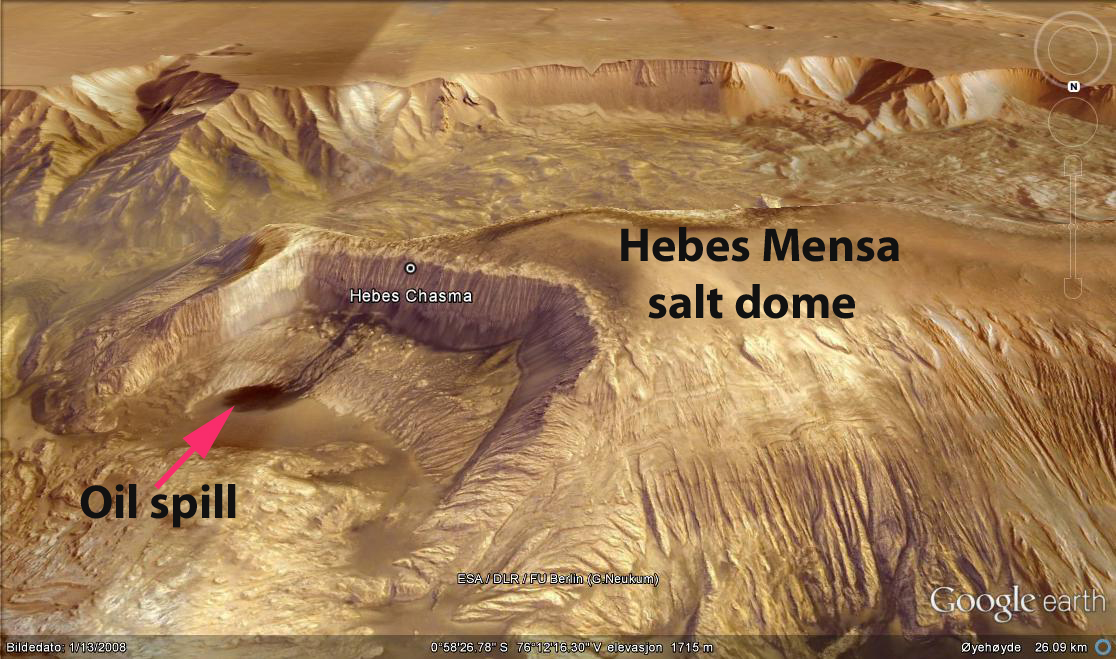
All I can say is "I do not know".
Any means used to make Tar and Plastics would work well with things like brick and adobe, I think
Ending Pending
#1109 Re: Science, Technology, and Astronomy » Humanoid and other robots. » 2025-05-27 09:42:10
This is a deviation from Humanoid: https://www.youtube.com/watch?v=yA_tCoE … LACARWORLD
Quote:
Elon Musk SHOCKED NEW Tesla DOG Robot At Giga Texas! 5 Features REVEALED To Protect Your Home!
TESLA CAR WORLD
239K subscribers
A quadruped?
I see utility for it on the Moon and Mars, as for outdoor, in spaces not so much designed for humans.
But I am interested in a Centaur: https://civitai.com/models/138772/rpgcentaur
Image quote: 
But this is Spot, partway there: https://robotsguide.com/robots/spot
Image Quote: 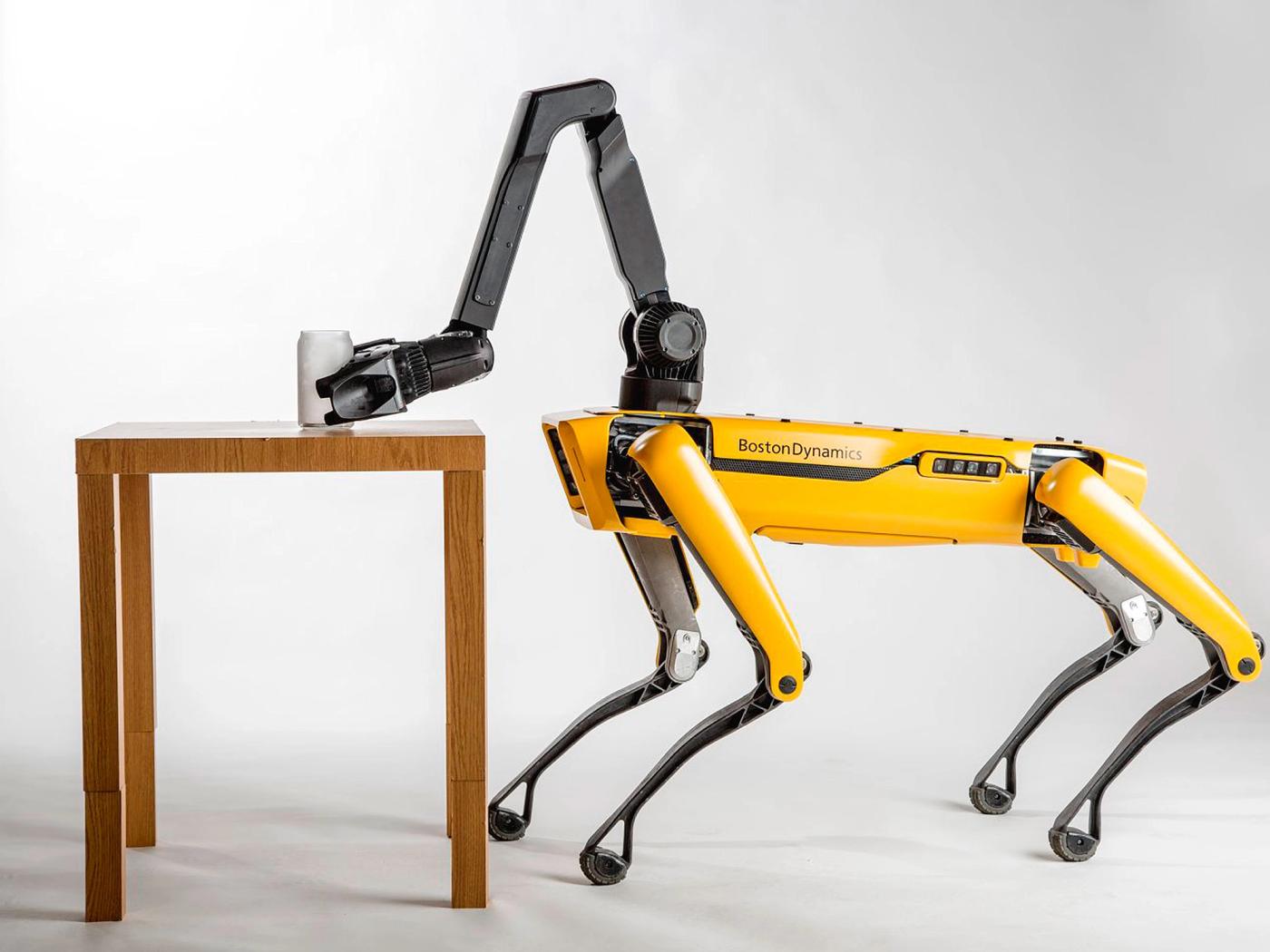
You would not want a full sized centaur, for inside your house, but maybe if they can miniaturize some kind of hand/grasper, they could make a Mini-Centaur.
I do understand that Tesla has its hands completely full with Cars, Optimus, and now a dog robot, but somewhere down the line.
I think that such a robot could be quite useful on the Moon or Mars. It could have a toolbox on top of its saddle. Plus it could have more battery than a humanoid. The torso might be built so that it could turn almost 180 degrees at the waist, so that it could access its tool box.
If you had a nuclear reactor, and some kind of a protective tent, these things, might make it OK to get some work done on Mars.
For the Moon, I imagine adding an umbrella with solar cells, so that it could operate throughout most of the Lunar Day.
Ending Pending
#1110 Re: Interplanetary transportation » Multi-Ship Expeditions, Starboat & Starship, Other. » 2025-05-26 19:31:58
The manufacture of ice sinkholes could be aided by something that perhaps should rather be called a "Tent" rather than a dome.
It may use a bit of compressed air in side to keep it inflated, or maybe it would use rigid structure and anchors to keep the tent as desired.
The edges could be tucked under soil by a humanoid robot with a hand shovel, perhaps.
It might not be necessary to move the bulk of the soil covering the ice, if heat is transmitted though the soil into the ice and the ice then sublimates, the dirt will naturally fall down as the icy pit forms. This could reduce effort needed by a significant amount.
So, yes, I have modified a drawing with a tent with a Vertical Starship for the center mast.

Of course if you had a Horizontal Starship you could put a tent over that, but the ice pit would be longer, and so the tent would need to be longer.
Ending Pending
There would be more dirt in the bottom of the pit than the drawing shows, if the dirt had not been scrapped off of the ice first.
Ending Pending
#1111 Re: Interplanetary transportation » Multi-Ship Expeditions, Starboat & Starship, Other. » 2025-05-26 10:01:39
I think that evaporative ice mining may be of significant value, compared to working with liquids and so much with solids.

This is intended to convey methods, it should not be considered proportional to actual relative sizes. However the idea of evaporating a pit, and landing a ship into it, is demonstrated.
Of course the dome and the other items have to be moved out of the way for the landing, but might be brought back after that.
Keeping the ice stable after that may require reducing the amount of sunlight that can enter the dome. As it happens Mars will try to do that with dust anyway.
It can be obvious that on average the base of the ship will have the most radiation protection from this, both GCR and Solar. But of course their may be times of day where solar may be more a danger if for instance some kind of a solar eruption. In that case you might seek a better shelter.
The ship will also be thermally buffered in a hole under a dome.
The nuclear itself might be put into an evaporation hole of its own, to protect the ship, and perhaps moved a bit elsewhere.
It is possible that a great deal of setup could be done prior to a ship landing.
While landing precisely in a hole from space, seems too demanding to me, I would suggest that if the ship could land, disgorge its equipment, and be partially refilled, then the site prep could be done and then the ship activated to do a hop. Hops were done with early starship using raptor #1, so I do not think that is too demanding.
A big hope would be that this could be done by a collection of Optimus-Like and other types of robotic equipment.
I know it is not going to be popular, but I suggest again a side landing ship. I am pushing my luck but I will suggest again that it not have movable flaps, but rather a "Flange" all around its long perimeter, to expand its air braking footprint.
This is the idea: 
So, I don't think that flaps are going to be that effective for Mars anyway, and I suggest that perhaps thrusters on the leeward side could be able to maintain the angled-horizontal presentation of side #2's heat shield to the atmospheric burn.
By having a larger surface area than that of the ship itself only, I hope to get a better braking effect to slow to a lower terminal velocity prior to landing, thus hoping to reduce the amount of propellants needed for landing.
Of course, if the thrusters are to orient the craft during passage through the atmosphere to landing, then those will consume more of the propellants.
But, you would not have the weight of the flap motors, or the power system to run them.
I am not thinking of carrying cargo in a ship like this. It is the cargo, so you could justify the weight of the flange and the legs by the idea that you skipped carrying 200 tons of Cargo.
After the aero burn the ship will have to rotate 180 degrees to present the thrusters and landing gear to the ground. and I don't know it could endure the forces imposed by doing that.
About terminal velocity. (I am hoping to cut it in half with the flange):
Quote:
Copilot Answer
Images
Videos
Approximately 4.8 times faster than on Earth
The terminal velocity of Starship on Mars is approximately 4.8 times faster than on Earth. The only mention of terminal velocity on Mars for Starship was on a blog post, which stated 66-68 m/s for SN8, implying ± 320 m/s on Mars. The SpaceX Mars landing simulation has a ~40 s landing burn initiating at ~Mach 2.3 = ~550 m/s (about 1.7 g Earth) for a total velocity change of ~700 m/s.
Stack Exchange
+2
So, you would do the 180-degrees roll somewhat high in the atmosphere, so the air density would not be as much as on the ground. On the ground saying the air density if 1% that of Earth is being generous.
So, I am hoping that the ship could survive the 180-degree roll because the air is so thin.
As for the flanged ship being pushed to LEO though Earths atmosphere, I am hoping that it could be streamlined enough that it could be done. Landing gear and reinforcement structure could be added in LEO, I hope.
My notion is that this would only need a one-time heat shield as you would not be flying it again from Mars.
Here again you might do a crude landing and then be partly refilled and then hop into a evaporation pit, to be then in a buffered environment, where radiation and thermal issues are reduced.
Post landing you could have some choices:
1) Remove the flange for another material use.
2) Put water bags over the horizontal craft to freeze and be further radiation protection.
A horizontal landing then avoids the need to tip the ship over and put braces under it.
As for the thrusters, Rocket Lab and Relativity Space will have smaller engines that are Metha-Lox, that might work.
And SpaceX has notions for special engines to land on the Moon.
Ending Pending
#1112 Re: Science, Technology, and Astronomy » Utilizing Superpower (Per Rethink X, Tony Seba) » 2025-05-25 20:21:20
If we could figure out how to make our energy do multiple things as it neutralizes a difference in more vibration and less vibration, then I feel that that is prudent.
So say we had a data center and were going to cool it. It has already been suggested to heat greenhouses with the waste heat. Or heat the incubators for precision fermentation.
First of all, I think we have two obvious pathways to extract the heat:
1) Extract the coolant fluid and warm the water in a tank as shown in the previous post:
2) With a heat pump, extract heat from the surface waters. This will leave a cold discharge that can be used indirectly to cool the data center.
Quote:
So, for the gasses in the tank, we might want to avoid explosions or burning, so to limit the Oxygen. We might store Hydrogen or CO2 in them.
Of the choices, I suggest Hydrogen/Nitrogen, and to introduce some CO2, and maybe Air.
As the water is to be warm at least we might grow things in the water that consume the gasses.In doing this we may be doing a bit of Stirring. If we heat the water inside the pool inside the tank and water evaporates and the condenses on the cold tank wall, then the cold water is made more warm, and so then may rise, and may carry nutrients with it. This may make the seas more fertile at those locations.
Route the heat into the tank to promote both Precision Fermentation and water distillation.
Also needed are chemicals such as Hydrogen, CO2, and perhaps a bit of Air with O2/N2. So, we are probably going to want to pull CO2 out of the water or atmosphere. As for the Hydrogen it can be created using electrolysis, I suppose. It is somewhat storable under pressure in an underwater container.
So, there are a lot of storable items. Cold for the Data Center, Hot/warm for the Precision Fermentation, Hydrogen Gas, CO2 Gas. And you can have battery packs for the Data Center, which I read has power draws the fluctuate very quickly.
So, I think you could have a good base energy source and then add in a variable such as Solar, Wind, Wave.
The various storage means I have listed, will perhaps help maintain the supply of resources to the Data Center, and allow the conversion of "Superpower" to useful product.
Here we may be harnessing various variable energy sources, and a steady one, also the differential temperature of the water.
How this is different from OTEC, is we use energy to exploit thermal differences in the water, to produce product.
OTEC tries to exploit thermal differences to make electricity so that the electricity can help make product.
It can be noted that we already are extracting CO2 presumably from the water and are growing things with it. So the Biomass might produce a precision fermentation product but also might make a biofuel as well.
We are also hoping that this process will encourage the making of Carbon built things like tanks and pipelines?
So, that is a form of sequestration.
OK, we hope to get some CO2 capture into organic matter into the Ocean by the upwelling of nutrient rich water: 
Yes, it is true we are heating the ocean a bit for a while in places, but the heat still will reach it's destiny, which is the deep universe, it just goes on a detour to do some work for us.
If Humans or animals eat the biomass produced, and if the poo, some of that poo will end up in sediments, and so then more permanently sequester Carbon.
And if it is necessary to extract CO2 from the environment, here is a possible way to do it while creating wealth associated products.
Ending Pending
#1113 Re: Science, Technology, and Astronomy » Utilizing Superpower (Per Rethink X, Tony Seba) » 2025-05-25 11:56:30
This goes into a lot of detail about this topic and also some about synthetic labor: https://www.youtube.com/watch?v=GTH7RRj … ithHerbert Quote:
EXCLUSIVE: Tesla Wins Big With Unlimited Clean Energy | Adam Dorr
Brighter with Herbert
117K subscribersJoin
This gives me an opportunity to unload some stuff from the Attic of my mind.
Among this are stirring, heating, splitting, and collecting.
A scheme I have in mind that I do not have 100% certainty on is distillation of water on the floor of an ocean.
I read that Optimus might be able to work underwater to about 10 bar level. (This is having a lot of uncertainty). This then opens some continental shelf, and some lake bottoms.
If you have a tank of 10 bar atmosphere, with a pool of warm water in it, and in cold water deeper, and we circulate the 10 bar air, we may hope to condense, fresh water in the interior top of the tank. We may want to have fans to circulate the "Air" rather vigorously.
Unlike vacuum distillation this is evaporation and condensation in a body of gases that might convey more moisture due to the thick nature of the air within.
In my dream world we could make these tanks out of Carbon. If so, we will need to anticipate microbes that will evolve to eat it so we may want to perhaps cover the Carbon walls, to keep Oxygen away. (Carbon eating microbes will perhaps not be too much of a problem for a while).
So, I feel that this process is capable of consuming lots of superpower, in various ways and we hope to provide strong economic value: https://superinnovators.com/2024/08/wor … s-99-tons/ Quote:
World’s largest carbon fiber rocket-building machine weighs 99 tons
Rocket Lab in the USA have begun installing a 12-metre tall automated fiber placement machine to produce the world’s largest carbon composite rocket structures in Maryland.From Rocket Lab 18/08/24 (originally released 08/08/23)
So, now we have a market for our Hydrocarbons. If we pull the Hydrogen off, we might make Carbon objects we can submerge under water.
You may heat the water in the tank by several methods. Electric Heat Pump? Electric Heater, Pulling Tropical Surface Water pumped into the bottom of the submerged tank.
The cold of the water on the Continental Shelf, a certain distance down will serve to drive a condensation process that will dry the "Air" interior to the tank, and so then will promote evaporation from the surface of the warm water in the bottom of the tank. I will make a diagram.
Pause..............

So, for the gasses in the tank, we might want to avoid explosions or burning, so to limit the Oxygen. We might store Hydrogen or CO2 in them.
Of the choices, I suggest Hydrogen/Nitrogen, and to introduce some CO2, and maybe Air.
As the water is to be warm at least we might grow things in the water that consume the gasses.
In doing this we may be doing a bit of Stirring. If we heat the water inside the pool inside the tank and water evaporates and the condenses on the cold tank wall, then the cold water is made more warm, and so then may rise, and may carry nutrients with it. This may make the seas more fertile at those locations.
We might do this in lakes as well for instance Lake Erie, it is rather shallow, but the water might not be that clean.
Dealing with interior salt lakes: Great Salt Lake, Dead Sea, Aral Sea, Salton Sea, Caspian Sea.
As for the Great Salt Lake, heating may cause the lake itself to evaporate more. But if you put solar panels over it, it may inhibit evaporation. So, then you may be able to cause the lake to expand, if you reduce evaporation.
Salton Sea, same thing more or less, make it swell. If California had any brains actually, they would route more water from the Colorado River into the Salton Sea.
Because if you did the Carbon Tank thing off the arid coastal areas of California, you might get quite a product of water and also produced biomass. You might be able to shut off the Aqueducts, and reroute the water.
Thankfully there are other salt lakes on the planet so that our "Green Tards" will not be able to stop the research.
Sorry, but I group the liberals in to the royal thinkers. Just look at Carbon Trading/ Carbon Taxes. They are simply trying to elevate themselves to the elite and to reduce common people to peasants whose resources will "Wisely" be metered, until they will be happy to pay with their "Worthless" lives to kiss the heal that crushes their mouth.
The "Green Tards" are the ones who bite the hand that feeds them.
Ending Pending
Why am I so brutal?
Well these "Green Tards" want to ring the alarm bells to have their butts wiped for them but they will not fix anything.
Of course I am annoyed.
Ending Pending
#1114 Re: Science, Technology, and Astronomy » Humanoid and other robots. » 2025-05-24 15:08:50
https://www.youtube.com/watch?v=RH3GOnB … ithHerbert
Quote:
EXCLUSIVE: Tesla's Bot Can’t Play Soccer… But That’s GENIUS!
Brighter with Herbert
117K subscribers
Interesting details.
Robots have actuators and not muscles, so total mimic of human "Skeleton" may not so much make sense. Not totally human like. While if might not play socker normal, it may be that it can do other things well.
Methods of training mentioned. And mimic is not the best results.
Ending Pending
#1115 Re: Interplanetary transportation » Multi-Ship Expeditions, Starboat & Starship, Other. » 2025-05-24 13:04:55
I have what I consider to be good news on batteries for Mars: https://newmars.com/forums/viewtopic.ph … 77#p231877
Quote:
Sodium Batteries may be better for Mars, due to the cold, than Lithium Batteries.
https://www.elevenenergy.co.uk/post/the … mperatures Quote:
Between -20°C and 55°C
Sodium batteries can operate between -20°C and 55°C, far exceeding the range of lithium batteries. They are suitable for extreme weather conditions and perform well in both low and high temperatures12345.
So, with some protection and perhaps on necessity battery heaters, robots might do pretty good on Mars.
It is being proposed to send some Optimus Robots to Mars, some prior to human arrival.
And I think I have something that they could do. Please take a look and consider: 
I do provide for some nuclear power so that the robots can charge up again.
We will however hope to exploit solar power as well that is intermittent.
The soil has been removed from part of an ice slab, and a solar dome put over that. We are hoping to promote the evaporation of ice to create an ice cave. At the same time, we intend to suck the moisture out of the air inside of the dome and port it into a condensation bag with enough pressure to allow for the storage of water ice. This could be relatively clean ice, I hope, as it is a sort of distillation process. Of course we do not want to get dust into it.
While sunshine may promote evaporation, we might also use fans, and a radiative heater to influence where the ice melts.
I suppose that you might go so far as to also include a greenhouse to grow some kind of food, but I want to get the parts in current illustration figured out.
With the ice cave we are starting to provide a radiation shelter, and also some protection from thermal extremes of cold.
When the humans arrive, considerable assets might have been set up before them.
This probably offers improved chances of success/survival.
Ending Pending
#1116 Re: Science, Technology, and Astronomy » Utilizing Superpower (Per Rethink X, Tony Seba) » 2025-05-24 12:33:54
I am willing to entertain the idea that the further accumulation of creation/invention may make what was true, now then false. That is that batteries will be a problem for alternative energy sources.
I have been hearing about Sodium types of batteries. The news tends to be positive: https://www.youtube.com/watch?v=jfsijkf … tricViking
Quote:
Why Solid State Sodium Batteries Could Slash EV Costs: 10x Power Density!
The Electric Viking
There is so much incentive for "Have Nots" to try to bypass Hydrocarbon Necessity. So, of course that will spill onto everyone else.
I am not a green though, I do not think we kill the horses and then invent cars. That is what Idiots do.
You invent cars and put the horses to other uses.
So, I think that RethinkX is approximately correct, but the time scale requires some patience.
Sodium Batteries may be better for Mars, due to the cold, than Lithium Batteries.
https://www.elevenenergy.co.uk/post/the … mperatures Quote:
Between -20°C and 55°C
Sodium batteries can operate between -20°C and 55°C, far exceeding the range of lithium batteries. They are suitable for extreme weather conditions and perform well in both low and high temperatures12345.
Ending Pending
#1117 Re: Terraformation » Pluto Realms » 2025-05-24 11:28:35
It is always possible that I do not understand correctly. It seems to have been said that for most of its orbit, the object could not have been detected from Earth with current technology. So, that suggests to me that there could be an enormous amount of objects, similar that are not currently observable. But that is not certain at all, it is a maybe at best.
I have on occasion tried to think of a solid radiator. The solid would be first cooled by radiation into the universe, but then would cool a secondary device by contact and conduction.
I do not feel that I can yet offer a potentially practical solution yet.
Obviously, a pile of metal dice on the Moon, could be "Flowed" into a machine and presented to a flat surface to convey their low vibration state onto the plate, then sent back out to the Moons surface to cool again.
Selective magnetism might be helpful, perhaps the dice could be ceramic but with some magnetite inside of them. To do this vacuum welding has to be avoided.
This brings questions about vacuum gap and conduction. Does heat flow into the "Die", only through physical transfer of vibrating molecule to molecule, or is there a radiation transfer across a very small gap?
Will the photons flow from the hot plate to the "Die" because of the proximity of the cold "Die", or must molecular vibration atom to atom be the only way of transfer?
If you have an opinion, I am interested.
Lets go the other way and consider hot marbles. If they are heated, then we cannot use magnetism, most likely as it would be above the curie point.
We could use gravity or synthetic gravity though, I think.
Can we heat up our marbles in a device, such as a solar concentrator and "Flow" them into a storage area?
Here, if we then "Flow" them to a boiler, contact will transfer some heat, but photons from the hot marbles will transfer quite a bit more.
It is not that I think I have a practical machine yet, but a means to visualize some questions.
But I am interested. Technically in microgravity it might be possible to magnetically manipulate the "Dice", to be exposed to the universe to cool, for instance if they heated above the curie point they could be ejected outwards, but upon cooling a magnetic field might suck them back towards the radiator, to make contact.
Again I do not propose that I have created a practical machine, but a set of questions instead.
Isaac Arthur seems to think that Mirrors will work for solar power even in the Kuiper Belt. I would have supposed out to Saturn. If we have fusion or solar, then we may want good radiator method.
A somewhat metal disc might do as well, if the radiator could move on it, and clamp the condenser to the surface, by a force, such as magnetism.
It might be that a practical machine will be created some day.
Ending Pending
Perhaps a solid ring of material which the condenser could physically embrace the small circumference of for the promotion of physical contact. And still I wonder if close proximity promotes faster photon transfer of energy across a very small vacuum gap, or if vibrations must transfer molecule to molecule by touch.
Ending Pending
#1118 Re: Science, Technology, and Astronomy » Humanoid and other robots. » 2025-05-23 11:40:08
This video describes a population that is in a severe aging tilt, vs. births: https://www.bing.com/videos/riverview/r … 5f3fc842cd
Quote:
Why Florida is about to lose a lot of people...
YouTube
Reventure Consulting
91.4K views
1 week ago
I am interested in thinking about how humanoid robots might modify the process for such a place, and also for places with a more "Healthy" birth to death ratio.
It seems to me that the industrial revolution seems to have promoted "Collectivist" thinking at least in the 20th century.
https://en.wikipedia.org/wiki/Industrial_Revolution
It was a method that produced more apparent materials wealth, and so a means to power over society.
There is always a minority of people who want to set themselves up to charge people rent to attend their own lives. People who what to "Game" the system, and avoid actual unpleasant circumstances for themselves. You could call that intelligent in a certain way, or just selfish and evil, or good. I mention it simply because it seems to exist.
Collectivism brought us the bad actors of WWI and WWII.
Also, the Prussian school system. The "Prison Camp" school system. I grew up with privilege that I am not convinced that I was worthy of. But they did mess with us to get there. The idea of making the words "Class" and "Grade" a normal thing to do to masses of children. Granted it was measurements of the effects of time on the masses of children, and then the "Grading" was to give indication of observation of apparent capability. But then was it the treatment of masses of children as if they were a product you would buy in a store? In that case "Grade", reveals a system of exploitation.
I do understand that the USA was competing with other societies that were working with collectivism as well. There were not very many alternatives. You had to play it that way or be taken down by the "Fittest" in a contest of survival and power.
So, yes there was little choice, most of us were along for the ride, and put the blinders on and let the system label us for what it claimed we were. Again, that is what was very hard to avoid. It almost had to be.
https://cardinalinstitute.com/the-pruss … eexamined/
Quote:
By:
Tiffany Hoben
November 14, 2024
The American Education Model Began On A Foundation Of Local Control
In colonial America, education looked drastically different from the standardized, rigid system we have today. Parents, communities, and churches played the primary roles in educating children. There was no overarching system dictating what students learned or how they learned it. Each colony, each town, and each family even brought its own priorities and values to the process of teaching.The Founding Fathers built a nation on the belief that this kind of local control was essential — not just for education but for every aspect of life. They knew that communities must be free to pursue what works best for their unique needs. This idea of local control is at the heart of our nation’s founding documents and is crucial to preserving our freedoms. Yet, the American education system has drifted far from these founding ideals.
I recall we were pretty much told that the "One Room Schoolhouse" was inferior, and I suppose it was not the same as having a private tutor. But it may have offered a more "Go at your own rate", the way to personal improvement. And having older students may have had some benefit for the younger. And vice versa. I have the belief that as others have said, if you teach something you might learn it better. But you have to find something that works.
Quote:
History Behind The Prussian Model of Education
Fast-forward to 18th-century Prussia, where an entirely different philosophy of education was emerging. The Prussian model of education wasn’t designed to create critical thinkers; it wasn’t even designed for kids. Prussian leaders built it to produce disciplined, obedient soldiers who would follow orders without question.This was in response to the military weaknesses exposed by Prussia’s defeat by Napoleon. The defeat revealed shortcomings not only in military tactics but also in the population’s readiness and loyalty. This led Prussian leaders to recognize the need for a more unified, reliable, and well-trained citizenry that could support the state’s military and political objectives.
This shift in control allowed the state to decide what children learned and, more importantly, how they learned to think — or rather, not to think. In Prussia, schooling was a tool for control, shaping young people into compliant subjects who wouldn’t question authority or run tail in the face of a canon.
So, basically Satanic in nature, breaking the children and making them suitable drone/meat robots.
And in favoring a fast maturation rate, it ran contrary to the human story of evolution/breeding. That is children with a shorter childhood, being more ready for this treatment would on average preform better, as the children with a longer childhood would not be as ready for the materials in the classroom. Day Dreaming of course was to be punished. This may be the answer to why sometimes the best performers in public schools end up living in trailer courts. They may have ceased to learn, completed their childhood too soon.
And all of this, so that these children can be raised on average to pay rents to people who do not want a real job.
For America this worked fairly well, as we were on the winning side of WWI and WWII. (If we disserved it or not). Maybe luck with some talent.
Early Industrialization promoted collectivism, the machines tending to be big and clunky.
Now what about Humanoid Robots? They are showing up and may change the small parts of the collectivist machines.
At the same time, energy though solar offers some chances of a more individualized access to energy. While Utility Companies may also do solar and so then be able to charge "Rents" from the peasants, it is not all that way. We go in the direction of the beginning, where people had more individual fireplaces.
A partial exception to that is for example in England, where the trees all belonged to the king, and peasants could only pick up wood on the ground. That was necessary as trees were a war material, to makes ships, and to forge metal weapons. If you got caught cutting down a tree, the first violation you would lose an eye or a testicle. The second time you would be killed. (No, I don't know about female punishment).
In any case, a more individual solar and also the potential of individualized Humanoid Robots, might reduce the amount of social collectivism that can be imposed on the general population by the would-be rent collectors.
Where Humanoid Robots could be used in large masses in factories to produce wealth and displace humans from the work force. There also is the possibility that to own a Humanoid Robot.
So, an interesting thing is not just what a robot or a human might do, but what they might do in partnership. Education could be continual, depending on the resources the robots could provide. The notion of "Class" and "Grades" might be relatively stupid. You might just "Be all that you can be", if you have the attitude to progress.
The Robot Labor will not be born and raised for 16-24 years, rather it will be cloned, more or less on short notice.
So, it may be a curious matter to watch how society changes in an "Old State" life Florida, or in a "Young State" like Texas.
It will also be interesting to see how the "Rent Collectors" who only want that function will react, perhaps panic when they realize what is coming. And they cannot avoid it as if they kill our robotic progress, then other countries will replace us.
Some things to watch if we live to see it.
Ending Pending
And even also interesting, how do collectivist cultures deal with individualization of resources such as Solar and Artificial Labor?
Ending Pending
Is this the end of spiritual castration by Schoolmarms?
Ending Pending
#1119 Re: Interplanetary transportation » Multi-Ship Expeditions, Starboat & Starship, Other. » 2025-05-21 20:08:06
Two posts back #77, I mentioned growing alpine plants, in what essentially would be a radiator/water condenser on the surface of Mars.
Obviously, Algae and Cyanobacteria might do very well also for that.
And you could grow mushrooms on the organic materials created.
Ending Pending
#1120 Re: Interplanetary transportation » Multi-Ship Expeditions, Starboat & Starship, Other. » 2025-05-21 19:58:00
Calliban provided useful information here in answer to a discussion with (th) and myself: https://newmars.com/forums/viewtopic.ph … 30#p231830
Quote:
Calliban
Member
From: Northern England, UK
Registered: 2019-08-18
Posts: 4,023
tahanson43206 wrote:
For Void re post with images and GIF of asteroid NEAR probe...https://newmars.com/forums/viewtopic.ph … 94#p231794
That is an impressive composition!
Your recent introduction of the idea of using iron as propellant (reaction mass) might inspire one or two readers to wonder about the potential impact such highly accelerated iron atoms might have when they encounter the hull of a space craft. Your post includes mention of building up layers of material for radiation protection, and provision for arrival of the iron atoms used as reaction mass might seem advisable.
(th)
Short answer: none. Heavy ions have a very short range in matter (microns), due to their interaction with electron shells. Look up the Bethe-Bloch equation. Also, ions will tend to be swept away by solar wind.
One area where this could potentially be a problem, is planetary magnetospheres. Whilst interplanetary space is vast, the Earth's radiation belts start about 1000km above its surface. If they are pumped with ions that are accelerated as Earth's magnetic field lines sweep them, it could do damage to exposed components like solar panels.
"Plan and prepare for every possibility, and you will never act. It is nobler to have courage as we stumble into half the things we fear than to analyse every possible obstacle and begin nothing. Great things are achieved by embracing great dangers."
Thank You Calliban!
Ending Pending
#1121 Re: Science, Technology, and Astronomy » Utilizing Superpower (Per Rethink X, Tony Seba) » 2025-05-21 19:16:44
This is worth watching, I feel: https://www.youtube.com/watch?v=PC8-fxQ … l=RethinkX Quote:
The DAWN of STELLAR ENERGY | Key Findings of RethinkX’s ‘Understanding Stellar Energy’ Report
RethinkX
20.9K subscriber
They mentioned a notion of using heat from a data center to help do precision fermentation.
They kind of suggested a decision tree of sorts. With a weather forecast, you might rate how the sunshine of the next day will feed energy into your system. If it looks good for tomorrow, then you can consume more of the power in your battery system. If tomorrow is not too promising, then you conserve your battery power.
This feeds into a system I would like to describe.
This system may draw on several power sources, but I add a new one that I don't think has been factored in very much .
The temperature difference between day and night. This will very likely work best in arid areas with clear night skies being common.
Post #21 could be considered as prior reference materials to some extent: https://newmars.com/forums/viewtopic.ph … 13#p231013
Quote:
OK, this would be a round canal as a collector:

So, a sort of decision tree could exist for this due to weather forecasts. Normally we don't get magic wishes, but in this case maybe we can. You know what the Relative Humidity will be tonight. You know what the low temperatures will be. So, based on that you can draw air though the ice-water of the circular canal to catch moisture into it and also CO2. But you would further judge if to do that, depending on the forecast for tomorrow for solar energy, and the battery levels you have.
In a similar manner you may run the heat pump, that makes ice water, and could dump heat into the exhaust air, if you do decide to collect CO2 and water.
So, you would use battery power to collect CO2, moisture, and cold from the night air, if it is considered a good investment to drain part of the power in the batteries.
On the other hand if the situation is not optimal for getting CO2, moisture, and cold from the night air, you might make Hydrogen instead, or just conserve battery power. During periods when you did have daytime superpower you could make these same evaluations as well.
Then you might mate these processes with the idea of running a data center, and using the waste heat for precision fermentation, as you have then collected CO2, Hydrogen, and moisture for it.
Ending Pending
#1122 Re: Terraformation » Vesta, modest ambitions. » 2025-05-21 15:52:23
I agree with you Calliban. Vesta is sort of special. It may have veins of ore with Copper for instance.
And I would think that Space Elevators could work well for it. If so then you can also have tin can habitats around it as well. If you need more of some kind of thing like water you could probably get it from other little worlds in the Asteroid Belt.
Nitrogen might be a bit scarce, but we can hope that Carbonaceous materials may have a little bit. Also, Ceres, and Callisto seems to have hints of "Ammonium goop" of some kind.
https://pubs.aip.org/physicstoday/artic … uld-harbor
Quote:
Ceres therefore appears to have harbored liquid water with soluble carbon and nitrogen—two elements on which life as we know it is based. The bright spots are much richer in carbonates and sodium chloride.
Ending Pending
#1123 Re: Interplanetary transportation » Multi-Ship Expeditions, Starboat & Starship, Other. » 2025-05-21 13:27:57
This video that is a bit old, has several useful bits of information in it: https://www.bing.com/videos/riverview/r … 38a92e6a8c Quote:
Surprise Discoveries from Mars: Volcanic Ice, Weird Chemistry, Lava Tubes and More!
YouTube
Anton Petrov
140.1K views
1) Thin frost on many volcanoes, 1/100th of a mm or the thickness of a human hair. I mention this as it might be possible for a robotic system to vacuum up enough water for human settlements.
2) The polar ice does not seem to flow. This is important because if humans and robots were to make vaults in the ice, unlike many Earth glaciers, the ice will not flow, which is probably a good thing.
3) He indicates that lava tubes are probably not a very good possibility on Mars. I don't really understand why, but it is good to know what is real.
4) Impactors will be some level of concern on Mars, so undersurface may be helpful.
It has been claimed in the previous post materials that the surface materials of Ceres do not flow very much as apparently dirty ice tends not to flow as much as clean ice.
Again, from the prior post and post #57:
Post #57: https://newmars.com/forums/viewtopic.ph … 92#p231592
Quote:Here we are then:
The cone vault might reject excess heat into the stone under it, for the case of a sand storm, so that heat would keep flowing into the habitat.
The ice tunnel is slightly pressurized, and hosts a tent that protects a gutter that water can flow though as a liquid.
The ice tunnels can reject heat from themselves either to habitat space, or to some of the surface buildings that will double as radiators. You might use air compression and decompression to do a refrigeration.

I have suggested a robot room temperature of -10 degrees C which can be temporarily compatible with humans having the proper clothing and other needed life support gear. Probably some sort of battery may work at those temperatures, but in the end, if needed you could have a battery heater. It might be that robots may often hibernate in times of power depravation. (Dust Storm, Polar Winter). Of course, if you had some type of nuclear then solar would not matter as much.
I have an idea about a minimum solar powered life cultivation. This could be tied into shedding waste heat in the ice tunnels as necessary or also the same for tunnels in soft rock.
This claim might be partly trustworthy, I think: https://www.newsweek.com/desert-moss-su … nt-1918887 Quote:
A future civilization on Mars could be accompanied by one very special and resilient little plant.
A type of moss found in the desert—named Syntrichia caninervis—may be able to survive and grow in the harsh environment of Mars, according to a new paper in the journal The Innovation.
This moss can grow in freezing temperatures as cold as -320.8 degrees Fahrenheit, and can survive levels of gamma radiation that would kill most other plants and life forms.
The plant can also withstand incredibly dry conditions, as well as a combination of dryness, heavy radiation, and cold weather in a simulation of the conditions on the Red Planet.
"Our study shows that the environmental resilience of S. caninervis is superior to that of some of highly stress-tolerant microorganisms and tardigrades," the researchers wrote in the paper. "S. caninervis is a promising candidate pioneer plant for colonizing extraterrestrial environments, laying the foundation for building biologically sustainable human habitats beyond Earth."
In the drawing above a surface building could be a very low pressurization greenhouse. Offering some improvement on the raw Martian environment. But it would also be important in water recycling. If you wanted to use water evaporation as a coolant to get rid of excess heat in your underground facilities, then you could do that, and if the greenhouse was not too leaky, then at least in nighttime this would heat the greenhouse a bit, and also condense water out as ice and maybe even liquid, if you had a sufficient pressurization in the greenhouse. This would irrigate any plants you were trying to grow. And with pressurization, daytime thawing might yield, liquid water flows.
There may be other plants capable of enduring such a night freeze and day thaw environment.
So, you could recycle the cooling water to some extent. Some leakage would be expected, so you probably would be extending the tunnels in ice all the time to provide "Make-Up" water.
Here is a query that may have value: "Alpine plants that endure daily freezing"
Here is a general response: https://www.bing.com/search?q=Alpine+pl … c0&pc=DCTS
Here is one particular response: https://rarest.org/nature/beautiful-alp … h-climates Quote:
Alpine plants that endure daily freezing include12345:
Yellow Saxifrage
Mountain Harebell
Resilient perennials
Hardy shrubs
Evergreens
Flowers with adapted designs to the harsh, cold climates of high altitudes.
So, if we are going to have our industrial robots in under ice/underground industrial factories, heat is going to build up.
To be rid of it, water can absorb the heat though heat pump methods, and the water could be pumped to a surface greenhouse and vented to boil. While the greenhouses will inevitably leak some water vapor, we will probably be able to replace that water by melting more ice tubes, for robots to work in. So with that waste heat, perhaps preferential vented at night, you then cool the undergrounds and buffer the level of deep cold of the Martian nighttime in a greenhouse.
Of course, using liquid water in the cold environment of Mars, then requires that you have methods to keep pipes from freezing and bursting. In the mines, if the flow of slurry shut down, we used to drain the pipes, so that pipe damage would be prevented.
While Alpine plants are not food crops, I suggest that with some forms of selective breeding and even some GMO, these might be modified to grow happily in such "Radiator/Greenhouses".
In making machines, it is important to ask the question, "Does it serve us or do we serve it?"
In choosing to adapt to Mars and meet it "Halfway", we may be more likely to get service from machines rather than to have to baby the machines, and bear such a burden.
There are Ice bodies near the Equator, which may be suitable. We don't know that yet though.
However, at a higher latitude we have this one the size of Texas and California: https://www.space.com/30502-mars-giant- … y-mro.html Quote:
"It extends down to latitudes of 38 degrees. This would be like someone in Kansas digging in their backyard and finding ice as thick as a 13-story building that covers an area the size of Texas and California combined," Bramson said.
For comparison, the latitude of southern Spain is about 38 degrees. So Mars having a similar tilt solar energy would be similar to that except attenuated by distance from the sun, and also the problem of dust storms.
But there could be sunlight in the winter, worth harvesting. But also the ability to hibernate much of the robot community may be a good option to have in times where solar power is blocked.
So, the tricks learned for Mars, might eventually be applied in part to other worlds believed to be icy such as Ceres, and Callisto.
Ending Pending
#1124 Re: Interplanetary transportation » Multi-Ship Expeditions, Starboat & Starship, Other. » 2025-05-20 21:14:09
A little diversion to Ceres: https://www.msn.com/en-us/news/technolo … r-AA1F9PZ0 Quote:
Frozen ocean world discovered between Mars and Jupiter
Story by Rebecca Shavit • 4h •
7 min read
Quote:
Their study, published in Nature Astronomy, proposes that up to 90% of Ceres' outer layers could be ice. Instead of solid rock, they believe the crust is dirty ice—formed as a slushy, muddy ocean froze over time.
Quote:
Sori explained, “We think that there's lots of water-ice near Ceres' surface, and that it gets gradually less icy as you go deeper and deeper.” He added that earlier models didn’t account for how strong icy mixtures can be. Scientists once thought craters on an ice-rich body would quickly deform, behaving like honey or flowing glaciers.
But when mixed with just a bit of solid rock, ice behaves differently. “Even solids will flow over long timescales,” said Pamerleau. “Ice flows more readily than rock. Craters have deep bowls which produce high stresses that then relax to a lower stress state, resulting in a shallower bowl via solid state flow.” Their models show that these crater shapes can hold steady for billions of years—reshaping what we know about frozen worlds.
So, this might apply to robot tunnels in ice on Mars. After carving the tunnel, then I hope to smear a paste of fibers and mud to freeze on the interior surfaces of the tunnels, and so perhaps to make them more stable.
I suggest that a robot room temperature could be -10 degrees C, which is also a bit tolerable for humans with protective gear.
Prior posts deal with such a thing:
Post #56: https://newmars.com/forums/viewtopic.ph … 89#p231589
Quote:
These ice slabs are supposed to be all over Mars, I suppose mid latitudes and upper latitudes more so.
https://www.sciencealert.com/new-resear … ter-liquid Quote:Vast, Thick Ice Sheets Have Been Found Buried All Over Mars
Space
11 January 2018
ByBen Guarino, Washington Post
Image Quote:

Post #57: https://newmars.com/forums/viewtopic.ph … 92#p231592
Quote:
Here we are then:
The cone vault might reject excess heat into the stone under it, for the case of a sand storm, so that heat would keep flowing into the habitat.
The ice tunnel is slightly pressurized, and hosts a tent that protects a gutter that water can flow though as a liquid.
The ice tunnels can reject heat from themselves either to habitat space, or to some of the surface buildings that will double as radiators. You might use air compression and decompression to do a refrigeration.
So, one nice thing about icy worlds such as Mars and Ceres, is that you can get your water supply while digging a habitat expansion.
And it is quite possible to have a house inside of a ice cavity, and pull heat out of the ice cavity and into the house using a heat pump, provided you have the energy to run the heat pump.
However prolonged industrial or other activities might build up heat that you would need to dispose of to the surface, perhaps by boiling water at a low pressure.
Boil more water, need more water, need more water, expand your living spaces.
I am guessing that robots at -10 degrees C may be a good thing because if you have a lower air pressure, then your cooling for the robots is a bit easier.
Ending Pending
It is nice that Ceres may have very thick layers of ice that get muddier as you go down, but it may be that the Dwarf Planet may not have that much Nitrogen. But then again maybe the liquid below was an Ammonia/water mix, then there would be lots of Nitrogen.
And infalls of asteroid materials probably contain Carbon.
Very fortunate, perhaps.
Ending Pending
#1125 Re: Interplanetary transportation » Multi-Ship Expeditions, Starboat & Starship, Other. » 2025-05-20 11:25:11
To go a bit further:
I am presuming that at least in places, pools of fine dust exist, such as in old craters.
Starship is the model I am thinking to work with or ships like it: https://marspedia.org/Phobos
Quote:
Phobos, one of Mars' moons, is covered with a layer of fine-grained regolith at least 100 meters thick1. The regolith may be deficient in the ❤️00 μm size fraction and contain martian material with concentrations ~250 ppm in the upper 0.5 m, and 1–2 orders of magnitude lower at greater depth2.
So, to start the "Castle" I am hoping to "Swim" ships into the dust layer. The rocket engines at the tail firing, and a small pushing of a gas out of the nose. Between the gas and the vibrations of the engines firing, I am hoping for a fluidization of the dust layer, but it will need a gentle touch, or the dust will be blown away.
Perhaps multiple instances of this. Further anchoring methods might include the use of electrostatic or magnetic forces.
At some point robotic arms attached on expandable tracks (Nod to Calliban), the collection of fine regolith, some ships might be filled with it, to gather more weight.
The "Sanctuary" might start with a orbital Starship collection. At least two ships. A cube would have 12, so we could pretend we are borg, as in Sci-Fi. But I like better 9 used to make a double tetrahedron.
Tetrahedron: https://en.wikipedia.org/wiki/Tetrahedron
Image Quote:  Here you can visualize a triangle of 3 Starships, and an apex rising towards you approximately, of another 3 ships. Then imagine an mirror apex of 3 more, that points from the triangle base away from you.
Wrap it in a tent, of selected albedo/color. This may reduce thermal stresses on the Starship walls. It also may serve as a bit of a micrometeors protection as tiny ones may explode before hitting the ship walls.
Two methods of extended radiation shielding come to mind. In one, we have bags of regolith that we wrap around the areas that we select for radiation storm shelters.
The 2nd one may involve pools of water.
This image is to indicate methods, it is not an engineering drawing: 
The regolith provides some protection, but in radiation storms from the sun, the humans may need to get into the "Gym" inside of a diving bell inside of a pool of water, to escape severe damage.
The water can come from ??? Earth? Moon? Mars? or Oxygen from Phobos or Deimos and Ammonia from Mars. Reacting Ammonia with regolith may produce water and Nitrogen both having value in such a "Sanctuary".
The sanctuary ships could be spun to give synthetic gravity.
Over time the "Sanctuary" itself could be built up into a solar power plant that could beam power to the "Castle".
In bulking up with shielding materials, the need to jump into diving bells in water pockets will be reduced. Eventually to zero, it is hopes when the ships are docked with the "Sanctuary".
So, the "Sanctuary" and "Castle" will be built up over time to each provide protection from the harshness of space.
At first it will be too dangerous to have a spin gravity device in the "Castle". Something like a unbalanced washing machine marching across the laundry room floor. But in time as the "Castle" is bulked up, and perhaps anchored to big slabs of rock, then a spin gravity device might be included. But the "Sanctuary" will still be desired, as it may provide extra power to the "Castle".
As for collecting materials into the "Castle" just now, I am thinking of metal tracks extending from the "Castle" that robot collectors can ride on. Over time they may encompass the moon and connect to another "Castle" at the other pole.
It is my hope that this setup could provide propellants such as Oxygen, and metals. And of course habitat for humans and many more useful robots.
Ending Pending