You are not logged in.
- Topics: Active | Unanswered
Announcement
#76 Re: Not So Free Chat » Peter Zeihan again: and also other thinkers: » 2026-04-28 18:23:16
This is rather interesting: https://www.bing.com/videos/riverview/r … &FORM=VIRE
Quote:
UAE Leaves OPEC—This RUINED Carney's Agenda
YouTube
The Elevate Report
902 views
I wish to avoid related issues like relationships between Canada and the USA or the Alberta thing.
What I am interested in it this seems to be the beginning of the inversion of the 1970's.
Where the producers began to assert greater power then, now it appears that the holders of markets may be having their day.
Since we have a protectionist President, I would anticipate that Greater North American Oil Resources may need some protection.
Protection for the Shale industry's technology capabilities and also that for heavy oil or Tar sands that mostly our close neighbors have.
Could the USA instead of tariffs, auction off pieces of the Market to former OPEC members for a favorable price? Then still leaving a slice for the other industrial petrochemical producers like Shale Oil?
This would then stretch out the petroleum reserves of the USA. But the ability to ramp Shale and perhaps Tars Sands up (Canada), would remain.
Auctioning off slices of our oil market, for favorable terms would be the inverse of what we had to deal with in the 1970's.
Ending Pending 
#77 Re: Business Proposals » Data Centers (Including Off World) » 2026-04-27 19:43:47
Query: "How are Data Centers cooled?"
https://www.bing.com/search?q=How%20are … E8B4EFD932
https://www.bing.com/videos/riverview/r … ORM=VMSOVR
Quote:
OK, I am going to go wilder here with notions.
Query: "turbines in ocean currents"
Some Images: https://www.bing.com/images/search?q=tu … C3&first=1
https://www.freethink.com/energy/deep-ocean-currents
Image Quote: 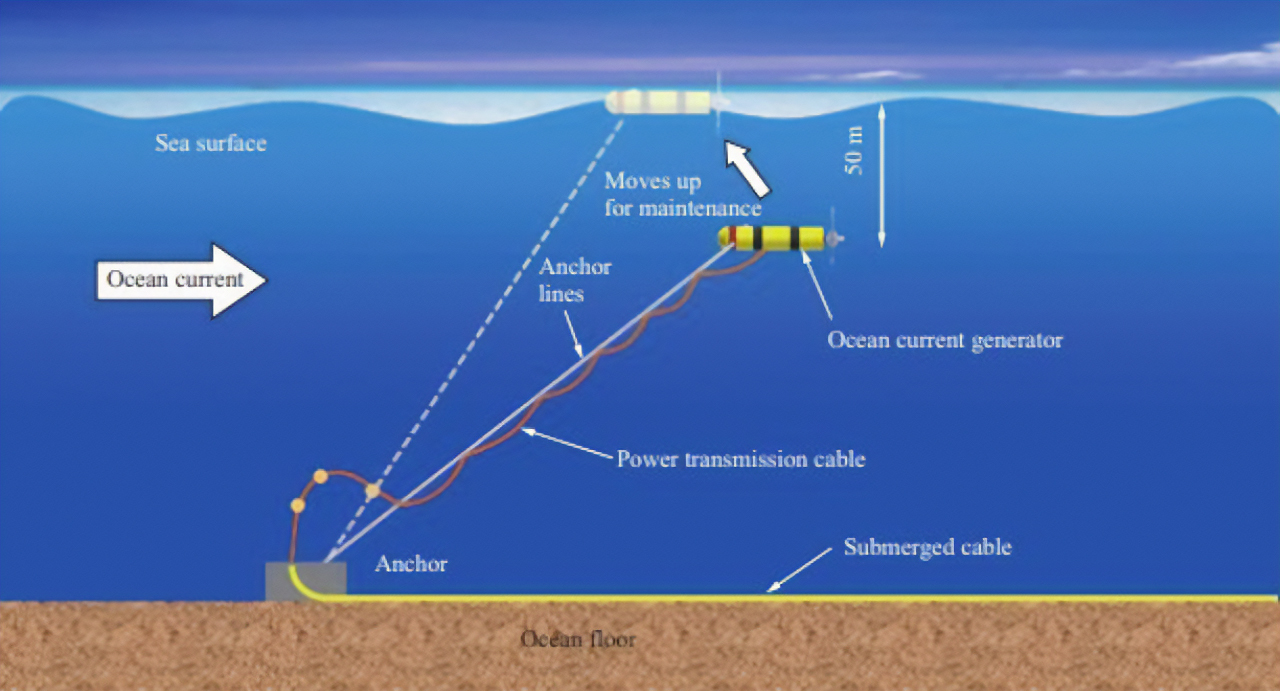
https://fity.club/lists/u/underwater-turbine-power/
Image Quote: 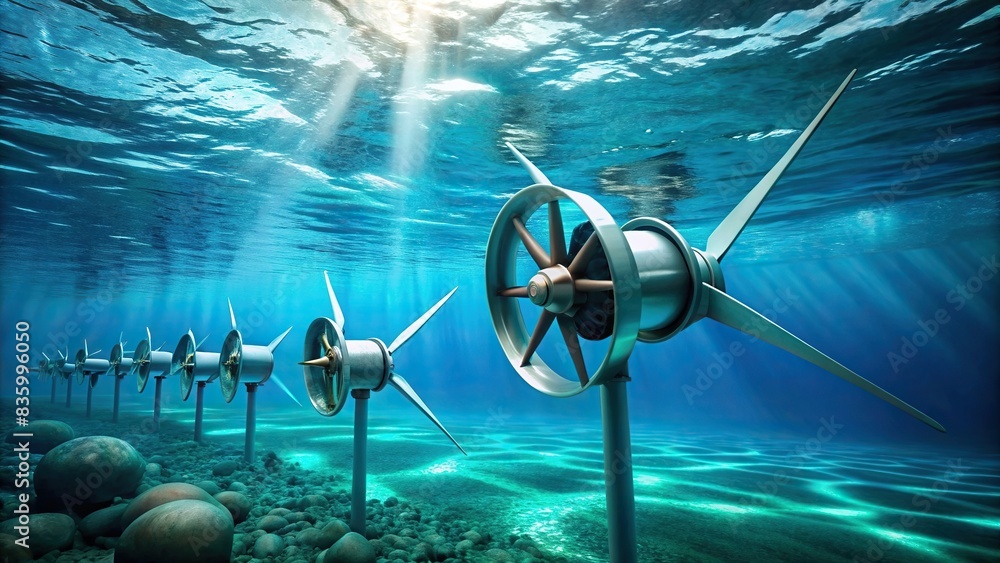
https://interestingengineering.com/ener … wind-farms
Image Quote: 
Quote:
Ocean currents that can generate 2.5 times more power than wind farms identified
The researchers traced 43 million data points tracked over three decades to identify areas with highest power generation potential in the oceans.
OK, so what if we could have pressurized submarine data centers?
330 feet, (100.584 meters) is approximately 10 bars pressure.
A shell pressurized to 10 bars would present breathing issues for humans, but we may have suitable humanoid robots to put in these chambers. I thin a human could use a mix of Helium and Oxygen, but it would be costly.
To avoid fire, the gas used might be Argon, Nitrogen, or maybe even CO2, but CO2 would be very toxic to humans.
But now the gas that you are cooling your racks with is much denser and can carry away heat better, I think.
The method to dump the heat from the gas presumably would be a heat exchanger. 10 bars warm gas though metal to cold sea water.
I chose 10 bars water column because I don't want the waste heat to go to waste.
Water at that depth may very well have nutrients in it and if it is heated it may flow upwards to deliver the nutrients into the light.
Quote:
The continental shelf is typically found at depths ranging from 0 to 200 meters. This shallow region is biologically productive, with sunlight penetrating deep enough to support photosynthesis, allowing for the growth of phytoplankton and other marine life. Nutrients from land runoff and upwelling from deeper waters further enhance the shelf's productivity, making it a crucial habitat for marine ecosystems.
So it may need to be deeper, I suspect that it is conditional.
OH well, then deeper, higher pressure.
But then you need a way to get data to and from Skynet, err. Starlink.
I guess there are limits also, if you go too deep the gas may be crushed too much???
Well, something on that order might be of value.
Ending Pending
#78 Re: Terraformation » The Moon » 2026-04-27 16:38:34
I have been thinking about gasses in the Moons Cracks. (See the just prior post).
Quote:
Approximately 60 miles
The Earth's atmosphere is approximately 60 miles (about 86 kilometers) thick from the surface to the edge of space. It consists of several layers, with the troposphere being the most active layer, where weather occurs, and the stratosphere above it, where ozone is abundant.
Wiki
It is not really a correct comparison 19 km to 86 km I know that the tenuous Earth's atmosphere extends much above 86 km.
Even so, 19 km deep on the Moon, I would not expect millibars of pressure, but maybe microbars 19 km down.
It is probably not down to Moon surface vacuum, but a bit more atmosphere than that.
So, then is this a reservoir that could be tapped.
Carbon and Nitrogen are expected, and I think that maybe some hydrogen and even water vapor might be possible.
For instance, OH and H20 molecules travel around on the Moons surface. If they get though the regolith and into a crack, do they then fall into it and accumulate?
Ending Pending
#79 Re: Terraformation » The Moon » 2026-04-27 07:40:50
https://www.msn.com/en-us/news/opinion/ … i-AA1ZUCEd
Quote:
Why the moon is cracking and slowly drifting away from Earth
The Moon is slowly drifting away from Earth while internal forces continue to crack its surface revealing an evolving relationship between the two bodies
So, cracks that may go as deep as 19 km.
My hope is that there may be some outgassing from some of these fractures.
So, then perhaps a source of volatile materials of some value.
No certainty of that but maybe.
https://lunarpedia.org/w/Lunar_outgassi … atmosphere.
Quote:
Outgassing events in which volatiles are vented from deep in the lunar interior to the surface, specifically, radon, nitrogen, carbon monoxide, and carbon dioxide, may be the result of low level volcanic or tectonic events on the moon, and are hypothesized to be the source of the tenuous lunar atmosphere.
I expect that the Radon is to be useless, but Carbon and Nitrogen may have value from this.
My reading says that Radon might eventually decay towards lead, but I don't know if the cracks may have some lead in them from that.
Anyway, the cracks may be a source of needed materials.
Ending Pending
#80 Re: Business Proposals » Data Centers (Including Off World) » 2026-04-27 07:34:17
Nutrient rich water typically is 200 or more meters down. So, Offshore windmills that go that deep may not be able to pull nutrients up in the manner I have suggested. However floating platforms currently are said to go up to 1000 meters deep so it is a possibility for them.
https://www.marinebiodiversity.ca/how-o … rine-life/
Image Quote: 
Quote:
Vertical mixing occurs when different layers of the ocean mix due to temperature and density differences. Wind-driven waves and storms can break down the thermocline (the barrier between warm surface waters and cold deep waters), allowing nutrient-rich deep water to mix with nutrient-depleted surface waters. This process is particularly active in temperate regions during winter months when surface waters cool and sink.
Upwelling, a more dramatic process, happens when deep, nutrient-rich water rises to replace surface water pushed away by winds or currents. The most productive marine ecosystems are found in upwelling zones, such as off the west coasts of continents. For example, the Peruvian Coast experiences intense upwelling, supporting one of the world’s largest fisheries.
So, in my opinion when a wind platform has excess energy it might be used to mix nutrient rich cold water with depleted surface water.
Otherwise its energy might be used to support data base activities.
In doing this, to a minor degree, the surface of the earth will be cooled by fossil cold in the ocean. This is a loan, but the Carbon captured out of the atmosphere will pay that loan back, as it is sequestered into the ocean bottom as sediments of organic fragments.
And of course this may produce food.
Ending Pending
#81 Re: Business Proposals » Data Centers (Including Off World) » 2026-04-26 17:53:47
I have a bag of tricks accumulated over time: https://newmars.com/forums/viewtopic.php?id=10144
I will fetch one:
Penetration of light into the "Photic Zone" of the ocean: https://en.wikipedia.org/wiki/Photic_zone
Image Quote: 
Cold water which has come from the polar areas may tend to have nutrients in it.
Data Centers produce waste heat. There are at least 2 things that could be done with that waste heat.
1) Distil fresh water and produce a brine coolant, using a vacuum process.
2) Lift nutrient rich water to the photic zone.
Someone said today that we may be getting over the hippie era. That is Champaigne Socialists, who need a butt kick or spanking, being able to stop #2 because of their pageant green goddess nonsense.
We need adults who know how to fix things, not brats that failed to grow up running things.
I have more tilted towards wave machines, but at this moment might like to lean toward windmills. https://en.wikipedia.org/wiki/Offshore_wind_power
Image Quote: 

Capillary tubes attached to the supports for the windmill may sink heat into those structures. Heat would bleed out into the cold sea water with nutrients and cause it to rise, fertilizing the Photic zone.
A tube filled with fresh water will have column water pressure, but not as much as the sea water. So, the capillary channels must withstand some differential pressure, but it is not as bad as if the capillaries were filled with 1 bar air.
And I have a trick for making large amounts of heat exchanger surface area.
https://www.xshsteel.com/products/stain … plate.html
Image Quote: 
Two places of dimpled metal can lie parallel to each other hand have their edges sealed. I believe this would tolerate a great deal of differential pressure with fresh water inside and sea water outside.
Since wind is intermittent I have added an ICE motor generator set: 
Of course, some batteries might be OK as well.
The platform is going to use it's power internally. We probably will not connect it to a grid. It is going to manufacture tokens that get routed to Starlink. Keep in mind that even with an internal combustion engine, the process may have low Carbon emissions and with the photosynthesis in the photic zone we may be Carbon Neutral or even sequestering Carbon.
OK, now I have added a heat pump down below, it will need an electric power line from the surface: 
I am not sure about this one but the lightest fresh water in a typical Lake or Pond is 0 Degrees Centigrade.
If we make the water light it takes less energy to bring the cold upwards. Reduced lift force.
Heat pumps are strange things, but I am presuming that in an inverse process we can pull cold out of the sea water that is already cold and bring the fresh water down close to 0 Degrees C.
>>>>>>>>>>>>>>>>>
Anyway, there is, a form of it, there are others. Some people think I should try to patent these things, but I am familiar with what happens to little men who make themselves prey to the powerful.
Anyway, I don't want to promote a stroke. It would be too much stress.
Logic says:
-If there is more compute, either robots will kill me or there will be life and health extension.
-If I provide this then I may end up in a nicer world. Not that this one is so bad though. I am fairly OK.
Ending Pending
#82 Re: Business Proposals » Data Centers (Including Off World) » 2026-04-26 11:20:26
Let me offer another way. We might consider wave and/or wind to be the motors for this.
OK, I am going to describe this mostly by words, but here is a illustration anyway: 
You take warm surface water and use a vacuum distillation process to create cold brine to shower on the floating data center to cool it, and warmer fresh water which may be ported to a use somewhere, perhaps on land.
You could do this and/or the previously described process.
Florida comes to mind for this process.
Ending Pending
#83 Re: Business Proposals » Data Centers (Including Off World) » 2026-04-26 10:17:24
A post from elsewhere by (th): https://newmars.com/forums/viewtopic.ph … 12#p239012
Quote:
The costs are not yet competitive with wind but from all the points made in the article, I deduce that wave power must eventually replace or at least strongly complement offshore wind farms. The production of DC rather than AC was a nice surprise.
Most likely true, if you only want the electric power and intend to lay power lines to get it to land.
But the seas offer cooling for Data Centers, and the power can be consumed on board the generating device.
The excepting could be that you might pump some cold water up from lower water layers. In that case you consume some power for that.
But in addition to all of that you can fertilize the sea, creating more food, and can sequester Carbon.
It is true you could do some of this with wind, or most of it. But Wave power is said to be more reliable than wind power.
>>>>>>>>>>>>>>>>>
As for not relating to Mars, if training data can be processed in the seas, and inference data be processed in orbit, then Starlink becomes more valuable than it is now. That then generates money for Rocket Companies and Moon exploration. At some point just scraps of capabilities involved would put Mars into the reach of the human race.
Ending Pending
#84 Re: Business Proposals » Data Centers (Including Off World) » 2026-04-26 08:58:07
If turns out to be true that wave power can incorporate data centers, then they might specialize in training, not inference. The Inference might be set up more in orbit. I have a shallow understanding of the difference but here is this: https://aivres.com/blog/ai-training-vs- … comparison Quote:
May 20, 2024
AI Training vs. Inferencing: A Comparison of the Data Center Infrastructure Each Requires
In the past few years, AI has seized the spotlight, leading groundbreaking research and catalyzing transformative progress across many industries. As organizations at all scales continue to tackle complex challenges and unlock new possibilities, the ability to meet distinct infrastructural requirements for various AI workloads becomes increasingly crucial.AI training and inferencing are two such workloads, each with distinct functions and requirements. While both play crucial roles and often function hand in hand, they entail different computational demands and necessitate varying infrastructural setups within the data center.
So, as I understand it Inference can tolerate errors from radiation more than training can.
Depending on the type of wave machine factors that might be seen on the internet as maps can suggest potentials.
1) Global wave power maps.
2) Global cold currents maps.
3) Continental Shelves (Generally wave machines might be anchored to a sea floor).
1) Query: "Global Map of wave power potentials" (There are various views on this).
https://www.bing.com/search?q=Global+Ma … pc=EDGEXST
https://www.bing.com/search?q=Global+Ma … pc=EDGEXST Image Quote: 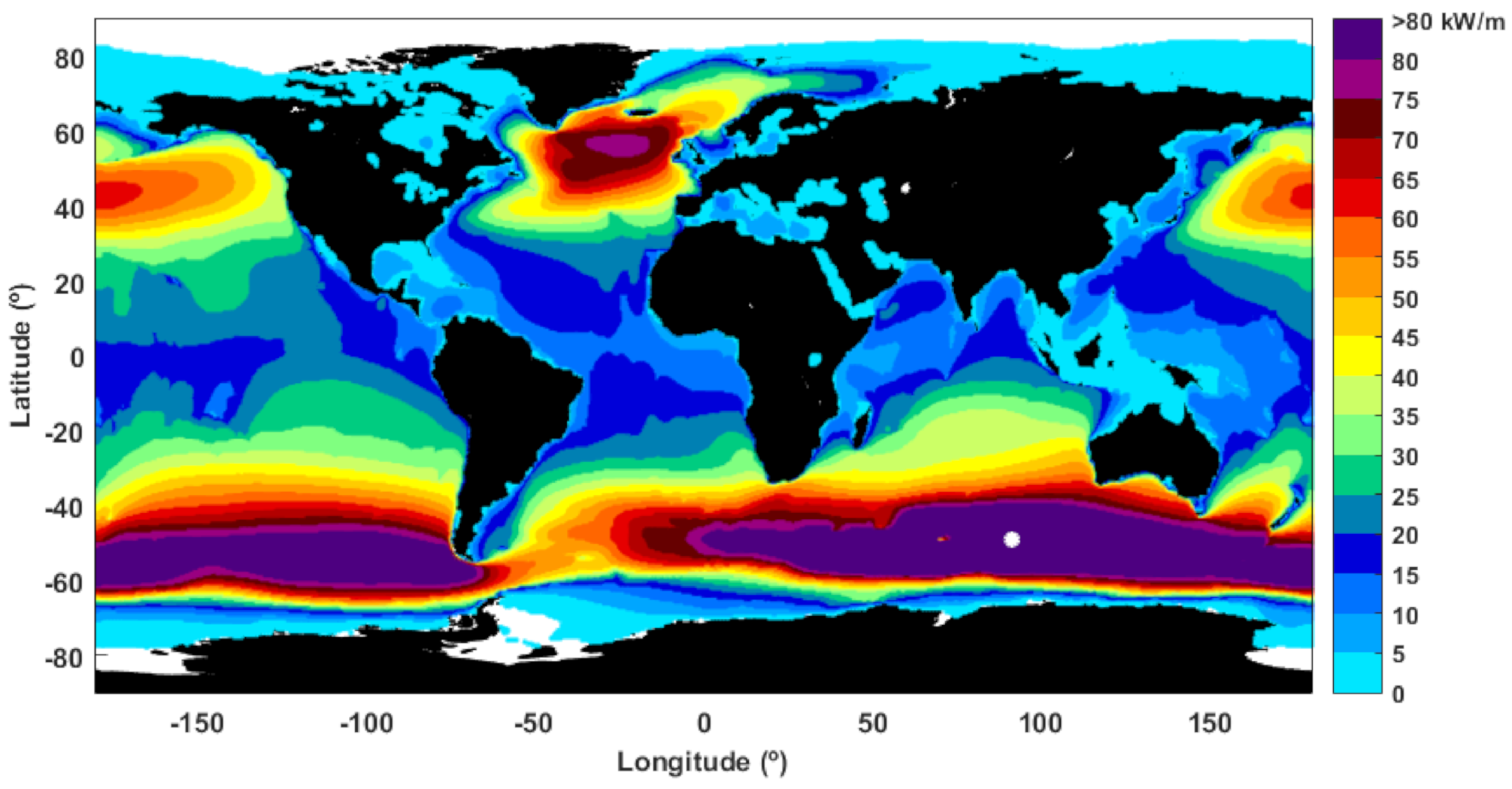
I don't think that necessarily the most violent wave action is desired, maybe.
2) Query: "Global Map of Cold Currents"
https://www.bing.com/images/search?q=gl … soverlay=1
https://www.bing.com/images/search?view … t=0&sim=11 Image Quote: 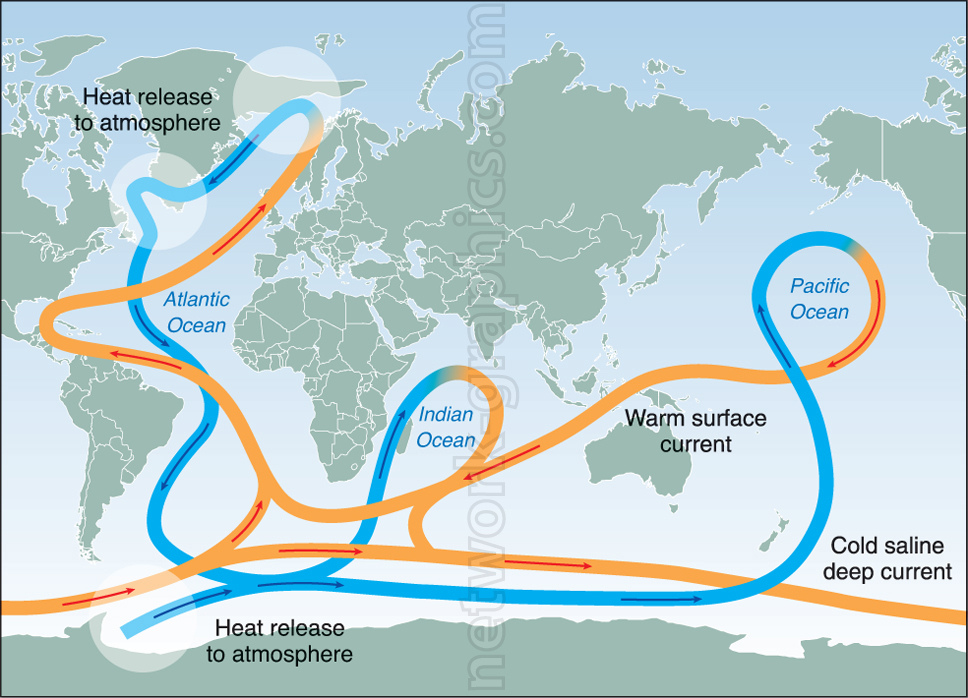
Cold currents provide a) Cold and b) nutrients.
If the type of wave power generator is compatible with it cold nutrient rick water can be pumped up to slosh over the outer surface of the wave generator. This might be done even with warm surface water, but you might have to expend more energy doing it, as you might have to go deeper.
The outer shell of the wave generator could serve as the outside of a heat exchanger, and the inner side as to have a fluid suitable to cool data center chips. This not only borrows cold from the ocean's refrigeration, (A thermal loan), but may fertilize the waters around the wave machine. The water brought up can be warmed by the wave machines, and also it can be mixed with nutrient poor water on the surface of the ocean. The result may be warm enough that it can present itself in the sunlight and so stimulate photosynthesis and food production and by the way, CARBON SEQUESTERATION.
Because of the above, I might suggest that these wave machines might have an on board "ICE" engine to keep the data chips running even when the waves are not delivering as desired. The point is you are sequestering Carbon so you might be "Net Zero". It could be considered as a proper thing to do. You could have a bank of batteries as well as to function in between wave and "Ice" power.
From the previous post, quote:
Here is a Swedish associated device, I believe: https://medium.com/@curiosityai/corpowe … 06e296bc33
Image Quote:So, you have an energy source and a thermal radiator sink. While this will redistribute the heat that ultimately comes from the waves, the heat was going to show up somewhere on the planet anyway.
Refueling the tank for the Ice Engine might be tricky but I think it could generally be done, on aperiodic basis between storms.
3) Query: "Global map of continental shelfs"
https://www.bing.com/search?q=Global+ma … pc=EDGEXST
https://www.bing.com/images/search?view … ajaxserp=0
https://www.bing.com/images/search?view … ajaxserp=0 Image Quote: 
https://www.bing.com/images/search?view … ajaxserp=0 Image Quote: 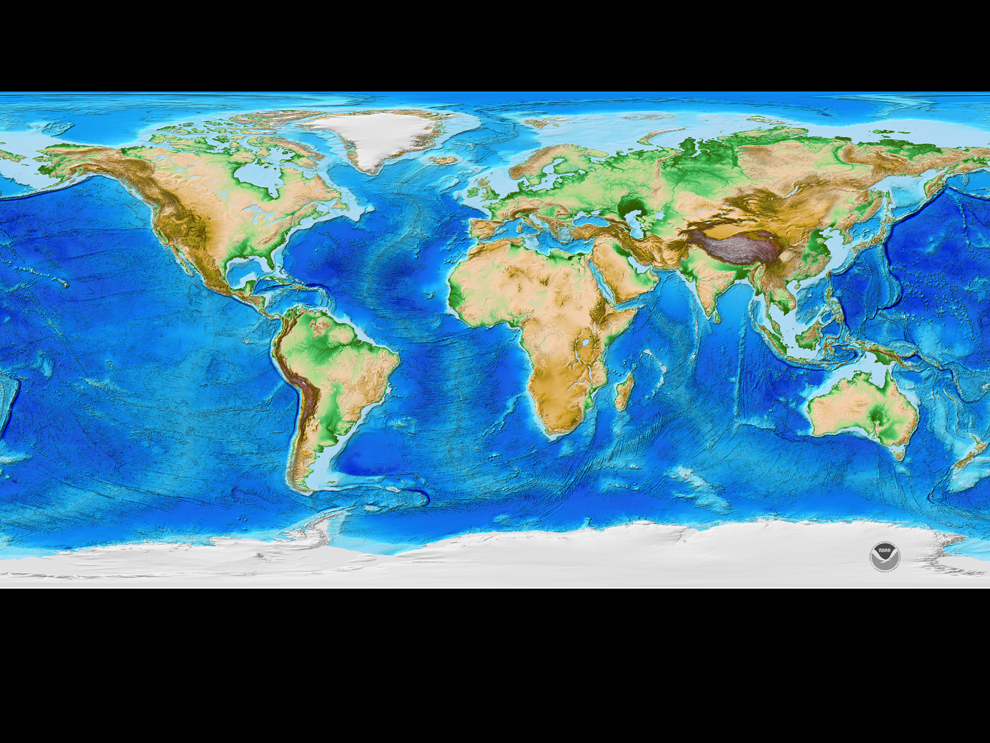
So, then Starlink could be the intermediary between training data centers in the sea and inference in the orbits.
We will want to build a "Butt Kicking Machine" for the Siearra Club types, who have previously blocked the fertilization of the seas. See a reference given by Dr. Robert Zubrin.
We would want to tenderize their Butts until they learned after quite a lot of such "Special Classes for the slow of wit".
Ending Pending
#85 Re: Business Proposals » Data Centers (Including Off World) » 2026-04-26 02:36:02
Wave Powered Data Centers and Starlink.
Yes I could try to chase down a patent, but at my age I need to avoid stress, and I have enough means of existance already.
Starlink is above stretches of ocean that could sustain wave power.
As a side note, I believe it is above Antarctica and Greenland where wind power might be used as well.
Here is a Swedish associated device, I believe: https://medium.com/@curiosityai/corpowe … 06e296bc33
Image Quote: 
So, you have an energy source and a thermal radiator sink. While this will redistribute the heat that ultimately comes from the waves, the heat was going to show up somewhere on the planet anyway.
Now you can avoid having to transmit power, Instead, you process data.
Data Tokens: https://altr.com/resource/blog-what-is- … ete-guide/
Quote:
What is Data Tokenization – A Complete Guide
This will be a Kardashev I method.
I don't believe that this will prohibit space data centers, because it will make Starlink more valuable. And it appears that the desire for power and cooling for AI will be almost infinite.
We also might consider wind powered AI both in the oceans and on ice caps, for similar reasons. Again, doing it this way, you would not have to connect wind power to a power grid.
Ending Pending
#86 Re: Life on Mars » Life Finds a Way » 2026-04-24 08:32:37
I would like to speculate on Early Mars, perhaps as an example of how planets around red dwarfs might support life.
https://en.wikipedia.org/wiki/Radiotrophic_fungus
Quote:
Radiotrophic fungus
https://en.wikipedia.org/wiki/Radiosynt … etabolism)
Quote:
Radiosynthesis (metabolism)
Dark
From Wikipedia, the free encyclopedia
Radiosynthesis is the theorized capture and metabolism, by living organisms, of energy from ionizing radiation, analogously to photosynthesis. Metabolism of ionizing radiation was theorized as early as 1956 by the Russian microbiologist S. I. Kuznetsov.[1]Beginning in the 1990s, researchers at the Chernobyl Nuclear Power Plant uncovered some 200 species of apparently radiotrophic fungi containing the pigment melanin on the walls of the reactor room and in the surrounding soil.[2][3][4] Such "melanized" fungi have also been discovered in nutrient-poor, high-altitude areas which are exposed to high levels of ultraviolet radiation.[5]
Following the Ukrainian results, an American team at the Albert Einstein College of Medicine of Yeshiva University in New York began experimenting with radiation exposure of melanin and melanized fungi. They found that ionizing radiation increased the ability of melanin to support an important metabolic reaction, and that Cryptococcus neoformans fungi grew three times faster than normal.[6][5] Microbiologist Ekaterina Dadachova suggested such fungi could serve as a food supply and source of radiation protection for interplanetary astronauts, who would be exposed to cosmic rays.[5][4]
In 2014, the American research group was awarded a patent for a method of enhancing the growth of microorganisms through increasing melanin content. The inventors of this process claimed their fungi were employing radiosynthesis, and hypothesized that radiosynthesis may have played a role in early life on Earth, by allowing melanized fungi to act as autotrophs.[7]
From October 2018 through March 2019, NASA conducted an experiment aboard the International Space Station to study radiotrophic fungi as a potential radiation barrier to the harmful radiation in space. Radiotrophic fungi have many possible applications on Earth as well, potentially including a disposal method for nuclear waste or use as high-altitude biofuel or a nutrition source.[8]
How much sunlight for Mars now?
Quote:
Mars receives about 43–44% of the sunlight that Earth does, due to its greater distance from the Sun and thin, dusty atmosphere.
Solar Irradiance
The average solar irradiance on Mars is approximately 590 W/m², compared to about 1,367 W/m² at the top of Earth's atmosphere and roughly 1,000 W/m² at Earth's surface under clear conditions. This means Mars gets less than half the sunlight Earth receives, primarily because it orbits at an average distance of 1.5 astronomical units (AU) from the Sun, compared to Earth’s 1 AU. The inverse square law explains this reduction: sunlight intensity decreases with the square of the distance from the Sun.
And I believe that the sun started out about 70% as bright as it is now.
Somehow, Mars had an ocean it seems about 3.5 billion years ago.
The story we get about worlds around red dwarf stars, is magnetic storms will strip away the atmosphere, and the radiation will kill the life.
However, in our solar system if Mars was the same as Earth but in the orbit, it is, with its magnetic field it might have avoided atmospheric stripping at least until it became tidal locked.
And the radiation would actually be food for a fungus, if it existed on such an Earth.
And then there is a chance that a world with 43-44% of Earth's light, might be more massive, and have twice the gravity.
Although the fungus may not be black perhaps a black version could exist that would optimize the albedo of such a planet to pull in heat. Perhaps if such a fungus existed for Mars, a black pigment may have helped Mars to be warm.
It is all maybes, but on the other side, I think that science sometimes is not open enough to possibilities.
Political science seems to be used to convince common people that they "Can't", and therefore should not try.
In my opinion that then makes common people so convinced to be easier victims to predatory rulers.
Ending Pending
#87 Re: Not So Free Chat » Peter Zeihan again: and also other thinkers: » 2026-04-24 06:59:59
This post might go along with the just previous one in my selfish opinion: https://www.youtube.com/watch?v=KS3z2qvp4yA
Quote:
Iran War Winners and Losers: North American Energy || Peter Zeihan
Zeihan on Geopolitics
I will venture some of my own questionable analysis.
It is a "Conspiracy" theory of mine that two processes may have been in operation, somewhat propagated by alien powers.
1) Keep the USA down. De-industrialize it, and make it a falling empire.
2) Keep Alberta and Saschachawan down. Prevent them from acquiring too much financial and therefore political power within Canada.
As pirates go, I think I am rather benevolent. My thinking is to let the container called Canada do what it will inside of it's own container. IF there is a Canada, then that is OK, if there are plural Canada's that is also OK, with me.
I only bring this up because the moment is precious. Here Mark Carney apparently, if I should believe the materials I read, is a "Green Deamon" in league with sinister forces global. He is said to be a globalist financial wizard.
So, due to history, most of Canada Oil will be mostly under the USA umbrella for now. I do wonder if the restriction on exporting crude does not block the export of refined product, what American fuel prices will be.
Now Canada has some choices. If they can overcome the B.C. (China? British?) promoted blockade, and pump mass amounts of Western oil to the pacific, then financial power goes in the direction of the west. Unless the east can confiscate more of it.
For America, Canada western oil going though B.C. to the pacific, is not a loss. If Alverta gets rich they are likely to buy things from us. And cold-blooded thinking says that if we had to we could do military actions of blockade. (If Canada became a colony of some alien empire).
Other oil and gas of the Americas, such as Brazil and Argentina, might draw lots of money into the Americas as well.
This is just my cold analysis of reality. Good chances new factors will alter it later on.
Ending Pending
#88 Re: Not So Free Chat » Peter Zeihan again: and also other thinkers: » 2026-04-23 21:34:30
Well, you just have to admire the Ukraine for this: https://www.bing.com/videos/riverview/r … 46d144a3f7 Quote:
Ukraine Just Did Something That Will UNBLOCK the Strait of Hormuz… Iran Can’t Stop It!
YouTube
Truth Outspoke
16.8K views
What a curious a turn. This may put Arabs, China, Japan, Korea, Ukraine, and the USA on the same side. We were a bit harsh with Ukraine, it seems true to me.
The Arabs and Greater North America (USA, Venezuela, Canada, Guyana) as the new OPEC servicing East Asia that makes stuff for those with Oil and Gas money.
Russia off in the shadows? Still selling to China, etc. IF Russia were smart it could offer weapons to the Arabs also, and screw Iran.
Ending Pending
#89 Re: Terraformation » Terraforming Earth » 2026-04-22 18:26:27
I am interested in chasing the idea of refrigerating soil, to increase it's humidity in conjunction with solar power.
I think it may be possible to achieve the following:
1) Double soil humidity.
2) Generate Industrial Heat.
3) Refrigerate Solar panels to increase their efficiency and to lifetimes.
4) Make pipes of Carbon from Oil and Natural Gas, and yet extract the Hydrogen as a fuel. (Maybe)
While I have previously focused on night and winter air, here I am exploring active cooling.
Quote:
I worked on this issue before: This depiction is approximately appropriate.
An additional feature might be exploited, if you could cool the soil using solar power and natural cooling events.
I have only marginal understanding of heat pumps so what I might suggest could be somewhat iffy.
https://link.springer.com/article/10.10 … 25-00021-z
Quote:
Home Carbon Neutral Systems Article
High-temperature heat pumps: key technologies and industrial applications toward carbon–neutral process heating
Review
Open access
Published: 29 December 2025
Volume 1, article number 21, (2025)
Cite this article
You have full access to this
open access
article
I am speculating on buried plastic pipes. Plastics have been criminalized. That and Microplastics.
But I feel that if we wear cloths that make microplastics and car tiers and such, pipes buried in the ground may not be a thing to fear. Just don't dump them in the ocean or grind them to fine dust.
My logic it to keep a value added to culture from hydrocarbon sources.'
*I feel that monarchists and other elites have dreamed of a form of socialism where they can cultivate a low intelligence servant race and reserve for themselves glorious superiority. You might thing they would want vast abundance, but I think they want to be superior to other people. So they do not like industrial societies at all. Reportedly this was true for the Estate Owning English.
I do not particularly like them if that is how they think a good society should be run. Just to give comfort to their ego's. To make the common people suffer, just so that an elite may feel superior, to me is not appropriate at all.
As I currently am trying to think of it, I am thinking of usine air as the fluid that interacts with the pipes and the solar panels.
Obviously, there are many climates. Some climates may be naturally dry and some naturally wet.
In either case the increase of humidity and even wetness in the soil the pipes would be burred in could be useful.
You would need energy storage to use it at night of course. In the night you could shed heat into the night air. And then cool the buried pipes. Then during the day, you could pull cold out of the pipes to cool the solar panels. Cooling the solar panels may increase their life span and efficiency.
One possible place to think about might be North Dakota or the south of the prarie provences.
In the summer you might cool the soil and so humidity the soil to suit plants. But in the winter, you might draw heat of the solar panels and push it into the soil. Then you might draw the stored heat out of the soil to heat a building.
If you were in Texas, you might cool the soil almost all year to humidity it. You might pull heat out of the soil to produce industrial heat from a heat pump system.
What if you are in Florida with high humidity? Well maybe you will get condensate to draw off. Water of that sort might be quite welcome.
I am working on it.
I already understand that in this economy the hardware may be too expensive. But with future robotics, deflation of hardware costs might become a reality.
Well, that is a bit of it. I am sure better can eventually be arrived at.
Goodnight, Ending Pending
#90 Re: Life on Mars » Life Finds a Way » 2026-04-22 08:36:43
I received a positive answer to the question "Can Black fungus found in nuclear reactors use Ultraviolet light?"
I got that on a query on my phone, not on my computer though.
https://en.wikipedia.org/wiki/Radiotrophic_fungus
Quote:
Radiotrophic fungus
A question is, can this fungus live in Mars simulations? Let's say the Mars day/night thermal cycle with the Relative Humidity effects?
As I mentioned in the previous post, some Lichen seem to be able to pluck moisture out of the air in such simulations and are somewhat tolerant of UV light. However, they do not appear to use UV light to grow.
Some situations on Mars will have daytimes that are above the freezing point of fresh water. But some Lichens can run a metabolism even if the temperatures are as low as -20 degrees C.
How does the black fungus or it's relatives tolerate these situations?
Then finally if some strain of the black fungus can work with all of that, how might it react to Perchlorates?
>>>>>>>>>>>>>>
Then the question can be poised, did life related to black fungus live on the lands of Earth before an Ozone layer appered?
And also, does the black fungus do better with Oxygen or with reduced Oxygen?
>>>>>>>>>>>>>>>>
Then the question, why did the black fungus power system does not compete with the green photosynthesis that we largely have now?
I do have a speculative answer for that: "One System Rules Them All", "Outcompetes them All.'
>>>>>>>>>>>>>>>>
Some have speculated that the Earth originally had purple pigment Photosynthesis, but Green outcompeted that.
I am wondering about "Black" pigment at some stage on the land. In the Oceans much of the hard UV would be blocked.
>>>>>>>>>>>>>>>>|
Could we create a terraform tool from Black Fungus to work with Mars?
It probably would not be a danger to Earth, as Green will probably outcompete it.
Does Black Fungus release Oxygen?
>>>>>>>>>>>>>>>>
I have speculated that perhaps life could run on wind. That is it might generate electricity from embedded crystals and live on that.
This might be true for worlds that may not have suitable sunlight for light driven organisms purple, black, or green.
Perhaps the dark side of a tidal locked world, or a planet with massive cloud cover.
>>>>>>>>>>>>>>>>
Possibly for Mars might there be life in the permafrost that might run on electric currents from dust storms?
Quote:
Copilot Search Branding
Like
Dislike
Images
Videos
Lightning has been confirmed on Mars, primarily occurring as small electrical discharges in dust storms and dust devils.
Evidence of Martian Lightning
NASA’s MAVEN spacecraft detected a whistler wave, a low-frequency electromagnetic signal typically caused by lightning, in Mars’ ionosphere. This event was recorded over a localized crustal magnetic field at an altitude of 349 kilometers on the night side of the planet, lasting 0.4 seconds and spanning up to 110 Hz, representing the first direct evidence of lightning-like activity on Mars (NASA, 2026). MAVEN’s detection was extremely rare, with only one event found among over 108,000 measurements, highlighting the elusive nature of Martian lightning.
Phys.org
+2
Mechanism of Lightning Formation
Unlike Earth, Mars lacks a global magnetic field and has a thin, dry carbon dioxide atmosphere. Lightning on Mars does not form in rain clouds but is generated by triboelectric charging during dust storms and dust devils. As dust grains collide and rub together, they accumulate electrical charge, which can discharge as small sparks or “mini-lightning” (Nature, 2025; EarthSky, 2025). Laboratory experiments and simulations confirm that these conditions can produce electrical discharges similar to those observed in terrestrial volcanic eruptions or dust devils.
CBS News
+1
Observations from the Surface
The Perseverance rover recorded 55 instances of electrical discharges over two Martian years, with seven events capturing full acoustic signatures, including tiny sonic booms akin to miniature thunderclaps. These discharges were typically very small, ranging from 0.1 to 150 nanojoules, with one larger event at 40 millijoules, far weaker than typical Earth lightning (ScienceAlert, 2025; CBS News, 2025). The events occurred mostly during the strongest winds at the leading edges of dust storms or within dust devils, confirming that both dust and wind are necessary for lightning formation.
ScienceAlert
+1
Implications
Martian lightning is much weaker and more localized than Earth’s, posing minimal risk to future human explorers but potentially affecting sensitive equipment. The discovery also provides insights into atmospheric chemistry, as electrical discharges can drive reactions that form oxidizing compounds like perchlorates, which are common on Mars (Nature, 2025). Understanding these discharges helps scientists model Mars’ atmosphere and plan future missions, including ESA’s proposed M-MATISSE mission.
Nature
Summary
Lightning on Mars exists but is rare, weak, and mostly near the surface.
It occurs primarily in dust storms and dust devils through triboelectric charging.
MAVEN detected a whistler wave from orbit, while Perseverance recorded miniature lightning and sonic signatures on the surface.
These findings enhance our understanding of Martian atmospheric dynamics and have implications for future exploration and planetary chemistry.
This discovery confirms that Mars, despite its thin atmosphere and lack of a global magnetic field, can generate electrical discharges similar to lightning, albeit on a much smaller scale than on Earth.
I have considered that perhaps "Carbon Tracks" may exist in permafrost soil where electric discharges may be attracted repeatedly.
Such Carbon Tracks can occur on circuit boards, so I speculate that it could happen in permafrost where repeated electrical discharges may occur.
The electrical discharges might melt water either fresh or brine and may reset chemistry to provide life sustaining chemicals to life.
Here again we do have microbes at least that can live on electricity itself, and maybe such chemistry as I have mentioned.
I speculate that a Mars simulation with simulated permafrost, might even allow Earth organisms of some sort to live in the presumed "Carbon Tracks" that might be generated by simulations of Mars Dust Storms.
Ending Pending
Quote:
Electric bacteria
Life that lives on electricity
Electric bacteria are a unique example of life forms that thrive on electricity. These bacteria, such as Shewanella and Geobacter, can survive on pure energy, consuming electrons from rocks and metals. They are not dependent on sugars or other nutrients, making them a fascinating subject of study in the field of microbiology. The discovery of electric bacteria shows that some basic forms of life can handle energy in its purest form, which is a significant advancement in our understanding of life's energy requirements.
New Scientist
+1
https://www.newscientist.com/article/dn … re-energy/
Quote:
Life
Meet the electric life forms that live on pure energy
Unlike any other life on Earth, these extraordinary bacteria use energy in its purest form – they eat and breathe electrons – and they are everywhereBy Catherine Brahic
16 July 2014
So, it may be interesting to see of there are any of these that may live in icy permafrost, perhaps polar or alpine.
There are microbes that "Eat Air"
Quote:
Antarctic microbes have been discovered that can eat air, specifically using atmospheric gases like hydrogen, carbon dioxide, and carbon monoxide. These bacteria, known for their ability to perform atmospheric chemosynthesis, thrive in low-nutrient environments, such as polar deserts, where they convert atmospheric gases into organic compounds for growth. This process allows them to survive in extreme conditions where traditional food sources are scarce, potentially playing a significant role in the ecosystem by contributing to carbon cycling.
https://refractor.io/biology/air-eating … ica-artic/
Quote:
Biology
Bacteria that "eat" only air found in cold deserts around the world
By Michael Irving
August 19, 2020 05:53 pm
https://www.sciencealert.com/strange-ba … e-realised
Quote:
Strange Bacteria That Survive Only on Air May Be More Prevalent Than We Realised
Nature
20 August 2020
ByTessa Koumoundouros
I speculate that the underside of thin rocks on Mars might have a favorable condition on their undersides, where the sun may warm the underside of a thin stone and releases trapped moisture for microbes to use. Then at night the rock grows cold and then in early morning moisture may condense on the underside of the rock.
Ending Pending
#91 Re: Life on Mars » Life Finds a Way » 2026-04-21 16:44:03
Interesting (th).
As I understand it there are maybe four reasons that life could not live in present day Mars.
1) No Water
2) Too Cold
3) Radiation
4) Perchlorates.
But there are life forms on Earth that can tolerate each of those conditions.
1) Lichens can pull water out of the atmosphere at 70 to 100 % Relative Humidity. In many places this humidity may occur before sunrise.
2) Lichens can metabolize down to -20 C.
3) A black Fungus eats radiation and UV.
4) Some microbes can eat Perchlorate.
The question is could there be an organism that could work with all 4 of these problems?
So, it has looked like Mars might be able to support life of some kind at this time. But it also is suspected that Mars could have had better or worse environments in the past. During a enduring bad spell, life might have gone extinct. A bad spell might have an atmosphere of less than 1 millibar pressure, which could have occurred perhaps when the axis would be tilted to freeze out almost all CO2 into the polar ice caps.
1) Quote:
Lichens can effectively pull water out of the atmosphere at 70 to 100% relative humidity, which is often found before sunrise. They utilize atmospheric water vapor as a primary source of hydration, allowing them to thrive in dry environments. Lichens do not have specialized organs for water uptake; instead, they absorb water from the air, and their water content can drop to 15-30% during dry spells, becoming metabolically inactive until humidity increases.
2) Quote:
Lichens can continue their metabolism down to -20 degrees Celsius due to their unique adaptations. They possess specialized structures that allow them to survive in extreme conditions, including polar regions. Their metabolic processes are adapted to low temperatures, enabling them to endure harsh environmental conditions and maintain their physiological functions.
3) Quote:
The black fungus, Cladosporium sphaerospermum, has been observed to thrive in the Chernobyl Exclusion Zone, where it appears to "eat" radiation. This phenomenon, known as radiosynthesis, involves the fungus using ionizing radiation as a source of energy to drive metabolic processes. The melanin in the fungus's cell walls absorbs and neutralizes radiation, similar to how chlorophyll harnesses sunlight in plants. This ability to convert radiation into usable energy allows the fungus to grow in areas with intense radioactive exposure, offering a potential solution for radiation contamination cleanup.
I suspect that it can use Ultraviolet radiation as an energy source, but I do not have strong data for it: https://en.wikipedia.org/wiki/Radiotrophic_fungus
4) Quote:
Yes
Yes, some organisms can eat perchlorates. Certain microorganisms, such as those capable of growth via perchlorate reduction, have been isolated and can utilize perchlorate to produce harmless chloride and oxygen. These microorganisms can thrive in environments where perchlorate is present, potentially aiding in soil and dust cleanup.
CDC
So, I am guessing that even if a organism that can work with all four factors does not exist at this time, it could have or maybe could/does exist somewhere in the universe.
Ending Pending
Quote:
In Mars simulations, several organisms have been tested for survival under Martian conditions:
Aspergillus calidoustus: This fungus has shown remarkable survival under Martian solar irradiation and atmospheric conditions, demonstrating its resilience to extreme environments.
1
Lichens: Certain lichen species, such as Diploschistes muscorum and Cetraria aculeata, have been found to remain metabolically active under simulated Martian conditions, including exposure to ionizing radiation.
1
Bacterial species: Studies have evaluated the survival of bacteria like Burkholderia cepacia, Pseudomonas aeruginosa, Serratia marcescens, and Klebsiella pneumoniae in Martian simulated conditions, highlighting their potential survival risks for human missions.
1These findings underscore the importance of understanding microbial resilience in the context of Mars exploration and planetary protection strategies.
My Opinion:
While I consider this to be a very nice set of results, it needs to be considered that Socialists, Monarchists, and others who view common people to be financial assets that they the elites are justified to exploit for wealth, they may use the planetary protection concerns as a political tool to accomplish their objectives of subjugation of societies to milk them for wealth.But I also do consider it important to be concerned about the matter. I just don't want a bunch of psychopathic elites to cripple the human race.
Ending Pending
#92 Re: Terraformation » The Moon » 2026-04-21 09:35:51
I think that with the hardware that seems to be possible to obtain, setting up regolith processing might involve:
1) The Orion or maybe an evolved Dragon.
2) Starship Freighters.
3) Blue Origins lander or a Stubby (Very Stubby) Starship.
Although the Lunar Starship is a very nice thing to have, the thing about the Moon is it has raw materials that can be developed into resources. If you can land a Starship Freighter(s), then you can use those resources to upgrade it to be habitat and factory. It does not make sense to expend the propellants to fly the Freighter Starship back up to orbit.
This is especially true if mass drivers can be made to work for the Moon.
So the idea of a "Stubby Starship" was proposed by Tim Dodd, I believe.
Here is a video about a similar idea: https://www.youtube.com/watch?v=V5_84O8rKSY
So, I don't see why a "Stuby Starship" should have to carry even 30 tons, just some people and a small amount of freight.
I would like to see a Hydro-Lox propulsion system as well, perhaps from Blue Origin.
IF the Earth might have to humanoid robots for each human, the for the Moon it might speculate 300 to 1, where not all robots might be humanoid.
Just some guessing.
So, full Lunar Starship is overkill, I think, but wonderful to have anyway.
Ending Pending
#93 Re: Not So Free Chat » Peter Zeihan again: and also other thinkers: » 2026-04-21 09:20:22
This post like the previous one is my opinions with ideas borrowed from better minds than my own.
There is the idea of "When the Student is ready, the Teacher will appear".
This will be like tutoring, I expect. Something that commoners cannot afford for the most part. Commoners are the main source of value in human activity, with the exception of people like Elon Musk, and President Trump. (Oh, I bet you love me).
Teh Prussian Classroom was adopted by the American school system for reasons of economic efficiency. That is at that time it was not that bad of a decision. But at this time a greater emphasis on capability might be important. If 2/3rds of the humanoid and human actors were to be robots, then their will be the "Human Time" and "Robot Time". That is if robots can be active around the clock, then they may have different tasks based on human sleep patterns.
Presuming any humans still live, then during the day robots that did other tasks may in many cases interact with children, while they would be awake. And here you have the case where teaching can be at the rate suitable to the individual student or perhaps small groups of similar level students.
Perhaps everyone would be in a "Special Class".
"Trailer Park" kids that matured early could be kept separate from those with a longer childhood. And persons with aptitude for certain things could have those developed, but also those with impediments to certain skills could be given more time and effort to "Catch-Up" in those things.
The Schoolmarms will get a butt kicking. Also, the same for their male equivalent.
Thoe whole idea of stigma might only apply to those who refuse to try.
The feeding of egos, and the stigma of failure put to classes and grades, probably not a worthy way to evaluate the worth of a person.
Anyway, some sort of shift is probable, I expect.
Ending Pending
#94 Re: Not So Free Chat » Peter Zeihan again: and also other thinkers: » 2026-04-20 09:14:16
It is amusing to see historical projections in time about concepts of a future. For instance people in the 1920's speculating on what the 21st century might look like.
But I have been thinking about one feature of robots. So perhaps I will be seen as silly some century in the future if I am noticed at all.
While it is important to consider the productivity amplification that may come from Humanoid Robots, here I am considering the cultural effects.
I will call both humans and humanoid robots "Actors". Only because they can each act on society both physically and verbally.
https://www.nbcnews.com/tech/tech-news/ … rcna265192
Quote:
Melania Trump walks side by side with humanoid robot at White House summit
Melania Trump pitched a vision of the future in which robots serve as educators who teach students about philosophy and art.
So, the robots may be able to communicate in multiple languages.
If it would come true that 2 out of 3 actors in Greater North American Societies would be humanoid robots, then I expect that language issues may be reduced. I myself am only 1/2 Scandinavian by genetics. I have a friend who told me that on a trip to Quebec the people there were very rude and refused to speak English which made it hard. I do understand the historical reasons. However, it does seem rather nasty to do this to someone who really is not English at all. But victim testimonies are not my purpose here.
If 2/3 of actors are multilingual, then in all areas of Greater North America, it will become very much easier to navigate in places where you do not know the language.
Your major activities being finding lodging, shopping, restaurants and so on, the issue of mono-linguistic cultures will not be nearly as much as it might be now.
If I understand how Optimus might work, you might take one with you when traveling, or your Optimus software may be able to manifest itself into a machine at a location where you have traveled to.
>>>>>>>>>>>>>>>>>>>
I am less certain about the "Vinegar" problem. Verbal and Violent rulers of limited use.
It is my opinion that language in humans first elevates the human race, but later sets up a predator and prey process that devolves the human race to rulers and producers.
Nature having taught humans how to efficiently manipulate objects, along the way they develop community and language. This then allows enough power to then create a civilization. After that however, you develop a specialized ruling class that avoids being productive as that requires effort and some endurance of discomfort.
The "Vinegars" emerge, and thereafter they keep trying to reduce the wealth of the productive people and keep trying to increase their "Vinegar" individuals in a society.
I think the curious thing is how much a Monarchy and Socialism resemble each other in the end.
I think we can see this in Europe. "The new boss, the same as the old boss".
Having said that I want it understood that I do not consider Elon Musk or President Trump to be Vinegars at all. Far from it. Very productive people.
I am not about jealousy of success, or I hope not to be.
America and Mexico are somewhat shed of the old Monarch Vinegars, but even so we suffer the emergence of similar kinds. But we have better chances than I think Western Europe and Canada have. The middle East is even more dammed than that, I fear.
The question is Humanoid Robot Actors with excellent verbal skills; how will this effect the Vinegar process?
Unlike a male Vinegar, they likely will NOT have the evolutionary compulsion to kill other males and mate with their women. And I presume that they will not have the same urges to avoid discomfort and toil. Unlike humans such robots might feel things, but could block unpleasant things. The females Vinegars ever hypergamous, will deplete the genetics and memes for productive behaviors in a society and ultimately put the human race back into the stone age outhouse, in my opinion.
The glorification of dominance is satanic in its nature in my opinion and is toxic to capabili9ties in the human race I think
The robots may displace the Vinegars to some extent.
I remains to be seen what actually happens, perhaps I will live to see a bit of it.
Ending Pending
#95 Re: Terraformation » The Moon » 2026-04-20 08:47:39
A thing that may be in reach early on would be an array of 2 or mare Starships, perhaps on their sides, that could be used to refine Lunar regolith.
The way I currently would like to see Moon method to develop would be where the Starships usually stay on the Moon, and to then have a smaller ship that could transport humans up a down to the Moons lower orbits.
A thing that seems apparent from some concepts of processing Lunar regolith is that heat in a vacuum may release Oxygen. But of course you have to capture the Oxygen, so the process needs to be in an enclosure. But you need to maintain the vacuum.
So with 2 or more starships, one ship could be in Vacuum, and one might then take the Oxygen produced as a pressurized gas.
So, perhaps a starship would be open door to be loaded with regolith, and the door then to be closed to process the regolith. The Vacuum processing might occur first, but later, after that is done perhaps the ship would be repressurized, and further processing.
Ultimately the regolith would be fully processed, and the Oxygen removed again, and then the products moved out of the ship to be put to a purpose.
And then repeat.
You may try for "Easy Oxygen" first, then perhaps Iron, and perhaps then the extraction of Aluminum and Silicon. The leftovers might be melted and cast into stone blocks.
This might be an early way to effectively extract wealth from the Lunar regolith.
Ending Pending
#96 Re: Terraformation » Terraforming Earth » 2026-04-19 09:15:00
Solar Power and Rainfall:
Quote:
Large solar panel arrays can create localized conditions that promote rainfall by altering temperature, airflow, and moisture patterns.
Mechanism of Rain Formation from Solar Panels
Solar panels affect the local microclimate primarily through temperature and airflow changes. Dark photovoltaic panels absorb sunlight, converting 10–20% into electricity while the rest contributes to heat. This creates thermal gradients, where the air above the panels warms slightly while the ground beneath remains cooler due to shading. The rising warm air generates updrafts and convection currents, which can lift moisture into the atmosphere and enhance cloud formation.
biologyinsights.com
+2The panels also increase surface roughness, slowing near-ground winds and promoting vertical mixing of air. This combination of rising warm air and altered wind patterns can lead to greater atmospheric instability, which is a key factor in precipitation formation.
biologyinsights.com
+1
Positive Feedback in Desert Environments
In arid regions like the Sahara, large solar farms have been observed to trigger rainfall and vegetation growth. The process works as a positive feedback loop: solar panels lower ground temperatures, warm air rises, clouds form, and rainfall increases. This rainfall supports plant growth, which further enhances local moisture levels, potentially leading to a gradual “greening” of desert areas.
EcoPortal.net
+1
Scale and Limitations
While these effects are noticeable in massive solar farms, the current scientific consensus indicates that typical solar installations are too small to significantly alter regional weather or precipitation patterns. Most observed impacts are localized, affecting the thermal boundary layer and dew point rather than causing widespread rainfall changes. Simulations suggest that only solar arrays covering extremely large areas, such as a significant portion of the Sahara, could meaningfully influence rainfall and global climate patterns.
biologyinsights.com
+3
Summary
Solar panels can indirectly cause rain by:
Creating thermal updrafts that lift air and moisture.
Modifying local wind and airflow through surface roughness.
Shading the ground, which reduces evaporation and enhances convection.
Supporting a positive feedback loop in deserts, where rainfall encourages vegetation growth, further increasing moisture.
These effects are most pronounced in large-scale solar farms in arid regions, while smaller installations mainly influence microclimates rather than regional weather.
3
I worked on this issue before: 
An additional feature might be exploited, if you could cool the soil using solar power and natural cooling events.
To do this then the part of the frame of pipes buried under the soil needs to be resistant to corrosion. Plastics, Aluminum?
Natural cooling events are :
1) Shade from the solar panels.
2) Night cooling.
3) Winter seasonal cooling.
Using fans, you could push cool air through non-permeable pipes when #2 and #3 are favorable.
You might also incorporate a cooling method for Solar Panels that the Saudi seem to be involved in: https://www.pv-magazine.com/2025/06/09/ … ncy-by-12/
Quote:
New cooling gel could raise PV module efficiency by 12%
Researchers in Saudi Arabia have developed a hydrogel composite that absorbs moisture in solar modules overnight and facilitates evaporative cooling throughout daylight hours. The system has undergone lab tests and outdoor experiments on two continents.June 9, 2025 Lior Kahana
If during the night for instance you cooled the soil by pushing cool night air through the pipes under the soil, now you may push the humidified air from the gel evaporation into the cooled pipes, hoping to promote condensation. Of course, you will need a small drain hole to allow the condensate to exit the pipe into the soil.
So, many places on Earth could benefit from this but I think that the western interior core of North America could benefit greatly.
Here is moer support for the rainfall production: https://www.ecoportal.net/en/solar-pane … uds/19854/
Quote:
Solar panels are creating an unexpected effect by forming rainfall clouds and thriving oases in the middle of the desert
Warren van der Sandt by Warren van der Sandt April 11, 2026 in Energy
Returning to the idea of pipes to cool the soil, you might even get into heat pump methods.
IF you could cool soil using buried pipes and produce industrial heat, you might even induce permafrost in the soil which might improve moisture quality.
Permafrost ponds occur in the arctic because the icy permafrost of the pond bottom does not allow the water to drain.
In Alaska under the Midnight sun, it is possible to grow "Crops" on top of permafrost, in the upper soil hat has thawed.
https://www.permafrostgrown.org/
Quote:
Researchers and farmers working together to understand permafrost-agriculture interactions.
Quote:
Farming on permafrost soil presents unique challenges and opportunities. The Permafrost Grown Project is a significant initiative that aims to understand the interactions between permafrost and agriculture in Alaska. The project focuses on developing sustainable, adaptable, and resilient permafrost-agroecosystems by co-producing knowledge with farmers and researchers. It employs a combination of field data collection, sensor networks, remote sensing techniques, agricultural experiments, existing agriculture experience, interviews, and socio-economic risk modeling to address various objectives related to permafrost and agriculture. The project is funded by the US National Science Foundation's Navigating the New Arctic Initiative and has a budget of 3 million USD over 5 years.
permafrostgrown.orgThe project's research team includes experts from the University of Alaska Fairbanks and Alaskan farmers, who collaborate to investigate the impacts of permafrost on agricultural infrastructure and cultivation activities. They aim to understand how permafrost affects soils used for agriculture and how agriculture affects permafrost. The team conducts ground penetrating radar (GPR) surveys and collects ground cores to assess permafrost conditions. The project's findings can benefit from the ~120-year legacy of farming on permafrost in Alaska and the predicted intensification of high-latitude agriculture in response to climate changes.
Futurum Careers
It is also possible that solar panel installations might moderate killing frosts. But natural thermal inertia, or you might even put a heating method into them, that may run on batteries and be used to extend the growing season a week or two.
Ending Pending
#97 Re: Not So Free Chat » Peter Zeihan again: and also other thinkers: » 2026-04-19 08:54:45
I like this analysis: https://www.bing.com/videos/riverview/r … ORM=VRDGAR
Quote:
Putin and Trump Have the SAME Strategy — And Nobody Sees It. Jiang Xueqin Analysis
YouTube
Доктор Вебер
8.6K views
I will agree to attribute some cunning to both Trump and Putin, but I believe that much of this process activates itself.
To some degree Russia and North America (Greater), are natural allies, not competitors. If you can think in multiple dimensions this becomes obvious. The friction with NATO is that their map of reality is outdated by centuries.
Ending Pending
#98 Re: Terraformation » The Moon » 2026-04-18 10:19:40
It has occurred to me to wonder if the Moon is fracking itself while it cools.
Quote:
Transient lunar phenomena
Outgassing events on the Moon are associated with transient lunar phenomena (TLPs), which are short-lived changes in light, color, or appearance on the lunar surface. These phenomena can include brightenings, dimmings, and color changes, often described as "mists," "clouds," or "volcanoes." The physical mechanism responsible for creating TLPs is not fully understood, but theories suggest they are the outcome of lunar outgassing, where gases are released from the surface of the Moon. This outgassing can be influenced by seismic activities, such as moonquakes, which may release gases that reflect sunlight and cause luminous phenomena.
https://en.wikipedia.org/wiki/Transient … phenomenon
Image Quote: 
Quote:
This map, based on a survey of 300 TLPs by Barbara M. Middlehurst and Patrick Moore, shows the approximate distribution of observed events. Red-hued events are in red; the remainder are in yellow.
Mare events and fire fountain event partially drained the interior of the Moon. But I don't expect that it was 100% efficient. The Moon cooling would develop stresses. Seismic events might extend cracking. Fresh cracking may facilitate release of deep trapped gasses.
So, polar deposits and fire fountain rock may offer desired things, but main cracks in the deeps of the Moon might also offer something of value.
Ia a spiral path of solar power from pole to pole could intercept fossil fire fountains and major cracks. Perhaps this would be a resource of value.
Major outgassing events may be rare, but it might be that certain pathways might outgas at a low rate more often. Possibly to some extent continually.
Ending Pending
#99 Re: Terraformation » The Moon » 2026-04-16 19:28:50
Continuing on Fire Fountains on the Moon: https://www.nature.com/articles/s41467-026-69087-8
Image Quote: 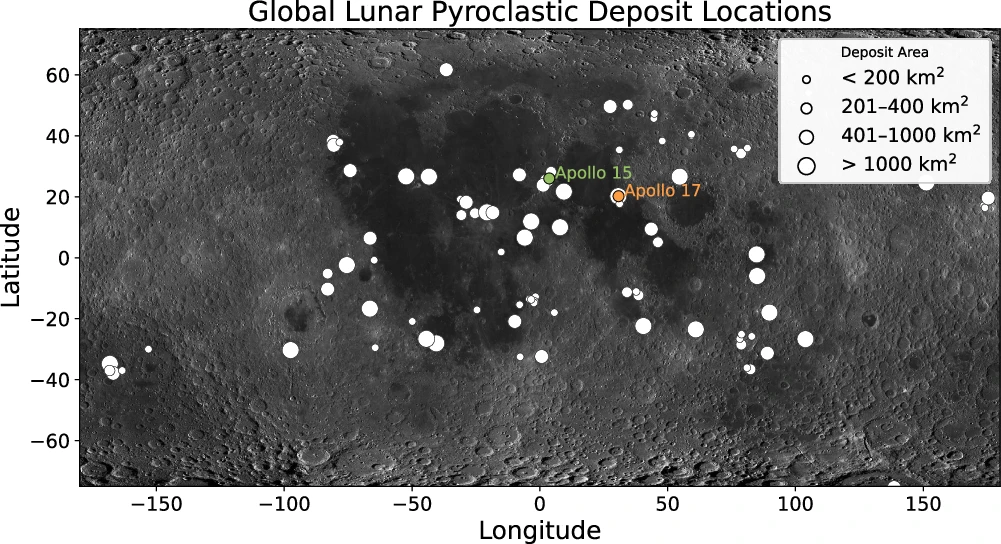
Isn't it interesting that the near side has the most, but there is inverse symmetry on the far side?
At -40 Latitude on the far side, some are to the left. At 20 to 40 Latitude, some are to the right. Probably not too important though.
Query: "How Thick were the Mare on the Moon?"
Quote:
500 meters to 1500 meters
The thickness of lunar maria typically ranges from 500 meters to 1500 meters. Individual lava flows within these maria can be about 10 to 20 meters thick, indicating that they are the result of several overlapping
Image Quote:
https://en.wikipedia.org/wiki/Lunar_mare
Quote:
Lunar mare
To get down 100-400 km is too deep, I think but to follow the "Pipe" down a distance may be possible.
The deepest mine on Earth is apparently 4 km deep. So on the Moon 4 * 6 = 24 km???
But I don't think that heat in the mine will be as much of a problem on the Moon.
I am guessing that the deeper parts of the Mare may have more volatiles than the surface also.
So if you could dig vaults 500 to 1500 meters deep in the Mare, perhaps desirable materials could be obtained.
So, back to post #283: https://newmars.com/forums/viewtopic.ph … 42#p238742
Quote:
So, from post #281, a carving-drilling method into a ancient Fire-Fountain might yield value:
Perhaps this will help visualization of it:
Both in the form of recovered materials and the vaults which in some cases could be rendered "Habitable" eventually.


So, I would modify the Japan concept of a equatorial ring into a spiral which might end at each pole and in connecting the poles intercept many of the fire fountains.
And then vaults where there might be a substance worth mining.
Ending Pending
#100 Re: Terraformation » The Moon » 2026-04-16 10:59:35
The idea of importing organics from other places to the Moon could be desired eventually, but of course prior to that if it is possible to get them more locally, that is probably a better path.
https://dailygalaxy.com/2026/02/japan-p … ound-moon/
Quote:
Science
Japan Plans to Create a Solar Ring Around the Moon to Power Earth for Eternity
Shimizu Corporation’s Luna Ring concept could transform global energy by harnessing the Moon’s solar power and beaming it back to Earth.Published on February 8, 2026 at 08:45
|
Lydia Amazouz
Written by Lydia Amazouz
|
Reading time : 4 minutes
Image Quote: 
https://www.youtube.com/@Anthrofuturism Has given me the impression that by heating Lunar Regolith, you can accumulate Hydrogen. But for Carbon you may lose mass where the Carbon may combine with the slag and be lost.
I don't consider that I am a source of original ideas, but maybe some modified ideas are more likely. In this case I don't what to interfere with Japan's dreaming too much, but I would like to modify there concept.
https://scitechdaily.com/moons-mystery- … nar-water/
Image Quote: 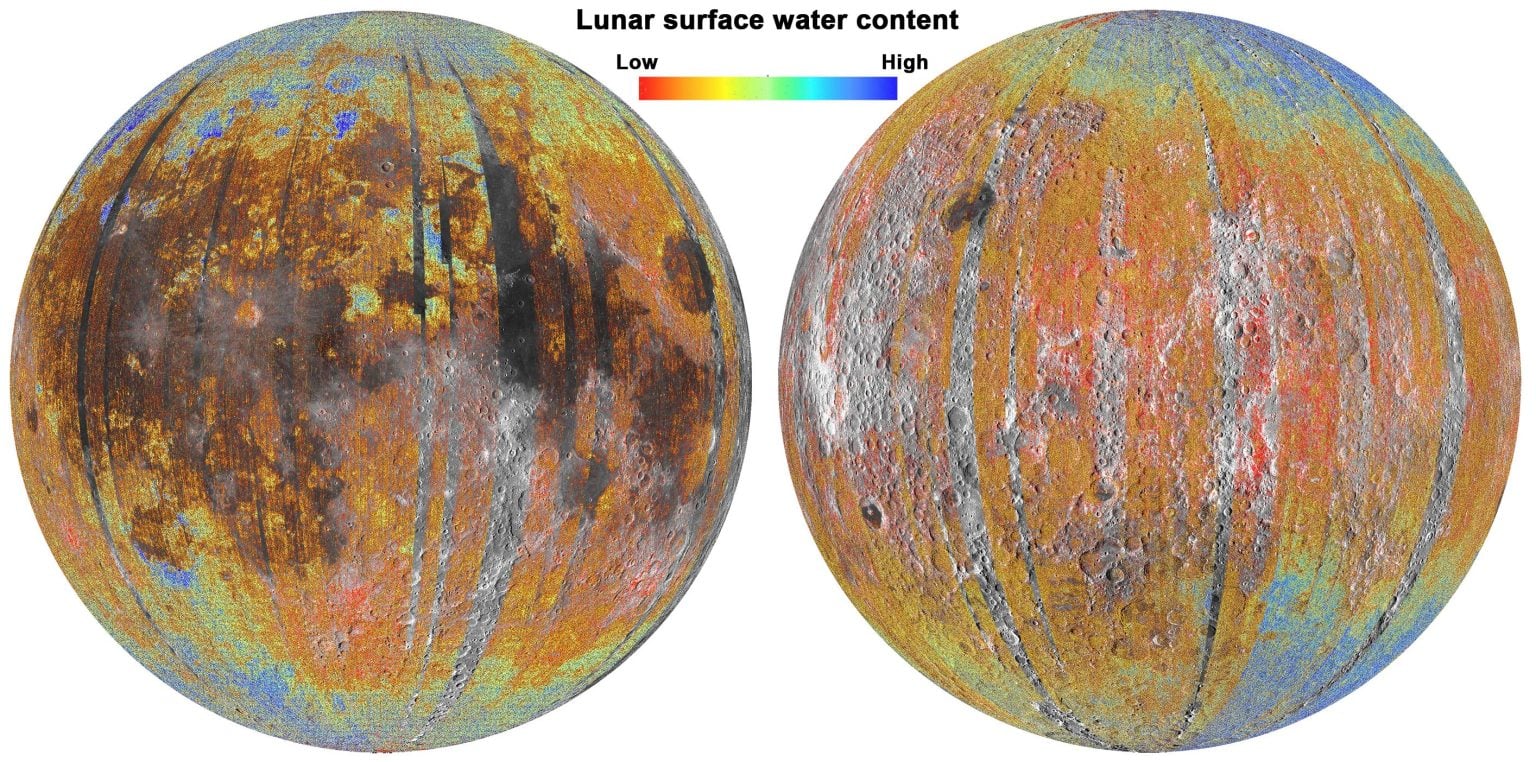
So, if we are going to start at the polar areas, I suggest modifying the Japan ring into a spiral. Volatiles are probably more prevalent at higher latitudes, and you do not have to travel nearly as far at high latitudes to encircle a portion of the Moon.
https://www.animalia-life.club/qa/pictu … oad-spiral
Image Quote: 
So, then if you started at one pole and spiral your way in one turn about the Moon down to the equator, then you could spiral one turn to the opposite pole. The Equator, it seems may offer less Hydrogen and Sulphur, as these seem to be retained better at high latitudes.
If you are making a spiral of solar panels, then I presume that you also do the roads and the power conductors, and this suggests melting a lot of regolith. The melting process may yield substances like Hydrogen, Sulphur, and Chlorine. So, you start out with more yield if you are at the high latitudes.
It seems as though some rocks on the Moon may have more Chlorine than others. In that case a spiral could include deviations so that the spiral may intercept a favorable mineral deposite.
https://www.nature.com/articles/s41598-019-42224-8
Quote:
Article
Open access
Published: 05 April 2019
An extremely heavy chlorine reservoir in the Moon: Insights from the apatite in lunar meteorites
Quote:
Copilot Search Branding
Like
Dislike
Images
Videos
Apatite, a phosphate mineral, has been found in lunar rocks and meteorites, revealing the Moon’s complex volatile history, including water and chlorine content.
Presence and Composition
Apatite on the Moon is primarily fluorapatite (Ca5(PO4)3F), though hydroxylapatite and chlorapatite have also been identified in some samples. It occurs in nearly all lunar rock types, including basalts and breccias, but is generally a trace mineral, ranging in size from sub-micron to 2 mm. Apatite serves as a key reservoir for phosphorus and rare earth elements on the Moon and is the most common volatile-bearing mineral in lunar rocks.
NASA
Insights into Lunar Volatiles
The discovery of apatite in lunar meteorites has provided evidence that the Moon’s early crust, over 4 billion years ago, was more water-rich than previously thought. Apatite contains hydrogen, fluorine, and chlorine, which allows scientists to study the volatile content and isotopic composition of lunar materials. Analyses show water contents ranging from 220 to 5200 ppm, with δD values from −100 to +550‰ and δ37Cl values from +3.8 to +81.1‰, indicating a heterogeneous distribution of volatiles and complex lunar formation processes.
Science Times
+2
Isotopic Significance
Lunar apatite exhibits a wide range of chlorine isotopic ratios (δ37Cl), much broader than terrestrial or chondritic values, suggesting the Moon contains an extremely heavy chlorine reservoir. This isotopic fractionation may result from volatile loss during the Moon-forming Giant Impact and subsequent differentiation of the lunar magma ocean, with late accretion of hydrous components contributing to the observed variability.
Nature
Debates on Water Content
While apatite has been used to infer water content in lunar rocks, some studies suggest it may overestimate water levels. Computer models indicate that hydrogen-rich apatite could form during crystallization from magma even in relatively dry conditions, meaning the high hydrogen content may not directly reflect a water-rich lunar environment. Nonetheless, the presence of water-bearing apatite in meteorites like AP 007 confirms that the Moon’s crust contained significant volatiles in its early history.
UCLA
+1
Scientific Importance
Studying apatite on the Moon helps scientists understand:
The volatile history of the Moon, including water, chlorine, and other elements.
2
The formation and differentiation of the lunar crust and magma ocean.
1
The distribution of phosphorus and rare earth elements, which are critical for understanding lunar geochemistry.
1In summary, lunar apatite is a crucial mineral for reconstructing the Moon’s early volatile inventory, providing insights into water content, chlorine isotopes, and the processes that shaped the Moon’s crust over 4 billion years ago.
My interest with Chlorine has to do with methods to extract things like Iron from Regolith at a low temperature.
In this other topic "Salt Electric Mining" is described: https://newmars.com/forums/viewtopic.php?id=11305
Removing Iron from regolith at a low temperature, then may reduce the amount of regolith you then have to process at a higher temperature. And in some cases, you might just want to extract the Iron at a low temperature and sinter the remainder into pavement or bricks.
Carbon:
Copilot Search Branding
Like
Dislike
Images
Videos
Carbon exists on the Moon in trace amounts, primarily in polar ices, regolith, and recently discovered graphene layers, but it is far less abundant than on Mars or Earth.
Forms and Sources of Lunar Carbon
Carbon on the Moon is present in several forms. Polar regions may contain subsurface carbon-bearing ices, which could provide a source of carbon, hydrogen, and oxygen for propellant production, though these deposits are limited and could be quickly exhausted on longer timescales. Lunar regolith and pyroclastic glasses also contain carbon, but at very low concentrations, making them less viable for large-scale resource extraction. Additionally, recent analysis of Chang’e-5 samples revealed thin layers of natural graphene in lunar dust, marking the first confirmation of few-layer graphene on the Moon.
arXiv.org
+1Trace gases in the lunar exosphere, including carbon dioxide (CO₂) and methane (CH₄), exist in extremely low concentrations and are unlikely to be useful for in-situ resource utilization. These gases may originate from solar wind interactions, cometary deposits, or outgassing from the Moon’s interior.
Wikipedia
+1
Potential Uses
Carbon is essential for supporting a sustained human presence on the Moon. It can be used to produce methalox propellant (methane and oxygen) for spacecraft refueling. NASA experiments have demonstrated that carbothermal reduction of lunar regolith can produce carbon monoxide, which can serve as a precursor for oxygen and fuel production, using solar energy to drive the reaction. The discovery of graphene also opens possibilities for advanced materials and electronics in lunar habitats.
arXiv.org
+2
Challenges
The Moon is extremely poor in carbon compared to Mars, and most accessible sources are concentrated in a few polar regions. Extraction would require careful site selection, energy input, and infrastructure to harvest and process the carbon efficiently. Bulk regolith and pyroclastic glasses are not practical sources due to low carbon content.
arXiv.org
Summary
While carbon is present on the Moon, it is scarce and unevenly distributed. Polar ices, regolith, and graphene layers represent the main sources, with polar ices being the most promising for near-term propellant production. Advances in extraction technologies, such as solar-driven carbothermal reduction, could enable sustainable lunar operations, but large-scale utilization will be limited by the Moon’s low carbon abundance.
Volatiles inside the Moon:
Carbon in the Moon
The presence of carbon in the Moon has been a topic of interest due to the detection of water and other volatile elements in lunar volcanic glasses. These glasses, formed from fire-fountain eruptions, contain hydrogen, fluorine, sulphur, and chlorine, indicating an origin from source magmas with similar volatile concentrations as parts of Earth’s upper mantle. This discovery challenges the long-held assumption of a volatile-free Moon and suggests that the Earth and Moon may share a common volatile source. The carbon content in these glasses is detectable, with similar abundances to those found in Earth’s mid-ocean ridge basalts, further supporting the idea of a Moon that contains at least some volatiles.
Wikipedia
So, this could be where a spiral of solar panels might intercept a location where a "Fire-Fountain" existed, and perhaps digging down would yield desired substances.
So, in my opinion a spiral of solar panels may satisfy the desire to export power from the Moon but also might facilitate power to specific mining locations as well. Adn while building the spiral valuable substances might be obtained at higher latitudes.
Ending Pending