New Mars Forums
You are not logged in.
- Topics: Active | Unanswered
Announcement
#26 2025-07-19 16:13:31
- Terraformer
- Member
- From: The Fortunate Isles
- Registered: 2007-08-27
- Posts: 4,011
- Website
Re: Electrostatic atmospheric confinement
Did you ever get an answer?
Use what is abundant and build to last
Offline
Like button can go here
#27 2025-07-20 14:49:20
- Calliban
- Member
- From: Northern England, UK
- Registered: 2019-08-18
- Posts: 4,384
Re: Electrostatic atmospheric confinement
I did. I put the question to the staff at Centauri Dreams as to whether M2P2 could be adapted to hold a breathable planetary atmosphere to a small body. Their response was that they didn't know, but suspected that the magnetic pressure would need to be far beyond what was foreseen for M2P2. Which makes sense, given that solar wind pressure is miniscule.
I did a few calcs a while back to work out how much superconductor would be needed to produce a magnetic field strong enough to form a plasma window of sufficient magnetic pressure. It looked doable. But another problem with magnetic confinement of plasma is that plasma leaks at the poles. I suspect that any atmosphere so contained would require gradual replenishment.
One idea that occured to me a while back was that solar wind particles could be used to power the production of an oxygen atmosphere. If water vapour is allowed to gradually enter a plasma formed from trapped solar wind particles, it will dissociate by ion collision into OH- and H+. Hydrogen ions, being lighter, would escape more rapidly. The OH ions, would recombine to produce water vapour and O2. Being heavier, the O2 would tend to accumulate closer to the surface. In this way, the trapped solar wind ions can be used to build an oxygen atmosphere from water vapour. Which obviates the need for electrolysis.
Last edited by Calliban (2025-07-20 15:03:24)
"Plan and prepare for every possibility, and you will never act. It is nobler to have courage as we stumble into half the things we fear than to analyse every possible obstacle and begin nothing. Great things are achieved by embracing great dangers."
Offline
Like button can go here
#28 2025-07-20 20:04:04
- Void
- Member
- Registered: 2011-12-29
- Posts: 9,840
Re: Electrostatic atmospheric confinement
Please consider this substitution for handling small dwarf planets and maybe icy moons: 
It could use improvement in both drawing methods and concepts. It is not electrostatic but perhaps you could stick Oxygen at the magnetic poles and try to synthesize water.
It is a cut-away of both the dwarf planet and the torus "Shell" that surrounds it. The rotational poles are shaded, so that most gas that might leak out might condense at the rotational poles, presuming that configuration is possible. You then could melt a toroid sea to reach down to the core if their is one so that you could mine.
If you wanted to put a differential electrostatic charge on the shell of the toroid, perhaps you would be able to attract molecules to the outer skin of the toroid. Perhaps a (-) charge in side would attract (+) ions.
The magnetic field may direct ions to impact the outside of the shell at the magnetic poles where you might use electrostatics to catch molecules.
If the toroid leaks, my hope is that the leakage will tend to migrate to the rotational poles and so then condense in the intense cold promoted there by the shade of the torus shell.
This is unlike a classical shell world where, escaped atmosphere would either float off or condense on top of the shell, perhaps collapsing it.
The magnetic field would help to retain a temporary atmosphere caused by a leak, until it could condense at the poles.
This particular notion needs poles that are not too tilted.
Ending Pending 
Last edited by Void (2025-07-20 20:12:19)
Be careful what you wish for.
Offline
Like button can go here
#29 2025-08-14 13:30:45
- Calliban
- Member
- From: Northern England, UK
- Registered: 2019-08-18
- Posts: 4,384
Re: Electrostatic atmospheric confinement
It turns out that magnetic fields have little effect on the atmospheric loss rate for terrestrial planets.
https://www.aanda.org/articles/aa/full_ … 34-18.html
Magnetic fields trap charged particles and may reduce the rate of escape close to the equator. But the open field lines close to the poles can have the opposite effect. So magnetic confinement of an atmosphere is unlikely to be successful.
"Plan and prepare for every possibility, and you will never act. It is nobler to have courage as we stumble into half the things we fear than to analyse every possible obstacle and begin nothing. Great things are achieved by embracing great dangers."
Offline
Like button can go here
#30 2025-08-16 07:13:38
- Void
- Member
- Registered: 2011-12-29
- Posts: 9,840
Re: Electrostatic atmospheric confinement
The pity is that Carl Sagan passed away. I believe that he would have continued to analyze reality with further input of information about reality. When he was alive, they tried to come up with some way to understand why Mars was the way it was. Atmospheric loss was understood to be a real thing. Earth had a Magnetic Field Mars did not so much have one.
It was a good guess. And I think atmospheric loss was indeed a factor. But now you indicate that magnetic fields do not have too much benefit, it seems.
But like a religion, verbalized science quickly locks into dogmas and protects them like a fortress. In order to communicate to a crowd and get affirmation from in a quest for validation of self, to be a pretty thing, they seek the correct things to say.
At least American School for commoners, is tilted to produce verbal people with common math capabilities as the white collars that the ruling class can use to keep the blue collars in verbal cages to serve the system.
But true science has a certain measure of the blue collar in it.
Lately the effort to keep the lid on has allowed a further extension of the apointocracy. Identifying "Minorities" such as females, the resentful sorts, to help further build up the white-collar lid.
But this is a bit cute, as it turns out that a bit of blue collar can get you some money now.
I am not hating on women except the self-ignorant ones. It is so easy for a person including myself to be given false pride, and to cling to it. They are not much different than I would be if given free white ruler status. (Not racial white, rather white collar).
But it seems that given enough time the lid placed on top of us erodes despite all efforts to make it impregnable.
I hope I will indeed see an increasingly valid description of how planets like Mars operate or operated.
Ending Pending
Last edited by Void (2025-08-16 07:24:25)
Be careful what you wish for.
Offline
Like button can go here
#31 2026-08-19 12:02:38
- Terraformer
- Member
- From: The Fortunate Isles
- Registered: 2007-08-27
- Posts: 4,011
- Website
Re: Electrostatic atmospheric confinement
Oxygen is paramagnetic. Perhaps strong enough magnetic fields would help to retain it? Otoh, they could have the opposite effect, accelerating oxygen molecules...
It occurs to me that bending the path of the oxygen enough is the key thing here. It doesnt matter if they're moving at escape velocity if they're moving downwards.
Water vapour, being paramagnetic, might be lost. But these worlds are cold, maybe it will freeze out long before reaching the exosphere.
Use what is abundant and build to last
Offline
Like button can go here
#32 2026-08-19 14:50:32
- SpaceNut
- Administrator
- From: New Hampshire
- Registered: 2004-07-22
- Posts: 30,844
Re: Electrostatic atmospheric confinement
So is lunar dust.. so A lunar static shield—most commonly known as NASA's Electrodynamic Dust Shield (EDS)—is a specialized technology that uses invisible, moving electric fields to actively push jagged, statically charged moon dust away from critical equipment.
Offline
Like button can go here
#33 2026-08-20 05:30:36
- Calliban
- Member
- From: Northern England, UK
- Registered: 2019-08-18
- Posts: 4,384
Re: Electrostatic atmospheric confinement
Liquid oxygen can be trapped between the poles of two magnets until it boils away. A powerful enough magnetic field would certainly have an effect on the structure of an oxygen atmosphere. One of the problems with retaining an atmosphere on a small body is the steepness of the gravitational gradient. If you are 500km above a 1000km diameter body, the gravity you experience will be one quarter that on the surface. The smaller the body, the more dramatic the effect. This becomes especially problematic on small bodies, because scale height is inversely proportional to the strength of gravity. To build up a high surface pressure on a world like Pluto, the atmosphere must be much deeper than it would have to be on a body as massive as Earth or Mars. But the higher you go, the weaker gravity becomes and the more scale height increases. Eventually, atmospheric loss rate becomes unsustainable.
If the magnetic field can reduce the scale height close to the surface, I.e. increase the rate that pressure declines with height, it could make a sizeable difference to the atmospheric leakage. It does help if the gas molecules are cold. At 90.2K, oxygen has a vapour pressure of 20KPa. This is about the same partial pressure as O2 in air. The colder and slower the oxygen molecules, the more effective the magnetic field will be.
Some months back, I built a spreadsheet model for a monomolecular atmosphere on a Pluto size and mass body. The model suggested that Pluto is close to the minimum size of a body capable of supporting a breathable pressure atmosphere. Beyond this minimum size, the combined effects of increased scale height and gravitational gradient reduce the sustainable surface pressure very quickly. Maybe a magnetic field would change that conclusion.
Building a human habitable atmospheric pressure on any KBO or moon is ambitious. Titan achieves it naturally. Pluto and Eris appear to have enough natural nitrogen for it to be achievable, if humans can add enough heat to evaporate the nitrogen ices in the crust. For smaller bodies it will be much more difficult, as most of them will have lost their volatile materials to space since the beginning of the solar system. Radiolysis of water ice by cosmic and solar radiation, has resulted in the build up of trapped oxygen in the surface layers of most icy bodies in the solar system. This oxygen will be released by adding heat. But in most cases, the amount released would be limited to microbars of surface pressure.
Releasing oxygen by electro-chemical decomposition of water is possible. But the energy requirements for a planetary scale atmosphere are daunting. We are looking at millions of gigawatts, sustained for hundreds of years. Maybe we really will have access to that much power in the future. But it looks huge compared to human capabilities today.
Last edited by Calliban (2026-08-20 05:58:49)
"Plan and prepare for every possibility, and you will never act. It is nobler to have courage as we stumble into half the things we fear than to analyse every possible obstacle and begin nothing. Great things are achieved by embracing great dangers."
Offline
Like button can go here
#34 2026-08-20 12:11:37
- Terraformer
- Member
- From: The Fortunate Isles
- Registered: 2007-08-27
- Posts: 4,011
- Website
Re: Electrostatic atmospheric confinement
Calliban,
The scale height decrease is compensated for by the greater area. On small bodies atmospheres need to be modeled with wedges rather than columns; it is no longer a thin layer over a sphere, but a sphere surrounding a smaller sphere.
As talked about before, a few microbars of oxygen should be enough for handling micrometeoroids. If a magnetic field can get us that far, it could prove a pretty useful pre paraterraforming step. At the least, we're going to want to avoid clathrates where we build, so some level of volatilisation will be necessary. Hopefully we can retain it.
Use what is abundant and build to last
Offline
Like button can go here
#35 2026-08-20 14:23:41
- Calliban
- Member
- From: Northern England, UK
- Registered: 2019-08-18
- Posts: 4,384
Re: Electrostatic atmospheric confinement
Calliban,
The scale height decrease is compensated for by the greater area. On small bodies atmospheres need to be modeled with wedges rather than columns; it is no longer a thin layer over a sphere, but a sphere surrounding a smaller sphere.
As talked about before, a few microbars of oxygen should be enough for handling micrometeoroids. If a magnetic field can get us that far, it could prove a pretty useful pre paraterraforming step. At the least, we're going to want to avoid clathrates where we build, so some level of volatilisation will be necessary. Hopefully we can retain it.
Thanks! For some reason it didn't occur to me to keep g constant in calculating the atmospheric scale height. It makes a dramatic difference.
Using Pluto as a baseline, I modelled a nitrogen atmosphere with a surface pressure of 20KPa. Surface temperature is taken to be 90K, with atmospheric temperature dropping 1K per km, reaching 40K at 50km. I then assume constant temperature above 50km.
The resulting atmosphere is remarkably compact. I am not quite sure that I trust the results. Scale height is 43.3km at ground level, declining to 19.28km at 50km. Pressure drops to 0.001Pa at a height of 22km. At 50km, pressure is 2E-20 Pa, essentially zero.
Last edited by Calliban (2026-08-20 14:29:32)
"Plan and prepare for every possibility, and you will never act. It is nobler to have courage as we stumble into half the things we fear than to analyse every possible obstacle and begin nothing. Great things are achieved by embracing great dangers."
Offline
Like button can go here
#36 2026-08-20 14:29:00
- Terraformer
- Member
- From: The Fortunate Isles
- Registered: 2007-08-27
- Posts: 4,011
- Website
Re: Electrostatic atmospheric confinement
It does make sense, 40K is a *very* low temperature. Even 90K is going to be 3.5x as dense as sea level.
New Horizons found far lower atmospheric loss rates for Pluto than previously estimated. Terraforming discourse may not have caught up yet.
Use what is abundant and build to last
Offline
Like button can go here
#37 2026-08-20 14:48:25
- Calliban
- Member
- From: Northern England, UK
- Registered: 2019-08-18
- Posts: 4,384
Re: Electrostatic atmospheric confinement
I repeated the calculation for a body 900km in diameter, with the same density as Pluto. Pressure at ground level is 20KPa, declining to 2.5mPa at 50km and 1.6E-36Pa at 100km. At 100km, local escape velocity is 414m/s. This is still 2.2x the mean molecular speed of N2 at 40K.
To work out the exact leakage rate: Any molecules whose speed is greater than local escape velocity will escape if mean free path is greater than local scale height.
Last edited by Calliban (2026-08-20 14:53:58)
"Plan and prepare for every possibility, and you will never act. It is nobler to have courage as we stumble into half the things we fear than to analyse every possible obstacle and begin nothing. Great things are achieved by embracing great dangers."
Offline
Like button can go here
#38 2026-08-20 15:18:52
- Calliban
- Member
- From: Northern England, UK
- Registered: 2019-08-18
- Posts: 4,384
Re: Electrostatic atmospheric confinement
For the 900km diameter body, mean free path exceeds scale height at a height of 59km. At this height, pressure is 1.5E-8Pa and density is 1.26E-12 kg.m-3. If we assume that 10% of gas molecules exceed escape velocity, then leakage rate is 1.26E-13kg.m-2s-1. Over the entire body, leakage rate will be 0.41kg.s-1. This is a negligible rate. The atmosphere will lose 10% of its mass to jeans escape every 1.66 billion years. I suspect that atmospheric erosion due to solar wind will be a more significant escape mechanism. A magnetic field would mitigate that problem.
A diameter of all of the confirmed dwarf planets exceeds 900km. The spreadsheet calculations suggest that all of these bodies could hold a cold N2 atmosphere with human habitable surface pressure for billions of years. But again, solar wind erosion is likely to strip away these atmospheres far more rapidly.
Salacia has a diameter of 840km. There are a further 14 known KBOs with diameter 600 - 800km.
Last edited by Calliban (2026-08-20 15:57:04)
"Plan and prepare for every possibility, and you will never act. It is nobler to have courage as we stumble into half the things we fear than to analyse every possible obstacle and begin nothing. Great things are achieved by embracing great dangers."
Offline
Like button can go here
#39 2026-08-20 17:39:14
- Calliban
- Member
- From: Northern England, UK
- Registered: 2019-08-18
- Posts: 4,384
Re: Electrostatic atmospheric confinement
Unfortunately, I made a miscalculation with the pressure gradient. It turns out that Pluto could support a 0.2bar surface pressure with negligible Jean's escape. However, a body 900km in diameter with density 1100kg/m3 (I.e Sedna) would struggle to hold onto a 10Pa atmosphere and would lose 10% of its atmosphere in just 26.6 years. So there is a definite cliff edge, beyond which retaining a thick atmosphere becomes impossible.
Maybe a magnetic field could reduce the scale height, such that a higher pressure is possible? Assuming we can make enough oxygen of course.
Last edited by Calliban (2026-08-20 17:40:51)
"Plan and prepare for every possibility, and you will never act. It is nobler to have courage as we stumble into half the things we fear than to analyse every possible obstacle and begin nothing. Great things are achieved by embracing great dangers."
Offline
Like button can go here
#40 2026-08-20 18:08:54
- Calliban
- Member
- From: Northern England, UK
- Registered: 2019-08-18
- Posts: 4,384
Re: Electrostatic atmospheric confinement
Makemake (r = 715km) could support a 20KPa atmosphere and would lose 10% every 221 million years. For Gonggong, r=615km, the loss rate is 10% every ~20 million years. I will follow up with other examples tomorrow.
Last edited by Calliban (2026-08-21 01:33:18)
"Plan and prepare for every possibility, and you will never act. It is nobler to have courage as we stumble into half the things we fear than to analyse every possible obstacle and begin nothing. Great things are achieved by embracing great dangers."
Offline
Like button can go here
#41 2026-08-20 18:12:55
- Void
- Member
- Registered: 2011-12-29
- Posts: 9,840
Re: Electrostatic atmospheric confinement
Good stuff Calliban. If Pluto, then maybe Triton and Eris. Triton however may be disrupted by Neptunes magnetic field. Don't know.
Ending Pending
Be careful what you wish for.
Offline
Like button can go here
#42 2026-08-21 05:30:50
- Calliban
- Member
- From: Northern England, UK
- Registered: 2019-08-18
- Posts: 4,384
Re: Electrostatic atmospheric confinement
Thanks. I think Neptune's magnetic field would definitely be a problem. Europa, Ganymede and Callisto are all devoid of atmosphere, despite having substantial gravity. I suspect that this is due to a combination of Jupiter's strong magnetic field and high rotation rate. The field lines pass through these moons at velocity that exceeds their orbital velocity. This would rapidly accelerate any charged ions in the vicinity of these moons, effectively stripping away the ionosphere.
I still have work to do getting my atmospheric escape model correct. It appears to be underestimating the atmospheric loss rate. I suspect that once this is corrected for, any body much smaller than Pluto would suffer intolerable loss rates for any significant atmospheric pressure.
As it is, using Makemake as an example, the column density needed to produce a 20KPa surface pressure would be 55,770kg.m-2. I suspect that any future inhabitants of this world would consider a habitable surface pressure to be too expensive to be worth the effort. Especially if they can make habitable space by melting tunnels through the ice and pressurising. A thin atmosphere on the surface would tend to accumulate as gases gradually leaked out. This might be valuable as a way of stopping micro-meteorites and increasing the surface temperature of this world. On any crustal shell world, there would remain a certain amount of surface infrastructure. Warming the ambient environment above deep cryogenic temperatures would make operability much easier.
Last edited by Calliban (2026-08-21 05:34:49)
"Plan and prepare for every possibility, and you will never act. It is nobler to have courage as we stumble into half the things we fear than to analyse every possible obstacle and begin nothing. Great things are achieved by embracing great dangers."
Offline
Like button can go here
#43 2026-08-21 08:04:53
- Void
- Member
- Registered: 2011-12-29
- Posts: 9,840
Re: Electrostatic atmospheric confinement
I recall that Carl Sagan said that Titan holds onto its atmosphere "Just Barely". It is only occasionally outside of the magnetic field of Saturn.
Triton has a very wispy atmosphere. Ganymede has a natural magnetic field that perhaps could be supplemented.
So, there are things to discover about this.
Quote:
Copilot Search Branding
Like
Dislike
Does Triton Lose Its Atmosphere?
Triton’s atmosphere is very thin — with a surface pressure of only about 1.4Pa (about 1/70,000th of Earth’s sea-level pressure) — and it does lose gas over time, but the process is slow compared to the timescales of its orbital and seasonal cycles.Why it loses atmosphere:
Low gravity: Triton’s small mass means its atmosphere is loosely bound, extending over 800km above the surface
Wikipedia
Wikipedia
.Escape of light gases: The upper atmosphere contains molecular and atomic hydrogen produced by the photolysis of methane. This hydrogen escapes into space relatively quickly, contributing to Triton’s magnetosphere
Wikipedia
Wikipedia
+1
.Other potential losses: Nitrogen and methane can also escape, though at much slower rates, and cryovolcanism may release some gases into the atmosphere
Everything Explained Today
Everything Explained Today
.Seasonal and climatic effects:
Triton’s atmosphere is highly sensitive to seasonal changes. When Triton warms (e.g., after passing its southern solstice in 2001), surface temperatures rise, increasing atmospheric density and possibly enhancing volatile transport between polar caps
Wikipedia
Wikipedia
+1
. Conversely, cooling can cause gases to condense and fall out of the atmosphere.Long-term trends:
Measurements show that Triton’s surface pressure has varied over decades — rising to ~1.9Pa in 1997 and peaking around 4Pa by 2010 — but by 2022 it had dropped back to ~1.45Pa, close to the 1989 Voyager 2 value
Wikipedia
Wikipedia
. This suggests that while some loss occurs, it is balanced by seasonal and thermal changes rather than a rapid depletion.Conclusion:
Yes — Triton’s atmosphere does lose gas, especially hydrogen, and its surface pressure can fluctuate over decades. However, the loss is gradual, and the atmosphere remains stable on human timescales due to seasonal replenishment and the moon’s relatively long orbital period.
If you could heat Triton up from below, perhaps a Tholen fog could isolate the heat imposed on the surface from the upper atmosphere.
Ending Pending
Last edited by Void (2026-08-21 08:07:43)
Be careful what you wish for.
Offline
Like button can go here
#44 2026-08-24 11:05:17
- Calliban
- Member
- From: Northern England, UK
- Registered: 2019-08-18
- Posts: 4,384
Re: Electrostatic atmospheric confinement
More on the atmosphere discovered around 2002XV93.
https://arxiv.org/pdf/2605.02243
This body is ~500km in diameter. The expectation is that objects <1000km in diameter, cannot retain atmospheres for Gyr timescales. However, for human purposes, a billion years is a long time. An artificial magnetosphere could reduce loss rates still further.
Thin atmospheres could potentially be useful for any future humans habitability of KBOs. Water ice has a vapour pressure, without which it will slowly evaporate into space. At -220°C, that vapour pressure is 2E-37Pa. This is so low, that very little ice will evaporate over the age of the solar system. However, at 173K (-100°C) vapour pressure is 1.3E-3 Pa.
https://www.engineeringtoolbox.com/ice- … d_576.html
Human activity will generate waste heat that will raise the temperature of the body. Without an atmospheric pressure, water ice will slowly sublime into space. A nanobar atmosphere could therefore be valuable in maintaining the long-term integrity of KBOs.
Previously, we have discussed aquaforming of KBOs. This would involve using nuclear heat to melt their interiors, producing an aquatic environment within which a marine ecosystem can be established. However, this is only sustainable if the body can radiate heat into space from its surface. The heat generated within the body must ultimately balance what is lost to space.
Last edited by Calliban (2026-08-24 11:53:50)
"Plan and prepare for every possibility, and you will never act. It is nobler to have courage as we stumble into half the things we fear than to analyse every possible obstacle and begin nothing. Great things are achieved by embracing great dangers."
Offline
Like button can go here
#45 2026-08-24 16:32:25
- Calliban
- Member
- From: Northern England, UK
- Registered: 2019-08-18
- Posts: 4,384
Re: Electrostatic atmospheric confinement
Going back to the original topic of this thread. I wanted to know if we could use electrostatic forces to confine an atmosphere. My thinking was that above a certain height (48km on Earth) the atmosphere is increasingly ionised and will therefore respond to an electric field. Suppose we surround a planetoid with a conducting mesh and put a similar mesh on the ground. We create a potential difference of several thousand volts between the two, with the mesh in space being positive and the ground negative. Gravity and the PD between the meshes will tend to pull the positive mesh downward, but the plasma pressure created by the upper atmosphere would tend to inflate the upper (positive) mesh away from the planetoid. These forces would balance, resulting in zero net tensile stress in the upper mesh. This is important, because it allows the mesh to be thin and easy to build for a planetary scale object.
The lower layers of the atmosphere would remain non-ionised, as the PD is beneath the breakdown voltage gradient of the gas. So it will function as a dielectric, preventing current flow between the two meshes. However, positive ions beneath the upper mesh will be repelled downward and pushed away from the mesh towards the upper atmosphere. This will exert a net pressure on the gases in the upper atmosphere. Any gas molecules that escape the lower layers will be ionised by collision and trapped by the electric field. Any positive ion that escapes the ionosphere and heads upwards with significant velocity, will lose energy as it travels up the electric field towards the positive mesh.
In this way, an atmosphere may be confined beneath it's ionosphere. This reinforces the natural confinement provided by gravity, allowing relatively small bodies to hold atmospheres using electric fields. The system would look something like this: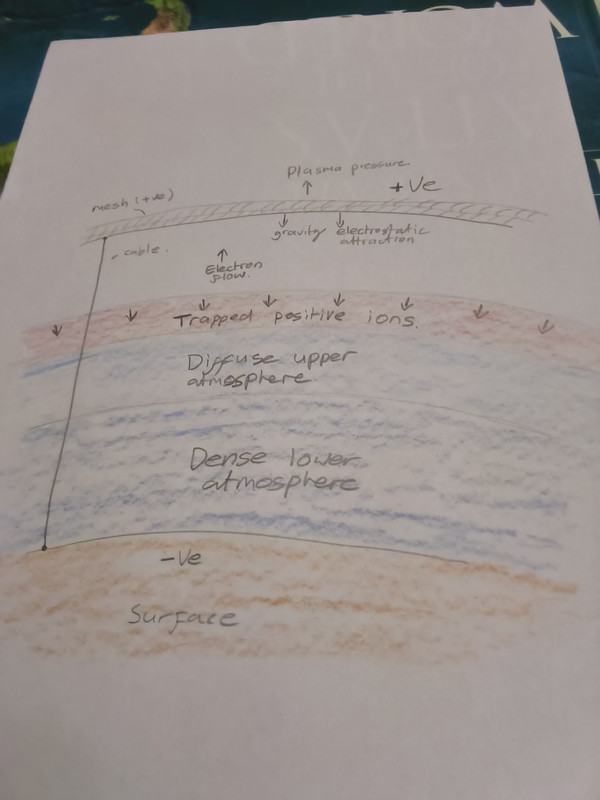
Last edited by Calliban (2026-08-24 16:58:10)
"Plan and prepare for every possibility, and you will never act. It is nobler to have courage as we stumble into half the things we fear than to analyse every possible obstacle and begin nothing. Great things are achieved by embracing great dangers."
Offline
Like button can go here
#46 2026-08-29 08:14:36
- Calliban
- Member
- From: Northern England, UK
- Registered: 2019-08-18
- Posts: 4,384
Re: Electrostatic atmospheric confinement
This paper discusses the transition between Jean's Escape (which I can model on a spreadsheet) and hydrodynamic escape, which I cannot.
https://iopscience.iop.org/article/10.1 … /2/L24/pdf
Jean's Escape is escape on a molecule by molecule basis. Hydrodynamic escape occurs when the flow rate is so great that the escaping molecules end up dragging other molecules with them. This can increase escape rate by orders of magnitude. Knowing when the transition will occur allows us to set the limits of a sustainable atmosphere.
Last edited by Calliban (2026-08-29 08:18:27)
"Plan and prepare for every possibility, and you will never act. It is nobler to have courage as we stumble into half the things we fear than to analyse every possible obstacle and begin nothing. Great things are achieved by embracing great dangers."
Offline
Like button can go here
#47 2026-08-29 15:36:36
- Calliban
- Member
- From: Northern England, UK
- Registered: 2019-08-18
- Posts: 4,384
Re: Electrostatic atmospheric confinement
According to this paper, past theoretical models have estimated Pluto's nitrogen escape rate to be ~E28 molecules per second.
https://www.sciencedirect.com/science/a … 3513004302
I decided to test my spreadsheet model against this value, using the atmospheric temperature and scale height data provided in this link.
https://www.detailedpedia.com/wiki-Atmosphere_of_Pluto
I assumed a 0.9Pa surface pressure. I found that the exobase height is 13,197km above the surface (11.2 Pluto radii). This compares to a height of 5 - 13 radii in the reference paper. The real exosphere is more tear drop shaped than spherical, as it is distorted by solar wind pressure.
The calculated Jean's escape rate is 696kg/s - 1.5E28 molecules per second. So my model isn't far off. The presence of methane makes Pluto's atmosphere much warmer than I had previously been modelling. At the surface, temperature is a chilly 37K. At 30km temperature rises to a maximum of 110K, before slowly declining to 80K at 180km, from where it remains constant. The much colder temperatures that I had been modelling, may not be realistic at Pluto distance from the sun.
The paper and my spreadsheet are theoretical models using what was known prior to direct measurement of escape rate. Specific results for the New Horizons Pluto flyby July 2015 are escape rate ∼3.5 × E27 N2 s−1, exobase at 8r ∼ 9600 km, with Jeans λ ∼ 5 for a reference Pluto atmosphere model. With Pluto’s highly elliptic orbit and variable solar activity affecting its atmosphere, Pluto’s escape rates’ range is (1–10) × E27 N2 s−1, exobase radius is bounded by ∼(5–13)r, and at the exobase Pluto is locked in the enhanced Jeans regime with λ ∼ (6–4).
So my calculated escape rate is slightly on the high side, but is probably within a factor of 2 for the 0.9Pa surface pressure at the time of the new horizons flyby.
At Pluto's perihelion at 30AU, solar flux is 1.5122W.m-2. This corresponds to a black body temperature of 72K. So Pluto's upper atmospheric temperature is close to the black body temperature at this distance from the sun. At Pluto's aphelion (49.305AU) solar irradiance is 0.56W.m-2, implying a black body temperature of 56K.
Last edited by Calliban (2026-08-29 16:13:06)
"Plan and prepare for every possibility, and you will never act. It is nobler to have courage as we stumble into half the things we fear than to analyse every possible obstacle and begin nothing. Great things are achieved by embracing great dangers."
Offline
Like button can go here