New Mars Forums
You are not logged in.
- Topics: Active | Unanswered
Announcement
#26 2026-07-12 17:09:41
- Void
- Member
- Registered: 2011-12-29
- Posts: 9,707
Re: AquaWorlds (Water Holding and Water Transporting Methods)
I think that quite often the transport of water on Mars may be done by Methane pipeline. Where a major body of water ice exists, Methane may be produced. Pipelines, perhaps of cast basalt, can convey it to various locations where it can be reacted with O2 from CO2, to make Water.

Here in another topic is further information: https://newmars.com/forums/viewtopic.php?id=11387
While a little tricky, my hope is that a pure water atmosphere can be split into H2 and O2, and separate with the H2 floating on top. At a low pressure, I hope that explosive conditions will not be an idea killer for this.
Spitting water if done in a pure way, will avoid the creation of CO which of course is a poison to creatures using Hemoglobin.
Using the Hydrogen and Mars atmosphere, various kinds of Precision Fermentation and Cellular Food Cultures could be done.
Using O2 and biomass created in that manner would support mushroom farming
So, by pipeline Methane moved, and then accumulations of water with an ice and mechanical covering in suitable sized craters.
Mechanical cover could be poly-films as vapor barriers and a manufactured simulation of pumice on top of that.
Manufactured chemicals added may grow things desired.
So, these may be put near points of economic interest such as a mineral deposit.
Ending Pending 
.
Last edited by Void (2026-07-12 17:20:42)
Is it possible that the root of political science claims is to produce white collar jobs for people who paid for an education and do not want a real job?
Offline
Like button can go here
#27 2026-07-16 09:49:06
- Void
- Member
- Registered: 2011-12-29
- Posts: 9,707
Re: AquaWorlds (Water Holding and Water Transporting Methods)
This may seem a strange place to put this video from Isaac Arthur, but my ideas are that Deimos/Phobos/Mars >>> Asteroids can be modified to Earth >>> Moon >>> Deimos/Phobos/Mars >>> Asteroids.
Although with effort Hydrogen could be lifted from Mars and combined with Oxygen from Demos/Phobos, it is in the asteroid belts that we would obtain giant drinks of water that this topic is compatable with.
But if you can gain propellants from Deimos/Phobos, then it may be true that you could get similar types from our Moon. Particularly if the Moon has a mass driver or other lift device such as rotavators or space elevator.
https://www.bing.com/videos/riverview/r … &FORM=VIRE
Quote:
Isaac Arthur, The Great Lunar Boom - Building a Civilization on the Moon
Pause..............
The concept of a Mass Driver has the largest currency at this time as it is a stated objective of people like Elon Muak at this time.
Historically the idea is to send loads to a "L" location. To do that you need a method to shave off residual speed. In the era of "O'Neill", the idea was a rotating catcher where the bags of regolith would impact and the ore be collected.
In the newer visions the words "Satellites Launched from a Mass Driver", suggest the current intentions. In that case, then you need some on-board propulsion and navigation included into the devices to be launched.
I am currently infatuated with Table Salt on the Moon. It appears that Sodium and Chlorine are both going to be available on the Moon, but at first Table Salts delivered might be a relatively easy starter path.
Query: "Sodium on the Moon?"
Quote:
Like
Dislike
Yes — the Moon contains sodium, both locked in its surface minerals and present as free atoms in its extremely thin exosphere. Global measurements from Chandrayaan‑2 show an average of about 1.33wt% sodium in the lunar surface, and Earth‑based observations detect roughly 67 sodium atoms per cubic centimeter in the exosphere.
Where the Moon’s Sodium Is Found
1. In Lunar Rocks and Soil
Sodium is a moderately volatile element hosted mainly in plagioclase feldspar and pyroxene minerals.
Returned Apollo, Luna, and Chang’e samples show 0.3–0.72wt% sodium in lunar soils.
NASA
NASA
Chandrayaan‑2’s X‑ray spectrometer (CLASS) produced the first global sodium map, finding a global average of 1.33±0.03wt%, higher than earlier sample-based estimates.
NASA
NASA
2. In the Lunar Exosphere
The Moon has a very thin “surface boundary exosphere.”
Sodium was first detected from Earth in 1988 as faint glowing emissions above the lunar limb.
Typical sodium density is about 67 atoms/cm³, roughly four times more abundant than potassium.
scienceinsights.org
scienceinsights.org
Sodium atoms come from:
Solar radiation releasing loosely bound atoms from the surface
Meteoroid impacts
Sputtering processes
A long‑lived adsorbed reservoir on the surface that replenishes the exosphere
NASA
NASA
+1
Why Sodium Matters
Sodium helps scientists trace the volatile history of the Moon.
Its distribution reveals differences between highlands and mare regions.
Variations in exospheric sodium help study meteoroid streams, solar wind interactions, and surface composition.
Science | AAAS
Science | AAAS
The presence of sodium in both the lunar regolith and exosphere is now well established through sample analysis, remote sensing, and orbital missions.
Query: "Is there Chlorine on the Moon?"
https://www.nature.com/articles/s41598-019-42224-8
Quote:
The apatite grain in Dhofar 458 has an average δ37Cl value of +76‰, indicative of an extremely heavy Cl reservoir in the Moon. Volatile loss associated with the Moon-forming Giant Impact and the formation of lunar magma ocean could account for the large Cl isotopic fractionation of the Moon.
So, of the two, I suspect that the Sodium is the one to seek on the Moon first, as for the process I am going to suggest, Chlorine may be reused many time, but Sodium be used perhaps once.
But mining and transportation and processing of raw ores is a set of skills that should be developed over a period of time. To begin with I suggest plastic bags filled with Table Salt be dropped from landing spacecraft just prior to the landing.
Query: "What happens if you expose Iron Oxide to Chlorine? Is Oxygen produced?"
Quote:
Copilot Search Branding
Like
Dislike
Reaction of Iron Oxide with Chlorine
When iron(II) oxide (FeO) is exposed to chlorine gas (Cl₂), a redox reaction occurs in which chlorine oxidizes the iron and itself is reduced to chloride ions. The balanced equation is:2 FeO + 3 Cl₂ → 2 FeCl₃ + O₂ Chemical Portal.
What happens
Iron oxidation: Iron in FeO is in the +2 oxidation state and is oxidized to +3 in FeCl₃.Chlorine reduction: Chlorine gas (Cl₂) is reduced to Cl⁻ in FeCl₃.
Oxygen release: One molecule of oxygen gas (O₂) is produced for every two molecules of FeO reacted Chemical Portal.
Conditions
This reaction typically requires heat to proceed efficiently, as chlorine is not a strong enough oxidizer at room temperature to fully oxidize FeO to FeCl₃ without thermal energy scienceinsights.org+1.The reaction is a single replacement (or redox) reaction, where chlorine displaces oxygen from iron oxide.
Key points
Oxygen is produced — yes, O₂ is a product of the reaction.The product FeCl₃ is iron(III) chloride, a black crystalline solid that turns reddish-brown in the presence of moisture scienceinsights.org.
This is analogous to how chlorine reacts with other metal oxides, displacing oxygen and forming metal chlorides.
Summary: Exposing iron oxide to chlorine gas under heat produces iron(III) chloride and oxygen gas, with chlorine acting as the oxidizing agent.
The process may be corrosive, particularly against Iron products, as I understand it.
Query: "FeCl₃?"
https://en.wikipedia.org/wiki/Iron(III)_chloride
Quote:
Melting point 307.6 °C (585.7 °F; 580.8 K) (anhydrous)
37 °C (99 °F; 310 K) (hexahydrate)[1]
Boiling point
316 °C (601 °F; 589 K) (anhydrous, decomposes)[1]
280 °C (536 °F; 553 K) (hexahydrate, decomposes)
So, it may be possible to apply Chlorine and heat to Lunar Regolith and produce O2 and FeCl₃
However perhaps other substances than Iron will absorb some of the Chlorine. Recovery methods would be desireable.
Materials in this topic may suggest how to separate the Iron and Chlorine.
https://newmars.com/forums/viewtopic.php?id=11305
"Index» Life support systems» Flash Recycling, Salt Electric Mining"
Salt Mining here does not indicated carving salts out of the Earth's crust. It is rather methods to perhaps use Chlorine and Electrolysis, to extract and recover materials from the Lunar Regolith.
Query: "Rocket using Sodium, Aluminum, and Oxygen?"
Quote:
Copilot Search Branding
Like
Dislike
Using Sodium, Aluminum, and Oxygen in Rocket Propulsion
A rocket engine can use sodium, aluminum, and oxygen as a propellant system if the sodium is used as an oxidizer and aluminum as the fuel. This is a form of bipropellant or hypergolic chemistry, where the oxidizer and fuel react to produce high‑energy gases for thrust.How it works
Oxidizer: Sodium (in the form of sodium perchlorate, NaClO₄, or sodium metal) provides oxygen atoms for combustion.Fuel: Aluminum (often as powder) burns with oxygen to form aluminum oxide (Al₂O₃), releasing large amounts of energy.
Reaction example:
8Al
+
3NaClO
4
→
4Al
2
O
3
+
3NaCl
Here, aluminum is oxidized from 0 to +3, and chlorine in perchlorate is reduced from +7 to −1 Numerade.
Performance considerations
High energy density: Aluminum has a high heat of combustion, and sodium perchlorate is a strong oxidizer, giving good specific impulse (Isp) potential.Thermal management: Sodium is highly reactive and can ignite at low temperatures, so handling requires careful control.
Combustion efficiency: In subscale tests, aluminum–oxygen systems have shown good performance, but mixing and two‑phase flow effects can reduce efficiency NASA Technical Reports Server (NTRS).
Applications
Lunar in‑situ propellant: Aluminum and oxygen (LOX) have been proposed for lunar ascent/descent and return missions because oxygen can be produced from lunar regolith water ice NASA Technical Reports Server (NTRS).Hybrid or bipropellant designs: Aluminum can be stored as a solid fuel, with oxygen or sodium‑based oxidizer supplied separately, allowing throttleable thrust and safer handling than all‑solid systems Wikipedia.
Safety and engineering challenges
Reactivity: Sodium metal is pyrophoric and must be handled under inert conditions.Corrosion: Sodium compounds can be corrosive to certain materials.
Ignition control: Requires precise mixing and ignition systems to avoid uncontrolled combustion.
In summary: Yes, a rocket can use sodium (as oxidizer) with aluminum (as fuel) and oxygen (from sodium compounds or LOX) to produce thrust. This combination offers high energy density and potential for in‑situ resource utilization, but requires careful engineering for safety and efficiency.
OK, so I am going to offer that mixing Sodium with reactive metal fuels from the Moon, might be Oxidized to produce propulsion.
Quote: "Rocket using Sodium, Aluminum, and Oxygen?"
Quote: Quote:
Copilot Search Branding
Like
Dislike
Using Sodium, Aluminum, and Oxygen in Rocket Propulsion
A rocket engine can use sodium, aluminum, and oxygen as a propellant system if the sodium is used as an oxidizer and aluminum as the fuel. This is a form of bipropellant or hypergolic chemistry, where the oxidizer and fuel react to produce high‑energy gases for thrust.How it works
Oxidizer: Sodium (in the form of sodium perchlorate, NaClO₄, or sodium metal) provides oxygen atoms for combustion.Fuel: Aluminum (often as powder) burns with oxygen to form aluminum oxide (Al₂O₃), releasing large amounts of energy.
Reaction example:
8Al
+
3NaClO
4
→
4Al
2
O
3
+
3NaCl
Here, aluminum is oxidized from 0 to +3, and chlorine in perchlorate is reduced from +7 to −1 Numerade.
Performance considerations
High energy density: Aluminum has a high heat of combustion, and sodium perchlorate is a strong oxidizer, giving good specific impulse (Isp) potential.Thermal management: Sodium is highly reactive and can ignite at low temperatures, so handling requires careful control.
Combustion efficiency: In subscale tests, aluminum–oxygen systems have shown good performance, but mixing and two‑phase flow effects can reduce efficiency NASA Technical Reports Server (NTRS).
Applications
Lunar in‑situ propellant: Aluminum and oxygen (LOX) have been proposed for lunar ascent/descent and return missions because oxygen can be produced from lunar regolith water ice NASA Technical Reports Server (NTRS).Hybrid or bipropellant designs: Aluminum can be stored as a solid fuel, with oxygen or sodium‑based oxidizer supplied separately, allowing throttleable thrust and safer handling than all‑solid systems Wikipedia.
Safety and engineering challenges
Reactivity: Sodium metal is pyrophoric and must be handled under inert conditions.Corrosion: Sodium compounds can be corrosive to certain materials.
Ignition control: Requires precise mixing and ignition systems to avoid uncontrolled combustion.
In summary: Yes, a rocket can use sodium (as oxidizer) with aluminum (as fuel) and oxygen (from sodium compounds or LOX) to produce thrust. This combination offers high energy density and potential for in‑situ resource utilization, but requires careful engineering for safety and efficiency.

The above drawing includes two joined one time fire engines. The launch assist engine does just that. The Mass Driver gives some of the energy to do a elliptical orbit of the Moon but the Launch Assist Engine gives the rest. The device passes to the other side of the Moon, it has to then rotate and the other engine (Orbit Complete Engine) be used to circularize the orbit.
I am planning it this way to reduce the rigors applied to the Mass Driver Device.
In Lunar Orbit, propulsion that uses metal propellants would then retrieve the devices and tow them to a processing location.
You could go to a "L" location and then fire the Orbit Completion Engine, but that requires more propulsive efforts.
The "Brains" could be recycled back to the surface of the Moon for reuse.
In this concept the "Carcasses" of these devices could then be recycled into various types of Spacecraft and Satellites.
I anticipate the brains to be about as smart as drones that are being used, in wars at this time. (Ukraine, Iran).
The engines would be started and could not stop, they would simply burn out. The Oxygen might just be compressed Oxygen.
Of course, I am thinking that these would be involved in Mass Production of the devices on the Moon. Robotic Labor in large quantities would be very much needed.
Ending Pending
Last edited by Void (2026-07-16 10:45:55)
Is it possible that the root of political science claims is to produce white collar jobs for people who paid for an education and do not want a real job?
Offline
Like button can go here
#28 2026-07-17 07:45:25
- Void
- Member
- Registered: 2011-12-29
- Posts: 9,707
Re: AquaWorlds (Water Holding and Water Transporting Methods)
So, one item I would like to explore is "Broken Molecules" as a resource.
Breaking molecules seems to often create Oxidizers or Fuels.
Moxie and Plasma method are example of this.
Natural Radiation in radiation belts might do something, and perhaps nuclear reactors could do something as well.
Not only molecule breakage but maybe even transmutation.
This one needs Neutrons, not Protons: https://phys.org/news/2025-07-marathon- … able%20way.
Quote:
July 28, 2025 report
Marathon Fusion claims it can turn mercury into gold while creating clean energy
by Krystal Kasal, Phys.orgedited by Lisa Lock, reviewed by Robert Egan
Query: "Can protons or electrons cause transmutation?"
Quote:
Copilot Search Branding
Like
Dislike
Can Protons or Electrons Cause Transmutation?
Yes — protons and electrons can both cause transmutation, but only under specific nuclear conditions, not through ordinary chemical processes.Transmutation is the conversion of one element or isotope into another, which requires a change in the number of protons in the nucleus. This is fundamentally different from chemical reactions, which only involve electrons in the outer shells and do not alter the nucleus Wikipedia+1.
How protons cause transmutation
Proton bombardment can induce nuclear changes if the proton has enough energy to overcome the electrostatic repulsion of the nucleus (Coulomb barrier).In particle accelerators, high-energy protons can collide with target nuclei, triggering reactions such as proton capture or spallation, which can change the element.
In stellar environments, proton–proton fusion in the Sun converts hydrogen nuclei (protons) into helium, releasing energy and producing new elements Wikipedia+1.
How electrons cause transmutation
Electrons themselves are not typically used to directly transmute elements because they are bound in atomic orbitals and have negligible mass compared to nucleons.However, beta decay involves the emission of an electron (or positron) from the nucleus. In beta-minus decay, a neutron is converted into a proton, an electron, and an antineutrino. This increases the atomic number by 1, changing one element into another (e.g., thorium-234 → protactinium-234) Chemistry LibreTexts.
In electron capture, an inner-shell electron is absorbed by the nucleus, converting a proton into a neutron, which decreases the atomic number and changes the element.
Key point
Protons: Can cause transmutation when bombarding nuclei with sufficient energy (e.g., fusion, accelerator reactions).Electrons: Can cause transmutation indirectly via beta decay or electron capture, but not by simply shooting electrons at nuclei in the way protons can.
In summary, while protons and electrons are involved in nuclear processes that change elements, only protons can directly induce transmutation through particle bombardment, and electrons can do so indirectly through radioactive decay mechanisms Wikipedia+2.
So, honestly, I am very interested in plasma breakage of molecules, but for the moment I want to explore if the magnetic field of Jupiter could be used as a resource.
Query: "Black fungus in nuclear reactors"
Quote:
Copilot Search Branding
Like
Dislike
Black Fungus in Nuclear Reactors — Radiotrophic Fungi
Black fungi found in nuclear reactor environments, such as the Chernobyl Exclusion Zone, are examples of radiotrophic fungi — organisms that can use ionizing radiation as an energy source through a process called radiosynthesis Wikipedia+1.What They Are
Species like Cladosporium sphaerospermum, Wangiella dermatitidis, and Cryptococcus neoformans are melanin-rich fungi that thrive in high-radiation areas Wikipedia+1. Melanin, the pigment that gives them their dark color, acts like a biological “solar panel” for radiation, absorbing gamma rays and beta particles forumscience.com+1.How They Survive
Radiosynthesis is thought to work as follows:Radiation absorption by melanin molecules.
Electron excitation within the melanin structure.
Energy transfer to nearby molecules.
Chemical conversion into ATP and other compounds to fuel growth forumscience.com.
This process allows them to grow in radiation levels up to 500 times higher than normal environments, where most life would be destroyed Wikipedia+1.
Discovery and Evidence
First documented in the late 1990s in Chernobyl’s reactor ruins, where black mould was found clinging to walls and conduits nuclear-news.net+1.Lab studies showed increased biomass and faster nutrient uptake under high radiation, with melanin altering its chemical properties to boost electron transfer Wikipedia.
Some fungi even exhibit radiotropism — growing toward radiation sources — though the exact mechanism remains unclear Wikipedia.
Potential Applications
Space exploration: Melanin-rich fungi could be used to shield astronauts from cosmic radiation nuclear-news.net.Radiation detoxification: Studying how they handle radiation may lead to bioremediation techniques for contaminated sites Forbes.
Bioenergy research: Understanding radiosynthesis could inspire new ways to harness radiation for energy forumscience.com.
Challenges
While promising, the exact biochemical pathways of radiosynthesis are not fully understood, and the process likely depends on limited nutrients alongside radiation Wikipedia. Replicating this in controlled environments or engineering it for practical use remains a research challenge.In summary: The “black fungus” in nuclear reactors is a remarkable example of life adapting to extreme conditions. Its ability to harness radiation through melanin-based radiosynthesis offers insights into extremophile biology and potential future technologies Wikipedia+2.
Query: "radiosynthesis"
Quote:
Like
Dislike
Radiosynthesis is a theorized biological process in which certain fungi convert ionizing radiation into usable energy, similar to how plants use sunlight in photosynthesis.
Radiosynthesis is observed primarily in radiotrophic fungi, such as Cladosporium sphaerospermum, which thrive in high-radiation environments like the Chernobyl Exclusion Zone
Forbes
Forbes
+1
. These fungi contain melanin, a pigment that not only shields against radiation but also appears to facilitate energy capture from ionizing radiation, enhancing metabolic reactions and promoting faster growth
Wikipedia
Wikipedia
+2
. Experiments have shown that melanized fungi can grow up to three times faster in highly radioactive conditions compared to normal environments
biologyinsights.com
biologyinsights.com
.Mechanism
The process involves melanin absorbing ionizing radiation, which alters its electronic structure and allows it to participate in cellular metabolic reactions. While the exact biochemical pathways are not fully understood, the absorbed energy seems to accelerate fungal growth and metabolism, rather than directly producing nutrients like photosynthesis does
teqnoverse.com
teqnoverse.com
. This makes radiosynthesis a supplementary energy source rather than a primary method of nutrition.Applications and Research
Radiosynthesis has potential applications in several fields:Bioremediation: Radiotrophic fungi could help clean up radioactive waste by absorbing radiation and concentrating radioactive isotopes
biologyinsights.com
biologyinsights.com
+1
.
Space exploration: These fungi may serve as natural radiation shields or food sources for astronauts exposed to cosmic rays
Wikipedia
Wikipedia
+1
.
Scientific study: Understanding radiosynthesis could shed light on extremophile survival strategies and the role of melanin in energy metabolism
ScienceAlert
ScienceAlert
.
NASA has even conducted experiments aboard the International Space Station to study radiotrophic fungi as potential radiation barriers in space
Wikipedia
Wikipedia
. While radiosynthesis remains a relatively new and partially theoretical concept, the evidence from Chernobyl and laboratory studies supports its existence as a unique adaptation to extreme radiation environments.
On Mars as it is atmospheric molecules may be broken up by radiation. So, small amounts of Oxygen and Carbon Monoxide exist.
On Earth, microbes in harsh places consume molecules in the atmosphere such as Methane, Hydrogen, Carbon Monoxide, CO2, and O2 to both gain energy and to create water and capture Carbon for their life processes.
So, broken molecule chemosynthesis does exist on Earth.
So, for 6 planets we have significant magnetic fields and one moon Ganymede has a self magnetic field.
The planets are Mercury, Earth, Jupiter, Saturn, Uranus, and Neptune.
I am speculating on putting radiation driven biospheres into the radiation belts of these worlds. In doing this broken molecules are to be expected, and even some transmutation. A container placed in a place of intense radiation will incur damages, and perhaps transmutations.
But taking the case of Jupiter with Callisto, Ganymede, Europa, and Io, materials to create such structures and a very intense magnetic field are available.
We might start with a tank of water with some other chemicals such as N2, Carbon, and nutrients. The tank will need some impactor protection.
The broken molecules produced might support life inside of the tank.
With a big enough tank humans might even reside inside of it if they were well enough protected from the radiation by water. Some toxic results might occur though, perhaps other transmuted substances which might be unstable, and emit secondary radiation.
A shell of a tank may transmute and be damaged over time. Perhaps needing replacement. But as the story about Mercury >>> Gold indicates, not all transmutation and damage to a tank would be worthless. (Perhaps).
So, this introduces the basics in such a collection of notions.
>>>>>>>>>>>>>>>>>>>
What about Mars? We have Moxie and we have the Plasma method. Mars also has some natural molecule breakage from radiation.
A perhaps excessively wild idea would be to create a lake on Mars with a somewhat exposed core that pushes Neutrons into the water, where the water has the other chemicals of life. This might be done to produce greenhouse gasses. Methane perhaps could be the result of this. Presumably microbes would consume produced broken molecules, and produce Methane to release to the atmosphere. Granted, the Carbon in the Methane might be radioactive, but I don't expect that the Hydrogen would be. (Maybe I am wrong).
Query: "Radioactive Carbon?"
Quote:
Copilot Search Branding
Like
Dislike
Radioactive carbon refers to carbon-14, a naturally occurring radioactive isotope of carbon used in dating organic materials.
What is Carbon-14?
Carbon-14 (C-14 or radiocarbon) is a radioactive isotope of carbon with 6 protons and 8 neutrons in its nucleus, making it unstable and capable of undergoing radioactive decay into nitrogen-14 by emitting a beta particle and an antineutrino
Wikipedia
Wikipedia
+1
. Unlike stable carbon isotopes (carbon-12 and carbon-13), carbon-14 is weakly radioactive and has a half-life of approximately 5,730 years, meaning half of any given amount decays over this period
Encyclopedia Britannica
Encyclopedia Britannica
+1
.Formation of Carbon-14
Carbon-14 is continuously formed in the upper atmosphere when cosmic rays collide with nitrogen-14 atoms, converting them into carbon-14
Wikipedia
Wikipedia
+1
. This radiocarbon then combines with oxygen to form carbon dioxide, which is absorbed by plants through photosynthesis and enters the biological carbon cycle, eventually reaching animals and humans through the food chain
Encyclopedia Britannica
Encyclopedia Britannica
+1
.Radioactive Decay and Half-Life
While an organism is alive, it maintains a nearly constant ratio of carbon-14 to carbon-12 because it continually absorbs carbon from its environment. After death, the intake stops, and the carbon-14 in its tissues begins to decay at a predictable rate, while carbon-12 remains constant
Encyclopedia Britannica
Encyclopedia Britannica
+1
. This decay process allows scientists to estimate the age of formerly living materials by measuring the remaining carbon-14.Applications
The most well-known application of radioactive carbon is radiocarbon dating, a method developed by Willard Libby in the late 1940s. It is widely used in archaeology, geology, and environmental science to date organic materials such as wood, bone, and plant fibers up to about 50,000–60,000 years old
Science Notes and Projects
Science Notes and Projects
+1
. Carbon-14 is also used in chemical and biological research as a tracer in carbon labeling experiments to study metabolic pathways and chemical reactions
Wikipedia
Wikipedia
.Summary
In essence, radioactive carbon (carbon-14) is a naturally occurring isotope that decays over time, providing a reliable clock for dating organic materials and a tool for scientific research. Its formation by cosmic rays, predictable decay, and integration into the carbon cycle make it a cornerstone of modern dating techniques and biochemical studies
Wikipedia
Wikipedia
+2
.
So, standard ideas about Methane as a greenhouse gas suppose that a power source might do "Moxie" and produce Methane to release to the Mars atmosphere.
But if we can create an ice covered lake on Mars and put a proper type of reactor into that lake we may promote life form growth which would have methane as a result. Atmospheric gasses could continually be pumped into that lake, and additional water, and Methane could be released. Carbon 14 apparently is not that much of a threat as per radiation.
For other lakes though nuclear reactors or solar energy could be used to run Moxie or Plasma method to break molecules.
More on that on the next post.
Ending Pending
Last edited by Void (2026-07-17 08:30:17)
Is it possible that the root of political science claims is to produce white collar jobs for people who paid for an education and do not want a real job?
Offline
Like button can go here
#29 2026-07-17 10:36:18
- Void
- Member
- Registered: 2011-12-29
- Posts: 9,707
Re: AquaWorlds (Water Holding and Water Transporting Methods)
A long shot idea to make the orbits of Mars "Wet" would be a space elevator where Hydrogen may move up it using capilary action.
That is quite a Maybe: Query: "Capillary action and Hydrogen?"
Quote:
Copilot Search Branding
Like
Dislike
Capillary Action and the Role of Hydrogen
Capillary action is the movement of a liquid through a narrow space (like a tube or porous material) without the need for external forces such as gravity. It occurs due to the combined effects of surface tension, cohesion, and adhesion Science Notes and Projects+1.Hydrogen’s role
Water’s ability to exhibit strong capillary action is largely due to hydrogen bonding. Hydrogen bonding is a type of dipole–dipole interaction that occurs when a hydrogen atom is covalently bonded to a highly electronegative atom (like oxygen in water) and is attracted to another electronegative atom. In water, each molecule can form up to four hydrogen bonds with neighboring molecules Khan Academy.These hydrogen bonds create high cohesion — water molecules stick to each other strongly — and also allow water to form strong adhesion to polar surfaces (like glass, cellulose in paper towels, or soil particles) Science Notes and Projects+1. This combination of cohesion and adhesion is what drives capillary action.
How it works
Cohesion: Hydrogen bonds between water molecules keep them together, creating surface tension.
Adhesion: Hydrogen bonds between water molecules and the container or porous material pull the liquid upward.
Surface tension: The net inward pull of hydrogen bonds minimizes the surface area, helping the liquid climb the narrow space Science Notes and Projects+1.
Example
When you dip a paper towel into water, the cellulose fibers have many −OH groups that can form hydrogen bonds with water. The adhesion between water and these groups, plus the cohesion between water molecules, causes the water to “climb” the fibers — a clear example of capillary action Khan Academy.Why hydrogen matters
Without hydrogen bonding, water would have much lower surface tension and cohesion, and capillary action would be far weaker. This is why nonpolar liquids (like mercury) do not exhibit the same strong capillary rise — they lack the hydrogen bonding network Science Notes and Projects+1.In short, hydrogen bonding in water is the key molecular reason why water can rise in narrow spaces through capillary action, making it essential for processes like water transport in plants and wicking in everyday materials.
If this long shot would work, a stream of Hydrogen would move up the space elevator, and encounter Oxygen atoms at the top of the space elevator to produce water which might be possible to condense.
Query: "Oxygen is a electron acceptor?"
Quote:
Copilot Search Branding
Like
Dislike
Oxygen serves as the final electron acceptor in the electron transport chain during aerobic respiration, enabling efficient ATP production and forming water as a byproduct.
Role of Oxygen in Cellular Respiration
Oxygen is crucial in the process of aerobic respiration, where it acts as the final electron acceptor in the electron transport chain (ETC). This process occurs in the mitochondria of cells and is essential for the production of adenosine triphosphate (ATP), the energy currency of the cell.Final Electron Acceptor: In the ETC, electrons are transferred through a series of protein complexes. At the end of this chain, oxygen accepts these low-energy electrons. This reaction is vital because, without oxygen, the electron flow would stop, leading to a halt in ATP production
biologyinsights.com
biologyinsights.com
+1
.Formation of Water: When oxygen accepts electrons, it also combines with protons (H⁺) from the surrounding medium to form water (H₂O). The overall reaction can be summarized as:
O
2
+
4
e
−
+
4
H
+
→
2
H
2
O
This formation of water is a harmless byproduct of cellular respiration
sciencestream.blog
sciencestream.blog
+1
.Electronegativity: Oxygen's high electronegativity makes it an efficient electron acceptor. Its strong attraction for electrons ensures the continuous movement of electrons through the ETC, which is necessary for maintaining the proton gradient that drives ATP synthesis
biologyinsights.com
biologyinsights.com
+1
.Importance of Oxygen
Energy Production: The presence of oxygen allows cells to produce significantly more ATP compared to anaerobic processes. In aerobic respiration, approximately 32 to 38 ATP molecules can be generated from one glucose molecule, whereas anaerobic respiration yields only about 2 ATP molecules
biologyinsights.com
biologyinsights.com
.
Consequences of Oxygen Absence: Without oxygen, cells must rely on anaerobic respiration or fermentation, which are less efficient and can lead to the accumulation of byproducts like lactic acid or ethanol
biologyinsights.com
biologyinsights.com
+1
.
In summary, oxygen's role as an electron acceptor is fundamental to the efficiency of aerobic respiration, enabling cells to maximize energy production while producing water as a non-toxic byproduct. This process is vital for the survival of aerobic organisms, including humans.
So, possibly Positive Hydrogen Ions might flow up a Carbon-Nano-Tube Space Elevator maybe assisted by capillary actions. But I don't know what the atmosphere of Mars would do to this process.
Such a space elevator then would not have heavy loads moving up and down, it, but probably you could have some kind of robots that could inspect and perhaps repair such an elevator cable.
But I admit that that is "Way Out There".
More likely Hydrogen would need to be lifted to orbit by a ship, and then the Oxygen of Phobos and/or Deimos used to create water with it.
I would consider that water to be reasonably plentiful on the surface of Mers. Probably not plentiful in orbit, unless Phobos may have ice in it.
To have plentiful water probably we have to go out to the outer Asteroid belt, 2.7 - 3.2 AU out.
As I have mentioned ice covered lakes on Mars I am sure conversation about it is expected by the reader.
But in orbits I am thinking about toroid rings filled with water.
Not a particularly good drawing. You will have to work to understand it: 
Actually, this might work better: https://www.bing.com/shop/productdetail … ORM=SSAPC1
Image Quote:
So, then you could use tapered Torus sizes, to close the ends of an otherwise cylinder shape.
Each torus then is its own "Lake/Sea", and the space inside of the stack of torus is a protected area that you might put something into such as a synthetic gravity device.
Natural radiation may give some life to the water as it may penetrate into the water.
But you might put artificial lights or port light in by some means (Fiber Optics?) or you might use Moxie or Plasma methods to create "Broken" chemistry such as Hydrogen, Oxygen, CO, etc.
These might make sense around Ceres or 10 Hygiea. They might even be used to transport water from the Asteroid Belt to Mars.
Ending Pending
Ending Pending
Last edited by Void (2026-07-17 11:42:59)
Is it possible that the root of political science claims is to produce white collar jobs for people who paid for an education and do not want a real job?
Offline
Like button can go here
#30 2026-07-18 08:28:37
- Void
- Member
- Registered: 2011-12-29
- Posts: 9,707
Re: AquaWorlds (Water Holding and Water Transporting Methods)
I wonder if the phrase "Ecosphere" might be better than Biosphere to indicate a "Container" with sources that feed a life process and the results of a "Biosphere's" life processes.
Ecosphere is already in use. But I will use it anyway. It seems to me that an Ecosphere is like a flywheel. If it is dependent on light, it does not immediately cease to have a life process when the lights go out.
It appears that most organisms have life from decay products. But plants, and some other organisms live off of naturally produced chemicals that do not come from other life.
Unexpected forms of life from decay are organisms that can live on Acetate and Oxygen in water. And some plants even have limited abilities in that regard.
I think it can be likely that plants do not live on Hydrogen or Methane as those are not likely to occur in quantity in the water that they use for life.
Should a mix of Hydrogen or Methane with Oxygen exist it's existence will be temporary, as fire is the enemy of such an arrangement.
While seas in a can make some sense in the outer asteroid belt, they are probably harder to achieve in the orbit of Mars. Phobos may have ice or more likely does not. Lifting Hydrogen for the purpose from Mars itself seems like it may be limited in scale, although the scale of Oxygen for water from Phobos or Deimos seems like it would be very large.
So, in the supposed path: Earth>Moon>Demos/Phobos/Mars>Asteroid (Dryer)>Asteroids (Weter), I feel that reservoirs of water on the surface of Mars are sensible and may parallel Seas in a can that might be achieved in the outer asteroid belt eventually.
Reservoirs on Mars for the now time and deep into the future of Mars are more likely to involve coverings such as domes, or protected ice coverings. But the techniques to establish ecospheres in them should be similar to the "Seas in Cans" concepts that might be developed in the asteroid belts and beyond.
It is an obvious idea to cover portions of Mars with "Glass Domes", as this runs parallel to the greenhouses that we like to use to slightly modify an Earth environment to allow certain types of biology to occur within.
Various types of Para-Terraforming could be done on Mars with "Transparent Domes".
But I think that perhaps transparency is a luxury item, if you can achieve an "Ecosphere" to produce the results you can accept by less costly methods.
Here is a "Dark Dome" concept: 
Yes you can make transparent domes, if you can afford them, but this concept is intended to be adapted to the conditions of Mars, to provide resource to the existence of humans and robots, not to drain them of wealth to support a pretty glass dome.
If you want and can build and maintain a pretty glass dome, then fine, that is your choice, but I want something that will serve, not require service.
The covering of the ice of the body of water is though at this time to consist of poly films laid on the bare ice, and a layer of artificially created Pumice.
If these ecosystems can be caused to exist and be a gain in economy, they may show how to do it inside of "Seas in a Can" in the outer solar system, starting with the outer asteroid belt. There again if you want "Glass Windows" and can afford them then take that choice, but otherwise I aim for material productiveness.
Ending Pending
While reservoirs may need to be lined with something, the big intention is to use icy permafrost under these reservoirs to retain water.
Ending Pending
Last edited by Void (2026-07-18 09:34:51)
Is it possible that the root of political science claims is to produce white collar jobs for people who paid for an education and do not want a real job?
Offline
Like button can go here
#31 2026-07-18 10:18:11
- Void
- Member
- Registered: 2011-12-29
- Posts: 9,707
Re: AquaWorlds (Water Holding and Water Transporting Methods)
In the prior post, I have indicated Methane piped into the lake that is shown.
The probable source of that Methane could be a robot city in a large body of ice. I presume cast basalt piping for that.
I suppose that it might not be impossible to transport Oxygen in a similar way.
But the basic sending of Methane is a way to irrigate a "Lake" or small "Sea'.
If they are made water tight like a cactus, then over time a flow of Methane reacted with Oxygen from a local or remote source, can provide the water.
In using Methane, in this way it can be anticipated that as a natural process some Methane leakage will occur, and so this will assist in warming the planet Mars.
A warm planet Mars however, at best may be as agriculturally productive as land in the High Arctic or the Antarctic of Earth. These are typically low productive biology systems. But in the water of the Arctic and Antarctic much higher biological productivity is possible.
As Mars is not only cold but is arid, the necessity of having covered reservoirs (Lakes Seas) is retained for some time, but eventually there may be a possibility of some kind of open water biological system here and there.
It is hard to know how productive Mars can be come, as it may be limited on atmospheric resources. But permafrost covered in a cold sea, may over time, gas out some atmospheric substances. If there are clathrates in the permafrost. So, by covering land with cold water, you do actually warm the permafrost sub-surface and may get an atmospheric gain that way.
Warming from cold water may occur at a higher rate than if you just try to warm the permafrost with a warmed atmosphere.
Warming the permafrost with atmosphere might eventually work but will take longer.
If you could cover the Northern basin of Mars with ice water, that would be much warmer than you could warm it with air warming.
Ending Pending
Is it possible that the root of political science claims is to produce white collar jobs for people who paid for an education and do not want a real job?
Offline
Like button can go here
#32 2026-07-18 12:00:41
- Void
- Member
- Registered: 2011-12-29
- Posts: 9,707
Re: AquaWorlds (Water Holding and Water Transporting Methods)
This post builds on two prior posts made today.
I am considering the methods of those posts applied to Hellas Depression on Mars and then to Mars as a whole.
Query: "Glaciers in Hellas Depression Mars?"
Quote:
Copilot Search Branding
Like
Dislike
Glaciers in Hellas Depression (Hellas Planitia), Mars
Hellas Planitia, the vast southern impact basin of Mars, is one of the largest and deepest known craters in the Solar System, with a floor about 7,152m below the datum and a diameter of ~2,300km Wikipedia. Its extreme depth and low elevation create conditions where water ice can remain stable under certain temperature and pressure regimes, making it a prime location for glacial activity.Evidence for Glaciers
Radar soundings from the Mars Reconnaissance Orbiter’s SHARAD instrument have detected lobate debris aprons (LDAs) in parts of eastern Hellas Planitia. These are interpreted as buried glaciers of water ice, covered by a layer of dust and rock debris that protects them from sublimation marspedia.org. The ice is thought to have accumulated on higher terrain, flowed downhill, and been preserved beneath debris.Landform Signatures
Glacial features in Hellas include:Lobate debris aprons – tongue-shaped deposits of ice and debris at the base of slopes marspedia.org.
Honeycomb terrain – circular, cell-like patterns possibly formed by ice pushing up rock layers, later eroded to reveal the structure marspedia.org.
Fretted terrain and lineated valley fill – textures and patterns consistent with ice flow and deformation Wikipedia.
Moraine-like ridges and flow-parallel lineations – indicators of past ice movement Taylor & Francis Online.
Glacial Processes and Climate Context
Recent studies suggest that in the northeastern rim of Hellas, glaciers and glacial runoff sculpted the landscape over the last ~3billion years Planetary Science Institute. On Mars, with weaker gravity, glaciers require thicker ice to flow. Meltwater likely flowed beneath glaciers, carving shallow, interconnected valleys rather than branching river systems. This process would have occurred during periods of higher obliquity (tilt) when ice could migrate from the poles to mid-latitudes Taylor & Francis Online.Polyphase Glaciation
Geomorphic mapping in eastern Hellas shows multiple glacial units, indicating polyphase glaciation — repeated ice ages over geological time Taylor & Francis Online. These ice masses may have grown during high-obliquity periods and decayed during lower-obliquity, cold, dry phases.Modern vs. Ancient Glaciers
Today, small glaciers are confined to latitudes poleward of ~30°, but Hellas’s depth and low elevation mean it could have hosted much larger ice sheets in the past Wikipedia. The combination of depth, debris cover, and preserved landforms makes Hellas a key site for understanding Martian glacial history.In summary: Hellas Planitia contains buried and surface-related glacial features, including lobate debris aprons, honeycomb terrain, and flow-related landforms, formed by water ice glaciers during past warm, high-obliquity periods. These glaciers played a major role in shaping the basin’s landscape, and their remnants provide important clues to Mars’s climate evolution.
https://www.semanticscholar.org/paper/G … 3de04a50a6
Image Quote: 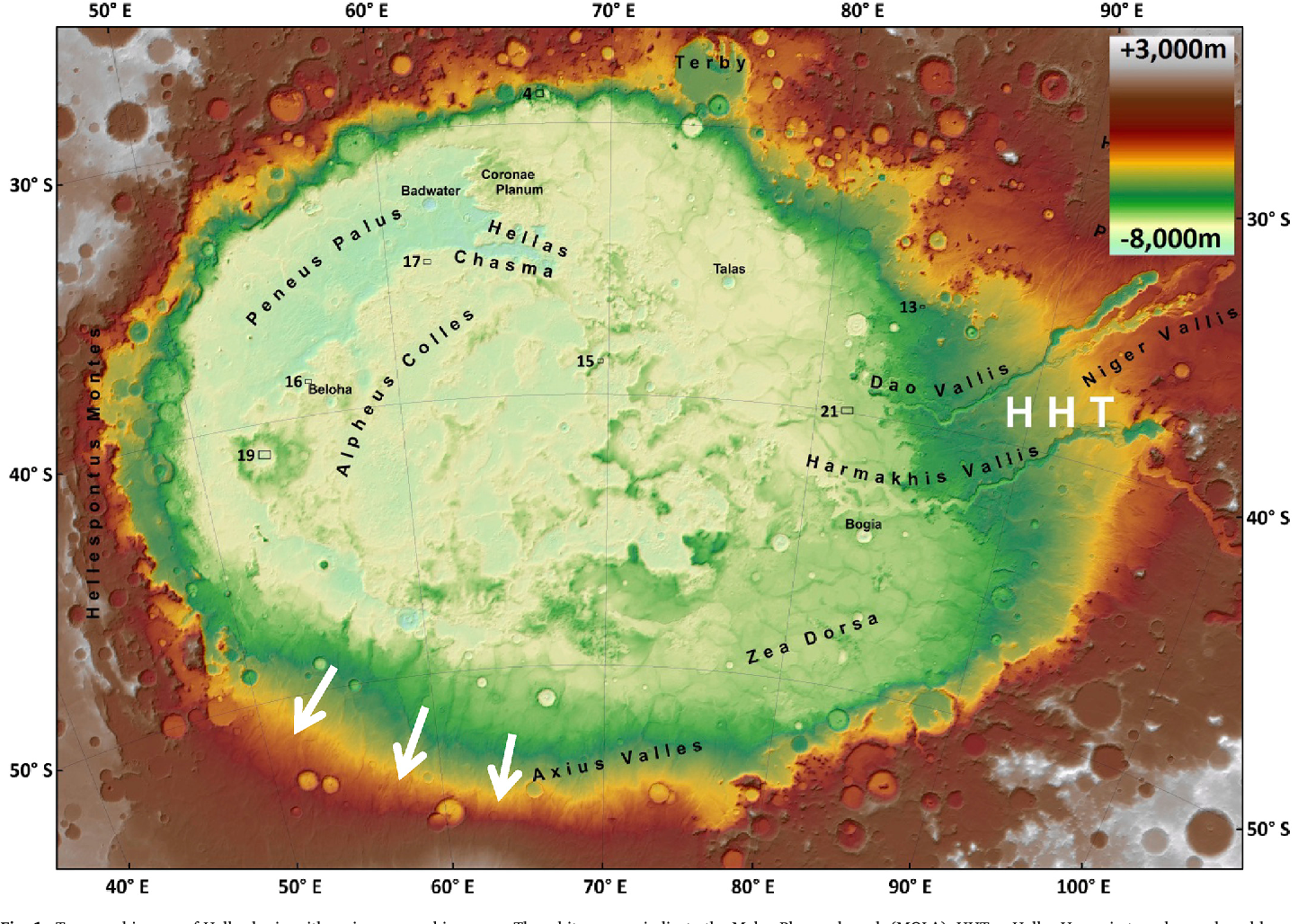
https://en.wikipedia.org/wiki/Hellas_Planitia
Quote:
Possible glaciers
Tongue-shaped glacier in Hellas Planitia. Ice may still exist there beneath an insulating layer of soil.
Close-up of glacier with a resolution of about 1 meter. The patterned ground is believed to be caused by the presence of ice.
Radar images by the Mars Reconnaissance Orbiter (MRO) spacecraft's SHARAD radar sounder suggest that features called lobate debris aprons in three craters in the eastern region of Hellas Planitia are actually glaciers of water ice lying buried beneath layers of dirt and rock.[19] The buried ice in these craters as measured by SHARAD is about 250 m (820 ft) thick on the upper crater and about 300 m (980 ft) and 450 m (1,480 ft) on the middle and lower levels respectively. Scientists believe that snow and ice accumulated on higher topography, flowed downhill, and is now protected from sublimation by a layer of rock debris and dust. Furrows and ridges on the surface were caused by deforming ice.
I am extremely annoyed that I cannot get a map that shows the locations.
https://marspedia.org/Hellas_Planitia
Image Quote: 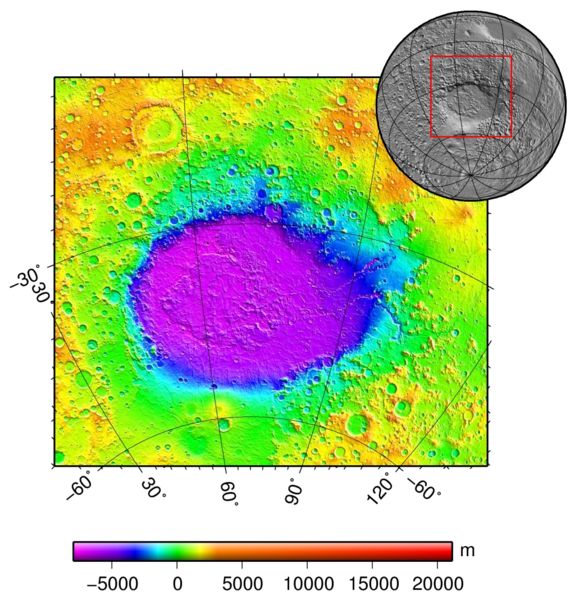
The above shows depth, which will be important for radiation considerations.
This radiation map shows how Hellas is rather special: https://www.jpl.nasa.gov/images/pia0348 … e-on-mars/ Image Quote: 
It may offer better conditions to slow down a spacecraft prior to landing as well. Perhaps even better protection from space rocks of a smaller size.
The primary deficiencies of Hellas are detected water and latitude. Winters especially in the furthest south would limit winter solar energy.
Query: "Where are the Hellas Glaciers located?" (Finally some improved information)
Copilot Search Branding
Like
Dislike
Location of the Hellas Glaciers on Mars
The Hellas Glaciers are found in the Hellas Basin in the southern highlands of Mars, specifically within the Hellas quadrangle (MC‑28) Wikipedia. This basin is one of the largest and deepest impact structures in the Solar System, with a diameter of about 2,300 km and a depth of roughly 7,152 m below the topographic datum Wikipedia. Its center is near 42.4°S, 70.5°E Wikipedia.Geographic context
Quadrangle: Hellas quadrangle (30°–65°S, 240°–300°W) Wikipedia.Basin location: Eastern half of the basin lies within the quadrangle, including the northern part where glaciers and glacial features are most prominent Wikipedia.
Notable features nearby: Amphitrites volcano, Hadriaca Patera, and major outflow channels like Dao Vallis and Reull Vallis Wikipedia.
Glacial features
Radar and imaging data show water‑ice glaciers in some craters within the basin, buried under dust layers ESA Science & Technology.Recent studies have mapped glacial landforms on the northeastern rim of Hellas, including latticework valleys carved by glacial runoff rather than rainfall Planetary Science Institute.
Some glaciers are located in Promethei Terra at the eastern rim, around 38°S, 104°E Phys.org.
Why they’re there
The Hellas Basin’s extreme depth creates higher atmospheric pressure (up to ~89% higher than at the surface) in its lowest areas, which can allow water ice to remain stable ESA Science & Technology. This, combined with past climatic conditions, likely enabled glaciers to form and persist for billions of years.In summary: The Hellas Glaciers are located in the deep southern Hellas Basin on Mars, primarily in the Hellas quadrangle, with notable examples found in the basin floor, northeastern rim, and Promethei Terra region Wikipedia+3.
Image Quote: 
Query: "Promethei Terra region, Mars"
Quote:
Like
Dislike
Promethei Terra is a large, heavily cratered highland region on Mars, east of the Hellas basin, featuring glaciers, lobate debris aprons, and extensive geological formations.Location and General Characteristics
Promethei Terra spans approximately 3,300 km at its broadest extent and is located east of the Hellas Planitia impact basin, primarily within the Hellas quadrangle of Mars
Wikipedia
Wikipedia
+1
. It is part of the southern highlands, a heavily cratered and ancient terrain that represents some of the oldest surfaces on Mars
USGS.gov
USGS.gov
. The region exhibits moderate to high relief, with isolated knobs, massifs, and rugged mountainous materials interspersed with smooth and channeled plains
USGS.gov
USGS.gov
.Surface Features and Geology
Promethei Terra is characterized by lobate debris aprons (LDAs), which are piles of material surrounding cliffs. Radar studies from the Mars Reconnaissance Orbiter indicate that these LDAs are glaciers covered by a thin layer of rock, containing large amounts of water ice
Wikipedia
Wikipedia
. The region also shows evidence of past snow accumulation, influenced by variations in Mars’ axial tilt, which affects water vapor distribution from the southern ice cap
Wikipedia
Wikipedia
.The surface is often covered by a layer of dust or volcanic ash, several tens of meters thick, which smooths landforms and partially fills craters
European Space Agency
European Space Agency
. Wind activity has removed this layer in some areas, revealing features such as dunes, crater walls, and dust devil tracks that can extend over 20 km
European Space Agency
European Space Agency
.Channels and Outflow Systems
Promethei Terra contains numerous channels and outflow systems, including the Reull Vallis, a 1,500 km-long valley network that cuts through the highlands northeast of the Hellas basin
USGS.gov
USGS.gov
+1
. These features indicate past fluvial activity, suggesting that water once flowed across the region, shaping valleys and contributing to mass wasting and sediment transport
USGS.gov
USGS.gov
.Scientific Significance
The combination of glacial features, ancient highlands, and fluvial channels makes Promethei Terra a key area for understanding Mars’ climatic history and the role of water in shaping its surface
Wikipedia
Wikipedia
+1
. The LDAs are also considered a potential source of water for future Mars colonists, highlighting the region’s importance for both scientific research and exploration planning
Wikipedia
Wikipedia
.Observations and Imaging
High-resolution images from ESA’s Mars Express and NASA’s Mars Odyssey missions have provided detailed views of Promethei Terra, revealing crater depths up to 1,200 meters, smooth dust-covered plains, and fine surface details such as dunes and deflation features
European Space Agency
European Space Agency
+1
. These observations help scientists map the geology and assess the distribution of ice and sediment across the region.
This is becoming a long chase!
Query: "Pictures of glaciers in Hellas Basin on Mars?"
Some images here: https://www.bing.com/search?q=Pictures+ … pc=EDGEXST
Quote:
Copilot Search Branding
Like
Dislike
Glacial Features in the Hellas Basin on Mars
Recent high-resolution imaging and geological studies have revealed that the Hellas Basin in Mars’ southern hemisphere contains compelling evidence of past glacial activity, including both ancient and more recent ice-related landforms.Ancient glacial landforms
Batson crater and surrounding terrain: New research has mapped and dated glaciers and glacial runoff that shaped the northeastern rim of the Hellas Basin over the last ~3 billion years. In Batson crater, sinuous valleys radiate from glacier sources, eroded by meltwater flowing beneath the ice. These valleys often form a latticework pattern rather than branching like tree roots, a signature of pressurized meltwater under glaciers Planetary Science Institute+1.
Lobate debris aprons: Radar data from the Mars Reconnaissance Orbiter’s SHARAD instrument show lobate debris aprons in eastern Hellas, interpreted as debris-covered glaciers of water ice buried under dust and rock. These aprons slope gently from highlands and can be hundreds of meters thick marspedia.org.
Honeycomb terrain: In the northwest floor of Hellas, erosion of ice-rich domes has left circular, honeycomb-like depressions. Ice layers here are estimated to be 100–1,000 meters thick marspedia.org.
Recent glacial landforms
Debris aprons and ice lobes: ESA’s Mars Express High Resolution Stereo Camera has imaged debris aprons extending from highland massifs, such as an 18 km-wide lobe from a 3.75 km high massif in eastern Hellas. These lobes are ~250 m thick and show viscous flow characteristics ESA Science & Technology.
Block glaciers: In Promethei Terra at the eastern rim, an “hourglass”-shaped structure contains a block glacier—ice mixed with scree—flowing into and out of craters. The lack of impact craters on these deposits suggests a relatively young origin, but sublimation has since removed much of the ice ESA Science & Technology.
Why these features matter
These landforms indicate that Hellas Basin hosted extensive ice deposits during warmer, wetter periods in Mars’ history. Even in the current cold, dry climate, the basin’s topography and ice-rich deposits suggest that glacial processes have played a major role in shaping its surface Planetary Science Institute+2.Where to find images
You can view these features in:NASA/JPL Mars Image and Video Gallery (search “Hellas Basin glaciers” or “Batson crater”)
ESA Mars Express HRSC image mosaics (Promethei Terra and eastern Hellas)
Mars Reconnaissance Orbiter SHARAD radar data (lobate debris aprons)
Planetary Science Institute and Astrobiology publications (recent Icarus paper with labeled glacier valleys)
These resources provide both visible and radar-based views of the glacial landforms in Hellas Basin, showing the scale and diversity of ice-related features on Mars.
Read less
>>>>>>>>>>>>> Enough research!
The point is if you could put a "Robot City" inside of one or more of these glaciers, then it could produce things like Methane and Oxygen, and perhaps also cast basalt piping to move Methane and maybe even Oxygen around in the Hellas Basin. The glaciers may tend to be at higher altitudes, although flowing down ward. But the drop is over shorter distances so perhaps a pipe system could bring Methane and maybe Oxygen down to radiation protected altitudes.
Query: "What is the maximum air pressure in Hellas Depression on Mars?"
Quote:
Copilot Search Branding
Like
Dislike
The maximum air pressure in the Hellas Depression (Hellas Planitia) on Mars occurs at its deepest point, where the atmospheric pressure reaches about 12.4 millibars (mbar) — equivalent to 1,240 pascals (Pa) or roughly 0.18 pounds per square inch (psi) Explore Scientific+1.This is about 103% higher than the average surface pressure on Mars (6.1 mbar or 610 Pa) and is the highest surface pressure measured anywhere on the planet HandWiki+1. The high pressure is due to the basin’s extreme depth — over 7,150 meters (23,465 feet) below Mars’s topographic datum — which increases air density and pressure at the bottom HandWiki+1.
Because this pressure is above the triple point of water, liquid water could theoretically exist in Hellas under certain conditions — for example, if temperatures were slightly above 0°C and dissolved salts were present to lower the freezing point Explore Scientific+1. However, in reality, the cold Martian environment and lack of sufficient heat make sustained liquid water extremely unlikely.
Summary:
Maximum pressure: 12.4 mbar (1,240 Pa, 0.18 psi) Explore Scientific+1
Location: Deepest point of Hellas Planitia, Mars
Reason: Extreme depth increases atmospheric density
Special note: Above water’s triple point, so liquid water could exist under specific conditions
So, the practice of Methane "Irrigation" could be practiced at these locations.
The greater radiation protection would have value.
It is possible that landing ships here from orbit will have a greater success to shave off speed with atmospheric breaking.
This site could have a companion site in the northern hemisphere.
It is possible that some of the human population might transfer between these seasonally. After all the seasons on Mars are almost twice as long as on Earth.
Cast basalt pipes to transfer gasses may be a good method to distribute power and water across the surface of Mars. Buried a short distance under the regolith, these would have minimal temperature fluctuations, I expect. It can be hoped that once built they might be useful for decades and maybe centuries.
Query: "A former sea in Hellas Depression on Mars?"
Quote:
Copilot Search Branding
Like
Dislike
A Former Sea in Hellas Depression on Mars?
Hellas Planitia, the vast depression in Mars’s southern hemisphere, is not the site of a primordial ocean like the hypothesized Paleo-Ocean in the northern lowlands, but it may have once contained lakes and even transient seas under certain conditions.Hellas Planitia’s Depth and Water Potential
Hellas is the largest and deepest known impact basin in the Solar System, with a floor about 7,152 meters (23,465 ft) below the topographic datum Wikipedia. At its lowest points, atmospheric pressure can reach 12.4 mbar in winter, above the triple point of water. If the water were salty, it could remain liquid under these conditions Wikipedia. This makes Hellas a prime candidate for past liquid water bodies.Evidence for Lakes and Glaciers
Geological studies suggest Hellas may have hosted glaciers and lakes in the distant past Wikipedia. Outflow channels such as Dao Vallis and Reull Vallis, fed by meltwater from the Hadriacus Mons complex, show gully features consistent with glacial or liquid flow Wikipedia. These channels could have delivered water into the basin, potentially forming temporary seas.Volcanic and Ice-Related Depressions
Within Hellas, some depressions—like those in the Galaxias Fossae region—show concentric fracture patterns resembling “ice cauldrons” on Earth, formed by volcanoes erupting beneath ice sheets sciencerocksmyworld.com+1. Such environments could have been warm, chemically rich, and water-rich, making them suitable for microbial life if they existed.Summary
While Hellas Planitia did not host a permanent, global ocean like the northern Paleo-Ocean, it could have contained lakes or even small seas in the distant past, especially during warmer, wetter periods when salty water could remain liquid at its extreme depths. The basin’s depth, glacial deposits, and outflow channels all support the idea that it was a significant water-related environment in Mars’s ancient history.
My thinking is that it may be possible that salt domes may exist in the low spots of Mars where salty water may have dried up.
The salt may have uses, but I am interested in the domes as perhaps holding humidity which could be extracted.
Or in some cases it might be possible to remove the salt and build underground structures.
In some cases to perhaps even store Methane or Oxygen in them.
Query: "Salt Domes on Mars?"
Well not much evidence so far, maybe one. The low areas of Mars may have evolved more like Earth for a time, I suspect, so that is a maybe.
Query: "Salt deposits under the Mediterranean Sea?"
Quote:
Like
Dislike
The salt deposits at the bottom of the Mediterranean Sea are primarily a result of the Messinian Salinity Crisis, which occurred around 5.5 to 6 million years ago, leading to significant geological and ecological changes.
Formation of Salt Deposits
The Mediterranean Sea is home to extensive salt deposits formed during the Messinian Salinity Crisis. This geological event occurred approximately 5.5 to 6 million years ago when tectonic movements temporarily closed the Strait of Gibraltar, isolating the Mediterranean from the Atlantic Ocean. As a result, the sea level dropped significantly due to evaporation, leading to the formation of vast salt flats and deposits that can reach thicknesses of up to 3 kilometers
Forbes
Forbes
+1
.Geological Significance
These salt deposits are not just remnants of a past hydrological crisis; they represent a significant geological feature that has been studied extensively. The deposits consist mainly of halite (rock salt) and gypsum, formed as seawater evaporated and concentrated the salts. The total volume of these deposits is estimated to be nearly one million cubic kilometers, making them one of the largest salt formations in the world
SciTechDaily
SciTechDaily
+1
.Impact on Biodiversity
The Messinian Salinity Crisis had profound effects on marine biodiversity in the Mediterranean. During this period, many marine species could not survive the drastic changes in salinity and habitat, leading to a significant loss of biodiversity. Studies indicate that only a small fraction of species survived, with recovery taking millions of years after the Mediterranean was reconnected to the Atlantic
SciTechDaily
SciTechDaily
.Current Research and Understanding
Recent studies continue to explore the processes that led to the formation of these salt deposits and their implications for understanding past climate conditions. Researchers are particularly interested in the fluid dynamics and sediment transport processes that govern salt formation in hypersaline environments like the Dead Sea, which shares similar characteristics with the ancient Mediterranean
Forbes
Forbes
+1
.
In summary, the salt deposits at the bottom of the Mediterranean Sea are a fascinating subject of study, reflecting a significant geological event that shaped the region's history and ecology.
Query: "Caves carved in salt mines?"
Lots of materials here: https://www.bing.com/search?q=Caves+car … pc=EDGEXST
Images of caves in salt mines: https://www.bing.com/images/search?q=Ca … C3&first=1
Image Quote: 
So, if Mars were to have salt deposits like those of the Mediterranean Sea, obviously gigantic cites could be established underground.
Ending Pending
Last edited by Void (2026-07-18 13:24:21)
Is it possible that the root of political science claims is to produce white collar jobs for people who paid for an education and do not want a real job?
Offline
Like button can go here
#33 2026-07-18 20:51:34
- Void
- Member
- Registered: 2011-12-29
- Posts: 9,707
Re: AquaWorlds (Water Holding and Water Transporting Methods)
Inevitably some ideas I discuss will reveal that I have been wrong. I don't consider that to be a reason to not try.
I previously had a look at glaciers in Hellas which may exist and be useful.
Now I wonder about the Shield Volcanos:
Query: "Glaciers on top of Mars shield volcano's?"
Quote:
Copilot Search Branding
Like
Dislike
Glaciers on Top of Martian Shield Volcanoes
Recent research suggests that some Martian shield volcanoes may be hiding massive glaciers beneath layers of ash and debris, making them prime targets for future exploration.Key Example: Hecates Tholus
One of the most studied cases is Hecates Tholus, an ancient shield volcano in Mars’ northern hemisphere. Scientists have compared it to Deception Island in Antarctica, where eruptions in the 1960s–70s buried glaciers with volcanic ash and dust. On Deception Island, ice was found beneath the debris, and similar features on Hecates Tholus could indicate the same Phys.org+1.Evidence for Buried Glaciers
Several “smoking gun” features on Hecates Tholus strongly suggest a solid ice core rather than just loose rock or lightly ice-cemented debris:Crevasses visible from space near the “headwalls” of the glacier — steep cliffs at the upper end — indicate that ice is still moving beneath the surface Phys.org+1.
Bergschrunds — deep cracks at the top of a glacier — form when moving ice separates from stagnant ice, a process that requires a coherent ice mass Universe Today+1.
Moraines and other glacial landforms that match those seen in other Martian glacier studies StarLust.
Why This Matters
Glaciers in the Martian mid-latitudes are harder to access than those at the poles, but they could hold massive, accessible water reserves. If confirmed, they would be ideal for future human missions, as they are closer to potential landing sites and less restricted by contamination rules Phys.org+1.Broader Context
While most Martian glaciers are found poleward of about 30° latitude, some are located on the flanks or summits of volcanoes. These are often rock glaciers — ice mixed with debris — but the Hecates Tholus case suggests that pure ice cores may also exist Wikipedia.In summary: Hecates Tholus and possibly other Martian shield volcanoes may be capped with glaciers hidden under volcanic debris. The combination of crevasses, bergschrunds, and moraines provides strong evidence for this, and if true, these sites could be among the most valuable for future Mars exploration.
Query: "Glaciers on top of Hecates Tholus shield volcano?"
Quote:
Copilot Search Branding
Like
Dislike
Glaciers on Hecates Tholus
Hecates Tholus, an ancient shield volcano in Mars’s Elysium region, has been the subject of recent research suggesting it may host massive glaciers hidden beneath layers of ash and debris.Evidence for Glacial Ice
Recent studies, including work published in Icarus (2026), compare Hecates Tholus to Deception Island in Antarctica — a volcanic island where glaciers were buried under volcanic ash from eruptions in the 1960s–70s. Scientists found that Hecates Tholus shares similar features, leading them to propose that ice may be preserved beneath its surface Phys.org+1.Key indicators include:
Crevasses visible from orbit, especially near the “headwalls” of valleys, which suggest a solid ice core is still moving under debris rather than just loose rock Phys.org+1.
Bergschrunds — deep cracks at the top of glaciers — which form when moving ice meets stagnant ice, a process detectable from space Phys.org+1.
Timing and Climate Context
Crater-count dating suggests glacial activity at Hecates Tholus occurred as recently as 5–20 million years ago, and possibly as recently as 440,000 years ago Wikipedia. Climate models indicate that ice is not stable there today, implying Mars’s obliquity (axial tilt) was higher during the glacial period, allowing ice to persist Wikipedia.Geological and Volcanic Setting
Hecates Tholus is about 182 km in diameter and formed during the Hesperian period, with volcanic activity lasting from at least 3.8 billion years ago to as recently as 100 million years ago Wikipedia. Its western flank is relatively young (Late Amazonian) due to limited cratering, while the summit has multiple concentric calderas. Glacial deposits have been found partly filling some of these calderas and adjacent depressions Wikipedia.Implications
If confirmed, these glaciers could represent significant water reserves in Mars’s mid-latitudes, potentially accessible to future human missions. However, the ice is likely buried under volcanic debris, making it challenging to access without in-situ exploration.In summary: While Hecates Tholus is not currently covered in visible ice, compelling orbital features suggest it may have hosted large glaciers in the past, with ice possibly still preserved beneath ash and debris, offering a tantalizing target for future Martian exploration Phys.org+1.
https://en.wikipedia.org/wiki/Hecates_Tholus
In space, sometimes the Europeans are more giving than some other sources: https://www.esa.int/ESA_Multimedia/Imag … ympus_Mons
Quote:
A perspective view of the western side of the Olympus Mons caldera showing evidence of ice/snow and water.
On the eastern side of the giant volcano, lava produced between 200 million and 20 million years ago melted a snow and ice layer on the volcanic shield, with the result that liquid water was on the surface as recently as 20 million years ago.
On the western side, lava produced between 200 million and 2.5 million years ago mobilised underground water and formed glaciers as recently as four million years ago.
CREDIT
ESA/DLR/FU Berlin (G. Neukum)
LICENCE
ESA Standard Licence
This is no guarantee, but a maybe.
What I am after here is the notion that if substantial ice can be located and tapped on a high mountain, then the production of Methane and Oxygen, might be piped in a system similar to what I suggested for Hellas Basin.
A high mountain may be where a Mass Driver may be made to work for Mars. If one works for the Moon then maybe in such a case on top of a mountain near the equator of Mars a Mass Driver might work.
Pipelines and Powerlines, and roadways. Periodic landing pads for spacecraft or hoppers.
While at first these would be isolated systems fed from a reservoir of fossil ice, eventually if Mars develops a strong economy with robots, it may be that a pipeline-Etc. System may network the whole planet.
For instance, Methane might flow in pipelines from polar ice to the top of Olympus Mons.
Then some clever way to send water or Hydrocarbons up to orbit with a Mass Driver perhaps.
Not to be squandered, but in time a method to send water from the Asteroid belts and beyond to intercept Mars and ice blocks to melt from aerobraking into the Martian atmosphere. (Credit for concept to Calliban).
Ending Pending
Last edited by Void (2026-07-18 21:15:20)
Is it possible that the root of political science claims is to produce white collar jobs for people who paid for an education and do not want a real job?
Offline
Like button can go here
#34 2026-07-20 09:26:34
- Void
- Member
- Registered: 2011-12-29
- Posts: 9,707
Re: AquaWorlds (Water Holding and Water Transporting Methods)
I have previously mentioned sub-systems that might be established on Mars utilizing fossil ice to feed Methane and maybe Oxygen into pipelines.
I also speculate on spacecraft/shuttles that could use Combinations of CO and CH4 fuels and Oxygen.
A quick look on the internet indicates that little to nothing has been considered as per sub-orbital spacecraft for Mars.
The idea of CO/O2 engines is a bit more promising:
Copilot Search Branding
Like
Dislike
Carbon Monoxide Rocket Engines for Mars
Carbon monoxide (CO) can be used as a rocket propellant on Mars if paired with oxygen (O₂), making it a candidate for in situ propellant production from the planet’s abundant CO₂ atmosphere.How CO Could Be Produced on Mars
Mars’ atmosphere is ~96% CO₂. One approach is photochemical reduction using a photocatalyst to split CO₂ into CO and O₂:2
CO
2
+
2
h
ν
→
2CO
+
O
2
This avoids the water-intensive Sabatier reaction that produces methane Space Exploration Stack Exchange. The CO and O₂ could then be stored cryogenically (LCO at -191.5°C, LOX at -183°C) for use in engines Space Exploration Stack Exchange.Performance and Limitations
Specific impulse (ISP) for CO/O₂ is about 200–260 s, much lower than methane/O₂ (~299s) or even hot CO₂ (~260s) Space Exploration Stack Exchange+1.Lower ISP means less efficient thrust per unit propellant mass, so CO/O₂ is better suited for short surface missions or return propulsion rather than high-efficiency orbital transfers Space Exploration Stack Exchange+1.
Combustion tests at NASA Lewis Research Center showed stable ignition and steady combustion when ignited by a separate source (e.g., LOX/H₂), but ignition boundaries are narrow, making remote ignition challenging NASA Technical Reports Server (NTRS).
Engine Design Considerations
Ignition: CO/O₂ is harder to ignite directly; NASA tests used LOX/H₂ as an ignition source, then switched to CO/O₂ NASA Technical Reports Server (NTRS).Thrust: Subscale tests achieved ~500lbf (Mars sea-level thrust) for sample-return mission engines NASA Technical Reports Server (NTRS).
Storage: LCO is denser than LOX but less dense than LH₂, so tankage and boil-off are still concerns Space Exploration Stack Exchange.
Alternative Mars Propellant Paths
CO₂/Magnesium: Wickman Spacecraft & Propulsion Company developed engines burning CO₂ with magnesium powder, enabling “air-breathing” jet-like operation for rovers wickmanspacecraft.com.Methane/O₂: More efficient but requires hydrogen brought from Earth or produced via Sabatier reaction wickmanspacecraft.com.
Summary
A CO/O₂ rocket engine is technically feasible for Mars, with proven combustion and ignition in lab-scale tests. It’s a viable in situ propellant option for return missions, especially if paired with a reliable ignition system. However, its lower ISP compared to methane or hot CO₂ means it’s best for short-range, high-mass missions rather than long-duration orbital transfers. For maximum efficiency, CO/O₂ may be used in combination with other propellant systems or in hybrid configurations.
I am actually most interested in a dual fuel method. Either two types of engines CO and CH4, or an engine that runs on CO that could tolerate an additional injection of some CH4.
Glaciers in Hellas linked to glaciers proximate to the shield volcanos (If any), and further linking low latitude ice bodies where they may exist in both hemispheres.
So, such a craft filled where CO, CH4, and O2 may be available, then to either do sub-orbital or even orbital to Phobos missions.
If traveling in a circle of jumps about the perimeter of Mars between the poles, then of course friction and gravity losses will cut into efficiency. But at times capability is more important than efficiency.
Pause...........
Hellas being among the best locations to land, as per thickness of atmosphere, and the top of Olympus Mons, perhaps being one of the worst places to land.
But could you launch from the base of a Shield Volcano and land on the top? The top being a good place to launch things from. Particularly if the fossil ice were available in each location.
From the top of Olympus Mons using some Methane, to gain to Phobos and be refilled with materials from Phobos. CO and O2. Good enough to land in Hellas. The point being that nuclear-electric rockets could bring large amounts of manufactured materials to orbit of Mars, and a landing in Hellas might be a best case for landing down-mass.
Then after unloaded, the ship to be refilled with what fuels are available, and O2, then to do some hops around the planet being refilled each time, finally to land and launch again from Olympus Mons.
The question of refilling from Phobos is open. It could be 1) O2 only, 2) CO and O2, 3) CO, CH4 and O2. We don't know yet.
But what about fresh snow and ice deposits on the top of Olympus Mons?
Quote:
Copilot Search Branding
Like
Dislike
Snowfall on Olympus Mons
Olympus Mons, the tallest volcano in the Solar System, has indeed experienced snowfall — and in fact, it is one of the most prominent examples of snow-covered mountains in the Solar System.Historical naming and early evidence
The mountain was first observed in the late 19th century as the albedo feature Nix Olympica, Latin for “Olympic Snow,” because of its bright, snow-like appearance in telescopic images Wikipedia+1.Glaciers and snow layers
Orbital observations have revealed that Olympus Mons hosts glaciers and snow layers. On the western side, lava flows between 200 million and 2.5 million years ago mobilized underground water, which formed glaciers as recently as about 4 million years ago ESA Science & Technology. On the eastern side, similar lava flows melted snow and ice layers around 20 million years ago, leaving liquid water on the surface at that time ESA Science & Technology.Atmospheric conditions
High-altitude clouds and airborne dust are common over Olympus Mons, and the summit’s atmospheric pressure is only about 12% of the average Martian surface pressure marspedia.org. These conditions allow for the formation and persistence of ice and snow.Scientific significance
The presence of snow and ice on Olympus Mons is important for understanding Mars’s climate history. It shows that even in the thin Martian atmosphere, cold, high-altitude conditions can support frozen water, and that past volcanic activity has interacted with subsurface water sources to create glacial deposits.Summary
Yes — Olympus Mons has had snowfall, with evidence of glaciers and ice layers preserved in its calderas. These features are a result of both ancient climate conditions and interactions between lava flows and subsurface water, making Olympus Mons a key site for studying Mars’s cryospheric history marspedia.org+1.
So, it is not hopeless. In fact, there are good chances for regolith covered glaciers at high altitudes.
I think the key to this may be the exposure of ice surfaces to heat. The more ice exposed to heat, the more moisture in the atmosphere. The more moisture in the atmosphere, the more greenhouse effect.
I think dust and volcanic eruptions have limited this possible way to emerge to a warmer Mars with a denser atmosphere. By covering exposed ice sufficiently the climate may instead lock down to what it is now. Axis angle modifies this and it seems likely because of buried ice at low latitudes and high altitudes, at times Mars oscillates to a warmer state. If this is true we might be able to trigger a switch to a warmer state, using greenhouse gasses and particles to warm the planet. Perhaps other methods.
In the warmer state, the atmospheric pressure would at least double, and snowfalls and temporary liquid water streams might be possible at times in certain locations.
What could be very valuable is if snowfall could increase on the tops of the Shield Volcanos.
Long term methods to modulate the dust, could be assistive. For instance, vast arrays of solar panels in Hellas that also serve as dust fences may alloy the retirement of much of the mobile dust, allowing the planet to present greater amounts of warmer ice surfaces.
However, it is good to have some dust, as such dust can also warm the planet a bit.
Quote:
Copilot Search Branding
Like
Dislike
How Dust Can Warm a Planet
Airborne dust plays a dual role in Earth’s climate — it can both cool and warm the planet, but new research shows its warming effect is far stronger than previously thought.The Warming Mechanism
Dust particles in the atmosphere can absorb and trap heat radiation emitted by the Earth, acting like a thin insulating blanket. This longwave radiative heating is especially strong when dust contains light-absorbing minerals like iron oxides (hematite, goethite) Cornell Chronicle. These minerals convert incoming sunlight into heat, which is then re-radiated back toward the surface, raising local and regional temperatures NASA Jet Propulsion Laboratory (JPL).Why the Warming Effect Is Underestimated
For years, climate models assumed dust’s heat-trapping power was about half of what it actually is. New UCLA-led studies, combining satellite data, aircraft measurements, and climate simulations, found that dust’s heating effect is about twice as strong as most models had estimated Earth.com+1. This means dust traps roughly 10% of the warming caused by human-emitted carbon dioxide, compared to the 5% most models had assigned Phys.org.Global Climate Impact
While dust also reflects some sunlight (cooling the planet), the net warming effect is larger than expected. This imbalance could:Raise surface temperatures in dust-prone regions, such as the Sahara, Middle East, and East Asia Phys.org.
Increase evaporation rates, altering atmospheric circulation and rainfall patterns — sometimes suppressing precipitation in some areas while enhancing it in others Phys.org.
Shift weather systems, affecting monsoons and storm tracks.
Why It Matters
Improving climate models to account for dust’s stronger warming effect will:Sharpen weather forecasts in dust-heavy regions.
Improve long-term climate projections, especially for regions downwind of major deserts Earth.com+1.
In short, dust is not just a passive atmospheric particle — it’s an active climate regulator whose warming influence is now recognized as a significant, previously underestimated factor in global warming.
But water ice clouds at high altitudes may matter a lot.
https://news.uchicago.edu/story/icy-clo … tudy-finds
Quote:
Icy clouds could have kept early Mars warm enough for rivers and lakes, study finds
Simulation led by UChicago geoscientist finds missing piece to Martian climate puzzle
Quote:
Copilot Search Branding
Like
Dislike
High-Altitude Clouds Could Have Warmed Ancient Mars
Recent climate modeling suggests that high-altitude, icy clouds — similar to cirrus clouds on Earth — may have played a key role in keeping early Mars warm enough to support liquid water for hundreds of years.The Climate Puzzle
Mars today is cold and dry, but geological evidence shows that 3.8 billion years ago it had rivers, lakes, and valley networks. At that time, the planet received only about 30% of Earth’s current sunlight, making it seem unlikely to have stayed warm long enough for sustained liquid water University of Chicago News+1.The Cloud Greenhouse Hypothesis
The “cloud greenhouse” idea proposes that thin layers of water ice clouds in the upper atmosphere could have trapped enough heat to offset the low insolation. These clouds would act like a planetary “sweatshirt,” reducing outgoing infrared radiation and warming the surface University of Chicago News+1.Why High-Altitude Clouds Work
Optimal height: Clouds at high altitudes are less reflective than low clouds, so they don’t block much sunlight but still trap heat effectively pmc.ncbi.nlm.nih.gov.Patchy surface ice: Simulations show that patchy surface water ice (e.g., in cold traps) leads to stable, high-altitude cloud formation, maximizing warming. Too much surface ice produces thick, low clouds that reflect sunlight and cool the planet SYFY Official Site+1.
Arid, warm climates: The model results are consistent with geologic data suggesting a warm, arid early Mars climate in some regions, with cold, icy areas elsewhere pmc.ncbi.nlm.nih.gov.
Supporting Evidence
2013 proposal: Early work by Urata and Toon suggested global cirrus-like cloud decks could warm Mars if CO₂ pressure was high enough pmc.ncbi.nlm.nih.gov.2021 UChicago study: Kite and colleagues used the MarsWRF climate model to show that high-altitude water ice clouds could produce strong, stable warming under the right conditions University of Chicago News+1.
Geologic fit: The scenario matches evidence of both warm, wet regions and cold, icy deposits, suggesting a patchy, dynamic early Martian climate pmc.ncbi.nlm.nih.gov.
Implications
If correct, this hypothesis:Explains how Mars could have had long-lived liquid water without a strong greenhouse gas like Earth’s CO₂.
Offers a plausible mechanism for planetary habitability in the distant past.
Highlights the importance of cloud microphysics and surface ice distribution in shaping early Martian climate.
In short, high-altitude icy clouds may have been the missing piece in the puzzle of how ancient Mars stayed warm enough for rivers and lakes, even with only a fraction of today’s sunlight University of Chicago News+1.
So, now I can make a further argument as to why it would be good to have power satellites in orbit of Mars. 1/3rd of Mars appears to have ice on or under its surface. There are many midlatitude ice slabs of fair thickness.
Query: "Ice slabs on Mars?"
Quote:
Copilot Search Branding
Like
Dislike
Ice Slabs on Mars
On Mars, ice slabs are most famously found at the polar regions, where seasonal and permanent ice deposits form and break apart in dramatic ways.Polar Ice Slabs
At both the north and south polar caps, water ice is overlain by seasonal layers of frozen carbon dioxide (dry ice). During winter, CO₂ frost can form 1–3m thick slabs above the ground, especially in the southern polar cap where a permanent dry ice cover about 8m thick exists Wikipedia. These slabs lie in continuous darkness and can be several meters thick. When sunlight returns in spring, the subsurface water ice warms, CO₂ sublimates, and pressure builds under the slab. This can cause the slab to rupture suddenly, producing geyser-like eruptions of CO₂ gas mixed with dust or sand. The gas flow often creates radial channel patterns in the surrounding regolith Wikipedia.Other Ice Features
While polar slabs are the most well-known, ice also exists in mid-latitudes and beneath the surface. NASA’s Subsurface Water Ice Mapping (SWIM) project has mapped buried water ice from the equator to about 60°N, identifying regions where ice could be accessed by future missions NASA. ESA’s Mars Express has also found massive layered ice deposits in the Medusae Fossae Formation, up to 3.7km thick, with radar signatures matching polar ice European Space Agency. USGS studies have identified near-surface ice in northern mid-latitudes, detectable through landforms like thermal contraction polygons and pingo-like mounds USGS.gov.Why They Matter
Resource potential: Ice is vital for drinking water and rocket fuel production.Scientific value: Ice cores could reveal Mars’ climate history and potential for past or present life.
Exploration planning: Accessible ice in flat, safe landing sites could reduce mission costs and risks NASA+1.
In short, ice slabs on Mars are a mix of seasonal CO₂ frost at the poles and buried water ice in other regions, with the polar slabs being the most visually striking and geologically active.
https://www.nasa.gov/solar-system/plane … s-new-map/
https://www.space.com/30502-mars-giant- … y-mro.html
Quote: 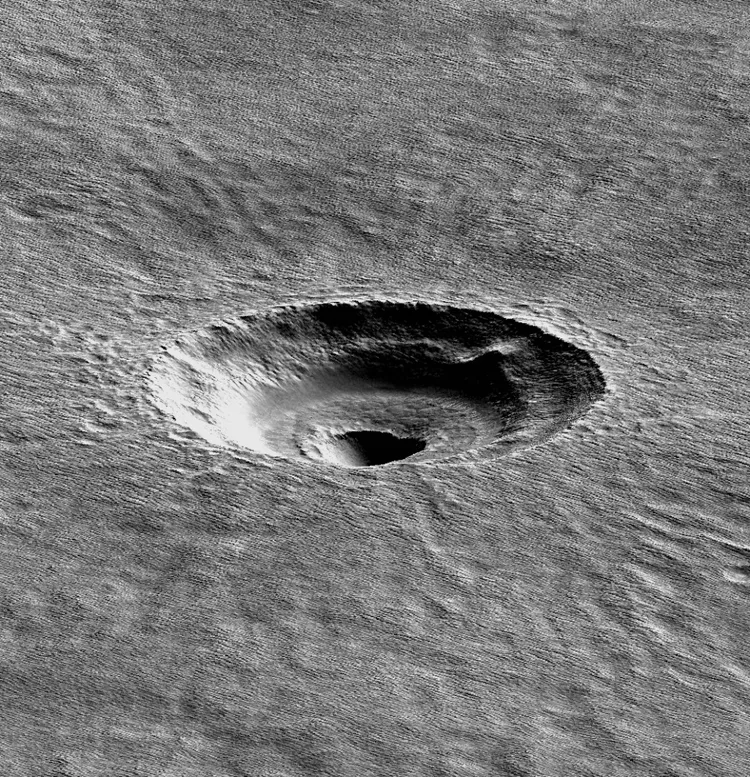
Size Matters:
Quote:
A giant slab of ice as big as California and Texas combined lurks just beneath the surface of Mars between its equator and north pole, researchers say.
This ice may be the result of snowfall tens of millions of years ago on Mars, scientists added.
These lower latitude ice slabs exist at latitudes that allow sunshine year around for a period of each day, barring dust storms.
Quote:
To look at ice hidden beneath the Martian surface, Bramson and her colleagues focused on strange craters in a region called Arcadia Planitia. This area lies in the mid-latitudes of Mars, analogous to Earthly latitudes falling between the U.S.-Canadian border and Kansas.
And considerably deep:
Quote:
The ice the scientists found measures 130 feet (40 m) thick and lies just beneath the dirt, or regolith, or Mars.
"It extends down to latitudes of 38 degrees. This would be like someone in Kansas digging in their backyard and finding ice as thick as a 13-story building that covers an area the size of Texas and California combined," Bramson said.
Such an extensive ice sheet had never been seen at these latitudes before, study team members said.
A new concept has occurred to me which would open up vast amounts of water reserves from such ice slabs.
Pause............
Query: "What would happen if you microwaved an ice slab on Mars from an orbital power satellite?"
Quote:
Copilot Search Branding
Like
Dislike
Microwaving an Ice Slab on Mars from an Orbital Power Satellite
If you could beam microwave energy from an orbital power satellite to a subsurface ice slab on Mars, the effect would depend on ice depth, dust content, and the power level.1. Microwave heating on Mars
Microwave water extraction is a form of in-situ resource utilization (ISRU) where high‑frequency electromagnetic waves heat water ice without direct contact orbitalxploration.com. On Mars, ice is often mixed with dust, which can actually improve microwave absorption compared to pure ice EarthSky. This means the slab could heat and melt faster than expected.2. Energy requirements
For small-scale experiments, microwave power ranges from 1kW to 30kW orbitalxploration.com. A kilowatt-scale beam could melt a few centimeters of ice in minutes, while higher power could melt meters. The orbital satellite would need to deliver this energy precisely to the target location, avoiding damage to regolith or equipment.3. Sublimation vs. melting
On Mars, exposed ice sublimates (turns directly to vapor) rather than melts because the thin atmosphere and low pressure make liquid water unstable University of Colorado Boulder. If the ice slab is shallow and the beam is strong enough, you could create a localized melt pool. However, if the slab is deeper or the beam is too weak, sublimation would dominate, releasing water vapor into the thin air.4. Dust’s role
Martian ice is often dusty EarthSky. Dust can lower the ice’s reflectivity, trapping more microwave energy and accelerating melting. This could be an advantage for extraction efficiency.5. Practical outcomes
If the slab is shallow and beam is strong enough: You could melt a localized pool of liquid water, which could be collected and used for life support or fuel production.
If the slab is deep or beam is weak: Most ice would sublimate, producing water vapor that would escape into the atmosphere without forming a liquid pool.
If the beam is too intense: It could heat and vaporize surrounding regolith, potentially damaging equipment or creating hazardous dust plumes.
6. Challenges
Precision targeting is critical to avoid overheating regolith or damaging infrastructure.
Atmospheric interference from dust storms could scatter or absorb the beam.
Thermal losses to the surrounding regolith would reduce efficiency.
Power delivery from orbit would require large, efficient microwave transmitters and receivers.
In summary: Microwaving a Martian ice slab from orbit could work for shallow, dust-rich ice, producing liquid water if the beam is strong enough to overcome sublimation losses. Deeper ice or weaker beams would likely just sublimate the ice into vapor. This approach is conceptually similar to ISRU water extraction technologies being tested for Mars missions orbitalxploration.com.
https://orbitalxploration.com/tag/micro … tion-mars/
Quote:
Microwave Water Extraction on Mars
When talking about microwave water extraction Mars, the process of using microwave energy to melt and collect subsurface ice on the Red Planet. Also known as Mars ISRU water extraction, it’s a core piece of making long‑duration missions possible because crews need water for drinking, fuel, and life support.I think most space organizations have thought of this on the small scale.
Microwaving from orbit would be large scale.
Key Elements and How They Fit Together
microwave water extraction Mars isn’t a stand‑alone gadget; it lives inside a network of technologies.

A melting under the regolith and evaporation of it will reduce the ice mass and cause a collapse of the materials covering the ice slab to collapse. This then can create an "Aquifer" of sorts.
Fresh water on Earth ice covered has some characteristics which may be induced into a water filled layer of regolith with ice on top of it inside the regolith.
Query: "Fresh water pond water temperatures in the winter?"
https://www.bing.com/search?q=Fresh+wat … pc=EDGEXST
Quote:
Copilot Search Branding
Like
Dislike
Winter Freshwater Pond Water Temperatures
In winter, freshwater pond water temperatures can drop well below freezing, but the exact temperature depends on pond depth, size, and local climate.Typical winter ranges
In cold climates like Minnesota, surface water can freeze at 32°F (0°C), but deeper water often remains liquid.
For most pond fish, the ideal winter temperature is around 40°F (4.4°C), as this is the minimum that supports survival for many species www.prestonponds.com.
In very cold conditions, the hypolimnion (deepest, coldest layer) can be much colder, while the epilimnion (top layer) may be slightly warmer due to residual heat or sunlight penetration Pond Informer.
If the pond is shallow or small, it can freeze solid; larger, deeper ponds may have unfrozen water at the bottom Pond Informer.
Why depth matters
Shallow ponds lose heat quickly and can freeze completely in winter Pond Informer.
Deeper ponds retain heat in the bottom layers, creating a refuge for fish and beneficial bacteria www.prestonponds.com+1.
Thermal stratification in large ponds means the coldest water is at the surface, while the deepest water stays relatively warm Pond Informer.
Practical tips for winter care
If your pond is shallow or in a very cold climate, consider insulating the pond or using a de-icer to keep an oxygen-rich hole open www.prestonponds.com.
Avoid running water features (fountains, waterfalls) if water is below 40°F, as freezing can damage equipment www.prestonponds.com.
Monitor temperature at multiple depths to ensure fish have access to warmer water Pond Informer.
Summary:
In winter, expect surface temperatures to be near or below freezing, with deeper water often staying above 40°F. The key to survival is maintaining a warm bottom layer and ensuring fish can move to it if needed.
So, it has occurred to me that you could have a "Rock Regolith Pond". Ony water between rocks and dirt, ice on top.
You can start with a patch, melt/evaporate it down, and then expand the depression in a line fashion.
As you may dump heat into the lower layer of the water, you may allow the upper part of the "Rock Regolith Pond" to be largely frozen.
Above the "Rock Regolith Pond" you would place rectenna structure and solar panel structures and also vapor barrier materials, (Tenting).
Evaporation from the "Rock Regolith Pond" would be collected by suction of the air under the tenting, and compression of it. There is no need for perfect efficiency in this collecting method.

The Rectenna + Solar Panels + Tenting will shade the rock bed helping its top to remain frozen and relatively slow the evaporation of it.
Heat, preferably waste heat will be injected into the lower layer of water in the "Rock Regolith Pond".
The warmer lower layer of water in the "Rock Regolith Pond" will melt adjacent ices and help keep the "Rock Regolith Pond" hydrated.
The setup will be intended to expand in a line.
Over time the water will accumulate salts which can be extracted or remain to help melt more ice at lower temperatures.
So, power and massive amounts of liquid water made accessible to a manufacturing process.
Leakage of water to the atmosphere will simply be assistive to other terraforming processes.
Ending Pending
Last edited by Void (2026-07-20 11:20:36)
Is it possible that the root of political science claims is to produce white collar jobs for people who paid for an education and do not want a real job?
Offline
Like button can go here
#35 2026-07-21 09:02:47
- Void
- Member
- Registered: 2011-12-29
- Posts: 9,707
Re: AquaWorlds (Water Holding and Water Transporting Methods)
Well, there seems to be a new contender for splitting molecules to produce useful products.
https://www.msn.com/en-us/weather/topst … r-AA28mJL6 Quote:
Researchers turn ocean wave vibrations into clean hydrogen fuel with no electricity needed
Story by Munis Raza • 4h •
3 min read
Pause...........
Granted, we do not have any hopes for some time that there will be waves to harvest energy from on Mars, but the outputs coming from this process would be very valuable on Mars. Electricity could drive it I believe.
New Word! piezosynthesis Nice, I had suggested some time ago, that on the dark side of tidal locked worlds with atmosphere, life forms might gain energy in the dark using this as they blow in the winds.
https://advanced.onlinelibrary.wiley.co … adfm.74769
I will not pretend that I understand it very well, but I understand what it can produce.
This article seems to explain it a little better: https://www.chemicalonline.com/doc/city … hesis-0001
I will say that if they can make it practical then they have done very good work.
Chemicals for this process from waves could do a very large amount of wealth creation for the human race.
Query: "Storing Hydrogen Peroxide?"
Quote:
Copilot Search Branding
Like
Dislike
Hydrogen peroxide should be stored in a cool, dark, well-ventilated area in compatible, tightly sealed containers to maintain stability and prevent hazards.
Key Storage Guidelines
Temperature: Hydrogen peroxide decomposes faster at higher temperatures. For household 3% solutions, store below 25°C (77°F), ideally in a cool cabinet or refrigerator. For higher concentrations (30% or more), refrigeration is recommended, with ideal temperatures between 2°C and 8°C (36°F to 46°F) to maximize stability and safety
scienceinsights.org
scienceinsights.org
+2
. Avoid freezing low-concentration solutions, as it can damage containers and alter concentration
bulkperoxide.com
bulkperoxide.com
.
Light Exposure: Light accelerates decomposition. Always store hydrogen peroxide in its original opaque brown bottle or another light-blocking container. If transferring, use amber glass or opaque HDPE containers
scienceinsights.org
scienceinsights.org
+1
.
Container Material: Use materials that do not react with hydrogen peroxide. Safe options include high-density polyethylene (HDPE), polypropylene, borosilicate glass, amber glass, and chemical-grade porcelain. Avoid metals, which can catalyze decomposition and cause rapid oxygen release
scienceinsights.org
scienceinsights.org
+3
.
Sealing and Ventilation: Containers should be tightly sealed but allow for slight venting to release oxygen gas generated by slow decomposition. Store in a well-ventilated area to prevent pressure buildup and reduce explosion risk
laballey.com
laballey.com
+1
.
Avoid Contamination: Never dip objects into the solution. Contaminants such as dust, metals, or organic matter accelerate decomposition and can create hazardous reactions
bulkperoxide.com
bulkperoxide.com
+1
.
Concentration Considerations: Shelf life varies by concentration. A sealed 3% solution lasts about three years, while an opened bottle is effective for 6–12 months. Higher concentrations (30–35%) last 3 years sealed and 1–2 years once opened
scienceinsights.org
scienceinsights.org
+1
.
Safety Precautions: Keep hydrogen peroxide out of reach of children, label containers clearly, and wear appropriate PPE (gloves, goggles) when handling concentrated solutions
evonik.com
evonik.com
. Avoid storing in garages, sheds, or areas exposed to heat or sunlight.
By following these guidelines—cool, dark, ventilated storage, compatible containers, and contamination prevention—hydrogen peroxide remains effective and safe for use over its intended shelf life.
So, could we have machines that run on a Hydrogen Peroxide Mix and a Hydrocarbon Fuel, on Mars?
Ending Pending
So now we have Moxie, Plasma, and Piezosynthesis to produce useful chemicals on Mars.
Ending Pending
Last edited by Void (2026-07-21 09:33:02)
Is it possible that the root of political science claims is to produce white collar jobs for people who paid for an education and do not want a real job?
Offline
Like button can go here
#36 2026-07-21 09:35:25
- Void
- Member
- Registered: 2011-12-29
- Posts: 9,707
Re: AquaWorlds (Water Holding and Water Transporting Methods)
I think I want to expand the idea of a Rock Aquifer Method on Mars.
Is it possible that the root of political science claims is to produce white collar jobs for people who paid for an education and do not want a real job?
Offline
Like button can go here
#37 2026-07-21 10:35:43
- Void
- Member
- Registered: 2011-12-29
- Posts: 9,707
Re: AquaWorlds (Water Holding and Water Transporting Methods)
Here I am moving in a direction and as I go adaptations emerge: 
I am trying to achieve a harmony with Mars that may allow a form of farming with maximum profit and minimum effort, if possible.
Certain life forms are apparently adapted to extreme conditions.
https://en.wikipedia.org/wiki/Lake_Vida
Quote:
Copilot Search Branding
Like
Dislike
Lake Vida is a hypersaline, ice-sealed lake in Victoria Valley, Antarctica, containing liquid brine beneath 19–21 meters of ice and hosting microbial life isolated for over 2,800 years.
Location and Physical Characteristics
Lake Vida is located in Victoria Valley, the northernmost of the McMurdo Dry Valleys in East Antarctica, at coordinates 77°23′S 161°56′E, with a surface elevation of approximately 349–390 meters
Wikipedia
Wikipedia
+1
. The lake measures about 5.4 km in length and 1.7 km in width, with a surface area of 6.8 km²
Wikipedia
Wikipedia
. It is a closed-basin endorheic lake, receiving inflows from ephemeral glacial streams such as Victoria River, Kite Stream, and Dune Creek, but has no outflows
Wikipedia
Wikipedia
+1
. The lake is permanently covered by thick ice, reaching at least 21 meters, which is the thickest non-glacial ice on Earth
Wikipedia
Wikipedia
.Salinity and Temperature
Beneath the ice, Lake Vida contains hypersaline brine, approximately seven times saltier than seawater, which allows it to remain liquid at extremely low temperatures, averaging −13 °C year-round
Wikipedia
Wikipedia
+2
. The brine is isolated from the atmosphere and surface water, creating a time capsule for ancient DNA and microbial life
Wikipedia
Wikipedia
+1
.Microbial Life and Ecosystem
Lake Vida gained attention in 2002 when scientists discovered 2,800-year-old halophilic microbes preserved in the ice, which were successfully revived upon thawing
Wikipedia
Wikipedia
+2
. The microbial community includes ultramicrobacteria, cyanobacteria, and other extremophiles, thriving in a dark, oxygen-deprived, and highly saline environment
dri.edu
dri.edu
. The lake also contains high levels of nitrous oxide and molecular hydrogen, which may serve as energy sources for life in the brine
Wikipedia
Wikipedia
+1
.Research and Scientific Significance
Lake Vida has been a focus of astrobiology and extremophile research, as its isolated ecosystem provides a model for potential life on Mars or icy moons like Europa
Wikipedia
Wikipedia
+3
. Research expeditions, including those led by Peter Doran and Alison Murray, have collected ice cores, brine, and sediment samples to study the lake’s microbiology, geochemistry, and climate history
Wikipedia
Wikipedia
+1
. The Lake Vida Meteorological Station monitors local climate conditions year-round, although it is unmanned
Wikipedia
Wikipedia
.Geology and Surrounding Features
The lake is surrounded by glaciers, ridges, and summits, including Upper Victoria Glacier, Packard Glacier, Mount Cerberus, and Mautino Peak
Wikipedia
Wikipedia
. The Victoria Valley dunefield lies to the east, providing insights into perennial niveo-aeolian processes
Wikipedia
Wikipedia
. The McMurdo Dry Valleys are classified as an extreme desert, receiving less than 10 cm of snow annually
Wikipedia
Wikipedia
.Historical Context
Lake Vida was named after Vida, a sled dog from Robert Falcon Scott’s Nimrod Expedition (1910–13) and was first explored by the Victoria University of Wellington Antarctic Expedition in 1958–59
Wikipedia
Wikipedia
+1
. Initial assumptions that the lake was frozen solid were overturned in the 1990s using ground-penetrating radar, revealing the liquid brine beneath the ice
dri.edu
dri.edu
+1
.
Lake Vida remains one of the least studied yet most extreme lakes on Earth, offering a unique natural laboratory for understanding life under extreme conditions, climate history, and potential analogs for extraterrestrial ecosystems
Wikipedia
Wikipedia
+2
.
Quote:
Beneath the ice, Lake Vida contains hypersaline brine, approximately seven times saltier than seawater, which allows it to remain liquid at extremely low temperatures, averaging −13 °C year-round
The adapted life forms are adapted to higher pressures than an artificial Mars environment though.
The calculator for vapor pressure: https://endmemo.com/chem/vaporpressurewater.php
So, at -13 C, then 2.2128 mbar. Well below the ambient pressure where most of the ice slabs exist.
Quote:
Life
Scientists have found life in an Antarctic Lake Vida that was sealed off from the outside world by a thick sheet of ice several thousands of years ago.[16][17] The discovery of the ecosystem pushes the boundaries of what life can endure, and may inform the search for alien microbes on other planets, such as Mars, or on icy moons, for instance, Jupiter's moon Europa.
Cold temperatures usually means slow growth, but I wonder if you gave the microbes a lot of Hydrogen and CO and Mars atmosphere may they perform well? Outputs could be biological and also if the CO2 is absorbed the production of a Argon/N2 mix which could be mixed with Oxygen to make an Air-Like mix.
A item that I think I will alter in the construction of a "Stone Aquifer", is that instead of stones, properly shaped non-rectangular bricks might be used.
It needs a lot more work. -13 C may not be necessary, it likely may be about the temperature of Antarctic sea water.
My objective is to make Mars more habitable, and so that it can interact with Deimos and Phobos to develop methods to reach the Asteroid belts to unlock large amounts of water.
Ending Pending
Last edited by Void (2026-07-21 10:53:56)
Is it possible that the root of political science claims is to produce white collar jobs for people who paid for an education and do not want a real job?
Offline
Like button can go here
#38 2026-07-21 11:57:49
- Void
- Member
- Registered: 2011-12-29
- Posts: 9,707
Re: AquaWorlds (Water Holding and Water Transporting Methods)
My notion here is compatible with the existing SpaceX idea of landing in the lower latitude Northern Hemisphere.
My view is that it could be very valuable to beam energy from orbit down to such a settlement.
The two moons will be valuable with or without water.
Query: "Water in Phobos and Deimos?"
Quote:
Copilot Search Branding
Like
Dislike
Phobos and Deimos may contain water, but current evidence suggests little to no water on their surfaces, with potential subsurface or mineral-bound water depending on their origin.
Surface Observations
Spectroscopic studies indicate that Phobos has very little to no water on its surface, and similar observations apply to Deimos. Analytical models support this, showing that surface water is minimal, but they do not rule out the presence of water beneath the surface or chemically bound in minerals
Docslib.org
Docslib.org
.Subsurface and Mineral Water
The potential for subsurface water or water of hydration depends heavily on the moons’ formation. If Phobos and Deimos are captured asteroids or comets, they could retain significant water today. Conversely, if they formed from accretionary debris or giant impacts on Mars, they might be largely depleted of volatiles, though some water could remain trapped in minerals or in the interior
University of Colorado Boulder
University of Colorado Boulder
+1
.Formation Implications
The moons’ water content is closely tied to their origin. The giant impact hypothesis suggests that if the moons formed from Mars impact ejecta, they would likely be dry, similar to the Earth’s Moon. However, studies of terrestrial tektites show that some water can survive high-energy impacts, implying that Phobos and Deimos might have retained some original water if the impact target was wet
University of Colorado Boulder
University of Colorado Boulder
.Exploration and Resource Potential
Phobos and Deimos are considered strategically important for human exploration due to their low gravity and accessibility. If water exists in usable quantities, it could support fuel production, life support, and radiation shielding for missions to Mars or beyond
Docslib.org
Docslib.org
. Future spacecraft missions are necessary to directly measure water content and clarify the moons’ origins.Summary
While direct evidence of water is limited, Phobos and Deimos could contain subsurface or mineral-bound water, with the amount depending on whether they are captured bodies or formed from Martian impact debris. Determining their water content is crucial for understanding their formation and for planning future human exploration
University of Colorado Boulder
University of Colorado Boulder
+1
.
The question of human life support answered eventually, it might be possible that the major human settlements will be on the surface of Mars or in orbit of Mars. Either way the place where the people may be given life support may allow remota actuation of robotic entities either on the surface or in orbit or both.
This is even more favorable to the notion of using the two moons for connection between Earth/Moon and the Asteroid Belt, using the two moons and Mars itself.
Query: "Carbon in Phobos and Deimos?"
Quote:
Like
Dislike
Yes, both Phobos and Deimos have carbon-rich surfaces, primarily from accreted interplanetary dust and possibly resembling carbonaceous chondrites.
Evidence of Carbon
Reflectance spectroscopy of Phobos and Deimos indicates that their surfaces are abundant in carbon, giving them spectral characteristics similar to carbonaceous asteroids, particularly D-type asteroids
NASA
NASA
+2
. Laboratory analyses and spacecraft observations suggest the presence of amorphous carbon and other dark components, which contribute to their low albedo and dark appearance
oup.com
oup.com
. These carbon-rich materials may also include minerals altered by space weathering, such as Fe^0 and FeS-bearing compounds
oup.com
oup.com
.Origin of Carbon
There are two main hypotheses regarding the carbon on these moons:Accretion from Interplanetary Dust Particles (IDPs): Phobos and Deimos lie within Mars’ gravity well, exposing them to a high flux of IDPs. Calculations estimate that over 4 billion years, Phobos could have accumulated roughly 5.1 × 10^11 kg of IDP material and Deimos about 1.6 × 10^11 kg, with approximately 10% of this mass being carbonaceous
NASA
NASA
+1
. This process could explain why their surfaces resemble carbonaceous chondrites even if their bulk composition originated from Mars-impact debris.
Intrinsic Carbonaceous Composition: Some studies suggest that the moons may have formed from carbon-rich material, either as captured primitive asteroids or from debris generated by a giant impact on Mars. The carbon detected on the surface could therefore reflect both primordial material and later deposition from IDPs
NASA
NASA
+2
.
Implications
The presence of carbon is significant because it affects the moons’ reflectance spectra, surface chemistry, and potential for future sample-return missions. Japan’s MMX mission aims to collect samples from Phobos, which will help determine whether the carbon is primarily surface-deposited or part of the moons’ bulk composition
littleastronomy.com
littleastronomy.com
+1
.
In summary, Phobos and Deimos do contain carbon, largely on their surfaces, acquired through interplanetary dust accumulation and possibly from their original formation material, giving them a carbonaceous appearance similar to certain asteroids
NASA
NASA
+2
This is very big if true:
In summary, Phobos and Deimos do contain carbon, largely on their surfaces, acquired through interplanetary dust accumulation and possibly from their original formation material, giving them a carbonaceous appearance similar to certain asteroids
So, then there are multiple ways to use Carbon, Oxygen, and Metals for space propulsions. The two moons will be extremely useful.
Query: "Phobos 2 detected outgassing from Phobos?"
Quote:
Copilot Search Branding
Like
Dislike
Yes — the Soviet spacecraft Phobos 2 detected faint but steady outgassing from Phobos during its 1988–1989 mission Northwestern University ECE+1.Phobos 2 was launched on 12 July 1988 and entered Mars orbit in January 1989. It carried multiple instruments, including an infrared spectrometer, and conducted three preliminary encounters with Phobos before contact was lost in March 1989 due to a computer malfunction Wikipedia.
During one of these encounters, the spacecraft’s instruments recorded outgassing — the release of gases from the moon’s surface — but the mission ended before it could determine the nature of the material releasing the gas Northwestern University ECE+1. The best scientific guess at the time was that water ice might be the source, though this could not be confirmed due to the loss of contact Northwestern University ECE.
Later observations by the Mars Global Surveyor and other missions have shown that Phobos is covered in a layer of fine dust up to a meter thick, and its low density suggests it may be composed of a mixture of rock and ice Northwestern University ECE+1. This supports the idea that the outgassing detected by Phobos 2 could have originated from subsurface water ice, but the exact mechanism and composition remain uncertain.
In summary:
Detected: Yes — faint, steady outgassing from Phobos.
Cause: Unknown at the time; water ice is the leading candidate.
Limitation: Mission failure prevented follow-up analysis.
Context: Supports theories that Phobos contains subsurface volatiles, possibly ice.
That is much more supportive to the idea of water ice inside of Phobos.
What is needed then early on is access to the interior and also some kind of good full life support in orbit including synthetic gravity and radiation protection.
Last edited by Void (2026-07-21 12:30:30)
Is it possible that the root of political science claims is to produce white collar jobs for people who paid for an education and do not want a real job?
Offline
Like button can go here
#39 2026-07-22 07:26:47
- Void
- Member
- Registered: 2011-12-29
- Posts: 9,707
Re: AquaWorlds (Water Holding and Water Transporting Methods)
One thing that I think emerges is that it could be convenient to send multiple nuclear-electric missions to the moons of Mars.
Such, if robotic, could take their time and use high efficiency plasma types of propulsions.
They could exploit "Ballistic Capture".
Quote:
Copilot Search Branding
Like
Dislike
Ballistic Capture to Mars
Ballistic capture to Mars is a low‑energy interplanetary transfer method that allows a spacecraft to enter orbit around Mars without requiring a large propulsive burn at arrival, using only the natural gravitational forces of the Sun, Earth, and Mars Wikipedia+1.How it works
In a ballistic capture transfer (BCT), the spacecraft is placed on a trajectory that initially has positive energy relative to Mars. As it travels, it gradually loses energy due to gravitational interactions, eventually becoming “captured” into a temporary orbit. This capture occurs in a region of space called the weak stability boundary (WSB), a fractal network of stable and unstable manifolds associated with Lagrange points arXiv.org. The spacecraft may first be captured far from Mars (an exterior BCT) and then maneuvered to a desired altitude within a ballistic capture set arXiv.org.Advantages over Hohmann transfer
Lower capture Δv: Saves significant propellant compared to a classical Hohmann transfer, which requires a large braking burn at Mars arXiv.org.No time‑critical orbit insertion: Launch can occur almost anytime, not just during narrow launch windows Wikipedia.
Reduced fuel cost and complexity: Less propellant means lighter spacecraft, higher payload capacity, and simpler mission design Wikipedia.
Safety: Avoids the risk of missing a precise braking maneuver Wikipedia.
Flight time and performance
Typical ballistic capture to Mars missions take up to a year, compared to about nine months for a Hohmann transfer Wikipedia.The transfer is low energy because it uses no Δv for capture, though some small corrections may be needed (often with low‑power ion thrusters) Wikipedia.
Applications and research
First demonstrated for the Moon by Japan’s Hiten (1991) and later by ESA’s SMART‑1 (2004) Wikipedia.Proposed for Mars in 2014 by Belbruno and Topputo, with simulations showing feasibility and efficiency arXiv.org.
Stability analysis and control strategies have been studied for small spacecraft (e.g., CubeSats) to ensure long‑term orbit maintenance Politesi.
Key considerations
Temporary capture: The orbit is not permanent; the spacecraft may eventually escape unless active station‑keeping is performed.Complex trajectory design: Requires precise planning to reach the WSB and then maneuver to the target orbit.
Longer mission duration: Missions must account for extended cruise phases.
In summary, ballistic capture to Mars is a promising low‑fuel, flexible alternative to traditional transfers, especially for missions where propellant efficiency, launch flexibility, and safety are priorities Wikipedia+2.
Early missions would have to carry the propellants needed to move from a "Temporary Capture" to orbital association with a moon of Mars.
But it might be that an earlier ship that had refilled propellants from one ot the Moons could go and get the later arrivals. Not sure if that would be a better way to do it or not.
Then you could build a power grid that might be able to beam power down to a base or bases on Mars on occasion.
But I think a great desire would be to provide a refilling station in Mars orbits, using some of that power, to process the materials of Deimos and Phobos. Products that may be produced might be Carbon and Oxygen as propellants, and metals also as propellants.
At some point the problems of artificial gravity and radiation need solving.
Probably if it becomes possible to make solar power devices on the Moon, it will also be possible to do it with the materials from the moons of Mars. Objections to solar power in orbit of Mars, do not hold up very well, because these power plants will not very much change their orbital energy (Inertia), and concentrating mirrors are very likely relatively easy to make.
In fact, it may be that for orbital Mars Solar-Thermal-Electric with supercritical CO2 may be the way to go. https://www.youtube.com/@Anthrofuturism has shown that for the Moon solar panels are better than heat engines. However, Mars orbits may have a better heat sinking situation than our Moons surface does.
I was investigating Carbon as radiation shielding and was surprised to learn that there are some new tricks for that.
Query: Carbon for radiation shielding?
Quote:
Copilot Search Branding
Like
Dislike
Carbon-Based Materials for Radiation Shielding
Carbon-based materials, especially carbon nanotubes (CNTs) and graphene, are being actively researched for radiation shielding due to their unique physical and electronic properties.Electromagnetic (EM) Radiation Shielding
Carbon nanotubes are excellent for shielding radio and microwave frequencies because of their high electrical conductivity, small diameter, and light weight. They can be incorporated into polymers, fabrics, or yarns to create flexible, lightweight shielding composites MDPI+1. Magnetic nanoparticles can be added to CNT fabrics to enhance shielding of electromagnetic waves MDPI.Ionizing Radiation (X-rays, Gamma Rays)
For higher-frequency ionizing radiation, pure carbon is less effective than metals because of its low atomic number. To improve shielding, tungsten nanoparticles or other high-Z materials are often combined with CNTs to increase photon absorption MDPI. Graphene-based nanocomposites are also being explored for gamma- and X-ray shielding, offering potential for lightweight, flexible, and multifunctional shields Nature.Applications
These composites are being developed for:Spacecraft and satellites – lightweight, flexible shielding for electronics and crew MDPI
Nuclear reactors – radiation protection with reduced weight compared to metals MDPI
Medical garments – wearable shielding for radiation workers MDPI
Lunar colonization – portable, multifunctional radiation protection MDPI
Advantages
Lightweight – critical for aerospace and wearable applications
Flexible – can be integrated into fabrics or structures
Multifunctional – can combine shielding with other properties (e.g., structural support, EMI protection)
Safer – avoids heavy metals like lead in some applications
Challenges
Large-scale, low-cost manufacturing of continuous CNT-based composites is still under development MDPI
Optimizing nanoparticle size, shape, and distribution for maximum shielding efficiency MDPI
Long-term stability and radiation resistance of nanomaterials under harsh conditions NASA Technical Reports Server (NTRS)
In summary: Carbon nanotubes and graphene-based composites are promising for both EM and ionizing radiation shielding, especially when combined with high-Z nanoparticles. They offer a path toward lighter, more flexible, and safer shielding solutions for aerospace, medical, and nuclear applications.
So, when it comes to small favors, I think we can have gratitude for each one, and should do so.
And I did mention on this site a new treatment for solid cancer tumors.
https://www.sciencedaily.com/releases/2 … 160655.htm
Quote:
This frog bacterium wiped out cancer tumors in mice with a single dose
So, each little nibble on the radiation problem counts for a lot. It may be possible that people on and around Mars may benefit from such treatments.
In treating materials of Phobos and Deimos, it may be possible to extract most of the Iron, and most of the Carbon and some of the Oxygen, and have a "Slag" remnant that could be fashioned into radiation shielding and also structure. It may be convenient to get Sodium Chloride, Table Salt from Mars, to use the Chlorine to extract the iron. I also accidentally discovered that a rocket based on Sodium, Aluminum, and Liquid Oxygen may have a fair amount of kick. If so, it might be useful to get Sodium from Mars for that.
Quote:
Copilot Search Branding
Like
Dislike
Rocket Propulsion Using Sodium, Aluminum, and Oxygen
Combining sodium, aluminum, and oxygen can produce a high-energy propellant system, but it requires careful engineering due to the reactivity of sodium and the combustion characteristics of aluminum–oxygen mixtures.Why These Materials Work
Oxygen acts as the oxidizer, enabling combustion in the absence of atmospheric air www.grc.nasa.gov+1.Aluminum is a lightweight metal fuel with a high energy density per unit mass. When burned with oxygen, it produces a large volume of hot gas, generating thrust NASA Technical Reports Server (NTRS)+1.
Sodium is an alkali metal with a very low ignition temperature and high reactivity. It can ignite at room temperature in air and burns with intense flame. In rocketry, sodium is sometimes used in bipropellant systems (e.g., sodium–oxygen) for high specific impulse Wikipedia.
Combustion Chemistry
When sodium burns, it reacts with oxygen to form sodium oxide (Na₂O) or sodium peroxide (Na₂O₂), releasing a large amount of heat. Aluminum burns to form aluminum oxide (Al₂O₃), also releasing significant energy. Combining both fuels with oxygen can create a multi-fuel combustion where:Sodium provides rapid ignition and high flame temperature.
Aluminum provides sustained, high-mass flow combustion.
Oxygen supports both reactions.
The overall reaction can be approximated as:
4Na + O₂ → 2Na₂O
4Al + 3O₂ → 2Al₂O₃
Both products are solid oxides, which can be used for regenerative cooling or as combustion chamber lining.Propellant Form and Delivery
Solid propellants: Sodium and aluminum can be mixed into a composite solid propellant with an oxidizer binder. This is similar to double-base propellants, where both fuel and oxidizer are present in the same grain www.seitzman.gatech.edu.Liquid/hybrid: Aluminum powder can be injected with liquid oxygen (LOX) for hybrid or bipropellant operation NASA Technical Reports Server (NTRS)+1. Sodium could be used as a separate liquid or gaseous oxidizer, but its volatility and reactivity make handling challenging.
Monopropellant concept: Sodium in gelled LOX could act as a monopropellant, with aluminum added for higher performance Space Exploration Stack Exchange.
Performance Considerations
Specific impulse (Isp): Aluminum–oxygen systems can achieve Isp values around 285–300 seconds Space Exploration Stack Exchange. Adding sodium could increase flame temperature and energy release, potentially improving performance, but may require trade-offs in stability and safety.Thrust: High flame temperatures from sodium combustion can increase thrust, but rapid reaction rates may cause instability if not controlled.
Hazards: Sodium is highly reactive with water and air; aluminum is pyrophoric in fine powder form. Combining them with oxygen creates a highly hazardous mixture that requires robust containment and ignition control.
Practical Applications
Research & development: Sodium–oxygen–aluminum systems have been studied for lunar in-situ propellant concepts, where aluminum could be mined from anorthosite and oxygen from water ice Space Exploration Stack Exchange.Specialized launchers: Such a propellant could be used in small, high-thrust applications where rapid ignition and high energy density are priorities, but safety and handling would be major design challenges.
In summary: Sodium, aluminum, and oxygen can form a high-energy rocket propellant system, but it is best suited for experimental or specialized applications due to the extreme reactivity of sodium and the pyrophoric nature of aluminum powder. Safe handling, precise mixing, and advanced combustion chamber design are essential for any practical implementation.
Sodium is a nightmare on the surface of the Earth, but I suspect that it can be better handled in the vacuum of space.
Aluminum extraction from the materials of Phobos and Deimos will be harder than getting Iron out of it.
Although it is hoped to get Carbon from the moons of Mars, another trick might be to bring Methane up from Mars, and react it with Oxygen from those two moons, to create water and CO2. Water can be used for various things, and also in an ALICE rocket, and of course CO2 can be used as propellant in many ways.
If slag blocks are a remainder, I would hope that they could be fashioned in shapes like logo blocks that interlock. Also, I am hoping that they can be coated with an Iron or Steel foil, and that to be magnetized, so that they attract each other. Vacuum welding of the iron foil and bands, cables and other fixtures would be expected and even desired in many aspects.
Ending Pending
Last edited by Void (2026-07-22 08:09:38)
Is it possible that the root of political science claims is to produce white collar jobs for people who paid for an education and do not want a real job?
Offline
Like button can go here
#40 2026-07-22 15:20:43
- Void
- Member
- Registered: 2011-12-29
- Posts: 9,707
Re: AquaWorlds (Water Holding and Water Transporting Methods)
So, I wonder what a minimum toehold to dwell near a Mars moon might be like. Presuming you would deploy robots to work with a moon and thought that you wanted humans to interact with the process in "Real-Time".
I have suggested this, but this is not the minimum. 
This is more minimal:
It presumes that a Starship body can be modified to allow some compartments 1, 2, 3 to be air filled, and the rest to be water filled. If there are some special Carbon Nano-Tube tricks for radiation protection, then the water fill can be reduced and the air fill expanded.
I am running on something that Dr. G. W. Johnson proposed, a tumbling Starship to generate about .5 g of spin gravity.
But I also anticipate improving that by attaching a regolith filled bag to the aft end of the ship to alter the center of gravity.
I presume that the ship is towed to Mars orbit prior to being put into service. It may or may not contain propellants on the way to Mars.
I am also presuming that there would be additional support ships that may land on Mars and that might upon returning to orbit change out the crew. Probably nuclear-electric-plasma method to tow it.
I am roughly using the dimensions of a crew dragon capsule for the size of compartments #1, and #2.
Granted it is a try. I expect that better plans might be available.
Future Starships may be of a larger size as well, even of diameter.
But something like this might establish a toehold in orbit to contribute to robotic efforts of action on the materials of one or two of the moons.
Ending Pending
Last edited by Void (2026-07-22 15:51:52)
Is it possible that the root of political science claims is to produce white collar jobs for people who paid for an education and do not want a real job?
Offline
Like button can go here
#41 2026-07-23 09:34:08
- Void
- Member
- Registered: 2011-12-29
- Posts: 9,707
Re: AquaWorlds (Water Holding and Water Transporting Methods)
I have modified the depiction of a Minimum device for prolonged human presence in Mars orbits: 
I am running on ideas from this article for the Carbon Net Container for regolith: https://www.frontiersin.org/journals/as … 45363/full
Quote: 
It is presumed that the idea for a net, perhaps Carbon Nano-Tube in some part of nature of it like the one in the article could hold lose regolith from Deimos or Phobos.
The Starship would have been modified in Earth orbit to provide partitions for keeping water and air separate.
The device might be towed to Mars orbit with or without the water, most likely by a nuclear-electric power propulsion system.
Ballistic Capture being used, a heat shield is not needed for capture to Mars orbits.
Having a centrifugal bag filled with loose regolith has some danger. If it ruptured it might make a collision hazard. So, responsible handling would be required.
Starship having a space elevator such as for Lunar Starship, could center the platform for the center of spin to allow docking of other ships while spinning. How to get people and materials on the platform into the "Minimum Ship" needs discovery of invention of method.
If the ship were filled with water prior to departure from Earth orbits, then humans might ride along, but the spin gravity may be only 1/3rd that of Earth. This would be a prolonged trip, unless some booster method would set it on its way to Mars.
If you could make 1 or more Starships to be boosters for the projection of this to Mars than the problem of length of time may be not so much.
I am imagining a hybrid method. A fast chemical thrust with booster stages, and a relatively low thrust 2nd stage which would be Nuclear Electric-Plasma thrust in nature.
I am hoping that this hybrid method would be able to shorten the travel time, but still allow for a Ballistic Capture of the Minimum Device to orbits of Mars.
>>>>>
Other prolonged ways to use it could involve Starships landing on Mars with the suicide dive method, being refilled on the surface of Mars and then traveling to this Minimum Device to exchange people.
The people in the Minimum Device would monitor the work of robotic systems doing various things with the moons of Mars, Deimos and Phobos. Building structures, and producing propellants for space travel from the regolith of those moons, and perhaps some Hydrogen from Mars itself.
Ending Pending
Last edited by Void (2026-07-23 09:53:04)
Is it possible that the root of political science claims is to produce white collar jobs for people who paid for an education and do not want a real job?
Offline
Like button can go here
#42 2026-07-23 15:23:29
- Void
- Member
- Registered: 2011-12-29
- Posts: 9,707
Re: AquaWorlds (Water Holding and Water Transporting Methods)
From the last post:
I have modified the depiction of a Minimum device for prolonged human presence in Mars orbits:
If this is workable, then burrowing into the two moons of Mars may also be workable.
https://www.solarsystemscope.com/spacep … ars/deimos
Image Quote: 
https://www.solarsystemscope.com/spacep … ars/phobos
Image Quote: 
Burrowing in will need discovery of what will work. Before it is done on a large scale it would be hard to put synthetic gravity into these two moons. So, perhaps humans could be rehabilitated in a free floating synthetic gravity machine after a period of time in microgravity inside of these moons while caverns are created.
I have suggested putting rocks inside of "Chicken Wire" enclosures, perhaps nets of Carbon Nano-Tube could be used as well.
A lid which could cover a crater may be a start to provide a radiation sanctuary to start with.
Materials which may be relatively easy to obtain from the regolith early on may be Iron, Carbon, and Oxygen.
So grades of Iron and Steel may be possible to make fixtures to which Chicken Wire could be fixed, and then fixed to that could be light weight netting. Then to fill with regolith.
We don't know what methods will actually work with these two moons, but here are some starter ideas: 
It may be possible to see indications of a large slab of rock and dig down and use rock anchors to help hold down the regolith dome.
The regolith dome may be netting stabilized with chicken wire and those then anchored to thin metal beams or poles. Something like hollow tent poles.
In this one I have included an open entrance for a ship to fly in. However it would need to be careful that it exhaust did not push the roof off of the little moon. Perhaps some kind of a cable would be attached to the ship and would pull the ship in.
Anyway, if anyone has better then fine. I want better.
Eventually the desire would be to hollow out and stabilize very large compartments that spin gravity machines could be installed into.
Ending Peiding
Last edited by Void (2026-07-23 16:03:13)
Is it possible that the root of political science claims is to produce white collar jobs for people who paid for an education and do not want a real job?
Offline
Like button can go here
#43 2026-07-24 10:22:41
- Void
- Member
- Registered: 2011-12-29
- Posts: 9,707
Re: AquaWorlds (Water Holding and Water Transporting Methods)
If I mention Mars or Deimos or Phobos, binary evaluations have to be suppressed. It is typical for the descendants of apes or people who look like they could have descended from apes to enter a configuration of two tribes against each other.
My pathways are about networks of variations of possibilities that work towards a desired purpose.
What is wealth? If I said I know how to get vast amounts of fairly clean water on Mars could that be a source of wealth?
Usually when we try to adapt Earth to Mars, we struggle as for some aspects of Mars it is not at all as generous as the Earth is.
But it may be that for some things, Mars might be more generous.
Coffee.........
Let borrow from Calliban. We know he wants to serve Man: https://newmars.com/forums/viewtopic.ph … 87#p240487
Well at any rate, perhaps some proficient method to make sheets of something that could be hung on a steel frame like corrugated metal sheets. Maybe we would want to be able to make ceramic sheets, or fiberglass sheets.
https://www.indiamart.com/proddetail/ti … 30662.html
Image Quote: 
We often talk about domes on Mars, but that might be because we intend to defend a very large differential pressure, usually hight pressure within and low pressure outside.
We also like to think about transparent structure, but from my point of view that is very expensive to achieve.
Suppose we could make an upgraded tin shed over a body of ice covered water.
Supports that that tin shed was a vacuum chamber, but also could be pressurized to a small degree.
Lets say down to 2 millibar and up to 20 millibar, on a guess.
The calculator again: https://endmemo.com/chem/vaporpressurewater.php
So, a vapor pressure of -14 C to 18 C (Approximately). I don't think we need to go out that far to either extreme to get what we would want. But if we could make a tin shed that could hold those differential pressures, then we might get away with many things.
Drawing needed: 
A problem I have had with the concept of a ice covered reservoir is that it is hard to keep the ice from sublimating in the Mars environment.
However, if you choose to turn it upside down, what if you could profit if ice or brine evaporates?
If you pull a vacuum inside the Tin Shed, you can induce sublimation and your pump can compress vapor into relatively clean water.
The vacuum and heat will do that evaporation, and so, with the energy to pull a vacuum, you may produce water you want and don't really have to worry if the ice sublimates, as you actually want it to. Relatively clean water then to use for industrial processes. If you get a toxic mixture you dump it into a boil bin, and then at times after it boils off just scoop the toxic materials out and send it to a waste site outside the Tin Shed.
As you can pull a vacuum, you may be able to produce a water vapor atmosphere inside the Tin Shed. Now you might be able to use a plasma process to produce H2 and O2 without worrying about producing toxic CO.
https://roadmaps.mit.edu/en/roadmaps/Pl … n_in_Space
Quote:
Copilot Search Branding
Like
Dislike
Plasma-Based Oxygen Production on Mars
Plasma-based oxygen generation is an emerging in-situ resource utilization (ISRU) technology that could be vital for sustaining human missions on Mars by converting the planet’s abundant carbon dioxide into breathable oxygen and rocket propellant.How It Works
On Mars, the atmosphere is about 96% CO₂, 2% nitrogen, and 2% argon European Space Agency. Plasma reactors use electrical energy to ionize the gas, creating a highly reactive environment. This “plasma” — the fourth state of matter — contains free electrons and ions that can break CO₂ molecules into oxygen and carbon monoxide SciTechDaily+1. The process can be tuned to optimize oxygen yield and separation from other gases.Two main approaches have been demonstrated:
Microwave excitation (e.g., University of Antwerp) to split CO₂ and produce oxygen and nitrogen oxides for fertilizers European Space Agency.
Radio waves or direct current (e.g., University of Lisbon) to achieve similar results, with energy inputs comparable to NASA’s MOXIE experiment (about 1 kWh per run) European Space Agency.
Advantages Over Current Methods
Higher efficiency: Plasma can split CO₂ more efficiently than electrolysis, potentially producing more oxygen per kilogram of equipment SciTechDaily+1.Versatility: Can also produce fuels and fertilizers from nitrogen and CO₂ European Space Agency+1.
Rapid startup: Non-thermal plasma reactors can ignite and operate quickly, even with intermittent power roadmaps.mit.edu.
Adaptability: Can process any feedstock and adjust conditions for different products roadmaps.mit.edu.
Challenges
CO₂ decomposition: Breaking CO₂ into oxygen is energetically demanding SciTechDaily+1.Oxygen separation: The output gas mixture must be purified to remove CO₂ and CO SciTechDaily+1.
Energy requirements: While plasma is efficient, it still needs significant electrical input, which must be supplied by solar, nuclear, or other Martian power sources.
Integration with Mars Missions
Plasma-based systems could complement NASA’s MOXIE experiment, which uses solid oxide electrolysis to produce small amounts of oxygen NASA. A plasma system could scale up production for life support and propellant needs, reducing reliance on Earth-launched supplies and cutting mission costs roadmaps.mit.edu+1.Outlook
Research teams from the University of Lisbon, MIT, Sorbonne University, Eindhoven University of Technology, and the Dutch Institute for Fundamental Energy Research have experimentally proven the concept under Mars-like conditions SciTechDaily+1. If scaled and optimized, plasma-based oxygen generation could become a core ISRU technology for Mars, enabling longer stays, in-situ fuel production, and sustainable agriculture.
The speak of splitting CO2 this way, I am reaching to hope that water vapor could be split this way, without exploding the Tin Shed.
The hope is that the H2 will float up to the ceiling, and be mixed with water vapor, and that the Oxygen will sink to the floor with water vapor, and that two different compressors can harvest each one of the gasses and fresh water by using compression.
The heat of compression can be deposited into a hot water container in the reservoir.
The Hydrogen and Oxygen as an option could be injected into the liquid water under the ice. Also, Mars atmosphere could be injected into that water. Microbes may consume these and perhaps, depending on options selected may generate an "Air" mix of Argon, Nitrogen, and Oxygen. This presumes that the Hydrogen matches Oxygen in the CO2, and some of the Oxygen you injected. The Hydrogen consumed by organisms that consume the CO2, and Oxygen surplus should be produced, mixed into an Argon and Nitrogen remnant.
So, a chemically driven biosphere under the ice, but you may also add light.

I have also added a Door #3
If you want to, you can turn off the vacuum pump and open Door #3, and bring things in and out of the shed. You will lose some water this way, so it is best if the ice is cold from the nighttime.
If you turn on a compressor and push the pressure up to 18 millibars, you can melt the ice and move things down into the water. Then you can let the ice reform overnight. Nice and clear we hope. Then if you have door sealed, and you may open doors #1 and #2 to have access to the water, even if the ice is covering the water (Except in the air lock).
LED's are not favored, most people like windows, but I have explained that windows are expensive, and this device has considerable value in my opinion.
LED's of high efficiency shining though the ice, will deliver heat to the water.
Also, plants might grow under the light and they also may use Acetate and Oxygen.
If done on a large-scale human habitation may be in the water or in tunnels and vaults under the water.
So, lots of benefits to these methods, I think.
Ending Pending
Last edited by Void (2026-07-24 11:39:27)
Is it possible that the root of political science claims is to produce white collar jobs for people who paid for an education and do not want a real job?
Offline
Like button can go here
#44 Yesterday 08:16:00
- Void
- Member
- Registered: 2011-12-29
- Posts: 9,707
Re: AquaWorlds (Water Holding and Water Transporting Methods)
I think that the previous post suggests how water might be easily recycled on Mars.
Now I want to work with "Make-Up" water. That is water that is brought in from an ice mass that is a result of previous natural events on Mars.
Solids Mining: Is one notion, Blast haul and process. I don't generally approve if it.
Liquid Mining: Using a heat source to liquify ice and then pumping the liquid out to process. This can have merit.
Vapor Mining: Using a heat source to vaporize ice, then pumping the vapors into a compressor to generate heat and liquid water by compression. I favor this.
While various methods are available, I favor the use of lasers as a heat source. Probably powered by Nuclear Fission in the present time.
The Ice slabs in "Temperate" areas may be processed in this way. Shoot a laser sideways into the ice mass and extract the produced vapors, produce an ice cave. And I will likely return to this in the future. But for now, I want to have another look at Korolev Crater.
https://en.wikipedia.org/wiki/Korolev_(Martian_crater)
Image Quote: 
I have added a water impoundment, a canal to this side cut-away drawing: 
Above View: 
The solar power installations on the inside south facing surface of the crater rim can be of various types. Solar panels, Solar Thermal, and most importantly Heliostat Mirrors.
This then allows concentrated sunlight to be projected from the rim down into the "Crack" where the canal will be, at the edge of the ice mass.
While it is true that the long dark winters will be unlikable, the long sunny summers will be very power intense.
Here is a factor I think I have not seen addressed yet, query: "Do most mars global dust storms happen in the southern summer?"
Quote:
Copilot Search Branding
Like
Dislike
Seasonal Timing of Mars’ Global Dust Storms
Yes — most Martian global dust storms occur during the southern hemisphere’s summer.Planetary observations show that large, planet‑encircling dust storms are most common in the latter, warmer part of the Martian year, which corresponds to southern summer marspedia.org+1. This period is when the southern hemisphere is tilted toward the Sun, producing relatively warm and sunny days that can trigger dust storms.
Why southern summer?
Seasonal heating: The southern summer brings higher solar insolation to the southern latitudes, especially in regions like the Hellas basin and Acidalia/Chryse areas, which are common storm initiation zones marspedia.org.Dust availability: Mars is dust‑covered nearly everywhere, and the combination of warmth and sunlight lifts fine dust into the atmosphere, where it can be transported globally Science Mission Directorate.
Storm growth: Smaller regional storms often begin in the southern spring and summer, then grow into global events that can last months marspedia.org+1.
Frequency and impact
Global dust storms happen roughly once every three Martian years (about 5.5 Earth years) marspedia.org.They can last from a month to several months, with peak opacity sometimes dropping sunlight to 1% for weeks marspedia.org.
These storms pose major risks to solar‑powered missions, as seen with the loss of the Opportunity rover in 2018 and the InSight lander in 2018 ScienceAlert.
In summary: If you’re tracking Martian dust storms, focus on the southern summer season — it’s when the planet is most likely to experience the largest, most disruptive global dust events.
So, I am thinking that if you are going to have a situation where you hibernate during the worst part of the North winter, you will be hibernated during much of the global dust storm as well.
Query: "How Long do global dust storms last on Mars?"
Quote:
Like
Dislike
Global dust storms on Mars occur roughly once every three Martian years, or about every 5.5 Earth years.
Mars experiences dust storms regularly, with smaller regional storms happening almost every year, particularly during the southern hemisphere’s spring and summer when the planet is closest to the Sun
NASA
NASA
+2
. These smaller storms can cover continent-sized areas and last for several weeks. However, the most extreme events—planet-encircling or global dust storms—are much rarer, occurring on average once every three Martian years, equivalent to about 5.5 Earth years
NASA
NASA
+2
.Seasonal and Geographic Patterns
Global dust storms typically develop during the southern hemisphere summer, when Mars is near perihelion, receiving maximum solar heating
biologyinsights.com
biologyinsights.com
. The storms often initiate in regions with high thermal gradients, such as the Hellas Basin and the Acidalia/Chryse regions, and can grow rapidly as they move toward the equator
marspedia.org
marspedia.org
+1
. The combination of solar heating and Mars’ thin atmosphere creates a positive feedback loop: rising warm air lifts dust, which absorbs sunlight, further heating the air and intensifying winds
www.marssociety.ca
www.marssociety.ca
+1
.Duration and Impact
Once a global dust storm forms, it can engulf the entire planet for months, significantly reducing sunlight and affecting solar-powered equipment on rovers and landers
ScienceAlert
ScienceAlert
+1
. While wind speeds can reach over 160 km/h, the thin Martian atmosphere means the force exerted is much lower than on Earth, so the primary hazard is dust accumulation rather than mechanical damage
NASA
NASA
+1
.
In summary, while Mars experiences annual regional dust storms, planet-wide global dust storms are rare, occurring approximately once every three Martian years, with their formation strongly influenced by seasonal solar heating and regional topography.
So, I am presuming that this settlement would survive on Nuclear Power and stored supplies during the long winter, and might not even notice if there is a global dust storm.
However, it may be possible that power from orbit could be delivered down to the settlement as well even in the winter and even in a dust storm.
I have used the word "Crack" to describe the location of the canal. I could have said "Mouth". if you consider your body, it is in such locations that infectious organisms may more easily take hold. As human occupation is similar to a organism taking hold in a preferred location then I think it makes sense.
Quote: "Lichen growing in cracks in rock and soil in German Mars experiment?"
https://www.skymania.com/lichen-survive … vironment/
https://www.nature.com/articles/s41598-023-32008-6
https://scitechdaily.com/lichens-defy-m … -extremes/
https://www.sciencedirect.com/science/a … 3313002055
Things that respond well to Mars humidity:
https://astrobiology.miraheze.org/wiki/ … atmosphere
Quote:
Copilot Search Branding
Like
Dislike
Lichens in Cracks: German Mars Simulation Findings
In a landmark experiment at the German Aerospace Center’s Mars Simulation Laboratory, Antarctic lichens were exposed to conditions mimicking the Martian surface for up to 34 days. The lichens — including Xanthoria parietina, Diploschistes muscorum, and Cetraria aculeata — were placed in simulated Martian atmosphere, low pressure, fluctuating temperatures, and intense ionizing radiation Skymania+2.Cracks as survival niches
The most successful lichen survival occurred in small cracks in rocks and gaps in simulated Martian soil. These micro-niches provided partial shielding from the harsh radiation environment, allowing the lichens to remain metabolically active rather than just surviving in a dormant state Skymania+1. In the unprotected group exposed to full surface-level radiation, lichens could only maintain minimal survival; only the “protected” samples in cracks or soil gaps continued normal activities like photosynthesis Spacewar.Com.Metabolic resilience
Recent studies show that even under high X-ray doses equivalent to one Martian year of heightened solar activity, the fungal partner in lichen symbiosis remained metabolically active. Diploschistes muscorum in particular sustained metabolic processes and activated defense mechanisms, challenging the long-held view that ionizing radiation is an insurmountable barrier to life Copernical.com+1.Why cracks matter
Cracks and gaps act as radiation shields and microclimates, retaining some moisture and reducing exposure to solar and galactic radiation. This is significant because Mars lacks a global magnetic field and thick atmosphere, leaving the surface exposed to intense radiation. Such niches could have been critical for any ancient Martian life, and they may still be relevant for potential future microbial habitats Skymania+1.Implications
These results suggest that if life ever arose on Mars, it could have persisted in protected micro-environments like rock fissures or soil crevices. They also highlight the need for strict planetary protection protocols to prevent contaminating Mars with terrestrial organisms Skymania.

So, I expect that this thing needs nuclear fission fuels from Earth, and we also hope that Nuclear Fission will become a real thing in time.
The Northern Summer would be a time to accumulate many materials to store for winter survival.
But orbital solar power may be beamed down to this settlement as well even in the winter and even during dust storms.
Query: "Can power satellites beam power down to Mars even in a dust storm?"
Quote:
Copilot Search Branding
Like
Dislike
Can Power Satellites Beam Energy to Mars During Dust Storms?
Power satellites in geosynchronous orbit could, in principle, beam energy to Mars even during dust storms — but there are significant engineering and environmental challenges that would need to be addressed.1. Dust storms and solar power limitations
Martian dust storms can block sunlight for days or weeks, reducing solar array output to near zero NASA. This is a major concern for solar-powered systems on Mars, but power satellites in orbit are not directly affected by surface dust. They can still generate electricity from sunlight and transmit it via microwaves or lasers to a receiver on Mars NASA.2. Atmospheric effects on transmission
While the dust storm itself doesn’t block the satellite’s own solar power, the Martian atmosphere during a storm can affect the beam. Fine dust particles in the atmosphere can scatter or absorb microwave or laser energy, reducing efficiency. However, the atmosphere is thin (about 1% of Earth’s density), so the impact is likely small compared to the surface dust problem NASA+1.3. Electrostatic hazards
Recent research shows that global dust storms can create electrostatic environments in the lower atmosphere, with potential for arcing and interference with electronics Phys.org+1. While this is more of a concern for surface equipment, it could still affect ground-based receivers or relay systems on Mars, especially if they are exposed.4. Practical considerations
Beam alignment and tracking: The receiver on Mars would need to track the satellite’s position accurately, even during storms.
Power stability: The satellite’s own power generation would remain unaffected, but the storm could delay or complicate surface operations that rely on delivered energy.
Redundancy: For critical missions, combining orbital power beaming with alternative power sources (e.g., nuclear, solar arrays) would be prudent.
Conclusion
Yes — a power satellite could still beam energy to Mars during a dust storm, since the storm’s main effect is on surface solar panels, not on orbital transmission. However, engineers would need to account for atmospheric scattering effects and electrostatic hazards to ensure reliable delivery of power. For long-term or high-reliability missions, integrating multiple power sources and hardened receiver systems would be essential.
So, orbital structures will be important not only to produce propellants and other resources from the raw materials of Deimos, Phobos, and Mars, but to deliver power down to such a settlement in spite of weather and seasonal conditions.
Ending Pending
Last edited by Void (Yesterday 09:35:16)
Is it possible that the root of political science claims is to produce white collar jobs for people who paid for an education and do not want a real job?
Offline
Like button can go here
#45 Yesterday 17:52:37
- Void
- Member
- Registered: 2011-12-29
- Posts: 9,707
Re: AquaWorlds (Water Holding and Water Transporting Methods)
(th) said: https://newmars.com/forums/viewtopic.ph … 24#p240524
The settlement scheme I have proposed should be resilient enough that it would not need
Laser methods are not ruled out but results would be strongly damaged by dust storms interrupting power transmissions from space. However as an item of commerce to pay for a service and the potential that it might accelerate settlement growth, may make it worthy of implementation.
Microwaves are my greater intention.
Function of it in the cases of Mars is unexplored but seems to have potential.
From my previous post, copilot said:
Conclusion
Yes — a power satellite could still beam energy to Mars during a dust storm, since the storm’s main effect is on surface solar panels, not on orbital transmission. However, engineers would need to account for atmospheric scattering effects and electrostatic hazards to ensure reliable delivery of power. For long-term or high-reliability missions, integrating multiple power sources and hardened receiver systems would be essential.
The concern of distance as a limit on transmission is not a strong concern for me as Japan thinkers are looking at beaming power from the Moon to Earth: https://www.ecoportal.net/en/japan-s-sh … d%20lasers. Quote:
Japan’s Shimizu Corporation proposed a solar belt around the Moon’s equator spanning 11,000 kilometers, and the way it would send that power home is unlike anything operating on Earth today
By Hugo Rojas
JUN 26, 2026
5 MIN READ
Quote:
Luna Ring
The company put forward a concept called the Luna Ring: a continuous belt of solar panels stretching 11,000 kilometers around the lunar equator, converting sunlight into electricity and beaming it back to Earth as microwaves and lasers.
Query: "What are the geosynchronous orbits?"
Quote:
Like
Dislike
A geosynchronous orbit is an Earth-centered orbit where a satellite's orbital period matches the Earth's rotation on its axis, specifically 23 hours, 56 minutes, and 4 seconds (one sidereal day)
Wikipedia
Wikipedia
. This allows the satellite to return to the same position in the sky each day. Typically, a geosynchronous orbit is positioned approximately 35,786 kilometers above the equator
wraycastle.com
wraycastle.com
+1
. A special case of this orbit is the geostationary orbit, where the satellite remains fixed over one point on the Earth's surface
RF Wireless World
RF Wireless World
.
Query: "Are there geosynchronous orbits where Latitude is variable?"
Quote:
Copilot Search Branding
Like
Dislike
Variable-Latitude Geosynchronous Orbits
Yes — geosynchronous orbits can have variable latitude coverage if they are inclined or elliptical (or both), even though they still match Earth’s rotation period of 23h56m4s Wikipedia+1.How it works
A geosynchronous orbit is defined by its orbital period, not by its position over the equator. If a satellite’s orbit has:Non-zero inclination (tilt of the orbital plane relative to the equator), or
Non-zero eccentricity (elliptical shape), or both,
then its latitude (and longitude) changes over the course of a day. This means the satellite’s ground track will trace a figure‑eight or teardrop pattern in the sky, and it will pass over different latitudes repeatedly Wikipedia+1.
Examples
Geostationary orbit: Inclination = 0°, eccentricity = 0 → always over the equator, fixed latitude Wikipedia.Inclined geosynchronous orbit: Inclination > 0°, circular → satellite moves north and south over the course of a day, covering a range of latitudes Earthdata+1.
Elliptical geosynchronous orbit: Eccentricity > 0°, inclination = 0° → satellite moves between higher and lower altitudes, but still covers a range of latitudes due to the orbital plane’s tilt relative to the equator Wikipedia.
Applications
Weather monitoring: Inclined geosynchronous satellites can scan both equatorial and mid‑latitude regions.Global communications: Elliptical or inclined geosynchronous orbits can provide coverage over multiple latitudes without requiring multiple fixed geostationary satellites.
Scientific observation: Variable‑latitude coverage allows repeated observations of different latitudinal zones.
In short: While geostationary orbits are fixed over the equator, any geosynchronous orbit with inclination or eccentricity will have variable latitude coverage over time Wikipedia+2.
Query: "There are also Sun Synchronous Orbits?"
Quote:
Copilot Search Branding
Like
Dislike
A Sun-synchronous orbit is a near-polar orbit in which a satellite passes over the same point on Earth at the same local solar time, providing consistent lighting conditions for imaging and observation.
Definition and Mechanics
A Sun-synchronous orbit (SSO), also called a heliosynchronous orbit, is a nearly polar orbit designed so that the satellite’s orbital plane precesses approximately one degree eastward each day to match the Earth’s movement around the Sun, keeping the local solar time of passage nearly constant over any given point on the planet
Wikipedia
Wikipedia
+1
. This is achieved by carefully selecting the orbit’s altitude and inclination, typically around 600–800 km above Earth with an inclination of about 98°, slightly retrograde relative to Earth’s rotation
Wikipedia
Wikipedia
+2
. The precession is caused by the Earth’s equatorial bulge, which perturbs the orbit in a predictable way.Advantages and Applications
The main advantage of SSO is consistent illumination, which is crucial for satellites that rely on visible or infrared imaging, such as:Earth observation satellites for monitoring land use, deforestation, and urban development
European Space Agency
European Space Agency
+1
.
Weather and climate satellites to track atmospheric and oceanic changes over time
Wikipedia
Wikipedia
+1
.
Reconnaissance and remote sensing satellites where consistent shadows and lighting improve image comparability
Wikipedia
Wikipedia
+1
.
Special SSO configurations include dawn/dusk orbits, where satellites ride the terminator between day and night, allowing solar panels to remain illuminated and instruments to observe the night side of Earth
Wikipedia
Wikipedia
+1
.
Examples
Notable satellites in Sun-synchronous orbits include:NASA’s Aqua satellite, orbiting at approximately 705 km, used for global water and climate monitoring
NASA
NASA
.
ESA’s Sentinel series, which provides high-resolution Earth observation data for environmental monitoring
sentinelmission.org
sentinelmission.org
.
Landsat satellites, which have been capturing consistent Earth imagery since the 1970s
sentinelmission.org
sentinelmission.org
.
Summary
Sun-synchronous orbits are a specialized type of polar orbit that maintain a fixed local solar time for each pass, enabling consistent lighting conditions for imaging and observation. They are widely used for Earth observation, weather monitoring, and scientific missions, with typical altitudes of 600–800 km and inclinations around 98°, and can include dawn/dusk configurations for continuous solar exposure. This makes SSO a critical tool for long-term environmental monitoring and satellite-based data collection.
Data Centers in space will be expected to occupy such orbits in the future.
Query: "Does Mars have a geosynchronous Orbits?"
Quote:
Like
Dislike
Mars has areosynchronous orbits, which are the equivalent of geosynchronous orbits on Earth, allowing satellites to maintain a consistent position relative to the Martian surface.
Areosynchronous Orbits
Definition: Areosynchronous orbits are orbits around Mars where a satellite's orbital period matches the rotational period of Mars, which is approximately 24.6 hours. This means that a satellite in such an orbit will return to the same position in the sky relative to the surface of Mars each Martian day
Wikipedia
Wikipedia
.
Altitude: To achieve an areosynchronous orbit, a satellite must be positioned at an altitude of approximately 17,000 kilometers (about 10,560 miles) above the Martian surface. This altitude allows the satellite to synchronize its orbit with Mars' rotation
Wikipedia
Wikipedia
+1
.
Areostationary Orbits
Definition: A specific type of areosynchronous orbit is the areostationary orbit, where the satellite appears to be stationary relative to a point on the Martian surface. This requires the satellite to be in a circular orbit directly above the equator
The Planetary Society
The Planetary Society
+1
.
Altitude for Areostationary Orbit: The semi-major axis for an areostationary orbit is about 20,427.7 kilometers (approximately 12,700 miles), placing the satellite at an altitude of about 17,038.2 kilometers (10,600 miles) above Mars. This altitude is between the orbits of Mars' moons, Phobos and Deimos
marspedia.org
marspedia.org
.
Applications and Considerations
Communication and Observation: Areosynchronous and areostationary orbits are ideal for communication satellites and observational missions, as they can provide continuous coverage over specific areas of Mars
Wikipedia
Wikipedia
+1
.
Station-Keeping: Due to Mars' non-spherical shape and gravitational anomalies, satellites in areosynchronous orbits may require station-keeping maneuvers to maintain their positions, especially if they are not in the stable equilibrium points
marspedia.org
marspedia.org
.
In summary, while Mars does not have geosynchronous orbits in the same sense as Earth, it has areosynchronous and areostationary orbits that serve similar purposes for satellite operations around the planet. These orbits are crucial for future Mars exploration and communication networks.
Query: "Can Mars have a sun synchronous orbits?"
Quote:
Like
Dislike
Yes, it is possible to have a sun-synchronous orbit on Mars, though it is only approximate due to Mars’ elliptical orbit.
Concept of Sun-Synchronous Orbits
A sun-synchronous orbit (SSO) is a nearly polar orbit in which a satellite passes over the same point on a planet’s surface at roughly the same local solar time. This is achieved by designing the orbit so that its plane precesses at the same rate as the planet revolves around the Sun, maintaining a consistent angle of sunlight for imaging or remote sensing purposes
Wikipedia
Wikipedia
+1
. On Earth, this requires careful selection of altitude and inclination to balance the planet’s oblateness and gravitational perturbations
scientificlib.com
scientificlib.com
.Sun-Synchronous Orbits on Mars
Mars can also support sun-synchronous orbits. The Mars Odyssey spacecraft operates in a near-sun-synchronous orbit with an inclination of about 93.1 degrees. This orbit precesses at nearly the same rate as Mars’ orbit around the Sun, allowing the spacecraft to maintain a roughly constant local solar time for its equatorial crossings
The Planetary Society
The Planetary Society
. However, because Mars’ orbit is noticeably elliptical, the exact timing of equatorial crossings varies by up to ±45 minutes over the Martian year, so the orbit is not perfectly sun-synchronous
The Planetary Society
The Planetary Society
.Practical Considerations
Inclination and altitude: To achieve a sun-synchronous orbit on Mars, the orbit must be nearly polar and carefully chosen in altitude to match the precession rate with Mars’ orbital motion
The Planetary Society
The Planetary Society
.
Ellipticity of Mars’ orbit: Mars’ elliptical orbit prevents a perfectly constant local solar time, unlike Earth’s more circular orbit
The Planetary Society
The Planetary Society
.
Propulsive adjustments: Occasional maneuvers may be required to maintain the desired orbit and timing, especially for long-duration missions
NASA
NASA
.
Applications
Sun-synchronous orbits on Mars are particularly useful for imaging, mapping, and remote sensing, as they provide consistent lighting conditions for surface observations. Mars Odyssey, for example, uses its orbit to optimize gamma-ray spectrometer performance and coordinate communications with surface rovers
The Planetary Society
The Planetary Society
.
In summary, sun-synchronous orbits are feasible on Mars, but they are approximate due to orbital eccentricity and may require minor adjustments to maintain consistent local solar time.
>>>>>>>>>>>>>>>>>>
So yes, (th) these things have potential for uses for Mars. Developing them would involve a balance between efficiency and capability.
It takes extra mind power to figure out how to develop a capability.
It takes a smaller mind to apply efficiency to it. Smaller, but very good at what it does.
When management puts the wrong sort of person into power, GDP suffers.
Power beamed down though a dust storm during a dust storm in a north hemisphere dust storm on Mars, may be relatively inefficient. but the capability to do it may be very valuable.
My concepts for the development of Mars involve selective settlements on the surface of Mars at the same time as to produce orbital structures which could be assistive to the surface, and will be assistive to space travel, and might support significant human populations in orbit.
One idea of symbiosis between the orbital and surface settlements, is to grow carbohydrates on Mars and ship them to orbit.
That is Food or things like food to orbit.
Power from orbit.
I have considered Carbon to Orbit, but that lacks Hydrogen, and I have considered Methane to Orbit, but that is a cryogenic fluid and so is difficult to handle. Food or organic bulk to orbit, can be frozen or not, and will provide more of what Deimos and Phobos perhaps will not.
We do think that some Carbon may be had from Deimos and Phobos, and it may be possible to find ice in Phobos.
Food can be eaten and excreted or just used without eating to react with Oxides of Regolith from Deimos and Phobos. Solar heat may improve this process as a method of pyrolysis.
Water and CO2 may ultimately result, along with reduced metals. Water and CO2 can have many uses in orbit, including propellants.
In this process we may extract O2 from Deimos and Phobos, and in certain types of propulsion around Mars, these gasses may ultimately be added to the atmosphere of Mars, increasing the total number of molecules in the Mars atmosphere.
While we may think to use spacecraft to lift food to orbit. But ultimately, we may hope to use mass drivers to send food to orbit. If they are in canisters and have some rocket power this may be sensible.
As the materials of Phobos and Deimos may be used up, I would hope to capture asteroids to Mars orbits so that they can be processed in a similar way.
Need some rest.
Ending Pending
Last edited by Void (Yesterday 18:37:11)
Is it possible that the root of political science claims is to produce white collar jobs for people who paid for an education and do not want a real job?
Offline
Like button can go here