New Mars Forums
You are not logged in.
- Topics: Active | Unanswered
Announcement
#276 2026-06-21 10:40:43
- Void
- Member
- Registered: 2011-12-29
- Posts: 9,836
Re: Multi-Ship Expeditions, Starboat & Starship, Other.
Continuing with the previous post I made today, here is my logic for Starting the "O'Neill" dreams in orbit of Mars.
It is very simple our Moon has lots of atoms, but only a little water and even less Nitrogen.
So, the Moon could be great for creating machines such as data centers and Starlink and such.
Some Finn(s) have created a concept I like: https://www.sciencealert.com/could-huma … anet-ceres Image Quote: 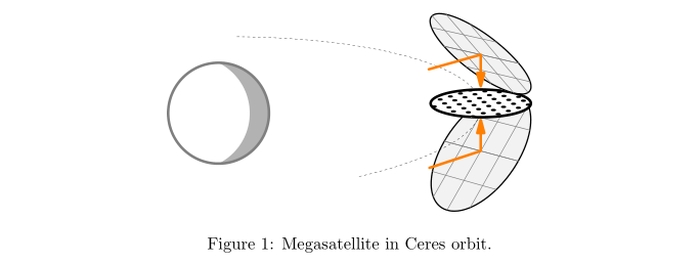
Many of these large asteroids have a lot of water. Exceptions are Vesta for example.
The main logic is that Ceres is expected to have a lot of Nitrogen containing compounds.
But Mars is closer. It has limited Nitrogen and quite a lot of water. So, it could support a limited number of orbital habitats. And those could serve as pathways to the Asteroid belt where more such materials may be in abundance.
But they could also support the development of habitats on the surface of Mars as well. On Mars solar panels and windows will be challenged by dust. Not so much in orbit. So I think that much of the time energy could be sent down to the ground when dust storms allowed it.
Initiating this technology, would then allow access to the asteroid belt.
Many of the asteroids of a larger size at about 3 AU +/- .3 AU seem to have an abundance of water. At least Ceres is expected to have lots of Nitrogen compounds.
https://en.wikipedia.org/wiki/List_of_e … _asteroids
Image Quote: 
If you built a multi-chambered cylinder, you could fill various compartments with water and Ammonia. And then using a method similar to a Solar Moth move them inward in the solar system.
https://www.bing.com/videos/riverview/r … &FORM=VIRE
https://www.youtube.com/watch?v=cEPnZ7RNl00
So supposing you built a multichambered structure and filled it with things desired on Mars. I am going ot borrow from Calliban in this.
He suggested using a mass drive on Ceres to eject ice blocks and they could eventually intercept Mars and vaporize on impacting it's atmosphere.
But we will build an ocean canister, a multichambered structure with lots of water and some Ammonia filled chambers.
Although solar energy is sparce at ~3 AU, mirrors are not that much of a problem to concentrate it.
Query: "Plasma propulsion with water?"
Quote:
Copilot Search Branding
Like
Dislike
Plasma Propulsion Using Water
Plasma propulsion with water is an emerging concept in space technology, aiming to replace traditional chemical fuels with a water-based electric thruster that converts water into plasma to generate thrust.How It Works
The Water-based Electric Thrusters (WET) system, led by the University of Bologna under Horizon Europe, uses the following steps Interesting Engineering+1:Vaporization: Liquid water is heated into steam.
Ionization: The steam is electrically ionized to create plasma — a superheated state of matter with free electrons and ions.
Acceleration: An electric field accelerates the charged plasma particles, producing thrust.
This is a form of electric propulsion, where electrical energy is used to accelerate propellant instead of burning fuel, making it highly efficient.
Advantages
Abundant propellant: Water is readily available on the Moon, asteroids, and other celestial bodies, enabling in-space refueling Interesting Engineering+1.Low power needs: WET thrusters operate at 500–1,000 watts, making them ideal for small satellites (SmallSats) Interesting Engineering+1.
Environmental benefits: No harmful emissions compared to chemical rockets Interesting Engineering+1.
High specific impulse: Efficiency is measured in seconds; water-based plasma thrusters can achieve very high values, meaning more fuel efficiency for long burns Interesting Engineering.
Examples and Performance
Miles Space M1.5 thruster: A cubesat-sized device producing 37.5 mN of thrust at 1.5 watts with a specific impulse of 4,800 seconds, suitable for low-Earth orbit descent and station-keeping Interesting Engineering.WET project: Aims to develop a scalable, standardized thruster for deep-space missions, with lab upgrades to test and characterize water-based plasma UniboMagazine+1.
Applications
Small satellite station-keepingOrbital maneuvering
Deep-space missions with in-situ refueling
Long-duration missions where fuel efficiency is critical
Challenges
Low thrust: Not suitable for heavy-lift launches; best for precision, low-thrust maneuvers.Complex plasma control: Requires precise management of ionization and acceleration.
Integration into existing spacecraft: Needs compatibility with satellite power and control systems.
In summary, water-based plasma propulsion is a promising, sustainable alternative for electric thrusters, especially for small satellites and deep-space missions. While it doesn’t match chemical rockets for raw thrust, its efficiency, low power draw, and potential for in-space refueling make it a compelling option for future space exploration Interesting Engineering+2.
Now that sounds more efficient than steam propulsion with a solar moth.
So, we have "Ocean Canisters" filled with water and other things, and with a solar power potential that is large and plasma thrusters.
The "Ocean Canisters" can have synthetic gravity worlds in association with them.
I think I see a magic number, it is 3. At the orbit of 10 Hygeia, the year is about 3 times that of Mars.
We have three options also:
Move the Ocean Worlds to an elliptical orbit that dives towards the orbit of Mars but still has a Aphelion in the asteroid belt.
1) Try to synchronize with a major asteroid like 10 Hygeia or Ceres.
2) Try to synchronize with a base in the asteroid belt that is free floating.
3) Try to match with Mars.
In crossing near Mars, the opportunity exists to eject ices or containers of water and Ammonia, to impact the atmosphere of Mars.
Over time the Ocean Worlds might be converted to have more air content and less water and Ammonia.
Even so they would be cyclers that a spaceship could rendezvous with travel with and be refueled/refilled from. They would sort of be "Spacecraft Carriers".
The Ocean Worlds in elliptical orbits would themselves be places for humans to be. The donor worlds such as 10 Hygeia and Ceres would likely host many habitations for humans and robots.
And then this may be another method to terraform Mars over time.
Eventually worlds like Callisto might be tapped in a similar way.
So, the raw materials are out there and the means to move them will exist.
Ending Pending 
https://www.bing.com/videos/riverview/r … ORM=VAMGZC
Some people think that E.L.P was not sophisticated, but neither am I.
That was playing in my head during this post.
Ending Pending
Last edited by Void (2026-06-21 11:33:13)
Be careful what you wish for.
Offline
Like button can go here
#277 2026-06-21 20:59:14
- Void
- Member
- Registered: 2011-12-29
- Posts: 9,836
Re: Multi-Ship Expeditions, Starboat & Starship, Other.
Something that has been cooking in my mind has jelled. I sort of described it elsewhere today: https://newmars.com/forums/viewtopic.ph … 95#p239895
The part of it that I care to bring here is "Bump and Purr".
3 Types of craft to achieve the purpose of attaining Mars.
1) A water tanker Nuclear-Electric or Solar, to bring water to the "Bumper" using plasma thrusters of some kind.
2) The "Bumper" A Nuclear Thermal Booster.
3) The "Purr", a Nuclear-Electric ship that will use plasma thrusters of some kind perhaps using water or a metal.
#1 brings water robotically through the Van Allen Belts from LEO to the "Bumper".
#2 being ready #3 is mounted onto it and it is filled.
#3 boosts #3 on its way to Mars. #3 "Purrs" with it's Nuclear-Electric thrusters into a Ballistic Capture into Mars orbit.
#1 brings more water to #2, so that it can bring itself down to a lower orbit above the Van Allen Belts, to repeat the operation.
On the way out to Mars #3 can be laden down with lots of payload. On the way back to Earth it may have minimal payload.
I feel that if this method had brought freight to Mars orbit, some of the freight would be for dealing with Phobos and Deimos, but some would be for the Mars surface, and if you had a "Shuttle Ship" like Starship, it could make several trips up and down, in a relatively short time period. On it's way up it could bring Water and Carbon. On its way down freight.
Otherwise, a Starship freighter has to run for several years to make a round trip to Mars and back.
Ending Pending
Last edited by Void (2026-06-21 21:12:47)
Be careful what you wish for.
Offline
Like button can go here
#278 2026-06-22 09:07:57
- Void
- Member
- Registered: 2011-12-29
- Posts: 9,836
Re: Multi-Ship Expeditions, Starboat & Starship, Other.
Stone Refinery:
Now, I want to consider a "Stone Refinery".
Query: "What is the difference between Molecular Flow and Viscous Flow of Gasses?"
Quote:
Copilot Search Branding
Like
Dislike
Difference Between Molecular Flow and Viscous Flow of Gases
Viscous flow and molecular flow describe how gases move under different pressure and density conditions, and they are distinguished by the dominant mechanism of momentum transfer.Viscous (Continuum) Flow
Occurs at higher pressures (near atmospheric or above) where gas density is high.Mean free path (λ) of molecules is much shorter than the characteristic dimension of the system (e.g., pipe diameter, d): λ « d.
Mechanism: Gas molecules are in constant collision with each other, transferring momentum and creating internal friction (viscosity). This results in a continuous, bulk flow.
Flow profile: Often parabolic (Poiseuille flow) in laminar conditions, with velocity highest at the center of a pipe.
Governing equations: Navier–Stokes equations apply.
Knudsen number (Kn): Kn ≤ 0.01 (Kn = λ/d) Engineer Fix+1.
Molecular (Free Molecular) Flow
Occurs at very low pressures (high vacuum or ultra-high vacuum) where gas density is extremely low.Mean free path (λ) is much larger than the system’s characteristic dimension: λ » d.
Mechanism: Molecules are far apart and rarely collide with each other. Instead, they collide mostly with container walls. Momentum transfer happens via diffuse reflection from walls, not internal shearing.
Flow behavior: Gas motion is governed by individual particle trajectories; no continuous bulk flow. Flow rate is driven by pressure difference, but molecules may not “slide” along surfaces.
Knudsen number (Kn): Kn ≥ 10 Wikipedia.
Special considerations: Conventional pumps (relying on viscous drag) are ineffective; special pumps like turbomolecular or ion pumps are used Wikipedia.
Transition Regime
Between viscous and molecular flow lies the Knudsen flow (or transitional/rarefied flow) regime, where Kn ≈ 0.1–10. Here, both molecular and viscous effects influence the flow Wikipedia+1.In summary:
Viscous flow: High density, short mean free path, momentum transfer via molecule–molecule collisions, governed by viscosity.
Molecular flow: Low density, long mean free path, momentum transfer via molecule–wall collisions, governed by surface interactions.
The Knudsen number is the key parameter to distinguish between them.
We are going to use Molecular Flow and usually condensation from a gas to a solid.
We can also hope to adapt the works of the author of: https://www.youtube.com/@Anthrofuturism/videos
He also requites very smart people for his videos.
His eye is on the Moon, but I am hoping to adapt his work to a more universal set of options such as rubble piles like Phobos and Deimos.
This video and quite a few others may be helpful: https://www.youtube.com/watch?v=SOUHUxVU04s
Quote:
Refining Moon Regolith With Lasers (Part 1)
ANTHROFUTURISM
ANTHROFUTURISM
We also can consult this Newmars topic for tricks: https://newmars.com/forums/viewtopic.php?id=11305
For instance, Chlorine from Mars might be used to create a method to pull Iron out of rocks and create Iron Chloride with a rather low boiling point. "Index» Life support systems» Flash Recycling, Salt Electric Mining"
https://en.wikipedia.org/wiki/Iron(III)_chloride
Quote:
Melting point 307.6 °C (585.7 °F; 580.8 K) (anhydrous)
37 °C (99 °F; 310 K) (hexahydrate)[1]
Boiling point
316 °C (601 °F; 589 K) (anhydrous, decomposes)[1]
280 °C (536 °F; 553 K) (hexahydrate, decomposes)
To sum it up the hope is to build a rock shell (With metal and other parts), in orbit of Mars that will provide radiation shielding and serve as a condenser.
So, if we are going to make a rock/stone shell that can contain molecular flow, we do not have to deal with high pressures that want to blow it apart, and only open holes in the shell will let free flowing molecules escape.
In any case depending on how you heat regolith, gasses can be emitted including Oxygen and perhaps water vapor or CO2.
But also, Iron can evaporate in a greater partial vacuum.
A stone shell could be cold enough to collect some of the things that evaporate such as Iron Chloride, and if sublimated, then Iron.
Quote:
Copilot Search Branding
Like
Dislike
Sublimation of Iron in a Vacuum
Iron does not sublime under normal atmospheric conditions because its vapor pressure is far too low at room temperature. However, in a high-vacuum environment, iron can be sublimed if the partial pressure of iron vapor is higher than the surrounding pressure, allowing molecules to escape directly from the solid to the gas phase Wikipedia.Vacuum Sublimation of Iron
In laboratory-scale vacuum sublimation, iron (or iron compounds) can be heated in a vacuum chamber so that its vapor pressure exceeds the ambient pressure. The vapor then condenses on a cold surface (e.g., a cold finger or cold trap) to form a purified solid deposit Chemistry LibreTexts+1. This is commonly used for purifying iron compounds such as iron(III) bromide (FeBr₃), which is hygroscopic and air-sensitive, requiring inert-atmosphere handling pdf.benchchem.com.Example: Iron(III) Bromide Purification
Apparatus: Sublimator body, cold finger condenser, high-vacuum pump (<0.1 Torr), inert gas supply.Setup: Glassware is oven-dried (>120°C) to remove moisture, then assembled under vacuum to prevent rehydration pdf.benchchem.com.
Process:Load the sample in an inert atmosphere (glovebox or Schlenk line).
Evacuate the system to high vacuum.
Cool the cold finger with liquid nitrogen or dry ice/acetone.
Gradually heat the sublimator; iron vapor condenses on the cold finger.
Collect the purified deposit and reassemble under vacuum to maintain purity.
Stability and Behavior
For iron chelates (e.g., with N,N′-disalicylideneethylenediamine), vacuum sublimation can be performed without thermal decomposition, though complete sublimation may not occur for all compounds Oxford Academic. This suggests that under controlled vacuum and temperature, iron can transition directly from solid to vapor and back to solid without significant decomposition.Key Points
Vacuum requirement: High vacuum (≤0.1 Torr) is essential to lower the effective vapor pressure and allow sublimation.Temperature control: Gradual heating prevents decomposition or unwanted reactions.
Inert atmosphere: Critical for air-sensitive iron compounds to avoid oxidation.
Cold trap: Ensures condensation of iron vapor into a pure solid.
In summary, iron can be sublimed in a vacuum when its vapor pressure exceeds the ambient pressure, and this process is widely used in the purification of iron compounds like FeBr₃, provided the setup is inert, vacuum-sealed, and temperature-controlled Chemistry LibreTexts+2.
As for hard to condense substances such as Oxygen, water vapor, and CO2, various methods might work such as Adsorption devices at a low temperature and other high vacuum pumps. It may also be possible to chemically collect some of these substances, where a gas molecule might bond to a solid chemical of some kind.

Lasers and Microwaves can be used to heat regolith. I believe that in a vacuum the will have a tendency to emit gas molecules and even sublimated molecules of various substances such as Iron that are normally solids, in the environments we live in.
In the drawing a solar panel serves as a sun shield for our "Rock Shell". We could elaborate on that and put more insulation between the solar panel and the rock shell. Mars itself will emit some heat, so there are limits on how cold is the temperature that would then occur in the rock shell. In order to condense substances like Water, CO2, and O2, the temperature needs to be at a lower and lower temperature.
So, a refrigeration device may be needed. The rock shell might be a place that heat can be rejected into in order to provide a super cold surface inside of the rock shell.
Coffee................
Now, about radiation protection from the Rock Shell:
Query: "How much regolith is needed for radiation protection on the Moon?"
Quote:
Copilot Search Branding
Like
Dislike
Regolith Requirements for Lunar Radiation Protection
For long‑term lunar habitation, lunar regolith is the most practical radiation shield because it’s abundant in place and avoids the high cost of launching shielding from Earth ResearchGate.Typical thickness requirements
Galactic Cosmic Rays (GCRs): At least 2m of regolith is needed to reduce exposure to about 150mSv per 180‑day mission. Increasing to 3m reduces this to roughly 100mSv ResearchGate.
Solar Particle Events (SEPs): Regolith is highly effective at stopping SEPs; even thinner layers (e.g., 1–1.5m) can provide strong protection, though deeper layers are better for mixed radiation environments ResearchGate.
Secondary radiation peak: Dose rates rise slightly between 1.0–1.5m due to neutron production from particle interactions, so optimal shielding often lies just beyond this range ResearchGate.
Mass estimates
Loose surface regolith has a bulk density of about 1.5–1.8g/cm³ agentcalc.com.
For a 2m layer over 1m²:
Volume = 2m × 1m² = 2m³
Mass ≈ 2m³ × 1.6g/cm³ = 3.2tons per square meter.
For a 3m layer: ≈ 4.8tons/m².
These figures scale with habitat area — a 100m² habitat with 2m regolith shielding would require ~320tons of regolith.Engineering considerations
Compression: Compressing regolith increases density and reduces required thickness, improving both radiation and thermal insulation MDPI.
Mixed materials: Combining regolith with hydrogen‑rich materials (e.g., polyethylene) can enhance GCR shielding efficiency ResearchGate.
Habitat design: Some concepts use buried structures or lava tubes for extra protection, reducing the need for thick regolith layers on the surface MDPI.
Summary
For a safe, long‑term lunar base, 2–3m of regolith is a common engineering target for GCR protection, with ~3–5tons/m² of regolith mass needed for a 1m² area. This makes regolith‑based shielding a cost‑competitive and sustainable solution for lunar radiation protection ResearchGate.
So, although the rock shell might start much thinner, it would be desirable to provide exceptional radiation protection inside of it later as the construction progressed. In a previous post I have shown how Starships partially filled with water could be used for radiation protection before a proper rock shell is completed: https://newmars.com/forums/viewtopic.ph … 91#p239891
Quote:
In any case an option that could be available is this:

There could be compatibility issues as you may not want sublimated substances to coat your Starship cluster. But then just make a 2 chambered rock shell. One as a refinery and one to host a Starship Cluster.
So, regolith from Phobos and Deimos could first have magnetic iron extracted and processed separately, and then be treated with heat, by lasers or microwaves. Then either sintered into blocks or cast into blocks. The hope is that sufficient convenient substances such as Iron, H20, CO2, and Oxygen will be sublimated and can be condensed.
Synthetic Gravity:
It might be useful to rotate the rock shell a little bit so as to have a small synthetic gravity in at least some parts of it.
Substances such as Sodium Chloride, Water, and Carbon might be extracted from Mars itself to assist in the Rock Shell processes.
Chlorine may make extraction of some Iron easier. Water and Carbon are wanted for many things.
While I talk of a stone shell, I am also expecting Metals and Carbon Structures to help bond the slabs together into a sound structure.
If this works, then I think we can anticipate that a whole lot of stone shell structure could be built from Phobos and Demos.
Ending Pending
Last edited by Void (2026-06-22 10:18:21)
Be careful what you wish for.
Offline
Like button can go here
#279 2026-06-22 11:56:51
- Void
- Member
- Registered: 2011-12-29
- Posts: 9,836
Re: Multi-Ship Expeditions, Starboat & Starship, Other.
As a follow up to the just prior post about a rock refinery, I would add that it may be possible to put a small amount of Hydrogen atoms in the chamber and have a hot point, perhaps eves something like a spark plug or hot plate so that if Oxygen and Hydrogen molecules come together, they will form into Water molecules.
Then, if you have a condenser a bit colder than she surface of Callisto, it may be possible to condense the water as an ice. Then the Ice could be harvested. You would split the Hydrogen off and put it back in the chamber.
This may be a way to capture the Oxygen that is produced by heating the regolith.
If the air pressure inside the chamber remains below viscous flow levels then your Hydrogen will not be pushed out of the chamber except that there should be a gaping open hole in it.
It may be that the regolith of Phobos and Deimos will have some Hydrogen in it, or it may not be so hard to get some from Mars itself from time to time.
Ending Pending
Last edited by Void (2026-06-22 11:57:12)
Be careful what you wish for.
Offline
Like button can go here
#280 2026-06-22 16:32:39
- Void
- Member
- Registered: 2011-12-29
- Posts: 9,836
Re: Multi-Ship Expeditions, Starboat & Starship, Other.
This is the third post I have made today, so posts #278 and #279 are in association with it.
Asteroid Companions and Belt Dippers.
This is not to signify the complete structure of a Asteroid Companion or a Belt Dipper. Just signifies some of the Major components.
In my view stage #1 of Orbital Mars would involve bringing water to orbit from Mars. Stage #2 would involve bringing Hydrogen up from Mars and using it in conjunction with the Materials of Phobos and Deimos, extracting Oxygen, producing water with that Oxygen and the Hydrogen, and also producing major solid structures in orbit.
Then with that it may be possible to use Nuclear power and some of the water to access the main Asteroid Belt.
https://en.wikipedia.org/wiki/Asteroid_belt
Image Quote: 
The exceptional asteroids often but not always are icy and/or Carbonaceous: https://en.wikipedia.org/wiki/List_of_e … _asteroids
Image Quote:
Often these are almost or even more than 3 AU out.
Closer in at about 2.1 AU are smaller asteroids: https://en.wikipedia.org/wiki/C-type_asteroid
Quote: They lie most often at the outer edge of the asteroid belt, 3.5 au (520 million km; 330 million mi) from the Sun, where 80% of the asteroids are of this type,[2] whereas only 40% of asteroids at 2 au (300 million km; 190 million mi) from the Sun are C-type. [3] The proportion of C-types may actually be greater than this, since C-types are much darker (and hence less detectable) than most other asteroid types, except for D-types and others that lie mostly at the extreme outer edge of the asteroid belt.
So, wherever you go in the belt there may be an assortment of materials. But large Asteroids are very interesting. Ceres is expected to have significant amounts of Nitrogen. I do not know for sure about others.
So, let's say you could continuously build companions and could then fly them to another location. You could fly them to Vesta to be a companion of it.
Or you could turn them into "Dippers". Dippers would have an Aphelion in the Asteroid belt but protrude inward into the terrestrial planet zones to form a Parhelion.
Even after they would then be in an eccentric orbit, more materials could be joined to it from Ceres by new built devices.
These "Belt Dippers" could be deployed in various situations.
1) They could become a companion to a rocky asteroid that is already in an eccentric orbit.
2) They could have an Aphelion that is synchronous with an exceptional asteroid.
3) They could be on a timing that touches 3 parts of the asteroid belt repeatedly. In that case they might have a companion device that is in a circular orbit within the asteroid belt that they would align with repeatedly.
4) They could try to lock themselves into an orbit that repeatedly crosses or approaches Mars.
These would be "O'Neill" inspired but very water and ice loaded. They might carry other things like Ammonia. If they graze or approach Mars, they might unload Ice or Ammonia to impact the atmosphere of Mars, by some means. Perhaps Mars would pay them somehow for this.
My best guess is that these might expel water or metals of silicon by plasma magnetic propulsions of some kind. Where they might start near Ceres the light is somewhat dim.
Quote:
Like
Dislike
Ceres receives significantly less sunlight than Earth, about 12–13% of the solar energy Earth gets, due to its distance of roughly 2.77–2.8 astronomical units from the Sun.
Ceres orbits the Sun at an average distance of approximately 2.77–2.8 AU (414 million km or 257 million miles), which is nearly three times farther than Earth
NASA
NASA
+2
. Because solar intensity decreases with the square of the distance, the sunlight reaching Ceres is roughly 1/9th of that received on Earth, meaning it gets about 12–13% of Earth’s solar flux. Light from the Sun takes about 22 minutes to reach Ceres
NASA
NASA
+1
.
Ceres rotates once every 9 hours, giving it one of the shortest day lengths in the solar system
NASA
NASA
+1
. Its axial tilt is only 4 degrees, so it spins nearly upright relative to its orbit, resulting in minimal seasonal variation and fairly uniform sunlight distribution across its surface throughout its orbit
NASA
NASA
. The dwarf planet completes one orbit around the Sun in 4.6 Earth years, which affects the long-term variation in solar exposure
NASA
NASA
+1
.
The surface of Ceres is composed of rock and ice, with regions of water vapor and cryovolcanic activity, which can influence local albedo and the absorption of sunlight
Wikipedia
Wikipedia
+1
. Its relatively low reflectivity (albedo ~0.09) means that most of the sunlight it receives is absorbed rather than reflected, contributing to surface warming despite the low solar flux
Encyclopedia Britannica
Encyclopedia Britannica
.
In summary, Ceres receives much weaker sunlight than Earth, with minimal seasonal changes due to its small axial tilt, and its surface conditions are shaped by this reduced solar energy combined with its icy and rocky composition.
But mirrors could work wonders for that. As mirrors are not 100% efficient let's say you would perhaps need 10 times as much mirror area at Ceres to get similar illumination to a solar panel as what you might have near Earth.
So that is not a huge problem. But as you moved the device to a more eccentric orbit, during Perihelion, it would gut much more sunlight.
I don't think it would be a huge concern if it took 100 years for such a device to move from Ceres proximity to an elliptical orbit that was desired.
But the point is then if you had interplanetary ships, they could rendezvous with these devices and ride along with them, providing considerable benefits to the travelers.
Ending Pending :)
Last edited by Void (2026-06-22 17:12:13)
Be careful what you wish for.
Offline
Like button can go here
#281 2026-06-23 09:13:35
- Void
- Member
- Registered: 2011-12-29
- Posts: 9,836
Re: Multi-Ship Expeditions, Starboat & Starship, Other.
Morning Coffee....I seldom skip an opportunity to goof off.........
Silly Calculations:
Query: "How Many Cubic Meters of material are in the moon Phobos?"
Quote:
Copilot Search Branding
Like
Dislike
Volume of Phobos in Cubic Meters
Phobos, the larger of Mars’s two moons, has a volume of about 5,695 ± 32 km³ Wikipedia.To convert cubic kilometers to cubic meters:
1 km³ = 1,000,000 m³ (since 1 km = 1,000 m, and volume scales with the cube of length).So:
5,695 km³ × 1,000,000 m³/km³ = 5.695 × 10⁹ m³ (approximately 5.7 billion cubic meters).Final Answer: Phobos contains roughly 5.7 × 10⁹ cubic meters of material, with an uncertainty of about ±32 million m³ Wikipedia.
This volume reflects its irregular shape and low density (about 1.86 g/cm³), consistent with it being a rubble-pile asteroid-like body Wikipedia+1.
Query: "How much porosity is there in Phobos?"
Quote:
Copilot Search Branding
Like
Dislike
Porosity of Phobos
Phobos, Mars’s innermost moon, has an estimated macroporosity of about 12–20% NASA Technical Reports Server (NTRS). This value is derived from spectral measurements, density estimates, and comparisons with other asteroids, and it reflects the proportion of void space in its bulk material.What this means
Macroporosity refers to the large-scale pore space in a body, not just microscopic gaps between grains. For Phobos, this is consistent with a fractured but coherent interior — meaning it is not a completely loose rubble pile, but rather a structure with fractures and intact blocks NASA Technical Reports Server (NTRS).This level of porosity is lower than that of Deimos (23–44%), which is more loosely consolidated NASA Technical Reports Server (NTRS).
The porosity is also similar to that of C-type asteroids, which are carbon-rich and generally have high porosity MDPI.
Implications
The relatively low macroporosity for a small moon suggests Phobos has a more solid, albeit fractured, internal structure.This internal coherence is reflected in its surface morphology: Phobos shows a globally coherent pattern of grooves, unlike Deimos, which has a more fragmental, debris-dominated surface NASA Technical Reports Server (NTRS).
Such porosity affects regolith strength, thermal properties, and potential for future in-situ resource utilization, making it important for planning landings or base construction.
In summary, Phobos is about 12–20% macroporous, indicating a fractured but structurally coherent interior, which shapes both its surface features and its physical behavior NASA Technical Reports Server (NTRS).
Query: "How much regolith is needed for radiation protection on the Moon?"
Quote:
Copilot Search Branding
Like
Dislike
Regolith Requirements for Lunar Radiation Protection
For long‑term lunar habitation, lunar regolith is the most practical radiation shield because it’s abundant in place and avoids the high cost of launching shielding from Earth ResearchGate. The amount needed depends on the target radiation dose, regolith density, and the type of radiation (Galactic Cosmic Rays vs. Solar Particle Events).Typical thicknesses and doses
Galactic Cosmic Rays (GCRs): At least 2m of regolith is needed to reduce exposure to about 150mSv per 180‑day mission. Increasing to 3m reduces this to roughly 100mSv ResearchGate.
Solar Particle Events (SEPs): Regolith is highly effective at stopping SEPs; even 1–2m can significantly reduce dose, with effectiveness increasing with depth ResearchGate.
Optimal depth: Some simulations show a peak in secondary radiation between 1.0–1.5m, so 2–3m is often used for balanced protection ResearchGate.
Mass estimates
Loose surface regolith density is ~1.5–1.8g/cm³ agentcalc.com.
For a 2m layer over 1m²:
200cm
×
100cm
×
1.6g/cm
3
=
3200g
=
3.2kg/m
2For a 3m layer: ~4.8kg/m².
Over a 100m² habitat, 2m of regolith would require ~320ton, and 3m would require ~480ton.
Engineering considerations
Mixed materials (e.g., regolith + polyethylene or aluminum) can improve GCR shielding efficiency and reduce required thickness MDPI+1.
Buried habitats or lava tubes can combine regolith overhang with structural shielding for lower total regolith mass MDPI.
Secondary radiation from GCRs peaks at intermediate depths, so over‑shielding beyond ~1.5m offers diminishing returns ResearchGate.
Summary tableTarget Dose Regolith Depth Density (g/cm³) Mass per m²
Notes~150mSv/180d 2m 1.6 3.2kg/m²
GCR protection~100mSv/180d 3m 1.6 4.8kg/m²
GCR + SEP protection~50mSv/yr 1–2m 1.6 1.6–3.2kg/m²
Lower target, less depthBottom line: For a safe long‑term lunar base, 2–3m of compacted regolith is a common engineering target, translating to ~3–5kg/m² of material. This can be reduced with mixed shielding or by using natural overhangs, but the exact amount depends on the mission’s radiation goals and the regolith’s density and composition agentcalc.com+1.
So, a radiation shields 3 meters thick.
So, approximately 5.7 × 10⁹ cubic meters of material.
So, approximately 5700000000 Cubic Meters of materials.
5700000000/3 = 1,900,000,000 x 3 x 1, I think???
The square root of that? 43588.9894???
For the moment ignore the porosity of the materals.
So, a square pancake orbiting Mars about 43,588 x 43,588 x 3 meters?
So then about 43.6 km x 43.6 km x 3 meters?
1,892.25 sq km x 3 meters?
how many square km is Rhode Island?
4,001 km² seems to be the answer.
So, a bit less than 1/2 the area of Rhode Island, if there are no major errors in my math.
I just wanted to get a visual on how large of a square pancake you might make of such a thing. Then if you chose to convert it into a hollow sphere, presumably not incredibly different in interior surface area. (I am playing a very sloppy game here).
If you want to spank me over the math, please do so. But don't get too fussy, I am just trying to visualize the potential.
In reality you would not make a single sphere, and you would not use all the materials for construction. Some would be to make Oxygen compounds, and some would go to various products, and the slag would go to such a construction. And of course there is porosity.
Deimos, I expect would be considerably smaller.
Ending Pending
Last edited by Void (2026-06-23 09:46:12)
Be careful what you wish for.
Offline
Like button can go here
#282 2026-06-23 09:55:44
- Void
- Member
- Registered: 2011-12-29
- Posts: 9,836
Re: Multi-Ship Expeditions, Starboat & Starship, Other.
So, maybe a sanity check.
How close it my thinking to that of Dr. Robert Zubrin, SpaceX, and the Large Ship concepts from the members here?
1) I do not object to SpaceX doing Mars direct with robot spacecraft, and if that works, then with crew.
2) I agree with the members here that after the era of #1, a "Large Ship" concept is desirable.
3) I agree with Dr. Robert Zubrin that a Mini-Starship would be nice to have. Someday perhaps one may be made.
4) I agree with Dr. Robert Zubrin that it is likely to be Mars first (I include Phobos and Deimos), and then the asteroid belt.
So, no, I am not at crosscurrents with ideas from actual smart people, not for the most part. I am just looking for new useful tricks.
Ending Pending
Last edited by Void (2026-06-23 09:59:41)
Be careful what you wish for.
Offline
Like button can go here
#283 2026-06-23 11:09:50
- Void
- Member
- Registered: 2011-12-29
- Posts: 9,836
Re: Multi-Ship Expeditions, Starboat & Starship, Other.
Starship is a wonderful machine, mostly to cope with Earth and perhaps to cope with Mars as well.
But I wonder about a Mars Water Tanker, and a Mars Hydrogen Tanker. Such a specialized device might be different and is different may be efficient.
The water tanker is obvious. If you have a good power source in orbit then many things can be done with water, and water is requires less maintenance than Cryogenic propellants.
The Stoke Space 2nd stage "NOVA" interests me: https://www.stokespace.com/
https://www.stokespace.com/nova/
Image Quote: 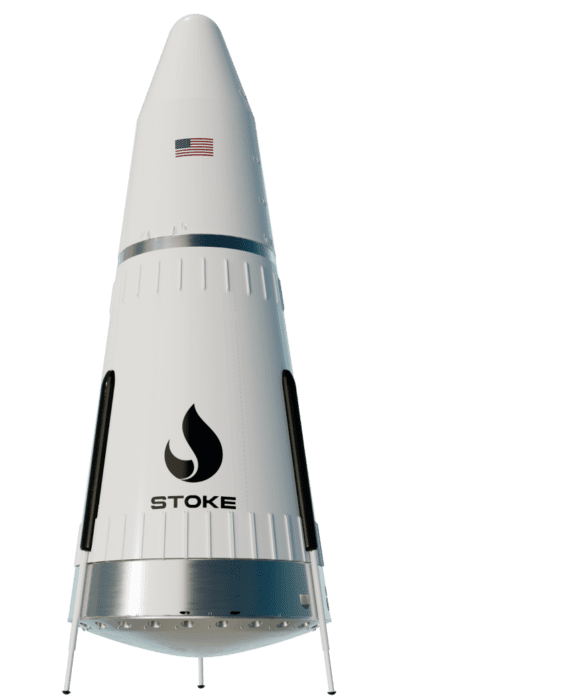
Mars having a thinner atmosphere, I think you could get away with a broader base than what is in the picture.
On Mars the Hydrogen leak problem may not be as much of a concern, as long as pressurized Oxygen is not available.
It may not matter as much if a Hydrogen joint leaks a bit, There is almost no free Oxygen in the atmosphere, so the standards probably can be relaxed in that regard.
I am presuming that the ship could fly SSTO from the surface of Mars and bring Water and/or Hydrogen to orbits of Mars.
I am also presuming that the NOVA will work, and that it can be sized up to fit on top of SpaceX Superheavy or the 1st stage of some other vendor. Once in LEO, it could be delivered by various means to Mars orbit where again it is presumed that it could be refilled and send down to the Mars surface.
Water deliveries will be nice at first, but later when Oxygen can be extractable from the materials of Phobos and Deimos, water can be created in orbit with Hydrogen from the surface of Mars. Converting it to water would quickly solve any Hydrogen boil off problems.
Oxygen first extracted from Regolith is one method. Another method would be to bake regolith with Hydrogen. In orbit the heat for baking could be Solar or other.
So, I think perhaps Mars can be an orbital refilling station for various propellants, water being among them.
Ending Pending
Last edited by Void (2026-06-23 11:21:51)
Be careful what you wish for.
Offline
Like button can go here
#284 2026-07-30 10:52:28
- Void
- Member
- Registered: 2011-12-29
- Posts: 9,836
Re: Multi-Ship Expeditions, Starboat & Starship, Other.
I think I would like to ponder the idea of how many repeat uses of a Starship might matter.
Obviously and attempt can be made to launch a Starship once. I am watching a video that indicates that even if Starship is not reused, if the Super Heavy were reused, the system would be lower price than is the Falcon 9 system.
What if you could use a Starship twice? Ok, bring it back once with a Heat Shield, and never mind repairing the heat shield, just use it and lose it the second time.
What if you could do three times. First time a new heat shield, 2nd time some fast-patching method, third time use and dispose.
Fast patching might be ok, provided you can dispose of a patched ship when it fails during reentry.
Could you just replace a missing tile or smear some ablative goop on the vacant spot?
I am supposing that if problems show up during reentry, you might be able to make the ship skip off of the atmosphere, to dump it into the Atlantic.
This method of not being obsessive about a perfect Heat Shield, might help discover the repeatability of other systems on the ships.
10 repeats would be quite an accomplishment, I think.
Obviously more than that are wanted.
Ending Pending
One very absurd idea is to have Starship blow its nose and end up engines up floating on the ocean. The purpose would be to recover the Engine section parts.
Yes, I know it is among the dumbest of ideas, but maybe, if it approached the sea and then could do a cartwheel 180 degrees and blow holes in the nose and propellant tanks, sea water might flood those compartments, and perhaps somehow the remainder could float engines up.
Don't know how many engine parts could be retrieved as useful that way. But maybe some of them.
In such as case, perhaps instead of a tiled heat shield, you would use ablative heat shielding.
In think that in one reentry, Starship actually had holes burned in its main tanks. Maybe I am wrong about that.
So, then a onetime heat shield would only have to keep the ship in shape down to the surface of the Ocean.
Ending Pending
Last edited by Void (2026-07-30 11:13:27)
Be careful what you wish for.
Offline
Like button can go here
#285 2026-07-30 19:05:46
- Void
- Member
- Registered: 2011-12-29
- Posts: 9,836
Re: Multi-Ship Expeditions, Starboat & Starship, Other.
I did not intend to set off a panic attack about Starship heat shield. I anticipate that over time the technology will continually improve.
For now my main concern is if the economics for deploying for space constellations will be solvent. I really think it will be.
But I think if it is not understood that I advocate for Electric propulsion as at least part of Mars missions, I will mention it again.
I think that it is likely that in any case SpaceX will be ablet to send one-way Starships to Mars.
If they can do more than that then fabulous.
Ending Pending
Be careful what you wish for.
Offline
Like button can go here
#286 2026-07-30 20:51:13
- Void
- Member
- Registered: 2011-12-29
- Posts: 9,836
Re: Multi-Ship Expeditions, Starboat & Starship, Other.
These people are relatively optimistic about the heat shield and Starship in general: https://www.youtube.com/watch?v=F3gPizQp5mI
Quote:
STARSHIP IFT-13: OVER 1,500 LAUNCHES BY 2028?
Over The Horizon
Over The Horizon
I think that there are good chances for it to have a real pay-off.
Ending Pending
Last edited by Void (2026-07-30 20:51:55)
Be careful what you wish for.
Offline
Like button can go here
#287 2026-08-01 09:56:49
- Void
- Member
- Registered: 2011-12-29
- Posts: 9,836
Re: Multi-Ship Expeditions, Starboat & Starship, Other.
I want to engage in a less than professional. Analysis of the heat shield situation.
First of all anyone with senses can tell that every Anti-American force is arrayed against success. These at times could even be Jealous allies.
Further, the Porksters, want tax payer money. For my lifetime I am convinced that new systems built have repeatedly been stopped so that a restart can bring in new tax revenue into space related companies.
So, almost everyone wants SpaceX to fail. Except SpaceX, National Security Interests, and space fans.
I think I agree with dialog here that says the heat shield is not ready for many things yet, and may not be possible to become ready.
However, I want to list how the SpaceX heat shield is better than the Space Shuttle heat shield.
1) It does not cover 100% of the Starship. Therefore it's expense may be less.
Query: "How much of Starship is covered by the heat shield?"
Quote:
Copilot Search Branding
Like
Dislike
Heat Shield Coverage on Starship
Starship’s heat shield covers the entire windward (leeward) side of the upper stage — the side facing the atmosphere during reentry — and is designed to protect the vehicle from temperatures exceeding 1,400°C (2,550°F) starship-spacex.fandom.com.The shield is made up of about 18,000 hexagonal ceramic tiles arranged in a tessellating pattern to conform to the curved surface Space Exploration Stack Exchange. These tiles are mounted on studs welded to the airframe, allowing for thermal expansion and contraction, and enabling rapid replacement starship-spacex.fandom.com.
The leeward side (the side away from the atmosphere) is left bare 300‑series stainless steel, which is not heated significantly during reentry starship-spacex.fandom.com. This means the heat shield is not a continuous wraparound; it’s a large, curved field of tiles on the windward side, with the rest of the vehicle exposed to the environment.
In summary:
Covered area: Entire windward side of the upper stage.
Material: ~18,000 hexagonal ceramic tiles (TUFROC derivative) starship-spacex.fandom.com+1.
Exposure: Leeward side is bare metal, not protected by the heat shield.
This design prioritizes mass efficiency and rapid reuse, as the heat shield can be inspected and replaced after each flight without major structural work starship-spacex.fandom.com.
*As I understand it the heat shield tiles are thinner than for the Space Shuttle due to Stainless Steel.
Query: "Are Starship Heat Shi9eld Tiles thinner than Space Shuttle Tiles?"
Quote:
Copilot Search Branding
Like
Dislike
Yes — Starship heat shield tiles are generally thinner than Space Shuttle tiles.SpaceX engineers have confirmed that the Starship tiles are made from a denser, tougher ceramic (often referred to as Tufroc) rather than the Shuttle’s fibrous/foam/aerogel core, which was very insulating but fragile and moisture‑absorbing ProfoundQa. This denser ceramic allows for a thinner tile profile while still providing sufficient thermal protection.
The Shuttle tiles, especially the older Reaction Cured Glass (RCG) type, had a fibrous core surrounded by a glass coating, and were individually machined to precise thicknesses. The Starship tiles, in contrast, are mostly the same size and thickness across the hull, which simplifies manufacturing and repair but adds mass Reddit. The thinner profile is part of a design trade‑off to reduce weight while maintaining performance.
In summary, Starship tiles are thinner and denser than Shuttle tiles, using a different material approach that sacrifices some of the Shuttle’s insulating core for strength and durability, while also simplifying production ProfoundQa+1.
So, the heat shield is not the same as the Shuttle Heat Shield.
Query: "Is the Starships heat shield built robotically?"
Quote:
Copilot Search Branding
Like
Dislike
How Starship’s Heat Shield Is Built
Yes — Starship’s heat shield is built robotically, with a highly automated manufacturing process.SpaceX produces the thousands of hexagonal ceramic tiles that make up the vehicle’s thermal protection system (TPS) at its in‑house “bakery” facility. The tiles are made from a form of toughened silica ceramic (often referred to as a TUFROC derivative) and are designed to be lightweight, porous, and oxidation‑resistant starship-spacex.fandom.com. The black coating on the tiles helps radiate heat away from the vehicle.
Manufacturing process:
The tiles are mass‑produced in a highly automated environment, allowing for consistent quality and rapid production starship-spacex.fandom.com.
They are not bonded directly to the hull; instead, they are mounted on studs welded to the airframe. This mechanical attachment allows for thermal expansion and contraction, and it makes replacement easier after flight starship-spacex.fandom.com.
The standardized hexagonal shape enables a tessellating pattern that covers the curved windward surface with minimal unique parts, further supporting automation and scalability starship-spacex.fandom.com.
Why robotics matter:
Automation is key to SpaceX’s goal of a rapidly reusable TPS. The robotic production ensures uniformity, reduces manual labor, and supports the quick inspection and replacement of tiles after flights — a critical factor for achieving full and rapid reuse starship-spacex.fandom.com.In short, Starship’s heat shield is not hand‑built; it’s a product of industrial‑scale, robotics‑driven manufacturing that aligns with SpaceX’s vision for low‑cost, high‑reliability spaceflight. Gizmodo
This robotic service along with most tiles being of uniform shape and size, suggests reduced cost and time for Heat Shield repairs.
In addition, I will mention the secondary ablative heat shield layer that might better assure that a ship can be recovered to repair, if the heat shield is breached.
So, I will admit, the heat shield has a long way to go, but the current method may be financially sound to use, for LEO activities.
I do not like it when very highly intelligent people do not accurately describe the true situation to the uninformed public!
Ending Pending
Last edited by Void (2026-08-01 10:16:40)
Be careful what you wish for.
Offline
Like button can go here
#288 2026-08-18 10:58:37
- Void
- Member
- Registered: 2011-12-29
- Posts: 9,836
Re: Multi-Ship Expeditions, Starboat & Starship, Other.
A thing that is of interest to me is if you could refill another vendors 2nd stage in LEO, using a 200t lift Starship.
Missions to the Moon using Lunar Starship are said to need 5-6 expendable 200t lift Starships.
But it seems that Terran R is getting close to a level of use similar to Falcon 9.
Quote:
Copilot Search Branding
Like
Dislike
Terran R Second Stage Overview
The Terran R is a two‑stage, partially reusable heavy‑lift launch vehicle from Relativity Space, designed to serve the Low Earth Orbit (LEO) constellation market and beyond. Its second stage is a key component of the vehicle’s architecture.Engine and Propulsion
Powered by a single Aeon V vacuum‑optimized engine Relativity Space+1.
Uses a gas generator cycle with liquid methane (CH₄) and liquid oxygen (LOX) as propellants Relativity Space+1.
Produces about 323,000 lbf (1,440 kN) of vacuum thrust Wikipedia.
The Aeon V has completed its qualification campaign, verifying service life, duration, and ignition capabilities for flight‑one NASASpaceFlight.com+1.
Design and Integration
The second stage is expended — it is not recovered after burnout, unlike the first stage Wikipedia.
As of June 2026, the first flight‑ready second stage had completed final subsystem integration, including fluid systems, brackets, harnesses, valves, and raceway hardware NASASpaceFlight.com+1.
It was shipped from Relativity’s Long Beach facility to NASA’s Stennis Space Center for testing at the historic A2 test stand, originally used for Saturn V second stage certification NASASpaceFlight.com+1.
Testing at Stennis
Preparations included initial startup of the environmental control system and a LOX flush to validate hardware before propellant loading NASASpaceFlight.com+1.
The A2 stand is equipped with a drawbridge, aft test adapter, and diverter for stage integration and testing NASASpaceFlight.com.
The Aeon V engine’s qualification confirms it can handle the demands of the Terran R’s mission profile.
Role in the VehicleThe second stage follows the first stage’s burnout and continues the ascent to orbit, using the Aeon V’s high vacuum efficiency to complete the mission.
It is part of a larger Terran R system with a 13‑engine first stage (Aeon R) and a 3,497,000 lbf total liftoff thrust Relativity Space.
In summary, the Terran R’s second stage is a single‑engine, expendable, methane/LOX‑powered stage built for high‑efficiency orbital insertion, with its Aeon V engine fully qualified and the stage itself undergoing rigorous ground testing ahead of the planned 2026 debut Relativity Space+2.
I got these numbers which I don't know how trustworthy are:
Summary
Dry mass: ~10–15ton (10,000–15,000kg)Wet mass: ~15–20ton (15,000–20,000kg)
Propellant: LOX / CH₄, vacuum‑optimized engine
Status: Expendable in baseline design Wikipedia+2
These figures are estimates based on engine data and stage performance; exact published values
So, if true a Starship could refill Terran-R 2nd stage, if the devices were so equipped.
Well, perhaps better information will come along after the rocket may begin service.
But the point is, perhaps something could be done that would be useful with the Terran-R 2nd stage if it receives support from Starship.
For instance if a Starship carried it to orbit of the Moon and could refill it could it land one or more times on the Moon?
If so, then an Optimus Robot riding it might collect samples which would be of value various places on the Moon.
This presumes that the engine could be throttled such as to land. I anticipate that you might ballast the ship with cargo attached to it's outside such as instrumentation to leave behind.
So, then landing instrumentation and collecting samples. In this case the Starship itself would not land on the Moon and might have enough power with the Terran-R device to bring samples back to LEO or in a capsule to land on Earth.
Ending Pending
Last edited by Void (2026-08-18 11:13:51)
Be careful what you wish for.
Offline
Like button can go here