New Mars Forums
You are not logged in.
- Topics: Active | Unanswered
Announcement
#26 2026-02-12 11:44:15
- Void
- Member
- Registered: 2011-12-29
- Posts: 9,848
Re: space x going to the moon instead of mars
I expect that any rocket company in the USA now will be pressed by the government to develop their systems as well as they can because foreign entities will be doing it also as well as they can. Who gets the best cost first wins at least for a time.
Mass to orbit is more important than crew to orbit. Dragon does crew to orbit well enough.
Ending Pending 
Last edited by Void (2026-02-12 11:44:42)
Be careful what you wish for.
Offline
Like button can go here
#27 2026-02-12 15:51:22
- SpaceNut
- Administrator
- From: New Hampshire
- Registered: 2004-07-22
- Posts: 30,844
Re: space x going to the moon instead of mars
Something to remove is the Lunar ship was never intended to come home as it was for the gateway.
Offline
Like button can go here
#28 2026-02-13 06:30:58
- Calliban
- Member
- From: Northern England, UK
- Registered: 2019-08-18
- Posts: 4,387
Re: space x going to the moon instead of mars
Musk is postponing, not abandoning his Humans to Mars plans, whilst SpaceX focuses on the Artemis programme. This is a positive development in my opinion that could actually accelerate the colonisation of Mars. The reason is that a manned base on the moon could be used to provide the raw materials needed for space manufacturing. Musk has already discussed developing mass drivers to this end. Using space manufacturing, we can build large ships driven by reaction engines. This would allow the transportation of large numbers of people and large quantities of equipment from low Earth orbit to low Mars orbit. Mars can ultimately become part of a triangle trade by providing volatiles to people and industry based in high Earth orbit. Industry in HEO can make SPS systems and other orbital infrastructure that is of value to customers on Earth. This plan allows a Mars colony to ultimately pay for itself, given the paucity of volatile elements on the moon.
Musks decision is probably based on an understanding that a Mars colony needs a business case. This won't exist until humanity has established a manufacturing presence in high Earth orbit. This in turn requires a human presence on the moon, along with mining and ore export infrastructure. The moon has limited value as a final destination for human beings. But it has a lot of value as a mining outpost exporting bulk metal oxides to support HEO manufacturing. That much has been understood since the 1970s.
In the longer term, Mars may supplant HEO as the solar system's premier manufacturing base. Phobos is an easier place to export ores from than the moon. Mars can provide volatile elements needed to support manufacturing in Mars orbit and this is logistically easier than sending them back to HEO. But it will take a lot of time for Martian industry to reach this point. In the medium term, Phobos provides reaction mass that can be used to drive reaction driven vessels from LMO to HEO.
Last edited by Calliban (2026-02-13 06:44:23)
"Plan and prepare for every possibility, and you will never act. It is nobler to have courage as we stumble into half the things we fear than to analyse every possible obstacle and begin nothing. Great things are achieved by embracing great dangers."
Offline
Like button can go here
#29 2026-02-13 07:54:22
- Terraformer
- Member
- From: The Fortunate Isles
- Registered: 2007-08-27
- Posts: 4,011
- Website
Re: space x going to the moon instead of mars
Mars may end up being the cheapest place to get elements such as copper and tin and silver for in space manufacturing. Ores only form on planets with hydrogeological processes that can concentrate them. That means Earth and maybe/likely Mars.
In the meantime, we'll have to haul them up from Earth, but fortunately Luna can provide nearly all the mass we need. Maybe even meteoric nickel-iron. And unlike Mars, it has a possible business case for mining, tourism, research, and orbital support services. Which are the reasons humans live in inhospitable Terran environments today. Though, given his haste, Musk may have a Fallen Angels scenario on his mind, where the bulk of humanity turn against space travel and there are only the people up there already to carry the flame to other worlds. A few thousand people should be viable genetically at least, especially given how highly selected they'd be. He may also have an Elysium scenario in mind too, given the talk of using orbital datacentres for the next great economic leap...
Once we have manufacturing on Luna we can start sending sollettas and iron nanorods to Mars, warm the place up somewhat before we get there.
Use what is abundant and build to last
Offline
Like button can go here
#30 2026-02-13 18:26:50
- SpaceNut
- Administrator
- From: New Hampshire
- Registered: 2004-07-22
- Posts: 30,844
Re: space x going to the moon instead of mars
We need to remember that the short starship is just a taxi with built in life support and habitat launched from earth on top of the now block 4 booster, it has a propellant load (700 - 800 mT) that does not deliver payload to orbit as the normal starship does.
It is still a fill and go system for the fuel so little loitering time once filled it then travels to the lunar gateway to which if it was to do more than a day the boiloff would bring the amount of payload it could bring to the lunar surface. After about a week it needs to launch once more back to the gateway and transfer back to the Orion.
The ship is a disposable ship that builds nothing on the moon for permanent staying as the total Nasa said Apollo on steroids' proposed.
The Falcon 9 heavy that Zubrin put forth does these things that Nasa seems to not wish any more.
The crew useable payload for astronauts to make use of include such things as suits, tools, lunar experiments, logistics of (food, water, spare parts), surface equipment (rovers) and while its indicate shelters these are probably not solar arrays or Kilowatt system for power
.
If it is able to deliver 40 mT to the surface it might fall out as
5 mT of inflatable Hab. for radiation shielding pressurized volume, life support, avionics, ECLSS, controls, power
5 mT for Airlock, ladders, other fixed surface system
5, crew useable logistics which I listed earlier as its the consumed items
If its more like several airlocks we might be closer to 12 to 15 mT for a buried Habitat
other items would be dependent on landing location.
Dr. Robert Zubrin Moon Direct: How to build a moonbase in four years
Offline
Like button can go here
#31 2026-02-16 12:50:08
- SpaceNut
- Administrator
- From: New Hampshire
- Registered: 2004-07-22
- Posts: 30,844
Re: space x going to the moon instead of mars
RGClark wrote:NASA and the military brass are becoming increasingly disenchanted with the SpaceX progress on the Starship HLS lunar lander. Eric Berger in an article discussed some possible alternative options being offered that NASA could use to beat or match China in getting back to the Moon. The one deemed most likely would use Blue Origin’s Blue Moon Mk1 cargo lander instead as a manned lander:
How America fell behind China in the lunar space race—and how it can catch back up.
Thanks to some recent reporting, we've found a potential solution to the Artemis blues.
ERIC BERGER – OCT 2, 2025 7:30 AM |
“Here comes the important part. Ars can now report, based on government sources, that Blue Origin has begun preliminary work on a modified version of the Mark 1 lander—leveraging learnings from Mark 2 crew development—that could be part of an architecture to land humans on the Moon this decade. NASA has not formally requested Blue Origin to work on this technology, but according to a space agency official, the company recognizes the urgency of the need.”
https://arstechnica.com/space/2025/10/h … h-back-up/This plan would not need any refueling launches, unlike the larger Blue Moon Mk2 manned lander. I’m puzzled though by the statement in the article it would use “multiple” Mk1’s. Presumably that would take multiple New Glenn launches?
I had suggested it might be doable using a single Blue Moon Mk1 launched on a single New Glenn. This though would require New Glenn reaching its intended payload capacity of 45 tons reusable, 60+ tons expendable:
Could Blue Origin develop a lander for Artemis III?
https://www.reddit.com/r/BlueOrigin/s/DjyRJUVC2EBob Clark
The plan appears to use multiple Blue Moon Mk1 landers launched on multiple New Glenns, though not using refueling. It’s likely though it can be launched on a single New Glenn but in expendable format. The reason is a 45 ton payload capability as partially reusable likely means a 60+ ton capability as an expendable. Based on the 21 ton size of the Blue Moon Mk1 with the capability to do land 3 tons on the Moon as a one-way lander, its propellant/dry mass ratio is likely 18 tons/3 tons. Consider then the Delta IV Heavy’s upper stage, the same stage used as the interim upper stage on the SLS Block 1, could serve as the Earth departure stage for this lander. The spec’s on the DIVH upper stage are:
Second stage – DCSS
Height 13.7 m (45 ft)
Empty mass 3,490 kg (7,690 lb)
Gross mass 30,710 kg (67,700 lb)
Propellant mass 27,220 kg (60,010 lb)
Powered by 1×RL10-B-2
Maximum thrust 110 kN (25,000 lbf)
Specific impulse. 465.5 s (4.565 km/s)
Burn time 1,125 seconds
Propellant LH2 / LOX
https://en.wikipedia.org/wiki/Delta_IV_ … pabilitiesThen this can make the ca. 3,000 m/s delta-v needed for translunar injection(TLI):
465.5*9.81Ln(1+27.22/(3.49 + 25)) =3,062.362
Blue Origin could use this stage or, more likely, derive a comparable one from two copies of the Blue Moon Mk1.
Bob Clark
Offline
Like button can go here
#32 2026-02-16 12:52:31
- SpaceNut
- Administrator
- From: New Hampshire
- Registered: 2004-07-22
- Posts: 30,844
Re: space x going to the moon instead of mars
Starship HLS lunar lander never did make sense for the moon as an expendable rocket, sure its got payload mass but that does not make it practical.
Offline
Like button can go here
#33 2026-02-21 20:42:16
- SpaceNut
- Administrator
- From: New Hampshire
- Registered: 2004-07-22
- Posts: 30,844
Re: space x going to the moon instead of mars
Why is NASA snubbing SpaceX for Artemis?
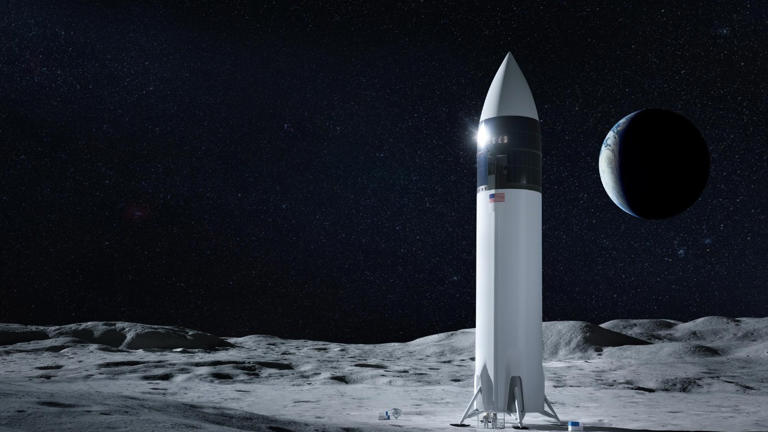
NASA is reopening competition on the Artemis moon lander contract originally awarded solely to SpaceX, a decision that has fueled speculation about whether the agency is deliberately sidelining Elon Musk’s company. The move comes as Starship development timelines have slipped, putting pressure on the planned Artemis III mission to return astronauts to the lunar surface. But the full procurement record tells a more complicated story than a simple snub, pointing instead to a long-planned shift toward multiple providers and layered redundancy.
How SpaceX Won the Sole Lander Contract
When NASA selected SpaceX in April 2021 for the Artemis Human Landing System Option A contract, the agency made a deliberate choice to fund just one provider. The firm-fixed-price award was valued at $2.89 billion and issued under the NextSTEP-2 Appendix H BAA framework. NASA had originally hoped to select two lander providers, but congressional appropriations fell short of what the agency requested, forcing a single downselect. SpaceX’s Starship-derived lander won on both technical merit and price, beating proposals from Blue Origin and Dynetics by offering more payload capacity at a lower evaluated cost.Both losing bidders protested the decision, arguing that NASA should have either re-opened the competition or adjusted its requirements when it realized it could not afford two awards. The Government Accountability Office reviewed the challenges and, in a detailed bid protest ruling, did not sustain either protest, finding that NASA had acted within its authority given the funding it had available. That ruling cemented SpaceX’s position as the sole lunar lander developer for Artemis III. For roughly two years, no other company held a contract to build a crewed moon lander for the program, and NASA focused its human landing system resources on shepherding Starship through design reviews, environmental assessments, and a demanding series of test flights.
NASA’s Deliberate Two-Track Strategy
The single-provider arrangement was never meant to be permanent. As early as 2022, NASA publicly outlined a two-track strategy that paired additional work under SpaceX’s existing contract with a separate open competition for a second lander provider. In that update, the agency described its intent to fund an upgraded Starship variant for later missions while simultaneously soliciting proposals for a new class of “sustaining” landers designed for recurring use. This is a critical detail that undermines the “snub” narrative: NASA was planning to bring in a second company well before any Starship delays became a dominant public concern, framing the move as part of a broader shift toward a sustainable lunar transportation ecosystem.The second competition, known as Sustaining Lunar Development (SLD), concluded in May 2023, when NASA selected Blue Origin for the Appendix P contract valued at about $3.4 billion. Under that award, Blue Origin will fly an uncrewed demonstration mission before attempting a crewed landing on Artemis V, using a multi-element architecture that includes a reusable lander and supporting spacecraft. The contract value actually exceeds SpaceX’s original $2.89 billion award, which complicates any claim that NASA is playing favorites for or against a single company. Both firms now hold multibillion-dollar lunar lander contracts, both must pass rigorous design and safety reviews, and both face tight schedules to prove out complex hardware before astronauts ride their vehicles to the Moon.
What the Bid Reopening Actually Means
The latest development, reported by Reuters in 2025, is that NASA is opening SpaceX’s moon lander contract to rival bids as Starship development lags behind schedule. The NASA administrator was quoted as saying, “I’m in the process of opening that contract up. I think we’ll see companies like Blue get involved, and maybe others.” That language signals urgency but not necessarily a loss of confidence in SpaceX; it reads more like an insurance policy aimed at protecting the Artemis III schedule. In effect, NASA is trying to avoid a scenario in which a single technical setback in one program cascades into multi-year delays for the entire lunar return effort.Opening the contract to competition does not cancel SpaceX’s existing work or erase the milestones already achieved under the Option A award. The firm-fixed-price structure means SpaceX bears the financial risk of cost growth and delays, not taxpayers, and NASA can continue to pay only for completed milestones while keeping other options in play. What the reopening does is create a parallel path so that if Starship is not certified for crewed lunar operations on the required timeline, another vehicle could potentially fill the gap for Artemis III or a re-phased mission. This approach mirrors the same logic NASA used when it created the Sustaining Lunar Development track in the first place: avoid single points of failure in a program that carries enormous scientific, diplomatic, and political stakes for the United States and its partners.
SpaceX Is Not Being Frozen Out
One fact that often gets lost in coverage of this story is that NASA continues to expand its relationship with SpaceX outside the lander contract. The agency recently added Starship to the company’s Launch Services II portfolio through a contract modification, formally making the vehicle eligible to compete for a wide range of science and exploration missions. That is not the action of an agency trying to sideline a contractor. Instead, it reflects a pragmatic separation between Starship’s emerging heavy-lift capability and the far more demanding requirements of landing humans on the Moon, allowing NASA to tap the rocket’s lift capacity while still insisting on additional testing for crewed surface missions.The distinction matters because lunar landing certification involves challenges that go well beyond reaching orbit or even delivering large payloads to deep space. A crewed Starship variant must demonstrate reliable propellant transfer in space, execute precision landings in the unforgiving lunar environment, and integrate seamlessly with the Orion spacecraft, Gateway elements, and surface systems that make up the broader Artemis architecture. These are engineering problems that exist regardless of how well Starship performs as a cargo launcher. NASA can simultaneously trust SpaceX for routine or uncrewed launches while hedging its bets on the much harder problem of crewed lunar operations. The agency’s own Artemis series and broader program updates consistently frame the Moon campaign as a multi-provider effort that mixes commercial, international, and government-built systems rather than relying on a single company or vehicle.
Risk Management, Not Retaliation
The dominant framing in public discussion treats NASA’s bid reopening as a rebuke of SpaceX or a reaction to Elon Musk’s public profile. That reading ignores the procurement timeline. NASA pursued a second lander provider starting in 2022, awarded Blue Origin a contract worth more than SpaceX’s original award in 2023, and only later moved to open the Artemis III lander work to additional competition as Starship slipped against internal schedules. In other words, diversification was baked into the plan from the moment the agency had enough funding to support it, long before any one company’s delays became front-page news. The reopening is best understood as an extension of that same philosophy into the near-term mission manifest rather than a sudden change of heart.For NASA, the stakes go beyond any individual contractor. Artemis is meant to prove that the United States and its partners can maintain a sustained human presence in deep space, using commercial services where possible and government-owned systems where necessary. That vision requires redundancy, competition, and the ability to pivot when technical reality diverges from optimistic timelines. Reopening the lander contract fits squarely within that risk-management playbook. SpaceX remains a central player with a substantial contract and growing launch portfolio, while Blue Origin and potentially other firms gain opportunities to contribute hardware and ideas. Rather than a simple story of punishment or favoritism, the record shows an agency trying to balance ambition with resilience, ensuring that when astronauts finally return to the lunar surface, they do so on a foundation that can survive setbacks from any single company or vehicle.
Reference links
https://www.nasa.gov/news-release/as-ar … s-on-moon/
https://www.gao.gov/products/b-419783%2 … b-419783.4
https://www.nasa.gov/news-release/nasa- … r-artemis/
https://www.nasa.gov/centers-and-facili … -provider/
https://www.reuters.com/science/us-seek … 025-10-20/
https://www.nasa.gov/news-release/nasa- … -starship/
Offline
Like button can go here
#34 2026-02-26 16:20:39
- SpaceNut
- Administrator
- From: New Hampshire
- Registered: 2004-07-22
- Posts: 30,844
Re: space x going to the moon instead of mars
SpaceX has shifted its primary focus to lunar missions to build a "self-growing city on the moon," with uncrewed Mars missions delayed until at least 2026–2027 and human flights likely 2029–2031. While prioritizing the Moon, SpaceX aims to begin the Mars push in 5–7 years, with a potential for 100+ missions by 2030/31.
Key Details on the Shift:
Revised Mars Timeline: Uncrewed missions are now expected in 2026 or 2027, with human missions pushed to 2029 or 2031, acknowledging previous optimistic, missed deadlines.
Moon Priority: The moon is now considered faster to reach and a better, closer testing ground for, as Musk put it, "securing the future of civilization".Upcoming Milestones: SpaceX is under contract to take NASA astronauts to the moon's South Pole, with NASA expecting this by 2028.
Long-Term Goal: Despite the focus on the Moon, Mars remains the ultimate long-term goal, with plans for numerous missions launching in the 2028/29 and 2030/31 windows.The shift reflects a strategic pivot towards lunar development while facing contractual and practical pressures, making the Moon the more immediate target for the next few years
Offline
Like button can go here