New Mars Forums
You are not logged in.
- Topics: Active | Unanswered
Announcement
#1 2026-02-04 18:44:35
- SpaceNut
- Administrator
- From: New Hampshire
- Registered: 2004-07-22
- Posts: 30,834
space x going to the moon instead of mars
As of February 2026, Elon Musk announced that SpaceX is shifting its primary, near-term focus from Mars to building a "self-growing city" on the Moon. While Mars remains a long-term goal, the Moon is prioritized because it is closer, allows for faster iteration (launches every 10 days vs. 26 months), and secures civilization's future more rapidly.
Key details of this shift:
Focus on the Moon: SpaceX is pivoting to establish a long-term, self-sustaining lunar presence, using the moon as a testing ground and a "stepping stone" to Mars.
Target Dates: An uncrewed lunar landing is targeted for March 2027, with a self-growing city possible in less than 10 years.
Moon over Mars: Despite previously calling the Moon a "distraction," Musk noted that the Moon is faster and safer for building a sustainable civilization.
Starship Utilization: The Starship megarocket will be used for these lunar missions.
Future Mars Ambitions: Mars is not abandoned; it remains a goal to pursue within 5–7 years, but it is no longer the immediate primary target.
This shift also aligns with supporting NASA's Artemis III mission and long-term lunar south pole exploration, which could use SpaceX's Starship for human landings
SpaceX prioritizes lunar 'self-growing city' over Mars project, Musk says
Summary
SpaceX shifts focus to lunar city, Mars project delayed
Musk cites civilization's future, Moon is faster than Mars
SpaceX plans uncrewed lunar landing by March 2027
Offline
Like button can go here
#2 2026-02-04 19:05:59
- SpaceNut
- Administrator
- From: New Hampshire
- Registered: 2004-07-22
- Posts: 30,834
Re: space x going to the moon instead of mars
Elon Musk says SpaceX will prioritize a city on the moon instead of a colony on Mars
SpaceX’s decision to focus on establishing a lunar city ahead of building a Mars colony represents a significant shift in Elon Musk’s space exploration ambitions
On Sunday Elon Musk said that SpaceX is prioritizing the establishment of a “self-growing city” on the moon over and above his long stated ambition to settle Mars.
In a post on his social media platform X, Musk wrote that a lunar city could be built within the next decade. “The mission of SpaceX remains the same: extend consciousness and life as we know it to the stars,” Musk wrote.
The pivot signals a shift in focus for SpaceX, which Musk has long claimed will help establish human civilization on Mars using the company’s still in development megarocket Starship. This is far from the first time Musk has changed SpaceX’s time line for a Mars mission—in 2016, for instance, he suggested a landing could be achieved by 2018, and he later pushed a potential touchdown to 2022.
Then Musk tweaked the timing again, indicating in 2025 that the company was aiming to launch five uncrewed Starships to Mars this year and that they would be loaded with robots made by his car company Tesla. Importantly, 2026 was considered optimal because where Earth and Mars would be in their respective orbits would cut the journey time to approximately six months. Such ideal alignments occur like clockwork every two years, setting a natural cadence for new Mars missions.
But development of Starship has proved more troublesome than Musk projected, with the rocket experiencing catastrophic failures across multiple test flights in recent years. Additionally, SpaceX is on the hook for a Starship-based crewed lunar landing as the linchpin of NASA’s Artemis III mission, which is meant to be the first human foray back to the moon since 1972. Starship’s ongoing woes are now a key driver of delays for the launch of Artemis III, which NASA recently announced has slipped to no earlier than 2028.
Other factors that have potentially driven SpaceX’s shift are its merger with Musk’s artificial intelligence start-up xAI and a planned push to launch a million orbital data centers. In a February 2 blog post, Musk wrote that the latter project, combined with Starship, could eventually lead to manufacturing and launching satellites from the lunar surface.
In his X post on Sunday, Musk said that SpaceX would resume working toward Mars in the next five to seven years. But he pointed out that establishing a base on the moon would be more efficient.
“The overriding priority is securing the future of civilization and the Moon is faster,” he wrote.
Offline
Like button can go here
#3 2026-02-04 19:22:12
- SpaceNut
- Administrator
- From: New Hampshire
- Registered: 2004-07-22
- Posts: 30,834
Re: space x going to the moon instead of mars
index of topics that relate to starship.
Musk announces upgraded Starship 2.0
Starship to mars count down 273 days to launch now on hold and need a new count down number of days.
Starship is Go... covers all of the development and both mars and Lunar information
Starship Lunar Lander and landing legs of course the Lunar rocket was not to return back then.
Offline
Like button can go here
#4 2026-02-05 19:59:24
- SpaceNut
- Administrator
- From: New Hampshire
- Registered: 2004-07-22
- Posts: 30,834
Re: space x going to the moon instead of mars
Lots of topics with starship in the title...
Multi-Ship Expeditions, Starboat & Starship, Other.
Alternate BFR (Big Falcon Rocket)
Upcoming Launch Schedule for NewMars members for starship
SpaceX COULD have done a manned lunar mission this year… a 2022 topic creation
Offline
Like button can go here
#5 2026-02-07 12:39:56
- SpaceNut
- Administrator
- From: New Hampshire
- Registered: 2004-07-22
- Posts: 30,834
Re: space x going to the moon instead of mars
Back when the Bezo Lunar lander RFP were created
SpaceX should withdraw Starship as an Artemis lunar lander.
Frame of mind for the topic in 2005 Building your own Starship
Starship Booster Prototypes beginning soon
Lunar Landing legs for starship
Offline
Like button can go here
#6 2026-02-07 13:17:16
- SpaceNut
- Administrator
- From: New Hampshire
- Registered: 2004-07-22
- Posts: 30,834
Re: space x going to the moon instead of mars
Space X - getting ready for Mars. a 2017 topic
Offline
Like button can go here
#7 2026-02-07 13:22:51
- SpaceNut
- Administrator
- From: New Hampshire
- Registered: 2004-07-22
- Posts: 30,834
Re: space x going to the moon instead of mars
Offline
Like button can go here
#8 2026-02-07 13:26:46
- SpaceNut
- Administrator
- From: New Hampshire
- Registered: 2004-07-22
- Posts: 30,834
Re: space x going to the moon instead of mars
Super Heavy + Starship Escape System: Passenger flight Certification
To which human rating is always an issue...
Starhopper+Starship for heavy. Triple-cored Starship for super heavy.
Offline
Like button can go here
#9 2026-02-07 15:18:58
- SpaceNut
- Administrator
- From: New Hampshire
- Registered: 2004-07-22
- Posts: 30,834
Re: space x going to the moon instead of mars
Offline
Like button can go here
#10 2026-02-07 15:33:25
- SpaceNut
- Administrator
- From: New Hampshire
- Registered: 2004-07-22
- Posts: 30,834
Re: space x going to the moon instead of mars
Musk clips his Mars settlement ambition, aims for the moon instead
Elon Musk’s ambition to one day settle Mars appears to have taken a back seat to a rather nearer and more achievable goal – sending humans to live on the moon.
In a statement on X on Sunday, the billionaire said his company SpaceX has now shifted its priorities to building “a self-growing city on the Moon,” arguing that it could be achieved in less than a decade, compared with more than 20 years for a similar plan on Mars.
“The overriding priority is securing the future of civilization and the Moon is faster,” he said on X Sunday. “It is only possible to travel to Mars when the planets align every 26 months (six month trip time), whereas we can launch to the Moon every 10 days (2 day trip time).”
It is not immediately clear what Musk meant by a “self-growing city” or whether his plans are in line with a similar lunar plan NASA proposes. CNN has reached out to SpaceX for comment.
Musk said the company remains committed to building a Mars city, and will begin doing so in about five to seven years. As recently as last May, Musk had said SpaceX was working to land its first uncrewed Starship on Mars as soon as late 2026.
Musk’s trimming of his previous space travel predictions came after SpaceX acquired XAI last week, in a move that will merge two of his most ambitious companies into the most valuable private firm in the world.
Shifting SpaceX’s focus away from Mars and to the moon — which is considered a more technologically and financially feasible target for an extraterrestrial settlement — could serve as a stepping stone that can help investors get comfortable with Musk’s more ambitious ideas.
“Musk’s ultimate goal is to get civilization to Mars. It’s going to be very expensive, and as a soon-to-be public company, SpaceX needs to appease shareholders,” said Justus Parmar, CEO of Fortuna Investments, a venture capital firm invested in SpaceX.
“Setting up operations on the lunar surface will provide a quicker return on revenue, so it’s a natural step on the way to a more expensive and heavier R&D project to get to Mars,” Parmar added.
Reversing course
For more than a decade, Musk has made it a point to advertise his laser focus on establishing a settlement on Mars, saying it has been SpaceX’s guiding goal since the company was founded in 2002.In speeches delivered at aerospace conferences and events for SpaceX employees, he has detailed ambitious — albeit dubiously feasible — plans for establishing a permanent human presence on the red planet, saying such a step is necessary for ensuring a colony of humans can survive a potential apocalypse.
NASA, in contrast, has focused on its lunar ambitions, particularly since President Donald Trump’s first term, when then-Vice President Mike Pence abruptly declared that the United States would return its astronauts to the moon by 2024.
The bold plan did not pan out, and NASA is currently working to return astronauts to the lunar surface by 2028 — the time frame the agency had been working toward in the Obama era. That return will mark the first time humans have set foot on the moon since the Apollo program ended in 1972.
Musk has criticized the efforts in the past, alluding to NASA’s moon program, named Artemis, as a “distraction” on X early last year.
“No, we’re going straight to Mars,” he wrote at the time. “The Moon is a distraction.”
Musk’s apparent pivot to focusing on the moon comes as the tech billionaire – whose companies receive huge government contracts – has taken a far more vocal stance on politics than in years past. He poured $290 million into the US presidential election, backing Donald Trump and receiving a White House job only to have an abrupt falling out with the president. He returned to his good graces this past fall.
Lunar controversy
While NASA has built the rocket and spacecraft designed to launch astronauts from Earth and to the lunar vicinity, SpaceX has a nearly $3 billion contract to build the federal agency’s lunar lander, or the vehicle that will ferry the crew members from their spacecraft down to the moon’s surface.SpaceX plans to use its Starship system for the task — the largest spacecraft and rocket system ever built, and the vehicle that Musk says is purpose-made for taking people to Mars.
Starship, however, is still in the early stages of development and has often exploded during testing. The spacecraft has never traveled to orbit or conducted an operational flight, and SpaceX is expected to debut a new line of Starship prototypes as soon as early March.
Starship is extremely ambitious, and its role in NASA’s moon program has also been a point of controversy.
Sean Duffy, Trump’s secretary of transportation who also served a brief stint as acting NASA administrator last year, called out SpaceX in October — warning the company did not appear to be on track to have its lunar lander ready in time for NASA’s moon-landing mission as the space agency races to beat China’s lunar exploration program.
Duffy notably threatened to sideline SpaceX from the moon-landing mission, called Artemis III, and said he would evaluate whether SpaceX’s chief competitor, Blue Origin, could get the job done faster.
Blue Origin, the space exploration company founded by Jeff Bezos, also holds a multibillion-dollar NASA contract to develop a vehicle capable of ferrying astronauts from deep space to the lunar surface. The company announced last month that it is halting trips on its suborbital space tourism rocket — which previously carried Bezos, Katy Perry and William Shatner to space — in order to focus on lunar lander development.
NASA officials have not openly revisited the Artemis III lunar lander contract since the agency’s newly installed administrator, billionaire tech CEO Jared Isaacman, was confirmed for the top job in December. Isaacman is considered an ally of Musk as he has twice paid to fly on SpaceX capsules to Earth orbit.
Musk’s assertion that SpaceX will now focus on lunar exploration comes as NASA is gearing up to launch its first crewed mission of the Artemis program, called Artemis II.
That mission is slated to launch four astronauts on a trip that will circumnavigate the moon but will not land on it, serving as a pathfinder for the more complex Artemis III landing mission. Artemis II is scheduled to launch as soon as March.
Offline
Like button can go here
#11 2026-02-09 09:06:56
- GW Johnson
- Member
- From: McGregor, Texas USA
- Registered: 2011-12-04
- Posts: 6,266
- Website
Re: space x going to the moon instead of mars
From AIAA's daily Launch email newsletter for Mon 9 Feb 2026:
Wall Street Journal
SpaceX Delays Mars Plans To Focus on Moon
SpaceX has put off a mission to Mars planned for this year, shifting its focus to a long-promised lunar voyage for NASA. The rocket company told investors it will prioritize going to the moon first and attempt a trip to Mars at a later time, according to people familiar with the matter. The company will target March 2027 for a lunar landing without humans on board, another person said.
GW
GW Johnson
McGregor, Texas
"There is nothing as expensive as a dead crew, especially one dead from a bad management decision"
Offline
Like button can go here
#12 2026-02-09 10:51:20
- Void
- Member
- Registered: 2011-12-29
- Posts: 9,797
Re: space x going to the moon instead of mars
That makes sense to me.
If they can make Starlink work, and if they can make sun-synchronous data satellites work, both will probably be able to fly to Mars using electric propulsion. Maybe not Krypton, but perhaps Argon.
If they want them to arrive sooner, they can give them some kind of a boost from chemical or nuclear thermal orbital systems.
Both Earth and Mars have Argon, I believe in their atmospheres. If these systems can work for Earth then perhaps they can work for Mars. It seems reasonable to me.
If they do both bottom-up and top-down for Mars I think that could work.
They could send Mars adapted robots for the bottom-up portion and then send to orbit the Star-links and the Data Center Satellites.
The radiation environment may be a question for the satellites. Mars does not have the magnetic field, but perhaps the materials of Deimos and Phobos could provide crude methods to more greatly shield the data processing devices, if that is the case.
Using mirrors to shine on solar panels at Mars, may improve the energy to radiation ratio. Mirrors might increase secondary radiation, but they would make more energy available to the processors. The Mirrors may be an advantage at Mars orbits as the sun's radiation may be attenuated. But increased secondary radiation may be a problem. As for GCR, I don't know what the balance would be.
There is talk about self healing solar panels which might self heal similar to how Roman concrete did so. So, the panels might be able to operate for 100 years??? Anyway Argon refilling might be possible from Mars as well.
So, if they can operate Humanoid and other robots in part using orbital assets, the robots could set up initiation of large infrastructure.
This is not to say that a few human visits could not occur before a permanent stay would be possible.
Ending Pending 
Last edited by Void (2026-02-09 10:55:20)
Be careful what you wish for.
Offline
Like button can go here
#13 2026-02-09 11:13:43
- GW Johnson
- Member
- From: McGregor, Texas USA
- Registered: 2011-12-04
- Posts: 6,266
- Website
Re: space x going to the moon instead of mars
Void:
You cannot use electric propulsion to take humans from Earth orbit to Mars. Electric propulsion is extremely low thrust/low acceleration. It takes a month or two, maybe three, to spiral out through the Van Allen radiation belts. That long an exposure is a fatal dose for any crew.
You need to cross the Van Allen belts in only a day or so, something known since just before Apollo. That takes high-thrust chemical or nuclear rockets to get significant vehicle acceleration. You need around 0.1 to 0.5-ish vehicle gee capability to make that happen. Electric is typically under 1/10,000 gee.
The departure dV from Earth orbit onto the transfer trajectectory to Mars (or the moon, or anywhere else out there) is the biggest dV by far! If you have to use chemical (or nuclear) for that, then why bother with electric?
My point: there is a whale of a lot more to worry about than just Isp, when looking at travel to Mars, or the moon, or anywhere else. Focusing on only one aspect is a guaranteed trip down the wrong path.
GW
Last edited by GW Johnson (2026-02-09 11:14:34)
GW Johnson
McGregor, Texas
"There is nothing as expensive as a dead crew, especially one dead from a bad management decision"
Offline
Like button can go here
#14 2026-02-09 11:18:48
- GW Johnson
- Member
- From: McGregor, Texas USA
- Registered: 2011-12-04
- Posts: 6,266
- Website
Re: space x going to the moon instead of mars
Same is true returning home, too! You have to cross the Van Allen belts fast, then either decelerate into orbit or do a free return. You cannot kill your crew trying to spiral-in slowly with electric.
GW
Last edited by GW Johnson (2026-02-09 11:19:10)
GW Johnson
McGregor, Texas
"There is nothing as expensive as a dead crew, especially one dead from a bad management decision"
Offline
Like button can go here
#15 2026-02-09 11:39:08
- Void
- Member
- Registered: 2011-12-29
- Posts: 9,797
Re: space x going to the moon instead of mars
Yes a boost though the Van Allen Belts is a need. But Elon Musk is even thinking of making devices from Moon materials.
And the reason to use ion thrust as solar power is that during flight the solar power drives the flight. When arrived it provides communications and compute. You don't need atmospheric entry. You may not dip that low into the hill sphere of Mars even. (Not sure).
I have been conservative in saying Argon for propellants, but Neumann Drive and Magdrive may provide propellants from the Moon.
The point is fs you do a data center and star-link for Earth you almost surely will do it for Mars.
And it is likely that you could fly them to Mars orbit from Earth/Moon.
You could likely gang them together for transit and break them apart upon arrival to Mars.
A gang of ships Satellites could share power and be serviced for repair by robots in flight to Mars.
I am simply trying to look inside the head of Elon Musk / SpaceX.
Ending Pending
Be careful what you wish for.
Offline
Like button can go here
#16 2026-02-09 14:02:48
- kbd512
- Administrator
- Registered: 2015-01-02
- Posts: 8,533
Re: space x going to the moon instead of mars
A ship using ion propulsion can boost itself into a stable GEO without any crew aboard, and then a minimally loaded Starship V3 can dock with it at the far edges of Earth's Van Allen Belts, where radiation exposure is minimal. At 100kg per crew member, 100 crew members represents a 10t payload per Starship, aboard a vehicle that nominally delivers 200t to LEO and 15t to 25t to GEO, without refueling. That is more than sufficient payload performance to reach GEO. The time spent spiraling out from GEO to TMI is minimal.
If Starship V3 still requires 1 refueling event to return to Earth with an acceptable performance margin, then that still makes more economic sense than refueling it a half dozen times or more to send a Starship all the way to Mars. That means in-space electric propulsion is both feasible and practical using a modest but meaningful modification to how we perform crew transfers to larger / heavier / slower / but better-equipped interplanetary ships with artificial gravity and mass margins for additional crew provisions.
There is no hard requirement for the interplanetary ship to perform impulsive maneuvers to clear the Van Allen Belts swiftly when nobody is aboard. From a ship design standpoint, it's better if interplanetary ships don't perform impulsive maneuvers because then they don't need to withstand an additional set of significant mechanical loads applied to them by high-thrust engines.
If your propulsion options allow you to maximize speed or payload, go for payload. Enormous carrying capacity precludes the need for speedy transits. The slow boat to China still makes it to China, and still arrives carrying an enormous payload. We need bulk freighters to safely send people to Mars, not Ferraris.
If we insist on using LOX/LCH4 or LOX/LH2 propulsion, then over 90% of all the mass we deliver to orbit for Mars missions, assuming Earth orbit to Mars orbit and then back to Earth orbit transportation, is propellant. Using electric propulsion achieving an Isp of 2,500s or greater, at least 50% of the mass we ship can be anything except the propellant. If one of the primary mission objectives is to deliver things other than propellant, then in-space electric propulsion is a non-negotiable hard requirement.
It's not practical to build these enormous AI data centers in orbit and do Mars missions when every Mars mission requires at least a half dozen flights per outbound transit. At some point, our fuel consumption starts impacting other sectors of our economy, and that's where the Mars missions will end, because someone will invariably point out that there is no massive immediate economic return on investment. A Mars colony is a slow-burn investment into the future of humanity through enhancement of our reach into our own solar system. A large Mars colony is a long term side-hustle that pays off in the mid to far future, likely in ways we don't yet fully comprehend.
All the tech applicable to a Mars colony will eventually pay into real-life Star Trek starships that we can use to colonize planets orbiting nearby stars. If we don't have the interplanetary transport and colonization tech ready to go by the time AI figures out how to bend spacetime, then we're going to squander another 25 to 50 years experimenting with how to live on another planet before we can do anything at all with our snazzy new Star Trek "real-life starships", apart from taking pretty pictures. All the "baby steps" we take to get to that point are just that- a toddler learning to crawl-walk-run. Capitalizing on existing and emerging electric propulsion is merely one more of those baby steps.
Offline
Like button can go here
#17 2026-02-09 14:38:09
- GW Johnson
- Member
- From: McGregor, Texas USA
- Registered: 2011-12-04
- Posts: 6,266
- Website
Re: space x going to the moon instead of mars
Here's variation on what KBD512 suggested. Put together a reusable electric-drive transfer vehicle that is 2-way capable and reusable. Do this in LEO where humans can build the thing from docked modules like the ISS was. Load it there, too. Spiral it out unmanned to an orbit outside the outer Van Allen belt, say 60,000 or 70,000 km out. That's where you send the crew to board it, and to recover them coming home.
But, you do not need a Starship to do that!
Falcon-Heavy with a Dragon has plenty of dV to take a crew of 4 to 7 (there are up to 7 seats in the capsule) across the belts quickly to board the ship there. It's not rated for usefulness beyond about 6 months, but I bet it could be. That's your emergency bailout capsule coming home. Falcon-Heavy also has the dV to fly up empty and bring a returning crew of 4 to 7 home. Once the reusable orbit-to-orbit craft is built, all you have to do is resupply it. It might be just about as easy to spiral in to LEO uncrewed for that, since the dV to LEO is only about 7.8 km/s + loss coverage, while the dV to 60-70,000 km circular is near 10.5 km/s + loss coverage + circularization.
Starship might be more appropriate for larger crews, but remember, its first and best role is as a transport to LEO, without any refueling tanker flights at all. Why use a big vehicle when a smaller one will serve? Just build some sort of tug based in LEO, which would require a lot fewer tanker flights to keep supplied if it is smaller than a Starship, and let it push a small hab about the size of Skylab at the most, for transporting crews quickly across the Van Allen belts. Just keep the tug and hab in LEO, based there.
The orbit-to-orbit interplanetary (or lunar) transport, ought to have spin gravity. Crews will be out there a long time, especially spiralling in and out at the moon or Mars. It will need a solar flare storm shelter, too. The rest of that stuff (the ordinary rockets and capsules) is short-term zero-gee stuff.
If we are going to send Dragons (or similar) out beyond the Van Allen belts, we will need better forecasting for solar weather, lest an unanticipated event kill a crew needlessly. And we will need a station in LEO at which to assemble things and to fill them up with mission propellants. It would seem likely one station could perform both functions.
All that being said, I am wondering why we would even consider sending tall, narrow Starships with landing legs and pads that are inherently too small, to the moon or Mars, before big, flat, hard-surfaced paved landing pads have been constructed. That's the fatal shortfall in Musk's vision. And don't kid yourself, it is a fatal shortfall.
GW
Last edited by GW Johnson (2026-02-09 14:43:35)
GW Johnson
McGregor, Texas
"There is nothing as expensive as a dead crew, especially one dead from a bad management decision"
Offline
Like button can go here
#18 2026-02-09 15:08:11
- SpaceNut
- Administrator
- From: New Hampshire
- Registered: 2004-07-22
- Posts: 30,834
Re: space x going to the moon instead of mars
The reason is number of launches that can happen, with Musk build launch break it methods of rockets.
A mar cadence it does not achieve so he is left to do near orbit and not much else with current rockets development.
A fast launch is due to the need to refuel on orbiting starships and nothing else.
A chance to launch every 10 days whether it is destroyed or successful is the goal.
The numbers for block 3 only achieves a payload of 100mT and with the need for a full load of fuel being 1200mT to go to mars that way to many ships to send anything meaningful to mars.
Offline
Like button can go here
#19 2026-02-10 09:55:21
- Terraformer
- Member
- From: The Fortunate Isles
- Registered: 2007-08-27
- Posts: 4,010
- Website
Re: space x going to the moon instead of mars
Luna has a potential business case, with mining, tourism, research, support services and goods for orbit. Mars, does not. Luna also has plentiful solar power without an atmosphere to interfere.
With lunar railguns and refining, we can construct hulls for the big ships from space resources, and fuel them up with lunar oxygen. Also have the possibility of tethers with lunar rock for counterweights, maybe made of lunar basalt.
Shackleton City should be laid out on a hexagonal plan. Tesselated domes.
Use what is abundant and build to last
Offline
Like button can go here
#20 2026-02-10 15:48:18
- Void
- Member
- Registered: 2011-12-29
- Posts: 9,797
Re: space x going to the moon instead of mars
As I look at it again, I think there is great wisdom in going to the Moon first.
Robots is one reason. With AI data bases in space and various types of robots. Earth<>Moon time latency is relatively low. Eventually we will want a collection of robots that can replicate an event. You could tell them please build "One of these". "Put it at that location".
IF you start with Mars, then your time latency to train this is many times more than to do it for the Moon. But on the Moon you can reset an error and retrain in a shorter time.
Once you have an AI/Collection of Robots, that knows how to build a certain thing such as a building or solar structure, then that should be replicable on Mars or other worlds.
Further, with Moon robots we can more completely survey the Moons resources than the time and effort to do the same for Mars.
The Moon over time since the Apollo events has gradually been rehabilitated from a total death world to something that has a greater resemblance to Mars. We probably should explore how far that goes.
For instance, if we could find a source of Carbon that is sufficient that would be very important on the Moon.
Having developed advanced AI/Robotic systems we could send them to many places in the solar system and tell them to set things up for us. Creating such AI/Robotics will likely happen easier on the Moon than Mars.
Ending Pending
Last edited by Void (2026-02-10 15:57:13)
Be careful what you wish for.
Offline
Like button can go here
#21 2026-02-10 15:58:55
- SpaceNut
- Administrator
- From: New Hampshire
- Registered: 2004-07-22
- Posts: 30,834
Re: space x going to the moon instead of mars
Same problem just different destination On Orbit Propellant Refueling Techniques Depot Rotation Ullage
Offline
Like button can go here
#22 2026-02-10 16:52:14
- kbd512
- Administrator
- Registered: 2015-01-02
- Posts: 8,533
Re: space x going to the moon instead of mars
GW,
A larger Starship should be cheaper to fly than a Falcon Heavy. Falcon 9 / Falcon Heavy are both reliable rockets, and fit-for-purpose, but the marginal cost of flying a mass produced Starship will likely be much lower than the Falcon series because SpaceX is creating the infrastructure for Starship mass production at a scale it never did for Falcon and Dragon. SpaceX also failed to man-rate Falcon Heavy, which is a problem. Maybe not a big one, but an impediment nonetheless. Atlas V had the same problem, which ULA later rectified, but only at extreme expense. Regardless, fuel costs are going to become significant under this new operating regime of daily or even hourly launches. A rocket flown that way must burn the cheapest fuel money can buy, and that's Methane.
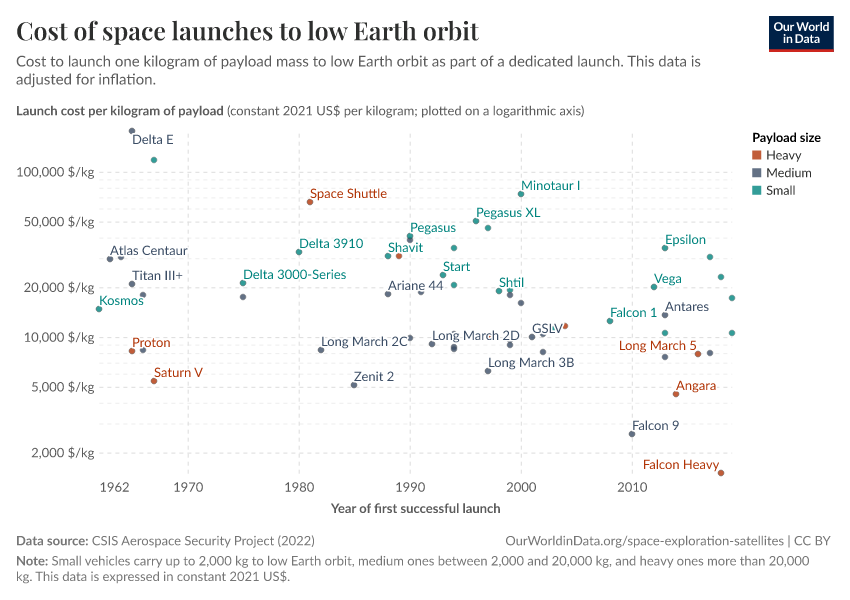
A Falcon Heavy flight is around $100M and the independent analysis math on a Starship flights says marginal cost is around $10M per flight, and SpaceX could charge between $20M and $100M per flight while undercutting all existing orbital launch vehicles by a considerable margin.
Why launch a crew aboard one marginally capable heavy lift rocket when you can launch 10 super heavy lift rockets for the same price?
A 2,000t mass allocation is a pretty robust mission package, is it not? You ought to be able to do quite a bit of science with that.
$200M to $1B to deliver 2,000t IMLEO (double the mass of the ISS), for a crewed exploration mission, has to be one of the cheapest exploration missions in living memory. If they only charged $20M per flight, then the mission can be 10,000t IMLEO for $1B. Putting a Ford Class aircraft carrier's equivalent tonnage (110,000t) into LEO, costs less than building the actual USS Ford. I have to believe that Elon Musk and SpaceX understand that all commercial and colonization missions revolve around cost per ton delivered and little else. If government budgets are restricted in the future, then all future exploration missions will be similarly budget-constrained. There will still be more than enough dollars for exploration missions.
SpaceX, Blue Origin, and our other aerospace primes should be focusing on creating a "shopping catalog" of mission hardware sets, so that anyone who is willing to foot the bill can select from their catalog and walk out with the hardware required to perform a specific mission.
I agree with the idea about using a space tug, but not one that requires constant refills of cryogenic liquids. Tugs should be used for slow but inevitable "heavy hauls" of vehicles and cargo to higher orbits using electric propulsion, wherein time spent spiraling-out is a non-issue. We can afford to use pure chemical propulsion for rapid transit with crew members to GEO. The radiation fluence at the orbital altitudes involved is nowhere near what it is within the heart of those captured proton belts. NASA has worked on ZBO tech for a very long time now. It's either time to get that up and running if we're going to do tugs using cryogenic liquids, or to move on to other more productive propulsion technologies. If someone gets ZBO to work at a later date, then we'll circle back to it.
RocketStar has developed and flown in space their FireStar aneutronic "fusion afterburner" for electric ion engines. It improves thrust output by 50%, so nothing too spectacular, but Isp is 7,300s and the primary propellant is water. All they're doing is ramming high energy protons from the ion engine exhaust into Boron atoms and fomenting a very rapid radioactive decay chain starting with Carbon-12, a serendipitous exploitation of unique atomic properties of Boron and water, that briefly uses fusion as a radioactive decay catalyst, and dumps the heat into water vapor, creating more thrust in the process. The process is highly electrically efficient, and that is what matters, because it consumes electrical power rather than producing any from fusion. The extra power doesn't even come from fusion, only the rapid decay of Carbon-12. Work began back in 2014 from the results of an AFRL propulsion experiment for their spy satellites, IIRC. The specific phenomenon being exploited was understood and known to occur, but nobody thought to use it to generate additional thrust from an ion engine. It took RocketStar's people about 10 years from basic concept to working ground engine demonstrator in 2024, followed by an in-space demo in 2025 about a very small 6U Rogue Space Systems commercial micro satellite, named "Barry-2", primarily intended to demo COTS computer hardware in a high radiation environment. I believe it was launched aboard a Falcon 9 as a tertiary payload, March 15th, 2025, with the satellite's designator being OTP-2. NORAD ID was 63235. So far as I know, it's now defunct.
I think a tiny amount of Boron mixed into water is a suitable propellant for in-space propulsion using existing ion engines. Even gases like Argon or Oxygen or Nitrogen are more difficult to store and costly to obtain in pure form, in comparison to Boron and water.
All the more advanced fission and fusion concepts look very promising for high-thrust applications, but they're also very difficult to do safely and none of them are ready to use in the near term, which means they'll need to be worked into the program over the next 10 to 20 years. A water propellant 7,300s Isp ion engine with 2,900N of thrust per MWe of input electrical power is a nice consolation prize in lieu of Helicity's "real" Fusion Drive or BWXT's NTR. As I said before, baby steps. Fusion catalyzed Carbon-12 radioactive decay is good enough for now. Learn to accept the consolation prizes and move forward using what we can do over the short term for in-space propulsion. Real star-like fusion and fission reactors the size of trash cans pumping out a gigawatt of power are just really hard to do properly when they're not national priorities. We'll eventually make them work the way we want them to, but not in our immediate future.
In the mean time, we can still put together a pretty spectacular exploration class mission using what we have working right now or will have working within the next 5 years. I think it's reasonable to assume that Starship will be up and running 5 years from now. 5 years of FireStar development would deliver a MW-class pulsed plasma ion engine up and running. We've already ground tested several MW-class ion engines, and have decades of development work behind them. We're not working with a completely new technology here. It's a novel application of existing technologies, but purely operates on existing tech nonetheless.
If we can achieve a direct transfer to a high orbit using a lightly loaded (personnel only) Starship, with no docking or transfer until you get to GEO, isn't that simpler and faster, even though a space tug would still work?
For a chemical space tug, what major part of the upper stage vehicle mass do we get to leave behind?
Won't it be limited to the heat shield only?
Offline
Like button can go here
#23 2026-02-10 21:43:53
- Oldfart1939
- Member
- Registered: 2016-11-26
- Posts: 2,516
Re: space x going to the moon instead of mars
I agree with GW about the landing of a tall and topheavy Starship being a VERY BAD idea. I recall from my course in Statics about having the center of mass over the base area being stable. The Starship needs to be a lot shorter and possibly include a 3rd stage instead of the whole shebang trying to land as one big chunk of metal. The lander should probably be fueled with hypergolic fuels instead of cryogenics. I know that making the trip isn't really within the realm of the large 2 stage vehicle, but inclusion of an expendable Earth departure stage and a seperate lander would undoubtedly work. The math should be fairly simple but getting it built in under 3 years is very problematic.
Last edited by Oldfart1939 (2026-02-10 21:45:46)
Offline
Like button can go here
#24 2026-02-11 04:18:16
- kbd512
- Administrator
- Registered: 2015-01-02
- Posts: 8,533
Re: space x going to the moon instead of mars
Oldfart1939,
ULA's so-called "crasher stage" concept landed a RL-10 powered Centaur upper stage on the moon using thrusters affixed to all four corners of the vehicle so that the upper stage could land on its side, which was a very stable landing configuration, relative to a vertical Centaur-based lander similar to the one proposed by Lockheed-Martin, or SpaceX's "more ridiculous" super-sized version.
This 2013 article from Jon Goff, over at Selenian Boondocks, describes his take on the concept:
Centaur UnCrasher Stages for Simplified Lunar Landings
Offline
Like button can go here
#25 2026-02-12 09:58:22
- GW Johnson
- Member
- From: McGregor, Texas USA
- Registered: 2011-12-04
- Posts: 6,266
- Website
Re: space x going to the moon instead of mars
Whether the Starship really will be cheaper to launch than a Falcon-9 or Falcon-Heavy is still debatable. That answer CANNOT be known until experimental flight testing and design changes are done. Be aware that SpaceX is talking about an even larger Block 4, while the somewhat-larger Block 3 still has yet to fly at all! Block 2 pretty much worked mostly right in the last two experimental flight tests.
The change from "block to block" is somewhat closer to a new design than just a minor variation on an old one. Always has been, always will be. That's just the inherent nature of vehicle developments and the experimental flight tests to "prove them out".
The cost question also depends upon how big your crews are. If 3-7, a Falcon-9 or Falcon-Heavy and Dragon makes very good sense at ~ $90 M/(3 to 7) for $12-30M per seat. That may look like a high seat price, but if all you are flying is a small crew, that's a small portion of your overall mission cost.
If you are flying a big crew 20+, then you would need more than one Dragon, and something big like Starship makes a lot more sense to shoot them all up there in one launch. Per seat price? Nobody can know yet!
Early exploration does NOT need big crews! That comes later when you do some sort of experimental base where you can prove out and verify that you really can start to "live off the land". That capability will NOT be the case in the first explorations, and it will still NOT be the case, when you first set up that experimental base. That is inherent.
Let's just say I am extremely skeptical of the "$10 M launch cost" some have been bandying about for Starship. I rather think $100 M is a better wild guess! But it is ONLY a wild guess! NOBODY has anything any better than a wild guess! Not Musk, not ANYBODY! $100M / (20+) is under $5M per seat. Still a small portion of any real mission cost.
GW
Last edited by GW Johnson (2026-02-12 10:08:12)
GW Johnson
McGregor, Texas
"There is nothing as expensive as a dead crew, especially one dead from a bad management decision"
Offline
Like button can go here