You are not logged in.
- Topics: Active | Unanswered
Announcement
#1 2026-01-15 13:39:21
- Void
- Member
- Registered: 2011-12-29
- Posts: 9,569
Bogs and Bog, Floating Island Technology, and Roller Solar.
To me this somewhat for amusement and learning. But I think it might lead to something useful, so if the administration tolerates it I will work on this. Otherwise, we can delete it.
I have noticed that certain people in the world have created floating islands to make farms on, so that is of interest. Also, Bogs could be places where Carbon could be sequestered, from the atmosphere. Ideally such sequestration could be in association with economically gainful activities.
https://en.wikipedia.org/wiki/Chinampa
Quote:
Floating islands for farming are innovative solutions that utilize water bodies for agricultural purposes. These islands can be constructed using various materials and designs, such as reeds, mud, or specialized floating structures. Here are some key points about floating islands for farming:
Chinampas: These ancient Aztec floating gardens are still used today in the Valley of Mexico. They consist of small, rectangular plots built on lake beds, surrounded by canals for irrigation and drainage. Chinampas are known for their ability to grow diverse crops and support a balanced ecosystem.
3
BioHaven Floating Islands: These islands are designed for farm ponds, treatment ponds, and more. They come in various sizes and can be customized with planting pockets for aquatic or terrestrial plants. BioHaven islands are also used for waterfowl nesting and can be placed in shallow or deep water.
1
Floating Riverbanks: These can be planted with edible crops, transforming canal and river banks into floating farms. They provide inspiration and food for local populations and can be positioned next to boats, cafes, or docks.
1
Floating Walkways: These can be combined with Floating Ecosystems to create larger floating farms, allowing for easy access for planting and harvesting crops.
1Floating islands for farming offer sustainable and innovative solutions for growing crops in water bodies, supporting both agricultural production and environmental conservation.
5 Sources
This may have paths to Mars.
Also, though this may have paths to solar energy.

A floating Island might support solar collectors and farming. It might be spun on the water to assist in making the installation sun facing.
https://engineerine.com/portugals-floating-solar-farm/
Quote:
Portugal’s Floating Solar Farm: A Renewable Energy Revolution
Last Updated on March 24, 2025 by Alex Ramirez
Image Quote: 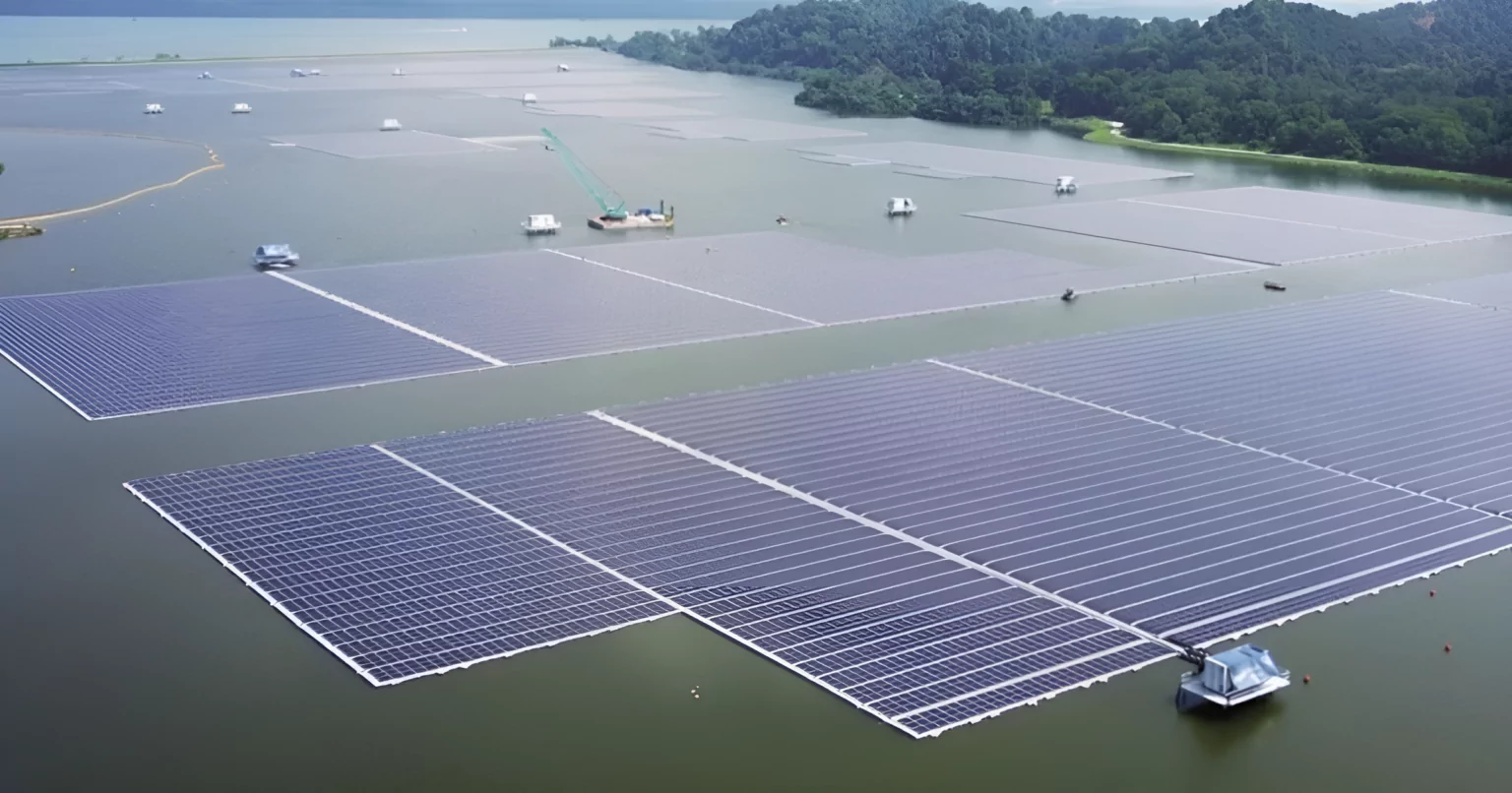
I think that the means of floatation of floating islands is partial fermentation and the pickling of the substance of the island. The Oxygen being consumed, decay is retarded. The mass if filled with gas bubbles.
So, I am thinking that you could put new vegetation under the island periodically and perhaps bubble Nitrogen or CO2 under the island to push tiny flotation bubbles under it.
You might put woven mats on top, and maybe bamboo frames on top of that.
Then Solar panels on top of that.
You may or may not promote agriculture on top of the island, under the solar panels.
You may be able to rotate the island during the day so that the solar panels face the sun.
If you are on top of a salt water body, even hypersaline, your flotation will be enhanced, and the salt may help to pickle the biomass under the island.
Should you want to inhibit evaporation, you might put a vapor barrier under the mats that would be put on top of the islands vegetation mass.
On Mars, if you had this in a dome, your pressure could be low inside the dome and you could have hypersaline water.
OK, that opens it a bit. The island is to primarily be made of biological waste.
If you are promoting agriculture on top of it then the nightly dews will settle on the vegetation helping to water it. This most likely would be done on fresh water, but maybe some salt tolerant crop could be grown on salt water.
Ending Pending 
Last edited by Void (2026-01-16 11:25:42)
Is it possible that the root of political science claims is to produce white collar jobs for people who paid for an education and do not want a real job?
Offline
Like button can go here
#2 2026-01-15 17:36:42
- Void
- Member
- Registered: 2011-12-29
- Posts: 9,569
Re: Bogs and Bog, Floating Island Technology, and Roller Solar.
The idea of a floating island well sized to a pond which could rotate to follow the sun, allowing better solar panel performance, could be hindered by winter ice.
However, moving water can melt holes in ice, on rivers and even lakes.
https://www.elitedockbubbler.com/
Quote:
Bubbler systems are effective for melting ice by transferring heat energy from the water to the ice, causing it to melt. Here are some key points about their operation:
Heat Transfer: Bubblers transfer heat energy from the warmer water at the bottom of a lake or pond to the ice cover, which helps to melt the ice.
1
Controlled Melting: These systems can reduce ice thickness, allowing ships to pass through or causing ice to break up more easily.
1
Environmental Benefits: Using bubbler systems can also improve water quality by adding dissolved oxygen, benefiting aquatic life.
1
Installation Considerations: The effectiveness of a bubbler system depends on factors like water depth, temperature, and natural ice cover characteristics.
2For more detailed information, you can refer to the sources,, and.
33 Sources
So, a pond almost entirely covered by a floating island could retain considerable heat in the water at it's bottom provided the pond were greater than 6 feet deep as I recall.
If you included a means of melting the ice by swirling that warmer water onto the water at the perimeter, of the floating island, you might be able to keep ice from gluing the island in place to the shore. A bubbler method might work.
And during the winter, you might also add heat back into the pond using solar energy.
Such a pond almost fully covered by a floating island, might engage in a simulation of the pickling process of a natural bog. So the decay rate of the floating island might be slow.
While you could rely in part on decay to insert tiny bubbles into the mesh of the floating island, it could be that burning something and then pumping the exhaust under the floating island would do rather nicely, as it would be deficient of Oxygen.
I am not sure how artificial saltwater bogs would work, but the salt might be assistive in pickling the floating island.
As I have said before you might include vapor barriers to reduce evaporation from a saltwater or brine bog, floating island.
The idea of a floating island, is then that it can rotate during the day, helping to present an array of solar panels to the sun, with one degree of mobility, and a bio-bearing.
Ending Pending
Last edited by Void (2026-01-15 17:49:27)
Is it possible that the root of political science claims is to produce white collar jobs for people who paid for an education and do not want a real job?
Offline
Like button can go here
#3 2026-01-16 11:29:51
- Void
- Member
- Registered: 2011-12-29
- Posts: 9,569
Re: Bogs and Bog, Floating Island Technology, and Roller Solar.
I have expanded the title of this topic with the phrase ", and Roller Solar".
Both a rotator platform and "Roller Solar" can probably use ganged collective actuation for collections of solar panels mounted on them.
I will reference "Roller Solar" here now, bringing materials into this topic:
https://newmars.com/forums/viewtopic.ph … 39#p237139
https://newmars.com/forums/viewtopic.ph … 48#p237148
https://newmars.com/forums/viewtopic.ph … 54#p237154
https://newmars.com/forums/viewtopic.ph … 55#p237155
Buth turntable and roller schemes provide one axis of rotation.
I feel that either could implement rows of solar panels that can have that have mutual linkages that can orient them to the sun.
A visual for that might be vertical or horizontal window blinds.
While this may give the best pose to the sun's movements in the sky, it might also allow the panels to be posed in a manner to endure weather conditions that can cause damage, by wind or hail.
https://en.wikipedia.org/wiki/Window_blind
Imagine that this is a collection of solar panels: Image Quote: 
Imagine that the sun is at the left of the image. The panels would be too close together. but the concept is represented.
The primary axis of rotation is to spin horizontal with the floating island, and between vertical and horizontal for the roller.
Each presents a flat surface upon which hinged solar panels can be attached. Linkages can "Gang" these panels.
So for the primary orientation, you could have a singular method of actuation and positioning.
For the flat island, that will be an orientation of the whole structure. For a roller system the roll is the primary be a roll, which will be controlled by a single method of actuation and orientation.
The will both present a flat surface to the sun, upon which a collection of solar panels can be linked to be actuated and positioned as a collection.
To protect from wind, perhaps the solar panels can be "Locked Down" to the flat surface.
To protect from hail, perhaps an approximately vertical position would be appropriate. But that might expose the panels to damage from the wind. So, not perfect protection.
Otherwise, orientation can be according to energy concerns.
A solar panel may have a cooling pigment on its back side, and in the night might lie flat with that cooling surface exposed to the sky.
So, if you have a water reservoir, you might cool it at night and use the cooled water to cool the solar panels during the day.
Ending Pending
Last edited by Void (2026-01-16 11:51:29)
Is it possible that the root of political science claims is to produce white collar jobs for people who paid for an education and do not want a real job?
Offline
Like button can go here
#4 2026-01-17 12:14:58
- Void
- Member
- Registered: 2011-12-29
- Posts: 9,569
Re: Bogs and Bog, Floating Island Technology, and Roller Solar.
So, this bog thing is to some extent a giggle. But it may point in a good direction. Some soils and climates may give permission to do these things. If Carbon in the atmosphere is such a terrible thing then the correct thing to do is to find ways to incorporate Carbon into mechanisms that may benefit people.
There is a possibility that such bogs and floating islands may produce some Methane. But if you can collect it and burn it, then you only emit CO2, but you are on balance sequestering Carbon in the vegetation that you used to make your Floating Island and bog. IF you lay a sheet of poly in a sandwich method into the structure of the floating island you might have a means to collect the Methane. Then burn it and then port the CO2 under the island to be tiny bubbles entrained into the structure of the floating island. Helping tp pickle the vegetation of the floating island.
Most schemes to sequester Carbon require an expenditure of resources to produce nothing. So then just another trick from the Elites to try to render the common people into burdened surfs.
A rotating floating island could have gardens under its solar panels. As there will be lots of water, you can have a sprinkler system that could both ward off frosts, and fight fires.
Ending Pending
Last edited by Void (2026-01-17 12:23:19)
Is it possible that the root of political science claims is to produce white collar jobs for people who paid for an education and do not want a real job?
Offline
Like button can go here
#5 2026-02-01 11:04:37
- Void
- Member
- Registered: 2011-12-29
- Posts: 9,569
Re: Bogs and Bog, Floating Island Technology, and Roller Solar.
This looks like almost compatible with some Earth environments and perhaps some future Mars environments: 
So, this mimics a freshwater lens: https://en.wikipedia.org/wiki/Lens_(hydrology)
Image Quote: 
Don Juan Pond suggests how salty the water could be outside of the fresh water lens: https://en.wikipedia.org/wiki/Don_Juan_Pond
Image Quote: 
Quote:
From Wikipedia, the free encyclopedia
Don Juan PondDon Juan Pond is a small and very shallow hypersaline lake in the western end of Wright Valley (South Fork), Victoria Land, Antarctica, 9 kilometres (5.6 mi) west from Lake Vanda. It is wedged between the Asgard Range to the south and the Dais Range to the north. On the west end is a small tributary[not verified in body] and a rock glacier.
With a salinity level of 45.8%, Don Juan Pond is the saltiest of the Antarctic lakes.[1][2] This salinity causes significant freezing-point depression, allowing the pond to remain liquid even at temperatures as low as −50 °C (−58 °F).
Don Juan Pond was discovered in 1961. It was named for two helicopter pilots, Lt. Don Roe and Lt. John Hickey, who piloted the helicopter involved with the first field party investigating the pond.[2]
The water is probably too salty for most or any life. The cold temperatures are too cold also for life, It looks like.
The fresh water however or less salty water of the Lens is likely to be able to host life.
The "Boat" that would hold the "Lens" could perhaps be made of plastic. Generally, it would be out of the sunlight, and plastics seem to be tolerant of salts.
I have suggested a bamboo deck as I presume it is cheap to produce, but it could be something else. I also think that under the deck might be a vapor barrier to oppose evaporation of water from the lens.
Filling most of the surface of a body of water like the Salton Sea or the Dead Sea, the evaporation rate should be reduced. So the body of water might swell up and become less salty.
A salty body of water in the Great Basin, if it could cut its evaporation rate by 90%, might be fillable from natural rainfall.
But you might need covered canals to route occasional rainwater into the body of water.
IF 5% or 10% of the basin water is exposed, you could still have beaches and spaces for boats to travel between the islands. It might be sensible to divert some of the Colorado River Water to fill such basins.
"Crops" could be grown in the "Lens" water, perhaps using small amounts of light and also chemicals such as Acetate and Oxygen.
Ending Pending
Last edited by Void (2026-02-01 11:22:44)
Is it possible that the root of political science claims is to produce white collar jobs for people who paid for an education and do not want a real job?
Offline
Like button can go here
#6 2026-02-02 14:09:37
- Void
- Member
- Registered: 2011-12-29
- Posts: 9,569
Re: Bogs and Bog, Floating Island Technology, and Roller Solar.
From the prior post:
This looks like almost compatible with some Earth environments and perhaps some future Mars environments:
So, I am going to speculate on Sargasso Seaweed as a crop. https://en.wikipedia.org/wiki/Sargassum
Quote:
Sargassum is a genus of brown macroalgae (seaweed) in the order Fucales of the class Phaeophyceae.[1] This brown macroalgae comes from the Sargasso Sea, which was named because it hosts large amounts of Sargassum.[
I have no certainty that it would grow well in giant plastic bags, but.....
Quote:
Sustainable uses
Even though Sargassum influxes have already generated significant environmental and economic issues, researchers and industries are considering methods of converting this biomass to sustainable resources.[70] Sargassum is a rich source of carbohydrates, minerals, and bioactive compounds and it has been used as compost or organic fertilizer in the coastal communities, to reduce waste and increase soil productivity.[71][72]More recent research has also investigated the applications of Sargassum in bioremediation and carbon sequestration because it has a high carbon/nitrogen ratio and therefore could be used to take away contaminants and sequester atmospheric CO2.[73] Nonetheless, the presence of high salt and heavy metals in certain Sargassum biomass requires thorough processing prior to agricultural or industrial use.
Recent work has also examined Sargassum as a biosorbent for recovering rare earth elements (REEs). A 2025 study found that Sargassum filipendula efficiently adsorbs REEs across low to high concentrations, with fresh biomass performing especially well at environmentally relevant levels.[74] The species showed high capacities for heavy REEs, maintained effectiveness under high salinity and variable pH, and outperformed activated carbon. This suggests a scalable “algal mining” pathway that could help manage coastal Sargassum while supporting sustainable supplies of critical materials.
As an example, if you started with a saline body of water, you could put these floating islands on them. Consider the Salton Sea.
And don't get hung up on plastics and microplastics. That was just a ploy by the globalists who want to destroy industry so that they can employ you to shovel poo out of there pony barn on their nice green estates. Their game is to knock you down so that they can be above you and yet not ascend at all as people.
The Salton Sea is too salty for fish or will be soon: https://en.wikipedia.org/wiki/Salton_Sea
https://saltonseaactioncommittee.org/faq/
Quote:
Approximately 55 parts per thousand
The Salton Sea is approximately 55 parts per thousand (PPT), making it significantly saltier than ocean water, which is about 35 PPT. The salinity of the Salton Sea increases every year due to evaporation and the inflow of approximately 4 million tons of salt annually. Currently, it is more than twice as salty as the Pacific Ocean.
saltonseaactioncommittee.org
+2
I recall reading at one time that in general salinity twice that of sea water is about the limit of what some fish can tolerate.
Here is a list of salt tolerant fishes which lived or might even still live in the Salton Sea: https://pondinformer.com/salton-sea-fish-species/
Water filled plastic bags or rigid structure might float on the Salton Sea, if filled with water that is less salty than that of the Salton Sea. So, they could be floats.
If a platform were put on top of that it might shelter the floats from UV light. On the platforms you might put solar panels. The resulting floating islands and the panels might follow the sun. While the floats might contain fresh water, water about the saltiness of sea water +/k-??? might support something like Sargasso Seaweed. I have no test data on that. I want to speculate on that because as it is an Algae, it might like microalgae be able to be sustained on Oxygen and Acetate, in the dark.
https://news.ucr.edu/articles/2022/06/2 … t-sunshine
Quote:
Artificial photosynthesis can produce food without sunshine
Scientists are developing artificial photosynthesis to help make food production more energy-efficient here on Earth, and one day possibly on Mars
Quote:
Experiments showed that a wide range of food-producing organisms can be grown in the dark directly on the acetate-rich electrolyzer output, including green algae, yeast, and fungal mycelium that produce mushrooms. Producing algae with this technology is approximately fourfold more energy efficient than growing it photosynthetically. Yeast production is about 18-fold more energy efficient than how it is typically cultivated using sugar extracted from corn.
So, it is my expectation that any surface of such a body of water covered by such a device should have minimum evaporation. So, more water should accumulate in the body of water, and the saltiness should be diluted.
IF you could grow a crop in the dark, using Acetate, and Oxygen, you may subject it to a process. You might ferment it to produce Methane, or you might subject it to Pyrolysis, to produce gasses and Carbon heavy solids.
The CO2 needed to make the Acetate might came from the brine of the lake or from the atmosphere. Some of the produced products, Methane, Carbon Solids, might be manufacture into higher quality Carbon products. Certain parts of the floating islands might in part be manufactured that way.
Here is a topic that deals with that: https://newmars.com/forums/viewtopic.php?id=11299
The lake then could swell up to occupy its former shorelines, then covering the toxic dry lake bottom dusts.
https://www.inovynawards.com/ocean-sun- … -typhoons/
Image Quote: 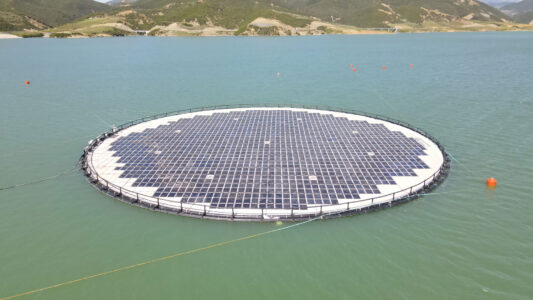
While you could have multiple rotator floating islands, you could fill in the gaps with non-rotating platforms between the rotators.
So, you might reduce the evaporation from the Salton Sea down to!% to 10% depending how you did it.
If the Salton Sea gets too high, you simply pump the excess salty water to another basin, and begin setting that one up the same way.
I think that you could bring fishing/fish back to the Salton Sea doing only some of this.
Actually, I think that if you could drop the evaporation down to 1% of normal you could just fill basins with rainwater in the Great Basin.
The heat of the sun and of the day would be rejected into the air and sky above the islands, but the solar panel structures might serve as radiators at night.
So, the water might not get too hot.
This process could pull Carbon out of the atmosphere, to regulate the climate which the Greens who want us to be poo shovelers are so worried about.
Ending Pending
FYI, some of the Carbon captured could be incorporated into the water floats.
Ending Pending
Last edited by Void (2026-02-02 15:05:39)
Is it possible that the root of political science claims is to produce white collar jobs for people who paid for an education and do not want a real job?
Offline
Like button can go here
#7 2026-02-04 14:08:33
- Void
- Member
- Registered: 2011-12-29
- Posts: 9,569
Re: Bogs and Bog, Floating Island Technology, and Roller Solar.
Repeating materials but I hope to show things even better: https://www.youtube.com/live/DVhJQ0WDv2s
Quote:
Carbon is the New Metal
As I understand it they are splitting Methane (CH4) to produce their Carbon products and end up with Hydrogen as a byproduct.
https://en.wikipedia.org/wiki/Precision_fermentation
Quote:
Copilot Search Branding
Precision fermentation - Wikipedia
Precision fermentation is a biotechnology process that uses microorganisms, such as bacteria, fungi, or yeasts, to produce specific biological molecules. This method involves rewriting the DNA of these microorganisms to "brew" ingredients that are molecularly identical to those found in nature, allowing for the production of food ingredients without the need for traditional farming. It is used to create high-value compounds like proteins, enzymes, and biofuels, ensuring high yields and purity. Historically, precision fermentation has been utilized for decades to produce common ingredients like rennet and citric acid.
Wikipedia
+4
Precision Fermentation can be done with Hydrogen and Atmospheric CO2:https://www.biologie.rwth-aachen.de/cms/biologie/forschung/fachbereiche/publikationen/~fmtva/details/?file=1021396&lidx=1
Quote:
Precision fermentation with hydrogen is a promising approach in biotechnology, particularly in food production. This method utilizes genetically engineered microorganisms to produce high-value biomolecules, such as proteins and pharmaceuticals, with high yield and purity. The process involves several interconnected stages, including strain development, upstream fermentation, downstream purification, and final formulation. Precision fermentation is particularly beneficial for producing smaller biologic modalities, such as peptides and antibody fragments, due to its cost-effectiveness and efficiency across various scales.
biologie.rwth-aachen.dePrecision fermentation with hydrogen is expected to play a significant role in sustainable nutrition and the development of next-generation therapeutics. By leveraging microbial fermentation, this technology can create climate-friendly dairy alternatives, next-gen therapeutics, and circular materials, aligning with global sustainability goals.
Pharma's Almanac
Cellular Agriculture may be similar in production.
Biogas could come from either a digester or using pyrolysis.
https://www.motherearthnews.com/sustain … z14aszrob/
Quote:
Make a Biogas Generator to Produce Your Own Natural Gas
Transform grass clippings, food waste and livestock manure into renewable energy via a homemade biogas generator.
By Paul Scheckel
|
Updated on January 3, 2022
X
https://en.wikipedia.org/wiki/Pyrolysis
Quote:
Copilot Search Branding
(PDF) Safety assessment of the process RE‐PET, based on EREMA Basic technology, used to recycle post‐consumer PET into food contact materials
Pyrolysis is a thermochemical process that involves the heating of organic materials in the absence of oxygen, leading to their decomposition. This process produces valuable products such as gases, liquids (like bio-oil), and solids (like char). Pyrolysis is particularly useful for treating various organic materials, including biomass, plastics, and hazardous waste, as it can break down complex compounds into simpler substances. The process typically occurs at high temperatures, often above 500 °C, and is applied in fields such as energy production, recycling, and waste management.
Wikipedia
+4
So, you might have to electrolyze some water as well to keep the Hydrogen content up, but you could run this process inside of plastic bags filled with fresh or salty water that float on top of salty bodies of water.
And you may be able to make floating islands that you can put solar power equipment on to generate the needed electricity.
Those islands might be able to rotate to follow the sun east to west, and the panels may be linked together like window blinds to also follow the sunup and down.
Many salty reservoirs might be possible to build on desert shorelines of the oceans and also inland, in marginal land.
So, the process may generate products from precision fermentation and Cellular Agriculture, and to pull CO2 from the atmosphere.
If so, then it may be practical to burn all the hydrocarbons that can be found and accessed.
Ending Pending
Last edited by Void (2026-02-04 14:34:31)
Is it possible that the root of political science claims is to produce white collar jobs for people who paid for an education and do not want a real job?
Offline
Like button can go here
#8 2026-02-04 21:40:15
- Void
- Member
- Registered: 2011-12-29
- Posts: 9,569
Re: Bogs and Bog, Floating Island Technology, and Roller Solar.
So, actually I was a hurry on the last post. I believe that microbes that you might feed CO2 and H2, will create Methane and the other products of their metabolism.
https://news.berkeley.edu/2025/08/14/sc … f-methane/
Quote:
Methanogens
Microbes that eat hydrogen and create methane include methanogens, which are anaerobic archaea that produce methane as a byproduct of their energy metabolism. They thrive in oxygen-free environments such as wetlands, rice fields, and the digestive tracts of animals. Methanogens utilize hydrogen, carbon dioxide, and other organic compounds to generate methane through a process called methanogenesis, which is a form of anaerobic respiration.
University of California, Berkeley
+2
So, energy-wise, I believe that it is easier to split Methane with electrolysis than it is to split water.
So, this anerobic process could be used in Precision Fermentation and also Cellular Agriculture, I believe.
I think the process could be useful in creating Carbon products and also in making plastics.
And I think this could work on Mars with some alterations.
If the ability to build Carbon products is a thing that keeps growing, then Venus would be valuable for both Nitrogen and Carbon, provided that the products would be useful in the atmosphere, or if some method to lift things to orbit on Venus emerges.
And then as you go our in the solar system to the Outer Asteroid Belt, Carbon is plenty, and then also presumed to be in the moons of the outer planets, and part of Pluto and other dwarf planets.
Ending Pending
Last edited by Void (2026-02-04 21:48:59)
Is it possible that the root of political science claims is to produce white collar jobs for people who paid for an education and do not want a real job?
Offline
Like button can go here
#9 2026-02-05 10:43:45
- Void
- Member
- Registered: 2011-12-29
- Posts: 9,569
Re: Bogs and Bog, Floating Island Technology, and Roller Solar.
Here then is a "Water Pontoon" scheme: 
If you were to suppress the wave mixing action of the Salton Sea, you might turn the whole thing into a solar salt pond.
https://en.wikipedia.org/wiki/Solar_pond
Quote:
Solar Salt Pond
A solar salt pond is a large body of saltwater that collects and stores solar thermal energy, providing a sustainable source of heat and power. The process involves evaporating water out of brine using sunlight, leaving behind pure sodium chloride crystals as residue. This method is known for its high purity and is used in various applications, including water softening, cooking, and as a general-purpose seasoning. Solar salt ponds are particularly attractive for rural areas in developing countries due to their ability to harness solar energy for electricity generation and other thermal energy uses.
Wikipedia
+4
Image Quote: 
With most of the body of water, such as the Salton Sea covered in floating island for solar energy and also bio-farming, the waves suppressed, so then mixing suppressed, you intentionally use heat pumps to extract heat from the upper waters and add it to the lower waters. You also induce salt gradients.
Having done this then the upper waters may be suitable for fish to live in as you have pushed some of the salt down to the bottom of the reservoir.
And when convenient you might then extract the heat for some process you desire to maintain. You actually might be able to run a heat engine from it even.
Quote:
Description
When the sun's rays contact the bottom of a shallow pool, they heat the water adjacent to the bottom. When water at the bottom of the pool is heated, it becomes less dense than the cooler water above it, and convection begins. Solar ponds heat water by impeding this convection. Salt is added to the water until the lower layers of water become completely saturated. High-salinity water at the bottom of the pond does not mix readily with the low-salinity water above it, so when the bottom layer of water is heated, convection occurs separately in the bottom and top layers, with only mild mixing between the two. This greatly reduces heat loss, and allows for the high-salinity water to get up to 90 °C while maintaining 30 °C low-salinity water.[1] This hot, salty water can then be pumped away for use in electricity generation, through a turbine or as a source of thermal energy.
This is perhaps a case where at times your heat pumps might extract heat from the solar panels in addition to the electricity generated. Then to heat the bottom water. Then at night the solar panels to behave as radiators, and again if desired to reject heat into the solar panels using a heat pump system. To some extent this may extract energy from the day/night cycle.
A very important sub-part of this is to extract CO2 from the air directly or indirectly from the Salton Sea.
So, then to use it to produce plastics and Carbon products, and to regulate the climate of a planet.
For Mars this may be possible when the entire amount of CO2 available is vaporized into the atmosphere, but certain revisions of method may be needed.
For Mars, it can be expected that the process will leak Hydrocarbons into the atmosphere which would be assistive to further terraform the planet.
Ending Pending
Last edited by Void (2026-02-05 10:57:49)
Is it possible that the root of political science claims is to produce white collar jobs for people who paid for an education and do not want a real job?
Offline
Like button can go here
#10 2026-02-05 12:28:43
- Void
- Member
- Registered: 2011-12-29
- Posts: 9,569
Re: Bogs and Bog, Floating Island Technology, and Roller Solar.
About Microplastics. Of course I like this as it favors my views: https://backreaction.blogspot.com/2026/ … -says.html Quote:
Wednesday, February 04, 2026
Microplastics: What the Evidence Really Says
You’ve probably seen the headlines about microplastics, which claim that the micrometer-scale bits of plastic are everywhere, causing a wide variety of health issues. But while the headlines get more and more extreme, the scientific research on microplastics doesn’t actually support the media’s claims. Let’s take a look.
My own view of the process of civilization is that it turns wine into vinegar. At first the wilderness people create civilization which is sweet. They can do so, because the wilderness has given them "Blue Collar Skills". But they have enough verbal skills as well to share with each other on plans.
The Vinegar stage gives us the "Verbal and Violent" who displace the genes and memes of the more useful people of transition from wilderness to initial "Sweet" civilization.
From there survival of genes and memes depends more and more on predation from the Vinegar people, upon the wealth and life's of the productivity of the transition people.
The Industrial Revolution gave us a reprieve form the total power of the Vinegar people.
And they, the Vinegar People have been struggling to take us as slaves again all along.
So, the made untruth about fracking, and then about plastics, and then microplastics.
Anything to stifle "Blue Collar Power" and to promote green plantation owners where little by little the useful genes and memes can be replaced by "Vinegar" versions.
So, it is so stupid to worry about microplastics, when they come from the fabrics we use and also from things like car tires.
The author above seems to have a very good mind. That is a form of relief from the general "Vinegar" stupidity we usually have to deal with.
https://iee.psu.edu/news/blog/microplas … t-yourself
Quote:
Microplastics originate from various sources, including the breakdown of larger plastic items, synthetic textiles, vehicle tires, and personal care products.
Key Sources of Microplastics
Breakdown of Larger Plastics: Microplastics can form when larger plastic debris, such as bottles and bags, degrade into smaller fragments due to environmental factors like sunlight, friction, and weathering. This process creates what are known as secondary microplastics.
2
Synthetic Textiles: Washing synthetic clothing releases thousands of microfibers into wastewater. These microfibers are a significant contributor to microplastic pollution, as they can enter water systems and eventually the food chain.
2
Vehicle Tires: As tires wear down, they shed tiny particles that contribute to microplastic pollution. It is estimated that tire wear accounts for a substantial percentage of microplastics released into the environment.
2
Personal Care Products: Many personal care items, such as exfoliating scrubs and toothpaste, have historically contained microbeads—tiny plastic particles designed for scrubbing. Although many countries have banned these, they still contribute to microplastic pollution.
2
Household Items: Everyday items like plastic chopping boards and microwavable containers can leach microplastics into food, especially when heated. This highlights the pervasive nature of microplastics in our daily lives.
1
Urban Dust and Road Markings: Microplastics can also be found in urban dust, which is a mix of various particles, including those from road markings and construction materials.
1Conclusion
Microplastics are a widespread environmental issue, originating from a variety of sources, including the breakdown of larger plastics, synthetic textiles, vehicle tires, and personal care products. Their presence in the environment raises concerns about their impact on ecosystems and human health. Understanding these sources is crucial for developing strategies to mitigate microplastic pollution.
Communism and Fascism will not protect you from the "Verbal and Violent" "Vinegars". In fact these are special roads to "Vinegar Hell".
My intentions are to have plastic pontoons that support solar equipment. I intend that the plastics will generally be shielded from things that make them break down, such as Ultraviolet Light.
I microplastics go into the water, I am hoping that they may settle into the sediments of such a body of water.
Anyway the great hope is that space may provide a useful wilderness for our people to provide habitat for their escape from the "Verbal and Violent Vinegars".
This then perhaps to forestall the death of the human mind from the process of the Vinegars.
Ending Pending
Last edited by Void (2026-02-05 12:45:33)
Is it possible that the root of political science claims is to produce white collar jobs for people who paid for an education and do not want a real job?
Offline
Like button can go here
#11 2026-02-06 10:25:44
- Void
- Member
- Registered: 2011-12-29
- Posts: 9,569
Re: Bogs and Bog, Floating Island Technology, and Roller Solar.
So, for marginal places like brine lakes, or even just desert, two different processes might be done:
1)-Aerobic
2)-Anerobic
1) Aerobic: Acetate/Oxygen
2) Anerobic: Hydrogen/CO2
These can be done in the shade, as plastic tends to deteriorate under sunlight.
The #1 Aerobic, has recently been discovered as possible:
https://www.snexplores.org/article/inno … ts-in-dark
https://www.biotechniques.com/plant-cli … -sunlight/
So, Aerobic can be single cell and multicellular.
The #2 Anerobic as far as I know these are all single cell organisms.
For #1, Yeast is said to be 18x more efficient than photosynthesis.
For #1, Algae is said to be 4x more efficient than photosynthesis.
* It is hard to know if Macro-Algae also work well with Acetate and Oxygen.
* We can hope that multicellular plants might be adaptive to Acetate and Oxygen.
* I have an interest in the domestication of some large plants for this purpose. Macro-Algae such as Sargasso Seaweed, Hydrilla, Duckweed. Duckweed will need an air layer in the flotation bladders.
For #2 as far as I know all the organisms are single cell. I wonder if gene editing could create multicellular that can live on Hydrogen/CO2.
This might scare some people, but there is no natural environment on Earth of any scale where these could go "Feral". IF you could create vegetables that could life off of Hydrogen/CO2.
At any rate, I think that the Hydrogen cycle is more economic as per energy than is the Oxygen cycle. And might be very useful in capturing CO2 out of the environment.
https://onlinelibrary.wiley.com/doi/abs … 719e2f6ea5
Quote:
Copilot Search Branding
Electrochemical Splitting of Methane in Molten Salts To Produce Hydrogen - Fan - 2021 - Angewandte Chemie International Edition - Wiley Online Library
Electrolysis of methane involves the electrochemical splitting of methane to produce hydrogen and solid carbon, offering a cleaner alternative to traditional hydrogen production methods.
Overview of Electrolysis of Methane
Electrolysis of methane is a process that can be used to convert methane (CH₄) into hydrogen (H₂) and solid carbon (C) through an electrochemical reaction. This method is considered more environmentally friendly compared to conventional methods like methane steam reforming, which typically results in significant carbon emissions.
Process Description
Electrochemical Reaction: In the electrolysis of methane, methane is oxidized at the anode, producing hydrogen gas and carbon dioxide. The carbon dioxide can be captured and reduced to solid carbon at the cathode. This separation of hydrogen generation and carbon deposition allows for a cleaner process with minimal emissions.
1
Temperature and Conditions: The process can be conducted at elevated temperatures, such as 500 °C, in molten salts, which helps in reducing energy consumption and avoiding coke formation that can occur in traditional methods.
1
Efficiency: The electrochemical splitting of methane has been shown to have a lower equivalent carbon emission compared to methane steam reforming and requires less energy input than alkaline water electrolysis.
11 Source
Applications and Benefits
Hydrogen Production: The hydrogen produced can be used as a clean fuel for fuel cells or as a feedstock for various chemical processes.
Carbon Management: The solid carbon produced can potentially be utilized in various applications, reducing the overall carbon footprint of methane utilization.
Integration with Renewable Energy: This process can be integrated with renewable energy sources, making it a viable option for sustainable hydrogen production.
22 Sources
Conclusion
The electrolysis of methane presents a promising pathway for producing hydrogen while managing carbon emissions effectively. As research and technology advance, this method could play a significant role in the transition to cleaner energy systems. Further developments in reactor design and catalyst efficiency are essential for optimizing this process and making it commercially viable.wiley.com
So, we can then look at making Carbon products: https://newmars.com/forums/viewtopic.php?id=11299
"Index» Life support systems» Carbon is the New Metal"
So, in this process a byproduct could be Precision Fermentation Products, and also perhaps Cellular Food Production.
I think this #2 Anerobic cycle will be rather energy efficient.
And this solar process would not have to be connected to a grid, although it could be. So, if in a desert, in a brine pool, the sunshine may be as predictable as can be on the Earth, I believe. So,you could run the process mostly when the sun shines, and not so much when it does not shine.
Ending Pending
Last edited by Void (2026-02-06 11:03:19)
Is it possible that the root of political science claims is to produce white collar jobs for people who paid for an education and do not want a real job?
Offline
Like button can go here
#12 2026-02-06 11:28:15
- Void
- Member
- Registered: 2011-12-29
- Posts: 9,569
Re: Bogs and Bog, Floating Island Technology, and Roller Solar.
So, if Carbon is to be a "New Metal", where the production of Carbon parts is enhanced in ability and price, Stainless Steel may have a bit of a competitor.
Don't get me wrong, I can see the value of Superheavy being Stainless Steel, and that reusable Starship needs to be Stainless Steel.
But for craft that do not need to aerobrake, then perhaps in some cases Carbon will be a useful choice. This could include interworld spacecraft and also perhaps a new version of aa expendable Starship.
At some point it might become possible to replace Stainless Steel with Carbon for the upper parts of an Expendable Starship. Pushing it even father, then even the propellant tanks. The engines might be mostly the only parts reused. The ship might go to orbit and be taken apart with the Carbon portions staying in orbit and things like the engines being brought back down with a Stainless-Steel Starship type.
The point is the Stainless-Steel Starship when it is more developed will be a fantastic system, but if you could drop the dry mass for Expendables that might be a good asset also.
But it would be a thing for the future, when the Carbon tech is more developed.
Ending Pending
Last edited by Void (2026-02-06 11:32:31)
Is it possible that the root of political science claims is to produce white collar jobs for people who paid for an education and do not want a real job?
Offline
Like button can go here
#13 2026-02-06 15:47:37
- kbd512
- Administrator
- Registered: 2015-01-02
- Posts: 8,533
Re: Bogs and Bog, Floating Island Technology, and Roller Solar.
Void,
If you have a clear polymer and fresh water, can you make some kind of giant selectively deformable "water lens" to evaporate sea water, collect the minerals, and extract the fresh water from the ocean?
I'm thinking of something like an enormous "breast implant", for lack of a better visual representation, rather than a "contact lens", and you use mechanical / hydraulic power to "deform" said lens to optimally concentrate the sunlight.
Why the "breast implant" vs "contact lens" approach?
You can control concentration of the sunlight in a way that isn't practical with a single lens and would otherwise require some sort of "giant telescope" precision lens alignment which would make the device much more expensive than a fresh water filled silicone membrane that can give you just enough power concentration to flash the water to steam in a controlled manner. It's much less of a "solar death ray" than it is a slow but immensely powerful hydraulic cylinder that delivers just enough "photonic force" to the surface of the sea water to get the job done, without going overboard with the power concentration.
The size of this device could be enormous, secured to a shallow sea bed offshore using steel hydraulic cylinders sunk into the bedrock, which are then used to deform the membrane, as required, to optimize beam intensity and size. I was thinking of using some layers of flexible plastic underneath it to collect and route the fresh water and mineral rich brine. That's another reason why we don't "death ray" power, because it would melt the collector plate plastic.
The "benefit" to this style of fresh water and mineral brine collection is that it can be a fundamentally simple mechanical device with minimal moving parts. Apart from the lens support / lens deformation hydraulic stanchions arrayed around the periphery of the lens, there's very little metal required, temperatures aren't completely nuts so it wouldn't kill the marine life below it, and over time we could "mine" truly enormous quantities of light (Sodium, Calcium, Magnesium, Lithium) and heavy (Uranium) metals. The carbonates would supply CO2, and maybe we could devise a method to collect the dissolved CO2 as well.
Maybe you already thought of this. If so, then disregard. I just thought it would be a neat "low-tech" way of getting fresh water and large quantities of light aerospace and battery making metals.
Offline
Like button can go here
#14 2026-02-06 15:52:36
- kbd512
- Administrator
- Registered: 2015-01-02
- Posts: 8,533
Re: Bogs and Bog, Floating Island Technology, and Roller Solar.
Void,
All the concepts I've seen from you seem to involve "floating" the lens on the surface of the water, but I'm talking about suspending the lens above the water so that it's not subject to unintended deformation from wave action. This is just an idea that may or may not work for any number of reasons, not something I've completely thought through. It struck my fancy because it's reasonably simple in theory, can be purely mechanical by using mechanical sun trackers, and uses low cost materials for construction.
Edit:
Maybe the correct analogy for the silicone lens, rather than a "breast implant", is actually a multi-cell "air mattress" which contains fresh water.
Last edited by kbd512 (2026-02-06 16:13:20)
Offline
Like button can go here
#15 2026-02-06 21:17:54
- kbd512
- Administrator
- Registered: 2015-01-02
- Posts: 8,533
Re: Bogs and Bog, Floating Island Technology, and Roller Solar.
Void,
Apparently, someone has already done this:
Offline
Like button can go here
#16 2026-02-06 22:06:28
- Void
- Member
- Registered: 2011-12-29
- Posts: 9,569
Re: Bogs and Bog, Floating Island Technology, and Roller Solar.
Such ideas are worthy of continuing efforts, I feel.
I am also interested in perhaps extracting minerals from water. I am considering H2/CO2 to power microbes that might do that as well as generating Methane. Then you might get the mineral and the Carbon to make parts from.
Ending Pending
Is it possible that the root of political science claims is to produce white collar jobs for people who paid for an education and do not want a real job?
Offline
Like button can go here
#17 2026-02-07 09:44:14
- Void
- Member
- Registered: 2011-12-29
- Posts: 9,569
Re: Bogs and Bog, Floating Island Technology, and Roller Solar.
The idea of using large bodies of water as bearings is an interesting one, but they are at times very turbulent. And Mars does not at this time have larger bodies of water. So, I think to use water as a bearing internal to land. And I hope to introduce processes on Earth that might be translatable to Mars.
I don't actually like to pick on little girls, but I am eager to have human civilization depart from "Gretta-Land".
While the Aerobic side interests me, I am also very interested in what the Anaerobic side H2/CO2 can do for us. Problems with Hydrogen are storage, and generation of it from water. It is my impression that it is easier to split Methane than it is to split water.
https://www.pnnl.gov/news-media/new-cle … -emissions
Quote:
Researchers from Pacific Northwest National Laboratory (PNNL) and West Virginia University (WVU), in collaboration with industry partners Southern California Gas Company (SoCalGas) and C4-MCP, have developed a process that converts methane—the primary component of natural gas—into hydrogen while emitting zero CO2. The process also creates carbon solids for manufacturing applications.
So, the above may solve the creation of Hydrogen and the creation of Carbon Solids for structures and machine parts.
The Hydrogen might then be dissolved into pontoons of water to foster the growth of Methanogens which will produce Methane. So, we can rotate the Hydrogen molecules back and forth between these two processes.
Hydrogen solubility in water is rather low, so you might put your compressed Hydrogen tanks inside of the pontoons of water. That way generally Hydrogen that leaks from such a storage will be delivered to the Methanogens over time. The Hydrogen tanks then become "Hydrogen Capacitors".
The Methanogens can be put to work to make things other than Methane.
-Precision Fermentation
-Cellular Agriculture
-Biomining
https://en.wikipedia.org/wiki/Methanogen
https://en.wikipedia.org/wiki/Precision_fermentation
Promising approach to sustainable food production
Precision fermentation with hydrogen is a promising approach to sustainable food production. Aerobic hydrogen-oxidising bacteria (HOBs) convert atmospheric CO2 and green hydrogen into biomass via gas fermentation, a process already used for food-grade single-cell protein production. This method requires minimal land and water, offering a supply chain independent of agriculture and with potential for carbon-neutral production and carbon capture. To expand beyond single-cell protein, HOBs must be engineered into cell factories for precision fermentation. Advances in synthetic biology, metabolic engineering, computational modeling, and bioreactor design are accelerating the development of scalable bioprocesses for gas-based fermentation.
Wikipedia
Quote:
Precision fermentation is a production process in which specific biological molecules are manufactured using microorganisms. It can be used to produce food ingredients that are conventionally sourced from animals and plants, including proteins, lipids, carbohydrates, and other metabolites. Bacteria, yeast, or other cell types produce large quantities of a specific compound which is then extracted and purified from the fermentation broth or cell lysate.[1] For example, milk or egg proteins, dairy fats, functional oligosaccharides, flavour and colour compounds or vitamins.[2]
So, now the atmosphere itself becomes a universal pipeline that delivers CO2 to any surface location on Earth, Mars, or Venus. Of course the Surface of Venus is hopeless, but there is hope at altitude.
So, now we do not suffer if someone burns coal, but we might benefit.
In the case of Earth, we might draw down the CO2 to bring on an ice age, but then beam extra solar power from space, to compensate for the loss of insulation. So, then artificially controlling the climate.
Purposely thawing the North with imported power and letting Antarctica pull water out of the oceans to make ice. And then developing the technology to life on and in the ice of Antarctica.
Simply options, not mandates.
But in an imaginary future we might draw down the oceans to Ice Age levels if that was desired.
For Mars, imported power from space may help to improve the conditions, allowing at least mostly covered lakes and seas.
Here again if you have various sized floating Lilly pad solar installations that cover 90%/95%/99% of the water, and active irrigation, significant bodies of water may be made possible even with a relatively low atmospheric pressure.
Again, harvesting the CO2 you might make Carbon Structures. You would need to replace the CO2 with other gasses over time to maintain the atmospheric pressure.
I suggest processing the moons of Mars and the rocks of Mars to produce more Oxygen for the purpose. Then also moving asteroids into the orbits of Mars to process them as well.
Someday then to import Nitrogen from some source or to recover it from underground if there is some in the deep water in the crust.
For Venus I am hoping that Carbon and/or other structures may be extracted from the atmosphere to make floating structures.
Ending Pending
Last edited by Void (2026-02-07 10:22:15)
Is it possible that the root of political science claims is to produce white collar jobs for people who paid for an education and do not want a real job?
Offline
Like button can go here
#18 2026-02-07 13:01:11
- Void
- Member
- Registered: 2011-12-29
- Posts: 9,569
Re: Bogs and Bog, Floating Island Technology, and Roller Solar.
This is sort of where I am going with it: 
So, in places like Ther Great Basin, you might reduce water losses to 10%/5%/1%, to be able to keep reservoirs inflated with water from local sources, or imported water.
In the top view there is a floating Solar Rotator. It can cool the solar panels with a heat pump during the sunshine, and push heat into the very briny water at the bottom of the pond (Pink).
The Static Cover, (Orange), has radiators that can reject heat into the night sky of a desert to generate power.
The side view has a (Green) top layer that can have pontoons of the least salty water, which support a Anaerobic process of H2/CO2.
The Blue Layer being perhaps less than two times as salty as the ocean, might support some forms of living things living on Oxygen/Acetate and perhaps a little artificial light.
The pink layer would be warm or hot, but less than the boiling point of water, probably.
In the future it will make much more sense to inflate these with local river water such as the Colorado River, then to do irrigation on Dry Land Farming.
The major concern would be that if you made reservoirs that swelled up very large it might induce earthquakes. But this would be a way to lower the sea levels by holding water into dry desert basins.
And of course I intend that these devices will capture a lot of Carbon from the atmosphsere.
Ending Pending
Last edited by Void (2026-02-07 13:10:43)
Is it possible that the root of political science claims is to produce white collar jobs for people who paid for an education and do not want a real job?
Offline
Like button can go here
#19 2026-02-08 08:31:26
- Void
- Member
- Registered: 2011-12-29
- Posts: 9,569
Re: Bogs and Bog, Floating Island Technology, and Roller Solar.
Processes that split molecules will be important in this.
Water Electrolysis and Turquoise Hydrogen are two methods. Turquoise Hydrogen can produce Carbon Solids.
I found and lost a reference to a Utube video about "Utube, Australian electrolysis method using capillary tubes".
Apparently high efficiency and not needing Iridium.
Here is a similar video: https://www.youtube.com/watch?v=oGcIVmNwGmM
Quote:
The Electrolysis Bubble Free Breakthrough
jimboot2
There apparently are several types of Turquoise Hydrogen: https://modernhydrogen.com/company/stud … -hydrogen/ Quote:
Reference
Turquoise Hydrogen
Hydrogen, often championed for its potential in cleaner energy, combusts cleanly without releasing carbon dioxide (CO2). Turquoise hydrogen, specifically, is a key player as a bridge to a 100% renewable energy-powered world.This page provides a look into turquoise hydrogen and its role in hard-to-decarbonize industries.
Galvorn is a Carbon product that could be a result of Turquoise Hydrogen production: https://dexmat.com/why-galvorn/making-galvorn/ Quote:
From disordered carbon nanotubes to aligned high-performance fibers.
carbon-nanotubes
Galvorn is made using very pure, high-quality carbon nanotubes (CNTs). We use solvents to mix the disordered CNTs into a solution. Then our proprietary fluid phase process aligns the carbon nanotubes and increases their packing density into single filament fiber tow or films. The alignment and packing on the molecular level are key to achieving Galvorn’s high-performance properties.
Quote:
Scientifically designed for carbon-negative impact
Galvorn embodies carbon into a useful high-performance material. Its production process has significant efficiency advantages over traditional metals and carbon fiber. In addition to having a near 1:1 feedstock-to-product conversion, the production process is fundamentally less energy intense. Additionally, the feedstock carbon nanotubes (CNTs) are produced from methane, splitting CH4 into CNTs and hydrogen. With hydrogen as a byproduct, Galvorn can support the clean energy transition through production and utilization.
So, these processes should be good on Earth, Mars and many places in space.
Ending Pending
Last edited by Void (2026-02-08 09:01:12)
Is it possible that the root of political science claims is to produce white collar jobs for people who paid for an education and do not want a real job?
Offline
Like button can go here
#20 2026-02-08 09:53:59
- Void
- Member
- Registered: 2011-12-29
- Posts: 9,569
Re: Bogs and Bog, Floating Island Technology, and Roller Solar.
Referring to the electrolysis methods mentioned in the previous post, I presume simulated decay products like Acetate can be produced, along with Oxygen.
It seems likely to me that some organisms' east products of decay. Obviously, Fungi and Yeast. But some Algae and maybe some plants also do so. This could explain in part how some organisms would survive an extinction disaster. Lots of dead materials decaying, and residual Oxygen in the air and water. I saw in one search that the decay of Macroalgae not only produces Acetate but also some other products. Perhaps those also might be used to grow other organisms.
So, as fuels to grow things we have Hydrogen, Methane, Acetate, and perhaps some other things.
As a segway, I have an idea for utilizing Hydrogen, underwater. Since it is in my mind I will make a drawing.

Hydrogen has multiple problems with handling. In this case I imagine a flexible Hydrogen bag inside of a flexible agriculture bag.
The Hydrogen is expected to leak out of the Hydrogen over time and feed organisms as a food/fuel. The Host bag that it is inside of will have water suitable to some type of living organisms, and the needed nutrients provided and either Oxygen dissolved in the water or CO2 dissolved in the water.
If the case is CO2, then the microbes might likely product Methane, and also might do some tasks, like:
-Precision Fermentation
-Cellular Farming
-Mineral processing related to mining.
I imagine we might expect free floating organisms and organisms making a biofilm. A robot to "Weed" this situation might be desired.
In the case of the Salton Sea, then the lake may provide shelter. The assembly may be in relatively shallow water.
This could be done on the bottom of lakes or on the continental shelf. In shallow areas some light would get though, perhaps helpful to signal organisms what to do.
The growing of Macroalgae in such bags might be useful. I don't know if they would be able to utilize dissolved Hydrogen or not. Of course they would need Oxygen and not CO2. They might be provided both Hydrogen and Acetate and perhaps some other decay product simulation.
And we do not know if some organisms can consume Methane under water. It seems reasonable that they might because Methane Seeps and so on.
Macroalgae consuming dissolved Methane? Well, it might be possible. Don't know.
While open water might blead a little light into relatively shallow bottoms, it might also be possible to pipe light down with fiber optics or alternately produce a little light with LET's. These might be useful on Mars.
Anyway even if you have toxic water like the Dead Sea, you might put these things into it and grow crops. You may have problems anchoring them down in such buoyant water though.
Can we do a "Wetter" Nemo's garden? https://www.nemosgarden.com/
Image Quote: 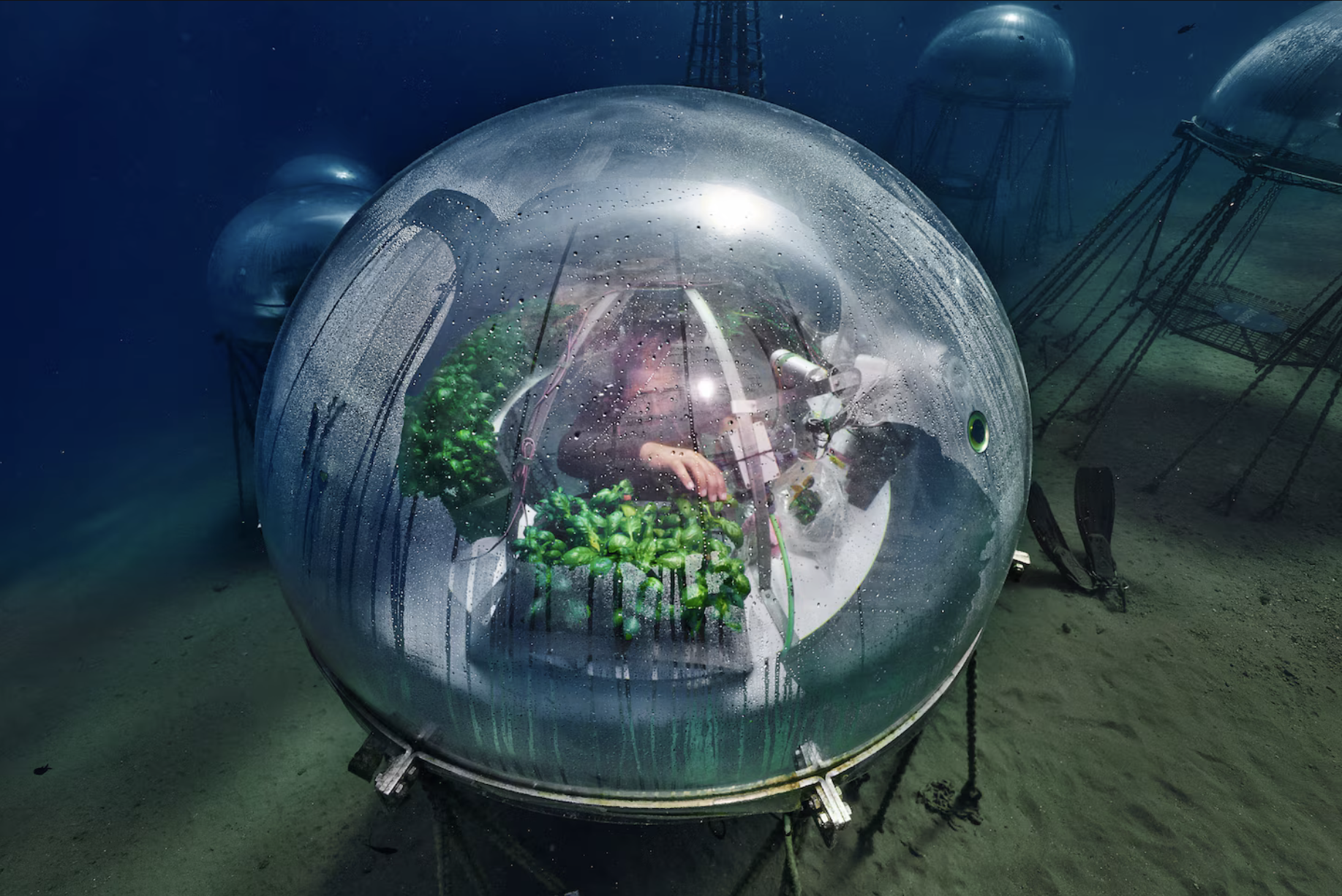
These underwater domes are filled with air, and are hard to anchor down, and will have significant differential air pressure to hold against.
But a mostly water filled situation may be easier. Macroalgae might be an option.
A Wet Version: 
So, this could utilize both photosynthesis and chemosynthesis with Acetate, Methane?, Hydrogen?
To some extent Macroalgae being domesticated could be a sort of Vegetables in the diet of people.
The risk of Hydrogen explosions may be low, as the air pocket on top is small, and we hope that the organisms within will consume the Hydrogen that leaks though the Hydrogen bag. But there could be some risk. But the volume of the explosion may be low.
The air pocket might also allow humans to work inside of the structure, but the gasses would need monitoring and perhaps robots would do as well.
This would be frost free agriculture, and with unusual circumstances so that normal pest species for the crop would be inhibited from damaging it.
Ending Pending
So, for instance you might switch to this kind of agriculture and allow the Aral Sea to fill back up with water.
https://en.wikipedia.org/wiki/Aral_Sea
You could put floating solar over the deeper parts and this agriculture in the shallower parts. Floating Solar may reduce evaporation, perhaps allowing the sea to expand even more.
Ending Pending
Last edited by Void (2026-02-08 10:41:10)
Is it possible that the root of political science claims is to produce white collar jobs for people who paid for an education and do not want a real job?
Offline
Like button can go here
#21 2026-02-09 23:01:04
- Void
- Member
- Registered: 2011-12-29
- Posts: 9,569
Re: Bogs and Bog, Floating Island Technology, and Roller Solar.
Suppose a sea in a dry land with it mostly covered. I have previously suggested rotating solar floating islands.
But for Mars and let's speculate 100% cover, maybe for the Salton Sea, a 98% covering. Perhaps just some beaches on the shoreline.
Evaporation 98% inhibited??? Not known. You could have rotators or not.
On Mars rotating floating islands would leave water open to boil or evaporate into the thin atmosphere. Even if the Atmosphere becomes 2.5 times as thick as it is it would be so. You could live with that if you had enough makeup water. But Mars would be more suitable to fixed robotic solar arrays. That is the gravity is .38 that of Earth, we don't expect hail, and the winds are not much of a threat. Dust is a problem in both worlds but much worse on Mars. We would expect to have cleaning robots to groom the solar arrays all the time, I expect.
On Mars we might have something like floating islands, only as spinning hovercraft. A hover platform could be sun following by periodic jets of air under its skirt and an actuation to spin to follow the sun. Simply compressing Mars atmosphere and a lift and spin event every so many minutes during the day. Such hover platforms would not have to be over water reservoirs but could be.
OK, then I think means to have a little sea will exist on both Mars and as similar we might look at the Salton Sea.
I have speculated before that if you covered 98% of the Salton Sea with floating platforms that inhibit evaporation, the Salton Sea would swell up and deepen until the salinity was compatible with some forms of salt tolerant creatures.
It always amused me that people may talk about putting artificial lights into a presumed sea on Europa, but will not think it wise for Mars or indeed for the Salton Sea.
But let's imagine 5% light. Then add Oxygen and Acetate. Now can you grow Macroalgae??? That is a maybe. But you could grow microalgae it seems.
Your 5% light could come though fiber optics or windows or artificial lights.
In post #18 I have a drawing: https://newmars.com/forums/viewtopic.ph … 07#p237907
Quote:
This is sort of where I am going with it:
So, in places like Ther Great Basin, you might reduce water losses to 10%/5%/1%, to be able to keep reservoirs inflated with water from local sources, or imported water.
In the top view there is a floating Solar Rotator. It can cool the solar panels with a heat pump during the sunshine, and push heat into the very briny water at the bottom of the pond (Pink).
The Static Cover, (Orange), has radiators that can reject heat into the night sky of a desert to generate power.
The side view has a (Green) top layer that can have pontoons of the least salty water, which support a Anaerobic process of H2/CO2.
The Blue Layer being perhaps less than two times as salty as the ocean, might support some forms of living things living on Oxygen/Acetate and perhaps a little artificial light.
The pink layer would be warm or hot, but less than the boiling point of water, probably.
In the future it will make much more sense to inflate these with local river water such as the Colorado River, then to do irrigation on Dry Land Farming.
You don't have to do all of it but you might.
The solar panels and the floating cover will reject some of the heat of the day.
But you could use heat pumps during the sunshine to maintain salt gradients and temperatures. You might cool the solar panels during the day with a cool fluid flow and push heat into the bottom pink layer.
During the night you might pull heat from the pink layer and flow it though the panels to reject heat and to generate electricity.
All the time you could grow Algae of some kind in the blue layer.
Or if you prefer, forget the heated bottom layer and just have temperate temperatures at the bottom of the Salton Sea, and grow Macroalgae, (If it is possible) as vegetables.
Salt is always accumulating in the Salton Sea, but if you allow the sea to keep expanding you can keep the level habitable.
But at some point perhaps you flow it to another basin in the Great Basin and keep expanding. Rather than irrigating crops with the Colorado River perhaps you just keep building more covered seas.
And of course, I consider this how we may first get productive farmland on Mars.
Ending Pending
Last edited by Void (2026-02-09 23:20:55)
Is it possible that the root of political science claims is to produce white collar jobs for people who paid for an education and do not want a real job?
Offline
Like button can go here
#22 2026-02-12 10:48:59
- Void
- Member
- Registered: 2011-12-29
- Posts: 9,569
Re: Bogs and Bog, Floating Island Technology, and Roller Solar.
So, I guess I will chase this around some more.
https://exclav.es/2023/08/24/sunshine-maps-revisited/
Image Quote: 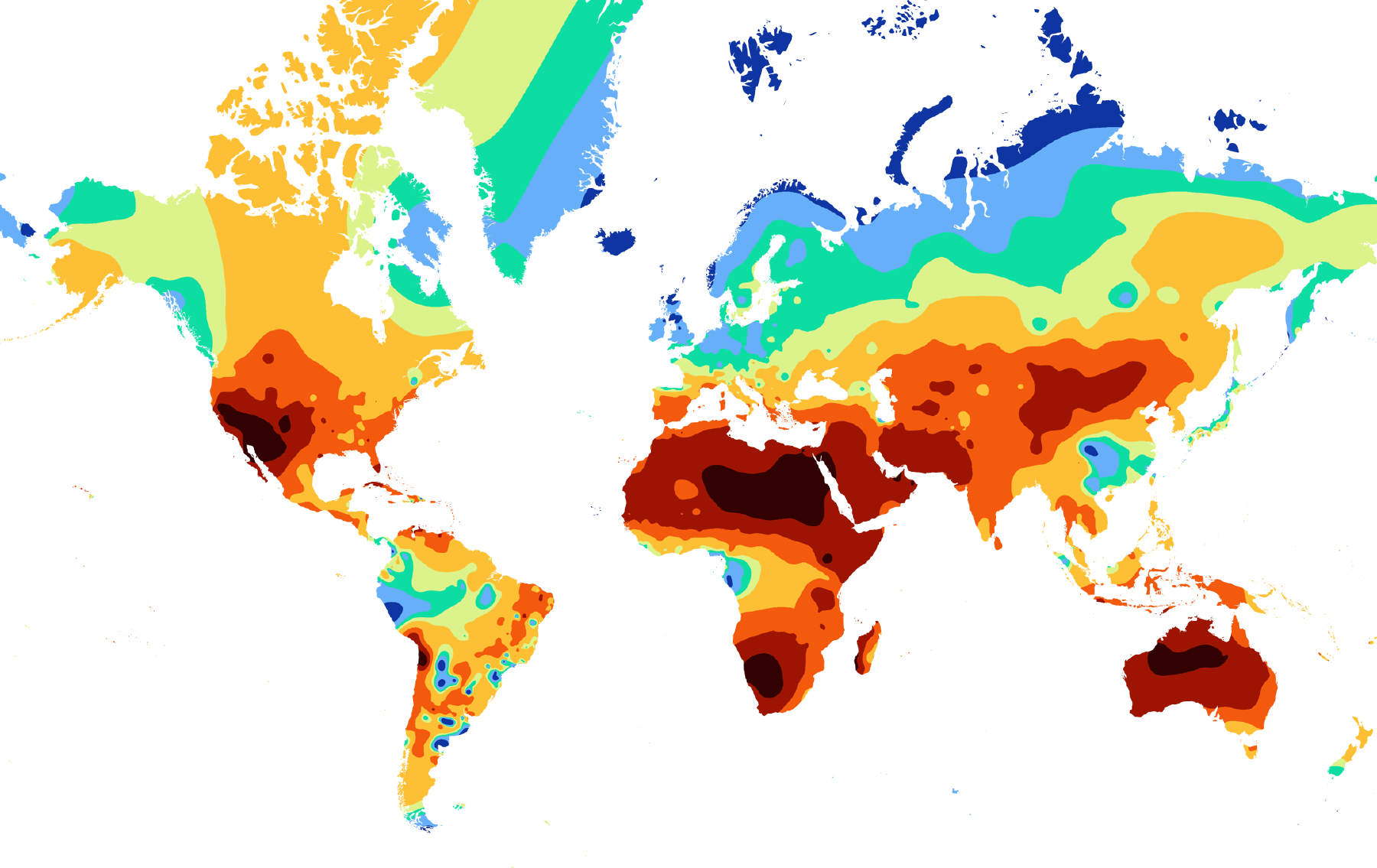
The three ways that power could be sent to the Earth's surface that I am aware of are:
-Orbital Mirrors.
-Microwaves.
-Lasers.
Typically, the idea is to beam power to where it is needed. This would often be to cloudy areas though, which in some cases would be counterproductive.
But places like the Great Basin in North America, might be thought of as a sort of window in the sky.
And of course if you have looked into this topic, you know that I am interested in Cisterns and Carbon Capture (At a profit), for places like the Great Basin.
Carbon Capture at best has been to do power to Gas or other fuels. At worst it is a hairshirt intended to make the population of western nations poorer.
If you have a cistern in the desert that is associated with productive Carbon Capture, then it may be sensible also to beam space power to it, as there is less in the nature of cloudy skies. It is more like a window with shades open.
This is the type of behaviors I would like to see more of: https://globalenergyprize.org/en/2025/0 … di-arabia/
Quote:
Cooling gel doubling the service life of solar panels was created in Saudi Arabia
12.06.2025 in News, Science and Technology
Saudi researchers have developed a novel cooling gel that enhances solar panel performance and extends their lifespan. This hydrogel, made from sodium polyacrylate and lithium chloride, absorbs moisture at night and cools the panels through evaporation during the day.
The technology improves solar panel efficiency by 12% and increases their service life by doubling.
2
It operates without the need for electricity or material replacements, making it a low-cost solution for solar energy.
2
Field tests in Saudi Arabia and the USA confirmed its effectiveness, with stable cooling and improved energy conversion efficiency.
2This innovative approach represents a significant advancement in solar energy technology, particularly in hot and humid climates.
They should be proud!
Now, what if you had these solar panels on top of a floating island, and pulled the evaporating moisture into a cold condenser?
I have made this variation on the covered pond: 
Instead of holding heat on the bottom hold cold.
So, perhaps not relying entirely on rainwater, but absorbing moisture into the gel at night. Then the gel cools the solar panels during the day, and if you capture the moisture coming off you can perhaps condense it into cold salt water.
In reality if you wanted to go extreme, the water at the bottom of the pond might be as cold as Don Juan Pond in Antarctica.
https://en.wikipedia.org/wiki/Don_Juan_Pond
Quote:
With a salinity level of 45.8%, Don Juan Pond is the saltiest of the Antarctic lakes.[1][2] This salinity causes significant freezing-point depression, allowing the pond to remain liquid even at temperatures as low as −50 °C (−58 °F).
Such very cold very salty water would suck almost all water from the air. But it would take a lot of energy to pull the temperatures down that far.
Water as salty as the Arctic Ocean and nearly as cold would be more sensible. With a layer of less salty warmer water on top, it would be well insulated.
And you could glow Algae or perhaps even Macroalgae in it.
I am thinking heat pumps of course. Presuming that batteries can store energy efficiently then you could run a heat pump at night and dump heat into the night sky, cooling the bottom water. In the drawing I have distinguished between solar panels and radiators.
The gel in the solar panels might absorb moisture from the night air and also be cooled at night, and then during the day could cool the solar panels, and release the moisture. The moisture might be collected then and condensed into the cold salty water, which might be presented to it in a condensing device.
I did say batteries for night power, but it might be that power might be beamed down at night. This might contradict the moisture gathering function, but maybe it could be on and off to cycle many times during a night.
Of the power might be beamed down nearby to the covered cistern.
The water is salty of course, but could be distilled to provide fresh water. But in that case the grey water would need to go back into the cistern.
So, the objective of capturing Carbon to build cistern structure might make sense, where substances like plastic and Carbon parts might be created from Carbon pulled from the atmosphere. During the process of condensing moisture into the cold salt water that cold salt water may absorb CO2 from the air.
Ending Pending
Last edited by Void (2026-02-12 11:38:51)
Is it possible that the root of political science claims is to produce white collar jobs for people who paid for an education and do not want a real job?
Offline
Like button can go here
#23 2026-02-25 12:20:07
- Void
- Member
- Registered: 2011-12-29
- Posts: 9,569
Re: Bogs and Bog, Floating Island Technology, and Roller Solar.
This material is a bit supportive of materials in this topic: https://www.msn.com/en-us/lifestyle/lif … r-AA1WO7dU
Quote:
Scientists make groundbreaking discovery about plants grown under solar panels: 'These things can work together'
Story by Sarah Winfrey • 3d •
2 min read
Solar panels not only provide shade, but also potentially increase the surface area of the "Surface".
I think that the situation could be improved even more.
https://globalenergyprize.org/en/2025/0 … di-arabia/
Quote:
Cooling gel doubling the service life of solar panels was created in Saudi Arabia
12.06.2025 in News, Science and Technology
Quote:
Hydrogel composite
Saudi Arabian gel to cool solar panels
The Saudi Arabian gel for cooling solar panels is a hydrogel composite that absorbs moisture overnight and provides evaporative cooling during daylight hours. This innovative technology, developed by researchers from King Abdullah University of Science and Technology (KAUST), consists of polyacrylic acid sodium salt (PAAS) and lithium chloride (LiCl) hydrogel composites applied to the rear side of solar modules. The material absorbs moisture from the air at night using LiCl, and then slowly releases it during the day to cool the panels through evaporation. This method does not require electricity or any replacements, making it a low-cost and efficient solution for extending the life of solar panels and improving their efficiency. The system has been tested in both laboratory and outdoor settings, demonstrating its effectiveness in reducing the temperature of photovoltaic panels and increasing their power output.
Ассоциация

The notion is to add to the already listed benefits.
-The gel absorbing moisture from the air at night,
-Gives it up to the air during the day.
-Using forced convection, the moist air is conducted through a pipe network that is also the supports for the solar panels.
-The ground being shaded and cool may condense the moisture into liquid water, which leaks out of the pipe in the soil to water plants.
I anticipate as others do that robots will lower the cost of hardware, perhaps justifying this method.
Didn't think of it before but the plants, seeking CO2 will give up moisture to the gel, the soil will as well.
Ending Pending
Last edited by Void (2026-02-25 13:00:00)
Is it possible that the root of political science claims is to produce white collar jobs for people who paid for an education and do not want a real job?
Offline
Like button can go here
#24 2026-02-26 11:08:56
- Void
- Member
- Registered: 2011-12-29
- Posts: 9,569
Re: Bogs and Bog, Floating Island Technology, and Roller Solar.
Having a further look at the previous post, perhaps I will have to change the title of this topic, but for now, I will not.
I have turned my eye further towards arid lands and grasslands. These will tend to have greater differentials of day/night temperatures, which on Earth like a future partially terraformed Mars may have value.
https://skybrary.aero/articles/cold-sem … limate-bsk
Image Quote: 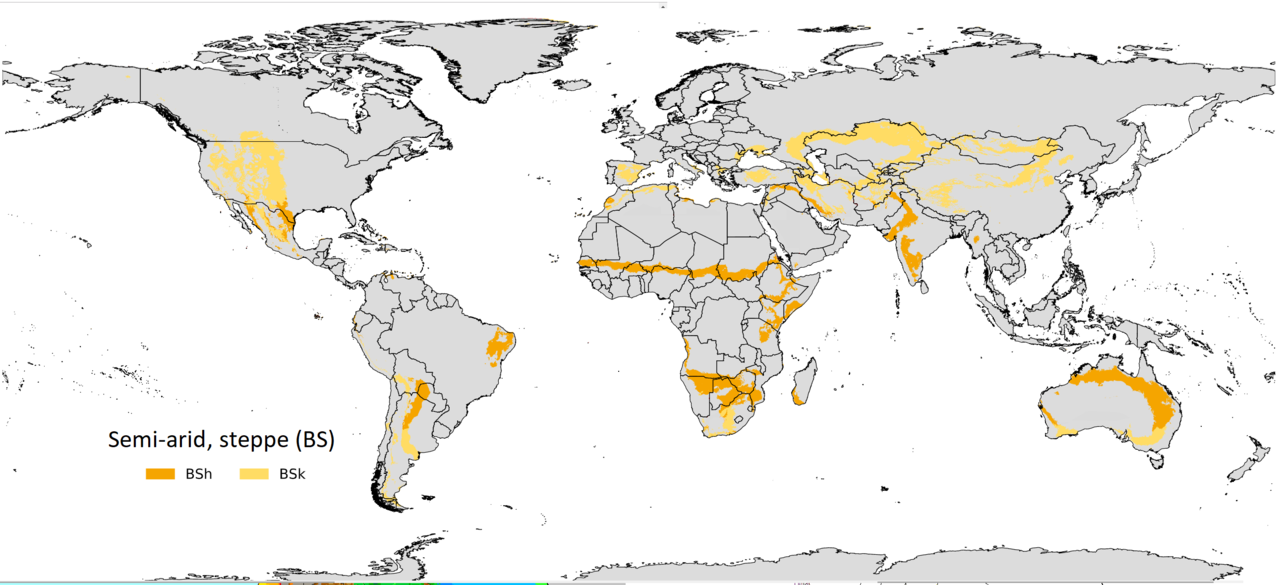
The map seems to indicate that North America has a large portion of land that is not quite desert, but may have some amount of useful moisture more than a desert.
This could be very useful, if an atmospheric condenser technology would become practical economically.
The climate is likely to have sunshine, and cold nights, and moisture to condense. Additionally winter cold can move through much of its continental climate.
These tend to be the regions of North America with lower populations, except for Canada, where you have to find your better hope of farming where you can.
So, as areas where solar energy may have advantages, atmospheric condensation may also be in association with that:
The notion is to add to the already listed benefits.
-The gel absorbing moisture from the air at night,
-Gives it up to the air during the day.
-Using forced convection, the moist air is conducted through a pipe network that is also the supports for the solar panels.
-The ground being shaded and cool may condense the moisture into liquid water, which leaks out of the pipe in the soil to water plants.I anticipate as others do that robots will lower the cost of hardware, perhaps justifying this method.
Didn't think of it before but the plants, seeking CO2 will give up moisture to the gel, the soil will as well.
Some prarie lands might also benefit from the method: https://slidetodoc.com/fire-ecology-of- … ms-ranged/
Some other maps are here: https://fity.club/lists/suggestions/Sem … imate-Map/
Image Quote: .png)
Using cold, moisture might be better managed.
The solar panels will experience the cold of night, and so with the gel may capture moisture.
The soil being shaded by the solar panels, and being cooled with night air, and winter air, may be a reservoir of cold.
If the moisture in the gel exits the gel to cool the solar panels, it might be conducted to the cold in the ground. And so become another sponge for moisture. During the night when the gel may be absorbing moisture from the air, the ground and vegetation growing on it may give up moisture from the ground that the gel may absorb.
By putting up solar panels, the surface area of the arid area is increased, but the amount of total sunlight is not increased. (Unless you send more from space).
More surface area means more cooling potential, and normally could mean more evaporation of exposed moisture, but the cooling gel may reduce net evaporation by capturing dew and near dew moisture from the air.
The cooling gel was apparently conceived of in Saudi Arabia: https://globalenergyprize.org/en/2025/0 … di-arabia/ Quote:
Cooling gel doubling the service life of solar panels was created in Saudi Arabia
12.06.2025 in News, Science and Technology
I expect that it increases efficiency as well by cooling the solar panels.
https://synthorum.com/articles/cooling- … fficiency/
Quote:
About 1,170 results
Innovative Cooling Methods for Solar Panel Efficiency
Yes, cooling solar panels can significantly increase their efficiency, with potential improvements in energy output ranging from 10% to over 20% depending on the cooling method used.
Impact of Temperature on Solar Panel Efficiency
As the temperature of solar panels rises, their efficiency typically declines. This is due to the thermal dynamics of photovoltaic cells, which can lead to reduced energy output when temperatures exceed optimal levels. Effective cooling strategies are essential to mitigate overheating and maintain higher efficiency levels.
synthorum.com
Cooling Methods and Their Benefits
Passive Cooling: This method relies on natural heat dissipation without additional energy input. Techniques include airflow management and shading, which can improve efficiency by about 10%.
1
Active Cooling: This involves using pumps and fluids to actively dissipate heat. Active cooling methods can increase solar panel efficiency by 15% to 20% or more, depending on the system and environmental conditions. For example, evaporative cooling can lower panel temperatures by 10–15°C, particularly effective in arid climates.
1
Advanced Techniques: Innovations such as phase change materials (PCMs) and heat pipes can enhance heat transfer and maintain uniform temperature distribution, further improving performance with minimal energy consumption.
1
Hybrid Systems: Combining different cooling methods, such as air and water cooling, can maximize efficiency gains, especially in large-scale solar installations.
11 Source
Conclusion
Implementing effective cooling strategies is crucial for optimizing solar panel performance. By maintaining lower operating temperatures, solar panels can produce more energy, thus enhancing their overall efficiency and longevity. As solar technology continues to evolve, integrating advanced cooling solutions will play a vital role in maximizing energy output and improving the sustainability of solar energy systems.
synthorum
So, I think that if piping could double as support frame for solar panels, this might be useful.
My hope is that with more advanced robotics, the cost of such pipe/frames will be deflated over time.
I intend to adapt this to solar collectors on water at a later time, as I need to move on with my day now.
Ending Pending
Last edited by Void (2026-02-26 11:45:19)
Is it possible that the root of political science claims is to produce white collar jobs for people who paid for an education and do not want a real job?
Offline
Like button can go here
#25 2026-02-27 08:07:44
- Void
- Member
- Registered: 2011-12-29
- Posts: 9,569
Re: Bogs and Bog, Floating Island Technology, and Roller Solar.
Well, I think this item from the Electric Viking might fit in to some version of what I have suggested in the previous two posts: https://www.bing.com/videos/riverview/r … &FORM=VIRE Quote:
Solar Waves: The Modular Solar System That Changes Everything
YouTube
The Electric Viking
2.4K views
10 hours ago
Perhaps it could be blended with what I have attempted to think about, and also perhaps also associated with an irrigation system:
Presumably if cleaning happened at night the gel on the rear side of the panel might absorb some of the evaporation from that process.
Another option in some locations would be to air cool the soil in the wintertime, using the buried piping. Winter air pushed through the pipe might allow to formation of a "Semi-Permafrost". But of course, in buried pipes you would have to avoid bursting pipes with expanding freezing water.
During the day, when there might be excess solar energy, you might run the convection fan to push cold winter air though the underground piping.
When spring would come then you might push humidified air from the solar panel gel into the pipes, again in such a pattern to avoid pipe damage.
Even if you had frozen the soil to some depth, over the winter, in Alaska, it is not uncommon to grow gardens on top of permafrost. It could complicate things though.
And of course finally you might involve your underground piping it a heat pump process somehow. I am just saying you might. By pulling heat out of the ground you might heat some buildings.
Heating buildings might cool the ground. IF you had a closed air circulation system then you might not lose moisture from the soil doing this. But when the time came to collect the moisture from the gel cooling the solar panels, you would then use more of an open-air flow.
Heating an industrial process using ground heat might be a more practical option.
OF course the more complex a system becomes the more expensive. But with more complex robots to make hardware, the costs of hardware might go down.
If you were cooling the soil with a heat pump method, then you would not have to push it to the freezing point.
And if you have irrigation water available, with a system like this you might get the best use of it.
The solar panel system explained by the Electric Viking apparently can collect rainwater as well.
Ending Pending
Last edited by Void (2026-02-27 08:37:25)
Is it possible that the root of political science claims is to produce white collar jobs for people who paid for an education and do not want a real job?
Offline
Like button can go here