New Mars Forums
You are not logged in.
- Topics: Active | Unanswered
Announcement
#51 2025-04-16 08:35:04
- Calliban
- Member
- From: Northern England, UK
- Registered: 2019-08-18
- Posts: 4,357
Re: Habitat Design on Mars
I'm back in the UK. I got back from Holland at about 1 o'clock this morning. I had a wonderful time and saw five different Dutch towns and cities.
I am still considering exactly what lessons future Martian urban designers might learn from Dutch urban architecture. But it occurs to me that a large part of urban design is a function of its local environment. Holland is a flat wetland, much of which is reclaimed from the sea. This made it relatively easy to dig canals, which could take sea freight directly into cities from the Zuider Zee and allow goods to be lifted directly off of barges into houses and warehouses. In the days before fossil fuel driven transportation, the position of Holland and its flat low lying nature were uniquely beneficial for trade. Amsterdam's urban architecture were a result of its position in a wetland environment on the edge of a saltwater lagoon (the Zuider Zee) that allowed easy access to the Baltic, the North Sea coasts and through the English channel, the Dutch could access the Mediterranean and the coast of Africa relatively easily. At the same time as being well positioned and ideal for water transport, Holland was protected from invasion by the swampy land to the south and east, which made it very difficult for an army to advance prior to the development of road infrastructure. This allowed the Netherlands to develop as a maritime trading empire, able to concentrate its military spending on naval capability. This gave them early global reach, which brought home a great deal of wealth.
A Martian city will exist in a very different environment. There are no seas or wetlands on Mars. There are not and will not be for a long time to come, any trading nations within easy reach on the Martian surface. What is more, any Martian settlement will need to be a pressure structure. This constrains how we will build Martian cities. One thing a Martian settlement does have in common with the Netherlands is that habitable land is something that must be created and maintained against natural forces. In Holland, that force is the sea, which threatens to flood the land and cities and is held back by soil dykes. On Mars, we must reliably maintain containment of atmosphere against vacuum. The sort of city architecture that this will drive is quite dissimilar to anything that we find in the Netherlands.
It will be desirable for cities to grow incrementally. Until terraforming is able to substantially increase Martian atmospheric pressure, it makes no sense at all building an entire city under a single environmental enclosure. This would require building the entire city at once. That is not a realistic prospect for a colony, as it requires enormous resources invested up front. More likely, a city will develop by adding small cells or districts, each protected by its own atmospheric containment structure. This allows both incremental growth and resiliance against accidental depressurisation.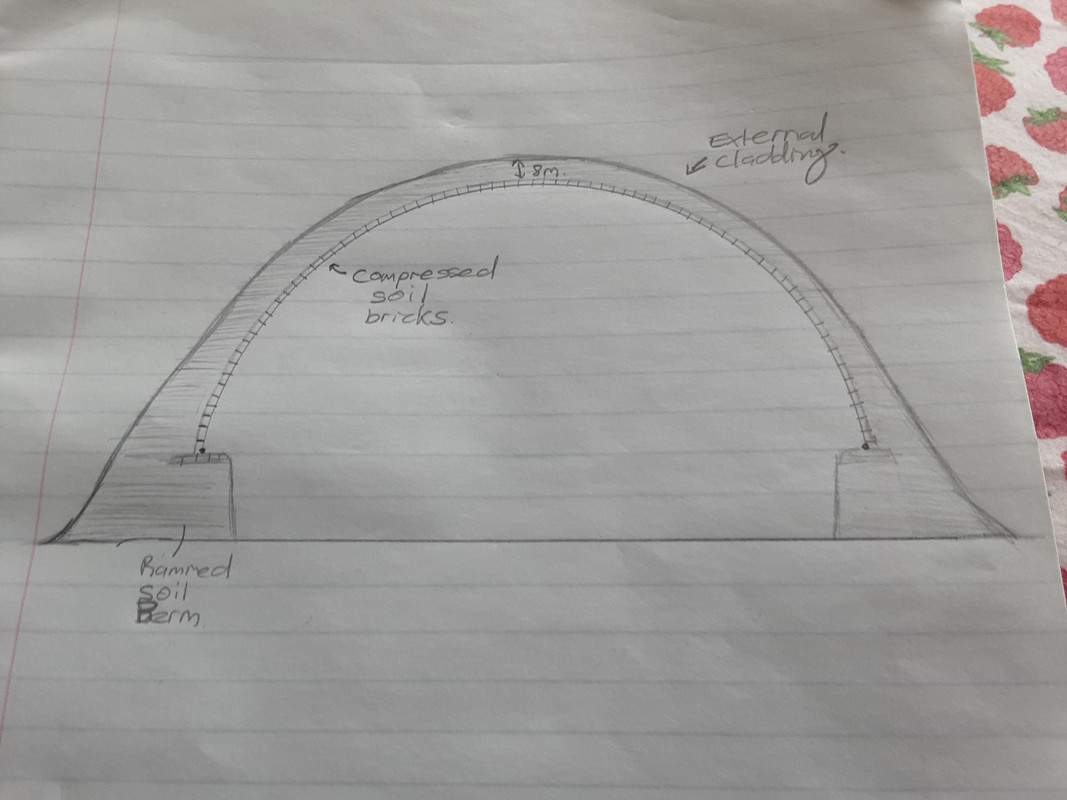
Each cell will contain a small village. We would want to accomodate urban expansion without interfering with the pressure structure of other cells around it. So the liklihood is that as we add additional districts to the city we would connect them to others by underground tunnels. This avoids the need to depressurise inhabitated parts of the city to add new ones. So Martian cities will grow as collections of villages rather than as a single expanding urban metropolis.
The soil dome shown above is the easiest way of building a pressurised enclosure on Mars using a minimal industrial base and essentially only lightly processed natural materials. Internal pressure is balanced by the weight of compressed, grade seperated overburden, which is provided by sieving a tampering down Martian regolith. We would build up the soil berm in layers as we assemble the brick dome. This is analogous to 3D printing, with robotic vehicles dropping graded regolith onto the structure and tamping it down. This provides an incrementally growing roadway that can be used to assemble the dome as the soil layer builds up to its edge.
To limit the length of tunnels, the cityscape would grow as a hexagonal lattice of soil domes, with a nextwork of tunnels connecting them.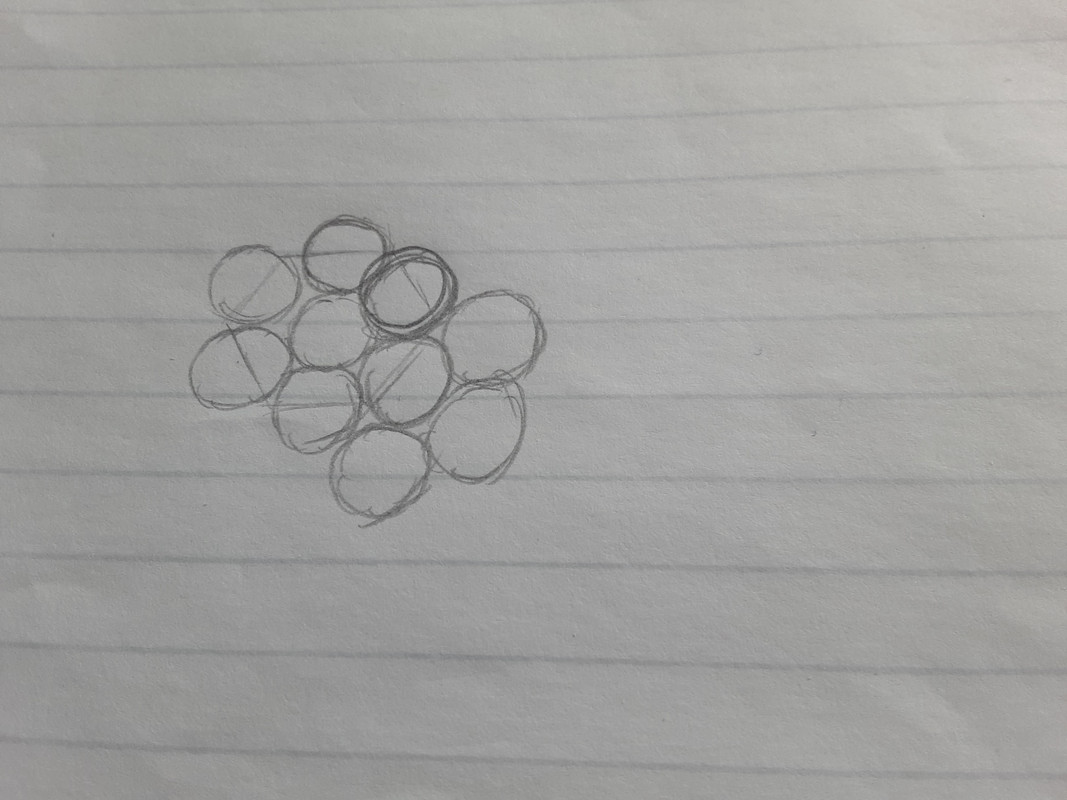
The interior design of each urban village will likely be dense, as there is a need to house the maximum number of people and economic functions to maximise the return on investment of building the pressure dome.
Last edited by Calliban (2025-04-16 08:51:36)
"Plan and prepare for every possibility, and you will never act. It is nobler to have courage as we stumble into half the things we fear than to analyse every possible obstacle and begin nothing. Great things are achieved by embracing great dangers."
Offline
Like button can go here
#52 2025-04-16 10:13:16
- Void
- Member
- Registered: 2011-12-29
- Posts: 9,786
Re: Habitat Design on Mars
I wanted to leave you alone during your vacation.
Thinking about bulk raw materials on Mars.
I would mention the enormous amount of clay that apparently is on Mars.
If brine from a well could be accessed, here is another interesting possibility: https://www.msn.com/en-us/money/other/s … r-AA1D0FE9 Quote:
Scientists debut innovative technology to transform seawater into next-gen building materials: 'We can fully control their properties'
Story by Leslie Sattler • 10h •
2 min read
And then there is sandstone, such as Mt. Sharp: https://en.wikipedia.org/wiki/Mount_Sharp
And things like Asphalt, Ice, Pykrete, and even water.
And then of course Lava Tubes.
So, bulk materials, some of which might be useful in your construction plans.
Ending Pending 
Last edited by Void (2025-04-16 10:19:28)
Be careful what you wish for.
Offline
Like button can go here
#53 2025-04-16 16:21:26
- Calliban
- Member
- From: Northern England, UK
- Registered: 2019-08-18
- Posts: 4,357
Re: Habitat Design on Mars
For the dome itself, I was thinking of this.
https://www.sciencealert.com/it-turns-o … n-concrete
If we can seperate fines from the bulk Martian regolith, then a hydraulic press can produce all of the bricks needed to build the inner dome. Bulk regolith can then be heaped into berms around the dome. This provides enough weight to balance internal pressure. The berm can be built up in layers, which are compacted by running heavy vehicles over them.
You mention asphalt. If we can produce (or find) heavy hydrocarbons on Mars, they would be useful for producing coatings. Painting the inner surface of a compressed soil brick dome will limit its moisture uptake. The bricks themselves can be bonded with a thin layer of sulphurcrete. This will be a mixture of liquid sulphur and Martian fines that are squirted onto brick surfaces using a glue gun. This bonds the brick coarses together during dome assembly.
After construction, the outer surface of the soil berm needs to the stabilised against erosion from Martian dust and winds. A layer of rocks could be used to do this. We could seperate regolith into different grades using sieves. The fines are used to make bricks in the hydrauoic press. Intermediate grades form the compacted berm built around the dome, that forms ballast against internal pressure. Coarse rocks are stacked in a layer covering the whole structure. In this way, the pressure enclosure can be built up using regolith, without any chemical or thermal processing. Only sorting an selective compression, with small amounts of sulphur used build the inner dome.
The inner city structures built beneath the dome will also be built from processed regolith and stone. Many buildings will be constructed from the same compressed regolith blocks that are used to build the dome. We could also use cut stone to build structures, using adobe mortar as the bonding agent. As these structures will never see rain, we can use unfired soil bricks to make most compressive structures. Cut rocks and tiles can also be used to make timbrel vaults for upper floors and roof structures. In this way, we can build entires cities on Mars using nothing more elaborate than the stone and dirt that we happen to find nearby.
Last edited by Calliban (2025-04-16 16:37:22)
"Plan and prepare for every possibility, and you will never act. It is nobler to have courage as we stumble into half the things we fear than to analyse every possible obstacle and begin nothing. Great things are achieved by embracing great dangers."
Offline
Like button can go here
#54 2025-04-16 16:49:02
- kbd512
- Administrator
- Registered: 2015-01-02
- Posts: 8,533
Re: Habitat Design on Mars
If the bricks are fired in a kiln, perhaps at a lower temperature if combined with Sulfur, will that increase their strength?
Offline
Like button can go here
#55 2025-04-17 07:05:19
- Calliban
- Member
- From: Northern England, UK
- Registered: 2019-08-18
- Posts: 4,357
Re: Habitat Design on Mars
If the bricks are fired in a kiln, perhaps at a lower temperature if combined with Sulfur, will that increase their strength?
Yes. Firing in a neutral atmosphere is a form of sintering, where grain boundaries fuse together. Interestingly, if the bricks are fired in a CO atmosphere, the Fe2O3 within the clay will partially reduce forming Fe3O4 and even longer iron oxide chains. This creates an extremely hard and strong brick. Foundation bricks are typically made in this way and they have a characteristic blue colour due to the iron(II) oxide they contain.
The strength of sintered bricks is relatively impervious to moisture, as the grain boundaries are fused. However, green bricks are easier and less energy intensive to make. We are using them as a sort of liner to prevent tne compacted regolith berm from crumbling inwards. Baked bricks are always better and stronger and more moisture resistant. But those advantages come at a cost. The firing temperature for clay bricks is approximately 1000 - 1100°C. We could potentially use concentrated solar to provide that heat. It is just more infrastructure and cost.
Last edited by Calliban (2025-04-17 07:10:45)
"Plan and prepare for every possibility, and you will never act. It is nobler to have courage as we stumble into half the things we fear than to analyse every possible obstacle and begin nothing. Great things are achieved by embracing great dangers."
Offline
Like button can go here
#56 2025-04-17 16:19:18
- Calliban
- Member
- From: Northern England, UK
- Registered: 2019-08-18
- Posts: 4,357
Re: Habitat Design on Mars
Early urban architecture on Mars will likely focus on construction of individual buildings, with their own gravity pressure boundaries. This achieves the maximum possible utilisation of internal volume. These will likely be hemispherical brick dome structures, as a hemisphere offers the most volume per unit surface area. The brick domes will be covered in compacted soil, providing enough downward pressure to counterbalance internal atmospheric pressure. The soil will also provide thermal insulation and radiation shielding.
In terms of the size of early habitat buildings, we can make comparisons with long duration sea vessels here on Earth. The Astute Class nuclear submarines carry up to 109 crew. The pressure vessel is a cylinder about 90m long and about 10m in diameter, with hemispherical end caps at both ends. Internal volume is about 6800m3, or 62.4m3 per crew member. Only a fraction of that is hotel space. Much is taken up by the reactor compartment, weapons stowage and machinery spaces. Let's assume that our early habitats provide 60m3 of volume per person, including accomodation and workspace. A habitat housing 1000 people will need 60,000m3 of internal volume. That is a hemisphere some 30.6m in radius, or 61.2m in diameter.
This is a construction that we could realistically produce on Mars. To provide a 0.5bar internal pressure, we must cover the dome with 77,400 tonnes of regolith, or about 40,000m3. That is 10 acres of ground excavated to a depth of 1m.
The internal structure of the building can be made using stone, tile, soil cement and adobe bricks. The article below describes a sustainable urban dwelling unit built in Ethiopia, entirely from ceramic materials.
https://www.notechmagazine.com/2011/12/ … -sudu.html
This is probably how we will build on Mars. We can build functional and comfortable buildings from the regolith and stone that exist on the surface. Bricks do not need to be fired, but will be stronger if they are.
Last edited by Calliban (2025-04-17 16:48:38)
"Plan and prepare for every possibility, and you will never act. It is nobler to have courage as we stumble into half the things we fear than to analyse every possible obstacle and begin nothing. Great things are achieved by embracing great dangers."
Offline
Like button can go here
#57 2025-06-16 02:53:42
- Calliban
- Member
- From: Northern England, UK
- Registered: 2019-08-18
- Posts: 4,357
Re: Habitat Design on Mars
Are cities bad for mental health?
https://youtu.be/Rb6KlJbLW1M
Population density appears to correlate negatively with mental health. As a minimum, I think we can design our cities to be much better for living in. Carfree or low car environments allow streets to become more habitable spaces. In Holland, there was substantially less car traffic than in the UK. People tended to walk and bike a lot more. Cities are set up as pedestrian spaces because most of them are pre-industrial.
Bikes bring problems of their own. They are silent and it is easy not to see them coming when stepping out into a road. In Amsterdam, my wife and I came across a man who had been knocked down by a bike. He had a serious head injury.
The quality of architecture definitely helps as well. Artistically beautiful places are always better environments to be in. The UK is full of drab, mass produced and ugly buildings. Endless sprawling housing estates, that are neither urban nor rural. A seemingly endless nowhere that people dream of escaping from.
Last edited by Calliban (2025-06-16 03:03:23)
"Plan and prepare for every possibility, and you will never act. It is nobler to have courage as we stumble into half the things we fear than to analyse every possible obstacle and begin nothing. Great things are achieved by embracing great dangers."
Offline
Like button can go here
#58 2025-09-19 06:07:44
- Calliban
- Member
- From: Northern England, UK
- Registered: 2019-08-18
- Posts: 4,357
Re: Habitat Design on Mars
Another excellent video from Dami Lee.
https://youtu.be/8GbHWY0roOY
This one examines Lord of the Rings architecture. Both hobbits and dwarves live in underground structures, but there is a vast difference between them. The hobbits build small, individual underground borrows, which conserve heat and protect them from the weather outside. The dwarves carved out entire mountains, building great underground cities with great halls and art deco architecture. They specifically wanted to leave an eternal mark upon the Earth.
Future Martians, will build both kinds of structure. This will be a civilisation built underground.
"Plan and prepare for every possibility, and you will never act. It is nobler to have courage as we stumble into half the things we fear than to analyse every possible obstacle and begin nothing. Great things are achieved by embracing great dangers."
Offline
Like button can go here
#59 2025-12-29 11:55:10
- SpaceNut
- Administrator
- From: New Hampshire
- Registered: 2004-07-22
- Posts: 30,832
Offline
Like button can go here
#60 2026-01-04 09:10:09
- SpaceNut
- Administrator
- From: New Hampshire
- Registered: 2004-07-22
- Posts: 30,832
Re: Habitat Design on Mars
Constructing a pressurized, human-habitable in-situ brick dome on Mars within a one-year timeframe is currently not feasible with existing technology and knowledge. The timeline is too aggressive given the numerous technological, logistical, and environmental challenges. Most current research focuses on long-term, autonomous construction over many years prior to human arrival.
Feasibility and Challenges
The one-year timeframe for a human-habitable, pressurized dome built from in-situ (on-site) Martian bricks is impractical due to the following factors:
Lack of Established Technology: While scientists have successfully created "space bricks" using Martian soil simulants and bacteria or sulfur-based concrete in labs on Earth, these methods are still experimental. The technology needs extensive testing in a Martian Atmosphere Simulator and in the actual Martian environment to verify its viability.
Environmental Extremes: Mars features extremely low atmospheric pressure (making human survival without a spacesuit impossible), high radiation levels, extreme temperatures, and pervasive fine dust that requires significant shielding and robust life support systems. A habitat must be a double-layered pressure vessel to handle the pressure difference and protect from radiation, a complex engineering feat.
Logistical and Autonomy Requirements: Construction would need to be performed autonomously by robots before human arrival, as the construction process itself can be affected by the harsh conditions and is too dangerous for humans without a finished habitat. Developing and deploying these advanced robotic systems is a multi-year effort.
Resource Processing Time: Acquiring and processing sufficient quantities of Martian regolith into usable, load-bearing bricks for a large, human-habitable dome would take substantial time, likely exceeding one year, even with advanced machinery.
Testing and Verification: A finished habitat would require extensive automated testing of its structural integrity, life support systems (air and water recycling, thermal control), and radiation shielding before any humans could safely inhabit it.
Conceptual Long-Term Approach (Not within one year)
A viable plan, spanning several years, would involve:
Phase 1: Pre-cursor Missions (Years 1-3+): Send robotic missions to the chosen site to prospect for resources (e.g., water ice, specific regolith compositions), deploy power systems, and set up autonomous construction machinery.
Phase 2: Autonomous Construction (Years 4-6+): Utilize autonomous 3D-printing systems, potentially using methods like laser sintering of regolith or sulfur-based concrete, to construct the dome structure and an external radiation-shielding layer (e.g., a thick layer of regolith).
Phase 3: Systems Installation and Testing (Year 7+): Install and rigorously test life support, power, communication, and environmental control systems, potentially using a year-long analog simulation with a crew on Earth.
Phase 4: Human Arrival and Occupation (Year 8+): Crew arrives and begins occupation of the verified, safe habitat.Current State of Technology
Automated Construction: Research and development are underway for robotic 3D printing systems designed to use local planetary resources (regolith). The current technology involves high-powered lasers or polymer binders to fuse regolith into strong structures, but these systems are still experimental and require further testing in Earth-based analog environments before being deployed to Mars.In-Situ Resource Utilization (ISRU): ISRU is a critical concept for Mars missions, but current efforts are focused on simpler tasks like extracting oxygen from the atmosphere (e.g., the MOXIE experiment). Utilizing resources for large-scale construction is a much more complex challenge, with many knowledge gaps regarding resource location, extraction, and processing methods.
Pressurization and Habitability: The Martian atmosphere is extremely thin, primarily carbon dioxide, and without a strong magnetic field to protect it from solar winds, any engineered atmosphere would require continuous maintenance. The primary challenge for any habitat is maintaining a seal and stable internal pressure in the harsh external environment, which requires advanced materials and construction integrity that have not yet been demonstrated in an in-situ Mars context.
Deployment and Testing Timelines: Developing and deploying such advanced construction equipment would take many years, separate from the actual construction time. An actual human mission would likely be "forward supplied" with equipment sent years in advance to ensure it is operational before a crew arrives.
Key Challenges for a One-Year Timeline
Technology Readiness Level (TRL): The technologies needed for fully autonomous, large-scale, and reliable construction on Mars are not yet at the required TRL for a one-year deployment and construction cycle.
Environmental Extremes: Equipment must be able to operate in the abrasive Martian dust, extreme cold, and low-pressure environment, which poses significant engineering hurdles.Energy Requirements: Sintering regolith into a durable, ceramic-like material requires a significant amount of energy, which would need a substantial and reliable power source, such as a nuclear reactor, that would need to be deployed first.
Structural Integrity and Sealing: Ensuring the in-situ constructed dome can be reliably pressurized to a human-habitable level without leaks is a major challenge that requires extensive testing and validation.
In summary, current efforts are focused on small-scale experiments and Earth-based simulations. Building a permanent, pressurized, human-habitable dome on Mars using only local materials remains a goal for future decades, not the immediate future
Content is no longer required as projects for the people desire robots. so why are we going?
Offline
Like button can go here