New Mars Forums
You are not logged in.
- Topics: Active | Unanswered
Announcement
#1251 Re: Science, Technology, and Astronomy » Vacuum plus Water Gravity plus Air Compression Energy Storage » 2024-09-18 16:37:30
The storage is not a number but a variable that is determined based on the tank volumes, water amount, internal and external capability for pressure and vacuum as Caliban has already indicated due to implosion and explosion of the tanks and piping due to those levels.
So, you must decide on the level of work that must be produced to determine those values in the above statement. You must determine the power levels for the pump and generator in order to size all other aspects of a design storage and use.
One can make the storage the size of a walnut under extreme pressures or vacuum, or you can have a mountain size unit will be minimal of those.
The original numbers have already been given and they produce very little energy.
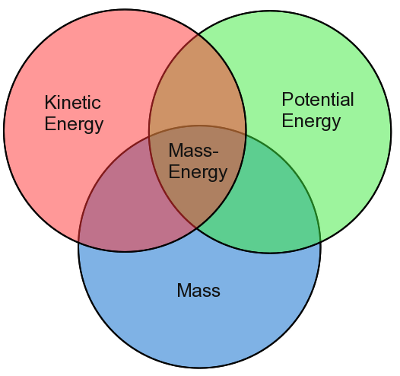
You must also include Gravity Energy Storage as they are part of the energy system by default.
We are still talking about the most efficient form of storage and conversion rate for Electricity, Work, and Power
Summary of Force, Work and Power
Force = Energy applied to an object(Measured in Newtons).
Work = Force X Distance, or the amount of heat transferred (Measured in Joules or calories).
Power = Work/Time (Measured in Watts)
Various Energy Units
1 calorie (thermochemical) = 4.184 J
1 Btu = 251.9958 calories
1 Btu (thermochemical) = 1054.35 J
1 kilowatt-hour (kWh) = 3.6 x 10⁶ J
1 kilowatt-hour (kWh) = 3412 Btu (IT)
1 therm = 100,000 Btu
1 electron-volt = 1.6022 x 10⁻¹⁹ J
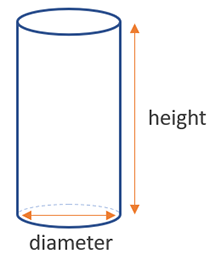
https://www.wikihow.com/Calculate-the-V … a-Cylinder
https://www.gigacalculator.com/calculat … ulator.php
https://en.wikipedia.org/wiki/Working_fluid
generator type for the working fluid determines inlet rate from the volume
This is also where we get into how much power wattage can I get for how long of a duration before refilling the volume.
Pressure control is achieved in hydraulic systems by metering the flow of a fluid into or out of a constrained volume to create force such as a jack for an automobile.
https://www.hi-force.com/en-uk/blog-det … te-a-force
https://www.hydraulicspneumatics.com/te … c-pressure
A pump adds energy to oil in any of the three ways, as described by Bernoulli’s equation:
Hydraulics pneumatics Com Sites Hydraulics pneumatics com Files Dec mc Eq1
where P is the pressure,
ρ is the density,
v is the velocity,
g is the acceleration due to gravity, and
h is the elevation.
More equations on the page
https://www.machinerylubrication.com/Re … re-vs-flow

Of course, this is moving the fluid to make pressure from the reservoir to the location to be moved.
Sensing functions that are computer controller-ed used to produce a response for more or less power seems to be good to have.
While I am thinking about gravity and water as the mass that we can make use of.
https://www.micro-hydro-power.com/water-turbines.htm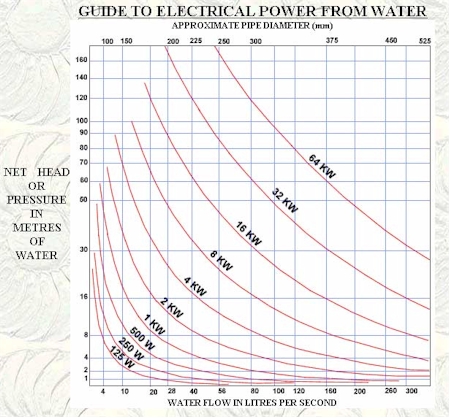
Power (watts) = Head (m) x Flow (litres/sec) x 9.81 (gravitational constant ‘g’) A typical water to wire efficiency is around 70%, so you should multiply the result by 0.7 to get the actual amount of electricity that you can expect from the site.
https://www.builditsolar.com/Projects/H … fRiver.htm
Power = (1/2)(Turbine Efficiency) (Water Density) (Turbine Flow Area) (Water Velocity)^3
Normally the mass is what will cause the turbine to move so knowing the amount and time is a flow rate.
Rotation is required and that is torque for the turbine.
Of course, when you need RPM's we are looking at that flow rate as it relates to the torque values.
https://www.studysmarter.us/explanation … al-motion/
https://en.wikipedia.org/wiki/Torque
Power in rotational systems (torque and frequency of a rotation)-527.png)
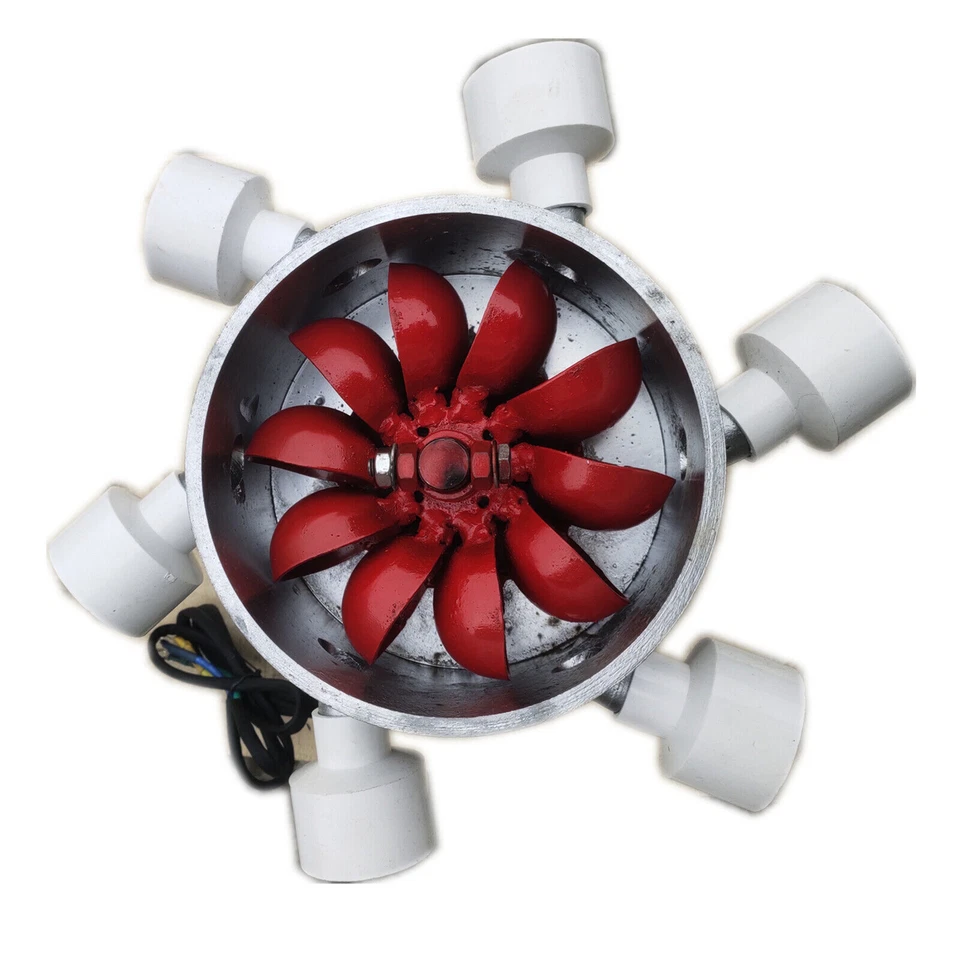
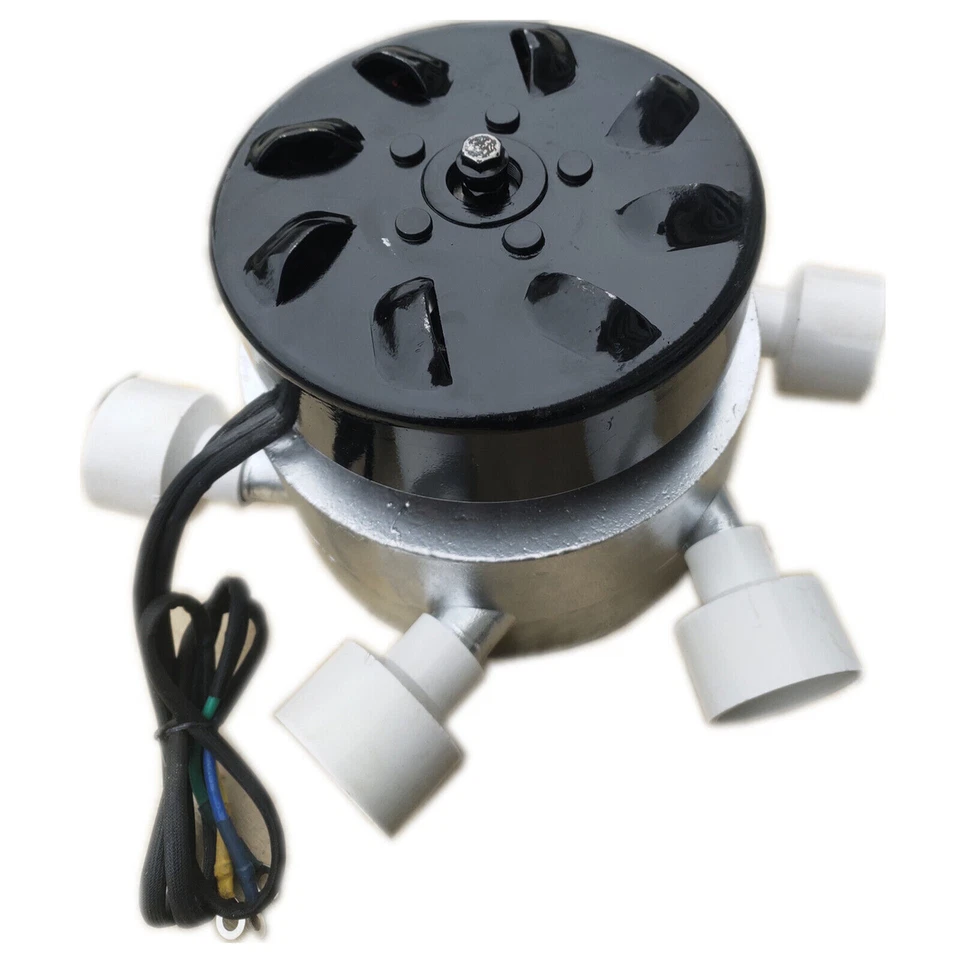
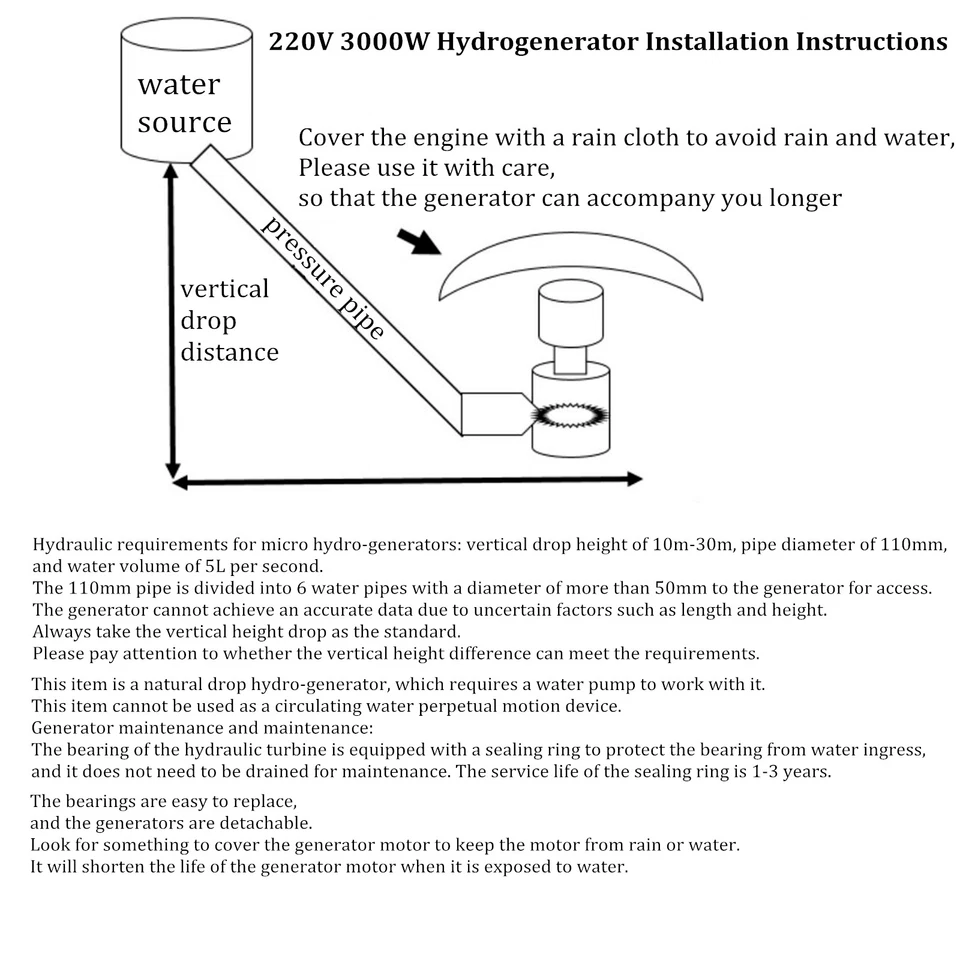
power generation from the top to the bottom means we want to make 2 -3 times what we would use. So I am looking at the 3kw turbine as it would cost less than $400 on ebay turbine
.
#1252 Re: Science, Technology, and Astronomy » Vacuum plus Water Gravity plus Air Compression Energy Storage » 2024-09-17 18:16:06
Store of pressure or is defendant on size of chamber and period that measurement is done.
https://nooutage.com/hydroele.htm
https://attradev.ncat.org/wp-content/up … design.pdf
So off grid water power creators use an old washing machine motor rewound to producr 600 w at 24 v like this unit
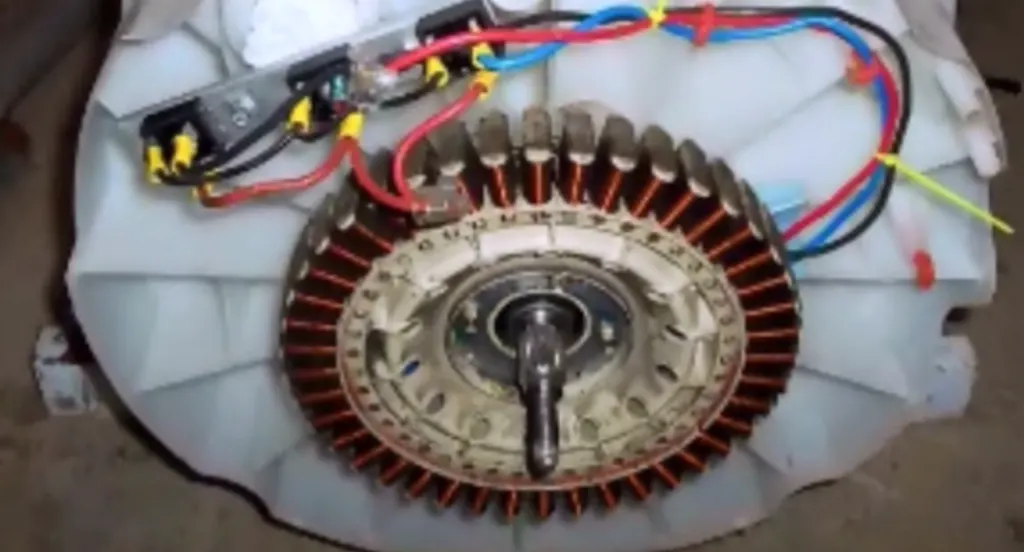
the magnetic disk that goes over the coils is not shown.
#1253 Re: Science, Technology, and Astronomy » Vacuum plus Water Gravity plus Air Compression Energy Storage » 2024-09-15 17:55:57
In artesian well control design, a one-line jet pump or equivalent is used to move water from the non-pressurized water storage tank which is the bottom tank into a water pressure tank which is what we have with the top tank. It has a typical 20-40 or 30-50 psi trip point to turn on and off the jet pump that is in the well. Of course, that is an open loop system as we are closing the loop by creating energy with the released water that will travel down to the lower tank through a generator unit. While in a well we have 1 Atm above the well it's the column of water that build pressure to aid the pumping unit.
#1254 Re: Home improvements » Solar Installation in McGregor, Texas August 2024 Start » 2024-09-15 14:35:00
Thats why storage batteries that are part of the power wall that KBD512 matter as excess since when you you want energy that is saved for later.
The frequency of 60 hz is looked at we are in the audio range and that makes the grid unit that GW has a part of an amplifier where the amplitude controls whether you are pushing energy into the grid.
#1255 Re: Science, Technology, and Astronomy » Vacuum plus Water Gravity plus Air Compression Energy Storage » 2024-09-15 14:27:06
Starting with a tank that is empty will have in the space 1 Atm no matter how large the tank is. So, let's just fill a random size tank with 1 meter of water and only choose the height as the fixed dimension that matters. If we start at 2m tall and fill just 1-meter, the air pressure will rise to 2 Atm that the air occupies.
Now let's run the same experiment with a 3-meter-tall tank we have a result of 1.5 atm per meter that the air will occupy.
Ok we fill a 2-meter tank and vent the air we have zero pressure. But if we lower the level with 1 meter with the tank closed, we will have a -1 Atm in the void that is created after pumping it out. So now just assume that the tank is 3-meter tall and filled and we lower the level to just 1 meter then the void of 2 meters will have a -2 Atm.
#1256 Re: Home improvements » Solar Installation in McGregor, Texas August 2024 Start » 2024-09-15 09:34:30
Thinking about when the storms take out the grid and the solar could produce power but is not due to missing AC sync field one could open the line and connect a sine wave invertor to that and while disconnected from the grid the home would be powered. Once can use a car battery and connected solar panels to the battery to charge it. without knowing the size of the AC field sync line, one might think that a 100-w unit would be capable of making the needed sinewave for the grid connected unit for home use while the sun is out. Since your design has no battery backup to it.
#1257 Re: Home improvements » Home Solar System to Achieve Energy Usage Offset » 2024-09-15 09:30:01
Innovative company introduces new technology that automatically shelters solar panels: 'Stow early and stow often' as TerraTrak. It can protect the panels from one of the most damaging natural weather occurrences: hail.
Terrasmart's panels already feature PeakYield, a cloud-based tracker control and monitoring software, which allows the panels to move with the sun and avoid clouds to maximize their energy output.
Now, with the TerraTrak feature, the panels will be alerted when a storm is coming and move themselves to a 50- or 60-degree angle to protect themselves from hail or wind damage. The system is fully autonomous, meaning the panels will move without any human prompting, as Electrek detailed.
#1258 Re: Science, Technology, and Astronomy » Vacuum plus Water Gravity plus Air Compression Energy Storage » 2024-09-14 18:18:45
update
1) water is 1,000 kg/m3 for water which is 1 metric ton.
2) power theoretically available (W) = 0 water flow as its not moving but if you use 1 m3/s rather than a 0
then it will be 9.81 m/s2 * 1 m3/s * 1,000 kg/m3 * 10 m = 98,000 w or 98 Kw/sec.
3) a vacuum is at the top means that water will not flow until the pump turns on to push the water out, for that energy is not present until a power source is used.
4) a vacuum at the bottom means that it will pull all of the tank until full / once air pressure in the top expands and drops as the water flows out. Which allows the turbine to turn and create power as long as the water is flowing. Power will drop as the water pressure drops as the top tank is emptied.
To get answers on the pump size and power we will need to convert units for the equations
https://www.engineeringtoolbox.com/unit … html#Power
We will need pipe diameters and a turbine generator to finish up a design.
so a minute means 98kw/s / 60 sec = 1,633 w/min and for the hour / 60 once more gets 27 w/hr which is quite tiny due to the quick flow rate. when we are looking for power in kilowatt we will need
Example - Energy in Elevated Water Volume
10 m3 volume of water is elevated 10 m above the turbine. The potential energy in the water volume can be calculated asW = (1000 kg/m3) (10 m3) (9.81 m/s2) (10 m)
= 981000 J (Ws)
= 981 kJ (kWs)
= 0.27 kWh
Due to 10 times more water to flow...
#1259 Re: Science, Technology, and Astronomy » Vacuum plus Water Gravity plus Air Compression Energy Storage » 2024-09-14 14:13:27
Pressure is the compression as the water flows from the pumping of it to the top tank.
Just like vacuum is created from the pumping action but only if the flow from the top tank is stopped.
Otherwise, the pumping unchecked is aided by less resistance to water flow.
#1260 Re: Science, Technology, and Astronomy » Vacuum plus Water Gravity plus Air Compression Energy Storage » 2024-09-14 14:08:13
Potential energy of the upper tank is mass x gravity and pressure
Energy created by the turbine as water flows to the lower tank is flow rate
Energy to be used via the homeowner kwhr
Energy used by the pump movement of water kwhr
#1261 Re: Science, Technology, and Astronomy » Vacuum plus Water Gravity plus Air Compression Energy Storage » 2024-09-14 13:44:52
The tank at the top will have Compressed gas energy storage. as a result of pumping the water from the lowest tank to the top if the amount of water is greater than that of the volume in the bottom tank as the pressure will force the water back downward to the lower tank unless it's restricted until a max level of pressure is achieve. The shutting off of the water flowing only creates a minor vacuum in that tank as a result of the pumping of it.
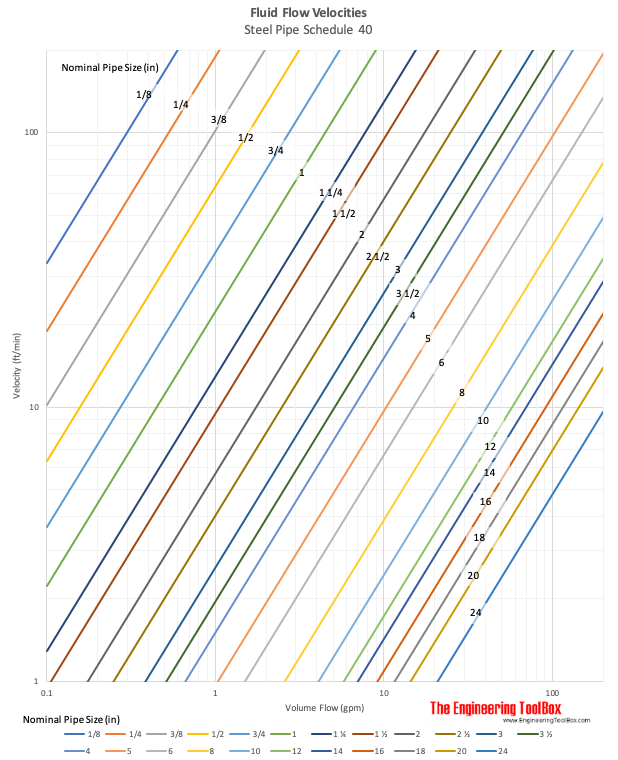
The restriction of fluid flowing other than the turbine and valve is the size of the piping that is used which is contained in this topic Power Distribution by pipelines on Mars and others.
Water Flow based on Pipe Size Inside and Outside Diameters
#1262 Re: Science, Technology, and Astronomy » Vacuum plus Water Gravity plus Air Compression Energy Storage » 2024-09-14 07:46:04
water falling gives a level of generation as well
https://www.engineeringtoolbox.com/hydr … _1359.html
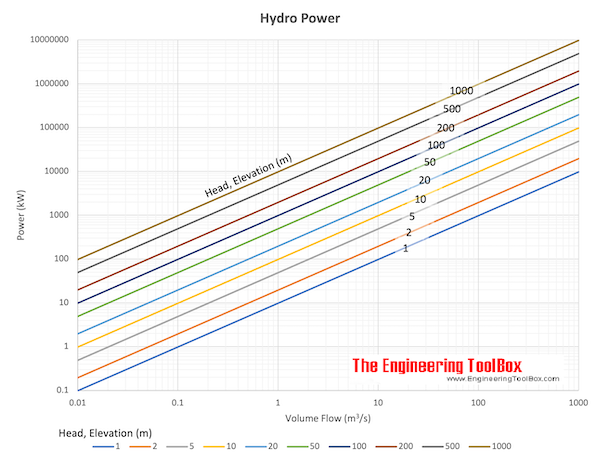
So we have both equations for up and down.
So the down equation - energy surplus must be still greater than the level required to pump it back up to the top tank.
The theoretically power available from falling water can be expressed as
Pth = ρ q g h
where
Pth = power theoretically available (W)
ρ = density (kg/m3) (~ 1000 kg/m3 for water)
q = water flow (m3/s)
g = acceleration of gravity (9.81 m/s2)
h = falling height, head (m)
#1263 Re: Science, Technology, and Astronomy » CAES Compressed Air Energy Storage » 2024-09-14 07:31:06
Thats like the issue for gasoline engines as we only convert 25% of that potential energy due to equilibrium being 50%. So far only the solar thermal conversion is higher.
The energy equivalent of a gallon of gasoline is approximately 33.7 kWh or 1.213x10^8 joules. A gallon of gasoline contains the equivalent of 36 kWhs of electrical energy. Alternatively, a gallon of gasoline is equivalent in energy terms to 4 kilowatt hours
#1264 Re: Science, Technology, and Astronomy » Oxygen bottleneck and fire ignition » 2024-09-13 17:20:16
related to earths oxygen What's the highest place on Earth that humans live?
Worldwide, more than 80 million people live at least 8,202 feet (2,500 meters) above sea level, mainly in South America, Central Asia and East Africa.
Some of the highest permanent settlements include Wenquan in China's Qinghai province, at a staggering 15,980 feet (4,870 m) above sea level, and Korzok in India, around 15,000 feet (4,572 m) above sea level.
However, one place towers above them all. Nestled in the Peruvian Andes is a town that is nicknamed "Devil's Paradise." Officially named La Rinconada, its 50,000 inhabitants live between 16,404 feet (5,000 m) and 17,388 feet (5,300 m) above sea level, making it the highest permanent settlement on Earth.
Like on Mars nothing will be easy.
#1265 Re: Life on Mars » Covergent evolution Mars-Earth » 2024-09-13 17:16:29
All Life on Earth Comes From One Single Ancestor. And It's So Much Older Than We Thought.
A new study suggests that this organism likely lived on Earth only 400 million years after its formation.
The paper reads:
“The common ancestry of all extant cellular life is evidenced by the universal genetic code, machinery for protein synthesis, shared chirality of the almost-universal set of 20 amino acids and use of ATP as a common energy currency. As such, our understanding of LUCA impacts our understanding of the early evolution of life on Earth. Was LUCA a simple or complex organism? What kind of environment did it inhabit and when?”
“The evolutionary history of genes is complicated by their exchange between lineages,” University of Bristol’s Edmund Moody, the lead author of the study, said in a press statement. “We have to use complex evolutionary models to reconcile the evolutionary history of genes with the genealogy of species.”
Not satisfied with just learning its age, the team took things a step further and retraced the physiological characteristics of living species to understand what LUCA must’ve been like 4.2 billion years ago—and the results gave some surprising answers. The scientists estimate that while LUCA was a simple prokaryote, it likely had an immune system, meaning it was already fighting off primordial viruses.
#1266 Re: Human missions » Boeing Starliner OFT-2 » 2024-09-13 16:52:20
#1267 Re: Human missions » Starship is Go... » 2024-09-13 16:46:59
SpaceX’s next Starship flight delayed by months
SpaceX says it’s been ready to launch the mighty Starship rocket on its fifth test flight since early August, and had been expecting the Federal Aviation Administration (FAA) to give it the green light for the flight to take place in mid-September. But it’s now emerged that the FAA is unlikely to grant a launch license until late November at the earliest.
This delay was not based on a new safety concern, but instead driven by superfluous environmental analysis.”
#1268 Re: Not So Free Chat » Fixing Americas car industry » 2024-09-13 16:45:17
#1269 Re: Human missions » NASA's Asteroid redirect/retrieval mission; should it be cancelled? » 2024-09-13 16:42:48
Earth’s New Visitor: Asteroid to Become Temporary Mini-moon for Two Months
Starting on September 29, 2024, Earth will briefly have a second "moon" as a small asteroid, 2024 PT5, gets captured by our planet's gravity. This mini-moon will stick around for nearly two months before continuing its journey through space.
#1270 Re: Human missions » Starship is Go... » 2024-09-12 17:47:20
#1271 Re: Human missions » SpaceX announces Polaris Dawn Missions » 2024-09-12 17:43:27
Polaris Dawn spacewalk: Is the US breaking a 50-year-old space law? violates Article VI of the Outer Space Treaty
commandeered spacewalks. Elon Musk’s SpaceX has new suits and big goals, and it wants to test them as fast as possible. It is now the only private company that delivers humans to live and work in space, and NASA, the space agency of the United States, relies on it.
Polaris Dawn is not a NASA mission, and it is not regulated by the US government. So when its astronauts exit their capsule and ‘walk’ in space, it will mark a massive first for the private industry that is starting to dominate realms beyond Earth.
And this raises a question: Is the US breaking a promise it made 50 years ago about how to operate in space?
#1272 Re: Life support systems » Spacesuit Compatibility Requirement » 2024-09-12 17:40:30
Stranded NASA Astronauts Are Ditching Boeing Spacesuits For SpaceX Gear: Here's Why
There are significant differences between the Boeing CST-100 Starliner and the SpaceX Dragon, so the Starliner IVA spacesuit and the SpaceX IVA spacesuit are wildly different as well.
For a start, the Boeing CST-100 Starliner lands on solid ground using three parachutes and airbags. The SpaceX Dragon, on the other hand, lands under four main parachutes in the ocean, using two drogue parachutes to slow its descent. The Boeing CST-100 Starliner has a diameter of 15 feet and a length of 16.5 feet. The SpaceX Dragon, meanwhile, is 26.7 feet long and 13 feet wide. As NASA explained in a statement to USA Today, "suits for different providers are not designed to be compatible outside of their own spacecraft, as each suit design must match its respective system."
According to program manager for NASA's Commercial Crew Program Steve Stich, it has always been NASA's goal to "have two dissimilar systems." That is because having an alternative system is key in the event of a failure, like the one we witnessed with the Starliner.
#1273 Re: Human missions » Boeing Starliner OFT-2 » 2024-09-11 19:39:17
It appears that more thrusters did not function and that the ship had some communication issues but landed on target despite these issues.
#1274 Re: Human missions » Starship is Go... » 2024-09-11 19:38:16
looking like November for Musk to complete the paperwork to take care of the issues for the FAA.
#1275 Re: Science, Technology, and Astronomy » Vacuum plus Water Gravity plus Air Compression Energy Storage » 2024-09-11 19:35:36
Part of the equations are Horsepower required to pump water.
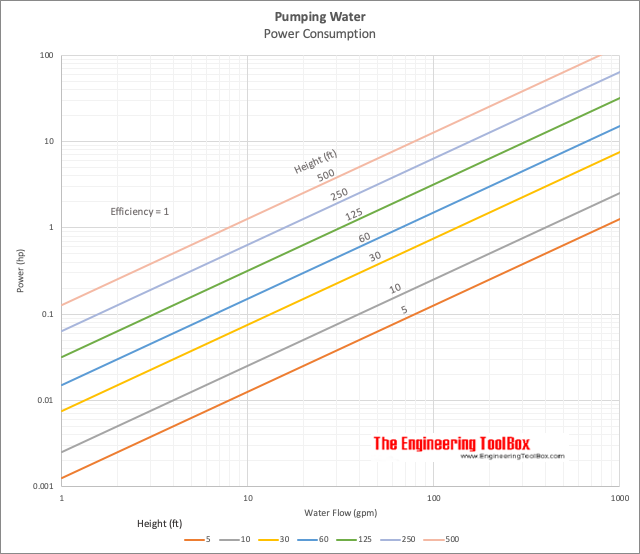
That said we need to know that the power created is greater than that to which we see and still have energy from creation that is excess due to the vacuum and gravity.
Pumping Water - Required Horsepower
Horsepower required to pump water.Energy imparted to water by the pump is called water horsepower - and can be calculated as
Pwhp = q h SG / (3960 μ)
where
Pwhp = water horsepower (hp)
q = flow (gal/min)
h = head (ft)
SG = 1 for water Specific Gravity
μ = pump efficiency (decimal value)
Horsepower can also be calculated as:
Pwhp = q dp / (1715 μ)
where
Pwhp = water horsepower (hp)
dp = delivered pressure (psi)