New Mars Forums
You are not logged in.
- Topics: Active | Unanswered
Announcement
#851 Re: Exploration to Settlement Creation » Companion for Mars Expedition Number One; 17 crew members » 2025-11-27 17:22:18
How to make metals from Martian dirt
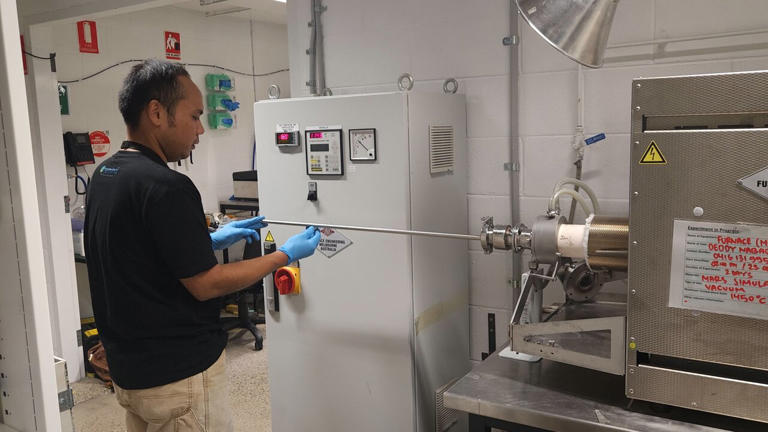
The idea of building settlements on Mars is a popular goal of billionaires, space agencies and interplanetary enthusiasts.
But construction demands materials, and we can't ship it all from Earth: it cost US$243 million just to send NASA's one ton Perseverance Rover to the Red Planet.Unless we're building a settlement for ants, we'll need much, much more stuff. So how do we get it there?
CSIRO Postdoctoral Fellow and Swinburne alum Dr. Deddy Nababan has been pondering this question for years. His answer lies in the Martian dirt, known as regolith.
Building an off-world foundry
As it turns out, Mars has all the ingredients needed to make native metals. This includes iron-rich oxides in regolith and carbon from its thin atmosphere, which act as a reducing agent.Swinburne University of Technology astrometallurgist, Professor Akbar Rhamdhani, is working with Dr. Nababan to test this process with regolith simulant—an artificial recreation of the stuff found on Mars. The work was published in two papers in the journal Acta Astronautica.
https://linkinghub.elsevier.com/retriev … 6525002814
https://www.sciencedirect.com/science/a … via%3Dihub
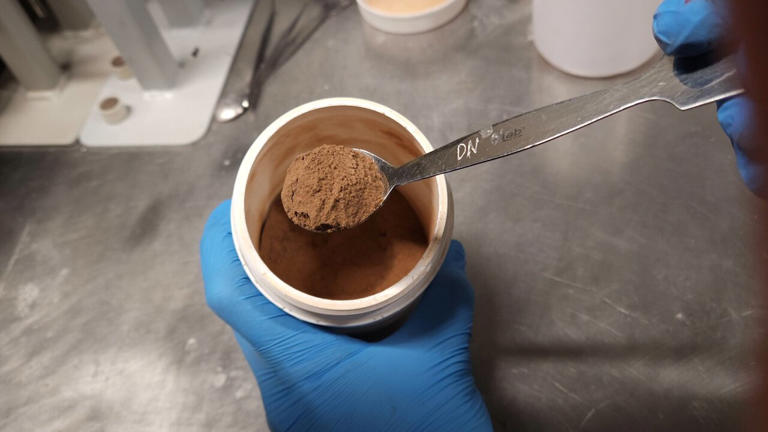
"We picked a simulant with very similar properties to that found at Gale Crater on Mars and processed them on Earth with simulated Mars conditions to give us a good idea of how the process would perform off-world," he said.
The simulant is placed inside a chamber at Mars surface pressure and heated at increasing temperatures. The experiments showed pure iron metal formation around 1,000°C, with liquid iron-silicon alloys produced around 1400°C.
"At high enough temperatures, all of the metals coalesced into one large droplet. This could then be separated from liquid slag the same way it is on Earth," Professor Rhamdhani said.
Along with Dr. Nababan, Prof Rhamdhani is collaborating with CSIRO's Dr. Mark Pownceby to further advance the process. They're particularly focused on making metals with zero waste, where the byproducts of the process are used to make useful items.
If you can't ship it, make it
ISRU is a growing area of space science because in rocket launches, every kilogram counts. While the cost of launches is going down, the demands of human exploration are immense.But huge developments are already happening, including the first demonstration of ISRU off-world: The MOXIE experiment onboard the Mars Perseverance rover produced breathable oxygen using only the carbon dioxide in the planet's atmosphere.
Metal production is the next giant leap. Professor Rhamdhani hopes Mars-made alloys could be used as shells for housing or research facilities, and in machinery for excavation.
"There are certainly challenges. We need to better understand how these alloys would perform over time, and of course whether this process can be recreated on the real Martian surface," he said.
But in the meantime, Swinburne and its partners are doubling down. Professor Rhamdhani together with Dr. Matt Shaw and Dr. Deddy Nababan from CSIRO recently delivered a four-day joint Swinburne-CSIRO bespoke workshop on astrometallurgy in South Korea, and the feedback was promising.
"We're starting to see increased interest in this field globally as the world gets serious about Mars exploration," he said.
"To make it happen, we're going to need experts from many fields—mining, engineering, geology, and much more."
For Dr. Nababan, the benefits go beyond exploration. He hopes their research will also drive more efficient metallurgy on Earth.
"By doing this, I wish that I can help the development of space exploration, and at the end it will bring good to human life here on Earth."
#852 Re: Exploration to Settlement Creation » Companion for Mars Expedition Number One; 17 crew members » 2025-11-27 16:55:28
Digging the material downward while it would allow for building on bedrock still means a huge amount of work to bring it out depending on how deep it gets. It would be simular to the open pit mines earth has.
To move 10 cubic meters of Mars regolith, you would need a tandem axle dump truck or a medium-to-large single-axle dump truck. A standard commercial tandem axle dump truck typically holds between 7.6 to 10.7 cubic meters (10 to 14 cubic yards) of material, making it a suitable option for exactly 10 cubic meters.
Dump Truck Options for 10 Cubic Meters
Medium Dump Truck (Single Axle):
These can hold a load volume of 3 to 6 cubic meters, so you would likely need two trips, or a very large single-axle model near its upper limit.Tandem Axle Dump Truck:
This is the most efficient option, as its typical capacity of 7.6 to 10.7 cubic meters can handle the entire volume in a single load. Some models can even handle up to 13 to 20 cubic meters.
Large Dump Truck (Tri-Axle/Super Dump): These trucks have capacities ranging from 13 to over 25 cubic meters, which would easily manage the load, though the truck might not be operating at full volumetric capacity.
Important ConsiderationsWeight vs. Volume:
The weight of the regolith (Martian soil) is a critical factor, even more so than volume. The density of material matters in determining the actual safe load capacity to avoid overloading the truck's weight limits.Martian Gravity:
The user's prompt specifies "Mars regolith," which implies an off-world scenario. The lower gravity on Mars (roughly 38% of Earth's gravity) would significantly alter the weight constraints and potentially allow a standard Earth-rated dump truck to carry a larger mass of material than it could on Earth, assuming the engineering for the martian environment is addressed.Equipment Specialization:
For actual off-world operations, the equipment would be specifically designed for the Martian environment, likely featuring wider cutting heads or different axle configurations to handle the unique terrain and gravity conditions.
How Many Cubic Yards Are in a Dump Truck?

Larger dump trucks can carry approximately 10 to 16 cubic yards of material. However, the total volume is not usually the limiting factor. In most cases, the vehicle’s weight limit will determine how much material you are ultimately able to safely transport.
So a dump truck that we could use is
A tri-axle dump truck typically weighs between 25,000 and 35,000 pounds when empty, but can weigh up to 80,000 pounds when fully loaded, depending on the load and local regulations. The specific weight varies based on the materials used to construct the truck (e.g., aluminum bodies are lighter than steel), the size and type of the dump body, and the weight of the fuel and driver
#853 Re: Meta New Mars » Housekeeping » 2025-11-27 15:25:23
Those systems can be part of the strip out of the systems that can be backups in the cargo ships, since making the ships all the same reduces cost to build them. But those systems are all talked about in the large ships folder and in Life support folder in details. The cost is mass being shipped via starship cargo mass which is still affloat for a hard number.
#854 Re: Exploration to Settlement Creation » WIKI Project construction design meaning for insitu materials » 2025-11-27 09:50:16
10 m wide spiral that has end retaining wall hieght of 1 meter around that parabolic dome.
Structure Description
[]Dome: A [size=15]parabolic dome[/size] that is 200 m in diameter and 120 m tall.
[]Road: A 10 m wide road wraps around the dome.Spiral: A 1 m high spiral encircles the road/dome structure.
Assuming the user wants to calculate the total length of the 10-meter wide spiral road around the parabolic dome, here is the solution. The "1 meter high spiral" is assumed to be the pitch of the spiral (vertical distance per full revolution), and the road is assumed to follow the surface of the parabolic dome.
Step 1: Define the Parabolic Dome Equation The parabolic dome has a diameter of \(200\) m (radius \(R=100\) m) and a height \(H=120\) m. The equation for the height \(h\) as a function of the radius \(r\) is:\(h=H-ar^{2}\)Using the base dimensions (\(h=0\) when \(r=R=100\) m):\(0=120-a(100^{2})\implies a=\frac{120}{10000}=0.012\)The equation of the dome is \(h=120-0.012r^{2}\). The radius can be expressed in terms of height:\(r=\sqrt{\frac{120-h}{0.012}}\)
Step 2: Formulate the Arc Length Integral The road is a spiral with a pitch \(P=1\) m. The total length \(L\) of a spiral can be found using the arc length formula for a 3D curve in cylindrical coordinates:\(L=\int _{0}^{H}\sqrt{\left(\frac{dr}{dh}\right)^{2}+r^{2}\left(\frac{d\theta }{dh}\right)^{2}+1}\,dh\)The angular change \(\frac{d\theta }{dh}\) is constant, where \(2\pi \) radians corresponds to the pitch \(P\):\(\frac{d\theta }{dh}=\frac{2\pi }{P}=\frac{2\pi }{1}=2\pi \text{\ rad/m}\)Differentiating \(r(h)\) with respect to \(h\):\(\frac{dr}{dh}=\frac{1}{2\sqrt{\frac{120-h}{0.012}}}\cdot \left(\frac{-1}{0.012}\right)=-\frac{1}{2\sqrt{0.012(120-h)}}\)The integral becomes:\(L=\int _{0}^{120}\sqrt{\left(-\frac{1}{2\sqrt{0.012(120-h)}}\right)^{2}+\left(\sqrt{\frac{120-h}{0.012}}\right)^{2}(2\pi )^{2}+1}\,dh\)\(L=\int _{0}^{120}\sqrt{\frac{1}{4(0.012)(120-h)}+\frac{120-h}{0.012}\cdot 4\pi ^{2}+1}\,dh\)
Step 3: Calculate the Integral This integral is complex. After evaluation, the approximate length of the spiral is:\(L\approx 4768.8\text{\ m}\)The road width of 10 m is used for context but does not affect the centerline length calculation.
Answer: The calculated total length of the spiral road with a 1 meter pitch around the parabolic dome is approximately 4768.8 meters (or about 4.77 km).
The dome will need a lead up ramp that can grow as we approach the overlap area after going around to achieve each loop height change of 1 M. The dome also has not ground level entrances that would most likely be arched and 10 M wide as an air lock for equipment to go in and out of the city in at least 2 or more locations.
Digging the material downward while it would allow for building on bedrock still means a huge amount of work to bring it out depending on how deep it gets. It would be simular to the open pit mines earth has.
To move 10 cubic meters of Mars regolith, you would need a tandem axle dump truck or a medium-to-large single-axle dump truck. A standard commercial tandem axle dump truck typically holds between 7.6 to 10.7 cubic meters (10 to 14 cubic yards) of material, making it a suitable option for exactly 10 cubic meters.
Dump Truck Options for 10 Cubic Meters
Medium Dump Truck (Single Axle):
These can hold a load volume of 3 to 6 cubic meters, so you would likely need two trips, or a very large single-axle model near its upper limit.Tandem Axle Dump Truck:
This is the most efficient option, as its typical capacity of 7.6 to 10.7 cubic meters can handle the entire volume in a single load. Some models can even handle up to 13 to 20 cubic meters.
Large Dump Truck (Tri-Axle/Super Dump): These trucks have capacities ranging from 13 to over 25 cubic meters, which would easily manage the load, though the truck might not be operating at full volumetric capacity.
Important ConsiderationsWeight vs. Volume:
The weight of the regolith (Martian soil) is a critical factor, even more so than volume. The density of material matters in determining the actual safe load capacity to avoid overloading the truck's weight limits.Martian Gravity:
The user's prompt specifies "Mars regolith," which implies an off-world scenario. The lower gravity on Mars (roughly 38% of Earth's gravity) would significantly alter the weight constraints and potentially allow a standard Earth-rated dump truck to carry a larger mass of material than it could on Earth, assuming the engineering for the martian environment is addressed.Equipment Specialization:
For actual off-world operations, the equipment would be specifically designed for the Martian environment, likely featuring wider cutting heads or different axle configurations to handle the unique terrain and gravity conditions.
How Many Cubic Yards Are in a Dump Truck?
Larger dump trucks can carry approximately 10 to 16 cubic yards of material. However, the total volume is not usually the limiting factor. In most cases, the vehicle’s weight limit will determine how much material you are ultimately able to safely transport.
So a dump truck that we could use is
A tri-axle dump truck typically weighs between 25,000 and 35,000 pounds when empty, but can weigh up to 80,000 pounds when fully loaded, depending on the load and local regulations. The specific weight varies based on the materials used to construct the truck (e.g., aluminum bodies are lighter than steel), the size and type of the dump body, and the weight of the fuel and driver
Digging a cylinder or depth depends on how deep it will go.
To calculate the volume of a cylinder in cubic meters with only the diameter provided, we must assume a value for the height (h) of the cylinder, as it is a required parameter. Assuming the height is equal to the diameter (200 m), the volume can be calculated.
BBCode Output
Assumed Parameters:
Diameter (d) = 200 m
Radius (r) = d / 2 = 100 m
Assumed Height (h) = 200 m
Formula:
The volume (V) of a cylinder is calculated using the formula V = πr²h.
Calculation:
V = π × (100 m)² × 200 m
V = π × 10,000 m² × 200 m
V = 2,000,000π m³
V ≈ 6,283,185.3 cubic meters (using π ≈ 3.14159265)
Result:
The volume of a cylinder with a 200 m diameter and an assumed 200 m height is approximately 6,283,185.3 m³ (cubic meters).
Of course we can practice the spiral ramp in reverse for digging the material...

#855 Re: Civilization and Culture » Holidays » 2025-11-27 09:41:43
To be thankfull for my remaining family which still needs my support is about it for today. Meal will be a quick minimal cook activity for the family, store bought fully cooked Turkey with instant potatoe, vegitables and the fixing.
Certified mail was not delivered on first attempt but that is expected.
#856 Re: Exploration to Settlement Creation » A City Rises on the Plain... » 2025-11-27 09:38:00
A mat or raft foundation is a large, single slab that supports the entire building's walls and columns. It's a good choice when soil pressure is low or building loads are heavy because it spreads the total weight of the structure over a large area, similar to how individual footings distribute weight under a wall.
How a mat foundation works
Combines footings:
Instead of separate footings for each wall and column, a mat foundation acts as one large, combined footing.Distributes load:
It provides a large, stable base that spreads the entire building's load over a wide area, preventing excessive pressure on any one spot in the soil.Ideal for certain conditions:
A mat foundation can be the most economical solution when dealing with weak soil or heavy loads, as it avoids the need for extensive deep-foundation systems like piles or caissons.
Mat foundation vs. other typesStem wall:
A stem wall foundation has a slab poured on top of a perimeter footing and stem wall. It is used to transfer the load of the exterior walls to the soil, but it can be subject to movement during frost conditions if not designed properly.Individual footing:
An individual footing is a separate, smaller concrete pad beneath each column or wall. This is common in ordinary buildings, but for heavy loads, the individual footings can be very large and numerous, making a mat foundation more efficiency.
Related topic might contain informations such as a starship landing pad, concrete landing and more for building on mars.
Anchoring a structure is only to form the end seal of walls that are constructed on this base component of a building. Which will include brick internal walls collumn support for roof, floor or cielings. These may use arch support strucutres within to aid in that stress loading of the above radiation obsorbing materials.
#857 Re: Exploration to Settlement Creation » No bake Mars bricks » 2025-11-26 14:26:32
To answer in a way. Inside the structure we need floors and that means we need a support system internal to the outer stucture.
That means load bearing parts for the walls and floor interconnects.
Brick floor support for Mars domes would likely involve a reinforced, in-situ foundation, possibly built using a combination of the dome's bricks and a traditional anchoring system. As on Earth, the dome would require a solid base to distribute the load, but on Mars, it would also need to anchor the dome against the outward force of the internal pressure. Support structures could also include 3D-printed, load-bearing columns or walls built from Martian regolith, and the dome's tension members could continue below ground to form a basement or sub-basement.
Support structure components
Anchoring foundation:
On Mars, a pressurized dome exerts an outward "tension" force that must be anchored to prevent it from tearing itself out of the ground.
The foundation would need to be engineered to counteract this tension, likely using a combination of 3D printing and traditional masonry techniques.
Tension members from the dome could extend below ground to create a sub-basement or foundation to help hold the structure down.In-situ material use:
Local Martian soil (regolith) could be used to create bricks, concrete, or other building materials for the foundation.NASA's "astrocrete" method uses regolith and a binding agent from human waste to create a strong, locally sourced material.
Ice from Mars' polar regions could also be used as a binding agent or for creating ice bricks for a foundation.
Load-bearing structures: In addition to the foundation, the floor itself might be supported by columns, walls, or a combination of both, which could be created using 3D printing.
3D-printed concrete and other materials can be used to create load-bearing beams and columns comparable in strength to traditional materials.Underground extension:
Integrating the dome with an underground structure could provide several benefits.Stability:
The sub-basement structure provides extra support to prevent the dome from "pulling" out of the ground due to internal pressure.Radiation shielding:
Burying parts of the habitat provides a natural shield against radiation.Examples of proposed support structures
Basement:
The sub-basement could be a structural extension of the dome, continuing the tension members below ground to form a complete hemispherical structure.3D printed columns/walls:
3D-printed elements could be used for the floor support, potentially integrated with the dome's tension members to create a strong and cohesive structure.Ice and regolith:
A combination of ice and regolith, possibly forming bricks, could be used to create a strong, cold-resistant foundation that can be assembled relatively quickly
#858 Re: Exploration to Settlement Creation » WIKI Project construction design meaning for insitu materials » 2025-11-26 14:05:37
You can get a rough internal volume but once the structures are placed inside and you start to divi it up that volume will be less.
approximate 2,261,946 cubic meters.
Early structures should account for crew number count and equipment to do the initial toe and foot hold of settlement.
#859 Re: Exploration to Settlement Creation » A City Rises on the Plain... » 2025-11-26 14:03:54
You can get a rough internal volume but once the structures areplaced inside and you start to divi it up that volume will be less.
approximate 2,261,946 cubic meters.
The construction shack as you put it is the expermenting stage for materials, equipment, mining for the correct ingrideinces to make the brick and more for the first time on Mars as it adds to the volume of a starships capability.
All things on earth require some sort of foundation to tie in the above structure as well. We will not be on a dirt floor so more practice will be reqired.
#860 Re: Exploration to Settlement Creation » No bake Mars bricks » 2025-11-26 13:58:51
There is also other shapes that structures can take on Mars not just domes of any type.
Mesopotamian brick buildings were made primarily from sun-dried mud bricks due to a lack of stone, with common structures including simple houses, monumental ziggurats, and city walls. The mud bricks were affordable, sustainable, and could be made quickly, while fired bricks were a more durable, elite material used for major structures like palaces and glazed gates.
Common building materials
Mud brick:
The most common building material, made from local clay, straw, and water. It was used for everything from humble homes to massive temples.Fired brick:
A more durable and expensive option, fired bricks were used for larger, more permanent structures and palaces, often decorated with elaborate glazed reliefs to signify power and wealth.Bitumen:
A sticky, tar-like substance found in the region, used as mortar to hold bricks together, as seen in structures like the ziggurat of Ur.Types of buildings
Houses:
Typically rectangular, with thick walls for insulation and rooms arranged around a central courtyard. The poor lived in simple, single-room huts, while wealthier homes were larger and sometimes multi-story.Ziggurats:
Large, tiered temple towers with receding levels, built as religious centers to honor deities. They often had sloping walls and were accessible by ramps or a spiral staircase.City walls:
Major Mesopotamian cities were fortified with massive walls, often constructed from mudbrick and lined with decorative glazed bricks for added strength and visual impact.Construction and sustainability
Local resources:
Mesopotamians relied on locally available materials, making mudbrick construction a sustainable practice that avoided the environmental impact of quarrying stone.Thermal regulation:
The natural properties of mudbrick provided excellent insulation, helping to keep buildings cool in summer and warm in winter without modern heating or cooling systems

#861 Re: Exploration to Settlement Creation » A City Rises on the Plain... » 2025-11-25 15:33:52
Around 650 cubic meters are required for 100 people to survive on mars within a building. This includes set aside within the structure for all resources, Life support, Crew survival equipment. The estimate assumes an average weight of a crewmen of 200 lbs. per person, a minimum shipped food of 148,230 lbs, water of 111,700 lbs which is based on starships internal volume and travel of 6 months but on the surface we will want more.
For a Mars colony of 100 people, the living space requirement is estimated to be at least \(100\text{\ m}^{3}\) (\(~3530\text{\ ft}^{3}\)) per person for indefinite habitation, totaling at least \(10,000\text{\ m}^{3}\) (\(~353,000\text{\ ft}^{3}\)) for the crew. This accounts for not only personal living quarters but also essential shared spaces for work, recreation, and agriculture, which are necessary for a self-sustaining settlement. For transit, the space requirement is lower, with estimates around \(80\text{\ m}^{3}\) (\(~2825\text{\ ft}^{3}\)) per person for deep space missions, though designs can vary significantly. For a Mars settlement Total: A minimum of \(10,000\text{\ m}^{3}\) (\(~353,000\text{\ ft}^{3}\)) of habitable volume for 100 people.Per person: A minimum of \(100\text{\ m}^{3}\) (\(~3530\text{\ ft}^{3}\)) per person is cited as a requirement for indefinite habitation, based on scaling from civilian needs.Purpose: This space must include a mix of personal areas and shared facilities for activities like work, exercise, and agriculture. For Mars transit (per person) Deep space/Mars transit: NASA's baseline estimate for long-duration deep space missions is \(80\text{\ m}^{3}\) per person.SpaceX Starship: The SpaceX Starship is designed to carry up to 100 passengers in its total volume, though this is for later-stage colonization missions once infrastructure is in place. Key considerations Transit vs. settlement: The space requirements are vastly different between the long transit phase and the final, permanent settlement. Transit requires efficient use of space for a shorter duration, while a settlement requires much larger volumes for long-term sustainability.Infrastructure: A crew of 100 people would require significant infrastructure and cargo to support them, which takes up a large portion of the total volume available in a spacecraft like the Starship.
For a crew of 100 on a long-duration Mars mission (over 180 days), the estimated minimum acceptable living volume required is approximately 2,500 cubic meters (m³), based on a NASA guideline of 25 m³ per person.
Living Space Requirement for a 100-Person Mars Crew
The living space requirements for deep space missions are based on NASA research and historical spaceflight data. For long-duration missions (over 180 days), the primary concern is the "net habitable volume" (NHV) needed to ensure crew physical and psychological health and mission success.
The guidelines below detail the estimated volume requirements.
[h2]Key Metrics[/h2]
* Minimum Acceptable Net Habitable Volume (NHV) per person: 25 m³ (approx. 883 ft³)
* Estimated total minimum NHV for 100 people: 2,500 m³[h2]Factors Influencing Volume Requirements[/h2]
NASA research emphasizes a "bottom-up" approach to habitat design, where volume is allocated based on specific functional areas and activities.* Mission Duration: Requirements for short transit (e.g., a few months) are more constrained than for an extended stay on the Martian surface. The 25 m³ figure is specifically for long-duration exploration missions.
* Functional Areas: The total volume must support various functions, including:
* Private crew quarters (approx. 5 m³ personal space per person)
* Hygiene and waste management facilities
* Exercise areas
* Medical facilities
* Work and science areas
* Communal/recreation spaces
* Stowage for supplies and equipment
* Psychological Factors: Adequate space is crucial for crew well-being and performance in confined, isolated environments. Confinement studies and data from facilities like the International Space Station (ISS) inform these guidelines.
* Gravity: In microgravity, space can be used more effectively (e.g., all three dimensions). On the Martian surface, where some gravity is present, floor area and familiar terrestrial accommodations become more relevant.[h2]Comparison with Existing Habitats[/h2]
* Apollo Spacecraft: Very cramped, about 210 cubic feet total for a crew of three.
* International Space Station (ISS): Offers a much larger volume, around 152 m³ (5,368 ft³) per crew member for a six-person crew, as volume was not a primary constraint.The 2,500 m³ figure represents a minimum engineering standard; for optimal performance and comfort on the Martian surface, more generous space would be ideal.
Human Research Program
#862 Re: Exploration to Settlement Creation » WIKI Project construction design meaning for insitu materials » 2025-11-25 15:23:56
Here is the nanoparticle compressed brick topic No bake Mars bricks/cdn.vox-cdn.com/uploads/chorus_image/image/54479463/mars_brick_1.0.jpg)
Edit to add Nasa document
Regolith Adaptive Modification Systems (RAMS)
If this is a grade A class brick then I will pass as it is cracked.
#863 Re: Meta New Mars » Mars Society or NewMars mission or charter statement » 2025-11-25 15:19:54
The Mars Society's mission is to advocate for the human exploration and settlement of Mars by educating the public, promoting government and commercial support for Mars research, and inspiring a shared, challenging endeavor for humanity.
The organization's primary goals are to inform the public and government about the benefits of Mars exploration and to work toward establishing a permanent human presence on the Red Planet.Key aspects of the mission
Public education and advocacy:
The Mars Society works to educate the public, media, and government on the benefits of exploring Mars.Promoting government support:
It promotes international support for government-funded Mars research and exploration programs.Encouraging commercial ventures:
The organization advocates for commercial space ventures that will aid in Mars exploration and settlement.Pioneering research and programs:
The Mars Society pioneers research and develops programs to further the goal of Mars exploration and settlement.Inspiring a grand challenge:
The mission frames human exploration of Mars as a noble challenge that can unite humanity and drive progress
#864 Re: Meta New Mars » Housekeeping » 2025-11-25 15:18:10
Talked about this in topic Mars Society or NewMars mission or charter statement
#865 Re: Meta New Mars » Housekeeping » 2025-11-24 15:33:17
Paint research is in our forum already as done for Ice crete with content from GW.
#866 Re: Exploration to Settlement Creation » WIKI Project construction design meaning for insitu materials » 2025-11-24 15:28:35
Domes are usually a topper for a structure that is under them.
Types of Domes in Architecture: A Comprehensive Guide
What is a Dome?
Types of Domes
Dome Types Based on Support System
Dome on Pendentives
Dome on Squinches
Types of Domes Based on Shape/ Form
Hemispherical Dome
Bulbous Dome/ Onion Dome
Beehive Dome
Geodesic Dome
Ellipsoidal/ Oval Dome
Sail Dome
Cloistered Dome
Cross-Arched Dome
Compound Dome
Types of Domes Based on Material
Masonry Domes
Concrete Domes
Tensile Fabric Domes
Metal and Glass Domes
Getting a Dome Structure Builtome structures can be classified on the basis of three major factors, as follows:
Types of Domes Based on Support System: Two types of structures have been used to support masonry domes for many centuries, and historically allowed builders to transition from square-shaped rooms to circular roof forms efficiently. These are:
Domes on pendentives
Domes on squinches
Types of Domes Based on Shape/ Form: Although typically hemispherical, dome shapes can be modified to form other related forms. Some of the commonly observed dome shapes are:
Hemispherical dome
Bulbous/ onion dome
Beehive dome
Geodesic dome
Ellipsoidal/ oval dome
Sail dome
Cloistered dome
Cross-arched dome
Compound dome
Types of Domes Based on Material Used: Domes can be constructed using a wide range of materials, including the following types:
Masonry domes
Concrete domes
Tensile fabric domes
Metal and glass domes
Dome Types Based on Support System


#867 Re: Exploration to Settlement Creation » WIKI Project construction design meaning for insitu materials » 2025-11-23 18:10:25
So why different answers....
The area of a 200 m diameter dome, assuming it is a perfect hemisphere, is approximately 62,831.85m^2.
Step 1: Determine the radius and formula The dome is assumed to be a perfect hemisphere (half of a sphere). The diameter (\(D\)) is given as \(200\text{\ m}\). The radius (\(r\)) is half the diameter, \(r=D/2=100\text{\ m}\). The formula for the curved surface area of a hemisphere is \(A=2\pi r^{2}\).
Step 2: Calculate the area Substitute the radius into the area formula and calculate the result: \(A=2\pi (100\text{\ m})^{2}\)\(A=2\pi (10000\text{\ m}^{2})\)\(A=20000\pi \text{\ m}^{2}\)Numerically approximated, this value is: \(A\approx 62831.85\text{\ m}^{2}\)
Answer: The area of the dome is approximately \(62,831.85\text{\ m}^{2}\) (or exactly \(20000\pi \text{\ m}^{2}\)).
That makes the weight not correct only being half what is needed.
Number of bricks to make a wall 1 meter thick?
The number of bricks needed for a 1-meter wall depends on the wall's height and thickness.
For a 1-meter-high, single-layer "half-brick" wall, you will need approximately 60 bricks.
For a 1-meter-high, two-layer "one-brick" wall, you will need approximately 120 bricks.
You can calculate the total for any wall by multiplying the wall's square meterage by the appropriate number of bricks per square meter (60 or 120) and adding about 10% for wastage.Calculation for a 1-meter-high wall
Step 1: Determine the wall's length and thickness.
Let's assume the wall is 1 meter long and 1 meter high.Step 2: Determine the thickness of the wall.
Single-layer (half-brick) wall: You'll need about 60 bricks per square meter.
Two-layer (one-brick) wall: You'll need about 120 bricks per square meter.Step 3: Calculate the total number of bricks.
Single-layer: 1 meter (length) x 1 meter (height) x 60 bricks/sq meter = 60 bricks.
Two-layer: 1 meter (length) x 1 meter (height) x 120 bricks/sq meter = 120 bricks.Step 4: Add extra for wastage.
Add an extra 5-10% for cuts and mistakes.
For a 60-brick wall, add 3 to 6 extra bricks. For a 120-brick wall, add 6 to 12 extra bricks
#868 Re: Exploration to Settlement Creation » WIKI Project construction design meaning for insitu materials » 2025-11-23 15:36:19
A pressurized dome on Mars creates an "air pressure lift" that pushes outwards and upwards, a force that must be counteracted by the dome's structure and foundation to prevent it from tearing away from the Martian surface. The pressure is a result of the difference between the internal, breathable atmosphere and the extremely thin external Martian atmosphere. This upward force increases with the size of the dome, so while the internal pressure can support the dome's weight, the primary engineering challenge is managing the tension and anchoring the structure against the outward and upward forces.
How the air pressure lift works Pressure differential:
The core principle is the pressure difference. A dome designed for human life would have an internal pressure (e.g., \(15\) PSI, similar to Earth's sea level) that is hundreds of times greater than Mars's external atmospheric pressure (about \(0.006\) times Earth's).Outward and upward force:
This pressure difference exerts a force on every part of the dome's interior surface, pushing outwards in all directions and upwards against the ground.Force equation:
The total upward force on the dome is equal to the pressure difference multiplied by the dome's internal area. For a large dome, this can be an enormous force, measured in millions of tonnes.
For example, a \(100\)-meter diameter dome with a pressure of \(1\) atmosphere would exert a lifting force of about \(78,000\) tonnes.Structural tension:
This outward force places the dome's structure under tension, meaning it is constantly being stretched and pulled apart.How to counter the lift Anchoring and foundations:
The most critical engineering challenge is anchoring the dome to the Martian surface to resist this force.Force scaling:
The force trying to lift the dome increases with the square of its diameter (\(Force\propto Diameter^{2}\)), while the anchoring force is limited by the dome's circumference (\(Anchoring\ force\propto Circumference\propto Diameter\)). This means that the force-to-strength ratio becomes increasingly unfavorable as the dome gets larger.Structural design:
Because of this, early Mars dome designs are limited in size, and engineering focuses on creating a strong foundation and using tension-resistant materials. Some concepts also use internal structures, like multiple layers of pressure cells, to contain the pressure
#869 Re: Meta New Mars » Housekeeping » 2025-11-23 15:26:11
Picture the dome as a balloon and the pressure of inflation must keep shape as a mass is placeed onto it to keep it from floating and for radiation protection. That mass is a minimum of 10 meters or better on top of each meter.
#870 Re: Exploration to Settlement Creation » WIKI Project construction design meaning for insitu materials » 2025-11-23 07:51:06
The spiral Ziggurat is a structure that would pile the berm msterial around the dome.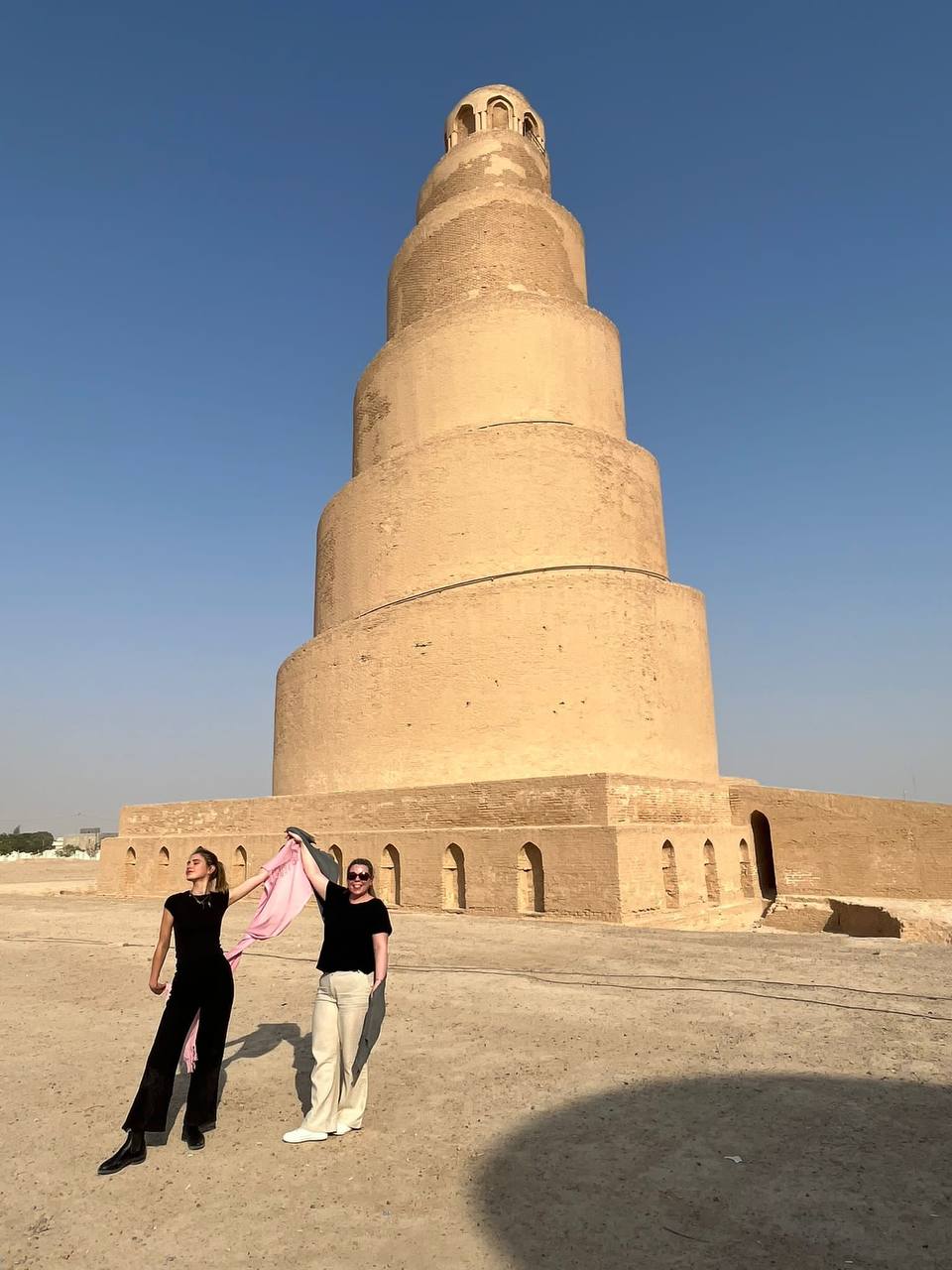
That mean counter compression is not the same externally for the shape of the domes upward pressure rise for the internal shape.
A ramp that increases means more mass above the dome shape which is not the same inside forcing that mass to cause calapse. It is physics as the dome is not gettting thicker as the ramp load changes.
#871 Re: Exploration to Settlement Creation » WIKI Project construction design meaning for insitu materials » 2025-11-22 19:34:18
Building a dome on Mars using local soil to create bricks is a feasible concept being actively researched by scientists and engineers. Bricks made from compressed Martian soil simulant have been found to be stronger than steel-reinforced concrete, potentially exceeding the specified Grade A brick 125 N/mm² strength requirement.
Martian Brick Strength
Material: Martian soil (regolith) contains iron oxide nanoparticles which act as a natural binding agent under high pressure.Method:
A simple high-pressure compression method (like a blow from a hammer) can create sturdy bricks without needing an oven or additional binding agents from Earth. Other research explores using bacteria and urea or molten sulfur as binders.Strength:
Compressed Martian soil bricks have a compressive strength comparable to or even greater than steel-reinforced concrete (average adobe bricks have a much lower strength of 250-300 psi or 1.7-2.0 N/mm²). The specified 125 N/mm² (equivalent to approximately 18,129 psi) is an extremely high "Grade A" strength, which may be achievable or exceeded with these advanced composite materials/methods.Dome Construction and Soil Usage
Dome Feasibility:
Domes are a potential structure for human habitats on Mars, but they must be able to withstand the low external atmospheric pressure, internal positive pressure, and harsh environment (radiation, micrometeoroids).Construction Method:
The compression method is compatible with additive manufacturing (3D printing), where layers of soil are compacted to build a structure.Radiation Shielding:
10 tonnes of soil can provide significant radiation shielding. Habitats are likely to be built underground or covered with a thick layer of regolith to protect inhabitants from intense radiation. A depth of around 3-4 meters (or more to be safe) of rock/soil is needed to completely react out the pressure load and provide necessary shielding for a pressurized habitat.
In essence, using Martian soil to create extremely strong bricks for a protective dome is considered a promising strategy for future Martian settlements, as it drastically reduces the amount of material that would need to be transported from Earth
#872 Re: Exploration to Settlement Creation » WIKI Project construction design meaning for insitu materials » 2025-11-22 19:10:05
A counter pressure is generally not how an internal atmosphere in a Martian dome would be contained. The force from an internal, human-habitable atmosphere on Mars is immense (around 10 tonnes per square meter), meaning the structure needs sufficient mass and design to resist this tension and prevent it from being lifted off its foundations. The most practical engineering approach for a dome made of Martian regolith bricks involves using the weight of the material itself (or an external regolith covering) to counteract the internal pressure differential.
Internal Pressure Requirements
Mars's Atmospheric Pressure:
The external atmospheric pressure on the surface of Mars is extremely low, averaging only about 0.6 kilopascals (kPa), which is less than 1% of Earth's sea-level pressure. It is effectively a near-vacuum from an engineering perspective.Human Habitable Pressure:
A human habitat requires a total internal pressure of at least 25 kPa with sufficient oxygen partial pressure to be functional without a pressure suit, or full Earth-equivalent pressure of 101.3 kPa (1 atm) for a standard environment.Pressure Differential:
The critical engineering challenge is the 100+ kPa pressure differential between the inside of the dome and the outside Martian atmosphere. This creates a massive outward and upward force on the structure.Structural Considerations for Regolith Domes
Tension vs. Compression:
Domes on Earth are compression structures, meaning their shape naturally handles the force of their own weight pushing down. On Mars, the low gravity and high internal pressure put the dome under tension, trying to tear it apart and lift it from its foundations.Material Limitations:
Regolith bricks, even advanced "StarCrete" or sintered versions with high compressive strength (up to 72 MPa), have lower tensile strength. Standard bricks and concrete perform poorly in tension.Design Solution: Weight and Reinforcement:
The primary method to manage the internal pressure is to use a thick layer of regolith as shielding/ballast.
Proposals often suggest using an internal inflatable bladder or a strong internal shell (perhaps with steel or carbon fiber reinforcement) to contain the air.This internal structure is then buried under several meters of Martian soil/bricks. The sheer weight of this external material provides the necessary "counter pressure" by pushing down and counteracting the upward lift from the internal atmosphere.
In short, the counter pressure is not an engineered force applied externally but rather the passive mass of significant regolith shielding used to anchor the structure to the ground.
The value of 10 tonnes per square meter is commonly used in discussions about Mars colonization, but it refers to two different concepts:
Earth's Atmospheric Pressure:
The pressure of Earth's atmosphere at sea level is approximately 10 tonnes of force per square meter (or about 100 kPa). This immense force is a key engineering challenge for designing habitats on Mars. Structures would need high tensile strength to contain a standard Earth-like atmosphere while resisting this outward pressure.Radiation Shielding Mass:
Around 10 tonnes of material (such as Martian soil or regolith) per square meter of surface area is considered sufficient for complete shielding from cosmic rays and solar radiation for a Mars habitat. This would require burying a habitat under several meters of soil (e.g., about 6.67 meters if the soil density is 1.5 tonnes per cubic meter).The actual atmospheric pressure on the surface of Mars is much lower, varying with elevation and season but averaging around 600 Pascals (Pa), which is less than 0.1 tonnes of force per square meter (about 0.6% of Earth's sea-level pressure). This pressure is far too low for humans to survive without a pressure suit.
#873 Re: Exploration to Settlement Creation » WIKI Project construction design meaning for insitu materials » 2025-11-22 15:49:20
Martian sand grain sizes vary, with most active sand being very fine, around 50–150 micrometers, but coarser grains up to 500 micrometers or more are found in specific bedforms like coarse-grained ripples. The soil also contains dust particles smaller than this, and some inactive areas have a surface layer of much larger, dust-covered grains.
Fine sand
Dominant size:
The most common size for active sand is very fine, typically between 50–150 micrometers.Location:
This size is abundant in the troughs and on the surface of active ripples and other wind-blown features.Color:
The fine sand is often reddish due to the presence of iron oxides.
Coarser grainsSize:
Coarser grains can reach up to 500 micrometers and sometimes even larger, occasionally up to 1.4 mm or more.Location:
These larger grains are found on the crests of coarse-grained ripples and can be found on inactive bedforms.
Appearance: They may be reddish or whitish and have irregular shapes, suggesting they are formed from the erosion of local bedrock.Other particle sizes
Dust:
A significant amount of dust, much smaller than sand grains, is also present. It can mix with the sand or form a thin layer on top of other features.Gravel:
In certain areas, such as crater rims, gravel-sized particles (diameters above 2 mm) have been observed
#874 Re: Life support systems » Dust Mitigation Mars Solidified Regolith or Artificial Lichen » 2025-11-22 15:45:57
Martian atmospheric dust grains are fine, typically with an effective radius of about \(1-3\mu m\) in diameter, though this can vary. During dust storms, larger particles can be lifted, temporarily increasing the effective radius to over \(4\mu m\) before returning to seasonal averages. The size distribution of atmospheric dust is a fundamental component of Mars's climate. Typical sizes
Average diameter:
Martian dust is fine-grained, with an average diameter of about \(1-3\mu m\).Effective radius:
The atmosphere typically supports dust with an effective radius near \(1.5\mu m\). Variations and dust stormsDust storms:
The effective radius can increase to over \(4\mu m\) during major dust events, when larger particles are freshly lifted and transported.Seasonal changes:
During low dust times, the effective radius may be closer to \(1\mu m\), while during higher dust times in spring and summer, it can be up to \(2\mu m\).Vertical distribution:
Studies show that dust particles have an effective radius of \(1.0\mu m\) over much of the atmospheric column, with little variation by height.Significance Climate impact:
The presence of micrometer-sized dust in the atmosphere is a fundamental component of Mars's climate, affecting the planet's water content.Sedimentation:
Dust particles are not suspended permanently and are continuously removed from the atmosphere through sedimentation, which is evident from the degradation of solar panels on landers
#875 Re: Exploration to Settlement Creation » Domed habitats... - ...size, materials, and more. » 2025-11-21 17:33:04
Seem the crash of 2005 took out quite a few posts with the following one for 2008 through 2011 until we got James for administrator.