New Mars Forums
You are not logged in.
- Topics: Active | Unanswered
Announcement
#28901 Re: Human missions » The need for a Moon direct *2* - ...continue here. » 2004-12-28 09:44:12
The Lunar Reconnaissance Orbiter or LRO has had some work on what it will contain.
Science instruments picked for NASA's new lunar probe
Selected investigations and principal investigators:
"Lunar Orbiter Laser Altimeter (LOLA) Measurement Investigation" - principal investigator Dr. David E. Smith, NASA Goddard Space Flight Center (GSFC), Greenbelt, Md. LOLA will determine the global topography of the lunar surface at high resolution, measure landing site slopes and search for polar ices in shadowed regions.
"Lunar Reconnaissance Orbiter Camera" (LROC) - principal investigator Dr. Mark Robinson, Northwestern University, Evanston, Ill. LROC will acquire targeted images of the lunar surface capable of resolving small-scale features that could be landing site hazards, as well as wide-angle images at multiple wavelengths of the lunar poles to document changing illumination conditions and potential resources.
"Lunar Exploration Neutron Detector" (LEND) - principal investigator Dr. Igor Mitrofanov, Institute for Space Research, and Federal Space Agency, Moscow. LEND will map the flux of neutrons from the lunar surface to search for evidence of water ice and provide measurements of the space radiation environment which can be useful for future human exploration.
"Diviner Lunar Radiometer Experiment" - principal investigator Prof. David Paige, UCLA, Los Angeles. Diviner will map the temperature of the entire lunar surface at 300 meter horizontal scales to identify cold- traps and potential ice deposits.
"Lyman-Alpha Mapping Project" (LAMP) - principal investigator Dr. Alan Stern, Southwest Research Institute, Boulder, Colo. LAMP will observe the entire lunar surface in the far ultraviolet. LAMP will search for surface ices and frosts in the polar regions and provide images of permanently shadowed regions illuminated only by starlight.
"Cosmic Ray Telescope for the Effects of Radiation" (CRaTER) - principal investigator Prof. Harlan Spence, Boston University, Mass. CRaTER will investigate the effect of galactic cosmic rays on tissue- equivalent plastics as a constraint on models of biological response to background space radiation.
#28902 Re: Meta New Mars » Posting Images - ...especially *large* ones » 2004-12-27 21:29:16
Is the code button for html?
Example html code line:
<P ALIGN="CENTER"><A HREF="Project Constellation Editorials Archives_files/ss1-cartoon.jpg"><IMG SRC="Project Constellation Editorials Archives_files/ss1-cartoon.jpg" BORDER=0 WIDTH=428 HEIGHT=321></A></P>
The original time this was posted on Jame's Project Constellation site it had a width=*** that were off the page, changing to something smaller worked fine in that case.
#28903 Re: Not So Free Chat » Tsunami in Asia » 2004-12-27 21:09:46
The quake was along the Java trench that is on the ring of fire as it is known also it is on the edge of one of the tectonic plates as well. I was up late last night when I first heard of this event. It is indeed tragic that communications from around the world of the event could be heard here so many hours before but yet it would seem none or little was done over there in so many nations to communicate the impending danger.
#28904 Re: Human missions » Return to flight slipping » 2004-12-27 12:56:33
Sounds more business like than in the past but still falls short IMO when it comes to laying off people. Why carry the added burden on the books?
So far, only three programs have been canceled, which will save roughly $177 million and potentially affect 470 jobs, mostly NASA contractors.
The first program -- the second phase of the Advanced Health Management System program -- was to include a slight change in the shuttle's main engines as well as better information in the cockpit for the crew. But there were questions about whether the change would reduce risk to the crew as much as had been predicted. Ultimately, it was deemed largely unnecessary.
NASA will save $31 million because of the decision not to proceed with the program, agency spokesman Allard Beutel said. That will affect 121 positions -- all employees working on the first phase of the program, including six NASA employees.
The second canceled upgrade was for the orbiters' cockpits, to make the instrument panels easier to read. When NASA decided to go ahead with the changes, the agency also planned to fly the shuttle until at least 2020, and perhaps longer. When officials went back to re-examine the idea, an internal study showed that the upgrade could be installed in only two of the three orbiters before the fleet is retired, Beutel said.
Canceling the program will save $25 million -- NASA already has spent $398 million on it -- and affect 215 jobs, including 20 NASA civil servants.
The third program to be scrapped was the Orbiter Vehicle Health Monitoring System, essentially a newer, better version of the data recorders now on the shuttle.
Instead of replacing the recorders, Beutel said, NASA will replace the recording tapes to extend the lives of the devices, as well as redesign them to allow more data to be transmitted to the ground during a mission. The agency already is adding new sensors to the orbiters' wings as part of the return-to-flight effort.
civil servants affected by the decision will be reassigned to other jobs; most work at Johnson Space Center in Houston.
Shuttle contractors are trying to make sure that the positions affected by the cancellations are folded into other operations.
"We think that the number of USA employees that could be affected is less than 150," he said. "But we hope not to lay anybody off if we can avoid it. We're looking for placement options and transfer opportunities."
#28905 Re: Human missions » ISS Woes & To-Mars » 2004-12-27 06:02:33
Another successful delivery.
Thanks should be given for the Russian's and there commitment to providing there ships for the ISS.
#28906 Re: Human missions » Ordinary people...? » 2004-12-27 05:59:36
Anyone caring to go in the first place cares little about the time for they have already decided that it does not matter to them if they are going. What will matter is the dollars needed to go.
If we had only kept going lone ago we would never have been in this position in the first place. The much needed infrastructure would have been in place and cost would have come down, I would hope in the last 30 plus years that we have been floundering in LEO had we continued..
#28907 Re: Human missions » Return to flight slipping » 2004-12-27 05:52:55
Yeah so? NASA isn't a business. There is nothing wrong with this.
That's true but maybe it should be run more like one.
Businesses one have an income stream from which it pays wages and benefits for those that work to produce the commodity that is sold. The remainder goes into R&D and savings once paying the stock holder dividends. They must as part of the source budget how much goes for the manufacture of those goods and there research.
But if the company functioned like NASA does then they would be filing chapter 11 for they would have spent all sources of revenue. Never putting anything aside for a rainy day. The company as well would have not planned what was needed to keep it within the market share for its product. Which one of the reasons for the Space exploration goals.
They company for its manufactured product looks for ways to reduce the cost to manufacture the item but also at the remaining overhead costs. They look to reduce cost for each one made after the first. The shuttle is a failure in that regards.
They in turn also look at design for manufacturability of the item so as to start out with the lowest cost to make the item to begin with.
Repair is a part of the warranty of the product and there must be quality not just quantity for all that is made.
Ok so Nasa is not a business they do R&D, manufacture items for launch and page huge wage costs from a given revenue source that you and I pay. From the budget dollars granted this agency from the congress.
Sounds like a business to me.
They just do not receive anything from its manufactured goods and only marginally from its research as income or revenue. That is a draw back of being a government agency.
So why do rockets cost so much?

#28908 Re: Interplanetary transportation » Just Cancel The Shuttle Program - Not in five years, do it right now. » 2004-12-27 05:32:06
Yes cost effective is a must for any space activity.
The shuttle will be kept very busy after its return to flight, there is much science to catch up on and experiments to do.
Yes the max number of flights to finish the ISS.
So what science has been neglected or is this science that can only be done on the shuttle and not the ISS? ???
#28909 Re: Science, Technology, and Astronomy » Singularity - Black Holes, Gamma Rays, Magnetars, etc » 2004-12-26 21:50:57
Yup quick search of Astronomers Find First Direct Evidence Linking Black Holes and Supernovae as you noted. I recall some time ago reading an article that detailed how I think one of the first Black holes was found because the companion star was having its gas stolen from it. The name was very similar... Not all to many light years from here if I recall.. But it escapes me at this time, it was many years ago and may have pre-dated even hubble just not sure any more..
#28910 Re: Intelligent Alien Life » More and more, Mars looking like no life » 2004-12-26 21:34:45
It is highly unlikely that life will spring while the temperature is below the freezing point of water since it is felt that it is a necessary ingredient for life or at least its amino acids to form.
A temperature that is 60 would I think be fine if it where sustained for a long period of time while water did exist.
#28911 Re: Human missions » ISS Woes & To-Mars » 2004-12-25 19:48:43
Barring any mishap of docking to the ISS they will soon get the much need food supplies.
'Progress' to Dock with ISS on Sunday
Christmas comes to Space Station as supplies approach
#28912 Re: Human missions » Return to flight slipping » 2004-12-25 19:42:24
Well for those that do not wish to see the shuttle ever fly again , this news will go against there wished for it will give the shuttle increased chance for night flights.
Radar duo could help lift restriction Shuttle may see launch at night
#28913 Re: Interplanetary transportation » Just Cancel The Shuttle Program - Not in five years, do it right now. » 2004-12-23 17:41:30
If the shuttle had even been re-designed it should have been made into two entirely different configurations. Shuttle c,z for the cargo and a mini shuttle for crew with maybe no more than the capacity of a progress for cargo.
#28914 Re: Human missions » Dr Jeffrey Bell - His Personal View » 2004-12-23 14:07:14
I guess for me it is more of is there any middle ground between the options.
Sending a real formulated rant to those that will listen does influence some things thou it may only be just a little.
I find all the discussions very useful and can only hope those that are in power do visit such sites as this one.
#28915 Re: Unmanned probes » Phoenix - North Pole Region Lander (PHX) » 2004-12-23 11:56:10
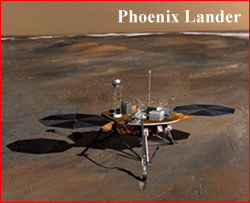
Ya I had found a few articles that talk of all three probes being sent to mars stating in 2005, then 2007 and finally in 2009 but not much seperately.
from decontamination article:
Then, in 2007, comes the Phoenix, which will explore the polar ice caps and drill for samples, according to Karen Buxbaum, Mars program planetary projection manager from the Jet Propulsion Laboratory. The ice caps are believed to contain organic compounds, which, in turn, could help answer the question of whether life existed--or exists--on Mars.
Edit:[url=http://www.marsnews.com/missions/phoenix/]
here is a link to all news articles from the part year or so[/url]
QUICK FACTS
Launch: October 2007
Landing: late 2008
Science instruments:
Mars Descent Imager (MARDI)
Stereo Surface Imager (SSI)
Thermal Evolved Gas Analyzer (TEGA)
Mars Environmental Compatibility Assessment (MECA)
Meteorology Suite (MET)
Robot Arm and Camera
#28916 Re: Human missions » ISS Woes & To-Mars » 2004-12-23 11:51:20
This is sort of interesting for what the supplies are in terms of quantity being brought to the ISS by the Prgoress M ship. While this is for just 2 people grand total of 10,094 pounds. Just think about what would be needed for the trip to Mars.
The supply ship will be carrying 5,047 pounds of cargo, including 1,234 pounds of propellant, 110 pounds of oxygen, 926 pounds of water and 2,777 pounds of dry goods.
The latter category includes repair equipment and spare parts, experiment hardware, clothing and about 70 food containers, 41 of which include American choices and 29 of which feature Russian menu items. That's enough food for 67 days of operations at one full ration per day per crew member and another 45 days at a consumption rate of 0.8 rations per crew member per day.
#28917 Re: Science, Technology, and Astronomy » Potentially Hazardous Asteroids - (...does this make you feel any better?) » 2004-12-23 06:31:41
Well our satellites just missed a visitor thou it was only about 16 feet (5 meters) wide.
This space rock was relatively small and posed little of any danger had it plunged into the atmosphere.
#28918 Re: Planetary transportation » The Methane Based Economy - Exploring Mars in a Reusable Manner » 2004-12-23 06:22:34
Was just thinking of the need to transport items from one site to the next and of the pipe lines for fixed locations, These could be a dual function if laid in pairs much like railroad tracks. Power could be fed onto them and the vehicle could make contact to them and be powered by them.
#28919 Re: Science, Technology, and Astronomy » Any Chemists? - Quick question... » 2004-12-23 06:17:59
Just in case you do not see this in the other post:
discontinue drinking the water? I know from my own home where Iron and magnesium are very high that it is unwise to ingest any amount long term.
If you where to distill it then it would be ok.
#28920 Re: Human missions » Delta IV Heavy and Beyond » 2004-12-23 06:15:43
I would assume by computer clock cycles which do have errors for they rely on programming technique as well as the actual crystal or oscillator accuracy.
I hope you feel better soon and discontinue drinking the water? I know from my own home where Iron and magnesium are very high that it is unwise to ingest any amount long term.
If you where to distill it then it would be ok.
#28921 Re: Science, Technology, and Astronomy » Planned Earthly or Space Telescopes - from any nation » 2004-12-23 06:07:21
World's most powerful infrared camera opens its eyes on the heavens
Well if this is true then we can shut down another space telescope if I follow the hubble deorbit discusions correctly in some eyes but not IMO. I wonder when the first real astronomical discoveries will be announce from its use as does the hubble and spitz have regularly.
#28922 Re: Human missions » Delta IV Heavy and Beyond » 2004-12-23 06:01:05
Well actually the first stage shut off early and the second stage had to make up for it.
Spacetoday
Delta 4's first stage — three identical core boosters — shut down eight seconds earlier than expected. To compensate, the upper stage fired longer than planned during the second of three burns needed to place the primary payload, a demonstration satellite, into geosynchronous orbit, and as a result ran out of propellant during the final burn.
Delta IV Heavy is designed to carry 50,000 pounds into low-Earth orbit and about 29,000 pounds to geostationary orbit, an altitude used by communication satellites and other spacecraft that is about 22,300 miles above Earth.
military stepped in to pay about $141 million
spaceflight
22,000 pounds for Trans Lunar Injection routes to the moon and 17,600 pounds on Mars-bound trajectories.
According to other resource articles it seems that the airforce is happy enough with preformance as to go ahead and to pay for the launch of this demostrator flight.
I wonder if the side boosters are reused? They were monitored until they seperated from the central core.
#28923 Re: Human missions » Post central for information on CEV 2 - ...continue here. » 2004-12-22 06:23:01
Well the Boeing's new Delta 4 Heavy rocket lhas finally ifted off for test mission
New Delta 4 Rocket Launches Succesfully in Flight Debut
This rocket had been though alot over the past year getting it ready for only a demostrator flight pay for by the Airforce at $140million.
Lots of details in engine types and such for both articles.
#28924 Re: Science, Technology, and Astronomy » Planned Earthly or Space Telescopes - from any nation » 2004-12-22 06:16:43
New Solar Telescope Would Focus on Sunspots, Storms
Known as the Advanced Technology Solar Telescope (ATST) it
would be the world's largest optical solar telescope.
The project remains in the proposal stage. Scientists must decide where to place the telescope and secure funding to construct and operate it. Backers hope to build the telescope in Haleakala, Hawaii.
The telescope could be operational by 2010, according to the project team, provided international scientific funding agencies approve the final site selection and required construction funds.
#28925 Re: Human missions » The need for a Moon direct *2* - ...continue here. » 2004-12-22 06:11:35
Northrop Grumman received $137 million - the most of any contractor - to help fulfill space exploration goals to design gadgets to help U.S. return to the moon and travel to Mars.
See previous post image:
Device is a 44-pound, six-legged robot, shaped like an insect, that will inspect and maintain exteriors of any Nasa spacecrafts.
side project:
Northrop Grumman will also work on a heat-resistent "skirt" that would deploy around a spacecraft just before re-entry, slowing the vehicle down and thus reducing dangerous heat damage, which contributed to the Columbia shuttle accident nearly two years ago.