You are not logged in.
OK, then I accept your correction of my perception of your thinking. I guess B.O. is going to be the chosen one in that case, if SpaceX is not ready yet.
I kind of like B.O.'s plan anyway. Lunar Starship is really an oversize task, but will be very valuable if it can be matured. But maybe B.O. is ready first.
Ending
Be careful what you wish for.
Offline
Like button can go here
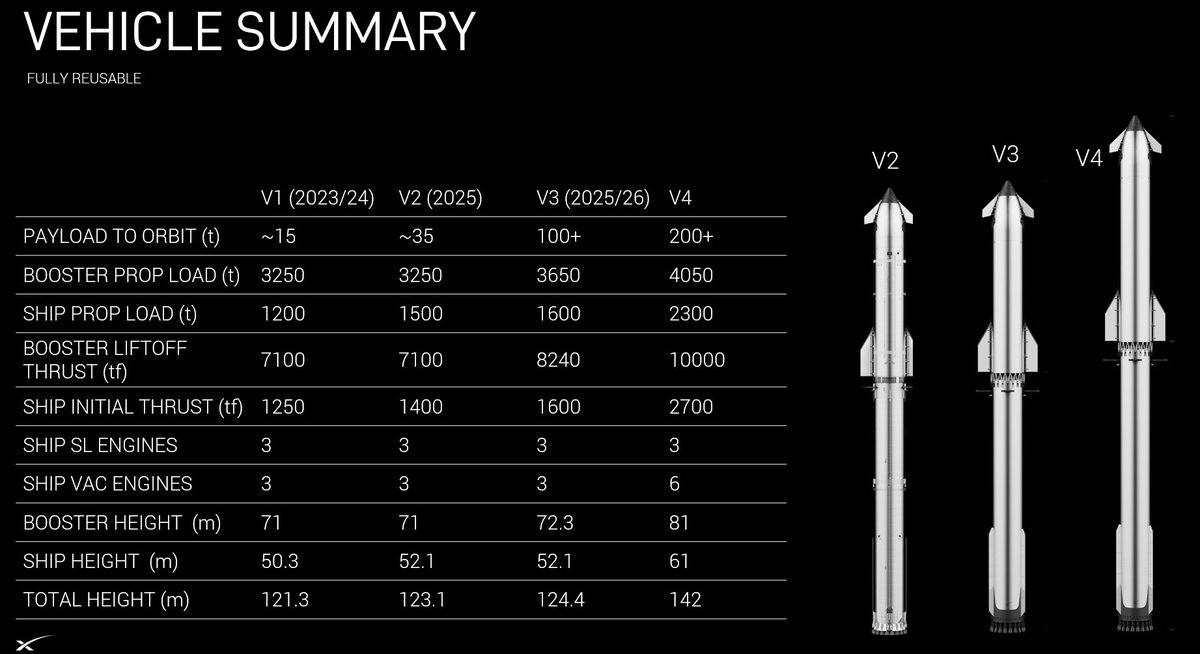
I thought I was being clear my only concern about the development pace of the Starship is only in the context of its use as a manned lander for the Artemis lunar lander. It could take until 2050 to get to 100 tons to orbit if all it was doing was delivering satellites to orbit. But as a lander for Artemis it is under extreme time constraints. Since the plan is to use it as a lander by 2028 it must have 100 tons payload capacity and be able to do multiple in-space cryogenic refuelings by that time.
The time constraint actually is even worse than that. Understandably NASA would like an unmanned demonstration of this capability first, given the numerous explosions of the Starship in flight, therefore SpaceX has said it will conduct an unmanned demonstration in 2027. Then it only has 1 year to reach 100 tons to orbit and have cryogenic refueling mastered.
Reaching 100 tons to orbit is a necessary requirement for this role. To reassure NASA you would think they would confirm Starship V3 already has reached this capability but instead they say nothing. This leads to my skepticism it can deliver 100 tons to orbit. We know it can deliver ca. 50 tons and my guess is the max payload capacity could be in this range. If the max capability were even, say, 80 tons to orbit that would be reassuring that it might be able to fulfill the refueling role at that payload capacity. At only ca. 50 tons to orbit it can not.
Note SpaceX has already said twice before a Starship will be able to reach 100 tons to orbit then after it flew it downgraded what the payload capability actually is. If it says once again Starship V3 can’t deliver the needed 100 tons to orbit, but we will have wait again for the next version Starship V4 that will engender severe skepticism even V4 can fulfill this requirement.
https://pbs.twimg.com/media/GzY0wZLa4Ak5K57.jpg
Bob Clark
Here is the topic that was started wiki Block 4 starship first mission propellant creation
So far a real test is to stay in orbit much longer to solve what the issue was.
Offline
Like button can go here
My point all along has been that the history of payload masses carried during development flight tests HAS NOTHING TO DO with the payload capacity of the operational form of the vehicle!
You might (or might not) see the actual max value demonstrated during the demonstration flight tests. You might well see something fairly close. No guarantees, though. Once the design freezes, they will be able to figure what that number is, even if they do not actually fly it. And NO, they are NOT YET DONE with development flight tests! The version 3 design has NOT YET BEEN FROZEN!
Why do I say that? Simply because not all the pieces are yet doing all the things that they are supposed to do! Until they do, you are BY DEFINITION still in development flight testing! Why? Because you must keep changing things until it does work!
By the way, version 4 is a new design. It must go through the same kind of development flight tests, followed by demonstration flight tests, before it could possibly go operational!
So, too, the moon lander version "HLS" must go through the same sequence of development, then demonstration flight tests!
And any other version, as well!
So arguing about a payload capacity "shortfall" while the vehicle is still in development flight testing is pointless! It's literally "angels on the head of a pin" stuff.
Yes, SpaceX is far behind schedule getting "Starship/Superheavy" operational. Yes, that seriously impacts the NASA Artemis schedule.
Is that SpaceX's fault? Only somewhat.
A lot of the fault lies with NASA itself, for NOT using the observed development times for Falcon-1, Falcon-9, Falcon-Heavy, and the Merlin engines, in its projections of how soon Musk's outfit could actually get the Raptor engines and the Starship and Superheavy stages ready.
Instead, NASA used the super-over-optimistic timelines that are required to have a winning proposal in the government contracting business. No one in government procurement offices who was actually competent, has believed those BS proposal timelines, not since just after WW2! So believing those BS proposal timelines today, is just negligence and incompetence on the part of today's NASA!
And, it would appear that ULA did not do enough in the way of development and demonstration flight tests with Vulcan Centaur. And maybe also Blue Origin with its New Glenn. Both outfits have been surprised by flaws that should have been found and fixed during development flight testing. Clearly, they were not! And finding and fixing problems once operational, is VERY expensive, indeed!
The lesson is clear: do enough flight testing not to be surprised when you go operational. This is commercial contracting work, not the old highly-experimental stuff the government did and managed, just buying stuff from contractors, and doing its own integration and test. They knew that stuff was risky. That's why every single astronaut was a test pilot until Apollo 17.
GW
Last edited by GW Johnson (2026-11-18 14:12:19)
GW Johnson
McGregor, Texas
"There is nothing as expensive as a dead crew, especially one dead from a bad management decision"
Offline
Like button can go here
In the light of the recent ULA launch failure--if BO's BE-4 engine is at all implicated in the failure, BO may be grounded into mid 2027. I'm not preaching gloom and doom--just several YouTube commentors on the AI based channels. I'm simply gonna wait till someone responsible speaks out over the anomaly.
Offline
Like button can go here
I have not seen anything credible yet, except that the flaw was somewhere in the first stage liquid core. It literally did not provide enough thrust to hit the right staging conditions.
Could be an engine flaw, could be a flight controls flaw, could be a flaw in delivering propellant to the engines. No one yet knows for sure.
I think we will soon see, though. Information is coming out faster and faster.
GW
GW Johnson
McGregor, Texas
"There is nothing as expensive as a dead crew, especially one dead from a bad management decision"
Offline
Like button can go here
Check this YouTube video which involves an analysis of ULA's failure.
Title:
Vulcan Failure: ULA Blames Its Own Rocket, Not the BE-4
https://www.youtube.com/watch?v=khMmKcpJk9A
Last edited by Oldfart1939 (2026-11-18 17:01:44)
Offline
Like button can go here