New Mars Forums
You are not logged in.
- Topics: Active | Unanswered
Announcement
#1 2026-11-09 16:19:30
- SpaceNut
- Administrator
- From: New Hampshire
- Registered: 2004-07-22
- Posts: 30,883
NASA is turning a Mars rover into a nuclear-powered scout for humanity
NASA is turning a Mars rover into a nuclear-powered scout for humanity’s first moon base
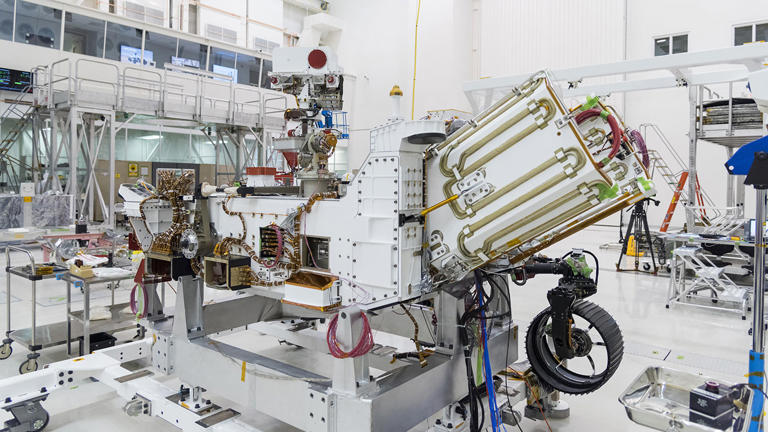
NASA is preparing to send a nuclear-powered rover to the Moon’s South Pole in late 2028, using hardware originally developed for Mars exploration. Named PROMISE, the six-wheeled vehicle will search for underground ice, examine lunar terrain, and gather the data needed to help establish humanity’s first permanent lunar outpost.
NASA Is Giving Proven Mars Rover Technology a New Mission
Rather than designing an entirely new lunar vehicle, NASA is taking an unusual approach: transforming existing Mars rover technology into a machine capable of exploring one of the Moon’s most challenging environments.According to NASA, the Polar Rover for Observation, Mapping, and In-Situ Exploration (PROMISE) will be developed at the agency’s Jet Propulsion Laboratory (JPL) in Southern California. Engineers will reuse components associated with the successful Curiosity and Perseverance Mars missions, drawing on more than three decades of experience operating robotic explorers on another world.
At the center of this effort is a duplicate of Curiosity that has served as a vehicle system test bed for the Mars mission. Its electronics, body structure, and mobility system will be adapted for lunar operations. Additional flight-spare components and test equipment from both Mars rover programs will complete the vehicle.
The mission is currently targeting a late 2028 launch, followed by an 18-month primary mission near the lunar South Pole. Its objective extends beyond scientific exploration. PROMISE will investigate potential resources and assess surface conditions that could influence where future astronauts land, travel, and eventually establish infrastructure.
Reusing existing systems could also allow NASA to benefit from years of engineering experience while adapting proven technology to a different planetary environment.
Why a Nuclear-Powered Rover Could Change Lunar Exploration
One of PROMISE’s defining features is its multi-mission radioisotope thermoelectric generator (MMRTG), the same type of power system used aboard Curiosity and Perseverance. Unlike solar-powered rovers, which depend on sunlight to generate electricity, an MMRTG converts heat produced by the natural radioactive decay of plutonium-238 into electrical power.This distinction matters near the lunar South Pole, where the Sun remains low on the horizon and some deep craters contain permanently shadowed regions. These areas may preserve water ice and other volatile substances that have accumulated over immense periods. A nuclear power system can supply electricity independently of direct sunlight, allowing PROMISE to investigate terrain that would present serious limitations for solar-powered vehicles. Radioisotope systems also produce heat, which can help spacecraft hardware survive cold environments.
The rover will carry advanced sensors and navigation software designed to support autonomous driving in darkness. Its onboard computing system will process three-dimensional terrain information to help the vehicle identify obstacles and navigate challenging surfaces. PROMISE will test three technologies working together: High Performance Spaceflight Computing (HPSC), Surface Characterization and Autonomous Navigation in 3D (SCAN-3D), and High-speed Intelligent Robust Autonomous Terrain Exploration (HI-RATE). These systems could help future planetary rovers travel farther with less dependence on continuous instructions from Earth.
A Drill Will Search for Water Ice Beneath the Lunar Surface
One of PROMISE’s primary scientific objectives is determining what lies beneath the Moon’s polar soil.Its Regolith and Ice Drill for Exploring New Terrain (TRIDENT) will extract lunar material from depths reaching approximately 3.3 feet (1 meter). Scientists will analyze these samples to investigate the presence and distribution of water ice and other volatile compounds. The rover will carry a collection of instruments capable of examining the lunar environment from several perspectives.
The Mass Spectrometer Observing Lunar Operations (MSOLO) will investigate volatile substances, while the Near-Infrared Volatiles Spectrometer System (NIRVSS) will help characterize materials associated with water and other compounds. The Neutron Spectrometer System (NSS) will contribute measurements relevant to identifying hydrogen-bearing materials beneath the surface. Additional instruments will examine geology, radiation, and environmental conditions.
This research has implications for future lunar operations. If accessible deposits of water ice can be identified and eventually extracted, they could provide water for astronauts and potentially support the production of oxygen and rocket propellant. PROMISE will not operate as a mining vehicle. Its measurements are intended to help scientists determine where resources may exist, how they are distributed, and what future extraction systems might encounter.
The Rover Will Also Test Whether the Ground Can Support a Moon Base
Finding water is only part of the challenge. NASA also needs to understand whether the lunar surface can support the vehicles, equipment, and structures required for a sustained human presence. PROMISE will use its six-wheeled mobility system as a scientific instrument. By measuring how its wheels interact with lunar regolith, engineers can assess whether the terrain is firm, loose, uneven, or prone to sinking.The rover may even use one wheel to excavate a small trench, recording how the material responds. Such observations could help NASA evaluate future landing sites and design transportation systems capable of operating in the Moon’s polar environment.
PROMISE will also complement NASA’s Volatiles Investigating Polar Exploration Rover (VIPER) mission. Both vehicles carry several related scientific instruments, allowing researchers to compare measurements from different locations near the lunar South Pole. Together, their data could provide a broader picture of polar resources and terrain conditions than either rover could produce alone.
A Robotic Scout for NASA’s Future Lunar Outpost
PROMISE represents an early step in NASA’s proposed Moon Base development strategy, which begins with robotic reconnaissance before expanding toward infrastructure supporting human activities. The agency plans to use robotic missions to investigate the environment, evaluate potential resources, and demonstrate technologies needed for future operations.For PROMISE, that means combining subsurface drilling, chemical analysis, radiation measurements, terrain assessment, and autonomous navigation within a single mobile platform. The mission’s value will ultimately depend on what those instruments reveal. Identifying promising ice deposits would help narrow the search for usable lunar resources, while detailed measurements of surface conditions could inform the design of future vehicles and facilities.
By repurposing technology originally built to explore Mars, NASA hopes to answer practical questions about living and working on the Moon, before the first permanent lunar outpost takes shape.
Offline
Like button can go here
#2 2026-11-09 16:20:54
- SpaceNut
- Administrator
- From: New Hampshire
- Registered: 2004-07-22
- Posts: 30,883
Re: NASA is turning a Mars rover into a nuclear-powered scout for humanity
Offline
Like button can go here