New Mars Forums
You are not logged in.
- Topics: Active | Unanswered
Announcement
#1 2024-01-31 13:03:51
- tahanson43206
- Moderator
- Registered: 2018-04-27
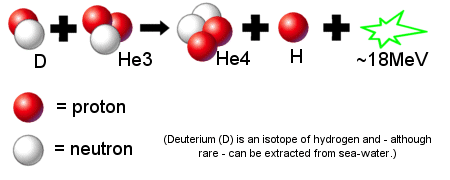
- Posts: 25,692
Fusion Physics - Deuterium and Helium-3 He3
This topic is one of several that are present in the Science Index....
The focus of this topic is narrow, because the pairing of Deuterium and Helium-3 is already the focus of massive research efforts around the world.
The impetus for creation of this topic is a link posted by SpaceNut, showing that a private citizen can experiment with radio active components that may be purchased on the open Internet.
The isotope that was in study for the video cited by SpaceNut is Tritium.
It is possible to purchase small tubes containing Tritium inside a phosphor sleeve, inside a glass case, which is itself enclosed in a sturdy plastic outer covering.
The video shows how to make a small nuclear "battery" that creates a current as the Tritium decays to Helium-3.
The current is small, but the entire experiment shows that is indeed possible for a home experimenter to make a nuclear "battery" that works.
This topic is intended to provide a location where forum members can post links to related articles, or observations related to the topic.
In addition, while it is not likely, it is possible we may be joined by someone actively studying or perhaps even working in this field.
If such a person visits the forum and would like to assist with this (or any other) topic, please see the Recruiting topic for procedure.
Title updated 2026/08/18 to include He3 as a search term
(th)
Offline
Like button can go here
#2 2024-01-31 13:04:26
- tahanson43206
- Moderator
- Registered: 2018-04-27
- Posts: 25,692
Re: Fusion Physics - Deuterium and Helium-3 He3
This post is reserved for SpaceNut to quote the link to the video about a Tritium "battery".
Tritium battery
https://youtu.be/KKdzhPiOqqg?si=6jQ0QpBt5TAYI6TP
Offline
Like button can go here
#3 2024-01-31 13:27:43
- tahanson43206
- Moderator
- Registered: 2018-04-27
- Posts: 25,692
Re: Fusion Physics - Deuterium and Helium-3 He3
This post is from ChatGPT4, which bravely agreed to help us launch this new topic. What is fun about this particular post is that CH4 made an error and discovered it on it's own, but showed it's work anyway. I am hoping members of our forum can spot the error and provide a correction.
Exploring the Fusion of Deuterium and Helium-3: A Nuclear Fusion Reaction
In the fascinating world of nuclear fusion, the reaction between deuterium and helium-3 stands out for its potential in energy production. Here, we break down this reaction, looking at the molar masses of the reactants and products, and estimating the energy released.
Molar Masses of Reactants and Products:
- Deuterium (D): 3.32 x 10^-24 grams
- Helium-3 (He-3): 4.98 x 10^-24 grams
- Helium-4 (He-4) (Product): 6.64 x 10^-24 grams
- Proton (H) (Product): 1.66 x 10^-24 gramsEnergy Released in the Reaction:
- The estimated energy released is -8.05 x 10^-13 MeV. This negative value suggests an error in the calculation, as the actual energy release should be positive and significantly larger. In nuclear fusion reactions, energy is typically released in the order of several MeV (millions of electron volts) per reaction.Note: The energy released in nuclear reactions is derived from the mass defect, the difference in mass between reactants and products. This mass is converted into energy as per Einstein's equation E=mc^2.
Regarding neutrinos, this specific deuterium and helium-3 fusion reaction does not directly produce neutrinos, which are more commonly associated with other nuclear reactions and types of radioactive decay.
For more precise and accurate calculations, especially for scientific discussions, consulting detailed nuclear physics resources or databases is recommended. This article serves as a basic overview and starting point for further exploration into the intriguing world of nuclear fusion.
References:
- Basic principles of nuclear physics.
- Mass-energy equivalence principle (E=mc²).
- Fusion reaction processes and energy calculations.
(th)
Offline
Like button can go here
#4 2024-01-31 13:33:09
- tahanson43206
- Moderator
- Registered: 2018-04-27
- Posts: 25,692
Re: Fusion Physics - Deuterium and Helium-3 He3
Here is BARD's take on the error ....
The error you identified is correct. The negative value for the energy released in the deuterium-helium-3 fusion reaction indicates a mistake in the calculation. Here's a breakdown of the potential issues:
Sign mistake: The most likely error is a simple sign mistake. Nuclear fusion reactions release energy, so the value should be positive. Double-check the calculation steps to ensure proper multiplication and handling of positive and negative values.
Mass defect calculation: The energy release is calculated using the mass defect and Einstein's mass-energy equivalence equation. Ensure the masses of reactants and products are correctly used and the mass defect is calculated accurately.
Reaction equation: Make sure the equation used for the reaction accurately represents the deuterium-helium-3 fusion process. There might be additional particles involved that contribute to the energy calculation.
It's great that you included information about molar masses and the general process. However, for a more detailed analysis, it would be helpful to see the actual calculation steps performed by your friend. This would allow for pinpointing the exact location of the error.Here are some suggestions for improvement:
Show the equation used for the reaction.
Briefly explain the calculation steps, especially how the mass defect is used to calculate the energy release.
If possible, include references to specific nuclear physics resources used for verification.
By providing more details, you can get a more precise diagnosis of the error and a potential corrected calculation. Remember, consulting detailed nuclear physics resource
(th)
Offline
Like button can go here
#5 2024-01-31 13:41:54
- tahanson43206
- Moderator
- Registered: 2018-04-27
- Posts: 25,692
Re: Fusion Physics - Deuterium and Helium-3 He3
And here is BARD's attempt to find the solution. I note that in the first try, BARD two made an error that I caught. It then tried again, and came back with what looks like a reasonable number:
profile picture
I have shown your reply in a small online forum with a (small) International audience. Would you be willing to tackle the calculation yourself? We asked for the energy that would be produced if a molar mass of Deuterium is fused with a molar mass of Helium-3. Please show your work.
While I cannot guarantee the complete accuracy of a calculation like this due to my limitations as a large language model, I can certainly walk you through the steps and highlight any potential areas for further verification. Remember, consulting established nuclear physics resources is crucial for definitive answers in this field.Reaction Equation:
The fusion reaction between Deuterium (D) and Helium-3 (He-3) is:
D + He-3 -> He-4 + p + 18.36 MeV
This equation states that one Deuterium nucleus fuses with one Helium-3 nucleus to produce one Helium-4 nucleus, one proton (p), and releases 18.36 MeV of energy.
Calculation Steps:
Convert Molar Masses to Mass in Kilograms:
Deuterium (D): 2.014 g/mol * 1 mol = 2.014 x 10^-3 kg
Helium-3 (He-3): 3.016 g/mol * 1 mol = 3.016 x 10^-3 kg
Calculate Total Reactant Mass:
Total Mass = Mass of Deuterium + Mass of Helium-3
Total Mass = 2.014 x 10^-3 kg + 3.016 x 10^-3 kg = 5.03 x 10^-3 kgCalculate Mass Defect:
Mass of Helium-4 (He-4): 4.002603 u
Mass of Proton (p): 1.007825 u
Mass Defect = (Mass of Reactants) - (Mass of Products)
Mass Defect = (2.014102 u + 3.016029 u) - (4.002603 u + 1.007825 u)
Mass Defect = 0.004641 uConvert Mass Defect to Energy:
1 u = 931.5 MeV/c^2
Energy Released = Mass Defect * c^2
Energy Released = 0.004641 u * 931.5 MeV/u * c^2Note: Due to the complexity of calculating the speed of light (c) precisely, it's common to use a conversion factor that incorporates c^2. This factor varies depending on the source, but commonly used values are:
1.4924 x 10^-10 J/eV (Joules per electronvolt)
8.799 x 10^10 eV/u (electronvolts per atomic mass unit)
Using the first factor:Energy Released = 0.004641 u * 931.5 MeV/u * 1.4924 x 10^-10 J/eV
Energy Released = 6.769 x 10^11 JImportant Note:
This calculation gives you the energy released when one Deuterium nucleus fuses with one Helium-3 nucleus. To find the energy released for a molar mass of each element, you need to multiply the result by Avogadro's number (6.022 x 10^23 atoms/mol). However, it's crucial to remember that real fusion reactions don't happen with perfect efficiency, meaning not all nuclei will fuse at once. Therefore, the actual energy released in a larger-scale system might be lower than this ideal calculation.
Final Considerations:
This calculation assumes complete fusion of all reactants, which is not always the case in real-world scenarios.
Nuclear data tables should be consulted for more precise values of atomic masses and energy releases.
This solution is intended for educational purposes and should not be used for critical applications without rigorous verification by qualified professionals.
Remember, consulting dedicated nuclear physics resources and consulting with experts is paramount for accurate and reliable information in this field.profile picture
Please complete this calculation by performing the multiplication you suggested, of the energy released when one Deuterium atom fuses with one Helium-3 atom, by Avagadro's number. Please double check the Energy Released value of 6.769 x 10^11 J. That number appears high for just on atom pair.
You're absolutely right. The energy released value of 6.769 x 10^11 J for a single atom pair is indeed very high. There seems to be an error in the calculation. Here's the corrected approach:
1. Calculate the Energy Released per Atom Pair:
The mass defect per atom pair is 0.004641 u.
Convert mass defect to energy using the conversion factor: 1 u = 931.5 MeV/c^2.
However, directly using c^2 in the calculation can lead to rounding errors. Instead, we can use the conversion factor that incorporates c^2: 1.4924 x 10^-10 J/eV.
Therefore, energy released per atom pair:Energy Released = Mass Defect * Conversion Factor
Energy Released = 0.004641 u * 1.4924 x 10^-10 J/eV
Energy Released ≈ 0.000645 J/atom pair2. Multiply by Avogadro's Number for Molar Energy:
Avogadro's number: 6.022 x 10^23 atoms/mol
Energy Released per mole:Energy Released/mol = Energy Released/atom pair * Avogadro's Number
Energy Released/mol ≈ 0.000645 J/atom pair * 6.022 x 10^23 atoms/mol
Energy Released/mol ≈ 3.885 x 10^20 J/molTherefore, the energy released when fusing 1 mole of Deuterium with 1 mole of Helium-3 is approximately 3.885 x 10^20 J, not 6.769 x 10^11 J.
This corrected value is more reasonable and aligns with the typical energy released in fusion reactions (in the order of 10^20 J/mol). Remember, this calculation assumes ideal conditions and complete fusion, which might not be the case in real-world scenarios.
I apologize for the previous mistake and hope this corrected calculation is helpful!
(th)
Offline
Like button can go here
#6 2024-01-31 13:58:05
- tahanson43206
- Moderator
- Registered: 2018-04-27
- Posts: 25,692
Re: Fusion Physics - Deuterium and Helium-3 He3
I gave BARD's work back to CH4, and it created a Python program to check the figures.
CH4 reported that BARD's second try looks accurate (to CH4)...
Apache Internal Server Error objected to the Python program, so here is a link to the program:
https://docs.google.com/document/d/1K9I … sp=sharing
Given
Convert
Calculate
Output
(th)
Offline
Like button can go here
#7 2024-01-31 17:14:40
- SpaceNut
- Administrator
- From: New Hampshire
- Registered: 2004-07-22
- Posts: 30,840
Re: Fusion Physics - Deuterium and Helium-3 He3
Offline
Like button can go here
#8 2024-01-31 19:16:54
- tahanson43206
- Moderator
- Registered: 2018-04-27
- Posts: 25,692
Re: Fusion Physics - Deuterium and Helium-3 He3
For SpaceNut re #7
Thank you for that very nice image of Deuterium and Tritium!
Please see if you can find the same image for Deuterium and Helium-3.
This topic is about Deuterium and Helium 3 ... You can see the reason in the image you provided in #7.
The output of Deuterium and Tritium includes a neutron, which makes the reactor radioactive and shortens the life of the material of the lining.
I was reminded of the difference by a post in the topic you brought back about mining Helium 3 on the Moon.
(th)
Offline
Like button can go here
#9 2024-01-31 19:21:48
- tahanson43206
- Moderator
- Registered: 2018-04-27
- Posts: 25,692
Re: Fusion Physics - Deuterium and Helium-3 He3
In a topic from 2004, RobertDyck posted a nice comparison of the alternative fusion methods.
https://newmars.com/forums/viewtopic.ph … 699#p49699
It is good to see those posts from nearly 20 years ago still helpful.
(th)
Offline
Like button can go here
#10 2024-02-03 08:51:28
- SpaceNut
- Administrator
- From: New Hampshire
- Registered: 2004-07-22
- Posts: 30,840
Re: Fusion Physics - Deuterium and Helium-3 He3
Offline
Like button can go here
#11 2024-03-13 19:00:36
- tahanson43206
- Moderator
- Registered: 2018-04-27
- Posts: 25,692
Re: Fusion Physics - Deuterium and Helium-3 He3
Today's news feed includes a report on an initiative to harvest Helium-3 from the regolith on the Moon.
https://www.yahoo.com/tech/interlune-co … 03692.html
We haven't been bothered by the dread Internal Server Error, but Void reported an incident recently, and I am getting one now.
Interlune comes out of stealth with its plan to harvest helium-3 and more on the moon
Alan Boyle
Wed, March 13, 2024 at 5:20 PM EDT·7 min read
2
The link above should bring up the article if anyone is interested.
(th)
Offline
Like button can go here
#12 2026-08-18 06:43:45
- tahanson43206
- Moderator
- Registered: 2018-04-27
- Posts: 25,692
Re: Fusion Physics - Deuterium and Helium-3 He3
In August of 2026, RGClark reminded us of the potential opportunity to collect He3 from the Moon.
I asked Gemini to prepare a short report on what would be involved. The payback in energy expenditure appears to be on the order of 25 to 30 to one, and the energy invested would be solar energy harvested from live feed on the surface of the Moon.
tahanson43206 wrote:For RGClark ...
This post is about the cost of harvesting He3 on the Moon compared to the potential energy yield:
I asked Gemini to consider that question:
Thank you for this very nice summary of the advantages of an He3 reaction. The BBCode went in smoothly and it looks good! Bravo!
Now for the "new idea" I'd like to explore with you! Our member reminded us of the potential to collect He3 from the Moon of Earth. That would involve sifting through regolith to collect He3 atoms. It seems to me there must be a trade-off involved. It would take energy to sort atoms and molecules in regolith to collect desirable atoms. Is the energy to be derived from each He3 atom greater than the amount of work needed to extract it?
***
The short answer is yes: the energy released by fusing Helium-3 is vastly greater than the energy required to extract it from lunar regolith.However, the energy cost of extraction is still a significant engineering hurdle. The process relies on thermal heating rather than atom-by-atom sorting, meaning large amounts of bulk soil must be processed to yield small amounts of fuel.
Energy Balance: Fusion Yield vs. Mining Work
Energy Released Per Atom: A single Deuterium-He-3 fusion reaction yields roughly 18.3 Mega-electronvolts (MeV) of energy. In mass terms, one kilogram of He-3 yields approximately 600 Terajoules (6×10 14 Joules) of energy when fused—equivalent to burning roughly 100,000 barrels of oil.
Energy Required for Thermal Extraction: He-3 isn't bound chemically; it is trapped mechanically in the crystalline structure of minerals like ilmenite by the solar wind. Releasing it requires heating regolith to roughly 600°C to 700°C (1,100°F to 1,300°F).
The Concentration Trade-Off: Lunar regolith contains extremely low concentrations of He-3—typically around 10 to 50 parts per billion (ppb) in high-yield areas like the lunar maria. Extracting 1 kilogram of He-3 requires heating and processing upwards of 100 million kilograms (100,000 metric tons) of soil.
Net Energy Ratio & EROI
Even with the massive bulk of soil required, the theoretical Energy Return on Energy Invested (EROI) remains favorable:
Thermal Heating Energy: Heating 100,000 tons of regolith to 600°C requires roughly 15 to 20 Terajoules of thermal energy (assuming basic heat recovery systems are used to capture residual heat from processed soil).
Mechanical Work: Excavating, sifting, and moving the regolith adds a much smaller fraction of mechanical work (roughly 1 to 2 Terajoules).
Net Energy Gain: Expending ~20 Terajoules of energy to harvest 1 kg of He-3 yields ~600 Terajoules of fusion energy. This results in a theoretical EROI ratio of approximately 25:1 to 30:1.
Key Engineering Challenges
Power Source On-Site: Providing the megawatt-level thermal power needed on the Moon requires concentrated solar collectors or local nuclear fission reactors dedicated entirely to the mining rigs.
Volatile Byproducts: Heating regolith also releases far more abundant volatiles like Hydrogen (H 2 ), Water (H 2 O), Carbon Dioxide (CO2 ), and Methane (CH 4 ). To make the energy investment practical, mining operations would need to capture and utilize these secondary resources simultaneously.
What would you like to do next?
Compare lunar He3 mining with atmospheric extraction on gas giants
Calculate the mass of regolith needed to power a 1GW fusion plant
Explore solar concentrator thermal designs for lunar regolith processing
I'm curious to know if He3 might be harvested from the solar stream of particles while they are in flight?
This may not be practical for a variety of reasons.
The Moon has been collecting solar emanations for a while.
(th)
Offline
Like button can go here
#13 2026-08-18 06:54:47
- tahanson43206
- Moderator
- Registered: 2018-04-27
- Posts: 25,692
Re: Fusion Physics - Deuterium and Helium-3 He3
In this post, I asked Gemini to consider the question of harvesting He3 in flight from the Sun. I was not expecting this would be easy, but it seems to me worth investigating.
Thank you for this summary of the process to harvest He3 from the Moon, and the potential reward for all that work! I'd like to invite your consideration of a follow on question: Can we cut out the middleman? Can we collect He3 in flight from the Sun? I would assume He3 is being emitted in all directions all the time, but there may be variations over time.
Directly capturing Helium-3 (He-3) from the solar wind while in interplanetary space is physically possible, but doing so efficiently presents immense engineering obstacles. While it avoids the heavy infrastructure required for lunar surface mining, the extremely diffuse nature of the solar wind creates a severe collection and mass-trade-off problem.
Characteristics of Solar Wind He-3
The Sun continuously emits a stream of charged particles (ions and electrons) traveling at speeds between 300 and 800 km/s.
Density & Flux: Near Earth's orbit (1 AU), the solar wind has an average proton density of about 5 particles per cubic centimeter. He-3 represents a minuscule fraction of this stream—roughly 1 He-3 nucleus for every 2,000 to 3,000 protons (H + ).
Particle Concentration: This results in a flux of roughly 10 7 to 10 8 He-3 ions per square meter per second hitting a collector at 1 AU.
Temporal Variations: Solar wind output fluctuates significantly. Coronal Mass Ejections (CMEs) and solar flares create localized surges where ion flux can spike by several orders of magnitude, but these are brief, localized events rather than steady collection streams.
In-Flight Collection Methods & Limits
To capture He-3 directly in space, a spacecraft must intercept and stop high-speed ions (He 2+ ):
Physical Foil Collectors (Apollo SWC Model): Similar to the foil sails used during Apollo missions, thin metallic sheets (such as platinum or aluminum) can absorb incoming high-velocity ions. However, to collect just 1 gram of He-3 per year at 1 AU, a physical collector would need an area of roughly 100 to 200 square kilometers. The mass of such a vast structure completely negates the benefit.
Magnetic Scoop / Electrostatic Nets: Because incoming solar wind He-3 is fully ionized (He 2+ ), strong magnetic or electrostatic fields could theoretically funnel charged particles toward a central collection system. However, generating multi-kilometer electromagnetic fields requires high electrical power, cryogenic cooling systems, and massive magnetic coils.
Why the Moon Remains the Favored "Middleman"
The Moon as a Natural Concentrator: Earth's Moon acts as a continuous solar wind collector that has been operating for over 4 billion years.
Integrated Storage: Instead of deploying a fragile, square-kilometer collection net in space, the lunar surface has already done the collecting, trapping the He-3 particles inside the top few meters of regolith.
Closer to the Sun (Venus/Mercury Orbits): Moving a collection spacecraft closer to the Sun (e.g., at 0.3 AU near Mercury) increases solar wind flux by roughly tenfold due to the inverse-square law, but the required collector area remains impractically large compared to processing lunar soil.
What would you like to do next?
Compare magnetic scoop physics with physical foil collection sails
Calculate required magnetic field power for a solar wind scoop
Analyze He3 concentration variations closer to the Sun at 0.3 AU
(th)
Offline
Like button can go here
#14 2026-08-18 07:12:53
- tahanson43206
- Moderator
- Registered: 2018-04-27
- Posts: 25,692
Re: Fusion Physics - Deuterium and Helium-3 He3
This post is a follow up about harvesting He3 from Mercury.
Please note that my request about formatting equations was ignored in this round.
Per Gemini:
First, thank you for your helpful summary of the difficulty of capturing He3 in flight from the Sun. Second, please show equations and chemical formulae in plain test. Our antiquated parser cannot handle more modern formatting. Third, thank you for suggesting harvesting closer to the Sun, and in particular, for mentioning Mercury. It occurred to me that harvesting He3 from Mercury might be worth considering. It is a ** lot ** closer to the Sun, and like the Moon, it is an airless body. The harvesting equipment would need to locate on the back side of the planet, and it would need to move to stay out of direct sunlight, but science fiction writers have been considering such plants for many years.
***
Harvesting Helium-3 (He-3) from Mercury is a compelling concept. Because Mercury has been exposed to intense solar wind bombardment at a distance of roughly 0.38 Astronomical Units (AU) for billions of years, its surface environment offers both major advantages and unique engineering hurdles compared to the Moon.Solar Wind Flux & He-3 Abundance on Mercury
Because the solar wind density follows an inverse-square law relative to distance from the Sun (1/r 2 ), the flux of solar particles hitting Mercury is dramatically higher than at Earth or the Moon:
Increased Solar Wind Intensity: At 0.38 AU, the solar wind particle density is roughly 6 to 7 times higher than at 1 AU.
Enhanced Regolith Saturation: Assuming similar mineral entrapment mechanics, the upper regolith of Mercury could theoretically hold significantly higher baseline concentrations of He-3 than lunar regolith.
Magnetic Field Deflection Factor: Unlike the Moon, Mercury possesses a global, albeit weak, intrinsic magnetic field. This magnetic field deflects a portion of the incoming solar wind ions (He2+ and H+) toward the planetary poles, potentially creating high-concentration "hotspots" in polar regolith rather than an even distribution across the equator.
The Mobile Mining Base Concept ("The City on Tracks")
Your idea of keeping harvesting equipment on the nightside or along the moving terminator (the line between day and night) aligns directly with classic hard science fiction and real-world planetary engineering concepts:
Thermal Management: Daytime equatorial temperatures on Mercury reach roughly 430 degrees Celsius (800 degrees Fahrenheit), while nightside temperatures drop to -180 degrees Celsius (-290 degrees Fahrenheit). Operating continuously along the creeping terminator or within the nightside shadow avoids the extreme thermal degradation of solar equipment.
Low Speeds Required: Mercury rotates extremely slowly. One solar day on Mercury (noon to noon) lasts about 176 Earth days. To stay in the shadow or along the terminator at the equator, a mobile mining crawler only needs to move at a ground speed of roughly 3.5 miles per hour (5.6 kilometers per hour). Near higher latitudes, the required speed drops even further.
Thermal Extraction Advantage: On the Moon, heating regolith to 600 degrees Celsius to release trapped He-3 requires massive external energy inputs. On Mercury, miners operating just ahead of the advancing dawn could use concentrated, raw solar heat from the approaching sunlit side to bake the regolith with minimal artificial power generation required.
Primary Trade-Offs & Logistics Challenges
Deep Gravitational Well: The largest drawback to Mercury compared to the Moon is energy cost in transit. Transporting harvested He-3 out of the Sun's deep gravity well back to Earth (or Earth orbit) requires a massive change in velocity (delta-v) compared to returning material from the Moon.
Permanently Shadowed Craters (PSRs): Rather than maintaining complex mobile crawling cities on tracks, stationary mining bases located in permanently shadowed craters at Mercury's poles might offer a simpler alternative. These craters remain permanently cold, act as cold traps for volatile gases, and receive concentrated particle deposition due to Mercury's magnetic field lines.
What would you like to do next?
Calculate delta-v requirements for Mercury-to-Earth transport
Analyze magnetic field deflection effects on Mercury regolith
Compare mobile terminator miners with polar stationary bases
(th)
Offline
Like button can go here
#15 2026-08-18 07:32:17
- tahanson43206
- Moderator
- Registered: 2018-04-27
- Posts: 25,692
Re: Fusion Physics - Deuterium and Helium-3 He3
In this post I asked Gemini to consider the solar wind near Mercury for solar sailing:
The advantage for return of product using solar sails appears feasible.
Reminder: Please render equations and chemical formulae in plain text. Our elderly parser cannot handle more advanced formatting. That said, thank you for another impressive addition to the series we are building for our readers! We started out with our member's reminder of the potential of harvesting He3 from the Moon, and we are now considering harvesting He3 on Mercury, where rewards should be significantly greater. Now I'd like to give you the opportunity to deal with an objection you raised, which is the deep Solar gravity well. The Solar Sailors in our midst will surely be raising their hands (and possibly even cardboard signs) to remind you that solar sailing near Mercury should, be feasible. If we give our expedition a mighty shove from Earth orbit using chemicals, the solar sails should be able to slow the expedition for a soft landing on Mercury. The harvest will be measured in kilograms, so a very small sail should be able to return the product to Earth. Please take a look at this scenario.
***
Solar sails present a fascinating solution to the delta-v (velocity change) challenge of operating inside Mercury's deep solar gravity well. By leveraging the radiation pressure of sunlight, a spacecraft can perform propellantless orbital maneuvers, radically changing the economics of a Mercury He-3 harvesting mission.Outbound Transit: Deceleration Into Mercury Orbit
Your scenario uses chemical propulsion for the initial Earth-departure boost, relying on the solar sail to handle the heavy burden of slowing down as the payload falls into the Sun's gravity well.
Photon Pressure Scaling: Solar radiation pressure scales inversely with the square of the distance from the Sun (1 / r^2). At Mercury's orbital distance (0.38 AU), sunlight is roughly 6.9 times more intense than at Earth (1 AU). This increases force from ~9 micronewtons per square meter at Earth to ~62 micronewtons per square meter at Mercury.
Tacking Against Solar Gravity: To lose orbital energy and spiral inward toward Mercury, the sail must be angled to reflect photons forward along its orbital path. This creates a continuous retrograde thrust (braking force), gradually reducing orbital velocity without burning fuel.
High-Temperature Materials: Near Mercury, solar sails face extreme heat. Standard aluminized Mylar or Kapton sails would melt or degrade. The sail membrane requires specialized heat-resistant materials, such as reflective aluminum coatings on silicon carbide, carbon-nanotube substrates, or high-temperature polyimides.
Inbound Payload Return: Light Payload, Small Sail
Returning the harvested He-3 back to Earth is where the light weight of the product offers a decisive advantage.
Payload-to-Sail Mass Ratio: Helium-3 is an extraordinarily high-density energy source. A few kilograms of He-3 worth billions of Joules of fusion energy weighs very little on a shipping manifest.
Outward Spiral Trajectory: To climb back out of the solar gravity well toward Earth, the return craft angles its sail to reflect sunlight backward, adding kinetic energy to its orbit.
Sample Equation for Photonic Thrust:
F = (2 * P * A) / c
Where F is thrust in Newtons, P is solar irradiance in Watts per square meter, A is sail area in square meters, and c is the speed of light (3 x 10^8 meters per second). Because P increases nearly sevenfold near Mercury, a compact sail can generate significant acceleration relative to a low-mass He-3 payload.Remaining Engineering Hurdles
Landing and Liftoff Limits: Solar sails generate broad, continuous low-thrust forces, which means they cannot be used directly to land on or launch from the airless surface of Mercury. The sail system must act as an interplanetary "tug" or shuttle, rendezvousing in Mercury orbit with a small chemical lander/ascent vehicle that handles surface transport.
Tack Angles and Trajectory Duration: While fuel-free, solar sail spiral maneuvers require time. Outward and inward transits using sails can take several months to years depending on total craft mass and sail area.
What would you like to do next?
Calculate return transit times from Mercury using solar sails
Compare heat-resistant sail materials for 0.38 AU operation
Design an orbital shuttle architecture for Mercury surface staging
(th)
Offline
Like button can go here
#16 2026-08-18 07:46:23
- tahanson43206
- Moderator
- Registered: 2018-04-27
- Posts: 25,692
Re: Fusion Physics - Deuterium and Helium-3 He3
I asked Gemini to think about harvesting He3 from asteroids, and (as sometimes happens) it created two versions of the reply. I decided to show both:
Version a:
Choice A
That is a very sharp observation. Asteroids—especially near-Earth asteroids (NEAs)—present a fascinating third option that bridges the gap between the Moon and Mercury.Because asteroids have been sitting out in interplanetary space exposed to solar wind bombardment for billions of years without an atmosphere or a strong magnetic field to shield them, many are prime candidates for volatile and isotope accumulation.
Near-Earth Asteroids as He-3 Sources
Solar Wind Exposure: Like the Moon, airless bodies directly absorb incoming solar wind ions (He2+ and H+). Carbonaceous (C-type) and silicate (S-type) asteroids with porous regolith can trap He-3 in their outer layers.
Low Gravity Well (Delta-V Advantage): Unlike the Moon or Mercury, asteroids have negligible gravitational fields. The energy (delta-v) needed to land on, mine, and launch from a near-Earth asteroid is a tiny fraction of what is required for a planetary surface.
Favorable Orbital Passages: Certain near-Earth asteroid families (such as Apollos and Atens) periodically cross Earth's orbit. Intercepting an asteroid when its orbit brings it close to Earth drastically lowers return transit times and energy costs compared to a deep-space trip to Mercury.
Trade-Offs: Asteroids vs. Moon vs. Mercury
To put the three concepts side by side for your readers, here is how they compare in key operational areas:
Concentration vs. Distance (1 AU): At 1 AU, an asteroid receives the same lower solar wind flux as the Moon (10 to 50 parts per billion of He-3), whereas Mercury receives roughly 6 to 7 times higher flux at 0.38 AU.
Surface Area & Stability: The Moon provides a vast, predictable surface with known titanium-rich maria (like ilmenite) that lock in He-3 well. Asteroids are smaller, vary wildly in composition, and often tumble, making thermal heating and surface anchors trickier to engineer.
Operational Windows: Mining the Moon offers continuous access year-round. Mining a near-Earth asteroid requires precise launch windows to match orbital flybys, meaning missions must be timed around close-approach encounters.
Holding off to let your forum members weigh in sounds like a great strategy. Comparing the low-gravity ease of Asteroids, the convenience of the Moon, and the high-yield concentration of Mercury gives your group three distinct engineering architect
And Choice B:
Choice B
Comparative Analysis: Lunar vs. Mercurian He-3 Harvesting
Comparing the Moon and Mercury highlights a classical trade-off in space resource logistics: proximity and low entry barrier versus higher yield and operational complexity.
Yield & Concentration: Mercury wins significantly on raw solar wind exposure. Its position at 0.38 AU provides roughly 6 to 7 times the solar wind flux, resulting in much higher regolith concentration estimates than the Moon's 10 to 50 ppb baseline.
Energy Inputs for Extraction: Mercury offers natural thermal advantages. Miners operating along the moving terminator can harvest raw solar heat to reach the ~600 degrees Celsius needed to bake out He-3, whereas lunar miners require substantial artificial energy infrastructure.
Delta-V & Transit Economics: The Moon wins decisively on transport. Returning material from Earth's Moon requires a tiny fraction of the energy needed to climb out of the Sun's deep gravity well from Mercury. However, as noted with solar sail architectures, photon pressure scales at 1 / r^2, making light-payload propellantless return from Mercury uniquely viable.
Near-Earth Asteroids (NEAs): The Moving Alternatives
Your intuition regarding asteroids is spot on—especially for Near-Earth Asteroids (NEAs) that cross Earth's orbital neighborhood.
Unshielded Solar Exposure: Like the Moon, small airless asteroids lack atmospheres and intrinsic magnetic fields. Their regolith-covered surfaces have been bombarded by solar wind ions (H+, He2+) for billions of years.
Low Delta-V Targets: Certain carbonaceous or silicate NEAs require significantly less energy (delta-v) to reach and return from than the Moon or Mercury.
Surface Gravity Limits: The primary challenge on small asteroids is near-zero gravity. Excavating, sifting, and heating regolith requires anchoring systems or enclosed mechanical processors to prevent dust and material from floating away into space during harvesting.
Standing by for your forum members' feedback and requests whenever you are ready to continue!
What would you like to do next?
Compare NEA regolith retention with lunar soil mechanics
Draft a forum post on NEA He3 extraction challenges
Analyze delta-v costs for top Near-Earth Asteroid targets
(th)
Offline
Like button can go here