New Mars Forums
You are not logged in.
- Topics: Active | Unanswered
Announcement
#51 2026-07-28 20:00:50
- Void
- Member
- Registered: 2011-12-29
- Posts: 9,948
Re: AquaWorlds (Water Holding and Water Transporting Methods)
I believe that I am getting a better idea of what Solid Fueled Electric Plasma thrusters can do, at this time.
Query: "What is the performance of the Neumann Drive relative to other electric rockets?"
Quote:
Copilot Search Branding
Like
Dislike
Neumann Drive Performance vs. Other Electric Rockets
The Neumann Drive is a solid-metal propellant, solar-electric ion thruster that uses its patented Centre-Triggered Pulsed Cathodic Arc Thruster (CTPCAT) technology to convert a solid conductive fuel rod into plasma for thrust Neumann Space+1. Its performance is defined by high specific impulse (Isp), exceptional Δv capability, and rapid, on-demand operation.Key performance metrics and advantages:
High Specific Impulse & Δv: The Neumann Drive can achieve tens of km/s exhaust velocities, enabling high specific impulse and exceptional Δv for its class Neumann Space. This is comparable to or better than many established electric thrusters like Hall-effect or gridded ion engines, which typically operate in the 2,000–3,000 s Isp range, while the Neumann Drive’s plasma exhaust can exceed 30,000 s Isp in theory due to the high plasma velocity Neumann Space+1.
No Warm-Up Required: Unlike many electric thrusters that need time to reach optimal performance, the Neumann Drive can produce thrust immediately, enabling on-demand manoeuvres Neumann Space.
No Neutraliser Needed: The electron-rich discharge self-neutralises the plasma, eliminating the need for an exhaust neutraliser, a common requirement in ion thrusters Neumann Space.
Solid, Inert Propellant: Uses solid conductive metals or alloys (e.g., copper, aluminium, titanium) that are chemically inert, non-toxic, and radiation-tolerant. This allows in-orbit refuelling and potential in-situ resource utilisation (ISRU) of space debris Neumann Space+1.
Scalability & Power Flexibility: Multiple thruster heads can fire simultaneously, and pulsed operation allows efficient use of a range of power levels without significant Isp loss www.space.gov.au.
Flight Heritage: The ND-50 variant has been successfully commissioned on the UK’s CarbSAR mission, confirming in-orbit reliability and operational readiness www.space.gov.au.
Comparison to other electric rockets:
Hall-effect thrusters (e.g., NASA’s 6 kW Xenon thruster) offer high Isp (~3,000 s) but lower exhaust velocity and require neutralisers. The Neumann Drive’s plasma exhaust is faster and self-neutralising, potentially offering higher Δv for the same propellant mass.
Gridded ion engines (e.g., NASA’s NSTAR) have high Isp (~3,500–4,000 s) but require complex grids and warm-up. The Neumann Drive avoids these issues and can start instantly.
Pulsed plasma thrusters (PPTs) have lower Isp (~1,000–2,000 s) and require high-voltage pulses; the Neumann Drive’s CTPCAT design offers higher Isp and more controllable thrust.
Bottom line:
The Neumann Drive’s high Isp, rapid response, no-neutraliser operation, and solid propellant flexibility give it competitive or superior performance to many established electric thrusters, especially for missions needing high Δv, quick manoeuvres, and in-orbit refuelling. Its unique solid-metal propellant also opens new possibilities for space debris recycling and mission extension Neumann Space+2.
Query: "What is the performance of the Magdrive relative to other electric rockets?"
Quote:
Copilot Search Branding
Like
Dislike
Magdrive Performance vs. Other Electric Rockets
Magdrive’s Rogue thruster is designed to outperform many conventional electric propulsion systems in thrust level, efficiency, and integration potential for small spacecraft.Key performance metrics
Thrust: Tens of millinewtons (mN), an order of magnitude higher than similar-sized ion or Hall-effect thrusters, which typically produce only tenths of mN magdrive.space+1.
Specific impulse (Isp): Up to 1500 seconds, with the ability to adjust Isp for different mission needs magdrive.space+1.
Energy storage: 3kg system with 10kJ onboard energy, enabling rapid discharge for high-power plasma generation magdrive.space+1.
Mass: ~2.5kg dry mass including propellant, processor, and energy storage, fitting in a single 2U CubeSat magdrive.space.
Thrust vectoring: Up to 10° for main propulsion or attitude control magdrive.space.
Power draw: Variable from ~0.5W to 150W, with rapid pulsed-power delivery to metal propellant Aerospace America.
Comparison to other electric rockets
Ion/Hall-effect thrusters: High Isp (often 2000–3000s) but very low thrust (0.01–0.1N), requiring large arrays for useful force. Magdrive’s Rogue trades some Isp for much higher thrust, enabling high-cadence maneuvers and satellite servicing that are difficult with traditional electric thrusters Aerospace America+1.
Pulsed plasma thrusters (PPTs): Similar to Magdrive’s design, but usually require large metal propellant loads and are less efficient. Magdrive’s compact, storable-metal design and rapid energy discharge improve efficiency and integration dl.iafastro.directory.
Chemical thrusters: Much higher thrust than electric systems, but lower Isp and higher propellant mass. Magdrive’s electric approach offers a thrust-to-weight ratio and specific impulse that bridge the gap between chemical and high-Isp electric systems dl.iafastro.directory.
AdvantagesHigher thrust for small spacecraft enables more frequent avoidance maneuvers, rendezvous, and deorbiting Aerospace America+1.
Storable metal propellant avoids cryogenics and pressurization, simplifying integration and enabling refueling from space debris or asteroids Aerospace America.
Variable Isp and deep throttling allow flexible mission profiles magdrive.space+1.
Limitations
Lower Isp than some advanced ion thrusters means less fuel efficiency for long-duration missions.
Requires significant onboard energy storage, which limits continuous operation compared to continuous-power electric thrusters.
Bottom line: Magdrive’s Rogue thruster is not the most efficient in terms of Isp, but it is significantly more powerful than most small electric thrusters, making it ideal for maneuver-intensive, small-satellite missions where high thrust and rapid response are priorities over maximum fuel efficiency magdrive.space+2.
The Neumann Drive and Magdrive are sponsored by small companies, and I feel can be considered to be in their infancy.
Query: "What is the performance of the NASA Nuclear-Lithium spacecraft to Mars relative to other electric rockets?"
Quote:
Copilot Search Branding
Like
Dislike
NASA’s Lithium-Fed Nuclear Electric Thruster vs. Other Electric Rockets
NASA’s latest lithium-fed magnetoplasmadynamic (MPD) thruster is a major leap in electric propulsion performance for Mars missions. In February 2026, a prototype tested at JPL’s CoMeT vacuum facility reached 120 kilowatts of power — more than 25 times the highest-power electric thrusters currently flying on NASA’s Psyche spacecraft NASA Jet Propulsion Laboratory (JPL)+1. This is the highest U.S. electric propulsion power level ever achieved in a test.How it Compares to Other Electric Rockets
Current NASA electric thrusters (e.g., Hall-effect and ion engines on Psyche) operate at ~4–5 kW, producing low but continuous thrust over long durations Metal Tech News.Lithium-fed MPD thrusters use lithium metal vapor accelerated by electromagnetic fields, enabling much higher power and thrust density than solar-powered electric systems NASA Jet Propulsion Laboratory (JPL)+1.
Nuclear electric propulsion (NEP) systems like this can scale to megawatt-class power for crewed missions, far beyond the kilowatt range of current solar-powered electric rockets nasaspacenews.com+1.
Performance Benefits for Mars Missions
Propellant efficiency: Electric propulsion uses up to 90% less propellant than chemical rockets, reducing fuel mass and enabling larger payloads NASA Jet Propulsion Laboratory (JPL)+1.Transit time: With nuclear power, lithium-fed MPD thrusters could cut Mars transit times to ~2 months instead of 6–9 months for chemical rockets nasaspacenews.com.
Thrust capability: The lithium-fed MPD’s high power allows for steady acceleration that builds speed over time, making it ideal for heavy, crewed spacecraft nasaspacenews.com.
Relative to Other Electric Rocket Types
Ion engines (e.g., NASA’s Dawn, Deep Space 1): High specific impulse but very low thrust; best for small, long-duration missions.Hall-effect thrusters (e.g., Psyche): Moderate specific impulse and thrust; good for medium payloads but limited by solar power.
Lithium-fed MPD: Higher thrust and power than ion/Hall-effect, enabling faster, heavier missions — but still lower thrust than chemical rockets, just far more efficient in propellant use.
In summary: NASA’s lithium-fed MPD thruster is orders of magnitude more powerful than current electric rockets, making it a leading candidate for nuclear electric propulsion in crewed Mars missions, with the potential to drastically reduce travel time and fuel needs compared to both chemical rockets and existing electric systems NASA Jet Propulsion Laboratory (JPL)+2.
So, I anticipate lots of room for development for these three systems. The NASA system uses Lithium, but my guess is it might use another substance with lesser performance.
My current interest in this is not so much ships that sprint at high speed between Earth and Mars, but "Generation Ships" that never leave the solar system (Until Fusion becomes real).
Imagine a ship that is like a single cell, with sufficient metabolism including humans and robots, to process various materials and build a replica ship or to expand the original ship.
Generally only using Metals, Carbon, Silicon as propellants, conserving water and Nitrogen and some Carbon.
And yes, if fusion becomes real or even if nuclear fission becomes massive, eventually a ship might stop off at Haleys Comet and begin working with it.
Ending Pending 
Last edited by Void (2026-07-28 20:24:38)
Be careful what you wish for.
Offline
Like button can go here
#52 2026-07-29 05:52:10
- Void
- Member
- Registered: 2011-12-29
- Posts: 9,948
Re: AquaWorlds (Water Holding and Water Transporting Methods)
Cultural Inertia is a problem at this time. At the emergence of humans in space, it was not realistic to propel a spacecraft with metal propellants and it was not realistic to anticipate huge amounts of artificial labor.
There are high difficulty propellants such as might come from Earth, or other planets in general. Low gravity propellants might often come from Asteroids and some moons, I expect.
Where stony and metal asteroids are common metal and Silicon propellants might be had. By about 2.5 AU, it starts to look like Carbonaceous may be common with Metals, Silicon, Carbon, and burnable gasses becoming available.
By 3.0 AU it may be that water-based propulsions, and even water plasma propulsion may be a reasonable method.
So, Deimos and Phobos are perhaps the beginning of low difficulty propellants. An exception to this could be if some method to lift mass effectively from smaller terrestrial objects like our Moon and Mars. That option, Moon or Mars is yet to be demonstrated as practical/actual.
In the days of O'Neill, Solid-Plasma propulsion and Robotics were not major factors in planning. At most mass shot out of a Mass Drive to propel a spaceship or Water based propulsion were the expectation, I think.
So, now I have suggested Interplanetary Generation Ships. (Not Interstellar). The ability to do back and fourth space trips more similar to the efforts similar to NASA will likely also exist, but Actuation Arks I think are a good way to go, to set up Hearth-Places in various spots in the solar system.
I think we have much better possibilities for energy resources in space than existed in the times of O'Niell.
While Nuclear Fission has value, solar is not so bad either. Concentrating mirrors can do a lot to overcome it's shortcommings.
Nuclear Fusion will change the story, as both Mars and Titan will become much more usable for development.
However, if Hearth-Places are established in the asteroid belt, it may be quite possible to send metals to Titan, and in that case Titan may become the most Habitable World, beyond Earth.
An Actuation Ark could be mostly robotic with a small number of humans. I could propose structures for it. That could involve on low maintenance habitation method for robots, and a higher maintenance habitation method for a small number of humans.
Ending Pending
Artificial Labor:
Quote:
[
Copilot Search BrandingLike
Dislike
Artificial labor, driven by AI, is reshaping the workforce by automating tasks, augmenting human work, and creating both opportunities and challenges for employment across industries.
Current and Projected Impacts
AI technologies, particularly generative AI, are already capable of replacing certain tasks in the labor market. A study by MIT found that AI could potentially replace 11.7% of the U.S. workforce, affecting sectors such as finance, healthcare, and professional services, representing up to $1.2 trillion in wages
CNBC
CNBC
. Early evidence shows that entry-level workers in AI-exposed occupations have experienced a 16% relative decline in employment, while more experienced workers remain largely unaffected
Stanford University
Stanford University
. However, broader labor market analyses indicate that economy-wide disruptions are gradual, often taking decades to fully materialize, similar to past technological shifts like computers and the internet
Yale University
Yale University
.Occupations Most Affected
AI impacts are concentrated in roles where tasks can be easily automated or augmented. According to the Bureau of Labor Statistics, occupations such as software developers, database administrators, financial analysts, and legal assistants are susceptible to AI-driven changes. Some roles, like software development, may see employment growth due to AI augmenting productivity, while others, particularly routine or entry-level positions, face potential displacement
U.S. Bureau of Labor Statistics
U.S. Bureau of Labor Statistics
+1
.Workforce Adaptation and AI Literacy
To address these changes, the U.S. Department of Labor has introduced an AI Literacy Framework, providing guidance for workforce and education systems to develop AI skills. This framework emphasizes flexibility across industries and roles, aiming to equip workers with the knowledge to adapt to AI-driven labor changes and participate in the evolving economy
U.S. Department of Labor
U.S. Department of Labor
. Reskilling and upskilling initiatives are critical, especially for workers in occupations most exposed to AI automation.Key Considerations
Task vs. Job Displacement: AI often automates specific tasks rather than entire jobs, allowing humans to focus on higher-value activities.
Generational Effects: Early-career workers are more vulnerable to AI-induced employment shifts, highlighting the need for targeted support and training
Stanford University
Stanford University
.
Long-Term Outlook: While AI adoption is accelerating, widespread labor market transformation is expected to unfold over years, not months, giving policymakers and organizations time to implement adaptation strategies
Yale University
Yale University
.
Conclusion
Artificial labor, through AI, is transforming the nature of work by automating repetitive tasks, augmenting human capabilities, and reshaping employment patterns. While some jobs face displacement, others will grow or evolve, emphasizing the importance of AI literacy, reskilling, and proactive workforce planning to ensure workers can thrive in an AI-driven economy
Hope that answers it for you (th).
Ending Pending
Last edited by Void (2026-07-29 06:31:01)
Be careful what you wish for.
Offline
Like button can go here
#53 2026-07-29 06:56:16
- Void
- Member
- Registered: 2011-12-29
- Posts: 9,948
Re: AquaWorlds (Water Holding and Water Transporting Methods)
Building on the two previous posts, I want to explore Metal-Plasma Propulsions as Mass Drivers for the Moon.
I recently saw Elon Musk explain impactor protection on a Dragon Capsule.
An outer wall struck is then punctured but vaporizes the impactor. The vapor plume impacts the second wall and embeds itself into it.
The moral of this story is that a plasma deposition might be possible to use to accumulate mass.
Quote:
Copilot Search Branding
Like
Dislike
Lowest Practical Lunar Orbit
The lowest practical lunar orbit is generally considered to be in the tens of kilometers range, with ~30–50 km at periapsis being a realistic long‑term operational limit for most missions trendsmask.com. This is far below the ~100 km “low lunar orbit” (LLO) threshold, but much higher than the theoretical minimum.Why it’s not much lower
Gravity field irregularities: The Moon’s surface has large mass concentrations (“mascons”) that cause significant orbital perturbations. These can destabilize orbits at low altitudes, making them hard to maintain without constant station‑keeping Wikipedia+1.Surface relief: Even in the most level regions, mountains, crater rims, and other topography can block orbits at very low altitudes trendsmask.com.
Fuel costs: Station‑keeping maneuvers are required to counteract perturbations, which increases mission cost and complexity.
Real‑world examples
Lunar Reconnaissance Orbiter (LRO): Operates in a near‑circular polar orbit averaging ~50 km, with periapsis around 35 km trendsmask.com. This is a proven, long‑duration low orbit.Chang’e 2: Achieved a periapsis of 15 km during a flyby, but this was a brief, non‑stationary pass Space Exploration Stack Exchange.
LADEE: Operated at ~20 km × 60 km for a short mission Space Exploration Stack Exchange.
PFS‑2 (Apollo 16): Intended for ~88 km, but due to gravity anomalies, it crashed after passes as low as ~6 km Space Exploration Stack Exchange.
Stable low orbits
Due to the Moon’s gravity field, only certain inclinations allow stable “frozen” orbits at low altitudes — typically 27°, 50°, 76°, and 86° Wikipedia. These orbits naturally balance perturbations and can last for years without major corrections.In summary:
Theoretical minimum: Just above the tallest local terrain (a few meters in ideal cases) trendsmask.com.
Practical minimum for long missions: ~30–50 km at periapsis, with 35 km being a proven benchmark trendsmask.com.
Very low passes: Possible for short missions (e.g., 15–20 km), but require constant corrections and are not sustainable for long durations.
In post #51, three metals to Plasma propulsion methods are described. Each of these will have exhaust speed and exhaust focus.
If you could cross the gap to an orbiting object, say 31 km in altitude, you might hit it with the plume and hope to deposit materials. You would not want to erode materials, which could also be a result.
If you could cross the gap before the expanding plume expanded beyond the size of the object to impact, you might hope to accumulate most of the plume.
So, plume expansion rate matters and velocity matters. Also to condense a metal plasma to an object the object has to be a sufficient heat sink.
From the Moon we could hope to project metals and Silicon in this manner.
So, this would be a method of mass projection not the same as a Mass Driver.
I don't know if it can be done or not, but if can do, then you could have an ideal orbit and multiple matter projectors from various point of the Moon under that orbit.
Ending Pending
Last edited by Void (2026-07-29 07:09:07)
Be careful what you wish for.
Offline
Like button can go here
#54 2026-07-30 09:09:33
- Void
- Member
- Registered: 2011-12-29
- Posts: 9,948
Re: AquaWorlds (Water Holding and Water Transporting Methods)
(th) Made a request: https://newmars.com/forums/viewtopic.ph … 07#p240607
I will decide to review your request several times. I was hoping that organizations like SpaceX would show us how to do things. I consider myself to be very much less than to be able to address such a task. In imagining that I might attempt it, it is important to understand that state of mind is very important. Bad emotions will not foster the emergence of higher thoughts, quite the contrary.
Sleeping on it may produce results. We really don't know ourselves unless we have given sleep a chance to rearrange us til we are more sane.
Lets consider what we might hope to do for Ceres, then perhaps dare to think of the Moon. If we cannot do it for Ceres then perhaps for a smaller world such as 10 Hygeia. The reason is we don't want the negative emotions we might have if we fail t make the Moon work.
I read your request yesterday, and have not read it today again yet. I have had some sleep. So, I will put out what is on my mind now and we can consider if we could adapt your requests or change my mind over time.
Query: "What was the exit speed of spin Launch?"
Quote:
Copilot Search Branding
Like
Dislike
Exit Speed of SpinLaunch
SpinLaunch’s full-scale Orbital Accelerator is designed to spin a payload to an exit velocity of about 4,700 mph (7,500 km/h or 2.1 km/s) before releasing it upward Wikipedia. This high-speed launch is intended to give the vehicle most of the velocity it needs to reach low Earth orbit, with a small rocket motor igniting at altitude to complete the orbit.For its suborbital prototype at Spaceport America, earlier test flights achieved exit velocities around 1,000 mph in initial demonstrations Big Think. These suborbital tests were used to validate the spin-up and release mechanism, but they did not reach the orbital-scale speeds.
Summary of exit speeds:
Full-scale Orbital Accelerator target: ~4,700 mph (7,500 km/h, 2.1 km/s) Wikipedia
Suborbital prototype test flights: ~1,000 mph Big Think
The difference reflects the scale of the system — the prototype is smaller and used for development, while the full-scale design is intended to launch payloads toward orbit.
So, someone did something but has not finished with a wealth generating product.
I don't like the way they do it. For the Moon, Ceres, or 10 Hygiea I think we want alterations.
Coffee...........
Old people know what this is: https://www.dreamstime.com/illustration … plate.html
Image Quote: 
Well, it was noble for the "O'Neill" crowd to offer something, anything that might work even throwing a bag of regolith at an "L" location.
But I think we have to presume that what is more possible is a device with thrust capabilities that could be mass produced at a reasonably price by artificial labor on the Moon, Ceres, 10 Hygiea.
So, I would turn the Spin Launch horizontal to the surface of a world. And at best we can hope to send a device to orbit partly on its own internal power. The value of the device after that would rely on what it could be recycled to become.
I also want a slide process on a flywheel as method rather than to swing a load on a string. We might even try to involve some kind of centrifugal crossbow mechanism, but lets set that aside for a later attempt at improvements.
Pause............
I had this from some other posts: 
I am presuming a relatively stupid dual boost process. You light the fuse and it burns out. Then if you made orbit the second device is ignited and it burns out to circularize the orbit. I am presuming something more like a solid or hybrid chemical burn device. Perhaps compressed Oxygen and some sort of fuel made out of a regolith material.

So, rather than spinning a load on a tether, as it fires its engine to dismount from the Platen Flywheel, it acquires momentum from the spin of the Platen Flywheel. The load is balanced until then with the load being centered for spin-up.
Then you have to have some strong means to deal with an unbalanced condition that occurs during launch.
I would like this to be able to repeatedly be loaded while spin-up is in play, but lets start with just getting one launch.
The bearings for the platen can be near the center, but of course if this thing starts wobbling, like a top, you might not want to be nearby, if it decides to take a walk across the landscape.
I think that is a good start. Some time today I will read your request again (th).
Ending Pending
Last edited by Void (2026-07-30 11:27:39)
Be careful what you wish for.
Offline
Like button can go here
#55 2026-07-30 21:06:53
- Void
- Member
- Registered: 2011-12-29
- Posts: 9,948
Re: AquaWorlds (Water Holding and Water Transporting Methods)
Building on the previous post: 
The Launch slide might have a method of power within itself Springs or Linear Mass Driver?
I intend that the rocket engine will be firing on launch as well.
The hope would be to be able to robotically load rocket units into the Lauch Slide, from the center, and then tilt the Launch Slide down.
A counterweight on the other side would also move.
Ending Pending
Last edited by Void (2026-07-30 21:10:45)
Be careful what you wish for.
Offline
Like button can go here
#56 2026-07-31 06:51:45
- Void
- Member
- Registered: 2011-12-29
- Posts: 9,948
Re: AquaWorlds (Water Holding and Water Transporting Methods)
(th) has made the interesting suggestion of adding a rail gun: https://newmars.com/forums/viewtopic.ph … 33#p240633
Yes, that is an idea worth consideration. I know that they have some problems like arcing damages the tracks, but that could perhaps be continuously repaired by some sort of 3D printing process, I am guessing. I recall a discussion of in a video by https://www.youtube.com/@Anthrofuturism
Quote:
Copilot Search Branding
Like
Dislike
Anthrofuturism and Railguns
Anthrofuturism is a creative and speculative approach to envisioning the future of humanity, often focusing on technological, cultural, and environmental futures. The channel Anthrofuturism (Anthropos Futuria) explores ideas like lunar development, orbital supply chains, and advanced propulsion systems, including railguns, as part of its vision for a human future YouTube.Railguns in Anthrofuturism’s Context
On their YouTube channel, Anthrofuturism has produced videos such as “railgun propulsion energy density amplification”, which examines how railguns can be used to achieve high-speed launches with minimal propellant, potentially enabling space-based or lunar applications YouTube. This aligns with their broader interest in mass drivers and electromagnetic launch systems.A railgun is a type of electromagnetic launcher that uses parallel conductive rails and a current pulse to accelerate a projectile to very high velocities — often exceeding 3 km/s, far beyond conventional guns Wikipedia. Unlike chemical propellant systems, railguns rely on electromagnetic forces, which can reduce the need for explosives and lower projectile costs.
Why Railguns Fit Anthrofuturism’s Vision
High Efficiency: Railguns can achieve high kinetic energy without chemical propellants, making them attractive for space launch or lunar cargo transport Wikipedia.Scalability: Concepts like the orbital supply chain and lunar mass driver (a large-scale railgun system) are central to Anthrofuturism’s ideas for sustainable lunar and space-based infrastructure YouTube.
Energy Density: By using electromagnetic acceleration, railguns can “amplify” energy density in propulsion, enabling heavier payloads or longer ranges YouTube.
Related Concepts
Plasma railguns: A variant that accelerates ionized plasma instead of solid projectiles, with velocities up to several hundred km/s, useful for fusion research and advanced propulsion Wikipedia.Mass drivers: Large-scale electromagnetic launch systems, often envisioned for moving cargo or people in space or on planetary surfaces.
In short, Anthrofuturism’s railgun content is part of a larger speculative framework for human expansion into space, leveraging electromagnetic launch technology to make deep-space and lunar missions more efficient and sustainable.
Again, thanks for the suggestion (th): https://www.youtube.com/watch?v=Gots8OQPRew
Quote:
railgun propulsion energy density amplification
ANTHROFUTURISM
ANTHROFUTURISM
I will review that to refresh my thinking.
Shot Put: https://www.bing.com/videos/riverview/r … ajaxhist=0
Quote:
How To Throw Shot Put Like The USA Record Holder
YouTube
Throws University
26.9K views
But our shot will have self propulsion as well.
But at this time a proper decision to be made is to not yet drill down in those weeds.
Other patches of potential with other weeds might be considered at this point. Then a collection of options to be evaluated for relative productivity.
Alternate Option A: Very large spaceships that simply burn matter to rise to orbit. In the end, it is a question of manipulating matter and energy to achieve a preferred result if possible.
Alternate Option B: Use Metal Plasma Projectors to send matter to a collector in an orbit.
Alternate Option C: Asteroid Materials. Some selected asteroids might be able to donate mass to Earth/Moon orbits.
Alternate Option D: Deimos/Phobos/Mars.
Alternate Option E: ???
In addition we can consider if any of these would benefit from being in combination with something like a electric train drive or "Mass Driver".
I think a rail gun is very nice with capacitors and coils, but could electrical train technology be of any use in space?
Query: "Fastest Electric Train"
Quote:
Copilot Search Branding
Like
Dislike
The fastest electric train is currently China’s maglev test train, which reached 700 km/h, surpassing all other high-speed trains.
Overview of Record-Breaking Speeds
The world’s fastest electric train is a superconducting maglev train tested in China, which achieved a top speed of 700 km/h (435 mph) in just two seconds on a 400-meter test track, setting a new milestone for magnetic levitation technology and electric propulsion systems (Hindustan Times, 2025)
Hindustan Times
Hindustan Times
. This train is not yet in commercial service but demonstrates the potential for ultra-high-speed rail travel.Commercially Operating High-Speed Trains
Among trains in regular service, the JR Central L0 Series Maglev in Japan holds the record with a speed of 603 km/h, using magnetic levitation technology to float above the tracks, eliminating friction and allowing extreme speeds (WORLDOSTATS, 2025)
worldostats.com
worldostats.com
. Other notable high-speed electric trains include:CRRC Maglev 600 (China): 600 km/h top speed, showcasing China’s advanced maglev engineering
worldostats.com
worldostats.com
.
Shanghai Maglev (Transrapid SMT, China): First commercial maglev exceeding 500 km/h
worldostats.com
worldostats.com
.
Frecciarossa 1000 (Italy): Conventional high-speed electric train with operational speeds of 300 km/h and a test speed of 389 km/h
Railway Technology
Railway Technology
.
KTX-Sancheon (South Korea): Operates at 305 km/h
Railway Technology
Railway Technology
.
Technological Highlights
Maglev trains achieve these extreme speeds through magnetic levitation, which removes physical contact with rails, reducing friction and allowing smoother acceleration. Key technologies include superconducting magnets, high-power electromagnetic propulsion, and advanced control systems to maintain stability at ultra-high speeds
Hindustan Times
Hindustan Times
. Conventional high-speed electric trains rely on aerodynamic design, lightweight materials, and distributed electric traction to reach speeds over 300 km/h
Railway Technology
Railway Technology
+1
.Global Leaders
Japan and China dominate the field of ultra-fast electric trains, with Japan pioneering maglev technology and China rapidly expanding both maglev and conventional high-speed rail networks. Europe also contributes with advanced high-speed trains like TGV POS (France) and Frecciarossa 1000 (Italy), though their operational speeds are lower than maglev systems
worldostats.com
worldostats.com
.Conclusion
While conventional high-speed electric trains like the Frecciarossa 1000 and KTX-Sancheon operate at speeds around 300–330 km/h, maglev technology has pushed the boundaries, with test speeds reaching 700 km/h in China and 603 km/h in Japan, making them the fastest electric trains in the world today
worldostats.com
worldostats.com
+1
. These advancements indicate a future where ultra-fast, frictionless rail travel could rival air travel for certain routes.
While a train might seem rather conventional, they can carry significant loads such as a chemically propelled rocket.
I think it is inevitable that we will want to find a way to get resources from the Moon, but I also am very interested in this option:
Alternate Option D: Deimos/Phobos/Mars.
In post #51, three devices which use conductive solid Propellants to produce a plasma thrust.
What if we use other tricks in orbit to initiate a sending of such materials to Earth/Moon?
A mass driver of some kind to send a solar powered device that can use "conductive solid Propellants".
Deimos and Phobos will have lots of "conductive solid Propellants" and Mars itself can provide Carbon and CO2 and water.
A problem with solar power at Mars is it is relatively dim, but if we could send a device in to a elliptical solar orbit, so that it falls deeper into the sunlight, it can then circularize it's orbit to move into an Earth/Moon orbit.
Neumann Drive is the most mass efficient, and could spin a launcher. We again could have a slide and that slide might have rail gun properties.
The sent device might have to be folded up and would need to unpack itself after launch, to deploy its power systems and thrust methods.
Its thrust method might be Magdrive, or maybe NASA will adapt their system to use metals other than Lithium.
The Neumann Drive is an energy pig, but we don't have to care, as we can make thin mirrors in orbit of Mars that will provide lots of solar power. Our solar power might be solar panels or supercritical CO2.
Having a system like this in Mars orbit, we could also send machines to the asteroid belt, but they may need nuclear power.
A value of all of this is that from the materials of Deimos/Phobos/Mars, we can build "Athletic" machines to fly to Earth/Moon, or Asteroids, but we can also keep some of the less valuable materials to build shelters for robots and humans in the orbits of Mars.
Blue Alchemist is for the Moon but could likely do very well for Deimos/Phobos/Mars: https://www.blueorigin.com/news/blue-al … astructure
Quote:
Blue Alchemist is Blue Origin's end-to-end, scalable system for turning lunar regolith into solar cells, power transmission wire, silicon, metals, and oxygen. Using molten regolith electrolysis, the process applies an electrical current to separate oxygen from metals such as iron, aluminum, and silicon, all without water, toxic chemicals, or carbon emissions. The silicon is refined to the high purity needed for efficient, radiation-resistant solar cells, while the oxygen can support life support systems, fuel cell regeneration, or be used as rocket propellant. By building these essential resources directly from local materials, Blue Alchemist removes the need to haul vast supplies from Earth, making sustained lunar presence and Mars exploration possible. Blue Alchemist is supported by a NASA Tipping Point award through the agency’s Game Changing Development program, managed by NASA’s Space Technology Mission Directorate.
For Deimos/Phobos/Mars, Carbon and Hydrogen will be in greater supply, so this may make certain matter manipulations easer.
While the device is tuned to make fine materials, it might also make a conductive alloy of several materials reduced of Oxygen that might be suitable as propellants.
Getting materials from Deimos/Phobos/Mars to Earth/Moon, might not be an impossible idea.
But of course we should also use the Moon where it is possible and more practical.
Ending Pending
Last edited by Void (2026-07-31 07:51:16)
Be careful what you wish for.
Offline
Like button can go here
#57 2026-08-01 08:29:11
- Void
- Member
- Registered: 2011-12-29
- Posts: 9,948
Re: AquaWorlds (Water Holding and Water Transporting Methods)
I am taking a recess from my own thinking and exploring and being surprised by the work of greater minds. My main interest here is on rockets made from Lunar Materials. I have been pleasantly surprised!
Query: "Rocket Methods made from Lunar Materials?"
Quote:
Copilot Search Branding
Like
Dislike
Rocket Methods and Propulsion from Lunar Materials
Several NASA-led and academic projects are demonstrating how lunar regolith (Moon soil) can be processed into materials for rocket engines, launch/landing pads, and even hybrid propulsion systems.1. Hybrid Rocket Engines from Lunar Metals
Researchers have designed a lunar lander with a hybrid rocket engine using magnesium (Mg) and aluminum (Al) extracted from regolith via adapted electrolysis Springer. These metals are abundant in lunar soil, and their oxides can serve as solid fuels. The engine design also incorporates cryogenic tanks made from native lunar materials to handle extreme temperature swings. Simulations show this could enable efficient travel between lunar research stations, reducing reliance on Earth-based propellant.2. Silicon-Based Hybrid Propellant (SiLOX)
At NASA’s Kennedy Space Center, scientists have tested controlled combustion of nano- and porous silicon from regolith with liquid oxygen to create a hybrid propellant NASA Technical Reports Server (NTRS). This “SiLOX” system produces heat and thrust in a controlled manner, with pre-treated silicon allowing precise burn rate control. The process could be integrated with oxygen extraction technologies from regolith, making it a potential in-situ energy source for lunar operations.3. Regolith-Thermoset Polymer Launch/Landing Pads
For safety, lunar launch and landing pads are being developed from regolith mixed with thermoset polymers NASA Technical Reports Server (NTRS). These composites can withstand methane-oxygen rocket plume conditions and reduce ejecta damage. While some erosion occurs under extreme thermal tests, the pads effectively protect surface assets. The polymer can be mixed and extruded on-site using screw extruder technology, with up to 90% regolith content.4. 3D-Printed Structural and Shielding Components
NASA’s MMPACT project is using 3D printing with regolith and local binders (like water extracted from regolith) to build habitats, radiation shielding, and rocket pads NASA. Techniques such as Contour Crafting and selective separation sintering can produce large, monolithic structures or precise parts, reducing launch mass.Summary of Lunar Resource Uses in Rocket Systems
Fuels: Mg/Al oxides for hybrid engines Springer
Propellant: Nano-silicon + liquid oxygen (SiLOX) NASA Technical Reports Server (NTRS)
Structures: Regolith-thermoset polymer pads NASA Technical Reports Server (NTRS)
Construction: 3D-printed regolith-based components NASA
These approaches aim to reduce Earth supply chains and enable self-sustaining lunar infrastructure, with potential spin-offs for terrestrial applications.
Query: "Silicon-Based Hybrid Propellant (SiLOX)"
Quote:
Copilot Search Branding
Like
Dislike
Silicon-Based Hybrid Propellant (SiLOX)
SiLOX is a proposed hybrid rocket propellant using porous or nano-silicon as fuel and liquid oxygen (LOX) as oxidizer, designed for in-situ resource utilization (ISRU) on the Moon and other bodies.Concept and Development
NASA’s Kennedy Space Center (KSC) has explored controlled passivation of porous silicon to slow its normally explosive reaction with oxygen. By exposing the silicon surface to a controlled dose of gaseous oxygen, the team reduced the detonation rate enough to achieve a non-explosive, controlled burn NASA TechPort+1. This approach allows the silicon to be stored stably in vacuum (as on the Moon) without active cooling, unlike terrestrial silicon, which oxidizes in air NASA TechPort.Key Advantages
In-situ production: Silicon is abundant in lunar regolith; LOX can be extracted from the same regolith via technologies like carbothermal reduction (CaRD) or molten regolith electrolysis (MRE) NASA Technical Reports Server (NTRS).Storable in vacuum: No active cooling needed, enabling long-term storage on the Moon or in space NASA TechPort.
Hypergolic: Reacts spontaneously with LOX without ignition systems NASA TechPort.
Throttleable and shut-off capability: Unlike solid rockets, the burn can be stopped by cutting LOX flow, useful for multi-burn missions NASA TechPort.
Burn rate control: Pre-treatment (e.g., muffle furnace heating) can adjust burn rate for different mission needs — high thrust for launch or lower burn for efficiency NASA Technical Reports Server (NTRS).
Ubiquitous feedstock: Silicates are common in the solar system, so SiLOX could be produced on Mars, asteroids, or moons of Jupiter NASA TechPort.
Experimental Results
KSC’s proof-of-concept demonstrated:Controlled combustion of nano- and porous silicon with gaseous and liquid oxygen.
Effective burn rate and energy release control via surface passivation NASA Technical Reports Server (NTRS)+1.
Potential for integration into lunar surface operations and as a thermal/electrical energy storage medium NASA Technical Reports Server (NTRS).
Applications
Lunar Gateway refueling: Vehicles could receive Moon-derived SiLOX for deep-space missions, reducing launch mass NASA TechPort.Multi-burn missions: Shuttleable LOX flow allows staged burns.
Energy storage: Regenerative properties of porous silicon could store thermal or electrical energy NASA Technical Reports Server (NTRS).
Terrestrial adaptation: The technology could be adapted for Earth-based hybrid rocketry with modified oxidizer handling NASA Technical Reports Server (NTRS).
Challenges
Safety: Controlling the passivation process to avoid accidental detonation.Material handling: Managing porous/nano-silicon grains in LOX systems.
Integration: Adapting to existing hybrid rocket designs and safety protocols.
In summary, SiLOX is a promising hybrid propellant concept that leverages lunar and other extraterrestrial resources, offers throttleable, storable, and potentially regenerative propulsion, and could significantly reduce the logistical burden of space missions NASA TechPort+1.
I am extremely happy with the SiLOX concepts!
I am going to risk looking stupid by designing a propulsion device from this. I expect that it would most likely explode, but all rockets desire to explode, it take the rocket scientist to convince them not to. I do not qualify. But let's call it an energy device.
This is probably more of a bomb than a rocket, but if domesticated and tamed, perhaps it could change thinking, such as do we need a Mass Driver at all, or could we do this from Phobos and Deimos materials: 
Missing at the start are method to steer the device or circularize it's orbit.
The objective is to get mass into orbit of the Moon or even to an "L" location.
While the possibility of loading these bombs into a mass driver can be considered, the word bomb is a caution.
I have suggested a pile of thermite and extra fuels to be placed under the "Engine" to get it started. So, this would be a one time explosion, to hope to have an "Orion" effect to get things started.
It could not be shut off; it would burn until the LOX was depleted or until an explosive event.
The engine bell might be 3D printed from various materials including Silicon.
It is a try YODA! DO and DON'T DO depend on TRYING!
Ending Pending
Last edited by Void (2026-08-01 08:58:39)
Be careful what you wish for.
Offline
Like button can go here
#58 2026-08-01 10:57:31
- Void
- Member
- Registered: 2011-12-29
- Posts: 9,948
Re: AquaWorlds (Water Holding and Water Transporting Methods)
Thanks for the useful comments (th).
I have added Steering and Circularization to the idea.
I expect that a set of valves controlled by AI could survive in the engine bell, as long as cooled Oxygen may run through them.
This might cause more or less combustion on one side of the engine than the other, to produce steering.
When the Oxygen ran out though the valves may be cooked.
A second engine would the circularize/modify the orbit.
In the end you would have a chunk of metal junk, that a Metal-Plasma propulsion system could tow to a processing center in orbit or an "L" location.
Ending Pending
Last edited by Void (2026-08-01 11:02:26)
Be careful what you wish for.
Offline
Like button can go here
#59 2026-08-01 20:25:30
- Void
- Member
- Registered: 2011-12-29
- Posts: 9,948
Re: AquaWorlds (Water Holding and Water Transporting Methods)
I want to explore more practical means. If we can presume that the Moon can provide Oxygen, Silicon, and some metals, these are perhaps lower performing than are Metha-Lox or Hydro-Lox.
I wondered about this question: "How Much propellant does Starship need to reach a minimum Lunar Orbit?"
Quote:
Copilot Search Branding
Like
Dislike
Propellant Needed for Starship to Reach Minimum Lunar Orbit
For NASA’s Artemis program, the Starship Human Landing System (HLS) is designed to deliver crew from the Orion capsule to the lunar surface and back, with on‑orbit propellant refueling being essential for the return trip Wikipedia+1.Fuel Capacity and Usage
Full propellant capacity: ~1,200 tonnes of liquid methane (CH₄) and liquid oxygen (LOX) in the Starship upper stage hub.sivo.it.com.Minimum lunar orbit (MLO) is the lowest stable orbit around the Moon, roughly 100–150 km altitude. Reaching MLO requires a Trans‑Lunar Injection (TLI) burn from Earth orbit, followed by a Lunar Orbit Insertion (LOI) burn to circularize the orbit.
Typical Propellant Requirements
From Earth orbit to MLO:TLI burn: ~300–400 tonnes of propellant (methane + LOX) to escape Earth’s gravity and reach the Moon.
LOI burn: ~100–150 tonnes to insert into MLO.
Total for MLO: ~450–550 tonnes of propellant.
From MLO to lunar surface: ~100–150 tonnes (surface descent burn).
From lunar surface to MLO: ~150–200 tonnes (ascent burn).
From MLO back to Earth orbit: ~450–550 tonnes (return TLI burn).
Refueling Strategy
Because Starship cannot carry enough propellant for the round trip from Earth orbit, orbital refueling is used:Artemis 3 HLS will be launched empty or with minimal propellant, then refueled in LEO with ~10 tanker launches of propellant from depots Wikipedia.
Each tanker delivers ~100–150 tonnes of propellant to the depot, which is then transferred to the HLS.
This allows the HLS to carry the full ~1,200 tonnes of propellant for the entire mission SpaceX.
Summary Table
Mission Segment
Approx. Propellant NeededEarth orbit → MLO
450–550 tonnesMLO → lunar surface
100–150 tonnesLunar surface → MLO
150–200 tonnesMLO → Earth orbit
450–550 tonnesTotal for round trip
~1,150–1,400 tonnes (with depot refuel)In short: To reach and return from minimum lunar orbit, a Starship HLS needs about 1,150–1,400 tonnes of propellant in total, with the majority (~450–550 tonnes) used for the TLI/LOI burns and the rest for descent/ascent. On‑orbit refueling from depots makes this feasible without carrying all propellant at launch Wikipedia+2.
The proportion of LOX to Methane is 3.6/1 it seems.
Quote:
From MLO to lunar surface: ~100–150 tonnes (surface descent burn).
From lunar surface to MLO: ~150–200 tonnes (ascent burn).
*The problem with the (surface descent burn) is I do not know how much propellant is on board the ship when it lands.
*The problem with the (ascent burn) is I am not sure what cargo and extra propellant to return to Earth Orbit are on board the ship.
My poor math says that you need about 21 to 33 tone of Methane to Land. But I am presuming that that presumes that you need all the propellants to ascend to orbit and to then go to LEO.
But to lift more LOX and Silicon and Metals you would need more.
Where I am going with this is if you used Starship engines only for MLO moving up and down to and from the surface, all of your LOX for that could come from the Moon and you likely would have to bring your Methane from Earth, for both actions.
But if you had Lunar Propellants for the Starships travel from LEO to MLO, those would not have to include Methane.
You might burn Silicon and LOX and you might also use a more efficient process of Metal-Plasma propulsion.
This would perhaps not be suitable for humans, but An electric propulsion can be 10 to 30 times as efficient as chemical propulsions are.
The point is you could get a lot of tonnage to the Moon on the cheep perhaps.
Granted if you source the LOX and Silicon and Metals from the Moon, you consume quite a lot of propellants to get propellants from the Moon to LEO.
Lets see what Isaac Arthur thinks: https://www.youtube.com/watch?v=AZC1ElYVfJ0
Quote:
Nomadic Miners On The Moon
Isaac Arthur
Isaac Arthur
I will venture that if you could make hybrid boosters to connect onto a Starship, they could assist it to MLO.
OK, apparently it might be profitable to move LOX from the Moon to LEO, at least this opinion says so:
Quote:
Copilot Search Branding
Like
Dislike
Exporting Oxygen from the Moon to LEO
Yes — oxygen can be exported from the Moon to Low Earth Orbit (LEO), and doing so is a key part of long-term space sustainability plans.Why it’s possible
The Moon’s surface material, regolith, contains about 41–45% oxygen by weight, mostly bound in metal oxides like ilmenite and silicates biologyinsights.com. Technologies such as Molten Regolith Electrolysis (MRE) and hydrogen reduction can extract this oxygen as pure gas biologyinsights.com+1. Once produced, the oxygen can be stored in tanks and transported to LEO.Cost and efficiency advantages
Launching from the Moon to LEO is far cheaper than launching from Earth. Placing 1kg on the lunar surface requires about 7kg to LEO, most of which is fuel for the trip Lunar and Planetary Institute. If a lunar oxygen production plant supplies its own return fuel, the Earth launch mass drops to about 1.2kg per kg delivered to the Moon Lunar and Planetary Institute. This means lunar-derived oxygen can be less expensive than Earth-shipped propellant for LEO missions.Applications in LEO
Spacecraft propellant: Liquid oxygen (LOX) is a major oxidizer for rocket engines, enabling longer missions and in-space refueling heliosmatters.com+1.Life support: Oxygen can be used for crew breathing in lunar bases or space stations.
Cislunar operations: Excess oxygen can be sent to lunar orbit for missions to the Moon or beyond.
Challenges
Infrastructure cost: Building and operating a lunar production and export facility requires significant upfront investment Reddit.Transportation: Ships must carry their own propellant to decelerate into LEO and return to the Moon Reddit.
Technology maturity: While NASA and private companies have demonstrated oxygen extraction from lunar simulant NASA, large-scale, continuous production and export systems are still in development.
Outlook
With ongoing Artemis missions and private-sector investment, lunar oxygen export to LEO is a realistic near-term goal. It could become a core part of a sustainable space economy, reducing reliance on Earth for propellant and enabling more frequent and cost-effective deep-space missions
But I am trying to find efficiency in the process.
I don't like transporting LOX. Can you transport Iron Oxide and get easy Oxygen along the way. Presuming that you might also bring Silicon along with you. So, if you had some Hydrogen with you, easy Oxygen could be extracted from Iron Oxide, and the Oxygen then be burned with Silicon. You would split the water produced, and reuse the Hydrogen to reduce more Iron Oxide. But you would then have Iron which you might use as a propellant in a metal-Plasma propulsion.
So, I don't think I have the best magic yet but I am wondering if a Lunar Starship could have minimized Raptor engines, maybe even smaller engines for Metha-Lox, but also have other types of propulsions.
>>>>>>>>>>>>>>>>>
Really my reason for all this blabbing is to get a feal for the utility of the Moon, relative to Demos/Phobos/Mars.
The Moon has gravity, that's bad, not maybe that's good. The point is Deimos and Phobos need less effort to lift materials off of, but it is rather handy to have some gravity as the Moon does, to do processes that are somewhat similar to what we do on Earth.
My point being that slow-mo methods that are efficient and suitable might make it possible to move propellants from the Moon Just using spaceships. Granted it would be nice to have some sort of mass driver.
China seems to be of the opinion that water is available in glass beads, in regolith away from the poles.
But it would be nice to have metal and silicon and LOX propellants from many rocky worlds. I hope the Moon can be included.
Ending Pending
Last edited by Void (2026-08-01 21:20:52)
Be careful what you wish for.
Offline
Like button can go here
#60 2026-08-02 07:41:14
- Void
- Member
- Registered: 2011-12-29
- Posts: 9,948
Re: AquaWorlds (Water Holding and Water Transporting Methods)
I got off into the Ozone in the last post.
Just for giggles I am going to query for "Silicon-Based Hybrid Propellant (SiLOX)", and see if I get an answer similar to my previous query a few posts ago.
Well Copilot was silent this time, but I did get this: https://ntrs.nasa.gov/citations/20240000517
Quote:
Making Rocket Fuel from Moon Rocks: Silicon-Liquid Oxygen (SiLOX) as a Hybrid Propellant
I took the quotes off of the phrase and Copilot then spoke:
Copilot Search Branding
Like
Dislike
Silicon-Based Hybrid Propellant (SiLOX)
SiLOX is a proposed hybrid rocket propellant using porous or nano-silicon as fuel and liquid oxygen (LOX) as oxidizer, designed for in-situ resource utilization (ISRU) on the Moon and other bodies.Concept and Development
NASA’s Kennedy Space Center (KSC) has explored controlled passivation of porous silicon to slow its normally explosive reaction with oxygen. By exposing the silicon surface to a controlled dose of gaseous oxygen, the team reduced the detonation rate enough to achieve a non-explosive, controlled burn NASA TechPort+1. This approach allows the silicon to be stored stably in vacuum (as on the Moon) without active cooling, unlike terrestrial silicon, which oxidizes in air NASA TechPort.Key Advantages
In-situ production: Silicon is abundant in lunar regolith; LOX can be extracted from the same regolith via technologies like carbothermal reduction (CaRD) or molten regolith electrolysis (MRE) NASA Technical Reports Server (NTRS).Storable in vacuum: No active cooling needed, enabling long-term storage on the Moon or in space NASA TechPort.
Hypergolic: Reacts spontaneously with LOX without ignition systems NASA TechPort.
Throttleable and shut-off capability: Unlike solid rockets, the burn can be stopped by cutting LOX flow, useful for multi-burn missions NASA TechPort.
Burn rate control: Pre-treatment (e.g., muffle furnace heating) can adjust burn rate for different mission needs — high thrust for launch or lower burn for efficiency NASA Technical Reports Server (NTRS).
Ubiquitous feedstock: Silicates are common in the solar system, so SiLOX could be produced on Mars, asteroids, or moons of Jupiter NASA TechPort.
Experimental Results
KSC’s proof-of-concept demonstrated:Controlled combustion of nano- and porous silicon with gaseous and liquid oxygen.
Effective burn rate and energy release control via surface passivation NASA Technical Reports Server (NTRS)+1.
Potential for integration into lunar surface operations and as a thermal/electrical energy storage medium NASA Technical Reports Server (NTRS).
Applications
Lunar Gateway refueling: Vehicles could receive Moon-derived SiLOX for deep-space missions, reducing launch mass NASA TechPort.Multi-burn missions: Shuttleable LOX flow allows staged burns.
Energy storage: Regenerative properties of porous silicon could store thermal or electrical energy NASA Technical Reports Server (NTRS).
Terrestrial adaptation: The technology could be adapted for Earth-based hybrid rocketry with in-situ resource production NASA Technical Reports Server (NTRS).
Challenges
Safety: Controlling detonation rate is critical; uncontrolled burns could be hazardous.Material handling: Requires precise passivation and storage protocols.
Integration: Needs compatibility with existing hybrid rocket systems and ISRU infrastructure.
In summary, SiLOX is a promising hybrid propellant concept that leverages lunar and other extraterrestrial silicon resources with LOX, offering storable, throttleable, and potentially multi-purpose propulsion for future space missions NASA TechPort+1.
I think that until mass drivers or the equivalent of some other kind could be made operational, the use of SiLOX to supplement MethaLOX may be very valuable.
Suppose you made side boosters for Lunar Starship that were SiLOX. Then they could assist Starship to orbit but Starship could steer. This might offer a method to lift huge loads off of the Lunar surface with SiLOX as the main muscle and Starship as the guide.
And I see water, Iron Oxide, Carbon as companion substances for the SiLOX method
Both combustion processes and Metal>Plasma propulsion methods.
The Adapted Starships, with SiLOX assist side boosters, may travel up and down from the MLO at 100 km, and might be reached by travel platforms that navigate between LEO and MLO orbits
Having both a combustion process and a Metal>Plasma propulsion process may be a mix of safety and time saving and also efficiency.
You do not wan to loiter in the Van Allen Belts, but otherwise except for time savings you may want to opt for the efficiency of Metal>Plasma.
And this scheme may make sense for Earth/Moon<>Deimos/Phobos/Mars transfers.
Perhaps first a chemical burn with SiLOX and then a finishing propulsive method of Metal>Plasma to get to the target world.
If you can refill propellants from various worlds, you have true options.
For a quick chemical burn to pass the Van Allen Belts, you might want a tank of LOX.
But also, as I have said, you might pull Hydrogen from water and burn the Oxygen with Silicon and while doing that react the Hydrogen with Iron Oxide, recreating water, and providing Iron.
So, that might be a long chemical burn method which we do not currently use. But the value of that would be no Cryogenic Liquids handled.
SiLOX apparently can work with gas Oxygen or LOX.
So, these things might fit in with Roberts Large Ship ideas, and you could have specialized ships that address the surface of each world and do not need nearly as powerful of a heat shield.
Ending Pending
Carbon being a cousin to Silicon, you could have a continuous burn method with Carbon, where you extract Oxygen from Water to burn Carbon, and then use the Hydrogen and solar heat to extract Oxygen from Iron Oxide.
But producing CO2, it may also be possible to heat CO2 into a plasma to get propulsion.
Deimos/Phobos/Mars may provide Carbon.
Ending Pending
As I have said before, I think that a combination propulsive method may offer the best of worlds. A chemical burn that cuts time off of the trip, followed by a Metal>Plasma finishing method to enter orbit of a world without the use of a heat shield method.
Ending Pending
Last edited by Void (2026-08-02 08:10:36)
Be careful what you wish for.
Offline
Like button can go here
#61 2026-08-03 07:24:02
- Void
- Member
- Registered: 2011-12-29
- Posts: 9,948
Re: AquaWorlds (Water Holding and Water Transporting Methods)
(th) was good enough to answer a request in another topic: https://newmars.com/forums/viewtopic.ph … 01#p240701
Quote:
I am going to work on one of my wild ideas or method of analysis here so that I do not clutter more professional conversations.
The video discusses "Flying a Cylinder". Starship is a Cylinder with a nose. But I would like to know if a literal cylinder could be flown. Perhaps it would need a "Pseudo Nose", but basically a Cylinder.
I will start with an argument about the "PEZ Dispenser". The relative value of bringing it back from LEO, or using it as a material good in LEO and beyond.
Coffee.......
If we presume a future where metal and plastic parts can have reuse in LEO or beyond, then at that point space junk and recently lifted mass might be in a path of recycling. Bringing the PEZ Dispenser back to the surface of the Earth puts a load on the heat shield and landing systems that might be avoided, if the "PEZ Dispenser were removed and recycled in orbit.
Starship is best for "Up-Mass". Down mass is more justified if it is a reusable lifting device, or the "Starfall" system to return materials of high value to the surface of the Earth.
Parts from the "PEZ Dispenser" may have orbital value if they can be converted into orbital parts or be used as propellants.
Plastics likely can be made into orbital parts in 3D processes, and metals may more easily become propellants.
But of course, you then have to keep making more "PEZ Dispensers". You have to decide what is the greater value:
1) Bring the "PEZ Dispenser back down to the surface of the Earth.
2) Recycle the "PEZ Dispenser" in orbit and be required to replace it for the next flight.
Taking that further, I might argue if you can find a "Heat Shield" method and flying method to bring a Cylinder down to the surface of the Earth, then you may be able to leave the Cargo Compartment and nose of a Starship in LEO, for recycling.
Coffee.......
I will agree that the concept is weird, but keep in mind that in doing that you do not have to have a heat shield for the Cargo Compartment and Nose. Cost reductions if you can get away with it. And then, (Ideally) you have only one type of tile for the heat shield no onezies and twozies for the nose.

If you could enter the atmosphere with this and land the "Locomotive", then you reduce the amount of heat shield and engine power you need for landing. You might even afford legs of some kind so you could land on a sea platform if desired.
Of course, you would need to mass produce Stainless Steel shells for the Cargo Compartment and Nose and "PEZ Dispenser", but you would have a lot of metal and plastic mass in orbit, presuming some of the interior would be made of plastics and metals other than Stainless Steel.
The "Locomotive" would be relatively topple resistant compared to a whole ship.
Ending Pending
Last edited by Void (2026-08-03 08:53:11)
Be careful what you wish for.
Offline
Like button can go here
#62 2026-08-03 08:24:27
- Void
- Member
- Registered: 2011-12-29
- Posts: 9,948
Re: AquaWorlds (Water Holding and Water Transporting Methods)
In regard to the previous post, if you wanted to turn the Cargo and Nose compartment into a 3rd stage you could. Then the "Locomotive" would not have to acquire a circular orbit, you would put an engine in the 3rd Stage and let it finish the job.
But you don't have to do that. You could do that.
So, then if the "Locomotive" were to do a sub-orbital, being able to land it a sea platform might be useful.
Ending Pending
Be careful what you wish for.
Offline
Like button can go here
#63 2026-08-03 08:54:07
- Void
- Member
- Registered: 2011-12-29
- Posts: 9,948
Re: AquaWorlds (Water Holding and Water Transporting Methods)
Looking at the previous two posts I can say some speculations on the Cargo and Nose compartment, some options.

If the upper section does not have propulsion then the "Locomotive" has to go to a full orbit.
If the upper section does have propulsion then the "Locomotive" can do sub-orbital and may not need "Header Tanks".
The upper section could be a simple cap with a "PEZ Dispenser", or all the way furnished to be a space ship.
Ending Pending
Elesewhere, (th) said: https://newmars.com/forums/viewtopic.ph … 11#p240711
Quote:
Combining robotic refurbishment of that swappable heat shield with the ability to swap heat shields at the launch/landing tower would yield a system that might function like an airline does today.
Yes, we have spoken of "Strap on heat shields" before. For this modified system it may make sense, as it is not bringing back the upper part.
Ending Pending
Last edited by Void (2026-08-03 11:50:54)
Be careful what you wish for.
Offline
Like button can go here
#64 2026-08-04 05:44:53
- Void
- Member
- Registered: 2011-12-29
- Posts: 9,948
Re: AquaWorlds (Water Holding and Water Transporting Methods)
I decided to elaborate a bit more on the "Weird Ship" ideas: 
In reality this concept if it could work would be a compromise between Expendable(Not Really), and Reusable Starships.
This is not to replace all types of Starships.
I have named the inclined top section of the "Locomotive" the "Crown".
I have also suggested that the Cargo/Nose sections in some cases could simply be a container for water and Carbon, to be brought to orbit.
If the "Locomotive" is used as Sub-Orbital, then it might land on sea platforms, and the legs, if legs were used could be rather small.
Here is a suggested landing platform method: 
The Weird Ship has little wheels that pop out of the engine compartment to help guide it down a cone shaped receiver platform.
A fresh water tank receives the flames. Overpressure can exit the fresh water tank pushing through "Diode Valves" or "Gates".
Further shock absorbing methods could be bult into the Landing platform itself.
A robot arm might grasp a handle on the leeward side of the ship to inhibit tipping and to help guide the ship downward it's last part.
I am sure this could be improved on.
Ending Pending
Last edited by Void (2026-08-04 06:18:33)
Be careful what you wish for.
Offline
Like button can go here
#65 2026-08-04 07:08:32
- Void
- Member
- Registered: 2011-12-29
- Posts: 9,948
Re: AquaWorlds (Water Holding and Water Transporting Methods)
Continuing with the previous post, I would argue that having metal tankage in LEO, could allow the production of efficient fuels for Metal>Plasma methods to access the Moon.
The Moon itself might provide return propellants of Metals and also might support "SiLOX".
Quote:
Copilot Search Branding
Like
Dislike
SiLOX Rocket Propulsion System
SiLOX is a proposed hybrid rocket propellant system using porous silicon as fuel and liquid oxygen (LOX) as oxidizer, designed for in‑space and lunar applications.Concept and Composition
SiLOX stands for Silicon–Liquid Oxygen. It uses elemental silicon (often in porous or nano‑form) as the fuel and liquid oxygen as the oxidizer. In a vacuum, porous silicon can react explosively with oxygen, but NASA’s Kennedy Space Center research has shown that controlling the burn rate through surface passivation (partial oxidation) allows for a non‑explosive, controlled combustion NASA TechPort+1.How It Works
Fuel: Porous or nano‑silicon, produced from silicon‑rich lunar regolith or other silicate‑rich bodies.Oxidizer: Liquid oxygen, which can be extracted from regolith via technologies like molten regolith electrolysis (MRE) or carbothermal reduction (CaRD) NASA Technical Reports Server (NTRS).
Combustion: The silicon burns in LOX, producing high‑energy gases. By pre‑treatments (e.g., controlled oxygen exposure in a muffle furnace), the burn rate can be tuned for different mission needs NASA Technical Reports Server (NTRS).
Hybrid Design: Combines the simplicity of solid fuels with the controllability of liquid oxidizers.
Key Advantages
In‑situ Resource Utilization (ISRU): Silicon and oxygen are abundant on the Moon and other bodies, reducing the need to launch propellants from Earth NASA TechPort.Storable in Vacuum: Silicon does not oxidize in space vacuum, so the fuel can be stored long‑term without active cooling NASA TechPort.
Hypergolic Reaction: Silicon and LOX ignite spontaneously without an external ignition source NASA TechPort.
Burn Control: Shutting off LOX stops the burn, enabling multiple independent burns for complex missions NASA TechPort.
Versatility: Same fuel can be adapted for high‑thrust launch or efficient, high‑Isp burns by adjusting burn rate NASA TechPort.
Solar System Availability: Silicates are common across the solar system, so SiLOX could be produced on Mars, asteroids, or moons NASA TechPort.
Research Status
NASA’s TechPort project (CIF 22‑5) has demonstrated proof‑of‑concept for controlled combustion of nano‑ and porous silicon in LOX environments. Experiments used bomb calorimeters and pressure transducers to measure reaction rates, showing that burn rate and total energy release can be effectively controlled NASA Technical Reports Server (NTRS)+1. The work also developed safety documentation and procedures for handling such systems.Potential Applications
Lunar Gateway refueling: Vehicles could receive SiLOX from lunar regolith processing for deep‑space missions.Mars and asteroid missions: Use local silicate resources for propellant production.
Terrestrial hybrids: Adapted for terrestrial launch systems where LOX is available.
In summary, SiLOX is a promising hybrid propulsion concept that leverages lunar and other silicate resources to create a storable, hypergolic, and controllable rocket fuel system, with significant potential for reducing launch costs and enabling sustainable space exploration NASA TechPort+2.
SiLOX might partner well with Magdrive and Neumann Drive, or the Lithium>Plasma method from NASA.
Ballistic Capture has a place in this I think.
Copilot Search Branding
Like
Dislike
Ballistic capture is a low-energy method for sending spacecraft to Mars, allowing orbit insertion with minimal fuel and flexible launch windows.
Concept Overview
Ballistic capture is a method where a spacecraft naturally falls into orbit around a planet using gravitational forces, requiring little to no fuel for orbital insertion
Wikipedia
Wikipedia
. Unlike traditional Hohmann transfers, which require a precise launch window every 26 months and a significant braking maneuver at Mars, ballistic capture allows the spacecraft to be captured into orbit gradually, often far from the planet, and then maneuver to the desired orbit with minimal propulsion
arXiv.org
arXiv.org
+1
.How It Works for Mars
Initial Transfer: The spacecraft is sent from Earth to a point near Mars’ orbit but millions of kilometers away from the planet itself
arXiv.org
arXiv.org
.
Ballistic Capture: At this distant location, the spacecraft enters a weak stability boundary, where Mars’ gravity gradually captures it into an orbit without a large delta-v burn
arXiv.org
arXiv.org
+1
.
Orbit Adjustment: Minor corrections using low-thrust engines or ion propulsion bring the spacecraft to the final scientific orbit around Mars
arXiv.org
arXiv.org
+1
.
Advantages
Fuel Efficiency: Ballistic capture can significantly reduce the delta-v required for orbit insertion, especially for higher-altitude orbits above 22,000 km
arXiv.org
arXiv.org
.
Flexible Launch Windows: Unlike Hohmann transfers, ballistic capture does not require waiting for a specific Earth-Mars alignment, allowing launches at almost any time
iafastro.directory
iafastro.directory
.
Gentle Capture: The gradual orbital insertion reduces stress on spacecraft systems, increasing safety and potentially allowing larger payloads
politesi.polimi.it
politesi.polimi.it
.
Extended Mission Design: The method enables the design of ballistic capture corridors, which can be autonomously computed on board, enhancing mission flexibility and robustness
arXiv.org
arXiv.org
.
Trade-offs
Longer Travel Time: Ballistic capture transfers typically take up to one year, compared to nine months for a Hohmann transfer
Wikipedia
Wikipedia
.
Complex Trajectory Planning: Designing these transfers requires advanced astrodynamics and careful analysis of stable sets and weak stability boundaries
arXiv.org
arXiv.org
+1
.
Applications
Ballistic capture has been successfully applied in lunar missions (e.g., Japan’s Hiten, ESA’s SMART-1, NASA’s GRAIL) and is now being studied for Mars missions, including potential CubeSat and sample return missions
Wikipedia
Wikipedia
+1
. It offers a promising alternative for future Mars exploration, particularly for missions prioritizing fuel efficiency, payload capacity, and flexible launch timing.
Ballistic capture to Earth?
Copilot Search Branding
Like
Dislike
Ballistic Capture to Earth Orbit
Ballistic capture is a low‑energy orbital transfer technique in astrodynamics that allows a spacecraft to be temporarily inserted into orbit around a celestial body—such as Earth—using only gravitational forces, without requiring a propulsive maneuver at the point of closest approach Wikipedia+1.How it works
In ballistic capture, the spacecraft is placed on a trajectory that intersects the weak stability boundary of the target body. This region is part of the planar elliptic restricted three‑body problem, where the gravitational influences of the departure body (e.g., Sun), target body (e.g., Earth), and a third body (e.g., Moon) balance to allow a transition from a hyperbolic to an elliptic orbit grokipedia.com.
The spacecraft “falls” into the target’s orbit due to these perturbations, requiring only minor corrections—often with low‑power ion thrusters Wikipedia.Earth orbit application
For Earth orbit, ballistic capture can be used to:Insert a spacecraft into a temporary orbit around Earth.
Serve as a launch stage for further missions (e.g., to the Moon, Mars, or other destinations) by linking to other ballistic capture trajectories arXiv.org+1.
Provide flexible launch windows—unlike Hohmann transfers, which require precise timing—making it safer and more robust Wikipedia+1.
Advantages
No propulsive capture burn at periapsis, saving fuel (up to 18–25% delta‑v vs. Hohmann) grokipedia.com.Safer because there’s no time‑critical orbit insertion Wikipedia.
Launch flexibility—can occur almost anytime, not just during narrow windows Wikipedia.
Higher payload capacity due to reduced fuel needs grokipedia.com.
Limitations
Longer transfer times (months to years) compared to Hohmann transfers (~9 months) Wikipedia+1.Requires precise trajectory targeting using stable manifolds in phase space grokipedia.com.
Capture is temporary—the spacecraft may escape or require reinsertion arXiv.org.
Examples
Hiten (1991): First use of ballistic capture to the Moon Wikipedia+1.SMART‑1 (2004): Interior ballistic capture to the Moon Wikipedia+1.
GRAIL (2011): Used a ballistic capture transfer to lunar orbit arXiv.org.
Earth–Mars ballistic capture: Proposed to reduce capture delta‑v and allow flexible launch periods arXiv.org.
Current research
Recent studies (e.g., University of Auckland work) focus on optimizing transfers from ballistic capture to Earth–Moon periodic orbits, relevant for lunar return missions like Artemis arXiv.org. These aim to combine ballistic capture with low‑thrust propulsion for hybrid trajectories that further reduce energy costs grokipedia.com.In summary: Ballistic capture to Earth orbit is a promising, fuel‑efficient method for temporary insertion into Earth’s orbit, with applications in flexible launch strategies, lunar and interplanetary missions, and as a stepping stone for more complex transfers.
So, both SiLOX and Metal>Plasma methods can be supported from the Earth/Moon and Deimos/Phobos/Mars.
The things I do not like about Ballistic Capture using Electric Propulsions only are that the sun dims at Mars orbit and Ballistic Capture adds extended time to the trip, which inflates the life support burden.
By using SiLOX to start the trip and then finishing with Metal>Plasma, these things could be modified. The time duration might be shortened, I think and the suns dimming towards Mars can be compensated for.
Unlike "Burning To Orbit" with liquid fuels, SiLOX could be much pokier. You might take hours/days/weeks to do your SiLOX burn.
And to start of from Mars to Earth, you would not have to wait for an electric rocket propulsion system to move into more intense sunlight near Earth, the SiLOX would send it to the greater sunlight.
Instead of landing on Mars with heat shields, you could refill from Deimos or Phobos, and not even need heat shields unless you used a specialized lander.
Extracting SiLOX from the Moon might be convenient even without a mass driver. You might just bring Silicon Oxide to a orbital station to have it converted into Si and LOX. Or maybe you would do the fuel creation on the Moon.
Options would exist. And maybe at some point a Mass Driver will make sense.
Ending Pending
Last edited by Void (2026-08-04 07:26:49)
Be careful what you wish for.
Offline
Like button can go here
#66 2026-08-04 07:33:18
- Void
- Member
- Registered: 2011-12-29
- Posts: 9,948
Re: AquaWorlds (Water Holding and Water Transporting Methods)
This post can be associated with the previous two posts and some before that:
Because you asked, query: "What is the exhaust of a SiLOX propulsion system like?"
Quote:
Copilot Search Branding
Like
Dislike
Exhaust Characteristics of a SiLOX Propulsion System
A SiLOX propulsion system uses porous silicon as the fuel and liquid oxygen (LOX) as the oxidizer, burning in a controlled manner to produce thrust NASA Technical Reports Server (NTRS)+1. The exhaust is the hot gas mixture resulting from the oxidation of silicon in LOX.Chemical composition of the exhaust
When porous silicon burns in LOX, the primary reaction is:
Si + O₂ → SiO₂ (silicon dioxide), along with heat and a small amount of water vapor if trace hydrogen or hydrocarbons are present. The exhaust is therefore mainly hot, dense silicon dioxide gas (in gaseous form at high temperature), with possible minor components like water vapor and unreacted oxygen depending on combustion efficiency NASA Technical Reports Server (NTRS).Physical properties
Temperature: Very high, similar to other LOX-fueled systems, as silicon oxidation is exothermic.
Density: High, because SiO₂ gas is dense compared to typical rocket exhaust gases like CO₂ or H₂O vapor.
Color/visibility: Likely a white or pale gray plume due to fine particulate SiO₂ aerosols, similar to some solid-fuel rocket exhausts, but potentially less visible than hydrogen-rich exhausts.
Acidity: The SiO₂ gas is neutral, but if condensed, it forms silica particles that can be mildly abrasive and may require particulate filtration in the exhaust system.
Behavior in space vs. atmosphere
In vacuum, the exhaust expands rapidly without atmospheric pressure to compress it, producing high thrust.
In atmosphere, the exhaust would be visible as a dense, hot plume, possibly with some condensation into fine ash-like particles.
Comparison to other rocket exhausts
Unlike hydrogen-rich LOX systems (e.g., LOX–liquid hydrogen), SiLOX exhaust is not water-rich; it’s silica-rich.
Compared to solid-fuel rockets, the exhaust is cleaner in terms of unburned fuel, but still contains fine particulates.
Compared to hydrocarbon LOX systems, it produces no carbon-based pollutants.
Practical implications
The high density and particulate nature mean the exhaust system would need thermal protection and particulate filters to prevent nozzle erosion.
The exhaust’s opacity and particulate content could affect visibility and acoustic signature in atmospheric operations.
In summary, the SiLOX exhaust is a hot, dense, silica-rich gas plume with possible minor water vapor, appearing as a white or gray, particulate-laden plume in atmosphere, and expanding rapidly in vacuum NASA Technical Reports Server (NTRS)+1.
I would not think that using it in Earth's atmosphere is a sensible option.
Starting from the Moon, and being outside of the Earth's magnetic field (Most of the time), a healthy system would perhaps create a fog of sorts, that the solar wind and Photons could blow away. Or the particles might settle on the Moon in some cases.
Like most technologies there will be "Best Practices".
For Mars, there is an interesting question. Would the particles warm up the planet? https://news.northwestern.edu/stories/2 … 0habitable.
Quote:
How we could warm Mars
A new idea among a rich history of proposals to make the surface of the cold planet habitable
August 9, 2024 | By Win Reynolds
Quote:
Engineered dust particles
This new method, using engineered dust particles released into the atmosphere, could potentially warm the Red Planet by more than 50 degrees Fahrenheit, to temperatures suitable for microbial life — a crucial first step toward making Mars habitable.
No proof that such particles will warm the planet but it would be something worth finding out.
The glass dust might block some UV. I don't have proof of that either.
But the same process that would make the Si fuel, could be a cousin to producing the particles that would warm the planet.
*On a side note, I wonder if adding a pinch of water to the SiLOX would make it expand faster?
Ending Pending
Last edited by Void (2026-08-04 07:46:17)
Be careful what you wish for.
Offline
Like button can go here
#67 2026-08-04 07:56:23
- Void
- Member
- Registered: 2011-12-29
- Posts: 9,948
Re: AquaWorlds (Water Holding and Water Transporting Methods)
To continue with several prior posts, SiLOX can work with gas Oxygen, so technically you could just burn the boiloff from your LOX tank, and not need a method to prevent boiloff. That would save dry mass and energy.
Query: "Can SiLOX with Oxygen Gas instead of LOX?"
Quote:
Copilot Search Branding
Like
Dislike
Yes — SiLOX (silicon–liquid oxygen) can be used with oxygen gas instead of liquid oxygen, and in fact, NASA’s research has demonstrated that elemental silicon can be combusted in both gaseous and liquid oxygen environments in a controlled manner NASA Technical Reports Server (NTRS)+1.How it works
Porous or nano-silicon is an energetic material. In a vacuum or pure oxygen environment, it can burn or even detonate if the reaction rate is too fast. NASA’s Kennedy Space Center team has shown that by pre‑passivating the silicon surface with a controlled dose of gaseous oxygen, they can slow the burn rate enough to achieve a non‑explosive, controlled combustion NASA TechPort. This passivation process reduces the reactivity of the surface, allowing the silicon to burn steadily when exposed to oxygen gas.Why oxygen gas works
Same chemistry: The combustion reaction is fundamentally the same whether the oxygen is in gaseous or liquid form — silicon reacts with oxygen to form silicon dioxide, releasing energy NASA Technical Reports Server (NTRS).Controlled burn: In gaseous oxygen, the burn rate can be tuned by adjusting the oxygen flow and silicon surface condition, which is useful for hybrid rocket applications NASA TechPort.
Vacuum compatibility: Silicon is stable in vacuum, so it can be stored and handled in space without active cooling, making it suitable for in‑situ resource utilization (ISRU) on the Moon or Mars NASA TechPort.
Applications
Hybrid rocket propellant: SiLOX can be used in hybrid rocket motors where the silicon fuel is fed into a chamber with oxygen gas or liquid oxygen. Shutting off the oxygen flow stops the burn, enabling multiple burns without refueling NASA TechPort.In‑situ propellant production: On the Moon or Mars, silicon-rich regolith can be processed to produce silicon fuel, and oxygen can be extracted from the same regolith for use as oxidizer NASA Technical Reports Server (NTRS)+1.
In summary: SiLOX is not limited to liquid oxygen — it can work with oxygen gas, and in fact, gaseous oxygen is often used in the passivation and controlled burn experiments that make SiLOX a viable hybrid propellant concept NASA Technical Reports Server (NTRS)+2.
So, I think there may be a more controllable using gas Oxygen rather than LOX in the combustion process.
Ending Pending
Last edited by Void (2026-08-04 08:00:52)
Be careful what you wish for.
Offline
Like button can go here
#68 2026-08-04 08:48:46
- Void
- Member
- Registered: 2011-12-29
- Posts: 9,948
Re: AquaWorlds (Water Holding and Water Transporting Methods)
Yes, if you breath glass particles you will risk damage to your lungs. So, don't do that!
Would SiLOX make things worse on the Moon? Good chances, but....
Query: "Sizes of dust particles on the Moon?"
Quote:
Copilot Search Branding
Like
Dislike
Sizes of Dust Particles on the Moon
Lunar dust, part of the lunar regolith, spans a wide size range from large rocks down to submicron particles, but the most hazardous and studied fractions are the fine and ultrafine grains.Typical size ranges
General regolith grains: From large rocks and gravel down to dust, with an average particle size of about 70µm www.lunarpedia.org.
Dust definition: Particles less than 100µm in diameter www.lunarpedia.org.
Fine dust fraction: Particles <20µm can make up 10–20% of the regolith’s mass www.lunarpedia.org.
Respirable fraction: Particles <10µm in 1g of dust; in the Moon’s lower gravity, this threshold may be larger NASA Technical Reports Server (NTRS).
Submicron fraction: Particles <1µm to <100nm (0.1µm) are present in high number density (100–200nm size range) NASA Technical Reports Server (NTRS).
Nano-dust: NIST research has measured particles as small as 400nm in length NIST.
Shape and properties
Lunar dust grains are often elliptical with sharp points and edges due to lack of water weathering and constant micrometeorite bombardment www.lunarpedia.org. These sharp, hard particles are highly abrasive and can penetrate materials easily.Why size matters
Fine dust (<20µm) can be inhaled deeply into the lungs, causing “lunar hay fever” Science Mission Directorate.
Submicron and nano-dust can scatter light and affect the Moon’s albedo, influencing how satellites calibrate instruments NIST.
Electrostatic charging on the Moon can lift fine dust particles into the air, even in low gravity Science Partner Journals.
Summary table of lunar dust size categories:
Size category Diameter range
NotesCoarse regolith >1cm
Boulders, gravelDust <100µm
Average ~70µmFine dust <20µm
10–20% of regolith massRespirable fraction <10µm (1g)
May be larger in 1/6gSubmicron <1µm
High number densityNano-dust <100nm
Measured as small as 400nmIn short, lunar dust ranges from centimeter-scale rocks to nanoscale particles, with the most problematic fractions being the fine (<20µm) and ultrafine (<1µm) grains that pose health, engineering, and optical challenges for lunar exploration www.lunarpedia.org+2.
So, the Moon is already a mess that way.
And I suspect that the output of particles from SiLOX exhaust may well be rounded, and not so much like razor blades.
Ending Pending
Last edited by Void (2026-08-04 08:54:55)
Be careful what you wish for.
Offline
Like button can go here
#69 2026-08-04 13:28:17
- Void
- Member
- Registered: 2011-12-29
- Posts: 9,948
Re: AquaWorlds (Water Holding and Water Transporting Methods)
OK (th), I have this:
Quote:
Copilot Search Branding
Like
Dislike
NASA’s SiLOX Propellant Research
NASA’s SiLOX (Silicon–Liquid Oxygen) project is a technology demonstration exploring the use of elemental silicon from the Moon as a hybrid rocket propellant with liquid oxygen (LOX) NASA TechPort+1.Purpose and Concept
The idea is to take silicon-rich lunar regolith (abundant on the Moon) and process it into porous or nano-silicon. When exposed to LOX in a vacuum, silicon can combust, but in its raw form it detonates too rapidly. NASA’s research focuses on controlling the burn rate by passivating the silicon’s surface with a controlled dose of gaseous oxygen before use NASA TechPort. This would allow it to act as a hypergolic hybrid propellant — reacting spontaneously with LOX without needing an ignition source NASA TechPort.Advantages
In-situ production: Silicon could be extracted from lunar regolith via ISRU (in-situ resource utilization) processes like carbothermal reduction (CaRD) or molten regolith electrolysis (MRE), avoiding costly Earth-based propellant launches NASA TechPort+1.Storable under vacuum: Unlike terrestrial silicon, lunar silicon does not oxidize in space, making it safe for long-term storage NASA TechPort.
Hybrid flexibility: Could be throttled by stopping LOX flow, enabling multiple burns for complex missions NASA TechPort.
Multi-application potential: Same fuel could be used for high-thrust launches or slower, efficient burns NASA TechPort.
Solar-system applicability: Silicates are common beyond Earth, so SiLOX could be used on Mars, asteroids, and moons NASA TechPort.
NASA’s Work
At Kennedy Space Center, the SiLOX team:Pre-treated nano- and porous silicon in muffle furnaces at varying temperatures to control combustion rate NASA Technical Reports Server (NTRS)+1.
Demonstrated proof-of-concept combustion with gaseous and liquid oxygen in controlled environments NASA Technical Reports Server (NTRS)+1.
Developed safety documentation and procedures for handling and storing the material NASA Technical Reports Server (NTRS).
Explored regenerative properties and potential for thermal/electrical energy generation NASA Technical Reports Server (NTRS).
Current Status
The project is in Technology Readiness Level (TRL) 3, meaning it has shown proof-of-concept in lab-scale tests but is not yet ready for flight hardware NASA Technical Reports Server (NTRS). It is part of NASA’s Center Innovation Fund and could support future lunar missions, including the Lunar Gateway as a refueling station NASA TechPort.In short: SiLOX is a promising in-situ propellant concept that could reduce mission costs and enable more flexible lunar and deep-space operations, but it remains in early development and has not yet been flown.
My interpretation of it is that you have to passivate the nano- and porous silicon with an Oxygen gas to tame it before exposing it to Liquid Oxygen. But I think you can use unaspirated silicon if you are using gas phase Oxygen as the Oxidizer.
Silicon and Oxygen are the most abundant substances on the Moon, it is said:
Quote:
Copilot Search Branding
Like
Dislike
Silicon Content in the Moon
Silicon is a major element in the Moon’s composition, but it is not the most abundant. Based on analyses of lunar rocks, regolith, and meteorites, silicon makes up roughly 10–15% of the Moon’s mass when expressed as SiO₂ (silica) WashU Sites.How it’s measured
On the Moon, nearly all silicon is bound in silicate minerals such as plagioclase feldspar, pyroxene, and olivine, rather than in free form like quartz WashU Sites. Geochemists often report silicon as the percentage of SiO₂ in the rock. For example:Lunar highlands basaltic anorthosites: ~14.9–24.0% Al₂O₃ and ~45.4–45.5% SiO₂ Wikipedia.
Lunar maria basalts: ~45.4–45.5% SiO₂ Wikipedia.
When converted to elemental silicon, these values correspond to about 10–15% Si by weight in lunar material WashU Sites.
Context in the Moon’s composition
Oxygen is the most abundant element (~41–45% by weight) WashU Sites.Silicon is the second most abundant major element after oxygen, followed by aluminum, calcium, and iron WashU Sites+1.
The Moon’s crust, mantle, and core all contain silicon, but the crust (especially highlands anorthosites) is rich in calcium- and aluminum-rich plagioclase, while the mantle and maria basalts are rich in magnesium- and iron-rich silicates sentinelmission.org.
In summary: About 10–15% of the Moon’s mass is silicon (as SiO₂), making it a key building block of lunar silicate minerals but far less abundant than oxygen.
If they can make this "Baby" practical then you can "Burn Rocks", for propulsion in many places in the solar system.
Dr. Johnson is a sold rocket expert, so I think he would be a better judge on the wear of nozzles and the potential for refilling Silicon into reusable hardware.
I would not want to restrict the potential for this device, but I think it would be quite nice to send a ship from Minimum Lunar Orbit to Mars or as part of the thrust for that purpose.
OK, I have some dialog about doing it with LOX:
Quote:
Copilot Search Branding
Like
Dislike
Deployment of Porous Silicon in a SiLOX Hybrid Rocket
In a SiLOX hybrid rocket, porous silicon (pSi) is used as the solid fuel and is deployed in a controlled manner so that it can burn steadily with liquid oxygen (LOX) without detonating.1. Material preparation and passivation
Porous silicon is first produced via electrochemical etching, creating a high-surface-area structure with nanopores Wikipedia. However, untreated pSi can react explosively with LOX in vacuum NASA TechPort. To make it safe and controllable, the surface is passivated by exposing it to a controlled dose of gaseous oxygen in a muffle furnace at varying temperatures for one-hour durations NASA Technical Reports Server (NTRS)+1. This passivation reduces the reactivity, slowing the burn rate to a controlled, non-explosive level.2. Form factor and storage
The passivated porous silicon is typically formed into discs or blocks that can be stored in vacuum-compatible containers. Because elemental silicon is stable in vacuum, the fuel can be stowed for long periods without active cooling NASA TechPort. This makes it ideal for in-situ production on the Moon or other bodies, where silicon-rich regolith is abundant.3. Deployment in the combustion chamber
In the rocket, the porous silicon fuel is fed into the combustion chamber in a way that allows controlled contact with LOX. The high surface area of pSi ensures rapid oxidation when exposed to oxygen, but the passivation layer moderates the reaction rate. The LOX is supplied from a separate tank and is injected so that it flows over or through the porous fuel surface, sustaining a steady burn NASA Technical Reports Server (NTRS)+1.4. Burn control and mission flexibility
By adjusting the passivation level or the LOX flow rate, the burn rate can be tuned for different mission needs — from high-thrust launches to more efficient, longer-burn phases NASA TechPort. Shutting off LOX stops the burn instantly, allowing multiple independent burns without complex valve systems.5. Advantages of this deployment approach
In-situ fuel production: Silicon can be extracted from regolith via processes like carbothermal reduction, making the fuel self-sustaining for lunar or planetary missions NASA Technical Reports Server (NTRS)+1.
Storable in vacuum: No need for cryogenic storage, simplifying design and reducing mass.
Hypergolic compatibility: Reacts spontaneously with LOX without ignition systems NASA TechPort.
Scalable design: The same fuel can be adapted for terrestrial or space use.
In summary, porous silicon in a SiLOX hybrid rocket is deployed as a passivated, high-surface-area solid fuel stored in vacuum-compatible form, fed into the combustion chamber where it burns steadily with LOX. The passivation process is key to controlling the burn rate and enabling safe, controllable propulsion NASA Technical Reports Server (NTRS)+1.
Here is the conversation about using Oxygen Gas:
Quote:
Copilot Search Branding
Like
Dislike
Deploying Porous Silicon in a SiLOX Hybrid Rocket with Gas Oxygen
Porous silicon (pSi) is being explored as a solid fuel in a SiLOX hybrid rocket — a system where the solid fuel is porous silicon and the oxidizer is gaseous oxygen (or liquid oxygen, LOX) NASA TechPort. The deployment process involves both material preparation and system integration.1. Fuel Preparation — Controlled Passivation
Porous silicon has a high surface-to-volume ratio, which makes it highly reactive with oxygen. In pure oxygen, it can detonate explosively NASA TechPort.To make it safe and controllable for a hybrid rocket, the surface is passivated — meaning it is exposed to a controlled dose of gaseous oxygen in a muffle furnace at specific temperatures for set durations NASA Technical Reports Server (NTRS)+1.
This passivation reduces the reactivity, slowing the burn rate to a controlled, non-explosive combustion.
The passivation process is tailored so that the fuel can still ignite spontaneously with LOX (hypergolic behavior) but burns steadily rather than detonating NASA TechPort.
2. Deployment in the Hybrid Motor
In a hybrid rocket, the solid fuel grain (here, porous silicon) is stored in a combustion chamber.The oxidizer (gaseous O₂) is supplied from a separate tank or generator, flowing through a nozzle into the chamber.
The porous silicon grain is designed so that as O₂ flows through its pores, the reaction proceeds in a controlled, steady burn rather than a sudden explosion NASA Technical Reports Server (NTRS).
The burn rate can be adjusted by:
Grain geometry (e.g., disc or rod shape)
Surface passivation level
O₂ flow rate and pressure
3. Advantages of SiLOX with Gas Oxygen
In-situ production: Silicon is abundant on the Moon and other bodies; LOX can be extracted from regolith, enabling in-space propellant production NASA TechPort.Storable: Unlike terrestrial silicon, pSi does not oxidize in vacuum, so it can be stored for long periods without cooling NASA TechPort.
Throttleable: Shutting off O₂ flow stops the burn, allowing multiple burns for complex missions NASA TechPort.
Versatile burn rates: By tuning passivation and O₂ flow, the same fuel can be used for high-thrust launches or efficient, high-Isp burns NASA TechPort.
4. Experimental Setup
NASA Kennedy Space Center has tested pSi in oxygen combustion vessels under vacuum, measuring burn rates with calibrated instruments NASA Technical Reports Server (NTRS).The goal is to integrate these grains into a hybrid rocket motor with a nozzle and oxidizer feed system, ensuring stable combustion and safe handling.
In summary: Porous silicon is deployed in a SiLOX hybrid rocket by first passivating its surface with controlled gaseous oxygen exposure to slow its reactivity, then embedding it as a solid fuel grain in a chamber where it burns steadily with gaseous oxygen. This approach enables safe, controllable, and potentially in-situ propellant use for space missions NASA Technical Reports Server (NTRS)+1.
OK, here are some "UNVALIDATED" claims for ISP:
Quote:
Copilot Search Branding
Like
Dislike
Specific Impulse of a Silicon–Oxygen Rocket Engine
A Silicon–Oxygen (SiO) rocket engine is not a standard designation in current aerospace literature, but if we interpret it as a hypothetical or experimental engine using silicon-based fuels (such as silicon hydrides or silicon–oxygen compounds) with an oxidizer, we can estimate its specific impulse (Isp) based on known propellant performance.Understanding Specific Impulse
Specific impulse (Isp) measures how efficiently an engine produces thrust from propellant. It is expressed in seconds and is directly proportional to the effective exhaust velocity of the propellant Wikipedia+1. Higher Isp means more velocity change (delta‑v) per unit propellant mass, which is critical for mission performance.Typical Isp Ranges for Known Propellants
Hydrazine (monopropellant): ~220 s www.orionnews.spaceRP‑1 / LOX (liquid rocket fuel): ~310–350 s www.orionnews.space
LH₂ / LOX: ~440–460 s www.orionnews.space
Nuclear thermal (NERVA): ~825 s www.orionnews.space
Ion thrusters: 1,500–3,000+ s www.orionnews.space
Estimating SiO Engine Isp
Silicon–oxygen compounds (e.g., SiO₂, silanes) have high energy density and can produce very hot exhaust gases. In theoretical studies, silicon-based fuels can achieve exhaust velocities in the range of 4,000–6,000 m/s, which would give an Isp of ~400–600 seconds in vacuum if no losses are considered www.orionnews.space.
However, in practice, real-world silicon–oxygen engines would likely have lower Isp due to combustion inefficiencies, nozzle losses, and propellant handling challenges. A reasonable practical estimate for a well-designed SiO engine might be in the 450–550 s range in vacuum, with lower values at sea level.Key Takeaway
If you are referring to a real-world engine, you would need to consult its manufacturer’s specifications. If it’s a hypothetical or experimental SiO engine, expect Isp in the 400–600 s vacuum range for high-performance designs, with lower values in atmospheric conditions. This would place it in the high-efficiency chemical rocket category, comparable to advanced LH₂/LOX engines but potentially with higher energy density if combustion is optimized.
I recall that hybrid rockets are hard to work with, but in this case the struggle to get it done seems to me worthwhile.
An article about Hybrid Rockets, (Not specifically SiLOX):
https://medium.com/@themagicnacho/desig … 5de7ae579a
Image Quote: 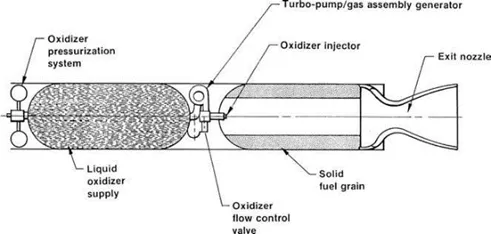
>>>>>>>>>>>>>>>>>>>
An example of a possible value in such a system is this:
Quote:
Copilot Search Branding
Like
Dislike
Composition of Ceres’ Surface
Ceres’ surface is a complex mixture of ultra-carbonaceous material, hydrated minerals, carbonates, organics, iron oxides, and volatiles, with a significant water component Cambridge University Press & Assessment.Key surface materials
Hydrated silicates: Mg-phyllosilicates (magnesium-rich clays) and NH₄‑phyllosilicates (ammonium-bearing clays) dominate, indicating past global aqueous alteration Cambridge University Press & Assessment.
Carbonates: Sodium carbonate (natrite) has been detected locally, suggesting alkaline fluids interacted with the surface Wiley Online Library+1.
Organics: Complex carbon compounds, possibly including hydrocarbons and other organic molecules, have been identified Cambridge University Press & Assessment.
Iron oxides: Present in small amounts, contributing to surface color and mineral diversity Cambridge University Press & Assessment.
Volatiles: Water ice and other volatiles are widespread, with water making up 17–27% of Ceres’ total mass in some form (ice and hydrated minerals) Wikipedia.
Mineralogical context
The average mineralogy shows evidence of advanced alteration under high hydrogen fugacity, consistent with large ice-rich bodies Wiley Online Library+1. This suggests Ceres once hosted a subsurface ocean, which may have frozen and left behind hydrated minerals and salts. Models also indicate possible methane production and clathrate hydrate formation during early freezing Wiley Online Library+1.Global vs. local variation
While the surface is globally homogeneous in composition, local features like impact craters and landslides expose subsurface materials, including sodium carbonate and other salts Wiley Online Library.Implications
The presence of water, organics, and salts makes Ceres a prime target for astrobiological interest, as any subsurface water could potentially support life Wikipedia. Its composition also links it to carbonaceous chondrite meteorites, suggesting it may be a remnant of an early solar system reservoir Cambridge University Press & Assessment.In summary, Ceres’ surface is a water-rich, carbon-rich, and chemically altered body with a mix of clays, carbonates, organics, and oxides, shaped by both early aqueous processes and ongoing volatile interactions.
So, you might build ships that could carry large amounts of water and maybe Ammonia into the inner solar system and be propelled by SiLOX to do it.
Probably you could do the same with the moon Callisto.
Quote:
Copilot Search Branding
Like
Dislike
Silicate Minerals on Callisto
Yes — silicate minerals have been detected on Callisto’s surface. Spectroscopic studies show that the moon’s surface is dominated by crystalline water ice mixed with a dark non-ice component, and this dark material contains silicates STScI+1.What the data shows
Galileo spacecraft observations and later ground-based and space-based spectroscopy revealed the presence of silicates alongside water ice, carbon dioxide, sulfur dioxide, and possibly ammonia www.whillyard.com.The dark material on Callisto’s surface is thought to be a mix of primordial endogenic silicates (from the moon’s interior) and exogenic dust (from impacts with other bodies) STScI.
The exact mineralogy of the dark component is still being refined, but the presence of silicate emission features in infrared spectra confirms their existence STScI.
Why it matters
Silicates are a key indicator of rocky material, and their presence supports the idea that Callisto has a rock–ice mixture in its interior, even though it lacks active volcanism or plate tectonics www.whillyard.com.Understanding the silicate composition helps scientists trace Callisto’s thermal history and the balance between endogenic (internal) and exogenic (impact) processes that have shaped its surface over billions of years STScI.
In summary: Callisto does have silicate minerals, primarily in its dark surface material, and ongoing studies aim to map their distribution and abundances to better understand the moon’s formation and evolution.
Ending Pending
Ending Pending
Last edited by Void (2026-08-04 14:03:49)
Be careful what you wish for.
Offline
Like button can go here
#70 2026-08-04 19:11:52
- Void
- Member
- Registered: 2011-12-29
- Posts: 9,948
Re: AquaWorlds (Water Holding and Water Transporting Methods)
I wish to point out that if SiLOX turns out to be practical, it will be wide spread.
Even little Stony worlds may have very high value after all. Itokawa as an example.
It turns out that at least this stony asteroid does have some primordial water, not just implantation from the sun.
Copilot Search Branding
Like
Dislike
Water on Itokawa
Recent analysis of regolith particles from the S-type asteroid Itokawa — collected by Japan’s Hayabusa mission — has revealed that it contains ancient, primordial water.Water content and isotopic signature
Measurements of hydrogen isotopic composition (δD) in low-calcium pyroxene grains from Itokawa show values of −79‰ to −53‰, which match those found in chondritic meteorites, achondrites, and terrestrial rocks pmc.ncbi.nlm.nih.gov+1. This indicates the water is chemically and isotopically similar to early solar system materials.The minerals themselves contain 698 to 988 parts per million (ppm) water by weight, after accounting for water loss due to heating from parent body processes and impacts pmc.ncbi.nlm.nih.gov. This means the bulk silicate Itokawa parent body originally had 160 to 510 ppm water.
Implications for planetary water
Itokawa formed interior to the snow line in the early solar system, where water ice would not have been stable. The presence of water in its minerals suggests that volatiles were incorporated during formation or delivered later. The study suggests that asteroids like Itokawa could have been a significant source of water for the early Earth and other terrestrial planets — potentially supplying up to 0.5 Earth’s oceans worth of water during planetary formation pmc.ncbi.nlm.nih.gov+1.Why it matters
This finding is important because:It shows that S-type asteroids, once thought to be dry, can carry measurable water.
It supports models where water-rich asteroids delivered volatiles to the inner solar system.
It provides direct evidence from a well-characterized asteroid sample, unlike most previous studies that relied on meteorites.
In short, Itokawa is not just a dry asteroid — it carries ancient, primordial water that could have played a role in the water budget of early Earth pmc.ncbi.nlm.nih.gov+1.
It seems that from what I have seen Hydrogen is easy to extract from regolith with heat and it bonding to Oxygen.
Carbon tends to be harder to get. Nitrogen would need importation I expect.
But the point is you could build a whole civilization primarily on the materials of Itokawa and actually fly it somewhere if you wanted to, using SiLOX.
That is about it.
I'm done.
Ending Pending
Last edited by Void (2026-08-04 19:16:46)
Be careful what you wish for.
Offline
Like button can go here
#71 2026-08-08 08:43:48
- Void
- Member
- Registered: 2011-12-29
- Posts: 9,948
Re: AquaWorlds (Water Holding and Water Transporting Methods)
OK, I have what I consider an important question: "What AU would a circular orbiting spacecraft with an orbit with twice the time period of Mars be?"
Copilot Search Branding
Like
Dislike
AU of a Circular Orbit with Twice Mars’s Orbital Period
To find the semi-major axis (radius for a circular orbit) of a spacecraft whose orbital period is twice Mars’s orbital period, we use Kepler’s Third Law:T
2
∝
a
3
For orbits around the same central body (the Sun), this becomes:T
2
a
3
=
constant
Step 1: Mars’s orbital period
Mars’s orbital period is about 687 Earth days (1.88 Earth years).
Twice that is:T
spacecraft
=
2
×
687days
=
1374days
Step 2: Convert to years
T
spacecraft
=
1374
365.25
≈
3.765years
Step 3: Apply Kepler’s Third Law
Kepler’s law in AU units is:a
3
=
T
2
where
T
is in years and
a
is in AU.a
3
=
(
3.765
)
2
≈
14.176
Step 4: Solve for
a
a
≈
14.176
3
≈
2.42AU
Final Answer
A circular orbit with twice Mars’s orbital period would have a semi-major axis of about 2.42 AU from the Sun.Interpretation:
This is slightly farther out than Mars’s orbit (1.52 AU) but much closer than Jupiter’s (5.2 AU). Such an orbit would be well within the asteroid belt and near the outer edge of the inner solar system. Wikipedia+1
Query: "What does "Co-orbital" Mean?"
Quote:
Like
Dislike
Co-orbital refers to two or more celestial bodies that share, or nearly share, the same orbit around a central body, typically in a 1:1 orbital resonance.
In astronomy, a co-orbital configuration occurs when two or more objects, such as planets, moons, or asteroids, orbit at the same or very similar distance from a primary body, resulting in a 1:1 mean-motion resonance
Wikipedia
Wikipedia
+1
. This means the objects have nearly identical orbital periods and maintain specific relative positions due to gravitational interactions
grokipedia.com
grokipedia.com
+1
.Types of Co-Orbital Configurations
Trojan orbits: Objects librate around the stable Lagrangian points L4 or L5, located 60° ahead of or behind a larger body. Jupiter’s Trojan asteroids are a well-known example
Wikipedia
Wikipedia
+1
.
Horseshoe orbits: Objects oscillate around points opposite the primary body, forming a horseshoe-shaped path. Saturn’s moons Janus and Epimetheus share such an orbit, exchanging positions periodically
grokipedia.com
grokipedia.com
.
Quasi-satellites: These appear to orbit a planet retrograde but are actually in a resonant heliocentric orbit, temporarily mimicking a satellite
grokipedia.com
grokipedia.com
.
Co-orbital arrangements are generally stable over short timescales but can be influenced by perturbations from other bodies, making long-term stability variable
grokipedia.com
grokipedia.com
. They provide valuable insights into planetary dynamics, asteroid populations, and potential exoplanetary systems
grokipedia.com
grokipedia.com
.
In simple terms, co-orbital objects “share the same orbit” without colliding, maintaining a delicate gravitational balance that allows them to coexist in the same orbital path around a central body
The Free Dictionary
The Free Dictionary
.
So, how about a "Ring of Perls" in the asteroid belt at 2.42 AU, where each member of the ring is co-orbital with the others.
Summary of Quotes:
Final Answer
A circular orbit with twice Mars’s orbital period would have a semi-major axis of about 2.42 AU from the Sun.In simple terms, co-orbital objects “share the same orbit” without colliding, maintaining a delicate gravitational balance that allows them to coexist in the same orbital path around a central body
I am seeking to know if this could have a value. Here I am expecting that Deimos/Phobos/Mars will be refueling locations.
These might be worlds where small populations might live, perhaps as they would be in a ring, they would be socially compatible with each other.
I am thinking that these stations could be useful for accessing major asteroid resources: https://en.wikipedia.org/wiki/List_of_e … _asteroids
Image Quote: 
Vesta is rather close to the 2.42 AU, and most icy or carbonaceous asteroids of major size are from about 2.7 AU to 3.1 AU.
If each major platform might have 1000 people and many robots, even so a set of such stations co-orbital might be one for each Mars day. (Just a wild number).
So then 687,000 people in this ring of co-orbital stations at 2.42 AU from the sun.
A Starship in current thinking could support 100 people for many months, so you could have 100 people moving on a Starship from one such station to another quite often. So, people could perhaps be likely to find a station where they are compatible with the inhabitants.
The amount of ISP? needed may be relatively small.
I anticipate that mining facilities on various asteroids would send materials to these stations for exchange for other things they may recieve.
Query; "How bright would the sunlight be at 2.42 AU"
Quote:
Copilot Search Branding
Like
Dislike
Sunlight Brightness at 2.42 AU
At 2.42 astronomical units (AU) from the Sun, the sunlight would be about 18% of the brightness you experience on Earth.Why this is the case
The inverse square law states that the intensity of light (and thus brightness) decreases with the square of the distance from the source. Since 1 AU is the average Earth–Sun distance, the brightness ratio is:Brightness ratio
=
1
(
distance in AU
)
2
For 2.42 AU:Brightness ratio
=
1
(
2.42
)
2
≈
1
5.8564
≈
0.1707
That means the Sun would appear roughly 17–18% as bright as it does from Earth TimeAndDate.What this looks like
Visual appearance: The Sun would be noticeably smaller in the sky and much dimmer, but still visible as a bright disk if you could see it directly (without damaging your eyes).Atmospheric effects: If you were on a planet or moon at that distance, the atmosphere would further reduce the light reaching the surface, but the 18% figure is the direct solar irradiance without atmospheric filtering.
Comparison: At 1.5 AU (Mars’ average distance), sunlight is about 44% of Earth’s brightness; at 2.42 AU, it’s even less.
In short: At 2.42 AU, sunlight would be about 18% as bright as on Earth, making it significantly dimmer but still bright enough to see the Sun directly in daylight. SunCalc
These "Main Stations" would not be doing much thrusting, so concentrating mirrors could easily make solar energy useful at this distance from the sun.
So, these stations might be for finer manufacturing, and the mining towns on asteroids may do more of the basic industry.
Elsewhere, Calliban has had a very interesting idea: https://newmars.com/forums/viewtopic.ph … 95#p240795
Quote:
Previously, we have discussed the option of terraforming Mars by firing packages of ice into its upper atmosphere.
And such an activity might be supported from the "Main Stations" that i have been suggesting in this post.
Ir might be done precisely as Calliban has suggested, or it may be that elliptical stations that are in a 1:1 orbit of Mars may receive these from the "Main Stations" by way of robotic electric rockets.
Well, someone with a bigger brain might help me correct this. It is not quite what I expected:
Query: "With an elliptical orbit with an aphelion at 2.42 AU that is 1:1 relationship to Mars orbital period have for the AU of the peri perihelion?" Quote:
Copilot Search Branding
Like
Dislike
Perihelion Distance for a 1:1 Orbital Period Object at 2.42AU Aphelion
We can solve this using Kepler’s third law and the definition of orbital eccentricity.Step 1: Recall Kepler’s third law
For objects orbiting the Sun, the square of the orbital period
T
(in years) is proportional to the cube of the semi-major axis
a
(in AU):T
2
=
a
3
If the orbital period is the same as Mars’s, then:a
3
=
(
1.52
)
3
⇒
a
≈
1.52AU
This is the semi-major axis for a 1:1 period orbit.Step 2: Relate semi-major axis to perihelion and aphelion
For an ellipse:a
=
r
p
+
r
a
2
where
r
p
is the perihelion distance and
r
a
is the aphelion distance.We are given:
r
a
=
2.42AU
,
a
=
1.52AU
Substitute into the equation:1.52
=
r
p
+
2.42
2
Multiply both sides by 2:3.04
=
r
p
+
2.42
Subtract 2.42:r
p
=
3.04
−
2.42
=
0.62AU
Step 3: Interpretation
The perihelion distance is 0.62AU from the Sun. This is well inside Mars’s orbit, so the object would be much closer to the Sun than Mars at any point in its orbit.Final Answer:
Perihelion distance ≈ 0.62AU for a 1:1 orbital period object with aphelion at 2.42AU.
I asked for the AU of Venus:
Like
Dislike
The average distance of Venus from the Sun is approximately 0.72 astronomical units (AU), which is equivalent to about 67 million miles (108 million kilometers)
NASA
NASA
+2
Venus has a 224.7 days long year.
Quote:
Copilot Search Branding
Like
Dislike
A Mars year lasts approximately 687 Earth days. This is due to Mars's greater distance from the Sun, resulting in a longer orbital period compared to Earth
Universe Today
Universe Today
+3
. In terms of Martian days, there are about 668 sols in a Mars year
The Planetary Society
T
224.7 * 3 = 674.1
So, a rather dirty 3:1 relationship between Venus and Mars.
You might drop ice from a elliptical orbit station to Mars, but Callibans idea may be more energy efficient.
But now it looks as though spacecraft ejected from such a ship might aerobrake to Venus.
It is also likely that you could drop ice from such a station to collide with a shadowed crater on our Moon.
I guess a crewed spaceship might be able to join to an elliptical station and be hosted there to travel to another location in the network.
I am not saying this is the thing to do, rather this is something to consider.
Good chances there can be better plans.
Ending Pending
Last edited by Void (2026-08-08 09:53:40)
Be careful what you wish for.
Offline
Like button can go here
#72 2026-08-08 16:34:16
- Void
- Member
- Registered: 2011-12-29
- Posts: 9,948
Re: AquaWorlds (Water Holding and Water Transporting Methods)
Continuing with the materials from my just previous post,
I am interested in an orbit that travels into the asteroid belt to about 2.42 AU at aphelion and that its other end perihelion will be 1.52 AU in approximate alignment with Mars and antenatally the sun/Mars L3 position in the solar system.
Query: "How long would a year be for a space station that orbited from 2.42 AU to 1.52 AU?"
Quote:
Copilot Search Branding
Like
Dislike
Orbital Year for a Space Station Between 2.42 AU and 1.52 AU
To find the orbital period of a space station whose orbit ranges from 2.42 AU to 1.52 AU, we use Kepler’s Third Law:T
2
∝
a
3
Here:T
= orbital period in yearsa
= semi-major axis in AU (average of the two distances)The proportionality constant is 1 for orbits around the Sun.
Step 1: Calculate the semi-major axis
a
=
2.42
+
1.52
2
=
1.97AU
Step 2: Apply Kepler’s Third LawT
=
a
3
=
(
1.97
)
3
T
≈
7.64
≈
2.76years
Step 3: Interpret the result
A space station with an average orbital distance of 1.97 AU from the Sun would complete about 2.76 Earth years for one full orbit.Note: This assumes the central body is the Sun and the orbit is nearly circular. If the central body is different (e.g., a planet), you would adjust the constant in Kepler’s law to match that body’s mass Calculator Academy+1.
Final Answer: ≈ 2.76 Earth years for a full orbit at an average distance of 1.97 AU from the Sun.
2.76 * 365 = 1,007.4 Earth days.
A Mars year is about 687 Earth days long. 1.5 * 687 = 1,030.5
So the results are close. Some tuning is desired I believe.
So, Mars has a Sun/Mars L3 Location.
I believe that the space station would cross Mars perihelion for one orbit and then the L3 on the next orbit. Its aphelion would be in the asteroid belt at about 2.42 AU.
So, the station would get 1 opportunity to dump water ice and other materials onto Mars once every 2 orbits or every 5.2 years.
I imagine this as a station as a giant set of containers in which ocean life could be fostered. But every 5.2 years most of the water would be flowed into a very large bag to freeze. An explosive device might be placed inside of it. It would be sent to collide with Mars and the explosive charge would be set off just before hitting the atmosphere.
The water on the station would come from the Asteroid Belt, and would be sent to the station using very efficient electric means such as mass driver first followed by some sort of electric plasma propulsion method.
This sort of based on thinking from Calliban, but of course I have twisted it a bit.
We could call the Sun/Mars L3 False Mars or Newmars!.
So, this big station with the 2.42 to 1.52 orbit might be a platform that Starships could join with to go between Mars and the asteroid belt.
Maintaining synchronization of this system will require some propulsive power and navigation as gravity of objects in the solar system will perturb these orbits.
>>>>>>>>>>>>
A similar system of some sort might be arranged to dump water ice and Carbon onto our Moons shadowed craters.
Ending Pending
Last edited by Void (2026-08-08 17:03:56)
Be careful what you wish for.
Offline
Like button can go here
#73 2026-08-09 07:38:42
- Void
- Member
- Registered: 2011-12-29
- Posts: 9,948
Re: AquaWorlds (Water Holding and Water Transporting Methods)
Of Mars Crossing Asteroids, the "Outer Grazers" look interesting to me.
https://en.wikipedia.org/wiki/List_of_M … or_planets
Example: https://en.wikipedia.org/wiki/132_Aethra Large and Metal, and more easily accessed than 16 Psyche, I expect.
Example: https://en.wikipedia.org/wiki/512_Taurinensis Large, lower inclination but stony.
They often have Perihelion's near the orbit of Mars, and Aphelion's at about 3.0 AU, but in some cases less than that.
That puts them between two places where volatiles can be had.
most of them are stony, but some are metal or C types.
The fact that they may dip towards the orbit of Mars and pass near major icy/C asteroids in the main belt makes them attractive.
The solar energy at times will be close to that of Mars, which could have some value.
Ending Pending
Last edited by Void (2026-08-09 07:50:06)
Be careful what you wish for.
Offline
Like button can go here
#74 2026-08-13 15:49:42
- Void
- Member
- Registered: 2011-12-29
- Posts: 9,948
Re: AquaWorlds (Water Holding and Water Transporting Methods)
Scott Manley produced an interesting video: https://www.youtube.com/watch?v=0EczgLYS7I4
Quote:
Using Water As Rocket Fuel - Is This The Future of Space Exploration?
Scott Manley
Scott Manley
Steam is mentioned and put down. Rather these are means of propulsion involving water such as electrolysis and then burning, or there is even a thruster that runs on Oxygen and sounded like it has a high ISP. But the technology is new, and of course the thrusters may be subject to damage from reactive Oxygen.
Anyway, I have long wanted a method to use Oxygen on its own as a propellant, so I was happy to hear of it.
Ending Pending
Query: "Oxygen Hall Thruster?"
Quote:
Copilot Search Branding
Like
Dislike
Oxygen-Fuelled Hall Effect Thrusters
An oxygen-fuelled Hall Effect Thruster (HET) is a type of electric propulsion device that uses oxygen gas as its propellant instead of the more common xenon. It operates on the same basic principle as a standard Hall thruster — using a magnetic field to confine electrons, ionizing the propellant, and accelerating the resulting ions to produce thrust — but with oxygen’s unique chemical and physical properties.How it Works
In a Hall thruster, a discharge channel generates a plasma from the propellant. Electrons are confined axially by a magnetic field, which increases their density and allows them to efficiently ionize neutral atoms. The ions are then accelerated by an electric field toward the anode, producing thrust. A neutralizer emits electrons to prevent the ion beam from charging the spacecraft Wikipedia.For oxygen, the ionization process is more complex because oxygen is a diatomic molecule (O₂) and can form multiple ion species (O⁺, O₂⁺, O₃⁺, etc.). This affects plasma density, ionization efficiency, and exhaust characteristics.
Performance with Oxygen
Experimental studies show that oxygen-fuelled HETs have lower propellant utilization (around 45%) compared to xenon-based thrusters, leading to lower specific impulse (about 1,000 s) and lower thrust efficiency (~9%) J-Stage. This is due to:Lower ionization efficiency of oxygen compared to noble gases.
Higher energy losses from molecular dissociation and recombination.
Greater plasma-wall interactions, especially with shorter channel lengths.
Optimal channel length for oxygen is longer than for xenon (e.g., ~12–13 mm) to allow sufficient ionization before ions are accelerated Spiral+1. Shorter channels can limit ionization, while very long channels increase energy losses.
Material Considerations
Oxygen is highly reactive, so thruster components must resist oxidation:Channel walls: Boron Nitride (BN) and BN–AlN composites reduce secondary electron emission, improving efficiency J-Stage.
Anodes: Tungsten is common but can form insulating oxide layers; alternative materials are being explored to prevent long-term degradation Spiral.
Advantages
In-situ propellant: Oxygen can be produced from water via electrolysis, making it attractive for lunar or Martian missions where water ice is available Spiral.Reduced launch mass: Avoids the need to carry heavy noble gas propellant.
Challenges
Lower efficiency and specific impulse compared to xenon HETs.Complex plasma chemistry requiring careful control of ion species.
Material compatibility with oxygen plasma.
Applications
Oxygen-fuelled HETs are envisioned for:Lunar and Martian surface missions using in-situ propellant production.
Water electrolysis-based propulsion systems for long-duration space missions.
Demonstration of closed-loop propellant cycles in space.
In summary, oxygen-fuelled Hall thrusters are a promising but challenging technology for future space missions, offering the potential for sustainable, in-situ propellant use, but requiring advanced materials and plasma control to match the performance of xenon-based systems Spiral+1.
https://www.sciencedirect.com/science/a … 6522006713
Quote:
Acta Astronautica
Volume 203, February 2023, Pages 268-279
Acta Astronautica
Research paper
An oxygen-fuelled Hall Effect Thruster: Channel length, ceramic walls and anode material experimental analyses
Author links open overlay panel
J.M. Tejeda
, A. Knoll
Early days for this technology, I expect, but Oxygen can be gotten almost anywhere in the regions that humans may some day visit.
Ending Pending
Last edited by Void (2026-08-13 16:02:13)
Be careful what you wish for.
Offline
Like button can go here
#75 2026-08-13 20:28:03
- Void
- Member
- Registered: 2011-12-29
- Posts: 9,948
Re: AquaWorlds (Water Holding and Water Transporting Methods)
Excellent work in another topic (th)! https://newmars.com/forums/viewtopic.ph … 22#p240922
I have in mind a "Habitable Radiator" to work with something similar.
While seems desirable to pass photons though windows into a growth chamber, I will not do that for this, or if it is done with will be only a part of the energy process.
A "Habitable Radiator" in this case can be a sort of bottle or can that can hole liquid water or steam.
A concentrating mirror will focus sunlight onto a CO2 Boiler, I presume "Super Critical" in pressurization. The Turbine being between the boiler and the CO2 Condenser, and the CO2 Condenser being in that bottle or can filled at least in part with water.
Water in the bottle or can to be collected as a liquid and squirted onto the CO2 Condenser.
The habitable radiator is actually a water reservoir that contains water. The water is a propellant. Various ways described in the previous post can be used.
To be conservative is to think it unlikely that Phobos will contain water ice, although some optimists think it may.
But by bringing Hydrogen from Mars and combining it with Oxygen from the Martian moons this device could be filled.
A similar vision might work for the vision of (th). Oxygen from our Moon. Hydrogen from Earth. To make it more transportable then Methane from Earth, split the Methane and transport the Carbon to the Moon where it will be wanted, and then combine Lunar Oxygen with Earth Hydrogen to make water to fill this thing. But it may turn out that the Moon has enough Hydrogen for it.
The water will make excellent radiation shielding, and at times could support aquiculture.
In the mode where you split water into Oxygen and Hydrogen, probably the Hydrogen can provide thrust using a high temperature heat process. And the Oxygen the to be used in Hall Thrusters.
The methods may work to bring massive amounts of water from the outer asteroid belt and further out to the more inner solar system.
Ending Pending
Last edited by Void (2026-08-13 20:40:41)
Be careful what you wish for.
Offline
Like button can go here