New Mars Forums
You are not logged in.
- Topics: Active | Unanswered
Announcement
Pages: 1
#1 2025-02-13 12:23:49
- tahanson43206
- Moderator
- Registered: 2018-04-27
- Posts: 26,280
Mars Sky
This new topic is dedicated to the memory of Palomar who participated in the NewMars forum over a number of years.
https://www.facebook.com/beyondoursight … p2c24fjy7R
It is possible the video is available from a source other than Facebook, and if a member finds an alternative link please post it.
The video at the link above shows a panorama from one of the on site rovers, with the Milky Way prominent overhead.
The Earth has very few Dark Sky locations left.
At the moment, and for a little while yet, Mars is a good Dark Sky site.
here's another shorter link: https://www.facebook.com/watch/?v=1248463009591225
***
Palomar used two id's while she was here:
User list for Palomar*
Username Title Posts Registered
Palomar Member 9,734 2002-05-30
Palomar7 Member 81 2017-12-20
Pages:1
(th)
Offline
Like button can go here
#2 2025-02-13 12:24:22
- tahanson43206
- Moderator
- Registered: 2018-04-27
- Posts: 26,280
Re: Mars Sky
this post is reserved for an index to posts that may be contributed by NewMars members over time.
(th)
Offline
Like button can go here
#3 2026-07-28 08:29:46
- tahanson43206
- Moderator
- Registered: 2018-04-27
- Posts: 26,280
Re: Mars Sky
This post is the beginning of a series I am planning to study the sky above Mars at midnight.
The purpose of this series is to obtain and to publish the coordinates for images of the sky to be taken at midnight of the instant of the beginning of each of the 24 months of the Mars business calendar.
The opening skyscape is the one above the surface of Mars at midnight at the equator on the moment when each new Mars Year begins.
As this series opens, I am not clear on when that instant occurs, but I ** am ** confident human astronomers have chosen the moment so all ** we ** here in NewMars.com forum is to understand and publish that information.
Once that coordinate is known, then the remaining coordinates will be found 15 celestial degrees from that point, until all 360 degrees are completed.
Once those coordinates are known, then it should be possible to find photographs of the related sections of sky.
All NewMars members with an interest in astronomy are welcome to assist with the development of this topic.
The primary opening question is: Where are we looking in the sky, when we are looking up from the surface of Mars at midnight of the beginning of year 39.
We are currently closing in on the end of Year 38.
(th)
Offline
Like button can go here
#4 2026-07-28 18:17:26
- Calliban
- Member
- From: Northern England, UK
- Registered: 2019-08-18
- Posts: 4,437
Re: Mars Sky
The peaks of the Tharsis volcanoes are above the atmospheric dust layer. They would be excellent places for optical telescopes. For IR telescopes, we would need to be above the atmosphere entirely. Carbon dioxide is well known for scattering IR light. Phobos would be a good place for IR telescopes. It is tidally locked, so the side opposite Stickney always faces away from Mars.
"Plan and prepare for every possibility, and you will never act. It is nobler to have courage as we stumble into half the things we fear than to analyse every possible obstacle and begin nothing. Great things are achieved by embracing great dangers."
Offline
Like button can go here
#5 2026-09-29 08:34:46
- tahanson43206
- Moderator
- Registered: 2018-04-27
- Posts: 26,280
Re: Mars Sky
If this image link works, it will show Earth as seen from Mars.
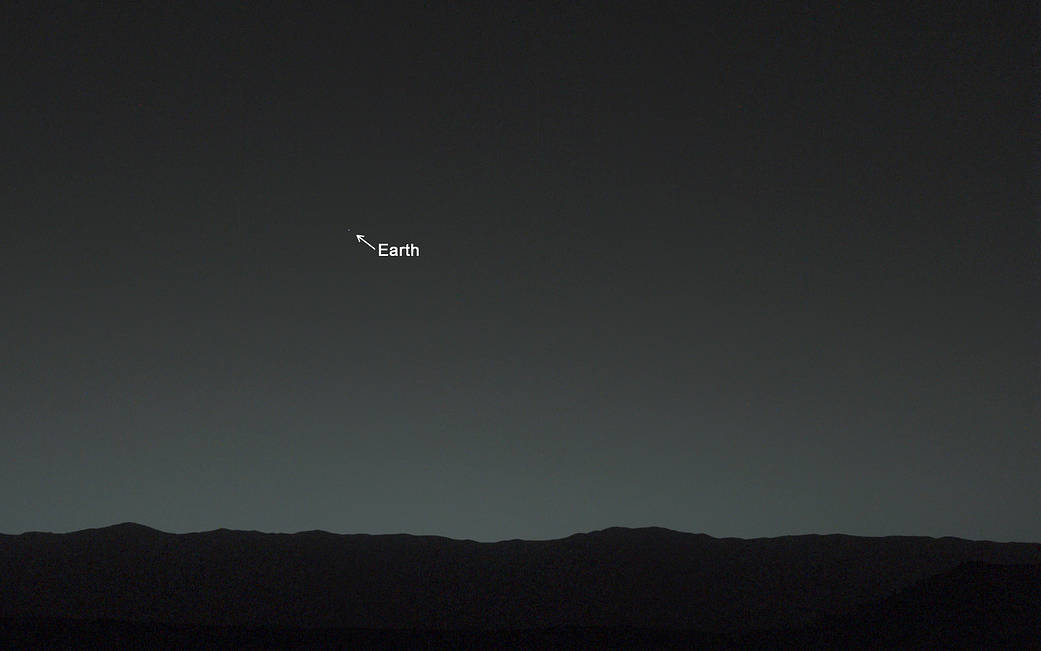
This image came up in discussion of how to create the Business Calendar for Mars for Mars Year 39.
(th)
Offline
Like button can go here
Pages: 1