New Mars Forums
You are not logged in.
- Topics: Active | Unanswered
Announcement
#2276 2026-04-13 15:05:23
- GW Johnson
- Member
- From: McGregor, Texas USA
- Registered: 2011-12-04
- Posts: 6,266
- Website
Re: Starship is Go...
Both SpaceX and Blue Origin are companies that first and foremost have to make a profit, not lose money. SpaceX was profitable with Falcon-9/-Heavy, but has bet its future "farm" on rideshares with Starship/Superheavy. They still have their hands full just trying to make Starship/Superheavy work at all as a transport to LEO. Blue Origin has its hands full trying to make New Glenn into a profit center. Coming up with a contracted NASA lunar lander is a smaller piece of that overall larger puzzle, for both of them. I cannot fault their priorities.
Of the two, I suspect Blue Origin might be a little closer to satisfying the NASA lander contract. That is because SpaceX bit off a much-larger piece of "iffy" technology advancement, trying to do the all-reusable Starship/Superheavy. Plus, my reading of the events suggests the ratio of Musk time to real time (3 to 4) is a bit bigger than Bezos's ratio (2 to 3).
The time from lunar rendezvous being the adopted Apollo architecture in 1964 or 1965, to the Apollo-9 checkout of the Apollo CSM with its LM in LEO in 1969, was only 4 or 5 years! THAT is how long it took Grumman to come up with a workable lander, under a crash program where cost was no object. And higher risk-taking by NASA with its astronauts was "normal".
Artemis is NOT a crash program where cost is no object, and NASA (I hope) has learned not to take such extreme risks with its astronauts! Expecting SpaceX and Blue Origin to come up with anything workable as a lunar lander in only 4 years or so, is actually quite unreasonable! SpaceX started only 2-3 years ago, and Blue Origin "in earnest" only last year.
You CANNOT count the proposal and contract-win time, as real hardware development time! That only sets the concept they will focus upon. REAL development only starts AFTER contract award. And coming up with a concept has NOTHING to do with its development into something real! That's just life. Ugly, ain't it?
NASA projecting schedules that have no reality tells me there is no one there anymore that understands the difference between company time and real time, and that the ratio varies from company to company. I would expect that, after all the former traditional contractors agglomerated into monopolies that no longer really compete (with the government making no anti-trust moves to stop it). THAT is why "new space" has had such a hard time getting established. The game was rigged.
GW
Last edited by GW Johnson (2026-04-13 15:18:04)
GW Johnson
McGregor, Texas
"There is nothing as expensive as a dead crew, especially one dead from a bad management decision"
Offline
Like button can go here
#2277 2026-04-23 17:29:48
- SpaceNut
- Administrator
- From: New Hampshire
- Registered: 2004-07-22
- Posts: 30,840
Re: Starship is Go...
SpaceX targets Starship flight 12 as NASA eyes lunar-ready refueling demos
SpaceX is gearing up for Starship Flight 12, a mission that could mark a turning point in the company’s effort to prove orbital refueling works at the scale NASA needs for its Artemis lunar lander. As of late April 2026, the flight has not received a public launch date, but the stakes are already clear: until SpaceX can reliably transfer hundreds of tons of propellant between vehicles in orbit, no astronaut will ride Starship to the Moon.
The Artemis program’s entire lunar landing architecture depends on this capability. NASA’s published mission overview for Artemis III and IV describes a chain of events that must unfold before a crewed touchdown: SpaceX launches a propellant storage depot into Earth orbit, sends up a series of tanker flights to fill it, and then fuels a Human Landing System variant of Starship for its trip to the Moon. Only after that sequence is complete can Starship HLS leave orbit, rendezvous with NASA’s Orion capsule near the Moon, descend to the surface, and return crew safely. Orbital refueling is not an add-on. It is the load-bearing wall of the entire plan.What orbital refueling actually requires
The concept sounds simple: pump propellant from one spacecraft to another. In practice, it is one of the hardest unsolved problems in spaceflight at this scale. Liquid methane and liquid oxygen, Starship’s propellants, must be kept at cryogenic temperatures while being transferred between vehicles traveling at roughly 17,000 miles per hour. Boil-off, where warming fuel turns to gas and becomes unusable, is a constant threat. The two spacecraft must dock precisely, maintain stable orientation, and manage fluid dynamics that behave unpredictably in microgravity.NASA’s architecture calls for multiple tanker flights to fill a single depot, meaning the process must work not once but repeatedly and reliably. The agency has not publicly disclosed how many tanker launches are required or what failure rate it considers acceptable. Those parameters will shape whether the refueling campaign takes weeks or months, and whether a single tanker mishap can delay an entire Artemis mission.
SpaceX conducted propellant transfer experiments during earlier Starship test flights, including internal fluid movement tests that demonstrated basic plumbing in orbit. But transferring propellant between two separate vehicles at the volumes Starship HLS demands has not yet been demonstrated. Flight 12 is widely expected to push closer to that goal, though SpaceX has not confirmed the mission’s specific objectives.
The FAA’s incremental approval process
Every Starship flight must clear the Federal Aviation Administration’s regulatory process, and that process is deliberately incremental. The FAA evaluates each mission profile individually under the National Environmental Policy Act, examining trajectories, airspace closures, debris footprints, and safety corridors for aviation and maritime traffic. A change in reentry angle, landing zone, or on-orbit duration can trigger a new environmental assessment.
The agency’s stakeholder engagement portal for the Starship program hosts the environmental assessments and Finding of No Significant Impact documents that authorize specific flights from the Boca Chica launch site in South Texas. A tiered environmental assessment published for Flight 9 in 2025 illustrates the pattern: it addressed updated airspace closures, aircraft hazard areas, and overflight risks specific to that mission’s profile. Subsequent flights have followed the same framework, with each new configuration requiring its own review or falling within an already permitted envelope.For Flight 12, the regulatory picture is not yet public. If SpaceX plans extended on-orbit operations, ship-to-ship docking, or propellant transfer maneuvers that differ from previously cleared profiles, the FAA would need to evaluate those changes before granting a license. The agency operates on its own timeline, independent of SpaceX’s development pace or NASA’s Artemis schedule.
Artemis III and the schedule question
Artemis III, the mission intended to return astronauts to the lunar surface for the first time since Apollo 17 in 1972, has been a moving target for years. NASA continues to describe Starship HLS as the lander for that mission, but the agency has not publicly tied a specific Starship test flight number to a firm Artemis launch date. The schedule depends on technical readiness, regulatory approvals, and congressional funding cycles, three variables that rarely align on command.Blue Origin’s separate Human Landing System contract for Artemis V adds competitive pressure but does not change the fundamental requirement for Starship: NASA needs to see orbital refueling work before it commits crew to a mission that depends on it. The agency’s risk tolerance for human spaceflight is shaped by decades of hard lessons, from Challenger to Columbia, and no amount of schedule pressure is likely to shortcut the demonstration campaign.
What NASA has made clear, through its published mission architecture, is that the depot-and-tanker chain is not a stretch goal. It is the baseline design. If orbital refueling proves unreliable, the agency would need to either redesign the lander or adopt an entirely different vehicle, either of which would add years to an already delayed program.
Three actors, three timelines
The real tension in this story sits at the intersection of three organizations operating under different constraints. SpaceX wants to iterate fast, flying as often as possible to retire technical risk through rapid testing. NASA needs those tests to succeed in a specific sequence before it can certify Starship HLS for crew. And the FAA must clear each flight through an environmental review process that was not designed for the cadence SpaceX prefers.Each actor controls a piece of the timeline, and none controls all of it. SpaceX cannot fly without FAA clearance. NASA cannot schedule a crewed landing without verified refueling data. The FAA cannot accelerate reviews without compromising the environmental and safety analysis Congress requires it to perform.
For anyone tracking the Artemis program or the commercial launch industry, the practical guidance is straightforward: watch the FAA’s Boca Chica portal for new tiered assessments tied to upcoming flights, monitor NASA’s mission overviews for updates to the depot-and-tanker architecture, and treat any detailed Flight 12 scenario as provisional until backed by official documentation. The outlines of the lunar landing system are visible in the evidence that exists today. The exact role Flight 12 will play in that story depends on tests yet to fly and approvals yet to be signed.
The issue is the tank that is to receive the fuel / oxidizer is empty or low in internal pressure.
The first of the loads are at the same time being moved and as its move will drop as it exits and begin boiloff and as time goes that internal pressure of boiloff will need venting while still pumping more into the rising pressure and filling. The boil off will also happen as the tank is emptied which may allow the increasing pressure to aid in the push but at some point internal pressure will drop to the equal level of the other tank and will no longer be able to transfer any additional amount.
Offline
Like button can go here
#2278 2026-04-24 08:58:51
- GW Johnson
- Member
- From: McGregor, Texas USA
- Registered: 2011-12-04
- Posts: 6,266
- Website
Re: Starship is Go...
SpaceX uses the boil-off vapors as the tank pressurants, and manages it to desired tank pressure levels by deliberate controlled venting. In addition, they use it for cold-gas attitude thrusters as well.
What they did in the tank-tank test inside the one vehicle, was use the cold gas thrusters to create ullage thrust. And that ullage thrust provides the slight acceleration needed to settle the propellants into the aft tank bottoms, where the pumps can draw a suction on liquid without vapor spaces in it. That ullage thrust also slightly alters the orbital path, so you CANNOT do it that way at a space station.
But it could be done with two vehicles firmly docked together. Which is how they plan to do it, refueling one Starship docked to the other. The acceleration is slight, so you must provide ullage thrust for some period of time (minutes?) before the propellants settle, and continue to provide it all during the pumping operation. It will alter the orbit of the docked pair of vehicles.
GW
Last edited by GW Johnson (2026-04-24 09:00:51)
GW Johnson
McGregor, Texas
"There is nothing as expensive as a dead crew, especially one dead from a bad management decision"
Offline
Like button can go here
#2279 2026-05-01 08:37:34
- GW Johnson
- Member
- From: McGregor, Texas USA
- Registered: 2011-12-04
- Posts: 6,266
- Website
Re: Starship is Go...
This was the headline summary in today's AIAA "Daily Launch" email newsletter:
-----
The Next Web
SpaceX has spent more than $15 billion on Starship
SpaceX has spent more than $15 billion developing its Starship megarocket and is pushing for a launch cadence that would make space access resemble an airline schedule rather than a government programme, Reuters reported on Friday, drawing on the company’s confidential pre-IPO prospectus.
-----
The link was to a Space.com site. I looked at the full article, which was a Reuters article. While Starship has been a drain at a few $billion very year, SpaceX was showing huge profits (several $hundred-billions) until it started acquiring the XAI thing and linking it to Starlink. It recently went negative on profits, but not by all that far. The real budgetary drain has been the acquisitions and AI thing. The article gives cost to orbit numbers for Falcons in the $2700-3000 per kilogram range. The target for Starship-based launch operations is $30-300 per kilogram. It is quite clear that the main role for Starship is to be a to-orbit freighter. But if it really is that cheap to operate, AND refill-on-orbit proves feasible, then sending few to the moon or beyond starts looking quite feasible, too. That has been the vision all along.
GW
Last edited by GW Johnson (2026-05-01 08:39:18)
GW Johnson
McGregor, Texas
"There is nothing as expensive as a dead crew, especially one dead from a bad management decision"
Offline
Like button can go here
#2280 2026-05-04 12:44:43
- GW Johnson
- Member
- From: McGregor, Texas USA
- Registered: 2011-12-04
- Posts: 6,266
- Website
Re: Starship is Go...
I did see one posting on LinkedIn by Steve Yoon of NASA that the scheduled first flight of block 3 Starship/Superheavy is May 12.
GW
GW Johnson
McGregor, Texas
"There is nothing as expensive as a dead crew, especially one dead from a bad management decision"
Offline
Like button can go here
#2281 2026-05-11 23:03:17
- Oldfart1939
- Member
- Registered: 2016-11-26
- Posts: 2,518
Re: Starship is Go...
The earliest NOTAM is now 15 May with a several day launch widow following.
Online
Like button can go here
#2282 2026-05-12 09:12:58
- tahanson43206
- Moderator
- Registered: 2018-04-27
- Posts: 25,697
Re: Starship is Go...
This report indicates May 19th is now the earliest launch date. The article includes some detail about the new version.
https://arstechnica.com/space/2026/05/s … wtab-en-us
Height is 408 feet (124 meters)
(th)
Offline
Like button can go here
#2283 2026-05-14 10:19:38
- GW Johnson
- Member
- From: McGregor, Texas USA
- Registered: 2011-12-04
- Posts: 6,266
- Website
Re: Starship is Go...
From AIAA’s “Daily Launch” email newsletter for Thursday, 14 May, 2026:
SPACENEWS
SpaceX sets date for first Starship version 3 launch
SpaceX has set a date for the long-delayed first launch of its next-generation Starship vehicle, which is critical to the company’s ambitions
SPACE
Will Starship launch from foreign shores? SpaceX 'constantly exploring' options for megarocket liftoff sites
SpaceX just revealed that it's on the hunt for additional launch sites for its Starship megarocket, eyeing locations both inside and beyond
SPACENEWS
SLS to launch without upper stage for Artemis 3
NASA plans to fly the Space Launch System on Artemis 3 without an upper stage as the agency begins to define revised plans for the mission. NASA, in a May 13 update on Artemis 3, said the SLS will launch with an inert “spacer” in place of the Interim Cryogenic Propulsion Stage on the mission. The spacer, being built at Marshall Space Flight Center, will have the same dimensions and interfaces as the ICPS.
-----
My take on these things:
Spacenews article: date is 19 May, 6:30 PM EDT. Or possibly later. Similar suborbital flight to Indian Ocean splashdown as before, no attempted booster recovery. Block 3 booster + block 3 Starship, which are more-or-less a prototype of the production orbital transport version. Starlink simulators to deploy, one or more with imaging capability to examine heat shield. Restart one Raptor in space. Maneuvers during entry. Missing tile test. Basically a reprise of Flight 11, but with a block 3 vehicle.
Space article: SpaceX is adding pads at Canaveral, and looking at purchasing land in Louisiana for another launch site for Starship. SpaceX is also looking at foreign launch sites, but will have to get around ITAR to do that.
Second Spacenews article: Artemis-3 will launch without an ICPS upper stage, but with an inert dummy taking its place. Being only an LEO mission, ICPS is not needed. The core and SRB’s are enough to send the capsule and service module to low orbit, as they did on Artemis-2.
GW
Last edited by GW Johnson (2026-05-14 10:20:39)
GW Johnson
McGregor, Texas
"There is nothing as expensive as a dead crew, especially one dead from a bad management decision"
Offline
Like button can go here
#2284 2026-05-15 15:06:08
- tahanson43206
- Moderator
- Registered: 2018-04-27
- Posts: 25,697
Re: Starship is Go...
Update per Google:
AI Overview SpaceX's next major test flight, Starship's 12th flight test, is scheduled to take place on Tuesday, May 19, 2026.The launch details include:Time: A 90-minute launch window opens at 6:30 p.m. EDT (5:30 p.m. local / 22:30 UTC).Location: SpaceX's Starbase facility in Boca Chica, Texas.Vehicle: Starship Version 3 (Booster 19 and Ship 39).Webcast: You can watch the live coverage on the SpaceX Launches page or the SpaceX YouTube Channel.If delays occur due to weather or technical issues, a backup date is available on May 20, 2026.
(th)
Offline
Like button can go here
#2285 2026-05-16 16:37:34
- GW Johnson
- Member
- From: McGregor, Texas USA
- Registered: 2011-12-04
- Posts: 6,266
- Website
Re: Starship is Go...
This one is basically a reprise with the new block 3 vehicle of Flight 11 done successfully with the block 2 vehicle. Given the past track record (of everybody, not just SpaceX, when flying new configurations), expect some shortfalls or failures.
GW
GW Johnson
McGregor, Texas
"There is nothing as expensive as a dead crew, especially one dead from a bad management decision"
Offline
Like button can go here
#2286 2026-05-16 17:37:55
- SpaceNut
- Administrator
- From: New Hampshire
- Registered: 2004-07-22
- Posts: 30,840
Re: Starship is Go...
Somethings that are different.
The world's biggest rocket: How SpaceX's new Starship 'V3' differs from its predecessors
The Ship upper stage has a list of upgrades as well, including plumbing and wiring layout changes in its own aft section, a larger propellant tank and an improved reaction control system. SpaceX also made significant improvements to how Ship handles cryogenic fuels, adding four docking ports along Starship's body and a dedicated system for managing cryogenic propellant in zero-g.
Storing the spacecraft's cryogenic propellants and transferring them between vehicles is a capability SpaceX has yet to attempt, but it's a critical technology for Starship's design.
V3 stands about 5 feet (1.5 meters) taller than previous Starship builds and packs a much heavier punch. Both stages —Super Heavy and Ship — have been equipped with SpaceX's new Raptor 3 engine — sleeker, more powerful and more reliable upgrades over the previous Raptor 2. For the Super Heavy booster, that means 33 engines firing with a combined thrust of over 18 million pounds at liftoff.
The V3 Super Heavy has three grid fins — lattice-like structures that help it steer back to Earth for pinpoint touchdowns — rather than the previous four, according to a May 12 SpaceX update. Each one is about 50% larger than before and situated lower on the booster's trunk to avoid heat from "hot-fire" staging procedures when separating from its Ship counterpart in flight
SpaceX unveils sweeping Starship V3 upgrades ahead of May 19 launch
Here is an explicit, broken-down list of the key changes, first starting with the changes to Super Heavy V3:
Grid Fin Redesign: Reduced from four fins to three. Each fin is now 50% larger and stronger, repositioned for better catching and lifting performance. Fins are lowered on the booster to reduce heat exposure during hot staging, with hardware moved inside the fuel tank for protection.
Integrated Hot Staging: Eliminates the old disposable interstage shield. The booster dome is now directly exposed to upper-stage engine ignition, protected by tank pressure and steel shielding. Interstage actuators retract after separation.
New Fuel Transfer System: Massive redesign of the fuel transfer tube—roughly the size of a Falcon 9 first stage—enables simultaneous startup of all 33 Raptors for faster, more reliable flip maneuvers.
Engine Bay / Thermal Protection: Engine shrouds removed entirely; new shielding added between engines. Propulsion and avionics are more tightly integrated. CO₂ fire suppression system deleted for a simpler, lighter aft section.
Propellant Loading Improvements: Switched from one quick disconnect to two separate systems for added redundancy and reduced pad complexity.
Next, we have the changes to Starship V3:Completely Redesigned Propulsion System: Clean-sheet redesign supports new Raptor startup, larger propellant volume, and an improved reaction control system while reducing trapped or leaked propellant risk.
Aft Section Simplification: Fluid and electrical systems rerouted; engine shrouds and large aft cavity deleted.
Flap Actuation Upgrade: Changed from two actuators per flap to one actuator with three motors for better redundancy, mass efficiency, and lower cost.
Faster Starlink Deployment: Upgraded PEZ dispenser enables quicker satellite release.
Long-Duration Spaceflight Capability: New systems for long orbital coasts, orbital refueling, cryogenic fluid management, vacuum-insulated header tanks, and high-voltage cryogenic recirculation.
Ship-to-Ship Docking + Refueling: Four docking drogues and dedicated propellant transfer connections added to support in-space refueling architecture.
Avionics Upgrades: 60 custom avionics units with integrated batteries, inverters, and high-voltage systems (9 MW peak power). New multi-sensor navigation for precision autonomous flight. RF sensors measure propellant in microgravity. ~50 onboard camera views and 480 Mbps Starlink connectivity for low-latency communications.
Next are the changes to the Raptor 3 Engine:Higher Thrust: Sea-level Raptors increased from 230 tf (507k lbf) to 250 tf (551k lbf); vacuum Raptors from 258 tf (568k lbf) to 275 tf (606k lbf).
Lower Mass: Sea-level engine mass reduced from 1630 kg to 1525 kg.
Simpler Design: Sensors and controllers integrated into the engine body; shrouds eliminated; new ignition system for all variants. Results in ~1 ton of vehicle-level weight savings per engine.
Finally, the upgrades to Launch Pad 2 are as follows:Faster propellant loading via larger farm and more pumps.
Chopstick improvements: shorter arms, electromechanical actuators (replacing hydraulic) for reliability.
Stronger quick-disconnect arm that swings farther away.
Redesigned launch mount for better load handling and protection.
New bidirectional flame diverter eliminates post-launch ablation and refurbishment.
Hardened propellant systems with separated methane/oxygen lines and protected valves/filters.
Offline
Like button can go here
#2287 2026-05-17 11:29:23
- Oldfart1939
- Member
- Registered: 2016-11-26
- Posts: 2,518
Re: Starship is Go...
The FAA Launch License is confirmed for the desired launch date(s). Everything seems to be a "go" for the 19th.
Online
Like button can go here
#2288 2026-05-17 12:33:31
- GW Johnson
- Member
- From: McGregor, Texas USA
- Registered: 2011-12-04
- Posts: 6,266
- Website
Re: Starship is Go...
The propellant is settled for transfers by using what is called "ullage thrust" to slightly-accelerate the vehicle (or docked vehicles). That dos change the orbit a bit. SpaceX does this ullage thrusting with attitude thrusters. At least some of those are cold gas thrusters that use boiloff vapors from the tanks as their cold gas supply. It's done by regulating the boiloff pressure within the tanks. What the thrusters do not use is vented. Long-term cryo storage (meaning weeks+) is not something they have yet addressed.
GW
GW Johnson
McGregor, Texas
"There is nothing as expensive as a dead crew, especially one dead from a bad management decision"
Offline
Like button can go here
#2289 2026-05-18 12:29:35
- Oldfart1939
- Member
- Registered: 2016-11-26
- Posts: 2,518
Re: Starship is Go...
The official launch date has now slipped to the 20th of May.
Online
Like button can go here
#2290 2026-05-21 05:14:19
Re: Starship is Go...
Worker dies at SpaceX's Starbase ahead of Starship V3 megarocket launch.
News
By Mike Wall
The death occurred early Friday morning (May 15) at SpaceX's Starbase site in South Texas.
https://www.space.com/space-exploration … ket-launch
This may effect scheduling for the flight 12 launch.
Another major workplace injury occurred at SpaceX last year:
SpaceX crane collapse in Texas being investigated by OSHA.
PUBLISHED THU, JUN 26 2025 7:54 PM EDT UPDATED THU, JUN 26 202511:27 PM EDT
The crane collapse was captured in a livestream by Lab Padre on YouTube, a SpaceX-focused channel. Clips from Lab Padre were widely shared on social media, including on X, which is owned by SpaceX CEO Elon Musk. It wasn’t immediately clear whether any SpaceX workers were injured as a result of the incident. Musk and other company executives didn’t respond to a request for comment.
https://www.cnbc.com/2025/06/26/spacex- … -osha.html
A heads up about how multi-billion dollar corporations operate. Whenever there is an accident where people were potentially injured, if there were no injuries the company quickly gets out there were no injuries. For instance like how SpaceX quickly got out there were no injuries during the static test explosion. But if the company makes no comment on the accident, it’s a good chance there were injuries. And the longer the company says nothing about the accident the more likely it becomes there were serious injuries.
Article from 2023 detailing SpaceX culture downplaying worker safety:
A REUTERS INVESTIGATION
At SpaceX, worker injuries soar in Elon Musk’s rush to Mars.
SpaceX rockets on a launchpad near Brownsville, Texas. The facility had a worker-injury rate six times the space-industry average in 2022. REUTERS/Go Nakamura
Reuters documented at least 600 previously unreported workplace injuries at Musk’s rocket company: crushed limbs, amputations, electrocutions, head and eye wounds and one death. SpaceX employees say they’re paying the price for the billionaire’s push to colonize space at breakneck speed.
By MARISA TAYLOR
Filed Nov. 10, 2023, 11 a.m. GMT
https://www.reuters.com/investigates/sp … sk-safety/
Bob Clark
Last edited by RGClark (2026-05-21 05:15:14)
Old Space rule of acquisition (with a nod to Star Trek - the Next Generation):
“Anything worth doing is worth doing for a billion dollars.”
Offline
Like button can go here
#2291 2026-05-21 17:47:40
- GW Johnson
- Member
- From: McGregor, Texas USA
- Registered: 2011-12-04
- Posts: 6,266
- Website
Re: Starship is Go...
Some unidentified issue was unresolvable. Multiple attempts and recycles to the 40 sec hold point, using up the 5 minute cold time window they had. No launch today. Maybe tomorrow.
GW
GW Johnson
McGregor, Texas
"There is nothing as expensive as a dead crew, especially one dead from a bad management decision"
Offline
Like button can go here
#2292 2026-05-22 06:15:34
- tahanson43206
- Moderator
- Registered: 2018-04-27
- Posts: 25,697
Re: Starship is Go...
As a follow up to GW Johnson's post #2291, Google came up with this report from Spaceflight Now:
SpaceX’s highly anticipated launch of the upgraded Starship Version 3 (Flight 12) from Starbase in Boca Chica, Texas, is targeting a launch window opening at 6:15 p.m. ET (5:30 p.m. CT). This follows a scrubbed attempt on May 21 caused by a ground equipment issue involving a hydraulic pin.
What I think is impressive is that the trouble could be isolated to a single component like that.
***
Here is a link to an article with more detail ... the pin was for the umbilical system on the new launch tower.
https://arstechnica.com/space/2026/05/g … wtab-en-us
Ground system issue scrubs first launch of SpaceX’s Starship V3 rocket
Engineers could make another attempt to launch Starship as soon as Friday evening.
Stephen Clark – May 21, 2026 10:05 PM | 60
SpaceX's Starship V3 rocket, towering 408 feet (124 meters) tall, awaits liftoff from Starbase, Texas. Credit: SpaceX
SpaceX got within 40 seconds of launching the first flight of a taller, more powerful version of its Starship rocket Thursday, but a pesky problem with the launch tower kept the vehicle bound to Earth for at least one more day.
Clouds and rain showers cleared the area around SpaceX’s launch site in South Texas, leaving mostly sunny skies over the Starship launch pad Thursday afternoon. SpaceX pushed back the launch time by one hour, but the countdown appeared to proceed smoothly once propellants began loading into the rocket.
That was true, at least, until the countdown clock paused 40 seconds before liftoff. The launch team repeatedly attempted to resume the countdown, only for the computer controlling the launch sequence to stop the clock again. There were five holds in all before SpaceX called off the launch attempt.
“It is sounding like we are not going to be able to clear this issue in time today, so we are going to be standing down from a launch,” said Dan Huot, a SpaceX official hosting the company’s live broadcast Thursday. “We got the vehicle totally loaded. We hit a couple of different holds as we worked through that count.”
Elon Musk, SpaceX’s founder and CEO, attributed the scrub to a hydraulic pin that failed to retract on an umbilical arm connecting the launch tower to the rocket. “If that can be fixed tonight, there will be another launch attempt tomorrow,” Musk wrote on X. The 90-minute launch window Friday would open at 5:30 pm CDT (22:30 UTC).
The upcoming Starship test flight will mark the first liftoff from a brand-new launch pad at Starbase, Texas, the 1-year-old city encompassing SpaceX’s South Texas test site near the US-Mexico border. It will be the 12th full-scale test flight of Starship and its Super Heavy booster to date, and the first to employ an overhauled design SpaceX calls Starship Version 3. Starship V3 introduces numerous changes, including 39 more efficient, higher-thrust Raptor engines, a redesigned propulsion system, three larger grid fins to replace four smaller ones, and a reusable hot staging ring permanently attached to the top of the Super Heavy booster.
(th)
Offline
Like button can go here
#2293 2026-05-22 12:37:04
Re: Starship is Go...
Worker dies at SpaceX's Starbase ahead of Starship V3 megarocket launch.
News
By Mike Wall
The death occurred early Friday morning (May 15) at SpaceX's Starbase site in South Texas.
https://www.space.com/space-exploration … ket-launch
…
My criticisms about SpaceX previously were about disagreements on engineering decisions. However, there has been commentary on social media that last weeks fatal accident was due to reasons other than what SpaceX has revealed:
__________________________
Space x Update: (Sent By Space X Worker)
Good morning. Here is an update and clarification regarding the accident that happened at SpaceX.
According to workers at the site, the victim was reportedly a contractor employed through a third-party construction company, not a direct SpaceX employee. Workers say SpaceX employees go through extensive safety training and OSHA monitoring, while contractors operate under their own company’s management and safety enforcement.
The most consistent information we have so far is that a beam was being moved by a crane while a worker was on a lift nearby. The beam reportedly fell, struck the lift, and caused the worker to suffer fatal injuries. CPR was attempted, but unfortunately the 25-year-old worker died at the scene. The construction company involved has reportedly not released details while the incident is being investigated.
The major question being raised is why a worker was allowed to be on or near a lift while a suspended beam was actively being moved. Standard construction safety protocols are meant to keep workers clear of suspended loads due to the obvious risks involved.
If the reports are accurate, there will likely be investigations into safety procedures, contractor oversight, and responsibility for the incident. Prayers to the worker’s family and everyone affected by this tragedy.
__________________________
https://www.facebook.com/share/17CRC3Zs … tid=wwXIfr
Granted this is a social media posting so its validity needs to verified. But SpaceX has only said he fell 8 feet from a scaffolding. That in itself seems suspicious. But if the scaffolding, or the worker himself, was hit by a falling a beam that could increase the chance of a serious injury.
This is an important distinction because OSHA has strict guidelines when workers can be within the vicinity of heavy objects being lifted by cranes. Last years crane accident also being operated in an unsafe fashion resulting in injuries gives credence to the idea this may indeed have been what happened.
Bob Clark
Old Space rule of acquisition (with a nod to Star Trek - the Next Generation):
“Anything worth doing is worth doing for a billion dollars.”
Offline
Like button can go here
#2294 2026-05-22 19:21:53
- tahanson43206
- Moderator
- Registered: 2018-04-27
- Posts: 25,697
Re: Starship is Go...
This post at 21:20 New Hampshire time captures a sense of Google's display of report of the SpaceX flight...
Top stories
SpaceX debuts Starship Version 3 for 12th test flight
LIVECNN
Live updates: Scaled-up SpaceX Starship megarocket splashes down after mixed success in debut test flight
36 minutes ago
Space
SpaceX Starship Flight 12 launch updates: Starship V3 Ship makes fiery splashdown in Indian Ocean as planned
LIVE2 minutes agoThe New York Times
SpaceX Completes Mostly Successful Starship Rocket Flight
1 hour ago
Florida Today
SpaceX's next-generation Starship V3 rocket makes maiden flight from Texas
58 minutes agoNBC News
SpaceX launches its biggest, most beefed-up Starship yet on a test flight
2 hours ago
Also in the news
9:41NBC News
SpaceX successfully launches prototype of Starship rocket
Video2 hours ago
SpaceX
Viasat-3 F3 Mission
I missed the flight so appreciate this summaries ... Apparently the flight reached the Indian Ocean.
(th)
Offline
Like button can go here
#2295 2026-05-22 19:58:34
- Void
- Member
- Registered: 2011-12-29
- Posts: 9,829
Re: Starship is Go...
I think that the booster had issues on landing, and the Starship went to sub-orbit on 5 engines. But the Starship landing looked pretty good. I am glad it was as good as it was, as it will allow evaluation of things that need improvement.
A good day.
Ending Peiding 
Be careful what you wish for.
Offline
Like button can go here
#2296 2026-05-22 21:14:01
- GW Johnson
- Member
- From: McGregor, Texas USA
- Registered: 2011-12-04
- Posts: 6,266
- Website
Re: Starship is Go...
I saw the SpaceX live video starting about 40 minutes into the flight, through landing. Then I gave them a couple of hours to get the video up for re-run, and watched from launch to the end. This was ship 39 v.3 and booster 19 v.3. I could see 3 larger grid fins on the booster, and the upper stage heatshield is not all the same hex tiles all over. Away from the belly mid line, the lateral tiles are large rectangular-plan sections, curved to match the shell. No clue what the hex tiles or these large rectangular heat shield plates are made of, but both are black in color. The lateral ones show a charred appearance after entry, as if they were ablatives. The hex tiles do show any change in appearance, so I think those are either refractory, or else a very slow ablative indeed.
This one rose off the pad faster than any of the v2's did, so liftoff T/W looked to be greater than 1.5, which is a good thing that lowers gravity losses significantly. Hot staging looked good with two exceptions: there were fewer engines than were planned to be burning, for the booster flip, and one of the Starship vacuum Raptors shut down immediately after staging. The booster made no boost-back burn at all, with all engines off, once flipped. I think there may have been 1 engine burning at touchdown, downrange, so it it hit the sea pretty close to Mach 1. There were no clues in the video about what the engine-out problems might have been.
Starship upper stage made a longer-than-planned burn to reach the suborbital transfer ellipse energy a bit later than planned, on 5 engines instead of all 6. More or less surface-grazing with about a 200 km apogee over the South Atlantic, and entry off the west side of Australia. They pretty much decided to delete the in-space ignition test at about the time of cutoff and coast onto the transfer ellipse. The satellite simulators deployment was all good, and faster than before. Entry looked rather good, and I saw nothing to suggest any hinge line burn-throughs on the aft flaps. No sheet metal damage either, near as I could tell. Belly flop descent and turn maneuvers went well. They had planned to make a 2-engine touchdown instead of the nominal 3-engine touchdown, and it looked pretty good to me. Once down in the water, it toppled over and exploded, just like expected.
Except for the engine failures, especially on the booster, it looked like a pretty good flight test to me. Most of the objectives were achieved, near as I could tell. Better than I really expected, for a significantly-changed configuration with new 3rd-version engines.
GW
Last edited by GW Johnson (2026-05-22 21:35:01)
GW Johnson
McGregor, Texas
"There is nothing as expensive as a dead crew, especially one dead from a bad management decision"
Offline
Like button can go here
#2297 2026-05-23 06:06:41
Re: Starship is Go...
Bad engineering is as bad engineering does:
https://x.com/mcrs987/status/2057998419 … QWCAYS9AQw
Bob Clark
Old Space rule of acquisition (with a nod to Star Trek - the Next Generation):
“Anything worth doing is worth doing for a billion dollars.”
Offline
Like button can go here
#2298 2026-05-23 10:43:22
- Void
- Member
- Registered: 2011-12-29
- Posts: 9,829
Re: Starship is Go...
I think Scott Manley has good ideas about the failures in the mission.
https://www.bing.com/videos/riverview/r … &FORM=VIRE Quote:
Starship Flight 12 - V3 Debuts with Max Power, Fatal Flips, Fast Landings and Exploding Raptors
27:56Starship Flight 12 - V3 Debuts with Max Power, Fatal Flips, Fast Landings and Exploding Raptors
YouTube
Scott Manley
16.4K views
He suggests that the Hot Stage went wrong for the Super Heavy, where perhaps gas bubble got into the raptors.
I don't know if that could have contributed to damage to the Vacuum Raptor on the Starship.
Anyway, the loss of the Superheavy may be corrected by improving the hot stage process.
Ending Pending
Last edited by Void (2026-05-23 10:47:50)
Be careful what you wish for.
Offline
Like button can go here
#2299 2026-05-23 17:23:09
- SpaceNut
- Administrator
- From: New Hampshire
- Registered: 2004-07-22
- Posts: 30,840
Re: Starship is Go...
That's the issue for the transfer of fuel on orbit but only time will tell.
Offline
Like button can go here
#2300 2026-05-23 18:34:18
Re: Starship is Go...
Below I present argument why there is bad engineering in the SpaceX development of the Starship. In a follow-up post I’ll explain why SpaceX has a solution right in front of them but they refuse to implement it.
___________________________________________
The SpaceX Starship is bad engineering. All through the early, prior tests of the Starship’s hovering and landing procedures, i.e., before the current flight tests, the Raptor version 1 would routinely leak fuel and catch fire. When SpaceX began the actual flight tests, the Raptor 1 and Raptor 2 continued to leak fuel and catch fire, sometimes even exploding in flight.
After a mishap investigation of one of the test flights, the FAA required SpaceX to fix the leaking fuel issue. But SpaceX really did not fix it. What they did is add additional fire shields and firewalls. This served to obscure the fact the Raptor still routinely leaked fuel and caught fire, and still sometimes exploded in flight.
Now we’re at Raptor 3 and the 12th test flight and the Raptor still leaks fuel and catches fire or outright explodes in flight. That’s bad engineering. A Raptor on the booster exploded taking out neighboring Raptors. And on the Starship, some “energetic event” at the 3:09 point in the flight on a vacuum Raptor caused it to shutdown. The Raptor did not explode in this case but an interior shot of the engine bay showed once again a Raptor was leaking fuel. If it had been allowed to operate it’s clear it too would have caught fire or exploded in flight.
This causes a problem for SpaceX and for NASA. The reason this is bad for SpaceX is there is no way NASA is going to qualify the Raptor for manned flight when it routinely leaks fuel and either catches fire or explodes in flight, no matter how many firewalls and fire shields SpaceX deploys obscuring that fact. It’s bad for NASA because NASA hopes to use the Starship as a manned lander for the Artemis program.
But the Raptor has been in development for over 10 years and has had this continuing leaking fuel problem all during this time even until now. SpaceX is unlikely to be able to solve it in 2 years when it has been unable to solve it during the over 10 years of Raptor development.
As I see it there are only two possible explanations as to why NASA continues to treat the Starship as a viable option for a manned lunar lander:
1.)By using fire shields SpaceX obscured the fact the Raptor continues to have the problem of leaking fuel and catching fire and never informed NASA of that fact.
2.)NASA was aware of the fact the Raptor continues to have the problem of leaking fuel and catching fire but never informed the public of that fact.
I don’t know which of those two possibilities is worse.
Image showing the “energetic event” that caused one of the Starship vacuum Raptors to shutdown.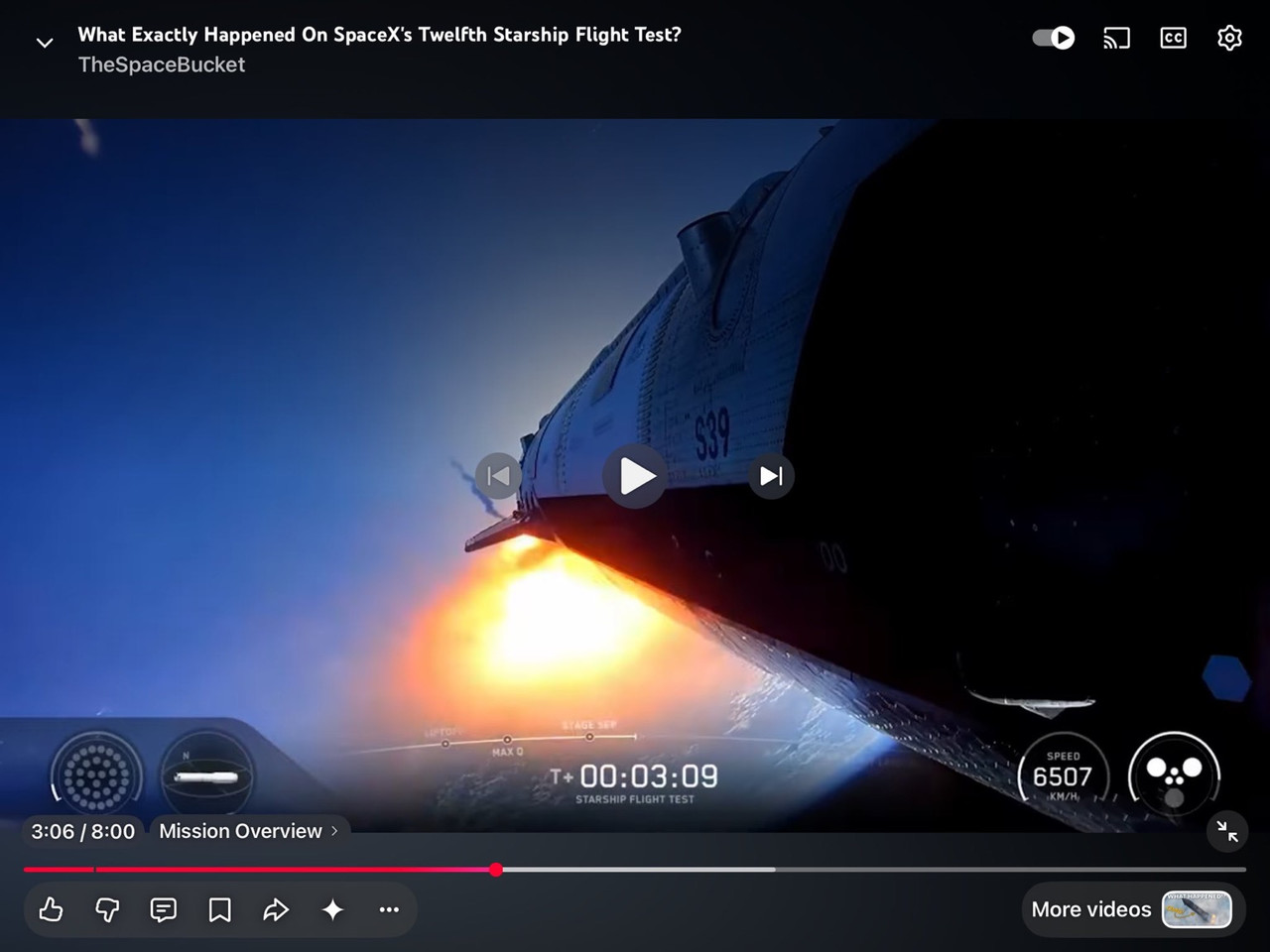
This video clip of the interior of the engine bay shows a vacuum Raptor, the one shutdown, leaking fuel:
What Exactly Happened On SpaceX's Twelfth Starship Flight Test?
https://youtu.be/NusIDi9Iu-M?t=257&si=JhwaX_oavromCl0O
Bob Clark
Last edited by RGClark (2026-05-23 19:11:10)
Old Space rule of acquisition (with a nod to Star Trek - the Next Generation):
“Anything worth doing is worth doing for a billion dollars.”
Offline
Like button can go here