New Mars Forums
You are not logged in.
- Topics: Active | Unanswered
Announcement
#1 2024-10-02 21:14:02
- tahanson43206
- Moderator
- Registered: 2018-04-27
- Posts: 26,209
Solar Cell Technology Improvements
For SpaceNut ... we have 3 pages of topics that contain the word "solar", but none that also contain the word "tandem"
This topic was renamed 2026/04/12 to cover improvements in technology.
Combining materials to capture different wavelengths of light has been going on for some time, but for whatever reason, the members of the forum have not created a topic just for these combinations...
The article that leads off this topic is about combining silicon and perovskite to approach 34% efficiency
https://theconversation.com/new-solar-c … wtab-en-us
Thanun Vongsuravanich / Shutterstock
New solar cells break efficiency record – they could eventually supercharge how we get energy from the Sun
Published: September 25, 2024 12:21pm EDT
AuthorSebastian Bonilla
Associate Professor of Materials, University of Oxford
Disclosure statement
Sebastian Bonilla receives funding from UK Research and Innovation, The Royal Academy of Engineering, and The Leverhulme Trust.
PartnersUniversity of Oxford
University of Oxford provides funding as a member of The Conversation UK.
View all partners
CC BY ND
We believe in the free flow of information
Republish our articles for free, online or in print, under a Creative Commons license.
X (Twitter)
Facebook221The sight of solar panels installed on rooftops and large energy farms has become commonplace in many regions around the world. Even in grey and rainy UK, solar power is becoming a major player in electricity generation.
This surge in solar is fuelled by two key developments. First, scientists, engineers and those in industry are learning how to make solar panels by the billions. Every fabrication step is meticulously optimised to produce them very cheaply. The second and most significant is the relentless increase in the panels’ power conversion efficiency – a measure of how much sunlight can be transformed into electricity.
The higher the efficiency of solar panels, the cheaper the electricity. This might make you wonder: just how efficient can we expect solar energy to become? And will it make a dent in our energy bills?
Current commercially available solar panels convert about 20-22% of sunlight into electrical power. However, new research published in Nature has shown that future solar panels could reach efficiencies as high as 34% by exploiting a new technology called tandem solar cells. The research demonstrates a record power conversion efficiency for tandem solar cells.
Do experts have something to add to public debate?
What are tandem solar cells?Traditional solar cells are made using a single material to absorb sunlight. Currently, almost all solar panels are made from silicon – the same material at the core of microchips. While silicon is a mature and reliable material, its efficiency is limited to about 29%.
To overcome this limit, scientists have turned to tandem solar cells, which stack two solar materials on top of each other to capture more of the Sun’s energy.
In the new nature paper, a team of researchers at the energy giant LONGi has reported a new tandem solar cell that combines silicon and perovskite materials. Thanks to their improved sunlight harvesting, the new perovskite-silicon tandem has achieved a world record 33.89% efficiency.
Perovskite solar materials, which were discovered less than two decades ago, have emerged as the ideal complement to the established silicon technology. The secret lies in their light absorption tuneability. Perovskite materials can capture high energy, blue light more efficiently than silicon.
In this way, energy losses are avoided and the total tandem efficiency increases. Other materials, called III-V semiconductors, have also been used in tandem cells and achieved higher efficiencies. The problem is they are hard to produce and expensive, so only small solar cells can be made in combination with focused light.
The scientific community is putting tremendous effort into perovskite solar cells. They have kept a phenomenal pace of development with efficiencies (for a single cell in the lab) rising from 14% to 26% in only 10 years. Such advancements enabled their integration into ultra-high-efficiency tandem solar cells, demonstrating a pathway to scale photovoltaic technology to the trillions of Watts the world needs to decarbonise our energy production.
Graph comparing different types of solar cell.
Tandem solar cells have huge potential. NREL, Author provided (no reuse)
The cost of solar electricityThe new record-breaking tandem cells can capture an additional 60% of solar energy. This means fewer panels are needed to produce the same energy, reducing installation costs and the land (or roof area) required for solar farms.
It also means that power plant operators will generate solar energy at a higher profit. However, due to the way that electricity prices are set in the UK, consumers may never notice a difference in their electricity bills. The real difference comes when you consider rooftop solar installations where the area is constrained and the space has to be exploited effectively.
The price of rooftop solar power is calculated based on two key measures. First, the total cost to install solar panels on your roof, and second, how much electricity they will generate over their 25 years of operation. While the installation cost is easy to obtain, the revenues from generating solar electricity at home are a bit more nuanced. You can save money by using less energy from the grid, especially in periods when it is costly, and you can also sell some of your surplus electricity back to the grid.
However, the grid operators will pay you a very small price for this electricity, so sometimes it is better to use a battery and store the energy so you can use it at night. Using average considerations for a typical British household, I have calculated the cash savings consumers would gain from rooftop solar electricity depending on the efficiency of the panels.
If we can improve panel efficiency from 22% to 34% without increasing the installation cost, savings in electricity bills will rise from £558ְ/year up to £709/year. A 27% bump in cash savings that would make solar rooftops extremely attractive, even in grey and cloudy Britain.
Solar panel manufacturing
The higher the efficiency of solar panels, the cheaper the resulting electricity. IM Imagery / Shutterstock
So when can we buy these new solar panels?As research continues, considerable efforts are being made to scale up this technology and ensure its long-term durability. The record breaking tandem cells are made in laboratories and are smaller than a postage stamp. Translating such high performance to metre-square areas remains a vast challenge.
Yet, we are making progress. Earlier this month, Oxford PV, a solar manufacturer at the forefront of perovskite technology, announced the first sale of its newly developed tandem solar panels. They have successfully tackled the challenges of integrating two solar materials and making durable and reliable panels. While they are still far from 34% efficiencies, their work shows a promising route for next generation solar cells.
Another consideration is the sustainability of the materials used in tandem solar panels. Extracting and processing some of the minerals in solar panels can be hugely energy intensive. Besides silicon, perovskite solar cells require the elements lead, carbon, iodine and bromine as components to make them work properly. Connecting perovskite and silicon also requires scarce materials containing an element called indium, so there is plenty of research still required to address these difficulties.
Despite the challenges, the scientific and industrial community remains committed to developing tandem solar devices that could be integrated into almost anything: cars, buildings and planes.
The recent developments toward high efficiency perovskite-silicon tandem cells indicate a bright future for solar power, ensuring solar continues to play a more prominent role in the global transition to renewable energy.
Renewable energy
Silicon
Environment
Solar energy
Green energy
Perovskite
Educate me
Perovskite solar cellsHow The Conversation is different
Every article you read here is written by university scholars and researchers with deep expertise in their subjects, sharing their knowledge in their own words. We don’t oversimplify complicated issues, but we do explain and clarify. We believe bringing the voices of experts into the public discourse is good for democracy.
Beth Daley
Editor and General Manager
(th)
Offline
Like button can go here
#2 2024-10-02 21:14:42
- tahanson43206
- Moderator
- Registered: 2018-04-27
- Posts: 26,209
Re: Solar Cell Technology Improvements
This post is reserved for an index to posts that may be contributed by NewMars members over time.
Index:
Post #3: Laboratory research to split blue light to improve capture efficiency
(th)
Offline
Like button can go here
#3 2026-04-12 19:19:30
- tahanson43206
- Moderator
- Registered: 2018-04-27
- Posts: 26,209
Re: Solar Cell Technology Improvements
This post is intended to report availability of an article about splitting of blue light to improve solar cell efficiency. This is still a laboratory project.
The post Scientists Set New Record for Solar Cell Efficiency appeared first on Futurism.
https://futurism.com/science-energy/res … ergy-cells
Scientists Set New Record for Solar Cell Efficiency
A sunny day for solar energy.
By Joe WilkinsPublished Apr 12, 2026 8:15 AM EDT
Close-up of a solar panel surface showing a grid of small, rectangular photovoltaic cells. The cells display a gradient of colors from pink and purple on the left to blue on the right, with black lines separating the cells and small metallic connectors visible at intervals.
Getty / FuturismWhat’s not to love about solar energy? Using photovoltaic cells — tiny semiconductors that convert light directly into electricity — we’re able to harness the power of the Sun itself, turning it into wattage to power our homes.
It’s great in theory, but there’s a huge catch. Of all the power our star graciously beams to us, only about 33 percent of it can ever be turned into usable electricity, and most commercial solar panels don’t even come close to that.
This ceiling is known as the Shockley-Queisser limit, named after the two physicists who first theorized it back in 1961. The reason comes down to thermodynamics: sunlight comes to us as a vast rainbow of light energy, but we can only convert a narrow slice of that spectrum into usable electricity. The rest either passes through, or is lost as excess heat.
But now it’s possible that a novel process could blow the Shockley-Quiesser limit wide open. In a new paper published in the Journal of the American Chemical Society, a team of scientists in Japan and Germany detail a method they say can capture the parts of the light spectrum that would otherwise be burned off as residual heat.
Basically, the researchers found that if you blast a certain compound with high-energy blue light — a part of the light band that we normally can’t convert to electricity — you can split the incoming energy into two usable parts. Using their method, the team was able to achieve around 130 percent energy conversion efficiency, meaning that for every 100 photons that entered, they could harvest 130 usable energy carriers.
To achieve the breakthrough, the team mixed the organic molecule tetracene with the metallic element molybdenum. While scientists had previously used tetracene to harness this kind of high-energy blue light before, there were practical issues preventing prolonged energy conversion, which they say the addition of molybdenum solved.
“We have two main strategies to break through this [Shockley-Queisser] limit,” Yoichi Sasaki, a chemist at Kyushu University and one of the study’s coauthors, said in a press release. “One is to convert lower-energy infrared photons into higher-energy visible photons. The other, what we explore here, is to use singlet fission to generate two excitons from a single exciton photon.”
It’s important to highlight that these are controlled lab tests so far. The most efficient commercially available solar panels still ring in with around a 25 percent efficiency rate, and that probably won’t change anytime soon. Still, it’s the biggest crack so far in a theoretical ceiling that’s stood for over 60 years.
(th)
Offline
Like button can go here
#4 2026-04-13 14:40:51
- SpaceNut
- Administrator
- From: New Hampshire
- Registered: 2004-07-22
- Posts: 30,873
Re: Solar Cell Technology Improvements
what you have is the triple junction layering where the substrates are of different materials.
Triple junction solar cells utilize multiple p-n junctions made from different semiconductor materials, allowing them to absorb a broader range of wavelengths of light. This design enhances their efficiency, with lab examples achieving over 46% under concentrated sunlight, significantly surpassing traditional single-junction cells, which have a maximum theoretical efficiency of 33.16%.
WikipediaThe performance of these solar cells is optimized by using filtered spectrums to match the current output of the sub-cells, which are designed to absorb specific ranges of wavelengths. For instance, the best balance in efficiency is reached at about 1.1 eV (approximately 1100 nm), which is close to the natural bandgap in silicon and other useful semiconductors.
Wikipedia
+1Overall, triple junction solar cells represent a significant advancement in solar technology, offering higher efficiency and better performance under various solar spectrum conditions.
Springer
+1

Offline
Like button can go here
#5 2026-04-13 14:50:01
- tahanson43206
- Moderator
- Registered: 2018-04-27
- Posts: 26,209
Re: Solar Cell Technology Improvements
For SpaceNut .... your post #4 described an entirely different system.
It appears you did not read the article before you went out to find the old way of doing things.
Our readers do not benefit by having an old system laid upon new work, as though the old system were as good as the new one.
(th)
Offline
Like button can go here
#6 2026-04-14 14:58:32
- SpaceNut
- Administrator
- From: New Hampshire
- Registered: 2004-07-22
- Posts: 30,873
Re: Solar Cell Technology Improvements
post 1 is multi junction
Current commercially available solar panels convert about 20-22% of sunlight into electrical power. However, new research published in Nature has shown that future solar panels could reach efficiencies as high as 34% by exploiting a new technology called tandem solar cells.

meaning there are 2 layers or junctions the outer is perovskite-silicon and the inner is silicon with them in parallel so it looks like a single panel but in actuality is 1 behind the other. FYI perovskite layer is an impurity that changes the thermal of the junction such that the higher the temp gets the less loss it has versus the pure silicon does as it drops as temperature rises.
there are also other materials
the light spectrum is tuning for the wavelength to collect the photons energy
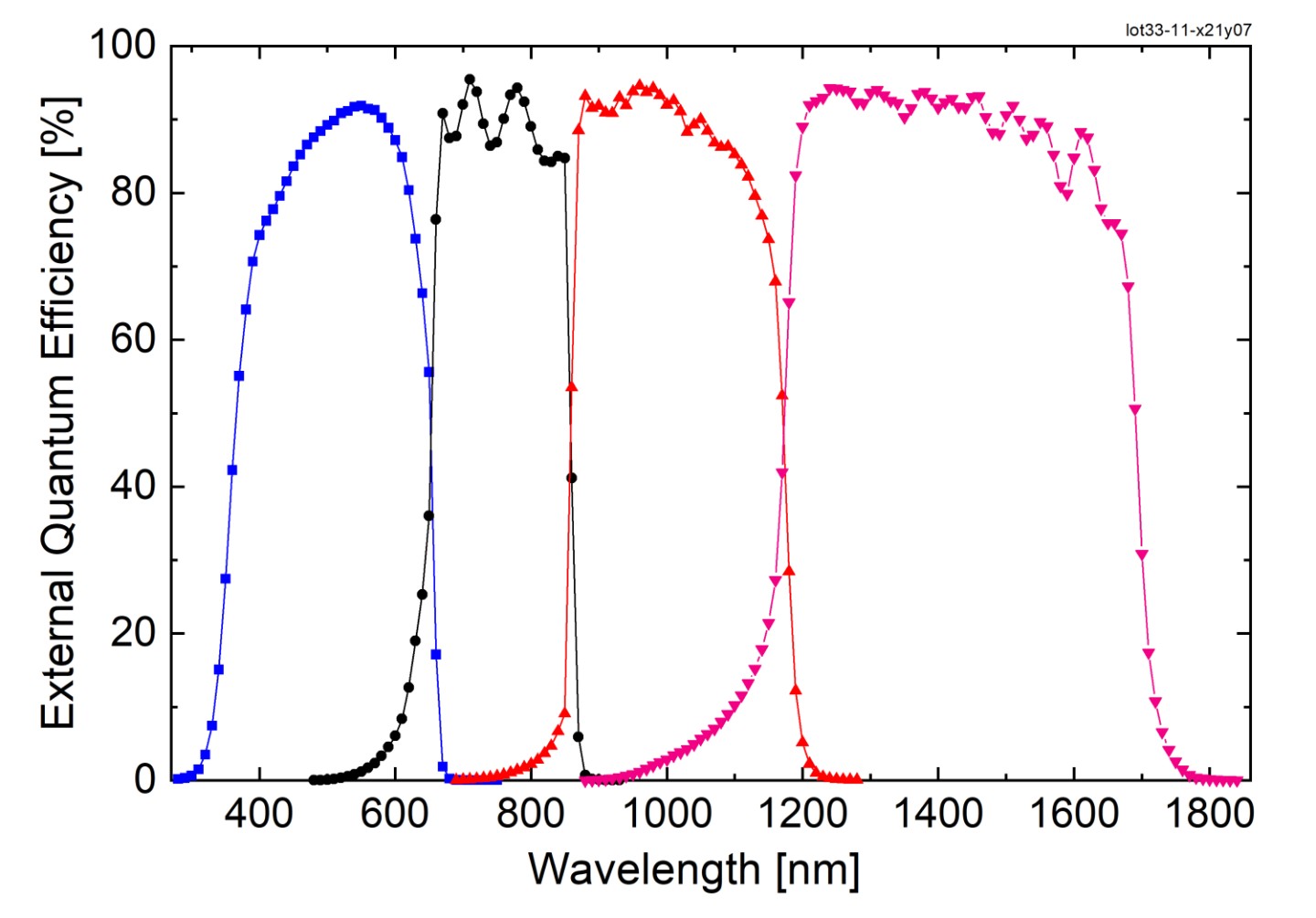
this is not new and the efficiency is a total of square meters and not of the compounding of layers.
the second one is a reflection of the light that is due to the materials in use.
Shockley-Queisser limit, named after the two physicists who first theorized it back in 1961. The reason comes down to thermodynamics: sunlight comes to us as a vast rainbow of light energy, but we can only convert a narrow slice of that spectrum into usable electricity. The rest either passes through, or is lost as excess heat.
Tandem Solar Cell Efficiencies
For your convenience, we have tabulated the above mentioned efficiencies in the table below. In the column 'Structure', J refers to the junctions (e.g. 3J means triple junction).
Technology Type Structure Max Certified Efficiency
GaInP/GaAs Monolithic 2J 32.8%
InGaP/GaAs/InGaAs Monolithic 3J 37.9%
GaAs/Si Stacked 2J 32.8%
GaAsP/Si Monolithic 2J 23.4%
Perovskite/Si Monolithic 2J 33.9%
GaInP/GaAs/Si Stacked 3J 35.9%
GaInP/GaAs/Si Monolithic 3J 25.9%
Perovskite/perovskite/silicon Monolithic 3J 27.1%
GaInP/GaInAs/Ge Monolithic 3J 34.5%
Perovskite/perovskite Monolithic 2J 29.1%
Perovskite/perovskite/perovskite Monolithic 3J 25.1%
The efficiencies mentioned in this section are mostly based on the Solar cell efficiency tables (Version 63) by Green et al .
plus we have had 3 junctions for space use as well not just the simple 2 layers....
which is exactly what the topic Building Solar from scratch is about as its about the material layers used to capture the wavelengths of light.
Offline
Like button can go here
#7 2026-04-14 17:40:49
- SpaceNut
- Administrator
- From: New Hampshire
- Registered: 2004-07-22
- Posts: 30,873
Re: Solar Cell Technology Improvements
here is another such topic in that Mars-made PV which contains perovskite. plus many other chemicals in the layers to make the junction
its not about a blue colored solar cell its about getting the enrgy from the blue spectrum light band...
Blue solar cells, specifically polycrystalline, are cost-effective, high-efficiency options that use raw silicon to absorb sunlight, though they are generally less efficient (\(15\text{--}18\%\)) than black monocrystalline panels. Newer advancements include using perovskite top layers to specifically capture high-energy blue light, boosting tandem cell efficiency beyond \(30\%\), while specialized luminescent concentrators can enhance energy capture from the blue spectrum.Key Aspects of Blue Solar Technology:Polycrystalline (Blue) Panels: Manufactured from multiple silicon crystals, these offer a more affordable, lower-waste alternative to monocrystalline, though they are less efficient at converting light to electricity due to higher electron scattering.Blue/UV Light Harvesting: Advanced perovskite/silicon tandem cells utilize perovskite top layers to specifically absorb high-energy blue light (shorter wavelengths) while silicon absorbs lower-energy red/infrared light, reaching efficiencies over \(30\%\).Transparent Luminescent Solar Concentrators: Researchers have developed transparent materials that, when applied over traditional panels or windows, capture specific invisible light wavelengths to enhance energy harvesting.Performance: While standard blue panels are less efficient (\(15\text{--}18\%\)) than black panels (\(20\%+\)), new materials are bridging this gap by improving photon conversion rates, as noted in studies from the Renewable Energy Institute and Reddit.Advantages:Cost: Lower manufacturing costs due to simpler, less refined,, and higher-production processes.Durability: Less susceptible to damage and reduced performance in hot climates compared to some alternatives.Sustainability: Less material waste during production, contributing to a smaller ecological footprint.
Blue polycrystalline: 15–18%
Black monocrystalline: 20%+
Tandems: 30%+
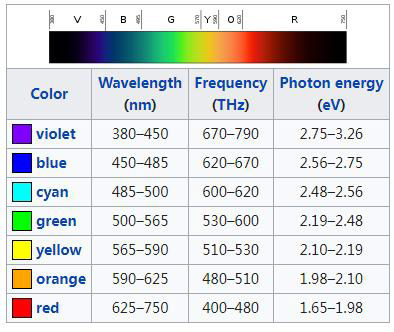
What Is the Visible Light Spectrum?
The Visible Light Spectrum
Color Wavelength (nm)
Red 625 - 740
Orange 590 - 625
Yellow 565 - 590
Green 520 - 565
Cyan 500 - 520
Blue 435 - 500
Violet 380 - 435
short answer for others is to capture the maximum possible solar wavelengths, you need materials with complementary band gaps arranged in tandem or multi‑junction architectures, because no single absorber can efficiently convert the entire 300–2500nm solar spectrum. Different materials absorb different color bands depending on their band‑gap energy.
:max_bytes(150000):strip_icc():format(webp)/the-visible-light-spectrum-2699036_FINAL2-c0b0ee6f82764efdb62a1af9b9525050.png)
Offline
Like button can go here
#8 2026-04-14 18:10:35
- SpaceNut
- Administrator
- From: New Hampshire
- Registered: 2004-07-22
- Posts: 30,873
Re: Solar Cell Technology Improvements
asking about blue color solar cell from google AI
Blue solar cells are typically polycrystalline solar panels, which appear blue due to an anti-reflective coating (usually silicon nitride) applied to reduce reflection and improve efficiency. These cells are created by melting raw silicon and pouring it into a mold, creating a multi-crystal structure that gives them a speckled look.
Key Characteristics of Blue (Polycrystalline) Solar Panels:Affordability: The manufacturing process for blue panels is simpler and less wasteful than black (monocrystalline) panels, making them a budget-friendly option.
Appearance: They have a distinctive, bright blue, glittery look, compared to the uniform black of high-efficiency cells.
Efficiency: They are slightly less efficient (generally 15-17%) than monocrystalline alternatives due to the fragmented nature of the silicon crystals.
Durability: Blue panels often offer increased UV light resistance, helping them maintain integrity over long periods.
Application: Ideal for projects with ample space where low initial costs are prioritized over maximum efficiency per square foot.
While black panels are generally better at absorbing light, the blue tint on poly panels allows them to perform well in bright conditions.
Offline
Like button can go here