New Mars Forums
You are not logged in.
- Topics: Active | Unanswered
Announcement
#126 2024-09-06 16:01:57
- GW Johnson
- Member
- From: McGregor, Texas USA
- Registered: 2011-12-04
- Posts: 6,156
- Website
Re: Boeing Starliner OFT-2
It finally showed up in a news story what the real hang-up was making a decision. The Boeing suits are so incompatible with Dragon that the two Starliner crew would have to ride back in shirtsleeves, exposing them to the capsule depressurization possibility that killed a Russian crew. That would be using Crew 8 Dragon as an emergency evacuation vehicle, with the Starliner crew riding in shirtsleeves on the cargo pallet installed below the 4 seats in that Dragon.
There is an ISS suit that fits Sunni Williams, but not one that fits Butch Wilmore. The Crew 9 Dragon only has 4 seats, but will bring a suit that fits Wilmore. That way, Wilmore and Williams could ride in pressure suits back aboard Crew 9 in February.
NONE of these stories addressed why Williams could not ride a Crew-8 emergency descent in that ISS suit, which would leave only Butch riding exposed in his shirtsleeves. That is part of why I know these news stories are still very flawed. It is hard to say how much of that flawed-ness is ignorant reporters, and how much is deliberate deception or evasiveness on the part of NASA and/or its contractors.
But there it is: did that lemon of a Starliner, or the risk of a shirtsleeve emergency descent on Crew-8, pose more risk to the Starliner crew? THAT is what they must have been debating all this time. And I notice NOBODY is talking about that! Apparently, the Starliner was considered more risky that a descent without a p-suit.
My advice to NASA on seats in Dragon still stands (and I know that some NASA folks see these forums): put all 7 seats back into Dragon! You don't have to fill them all, but if you should need them, then you have them. And you can always strap pressurized cargo into the empty seats. Just bag it up and tie it in with the seat belt! Whoever ruled otherwise (to the 4-sseat configuration) "for safety's sake" (worrying about speed of egress for the bottom 3 seats) was just dead wrong! 2020 hindsight clearly says so!
GW
Last edited by GW Johnson (2024-09-06 16:07:07)
GW Johnson
McGregor, Texas
"There is nothing as expensive as a dead crew, especially one dead from a bad management decision"
Offline
Like button can go here
#127 2024-09-06 19:58:23
- tahanson43206
- Moderator
- Registered: 2018-04-27
- Posts: 24,092
Re: Boeing Starliner OFT-2
The Starliner has safely exited the vicinity of the ISS, and it is positioned to execute a de-orbit burn at about 11 PM EST this evening.
It should be back on the ground around midnight EST.
(th)
Offline
Like button can go here
#128 2024-09-07 07:10:19
- tahanson43206
- Moderator
- Registered: 2018-04-27
- Posts: 24,092
Re: Boeing Starliner OFT-2
the Boeing Starliner touched down safely ...
https://www.cnn.com/2024/09/07/science/ … lcl-digvid
(th)
Offline
Like button can go here
#129 2024-09-07 07:53:55
- SpaceNut
- Administrator
- From: New Hampshire
- Registered: 2004-07-22
- Posts: 30,548
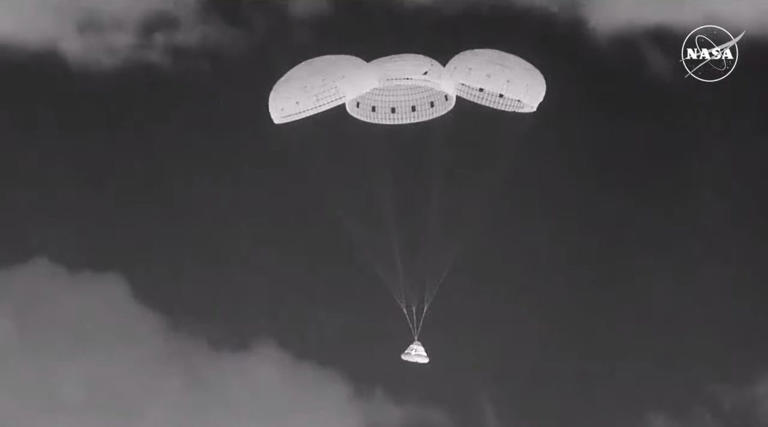
Offline
Like button can go here
#130 2024-09-11 19:39:17
- SpaceNut
- Administrator
- From: New Hampshire
- Registered: 2004-07-22
- Posts: 30,548
Re: Boeing Starliner OFT-2
It appears that more thrusters did not function and that the ship had some communication issues but landed on target despite these issues.
Offline
Like button can go here
#131 2024-09-13 16:52:20
- SpaceNut
- Administrator
- From: New Hampshire
- Registered: 2004-07-22
- Posts: 30,548
Re: Boeing Starliner OFT-2
Offline
Like button can go here
#132 2024-10-25 13:05:54
- GW Johnson
- Member
- From: McGregor, Texas USA
- Registered: 2011-12-04
- Posts: 6,156
- Website
Re: Boeing Starliner OFT-2
I saw in the news that the Boeing-built satellite Intelsat 33e blew up on orbit, generating space debris of significant concern. This is a "bus" that Boeing has been building and launching since the 1990's. It exists in multiple forms, depending upon how it is rigged with equipment installations.
Intelsat 33e was the latest form of this basic satellite "bus". It is the high-power form, referring to on-board electric generation equipment, and to radio frequency transmission power. This form is recent, and involves much larger solar panels, and the unique installation of bipropellant attitude thrusters, which earlier forms did not have.
Boeing bought the bipropellant thrusters from Moog Isp, but I rather doubt they bought the propellant tanks, plumbing, and control valves from Moog. These would be pretty much the same NTO-MMH hypergolic pressure-fed thrusters as were such a problem on Starliner. Not the thrusters themselves, the propellant supply and plumbing!
Does anybody else see a possible connection here?
This bipropellant pressure-fed thruster technology is well over 6 decades old. It has been quite reliable for about 5 of those 6 decades, once the material selection and equipment design requirements were established long ago. But if you go with cheaper substandard stuff, you have the very same problems experienced long ago when this stuff first came out.
My point: you either do it "right" and succeed, or you do it cheap, and fail. Starliner and Intelsat 33e both post-date the current Boeing corporate regime. The one that ditched quality (and complying with the FAR's) in favor of maximal shareholder value.
Anybody else see a correlation here?
GW
Last edited by GW Johnson (2024-10-25 13:08:15)
GW Johnson
McGregor, Texas
"There is nothing as expensive as a dead crew, especially one dead from a bad management decision"
Offline
Like button can go here
#133 2024-10-28 08:20:58
- GW Johnson
- Member
- From: McGregor, Texas USA
- Registered: 2011-12-04
- Posts: 6,156
- Website
Re: Boeing Starliner OFT-2
From AIAA’s “Daily Launch” for Monday 28 October 2024:
WALL STREET JOURNAL
Boeing Explores Sale of Space Business
Boeing helped put the first men on the moon. Now it wants to get out of the space race. The beleaguered company is exploring a sale of its storied NASA business, including the troubled Starliner space vehicle and operations that support the International Space Station, according to people familiar with the matter.
My take on it:
Here officially starts the beginning of the end for Starliner. NASA needs to switch its attention and help get Dreamchaser flying.
If Boeing leaves the space business entirely, one has to wonder about ULA, which is a joint venture of Boeing and Lockheed-Martin. ULA supposedly is independent of either company, but one has to wonder.
GW
Last edited by GW Johnson (2024-10-28 08:21:42)
GW Johnson
McGregor, Texas
"There is nothing as expensive as a dead crew, especially one dead from a bad management decision"
Offline
Like button can go here
#134 2025-01-31 09:41:41
- GW Johnson
- Member
- From: McGregor, Texas USA
- Registered: 2011-12-04
- Posts: 6,156
- Website
Re: Boeing Starliner OFT-2
This from AIAA's "Daily Launch" email newsletter for 1-31-2025:
SpaceNews
Safety panel reports progress in Starliner investigation
Boeing and NASA are making “significant progress” on addressing issues seen on a test flight of the company’s CST-100 Starliner spacecraft last year, an independent NASA safety panel says, although key problems with the spacecraft’s thrusters remain unresolved. Paul Hill, a member of the Aerospace Safety Advisory Panel (ASAP), said at a Jan. 30 public meeting that the committee was briefed on the status of the investigation into Starliner’s Crew Flight Test (CFT) mission recently.
xxx
My take:
Note the words "key problems with the spacecraft's thrusters remain unresolved". You don't go with the cheapest designs and components when you are handling NTO. There's more than 6 decades world-wide experiences that say so, quite clearly. With improper valve seal materials that swell, and improper designs that allow NTO and moisture to coincide, you are asking for trouble, and that is exactly what happened. The "cheap" also showed up in the helium leaks. The thruster subsystem needs to be redesigned "from scratch" and done right, or Starliner will never be reliable enough to certify for human flight.
Boeing is not going to do that, they are already very deep in the red with Starliner, amidst all the other losses for not doing their main airliner business right instead of cheap. You are literally watching the slow-motion end of Starliner. That "cheap instead of right" approach is a top management fault, as we all know, that has persisted and taken full effect all across the corporation over about a 3 decade period. They are actually considering selling off their entire space business, possibly even their share of ULA, per what I put in post 133 just above.
GW
GW Johnson
McGregor, Texas
"There is nothing as expensive as a dead crew, especially one dead from a bad management decision"
Offline
Like button can go here
#135 2025-02-10 17:39:14
- Oldfart1939
- Member
- Registered: 2016-11-26
- Posts: 2,491
Re: Boeing Starliner OFT-2
There have been several recent posts on YouTube regarding the possibility of Boeing laying off a load of workers in anticipation of cancellation of the SLS main stage. I've seen nothing more since last week, however.
Offline
Like button can go here
#136 2025-02-11 21:47:22
- GW Johnson
- Member
- From: McGregor, Texas USA
- Registered: 2011-12-04
- Posts: 6,156
- Website
Re: Boeing Starliner OFT-2
I found a news article and posted it in Meta New Mars, in the "GW Johnson postings" thread. It would seem that the threat of SLS cancellation is real enough that Boeing executives gave the required 60-day notice of impending layoffs to their SLS employees.
GW
GW Johnson
McGregor, Texas
"There is nothing as expensive as a dead crew, especially one dead from a bad management decision"
Offline
Like button can go here
#137 2025-10-18 17:12:06
- RobertDyck
- Moderator
- From: Winnipeg, Canada
- Registered: 2002-08-20
- Posts: 8,393
- Website
Re: Boeing Starliner OFT-2
Found this on the NASA Technical Report Server (pdf): TEST REPORT - EVALUATION OF DUPONT LRU 488 AS A SEAT SEAL MATERIAL IN THE MARQUARDT R4D ENGINE VALVE
January 1971
1.0 INTRODUCTION
Under contract to the Jet Propulsion Laboratory (Reference P.O. GK-541658-01, Items 3 and 4), The Marquardt Company conducted the evaluation test program described herein, to assess the suitability of DuPont LRU 488 molded elastomeric teflon as a seat seal material for the R4D valve. Molded seat seals, in accordance with a TMC configuration, were supplied by J.P.L. and assembled into R4D valve seat assemblies. The seat assemblies were installed into R4D valves and subjected to a test program intended to evaluate leakage characteristics as a function of cycle life and temperature.2.0 SUMMARY
During the period 19 December 1970 through 26 January 1971, The Marquardt Company conducted an evaluation test program on molded elastomeric seat seals of DuPont LRU 488. Six molded seals were supplied by JPL and two were assembled into two Marquardt R4D valve seats. Seal surface profiles were traced with a Bendix Proficorder to document the sealing surface interface prior to valve build-up. TMC P/N 228683 S/N 027 and 028 valves were assembled. The seat of the S/N 028 valve exhibited satisfactory seal surface attributes while that of the S/N 027 valve appeared eccentric to the seat center line. Subsequent acceptance testing resulted in excessive leakage of the S/N 027 valve and satisfactory test results with the S/N 028 valve.The S/N 027 valve seat was reworked to replace the seal and insert but a similar eccentric seal face profile and excessive leakage resulted. Machining of the seat to attempt to compensate tor the eccentric seal resulted in a seal profile which appeared to be capable of maintaining contact with the valve armature in the closed position, but subsequent leak checking resulted in excessive leakage. Further rework to recover this valve seat as a valid test unit was abandoned.
The S/N 028 valve was subjected to a cycle and temperature test with valve leakage monitored at specified increments of cycling. After completion of 7500 cycles at ambient temperature and 2500 cycles at 160°F, a leak rate of 6-7 scc/min of GN2 at 100 psig was measured. Subsequent disassembly of the valve disclosed significant loss of the seal material and testing was terminated.
Though the test goal of 25,000 valve cycles with leakage of less than 1 scc/hr of GN2 was not achieved, the test results indicate that the DuPont LRU 488 material is a suitable valve seat seal material but seal designs are not interchangeable with virgin TFE seals. Test unit failure results from flow-stream-impingement-motivated seal extrusion and subsequent seal shearing by the valve closing action. The elastomeric teflon seal design must preclude flow stream impingement which results in deformation of the seal such that subsequent valve action shears the material.
Current supply: Rulon® Fluoropolymers 488 PTFE
R-4D is the engine used for thruster quads on the Apollo Service Module (SM). Fuel was MMH, oxidizer N2O4 aka NTO. This is the same propellant mix used by modern capsules: Space Shuttle, SpaceX Dragon, Orion, and Boeing Starliner.
Offline
Like button can go here
#138 2025-10-22 15:44:23
- SpaceNut
- Administrator
- From: New Hampshire
- Registered: 2004-07-22
- Posts: 30,548
Re: Boeing Starliner OFT-2
Sticking a nail in the project.
Boeing abandones starliner after loses
Boeing has not abandoned the Starliner program after experiencing significant financial losses. The company continues to evaluate options to salvage the program, including potentially operating a cargo mission to test fixes to the propulsion system. Boeing is still considering how to address the propulsion issue and has not publicly announced plans to abandon the program. The company is working on resolving the issues and is exploring options to recover financially.
Offline
Like button can go here
#139 2025-12-02 15:50:21
- GW Johnson
- Member
- From: McGregor, Texas USA
- Registered: 2011-12-04
- Posts: 6,156
- Website
Re: Boeing Starliner OFT-2
Last I heard, NASA recently reduced the remaining contracted Starliner flights from 6 to 4, with 1 of the 4 to be the unmanned qualification flight Boeing still must fly. That's down to 3 paid crew delivery flights.
We will soon see if Boeing will fulfill its side of the contract, or just abandon the program to cut their losses. They will never make any profit off of this vehicle from their NASA contract. There might, or might not, be other customers for Starliner, though. We will see.
GW
GW Johnson
McGregor, Texas
"There is nothing as expensive as a dead crew, especially one dead from a bad management decision"
Offline
Like button can go here
#140 2025-12-03 06:51:13
- SpaceNut
- Administrator
- From: New Hampshire
- Registered: 2004-07-22
- Posts: 30,548
Re: Boeing Starliner OFT-2
seems that Nasa can just trust it for cargo for now.
Offline
Like button can go here
#141 2025-12-26 08:59:44
- SpaceNut
- Administrator
- From: New Hampshire
- Registered: 2004-07-22
- Posts: 30,548
Re: Boeing Starliner OFT-2
Safety panel: NASA downplayed Boeing Starliner problems
Sounds more like management not engineers making what could be another disaster in the making.
Offline
Like button can go here
#142 2026-02-12 15:40:50
- SpaceNut
- Administrator
- From: New Hampshire
- Registered: 2004-07-22
- Posts: 30,548
Re: Boeing Starliner OFT-2
News of the continued attempts..
NASA Thinks Boeing’s Starliner Can Fly in April, Which Is Hilarious
Despite these issues, the agency is hopeful that Boeing’s spacecraft will be ready for an uncrewed mission in April 2026, with crewed flights potentially happening by fall 2026. However, with numerous technical challenges still unresolved, the mission’s timeline remains uncertain.
Offline
Like button can go here
#143 2026-02-13 10:35:55
- GW Johnson
- Member
- From: McGregor, Texas USA
- Registered: 2011-12-04
- Posts: 6,156
- Website
Re: Boeing Starliner OFT-2
Spacenut:
Did you see the paragraph in the linked report that described how they fixed the leaky seals? By going to a material that better resists NTO?
Q: If the better material was known in the first place, then why did Boeing use something different? Ans -- cheaper.
What does that tell you about the thrusters? Think "cheaper" might have something to do with those troubles, too?
Certainly did for the B-737MAX debacle. And there's a couple of other airplanes Boeing is in deep kimchee with troubles. One is the 777-X, the other is the new USAF tanker. All built by the same Boeing. As is the SLS core stage.
GW
Last edited by GW Johnson (2026-02-13 10:37:57)
GW Johnson
McGregor, Texas
"There is nothing as expensive as a dead crew, especially one dead from a bad management decision"
Offline
Like button can go here
#144 2026-02-13 18:19:41
- SpaceNut
- Administrator
- From: New Hampshire
- Registered: 2004-07-22
- Posts: 30,548
Re: Boeing Starliner OFT-2
Boeing Starliner has faced multiple, distinct valve issues that delayed its crewed flight tests. Problems included corrosion-induced oxidizer valve failures in 2021 and an oscillating, potentially life-expired oxygen relief valve on the Atlas V rocket in May 2024. These issues required valve replacements, redesigns, and caused significant mission delays.
SpaceNews
SpaceNews
+3
Key details regarding the Starliner valve issues:
2021 Valve Failures (Orbital Flight Test-2): Thirteen valves in the service module failed to open due to moisture reacting with propellant, causing corrosion. Boeing replaced the valves and modified the system to prevent water intrusion.
2024 Valve Issues (Crew Flight Test): A, 2024, launch attempt was scrubbed due to a buzzing, oscillating oxygen valve on the Centaur upper stage of the United Launch Alliance (ULA) Atlas V rocket.Concerns and Disagreements: ValveTech, a former contractor, warned that the 2024 valve might have exceeded its 200,000-cycle life.
However, ULA and NASA dismissed these concerns, stating the valve was not leaking but merely oscillating.
Helium Leaks: During the June 2024 crewed mission, the Starliner capsule experienced helium leaks related to its propulsion system and thruster issues.
Resolution: For the 2021 issues, Boeing and NASA worked together to remediate the valves through mechanical, electrical, and thermal techniques. In 2024, the problematic valve was replaced.The persistent valve issues, along with other technical problems, led to significant delays and over $1 billion in extra costs for Boeing.
NASA Stuck in the Middle of Starliner Contractors’ Valve Fight
Offline
Like button can go here
#145 2026-02-20 15:14:01
- GW Johnson
- Member
- From: McGregor, Texas USA
- Registered: 2011-12-04
- Posts: 6,156
- Website
Re: Boeing Starliner OFT-2
From CBS News website 2-20-2026 (my take on it appended at the end):
NASA's new chief rebukes Boeing, space agency over problem-plagued Starliner mission that left astronauts stuck in space for months
By
William Harwood
Updated on: February 19, 2026 / 8:10 PM EST / CBS News
An independent review of the first — and so far, only — piloted flight of Boeing's troubled Starliner spacecraft concluded that the test represented a potentially life-threatening "Type A" mishap resulting from multiple technical problems and management miscues, NASA officials said Thursday. The findings prompted NASA's new chief to make openly critical comments about his own agency and Boeing.
"This was a really challenging event and...we almost did have a really terrible day," said Amit Kshatriya, NASA associate administrator. "We failed them."
He was referring to now-retired astronauts Barry "Butch" Wilmore and Sunita Williams, who were launched in June 2024 expecting to spend eight to 10 days in space. They ended up remaining in orbit for 286 days, hitching a ride home aboard a SpaceX Crew Dragon capsule in March 2025 after NASA ruled out landing aboard the Starliner.
NASA Administrator Jared Isaacman, who took the reigns of the agency in December, said NASA will continue working with Boeing to make the Starliner a viable crew transport vehicle, adding that "sustained crew and cargo access to low Earth orbit will remain essential, and America benefits from competition and redundancy."
"But to be clear, NASA will not fly another crew on Starliner until technical causes are understood and corrected, the propulsion system is fully qualified and appropriate investigation recommendations are implemented," he said.
He made the comments as the agency was releasing the results of a months-long independent investigation of the Starliner mission. The panel's report cited a long list of management failures and technical issues that were not fully understood at the time, but were still considered acceptable for flight.
The panel concluded the problems experienced during the mission were representative of a "Type A mishap," meaning an unexpected event that could have resulted in death or permanent disability, damage to government property exceeding $2 million and the loss of a spacecraft or launch vehicle.
Isaacman said the eventual cost of the Starliner's woes exceeded the $2 million threshold "a hundred fold."
"Starliner has design and engineering deficiencies that must be corrected," he said. "But the most troubling failure revealed by this investigation is not hardware. It's decision-making and leadership that, if left unchecked, could create a culture incompatible with human space flight."
Isaacman said the investigation revealed pressure within NASA to ensure the success of the agency's Commercial Crew Program, which is based on having two independent astronaut ferry ships. That advocacy "exceeded reasonable bounds and placed the mission the crew and America's space program at risk."
"This created a culture of mistrust that can never happen again and there will be leadership accountability," Isaacman said.
The report quoted unnamed personnel saying things like, "There was yelling in meetings. It was emotionally charged and unproductive."
Another said, "If you weren't aligned with the desired outcome, your input was filtered out or dismissed."
Yet another told the panel, "I stopped speaking up because I knew I would be dismissed."
Equally troubling, according to one NASA worker quoted in the report, "NASA wasn't blaming Boeing, but everybody else was. [...] You know, it's our program. We're responsible too. Nobody said that. And nobody within NASA [or outside of NASA] has been held accountable. Nobody. We're 11 months after it happened, and there's been no accountability at all, from any organization."
Isaacman promised that "lessons will be appropriately learned across the agency and there will be accountability."
In the wake of the space shuttle's retirement in 2011, NASA awarded multi-billion-dollar contracts to Boeing and SpaceX in 2014 to build independent ferry ships to carry astronauts to and from the space station. SpaceX, awarded an initial $2.6 billion contract, has now launched 13 piloted Crew Dragon flights for NASA and seven purely commercial missions.
In contrast, Boeing, awarded an initial $4.2 billion contract, ran into multiple problems during an unpiloted Starliner test flight in 2019 that eventually required a second crew-less test flight before Wilmore and Williams were finally launched on June 5, 2024, on what has been the ship's lone crewed test flight.
The trip to space atop a United Launch Alliance Atlas 5 rocket went smoothly and the crew successfully docked with the International Space Station the next day. But the capsule experienced multiple helium propulsion system leaks along the way and several maneuvering jets did not produce the expected thrust.
"During the rendezvous and proximity operations, propulsion anomalies cascaded into multiple thruster failures and a temporary loss of six-degree-of-freedom control," Isaacman said Thursday. "The controllers and the crew performed with extraordinary professionalism ... and docking was achieved.
"It is worth restating what should be obvious," he said. "At that moment, had different decisions been made, had thrusters not been recovered or had docking been unsuccessful, the outcome of this mission could have been very different."
Williams and Wilmore downplayed the malfunctions during the flight, which was originally expected to last about eight days. But NASA and Boeing ended up extending their stay in orbit, carrying out weeks of tests and analysis to determine whether the Starliner could be trusted to safely bring its crew back to Earth.
By August 2024, Boeing managers were convinced engineers understood the problems and the crew could safely come home in the Starliner. But NASA managers ruled that option out. Instead, they decided to keep the astronauts aboard the station until early 2025 when they could hitch a ride back to Earth aboard a SpaceX Crew Dragon ferry ship.
To make that possible, a Crew Dragon was launched in September 2024 with just two astronauts aboard instead of four as originally planned. That freed up two seats for Wilmore and Williams after the SpaceX crew completed their six-month stay in space.
The Starliner, meanwhile, successfully made an uncrewed return to Earth in September 2024 even though, the investigation report revealed, additional propulsion problems left the craft with no available backup options had another failure occurred.
The mission, "while ultimately successful in preserving crew safety, revealed critical vulnerabilities in the Starliner's propulsion system, NASA's oversight model and the broader culture of commercial human spaceflight," the investigation team concluded.
The panel issued 61 formal recommendations "across technical, organizational, and cultural domains to address these issues before the next crewed Starliner mission."
"The report underscores that technical excellence, transparent communication, and clear roles and responsibilities are not just best practices, they are essential to the success of any future commercial spaceflight missions," the team said. "The lessons from CFT must be institutionalized to ensure that safety is never compromised in pursuit of schedule or cost."
For its part, Boeing said in a statement the company had made "substantial progress" on corrective actions "and driven significant cultural changes across the team that directly align with the findings in the report."
"NASA's report will reinforce our ongoing efforts to strengthen our work...in support of mission and crew safety, which is and must always be our highest priority. We're working closely with NASA to ensure readiness for future Starliner missions and remain committed to NASA's vision for two commercial crew providers."
------
My take on it:
This report understates, but confirms, my contentions about NASA management culture valuing money and schedule (which is also money) above crew lives. It is quite apparent that NASA management never learned the lessons of the two lost shuttle crews. Or if any of them did, they no longer work there.
This report also confirms something not common knowledge up to now: that Butch and Sunita’s Starliner experienced even more propulsion problems during its unmanned return from the ISS, leaving no backups.
It would appear that Jared Isaacman might do some “housecleaning” among NASA management. He at least talks like it, in this report. We will see if he really does. However, it does concern me about him that, so far, he shows no sign of concern over a flawed heat shield flying crewed on Artemis-2, and the same flawed design being built for Artemis-3.
It would also appear, based on this report, that Jared Isaacman wants Boeing to properly “fix” Starliner, so that he has a second capsule to use, going to ISS. If it were me, I’d plow that money into Dreamchaser instead. But that is just me.
I would very strongly recommend to NASA that they fly Dragon with all 7 seats installed, even when only flying crews of 4 to the ISS. With the extra 3 seats, up to 3 astronauts in trouble at a time, could hitch a ride home with any full-size Dragon crew sent to ISS, that is coming home. Having that capability is simply far more important than the weight of the 3 seats, or any egress time issues associated with them. But, that importance assessment is true only if you value lives over money!
GW
Last edited by GW Johnson (2026-02-20 15:16:42)
GW Johnson
McGregor, Texas
"There is nothing as expensive as a dead crew, especially one dead from a bad management decision"
Offline
Like button can go here
#146 2026-02-20 15:23:13
- SpaceNut
- Administrator
- From: New Hampshire
- Registered: 2004-07-22
- Posts: 30,548
Re: Boeing Starliner OFT-2
Your tag line indicates that the "A" is for almost died..
Offline
Like button can go here
#147 2026-02-20 23:52:49
- Oldfart1939
- Member
- Registered: 2016-11-26
- Posts: 2,491
Re: Boeing Starliner OFT-2
"This was a really challenging event and...we almost did have a really terrible day," said Amit Kshatriya, NASA associate administrator. "We failed them."
"But to be clear, NASA will not fly another crew on Starliner until technical causes are understood and corrected, the propulsion system is fully qualified and appropriate investigation recommendations are implemented," he said.
The panel concluded the problems experienced during the mission were representative of a "Type A mishap," meaning an unexpected event that could have resulted in death or permanent disability, damage to government property exceeding $2 million and the loss of a spacecraft or launch vehicle.
Isaacman said the eventual cost of the Starliner's woes exceeded the $2 million threshold "a hundred fold."
"Starliner has design and engineering deficiencies that must be corrected," he said. "But the most troubling failure revealed by this investigation is not hardware. It's decision-making and leadership that, if left unchecked, could create a culture incompatible with human space flight."
Isaacman said the investigation revealed pressure within NASA to ensure the success of the agency's Commercial Crew Program, which is based on having two independent astronaut ferry ships. That advocacy "exceeded reasonable bounds and placed the mission the crew and America's space program at risk."
"This created a culture of mistrust that can never happen again and there will be leadership accountability," Isaacman said.
Isaacman promised that "lessons will be appropriately learned across the agency and there will be accountability.
"It is worth restating what should be obvious," he said. "At that moment, had different decisions been made, had thrusters not been recovered or had docking been unsuccessful, the outcome of this mission could have been very different."
Williams and Wilmore downplayed the malfunctions during the flight, which was originally expected to last about eight days. But NASA and Boeing ended up extending their stay in orbit, carrying out weeks of tests and analysis to determine whether the Starliner could be trusted to safely bring its crew back to Earth.
By August 2024, Boeing managers were convinced engineers understood the problems and the crew could safely come home in the Starliner. But NASA managers ruled that option out. Instead, they decided to keep the astronauts aboard the station until early 2025 when they could hitch a ride back to Earth aboard a SpaceX Crew Dragon ferry ship.
To make that possible, a Crew Dragon was launched in September 2024 with just two astronauts aboard instead of four as originally planned. That freed up two seats for Wilmore and Williams after the SpaceX crew completed their six-month stay in space.
The Starliner, meanwhile, successfully made an uncrewed return to Earth in September 2024 even though, the investigation report revealed, additional propulsion problems left the craft with no available backup options had another failure occurred.
The mission, "while ultimately successful in preserving crew safety, revealed critical vulnerabilities in the Starliner's propulsion system, NASA's oversight model and the broader culture of commercial human spaceflight," the investigation team concluded.
------
I've edited out a lot of stuff and include what I consider the take-home lesson portions! I'm pleased that Jared is the new Administrator
Offline
Like button can go here