New Mars Forums
You are not logged in.
- Topics: Active | Unanswered
Announcement
#526 2025-10-07 12:03:19
- Void
- Member
- Registered: 2011-12-29
- Posts: 9,669
Re: Venus
Make what you will of this!!!
https://www.msn.com/en-us/news/technolo … r-AA1O1JzN
Quote:
Venus's clouds contain massive reservoirs of water and iron
Story by Joseph Shavit • 3h •
5 min read
If it has life, then that is a fantastic thing to study.
If not, or possibly if it is from Pan Shermia between worlds, possibly a great place to set up camp, after all.
Diluted Sulfuric Acid is much better than concentrated Sulfuric Acid.
Have we been being "Gas Lighted" about both the Moon and Venus?
Ending Pending 
Last edited by Void (2025-10-07 12:06:12)
Is it possible that the root of political science claims is to produce white collar jobs for people who paid for an education and do not want a real job?
Offline
Like button can go here
#527 2025-10-25 16:49:56
- Void
- Member
- Registered: 2011-12-29
- Posts: 9,669
Re: Venus
So this video from Anton Petrov, has more about Venus water and minerals in the atmosphere. And it has quite a lot more.
https://www.youtube.com/watch?v=OHX-mcfO4bI
Quote:
Surprising Discoveries From Venus Hint at Habitability In the Atmosphere
Anton Petrov
It says that radiation should not be much of a problem for microbes in the atmosphere if they did exist.
It also talks about "Co-orbital Venus Asteroids".
Ending Pending
Last edited by Void (2025-10-25 16:51:57)
Is it possible that the root of political science claims is to produce white collar jobs for people who paid for an education and do not want a real job?
Offline
Like button can go here
#528 2026-05-07 07:53:14
- Void
- Member
- Registered: 2011-12-29
- Posts: 9,669
Re: Venus
Some mornings ideas gel in my mind. All the sudden several factors understood create what could be a new trick, or set of tricks.
A joyful this about Venus which is not true for Mars, is if life does not exist in its clouds, and none is expected on the surface, then we have a high certainty that their is no life to be concerned about.
Now I am wondering about VELO on Venus.
https://www.satnow.com/community/what-i … orbit-vleo
https://en.wikipedia.org/wiki/Very_low_Earth_orbit
Quote:
Very Low Earth Orbit (VLEO) refers to orbital altitudes below 400 kilometers (about 250 miles) above the Earth's surface, offering unique advantages for satellite operations.
Definition and Characteristics
Very Low Earth Orbit (VLEO) is defined as the region of space where satellites operate at altitudes typically ranging from 150 to 400 kilometers (approximately 93 to 250 miles). This proximity to Earth allows for several operational benefits, including reduced signal latency and enhanced imaging capabilities.
Wikipedia
+1
Advantages of VLEO
Reduced Signal Latency: Satellites in VLEO can transmit data with significantly lower latency due to their closer distance to Earth, which is crucial for real-time applications like remote sensing and communication networks.
2
Improved Imaging Resolution: The closer proximity allows VLEO satellites to capture higher-resolution images, making them ideal for applications such as environmental monitoring and urban planning.
2
Lower Launch Costs: Launching satellites into VLEO requires less energy compared to higher orbits, potentially reducing overall launch costs and allowing for the use of smaller launch vehicles.
2
Natural Deorbiting: Due to atmospheric drag, VLEO satellites tend to deorbit more quickly at the end of their operational life, which helps mitigate the issue of space debris.
23 Sources
Challenges of VLEO
Significant Atmospheric Drag: The denser atmosphere at these altitudes creates substantial drag, necessitating frequent propulsion adjustments to maintain orbit, which can increase operational complexity and fuel requirements.
2
Corrosion and Material Challenges: Satellites in VLEO are exposed to elements like atomic oxygen, which can corrode and damage spacecraft materials, requiring robust design and materials.
2
Shorter Operational Lifespan: The high atmospheric drag can lead to a shorter operational lifespan for satellites unless they are equipped with efficient propulsion systems.
13 Sources
Applications
VLEO is gaining interest for various applications, including Earth observation, telecommunications, and scientific research. Notable missions include the European Space Agency's GOCE satellite and China's Tiangong space station prototypes, which have successfully operated in VLEO.
Wikipedia
+1In summary, Very Low Earth Orbit presents a promising area for satellite operations, balancing the benefits of proximity to Earth with the challenges posed by atmospheric conditions. As technology advances, VLEO is expected to play a significant role in future satellite missions and applications.
I think that VELO may work much better for the as is Venus than for Earth and that Venus might be manipulated for it to work even better than that for Venus.
Factors that may make Venus better for Venus than Earth:
Query:
What is the height of the Atmosphere of Venus relative to that of the Earth?
Quote:
50 km
The atmosphere of Venus is significantly more massive than that of Earth. On Earth, 90% of the atmosphere is within 10 km of the surface, while on Venus, the same percentage is found at a height of 50 km. This means that Venus's atmosphere is about 90 times more massive than Earth's, extending to much greater heights above the surface.
Wikipedia
+2
Query: "What is the gravity of Venus?"
https://studydaily.blog/venus-gravity-compared-to-earth
Quote:
Venus gravity compared to Earth is approximately 90.4%, meaning a person weighing 100 pounds on Earth would weigh just over 90 pounds on the Venusian surface. While Venus is often referred to as Earth's twin due to its similar size and composition, its gravitational pull is 8.87 m/s², slightly weaker than Earth's standard 9.807 m/s².
So, a VELO orbit of Venus should be considerably higher than for one of Earth. Reasons are the Temperature of the lower atmosphere, the Lower Gravity, and the Greater Mass of the atmosphere of Venus.
>>>>>>>>>>
Another factor that may make VELO for Venus more attractive is energy density.
Query: "What is the solar flux at the orbit of Venus?"
Quote:
Approximately 2600 W/m²
Solar Flux at the Orbit of Venus
The solar flux at the orbit of Venus is approximately 2600 W/m². This value is significantly higher than the solar flux at Earth, which is about 1360 W/m². The increased solar flux at Venus can significantly enhance the performance of solar-powered vehicles, making it a viable option for space exploration and other
So the solar flux is approximately 1.9 times that of Earth.
Alright so, I think really that VELO for Venus will work a lot better. And the Atmospheric Drag should be less, if the high atmosphere is relatively depleted of CO2 and Sulfur compounds. This would be because the orbiter would be moving at a lower relative speed to the atmospheric molecules relative to the situation for Earth's VELO.
>>>>>>>>>>>>>>>
If we discover no life on Venus, then we can feel free to modify the planet.
https://www.popsci.com/science/mars-gli … atmosphere.
Quote:
Researchers think a key ally in thawing out icy, barren wastelands of Mars is glitter—more specifically, literally millions of tons of reflective metallic nanorod particles seeded throughout the Red Planet’s atmosphere. But if that sounds like a huge order, the team calculates their proposal is potentially 5,000 times more efficient than previous ideas.
So, if it could be done for Venus we could raise the VELO orbits for Venus as well. This would also raise where you could have floating habitants as well.
Some people might think to do this to make the Atmosphere of Venus shed into the Solar Wind. I would prefer to harvest the molecules to Orbits.
https://theconversation.com/venus-is-lo … ity-229342
https://earthsky.org/space/water-in-ven … eanalysis/
Quote:
New study says water in Venus’ clouds surprisingly abundant
Posted by
Paul Scott AndersonOctober 9, 2025
Quote:
Recent studies have revealed that Venus has more water than previously thought.
A new study indicates that Venus is losing water faster than previously estimated, with a process called dissociative recombination causing significant hydrogen loss.
2
The research suggests that Venus has about 60% of its clouds composed of water, which could indicate a more habitable environment for potential microbial life.
1
Overall, the findings challenge previous assumptions about Venus' water levels and its potential for supporting life.
2These discoveries highlight the complexity of Venus' atmospheric composition and its implications for understanding the planet's history and potential for habitability.
>>>>>>>>>>>>>>>
So, I am thinking that is might be possible to have a VELO atmospheric orbit for Venus that would be relativeliy efficient.
Two layers of spacecraft evolved perhaps from the Starship plan may give access to VELO from higher orbits and to the Cloud cities.
The higher orbital one may not be required to deal with a very acid environment.
The lower one would shuttle between the cloud habitations and VELO. They would meet in VELO.
Cutting the task in two reduces the air braking heat for both.
The one that takes the lower task might be able to float at 1-10 bars air pressure. Gain water and liquid CO2 from the floating stations, and also propellants.
The higher one would move from high orbit to VELO, and be refilled with Cargo and propellants there.
The spectrum of other desired materials might come from Venus itself or from Venus Crossing Asteroids.
https://en.wikipedia.org/wiki/List_of_V … or_planets
Quote:
Asteroids whose orbits cross that of Venus
Venus-crossing asteroids are asteroids whose orbits cross that of Venus. There are approximately 2,809 known Venus-crossers. These asteroids can pose a risk of collision with Earth due to their chaotic orbits and the potential for their paths to cross Earth's orbital plane. Some of these asteroids are highly eccentric and can become more visible during twilight when their sunlight is obscured by the Sun.
Wikipedia
+2For more detailed information, you can refer to the sources: Wikipedia and EarthSky.
These seem to be rather small but significant in size, maybe .5 km to 1.5 km in size. Some "Grazers" seem to be about 4 km in diameter.
>>>>>>>>>>>>>>>>>>
So, if Starship opens up the solar system, it could be that the path is:
Earth>Moon>Mars>Asteroid Belt>Venus Crossers> Venus.
Or Venus may produce water that could go Venus > Venus Crossers. It is possible that solar sails of Carbon might move the water from Venus orbit to these Venus Crossers.
Venus Crossers > Aero-burn to Venus.
>>>>>>>>>>>>>>>>>
I think I have a reasonable attitude about life on Venus. If it exists, then protection of it and us from it are important.
This might limit or prohibit what I have proposed.
If there is no Life, then Venus may be a very valuable planet for the human race.
>>>>>>>>>>>>>>>>>
Methods to mine the surface of Venus are probably possible.
Ending Pending
Last edited by Void (2026-05-07 09:03:46)
Is it possible that the root of political science claims is to produce white collar jobs for people who paid for an education and do not want a real job?
Offline
Like button can go here
#529 2026-05-07 09:43:04
- Void
- Member
- Registered: 2011-12-29
- Posts: 9,669
Re: Venus
If the previous post turns out to be largely true, then:
The Orbital to Very Low Venus Orbit might be at low enough differential speeds that much less tiling is needed for a heat shield. Perhaps Stainless Steel, and some active cooling might do. Probably flaps will not be useful so they would be absent. Thrusters would be used instead.
This would significantly lighten the spacecraft if true. It may be that it would refill from Oxygen gathered in the Very Low Venus Orbit.
As for the ship that would travel from the cloud habitats to Very Low Venus orbit, perhaps it would bring Methane to the Very Low Venus Orbit.
For it's return to the cloud settlements it would not have to use major rocket thrust, just air braking and floatation.
However, it would need to have tolerance of Acid and aerobraking heating. I don't know if regular Stainless steel would do.
Although Venus could perhaps work with SSTO, this would instead be a two-stage system where the upper stage gets refilled in Very Low Venus Orbit.
I don't know for sure that it is workable, but it might be.
Ending Pending
It might be that a modified Starship could collect samples from a Very Low Venus orbit and those samples might be presented from further down by a rocket or Balloon system.
Ending Pending
Last edited by Void (2026-05-07 09:51:31)
Is it possible that the root of political science claims is to produce white collar jobs for people who paid for an education and do not want a real job?
Offline
Like button can go here
#530 2026-05-08 07:16:59
- Void
- Member
- Registered: 2011-12-29
- Posts: 9,669
Re: Venus
Elon Musk has said that if Earth were just a little bit bigger with more gravity, accessing space might have been impossible.
So, Venus being about 90% per gravity, may offer an easier platform. Granted the surface is hell, but if it was habitable for billions of years, a SSTO method might have worked for accessing orbit. But it does not have a Moon, so we can be grateful for the favors we seem to have.
It has been very hard for me to get a good answer to "What is the speed of a lowest orbit around planet Venus?"
As usual, my computer is not as good as my phone to get information.
But.........."A low orbit around Venus, Just above it's dense atmosphere requires a orbital speed of approximately 7 km/s (25,200 km/hor~ 15,600 mph)" (That is what I got on my phone).
What is the speed of LEO?
Quote:
Approximately 17,000 miles per hour
The speed of satellites in Low Earth Orbit (LEO) is approximately 17,000 miles per hour (about 27,000 kilometers per hour). This speed is necessary to maintain a stable orbit around the Earth, as it balances the gravitational pull and the forward momentum required to keep the satellite in orbit.
Wikipedia
+2
So, about 2000 km/hour difference with Venus being less.
My understand that air braking heating is not linear to speed.
Is air braking speed linear to aerobraking heating of a spacecraft?
https://en.wikipedia.org/wiki/Aerobraking
Quote:
Not linear
The relationship between air braking speed and aerobraking heating of a spacecraft is not linear. Aerobraking involves the use of atmospheric drag to slow the spacecraft's velocity, which can lead to heating due to the frictional resistance of the air. The heating effect is not directly proportional to the speed of the braking but rather to the amount of drag applied and the duration of the braking process. The aerodynamic forces exerted by the atmosphere during aerobraking can significantly affect the spacecraft's temperature and, consequently, its heating.
So, my impression is that even a 1800 km/hr reduction in velocity will be more significant than the number suggests.
So, I am inclined to think that a Starship equipped to enter the Earth's atmosphere might do better in entering the upper atmosphere of Venus.
VELO is very hard (It is for Earth), and I presume to work at all it may need to use the planets spin as an aid.
https://en.wikipedia.org/wiki/Very_low_Earth_orbit
Quote:
Very Low Earth Orbit (VLEO) refers to orbital altitudes below 400 kilometers (about 250 miles) above the Earth's surface, offering unique advantages for satellite operations.
Definition and Characteristics
Very Low Earth Orbit (VLEO) is defined as the region of space where satellites operate at altitudes typically ranging from 150 to 400 kilometers (approximately 93 to 250 miles). This proximity to Earth allows for several operational benefits, including reduced signal latency and enhanced imaging capabilities.
Wikipedia
+1
Advantages of VLEO
Reduced Signal Latency: Satellites in VLEO can transmit data with significantly lower latency due to their closer distance to Earth, which is crucial for real-time applications like remote sensing and communication networks.
2
Improved Imaging Resolution: The closer proximity allows VLEO satellites to capture higher-resolution images, making them ideal for applications such as environmental monitoring and urban planning.
2
Lower Launch Costs: Launching satellites into VLEO requires less energy compared to higher orbits, potentially reducing overall launch costs and allowing for the use of smaller launch vehicles.
2
Natural Deorbiting: Due to atmospheric drag, VLEO satellites tend to deorbit more quickly at the end of their operational life, which helps mitigate the issue of space debris.
23 Sources
Challenges of VLEO
Significant Atmospheric Drag: The denser atmosphere at these altitudes creates substantial drag, necessitating frequent propulsion adjustments to maintain orbit, which can increase operational complexity and fuel requirements.
2
Corrosion and Material Challenges: Satellites in VLEO are exposed to elements like atomic oxygen, which can corrode and damage spacecraft materials, requiring robust design and materials.
2
Shorter Operational Lifespan: The high atmospheric drag can lead to a shorter operational lifespan for satellites unless they are equipped with efficient propulsion systems.
13 Sources
Applications
VLEO is gaining interest for various applications, including Earth observation, telecommunications, and scientific research. Notable missions include the European Space Agency's GOCE satellite and China's Tiangong space station prototypes, which have successfully operated in VLEO.
Wikipedia
+1In summary, Very Low Earth Orbit presents a promising area for satellite operations, balancing the benefits of proximity to Earth with the challenges posed by atmospheric conditions. As technology advances, VLEO is expected to play a significant role in future satellite missions and applications.
The European Very Low Earth Orbit electric rocket initiative is focused on advancing air-breathing electric propulsion technology for sustained operations in VLEO. This technology aims to provide long-duration missions without the need for onboard propellant by utilizing atmospheric particles as propellant. The AETHER project has been a significant step forward, demonstrating the effectiveness of air-breathing electric propulsion in compensating atmospheric drag. The project's results have been pivotal in preparing for future missions and advancing Europe's leadership in this area.
aether-h2020.euThe European Defence Agency has also allocated funds to develop its first VLEO satellite concept, VLEO-DEF, which will be built by a consortium of companies. This initiative is a significant European effort to develop military satellites specifically designed to operate permanently at VLEO, offering advantages such as higher resolution images and lower latency in communications.
milivox.mediaThe research and development of electric propulsion technologies are crucial for the future of space exploration and communication, with the potential to extend the operational lifetimes of satellites and enable new mission scenarios in VLEO.
The European Very Low Earth Orbit electric rocket initiative is focused on advancing air-breathing electric propulsion technology for sustained operations in VLEO. This technology aims to provide long-duration missions without the need for onboard propellant by utilizing atmospheric particles as propellant. The AETHER project has been a significant step forward, demonstrating the effectiveness of air-breathing electric propulsion in compensating atmospheric drag. The project's results have been pivotal in preparing for future missions and advancing Europe's leadership in this area.
aether-h2020.euThe European Defence Agency has also allocated funds to develop its first VLEO satellite concept, VLEO-DEF, which will be built by a consortium of companies. This initiative is a significant European effort to develop military satellites specifically designed to operate permanently at VLEO, offering advantages such as higher resolution images and lower latency in communications.
milivox.mediaThe research and development of electric propulsion technologies are crucial for the future of space exploration and communication, with the potential to extend the operational lifetimes of satellites and enable new mission scenarios in VLEO.
The Europeans have done some work on VELO: https://aether-h2020.eu/
The idea, I believe is to use atmospheric Nitrogen captured as a propellent for an Electric Rocket.
Quote:
The European Very Low Earth Orbit electric rocket initiative is focused on advancing air-breathing electric propulsion technology for sustained operations in VLEO. This technology aims to provide long-duration missions without the need for onboard propellant by utilizing atmospheric particles as propellant. The AETHER project has been a significant step forward, demonstrating the effectiveness of air-breathing electric propulsion in compensating atmospheric drag. The project's results have been pivotal in preparing for future missions and advancing Europe's leadership in this area.
aether-h2020.euThe European Defence Agency has also allocated funds to develop its first VLEO satellite concept, VLEO-DEF, which will be built by a consortium of companies. This initiative is a significant European effort to develop military satellites specifically designed to operate permanently at VLEO, offering advantages such as higher resolution images and lower latency in communications.
milivox.mediaThe research and development of electric propulsion technologies are crucial for the future of space exploration and communication, with the potential to extend the operational lifetimes of satellites and enable new mission scenarios in VLEO.
I am guessing that a "Sun Synchronous" VELO orbit is going to be hard to impossible for Earth.
But I have hopes for Venus and Mars.
What I would like to find is a stable perch where a spacecraft could be in a Sun Synchronous Very Low Planet Orbit (VLPO). And use captured atmosphere and sunlight to maintain that orbit. Even better than that would be to be able to accumulate propellants.
Note: I think it will probably not work out, but I think it is proper to try. (Yoda was wrong, 'There is a try')
People who don't try must simply parrot things that have been done before. It looks intelligent, and it serves a purpose, but it is not maximum intelligence and success).
Some things against success:
-Solar Flare atmospheric expansion.
-Gas mixtures. (I am hoping for Venus and Mars to have more N2 or another usable gas in the upper atmosphere, and less CO2.
For Venus primarily and perhaps also for Mars, I am wondering if a ship like a Starship could transit between higher obits and a platform in a sun synchronous Very Low Planet Orbit.
If necessary, we might invoke rotavators for the platform. This might reduce atmospheric drag, and so then chances might be a bit better.
Isaac Arthur has provided some materials: https://isaacarthur.net/video/upward-bound-skyhooks/
So actual intelligent people have done some work: https://www.niac.usra.edu/files/library … 1Grant.pdf
https://toughsf.blogspot.com/2020/07/te … l-way.html
Image Quote:
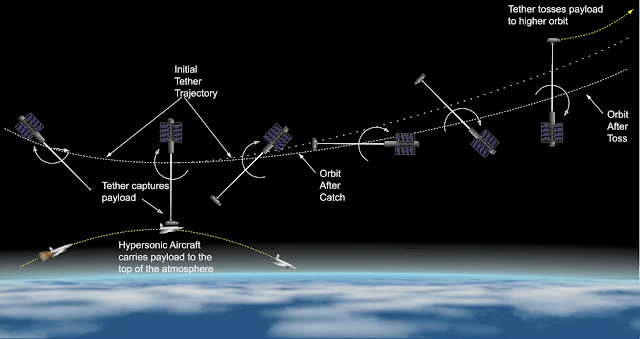
So, an Air-Breathing Rotavator Perch in Sun Synchronous Low Venus or Low Mars Orbit.
So, for either planet if the perches work, then you can have two specialized spacecraft.
1) -High Orbit to Perch
2a) -For Venus Perch to Floating platforms (Cloud Cities).
2b) -For Mars Perch to Surface.
#1 does not need landing legs.
#2a does not need landing legs, but does need a flotation method.
#2b does need landing legs.
If the Orbit <> Surface or Cloud Cities task is already in a reduced gravity, and is divided into two parts, perhaps the heat shielding technology can be of a lesser dry mass.
IF the Perches can draw gasses from the uppermost atmosphere, they may be able to at least partially refill a spacecraft.
Oxygen is the most likely propellant but perhaps Nitrogen can be involved as well.
Ending Pending
Last edited by Void (2026-05-08 08:26:36)
Is it possible that the root of political science claims is to produce white collar jobs for people who paid for an education and do not want a real job?
Offline
Like button can go here
#531 2026-05-08 15:07:42
- Void
- Member
- Registered: 2011-12-29
- Posts: 9,669
Re: Venus
(th) said: https://newmars.com/forums/viewtopic.ph … 15#p239215
Quote:
tahanson43206
Moderator
Registered: 2018-04-27
Posts: 24,560
For Void re orbits of Venus and Earth...Your initiative recently could be helpful to readers who might want to learn how to calculate the orbits of the two planets at various altitudes.
It appears your phone is smart enough to help your readers to understand how to perform the calculations.
There are multiple factors that work together to set the velocity of an object in orbit. Your presentation omits some of that detail, but perhaps your phone would be willing to provide it if you were to ask.
(th)
You are not wrong. It would be good at some point to better develop and perfect the line of thinking.
But if you consider that perhaps my process is like hunting, I am collecting clues and making evaluations of worth of investment.
My reason to chase this path is that it seems that Venus may be more a thing of value than previous evaluations proposed.
If the clouds of Venus are indeed 60% water instead of almost all Sulfuric Acid, the cloud city thing makes a little more sense.
A problem with Venus is that the idea of Space Elevator will not work.
But if it is possible to create a Very Low Venus Orbit Perch, then the task of linking Cloud Cities with Orbit is more viable. (If it can be done). Earth and Mars have a Moon(s) but Venus does not. So, the potentials are not that similar.
Three technologies might assist the development of Venus:
1) Venus Water <> Stony Asteroids might provide basic needs in Venus orbit.
-Water might be moved to the asteroids from Venus, using Carbon solar sails.
-Robots might make machines from the Stony Asteroids that could aerobrake into orbit of Venus.
2) Perching in a Very Low Venus Orbit.
-Stony Asteroid materials might be able to be used in electric propulsion.
-Nitrogen from the Venus atmosphere, might be used as electric rocket propulsion.
-Carbon might be used in an electric propulsive method.
-The atmosphere of Venus might provide chemical propellants for spaceships using Oxygen and Carbon, Nitrogen.
3) A process to swell up the atmosphere of Venus, might make it easier to extract the materials of the Atmosphere.
-Nano Particles proposed and greenhouse gasses proposed to heat Mars may be used to heat and swell Venus.
-Asteroids impacting Venus may also heat it. (This has been proposed in the past).
--A artificial Magnetic Field might be employed to reduce atmospheric losses under these treatments.
-The Nitrogen and Carbon of Venus as well as the small amount of water are potentially very valuable.
So, rather than to convert Venus to an Earth with expenses and little profit in the short term, we could find a way to make Venus profitable to a solar system economy. While the outer Solar System has lots of these resources, joining what Venus potentially can provide with what stony asteroid may provide, may allow the creation of air-filled artificial habitats in orbit of Venus.
And the solar energy is about 1.9 times that available in Earth orbit.
So, perhaps a rich province in the Solar System Civilization that maybe can be made to emerge.
Ending Pending
Last edited by Void (2026-05-08 15:33:18)
Is it possible that the root of political science claims is to produce white collar jobs for people who paid for an education and do not want a real job?
Offline
Like button can go here
#532 2026-05-09 08:12:56
- Void
- Member
- Registered: 2011-12-29
- Posts: 9,669
Re: Venus
I have seen an article about lava tubes on Venus. The first thoughts are well that will be very hot.
https://www.newscientist.com/article/24 … yre-weird/
Quote:
Space
Venus has lava tubes, and they're weird
It has been suggested that lava tubes - underground tunnels carved out by molten rock - might be on Venus, and now we have direct evidence that this is the caseBy Alex Wilkins
22 September 2025
Quote:
Copilot Search Branding
Like
Dislike
Venus has lava tubes, and they're weird | New Scientist
Recent discoveries have confirmed the existence of massive lava tubes on Venus, which are surprisingly large and differ significantly from those found on Earth and Mars.
Discovery and Characteristics
Researchers have found compelling evidence of lava tubes on Venus, which are underground tunnels formed by molten rock. These tubes are created when lava flows beneath the surface, cooling and solidifying while the molten rock continues to move. Once the lava drains away, it leaves behind a hollow tube. Recent studies led by Barbara De Toffoli from the University of Padova have identified these tubes using radar and mapping data from past missions, particularly around large shield volcanoes on the planet.
What I will suggest now is for those who may thing big.
I do think that the mining of the surface of Venus will be possible.
Several factors are needed for this probably.
-Electronics that work at high temperature.
-An energy source on the surface are a good start.
I am of course thinking that the "Miners" will be robots.
Do people aver think of making a dome on the surface of Venus, perhaps out of an acid and heat tolerant rock material.
Elsewhere and perhaps else when I have contemplated Dump-Aircraft that could deliver cryogenic fluids to the surface.
-Nitrogen?
-CO2?
-Water?
-Sulfuric Acid?
The aircraft can have characteristics of:
-Lighter than Air Ships.
-Giders.
-Airplanes.
While it is proposed to have air filled habitats at a suitable altitude of somewhat temperate character, It may be that technology will develop balloons that can contain Hydrogen long term.
https://infinityturbine.com/liftgenx-hy … rbine.html
Quote:
Balloons that can hold hydrogen long term are being developed for various applications, particularly in military and environmental contexts.
Hydrogen gas balloons are emerging as a revolutionary solution for military operations, capable of lifting heavy payloads and supporting prolonged missions.
1
Zero-pressure balloons are designed to extend the operational lifespan of balloons by allowing hydrogen to vent out, preventing bursting.
1
Solid-state hydrogen gas generators are being developed for meteorological balloons, providing a scalable solution for inflating balloons in remote areas.
1
The U.S. Navy is testing hydrogen-powered balloons paired with fuel-cell-powered drones, enhancing surveillance capabilities in remote environments.
1These innovations highlight the potential of hydrogen balloons for long-term applications, particularly in military and environmental scenarios.
Energy is very important for a civilization. Venus had cold at altitude and hat at the surface. Very hot.
An aircraft could be filled with a cryogenic fluid or water or even Sulfuric Acid as ballast.
It could be released to glide down to the surface. Upon contacting a sewer grate on top of a dome or lava tube, it could release its ballast.
Then being lightened, it might ascend back upwards by some means. Boiling Nitrogen or Water could power an engine to provide the reaction. A tank now filled with hot Nitrogen might provide lift.

Now you can provide a improve environment with electrical power for your mining robots.
It may be a bit cooler, and exclude the acid, and so then also add massive electric power, so long as a liquid is supplied by some means such as aircraft or even perhaps someday a vertical pipeline.
A Vertical pipeline could also provide an elevator.
Ending Pending
.
Last edited by Void (2026-05-09 08:51:29)
Is it possible that the root of political science claims is to produce white collar jobs for people who paid for an education and do not want a real job?
Offline
Like button can go here
#533 2026-05-09 09:13:04
- Void
- Member
- Registered: 2011-12-29
- Posts: 9,669
Re: Venus
So, in reference to the just prior post, the development of Venus, (If it is lifeless), might have 3 stages based on the method for rocky materials.
1) Venus Crossing Asteroids.
2) Venus Aircraft Method.
3) Giant machine trees that reach from the ground all the way up to 1/3 bar pressure perhaps.
Obviously #3 is going to force humans to stretch their reach of abilities.
But condensed fluids could flow down (Generating Electricity), and cool domes and lava tubes and tunnels and vaults, and the fluid boiling could make electricity and cool those structures.
As for the Sulfuric Acid, if a mix of Water and Sulfuric acid were the fluid, the heat would cause the Sulfuric acid to decompose into water vapor and Sulfur Oxides.
So, the Atmosphere might be made less acid by this method, I hope.
To possibility of adding a Ozone Layer would also reduce the production of acid.
The whole of Venus would be a giant solar engine.
Should particles and greenhouse gasses be used to heat and expand the atmosphere, then adjustments would be needed, and floating assets would have to float higher.
With an expanded atmosphere, it might be necessary to generate a magnetic field for the planet to keep the solar wind from stripping the atmosphere away.
If Venus could be utilized this way, and if the human race ever travels to other stars, then worlds like Venus might have high value.
Ending Pending
Last edited by Void (2026-05-09 14:56:08)
Is it possible that the root of political science claims is to produce white collar jobs for people who paid for an education and do not want a real job?
Offline
Like button can go here
#534 2026-05-09 15:14:21
- Void
- Member
- Registered: 2011-12-29
- Posts: 9,669
Re: Venus
This post can be given association with the 2 most previous posts.
Some people have proposed shell worlds, for terraforming some hard case worlds.
I have at times suggested shells within the atmosphere of Venus.
A singular shell might divide toxic gasses from a breathable atmosphere.
In such a case the planet would no longer be a solar collector in the manner that it is now. In that case it might be desired to heat the lower layer by some means like microwaves to keep it in a static condition.
Here is a wiki on some types of shell worlds: https://en.wikipedia.org/wiki/Shellworld
It does not seem to list the types I have suggested for Venus.

Such a shell would not necessarily separate the gasses of the atmosphere as the drawing above suggests.
But for the drawing above the shell might have multiple layers.
And a sort of shading shell on top that also would be a wind break.
I think that the N2/O2 atmosphere might be extremely windy. So you might want to be under a wind break that also shaded you. And these structures would need to be very strong.
Also, you would have to limit the amount of water above the shell to prevent massive accumulations of ice, snow, and water.
The bulk of water might be stored in lower shell partitions and have artificial light.
The maintenance of this system would require lots of robots with at least the intelligence of bees.
Power from solar and wind would be very abundant. Also, on the night side heat could be radiated to create electricity.
So quote from #533:
So, in reference to the just prior post, the development of Venus, (If it is lifeless), might have 3 stages based on the method for rocky materials.
1) Venus Crossing Asteroids.
2) Venus Aircraft Method.
3) Giant machine trees that reach from the ground all the way up to 1/3 bar pressure perhaps.
So we might name the idea in the post as:
4) Venus Shell world.
Perhaps Venus would transition 1-4 to get to such a place.
If you did then people could walk outside in a N2/O2 atmosphere of 1/2 to 1 bar pressure.
The shell might even rotate to give a day/night cycle, maybe 4 Earth Days Lone?
But the people of the future may choose what they want if they have the means to do it.
Ending Pending
Last edited by Void (2026-05-09 15:43:08)
Is it possible that the root of political science claims is to produce white collar jobs for people who paid for an education and do not want a real job?
Offline
Like button can go here
#535 2026-05-09 18:42:49
- Void
- Member
- Registered: 2011-12-29
- Posts: 9,669
Re: Venus
(th) per your comments: https://newmars.com/forums/viewtopic.ph … 38#p239238
Thankyou for your interest.
A shell method for Venus could be of varous types.
The one I showed is just one. It could have 10 shells with structural members connecting each, to give best strength.
The weather under the shell would be relatively static, I think if the current status of the lower atmosphere could be approximately preserved.
That is non-convective. The toxic gasses would all be kept there.
The situation would resemble a waterbed. A heavier fluid inside the enclosure and air outside it.
As I see it perhaps the outer three shells would be like wiffle balls with openings, to let some light though: https://en.wikipedia.org/wiki/Wiffle_ball
Image Quote: 
With each of the 3 layers, less and less light and wind would transfer though.
For the lower layers, this also might mitigate the problem of frost.
Presuming that the shell can rotate 1 time per day, that could help near the "Equator".
But the poles may be alternately tilted into the sunlight periodically to simulate seasons. Efforts might be made to limit ice buildups.
While it might be desirable to have solar panels, it might also be desirable to make the albedo favorable to desires. Polar areas less reflective and equatorial areas more reflective on average.
But I fear there could be severe wind storms, so at times it would be dangerous to be too far exposed in the 3 upper layers.
But then 7 lower layers would offer sanctuary.
>>>>>>>>>>>>>>>>
I have also considered lesser concepts, such as a hoop that extends around the circumference of the planet at the good pressure and temperatures. In that case though you cannot have an open-air environment, it must be enclosed and roofed over to keep the toxic gasses at bay.
Thankyou for your interest (th).
Ending Pending
Last edited by Void (2026-05-09 18:53:38)
Is it possible that the root of political science claims is to produce white collar jobs for people who paid for an education and do not want a real job?
Offline
Like button can go here
#536 2026-05-10 05:56:54
- Void
- Member
- Registered: 2011-12-29
- Posts: 9,669
Re: Venus
(th) per your comments: https://newmars.com/forums/viewtopic.ph … 41#p239241
I suppose that a sphere may describe a balloon like structure, although not all balloons have to be spherical.
This particular shell, unlike other shell worlds I have seen description for, would be like putting bubble warp on top of s swimming pool.
The Bubble Wrap itself has flotation properties on top of the heavy fluid, but the lighter fluid can float on top of the bubble wrap layer.
For Venus, the Toxic gas mix would dominantly be of CO2, but may include also N2, SO3, H20, represents the water.
The desired N2/O2 mix on top represents the air fluid above the swimming pool.
Instead of a bubble wrap parturition though the Venus shell would more be composed of multiple decks. And probably those to be divided into cellular chambers.
A different sort of the device would allow the gas mix above and below to be the same mix, and might have holes that have turbines in them. Cold air on the night side would fall though and hat air on the day side would rise to turn the turbines.
But you would not have a sky of breathable air in that case, and would need a space suit to survive on the "Surface".
>>>>>>>>>>>>>>>>>>>>>>>>>>>
Venus presents an interesting case. If we think that all terrestrial planets started as Hycean worlds, then could we have had a Venus at 2 AU out in a solar system? https://en.wikipedia.org/wiki/Hycean_planet
The formation of planets appears to be a somewhat random process so that might happen, for various sized stars.
The planet would start warm and have a greenhouse effect as long as its Hycean Atmosphere was retained.
But depending on the size of the planet and other factors such as type of star and Thea type impactors the early atmosphere might be swept away, just is it has been for our four terrestrial planets.
I think then there would be a Venus like atmosphere remnant for a while. if CO2 could be incorporated into rocks then you might end up with a 3 bar N2 dominated atmosphere. If not then an atmosphere like that of Venus might exist even at the condition of 2 AU for our type of star.
This presumes a balance of power where volcanism may emit CO2 faster than water processes can incorporate it into rock.
We know that for the 3 Bar atmosphere of the proposed 2 AU Venus that atmosphere might persist in our solar system, because our Venus can retain most of it's Nitrogen, and Titan is warm enough for a N2 Atmosphere.
So, it might be that a planet with water could exist with liquid water, beyond the so called habitable zone.
For a M type star which is very erosive of atmospheres this might be possible mercy. At the "Equivalent" sunlight of 2 AU the solar flux would be .25 (1/4) that of Earth, (Sort of). The Erosive nature of the solar wind of that star might also be reduced to .25 (1/40) that of the center of the "Habitable" zone.
At that greater distance, it is perhaps less likely that the planet may be tidal locked.
Of course planets that far out for some stars will be harder to detect.
Hopefully I got my math correct. I did not sleep particularly well last night.
Anyway, Venus type pathways, might lead to some interesting planets around other stars.
Add a magnetic field and maybe it would be more habitable on the surface or in the clouds.
Ending Pending
Last edited by Void (2026-05-10 06:28:22)
Is it possible that the root of political science claims is to produce white collar jobs for people who paid for an education and do not want a real job?
Offline
Like button can go here
#537 2026-05-10 11:25:56
- Void
- Member
- Registered: 2011-12-29
- Posts: 9,669
Re: Venus
Pertaining to the last few post I am imagining 3 types of cold terrestrials with resemblance to Venus.
With 25% of sunlight and at least 3 bars of N2 pressure, I think that there could be enough flowing water to lock most CO2 into rocks.
With 25% of sunlight and the Atmosphere of Venus, it may be too hot for surface water. So, the CO2 will not bond to rocks or freeze out.
With >25% of sunlight of Earth, at some point the CO2 will freeze out. If you then have 3 bars of N2, you will have some warming, but for many planets CO2 may find cold locations to accumulate as ice. The planet will probably not be warm enough for too much flowing liquid water, even at warm spots.
But if humans even go interstellar these planets may be attractive for utilization/terraforming.
Ending Pending
Is it possible that the root of political science claims is to produce white collar jobs for people who paid for an education and do not want a real job?
Offline
Like button can go here
#538 2026-06-05 17:11:33
- Void
- Member
- Registered: 2011-12-29
- Posts: 9,669
Re: Venus
This seems to say that some life lives in fog: https://www.youtube.com/watch?v=OBzb-fHukgM
Evidence That Fog Is Alive and Not just Some Weather Phenomenon
He also mentions implications for Venus.
Cosmic Dust may be useful to similar microbes for Venus if they do exist.
I am also aware that microbes are also responsible for inducing frost crystals. I do not know if these microbes will produce fog condensation.
https://www.universetoday.com/articles/ … oneer-data
Quote:
Venus' Clouds Contain Aerosols That Are 60% Water, According To Reanalyzed Pioneer Data
By Andy Tomaswick - October 01, 2025 04:26 PM UTC | Planetary Science
Quote:
Copilot Search Branding
Like
Dislike
Venus Clouds Contain About 60% Water
A 2025 reanalysis of NASA’s Pioneer Venus mission data has revealed that Venus’ cloud aerosols contain roughly 60% water, far more than previously thought Universe Today+1. This finding overturns decades of planetary science assumptions that Venus’ clouds are dominated by concentrated sulfuric acid.How the discovery was made
The Pioneer Venus Large Probe, which descended through Venus’ atmosphere in 1978, carried instruments designed to measure atmospheric gases. As it dropped through the thick cloud layers, its inlets became clogged with aerosol particles. These particles were later heated, causing them to decompose and release gases that the instruments recorded The Watchers. By analyzing these thermal decomposition signals, researchers could reconstruct the original composition of the cloud material.Composition details
Water: ~60% by mass, mostly bound in hydrated minerals such as hydrated ferric sulfate and hydrated magnesium sulfate, rather than as pure liquid droplets Cal Poly Pomona+1.Sulfuric acid: ~22% by mass, still present but less dominant than previously believed Universe Today+1.
Oxidized iron: ~20% by mass, also part of the aerosol mix Cal Poly Pomona.
Why it matters
This composition suggests:Venus’ atmosphere is less dry than long thought, with water playing a significant role in its chemistry Cal Poly Pomona.
The cloud environment may be more habitable for potential microbial life than previously assumed, given the presence of water and milder acidity compared to earlier models EarthSky.
The results highlight how reanalyzing old data with modern techniques can reveal new insights into planetary science.
In short, Venus’ clouds are not just acidic; they are a complex mixture where water is a major component, locked in hydrated minerals, and sulfuric acid is a smaller part of the aerosol mix.
Spiders that float: https://www.bing.com/search?q=life%20th … FD60095BAB
Quote:
Copilot Search Branding
Like
Dislike
How Spiders Use Electricity to “Float” in the Air
Some spiders can travel thousands of miles through the air without wings, using a process called ballooning that harnesses the Earth’s natural electric field for lift AskNature+1.The Science of Electrostatic Flight
The Earth’s atmosphere has a natural electric field — the ground is more negatively charged than the upper atmosphere, creating a voltage gradient of about 100–120 volts per meter on clear days usefulbs.com. This invisible field is similar to a giant battery, with the ground as the negative terminal and the sky as the positive usefulbs.com.When spiders release ultrafine silk threads, the material becomes positively charged through the triboelectric effect — a process where contact with air transfers charge Animals Around The Globe. This charge causes the silk strands to repel each other, spreading out and capturing more air, which counteracts gravity and provides lift Animals Around The Globe.
Sensory Detection
Spiders detect changes in the electric field using sensory hairs (trichobothria) on their bodies. These hairs move when the field changes, signaling the spider that it’s time to launch PBS+1. This “spidey sense” is so sensitive that spiders can initiate ballooning even on windless days PBS.The Launch Process
The behavior is called tiptoeing: the spider straightens its legs, raises its abdomen toward the sky, and releases multiple silk strands PBS+1. The charged silk threads are then carried upward by the electric field, sometimes reaching altitudes of 2–3 miles AskNature+1.Why It Matters
Ballooning is a key survival strategy for spiders:Dispersal: Spiders can cross oceans and continents, colonizing new habitats spacefed.com.
Escape: They can leave unfavorable environments or avoid predators.
Efficiency: Electrostatic lift works even without wind, making it a reliable mode of travel usefulbs.com.
In short, spiders “float” by turning their silk into charged sails that ride the Earth’s electric field, a remarkable example of how life can harness invisible natural forces to overcome gravity.
Venus levitates Oxygen into space with a stronger electric field than that of the Earth: https://www.bing.com/search?q=The+elect … pc=EDGEXST
Quote:
Copilot Search Branding
Like
Dislike
How Venus’s Electric Field Drives Oxygen Loss
Venus’s atmosphere is extremely dry, with surface temperatures hot enough to boil away any liquid water. This raises the question: where did the water go? One major answer lies in planetary atmospheric escape, and in Venus’s case, a powerful electric wind is responsible for stripping away heavy ions — including oxygen — from its upper atmosphere.The Electric Wind of Venus
Measurements from NASA’s Goddard Space Flight Center and other space agencies revealed that Venus has a persistent, global “polar wind”‑like ambipolar electric field in its ionosphere. This field is five to ten times stronger than Earth’s similar region NASA Scientific Visualization Studio+1. An “ambipolar” electric field means it accelerates both positive and negative ions in the same direction, effectively pushing them outward.How It Works
Gravity vs. Electric Force: Gravity holds the atmosphere down, but the electric field can push ions upward and outward, overcoming gravity’s pull NASA Scientific Visualization Studio.Ion Acceleration: The electric wind accelerates ions lighter than about 18 atomic mass units (amu) to escape velocity. Oxygen ions (O⁺) are heavier than this, but the field is strong enough to still accelerate them to speeds that allow escape AGU Publications+1.
Direct Escape: Unlike Earth, where solar wind stripping dominates, Venus’s electric field can directly eject heavy ions like oxygen into space, even without significant solar wind interaction UCL Discovery+1.
Why It Matters
Atmospheric Evolution: This process shows that planets can lose heavy atmospheric components entirely through electrical forces in their ionospheres UCL Discovery.Habitability Implications: For exoplanet studies, understanding such electric winds is crucial — a planet with ideal conditions for oceans and breathable air could still lose its atmosphere if strong electric fields exist NASA Scientific Visualization Studio.
Venus’s Case: The electric wind is a major reason Venus’s atmosphere is so thin and dry compared to Earth’s, despite its thick clouds.
In short: Venus’s electric field acts like a “levitating” force on oxygen ions in its upper atmosphere, accelerating them to escape into space, a process that shapes the planet’s atmospheric history and limits its potential for habitability NASA Scientific Visualization Studio+2.
So, perhaps on Venus, life might place itself in the clouds where it can get its best rewards. This might not be sunlight but perhaps chemicals.
The UV might split chemicals for it and also the high heat down below might split chemicals for it. For instance, H2SO4 converts to H20 and SO3 at the hot base of the clouds. I don't know if life could use that but perhaps some other chemicals are also generated that might be of use.
So, it is possible that Venus, Earth, and Mars swapped spit at some point in the past. For instance, if Earth had fog life already and Venus was in a less acid condition, perhaps Earth life might have seeded Venus when some object splashed into the atmosphere of Venus.
Even if Venus never had a cool surface, if it had clouds less acid than is so today, maybe something could have migrated from Earth.
Or the other way around.
Ending Pending
Last edited by Void (2026-06-05 17:29:15)
Is it possible that the root of political science claims is to produce white collar jobs for people who paid for an education and do not want a real job?
Offline
Like button can go here