You are not logged in.
- Topics: Active | Unanswered
Announcement
#1526 Re: Not So Free Chat » When Humans Eat Their Brains » 2025-01-22 20:56:33
That is an interesting story. I feel it indicates a lesson for our ambitions with space. Thinking just a little more out of the box might have paid off for the Norse in Greenland.
They were of course an isolated community and perhaps a bit too outlaw. They overused their resources, and probably supposed that the climate would turn around, but it was the little ice age. Some theories existed that English Pirates finished them off, or that the Moors went slaving. They may have fought a but with the Innuit.
But the main accepted story at this time is farming was marginal when they arrived and they depleted the soil and trees, and when the climate deteriorated that was against them. They finally had a bad winter and starved, it is thought.
But I think if they had had some foresight about the trees, and had a certain weed that has invaded Iceland, perhaps they might have pulled though.
https://hakaimagazine.com/features/why- … ng-purple/
Image Quote: 
The purple flowed plant fixes Nitrogen, and is changing Icelands deserts. It is possible if the Greenlanders had had it the soil would have been better and they might have been able to keep their livestock in better shape.
One article I read said they should have changed from cows to Sheep and Goats. But of course they were isolated, especially after the sea lanes became choked with ice, so they did not do those adaptations.
The Innuit had been moving south, with the seals as the climate deteriorated. It could have been possible that the Norse could have adopted Innuit survival methods, but it is thought that the church did not want that association to happen as the Innuit were Paigan. That is just a theory.
But if the Norse had done a bit more with fish and seals, and preserved and planted forests, and had had that plant to redeem the damaged soil, maybe history would have had them survive.
Not to put them down, but they needed more brains, than most Europeans had at that time.
Hopefully we will not miss some critical chances.
Ending Pending 
#1527 Not So Free Chat » When Humans Eat Their Brains » 2025-01-22 09:40:02
- Void
- Replies: 5
I will see if I can get away with this.
I have had some notions of this previously but stumbled upon a nice video about High Verbal IQ people.
Query: "academic agent"
https://www.youtube.com/watch?v=ZQUkOOWWa5o
Quote:
The Top 5 Dishonest Rhetorical Tactics of High Verbal IQs
Academic Agent
109K subscribers
I recall seeing an Astronaut talk about an ocean creature that when in its young stage, swims about with a brain, but when reaching adulthood anchors itself to a rock and then eats it's brain, as it has no need for it's expensive habits.
So, while we can hope that all of our efforts we may find our way out of darkness, once we may become more efficient, will we eat our brains?
I sometimes run a idea though my head, Homo Erectus vs Neanderthal. Small brain hive mind vs. big brain small groups. We know that some primitives (From our point of view) kill and eat monkeys. So we might presume that in prehistory, one group might at times eat the other group. Or at least deprive them of pattern continuation.
It is my opinion that excessive communication skills may lead to mind hiving, and then to the small brains problem.
Generally, communication is dominantly verbal. So, if it is at an excess, it may displace other types of intelligence.
There can be exceptions. A highly verbal skilled individual may be able to subordinate someone with excellent skills of other kinds, and then if mating you might get good verbal minds mixed with other skills. And this may be happening now. But a high verbal with the sleight of hand (Mouth), like a magic trick may displace people with other skills from success. This might damage the gene pool.
When Al Gore invented the internet, things changed. Keep in mind that I am using my eyes and hands to communicate. Even so, the internet is a short cut cheat even like verbal skills are. But I will always choose to cheat the lions, as they should not have eaten their brains so much. The internet also provides pictures and diagrams, which is much more to a Neanderthals liking.
The Homo Erectus are being knocked off of their props by this I calculate.
In case you may think that I have some vast artistic conceit like Hitler did, I don't. It seems likely that he and his kind supposed that if they created struggle then they would catalyze the emergence of higher types. I think that they were in error. They were breeding for roaches, in my opinion. Darwinism and survival of the fittest and those sorts of things that the verbal's had promoted.
I think I can see inside of their heads. They were primarily a Roman descended heritage, who deceived the Northern Europeans (Who were under persecution), to go out and kill. They flattered them, and deceived them, I feel. While on the surface the persecution of Jews was a diversion to help these people with their frustrations, I think that in a NAZI mind, killing half of the Jews would be to improve the Jews. Only the smart and resourceful of the Jews would survive. And the blame could be attached to the Northern Europeans, who did in many cases get their hands dirty.
But enough of that. The superiority complex of some Europeans, lead them to consider both Homo Erectus and Neanderthals as inferiors. They presumed that they were the test standard of highest value.
As they regarded themselves with a narcissistic glorification, of course they wanted to see Neanderthal as an earlier and inferior version of humans. The thick brows and cheekbones, and sloping forehead, were for inferiority, of course. But the Neanderthal had bigger brains than the so called "Modern Humans". It seems to have turned out that the bone around the eye sockets was to protect the large eyes, needed to live in dim light situations. So it was not inferior, just different. In my opinion such people were probably more visual than so called "Modern Humans". I believe that the eye size being 1.0 for a Neanderthal, ours would be .7 in the modern day. This probably indicates that they would have more brain development for visual and perhaps less for other functions. So, I suspect that Neanderthals would have found the internet to be a useful tool.
Pause for coffee.......
Alitta probably needs more bone around her eye sockets, as she has Mars eyes, presuming dimmer lighting: https://www.uhdpaper.com/2019/03/alita- … 8k-10.html
But maybe here cyborg body can keep the homo erectus from bashing her head in to eat her brains.
An Eye Mind has been dismissed by the heroes of the reality provided to us, as wasted brain in the some of the North Europeans, but I think it is also used as the "Mind's Eye", when not being used for vision in dim light.
I think that that is a bit racist, if you ask me, to dismiss a skill as not useful.
My intention here is to try to shed some light on things so that we can better see what may be true.
Now the verbal skin color game. Why do creatures in caves tend to lose pigment? Because they can. But it may also be true that being forced to generate a pigment may be a cost. I expect that humans that have ancestors that did not have a pigment requirement have become less pigmented. Living in a building and wearing clothing may tend to do that. But you probably also have to have the genes for pale color available to select as well.
The Inuit are a curios case though as they have not turned that pale even though living in the Arctic. https://en.wikipedia.org/wiki/Inuit
Image Quote:  I guess I would call their skin tone medium. But I wonder about their eyes. They do not tend to be blue, so do that have the Neanderthal adaptation of big eyes yet? Some theories say that they got lots of vitamin "D" from sea food so the pressure for pale skin was not present. I would say maybe. But also, if they had not pale skinned people to mate with, and did not mutate a pale skin, they might not convert even under pressure.
Parts of their bodies may also be strongly affected by the sun, as reflections from snow and ice make sunshine more intense. But how long has their blood line been in the Arctic? Perhaps they only recently adapted to the Arctic with their technology. https://en.wikipedia.org/wiki/Inuit They have a very impressive technology.
I wonder if the North being periodically horrible kills off a people and then other people come from the south when things improve. For instance the Dorset people preceded the Inuit, I believe: https://en.wikipedia.org/wiki/Dorset_culture
Quote:
The Dorset was a Paleo-Eskimo culture, lasting from 500 BCE to between 1000 CE and 1500 CE, that followed the Pre-Dorset and preceded the Thule people (proto-Inuit) in the North American Arctic. The culture and people are named after Cape Dorset (now Kinngait) in Nunavut, Canada, where the first evidence of its existence was found. The culture has been defined as having four phases due to the distinct differences in the technologies relating to hunting and tool making. Artifacts include distinctive triangular end-blades, oil lamps (qulliq) made of soapstone, and burins.
So, a mini-ice age might weaken a people in the Arctic, and maybe a plague might evolve somewhere, maybe in the more populated south. Then when things get better the Arctic people having been wiped out, someone from the south fills the vacancy. The reason that the Nordics don't have that experience is that where they currently live has not been quite that harsh, and so they may have various immune options in their populations.
They may have never had that much population. I believe that I read that all the Inuit could be seated in one stadium, or something like that.
Anyway, that helps to some extent. I am wondering about the words our Verbals use to manipulate society on the basis of skin tone. It didn't used to be black/white. (Sometimes the have to use "People of color").
It is about trying to be in charge of a wealth redistribution on the basis of described groups.
In my opinion the colonial era of Europeans, was simply a vacuum in parts of the world. The Europeans had gotten to some sort of viable methods of living. So, they spread. Then other groups adopted some of those viable methods, and there has been a push back. But I think the pushback is coming to an end.
My purpose in all of this is to see what is true if possible and not be deceived by the Verbals, who may be wolves in sheep's clothing.
A rational expansion into space, does not favor the NAZI idea of eliminating genes in order to make the human race stronger. As space may have more space to live, then we can entertain a larger gene pool to keep. The NAZI philosophy in the end did not favor the so called "White" Germans, even Hitler turned on them. So stories that seek to redistribute wealth to take tribute, in a tribal sense do not please me. It is just more of the same, different skin tones and other features.
Let's consider the phrase "Tall, Dark, and Handsom". I guess if you are a female and want to mate with a male, tall and dark indicates someone who can bash in other people's brains so that you can eat them also. Handsom? Well, the implication is that Tall and Dark are Handsome. But looks are actually based on the average.
At least for women it tends to be a bad thing if you don't have average looks, for a group. You will perhaps become regarded as strange and perhaps not even attractive.
https://www.psychologicalscience.org/pu … idual.html So, that seems to be a maybe, some of the time?
So, maybe we should take some time to figure out what "The Best And Brightest", (Verbal minds) are trying to do to us.
Ending Pending
#1528 Re: Terraformation » Adding Spin Gravity on Small Worlds. » 2025-01-22 08:21:03
I agree to the greater part of what has recently been said.
I think we will have the tools to answer some of those questions fairly soon. Because Dr. Johnson indicated in the past that Starship might be able to go up to .5 g in a baton tumble method.
Such testing would not require refilling the ship. Just LEO.
So I would start with a "Half Down Spiral Test".
You would likely load the ship in LEO with a set of humans, using Dragon. Then you would kick it to a .5 g rotation gravity simulation. Then over a time period you would bring the level down in small gradients to microgravity. I will presume life support sufficient to have a mission to the Moon and back, which is what is expected to be available to support the Artimus, intentions for the Moon.
While this will not do a 6 month or 1 year test of bone and muscle, it will be possible to have a look at blood pooling in the upper body. Also, the typical body chemistry tests could be performed. You should be able to see if the body is shedding Calcium, I think.
You also could do a "Half Up Spiral Test". Start at or near microgravity and increase the spin over a period of time in small increments.
My suspicion is that upper body blood pooling will not be exactly the same for all people, and that it will kick in at some level of gravity simulation between microgravity and .5 g simulation.
During such testing you could also find out information about sanitation. Plumbing. And you would be stress testing the ship as well.
This would test for any level of gravity simulation for worlds humans might visit in the next few decades except Venus.
And if you wanted to test for Venus, then just hook two Starships together at the tail, and you might be able to spiral up and down from Microgravity to close to 1 g.
Again, this could be done while the Starship is still not matured yet, as the Dragon exists, and Dream Chaser might become human rated, if there is a push to do that.
It would also be possible to do animal tests in this way, but really, I don't think any animal other than humans stands on it's two hind paws as much as humans. So, for animal testing you could do the tests longer term to see what bone losses are.
Eventually as the Starship becomes reliable as per life support, you might get test data from humans who have been in microgravity for 6-9 months. You might move them to a Starship and see how well they recondition as you spiral up the gravity simulation. This could be important for trips to Mars.
Someone is testing aerobraking, which might be a method of accessing Mars in increments: https://www.spaceforce.mil/News/Article … -maneuver/
Quote:
The X-37B Orbital Test Vehicle (OTV-7) will begin executing a series of novel maneuvers, called aerobraking, to change its orbit around Earth and safely dispose of its service module components in accordance with recognized standards for space debris mitigation.
So, my best guess would be that for a trip to Mars, you might have a fraction of 1 g for sanitary reasons, and perhaps to keep the blood pooling as favorable. Then as would be useful, you might tumble the ship at intervals to get the humans prepared for multiple aerobraking events, and finally to be conditioned to work on the surface of Mars.
But we do not yet know what level of gravity simulation would be enough to keep blood pooling as favorable, and we do not know what the sanitary gravity level is that would work best.
Ending Pending
#1529 Re: Science, Technology, and Astronomy » Humanoid and other robots. » 2025-01-21 11:37:35
I want to explain my attitude towards a "Lords and Ladies" culture. I only want it to be reasonably kept in check for the American culture. I think careless export of American methods to overwrite cultures with royalty as part of the method, is dangerous. The French and Russian revolutions are examples of that.
The empowerment of individualism is a preference, if you can afford it.
Royalty as in the UK is like having cats that keep the rats out. Or a dog if you prefer.
My observations on what works is a partnership between a republic and a constitutional monarchy. In the actual world that seems to have worked to some degree.
I will tend to become rabid in my thinking when I see people in the Democrat party, acting "Royal", as if they were entitled plantation owners. Not that I necessarily will have joy over every republican behavior in that party.
I want the American experiment to continue and improve. Leave us that, and we are not likely to bite you. Maybe a bark here and there.
Ending Pending
#1530 Re: Life support systems » Gold Hydrogen, Geologic Hydrogen, Natural Hydrogen, etc. » 2025-01-20 21:43:59
Well, this is hopeful: https://www.msn.com/en-us/money/other/g … ef10&ei=44
Quote:
Giant reserves of 'gold' hydrogen may be lurking beneath at least 30 US states, 1st-of-its-kind map reveals
Story by Sascha Pare • 13h • 3 min read
Image Quote:
Quote:

A map showing areas in the U.S. that are unlikely to host hydrogen reserves (white to light blue) and likely to host hydrogen reserves (blue to dark blue).
© U.S. Geological Survey
So, there is some talk that their could be 200 years of such energy reserves.
If that comes true, we will have plenty of time to shift to other exotic types of energy over time.
We can hope.
Ending Pending
#1531 Re: Terraformation » Interworld Para Terraforming » 2025-01-20 12:40:43
So, I am not sure I buy into the "Kardashev scale" notions. To me Venus says, no you are not going to learn to utilize all of the energy of Earth, to become Type I.
Instead, you are going to find that a world like Venus has a lot to offer, even if it is not your "Nursery World".
So, I think you would have a long period of being both Sub Type I and also a bit of Type II.
For Mars and Venus, solar power might be very attractive, at least in orbits, provided you had mass to build things with that is not deep in a gravity well. For Venus, Terrestrial Crossing Asteroids, may allow for access to Venus itself for materials. And of Course Mars, itself has .38 g and also Phobos and Deimos and then the asteroids as well.
Ending Pending
#1532 Re: Science, Technology, and Astronomy » Humanoid and other robots. » 2025-01-20 12:24:08
Well Tesla Cars do have a robotic nature: https://www.bing.com/videos/riverview/r … &FORM=VIRE Quote:
The INSANE Plan for Robovan
YouTube
Rebellionaire
172 views
4 hours ago
I think this will suit North America quite a bit and I think may enhance individuality. It will free us of subways and passenger trains, I expect.
Without inventive vigilance we risk decaying into a "Lords and Ladies" culture, with parasitic metering.
The empowering of the individual is what places in North America has to offer. Maybe not the only places in the world.
Individuality if too expensive, may be hard to afford though. But with what Tesla and others are doing, we may be able to make American young again, and prevent the decay into old world cultural structures.
The problem with a "Lords and Ladies" metered culture, is that it can become parasitic. There is an urge on the part of the "Lords and Ladies" to squeeze the metering to be able to expand the featherbedding in the numbers of the controlling entity.
Such cultures are relatively easy to be taken over by socialists and communists and fascists of the old world character.
So, really good. We probably get more individuality while becoming more efficient.
Ending Pending
I forgot to mention Covid-19, and the like. I think this arrangement would be much better for sanitation, if necessary, as it could adapt. It might become less efficient under those situations, but would be more sanitary than Subways, and Passenger trains.
Ending Pending
#1533 Re: Not So Free Chat » Peter Zeihan again: and also other thinkers: » 2025-01-20 10:34:01
I have seen other reports of this, some which are mentioned in this video:
https://www.bing.com/videos/riverview/r … &FORM=VIRE
Quote:
China's Real Population Numbers are Shocking (Demographic Collapse is More Advanced than we Thought)
YouTube
Based Camp with Simone & Malcolm Collins
27.1K views
2 months ago
So, they touch on why some nations may have false statistics on demographics.
A thing we have that might be a bit similar is how supposedly the democrats want to bring in outsiders who they think they can enroll in their party, to preserve the system they have where they attract favor by offering gifts to the people who they struggle to keep poor. Trying to gerrymander the culture. They love a patronage/protection racket method of control.
And also, nature some animals want to posture as bigger and more threatening than they actually are.
A similar thing they mention for Nigeria, is that to distribute oil money, a subregion has an incentive to inflate their population numbers to get a bigger share.
I am not interested in fighting all Deamons, I just want to know where they are, and their tricks.
Ending Pending
#1534 Re: Science, Technology, and Astronomy » Humanoid and other robots. » 2025-01-19 11:07:31
So, I have been trying to get some notion in my head of which cases of space manufacturing would support periodic or continual microgravity use.
Obviously this is very murky, hard to know.
Reusable Starship is said to have a payload capacity of 100 to 150 tons. If you divided that in half, then 50-75 tons, where each half could be devoted to a maker in one case and raw materials in the other case.
A maker would be like a manufacturing line, but some special robots like Optimus might be included.
Presumably if there were no waste then you would bring back a tonnage of product of 50-75 tons. If it is a drug, that is a lot. If fiber optic cables maybe not so much.
With a periodic Starship to microgravity Starship, then you must pay over and over again to lift the maker to orbit and to land it. On the other hand, each time that starship landed the maker could be deeply serviced with maintenance, repairs, and calibrations.
But if you did your Manufactuing continually in a LEO space station, you must do the servicing in orbit, which may be beyond what Optimus could do for now, so then you probably have to involve humans. But in that case you could lift 100-150 tons of raw materials and optimally return 100-150 tons of product with each Starship flight.
I will imagine that both methods will exist as different products may be involved.
Statistically their will be loss of ship events. So, periodic may be more susceptible to that. So, reliability of repeatable success, will matter.
But periodic may be done without humans, their dirt, and the life support they require.
If you don't have Oxygen in the cabin, you are not likely to get fires in the cabin, so that offers liberty as to materials in use.
Ending Pending
#1535 Re: Terraformation » Interworld Para Terraforming » 2025-01-18 21:12:36
If Ascender will be real, then before they do the H1 version that supposedly could go orbital they would do lesser vehicles: https://jpaerospace.com/blog/?p=6869 Quote:
TransAtmospheric Ascender
The TransAtmospheric Ascender will be our first airship to reach space. The vehicle is 2100 feet long and will have a crew of three. It will have a peak altitude of 350,000 feet and a maximum velocity of Mach 5. Technically it is a hypersonic waverider. The TransAtmospheric Ascender is strictly a suborbital vehicle. It will fly from a Block 2 Dark Sky Station floating at 120,000 feet to space then return to the station. The airship will be driven by a single four chamber version of our symphony hybrid chemical/electric rocket engine.The TransAtmospheric Ascender is still a few years away but as we get closer the design starts to firm up. Just thought you would like a look at where it stands.
I am very interested in knowing how their "symphony hybrid chemical/electric rocket engine" are to work.
These images may or may not apply: https://www.bing.com/images/search?q=as … RE&first=1
https://www.reddit.com/r/hybridairships … ?rdt=52638
My pea brain struggles.
Anyway I am imagining thinking backwards with it for Venus and Mars. Basing it in orbit, and letting it drop down on occasion into the atmosphere to extract chemicals.
For Mars, with only .38 g, this could be easier than for Earth or Venus. And Phobos and Deimos are in orbit for solid mass. A question is, if an Ascender could navigate though the mixing zone for the solar wind and the atmosphere of Mars, could it pick up Hydrogen and Helium? And of course Nitrogen and Carbon would be wanted.
Could this machine do Soaring? A lot of these things I only understand fragments of at this point.
Dynamic Soaring is being contemplated to be able to exceed the speed of the solar wind at the Heliopause: https://www.frontiersin.org/journals/sp … 17442/full
Quote:
Dynamic soaring as a means to exceed the solar wind speed
It is a long shot for the upper Martian atmosphere, but a question might yield to an answer eventually.
I am not at all assured that an Ascender could land on Mars. But perhaps they could be based in orbit. And if no other source were available fuel might be extracted from the Mars atmosphere. At least CO2, which could be split into CO and O2, but maybe H2 as well. Carbon could also be a propellant for the Neumann Drive, and Oxygen might be propellant for some type of Mass Driver ships engine. But of course metals and Oxygen can likely come from Phobos and Deimos.
It would be very good to be able to refuel/refill ships in Mars orbits to access the asteroid belt and for trips inward in the solar system.
Ending Pending
#1536 Re: Terraformation » Interworld Para Terraforming » 2025-01-18 13:11:07
Terraformer is working with others on airships and spinlaunch, elsewhere. I do not want to disturb that.
But Terraformer prompted me to have another look at Ascender, and I have some ideas about that device. Some may consider it to not be real, just a dream, but lets dream. After all a while back, Falcon 9 would be regarded as not possible.
https://www.bing.com/videos/riverview/r … &FORM=VIRE
Quote:
Introducing: Ascender H1 Variant Orbital Airship
YouTube
John Powell
147.3K views
10 months ago
I have a special focus on Venus for this, but lets allow that it might be used on any world with an atmosphere. It probably will not be suitable for gas giants, and likely not for Triton. But Venus, Earth, Mars, Titan, and Pluto, might have potential. Some now, and some after being terraformed a bit.
I am most interested at this time, in Venus, both now and if it were terraformed a bit.
I have been interested in Starship for Venus, but Ascender might offer some really nice features if it can be made to work. For Starship, I was thinking that it could dive into the atmosphere, and then perhaps come to rest at the 5 to 10 bar pressure level. But that puts it in an acid bath. And since it is made to function in the vacuum of low orbit at least, this is asking a whole lot too much, I fear.
We could speculate on doing this with Ascender, but again, acid bath, and probably wind storms that might tear it apart.
But lets split functions. Lets have Ascender only come down to a certain level in the atmosphere, to meet with another airship that is not designed to operate in orbit, but to endure at least 1/3 bar of pressure. Perhaps as much as 1 bar of pressure. Doing this, the lower operating airship needs to be able to endure acid, and wind. But the Ascender can perhaps be kept above these hazards for Venus.
https://en.wikipedia.org/wiki/Atmosphere_of_Venus
Image Quote: 
OK, you have to be at least 100 km up to avoid the acid. But you probably avoid serious wind turbulence that could destroy Ascender. Your choices might allow some exposure to acid for relatively brief time, to allow a lower reach for the Ascender.
Keep in mind that the gravity of Venus is less, 90% that of Earth, and so the atmosphere will extend higher than for Earth. If you replaced the atmosphere of Venus with the total atmosphere of Earth, it would bulge higher, both from the lesser gravity and from heating of the atmosphere.
So, kdb512 has worked out some solutions for mining the surface of Venus, and I think that if we had at least 3 layers of aircraft/spacecraft, we could have total connection between the surface of Venus and the orbits of Venus. Ascender would be the upper one. The middle one might be capable of operating in acid, from 5-10 bars up to the bottom limits of Ascender. The a lower ship might operate from the 5-10 bar level all the way down to the surface. Perhaps more layers might be needed but I think 3 is the minimum.
The middle aircraft that might operate from 5-10 bars up to 100 km (Maybe less), might be a combination of airship and rocket, in order to bump itself up to the location of the ascender.
So, just on a guess, it would have a balloon shaped for lift if powered by a rocket. It might be able to achieve a temporary orbit in the high atmosphere of Venus to meet with the Ascender as it dropped down to it's lowest planned position. After being disconnected from the Ascender, it would glide down to the 5-10 bar level to be refilled with rocket propellants and whatever else it was to take on board, and repeat.
My previous view of how to begin with Venus, has the notion that we go to Mars/Phobos/Deimos, and then perhaps the inner asteroid belt for things like water and Carbon, maybe Nitrogen to bring to stony terrestrial crossing asteroids. Then we airbrake materials manufactured in those terrestrial crossers, so to begin an orbital community and possibly a cloud community. I have very much wanted to find a way to mine the atmosphere of Venus. Ascender might allow that.
If the Ascender could dip down into the atmosphere of Venus, it might collect things like Carbon, Nitrogen, and Oxygen, even if no cloud cities were to exist. If it could fly in the "Bow Shock" of the solar wind as it would collide with the atmosphere of Venus, then Hydrogen and Helium might be obtained.
If you had those things brought to orbit with Ascender, and stony asteroid materials also available then you could set up an orbital community and eventually cloud cities.
If there is no life on Venus, then methods to swell up the atmosphere of Venus might make this plan work even better.
I know of 3 methods. 1) Impact the atmosphere with asteroids. 2) Greenhouse Gasses, 3) Particles.
1) Is dangerous if you have cities already.
2) Hydrocarbons manufactured might heat the atmosphere more, and also might block UV, decreasing the acid nature of the clouds.
3) Might heat the upper atmosphere more.
https://www.science.org/content/article … ts-thought
Quote:
Terraforming Mars could be easier than scientists thought
Tiny rods made from martian ingredients could trap heat and warm planet
Swelling up the atmosphere of Venus has the advantage that Ascender does not have to go as deep into the gravity well of Venus. But swelling the atmosphere may cause the atmosphere to be swept away by the solar wind, and I do not want to waste it that way.
So, to swell the atmosphere, then you may have to pay for a artificial protective magnetic field to protect it. Ideally this field would be leaky to let the solar wind in on the sunward side, but to hold it from sweeping away the upper atmosphere.
As the atmosphere has at least 3 times as much Nitrogen as does the Earth's of course that has value, and could be used to fill synthetic gravity habitats. The Carbon might be used to build orbital structure, and the Oxygen can be used in an Oxygen mass driver for propulsions.
So, I think that Venus could become a very valuable planet.
One final note, the solar flux will be better at Venus than Earth, if the Ascender is to be solar powered.
Ending Pending
#1537 Re: Science, Technology, and Astronomy » Humanoid and other robots. » 2025-01-18 11:39:44
If you have time for it, this is an interesting video, to a large extent about the robot hands: https://www.youtube.com/watch?v=3ryWf8StWjk
Quote:
EXCLUSIVE: Tesla Bot Delayed? Elon’s Genius Design Strategy | Dr. Scott Walter
Brighter with Herbert
97.7K subscribe
I have previously been interested in robots on the Moon, as the time latency is not impossible to work with.
But now I am thinking about Starship@LEO, and Space Manufacturing.
Currently the idea is like the ISS, with humans as the actuators, and the massive life support that that requires.
Alternately some companies are toying with a smaller scale space manufacturing with a capsule return of the product.
But Starship@LEO with Optimus would possibly be a low cost route to a higher volume production level.
While there can be alternative configurations, one that might pay well would be to launch a Starship to orbit with raw materials and the needed tools including a high-grade Optimus, could launch, manufacture, and land with created product, to a tower catch. You would avoid rendezvous and docking to another space object. No space toilet and showers needed. No food and little water needed.
While Optimus might do some self-directed actions, it also could be teleoperated using star link, I would suppose. Teleoperation from Earth could be from humans and/or supercomputers on the Earth's surface.
If the ships cabin had air pressurization, that could be Nitrogen or Argon, or Oxygen or Methane. You could have clean room type circumstances. As there would be Nitrogen or Argon, or Oxygen or Methane, the air cooling on robots would be workable.
While Microgravity Manufacturing is the main target for now, I also speculate that by tumbling a Starship per Dr. Johnson's concepts, you would do low gravity experiments to simulate the Moon and/or Mars, and also could do some experiments in low gravity Manufactuing.
I am interested in Lobster foot for Optimus working on these ships.
It is hard to believe that this exists but it is easy to see how it could be useful in microgravity or low gravity: https://brightside.me/articles/the-afri … ot-814508/ Quote: 
So, such a foot could grip hand holds, and could have eyes on it for local vision. But it also might be possible to use it to manipulate some objects. And even so, especially in low gravity it might still function to be able to walk on it.
It is probably not too good for persistence hunting on the savannah, but we will not be hunting antelope in space, except maybe in animal reserves in artificial gravity habitats. (Probably a dumb idea anyway).
The infatuation with extreme athletics, for historically efficient ways to get meat, is probably wrongly directed in the notion of what can be useful to humans of the future. That is my current opinion.
Ending Pending
#1538 Re: Science, Technology, and Astronomy » SPS Solar Power Satellite » 2025-01-16 12:42:48
Well, I see. A cool Maritime Climate might be ideal for that. Who could that be?
So, district heating, heated swimming pools, and tropical greenhouses as well. You can become energy libertines. For shame! What would Gretta think?
Ending Pending
#1539 Re: Terraformation » Venus » 2025-01-16 11:36:22
While I regret deviating from the work of kdb512 here about motors for Venus, he has already contributed much that is of interest.
I have deviated into methods of terraform of Venus using hydrocarbons as greenhouse effect and to modify UV's influence on the production of Sulfuric Acid.
I have already stated and affirmed that if Venus has life, then we can do without Venus. I think it is more improbable that Venus has life, but it is required to honestly look for it.
Without the existence of life on Venus, I think it can be supposed that swelling the atmosphere of Venus could be of value. Historically I had read of slamming the planet with an asteroid so that the atmosphere would swell up and be blown away by the solar wind. Then, supposedly the planet would be useful in 10,000 years or so. I do not like that for the time duration necessary, and for the fact that I want to harvest the atmosphere, not throw it away.
If we use greenhouse gasses to swell up the atmosphere of Venus, then it seems we may also reduce the UV conveyed to lower parts of the atmosphere, and so tip the balance to allow less production of Sulfuric Acid, and promote the retention of H20 and SO3. This may make the environment more machine friendly for cloud cities.
So, we can use a tool that is intended for Mars, to heat up a planet that is already very hot, but might hope to have useful results from that.
But now there seems to be a new tool for heating up Mars: https://www.japantimes.co.jp/news/2024/ … p-glitter/
Quote:
WORLD / Science & Health
Scientists propose warming up Mars by using heat-trapping 'glitter'
This tool also might work to swell up the atmosphere of Venus.
If the Atmosphere of Venus were considered a resource, then what it has to offer in declining magnitudes are Oxygen, Carbon, Nitrogen, Sulfuric Acid, Water, and some smaller things.
The heating methods I have described might not heat up the Exosphere of Venus, so may not promote air loss by heating, but it might elevate the Exosphere and make it more reachable by the solar wind.
Raising the upper atmosphere would reduce the gravitation experienced by the upper atmosphere. I am interested in atmospheric mining, so this might be useful. From my point of view this raises the orbital energy's of atmospheric atoms, even if they are only on suborbital pathways.
But my desire is to harvest the atmosphere, not so much to let the solar wind drag it away. So a magnetic field might be imposed to control the solar winds access to the swollen atmosphere. Of course this sounds expensive, but if the value of the product justifies it then the cost of a magnetic field might be tolerated. I would think that a leaky magnetic field would be preferred, to allow the solar wind to push itself into the atmosphere and mix with it but not carry it away.
I don't know how possible that is.
A magnetic field might also cause gasses that leak from orbital habitats to drop into the atmosphere of Venus, so this would be a form of conservation.
It orbit it may be possible to build structure in part with Carbon from the atmosphere of Venus. I have also suggested various ways to bring stony asteroid materials into the orbit of Venus, from small asteroids that cross orbits with the terrestrial planets. These materials could also contribute to habitats in orbit, and floating structures in the atmosphere of Venus.
kdb512, myself, and others have posted about various ways to mine the surface of Venus. These materials may also make a contribution to both floating and orbital structures.
Nitrogen and Oxygen from the atmosphere of Venus may be used to fill orbital structures along with Oxygen from Stony Asteroid materials.
I am interested in Very Low Orbit spacecraft of various kinds to lift atmosphere up to those orbital structures.
Here is an article about that for Earth. It may be adaptable to Venus: https://en.wikipedia.org/wiki/Very_low_Earth_orbit
Quote:
Very low Earth orbit
I also think that tether technology may be supportive of scooping atmosphere from Venus up to orbital structures.
While some people support the idea of cloud cities, I prefer orbital structure. But cloud cities are fine, but I think maybe more, robots would inhabit those for the most part with just a few humans. Orbital habitats would be bathed in a large amount of solar energy available. If they would be built substantial enough to support humans this could be a very good contribution to a solar system wide habitation process.
Ending Pending
#1540 Re: Science, Technology, and Astronomy » SPS Solar Power Satellite » 2025-01-15 20:38:26
I am hoping that I will not annoy you Calliban. This showed up: https://www.msn.com/en-us/news/technolo … 6203&ei=14
Quote:
China's space solar station could generate more energy in one year than all Earth's remaining oil
Story by Ellsworth Toohey • 7h • 2 min read
Of course an opportunity for a western panic attack.
But I have been thinking about data centers and radiators. It seems that radiators can be low in productivity in the vacuum of space, or that is my impression.
But what if you involved a heat pump?
If you had a solar power supply, and used it to power a heat pump, then you could power a data center and keep it cool.
The Norwegians have a heat pump that pushes heat up to 180 degrees C???? Here is the article: https://norwegianscitechnews.com/2021/0 … pump-ever/
Maybe I am already "Old-Tech", and don't understand.
But that is what a data center needs. Power and cooling?
Any thoughts?
Ending Pending
I agree that Mars/Phobos/Deimos are great places to do orbital structures, as you indicated in your previous post.
Ending Pending
#1541 Re: Terraformation » Venus » 2025-01-15 20:28:18
Actually this video was simply entertaining to me. But, in the previous post I suggested swelling up the atmosphere of Venus, so that the atmosphere would experience lower gravity. So, then I suppose I think that this might allow a velo atmospheric system to work better.
I don't know if an "Electret" could be helpful, but I am looking for helpful things for such an intention.
https://www.bing.com/videos/riverview/r … &FORM=VIRE Quote:
Creating an Exotic Material With A Permanent Static Charge (Electret)
YouTube
Plasma Channel
471.1K views
1 month ago
So, apparently it can attract matter. While I am interested in collecting atmospheric molecules, it also can work to collect dust, as perhaps from an asteroid or the Moon, I suppose.
I dust is not all of the same materials, then could you spin a Electret and separate types of grains of dust, where they may have different responses to the electrical field, and also have different material densities for inertia. Using electrostatic cling to separate substances using also a mechanical rotation.
A flow of a fluid, perhaps a gas of some type at some pressure might also be included in the process.
Just entertainment, no strong belief of accomplishment beyond that.
Ending Pending
#1542 Re: Science, Technology, and Astronomy » Nuclear Diamond Battery and radiation belts, Transmutation. » 2025-01-15 13:16:18
I appreciate that you have tried to define the boundaries of possibility in these things.
I would prefer not to meddle with the Earth's Van Allen belts for now anyway, until more is understood.
But for the two gas giants and the two ice giants the magnetic fields are perhaps "More"?
For Jupiter and Saturn, I see that some people think that their magnetic fields may trap antimatter that perhaps could be harvested. Here is a little bit on that: https://astronomy.stackexchange.com/que … etic-field
Your assertion of the lack of significant transmutation is both good and bad news for my speculations.
Even so, I recall that a Aluminum shielded shell to protect astronauts passing though the Van Allen Belts per cycler type method, would eventually become radioactive. But perhaps I recall wrongly.
Jupiter is another animal though: https://pmc.ncbi.nlm.nih.gov/articles/PMC8754300/
Quote:
The underlying source mechanism, involving either Jovian ring spallation by magnetospheric sulfur or stochastic oxygen heating by low-frequency plasma waves, puts Jupiter’s ion radiation belt in the same league with that of astrophysical particle accelerators.
Energy input to this situation is not required as it is a natural thing in existence already.
I am interested in learning. I am wanting to know where transmutation will happen in a useful or dangerous way. I am also interested in a radiation induced chemosynthesis, biological system.
So, my thoughts were to put enough shielding so that transmutation does not happen in the biological chemicals, and yet enough radiation gets in to generate useful chemicals. If transmutation of the outer layer is not economically viable, then all I care about is to prohibit it in the biological chemicals I would not want Tritium generated for instance.
So, I am thinking of mimicking the biology which apparently exists in ocean sediments: https://pmc.ncbi.nlm.nih.gov/articles/PMC7910440/
Quote:
Abstract
Water radiolysis continuously produces H2 and oxidized chemicals in wet sediment and rock. Radiolytic H2 has been identified as the primary electron donor (food) for microorganisms in continental aquifers kilometers below Earth’s surface. Radiolytic products may also be significant for sustaining life in subseafloor sediment and subsurface environments of other planets. However, the extent to which most subsurface ecosystems rely on radiolytic products has been poorly constrained, due to incomplete understanding of radiolytic chemical yields in natural environments. Here we show that all common marine sediment types catalyse radiolytic H2 production, amplifying yields by up to 27X relative to pure water. In electron equivalents, the global rate of radiolytic H2 production in marine sediment appears to be 1-2% of the global organic flux to the seafloor. However, most organic matter is consumed at or near the seafloor, whereas radiolytic H2 is produced at all sediment depths. Comparison of radiolytic H2 consumption rates to organic oxidation rates suggests that water radiolysis is the principal source of biologically accessible energy for microbial communities in marine sediment older than a few million years. Where water permeates similarly catalytic material on other worlds, life may also be sustained by water radiolysis.
So, I find this even more attractive than Transmutation, but if it had been possible to exploit Transmutation I would have been interested in that as well.
In post #6, I hoped to be able to promote both in a water ball like this: 
But you tell me that Transmutation will not be practical. Thanks, it is good to know. But I am still interested in biology driven by radioactivity.
-----------
Yes, Nuclear Diamond Batteries are said to be long lasting low power devices. But I read that in China an attempt at a 1-watt device is being made. That is still small, but who can be sure about the future of this?
Thermocouples are also very low yield devices, but a thermopile does better?
Not want to be annoying, just interested.
Ending Pending
#1543 Re: Terraformation » Venus » 2025-01-15 12:20:49
That sounds like it has some potential.
Sulfur has been found on the Moon and Mars, I believe.
I think some games may be played with chemistry on Venus. But step #1 is to be sure at a high level that life does or does not exist on Venus. I am thinking of the clouds, so unlike Mars, that could be tested fairly well, I think.
If it is confirmed that life does not exist, then I suggest we consider increasing the greenhouse effect on Venus.
For two reasons: 1) To give UV protection and so then to convert H2SO4 to SO3 or SO2, and H20. 2) To expand the atmosphere, so that it could be extracted to orbit from a higher position in the gravity well of Venus.
Here is a possible tool: https://www.colorado.edu/today/2010/06/ … lder-study Quote:
CU Boulder Today Early Earth Haze Likely Provided Ultraviolet Shield for Planet, Says New CU-Boulder Study
Published:6/3/20106/3/2010
So, in any case, we have the needed molecules to make a haze like Titan has. Methane for instance would apparently be converted into other things such as
At the hot base of the cloud deck on Venus, H2S04 decays into H20 and SO3. When SO2 and water are influenced by UV light then H2S04 is created.
Here is a related article in another topic about Earth: https://newmars.com/forums/viewtopic.ph … 48#p228948
Quote:
I find that this history of Earth is important.
https://www.msn.com/en-us/news/technolo … d31b&ei=18
Quote:How life began on Earth: Modeling the ancient atmosphere
Story by Science X staff • 2mo • 2 min readImage Quote:
Quote:Diagram of the atmospheric evolution of Earth's ancient atmosphere estimated by this study. Credit: Astrobiology (2024). DOI: 10.1089/ast.2024.0048
Quote:
The calculation reveals that most hydrogen was lost to space and that hydrocarbons like acetylene (produced from methane) shielded UV radiation. This inhibition of UV radiation significantly reduced the breakdown of water vapor and subsequent oxidation of methane, thus enhancing the production of organics.
I find the idea that Acetylene may have given protection from UV radiation. I wonder what sort of a greenhouse gas that gas could be for Mars.
Three possible ways to warm Mars would be greenhouse gasses, particles, and high water ice/vapor clouds.
If in addition Acetylene would offer UV protection, perhaps hardy Arctic, Alpine, and Antarctic life might be supported on the planet Mars.
Ending Pending
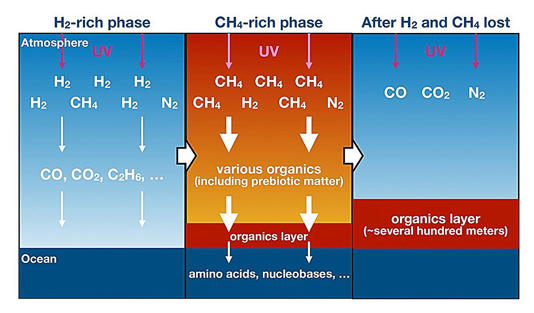
So, we have a primary conditions on Venus. Either it is having it's H2 replenished, or we just accidentally viewed it when it had the last of it's H2 in the clouds. I think the more probable idea is that it's H2 is replenished from some reservoirs, even if some H2 is carried away by the solar wind.
And so the two reservoirs that I can think of are either internal to Venus or external to Venus. External might be the solar wind or impactors.
So, the chemicals exist to make a haze like that of Titan. Making Methane might lead to the creation of Acetylene.
I guess the hope would be a haze layer well above the H2SO4 and H20 cloud layers. No guarantee for that, just a possibility.
If the atmosphere of Venus swells up then it's top will be further up in the gravity well of Venus. This might be assistive in the ability to collect atmosphere to put into O'Neill type habitats made of captured asteroid materials or materials mined from Venue.
Inside of the atmosphere of Venus then it may become less acid. Also if large floating structures were created, then Starship SSTO could drop down to say 5 or 10 bars depth, the have a very slow terminal velocity or even float.
Then the elevator might move the starship up to say the .33 bar level to launch it to space again, maybe SSTO, as the gravity of Venus is less than that of Earth.
If you are making Methane and Oxygen for Starship, then you perhaps could make Methane to make a haze on Venus.
Ending Pending
#1544 Re: Terraformation » Venus » 2025-01-14 10:31:37
That is very impressive. We had similar trucks in the mines, but I did not know where they came from.
My comments now are not for disputing any of the work you are doing.
But I want to suggest how it may be practical to store and use cool or cold fluids on the surface of Venus.
Coffee...........
OK, I got ahold of this calculator and may or may not be using it correctly. For water it seems to indicate 92 bar at a temperature of 540 F. (282 C).
And I am goofing here a little bit, but the bigger your tank the better, similar to how large animals handle cold better than small ones for amount of surface area per volume.
So, if we have a well insulated depression in the ground on Venus, with a roof over it, and a drain that can allow a water drop from an aircraft, to quickly enter the tank, we might hole the water for a certain period of time that could be useful.
Maybe the aircraft is filled with temperate water as ballast. It travels downward to the surface, hooks a load of ore or processed materials and dumps a large volume of water out of itself to become light enough to ascend. Chemically powered engines might work for it or steam powered engines. As if traveled down the water in its tanks might heat up, and if it had some water left over to ascend with the water could boil to turn an engine all the way up, with the boiling point dropping as it moved up to lower pressures.
Sulfuric Acid would be somewhat similar, but it decomposes at heating.
This looks to be above my pay grade, but I will try: https://chemistry.stackexchange.com/que … to-heating Quote:
The decomposition of H2SO4
to H2O
and SO3
is predominant between 400
and 700 K
. The formation of a small amount of gaseous sulfuric acid can be observed. Above 673 K
, the equilibrium constant of the reaction R1 becomes higher than 1 and increases rapidly.H2SO4↽−−⇀H2O+SO3(R1)
So, I will convert temperatures: 400 K > 126.85 C and 700 K > 426.85 C
Average temperature at the surface of Venus: https://www.space.com/18526-venus-temperature.html
Quote:
The average temperature on Venus is 864 degrees Fahrenheit (462 degrees Celsius). Temperature changes slightly traveling through the atmosphere, growing cooler farther away from the surface. Lead would melt on the surface of the planet, where the temperature is around 872 F (467 C).
Temperatures are cooler in the upper atmosphere, ranging from (minus 43 C) to (minus 173 C).
Just now, I am thinking this could be workable.
Drop the Sulfuric Acid load into a tank from an aircraft, then slow cook the SO3 (Trioxide) out of it and have a leftover of hot water.
I don't know if it would be hard to do liquid CO2, I suspect it is a possibility.
And then we might consider LOX and Liquid Nitrogen, but those will be hard.
Fuels might be interesting, but we have enough on our plates for now as far as I am concerned. Carbon or a very heavy Tar/Oil might be considered.
Sulfuric Acid: https://en.wikipedia.org/wiki/Sulfuric_acid
Quote:
Boiling point 337[1] °C (639 °F; 610 K)
When sulfuric acid is above 300 °C (572 °F; 573 K), it gradually decomposes to SO3 + H2O
So, as it would shed SO3, I am inclined to think that would be a sort of boil off that would temporarily keep the water from boiling off. But I am not sure.
One misgiving I have is the very dry dense air at the surface of Venus will probably try to suck the moisture out of the tanks by dissolving it so that problem would need handling.
I am going to be traveling so I may not be in touch as much for a bit.
Ending Pending
#1545 Re: Science, Technology, and Astronomy » Humanoid and other robots. » 2025-01-14 09:17:51
If these things work as is anticipated, it will be necessary for competition of almost every company to use Humanoid Robots: https://www.youtube.com/watch?v=ZGtoXQw3Lo4
Quote:
Mind-Blowing Humanoid Robot Walked Outside (The Internet Exploded)
AI Revolution
257K subscribers
It looks like a new world is coming, like it or not.
Ending Pending
#1546 Re: Terraformation » Venus » 2025-01-13 18:49:41
I appreciate your patience and hope we could toss some ideas around. I can see that you have some insights that I have missed.
My eye is more on the obtaining of Venus crossing asteroid materials to get started.
Then a diver, that could vacuum up dust and sand.
You are very interested in mining high quality ore veins on the surface, I believe.
For my concept of a diver, coolants in liquid form can allow a dive down to the surface, so I would think in that manner.
Let's say that for the Oxidizer, you have the method of necessary resort, if no other way can be found.
On the fuel side though I am starting to think about a wood gas internal combustion engine.
Here is a video: https://www.bing.com/videos/riverview/r … ORM=VRDGAR
One concept of this is that a diver would run on the gas and liquids produced, and might dump the residue out on the surface, which may contain a fair amount of Carbon. The dumping of the Cabon would be like dropping ballast.
Please remember I am trying to find some ways to do things, I am not seeking a conflict or to annoy you.
Just Rember I am to some extent a "Half-Wit". A jack of many trades. This allows me to cross reference things, but not all attempts produce a value.
Oxidizer is a real problem as you seem to have figured out. I have considered Sulfuric Acid. This might be compatible with a ceramic engine, I would hope. Apparently, it is not a very good Oxidizer without supplemental heat. But on the surface of Venus, we have supplemental heat. But of course keeping it liquid will be a challenge. Handling hot H2SO4 will also be a massive challenge.
But I may be on the wrong track, with Sulfuric Acid. It is my impression that it can deal with Carbon if heat is added, and I expect heat to be added on the surface of Venus.
It will not be as bad to keep as a liquid on the surface of Venus as would LOX be, but it would be a problem.
The divers I have thought about might be able to fly over a funnel an discharge the liquid into a storage tank.
I am not going to tell you that I have any high level of assurance that H2SO4 would be a suitable Oxidizer on the surface of Venus. I probably need guidance on that. It is quite available at altitudes on Venus.
Nitric Acid might be something, but it is said to be nasty.
But I am glad you called me on this. I think I have had an insight about Sulfuric Acid in the clouds. Apparently it may be supercooled.
https://www.sciencedirect.com/science/a … 3323001198
Quote:
•
Venus cloud droplets are supercooled and so they remain liquid and will never freeze anywhere in the cloud deck.
I am not sure what that means. Does it suggest that if we provided nucleation points we could get the materials to freeze and fall as precipitation?
A quick look indicates that cloud seeding on Earth works if there is super cooled water in the clouds.
So, while I may have interfered with your ideas for Oxidizers, we may have a trick to alter the nature of Venus.
If we seed the clouds, we may introduce convection. If we do that then H2SO4 will move to altitudes where it will be heated so much that it will decompose into H20 and SO2 or SO3. (I hope).
Where Venus inhibits convection, if divers could bring up dust and sand, that could be processed and possibly the tailings, (Waste) could be used to seed clouds, if it were desired to try to reduce the acid nature of Venus.
Now, I withdraw and confess that you may indeed have the correct notions for surface operations, and I interfered with your work.
But I think it may have been worth it to learn some new things.
My apologies.
Please retake the wheel.
Ending Pending
#1547 Re: Terraformation » Interworld Para Terraforming » 2025-01-13 12:46:31
I really liked this post from Terraformer: https://newmars.com/forums/viewtopic.ph … 31#p229031
A master platform, might have some centrifugal structures that could envelop and collect rubble tiny rubble piles.
The main problem I see in it is that an imbalance might happen where like a washing machine the load is too far off center. So, that needs to be thought about.
This is one try: 
The box with the counter rotor is to help set the collecting device to the proper spin for the object to be collected. Perhaps you would have zero spin for the collector "Cup", and then increase it until you start collecting materials.
Once materials were collected the device would move to a major platform near by, so that the materials can be further processed.
A certain amount of concept it included, but for sure it could be revised to be better.
Ending Pending
#1548 Re: Terraformation » Terraforming the Moon - From the inside » 2025-01-13 08:42:31
Hi Photon, maybe this can be of interest to you.
https://www.msn.com/en-us/news/technolo … 78a3&ei=52
Quote:
Scientists found far more water on the Moon than previously expected
Story by Joshua Shavit • 1w • 4 min read
Your idea is an interesting one. If the Moon has a lot of internal water deep down like the Earth does, then perhaps digging deep can yield that asset as well.
Ending Pending
#1549 Re: Science, Technology, and Astronomy » Nuclear Diamond Battery and radiation belts, Transmutation. » 2025-01-13 07:35:59
So, I have found evidence for transmutation using protons, by this query phrase "Proton radiation and transmutation?"
But on my phones search engine, Bing as usual may not get me where I want to go.
So, I copied phrasing from my phone to query that: ""Proton radiation" refers to a stream of high-energy protons use as radiation, while "transmutation describes the process of changing one element into another by altering the number of protons in its nucleus"
Again disappointed, it almost seems like the system under Bing wants to censor some of this.
It only wants to talk about proton beams for medical therapy.
Well, here is a article mentioning relativistic protons in some parts of the Van Allen Belts: https://agupubs.onlinelibrary.wiley.com … 23JA031484
Quote:
Journal of Geophysical Research: Space Physics
Journal of Geophysical Research: Space Physics
Research Article
Characteristics of High-Energy Protons in the Equatorial Plane of Inner Radiation Belt Observed by Van Allen Probes
Zhaohai He, Jiyao Xu, Lei Dai, Chi Wang, Tao Chen, Suping Duan, Ilan Roth
First published: 18 August 2023 https://doi.org/10.1029/2023JA031484Citations: 2
Well, those sound powerful.
Next Query: "Use of proton radiation to treat radioactive nuclear waste?"
OK, getting warmer: https://cordis.europa.eu/article/id/911 … roton-beam
Quote:
Europe must find sustainable ways of managing high-level, long-lived radioactive waste. Transmuting or converting this material into less toxic and shorter-lived elements would help to reduce the problem. Such treatment would decrease the amount and heat load of these toxic waste materials. Being radioactive, they must be prevented from going into deep geological repositories and their lifespan has to be limited to manageable timescales.
Transmutation requires a high-power proton accelerator. A new flexible fast spectrum research reactor, planned to be operational by 2023 in Mol (Belgium), is the multi-purpose hybrid research reactor for high-tech applications (MYRRHA). To demonstrate the feasibility of the reactor concept, the 'MYRRHA accelerator experiment, research and development programme' (MAX) project was established with EU funding.
Production of Carbon 14 with cosmic rays, and Nitrogen: https://en.wikipedia.org/wiki/Carbon-14
Then what is a cosmic ray? https://en.wikipedia.org/wiki/Cosmic_ray
Quote:
Cosmic rays or astroparticles are high-energy particles or clusters of particles (primarily represented by protons or atomic nuclei) that move through space at nearly the speed of light. They originate from the Sun, from outside of the Solar System in our own galaxy, and from distant galaxies. Upon impact … See more
So, if you have powerful protons and atomic nuclei, a collision with other matter may produce transmutation of some kind.
Query: "Where does Carbon 14 in nuclear diamond batteries come from?"
Where does Carbon 14 in nuclear diamond batteries come from?
Quote:
A sustainable solution to nuclear waste
The carbon-14 in these batteries comes from graphite blocks, a byproduct of nuclear fission reactors.This novel method not only offers a practical application for radioactive waste but also minimizes the cost and difficulty of safe storage.
The UK alone has almost 95,000 tons of graphite blocks.
The team from UKAEA and the University of Bristol uses a plasma deposition rig, a specialized device, to grow the diamond structure.
OK, but this transmutation to Carbon 14 probably involves Neutrons, so I cannot be totally assured that Protons may do similar.
So, maybe eventually, Nuclear Diamond Batteries can be sized up or ganged to provide a significant wattage, but for now they only supply a very tiny amount of power for very extended periods.
I stumbled onto an AI assistant, it provided this: "Yes, proton beams can indeed be used to induce nuclear transmutation! This process involves bombarding a target material with high-energy protons, causing nuclear reactions that transform one element or isotope into another1.
One application of this technique is in the transmutation of long-lived radioactive waste, such as cesium-137 and strontium-90, into shorter-lived or stable isotopes. This can help reduce the long-term radiotoxicity and volume of nuclear waste, making its management safer and more efficient2.
Would you like to know more about how this process works or its applications?"
Here I am presuming that a Carbon Shell can be transmuted with high energy Protons in a planetary radiation belt.
The blue area is then protected from that which can transmute, but the blue layer may experience radiolysis from secondary radiation which may penetrate into it.
It is likely to be desired that the Ocean floor simulation will be porous enough that the water based fluids can be circulated through it.
If it is only water then I would expect the production of Oxygen and Hydrogen. But CO2 and N2 could be included, so that other chemicals would be produced.
The chemistry generated, could then be presented to organism that could consume it.
So, it is possible that this is a type of biosphere that could run off of a radiation belt.
If there is a planet 9 and it is big and has radiation belts, then this might be possible to use at that location also.
I think I have dug up enough materials to justify speculation in these directions.
Ending Pending
#1550 Re: Science, Technology, and Astronomy » Humanoid and other robots. » 2025-01-12 20:30:41
Well, I have another orphan to put here: https://newmars.com/forums/viewtopic.ph … 56#p229056
Quote:
Void
Member
Registered: 2011-12-29
Posts: 7,961
If my presence becomes annoying and drags things the wrong way, just tell me, and I will step back.But the memberships work, have caused me to think I see a convenient convergence of possibilities at this point.
1) I would say that before a Starship is sent to Mars, there is going exist a desire to prove life support in space.
2) You might want to test some animals under synthetic gravity.
3) You might want to test Optimus Robots in such a ship, and perhaps to use teleoperation with them.
4) You might want to be able to use Dragon for limited visits to such a Starship.So, if you would spin one end over end, it may be able to simulate both 1/6 and .38 g forces.
It would make sense to keep this activity in LEO, so that radiation does not become a huge issue and to make access easier.
The Elevator may make it possible for access to the cabin area airlock, or it might make sense to put ballast on the ships tail end to cause the center of rotation to be at the location of an airlock/docking port.
Maybe this would be done so that a Dragon could facilitate visits to this test device, from another space station like the ISS, if it is still functional.
Humans might stay for a few days, to get a feal for things like body fluids migrations, and perhaps some other factors.
The Optimus when teleoperated either from another space Station or the surface of the Earth, might be able to manage the test animals.
So, you would be testing the ships' reliability, and the Optimus, and the Animals in fractional gravitation. For instance, you may want to test it over long time durations, such as 6 months or 9 months, or a simulated trip to Mars and back.
After all if it is going to go to Mars and back, it has to be very reliable.And it looks to me that these things are likely to be possible in the next couple of years.
Ending Pending smile
Not enough room in that town for all of us, I guess.
But this made me realize that very probably many people will go to LEO less to work than to be a tourist.
If robots are going to take over the work on Earth over time, then how much better would they be in orbit as they do not have the same bodily functions and so not as much of a life support burden.
Ending Pending