You are not logged in.
- Topics: Active | Unanswered
Announcement
#1501 Re: Terraformation » Shell Worlds » 2025-02-03 13:02:16
Rocky asteroids mined may give Uranium and Thorium. But with mirrors solar also has value.
Icy Asteroids like Ceres, may yield dissolved Uranium if they have underground seas. Asteroids that are too wet, may need a different way to handle things.
Keep in mind that if life is discovered in a lake, sea, or ocean, it is my attitude that that is very important, and we might want to divert economic planning away from such "Wildlife Preserves". So, I don't think that I am totally immoral.
I think that eventually fusion will become actual as a energy source, but that it may not be competitive against some energy sources in some locations.
Both you and previously Antius have pointed out the importance of radiators.
In working with "Wet" worlds like Ceres and Callisto, I wonder if volumes of water could be used along with "Metals" to make free floating radiators?
Is the shape of a red blood cell a good shape for a free floating space radiator? https://en.wikipedia.org/wiki/Blood_cell
https://en.wikipedia.org/wiki/Red_blood_cell
On an icy world like Callisto or even perhaps Ceres, you could melt a lake. Cover its bottom with regolith to slow down the melt process. Have radiator domes over the lakes to hold the water vapor, and to allow the domes to radiate. Granted you might have to defrost the domes from time to time, but that could also reject waste heat as well.
Image Quote: 
You could have diving bell air filled containers as habitats, and some with Vacuum, so that you could have Synthetic Gravity machines.
But the free floating radiators built from the materials of Callisto, might perhaps reduce the radiation in the radiation belts by taking the hit.
I will save other things for another time.
Ending Pending 
#1502 Re: Human missions » Air locks » 2025-02-03 12:30:59
You arguments have some merit, but as you have suggested mine might have a place as well: https://newmars.com/forums/viewtopic.ph … 74#p229574
Quote:
tahanson43206
Moderator
Registered: 2018-04-27
Posts: 20,206
For Void re #124Thanks for your reminder that water exists on Mars.
This is a situation where we both can be right.
I stated that only an obscenely wealthy individual could afford to pay for the water that may exist on Mars to fill a lake.
The fact that water exists on Mars does not mean it is affordable to average persons.
On Earth, it is possible to buy a one liter bottle of water for $1.50 at a convenience store. Apparently one liter can be purchased for as little as 50 cents.
On Mars, in 2025, the price of that bottle of water is infinite.
When the first liter of water lands with the first humans to drop in on the planet, that liter will cost about 80 billion dollars, give or take.
After many many decades, and possibly centuries, the price of a liter of water may fall to the equivalent of 50 cents.
I conclude that in this conversation, it is possible for us both to be right.
All we have to do is to select the epoch we are talking about.
(th)
We still don't have the ground truth the extent that I think Dr. Johnson would be comfortable with.
But the ISS already can tightly recycle water. So, a little water would go a long way. The bulk of water will be wanted to make propellants. Nuclear power would be a good choice for the surface of Mars, I think that most people now believe.
We will want large ice bodies for fuel. But for Make-Up water for people:
https://www.extremetech.com/extreme/167 … of%20water.
Quote:
If you heat up a cubic foot of Mars soil, you can harvest around two pints (one liter) of water. According to new data returned by NASA's Curiosity rover, this isn't just a one-off lucky find, either: It seems that most of the dirt on Mars harbors large amounts of water.
If you have electrical power either nuclear or solar, then you could likely get that water sufficiently to make it on Mars.
But of course that may be more trouble than extracting large amounts from an ice body.
If you want to use nuclear reactors, you will want to have radiators. A pond or lake can be such a radiator, and an airlock, and a farm.
A Lake with an inflatable dome over it might be covered in ice. It may not even need to be a transparent dome, just to serve as a vapor barrier and a radiator. With nuclear you may become less dependent on solar.
So, if you want gardens you can have them in chambers under water, or in vaults dug in the rock under a body of water.
Much of the agriculture might be precision fermentation type, so you don't even need lights for it. You just need electricity to crack water into Hydrogen and Oxygen. The Oxygen you can breath or use as propellants. The Hydrogen of course can be used in precision fermentation along with CO2.
If you have a lake with a low pressure dome over it, then you can play with day/night temperature fluctuations. At night frost will move from the ice to the interior surface of the dome. During the day that frost will evaporate as sunlight warms the dome. You can then compress the humid air inside the dome to produce distilled water.
So, you see the whole setup might serve rather well.
Then if you want greenhouses on the surface to grow vegetables you can do that as an independent function.
Much food can be stored indefinitely on Mars using freezing and drying. So, your solar dependent economy could tolerate interruptions like dust storms or winters. But your nuclear process will make sure that you have Oxygen to breath and water to drink, and even food from precision fermentation and mushrooms and stored frozen and dried foodstuffs.
Large amounts of water near Candor Chaos, the size of the Netherlands: https://www.newscientist.com/article/23 … e-equator/
It has to be evaluated how deep that water goes and if it is brine or ice or a combination.
A landing by SpaceX with robots might be able to give information on that.
Ending Pending
#1503 Re: Not So Free Chat » Peter Zeihan again: and also other thinkers: » 2025-02-03 11:03:17
I like this guy so far: https://www.bing.com/videos/riverview/r … ORM=WRVORC Quote:
The great Donald Trump RESET!
YouTube
Jeff Taylor
8 views
3 hours ago
You can sell your market, and you can sell your productive excess.
Robots.
Ending Pending
If taxes are shifted from income to importers, do we hurt the poor? Well, we don't so much need to import bulk foods that our poor might eat, then a bed to sleep on, hygiene needs. But the country is not only to be run for the poor, but also for the useful citizens. Many things that might be imported are nice but perhaps not necessary.
Ending Pending
#1504 Re: Not So Free Chat » Void Postings » 2025-02-03 10:42:32
I don't agree with that (th). Water is fabulously available on Mars.
Ending Pending
#1505 Re: Human missions » Air locks » 2025-02-03 10:21:22
A Barometric Airlock. I have been into that sort of thing for some time.
Search "Barometric".
I would suggest that you might look at what that could fetch.
If you had a shed on top of a lake which was covered in ice, then you might have a hatch that covers a hole in the ice.
If the shed can be pressurized to lets say 50 mbar of Martian atmosphere, then you could open that hatch and boiling would not be so much of a problem.
If you had a Hoist in the shed above the hatch, you would bring large items in and out of the lake.
https://endmemo.com/chem/vaporpressurewater.php
Actually 23.2977 mbar is enough for 20 deg C water. So, you could probably go down to 12 mbar or so as the maximum pressure the shed would have to hold. That would almost deal with 10 degree C water.
The Shed, would have horizontal doors like a barn, for instance that would need to be capable of holding up to 12 to 24 mbar of pressure. When the shed was pressurized those doors would be closed, and the hatch could be opened in the floor leading into the lake a load could be transferred Lake<>Shed.
Then the hatch could be closed, and the "Barn Doors" could be opened and the loads transferred Mars Surface<>Shed.
While humans in suits could move though this method(s), it would be much more sensible to be more safely and efficiently remotely teleoperating robots from a safe spot at the bottom of the lake for instance.
Ending Pending
Search Barometric: https://newmars.com/forums/search.php?s … d=78699263
#1506 Re: Terraformation » Shell Worlds » 2025-02-01 09:40:54
If I am annoying the membership, I will ask for forgiveness.
I have been thinking about removing the ice shells for worlds that have a subsurface ocean. I actually have the opinion to be protective about any world with significant signs of life.
But I will not tolerate "Royal Thinking" on the matter, where self-appointed elites have given evidence that their actual goals may simply be to keep the surfs down.
For entertainment, I would like to think of partially disassembly of Callisto and perhaps Enceladus as example possibilities.
By the time we had started on such a thing humans would have some clues as to possible life on some worlds, like Venus, Mars, Ceres, Titan, and Enceladus for instance.
If we check several worlds and many of them have alien life, and those are not from panspermia, then it could be speculated that life is all over the universe on worlds with seas. If several worlds in the solar system have genetically related life, then we can presume one case of a solar system with panspermia. If we find no life, then we can presume that the same is likely all over the universe.
In the case of Callisto, then stripping the icy top layers off might expose an ocean that could be covered in a shell.
The entire mass of the removed materials could construct many of the Balloons that are mentioned in Callibans post.
The sea, if it exists, would have been very cold and salty, perhaps not the best for life. Although geothermal might have warmed spots in that ocean. There could be some Uranium dissolved in that ocean.
Obviously, Enceladus could be checked for life and Uranium, earlier on. If it is true that these oceans have Uranium, then we might think about Pluto and Charon.
Ending Pending
#1507 Re: Terraformation » Shell Worlds » 2025-01-31 21:57:47
I hesitate to respond today, but have some lets say ideas that can be entertained in the mind.
Vesta was mentioned. I wonder if while tunneling it out for mining purposes could a "Hill Shell" be built similar as to a Balloon of the sorts suggested in the materials of your post. More or less a shell on the outer boundary of the Hill Sphere of Vesta. I don't intend to see it purposely pressurized. Rather sub-Balloons inside of it might be pressurized and then sub-worlds inside of those might be given artificial gravity.
Where Vesta may spin, this Hill Shell would be sun locked to resemble a tidal locked world. So the one side would be warmer and perhaps tap solar energy. The dark side being very cold, if air were to escape from the sub-Balloons, it would tend to condense as a frost on the inside of the Hill Shell. And so could be recovered mechanically. Vesta itself might be kept centered in the Hill Shell with magnetic force perhaps.
And then from the proceeding and receding sides of the Hill Shell a ribbon platform could extend outward to encompass the orbit of the sun. This to collect energy. The energy to flow through a common grid. A sort of a Ribbon Dyson Element.
Something like this might be contemplated on a much smaller scale for the Moons of Mars.
Where Phobos is expected to break apart in a number of millions of years this structure could be better suited to endure for tidal forces. But if Electron beams are a possible method of propulsion, could a Phobos ring and a Deimos ring modify each others orbital energy? Deimos moves out due to tidal force and Phobos moves in. Perhaps we can transfer these forces to each moon-ring from the other.
But perhaps I do not understand electron propulsion well enough yet.
But I feel it is good to try these ideas to better learn in that case, or to succeed even sometimes, maybe.
I guess that is a lot for now.
#1508 Re: Terraformation » The Moon » 2025-01-31 03:15:04
Some materials that I may work with later:
https://www.earth.com/news/moons-entire … the-poles/
Quote:
The Moon's entire surface is covered with water, even in direct sunlight
Eric Ralls
ByEric Ralls
Earth.com staff writer
Reading though it and other articles, it seems form (Other articles), the Moons mantle may have as much water as the Earth's mantle. From this article, it seems that Mara are dry, but volcanic eruptions may have brought some water up, and also it seems that impacts have brought rocks up with more water in them. That is my impression anyway.
So, a crater may matter for where it hit and how deep it went, and I suppose, how hot it made the materials.
Also I suspect that the impact event may sort the rock with the deeper "Wetter" rocks being in some particular part of the rim, I am guessing.
Roads/Rails on the Moon:
https://www.youtube.com/@Anthrofuturism
https://www.youtube.com/watch?v=k6XWZryfb5A
It seems that we could sinter a good surface that would be a bit like rails and road with low energy consumption for rolling resistance. The temperature should be 1050 degrees C to get the best qualities. A higher temperature will make the materials porous which is bad. To low a temperature and the sinter does not weld adequately.
For the ties you might make "Cast Regolith" which would have been liquified and then cast. I am supposing that if this regolith is that which may have been brought to the surface by impacts, it may be material with more water than average. (Maybe).
This information might apply to many other worlds I am guessing. Mars/Phobos/Deimos, I expect.
Ending Pending
#1509 Re: Terraformation » Interworld Para Terraforming » 2025-01-30 21:42:40
Based on the just previous post, some uncertainty exists.
The question of the value of the Moon.
The question of electric propulsive methods that may emerge.
New electric propulsive methods seem to be emerging. Among those could use Argon or Metals as propellants, maybe Carbon and Silicon. The obvious value of electric over chemical is efficiency with the larger consumption of time. For the transfer of stuff this may be OK. For transferring humans it may not be the best.
A Hybrid system which may be compatible with humans is to have a chemical booster or a nuclear thermal booster which pushes a electric propulsion system to a location, such as Mars. That is entirely my own opinion, as I have not seen support for it before.
Typically, what to do is evaluated in a zero sum way. We will have an argument for Mars Direct, and an argument for electric propulsion as the method. But I don't like that at all. I think that we will want both, so that we can evaluate and perhaps incorporate Mars, Phobos, and Deimos into the expansion of human activities.
This should allow for a flexible reaction to changes in reality. Reality may change due to discovery and inventions.
I think that SpaceX will likely attempt uncrewed missions to Mars at the very least. I see little problem with that other than actually being able to pull it off.
Discovery could be a thing like discovering a better value for the Moon. Lately, I have seen articles that suggest that the Moon may have considerably more water than we thought it did.
Here is an article which is already about 5 year old: https://www.bing.com/search?q=The+Moon+ … A0&PC=DCTS Quote:
<p>The moon has much more water than previously thought, a scientific team including Brown University has discovered. First-time measurements of lunar melt inclusions show that some parts of the lunar mantle have as much water as the Earth’s upper mantle.
So, if that is accessible, then it begins to suggest a changing future for the Moon. After all I think it has about the surface area of the Americas.
If as I suggested in the previous post, another type of Starship could be made, where the Nose Section is made into space stations and the Locomotive Section is used as boosters to help launch payloads such as a Starship into deep space, a Lunar aspect could be included. A Locomotive section might be used 1 or more times to do such a boost to a deep space Starship. It also might be used as a shuttle from the surface of the Moon, a number of times. But it also might then be retired to the Moon to become pressurized space.
Electric propulsion methods might be able to move chemical propellants around efficiently. For instance, Methane and Argon from LEO to refill orbital ships, and maybe Oxygen and metals from the Moon to orbits, where they may be propellants for Starships and Electric propulsions.
This whole setup might be just for Earth<>Moon, but also might eventually facilitate trips Earth/Moon<>Mars/Phobos/Deimos. We don't know yet.
One idea I am entertaining for Mars is that a Locomotive Section might boost a Starship converted to electric propulsion methods to a flyby of the Moon. The Locomotive would separate and then find means to land on the Moon with or without refilling in Lunar orbits. The Mars Starship from that point would already have been boosted so you might be cutting off some of the time penalty that electric propulsion creates. The electric Starship would achieve Martian orbit, and would not directly land humans or products sent.
I am not sure, but this might allow the windows to be opened a bit more as is said to be true for Ballistic Capture. You might indeed add Ballistic Capture methods.
Of course Large Ship Concepts could be fitted into this, I think, you would just scale it up.
Ending Pending
#1510 Re: Terraformation » Interworld Para Terraforming » 2025-01-29 21:41:26
I am just goofing around here: 
Could a Space Station be made of 10 Starship Cones? (Cargo/Crew Sections)
I have put a red circle in so we can see how close we might be to a torus: 
Because they are not used as fuel tanks, you could prefab them on the ground.
You may or may not spin the device for synthetic gravity. But at current Starship sizes you might only get to Lunar or Martian simulated gravity, I estimate.
That might be good as for tourism you might give the tourist a variety of alien gravity experiences. Plus when spun up, your sanitation is going to be more convenient.
You could use it for microgravity manufacturing where I expect it would be inhabited mostly by robots.
It might also move in the direction of a medium scale craft for transit, perhaps in a cycler of some kind or maybe even an expedition to Mars. (Not for landing though).
And this then is wanting to know what to do with the rest of the Starship, the Locomotive Section comprised mostly of tanks, and engines? Well, I have some notions as you might suspect.
1) Boosters for long range Starship missions.
2) Then perhaps reuse on the Moon.
So, of course the Starships do perhaps need two walls between the Nose Section and the Engine Sections. (But not necessarily).
But you can use the Locomotive Section as a "One-Time Tug" and then land it on the Moon.
When landed on the Moon, it is easier to tip over as it has been shortened by the removal of the Nose Section. And while it would not be prefabbed like the Nose Section may have been, the Moon can supply Insitu resources to upgrade the utility/habitability of these things.
So, the Locomotive Section may be able to boost a Starship on its way to another world, and then might land on the Moon, if sufficient propellants were available.
So, a Starship is supposed to be able to lift 100-200 tons to LEO, but if not to be re-landed, can lift more. Some of this would be eaten up by Prefabbing the Nose Section. But still you get to use all the parts for something that may be useful and you don't need flaps and motors or a heat shield. Of course you may need legs unless you have some sort of mechanism on the surface of the Moon to catch the Locomotive Section.
The Raptors might be removed and reused, I suppose.
So, then this is not quite like any of the Starship ideas so far, except for laying a Starship on its side on the Moon and upgrading it with Lunar Resources.
This would give Starship more reach, as you might use one or more Engine Sections to boost a Starship from LEO to another world.
If we then can have depots that can be moved around with electric rockets then we can arrange for propellants to be refilled near the Moon, as a further option.
Ending Pending
#1511 Re: Not So Free Chat » When Humans Eat Their Brains » 2025-01-29 09:42:25
Interesting materials Calliban.
I think just now we need to keep the attitude of study, and yet to avoid malpractice. About like doctoring, a lot of healing comes naturally. But like navigating a boat on a sea with different currents, if we could understand better, we might choose to navigate better to some extent, to at least not pave the roads to hell for ourselves.
There are a number of problems, and I see though the glass dimly/darkly, to Plagiarize an old author. Because of this lack of ability at good diagnosis, we should avoid hasty conclusions and only apply remedy if a greater certainty is achieved, or if emergency requires that we try something.
The idea of the "Blank Slate" has been quite a problem. That there are no local specialties inheritable. The archaic love to use it, masquerading as the moderns. I attribute that to old cultures, molesting new cultures. So, you can understand that I regard the USA as among the molested.
While the Blank Slaters want to claim that they can teach anyone to become anything, they also have joy in promoting tribalistic conflict. They retain the rights to say who is the best and brightest and also offer themselves as the saviors of the downtrodden, while they promoted the conflict in the first place.
The NAZI did, and do that, even so indicating that they can identify who is superior and who is inferior. Of course their thumb is on the scale, so that they can be "Them that am bestest".
It is interesting that the vote for Trump was to some extent less tribal. That is males of various ethnic groups more than expected gave Trump support. I think that is because these males have begun to realize that that thumb on the scale was putting them onto the "Eternal Boys Are Bad!" list. I am guessing they have gotten tired of it.
It is mathmatically sensible to some degree for females to encourage some conflict in tribes, as it will sort out the losers so they don't have to mate with them and they also can pick a thuggy boy and help him eat his victims. But this promotes less then Stone Age breeding. All you produce are verbally skilled brutes. You kill and eat the technicians.
In the post colonial era their has been a lot of vengeance seeking, and victim promotion, exploited by none other than the "Verbal and Violent" Blank Slaters!
And the historically upset from "Alien" oil money has also helped to molest the western societies.
But I believe that there is a swing and a sway to all of this, and that is for us to swing now and for them to see how good they are at dodging.
When you see a group of troublemakers, don't just focus on the male thuggies in the group. Also look at the girls.
Ending Pending
#1512 Re: Not So Free Chat » When Humans Eat Their Brains » 2025-01-28 22:38:37
Well, I have received a correction to my long ago learned ideas about Greenland: https://www.bing.com/videos/riverview/r … &FORM=VIRE
Quote:
What Happened to Norse Greenland?
YouTube
Fortress of Lugh
95K views
2 weeks ago
Looks like they got killed off by the Inuit, after a decline in their prosperity.
But the Nordic resettled the place, and the existing Greenlanders are to a minor part then genetically Nordic in that sense.
So, I better understand Danish sentiments. But I am neutral on current politics about the island.
I am myself half Swedish, which has almost as much Norwegian in that, so it is slightly possible that some ancestor of mine visited Greenland or was even born there as a few people did travel back and fourth for a time.
Ending Pending
#1513 Re: Terraformation » Will Mars be terraformed » 2025-01-28 20:40:35
I almost included this in my earlier post today: https://www.msn.com/en-us/news/technolo … d648&ei=11
Quote:
Relativistic electron beams: A new frontier in interstellar travel
Story by Joseph Shavit • 1d • 6 min read
The statite’s location, near the Parker Solar Probe’s closest approach to the Sun, ensures maximum energy harvesting. Equipped with a massive sunshield, the platform would protect sensitive components from extreme heat while generating the gigawatts of power needed for beam propulsion.
By focusing this energy into a relativistic electron beam, the statite could propel a spacecraft over distances of 100 to 1,000 AU. This represents a significant leap over existing propulsion technologies, which lose effectiveness beyond a few AU.
To maintain beam coherence over such distances, advanced focusing systems would be essential. While current optical and particle-beam technologies provide a foundation, they must be adapted for the unique challenges of interstellar propulsion. Innovations in beam steering, stabilization, and energy efficiency would further enhance system performance.
I might just be ignorant, but I would want to wonder if this could be tapped to do lesser tasks, such as propelling spacecraft in the hill sphere of Mars, by projecting beams from Phobos and Deimos. To be sure the power supply is needed and sunlight is not too wonderful but might be workable at Mars.
And I wonder if the electron cloud that is behind each of these moons could make a contribution?
https://www.space.com/38530-solar-wind- … hobos.html
https://www.sciencedirect.com/science/a … 7717305847
So, anyway, the (+) ions have a harder time filling the VOID behind the object, Phobos or Deimos, but the (-) electrons having less inertia may fille it more easily.
My hope would be that a sufficient power supply could be associated with these moons, and the electrons could be harvested to add to an electron beam to push spacecraft with relativistic electrons. Certainly, this would not be used to launch interstellar craft, but perhaps it could be used in the hill sphere of Mars.
So, the electrons do have mass, I believe, so it is a matter projector. And the inertial of the mass of the moons could accept the inertia from the recoil, I hope.
Ending Pending
#1514 Re: Life support systems » Gold Hydrogen, Geologic Hydrogen, Natural Hydrogen, etc. » 2025-01-28 20:21:42
Well this looks like a big thing to me: https://www.msn.com/en-us/news/technolo … d4bc&ei=16
Quote:
Massive reservoir of white hydrogen found hidden beneath the Earth's surface
Story by Joseph Shavit • 1h • 5 min read
So, let's hope it exists for other western countries, so we can get on with industry and not add more CO2 to the atmosphere.
If this is a general pattern, then I think we can have hopes for the same on Mars.
On both planets the resource of CO2 in combination with H2 could drive precision fermentation, among other things.
So, we could turn the equation on its head, where the waste gas we dumped into the atmosphere becomes a resource to make food, fuels, and other things.
https://www.youtube.com/user/tonyseba
https://salvadorklein.substack.com/p/fu … disruption
Quote:
Three Strikes Theory
Discover more from Three Strikes Theory
Every business, large or small, is Three Strikes away from disaster or Three Strokes away from success. Lets learn and win, together.
Type your email...
By subscribing, I agree to Substack's Terms of Use, and acknowledge its Information Collection Notice and Privacy Policy.
Continue reading
Sign in
FUTURE OF FOOD: the global disruption that precision fermentation represents and a circular economy start-up that is positioned to win
Let’s explore the imminent disruption in food and agriculture and see how a start-up has deliberately put itself “in lucks way” by alining with these technology trends and cost curves.
Salvador Klein
May 12, 2024
Ending Pending
#1515 Re: Terraformation » Will Mars be terraformed » 2025-01-28 09:45:34
Those are concepts worth considering. I agree that after the interplanetary rocket jockey era, methods similar to what you describe may make sense.
You may be able to give assistance. If we had a microwave oven in orbit tuned for it, could we heat dust in it and expose it to reducing agents, such as Hydrogen and Carbon, and hope to reduce the material until it can be electrically conductive? A secondary process would then produce Oxygen from the gas outputs. And it might be desired to subject the dust to other processes, to perhaps extract iron and maybe other substances.
But the leftovers if reduced, may be suitable to use in a Neumann Drive, I hope. The Neumann Drive is new and I don't know how well it can be sized up, but it is supposed to compare well with gas type electric rockets.
We also have the possibility of using a combustible mix of LOX and Aluminum powder. I would be a bit nervous about the stability of that however.
But I do wonder if we could make a paste of LOX and Oxidized dust from Phobos and Deimos to make projectiles to shoot out of a Mass Driver. We might be able to mix in a little bit of Magnetite, if we would keep it from combusting. Magnetite is already somewhat Oxidized, so maybe the risk is low. https://en.wikipedia.org/wiki/Magnetite My expectations are that the LOX will evaporate, and perhaps the dust would dissipate when it does. And so the evaporation and dust would be swept away by the solar winds, if the bullets did not hit the Mars atmosphere, or exit the Mars hill sphere. Both the LOX and the Magnetite should react from the magnetic fields of a mass driver.
So, I agree, those moons could be supplying both construction materials and propellants of various types.
Ending Pending
#1516 Re: Terraformation » 55km Mars tunnel idea 2.0 » 2025-01-27 12:48:01
Useful information to bring us closer to realty. Thanks Calliban!
Ending Pending
#1517 Re: Terraformation » Will Mars be terraformed » 2025-01-27 11:53:58
The reason why I suggest the possibility of orbiting a Starship(s) around Deimos, is that it has already been done for Bennu: https://space.stackexchange.com/questio … d-bennu-go Quote:
How low does OSIRIS REx's record-setting orbiting around Bennu go?
Asked 6 years ago
Modified 6 years ago
Viewed 125 times
This is a really nice answer, Quote:
4
Bennu's hill sphere is 29.5 km roughly. The orbit is roughly circular, about 1.75 km above the center, or about 1.5 km above the surface of the asteroid. It is well inside of the Hill Sphere. This doesn't even compare to Dawn, which orbited about 35 km above the surface at closest, and that was with a very eccentric orbit. Hayabusa 2 isn't really orbiting Ryugu, but is rather remaining stationary above it about 6 km above the surface.
The specific orbit, as outlined in this article, goes from 1.4 km to 2 km from the surface. Thus it will be only a bit over 1 km at the closest approach.
Share
Improve this answer
Follow
edited Jan 2, 2019 at 14:35
However, I expect Mars to tug at the orbit over time so maintenance thrust will be needed. The "Shadows Ship" would be a "moon-moon".
I am not doing a "Zero-Sum" contest here. I think that development of Mars and the moons are equally important. However, we do not know the long-term heath consequences of humans in a ~.38 g situation on the surface of Mars.
But we are somewhat convinced that an artificial gravity of 1 g may sustain human health for a time at least. We could probably achieve that with a ballasted Starship, and a larger Starship.
And we also have the passivity that we need less propulsive expenditure if we do not land humans or many humans on the surface of Mars at the start. We have the possibility of extracting Oxygen and radiation shielding materials, and metals from either Deimos or Phobos or both.
If we conclude that ~.38 g is not enough, then we have to take the long way after all. But as I have said before this could be tested in LEO, with a Starship. If we test a simulation of ~.38 g in LEO and it seems OK, then maybe we tilt towards humans more on the Mars surface. If the results of the testing are disappointing, then we need to test for a full ~1 g simulation next, to get an idea if we could start in the shadows of Deimos and expand from there.
If ballast is added to the tail end of a Starship, then the center of rotation can be moved towards the back and you might be able to reach up to ~1 g in the nose of the ship. But Dr. Johnson has suggested that without ballasting, a Starship could reach up to ~.5 g and so Mars simulated gravity testing could be done.
So, then we might have some data to plan our forward actions with more efficiently.
Pause................
Just now, I am contemplating the question, if it is possible to get some radiation protection by staying in the shadow of Deimos. But auxiliary means of protection could be developed as well, anticipating using local resources from Mars/Phobos/Deimos.
This is my first try at an "Ice Balloon Radiation Collar" for a ship, so have patience: 
A toroidal balloon could be filled with an ice chunk. Probably vapor phase to solid is preferred. The structure then has some strength, and may be anchored to the ship with cables and standoffs perhaps. I am anticipating the Hydrogen to come from Mars and the Oxygen for the water to come from one of the two moons. So, this could be helpful for GCR also. You could prefer the collar to be closer to the center of rotation, so perhaps your bedrooms and storm shelter are there as well.
To get this ship to Mars/Phobos/Deimos, I anticipate the use of a Chemical Burn Starship to give it a boost, and for the Converted Starship to use electric Argon as its finishing method of propulsion. The Chemical Burn Starship as Booster may be reusable. If you have a Nuclear Thermal Booster, then even better.
The Shadow Ship/Station might be upgraded over time, so that eventually it could come out into full sunlight and stop orbiting Deimos.
Again, I am sort of multiple ways on the idea of settling Mars. I think we do not want Mole people on Mars only, and that Sky People are desired also. Ideally the Martians will be free to be both at various time intervals.
Ending Pending
#1518 Re: Terraformation » Will Mars be terraformed » 2025-01-26 10:22:58
Some people hate optimism, but I will post this: https://www.youtube.com/watch?v=FWoZLn6BMWo
I will have more to say. But for Earth I am wondering if CO2 in the atmosphere could become regarded as a building material, provided a future with massive amounts of energy.
Pause................
Here is some useful information in my opinion: https://forum.nasaspaceflight.com/index … ic=58384.0
Quote:
Offline Michel Van
Full Member
***Posts: 340
Aachen, Germany
Liked: 180
Likes Given: 187
SpaceX Argon ion engine a game changer ?
« on: 02/28/2023 10:39 am »
Starlinks V2 minis are equipped with new Argon Hall thrusters for on orbit maneuveringArgon Hall thruster tech specs:
- 170 mN thrust
- 2500 s specific impulse
- 50% total efficiency
- 4.2 kW power
- 2.1 kg mass
- Center mounted cathodeAccording some sources in Internet is this 2.5 times more powerful of best NASA ion engine.
But real game changer is use of cheaper Argon as propellant, (instead Xenon).
0.9% of Earth atmosphere and 1.6% of Mars atmosphere is argon.Now this could be something for Starship equip with Argon Hall thrusters.
It could reduce transit time or able heavy cargo transport to Mars during unfavorable mission opportunities.But real game changer is long flights to Jupiter or Saturn
With those Argon Hall thrusters you could reduce transit time from 5 years down to months.
So, now, I am considering this: I am about to speculate on some version of Dr. Johnsons existing concept of spinning one Starship for artificial gravity. But in this case I am going to imagine that after entering LEO, it will be converted to a nuclear electric drive. The tanks might be filled with Argon.
The nuclear engine might be attached to the tail of the ship. So, the center of spin would be altered.
The ship could bring people to Mars, but I am really more considering that it would bring hardware to orbits of Mars, and then the ship might be used as a shelter for humans.
The second life of this device might be to try to hide in the shadow of one of the Martian moons, for radiation protection. As it would have nuclear power this device would not need sunlight. It would need some means of hovering. though behind a moon. I am supposing that ion thrusters may be able to do that due to the feeble gravitation of the two moons. If not then some auxiliary method will have to be afforded.
It is my opinion that we should not want to go to Mars and then become the parents of a "Land-Loving" culture on Mars. Mars obviously is much more suited as a platform to extend the human reach than is Earth, in my opinion.
But the orbits of Mars will not offer gravity and will be exposed to very dangerous radiation.
Anyway, perhaps it will be discovered to be impractical. So, let me know if the idea is unworkable. The Starship would spin. As it would have a nuclear reactor on it's tail, it would have a different center of spin than a normal Starship, the center of spin would be closer to the tail. As there are two propellant tanks, perhaps one could be filled with Argon and one with water, to give protection from the nuclear reactors radiation. The Argon might be augmented with Argon from Mars, and the water likely would be from Mars also or perhaps, Hydrogen from Mars, and Oxygen from a moon, to make water. Thermal steam thrusters might be suitable to maintain the hover desired. It would be tricky doing the hover while the ship is spinning, but maybe it can be done.
Of the two shadows, Demos is preferred. Lower gravity, and a slower rotation around Mars. Also Phobos has secondary radiation that is emitted from the surface of Mars, when hard radiation hits it. For Deimos, a orbit around Mars of 30 hours, indicates that the ship only has to also hover around Deimos once per that orbit. Also Deimos has a better view of the greater amount of the surface of Mars.
https://en.wikipedia.org/wiki/Deimos_(moon) OK about 30 hours.
The major protection from this would be from Solar radiation, but some GCR would be blocked. The reactor and Argon and water tanks would also block some GCR.
But it would be hoped that over time more protection could be built into the ship, from materials sent from Earth, and materials obtained from Mars and the moons of Mars.
So, anyway this would be the Mars starting point. A seed that could grow, which might afford humans a relatively safe start.
I have not abandoned the idea of surface activities on Mars. But a large part of this could be robots. The ship shielded by Deimos could have humans on it to teleoperate robots on Mar/Phobos/Deimos as might be useful.
As an example of additional radiation protection for the Deimos ship, perhaps Paraffin Wax could be manufactured on Mars and brought up to the ship.
Unlike the surface of Mars for humans, a shadow ship for Deimos might be able to simulate 1 g. Due to being ballasted at it's tail, and also SpaceX intends to make larger ships.
Pause...................
I am in agreement with Isaac Arthur that the poles of the two moons are of interest.
https://www.bing.com/videos/riverview/r … &FORM=VIRE Quote:
Settling the Martian Mars: Phobos & Deimos
YouTube
Isaac Arthur
62.6K views
10 months ago
Pause.................
So, things could go in several directions. You could add more Starships to the shadow ship behind Deimos, add more shielding materials as well, from various sources. And you could begin to build "Cradels" in the 4 poles of the moons.
As I see it a pit and wall structure might work. The wall might be a ring joined by metal bands/wires, into a ring that rests at a perimeter of a pit at a pole on a moon. Metals and Oxygen might be produced, but also slag bricks with metal wire or bands wrapped around them where the metal to metal can do a weld to hold them together.
Anyway, I need a nap, I think.
Ending Pending
#1519 Re: Terraformation » Will Mars be terraformed » 2025-01-25 17:55:10
I have so far resisted the temptation to start a new topic.
If I did, it might be named "Mars, Underground/Surface/Orbital". I am not trying to say that I have a brilliant plan, rather that I have continuing questions about objectives and methods.
I understand the logic of Mars Direct as promoted by Dr. Zubrin and others. You will note that I included surface in my world-be topic, so I do not exclude the Mars Direct method, but I am thinking that very likely we want "All of the above".
I have seen recent ideas that Nuclear could get humans to Mars in a short time period. But Dr. Zubrin has indicated that if you could do that, then you could send more stuff to Mars instead. As far as I am concerned if you send freight, then you can use it to shield humans from radiation along the way. So, there are many ways to look at it.
We think that SpaceX may in fair time, or eventually send robotic missions to Mars as precursors of discovery potential.
I have seen the idea of the X-37 doing atmospheric skipping. Many new things are coming into view. https://www.livescience.com/technology/ … t-to-earth Quote:
A secret, experimental space plane will be performing a new kind of specialized brake maneuver as it returns to Earth’s atmosphere, the U.S. Space Force announced.
I am tempted to say, "Well, then why not do that with Starship?". Perhaps it is possible, but also may complicate things.
But something that has sometimes annoyed me is that a Starship sent to Mars, could have drop tanks that it leaves in a sun orbit along the way. Doing that it could have various items attached to its outside on the leeward side. Those various items could use alternative methods to achieve a Mars orbit, perhaps. The reason I like this is you have 6-9 raptor engines on a Starship, and if you have extra propellants in drop tanks, then you can make better use of them. Granted the current fetish is reusability, but on occasion, SpaceX will expend hardware for a worthy purpose.
After Starship may have done the burn to exit Earth/Moon, the drop tanks could be dropped. And as is worthwhile the various probes could be disconnected and left to their own resources to do whatever mission they may have to do.
Devices that have Electric Propulsion might make sense. Possibly they could have other means such as heat shields to try to get into a modified orbit of Mars, and maybe also some small chemical thrusters. Anyway by this then the moons of Mars could be investigated deeply, perhaps, and also there could be some orbiters that could be used for the landing mission support.
As the Starships will apparently have side by side propellant transfers, I think that the fixtures for a drop tank a bit like the Space Shuttles Tank could be supported. And if this might work, it could be a way to get heavy hardware to Mars orbit in subsequent missions. Such hardware might be sent to the operations for the moons, or maybe a Starship could fly up and fetch them down.
I am enthusiastic for surface and subsurface operations on Mars, but as I see it, this is a way to get a "Twofer".
I prefer to be a pessimist as to what resources the two moons may contain. I hope for various common minerals, and also perhaps Carbon. I do not count on Hydrogen or Water.
But from my point of view, if you could fetch some Hydrogen up to activities to process such materials from Phobos and maybe Deimos, then with solar heat you could likely pull a lot of Oxygen out of the moons materials while reducing the "Ores". Even if the moons might have ice in them, this would likely be more workable than to dig down for it. at least at first. Although you would have Hydrogen losses along the way, you might reuse the same Hydrogen over and over for this purpose. Just splitting the water, you produced, and storing the Oxygen for propulsion and breathing.
Water and Carbon if available might make good radiation protection in orbit as well. And you could make refined metals and glass, and slag bricks as well. Having the means to obtain that Oxygen would facilitate returns to Earth, and also missions to the Asteroids and between Mars and the two moons.
I think that the idea of a chemical boost followed by an electric propulsion and then perhaps some aerobraking, would be a good companion process to a sort-or Mars Direct process.
In the previous post, Calliban gives some hope that Methane may already be available on Mars. That could be an alternative also. Starship could shuttle Methane up to the moons effort and the ships could be refilled for landing with Oxygen from the Moons. Again, solar energy, but I suppose if you insist, nuclear energy could be used to heat regolith in the presence of Phobos or Demos regolith.
I will want to add the materials of this post from another topic to this topic: https://newmars.com/forums/viewtopic.ph … 26#p229326
I have been an advocate for an orbital presence around Venus, recently. An aspect of that was I felt that solar energy around Venus would be very favorable. But if efficiency were 100% for mirrors, then you could amplify sunlight at Mars by 4 times around Mars, and get the same energy as you might in orbit of Venus. OK, as efficiency will not be 100% then lets use 5 to 1 as the ratio. So, sunlight for the orbit of Mars might be less than for Earth, but you could focus it to a high heat, and heat an oven containing regolith and Methane, and so reduce the "Ore", and produce H20 and CO2, perhaps. You could recycle the Hydrogen, and use the Oxygen for propulsion and breathing, and perhaps the Carbon could be made into space structure along with the Metals and Glass.
This should keep some people from getting allergic, as many people here do not like solar panels, and for this activity, we do not have to worry about the inertia of the solar power mirrors and apparatus. An the system might be able to generate electrical power as well, at times.
The same would be much harder to do on the surface of Mars.
And with Vast Space working towards space stations, eventually with artificial gravity, life support for humans in orbit of Mars may also be practical. https://www.vastspace.com/
Ending Pending
#1520 Re: Science, Technology, and Astronomy » Genetics » 2025-01-25 13:05:21
Based on the previous post, I think we can look at "Tribe against Nature", and "Tribe against Tribe".
This then can be inclusive of all gender of a tribe, and will sidetrack trickster words that might be used for exploitation.
"Tribe against Nature", may favor hand and eye, although teaching and collaboration would also need communication between tribe members.
"Tribe against Tribe", more favors human predation on humans, more so using a hive mind of communications, allowing a simplified brain, in my opinion. If you can kill a craftsman and take his possessions with a word connected hive group, then craftsmanship is not favored.
https://interestingengineering.com/list … inventions
Quote:
9 Things You Probably Didn’t Know Were Inuit Inventions
Did you know that first sunglasses were possibly invented by the Inuit?Published: Jan 12, 2021 11:19 AM EST
Photo of the Author Christopher McFadden
Christopher McFadden
My notions about football and other ball games, is that the ball represents things that you take from other people.
Should be takers or makers?
Of course, the physical fitness is to be admired, and the ability to work together, and conflict between groups is a thing that a "Tribe" needs to be prepaired to cope with, but I of course have much more respect for the "Maker", not the "Taker".
Ending Pending
#1521 Re: Science, Technology, and Astronomy » Genetics » 2025-01-25 11:59:53
OK, to start with, "I don't know", "I never knew".
https://www.bing.com/videos/riverview/r … d953d0221f Quote:
Human Remains Found In America Dated 128,000 BP #podcast #grahamhancock #science #history #ancient
YouTube
History Drops
7.2K views
1 week ago
The Innuit had skin boat technology to get to North America, I think actually that cultures have "Blooms" of genius, alternated with "Descent" into stupidity.
The thing is from time-to-time human individuals have a unusual genius. I feel that under certain circumstances realty can favor the "Blooming" of genius in a population.
I think that shorelines have almost always been very rewarding to so called "Hunter Gatherers".
Various peoples have relatively recently made boats. The Kells apparently had skin boats and visited Iceland. The innuit used skin boats and might still.
Natives used boats at least on rivers.
I don't know for sure, but I think shorelines offer rewards. I could imagine a "Bloom" of the Aboriginals if that is their name, who could have traveled coast lines. I am going to guess that the interior of the North American continent was not a good place for humans due to predators.
But certain islands off the coast of Ice Age North America, might have been more habitable as these predators would not have been present as much. The sea level would be much lower at times, so we don't know quite what those places may have been like.
So, for instance I expect that certain islands in the Pacific would have offered more land than they do now. And coastal boating might have been a thing as it was how to get resources.
So, due to predators like the "Short Faced Bear", perhaps aboriginal peoples did make it to the coast of North America on the pacific, but stayed on or near the coast, and drifted down towards South America.
https://www.sealevelmap.io/
Image Quote: 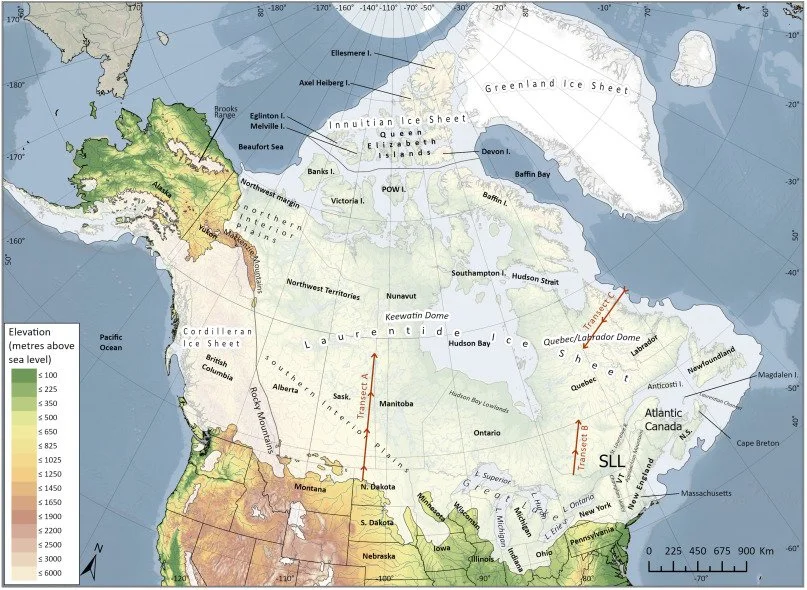
It is my opinion that a Innuit like culture on the pacific coast could easily have developed methods to hunt sea mammals, and that like for the Innuit, winter ice is a good time to get things like seals. So, if they had adapted up the coast of Asia towards Beringia, I would not be surprised if they could have migrated along the coast in search of sea food.
Image Quote: 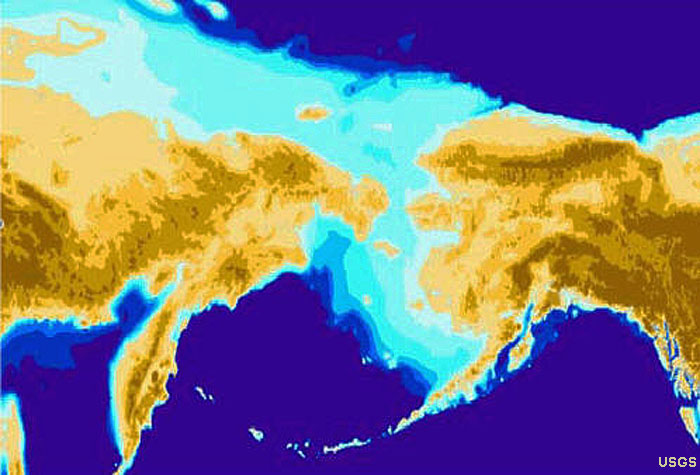
Another thing that could have promoted migration could be pressure from other tribes competing for resources.
If they made it to the coast of Alaska, I think they would understand that if they traveled south things might get better.
And even coastlines that were glaciated, might offer winter ice that they could camp on to get things like seals.
Periods of a tribal genius could be prompted by an environment that rewards craftsmanship. And this environment would give those rewards, but would unsuitable for "Football Hero" types. Sorry that unfortunately is what I think.
Nature only rewards continuation of pattern. If an environment favors killing your neighbor to get their stuff, then craftmanship is not rewarded. But if the environment favors the intelligence of the hand and eye, then craft of materials may trump the eaters of neighbors.
If it were true that the interior of North America was not very safe from predators, and was less rewarding than the coast, I can imagine these people might just keep drifting south, as it would be more rewarding than to invent a new technology to go into the interior.
Later on for some reason the more dangerous animals died off in North America, and other peoples from Asia, maybe Central Asia, moved in after the ice barrier disappeared. And eventually the Europeans and others.
I am not an expert, and don't pretend to be one, but this seems reasonable to me.
Ending Pending
#1522 Re: Terraformation » 55km Mars tunnel idea 2.0 » 2025-01-24 12:23:33
I think that to estimate practicality, you can look at the deepest mines on Earth.
https://www.guinnessworldrecords.com/wo … epest-mine
Quote:
Who
Mponeng gold mine
What
4 kilometre(s)
Where
South Africa
When
2012
The deepest mine in the world is AngloGold Ashanti's Mponeng gold mine, near Johannesburg in South Africa. By 2012, the operating depth had already reached 3.9-km below the surface, and later expansions have resulted in digging below the 4-km mark. In 2012, the mine produced 405,000 oz of gold. Rock walls mine reach temperatures 60°C and humidity levels can exceed 95%. To keep things cool, more than 6,000 tonnes of ice slurry are pumped into underground reservoirs, and giant fans aid air flow. Every day, about 5,000 lb of explosives are used and 6,400 tonnes of rock are excavated.
So, I am going to just guess that you might dig down 12 km and encounter similar conditions. As I understand it if you hit the rock wall with a hammer, the rock can explode from the differential pressure.
I suppose we could argue that we might get to some geothermal heat, but that could be done by having a cave not so deep and drilling wells from it downward.
Calliban has suggested pressurization with regolith, which is not such a bad idea, as it seems that the typical Mars soil can be compacted to an almost brick like hardness.
For your air column, I would say put pure Oxygen on top, and then with a few hatches you can go to a N2/O2 mix below.
But I have always looked at pressurization of a water column as attractive, and ice is not necessarily wrong. These are bulk materials that can be obtained on Mars.
Quote from PhotonBytes in post #1:
We can have artificial lighting powered by a nuclear thermal reactor and waste heat from it could keep the air warm by heating artificial lakes.
Inspiration of the megastructure from the TV series SILO:
Yes, lakes might make good radiators. And they may provide compression.
I would like to not be seen as a jerk doing this but there are ways to solve the trouble, without going to extraordinary efforts to dig deep.

There is even a sink trap in the rock, should all other barriers fail above it.
The lake could also be a source of distilled or condensed water by many different possible processes.
Ending Pending
#1523 Re: Science, Technology, and Astronomy » Genetics » 2025-01-24 11:09:19
This is an interesting feature of the human mind, that may or may not exist in some individuals:
https://www.msn.com/en-us/health/other/ … 6cdf&ei=17
Quote:
Aphantasia: What’s Happening In The Brains Of People Who Have No Mind’s Eye?
Story by Laura Simmons • 1w • 3 min read
Probably an important feature.
Ending Pending
#1524 Re: Terraformation » Colonizing / terraforming small asteroids » 2025-01-24 11:03:26
The moons of Mars, Phobos and Deimos may not be asteroids, but seem to resemble them.
Terraformer has been helpful in forming some of my ideas.
A tool that has some foundation in the thinking of Terraformer and Calliban, would perhaps resemble a Cookie Cutter Shark. https://en.wikipedia.org/wiki/Cookiecutter_shark Such a tool if it works for Phobos and Deimos might also work for some asteroids.
This is the first version I have for something like that: 
As pictured, it looks like it could chew on a tiny blob of lose materials. For Phobos, it might just Cookie-Cut some materials from the surface of Phobos, or I suppose Deimos.
So, here I am supposing that the Cookie-Cutter device will strip mine and object and that material will be added to a larger structure. This does not forbid tunneling into an asteroid or moon, and may help in such a tunneling effort.
The Cookie-Cutter is basically a centrifugal ring auger.
Here are some images of augers: https://www.bing.com/images/search?q=Au … C3&first=1
I have not shown blades in the machine drawing above, but we can imagine that they would be useful if added, perhaps spiral would be good, leading into a centrifugal trough to hole the spoils.
I believe that this family of thinking may relate to this sort of somewhat previous thinking: https://newatlas.com/space/space-habitat-ring-plan/
Image Quote: 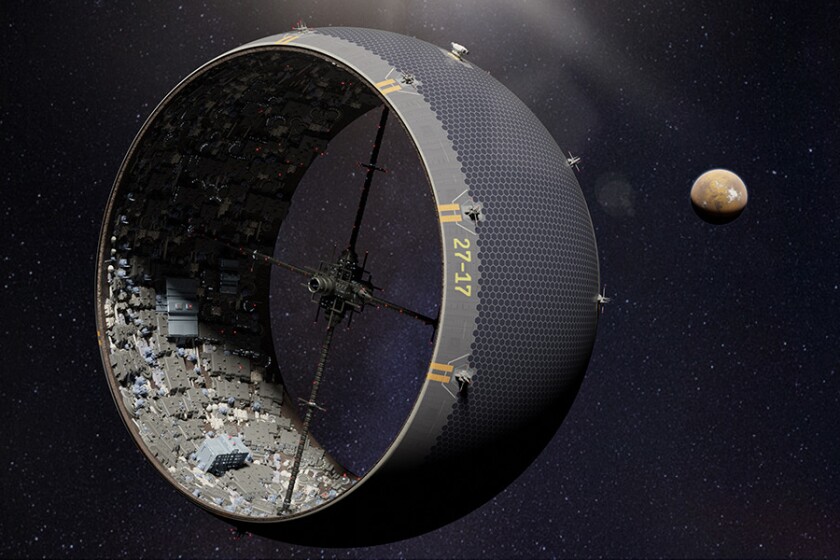
Quote:
You can't build space cities on the surface of asteroids, or even inside them, really, but you could turn them inside out to become the ground layers of spinning ring-type space stations, says a Rochester team, and it'd be a relatively cheap and easy way to build yourself a space habitat for humanityUniversity of Rochester
Probably the materials taken by the Cookie-Cutter need to be processed, and the good parts extracted, and the slag made into "Brick" that can be added to the large structure also shown in this post.
I consider these thoughts to be on the way to some sort of practical process. I would not like to expend fuels in propelling these things, so, I might like to see a propulsion based on Oxygen alone, as Oxygen is a common substance to be found almost anywhere. Other suggested propulsion methods could be Neumann Drive and Magdrive. And Aluminum and LOX method might also be considered.
When slag bricks are made, they might be incased in a tensile structure such as Carbon Nanotube and perhaps metal wires, so that these slag bricks can be joined to each other. There is some reason to think that Phobos and Deimos may have Carbon in them, but if not then the atmosphere of Mars certainly could provide it.
A great amount of robotics and automation might be used in this work, to establish safeholds in the orbits of Mars.
While the Martian-Mole option is interesting as well as a partner to this, I think Mars/Phobos/Deimos practically begs for
and Avian approach to Mars/Phobos/Deimos.
Ending Pending
#1525 Re: Terraformation » 55km Mars tunnel idea 2.0 » 2025-01-23 09:45:39
PhotonBytes,
It has gradually occurred to me that Mars/Phobos/Deimos can be a world for things that fly. An ~.38 g world. Optimists think that the bulk Mars atmosphere can become as much as 2.5 times as thick as it is now, from unthawed CO2 ice.
This would make the radiation situation on Mars much better than it is now.
Hellas, at its deepest point might be an air pressure of about 11.5 mbar. 2.5 times that would be perhaps 28.5 mbar, but the pressure would be more than that, as compression would make the lower layers of atmosphere denser and denser.
https://endmemo.com/chem/vaporpressurewater.php
That would allow a vapor pressure of 23.3 degrees C or more in that lowest spot on Mars.
Granted, for open water evaporation would be severely troublesome. But I think that covered lakes/canals, might work OK. Many Locations on Mars have a pressure of 9 mbar. 2.5 times that would be 22.5 or more, due to compression of layers. So, in those locations a vapor pressure of 19.5 or more.
A method to heat that CO2 up is provided here: https://news.uchicago.edu/story/scienti … -warm-mars Quote:
UChicago, Northwestern study suggests new approach to warm Mars could be 5,000 times more efficient than previous proposals
So, if Mars could be altered in that way, radiation would be better protected from on the surface, and the operation of ships like Starship might be better facilitated. The terminal velocity coming down would be improved, and the friction going up would not be that much increased, I think. So Starship SSTO would be a thing I think, providing for materials interchanges with Phobos and Deimos. And beyond that would be the asteroid belt.
So, I do not think that the best use of Mars is to become "MoleMen". But even so, your ideas in some ways could be worth chasing down. Especially with robotics being a very likely field of expansion of capabilities.
Near the equator, this apparently exists: https://www.space.com/mars-water-ice-eq … ozen-ocean
Image Quote: 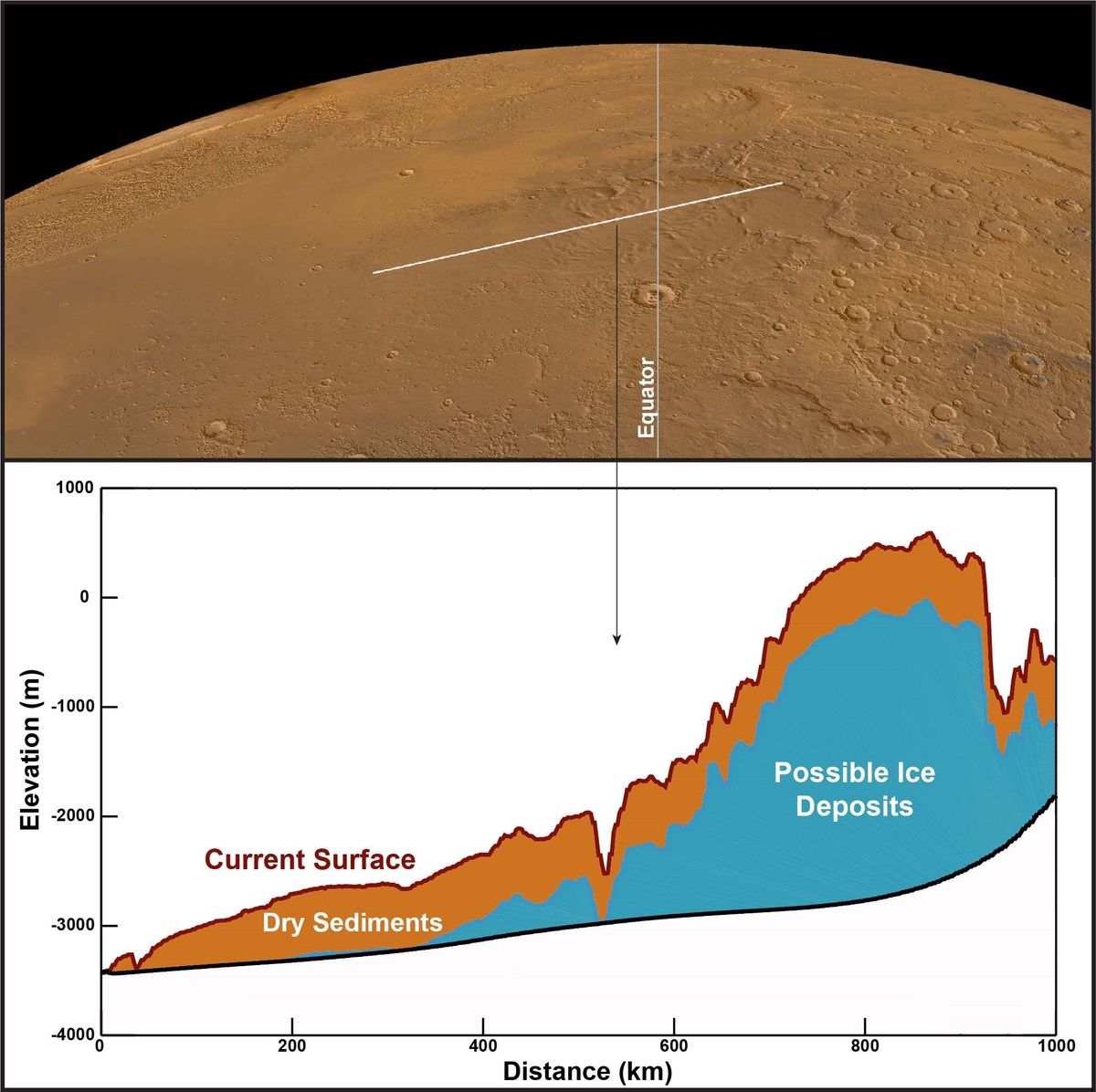
Quote:
In this image, the white line on Mars' surface (top) shows a stretch of land that was scanned by MARSIS. The graph below shows the shape of the land and the structure of the subsurface, with the layer of dry sediments (likely dust or volcanic ash) in brown and the layer of suspected ice-rich deposits in blue. The graph shows that the ice deposit is thousands of meters high and hundreds of kilometers wide. (Image credit: CReSIS/KU/Smithsonian Institution)
If the sediments over the ice are cemented reasonably well then you could dig a shaft and tunnel network in that, reaching into the ice body.
Underground cities in Anatolia: https://www.bing.com/images/search?q=un … RE&first=1
https://en.wikipedia.org/wiki/Derinkuyu … round_city
So, deep volcanic ash sediments could allow relatively easy digging into to make an underground city.
The ice may be relatively easy to dig into as well.
Suppose you dug a city, and put artificial lakes above it with domes.
You could dig diagonal shafts from the city down into the ice. Diagonal, so that you don't undermine the city.
You might start like this: 
By digging diagonal in the ice you can get makeup water, but not undermine your city in the volcanic sediments.
Then if you have some reason do dig deeper, maybe drill for geothermal you could do that below the ice layer.
And as this is to be near the Equator, then an orbital space community could be linked to this city, and they may trade resources.
Anyway, if you are going to dig then you have to start somewhere. This place could provide both volcanic sediments and massive amounts of ice.
Ending Pending
This would fit in with an "Avian" Mars, and be supportive of an expansion to the moons of Mars and the asteroid belt.
Ending Pending