New Mars Forums
You are not logged in.
- Topics: Active | Unanswered
Announcement
#126 Re: Science, Technology, and Astronomy » Fighter jets: F-35 vs Gripen vs Avro Arrow » 2026-01-04 16:41:43
RobertDyck,
When all you have is a hammer, everything looks like a nail. If you maintain your military with a war budget, everything looks like war.
When all you have is an ignorance-based perception of procurement timelines and logistics, every military expenditure looks like an unnecessary extravagance. When your beliefs about what an enemy will do, when they think they can get away with it, fails to account for their malevolent behavior, the only possible end result is a catastrophe resulting in extreme loss of life and confidence in a government's ability to protect its own people. The US learned from Pearl Harbor to never be taken by surprise. After the Cold War ended, that lesson was long since forgotten, yet Russia still existed to re-teach the forgotten lesson. I don't expect you to understand this, either.
Both America and the European Union, despite both having economies vastly larger than Russia, still cannot match Russia's monthly artillery shell output after 4 years of fighting in Ukraine. None of the fancy long range supersonic and hypersonic weapons or stealthy cruise missiles have meaningfully altered the course of that war, despite hundreds or thousands fired by both sides. Drones are a constant battlefield threat to infantry and vehicles, but haven't prevented the current trench warfare stalemate. Neither side has been able to establish air superiority, so it has not been possible for either side to bring the war to a decisive conclusion. This is a stark contrast to the first Iraq War, which was over with inside of a month, because one side was able to establish air superiority, which it used to destroy every last piece of Iraqi military equipment more sophisticated than an infantry rifle or anti-tank rocket launcher.
America wasn't even involved in WWII for 4 years. None of these clown shows masquerading as governments are going to protect your nation from anything. They operate on wishful thinking and purposeful ignorance of enemy actions. They lack the intellectual capacity to even comprehend how to respond with any sense of urgency to an actual military attack. The German Army spent months goofing off with internal travel permits across their own country to transport Leopards to Ukraine. If you were relying on those people to gear-up for wartime production and to move military equipment expeditiously to where it's required, then your country would look like Ukraine does today long before they'd have their act together.
Do you recall how long it took for European economies to recover from WWII?
Full repair of infrastructure took 20 to 30 years, which means the Cold War was already on the back end before complete recovery took effect. That's essentially a generation of young working age people who were forced to pay for the "failure of imagination" of their forefathers- people who tried to "wish away" what was so plainly happening in front of their very eyes, in other words people like you.
Ironically, Russia is going on a rampage. Now is the time to scale up military again, and stop Russia before it becomes World War 3. But President Trump is a scammer, who used unscrupulous business practices to defraud people.
If you actually believe that, then why is the Canadian defense industry still dithering?
Why hasn't Canadian artillery shell production already surpassed American artillery shell production?
Where is all the action on the part of Canada that backs up you running your mouth non-stop?
#127 Re: Exploration to Settlement Creation » WIKI Constructing things on Mars equipment needs » 2026-01-04 15:10:39
An all-electric 323hp variant of Caterpillar's D11 dozer, for use on Mars, to run for the same 12.8hrs at max effort here on Earth, the battery pack needs to be about 3.875MWh:
850hp * 0.38 = 323hp
323hp * 12.8hrs = 4,134.4hp-hr
4,134.4hp-hr * 745.7W/hp = 3,083,022Wh
We'll call that 3.1MWh.
We cannot discharge the battery to zero every time we use the dozer, so 3.1MWh / 0.8 = 3.875MWh
200Wh/kg and 150Wh/L has been achieved at the battery pack level for Tesla automotive Lithium-ion batteries.
3,875,000Wh / 200Wh/kg = 19,375kg
3,875,000Wh / 150Wh/L = 25,833L / 25.8m^3
That is a whopping big battery, but it still fits, just barely. It would handle the power demanded of it without issue, and without requiring a gigantic cooling system since the discharge rate is so low, but then you'll need a recharge for about 12 hours or use some kind of external cooling system to recharge the battery faster. Form-factor-wise, this vehicle, while essentially a great big battery inside a steel box, still appears to "fit" without issue. The weight distribution might be a little worse, though. It's doable, but requires a complete internal redesign of the vehicle.
#128 Re: Science, Technology, and Astronomy » Fighter jets: F-35 vs Gripen vs Avro Arrow » 2026-01-04 13:31:06
In the amount of time that the CF-18 has been in-service with the RCAF, if Canadian Arrow enthusiasts were so hard core about producing an indigenous airframe and engine combination, then why did they not form their own design team to do what Stavatti Aerospace did in America regarding their ideas for A-10 and stealthy trainer replacements / light fighters?
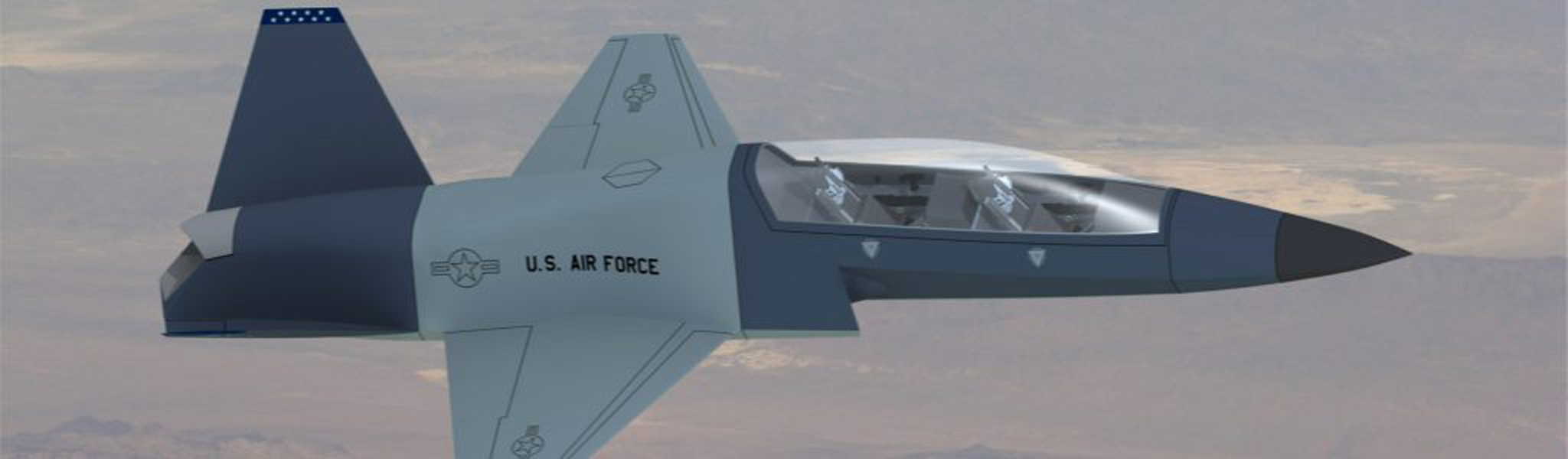

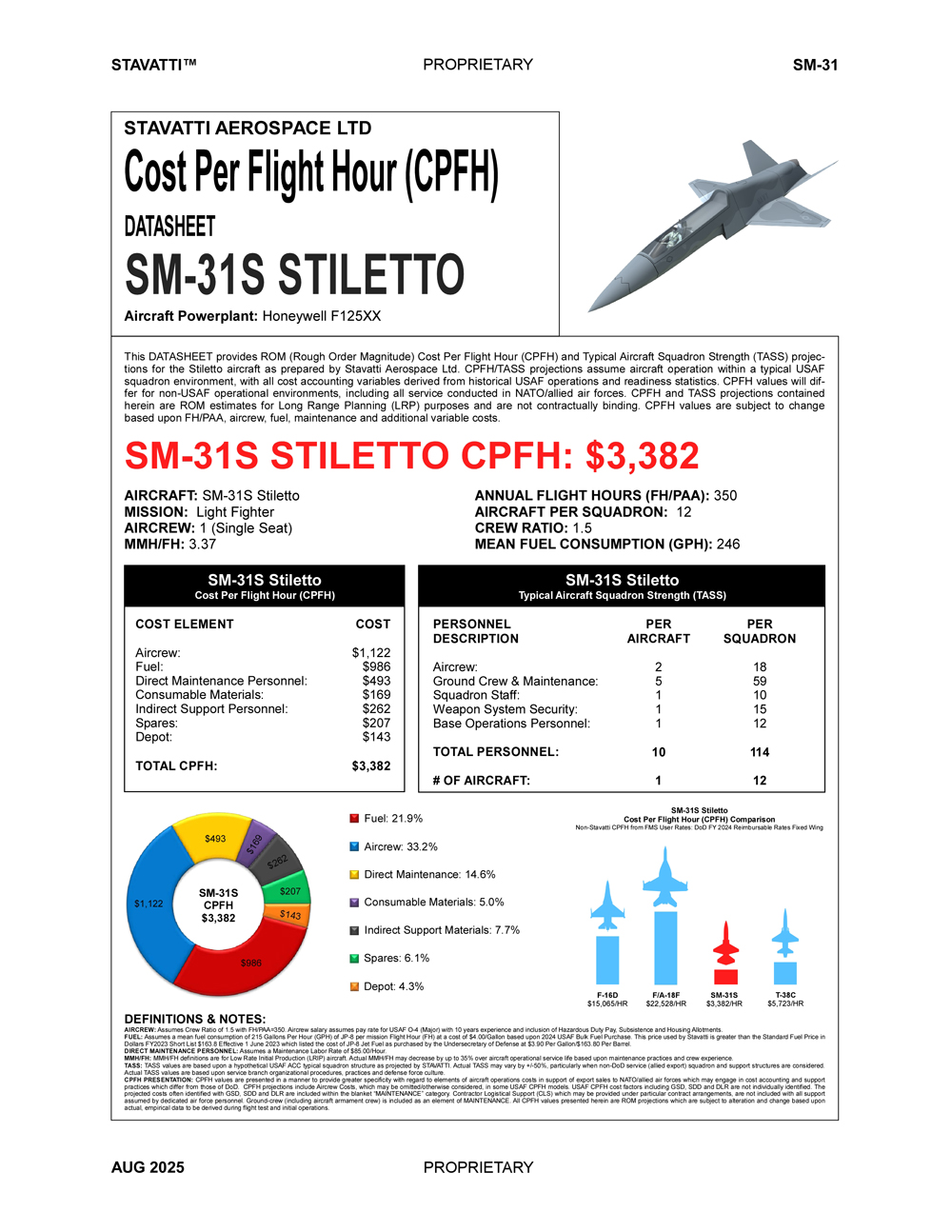
$23M flyaway cost with the Honeywell F125 engine, $3.4K to $4.4K cost per flight hour.
CF-18s presently cost $15,000 to $20,000 per flight hour.
Canada would not be competing with the US military for design requirements or orders, so Canada could pay for whichever design elements are most suitable for their use cases.
2 squadrons of F-35s would cost the same amount to purchase as 7 squadrons of these Stilleto light fighters. Canada could field light fighters equipped with Raytheon's Peregrine missiles to take down bomber-sized targets at around 100 miles from the launching interceptor. It has an internal autocannon, just like all other USAF fighters, and Sidewinders can be fitted to wingtip rails. Airframe shaping features reduce RCS the most, so Canada could opt for shaping only, without any eye-wateringly expensive RAM coatings to continuously maintain, as would be the case for the F-22 and F-35.
#129 Re: Science, Technology, and Astronomy » Fighter jets: F-35 vs Gripen vs Avro Arrow » 2026-01-03 21:22:26
RobertDyck,
You say that as if it's a bad thing.
It is bad if you're fighting another nation that has real air power.
Canada invented the snowplow.
The snow plow invented by J.W. Elliot was not the first deliberately designed snow plow, although I think it was the first rotary snow plow. The first motorized snow plow trucks were built and operated in New York City, IIRC.
Canada created the Polio vaccine.
Dr. Jonas Salk's research team created and tested the first successful Polio vaccine in Pittsburgh, Pennsylvania, after work done before WWII killed or paralyzed most of its recipients. Canada, amongst many other countries, used the Salk vaccine. Sabin worked on dead and live polio vaccines. Hilary Koprowski demonstrated the first successful live vaccine. IIRC, Herald Cox also worked on live vaccines.
The first walkie-talkie was created from work done by three different men. IIRC, there is merit to the claim that Canadians developed the first aircraft wireless sets.
I'll give Java to Canada, since that was mostly the original work product of one man. So far as I'm aware, no fighter jet in the world uses Java for primary flight control or engine control. Everything is written in C or assembly.
The first modems were invented by Bell Labs for SAGE, which was / is a part of NORAD.
Alkaline batteries were invented in the late 1890s. The first commercialized versions were the work product of a Canadian inventor.
Insulin and pacemakers I'll give to Canada.
The "wonderbra"? Squeezing a woman's breasts together has what, exactly, to do with fighter jets or war or inventiveness? Women were squeezing their breasts together long before the wonderbra existed.
Ah... Trivial Pursuit. Every argument you've provided against procuring the F-35 thus far is the direct result of this game.
#130 Re: Science, Technology, and Astronomy » Fighter jets: F-35 vs Gripen vs Avro Arrow » 2026-01-03 15:07:53
RobertDyck,
I thought one reason Trump was elected was to get the US out of foreign wars.
I realize the nuance will be lost on you, but the quiet part nobody is saying out loud is that Maduro was acting as an enabler for Russian and Chinese forces, primarily China, seeking to use our backyard as a staging ground for attacks against the US. China is the real reason America made such a show of force over the Maduro situation. If you didn't already know this, that's because you weren't paying attention. Stop taking every politically-motivated thing you read in the news at face value.
In less than 2 years, Canada had a fleet. Built in Canadian shipyards. At the end of WW2, Canada had the 3rd largest navy in the world. Only behind the US and UK. Yes, Canada has capacity to do that again, but doesn't want to.
Talk is cheap. Canada never built an aircraft carrier. The largest surface combatant ever built in Canada, as opposed to being operated by Canada, is their new River class destroyer, at 7,950t full load. Those ships use Lockheed-Martin's Aegis Combat System, SPY-7 radars, Standard Missiles, and Tomahawks. They also include propulsive motors built by GE and ASW helicopters built by Sikorsky.
#131 Re: Science, Technology, and Astronomy » Fighter jets: F-35 vs Gripen vs Avro Arrow » 2026-01-03 14:43:53
RobertDyck,
"Nagurskoye or Kotelny Island or Rogachevo"? Hmm. Never heard of them.
That doesn't surprise me in the slightest. You have a habit of glossing over the important little details such as where a Russian sneak attack using strategic bombers would actually come from.
The US is dependent on Canadian radar to detect and track any Russian bombers trying to fly over the North Pole and over Canada to reach the US.
You actually think the US primarily relies upon surface radar stations located in the US or Canada as our primary means of detecting the movements of Russian strategic assets?
Tell me what you think the NRO does.
The radars in Canada are part of a layered air defense system. They are no longer the primary or even secondary early warning systems used in the layered air defense approach taken by NORAD.
There are at least 5 separate layers to NORAD:
1. Satellites that monitor enemy ground movements and airspace from orbit, now in real-time
2. Satellites that monitor friendly ground movements and airspace from orbit, now in real-time
3. Radars and EO/IR sensors to observe enemy and friendly air space from the ground and air- the radars in Canada are part of this layer
4. Air defense system radars and missile batteries- this layer includes multiple overlapping layers of missile interception capabilities
5. Air defense tactical fighters to mop up leakers
#132 Re: Science, Technology, and Astronomy » Fighter jets: F-35 vs Gripen vs Avro Arrow » 2026-01-03 14:16:49
RobertDyck,
I have always said the F-35 is not the right fighter jet for Canada. From the time the F-35 was first completed and offered to America's allies. I have never dithered.
The basis for your conclusion is not connected to plainly observable reality. Canada hasn't taken any concrete actions to counter the threats posed by modern air defense systems and tactical fighters with survivable solutions. Canada's fighter fleet received its last major upgrades 20 years ago. Call that whatever you like.
If Canada had simply been "gifted" F-22s, your Air Force would go bankrupt trying to maintain them. You incessantly complain about the cost of the F-35 without acknowledging the F-22's much higher costs per flight hour. F-22s are dramatically more expensive to operate, in comparison to any other fighter jet in existence. You also refused to acknowledge that the F-35 outperformed the Gripen, Rafale, and Typhoon in actual mission performance, according to your own government. There are more F-35s which have actually been produced to date than all Gripens, Rafales, and Typhoons combined. F-35s are both less expensive and more capable than the rest of those jets.
The F-35 is better than a Super Hornet in terms of acceleration when it comes to regaining energy lost to maneuvering, it turns better than the F-16 unless said F-16 is unarmed, and it points the nose better than any F-16 during high-AoA maneuvering thanks to those barn door tail fins that are as large as the wings are on some of those other fighters. Kinematically, for people who still think about fighter capabilities in such terms, the F-35 is every bit as good as those earlier generations of jets when both jets are equally loaded. A Rafale pilot even said that his latest and greatest copy was, at best, "evenly matched" in a dogfight with his F-35 opponent. The F-35 does all of that with a stealth-optimized airframe. None of those other fighter jets have stealth or electronic warfare capabilities in the same class as the F-35.
On top of all that, the F-35 will fly farther on internal fuel alone than anything except a Su-35, Su-57, or F-15EX. The F-22, F-15E, and J-20 all fall short, especially against the C model. If the F-35 receives its scheduled engine upgrades, then it will exceed the unrefueled range of everything except a Su-35 in what is essentially a ferry flight configuration, and no Su-35 that heavily laden with fuel will still turn like the F-35. Whether burner is engaged or not, the drag rise associated with supersonic flight means jets with "supercruise" capability are burning significantly more fuel to do it, period. In a tactical fighter sized airframe, supercruising is an altogether rather pointless capability if you intend to patrol far from your base and still make it home without on-station aerial refueling assets. Aerodynamic drag vs Mach number and basic fuel burn rate math is what it is. Take that argument up with nature. Let us know if you figure out how to overturn basic flight physics.
Lastly, no other tactical fighter provides F-35 equivalent situational awareness and sensor fusion. When the APG-85 radar is installed in the upcoming blocks, it will also greatly exceed the detection and tracking capabilities of the F-22's APG-77. At that point, the F-22, Su-57, and possibly the J-20 with upgraded engines have a slight kinematic performance advantage in a dogfight, but that's about it. The latest F-35 radar and electronics are 20 years newer than those installed into the F-22. For a jet that supposedly doesn't do anything well, all those other fighters seem to have a very tough time matching its mix of capabilities.
Imitation is the most sincere form of flattery. Every new tactical fighter being developed looks like a F-22 or F-35 or one of the various airframe derivatives proposed by our defense contractor primes long ago, but never pursued. There's probably a reason for that beyond the trite and very tiresome "everyone but me is dumb" explanation. Either all aerospace defense contractors across all major world powers don't know what they're doing when they're designing F-35 clones, or they know exactly why they opted for their design decisions because they know what right looks like, even if someone like you doesn't.
If you're never going to join the 21st century by fielding modern tactical fighters, then your aviation fleet is relegated to a purely defensive role that (hopefully) never encounters modern air defense systems or other modern tactical fighters.
#133 Re: Exploration to Settlement Creation » WIKI Designing Mars equipment garage » 2026-01-03 02:12:06
We could use these "ice caves" on Mars for our earth moving equipment, as a water source, and for the radiation protection provided:
THE HEBRUS VALLES EXPLORATION ZONE: ACCESS TO THE MARTIAN SURFACE AND SUBSURFACE
Resource potential and planning for exploration of the Hebrus Valles, Mars
We have water, some of it potentially liquid, carbonates, sulfates, basalts, and other useful materials. If we find a good source of Iron-Manganese ore there, then I'd say we have a candidate for exploration at the very least, and likely a decent place to put a base since we're going to need enormous quantities of water for a decently-sized city.
#134 Re: Science, Technology, and Astronomy » Fighter jets: F-35 vs Gripen vs Avro Arrow » 2026-01-03 01:36:26
RobertDyck,
You know how I can tell who's serious about defending their homeland and who's merely paying lip service to the idea?
Actions. Actions speak louder than words ever will.
Dithering is an action, but not one the enemy respects.
If Canada was truly concerned about fending off a Russian sneak attack over the pole, they'd have enough radars up there so that if a Russian farted in Nagurskoye or Kotelny Island or Rogachevo, Canada would know about it. I've never heard you so much as mention those names before, which tells me most of what I need to know about how seriously you take the problem.
Since complaining about what President Trump said won't make those air bases disappear, I fail to see the point.
#135 Re: Meta New Mars » kbd512 Postings » 2026-01-03 01:14:27
tahanson43206,
SpaceNut's going in his own directions with his own topic, which he's entitled to do. He's focused on some things you don't want him to focus on, but if that ultimately helps him to circle back around to the central idea or theme of the topic, then so be it. Maybe he's right to focus on radiation or robots or whatever, or maybe not.
Why can't we develop topics as stream-of-thought, and then selectively edit or break them into sub-topics at a later time?
To the extent that any concept can be refined into a single coherent topic with zero deviations, I think that's great, but so much about space exploration and colonization involves multi-domain problem sets that I don't know how well that would work in actual practice.
If you want to edit my posts in that topic and put my ideas where you think they should go, I would not care. I wrote down my ideas, however disorganized. Some parts of them may not be where you think they belong. I would not be the least bit offended if you moved them to where you want them. I don't get too wrapped around the axle about this stuff. I can readily acknowledge that you probably have much better topic organizational skills than I ever will.
#136 Re: Science, Technology, and Astronomy » Fighter jets: F-35 vs Gripen vs Avro Arrow » 2026-01-03 01:00:29
RobertDyck,
Under such circumstances, why would Canada trust the United States under Donald Trump to supply critical defence equipment?
Are you unable to acknowledge that the Gripen is just as dependent upon American military equipment as the F-35 is?
Can a Gripen fly without its US-supplied F414 engine?
If not, then it's as irrelevant to this discussion about your personal fears about President Trump as the F-35 is, assuming Canada is truly worried that the US won't supply defense articles to them.
The topic of this thread is selecting a new tactical fighter that serves Canadians military requirements. To that end, I've put forward some ideas that have at least some chance of helping Canada establish an indigenous tactical fighter development and production.
Are you able to set aside your personal feelings about President Trump so we can discuss more important subject matter?
If not, then what alternative non-US-origin engine will power Canadian Gripens?
What non-US-origin avionics will Canadian Gripens use?
What non-US-origin weapons will Canadian Gripens use?
#137 Re: Exploration to Settlement Creation » WIKI Designing Mars equipment garage » 2026-01-02 23:55:25
What would it take to keep a very simple topic focused upon the content that belongs in the topic?
Why would you attempt to engineer a design for a structure or piece of equipment in the absence of all other relevant information related to how said structure or equipment will actually be used?
What materials are you going to use to make this equipment garage / outdoor repair shop?
How are you going to obtain them and where do they come from?
If this garage is for heavy duty construction and mining equipment, how big does it need to be, what types of repair and refueling equipment does it need to accommodate?
These are just a few of the many questions you cannot answer without consideration given to so many other seemingly unrelated details.
It's gonna be small / big / somewhere in between, we're gonna put some kind of repair equipment in it to repair something, and maybe people can work there, or maybe not.
Why can't we consider what we actually want to use this garage for, and if there's no discussion allowed for that, then what's the point?
Alternatively, why can't you specify exactly what you want put in this garage so nobody else is left to ponder over its purpose?
#138 Re: Exploration to Settlement Creation » WIKI Designing Mars equipment garage » 2026-01-02 23:45:55
Back here on Earth, in admittedly less extreme temperatures, for Canadian mining and rock crushing equipment operating in -30C temperatures, they're using a combination of high-Manganese steel, high-Chromium "white" Iron, and Austenitic Ductile Iron. Mangalloy is the traditional cold weather steel that becomes work hardened with use, but has already been replaced with Ductile Iron in many applications for cost and wear benefits. White Iron is used in applications where abrasion / cutting from rock is the most important factor, such as razor sharp little shards of crushed rock being pulverized into a powder. The first couple of stages of rock crushers will be Ductile Iron, with the final one to two stages being White Iron because softer metals will get abraded too quickly. Chromium makes White Iron very hard.
Nearly every component in a heavy duty diesel engine can be and in fact are made from ADI, with only the connecting rods, pistons, piston pins, fasteners, and other small parts being steel vs Ductile Iron. Forged 4340 steel is still the best general purpose material for crankshafts and connecting rods subjected to severe stresses, but even high performance engines like Chrysler's Gen III Hemi are now using ADI camshafts as OEM equipment, and some engines use ADI crankshafts as well. Ford put ADI on the map during the 1980s when they put ADI crankshafts in some of their high-output engines, so one could say ADI is a 1980s and beyond material. TVR, a British company known for their extreme performance road-legal race cars, was also well known for using ADI instead of forged steel in their high-output V8 and I6 engines. If ADI lacked performance relative to 4340, then TVR would've discovered this during testing. OEMs like Caterpillar don't try to "hot rod" their engines though, so ADI crankshafts work for them in their largest mining truck and marine engines, saving piles of cash over modestly stronger forgings.
If you do everything absolutely correctly with a 4340 forging, then you get about 20% more "power holding" capability and fatigue life over ADI, at extreme cost. Modern "wonder materials" like 300M or Titanium also come with use case limitations, like "don't ever scratch the surface or drop the part on something hard". You should not expect the average mechanic to abide by those limitations. You see 300M and Titanium used in race engine connecting rods or aircraft landing gear / wing spars / engine mounts only. Nobody uses Titanium in crankshafts, which should tell you something. You would never design a factory diesel engine to use Titanium parts, for example. You also "give up" toughness at low temperatures and chemical exposure resistance, hence why you don't see Titanium or super alloys used in ship hulls or propellers. The Soviets used Titanium successfully in a literal handful of submarines, but not without a lot more hull maintenance, and every class of attack sub designed thereafter switched back to steel. Titanium exhaust manifolds are notorious for cracking. Everyone with a lick of sense uses stainless, an Inconel super alloy to reduce weight and achieve high temperature resistance, or plain old cast ductile Iron if cost matters at all. Titanium is pretty and produces unique "engine noises", but engineers with design latitude will generally opt for any other material.
Why ADI for heavy duty earth moving equipment?
ADI is 50% less energy-intensive to make than cast steel and 80% less energy-intensive than forged steel because there are fewer processing steps involving extreme heating. ADI will give you 80% of the performance of a 4340 forging in a practical application, like a crankshaft. Nobody makes a crane boom out of 4340 forgings, though. They all use mild steel or boiler plate steel. ADI in automotive use is a 120ksi YS material, tempered 4340 can go up to 200ksi if you don't care about toughness, but 125ksi YS is typical of normalized 4340. Fatigue resistance is better with 4340 forgings only if you spare no expense in production. Any lesser forged steel is probably not as good as ADI, such as the micro-alloyed low-alloy content forgings that come out of the major automotive OEMs, particularly for crankshafts / camshafts / connecting rods. They use forging of cheaper steels for part-to-part consistency, not absolute strength and fatigue life. As heat treatment process control improved dramatically with computerized ovens, appropriately tempered Iron castings largely replaced forgings.
ADI can technically be welded, but isn't worth the expense. If you want to economically weld parts together, then you really need to use mild steel or boiler plate steels. The only kinds of cryogenic capable steel we have for heavy earth moving equipment are either 300 series stainless steels, which are no stronger than mild Carbon steels and often modestly weaker, or stronger high-Manganese steels more akin to HY80 equivalents used in ship building.
Caterpillar really likes to use ADI for cast components used to reduce component count and assembly time, or mild steel requiring no special weld prep, so that if someone welds on their equipment or bends a frame rail back into place, the structural integrity of the equipment hasn't been compromised. Mild steel cannot remain ductile due to the cold temperatures on Mars, which leaves stainless, which is also safe to weld without concern over strength loss.
That complex part on the back of their haul trucks where the wheels / final drive / frame rails attach is a very large single piece ADI casting. The bucket, cab, and forward chassis components are welded mild steel. On Mars that would be welded stainless steel.
So, I have a proposal:
Let's "get real" about something fundamental to "civilization building":
Modern human society is built on water processing ability, industrialized farming, thermal energy, steel, and concrete. All other "nice to have" materials and other technological advancements have come from that foundation.
Every Starship that lands eventually becomes part of the chassis or crane boom or other large components for these mining vehicles that we need to mine enough metal ore to create pressurized habitation to actually live on Mars permanently. The first order of business is to be able to produce pure Iron using electrolytic reduction techniques. This requires a lot of electricity, but the temperatures are very modest. Pure Iron plus small quantities of alloying metals and Carbon unlocks ADI. Most structural parts can be built using this material, because ADI has few problems with mildly cryogenic temperatures. As we make more equipment from scratch using mined metals, we'll want to add a steel mill and forging tools so small parts that really need to be forged steel can also be locally sourced. The only kinds of steels we can expect to survive the Martian nights are ADI, stainless, and high-Manganese alloys. Every bit of metals-based infrastructure needs to "natively" survive being cold-soaked, meaning the intrinsic material properties are suitable for use in a mildly cryogenic environment.
Most Iron-based alloys used on Earth are intended for construction, with equipment of any kind being a distant secondary consumer of metals. The majority of Iron production must be directed at pressurized habitation construction, not equipment or vehicles. Iron wiring is not lightweight compared to Copper or Aluminum, but most of it won't go anywhere after installation, won't corrode, and won't be transported very far, either. If a length of Copper conductor wire weighed 1lb, then its equivalent Iron wire only weighs 5lbs on Earth, but only 1.9lbs on Mars. This is obviously not ideal, but eliminates the immediate need for a Copper or Aluminum mining and refining industry. We can live with that result, though, even if Copper and Aluminum mining takes several additional decades of settlement development before it can be pursued.
After we have re-mastered Iron and steel suitable for production and use in the new context of the Martian surface environment, Aluminum, Silicon, Copper, and Uranium are our next priorities. Unfortunately, all of these technology metals are also very energy-intensive, which is why they're secondary priorities.
Everything else is an artifact of mass production of those metals. Iron is the key metal, as it always has been. When you have Iron, you can make most of the the structures and machines humans need to survive on Mars. The stainless steel is already being imported from Earth in the form of vehicles suitable for making the trip from Earth to Mars. If SpaceX follows their plan to deliver 1,000 Starships per launch opportunity, then that's about 100,000t of steel to work with. Mining haul trucks like the Caterpillar 797 weigh about 215t, so a decently-sized mining operation may have 10,000t of equipment, leaving the other 90,000t available for initial pressurized habitation construction.
We need tracked all-terrain earth movers powered by SCO2 gas turbine engines and electric motors to eliminate gear boxes, drive shafts, and as much of the working fluids as is practical. The fuel will be a finely powdered Carbon fluidized with CO2 for pumping, compressed O2 or LOX for oxidizer. The electric motors will save wear and tear on the brakes by mostly not requiring them. A super capacitor bank will provide the jolt of energy to overcome initial rolling resistance to get the vehicle moving, and then be recharged by the traction motors during braking. This is essentially an advanced turbine-electric locomotive power train. Daily maintenance tasks will include fuel replenishment, checking hydraulic fluid levels, track tension adjustment, determining if someone accidentally bent one of the soft stainless steel structural members holding the vehicle together. When turbine power is not being demanded to propel the vehicle, an electric pump will siphon CO2 from the atmosphere. At the end of each shift, the LCO2 tanks will be emptied back at the shop where it will be used to supply CO2 for shop air tools and making fresh batches of powdered Carbon fuel and O2 oxidizer using Gallium-Indium-Copper liquid metal. If we happen to discover a natural gas well nearby, then we might consider using Methane instead of synthetic coal, provided that the rockets don't consume all of the Methane. Regardless, the Martian atmosphere is the fuel / oxidizer and working fluid of choice.
Since we cannot readily use gigantic rubber tires in a cryogenic environment, we'll use steel track links instead. The dramatic reduction in relative vehicle gross weight means we need less power, even with tracks vs tires. The Cat 797F haul truck's gross weight with 400t max payload is 623.7t on Earth, but only 237t on Mars. Top speed is officially 65kmh when fully loaded, though I would surmise speed depends greatly upon local terrain and room to maneuver. Instead of 4,000hp, we can manage with less than that, say 1,520hp. 1,500hp corresponds with the output of the M1 Abrams AGT-1500 conventional gas turbine. Fuel consumption over an 18 hour shift is about 75gph.
US EIA rates diesel fuel at 138,500btu/gallon, so 75 gallons is 10,387,500BTU.
Net electrical output vs fuel burn for the big Cat C175-20 diesel engine which powers the 797F are as follows:
Max rated electrical output is 3.2MWe in an electric generator application.
It's burning 208gph at full output, so 28,808,000BTU.
10,918,400BTU (net electrical output) / 28,808,000BTU/hr (fuel consumption) = 37.9% overall thermal efficiency
Let's be very generous to the Cat engine and assert it's 40% thermally efficient at reduced engine load.
10,387,500BTU * 0.4 = 4,155,000BTU
4,155,000BTU / 2,545BTU/hr = 1,633hp
An average of 1,633hp constant power output on Earth equates to 620hp on Mars.
For a 50% thermally efficient SCO2 gas turbine, 620 * 2 * 2545 = 3,155,800BTU/hr
Pure Carbon produces 14,100 to 14,600BTU/lb, so let's use 14,100.
3,155,800BTU / 14,100BTU/lb = 223.8lbs of pure carbon per hour
223.8lbs of pure C * 2.67lbs of pure O2 per lb of pure C = 597.5lbs of pure O2 per hour
18 hour shifts would therefore require 4,028lbs of pure Carbon and 10,756lbs of pure O2
At 700bar, 10,756lbs of pure O2 would required 12.195m^3 of tank capacity
Pure Carbon powder is 1,800-2,200kg/m^3, so approximately 1.015m^3 of fuel tank capacity
5X 1mDx3mL O2 tanks will easily fit within the engine bay previously occupied by the C175-20, as will the fuel tank and SCO2 turbine and electric generator, although maybe the fuel tank should be in its standard location for what should be obvious reasons.
Anyway, we just did enough simple math to figure out that all the oxidizer and fuel will fit inside the engine compartment with lots of room to spare for the SCO2 gas turbine and electric generator. The haul truck doesn't require a complete redesign, it only needs to be gutted internally and the best layout for the new power train equipment established. Therefore, a Caterpillar 797F mining haul truck can be fabricated primarily from 300 series stainless cannibalized from Starships vs mild steel and ADI (already used in Earth-bound 797Fs). It can then be operated in a Martian metals mining operation with concessions made to use of a more thermally efficient SCO2 gas turbine engine driving an all-electric power train and delivering the power to ADI or high-Manganese forged steel tracks vs giant rubber tires. It's not perfectly ideal, but nothing ever is.
Note to self:
Make sure the high temperature radiator surface area can be a simple forward-facing steel panel.
Now back to ground pressure and power consumption, and rolling resistance for tracked vs wheeled vehicles...
US Army Published a Table Regarding Generally Observed Coefficient of Rolling Resistance vs Surface Type:
Concrete / Hard Soil / Sand
Heavy Truck: 0.012 / 0.06 / 0.25
Tracked Vehicle: 0.038 / 0.045 / (no value provided for sand in this table)
By the time you move the wheeled vehicle over hard soil, the tracked vehicle already has lower rolling resistance. If you have to move the vehicle through soft sand, then the wheeled vehicle is all but guaranteed to consume more fuel at equal weight. Wheels almost always deliver more speed in both on-road and off-road environments with sufficient power available / appropriate gearing, but not for equal fuel burn at equal vehicle gross weight. If you have a concrete or asphalt or hard rock quarry road, then the tracked vehicle is all but guaranteed to be less efficient. This follows reports I've seen regarding the actual fuel economy of our wheeled Stryker APCs, which while very fast and fuel efficient on roads, suddenly become fair to terrible in the deep sand drifts of Iraq and loose gravel mountain roads of Afghanistan.
Rubber Tracks vs Steel Tracks: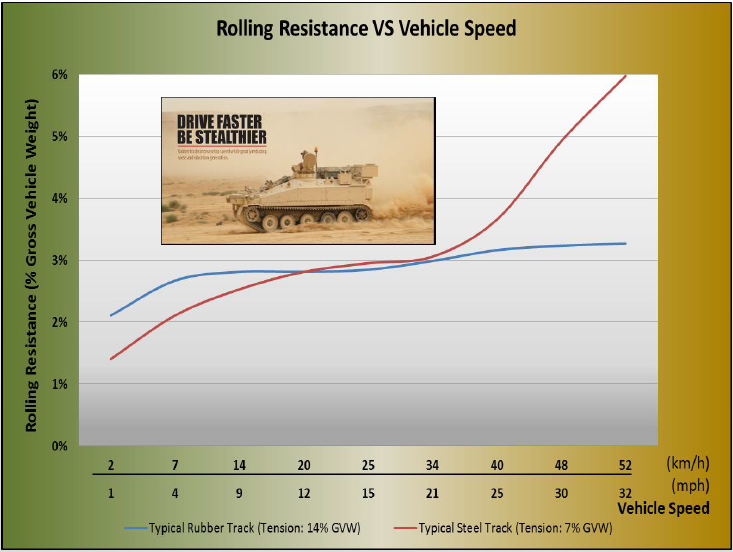
Go to Page 29 to see the observed rolling resistance coefficients table I referenced above:
US Army Engineer Research and Development Center - Geotechnical and Structures Laboratory - Standard for Ground Vehicle Mobility - February 2005
The mining haul truck is one of the largest pieces of equipment that needs to fit inside the garage, so 7.75m minimum height, preferably 16m high so the bucket can be tested inside the garage. The 797F is 9.5m wide, so perhaps the garage should be 25m in width to accommodate a pair of trucks. Overall length is 15m, so the garage should be 30m long.
Minimum Equipment Garage Dimensions for a pair of trucks, with room to spare for equipment and mechanics:
16mH x 25mW x 30mL
#139 Re: Exploration to Settlement Creation » WIKI Designing Mars equipment garage » 2026-01-02 01:47:21
I think an ad-hoc / in-situ garage implies using a natural terrain feature that can function as a garage, such as a cave, or something carved into a rock face. My assumption is that this garage primarily houses earth moving equipment.
Iron mining requires:
Drill rigs to create blasting holes
Excavators to scoop up the regolith
Drag lines for surface mining
Bulldozers to push piles of regolith around the job site
Haul trucks
To process the regolith into ore:
Rock crushers
Shakers and screens to separate larger rock chips from finer chips
Grinding mills to reduce the rock chips to a fine powder
Electromagnetic ore separators
Heaters to de-water hydrated minerals
Equipment used to drill wells would also be fabricated, repaired, and stored in unpressurized garages.
#140 Re: Science, Technology, and Astronomy » OpenFOAM » 2025-12-30 13:21:56
I feel like turbulent flow is the only way to reduce the gas velocity and build pressure so that the Hydrogen absorbs sufficient thermal energy to achieve 3,000K before it reaches the nozzle. Asymmetric sound suppressor baffles are what is needed, and that's exactly what the internals of that arc jet rocket engine I posted about actually look like in cross-section.
#141 Re: Science, Technology, and Astronomy » Fighter jets: F-35 vs Gripen vs Avro Arrow » 2025-12-30 10:51:43
This year alone, Canada has made almost twice as much money off supplying parts and electronics for the F-35 program as Saab's fighter jet business made worldwide. The very first Gripen-E was only delivered to the Swedish Air Force in October of 2025. That means they have no clue how well Gripen-E will perform in Swedish service because they've yet to train and deploy a complete squadron. Saab has already circumvented their supposed jobs deal with Brazil, for Brazil to supply Gripen-E to the Colombian as well as Brazilian Air Forces. Good luck, Canada. I mean that sincerely. You're going to need it!
More F-35 production infrastructure already exists in Canada than exists in Brazil for Gripen-E construction, but they've already sunk many billions into Brazil's Gripen program. Saab has delivered a whopping 2 fighter jets in 2025. Meanwhile, Lockheed-Martin has delivered over 190 F-35s in 2025, which is almost more than total Gripen production spanning multiple decades. Saab began "delivering" Gripen-E in 2021. We're at the end of 2025. Saab has delivered 6 Gripen-E models over the past 4 years. Canada almost made more tail sections for F-35s in 2025 alone than Saab has delivered total Gripen A/B/C/D/E/F models across multiple decades. Please let that mathematical reality sink in.
I always thought President Trump was king of egotistical decision making, but apparently he's an amateur compared to Canadian and European politicians. All that sweet F-35 program money will get burned setting up a Gripen factory in Canada, assuming that part of the deal ever happens, which might produce a grand total of 36 fighters. Burning your own house down to spite one American politician who will be gone in 3 years cannot possibly be "worth it", unless you're a leftist.
Ten years ago, Lockheed-Martin was practically begging all the partner nations to set up their own F-35 production lines so they wouldn't have to spend the billions to expand their own production facilities and ship F-35 components all over Christendom. Italy was the only nation which took them up on their request. Everyone else, to include Canada, only wanted to profit off of making parts for the F-35 fleet.
IIRC, the only portions of the software package that Lockheed-Martin "blocked" partner nations from accessing was the engine and flight control software, and only to ensure it was not locally modified. Nobody is going to show up at LM's corporate offices demanding a refund on their F-135 engine because they "hot-rodded" the thing. If Pratt doesn't approve an engine control software mod, then that's because they haven't tested it and don't know how it will affect engine life and reliability. General Motors does the same thing for warranty service on their engines and transmissions. If you modify the engine or transmission software, then you become personally responsible for the vehicle's performance. That is completely fair. GM sells passenger vehicles for general public and military use, not custom shop "hot rods". They have a side business, GM Performance Parts, to cater to people who want to "go nuts" with performance mods.
Stop allowing your leftist clown politicians to repeatedly screw your people over financially! President Trump will be gone in 3 years, and then they'll have to manufacture a new "crisis" to avoid public scrutiny while they continue to rob you blind. Canada could be waiting for Sweden to deliver Gripens to replace the RCAF's aging Hornets for the better part of a decade.
No, Canada Doesn’t Need to Spend $19 Billion on Jet Fighters
Excerpt from the article:
It asks: “Should Canada continue to be part of NATO or instead pursue non-military paths to peace in the world?”
Across the political divide, more and more voices are calling for a review or reset of Canadian foreign policy.
Until such a review has taken place, the government should defer spending $19 billion on unnecessary, climate-destroying, dangerous new fighter jets.
That was written in 2020. It's just more mentally retarded "we're saving the world by socially justifying ourselves to ourselves" leftist idiocy. These people don't give a crap about whether or not you even have a country, and lack the intellect to understand how a world run by Russia or China would simply grind them up to use as pot hole filler.
If you truly don't want the F-35, that's fine. Pick another fighter jet produced by a nation with an actual production line that can deliver combat jets. France and the UK can both deliver legacy fighter jet tails. Rafale and Typhoon are both capable fighters, and of completely non-US origin. Typhoon can fire US-made ordnance, if that's important to Canada. Rafale can fire AIM-120 and AIM-9 as well. Both can fire Meteor, which has longer range than our AIM-120. Ask them if they have some older jets to provide if money is truly that tight in Canada. Scavenge the remainder of the legacy Hornet fleet for spare parts, if you must, or start submitting tails to Boeing for their Service Life Extension Program. Get some more modern radars and cockpit instrumentation while you're at it. If you do actually want F-35s, but don't want to buy them directly from America so you can "stick it to Trump", then buy them from Italy or Japan. We really don't care and aren't offended by nations making defense choices that cater to their specific needs and wants. What we really do care about is a nation the size of Canada, which happens to share a border with America, not having any usable tactical fighters!
The micro fighter was and is a workable concept to provide many more tails for Canadian air defense than Canada would be able to afford by purchasing larger and therefore more expensive heavy fighters. Virtually every modern combat jet qualifies as a heavy fighter, to include the Gripen and F-16. They're great for strike missions, but heavy fighters will always be jaw-droppingly expensive to own and operate. If you're only going to fly intercept missions, then a miniaturized F-16 and Peregrine are ideal. Computer / sensor / weapons tech is at a place where micro fighters are perfectly usable in that role.
#142 Re: Meta New Mars » direction of New Mars & Mars Society » 2025-12-29 02:30:40
tahanson43206,
If we continue to develop computers to the point that they operate almost entirely on photons rather than electrons, then there's a case to be made for putting data centers in orbit, where an unobstructed line-of-sight to the best light source in the solar system is available to power them.
#143 Re: Science, Technology, and Astronomy » Google Meet Collaboration - Meetings Plus Followup Discussion » 2025-12-28 20:17:09
tahanson43206,
No worries. I thought something was wrong with my computer or internet connection. We'll still be able to meet next Sunday.
#144 Re: Science, Technology, and Astronomy » Google Meet Collaboration - Meetings Plus Followup Discussion » 2025-12-28 20:14:59
SpaceNut,
I made several attempts, but it kept saying "waiting for the meeting host to admit you".
#145 Re: Science, Technology, and Astronomy » Google Meet Collaboration - Meetings Plus Followup Discussion » 2025-12-28 19:37:50
tahanson43206,
I'm still receiving a message indicating that the host has to allow me to enter the meeting. I'm going to drop off.
#146 Re: Science, Technology, and Astronomy » Google Meet Collaboration - Meetings Plus Followup Discussion » 2025-12-28 19:23:29
SpaceNut,
Were you able to join the call?
#147 Re: Science, Technology, and Astronomy » Google Meet Collaboration - Meetings Plus Followup Discussion » 2025-12-28 19:18:25
I've tried to join several times now. No luck.
#148 Re: Not So Free Chat » Politics » 2025-12-28 13:48:12
SpaceNut,
Problem is the hard evidence is dismissed as being generated and not real.
Evidence is law of having sex with minors. That is a crime and documented.
There is no "hard evidence". The person making the accusation claimed to have such evidence, but then later said she lied about that and never had any such evidence. If such evidence does exit, giving a copy of it to the FBI would've been a great place to start.
Accusing someone of a crime is not "evidence" of anything. An accusation of a 20+ year old crime by someone who had their entire deposition thrown out after she later stated that "she made it all up to draw attention to the Epstein case", doesn't help prove anything in a court of law, except that the person making the accusation is a proven liar, by her own admission.
This is why, in the complete absence of corroborating evidence, if someone merely accuses you of a crime, the government doesn't automatically throw you in prison. Maybe you think an accusation alone is sufficient if it's made against someone you don't personally like, but I'm pretty sure you wouldn't want that same "standard of evidence" applied to you.
#149 Re: Meta New Mars » kbd512 Postings » 2025-12-27 18:56:56
tahanson43206,
The general public views space exploration as a special interest group that they will never become a significant part of. There's no shortage of new or old ideas, but there is a real issue with captured interest because nobody has gone anywhere new or done anything different enough from the norm to capture the public's attention. If / when we finally go back to the moon and onto Mars, then space exploration will once again become part of the public discourse regarding what we can or should do.
#150 Re: Not So Free Chat » Politics » 2025-12-27 15:17:13
RobertDyck,
How many times does hard evidence need to directly refute your personal beliefs before you question why you believe what you do?
Start by reading something that actually came from our government:
WhiteHouse.gov - National Security Strategy of the United States of America - November 2025
The section pertaining to Europe makes no claim about Europe or Europeans being viewed as a threat by the US government. This is actual governance policy that guides American strategic decision making / military alliance strengthening / opposition to adversarial nations, as opposed to fleeting political rhetoric.
ODNI.gov - Annual Threat Assessment of the U.S. Intelligence Community - March 2025
There's scarcely a mention of Europe there, apart from threats to Europe from Russia and terrorists. It's entirely focused on China, Russia, Iran, North Korea, and non-state terrorist groups.
So Trump has been tricked to destroy America's economy, offend all of America's trading partners, break all trade to make America poor. Ensure all freedom is destroyed in America. Most importantly, offend all of America's allies to destroy alliances, isolate America. Once America is poor, week, and isolated, it will be a pathetic nothing of a nothing that can be defeated. If anything survives of America, it will not matter because it will no longer be inspiration for other countries to believe they can have freedom too.
1. America's economy has not been destroyed by President Trump. His economic policies have consistently improved American economic self-reliance and productivity. Self-sufficiency ensures that America's economy cannot be greatly affected by external factors beyond its control. President Biden's administration only furthered our self-reliance for advanced electronics tech, so there is no serious dissent on pursuit of these strategic goals, only how to best achieve them. That means we'll continue to pursue self-reliance over globalism.
2. If America's trading partners are only interested in trading with America when there's a very lopsided benefit in their favor, then it's a bad business deal for America. Many of America's "allies" are only interested in this kind of relationship with America- "I love American dollars, but I hate Americans and America." An ever-growing number of Americans have had enough of that. If you hate America that much, then stop doing business with America.
3. The average American worker has been "made much poorer" by perpetuating globalism and materialism. Americans don't need an endless variety of meaningless choices to live well, and neither do the citizens of other nations. I think most nations, certainly all of the most advanced economies, will ultimately benefit from the highest degree of self-reliance they can achieve.
4. The people who most frequently take freedoms from others are radical leftist collectivists. Leftists have a dramatically better track record of impoverishing their own people and taking away freedoms as compared to any other political party more interested in economic prosperity than dogmatic party ideology.
5. Short of space aliens with the technology to travel between stars, America cannot be militarily defeated by external forces, only from within by its own people. The only people trying to do that are universally leftists. Nobody on the political right is attempting to destroy America from within.