You are not logged in.
- Topics: Active | Unanswered
Announcement
#1176 Re: Interplanetary transportation » Multi-Ship Expeditions, Starboat & Starship, Other. » 2025-05-08 18:34:30
So, I was surprised to find out that Optimus robot will not only have connection to a hive mind, but will also have it's own local mind which would be transferred from one robot to another.
So, we already have robot spaceships, but we do not have spaceships with robots on them.
I think very large platforms moving about in the solar system would likely have some sort of humanoid robot with functional hands on them.
So, Robot Space Sailors. Will they enjoy their tasks? I don't know if they will have enjoy. But the robots would be there to repair things and maybe to run 3D printers.
So, these robots could stay on such ships for a "Lifetime", which could be a longer life than a human.
So, if such a platform fetched a bunch of stuff from factories on Ceres, if it takes 10 or 20 years to make a delivery, is that a problem?
Actually, spaceship/platforms could be built from the materials from Ceres, and also humanoid robots, and then to load up their platform with stuff that will be valuable at another world. Mars, Earth/Moon, Venus, Stony Asteroids. In reality the ships would not need to leave their destination once they arrived as all of the materials in orbit would be of value at that location.
And their are several other major sized Sub-Dwarf-Planets where this might be possible and profitable.
An interesting concept would be if the materials delivered to Mars orbit were converted to orbital habitats, perhaps Earth people moving to those habitats would buy them like we might buy houses.
But what would the "Belters" want to get in return? Maybe retirement homes around Mars? Actually, there might not be that many humans working in the belt. 99.99% of the work force out there might be robots.
Some of the produced platforms might be converted into "Cycling Spaceships/worlds", and some might become "Semi-Cyclers".
All of these are likely to have lots of radiation blocking materials in them. Of course I favor Plastics, Paraffin Wax, and Water.
So, a "Semi-Cycler" might travel on it's own, or at times might join with a "Cycling Spaceship/world", and at other times, to dock by "Ballistic Capture" with a world like Mars, or maybe Ceres, maybe Earth. Somehow, maybe even Venus or Mercury, although those would be harder.
As far as a "Semi-Cycler" goes, it would have a mass somewhere between a Starship or a "Cycling Spaceship/world". (Isaac Arthur calls them Castiles). So, not having the large amount of mass as a Proper Cycler, you might choose to dock them to a world's gravity well, but would be reluctant to do it very often.
A "Semi-Cycler" could use gravitational boost(s) as propulsion method.
Eventually it might be that Callisto would become a build site for platforms eventually.
Here is that list again: https://en.wikipedia.org/wiki/List_of_e … _asteroids
Image Quote: 
Many of these large ones are from the outer solar system, but not Vesta. Those from the outer solar system tend to have a diverse mix of materials including water, Carbon, and at least in the case of Ceres, Nitrogen.
But Vesta being volcanic might have desirable mineral ores, including perhaps Copper and precious metals. So, platforms could be built there and then travel to Ceres to pick up other materials before traveling into the innermore solar system.
Power in the asteroid belts should not be a problem at all as thin mirrors should be a good source of it. Probably in orbit of these small worlds.
It might be that a platform departing from the outer asteroid belt would get a boost of some sort and then run on it's own resources. It might stop off at more inner asteroids to pick up propellants like Iron, or Aluminum along the way.
So, I have described how Mars could have a large orbital community. But the surface would be developed and mined as well.
Robot labor in vast quantities should make this all possible, or the robots will end us. But I don't know what their motive to kill us will be. Maybe they will just compose music on their spaceship-platforms and sing songs when it may suit them. Would that necessarily be abuse of a robot?
But they will be somewhat alien so who can know how it will go in the long run.
Ending Pending 
#1177 Re: Not So Free Chat » Oil, Peak Oil, etc. » 2025-05-08 13:09:19
I did not know these things about the Alberta Oil Sands: https://www.bing.com/videos/riverview/r … &FORM=VIRE Quote:
EM Shorts May 8 2025MH oil sands
YouTube
Energi Media
49 minutes ago
That's not going to run out for some time, it seems.
Unless someone kills it.
And thanks from one American.
Ending Pending
So, technically the UK can get Oil from both the USA and Canada, but Quebec will not let it though, so, it has to go through the USA. That might be a deeper civilizational level game. Bad Froggies! Or is it Thanks! Froggies?
A very strange world.
Ending Pending
#1178 Re: Not So Free Chat » Peter Zeihan again: and also other thinkers: » 2025-05-08 12:05:08
This seems significant: https://www.bing.com/videos/riverview/r … &FORM=VIRE
Quote:
BREAKING: Pres. Trump makes major trade deal with UK 'very big deal'
YouTube
LiveNOW from FOX
43.4K views
2 hours ago
#1179 Re: Interplanetary transportation » Multi-Ship Expeditions, Starboat & Starship, Other. » 2025-05-08 08:22:53
So, when we get to the point that humanoid robots in factories reproduce themselves at a high rate, then there would be more such factories, and so on.
Robots will either be the death of us or perhaps the life of us. We know that our patterns will not exist forever in any case. We might as well embrace it and find out if it is how we live or die.
Given matter and energy, then artificial labor may have no limits that we recognize at this time.
So, yes freighters crewed by robots, moving stuff around the solar system? Why not? How much? Lots I expect.
Now then what about Mars? Would you like to hide in a hole on Mars or fly though the solar system? You could do both and even more.
Probably the real Mars will eventually be in orbit of Mars. Easier to make synthetic gravity and also more connected to distant places in the solar system. But you could go down to Mars from time to time as it pleased you. Either in the flesh, or with a humanoid robot as a Avatar representative of you.
80 billion robots? How about 80 trillion?
Where are the limits?
Ending Pending
#1180 Re: Interplanetary transportation » Multi-Ship Expeditions, Starboat & Starship, Other. » 2025-05-08 07:03:44
I am ready to revisit the materials of post #39.
Magdrive and Neumann Drive are in development. Other new propulsive methods are likely in the future. The surfaces of worlds are likely to have plenty of materials for the Magdrive and Neumann Drive, all the way out to Callisto. But by the time you get to Titan, those materials become more precious, and things like Plastics, Paraffin Wax, and water could receive more consideration as propulsion mass.
But even for many spacecraft in the inner solar system, it may be convenient to provide Plastics, Paraffin Wax, and water, as these block radiation. Then at times it may be desired to use those substances as propulsion mass.
In posts previous including #39, I entertained the use of Paraffin and water. Relatively easy to store. Radiation protection, and relatively safe, but of course in space with Paraffin you need to fear a fire. So, Paraffin needs, handling methods that address that fire concern.
I have imagined a spacecraft with a power source. That could be solar or nuclear. I think it is more likely that common citizens will be empowered to use solar methods in space, as we can expect strong governing interference with widely distributed nuclear. (And that is a good thing).
A solar-electric platform might use many types of propellants. Argon, Iron, Aluminum, Copper. And for Neumann Drive the bulk of solid substances on the Periodic Table.
But now I want the option of Paraffin Wax used with water.
Because we have electricity, we can split the water into an Oxygen stream and burn it with Paraffin Wax in an engine.
As it turns out I imagine a pulsing burn process. In order to deliver the pulses to the engine we may have motors or solenoids of some sort, resembling the process used in Rocket Lab's Electron Rocket.
But now I want to include the Hydrogen from the split water back into the process. The Hydrogen can be heated very hot in a confined space and then released into the plume of mostly CO2 and Water vapor resulting from burning Paraffin in Oxygen.
We have existing concepts of launching payloads with hot Hydrogen Cannons, so I think this could work. It would be on a miniaturized level though. The exhaust from burning Paraffin Wax in Oxygen will become the bullet, and it will be pushed on by very hot Hydrogen.
Methods of cooling this process could be radiative, if you don't fire it too often in a time period, but perhaps active cooling of some kind will be wanted.
I will give some examples of Hydrogen "Guns".
https://www.universetoday.com/articles/ … bit-wvideo
Quote:
Hydrogen Gas Cannons Could Launch Payloads to Orbit (w/video)
By Nicholos Wethington
January 20, 2010
OK, this claims to do 3 times better than spin-launch: https://newatlas.com/space/greenlaunch- … as-launch/ Quote:
Space
Hypersonic space cannon promises 10 minutes from ground to orbit
By Loz Blain
April 14, 2022
So, I am hoping to get some of the performance of a nuclear thermal rocket using Hydrogen. Could hot hydrogen have its own explosion to further compress it and then squirt it into the plume of the results of burning Paraffin Wax and Oxygen?
As I have said, I think it might be possible to outfit a spacecraft with Paraffin Wax and water radiation protections. Those substances might even be able to be in living quarters. But the Paraffin might best be contained in a fire proof fabric. Means to put out fires would also be desired.
So, that is a bit weird as you could live inside of your propellant tanks.
Ending Pending
#1181 Re: Interplanetary transportation » Multi-Ship Expeditions, Starboat & Starship, Other. » 2025-05-07 19:07:22
I like the concepts in https://www.youtube.com/channel/UCRMkYy … feDtrQgcTA
But rather than a road around the equator, I might prefer one that extends from the Equator to the poles. Perhaps it would also encircle the pole, probably the south one.
If significant water exists at the poles with a little CO2, and I might hope, some Argon, things like Sulfur, and maybe Sodium may have settled out into the regolith at medium latitudes. Probably the heat of high noon will determine where a substance will settle out if it evaporates.
To start with though, I would like to see a base at low latitude, and one for polar ice, if it exists.
But before the formal roads are built, I wonder if we could get some kind of rockets that could do jumps between the bases. I would look at leftovers to start with.
Expended 2nd Stages:
-Falcon 9 (RP-1 and Oxygen)
-Terran-R (Methane and Oxygen)
-Neutron (Methane and Oxygen)
And the reusable 2nd stage of Stoke Space:
NOVA (Hydrogen and Oxygen)
They each have points. Even if Falcon 9 2nd stage has Cabon issues, the fuel would likely be the easiest to store in a space environment.
NOVA, is already designed for reuse, but of course Hydrogen fuel is a fussy baby.
Terran-R and Neutron, are both compatible with the fuel of Starship.
I want to have another look at Rotavators. Can we drop Ping-Pong Balls onto the Moon in places and have them survive the impact? If so then that will lift the Skyhook up. But if we find a way we may be able to lift things off of the Moon using that lift generated by dropping Ping Pong Balls.
I am not the first to think of Skyhooks on the Moon. Most of you will know Skyhooks, but here is a refresher: https://isaacarthur.net/video/upward-bound-skyhooks/
Some people have suggested that a Skyhook could hook a load on the surface of the Moon and lift it up. I am being more conservative. I want a Spacecraft to fly up the skyhook and hook onto it and then I want to release a bunch of Ping Pong Balls.
But we have limited amounts of Ping Pong Balls. But if we had some Plastic factories on Ceres, we might bring the materials to make Ping Pong Balls to an orbit of the Moon. Unless you have a massive amount of almost free artificial labor, then that is just too fantastic and expensive to even consider. But we are on the edge of another world, it seems.
If we are shipping in enormous amounts of Ping Pong Balls, to the Moon, we will make it rather habitable, as the organic needs will be rather satisfied.
If we then lift Iron and Aluminum to Lunar orbit then we can use them in Magdrive or Neumann Drive. If we bring Silicon up then we can use it in Neumann Drive.
We can get those substances at Ceres as well and much more. While it is true that the sunlight is dim at Ceres, relative to our Moon, I have already described that at Ceres mirrors of valuable metals could be given to a spacecraft to go back to our Earth<>Moon subsystem.
In addition it would be very easy to fill a Starship in orbit of Ceres, to give the craft a boost into the inner system burning chemicals.
I know that some people will think nuclear booster, but I recall Dr. Zubrin saying that what you do with nuclear power is cook up chemicals for a chemical rocket.
Of course all of this will depend on massive amounts of robot labor, but we may get just that.
So if you are lifting Moon materials up to Lunar orbit, and dropping enough Ping Pong Balls, you might have an equilibrium as the lifting will take orbital energy from the skyhook but the dropping of Ping Pong Balls will add orbital energy to the skyhook.
But it is possible that electron beams may be suitable to push the skyhook up so it can lift more Lunar Mass.
This concept is for interstellar probes, but could it be adapted to push a skyhook with beams of electrons from the Moon? https://phys.org/news/2025-01-relativis … alpha.html
Quote:
January 6, 2025
Editors' notes
Relativistic electron beam could propel probe to Alpha Centauri, study suggests
by Andy Tomaswick, Universe Today
I thought an electron beam would be bent by the magnetics of the solar wind, but apparently they think they can project an electron beam quite far.
Quote:
Utilizing electrons traveling at such high speeds has a couple of advantages. First, it's relatively easy to speed electrons up to around the speed of light—at least compared to other particles. However, since they all share the same negative charge, they will likely repel each other, diminishing the beam's effective push.
That is not as much of an issue at relativistic speeds due to a phenomenon discovered in particle accelerators known as relativistic pinch. Essentially, due to the time dilation of traveling at relativistic speeds, there isn't enough relative time experienced by the electrons to start pushing each other apart to any meaningful degree.
Discover the latest in science, tech, and space with over 100,000 subscribers who rely on Phys.org for daily insights. Sign up for our free newsletter and get updates on breakthroughs, innovations, and research that matter—daily or weekly.
Calculations in the paper show that such a beam could provide power out to 100 or even 1,000 AU, well past the point where any other known propulsion system would be able to have an impact. It also shows that at the end of the beam powering period, a 1,000 kg probe could be moving as fast as 10% of the speed of light—allowing it to reach Alpha Centauri in a little over 40 years.
So, anyway maybe that is adaptive to my desires, maybe not.
Ceres and other icy objects will be able to give plastics and water, and Paraffin, which can be used as radiation shielding as it happens.
Now if the Solar system had 80 billion space adapted humanoid robots, could you imagine that we could create a sub-economy linking a world like Ceres with our Moon?
Ending Pending
#1182 Re: Interplanetary transportation » Multi-Ship Expeditions, Starboat & Starship, Other. » 2025-05-07 13:39:38
As per posts #38 and #40, I sort of think that such an operation would be a little unusual, but possibly done in an emergency.
Noting the previous post which includes Magdrive and Neumann Drive, the substances Iron, Aluminum, Silicon, and Oxygen, are almost universal in availability.
Should either method or both become scalable to large sizes, then the ideas in #38 and #40 would be an unusual method.
Instead, if you were departing inward in the solar system, from Mars orbits or the Asteroid Belt, you might have a chemical or nuclear boost, and then fall back to electric propulsions with Iron or Aluminum or Silica, I think.
The Chemical Boost would mess with time, and so allow a solar electric craft to get into better sunshine than it could access in the beginnings of its trip, if it had to only be self-propelled.
Looking again at the Moon, I think it could be justified to have both a polar and equatorial base. These mostly inhabited by robots, just a tiny number of humans.
How to connect multiple bases at various latitudes is something to be interested in, I think.
Ending Pending
#1183 Re: Interplanetary transportation » Multi-Ship Expeditions, Starboat & Starship, Other. » 2025-05-07 10:00:05
Well, I guess I will put the content of the three prior posts largely on the shelf for now.
In line with this topic, I am currently interested in the possible effects in the future, where Artificial Labor may become available on the Moon. Artificial Labor = AI + Robots, including humanoid.
So, then a trade path between Earth and the Moon could be considered. I presume that Starship can be the first instance of a method of trade path. But as I have said before, two separate Starship methods might be used. One for the 1)Earth<>LEO and 2)Moon<> Low Lunar Orbit. To link the two then some sort of more efficient propulsion method could be desired.
The three methods I can think of at this time would be Solar-Electric-Argon, Magdrive, and Neumann Drive.
None of these are sized up enough at this time to handle the magnitude of the desired path of linking the two Starship methods. The closest hope for that would be "Jetson". However Jetson is just in a concept stage, I think. I am also going to guess that they will not set it up to use Argon. https://www.lockheedmartin.com/en-us/ne … power.html
So, electric propulsion has a long way to go to be suitable for cargo transfers #1<>#2.
A) The British have Magdrive, I seems. (A new concept, I don't know how far it has gone).
B) The Australians have Neumann Drive, (Practically a newborn thing for small applications at this time).
Both of these however use solid propellants, which is very different, and might have great potential with Lunar Materials.
A) https://www.ukspace.org/sme-member/magdrive/
Quote:
All SME Members
Magdrive
Magdrive is a pioneering UK-based company focused on revolutionising space propulsion. Its next-generation electrical pulsed plasma thrusters are set to transform the industry by delivering unmatched thrust and efficiency. With applications ranging from satellite servicing to in-space transport, Magdrive is at the forefront of enabling new possibilities in space exploration and beyond.
A) https://magdrive.space/
Quote:
Next-generation spacecraft propulsion
High-thrust electric propulsion systems for the space industry
Our family of electric plasma thrusters offers reliable, high-performance, storable electric propulsion solutions for critical space missions.
As I understand it Magdrive will be able to use Aluminum, Iron, or Copper.
B) https://neumannspace.com/neumann-drive/
Quote:
Our Products
The Neumann Drive’s superior electric propulsion system doesn’t just focus on performance; it covers the full mission lifecycle.
Our product range covers CubeSat, SmallSat and specific client requirements.Simple, solid-state, robust design with flight heritage
Rapid manufacturing capability
Availability off-the-shelf fully fuelled
Plug & Play integration
Ability to fulfil mission requirements
Safe to handle and operate
Sustainable propellants
In-space refuelling / mission extension
Minimal logistics and regulatory paperwork
Patent protected in many countries including in the U.S. (US Patent No 10,807,741)
The Neumann Drive’s unique solid metallic propellant rod is unrivalled in the market. The rod can be made (on Earth and in space) of any solid conductive metals and alloys – including the many tons of various metals already in orbit.
Neumann Drive has had some testing on a small scale in space. It will use most metals, Carbon, and Silicon as propellants.
So, of course I think that Aluminum, Iron, and Silicon should be available from the Moon and Earth.
And of course, another premium material that might come from the Moon would be Oxygen.
Transfers of bulk materials between worlds orbits, such as Earth and Moon could be possible using some sort of electric propulsion devices.
A Starship dedicated to Moon service could get its Oxygen from the Moon and has a tank large enough that it could carry extra Oxygen to Lunar Orbit. But in it's cargo it could carry Iron, Aluminum, and Silicon for propulsive needs also.
Alternately it might carry Iron Oxide. Or a different Oxide. Iron Oxide could be carried in containers made on the Moon of metal, and loaded into a Starship. This would still allow a Oxygen tank to be filled completely with Oxygen if desired.
At Lunar Orbit, Methane could be gifted to the Starship, enough to land and ascend again.
Carbon from Earth, along with Hydrogen bearing materials could be delivered to Lunar orbit to make Methane and other things. But Methane might be transported as it is in a tank.
A Starship landing might bear hardware as cargo as Downmass. However, it might bear plastic items as well.
https://pongplace.com/guides/ping-pong-balls-made-of/
Quote:
The new poly balls are made of a certain type of plastic known as ABS (acrylonitrile butadiene styrene) plastic. This material is generally considered strong, yet lightweight, and safe.
https://en.wikipedia.org/wiki/Acrylonit … ne_styrene
Quote:
Acrylonitrile butadiene styrene (ABS) (chemical formula (C8H8)x·(C4H6)y·(C3H3N)z ) is a common thermoplastic polymer. Its glass transition temperature is approximately 105 °C (221 °F).[4] ABS is amorphous and therefore has no true melting point.
ABS is a terpolymer made by polymerizing styrene and acrylonitrile in the presence of polybutadiene. The proportions can vary from 15% to 35% acrylonitrile, 5% to 30% butadiene and 40% to 60% styrene. The result is a long chain of polybutadiene crisscrossed with shorter chains of poly(styrene-co-acrylonitrile). The nitrile groups from neighboring chains, being polar, attract each other and bind the chains together, making ABS stronger than pure polystyrene. The acrylonitrile also contributes chemical resistance, fatigue resistance, hardness, and rigidity, while increasing the heat deflection temperature. The styrene gives the plastic a shiny, impervious surface, as well as hardness, rigidity, and improved processing ease. The polybutadiene, a rubbery substance, provides toughness and ductility at low temperatures, at the cost of heat resistance and rigidity.[2] For the majority of applications, ABS can be used between −20 and 80 °C (−4 and 176 °F), as its mechanical properties vary with temperature.[5] The properties are created by rubber toughening, where fine particles of elastomer are distributed throughout the rigid matrix.
So, it has everything the Moon lacks. Carbon, Hydrogen, and Nitrogen. And I bet it could be used in a 3D printer as raw material.
So, landing at a proper time in the Lunar Day/Night cycle, the balls might have been equilibrated to a best temperature by rotating in the sunshine and shadow in orbit.
I imagine the balls being in a big sack or fish net type thing and hanging on the sides of a Starship.
The intention is to release them at an appropriate altitude above the Lunar surface, just prior to landing. It is possible that the ship will spin a little prior to release, to make them fly away from the ship before it lands.
The landing legs of the ship could be of Carbon and maybe a little plastic as well.
The ship filling up with propellants of various kinds, would launch and leave behind it's landing legs assembly. It would get a new assembly for each landing.
It is possible that Methane for a ships assent could be manufactured from the Ping Pong Balls, but I think maybe fueling in its entirety in Lunar Orbit may be the best way.
Plastic items exposed to the Lunar environment are likely to deteriorate, so an early retrieval and relocation to storage would be desired.
The Balls could be processed to make Water, extract Nitrogen, and provide Carbon related materials for Lunar processes.
So, my hope is that the Moon settlement could provide so much in the way of Oxygen, Iron, Aluminum, and Silicon as propellants, that it would be well worth it.
Particularly if the propellants could support methods to access Mars, Phobos, Deimos, and the Asteroids for Metals desired on Earth.
Also of course some of those materials could be used to build orbital structures of use.
Having Carbon on the Moon, would provide CO2 as a coolant, so then it might be possible to implement data centers on the Moon which may have economic value to the Earth.
https://www.datacenterdynamics.com/en/n … a-centers/
Quote:
Stealthy startup Lonestar plans Moon-based data centers
For off-world disaster recoveryApril 20, 2022 By Peter Judge
So, it may become possible to generate wealth from the process sufficient to justify such a cargo's method(s).
Ending Pending
Other nations have gifts to offer all of us: https://www.msn.com/en-us/news/technolo … r-AA1Elt2y
Quote:
China’s breakthrough coating for spacecraft solar panels could boost power efficiency
Story by Aman Tripathi • 39m •
So, I am guessing that might be helpful on the Moon as well.
It is not impossible that Lunar power will be a great asset on the Moon, and possibly to export from the Moon.
Ending Pending
#1184 Re: Not So Free Chat » Oil, Peak Oil, etc. » 2025-05-06 18:56:01
I don't have an arsenal of proof that I can deploy against your arguments.
But Trump has said that Anwar maybe be bigger than Saudi-Arabia.
No certainty though about that: https://alaskapublic.org/news/2016-12-0 … ly-in-anwr
And indeed that oil will cost to recover if even if the Doom Goblins cannot block it.
Now more than I remember you can get plenty of information that contradicts other information.
As for the Shale Oil, it is said that the easy oil has been had already. So, the cost may go up. I would not know, it seems probable.
Canada Oil Sands, probably will not become more expensive for some time, I expect, depending on what transpires with Canada. If Otowa blocks oil, it could be that we will be dealing with Canada(s), such as East and West or maybe more. I choose not to have a favorite in that battle. I do think that Canadians will not like getting poorer and are likely to head towards what looks good to them. I do not support annexation to the USA, at least not until a very long courtship, and likely not all of Canada for now at least.
Oil Sands apparently need dilutant oil. Probably they can get it for some time.
As for OPEC oil, I no longer have a hate for it, as I feel that if we are going to use a Tariff method, we can play favorites among them now.
It used to be that we seemed to have to go hammer some of them from time to time. But while Oil is power and that sometimes flows into terrorism and what the Houthi have been doing we can follow them or their friends home now with Tariffs. That is if you actions cost us so much in military actions then good luck avoiding tariffs, as we will tax the money back out of you for the cost you imposed on us. So, good OPECS get access to our markets bad OPECS get extra Tariff's in their poop sandwiches.
So, we are probably going to be good for a while, and over time things like Solar and Batteries, and wind, and nuclear will be brought to rational and effective levels.
Ending Pending
#1185 Re: Interplanetary transportation » Multi-Ship Expeditions, Starboat & Starship, Other. » 2025-05-06 18:13:00
Quote:
Sorry, I have to ask these very pertinent questions.
GW
No, I take it as a great compliment that you would bother to offer your knowledge to me.
And yes, I am begging a lot of "Wish-ware" here and might easily fail on true "Hardware".
But I will chase the rabbit further. It is one of the things I like, to try on rare occasions it might pay off.
Failure is almost guaranteed but not quite for sure.
The propulsion method I am imagining would primarily be a Solar-Electric-Argon propulsion. So, it would not be of any strong force. Launch from a planet or moon of any significant size.
So, the quantity of water split would be at a small rate, and I guess I would go towards some kind of a very small, pulsed engine for the reasons you have given.
The reason for Paraffin Wax, and Water, are that they are easily stored and transported relative to things like Hydrogen, Methane, and Oxygen. Also, they are more compatible with a human habitation location, to provide radiation protection.
The Paraffin and Water could come from the Earth, in which case, a Starship carrying them up to orbit is less of a danger than a Starship loaded with extra Methane and Oxygen.
I have hopes that these two substances can be provided from Mars, and the Asteroid Belt, later on, and they might be carried long term to a desired location with minimum care such as concern for boil off.
In the case of a uncrewed version transporting materials to a location, if it is a Solar-Electric-Argon device, it can tank up from Earth and Mars, maybe the Moon, but if in the Asteroid Belt is not likely to procure Argon. It could get Argon to go out to the Asteroid Belt, perhaps from Mars, but would need another propulsion method to come back. I am making an attempt at that with Paraffin and Water.
A bit of "Wish-Wear" could be chemical burn "Nano-Engines". (Nano, sounds magic). Small engines. And perhaps pulsed. As you have pointed out some sort of reservoir is needed, and the engines cannot run continual. But if there are small reservoirs for Hydrogen and Oxygen and the disliked Parafin, these might fill and make possible the pulse method.
We needed electric for the Argon and may use it for our "Wish-Wear", at least in my imagination. Granted the sunlight is very dim at say the 3 AU from the sun, but mirrors can be very thin, and might be largely composed of metals wanted in the inner solar system. As I have said I would expect to get the Paraffin and Water from an Asteroid source, and so the Mirrors might be largely of export metals.
I have previously mentioned larger scale Hydro Lox method, but of course that would be very costly in dry mass, parts costs, and the need for reservoirs of significant size, perhaps likely Cryogenic in nature. Big costs. But that would be helpful to do a "Oberth" maneuver around a planet for a momentum assist.
But I suppose I might have rather asked you, about using Paraffin, Hydrogen, and Oxygen. If there is a very small engine, a "Micro" engine, and it is pulsed, I suppose that there is an advantage with dissipating heat, as combustion is periodic and not continual.
My logic for burning the Paraffin, is because it is there, as a commodity, or radiation protection. In a pinch it could be burned. It has more weight than Hydrogen, I believe, so, is a greater weight thrown backwards to produce a reaction to propel a ship.
Next then since I have Hydrogen I need some "Wish-Wear" to allow me to push the Hydrogen into the relatively dense plume which has limited ability to expand. Hydrogen however has greater ability to expand, so I hope to get some additional propulsion from that, as I hope that the Hydrogen embedded between the molecules of CO2 and H20 and maybe some other things will be pushed harder by the Hydrogen expansion.
The Hydrogen has greater expansion capability but the CO2 and H20 have greater mass.
And as further "Wish-Wear" perhaps I will have a magical heater that can preheat the Hydrogen prior to injection so that it does not cool the CO2 and H20 plume. This device would likely be electric, and from what you have said, over time the magic has to include immunity from the harm of embrittlement.
Since I am doing so much "Wish-Wear", I invoke electric motors to turn the turbines my magic engine. Rocket Lab does that with their electron rocket I believe.
Thank you in advance for your patience GW.
I must also add that Magdrive and Neumann Drive might provide alternate propellant methods such as metals, and Carbon and Silicon. This might be practical for departing the Asteroid Belt without a refill of Argon.
If you must be brutal go ahead, I am not going to lose a job for it. I am long retired. It is just attempts to keep using the mind. Like going to the gym.
Ending Pending
#1186 Re: Terraformation » Terraforming Earth » 2025-05-06 14:38:33
Well, it appears that the Earth has greater than advertised coping mechanisms for CO2.
https://www.msn.com/en-us/news/technolo … r-AA1EhmfI Quote:
Worldwide increase in plant CO2 capture signals major climate shift
Story by Joshua Shavit • 1h •
5 min read
Quote:
Plants play a huge role in shaping Earth’s climate. Through photosynthesis, they pull carbon dioxide (CO₂) out of the air. This massive exchange—called gross primary production (GPP)—is the largest carbon movement on the planet. GPP fuels the land carbon cycle and helps balance the atmosphere. But for years, scientists haven’t been able to pin down just how much carbon plants take in, or where and when they do it.
For decades, the global estimate for GPP hovered around 120 petagrams of carbon per year. That number, based mostly on satellite data and indirect modeling, became the standard. But a fresh look at the numbers reveals that plants may actually absorb far more carbon—up to 157 petagrams each year. That’s a leap of 31%, shaking up long-held views on how the planet breathes.
The revised estimate appeared in Nature and carries big weight. If plants soak up more carbon than we thought, they may offer more help in slowing climate change. It also changes the math in models that predict how Earth’s climate will shift in the coming decades. These models rely on solid GPP numbers to track carbon sinks and gauge how fast greenhouse gases pile up.
And also,
It is not a surprise then that the Sahara may be greening, as rising CO2 and the greater amount of water vapor cycling, should make it greener.
So, it may be that we are just lucky. Good!
Ending Pending
#1187 Re: Interplanetary transportation » Multi-Ship Expeditions, Starboat & Starship, Other. » 2025-05-06 13:25:47
I have some more to add to the previous post.
For one thing, I have given more thought about Paraffin Wax and Water in space. Obviouslly both useful in many ways, and for radiation protection as one thing.
I am thinking about a "Just In Time Burn Method", involving splitting water, then burning Paraffin in the Oxygen as a rocket thruster, but then adding the Hydrogen into the rocket engine after the Paraffin burn. Obviously, you are not going to get much of the Hydrogen burned, but that could be good, as Hydrogen has such a nature of expansion with heat. I believe this as where running water propellant in a thermal nuclear might give you a value of 1.0 as result, Hydrogen is said to be able to give you a 2.0 for the same mass. But to use Hydrogen propellant in a nuclear thermal, you need a large tank with dry mass, and you have to worry about boil off problems.
I imagine this to be an alternate thrust method for an electric rocket. Our government is sponsoring the building of "Jetson" which will be nuclear electric. But I don't expect that the government will be passing out nuclear reactors like candy in space to any Tom, Dick, or Harry. Especially not to Dick.
So, let's say you would have an Argon-Electric Solar Propulsion System, but could also have on board a Paraffin & Water method, using cracking of water with electrolysis. One problem with Argon-Electric is the Van Allen Belts, so, having a payload of Paraffin and water could protect people and things, and then become a propellant as well.
However, I am more interested in robots. As I see it, it is wonderful, that Lunar Starship could be able to land on the Moon and maybe even return to an Earth orbit.
However, what if Starship only goes to LEO, and lifts Argon, Paraffin, and water to orbit. If you had a Lunar Transit Tug, it could have on board three types of thrust.
1) Argon-Electric
2) Just in time, ((Oxygen + Paraffin) + Hydrogen)
3) Some small tankages to store a bit of Oxygen and Hydrogen to make sudden small thrusts as needed. Maybe not liquid.
Then this device serves to Tug stuff between LEO and Low Lunar Orbit.
Then your Lunar Starship only flies up and down on the Moon. Partially refilled with Oxygen from the Moon but with Fuels in Low Lunar Orbit.
I will make note that Paraffin, is a substance you might toss out of a ship in the final stages of landing to reduce thrust needed to land, and the strength of the landing legs.
You even can do that with Ice but likely would only do so in a Lunar cold shadow. (Polar or nighttime).
And of course, I have already named Carbon as a substance that can be tossed out as well, prior to landing.
And we can add Plastics and "Edible Structure" to that list.
So, I think that these methods of achieving better economy will be more prudent to perfect than a Mass Driver will be.
But of course if a Mass Driver can be then eventually it should be made.
Ending Pending
As for bases, I think that Equator, Temperate, and Polar latitudes could be considered. It would be nice to be able to travel between them, either with rocket method or rovers.
We know from the ISS that water can be tightly recycled, but it would be nice to be able to access polar water and CO2 in addition to being able to import chemicals to the Moon.
Maybe there is even Argon to be had on the Moon. I just don't understand why it would not be in the polar craters.
Argon??? https://www.psi.edu/blog/project/cold-t … d-regions/
Ending Pending
I would like to see our people enabled to go Into the Vastness: https://www.youtube.com/watch?v=wlG-QOL … Gunn-Topic Quote:
Into the Vastness
Nicholas Gunn
11.6K subscribers
Ending Pending
And then finally what is the eventual potential of Magdrive, and Neumann Drive?
Propellants for them will be massively available from the Moon.
Ending Pending
And we have the potential of chemical rocket burns with unusual chemical methods using Lunar materials.
Ending Pending
#1188 Re: Not So Free Chat » Oil, Peak Oil, etc. » 2025-05-06 13:00:21
I sometimes see videos from Joe Blogs. This is an interesting one.
https://www.bing.com/videos/riverview/r … d6f2dd2531
Quote:
USA Starts Oil Price War
YouTube
Joe Blogs
663 views
This, I think is related to the Globalist vs. Regionalist, conflicts.
It seems to me that if we are going to use Tariffs as a tool, dealing with OPEC and even getting a bit of revenge might be considered. Don't get me wrong, I think that some oil exporters from the M.E. have been relatively responsible, at least in this century. However, some have not been so. So, maybe there could be oil tariffs for jerks. Jerks would be those who seem to hate us simply because we are us.
That would be an interesting turn of fate, where we might fill up our oil storage facilities with OPEC oil, while charging tariffs to protect from an Oil Price War, and having reduced taxes due to the revenue from the tariffs.
We should probably work to protect the Canada(s) oil industry as well, as it is a good benefit to the USA. And our little tiff with the Canada(s) will not last forever. They needed a little drama, and now they have it but things will perhaps settle down.
Ending Pending
#1189 Re: Interplanetary transportation » Multi-Ship Expeditions, Starboat & Starship, Other. » 2025-05-05 09:07:15
I had a look at this material yesterday in another topic: https://newmars.com/forums/viewtopic.ph … 51#p231451 Post #30.
Tony Seba, has notions about the future of technology for Earth. He is not so interested in space, but I am.
I feel that space needs updating. We seem to be locked into notions from the last Century. I was there, so I understand that to be true. Ideas like Mass Drivers for the Moon, and getting water from the Lunar poles to support Apollo type mission architectures.
The factors mentioned by Tony Seba, might be applied to some extent to the Moon.
Mass Drivers presumes a 60's and 70's type of thinking. No such thing as a humanoid robot, so labor on the surface of the Moon to be extremely expensive, being humans encumbered in space suits.
But I am now thinking of large sections of spaceships, being constructed on the surface of the Moon and then to be lifted to orbit by some means. That would most likely involve chemical rockets to get to a very low orbit and then perhaps electric rockets to get the orbits up higher. Some sort of tether method might also be involved to pluck a device from a very low Lunar orbit, maybe even from a sub-orbital path. The tether would offer momentum exchange between mass of the tether and an electric rocket system, and the payload launched into a very wobbly orbit. Such a tether might not have to be extremely long.
The Moon having lots of mass could be manipulated to offer necessary life support to robots of various kinds. Even telepresence from the Earth, or from humans on the Moon might work rather well to assist the manipulation of robots on the Moon.
So the steps might be:
1) Construct a ship section.
2) Lift the ship section to a very low orbit.
3) Snatch that section to a higher orbit.
4) Assemble sections into a "Semi-Cycler".
There are some idea around about using Lunar materials to make propellants for chemical rockets to lift the ship sections to a low orbit.
These sections now only have "Dry Mass". When assembled they might go to a location where they could take on "Wet Mass". The means of propulsion might be Magdrive or Neumann Drive.
I suppose the Moons polar areas might provide water and CO2, which could be an option. But these "Dry Ships" would be occupied by robots, not humans. If they by some means could travel to LEO, or to Mars, then they might have means to collect "Wet Mass".
So, from my point of view, this might be a better path than trying to use a mass driver to push loads of Lunar materials into an orbit like L5, and then trying to process the materials in microgravity. In both cases, you have to manipulate materials, and collect and use energy.
If we could learn how to construct and loft "Dry Ships" from the Moon, and they then were occupied by robots, these ships could go to various locations to get "Wet Mass". In the case of LEO and Mars they could also take on Argon for electric propulsion.
Probably this could start by building them out of modified Starships from Earth itself and then collecting the "Wet Mass" from Earth.
But next I would like to consider "Dry Mass" construction on the near side of the Moon near the equator. Then to travel to LEO for "Wet Mass", and alternately getting "Wet Mass" from the Moons poles.
Later it may be possible that "Semi-Cyclers" could travel to Mars, to collect "Wet Mass".
And even later perhaps out to the outer Asteroid Belt for the "Wet Mass".
Various electric propulsion systems can use various substances for the means of travel. Also I think that these devices could use gravitational boosts to get where they could collect "Wet Mass".
My definition of "Wet Mass" includes, Water, Methane, Paraffin Wax, and Argon at least.
I like Paraffin Wax a lot as I feel that a "Semi-Cycler could loan them to a Starship in transit, as radiation protection. But Paraffin Wax could also be used as a fuel, during an Oberth boost in passage around a planet for a gravitational boost. Here is an example: https://www.nasa.gov/news-release/paraf … or-tested/
Quote:
3 min read
PARAFFIN-FUEL ROCKET MOTOR TESTED
A "Semi-Cycler" could have Paraffin Wax objects, and bags or tanks of water. Along with some other chemicals such as Carbon and a bit of Nitrogen and nutrients for microbes.
For an Oberth burn, water might be spilt into Hydrogen and Oxygen. The Hydrogen could be fed to microbes along with Carbon and other nutrients, to make food. The Oxygen would be stored in a tank for the Oberth burn.
The ship having the ability to split water could also have a just in time method of thrust, where the Hydrogen and Oxygen were burned as soon as created.
So, rather flexible, but I would also want some form of electric propulsion as well.
Once these "Semi-Cyclers" were fully built with "Dry Mass" and "Wet Mass", they could go into service to assist Starships transiting to and maybe from Mars.
(Eventually other worlds).
A "Semi-Cycler" being properly positioned into a useful orbit could be overtaken by a "Starship(s)". Then resources such as Paraffin Wax objects and bags of water could be moved from the "Semi-Cycler" into the Starship as radiation protection for the transit to Mars.
A "Semi-Cycler" might also be able to feed the Starship(s) with food, and might offer redundancy in life support. If the Starships propulsion or life support failed, then the "Semi-Cycler" might offer, methods of survival and recovery.
Otherwise with a successful transit, the Paraffin, and water bags could be returned for reuse into the Semi-Cycler.
The Semi-Cycler may take a different path than the ship after that or might follow along to the same destination, such as a Mars orbit for resupply.
So, I do not hate Mass Drivers, but I would like to investigate this alternate path.
Ending Pending
Electric propulsions may be too slow to accelerate and decelerate for direct use with humans, but the supporting role of a Semi-Cycler might use it very well.
Ending Pending
#1190 Re: Interplanetary transportation » Multi-Ship Expeditions, Starboat & Starship, Other. » 2025-05-04 19:43:11
A "Semi-Cycler" might start as a version of Starship converted to use an electrical power supply, and some electric rocket propellants of some kind.
One possible way to load it with water would be to bring Hydrogen up from a planet and then bond it to Oxygen from a moon.
Both Earth and Mars can supply Argon as propellants.
But Magdrive can use Iron, Aluminum, and Copper. (I don't know if this can be sized up).
But Neumann Drive can use most elements in the periodic table. (I don't know if this can be sized up).
So, really a assistive robot which can make journeys between worlds safer and more pleasant.
Ending Pending
#1191 Re: Science, Technology, and Astronomy » Utilizing Superpower (Per Rethink X, Tony Seba) » 2025-05-04 17:18:52
(th) requested that I attempt a summary of the previous posts video. Here is his request: https://newmars.com/forums/viewtopic.ph … 41#p231441
I have only watched it once and did not pick up everything. I will watch it again and see if I can get more details.
However, I can render a preliminary summary. Advancements in technology may allow manipulation of materials in time to create crafted hardware at reduced prices to harvest energy at a lowered cost.
This will involve:
1) Generalized Labor from Humanoid and other robots.
2) Lowered cost of labor will allow for lower cost hardware.
3) Lowered cost hardware may make the concept of "Superpower" justified.
4) Improved AI will make #1 in this list more useful as to have an actual brain.
In the case of solar energy, "Superpower" would be because the cost of hardware will be so low that it will be justified to have so much in the way of solar panel quantity that on the worst day of the year, you would still have enough energy. The "Superpower" then is exhibited the most strongly on your best day of the year.
The utility of "Superpower" is desired, so that there needs to be discovered/created productive method that could use that excess and "Low Cost" power, even if it is intermittent.
My view is that Tony Seba maybe is a little towards having "Elon Time", but I think eventually this will be likely to happen.
Here is the video again: https://www.youtube.com/watch?v=UHdUMDV … ithHerbert
Quote:
EXCLUSIVE: Tony Seba Predicts Super Abundant Utopia!
Brighter with Herbert
I will try to take notes.
Interesting terms:
-Stellar Energy
-Ignition Points
-Artificial Labor = Robots + AI
-Extractive vs. Stellar
Extractive @ 9.44 (Old)
Stellar @ 16.30 (New)
Overbuilding @ 20.55
Example: Amazon at Christmas (Highest Demand) and then the rest of the year.
Overbuilding for Stellar Energy apparently is the opposite of making very large storage, so that you can even out the energy over a time period. Overbuilding of solar panels, for instance, reduces the amount of energy storage you need.
But then that system will have "Superpower", at times that are not the worst days of winter for instance.
Superpower might be 3, 4, 5 times the worst-case energy harvesting. @ 24.10
So, you design your solar system for the worst week of the year and then get the superpower the rest of the year.
(This presumes that the cost of solar, wind, and batteries will continue to go down to a point that this could be afforded)
26.04 Ignition, Entropy, negative Entropy Moving from Entropy system to Negative Entropy system.
@ 29.00 Stellar Transportation System. Transportation 10-20 times cheaper than now.
@ 32.22, battery recycle, but also improving energy density in batteries. System can heal itself and produce more from what it has.
@34.29 Artificial Labor (Robots +AI) Improving much faster at this time than Moore's law.
@ 38.29 AI Ignition Point (System becomes self-sustaining and self-improving)
Eventual Artificial Labor costs $1.00/hour $0.10/hour or eventually less.
@ 44.00 Cern becomes more involved in the conversation.
Cern asks Tony Seba Questions. I may review this part next:
Ending Pending
@ 52.00 Space
@ 56.27 we will only need 1% of the land, and so perhaps vast areas will be turned back to nature.
@ 57.18 Precision Fermentation
@ 1.02.14 Human reproduction
@ 1.08.35 Economic translation which will have troubles. Inflation of some things. Deflation of others. Job losses.
@ 1.11.29 Economic Hallucinations.
@ 1.13.54 UBI? NO but "Granting Stellar Output Rights"
@ about 1.18.00 "Stellar Core needs to be open source, like internet or highway system"
@ 1.20.18 National debt and deflation, a problem
@ about 1.24.31 Urgent! to build "Stellar Energy System" before economic breakdown.
@ 1.30.50 What are the structures you need for Stellar rather than Extractive?
@ 1.34.37 These changes in the next 10 to 20 years it is said.
Ending Pending
#1192 Re: Interplanetary transportation » Multi-Ship Expeditions, Starboat & Starship, Other. » 2025-05-04 10:01:50
So, I prefer the Ballistic Capture method and here is a block diagram that could somewhat illustrate, the use of paired Starships and a "Semi-Cycler": 
A successful mission would give "Premium" transit circumstances. A failure to bond with a "Semi-Cycler" might allow the completion of the mission but with rather miserable and "Lean" experiences.
If Ballistic Capture is used, then you have very strong radiation protection and synthetic gravity, included upon connecting to the "Semi-Cycler" and expansion of habitation into the propellant tanks of one of the two ships.
A "Semi-Cycler" could include water in tanks, water bags, maybe Paraffin, for radiation shielding. This could make the propellant tanks more habitable. Also, it could include furnishings.
It would give some additional redundancy to life support and propulsion.
With Ballistic Capture, the heat shields and flaps assembly would not be required to acquire orbit of Mars.
Two options exist during Ballistic Capture. 1) Just the two ships do the Ballistic Capture or 2) The "Semi-Cycler" also comes with the two ships.
In option #1, then upon acquiring Mars orbit, the water bags and furnishings in the propellant tanks have to be resupplied from the Mars community, supposing that the ones from the "Semi-Cycler" were returned to the "Semi-Cycler". or 2) The water bags and furnishings are left in the propellant tanks, and the "Semi-Cycler" which did the Ballistic Capture, is supplied with new resources to replace what was taken by the ships.
It might be that the 2nd ship might then also have it's propellant tanks altered for human habitations.
So, in this case humans might be able to live for long periods of time in orbit of Mars.
I am, of course in favor of settlements on the surface of Mars, and in the orbits of Mars, so this suits me.
The "Semi-Cycler" then being resupplied and maintained, might then depart Mars and use electric propulsions, and gravity boosts from planets to acquire a suitable orbit to be used again.
Ending Pending
#1193 Re: Science, Technology, and Astronomy » Utilizing Superpower (Per Rethink X, Tony Seba) » 2025-05-04 09:22:16
This is of some interest to me: https://www.youtube.com/watch?v=UHdUMDV … ithHerbert
Quote:
EXCLUSIVE: Tony Seba Predicts AI + Robots Will Change EVERYTHING!
Brighter with Herbert
Ending Pending
#1194 Re: Interplanetary transportation » Multi-Ship Expeditions, Starboat & Starship, Other. » 2025-05-04 08:54:45
So, the idea of a "Semi-Cycler", can be of different kinds.
Ignoring artificial gravity, you could have one primarily for radiation protection and emergency propulsion.
In this case I am going to imagine a Starship with a full heat shield of the nature that SpaceX, has indicated will be its form to go to Mars. It would use air braking and propulsive landing and may not have excellent radiation protection or backup propulsion.
To be efficient, the "Semi-Cycler" would use electric propulsion, and gravity assists but even could possibly have the ability to use some chemical burns of some kind, when doing a gravity assist.
The "Semi-Cycler could also have the nature of a "Kit". For instance, if the "Semi-Cycler had water tanks, they could be positioned around locations of the Starship to increase, radiation protection. But even more if the "Kit" had inflatable "Water Balloons", then water from the Semi-Cycler could be imported to the interior of the Starship, if you took care not to allow a rupture to damage things like electronics.
So, you could have "Water Bags", to give additional radiation protection, internal to the ship.
But prior to the Mars encounter all of the water bags could be emptied back into the tanks of the "Semi-Cycler" and the water bags returned to the "Semi-Cycler". So, these bags might be used repeatedly, until they wear out.
The Starship would separate from the "Semi-Cycler", and do the expected airbrake and propulsive landing on Mars. The "Semi-Cycler" might do a gravity boost off of Mars and go on it's separate path.
The "Semi-Cycler" could have extra solar panels on in it's structure. At times the energy would be used for propulsive needs, and at times it might do precision fermentation. So, it could provide the travelers some of their food needs along the way. Since to preform precision fermentation, it must split water, to produce Hydrogen, Methane, or Acetate, Oxygen would be a byproduct.
Our expectations at this time are that a Starship should provide full life support, to maintain sufficient health. However, it may not have a level of radiation protection that may be desired.
It a Starship were to become reliant on "Semi-Cyclers", then there is a danger if it launches and cannot attain docking with such a "Semi-Cycler", then they would risk long term problems from radiation exposure, and perhaps a level of starvation not quite fatal. They would have to crowd into solar shelters during solar radiation storms, which could be very unpleasant. But with the "Semi-Cycler", they would have a better travel experience.
So, dependency on a "Semi-Cycler", should be partial only. Ideally the Semi-Cycler would be attainable.
It might be that groups of "Semi-Cyclers" would tend to travel together. And Starships might also travel in groups.
It might be that some Starships would be rigged together for spin gravity, and people might be rotated between non spin gravity ships and the spin gravity ships along the way to Mars.
At times a "Semi-Cycler" might be serviced by robot ships, to give new resources to the "Semi-Cyclers".
Power supplies, Argon propellants, water, etc.
But a "Semi-Cycler" might stop off at a planet, or other world, to have greater servicing than that.
As for doing Ballistic Capture, choosing time of departure would allow you to bend the rules about the nature of the orbit it would then take. At Mars, it may have loaded up on Argon, water, and other materials.
Ending Pending
#1195 Re: Interplanetary transportation » Multi-Ship Expeditions, Starboat & Starship, Other. » 2025-05-03 12:04:34
Regarding the two prior posts, it has occurred to me that a one-time Starship would not need a reusable heat shield so just the under shield might do, without the tiles, and then perhaps a bit more ablative materials for the hot spots.
Then we can hope that the motors and flaps mechanisms may have some other further use on Mars.
As for the Engines for a One-Time ship, perhaps they could be at their "End of Life" service.
So, then you would not use tile type heat shields for either the One-Time Landers, or the Semi-Cycler type Starships.
Ending Pending
#1196 Re: Interplanetary transportation » Multi-Ship Expeditions, Starboat & Starship, Other. » 2025-05-03 11:20:50
I would further like to make the point that you could have two major types of Starships going to Mars.
1) Ballistic Capture as described in the prior post.
2) One way Air Brake capture.
#1: Has been described in the just prior post, and could be the primary carrier of humans to Mars.
#2: Is a ship with no intention of relaunch, while it may carry cargo to the surface of Mars, it will after be converted to other needs such as habitation on the surface of Mars.
#1: Remaining in orbit and with synthetic gravity means and radiation shielding means with tanks of water, will remain in orbit and be incorporated into orbital activities, perhaps dealing with Phobos and Deimos.
A "Starboat" is desired, to link the two communities, and I suggest a updated version of NOVA 2nd Stage by Stoke Space. Since it will be a practice to keep radiation shields of water in orbit, and ice is available on or near the surface of Mars, Hydro Lox might not be such a bad plan for a Starboat.
Later on, the Starboats could carry Methane to orbit and the Carbon and Hydrogen be separated, to make water and Carbon structures in orbit. The water could be made 11% from Hydrogen in the Methane, and 79% from Oxygen from the two moons, Phobos and Deimos.
Ending Pending
#1197 Re: Interplanetary transportation » Multi-Ship Expeditions, Starboat & Starship, Other. » 2025-05-03 09:55:45
I want to make a very rough effort to try to blend the materials of this topic with some concept of a cycling or semi-cycling spaceship, and then even the NOVA concept of Stoke Space.
Here is a refresher from Marcus House about cyclers: https://www.bing.com/videos/riverview/r … &FORM=VIRE Quote:
Unleashing the Power of the Mars Cycler: SpaceX Starship to play a huge part?
YouTube
Marcus House
23K views
Returning to this from post #5:
OK, this may contain some practicality issues:

(Disregard the word "Lander")
What I have in mind is that both ships be brought to LEO, and then otherwise boosted by some other means if desired to a higher orbit.
One Ships tanks would be filled with Argon and water instead of Oxygen and Methane, and the other loaded with Oxygen and Methane. The assembly would include a power supply and some means of Argon Electric propulsion.
After this assembly were lifted to a higher orbit by a most convenient means of some kind, the Starship with the Methane and Oxygen would burn most or all of its Methane and Oxygen to head out into deep space, hopefully towards an intended intercept of Mars.
As I have explained in previous posts, the Methane and Oxygen tanks would be purged, and then converted to habitation using resources perhaps stored temporarily outside of the ships.
Then this assembly would be capable of generating artificial gravity by inducing a spin to the stack.
This then may allow for a ballistic capture to orbits of Mars eventually. The artificial gravity may promote health during the passage, but radiation is a big concern unless addressed by some additional means.
I propose that the additional means would be a "Semi-Cycler" which the assembly would rendezvous with in deep space. Before you go crazy (th), let me define a "Semi-Cycler".
Coffee..............
Semi-Cycler:
-This could be a device placed into a cycling orbit by primarily by Electric-Argon propulsion.
-It would include water tanks with water, and a power supply of some kind nuclear or electric.
-Since it will have water, for emergencies it may be possible to use thermal thruster methods for propulsion such as
explored by Calliban here: https://newmars.com/forums/viewtopic.ph … 67#p231367
-Another thrust method could be "Just-In-Time" Hydo Lox, where water could be split and sent directly to a small thruster in the event of a need.
-The "Semi-Cycler" would also include the means to do precision fermentation to produce food, using Oxygen and Hydrogen and needed nutrients. Such "Food" could also be a means of radiation protection and emergency food as well.
In order to achieve its cycle needed, to be available to assist a crewed mission, the "Semi-Cycler", could use Argon-Electric drive and also perhaps gravity assists from planets such as Earth and Mars, maybe Venus.
-I would suggest adding a NOVA 2nd Stage from Stoke Space to the assembly as well, as the "Semi-Cycler" could generate propellants for it. https://www.stokespace.com/nova/ The NOVA would likely be useful for landing on Mars and returning to orbit. It would not airbrake from interplanetary space, but would be carried along on a "Ballistic Capture" method.
Here is Ballistic Capture: https://en.wikipedia.org/wiki/Ballistic_capture
As I understand it your ship gets to the leading edge of the hill sphere of Mars, and then falls downhill into an orbit of Mars, as Mars moves toward the craft. This process requires only minor thrusting with ion engines, and will not require air braking to get into orbit. However the orbit is unstable and the craft would eventually leave the Mars Hill sphere unless additional thrusting is done.
Now you have arrived and are in orbit of Mars, with synthetic gravity and also sufficient radiation shielding.
(An alternative would be to separate the "Semi-Cycler" prior to the encounter of the Mars Hill Sphere, and then the ships alone would proceed to a Ballistic Capture. This would then provide an increased radiation danger though).
If the Semi-Cycler did include itself in the "Ballistic Capture" then it might be primed with fresh Argon and water from Mars, and might then proceed to prime itself to be of assistance to another multi-ship expedition to Mars.
What has to be kept in mind, however, is that "Semi-Cyclers will have a service life, where power plants, and engines will deteriorate over time.
So, it might be good to use them in Mars orbit.
The NOVA type 2nd stage could then be used for transit from the surface of Mars to orbits of Mars.
Ending Pending
#1198 Re: Interplanetary transportation » Yet another Solar Sail » 2025-05-03 09:52:14
This article could be of interest: https://interestingengineering.com/spac … lightsails Quote:
Space
Ultra-thin lightsails with billions of tiny holes to enable high-speed space travel
The 200 nanometer-thin prototype is a 60mm by 60mm square with billions of tiny holes.Updated: Mar 25, 2025 08:19 AM EST
Photo of the Author Mrigakshi Dixit
Mrigakshi Dixit
Of course they deviate by using lasers, but it is interesting.
Ending Pending
#1199 Life support systems » Atmospheric Condenser » 2025-05-02 09:46:39
- Void
- Replies: 1
I hate to start a new topic, but did not find a suitable existing one. (If you can (th) then this can move.
https://www.bing.com/videos/riverview/r … ORM=VAMGZC Quote:
Solving Desert Water Shortages Using 20,000 Volts
YouTube
Plasma Channel
1.4M views
I am thinking about Mars, but maybe something for Earth can emerge here.
On Mars, a Heat Pump may also be added to a system: https://www.bing.com/videos/riverview/r … ORM=VAMGZC Quote:
How This New Heat Pump is Genius
YouTube
Undecided with Matt Ferrell
26.4K views
Mars does have fog at times, long before morning, the RH% may become 70% to 100%.
https://www.libyanexpress.com/there-is-fog-on-mars/
Image Quote: 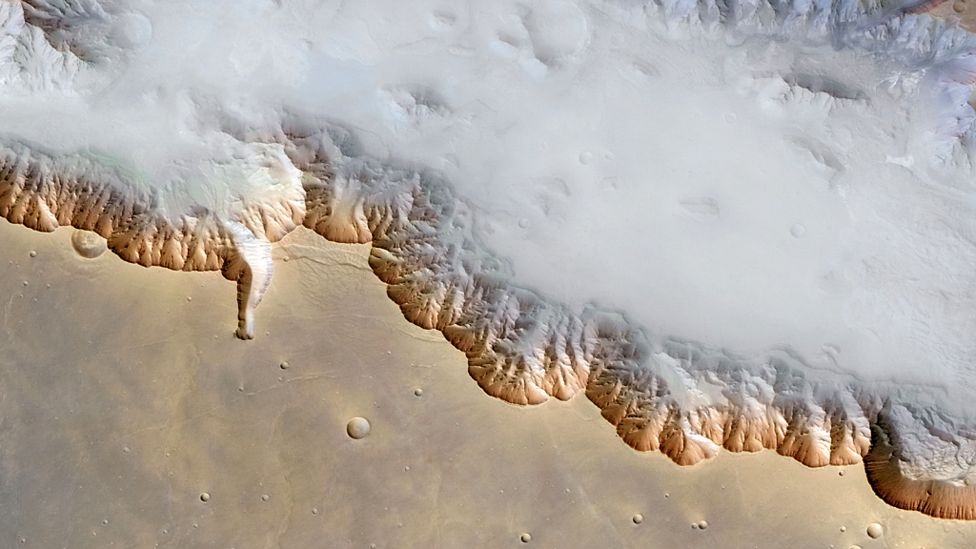
I understand that ground ice on Mars has a large potential to satisfy needs, particularly for making propellants. However it may be that for some reason it may be desirable to pull water from the atmosphere to support activities at a location not having another method for water.
I have a notion for a relatively passive air flow device: 
You could have a forced convection method and alter the device in that manner.
I am presuming that you could make compressed brick materials from Mars soil to make the arch/dome, that solar panels can be mounted on.
It might be helpful to add some fiber of some kind to the brick materials, and maybe a binder is going to be needed.
I expect to embed some sort of tubing into the device to allow a heat pump to pull heat out of the arch/dome and then the solar panel during the day. That heat would be ported to some need for heat.
Wherever you had the inlet air you could put a (+) grid. I also think that you could charge a fan blade (+) to serve as the input grid.
Then I hope to use an electron beam to paint (-) on the inside of the arch/dome.
I believe a plasma window would allow that, as the window would be able to hold a vacuum for the electron beam to be formed, and would then allow the electron beam to leave the emitter(s) to paint the surfaces (-).
Probably scraping frost is the best way to extract the water, but perhaps if you had forced air you could raise the internal air pressure high enough to allow liquid water condensation.
Anyway, maybe something like this could be of use, as it is a source of heat as well as a hope for water.
Ending Pending
#1200 Re: Interplanetary transportation » Multi-Ship Expeditions, Starboat & Starship, Other. » 2025-05-01 20:10:55
So, an energy storage device may be useful on worlds that are terrestrial, and perhaps those that resemble terrestrial, such as the Earth's Moon.
From: "Index» Science, Technology, and Astronomy» Geothermal and Geothermal Battery (Changed Title 12/21/23)"
https://newmars.com/forums/viewtopic.ph … 02#p231402
https://newmars.com/forums/viewtopic.ph … 05#p231405
Mostly an energy storage device but with a small potential for geothermal energy.
Of the Terrestrials, we have;
-Mercury (Has lots of Carbon)
-Venus (Has lots of Carbon)
-Earth (Has lots of Carbon)
-Moon (Has limited/unknown Carbon)
-Mars (Has lots of Carbon)
-Vesta (Has lots of Carbon)
So, if you can develop a geothermal device, which uses Carbon it may have broad utility.
A question exists for the Earth's Moon. Carbon is supposed to be limited in quantity, but recent measurements offer a puzzle. Also, it could be that some of the coldest spots in the shadowed craters of the Moon, may contain Carbon bearing compounds. And I have to wonder if the "Fire-Fountains" may still have Carbon in their frozen cores.
https://www.newscientist.com/article/22 … as-formed/ Quote:
Space
The moon is emitting carbon, raising questions about how it was formed
By Donna Lu6 May 2020
Quote:
Carbon on the moon has been a subject of research, revealing several key findings:
The moon emits carbon ions across almost its entire surface, indicating the presence of carbon.
1
There is a significant amount of ancient carbon beneath the moon's surface, which has likely been there since its formation, raising questions about its origin.
1
Additionally, carbon-bearing ices have been found at the lunar poles, with concentrations reaching up to 20% by weight.
1These findings contribute to our understanding of the moon's composition and its geological history.
I think that there are conditions and methods to import Carbon from any of the terrestrials including Earth. But of course access to local Carbon would be a desire as well.
I think that for the Equator of the Moon if you could store heat in the crust at say 1000 degrees C, that would be real energy to use in the nighttime. Radiators to capture and store cold could also be used.
And as I understand it, supercritical CO2 is a good way to tap into energy with a turbine.
Ending Pending
I think I want to try to explain how geothermal might work for Venus. It is probably beyond our abilities at this time, but suppose you could drill geothermal on Venus, with robotic systems. It appears that there is volcanism in many places.
Now suppose you could condense the Sulfuric Acid from the clouds of Venus into a liquid, and then with some sort of aircraft bring it down for evaporative cooling.
So, on Venus you would be dealing with hot supercritical CO2, and Sulfuric Acid. But say you had a Glider/Blimp, that could drop down to the surface with Sulfuric Acid as a ballast, and that it simply dumped the liquid into a vat on the surface of Venus. If the Sulfuric Acid is heated, it will decompose into Sulfur Oxides which could be vented, and then water, which could be used to evaporatively cool a geothermal process.
I will grant that this is quite a bit out there, and it will be some time and research before these capabilities might be mastered. But, I think that the energy levels would be fantastic, "I think".
If this process were dominant enough then the Sulfuric Acid in the clouds might be reduced, and the water vapor increased.
So, that could be quite an energy asset for a solar civilization. But it is quite a reach.
Ending Pending