You are not logged in.
- Topics: Active | Unanswered
Announcement
#1126 Re: Interplanetary transportation » Multi-Ship Expeditions, Starboat & Starship, Other. » 2025-05-20 08:46:16
Thanks for the attention (th): https://newmars.com/forums/viewtopic.ph … 96#p231796
Quote (th):
tahanson43206
Moderator
Registered: 2018-04-27
Posts: 21,297
For Void re post with images and GIF of asteroid NEAR probe...https://newmars.com/forums/viewtopic.ph … 94#p231794
That is an impressive composition!
Your recent introduction of the idea of using iron as propellant (reaction mass) might inspire one or two readers to wonder about the potential impact such highly accelerated iron atoms might have when they encounter the hull of a space craft. Your post includes mention of building up layers of material for radiation protection, and provision for arrival of the iron atoms used as reaction mass might seem advisable.
(th)
Honestly, I can not render a guarantee. Magdrive is from the British, and Neumann Drive is from Australia.
Both intend to start out in satellites in orbit of Earth. I would think that if there is a hazard, they could not do that. If the device emits a plasma of Iron or Aluminum, etc., then it might not be a hazard at all. But I suppose I am not 100% sure of that. And if a machine functions less than optimal, will it emit a chunk of solid Iron?
The devices are in small scale testing at this time. The question has to be asked, if the Iron or other plasma emitted could condense, would it condense into objects bigger than Micrometeoroids?
https://en.wikipedia.org/wiki/Micrometeoroid
Quote:
A micrometeoroid is a tiny meteoroid: a small particle of rock in space, usually weighing less than a gram. A micrometeorite is such a particle that survives passage through Earth's atmosphere and reaches Earth's surface.
The term "micrometeoroid" was officially deprecated by the IAU in 2017, as redundant to meteoroid.[1]
Something the size of a gram would be a real concern. However, I believe that the ISS gets sandblasted by small ones all the time. Here is some conversation about it for the ISS: https://nap.nationalacademies.org/read/5532/chapter/6
My understanding is that the handholds on the ISS have a texture like sandpaper due to very small impactors.
If the plasma exhaust could condense only typical into these sizes equivalent to normal meteoroids, then I don't think that the concern is that bad. But if at times something larger could be emitted, that could be a concern. I am not the creator of either Magdrive or Neumann Drive, so I do not know the nature in reality of this concern.
To now then become more optimistic, it can be noted that if this form of propulsion will normally have a very high exit velocity of Iron plasma or whatever solid is being rendered to a plasma. This will remove it from the location of emission very fast.
To visualize this for Earth Orbits, your exhaust is likely to flow in a retrograde direction, I think. If your exhaust exactly matched the prograde motion of the propulsion device, then the exhaust should fall straight down to the Earth and burn in the atmosphere if it has any sized objects. More probable is that the exhaust will have a retrograde velocity that is an escape velocity for Earth.
But the Earth's magnetic field exists, and may effect all this, and outside of the Earth's magnetic field, the Solar Wind might be able to modify the path of the exhaust, especially if it is a bubble of plasma.
I don't know what the emission speed is for the plasma. It could exceed the velocity of the solar system, and so would go outward, and also be to some extent pushed by the solar wind, if it were small enough.
Another trick is to send the exhaust out not exactly in the same plane of orbit. So, is you designated one of the suns poles as north and the other south, you could send your exhaust a tiny fraction of a degree up or down, alternately, and this would then greatly reduce the potential of a collision in the plane of orbit of the thrusting device.
But as far as shielding goes, yes for more stationary objects use it if you have it. As much as is practical. For robot ships that use Magdrive or Neumann Drive, having repair methods will be important. Any such impactors should be small. By necessity, certain planes of orbit might be restricted, if they are likely to carry people.
So, I think the level of hazard can be rendered as low but would never be zero. Of course that is already true, and the closer to the asteroid belt you go the more danger there naturally is anyway.
Other options for the more inner solar system is an Oxygen mass driver. If you can expel Oxygen it is expected to evaporate in sunlight.
So, in some cases that might be used in sensitive areas, and this may reduce collision hazards even more.
Oxygen is practically a waste material, except we breath it, and like that it helps create fire.
Ending Pending 
#1127 Re: Interplanetary transportation » Multi-Ship Expeditions, Starboat & Starship, Other. » 2025-05-19 20:47:28
Continuing from the previous posts, I see one possible option would be to have Spaceships capable of spin gravity stop spinning, and "Land" or Moor into the center of the circle. The crew of professional adults to spend some time proximate to the robots building this stuff. They would spend some time, and then their ship would leave and another would take their place. There would be a rotation of at least 2 such ships.
When a ship left the "Castle" they would go to a nearby free-floating sanctuary in orbit of Mars, and hide behind or inside of the sanctuary. Each trip to the sanctuary they would bring more materials to make the sanctuary more helpful in protecting from space caused harm to humans, such as radiation. They would spin their ship up and do a rehab for a period of time.
Eventually when the "Castle" was well enough anchored to the large slabs that may exist in the moon it was on then a spin gravity device could be put into the "Castle".
Originally, when starting the build-up, the humans would have to take sanctuary in radiation storm shelters as needed.
But over time as the "Sanctuary" and "Castle" were built up life would become better with more shielding from "Hard" Space.
And of course I expect certain supplies and crew rotations may come from Earth/Moon, and Mars itself.
If this technique would be perfected for both Phobos and Deimos, the method may very well also work for many appropriately similar asteroids.
Ending Pending
Example, Asteroid Eros: https://en.wikipedia.org/wiki/433_Eros
Image Quote: 
Image Quote: 
Quote:
Animation of NEAR Shoemaker trajectory from 19 February 1996 to 12 February 2001.
NEAR Shoemaker Eros(green) Earth(dk. blue) Mathilde[lt. blue) Sun
And here is another target: https://en.wikipedia.org/wiki/253_Mathilde
Image Quote: 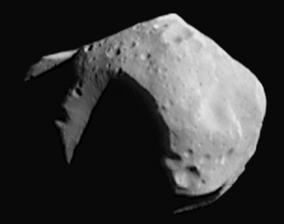
Quote:
253 Mathilde is an asteroid in the intermediate asteroid belt, approximately 50 kilometers in diameter, that was discovered by Austrian astronomer Johann Palisa at Vienna Observatory on 12 November 1885. It has a relatively elliptical orbit that requires more than four years to circle the Sun. This tumbling asteroid has an unusually slow rate of rotation, requiring 17.4 days to complete a 360° revolution about its axis. It is a primitive C-type asteroid, which means the surface has a high proportion of carbon; giving it a dark surface that reflects only 4% of the light that falls on it.[8]
So, Carbon, Iron, Oxygen presumed available. Probably because of the solar wind, both Eros and Mathilde, would have traces of water in the regolith at least. But Mathilde being Carbonaceous, maybe more than that. But that is not at all assured.
The point is if Iron turns out to work well in Magdrive, robotic ships should be able to swap materials all around parts of the solar system such as Earth/Moon to Jupiter/moons/Trojans/Greeks. Propellant supplies should be relatively convenient.
So, I hope at its extreme materials like Carbon could be brought to our Moon. That and perhaps water and a little Nitrogen.
Many "Castles" on asteroids, all over.
Ending Pending
#1128 Re: Interplanetary transportation » Multi-Ship Expeditions, Starboat & Starship, Other. » 2025-05-19 17:17:27
Here is a partial cut-away for the double wall diagram in the previous post: 
Here is the picture from the previous post:
Here is a possible way to put something heavy of treated materials onto a moon of Mars:
A greenhouse under the mirrors between the radiation walls.
And under the greenhouse, perhaps quarters for humans.
Ending Pending
#1129 Re: Interplanetary transportation » Multi-Ship Expeditions, Starboat & Starship, Other. » 2025-05-19 08:58:09
In the previous post I suggested that regolith such as that from the moons of Mars, could be separated into gasses and solids, where some of the Oxygen is extracted as CO2, H20 and other things. The solid remnant may have magnetic materials as a result. Perhaps some Magnetite. Some part of the solids may be possible to magnetize.
To do this, perhaps: https://en.wikipedia.org/wiki/Magnetiza … technology
Quote:
Magnetization roasting technology
For fine materials though it may be possible to magnetically separate the solids into more magnetic materials, and less magnetic materials.
The more magnetic stream might contribute to a method for extraction of Iron.
I would hope to get some glassy materials from the various grades of materials.
So, another build process in use could be Additive Glass Working.
Included could be low temperature processes as a part of options: https://www.ll.mit.edu/research-and-dev … emperature
Image Quote: 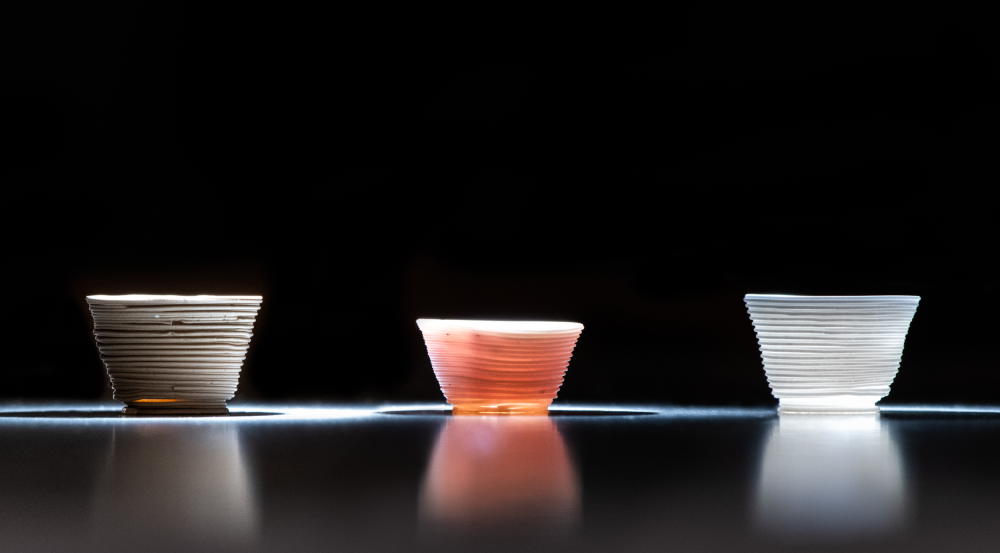
Quote:
Researchers used the low-temperature additive manufacturing process to build the glass cups above. The optical behavior of the printed cups can be tailored by altering the chemical components of the inks.
Quote:
The wrapping of a cylindrical structure in tensile cordage, might make such structure more durable/functional.
I a thick cylinder of materials were constructed on a rotational pole of Phobos or Deimos, this should give considerable protection from radiation from a sunward direction and some of the GCR. The moon itself could give quite a lot of radiation protection. Of course, an open top allows GCR in from that direction, but improvements overall are existing.
Here is a possible way to put something heavy of treated materials onto a moon of Mars: 
The grey area between two circular walls would be mostly protected from space radiation. For further protection a ceiling might be put in places between and higher up the walls. Solar arrays can be put onto the outer wall. While radiation protection is one desired result, the dual wall structure being heavy, might stay put even in the feeble gravity of Phobos or Deimos. Each wall might be wrapped on it's outer perimeter with tensile cord of some kind.
So, the hope is to extract at least Oxygen but maybe Hydrogen and Carbon if some is in the regolith. Then to extract at least some of the iron. Then the tailings made into protective structure which also can be held by the tiny gravity of such a moon or a similar sized asteroid.
Ending Pending
From that then there may be a desire to tunnel into the moons and hollow out spaces for more habitat.
The entire process should provide structure and propellants for spacecraft as well.
Oxygen and metals for the most part. The chemical propellant Oxygen and metals for something like Super Magdrive: https://newatlas.com/space/super-magdri … etal-fuel/ Quote:
Super Magdrive rocket thrusters run on heavy metal
By Joe Salas
October 05, 2024
Ending Pending
#1130 Re: Interplanetary transportation » Multi-Ship Expeditions, Starboat & Starship, Other. » 2025-05-18 21:36:55
There is a wiki for Legos: https://en.wikipedia.org/wiki/Lego
Image Quote: 
So, I am thinking of extracting Oxygen and maybe a few volatiles if they exist using heat, and hydrocarbons. Then to press a molten or semi-molten mass into forms that would make pieces that would fit together. Then to magnetize the magnetic materials in them as they cool down.
We might also want to come up with some kind of glue. And maybe some other methods to make stony magnetic structure stay together.
To some extent the magnetism, is a hope that if an impactor chips a piece off, it may hang around the composite magnetic field of a large structure near or on a moon of Mars, or an asteroid.
I suppose there is some chance that some kinds of radiation might be deflected by a main magnetic field, but I guess it would be an extra benefit. Mostly the mass of materials is to block radiation and to otherwise as well provide a interior space buffered from the cruel factors of outer space.
Ending Pending
#1131 Re: Science, Technology, and Astronomy » Humanoid and other robots. » 2025-05-18 08:08:09
I think that possibly Human/Robot societies might resemble Lichen.
Algae does not need Fungi, to live in some places, but in the form of Lichen, Algae can spread to hostile environments.
In one scene of a Mystery Science Theatre, Tom Tubo gets upset when the human drinks out of the blender that Tom Turbo the robot is infatuated with.
So, if we are a part of a symbiosis, do cyber-brains in a jar get jealous about what occurs with a robot-animal.
That is, a highly intelligent machine system may not care, against humans about a machine-animal. Or maybe we should call it a machine-animation.
If one Optimus is left to die on Mars for instance, can a replica of it's mind be teleported to another Optimus body. As far as I can tell, an Optimus is partially a part of a hive mind but also has a local mind.
It is unlikely that robots will exhibit collective sexual harassment. This is not what you might think it is. Sexual Shame, has value to keep hygiene for the society, but this can also be a tool used by groups to prevent mating between those who else otherwise might mate. That is sort of a television group shaming, which I suspect in part is vicarious sexual entertainment for the judgmental. In other words, a deep-seated group selfishness that humans are only partially aware of.
Don't get me wrong, I think sexuality is a calculation. There is only a certain number of careless behaviors that can occur before a mating system would be damaged. So, morality has a place. But sometimes morality acting masks selfish motivations from groups. Even genetic envy.
I think it may be unlikely that robots will have such a motivation. But then I could be wrong.
So, will a robotic system with a computer super mind, hate me for drinking out of a blender?
Probably not, unless it were insane.
Ending Pending
#1132 Re: Interplanetary transportation » Multi-Ship Expeditions, Starboat & Starship, Other. » 2025-05-18 07:05:36
The ability to extract utility from the Martian moons should enhance the reach of the human race, and those abilities should cross over to some extent on how to handle tiny worlds like asteroids. Phobos and Deimos should provide much in the way of propellants, and structures.
Melting giant slabs of materials might be possible. Another way could be to melt fine regolith on the surface of these moons and then pull the slabs off of the moon and join them into structures.
Magnetics is another interesting factor. If I could have bags of magnetic materials, then I might join them if part with magnetism. They might also be attachable by magnetism to Iron or Steel structures.
In the case of handling raw regolith, the notion of reacting that regolith with solar heat and a substance like Hydrogen, Ammonia, or Methane, or Carbon comes to mind. In that case we extract some of the Oxygen, and create compounds that can be later split. CO2 or H20. And this can be a source of Oxygen as for instance CO2 split into Oxygen and Carbon, you could reuse the Carbon to extract more Oxygen.
The roasted regolith then should become more magnetic in nature. So, then we can separate the partially magnetic materials from the less magnetic materials and perhaps make magnets out of the one, and further process the tailings into glassy objects.
https://en.wikipedia.org/wiki/Magnetiza … technology
Quote:
Magnetization roasting technology
I have run into some things that may hint at what I am after: https://link.springer.com/article/10.15 … 851-NN10.5
https://ntrs.nasa.gov/citations/20050110217
Glassy and magnetic interest me. There is one factor that is very important to overcome in space, and that is the radiation. I understand that at least 2 to 3 meters of regolith are needed for a sufficient long-term method.
So, I seek ways to join low grade materials into a protective structure(s).
We do not want to build everything out of fine metals and glasses. Too expensive, and not practical.
So, bags of magnetic marbles? That would be glass with some magnetite or magnetizable materials in it.
My logic is that the bags restrain the chips or marbles. The bags as a whole are magnetized, so they should attract magnetic materials and each other. The concept of bags may also allow corded methods to tie bags together.
So, where to get the bags? At least at first perhaps Earth. It is not normal to set up a settlement, dump the people off and say "Manufacture everything for yourselves from the dirt on the beach, goodby!".
We may later get them from Mars, and finally from Phobos and Deimos themselves.
Beta Cloth seems desirable, but hard to make at Phobos and Deimos: https://en.wikipedia.org/wiki/Beta_cloth
Quote:
Beta cloth is a type of fireproof PTFE impregnated silica fiber cloth used in the manufacture of Apollo/Skylab A7L space suits, the Apollo Thermal Micrometeoroid Garment, the McDivitt Purse,[1] and in other specialized applications.
Beta cloth consists of fine woven silica fiber, similar to glass fiber. The resulting fabric does not burn, and melts only at temperatures exceeding 650 °C (1,200 °F). To reduce its tendency to crease or tear when manipulated, and to increase durability, the fibers are coated with Teflon.
So, possibly the woven fiber can come from the moons, but the PTFE would come from Earth.
Alternately a less durable "plastic" could be used, and that be protected from UV in sunlight by a foil covering or magnetic dust. Magnetic dust might stick to the bags, as the bags will be magnetic.
So, some possible tricks to make radiation shelters in microgravity mostly from the raw regolith of Phobos and Deimos.
In the process we made water and Oxygen. These can be used in propulsions. Also water in evaporation proof containers can offer radiation protection.
In working with Phobos and Deimos, if a way can be found to attach a dome onto a small moon, then almost half of your radiation protection is the moon itself, and then you make a dome of Iron and bags of magnetic materials.
Any way some tricks that might work a bit. We certainly would like more tricks than that.
Ending Pending
#1133 Re: Science, Technology, and Astronomy » Genetics » 2025-05-18 06:31:32
This is interesting. What about prehistoric genius? Could small groups of more intelligent people benefited by breakthroughs in technology.
Hiding from violence and finding resources out of reach of less intelligent people who more depend on brute force and cruel method.
I think if the rewards are good enough, a special group might emerge from a general population and shelter from the greater more primitive gene pool. Of course their population might degenerate into verbal and violent once a more simple method of survival was formed. So, a higher intelligence emerges because of the challenge of water crossing. But once a easy giving unclaimed land was found for a period of time a intelligent group would expand. But then the human becomes the predator of the human, and it may be possible that verbal and violent replaces genius.
https://www.youtube.com/watch?v=IgRYpQ1 … l=Timeless
Quote:
The First Ship Builders Were Not Human
Timeless
1.65K subscribers
So, temporary groups of more gifted people could emerge but very possibly intelligence would be replaced by stupid, verbal, and violent. In other words technological intelligence could lead to rewards, but the reality then may change to one where the combination of verbal and violent can take away those rewards.
Maybe
Ending Pending
#1134 Re: Interplanetary transportation » Multi-Ship Expeditions, Starboat & Starship, Other. » 2025-05-17 18:27:35
So, there is the view that humans go to Mars, and burrow into it and become cavepeople. And then SpaceX adds the idea that materials and people have to be sent in a quantity that if the ships from Earth stop coming, the city built will not die.
But I go to the extent of intending that Mars/Phobos/Deimos, be wrapped in a partial Solar System wide, economy. This would hopefully enhance the materials that the Earth could obtain from space, and make it more likely that those ships from Earth will not stop coming.
In a more easy reality we would find hollow spaces inside of Phobos and Deimos, and pathways into those from the outside. I think the hollows of a sort are possible due to nullified gravitation in the interiors of the bodies, but they are not yet likely to be suitable, and the pathways in will not exist. We would have to do some fixing up. So, I want tools and methods to accomplish that fixing up. We would need methods to keep some adult people healthy for a prolonged period, until a large hollow construction could be made to put a spin habitat into.
If it is true that Phobos and Deimos do not have Carbon or Hydrogen in significant quantities, the materials of them are still of considerable value I believe.
-Combustion Rockets, they can provide Oxygen. Possibly Aluminum as a fuel even.
-Oxygen Mass Driver. If you can cast Oxygen out of your spacecraft then you can propel it.
-Dust Mass Driver. If you can cast dust out then you may have a propulsion. But it might dirty up things.
-Neumann Drive. An electric Rocket, with high efficiency that can use most of the periodic table as propellants.
-Magdrive. An electric Rocket, that can use Iron, Aluminum, or Copper. (This one might have some punch?
Mars of course could provide fuels, like Ammonia, Methane, Hydrogen, Paraffin.
And Mars could provide Argon for an Argon Electric propulsion.
So, Mars/Phobos/Deimos are probably very valuable to Earth as a method to secure materials from Space that would be useful on the inhabited worlds.
In the previous post I described a notion for spin gravity in orbit of Mars, where humans could be rehabilitated. Even while being in rehab, they could work with robots in orbit and on Mars to construct things. (Remote work).
Eventually it may be desired to have spin gravity facilities inside of Phobos and Deimos. But first surface work has to happen and then tunneling. Those doing that work will not have spin gravity. So, the crews would need to be swapped periodically.
As for treating the regolith of Phobos and Deimos, I suggest getting it to a microgravity facility where it would be made molten, held in a microgravity oven sort of. Then Ammonia added to the oven with the notion that the regolith will give up Oxygen and water will form. Some of the Nitrogen from the process would also be mixed with the water vapor.
So, the ball of molten rock would be reduces, and perhaps have magnetizable portions. You would then need a press that might squeeze it into a shape. Perhaps a hexagonal slab. During cool down past the curie point, a magnetic field would be imposed to give some magnetism to the slab.
Ideally the slabs would have some "Eyeholes" that cable Fastners could fixed into.
When cooled then these slabs would be fastened with cables to make hollow polygons that habitats could be built into.
This to provide some protections from radiation, impactors, and thermal shocks.
But a method to grab regolith and put it into the oven is needed.
But over time expansion would lead to the hollows inside of the moons that might be of significant value.
Ending Pending
#1135 Re: Interplanetary transportation » Multi-Ship Expeditions, Starboat & Starship, Other. » 2025-05-17 11:02:51
So tents, more or less. Items like Starship then functioning as equivalent to tent poles, and webs of lightweight and very strong materials.
This could be a tetrahedron, a cube, Dimanoid, or other shape.
I am only trying to give a beginning to a new construction technique that is related to previous concepts.
In addition to what I said above, I add Tensile cables, to help the structure stay together if it spins, and also Bags or regolith that can be wrapped outside of the Starships.
Also, interior to the starships bags of water. The water can come from the Oxygen of Phobos and Deimos as also the regolith might.
The Hydrogen for water then more likely comes from Mars.
Should we treat regolith with heat and Hydrogen, we may get our water, and also magnetizable regolith.
Magnetism would be to help encourage regolith that gets lose to hang around other magnetic masses in microgravity so as to reduce the formation of a Kesler Syndrome around Mars.
The tent and the various masses of the structure will tend to moderate temperatures.
Then most likely, we have solar panels external to the tent, and any other things needed such as docking ports.
Synthetic gravity could go as high as 1 g but I would entertain the minimum that can keep adults healthy for a time.
It may be that periodically the "Tent Crew" and a surface base would exchange people so that hopefully, in the surface base adults can more fully be made well.
But there is much to learn.
And of course a tent is just a toehold to get the leverage to really have at Phobos and Deimos to build things.
Ending Pending
#1136 Re: Interplanetary transportation » Multi-Ship Expeditions, Starboat & Starship, Other. » 2025-05-16 11:23:17
I am working on the convergence of two shapes, a disc and a cylinder.
It is helpful if you can see a example in nature: https://en.wikipedia.org/wiki/101955_Bennu
Image Quote: 
But I arrived at a diamond shape after exploring a cone shape, and umbrella shape, then a double-cone shape, which in the end resembles a diamond shape.
I began by thinking to mutate a cylinder shape in to a cone or umbrella or teepee shape.
To start with this concept: https://spacesettlementprogress.com/spi … ble-piles/ Quote: 
If we pinch one of the two hubs then we could get a cone shape, perhaps resembling a teepee, or umbrella, depending of the pitch of the shape.
https://en.wikipedia.org/wiki/Tipi Image Quote: 
But a more disc shaped version should resemble an umbrella: https://en.wikipedia.org/wiki/Umbrella
Image Quote: 
We could join two of either shape together to create a diamonoid shaped object. Dual tetrahedrons perhaps: https://mathmonks.com/wp-content/upload … hedron.jpg
Image Quote: 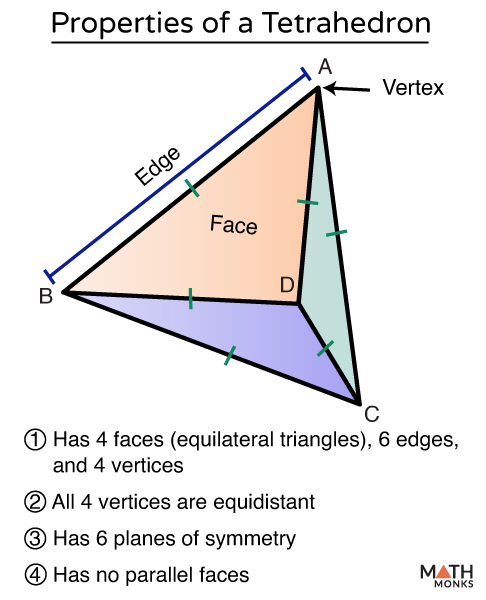
Originally what I was thinking of was a cone, suspended over Phobos, Demos, or a small asteroid. Regolith introduced inside of such a shape spinning, then providing some protection from space harshness.
But a TeePee, or an Umbrella has rigid parts, bones of spines, with a web wrapped around that.
The "Bones" could be Starships. So regolith from Phobos and Deimos could be used to fill the inside of the "Web".
Starships stacked like rods in a teepee, could have connections at one end on a common hub at the apex, and they may spread out to form the base. Then you can have a mirror of that and join them together.
The "Web" begins as a Carbon Nanotube net. But over time the shape can be built up with other processed materials.
So, the enclosure may protect from radiation to some extent. Protect from small impactors. Regulation of the thermal conditions inside.
If somehow we could attach this rotating shape to a moon or asteroid, then the gyroscopic problems may be dissipated.
So we are hoping for some synthetic gravity suitable to keep adults healthy, with other things like exercising and perhaps drugs.
A Starship converted to have habitation in the propellant tanks, might have additional radiation protection from bags of water inside of it, hung on the walls.
An advantage is that unlike landing stuff on Mars, you can bring the modified Starships and the Net from Earth, using a more efficient propulsion, and not needing air braking, or landing engines, legs, etc.
So, I think this begins to be practical for setting up early implementation of a orbital base for the two moons of Mars.
Ending Pending
#1137 Re: Not So Free Chat » An Englishman's Home Is His Redoubt (British Decline And Fall) » 2025-05-16 04:47:17
I hope you will not resent if I use this thought stream, to try to bring something peripheral to awareness, to attempt to drag it out to increased awareness.
The idea of "Split-Bed" geostorage/geothermal.
If we can make this arrangement we might mimic the Universe and turn dirt/regolith into machine parts. This might also not have to interfere to strongly with normal uses of soil or planetary surface.
The Universe, in the case of our solar system expands so that vibrations from our sun can flow outward. We can tap into this flow to make a smaller portion or reality run backwards, to store the energy of that flow for a finite time period.
This is not unlike an animal storing fat from the digestion of food, and Oxygen as a sink for Electrons. https://www.varsitytutors.com/ap_biolog … port-chain
Quote:
Oxygen is the final electron acceptor
I dimly understand what I am getting at, but by working with it perhaps greater awareness will come into consciousness.
By doing a split-bed thermal storage, we are also doing a split-bed, differential vibration storage. The hot bed resembles the sun, and the cold bed will resemble the deeps of the expanding universe.

A video I watched this morning indicated that Elon Musk is interested in making solar powered data centers, well away from the urban areas. So, the above scheme might run alongside of that.
For instance heat from the cooling of the data center could heat the hotbed or greenhouse, when convenient.
Superpower, used, could cool a section of ground so that moisture from the atmosphere could condense in the soil.
You could even take this to the point of permafrost, which is a phase change thermal storage factor. Another factor of permafrost, is that if rain falls or snow melts, the water is inhibited from draining into the deep ground.
Of course having permafrost below your crops, will have influence on the health of the roots of a crop.
But in this system the soil/ground becomes machine parts, while still being usable for things like growing plants.
Gardening can occur even on top of permafrost in Alaska: (Canada also I presume): https://www.uaf.edu/ces/publications/da … alaska.php
The soil thawed on top of the permafrost of course has to be of a sufficient thickness.
In any case presuming that robotics could make the drilling process economical and make the hardware items at prices well below the current pre-humanoid robot era that is about to become history.
Time and economics will make a future determination of virtue or not in this set of notions.
I think that the self-watering garden is interesting.
Ending Pending
#1138 Re: Not So Free Chat » An Englishman's Home Is His Redoubt (British Decline And Fall) » 2025-05-15 20:50:05
Granting the possibility that many types but not all types of hardware will go down in price, I see a way perhaps to utilize DC Superpower. This is a possibility not a certainty.
Starting with geothermal for heat pump, here is a drilling method: https://interestingengineering.com/ener … mal-energy
Supposing a world where solar panel prices continue dropping and perhaps batteries do as well. But the Solar may be the better part of a bargain than the batteries.
If you could drill a spilt geothermal where you run a heat pump and pull heat from one part of a thermal bed and deposit it into another. If you have a small battery pack, and charge it with DC, and set the heat pump to run for a small period when the battery is charged enough and to shut off when the battery is discharged.
If you have excess solar panels then this might allow extraction of value from "Superpower". On dim days, you might not get any runs, but on extremely sunny days you might even run continuous.
So, then ideas of how to connect that into external heat sources such as to cool a house or a hot day of summer, or a cold day of winter.
You might not have to even run the heat pump to extract stored hot or cold, just a circulation pump, and so that then needs its own power method.
Again, this is complexity and needs hardware that at this time would be rather expensive. But in a future world, where robot labor is less than $0.10/hour, perhaps some forms of hardware will have a reasonable price.
Ending Pending
#1139 Re: Interplanetary transportation » Multi-Ship Expeditions, Starboat & Starship, Other. » 2025-05-15 17:37:48
Bringing in some materials from other members: https://newmars.com/forums/viewtopic.ph … 76#p231676 Quote:
Calliban
Member
From: Northern England, UK
Registered: 2019-08-18
Posts: 4,013
Liquid ammonia has a higher hydrogen density than liquid hydrogen and can be stored at about 6bar vapour pressure at room temperature. The obvious disadvantage is that ammonia has molecular weight of 17amu. To transport 3kg of hydrogen, we need to send 17kg of ammonia to Mars. Still, it might be a positive tradeoff. Another advantage is that ammonia (or methane) shipped to Mars can be used as rocket fuel without further synthesis."Plan and prepare for every possibility, and you will never act. It is nobler to have courage as we stumble into half the things we fear than to analyse every possible obstacle and begin nothing. Great things are achieved by embracing great dangers."
My reply:
Void
Member
Registered: 2011-12-29
Posts: 8,374
You are very useful. I would like to see Ammonia as a rocket fuel for a Mars Surface<>Phobos<>Deimos sub-network. That and Oxygen of course, and Carbon. Maybe Ammonia and CO as fuels.While the die-hard members want to do the Musk Dream on Mars, I also want to do the Bezos Dream in orbit of Mars.
I will borrow from you now.
Ending Pending smile
So, if as I want it we will have settlements on the ground and also settlements in association with Phobos and Deimos, even if it turns out that Phobos and/or Deimos have Carbon and Water, it may be easier to establish a base on the surface of Mars and run robots to build things, in orbit of Mars primarily of the regolith of Phobos and Deimos. Or it could be vice versa. Perhaps a combination of the two. One hand washes the other sort of thing.
Being able to lift Ammonia and Carbon to the orbits of those moons we should be able to make whatever is desired. Keeping in mind that solar power at those moons should be much more predictable and more easily concentrated than on the surface of Mars.
Ending Pending
And we might refill Oxygen, the main propellant by mass on Mars, Phobos, and Deimos, if we have the technology set up for it.
Ending Pending
And a byproduct could be Iron and Aluminum which may be useful in Magdrive and Neumann Drive, two electric propulsion methods.
Ending Pending
#1140 Re: Interplanetary transportation » Ammonia as a storage medium for Mars Shipment » 2025-05-15 17:36:32
You are very useful. I would like to see Ammonia as a rocket fuel for a Mars Surface<>Phobos<>Deimos sub-network. That and Oxygen of course, and Carbon. Maybe Ammonia and CO as fuels.
While the die-hard members want to do the Musk Dream on Mars, I also want to do the Bezos Dream in orbit of Mars.
I will borrow from you now.
Ending Pending
#1141 Re: Interplanetary transportation » Multi-Ship Expeditions, Starboat & Starship, Other. » 2025-05-15 10:52:28
I want wonder about a special Starship type that can at least be imagined.
It is intended that this ship would not be for cargo hauling, and would use the hoped for 100 tons payload margin to allow the ship to be more fortified to do sideways landings on Mars.
I make note that the Lunar Starship is imagined to have special "OLM"? engines for a final landing on the Moon.
Otherwise perhaps small engines Metha Lox in type could be obtained from another vendor, perhaps Rocket Lab.
This ship would have a one-time heat shield, based on the current under-shield for Starship that is to be under the tiles as an emergency protection method.
The ship would require modifications in LEO. Perhaps removing the Raptors, and attaching legs to the leeward side of the ship, to allow horizontal landing.
Instead of motorized flaps, it would have overly large static flaps. This is to reduce the terminal velocity on atmospheric transit at Mars. In fact, if strong enough the flap area might be again as much as the windward side of the Starship.
This Starship would transit to Mars with yet another Starship of some kind with the raptor engines in its tail as is normal.
The propellant inside this special ship, would be plumbed so that its propellant can be routed to the companion ship with tail engines.
This horizontal landing Starship, when entering the Martian atmosphere would use its horizontal landing engines to maintain positioning on the way down, instead of the motorized flaps.
Once the ship has passed though the peak heating, it may be considered to do a 180-degree roll on the ship, so that the heat shield is pointed up and the landing legs and landing engines are pointed down.
Then the ship hopefully can land horizontal, as it is hoped that it had been given strength to not snap in half on landing.
Some people then would think to pile regolith on top of the ship.
However if you could carve a tunnel in an ice mass like exists Korolev Crater, your horizontal Starship might be capable of hover, as it has those large flaps. You might be able to fly it into a tunnel carved in ice, or maybe even into soft rock.
But another way is to hover it over to your superstructure and attach it.
Then I suggest Icebags draped over it. Others have already contemplated similar: https://www.marsicehouse.com/ Image Quote: 
So, I imagen that these bags will be tolerant of UV light, perhaps having Fluorine in their chemistry.
It does not make sense that a landing would be done somewhere where ice is not available. So, presuming it is then the bags draped over the horizontal Starship, could have water pumped into them and allowed to freeze.
This may not be great for low latitudes.
But the bags could have various pigments. Reflective like foil, transparent, or darkened. Of course, Mars dust is likely to settle on them so either you can live with that fact or you have a cleaning method.
So, this ice shelter over the Starship probably would not be pressurized, but it would provide a shelter under your starship, that robots could work in where temperature and radiation are moderated.
Please request better definition if you think I have offered something that is not in any way practical before you assume you understand what I intend.
But perhaps I have done a sufficient description of such a proposal.
Ending :Pending
#1142 Re: Life support systems » Gold Hydrogen, Geologic Hydrogen, Natural Hydrogen, etc. » 2025-05-14 17:18:37
Another article about Natural Hydrogen: https://www.msn.com/en-us/weather/topst … r-AA1ELIjT Quote:
Scientists think a hidden source of clean energy could power Earth for 170,000 years — and they've figured out the 'recipe' to find it
Story by Sascha Pare • 10h •
4 min read
If they do find it, I think that one possible win would be to feed Hydrogen and CO2 from the atmosphere to Microbes, to product biomass. That biomass could provide food, and perhaps Hydrocarbon fuels.
Ending Pending
#1143 Re: Not So Free Chat » An Englishman's Home Is His Redoubt (British Decline And Fall) » 2025-05-14 16:59:36
I listened to most of the video, until it cut out because I bumped my phone doing housework.
It is interesting. It is nice that their are people scheming these things. I wonder how Tony Seba's thinking would intersect it: https://ourworldindata.org/data-insight … ty-doubled Image Quote:
And if robotics reduces the cost of hardware, perhaps this decline rate in cost will increase.
It sounds like the people in the video run on lower expectations as part of making their methods work. They don't expect maximum convenience and comfort all the time.
However, if the cost of solar panels goes down enough then some system like theirs could have the 3x, 4x, or 5x amount of solar panels that the least energy providing week of the year still be good enough. For instance if you have 5x because you live in a very cloudy place, apparently people say that these solar panels can give power even on most cloudy days. So, that can lead to a different philosophy, because solar power can become more like clockwork. You would get some almost every day of the year.
So, using DC power would become attractive, especially if more devices for it were invented/created.
That then would leave you wondering what to do with the "Superpower" that would exist when better sunshine was available.
I think if hardware is expensive then you more likely want to run it around the clock, but if robotics makes hardware less expensive there may be more cases where you would not mind if it were idle 50% of the time.
Ending Pending
#1144 Re: Science, Technology, and Astronomy » Helium » 2025-05-14 16:47:54
Here is an article about sourcing Helium from volcanic hot spots: https://www.livescience.com/planet-eart … conductors Quote:
Planet Earth Geology
Yellowstone holds potentially untapped cache of 'carbon-free' helium for rockets, reactors and superconductors
News
By Sascha Pare published April 29, 2025
Conventional helium production comes with enormous carbon emissions, so scientists are looking for alternatives in places like Yellowstone, Tanzania's Rukwa Rift and India's Bakreswar-Tantloi province.
Perhaps geothermal power might go hand in hand with obtaining Helium.
Ending Pending
#1145 Re: Interplanetary transportation » Multi-Ship Expeditions, Starboat & Starship, Other. » 2025-05-14 11:35:43
The idea of orbital aquariums to grow something like Hydrilla comes to mind. These could be spinning, but also non-spinning might be considered. Each would have good qualities and troublesome qualities.
I consider Hydrilla as I am thinking it may have traits of a vascular land plants retained. Perhaps fiber, but I don't know that.
It grows well, even in low light conditions, and also can reproduce from fragments, I believe. It can be rooted but it does not have to be.
https://en.wikipedia.org/wiki/Hydrilla
Quote:
Copilot Answer
Images
Videos
Invasive aquatic plant
Hydrilla (Hydrilla verticillata) is an invasive aquatic plant native to the cool and warm waters of Asia, Africa, and Australia. It is known for its fast growth, capable of reaching lengths of up to 7 meters (23 feet), and can thrive in various water depths, from a few inches to 20 feet. Hydrilla can reproduce rapidly by fragmenting, allowing it to spread easily through waterways and boating activities. It is considered
So, a weed of interest.
I have speculated on spinning aquatic farms for it where the advantage may include, lowering the differential air pressure on windows to let light in.
But I am also interested in non-spinning methods. Simply a large, pressurized tank of water. Of course that could be deadly to humans, without the proper gear, but the farms would likely be mostly robotic.
The farms may be lighted, or might host light with Acetate and Oxygen, chemosynthesis. That is if Hydrilla can be modified, to grow properly with that.
Vascular crop plants can benefit from Acetate but need more to grow properly. There is some hope that the plants can be modified to not need light but grow well in Acetate and Oxygen. This, however, is not proven.
https://modernfarmer.com/2022/07/artifi … synthesis/
Quote:
Researchers have discovered a new way to grow plants using artificial photosynthesis, requiring no sunlight at all. Plants are growing in complete darkness in an acetate medium that replaces biological photosynthesis
Presuming advanced genetic engineering, I would hope that the plant could be modified into varieties, which may proved fiber, or foods, maybe even something like fruit or potatoes.
The advantage of growing things in a big tank of water in orbit could be many.
-Radiation protection.
-Thermal moderation
-Access to the tank walls to repair
As I have said the farmers could be robotic. However, some centrifuge schemes might allow the creation of air bubbles of size that humans might be able to breath from.
Centrifuging a whole cylinder or disk, may provide a method to have sunlight enter an enclosure with low differential pressure.
For Mars we have a great unknown, as to what the moons can provide. I tend to dismiss the idea that they can provide water and Carbon, but will be pleased to be wrong.
If all they can provide are metals, Silicates, and Oxygen, still it is a lot. If you could bring Ammonia up from Mars and react it with the regolith of the moons you could get water and Nitrogen for the farms. And of course the solid materials of the regolith could be used to build the farms.
However similar will hold true for the locations in the Asteroid Belt, and you would not be struggling as much with a gravity well as large as that of Mars.
Ending Pending
#1146 Re: Terraformation » Terraforming the Jovian moons... » 2025-05-14 11:17:30
Calliban, I wonder then if there can be fuels present at the same time. Ammonia, Carbon compounds. There should be an amount of Carbonaceous materials on the surface, and maybe below.
Ending Pending
#1147 Re: Science, Technology, and Astronomy » Genetics » 2025-05-14 10:45:39
https://www.siimland.co/my-longevity-routine
https://www.bing.com/videos/riverview/r … &FORM=VIRE Quote:
The Surprising Link Between Height and Longevity
YouTube
Siim Land
64 views
I wonder about pygmy people, what is the story for them. And will there be an "Ideal Gravity"? Some of the problem for large people could be inflammations, I speculate. Presumably from fighting against gravity with a large body.
Some measurements of human psychology I would like to have:
-Size-ism
-Shape-ism
-Sick-ism
A Size-ism that I think exists, is that in business taller, maybe larger men get more promotions, and so then more income. I am not surprised, because it would probably be instinctive to try to make alliances with men of physical power rather than to make them hostile to your power.
In the animal world, posing as larger than you are is one method to ward off an attack. So, the Size-ism instinct is probably deeply rooted.
But a negative image of your Shape-ism, would possibly take away from that for the reason that you might be displaying weakness, which can subtract from a strong
"Size-ism" evaluation.
You might get some sympathy points but that does not make you useful to the power centers, it makes you a liability.
Sympathy points go to the children usually.
Sick-ism is the revulsion to illness. In some bird that flock, a sick bird will be harassed as, it is a possible source of further infections. It is a bit like some forms of quarantine.
So, these are instincts, and to some degree resemble useful mental illness. A useful mental illness would be a more instinctive behavior that happens to direct you to do something that promotes the survival of your genes.
Being able to bypass instincts, that is an interesting skill, I expect. Perhaps it is sometimes called Courage. It may involve emotions or absence of emotions, but does it sometimes involve a higher level of consciousness?
These concepts for the Greeks as I have read. The Greeks liked a fit athlete, but not too muscular, so they appreciated moderation, but might have valued a good score for Size-ism, Shape-ism, and Sick-ism. And they did not particularly admire large penis.
Romans however in their degenerate periods, seem to have had emperors obsessed with a displacement of size-ism.
Men with large penis.
This might be a mental health measurement for a society, I think.
The reason I think it is that penis size was not likely to have any real utility for an emperor seeking to run the affairs of empire. Having large men around you may give you power but also could be a threat to you if you could not maintain good alliances with them.
So, of course I wonder about American measurements as for "Size-ism" are they rational?
A small part of me thinks that such an obsession with male parts is not rational. There is an expectation of some kind of large sexual reward, that does not very much exist in realty, I think.
My only concern is that if my leadership is irrational, that matters for the prosperity of my life.
Ending Pending
#1148 Re: Interplanetary transportation » Multi-Ship Expeditions, Starboat & Starship, Other. » 2025-05-13 20:30:33
Here is an old notion about a spin gravity aquaculture method in orbit: 
The primary game is to keep the differential pressure on the windows where the sunlight can enter in, low.
But there are other tricks to add, but it is getting late. Maybe another day.
Ending Pending
#1149 Re: Science, Technology, and Astronomy » Humanoid and other robots. » 2025-05-13 20:10:33
Another view:
https://www.bing.com/videos/riverview/r … &FORM=VIRE Quote:
The $8,000 Robot That Will End Your Career This Year
YouTube
Rod Miller
3 views
I have a fair amount of loathing for the Anointed of the baby boomers, even though I am a Looser baby boomer.
In our world Nuclear War was about to happen all the time.
And on TV which is what we had the chant "To get a good job, you need a good education". Well, that meant going to college, or basically people thought I would be as good as dead. That was the consequence of Sputnik.
I was definitely not going to make it as a Prussian. So, our school system at least 50% totally sucked for me. But I did learn some stuff, bless the suffering teachers who managed that much.
But as it happens, I could not very much go to college, money and grades. The prison camp school system was not for me.
But I discovered that industrial realty was really rather good, overall.
What am I getting at? Well, robots and what they do is perhaps the least bad thing that could happen.
You could have been handled in mass like salmon in a meat packing plant, and sent to a war, so the the weaklings could be killed off and the girls could welcome home war hero's.
Do I see how this will all end well? No, but there is going to be a lot of productivity.
It may be that the "Small Change" that you can earn will still buy you a ticket to OK.
No promises though. Sometimes the luck might not hold out.
I feel like someone on high was looking out for this dummy. I hope they will look out for your welfare.
Ending Pending
#1150 Re: Interplanetary transportation » Multi-Ship Expeditions, Starboat & Starship, Other. » 2025-05-13 16:06:59
Previously I was avoiding the use of sunlight to grow something like Hydrilla. However, I feel that there are places on Mars where it might be more practical to use sunlight. That does not prevent the use of Acetate and Oxygen as well though.
Here is some suitable reference materials for a special location on Mars for it: https://newmars.com/forums/viewtopic.ph … 73#p231373
Quote:
So, then a side view as I understand Korolev from it's picture:

Collections of Heliostats perched on the crater wall as shown, could send concentrated light down into the "Protected Notch".
In this "Library", https://newmars.com/forums/viewtopic.ph … 13#p190313 , are included some methods to deal with things such as UV light.
For UV light:
Dealing with UV light on Mars: (Post #1563)
This reference which discusses a 3 layer plastic inflatable dome method, includes materials from SeaDragon:Another UV reference:
Dealing with UV light on Mars:
http://newmars.com/forums/viewtopic.php … 06#p204806
So, this situation may make it possible to concentrate light to Earth Equivalent or even more. Even more would be useful because the various window methods including water and ice windows may attenuate the light.
Obviously if you are not going to mothball this location on Mars in the winter, having some nuclear power would be very desirable.
Ending Pending
Optimus dancing:
https://www.msn.com/en-us/technology/te … r-AA1EGkgV
https://www.msn.com/en-us/technology/te … r-AA1EGkgV
A robot on Mars would likely suffer less damage if it fell, that is one thing to consider.
Ending Pending