You are not logged in.
- Topics: Active | Unanswered
Announcement
#9326 Not So Free Chat » Parallel tracks of progess or lack of it. » 2012-05-11 16:01:57
- Void
- Replies: 1
I just thought I would express my overall opinion of current behaviors concerning potential extraterrestrial activities of humans.
One that I have a great deal of anxeity about is what I see as the aparent desire by some to discover a second genesis, to discover/prove that life arrises spontaniously from non life. I could take a relegious track and express a "Belief" that life only comes from the will of a creator.
However, that would be a poor position to take, if you wanted to argue against a different "Faith" based effort to prove that humankind only answers to itself.
I guess I see that the need of some to find a second genesis on Mars is a problem. It is not a problem if one occured, only that I have a great concern that all efforts to move humankind to Mars will be sabataged by an elete group who expouses a religion of non-diety, and wants to justify it's right to rule. That is I am concerned that all the efforts of human kind will bent to that agenda.
So, rather than do direct battle with them, I choose to side step what they are after.
I read an article, it was not offensive in itself, not a wrong thing, but it made me aware that the agenda is to gather information from distant star systems using DNA, and extreme miniturization. What is it they want to discover?
Why is it so much more important to discover alien life, than to promote the happyness of the human race I wonder?
I have to conclude that it is so that they can claim the non-existance of God, and so that they can invent the morality they want to invent, that is the one where they get to do what they want.
I am afraid, that this is the sad truth.
It may be foolish to express this in words, but I feel it is more foolish to go into direct conflict with this group. They are obviously quite intellegent, if perhaps missing other components of the human equasion.
This is my primary anxiety about Mars as an objective, that I feel that they can and will sabatoge any effort to go there.
They do not respect humanity's asperations to be free, on the contrary, they believe in control.
While they are correct that more data can be collected by robots, they forget that in the relm of space we will never discover what is on the other side, because for each discovery will be an endless array of new other sides. So, they will lean further and further on machines to discover information. The biggest prise they seek is a second genesis, so that they can engage in a religious control system contrary to the historical ones.
So even though it seems silly I now support robotic centered exploration of the Moon, and before that in fact also the current efforts expressed by business enterprises to exploit NEO asteroids.
I believe that I read a book by someone from India that there are four places where power is quested in:
-Priests (Reading Books, making reality conform to a book. The use of books/story telling to rule humans.).
-Acquisitioners (Books for sums, business.)
-Warlords (The use of tools to rule humans.)
-Intellectuals (I guess perhaps the decendants of warlords, who learned to use tools to manipulate further objects to attain wealth rather than gashing animals and humans with them).
So,
-I support remote control equipment to mine the Moon (With human marginally in proximity of the Moon as it is productive).
-The exploitation of NEO objects.
-The futher expansion to the Astroids except Ceres. (Unfortunately Ceres will likely be held in the zoo of objects that the people I speek of hope to find a second genesis on).
I love the idea of Mars and Ceres, but I think too much interference will come from those who want this discovery of a second genesis.
The second tract of the Moon and Asteriods is one they will be less inclined to interfere with.
So for the above reasons, I think I have very little left to discuss here.
Most or all of you are very good to interact with, but find too much regidity, and too much ego in a few cases.
#9327 Re: Terraformation » Vesta, modest ambitions. » 2012-05-08 23:28:50
GW Johnson said:
If Vesta has subsurface ice, then self-pressurized ice caves/aquaculture volumes become possible on it. Nothing more sophisticated than drilling rigs and steam generators are needed to hollow them out.
Although, I have yet to figure out how to anchor a drilling rig on a really low-gravity world like Vesta (2.9% of a gee, is that not what I saw quoted somewhere?)
GW
Well I started this. It is my opinion that Vesta will have little or no water ice, but I could be wrong for sure. This would not stop the importation of Ice say from Ceres, and exchange for metals?
It may be that a better candidate than Vesta can be found, but I went with Vesta because we have the most information about it.
Here would be a scheme for Vesta, and also for Phobos and Demos, and also other asteroids.
I recall a term "Chimney Cave". Unfortunately google did not return what I wanted. It may be a European term, as I think the reference I saw long ago was perhaps having to do with Switzerland.
Perhaps we could call it rouble pile caves.
Vesta had an impact, where 1% of it's materials were ejected I beleive, from it's south pole. I have to speculate that large slabs of rock came back down on Vesta as well. Perhaps they shatered, but even so, there should be slabs of rock which have voids under them, or where it would be possible to tunnel under them, unless, somehow the whole mass got packed down and vacuum welded.
Anyway, such slabs do not appear as apparent in the pictures, so I have to suppose that fine materials have flowed over 1 billion years time, and conceiled them.
If they exist, and can be tunneled under, then this would be a good option for an initial shelter, provided that the inhabitants were wise enough not to undermine it so much that it would fall and squish them.
Having such a location you could then have your drill rig, and anchor to a slab of rock overhead, and I guess drill down.
As for barometric Ice/water ponds or lakes, I guess if the cave was hollowed out large enough and enough water and ice were available, then you could put one under the slab of rock. Or hollow out a verticle tunnel and fill it with water and Ice, or half fill a horrizontal tunnel, seal it off and keep a minimal pressure in it, just enough to stabalize ice, and then have electric lights above the ice, and shine light down through the ice into the water below. (Or use submirged lights).
There woud be options.
For Vesta, it is my opinion that the surface would be the least habitible part, I would choose artificial worlds in geosynch, and also if you could drill down to the core,
then you could have all the metals, and it would also be zero gee there, so you could have spinning artificial habitats in the core of Vesta.
However that is some kind of mining job.
But I don't think the rock pressures would be that unreasonable. I believe that it would not be that much far above the deepest mine in South Africa for rock pressure. Keep in mind that as you tunnel down the gravitation deminishes.
#9328 Re: Terraformation » Artificial Magnetosphere - Electromagnetic Induction » 2012-05-08 23:05:17
GW Johnson said:
Might it not be easier to just replenish atmospheric gases every few centuries-to-millennia with asteroid/comet impacts, than to attempt planetary engineering on the scale of adding a massive moon? Or building a planet-girdling conductor and energizing it? Just the odd thought from an old guy.
Well I agree that that is closer to our actual scope of abilities, so you are not wrong.
However placing a moon into a geosynch and bonding it by gravitation does present the possiblity that the spin of the planet Mars can be used to generate large amounts of power as the apparatus attached to that moon cuts the magnetic lines of force of the plasma from the sun.
On the other hand if it did slow down the crust and create a magnetic field, that magnetic field could not extend to geosynch or it would choke off the process.
But the captured moon notion is for a race of beings beyond human kind I would think. If humans ever achieved that, then they would have graduated to a new level in my opinion.
So, I think you may be quite correct, long before that achievement the most likely method could be to capture asteroids into Mars orbit, and cook the volitiles out of them with solar concentrators, to produce a thicker atmosphere. But then you are left with the metals and slag. Why not make a artificial moon, make it big, and make it multi compartment hollow for habitation? It might be a long time before it was large enough to actually be used to slow down the Martian crust, but well talk is cheep, and I will be a long time gone before anyone makes those decisions.
Spacenut said:
The internal heat of the planet is probably produced by the radioactive decay of potassium-40, uranium-238 and thorium-232 isotopes.
Well, I will agree that those are big. However I am also inclined to entertain the notion that:
1) Photons striking the sunlit side of a planet cause a different electical charge than the dark side has, and I expect ground currents to run deep into the Planet, producing heat.
2) I expect that the solar wind which is magnetic and very energenic induces currents into the Earth and Mars, in diferent ways, because Earth has a significant magnetic field and Mars does not. However, Mars must have significant feromagnetic metals that are not oxidized, and further down, other materials under heat and pressure may exhibit magnetic properties.
As you know Europa and Io use tides to heat up.
Until recently that might not have been thought of either.
So, if this were to prove true, then Volcanism is caused not only by radioactive decay, but by electrical discharge due to solar energy, and also the solar wind.
So, if this were true, then it is possible that the Earth could remain habitible to life even after the heat from radioative decay is greately deminished.
If this were true, it would also indicate that Mars, and the Moon would be hotter inside than the radioactive decay theories predict. I could be wrong, but I think that that may already have been confirmed for the Moon.
#9329 Re: Life on Mars » New Clues to Guide Search for Life on Mars » 2012-05-06 16:02:38
I hate to be a posting pig, but that picture just had to draw me in.
I see the rocks in the pool of water.
Even though that pool of water may be very cold (And I presume any adapted life in it have an extremely low metabolism, I have to wonder what the temperature excursions are for the soil at the bottom of the pond. It seems to me that the warmth of the noonday sunlight must improve it't temperature.
I also see the rocks poking up out of the brine. That in fact really draws me. Brine ponds have not been photographed on Mars, but I am not sure they cannot exist. At least perhaps they can exist at some point in the procession of the tilting of the poles, if for instance snowfall were to contact a salt flat.  (Your postings indicate exposed salt flats, and the ice that is quite low in lattitude under the soil in places suggests snowfall has occurred at some time in the past 100,000 years)?
Anyway a rock soaking in brine, if it is at least a bit porous, in the conditions where day night temperatures are extreem, suggests that that process could make the rocks habitible. Where your articles suggest an extrordinary tollerance for salt by some organisms, it does leave in question if the temperatures on Mars can be high enough. I would think that at noon time during the summer of the southern hemmisphere, 1/8-1/4 inches inside of the rock, yes. And the rocks might be soaking in brine. Perhaps not an open pool of water, but a pool of brine under the surface of the soil.
So, I suppose that if the rocks were like wicks, they woud draw moisture upwards to the exposed surface of the rock. Sandstone perhaps?
It is a feature of the Arctic ocean that ice on the ice pack can become fresh enough to drink even though it started as salt water ice. Freezing causes brine to leave the ice through brine channels.
So, I speculate that there might be a hope that rocks wicking up mosisture out of briny mud on Mars (Presumed covered with a dry crust), might also from exposure to the cycling of temperatures on Mars generate a less briny fluid for microbes to use within the rock. It is even possible that orgainsms in the rocks, just under the surface might use photosynthisis. I would only expect this if they were a remnant organism from Mars past, or some organism that somehow made it to Mars from Earth or Ancient Venus.
#9330 Re: Life on Mars » Did we introduce life to Mars via space probes? » 2012-05-06 12:34:26
You see I think that solar systems start out lumpy, with collections of Ateroids, comets, and planets, in them. If a small star were to embed itself, I think that that would stop the cloud from condensing.
So, if an Earth ejected, and with life were to wander into such a cloud, it might become the point of nucleation for a star. Before it got too hot however, objects might splash into it and eject life.
Earths wandering in space very likely would have life underground even in interstellar space.
Or an alternate notion is that an Earth enters a cloud, and is slowed down by friction and collection of gass and dust, enough that it begins to orbit the cloud in an eliptical orbit. Eventually it's orbit might circularize, due to dipping repeatedly into the cloud. So then it might nucleate something.
Perhaps asteroid newly formed and liquid inside gets infected by the captured planet. And then that asteroid gets ejected from it's solar system and enters into a sibling domain in a stellar nursery, and infects it and so on.
If that were the case, then we might want to identify our sibling stars, the stars that were born with our star. Could this be done by spectrometry?
Oh well, then perhaps only life on Earth.
I am not making claims I am just speaking of possibilities.
#9331 Re: Life on Mars » Did we introduce life to Mars via space probes? » 2012-05-06 07:22:32
I choose to reserve my opinion, because there are too many unknowns to say.
For instance this about Venus:
http://www.astrobio.net/exclusive/4188/ … ne-planets-
Desert planets strikingly like the world depicted in the science fiction classic "Dune" might be the more common type of habitable planet in the galaxy, rather than watery planets such as Earth, researchers suggest.
Their findings also hint that Venus might have been a habitable desert world as recently as 1 billion years ago.
So, the evidence is that there were three fully habitable (For Microbes) in our inner solar system in the first billion years of the life of the solar system. Possibly there are still two barely habitible and one fully habitible planets now. (Upper Atmophere of Venus, and Sub surface Mars, Earth).
The Asteroid belt it appears was very snowy and wet at that time, and the cores of the asteroids, particularly the large ones contained melt water. If they were alive, then any disturbance in the solar system would allow some of them to impact Europa, Ganymede, and Titan.
What about IO in it's early life. It has boiled off it's water at least nearly all of it, but very early in it's life did it have an ice shell and an ocean?
Various moons in the outer solar system, had underground water, and some apparently still do.
Very early in the time of the solar system, the comets are thought to have had melt water in them.
Our solar system most likely ejected many planets, and Asteroids and Comets during its evolution.
Speculating that this is normal, it is very certain in my mind that some objects ejected from previous formation of other solar systems, got incorporated into the gas cloud that eventually became our solar system. Some larger objects could still have viable biospheres under their surfaces.
This ignors the possiblity of intellegent intention as well. (God, Angels, Aliens). (Don't say no, without evidence, that is not science).
So, our solar system seems to be dying. It has lived about 1/2 of it's life as a solar system with a star with Fusion.
What about 1/4 of it's life span, lets say 2.25 billion years ago? Possibly Venus still had seas at it's poles. Mars, was dying, but perhaps there were still some pockets of surface life. I expect that the Asteroids were all stone cold by then, but there is some speculation that Ceres may have a sea under it's crust, but I don't expect that it does. Some of the Moons of the outer solar system would still have life in them at that point.
What about 1/8 of its life span, lets say 1. 125 billion years into the process? Maybe still an ocean under Ceres, and maybe some suface habitats on Mars? Venus alive. Earth Alive.
Rocks flying about in the solar system.
We will have to have a lot of evidence to be sure, and we also cannot be sure that it will be presented to us honestly by those who make the stories of reality for us.
So, I don't know, and likely can't know.
I would speculate that if a object from Earth could impact a location where there was burried ice, then it might lie dormant until the polar tilt of Mars favored a thicker atmosphere, as is supposed by some to happen every 100,000 years or so. In that climate it is thought by some that a atmosphere of perhaps 11 Millibars average could exist, and snow falls, and ice sheets on the surface. Also some optimistically think that temporary ponds and small streams are possible then. If something from Earth dumped into that, and it liked living in mud, then I think yes, Mars can have Earth life.
#9332 Re: Life support systems » Solar Enclosure Architecture On Mars » 2012-05-04 14:53:59
Very happy.
Add on airlock/observation pod, 2 stage Air lock 1/2 and most of the pressure differential delt with by a 32-100 foot 32 DegF water column, and a small fraction by a very simple airlock pressurized with Martian Atmosphere.
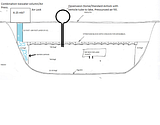
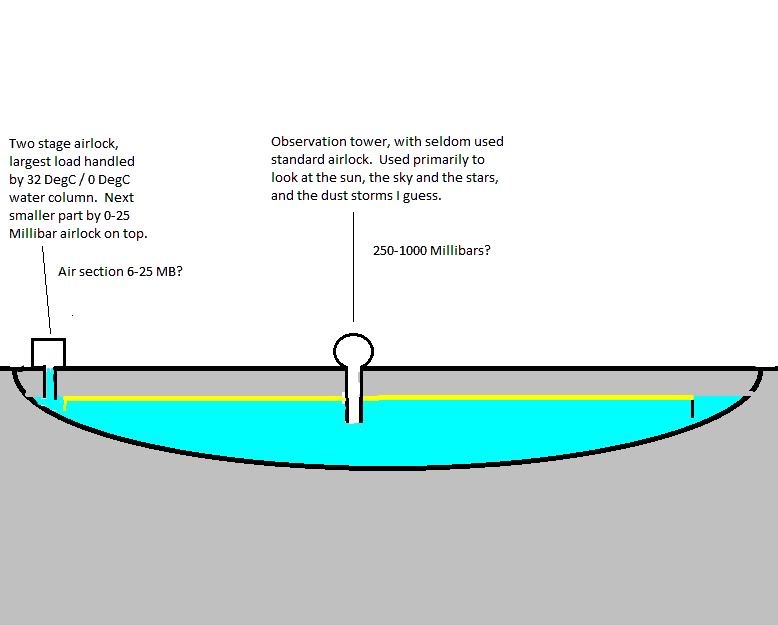
Large objects through the 2 stage airlock, people also. The observation tower as an airlock? Emergencies only. Otherwise look at the sun and the sky and the stars at night.
Well, I had some problems with that, but anyway the picture is not that good, but you get the idea. The two stage airlock on the left does most of it's work with a water column in a tube where the water is at 32 DegF / 0 DegC. It also requires a standard airlock to handle perhaps 1/40 the of the load, and would do so by moving the air pressure from 6 to 25? Millibars. Of course I have not shown the two sets of doors, 1 at the top of the water column, and 1 to get out to the Martial ambient environment.
The observation tower would mostly be that. See the sun, see the stars. However, it might also be used as an emergency airlock more like a standard airlock, it had such an airlock on a side of it, or in emergencies, it might function like the other air lock. Mostly it would be a observation tower to help keep sanity.
Speeking of sanity, it's Friday. Talk to you later.
#9333 Re: Life support systems » Solar Enclosure Architecture On Mars » 2012-05-03 16:45:50
Right click on the graphic object, and select "Properties".
Copy the address Example:
Paste the address between two consructions [***]Address[/***]
[img*]http://i134.photobucket.com/albums/q96/ … 1336009517[/img*]"
But leave out the "*". *I had to add the to stop it from embeding the graphic.
Submit
So as not to waste this post:
If a method like this were to work on Mars, then I would also suppose it might work on the Dwarf Planet Ceres, and the Moons of Jupiter, Callisto, and Ganymede, although Ganymede may be too radioactive for people to want to live there unless the radiation belts of Jupiter can be reduced in lethality.
Actually same logic for Europa, and Io, although rigolith is hard to come by with Europa, and Ice is hard to come by with Io. Perhaps a mass driver exchange program? But that really pushes the limits.
The poles of our Moon? Maybe, but you would have to import/Impact a lot of ice, most likely from the Asteroid belt.
Mercury may have vast ice sheets at it's poles in the shadowed craters. The jury is out on that. Radar detected something resembling it.
Think of the energy and minerals to be had on Mercury, if you had a decent place to grow food, with abundant volitiles.
Are we going to do graphic's battle now?
#9334 Re: Life support systems » Solar Enclosure Architecture On Mars » 2012-05-02 19:52:52
Nice.
I value your decisions. Here is my response:
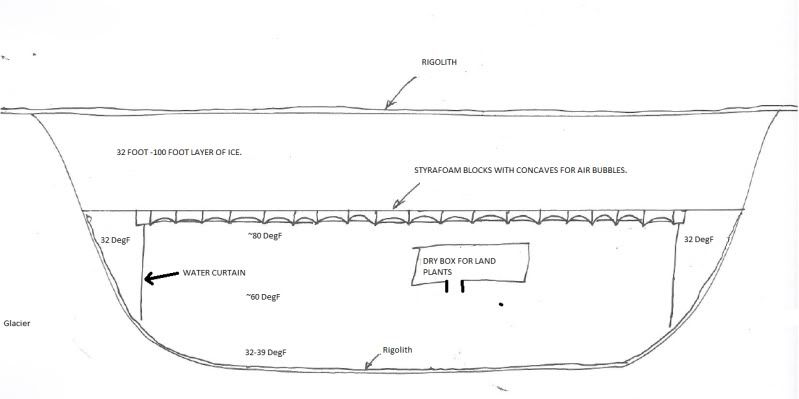
You might notice the curtain, which might allow temperatures as I have speculated, in conjuntion with styraform tiles with concave cavites within which air bubbles might exist, where Houdini would be grateful to have a breath of air. I might also add that duck weed might be able to live there if given light.
I expect that the pond would turn into a lake.
I have shown a "Dry Box" where you might suppose to grow dry land crops. I suggest that a humidity 100%< might occur if the cold water of the bottom were used.
I understand that for a rise of 20 DegF, we might expect the humidity to drop from 100% to 50%.
As another feature, it might be expected that a rock formation would resist the grinding force of the glasier. In that case if the glasier were slow moving then tunnels into soft rock might also yield caves where dry land things might grow.
However, don't let me inhibit solar greenhouses. I have my own notions, I don't want to stifle the innovation of others.
Please, others, do speculate. I will respect.
#9335 Re: Life support systems » Solar Enclosure Architecture On Mars » 2012-05-01 19:33:34
I agree, I may need to be more clear. I am not saying it is the only way, but it is a way to investigate.
1) Pipe pressurized steam into the lake using pipelines (Plastic might not hack it).
2) Condense the steam into the 32 degree, or coldest water in the lake.
Have a submersible light fixture with an on board steam turbine and electric generator.
Have the spectrum of light you want.
The whole light fixture assembly hopefully being easily disconnectable from the steam and condenser lines.
The whole light fixture assembly being small enough that a diver could carry it to a workshop for maintenance and repairs.
Virtually all the heat from the steam warming the lake, either condensate process or the light energy not consumed by the plants.
This then avoids the need for a power line system, the conductors and so on. Just what is internal to the steam powered light fixture.
An alternative would be a pneumatic light fixture, but then you have to have a vacuum line to vent the air pressure out to the Martian atmosphere.
Later:
I have been thinking about it and there is definitely a large issue with the pipes freezing at night. (Those above ground). They would have to be drained correctly and without error every late afternoon, or they might freeze and crack.
I still am interested in steam and pneumatics, but what the heck, I guess I could try to make electric wiring work with you.
Do you think that there could be a way to make "Plexiglass" enclosures, a network of them, Jerble tubes sort of, with an internal pressurization above that of the
water they were in? Then the lights and wires could be in them, and those tubes could perhaps connect up to the above ice habitat some way.
Just a question. Do you have an alternative?
#9336 Re: Life support systems » Solar Enclosure Architecture On Mars » 2012-05-01 16:53:34
A glacier 1/2 mile thick the size of Los Angeles such as what is thought to exist in Hellas would last quite a long time, being used in the manner you suggest, especially with water consirvation. Mars would likely be all the way terraformed before it ran out.
I suggest that at convenience, that a feature would be added. That would be to line the bottom with a layer of rogolith, for a 32 foot deep pond I suggest about 3 feet thick. (Sorry about the non metric, I think faster native).
That would serve several purposes.
1) Fresh water at 39 degrees F is heavier than fresh water at 32 degrees F. Therefore the rigolith being an insulator, the bottom of your pond can rise to 39 degrees maximum before the water starts turning over. (Don't want that, it would melt the ice).
2) It would serve as ballast. If the pond had an ice floor, there is always a chance that a block of ice would break loose from the lakebed and float up, with the pond water flowing beneith it. So the 3 foot layer of rigolith is ballast to hold it down.
3) Oxidation. Substances in a reduced state introduced to the bottom of the pond will "Rust". This will produce Hydrogen. Plants growing in the pond will produce hydrocarbon solids, and Oxygen. Unless the situation is reduced, you cannot have an increase in hydrocarbon mass. You could if you threw away some of the Oxygen, but why do that? We would want hydrocarbon mass to make plastics from I am thinking. So plastics from rusty iron, or other poorly oxidized rigolith.
What comes next here is a trial balloon. Don't get too warped about it.
I suggest that water from the pond could be boiled in the daytime using solar concentrators.
The steam could be piped under the ice. Remember that the pressure just under the ice would be perhaps 100 Millibars or more. This means that the steam will be rather warm, not hot. It could drive a turbine in a lamp unit to produce electricity to light the lamp. The light would shin down on the pond floor perhaps 20 feet below? (The water would have to be exceptionally clear for this to be a good plan) Perhap the plants would be in plantes attached just below the light fixture.
The warm steam would quench into 32 degrees Faharenheight water and if controlled properly, would leave a residue at 39 degrees Fahrenheight that would fall to the pond floor because it would be heavier than the 32 degree water.
I am thinking of plastic pipes for the steam and condensate. That is because plastics will print in a 3D printer easier, and the steam temperatures might be low enought that they would not be damaged.
Utilizing this method, it becomes obvious that there is a real danger that the pond will overheat, so;
Ammonia and water mixture carries heat from the pond floor (Don't know that plastic pipe will put up with that, so that could be a problem).
Ammonia is boiled out of the mixture and passed through a turbine at the surface, where the Ammonia is recondensed, and sent back the the mixture.
This of course will be most powerful in the night and during winters. I am afraid it will requre serious radiators, not plastic ones. Not certain, but thinking so.
And then there is the possiblity that you can have enclosures inside of the lake, and send some of the steam into them to warm them up, and so those could easily be at higher temperatures than 39 Degrees F.
Final thought. You could make a styraform tile block, and apply it to the bottom of the ice, inside of the pond, and it would eventually freeze to the ice. Of course styrfoam can get waterlogged, so some work needs to be done there.
And even more final those styrafoam blocks can have air pockets on their bottoms. Some parts of the styrafoam blocks deeply submirged, and some having air pockets in concave cavities.
#9337 Re: Terraformation » Artificial Magnetosphere - Electromagnetic Induction » 2012-05-01 16:39:05
RobertDyck Said:
Once synchronization occurred, the planet's dynamo stopped.
Well then if the major sheild volcanos of Mars were a Mascon, and a massive object were placed in geosynch, then a gravitational coupling which would resist some degree of force beyond the Martian velocity of rotation?
With the hopes for Asteroid Mining, and presumed advancements in human abilities, then an object placed there, and it having arrays to harvest energy from the momentum of the solar wind? Then a drag to slow down the crust of Mars?
That is the average force of the solar wind would be null more or less as the object orbited Mars, but the orbital speed of the object itself would drag against plasma magnetic lines of force, and if the degree of drag did not exceed the gravitational coupling of the shield volcano mascon and the orbital object, then this would slow down the crust, and also generate a lot of electrical power.
The object would be much closer to the crust of Mars than is our Moon, but it is presumed that it would be very much smaller.
So, how much of a magnetic field is enough? 1% of Earth?, 5%?, 10%?
I am not saying that it would be enough, but based on what you have said, a people who could set this up would achieve a magnetic field of some sort.
#9338 Re: Life support systems » Solar Enclosure Architecture On Mars » 2012-04-30 15:13:19
GW Johnson said:
I think that one could build an ice-covered pond, covered in turn by around 6-15 inches of regolith, and have stable fresh water underneath. The ice would be stable under the regolith. We've already seen that on Mars.
If the ice were a few meters thick, the pressure in the covered water would be high enough that a human diver on pure oxygen would not need a pressure suit. Just a wetsuit to stay warm at 0 C, and a pure-oxygen SCUBA, would work.
The way to keep the water liquid under the ice is the same as that required to grow aquatic Earth plants: use a sunlight-simulating electric lamp. Hence, it is possible right now to grow aquatic plants anywhere on Mars. No terraforming required. This is the best way I can imagine to turn acres and acres of surface to productive agriculture without building any sort of pressure domes.
Actually, it might even be made to work on the moon. Or, the asteroids.
There is the energy cost of running the lights. That's what solar PV and nuclear power are for.
GW
I think Lewis might have mentioned this as well. OK. I will run with it. (To be honest I have old archives where I suggested similar for canals to convey water, but I would prefer to lay down a vapor barrier under the soil and perhaps a layer of styrafoam).
However I don't want to be an idea moocher, so other than as a passing comment the above is if little significance.
I see that you are intending to employ native materials. Ice, water from ice and regolith.
Can we call this the minimum method? Otherwise to get fancy a large amount of fancy manufactured materials are required for the structure itself.
Later, I would indeed utilize fancy materials, which would allow much higer water temperatures, but you do have a formulation which minimises the burden of such effort intense materials.
I might add that in addition to wired electiric lights, there are the options, of fiber optics to convey solar energy in, and also pneumatic transfer of power to light fixtures with on board turbine generators. (That way no current carrying conductors in water. Just sealed lights, and a pressurized air supply, and a pipeline to drain that back to atmospheric vacuum).
Or Steam from solar concentrators, which would push steam through pipes to turn turbines in submirged lighting fixtures.
Or if the lights were LED's and did not give off much heat, then they could be embedded in the bottom layer of the ice, just above the water, and then the wires could indeed be "Dry" inside of "Conduit" inside of slots cut in the ice, and accessable for repairs by digging in the rigolith and cutting the ice.
Further there is the option of Chemosynthisis, where chemicals such as Oxygen and Methane would feed organisms.
I see one weakness in your plan. The Regolith, has a higher specific gravity than the Ice. However Trucks drive out on icy lakes and get away with it. With good engineering and a thick coat of ice it most likely will pass OK.
However if it were a concern, I suggest a trench like pond, so that the ice layer can "Grip" the sides and be stabalized that way. Even beyond that a serpintine trench which would likely do even better (Not sure).
The point is, I think we finally have an point of agreement, a path forward with this. I am very happy.
Putting up with 0 Degrees C may be a neccessity at first, but as I have said when the economy becomes larger and luxury is more available, I suggest that the rigolith be mixed with styrafoam, to make the mixture have a specific gravity of .9 which matches water ice, and I suggest that large lakes could be the order of the day. In that case, those rigolith covered lakes could easily have enclosures of materials which would allow temperatures inside well within the comfort zone of humans without suits, and also suitable to any fresh water aquatic life desired.
I also mention in passing that I have read of efforts to make underwater breathing apparatus, which can extract disolved Oxygen from water. This might be a useful tool.
Thanks for your comments.
Just some links about Mars Ice for those inclined to investigate:
The phrase I googled: "Thickness of subsurface ice on Mars"
http://www.planetary.brown.edu/pdfs/3966.pdf
http://www.ifa.hawaii.edu/~norb1/Papers … eages2.pdf
http://www.sciencedirect.com/science/ar … 3586901703
http://thesis.library.caltech.edu/1586/ … apter1.pdf
http://www-geodyn.mit.edu/mitrofanov.grl07.pdf
http://www.mendeley.com/research/global … -ice-mars/
http://www.upi.com/Science_News/2010/03 … 267625725/
This one:
http://www.universetoday.com/58518/mro- … rtian-ice/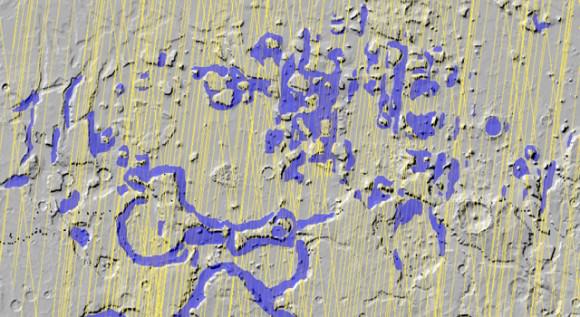
CO2:
http://www.sciencemag.org/content/300/5 … 1.full.pdf
http://www.nature.com/nature/journal/v4 … 05781.html
http://elements.geoscienceworld.org/con … 1.abstract
http://adsabs.harvard.edu/abs/1986Icar...67....1F
http://science.nasa.gov/media/medialibr … TAGGED.pdf
#9339 Re: Life support systems » Solar Enclosure Architecture On Mars » 2012-04-29 12:08:20
Salt tollerant water plants might be able to operate in below zero water.
I am tapering off, going to take a long break. Thanks Lewis & GW Johnson. If I have offended anyone else on this site, I give appogies.
I will look into visiting again in a few months.
#9340 Re: Life support systems » Solar Enclosure Architecture On Mars » 2012-04-29 07:38:41
GW Johnson
I think that baisically we are on a similar page.
You want the glass full, and I am trying to deal with it only partially full.
However, to fill it first comes a point where it is partially full. So I am trying to find alternate methods for agriculture for that period of time where Mars is only partially terraformed, or initially terraformed. Economics will not pay for the terraforming of Mars, unless it can be utilized effectively during the terraforming process.
It will have to pay it's own way. There will have to be a point in time where agriculture of some kind is possible in one place on Mars above others, and I think that could be Hellas, so I use it for my example.
I have suggested as my most optimistic proposal, uncovered irrigated fields. If Mars were terraformed to have 23 Millibars in the bottom of Hellas, then indeed ice water could be squirted onto Reindeer Moss fields, and it would in fairly short time evaporate from the surface, but some droplets would be retained in the soil. Eventually they would evaporate. In fact right now, if the soil in the bottom of Hellas had ice in it and you heated it, droplets of liquid water can persist for a time inside of the soil. But yes they will evaporate in time. The water will not boil however at 11.78 Millibars and 0 Degrees C, or if it were even colder salt water.
In the deserts of California, Colorado water can irrigate fields with water. It does not boil, but in the hot sun it will evaporate. Droplets of water will persist in the soil, but will eventually evaporate. It does not boil at 1010 Millibars and a temperature of 90 Degrees C.
So I have to say that that it is mechanically possible. You are correct, water is unstable. It also is in California.
So, the next important factor is Economics, or Practicality, whichever you might prefer.
I have suggested irrigation water from the ground, and then the Glaciers in Hellas, and then the South Polar Ice Cap.
Practicality and Profit would determine if it were to be done, the movement of sufficient water to the bottom of Hellas.
As for the choice of an open field or a covered field, that is also based on economics and practicality. The value of the water. If its expensive water then consirving it matters. A covering which retains mositure might make economic sense. Also, if a temperature above freezing cannot be achieved in an open field, then a covering is also desired. And of course there is the matter of Ultra Violet light. If no ozone layer exists, then a covering is a must, and it must protect the fields from UV damage.
Reindeer Moss exposed to atmosphere is actually an ambitious and perhaps poor choice relative to Moss which will grow under water, and likely under water which is under ice.
So for the purposes of water consirvation, I prefer ponds covered by Ice, and that ice covered by a vapor barrier, and then the mechanical enclosure must also at a minimum provide UV protection.
Beyond that if it is economically correct, such enclosures might have a greater internal pressure, but then if they leak that leakage takes moisture with it.
In the bottom of Hellas, a large plastic bag filled with ice water will not boil, and will not evaporate beyond the permeability of the plastic to moisture, or if the bag should be punctured. (Here I am presuming that the bag is kept at 0 Degrees C). The pressure inside of such a flexible bag should be ambient atmospheric pressure + the pressure of the static water column. So for the best present case, 11.78 Millibars + whatever debth of water you are measuring the pressure at.
The question is can enclosures be created which are as effective as a plastic bag? Another is can make up water be gathered at an economic cost to replace losses that are indeed assured to occur? And finally are the plants that can be grown of a reasonable economic value to justify the effort?
Selective breeding and genetic engineering may alter the answers.
Finally I want to point out that the reason to have a layer of ice is so that the surface is colder than 0 Degrees C. This depresses the vapor pressure, and reduces the evaporation rate. At the same time it increases the pressure of the liquid water, a sort of counter pressure suit for a pond. Yes if exposed, it will evaporate to the atmosphere, but be less inclined to do so than open water.
If for some reason an enclosed pond were created at the bottom of Hellas, then I estimate that for about 11? months, the pond might be frozen solid, and the ice surface temperatures would be very low. This would be winter. It is possible to add heat to allow liquid water, to utilize the scaps of sunlight that would occur in the winter, but the Summer would be the favored time to utilize sunlight with long days, and shorter nights. So 1/2 of the year, water would be easily consirved with a moisture cover. Then for most of the summer, the pond would be ice covered ice water. Then if it were favorable to the plants inside, perhaps a few weeks in the summer, the surface ice could be allowed to melt. At this time period the risk of loss of water to atmosphere would be largest, but then that would be the logical time when the moisture barrier would have previously refirbushed to it's maximum effectiveness.
If irrigation water is available, then these are economic and not purely mechanical questions.
If I have expressed any science errors here I prefer to know about it.
#9341 Re: Human missions » Planetary Resources Inc. » 2012-04-28 05:52:26
Well then pulse, is a mutual interest, and plasma, so plasma pulse.
I actually want to initially burn the Hydrogen & Oxygen, to provide a protection for the rocket nozzle. I believe, that magnetic fields are typcally imployed for that purpose as well, but if the pulsed burn is then further heated by other_means(), then the idea you expressed is quite similar.
However what I am really after is a Plasma Mass Driver.
Mass drivers to eject solid matter have been tried. But they would leave behind increasing navigation hazzards.
For some special missions, such as rare trips to places not in shipping lanes, this might be OK.
I have considered an Oxygen Mass Driver, using Paramagnetism, but frankly I am not capable of really knowing how to handle that. I just know that you can move liquid Oxygen with magnetism. An Oxygen Mass driver might make sense, if you have some rock which can simply be heated with solar heat to release Oxygen, and you liquified it. Or if you had a small amount of Hydrogen which you leveraged into a large amount of Oxygen, by Heating it with Oyxgenated rock to make water, and then split the water and reused the Hydrogen, until you had "Lost" it all. (Eventually you would loose the Hydrogen to the waste rock.
However, back to the Plasma Mass Driver.
In theory, a mass driver can approach the speed of light for ejection velocity. Of course, in fact your Mass Driver Machine will melt and/or explode, since it will always have practacticle mechanical limits, and a magnetic field pulse also will resist expanding and contracting over a certain speed and force.
However, with a Plasma Mass driver I would like to see a propulsion which would be even more powerful than just the notion of the expansion of a plasma out of a magnetic nozzle.
The complexity which I described is a natural result of trying to do something a first time (At least for myself).
First you try to accomplish something at all, then you try to make it elegant.
I guess I cannot think of any machine which would apply more linear energy to an atom/molecule than a plasma mass driver. So, I want one to drive my imaginary spaceship.
Entertainment.
Further notes:
-I also prefer a machine where if the magnetic/plasma propulsion fails, (Coils short out, or burn out, become unsafe to use), the machinery may in that situation still retain the ability to split water and do a chemical burn, perhaps a pulsed burn. To limp to a repair/rescue situation.
-A particle Accelerator might make matter move faster than a mass driver, or a super nova might, but they are too big to use in a spaceship, just yet.
-I was thinking of a repulsive magnetism, to push the plasma away, but of course the force of the field drops off quickly.
-Or a magnetic squeeze with a opening to squirt to plama out. Those devices that attempt to do fusion with a squeeze love to leak anyway.
This would be much more tough or impossible to accomplish:
-Now I am also thinking of a more typical mass driver. Perhaps plasma generated could be pulled along the sides of a ship. In that case, the rocket nozzles would be near the front, and would exhaust backwards, but then before the final exit the exhaust would be heated with a microwave pulse? Making the plasma magnetic, and therefore allowing it to be pulled by sequential electromagnets along the side of the ship. But then, that would be very hard to control, to keep the plasma from quenching on the materials of the ship. Perhaps if a stream of non plasma steam were traveling between the ships sides and the plasma, it would protect it?
Or in the outer solar system, could the ships sides be coated with a sacrifice material. Perhaps a combination of pulling and pushing coils, so that at one location the plasma is being pulled at an angle towards the ship, and at another being pushed away from the ship at an angle.
And I won't be surprised if someone says that this entity already did this, thing or that thing, as part of another thing and so on. That's fine. I want to know what the state of the art is.
We have a lot of black box people these days. When somewhat younger, I had to understand various descrete electronic components. Now, that is an outdated skill for the most part. I really don't expect that they put the same energy into training young people that any more than they train them for vacuum tube theory.
However, this tends to lead to a world of black box people. "Allakazam!" "Magic Carpet Rise!" So when people become too verbal, simply passing out buzz words, often the details are not obvious. How does the Magic Carpet fly? Alli Baba does not care. He only knows that it obeys him, and he might just get some of his archaic human compulsions satisified because he possesses a magic carpet. He thinks he can drop a rock on my head perhaps from his magic carpet. (If I was competition).
I want to know how to open the hood on the magic carpet, and exceed the verbalizers who's technology is to manipulate people for power. I want to understand the magic carpet beyond the level of verbal magical thinking.
#9342 Re: Human missions » Planetary Resources Inc. » 2012-04-27 15:45:58
Thanks for the info.
Since this is on topic more or less, and you guys would have high powered thinking as I might access, before I wander off (And I really do want to take a long break),
I have a notion, and some has already been mentioned, I would feedback both possitive and negitive on it. It is not that I think I have some wonderful new idea, it is that my internal knowledge is not sufficient to settle the questions, and some here might put some weight to it.
I mentioned a pulse rocket, I guess it could make sense if you split water that you had on board of a orbital rocket, and then wanted to burn it for propulsion. I presume pressurized storrage tanks, filled up and then a pulsed burn. (In this case the notion is that you would want to avoid the complications of storring cryrogenic fluids. The strength I see is that you can wait between pulses, and perhaps not need engines with an elaborate cooling system. (No channels with liquid Oxygen and Liquid Hydrogen). Of course those channels also serve to heat the burnable gasses, which I suppose might be wanted. The other deficiency might be that the thermal shock of a pulsed engine might fatigue the nozzle. Even so if humans wanted to manufacture rockets at remote locations where a reasonable energy source existed, and plenty of water, this rocket would be perhaps simple enough for them to manufacture off of Earth.
Plasma Engines as I have seen in the literature have had great advancement, they apparently have static Magnetic Nozzles? I am not sure but I believe that they typically do not handle water or Oxygen, but very likely might superheat Hydrogen to a plasma. I understand that Plasma is magnetic. However, the dynamics of magnetic plasma structure elude me. I do know that if plasma touches solid matter, or perhaps gas that is significantly colder, it will quench, and also very likely alter/damage a solid structure.
So, my weird question evolves to:
1) Can you generate a chemical burn pulse.
2) Can you then add energy by some means, to turn the tail end of that to plasma.
3) Can you eject the magnetic plasma using magnetic means. That is can you use an increasing magnetic repulsive pulse to push that magnetic plasma away even harder, therefore generating thrust.
Nozzle<Chemical Burn<Plasma Expansion<Magnetic Repulsion / Leaky Tokomack >>>>>>>>>>>>>>>>>>>>>
A sort of Plasma Ejecting Mass Driver.
It might help me to have a stronger mind for space propulsion if I know what my wrong thinking is in this matter.
Help would be appreciated.
#9343 Re: Human missions » Planetary Resources Inc. » 2012-04-26 18:41:38
GW Johnson said:
Metals I understand. Some stony minerals might also prove useful, who knows yet? Water (and other volatiles like ammonia and CO2) I think vary very greatly from object to object, and are likely the "matrix" that sticks the sand, gravel, cobbles, and boulders together, sort of a natural "icecrete".
What we have been calling "asteroids" have lesser volatiles, what we have been calling "comets" have more, but I'd bet real money these are really just a spectrum of volatile content, not two distinct classes of objects. The drier ones are the really loose rubble piles.
I would think enclosing a small asteroid/comet object inside a pressure "shell" of some sort, rated in a dozen or so millibar pressure capability, and heating the body to the ice-melting point 0 deg C, would separate the metals and minerals as solids, and the volatiles as liquid water and gases. Spin the vessel a little to separate these materials centrifugally, and then pump the gases and liquids where you want them.
I'm wondering if the rings of Saturn might not be a happier hunting ground for volatiles, especially water. Does anybody know if we have a composition, and particle density, for any of those rings yet?
GW
Mark Friedenbach said:
If we're talking about commercial operations, we must constrain ourselves to the inner solar system for probably the next fifty years in even the most optimistic scenario. We must be content to constrain ourselves to Venus, the Moon, Mars and the main belt (Venus is as far inwards as is worth going for resources, given the 13.1 km/s delta-v for a Mercury-Earth Hohmann transfer).
I have been trying and trying to figure out what they plan to do, and finally I found some web information I like, and I will add some speculations, which are likely to be wrong, but perhaps they will cause someone else to come up with the right ideas.
The sites:
http://www.nytimes.com/2012/04/24/scien … -belt.html
“There are probably about 1,500 near-Earth asteroids that are energetically easier to reach than the surface of the moon,” Mr. Anderson said.
Some of the asteroids are icy — up to 20 percent water — and the water could be drawn out by melting the ice. The water could be taken to supply stopovers for future astronauts or broken down into breathable oxygen or propellant for spacecraft on interplanetary missions.
Other asteroids are rocky and metallic. A throng of robotic mining spacecraft could grind up pieces of the asteroid and smelt it to capture precious metals within.
http://www.startribune.com/lifestyle/148648375.html
There are probably 1,500 asteroids that pass near Earth that would be good initial targets. They are at least 160 feet (50 meters) wide, and Anderson figures 10 percent have water and valuable minerals.
I am going to try to find one more item which says that out of 1,500 asteroids, 150 would be worth bothering with at first.
So, lots of Ice & hydrated and Carbonized materials? I was previously lead to believe that these were all dry bodies. Oh well.
So, here is my speculation.
1) Capture.
2) Grind inside of sack.
3) Separate materials.
4) Sinter segragates.
5) Capture and bottle volitile materials.
6) Deliver sintered items to various bidders/speculators/customers for further processing by them.
7) Keep platnum bearing sinter for special delivery to Earth.
Method of delivery of 7 to Earth could be.
A) Delivery vehicle, with heavy load, I presume you guys know what the limits are on practicality.
B) Deorbit and burn.
C) Parafoil to give some flight path? (Change that to weak guidance system of some kind).
D) Heat Shield remnant expelled in a safe location.
E) Explosive charge lowered on a tether.
F) At impact site guidance system drops load and saves iteself for reuse.
G) Special location is a bed of sand over a bed of solid rock.
H) Explosive charge hits first, and penetrates, expolodes and fluidizes the sand.
I) Heavy sinter chunk, "Splashes down".
J) Heavy sinter chunk impacts rock.
K) Heavy sinter chunk rebounds, shatters, etc.
Later Earth removers sift through the sand, guided by metal detectors.
--------------------------------------------------------------------------------------------
Building on those resources:
As per Mark Friedenbach
http://en.wikipedia.org/wiki/24_Themis
http://en.wikipedia.org/wiki/65_Cybele
And of course Ceres and Vesta and so on.
--------------------------------------------------------------------------------------------
Building on those resources:
As per GW Johnson
That very elegant and brilliant plan for refiling from the rings of Saturn.
I guess it could take a long time to exploit the outer solar system, because there may be so much to get in the inner solar system, but perhaps that notion of refueling in the rings suggests a scout expidition or two or more. I am sure samples are desired from the Saturn system.
I am not a kiss up I just really like your innovation on this one. It never occurred to me ever, and likely never would.
--------------------------------------------------------------------------------------------
I finally remembered the title of a book I read when I was very young. "Islands in Space".
Sort of a precursor to "The High Frontier".
In that book, it was suggested to inductively heat an Asteroid and inject liquid water into it to blow it up like making a blown glass item.
A hollow Asteroid.
Someone had rudely wrote "Planitoid Quackery" on that book.
But dreams have to start somewhere. The first, second, third offspring.............Eventually leads to a winner.
I am going to make myself scarce now.
#9344 Re: Life support systems » Solar Enclosure Architecture On Mars » 2012-04-25 19:16:26
Well about vapor pressure:
http://www.vaxasoftware.com/doc_eduen/qui/pvh2o.pdf
http://en.wikipedia.org/wiki/Water_(dat … se_diagram
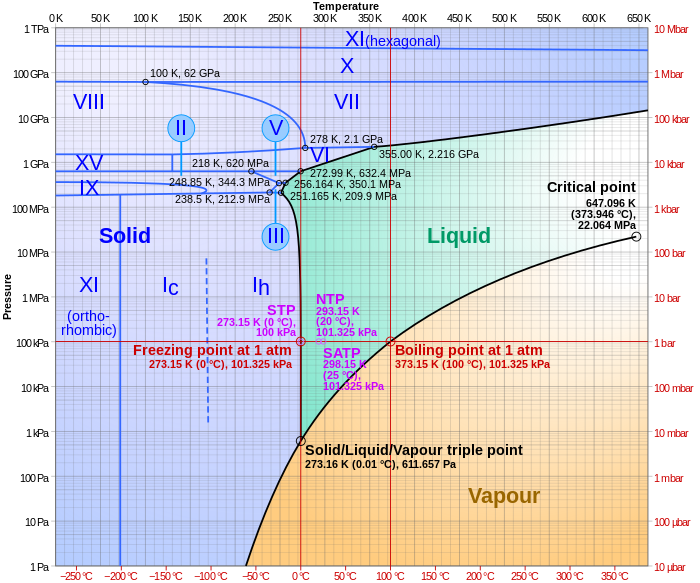
Well I guess that will do. As I have seen it, it appears that if Hellas eventually and optimistically had a 23 Millibar pressure then 70 DegF/23 DegC would be the boiling point of water. So, having ice water or even water at 39 DegF/3.89 DegC is quite reasonable, and even higher could be considered. So, an effective vapor barrier would not be used to suppress boiling with internal pressure relative to the external pressure, but would be a vapor barrier to inhibit evaporation.
In current terms it is my opinion that water kept at 32 DegF / 0 DegC would be stable in the bottom of Hellas, if given a vapor barrer, to keep the dryness and the winds of the atmosphere from stripping off the water. Of course it is desired to let the photons in to promote photosynthisis.
And if you would criticize that then consider that sea life including plant life I believe, can in fact work in water considerably colder than that if it is salt water. Therefore the vapor pressure of that solution would be less than 6.1 Milliabars.
In fact I believe that the current maximum pressure at the bottom of Hellas is > 11.466 Millibars, and that 11.466 Millibars allows for a boiling point of 48.2 DegF.
So, I am rather inclined to say that I was not Optimistic about what could be accomplished! I was consirvative!
Yes, and there is more, I don't care if the ice melts for a few weeks in the summer. Actually that would mimic the Arctic Tundra pond environment very well.
In fact that could allow for emergent plant life. However, now my problem is how do you keep alive and active a polinator type insect or other mobile animal that could polinate. I know that the Mona Loa bug on the top of Hawaii can live well below freezing, but how to give it resperation. (And of course it is not a polinator).
In the Hymilayas are insects with antifreeze which also can work well below freezing. Still how does a insect survive on 12 or less Millibars of Oxygen/Nitrogen mix?
My estimation is that is it unsolvable, but I will still think about it.
One thing I will not think about is Misquitos on Mars. I will swat them if they exist.
#9345 Re: Life support systems » Solar Enclosure Architecture On Mars » 2012-04-25 19:00:19
OK you are really in luck. More free philosophy from yours truely!
I will go to the gym tonight as I often do. It has done me incredable good to have that practice.
One deficiency I have is in my legs. So, my trainer often has me doing squat type exercises, which I do. I do them because I know that my legs will get stronger.
It is my opinion that with a real Mars settlement mission 15-30+++ years off, then if you have a hard time with Polymers, then work on that. Don't go run and hide and do the easy. The people who settle Mars will need every single trick that can be thought of, and even then there is a possiblity of there extinction.
When a mission finally gets launched, then those who are there can choose what to keep and what to set aside.
When I say something like I don't know much about plastics, that is only a half truth. I have calibrated temperature controllers for injection moulds, I have changed the probes. I have figured out solutions for such.
So in my equasion I cited a film to cover the ice/ice water. A transparancy. If it were true that polymers are forbidden on Mars, or can't work on Mars, even then I could turn to glass, or who knows "Transparent Aluminum", or terraform the planet and get the pressure up so the ice will be stable without an auxiliary covering.
The point is if I cite a variable "X", so that I can work on the issue "Y". I would prefer that I do not get the bums rush out the door, if simply because you have concerns about "X". Talk directly to me about that issue. Don't go get a buddy and do a double team on me.
It is extrordinarly wrong that there is a compulsion to impose orthodoxy in a question that requires that a new book be written, and does not demand that a recipe be followed. Following recipies, is a survival skill of our species, and I would never dispense with it, but it is not experimentation.
The tried and true never got anyone to Mars, let alone caused them to thrive there.
#9346 Re: Human missions » Planetary Resources Inc. » 2012-04-25 18:45:56
Various pre-positioned propulsion segments, to facilitate travel by spacecraft.
1) Solar Steam Rocket.
2) Burn as you split propulsion. In otherwords, with solar energy or nuclear energy, split the water into Hydrogen and Oxygen and do not store it cryrogenically, but only in pressurized containers, and when you have enough do a pulsed burn.
3) Store liquids, your Hydrogen Peroxide/Water solution for an Oxydizer, and perhaps Methane, if Carbon is available along with water.
4) Full Cryrogenic, Hydrogen and Oxygen stored liquid.
The idea I might see is they could gather the goodies, and even process them robotically and rather than returing that to Earth, pre-position them where travelers can latch on to them, and use them for their journey, and also for some extra consumables.
This could really open up Mars, and the real Asteroid belt.
After a tank like that was used, perhaps it would fly back to Earth orbit using electric propulsion, and be referbished for another mission.
Tanks could be loaded with water and prepositioned around Mars as well, if that technology did work because it should work for small objects near Mars as well shouldn't it?
If they could provide that for a Mars Mission, surely the sponsors of such a mission would pay rather well for the service.
And yes there are the valuable metals to bring home as well.
#9347 Re: Life support systems » Solar Enclosure Architecture On Mars » 2012-04-25 18:35:43
Glandu and Louis,
I simply was unable to understand your dialog. Therefore in the details, I will not dwell, unless, there is something I missed which you want to explain in explicit language. A good part of it or all of it was about the reference that Spacenut gave us.
One thing around here is the compulsion to put a wet blanket on creative thinking. That is citing that something is not the best to try to do at least not in the beginning. However, it will be at least 15 years before humans even to go Mars to visit, let alone settle. More like 30 +++++++++++!
Those children who are having their imaginations stimulated by symbolic illustration, may in many cases go on to create major changes in the equasion of what is best to try to do first for the first settlement. A whole new science could be invented by then. Now is not the time to limit possiblities. Expressing a concern is just fine, telling people just to give up is wrong. It is not how the west was won.
#9348 Re: Human missions » Starlite » 2012-04-23 15:56:05
I have no reply as to a spacecraft, but if we targeted something like that with solar concentrators, and place a mixture of water steam and CO2 on it, could hydrocarbons be generated, and diluted in the upward rushing stream of atmosphere. Greenhouse gasses?
#9349 Re: Life support systems » Solar Enclosure Architecture On Mars » 2012-04-23 15:07:51
Well, I thought I was done, but I decided to do a bit more research to fill in some things I left blank.
Before I get into the topic I am more interested in now (Tundra Ponds),
Here is another description of a Antarctic Dry Valley Lake:
http://phys.org/news/2012-04-carbon-con … ctica.html
It says the ice is 3-6 meters thick. one on Mars could be that thick, or if input from solar concentrators was used to further heat the lake, the ice could be much thinner to allow more light in.
It says that the fresher colder layer on top is nutrient poor. However humans could easily put more nutrients into that layer.
It says that the bottom layer lacks Oxygen. If this matters, then humans could arange to add oxygen. For instance if they wanted to make an artificial Ocean vent community, or a cold seep.
Antarctic Lakes such as Lake Bonnie have microbial matts. I believe that they would have more sophisticated plants, but they are isolated, and also, from time to time the lakes are destroyed I believe. So evolution does not have a method for continuity, and also transplantation is unlikely.
Here is a PDF, if you can get it to load. It is rather sciency, but I like the pictures. Anyway I can grasp some of it.
http://aslo.org/lo/toc/vol_51/issue_4/1801.pdf
Tundra Ponds:
Well yes the tundra tends to be half aquatic in the summer in many cases, due to the retention of surface water by permafrost, which inhibits drainage.
Here are some links I liked:
www.blueplanetbiomes.org/tundra_plant_heading.htm
http://www.blueplanetbiomes.org/arctic_moss.htm
http://www.arctic.uoguelph.ca/cpl/arcti … owmoss.htm
The artic moss is of interest, I think it could put up with being in a pond on Mars, maybe. But in it's natural situation it is very slow growing. However a domesticated variety which is fertilized and given a longer growing season might do better. Genetic engineering is a thought.
http://www.tropica.com/en/advising/site … capes.aspx
Nice pictures. Some of these plants might be adapted, or it suggests that there might be others more suitable.
Here I am most likely getting over optimistic, but still it is worth thinking about. Obviously my optimism neglects the fact that this picture lacks an ice layer, but still.....:
I guess in it's simplest form I think of a series of long ponds connected by pipes, and covered with an ice layer, and on the sides a raised berm and over that a tarp like covering, one draped over the berms, and anchored by tent pegs, and with soil shoveled over the edges to seal it. Perhaps enough head room for a human in a counterpressure suit to pass under the "Tarp". (Transparent film with UV protective properties, and humidity retention properties).
This could produce both Oxygen for the people, and also green organic matter which should be possible to use for something.
Sort of a protected, irrigated, tundra-pond scheme.
This would start with ground ice in Hellas (Or other places), size up to glaciers, and finally tap the south polar ice cap. Imagine the whole of Hellas irrigated in this manner. In times, also the plants grown would be domesticated to be more edible, and more useful.
#9350 Re: Life support systems » Solar Enclosure Architecture On Mars » 2012-04-22 22:19:40
Thanks for all the patience. And thanks for the tip.