You are not logged in.
- Topics: Active | Unanswered
Announcement
#9301 Re: Interplanetary transportation » Airship to Orbit? » 2012-06-24 14:12:57
As I said, I find this entertaining, and if you did not criticise it I would, but since you are somewhat taking the con, I will attempt to give it a little pro.
Impaler said:
I'm a big fan of electric propulsion but it just wont work in the atmosphere, I've seen studies that show that current SEP systems can't even go below the altitude of the ISS without suffering drag greater then the thrust they can generate, the figure of merit is W/m^2. Contrary to popular belief their is still a lot of atmospheric drag up their at orbital altitude and a big low density balloon is going to get pulled down so fast it ain't funny.
http://en.wikipedia.org/wiki/Ionocraft
If I am not mixed up, I have seen video's of actual devicis "levitating" (Actually being thrusted by ion flow). As the article implies, short circuits are an issue, but perhaps that is more true when you use it in a sea level air pressure environment. Perhaps the voltages don't have to be so high at 140,000 to 200,000 feet. So, the confusion is totally understandable, but I think it is a different type of electrical propulsion than the ion rocket. I also recall a reference to yet another device to propell airships, that woud involve charging a volume of gass electrostatically, and then compressing that and venting it. So, perhaps I am still confused. I am sure that they have some notion that they can build a device to thrust with. Otherwise I wouldn't think they would mention it for fear of being discredited.
Teraformer said:
One of the more interesting aspects of Airship to Orbit is that it doesn't need a heat shield or landing system. That's a major mass saving right there, though likely to be eliminated due to the mass of the airship.
I thought that might be true. So, return at least could make sense, if lifting does not.
I wonder if the device could plane in the air like an airplane, to get to 200,000 feet, only going 50-100 mph faster than the spin of the air at that height, and with a burst of propulsion elivate (Perhaps a small chemical rocket), pointing the nose up, and then pointing horizontal (More or less) then being above the worst drag, begin propulsion to have an orbit? I am imagining that if you are going to use electrostatic thrust for most of it even in "Sub-Orbit to Orbit mode" you would need to be able to feed a propulsion gas to the "Ionic Propulsion" once you were very much above 200,000 feet. They do talk about sending it to other places in the solar system, so, it must need a plan for that propulsion.
While magic tricks and camera tricks could easily produce the following references, I do believe that the effect is real. I have seen these before. Some people like to say it is antigravity (But it is not), and some think UFO's might use it. (Aliens) I guess if they exist, and if they have assender vehicles, then yes they might use it for some methods of travel. 
http://www.youtube.com/watch?v=fWJFQ3eF2HY
http://www.youtube.com/watch?v=jrfBrrDf … re=related
http://answers.yahoo.com/question/index … 239AAdGmat
Perhaps it could make sense, since if you can lift a mostly balsa wood model against the Earth gravitational field there could be a thrusting method which would work in the very dry ionosphere, where the lifter would actually "Plane" to a higher altitude than it's floatation characteristics would allow, so it would encounter increasingly thinner air as it increased velocity, and planed upwards. I don't know what would happen to molecules impinging on the leading edge. Would they be sucked into the thrust process? Of course if the impact released heat, then that heat would be at the expense of sub-orbital movement. It would have to be made up for just to stay at the same altitude, and more would have to be added to increase altitude.
Alright, I guess I will read the manual:
Quote:
The third part of the architecture is an airship/dynamic vehicle that flies directly to orbit. In order to utilize the few
molecules of gas at extreme altitudes, this craft is big. The initial test vehicle is 6,000 feet (over a mile) long. The
airship uses buoyancy to climb to 200,000 feet. From there it uses electric propulsion to slowly accelerate. As it
accelerate it dynamically climbs. Over several days it reaches orbital velocity.
So, OK then Ionic? propulsion from 200,000 feet, which is different from what I said, so I was a bit wrong, or a lot wrong. 
But I might be learning something new!
http://answers.yahoo.com/question/index … 706AAVxNJV
Nevertheless, several boundaries have been designated:
~ The Fédération Aéronautique Internationale has established the Kármán line at an altitude of 100 kilometers (62 mi) as a working definition for the boundary between aeronautics and astronautics. This is used because above an altitude of roughly 100 km, as Theodore von Kármán calculated, a vehicle would have to travel faster than orbital velocity in order to derive sufficient aerodynamic lift from the atmosphere to support itself.
~ The United States designates people who travel above an altitude of 50 miles (80 km) as astronauts.
~ NASA's mission control uses 76 miles (122 km) as their re-entry altitude, which roughly marks the boundary where atmospheric drag becomes noticeable, (depending on the ballistic coefficient of the vehicle), thus leading shuttles to switch from steering with thrusters to maneuvering with air surfaces.
This is a difficult question to answer because at some level, there is always stuff in space.
The space between our planets has some lingering dust and gas in it. So does the space between our sun and the next star. In fact, even the space between galaxies has SOME stuff in it.
I guess the best answer would be, at what point does the gas and dust cease to be gravitationally associated with the earth?
Well, that's actually closer than you think. At about 73 miles up most of the "stuff" that is zipping around in space is dominated by charged particles of solar wind and by gas/dust that is in a SOLAR orbit, not an earth-bound system.
So that's the best answer I can give. There really is no point at which there is NOTHING up there. However, the point at which the stuff up there is space stuff and not earth stuff is around 73 miles.
So, if you accept 62 miles, then the thing stops being a balloon at 200,000 feet, and must be a plane from there to 327,360 feet (127,360 feet higher), and then must be an orbital object above that. Since they say that the things are expected to be interplanetary, then I would think they would want to get to a higher altitude as fast as possible to reduce drag. Otherwise, I would think that having an orbital vehicle dock and take the load off their hands would make sense, ASAP, and then just drop back down.
I am interested in how such a system might be used on Mars. Slower oribital speeds needed, thinner atmoshere. And Venus, and Titan.
Oh and one more trick has occured to me. Could the wings that are actually balloons up to 200,000 feet be flattened as it transistions to a plane? Perhaps if it were filled with hydrogen, could you burn some of that off with Oxygen, and compress it into water? This might reduce drag, if the wings become thinner, and flatten out. Of course then they still have to be rigid. Then before return you would have to re-inflate the wings with Hydrogen.
#9302 Re: Interplanetary transportation » Airship to Orbit? » 2012-06-22 23:47:54
I looked it over now, rather entertaining if nothing else.
http://en.wikipedia.org/wiki/Orbital_airship
http://www.jpaerospace.com/atohandout.pdf
http://en.wikipedia.org/wiki/JP_Aerospace#Ascender
The PDF is nice to look at.
I guess the part I like the best is where if they do have the "Dark Sky Stations" at 140,000 feet then Oxygen could be collected to fuel the Orbital assender.
I wonder if those stations could also make a buck being communication relays, and also hotels? That might justify the stations and the ground to station airship.
The orbital assender is really outside of the box though.
I have plenty of reservations about how it could work, but I have thought of a few possible solutions for some problems.
I guess for the issue where space objects might puncture the orbital assender, I would speculate on small robots inside with patch kits, perhaps they would have Gecko feet to stick to the inside walls?
http://geckolab.lclark.edu/dept/geckostory.html
http://www.dailymail.co.uk/sciencetech/ … -mark.html
I am not sure but I am speculating that the "Electric" propulsion for the orbital assender might be a process of compressing electrostatically charged gas and venting it?
If the propulsion were electric, I would think that a powersat in orbit might be able to beam energy to it. If it were microwave, however I guess I don't know how the airship could convert that to electricity. If it were laser, and the skin was solar cells of a very thin type, then perhaps that could work.
I guess some time ago there was talk about super strong Nano Materials in the future. Perhaps that would be required, to make a very thin but strong structure.
It is entertaining however far off it is to our current grasp. I am glad that people are thinking so way far out.
#9303 Science, Technology, and Astronomy » The use of filler mass in propulsion. Could it help? » 2012-06-13 19:47:16
- Void
- Replies: 2
I am putting this here, because I think that there could be some who would resent it if I put something so wild into the transportation sections.
I have been wondering if any good can come from injecting non combutsible or non traditional substances into a cluster of rocket plumes.
I would start with the worst case notion, that of injecting just plain moon dust, from our Moon, or Phobos or Demos.
I had thought about injecting it into a rocket engine but intution told me that that is a no no.
I am thinking if you had a cluster of engines, at least 3, and you could inject a slury of dust and C02 for instance into the area between the exhaust plumes, could that serve any purpose?
Similarly of course is dry ice and water.
The thing Dust, Dry Ice and Water have in common is that they might be obtainable at far locations with less fuss, and they are rather storable. Turning dust into a slury for injection could be a problem.
I understand that for the solid rockets the space shuttle used, it was considered a good thing that it had soot and particles in the exhaust somehow it promoted thrust?
Ignorant wondering.
Of course it might be quite possible to obtain C02 and Reduced dust from an astoroid of certain types by subjecting the dust to concentrate solar heat. In that case the dust could actually be a fuel of sorts. (Think grain elivator explosions).
#9304 Re: Terraformation » Vesta, modest ambitions. » 2012-06-13 19:30:48
As for the spinning "Centrifuge" floating in a heavy gas, the axis would be vertical to the gravitational field. It is a possible option, not a necessity. Other methods are well worth considering.
As for Vesta a basalt Terraformer. True enough. However, I speculate on Vesta, only because we have data. I actually think we should look at NEO, and then the equivalant in Martian orbital proximity, and then perhaps something in the main belt smaller than Vesta, and with a clear signature of water being present.
If Phobos and Demos do show to have accessable water, then all the much better for everything. Go there before the main belt.
If Mars is sterile, then surely make something of it. If not, then figure out a plan, try to be moral towards the oganisms. We won't really know the options until we have some degree of certainty of the actual facts. We will not ever know for sure, sooner or later we will have to make a best guess, and live with our decision.
#9305 Re: Terraformation » Vesta, modest ambitions. » 2012-06-12 22:35:23
I do a lot of things by intuition. Love your calcs, but really beyond that not going to talk the language unless it need to. Have plenty of mind benders at work at this time and must rest my tiny little mind for that.
But interesting stuff.
I have in the past proposed an enclosure on the surface of low gravitational objects where that enclosure is filled with CO2, or Air.
Inside is a spinning "Balloon" contianing H2 or He2, or maybe air, if the esternal is CO2.
You get the notion, heavy gass with spinning baloon with gondola, where spinning baloon contains a lighter gass.
Further a "Mast" extending from the bottom of a floating boey, could An
(Note I could just scream, this site is one where a whole paragraph will misteriously dissapear, on a keystroke, therefore, I am wise to save and then edit. I have often had incidents where I have composed whole messages, and on a keystroke everything vanishes)
Anyway, if that is as bad as it gets, I will live.
Continuing;
A bottom thing floating on water. Think of an old fashion childs top, with a floatation gass inside, and a pool of water under it, and the apex of the bottom immersed in that pool of water.
So, maybe "Centrifuges" on Asteroids and Mars.
I like the geosynch stuff though, and for asteroids smaller than Vesta, perhaps a cavity created in the center with zero gee, where spinning worlds choudl be.
#9306 Re: Exploration to Settlement Creation » Domed habitats... - ...size, materials, and more. » 2012-06-10 08:41:36
Impaler,
I like your work. I think layering is a good notion. The idea that one wall does all is a starter, but when you look at the Martian environment your solution where layers handle different challenges, I like it.
I am not interested in playing topper, but I will just mention some of my thoughts, and you are certainly able to make of them what you will or will not.
-I have thought of glass "Scales" attached to a lizard skin, and the skin of fabric/film over a frame. However, I think this will be too labor intensive.
-I will suggest the addition of an expendable "Epidermis" for your shelter. As it appears that the shell-dome you would make will be rigid, it will have some of the properties of a tent frame. You could consider draping a expendable tent over it, and litterally using tent pegs to fasten the edges to the ground. I would suggest that this flexible film would be coated with a protective coating of glass spray. It would be change out and recycled periodically, perhaps ground up and used as filler for a new rigid dome, when it had deteriorated from the harsh outer Martial environment. It would also create yet another layer of themal insulation. I am merely offering the suggestion. Economics and technology would determine if this is a value added process, or simply a drag that you don't need.
-My enclosures with compression of air have typically been sausage links of netting holding in a bladder of compressed air. Some advantages, some liabilities. The links would need a method of connecting the ends as "Junctions".
I hope this does not annoy you that I jumped in with this stuff.
But I do like your method to construct a hard dome shell, that is not pressurized. It makes a lot of sense to me.
#9307 Re: Science, Technology, and Astronomy » Russians found water on the Moon. » 2012-06-05 23:42:55
I suppose the disk notion is more conventional, and perhaps more correct.
However, consider the desalination of water. I will mention two methods. 1) One is more familiar to logic, where you boil water with heat, and then condense it with cold. 2) Two is a method where you use a rotor (Actually two that have a cross-section like a peanut), and pull a vacuum on water which is briny, and then compress the vapors into a liquid.
So, I consider the formation of the Earth to be 2), and the formation of the Moon to be 1).
If a protoplanet has an extended atmosphere, then the zone of condensation is in two places. 1) The upper atmosphere, where the cold of space penetrates, and 2) The forming core, where pressure causes materials which might alternately in a vacuum become vapor, to become liquid, even at high temperatures.
It is to be understood that during the formation of such a binary world, there would be a continuous input of falling materials which would provide heat to the core, and a coninuous radiation of heat out of the atmosphere, which would provide the opportunity for very dirty, very large hail stones to form in a geosynchronous orbit inside of a temporary atmosphere surrounding a protoplanet. Further, the forming hail stones would tend to gravitate to each other, sticking together into one mass.
When the infall of small materials from the disk ceased, then the temporary extended atmosphere would dissipate, and the Moon would be left in a Vacuum, and would be gradually spiraled outwards into a more distant orbit by tidal interactions with the Earth.
Then afterwards if there were a heavy bombardment of Earth, by asteroids, some of that ejected material would pile up on the giant hailstone Moon.
I suggest a variation of this process for many other planets, and there moons.
Or yes perhaps many moons condense outside of a temporary planetary atmosphere from planetary disk materials.
#9308 Re: Life on Mars » Atmospheric Life in the recent past. » 2012-06-05 23:27:03
Well thanks for a reply to my lonely post.
I confess that I have partially reviewed your material. I am waiting to go to bed when my hair drys, so that is the moral justification.
As far as liquid brine goes, I suppose that such a brine might support life, but on Earth such a cold very brine solution typically does not.
I have read other peoples posts about life clinging to films on salt crystals in the very dry deserts of Chile (Spacenut I think), and that is wonderful, but in that case they are not also coping with deep cold. I am not saying it could not happen, but it is a very harsh challenge to any life form as I understand it.
However, in other posts I have suggested that the day night warm cold cycles might work on such a brine, to make conditions more happy for life. It is typical that salt water exposed to cold will experience a precipitation in the solution. Salt may precipitate out of the solution. It is also typical that in the Arctic ice pack, after many seasons of thaw and freeze cycles, the top layer of ice might be somewhat desalinated.
So, I suggest that in certain circumstances on Mars, the soils "Durocrust" might experience such a situation. In the night tiny ice crystals might freeze out of films of brine, and in the morining the suns warmth might melt them. If said crystals were not more salty than the Great Salt Lake water, or perhaps even the Dead Sea water, then it is reasonable to speculate that in that short period of time an organism might encounter conditions which might support life. I think that life processes in salt water can occur a few degrees below freezing on Earth. So, I am presuming a surface organism that depends on the warm cold cycles of the duracrust or sandstone which is salty.
Yes salt can pull water vapor out of the atmosphere, even on Mars. The day night temperature cycles can make it more habitable periodically for life.
Maybe.
#9309 Re: Human missions » Hudson's Bay Company - an interesting analogy? » 2012-06-05 23:09:36
A lonely post so far.
I myself think that if some entity should have the neccessary arrogance as to presume to dispense with portions of Mars, the needed conditions would be a promise to acomplish a certain amount of "Improvements" to the section of land. First a bidder would make a promise, or would state intention to fufill a requirment of improvement, and then they would be allowed to "Lease" a section of land with the promise of ownership if they fufill the promise.
I have little objection to the Hudson Bay company, who knows? Maybe it actually could be them in some cases.
Much of Mars should be off limits for some time however in my opinion. Just the places where we want alterations and settlements should be handled in the manner suggested above.
#9310 Re: Interplanetary transportation » Nuclear Pulse Propulsion starship. » 2012-06-03 22:34:56
Rune,
I did not set out to be a jerk on this, so please forgive me if it would now seem that is what I am doing. I did not have time to research it before now, and I feel a bit nervous that what I have found may not entirely agree. Please accept it or correct it as you feel needed. I entirely intend to be polite.
Anti-Matter
http://en.wikipedia.org/wiki/Antimatter … propulsion
The current (2011) record for antimatter storage is just over 1000 seconds performed in the CERN facility, a monumental leap from the millisecond timescales that previously were achievable[1].
An infant technology, but preuming a consirvative intrepreation of an improvement from 100 ms to 1000 seconds, isn't that an improvement on storage of 10,000/1?
It is easy to get me to slip on a bananna peel in the world of math, but I see that as being 16.67 minutes (1000 seconds). At least one bomb could be set off with that. (Delivering the antimatter to the bomb? Well, I said infant technology. I am just trying to judge if there is any hope at all, and I think there is).
What if another improvement of 10,000 times for the storage could be achieved? 16.67 minutes * 10,000 = 115.74 days (I think). Go to Mars and collect $200.00.
Starships? Not likely in my lifetime, but perhaps if an on board source of anti-matter could be created? It would be quite fantastic if the Bussard Ram Jet could be coupled to this concept. I know that fusion of regular Hydrogen is much harder than Heavy water and Helium3, but perhaps with antimatter triggering?
Anyway as I said I am interested in a planetary transport, not a starship, except for speculation fun.
I was looking for an article where a person had indicated that large amounts of anti-matter could be created in orbit with a machine, but I did not find it but I found this stuff, very interesting: The Van Allen belts have anti-matter in them that might be captured some day.
http://forums.liveleak.com/showthread.php?t=83679
http://www.pcmag.com/article2/0,2817,2390638,00.asp
http://www.centauri-dreams.org/?p=19198
Anyway I am not so stuck on anti-matter that I would want to depend on it. It is most likely for some considerable time in the future, and in fact when it does come, I think that perhaps heavy water and Helium 3 would be the prefered use for an anti-matter triggered explosion.
But for now, back to Thorium and U233 and other Uranium:
http://uranium-news.com/2010/09/11/yes- … m-uranium/
Yes you can make nuclear weapons from thorium, as well as from uranium
Uranium 233 is fissionable, and you can make bombs out of it. And the best part of all is that it can be purified chemically out of the spent fuel of the thorium reactor.Nuclear Weapons for the Masses . The Greenroom August 31, 2010 by Steven Den Beste“.……Thorium reactors use natural thorium, which is isotope 232. There are a lot of neutrons running around in there; it’s how reactors work. If an atom of thorium 232 absorbs a neutron, it becomes isotope 233. Some will fission, but some won’t.
Thorium 233 beta decays (HL 22 minutes) to proactinium 233, which beta decays (HL 27 days) to uranium 233.
Uranium 233 is fissionable, and you can make bombs out of it. And the best part of all is that it can be purified chemically out of the spent fuel of the thorium reactor. You don’t have to mess around with gas diffusion or centrifuges.
If, as some propose, there’s a thorium reactor buried in every backyard, you could face the possibility of pretty much any dedicated extremist being able to build nuclear weapons
http://www.americanscientist.org/issues … ium-future
U-233 is an excellent fuel for a fission weapon. It has a considerably smaller bare critical mass than U-235, about 15 kilograms versus 45 kilograms. This can be made significantly smaller—perhaps halved—by use of a lightweight beryllium tamper. Unlike the plutonium present in spent fuel, U-233 is immune to predetonation problems in even a crude gun-type bomb due to its low rate of spontaneous fission. It is a fairly copious alpha decayer, a property that can lead to premature detonation if the core is contaminated by light elements. But because the rate of alpha decay is only about one-sixth of that of Pu-239, this might not represent an insurmountable purification problem for would-be bomb makers. Perhaps liquid-fluoride thorium reactors could be engineered to enhance production of U-232 as a nonproliferation measure even if that produced a performance penalty.
http://kevinmeyerson.wordpress.com/2012 … ear-bombs/
http://en.wikipedia.org/wiki/Uranium-233
http://en.wikipedia.org/wiki/Uranium
It is interesting that there are potential sources of Thorium on Mars as well.
Among the other things I have read in the other links I posted is that with U233 you will have some U232 which is very dangerous. However as suggested in the quotes above, extracting U233 might be done by a chemical process, which I interpret as being favorable.
I have to add that in order for this technology to be safely used I think that our global culture will have had to evolve a trust system of some kind sufficient to maintain reasonable control of all of these processes. After all it is fission bombs in orbit isn't it.
Sadly there is likely still quite a few control freak groups who have always wanted to modify the human race before we go into space (Superman dreams), both communist, and fascist, and also religious.
I think it stems from a internal projection of the inadiquate nature of the members of such groups on to the rest of the world. It is easier to try to make other people be better than to try to be better yourself. No matter who you have to kill.
#9311 Science, Technology, and Astronomy » Russians found water on the Moon. » 2012-06-03 15:27:23
- Void
- Replies: 20
http://phys.org/news/2012-06-soviet-moo … l#firstCmt
The Soviet Luna 24 mission of 1976 drilled two meters down and extracted 170 grams of lunar soil, which it brought back to Earth for analysis, taking every possible precaution to avoid contamination. The scientists found that water made up 0.1 percent of the mass of the soil, and published their results in the journal Geokhimiia in 1978. The journal does not have a wide readership among Western scientists even though it was also available in English, and Crotts said the work was never cited by any scientist in the West.
If true, I will stick my neck out and say and speculate on an alternate theory for the formation of the Moon.
I think that the Earth might have been surrounded by a tempory atmosphere that extended all the way to geosynch while it was forming, and that the early moon might have been an icy object condensing like a hail stone in that atmospheric orbit.
I suggest that at that time the Earth could still have been not that much more than a proto planet. Therefore geosynch was not that far from the surface, similar to Vesta or Ceres.
I think that the temperatures could have been cold enough to allow it, since the atmosphere would surround the orbiting moon.
I think that eventually most of the ice was replace by rocky materials, as acumulation from the solar disk continued, and that the Earth and Moon each would have been places for the incomming dust and rock to stick to in the case of the Moon, a dirty orbiting hail stone.
Venus perhaps was too hot for such a moon to form, or it's moon eventually crashed. Mars? Don't know Phobos and Demos a remnants? Don't know.
Yes a very wild idea, but apparently if the Moon is not bone dry inside, it interfers with the theory that it was solely formed from dried out ejecta from a large object impacting Earth. I am willing to entertain a hybrid of the idea. The Moon existed previously as a hydrated object, and when the Mars sized object hit the Earth, then it did collect dry ejecta, but then water migrated towards the surface from the core.
I am not a proffessional in any way, so I guess I can speculate without distroying my career, I don't have one. Not for such a thing anyway.
#9312 Re: Interplanetary transportation » Nuclear Pulse Propulsion starship. » 2012-06-03 13:59:29
[I'm not sure U233 bred from Th232 can be made to explode. I was always told that a U233 bomb was not feasible. But it can be made into very good reactor fuel.
I know far less about it than you do. However, I think that there could be U238? on the Moon with the Thorium.
Maybe an antimatter trigger (Very futuristic), with a U238/u233 mixture could explode? As I said I don't know.
#9313 Re: Interplanetary transportation » Nuclear Pulse Propulsion starship. » 2012-05-31 22:25:28
I thought this might fit in here:
http://en.wikipedia.org/wiki/Antimatter … propulsion
Granted it is not even an infant yet, but a real exciting potential version of the pulsed method described in this thread.
I like the original Orion concept also though. Big bombs. That is K*** **S. Sort of a no fooling around approach. Lots of Testostorone in that.
Just in case you think I am a Kreep;
http://www.lunarpedia.org/index.php?title=KREEP
Thorium - Useful as a fuel in some nuclear reactors, as well as an ingredient in some super alloys
Uranium - A nuclear power source
More about mining on the Moon;
http://www.thelivingmoon.com/43ancients … ining.html
Quotes from the above;
Thorium Deposits
Information on the distribution of radioactivity on the lunar surface was one goal of Lunar Prospector. This map shows that the element thorium is highest on the front side of the Moon, mainly in the highlands south of Mare Imbrium. The correspondence with the Imbrium Basin suggests that the basaltic lavas that filled it were enriched in Th. Note that corresponding highland surfaces on the farside are lower. - SOURCE - NASAAgain you will notice that the richest deposits are in the vicinity of Copernicus Crater.
Thorium is a chemical element in the periodic table that has the symbol Th and atomic number 90. As a naturally occurring, slightly radioactive metal, it has been considered as an alternative nuclear fuel to uranium.When pure, thorium is a silvery white metal that retains its lustre for several months. However, when it is contaminated with the oxide, thorium slowly tarnishes in air, becoming grey and eventually black. Thorium dioxide (ThO2), also called thoria, has one of the highest melting points of all oxides (3300°C). When heated in air, thorium metal turnings ignite and burn brilliantly with a white light.
Thorium as a nuclear fuel
Thorium, as well as uranium and plutonium, can be used as fuel in a nuclear reactor. Although not fissile itself, 232Th will absorb slow neutrons to produce uranium-233 (233U), which is fissile. Hence, like 238U, it is fertile. In one significant respect 233U is better than the other two fissile isotopes used for nuclear fuel, 235U and plutonium-239 (239Pu), because of its higher neutron yield per neutron absorbed. - Source - Wikipedia
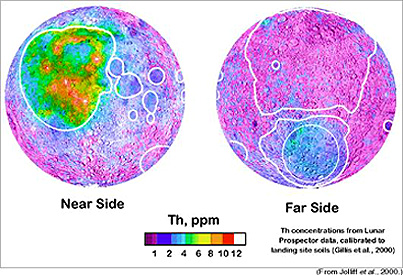
So, I guess that is why I think telepresence/telerobotics on the Moon could be big for getting machines and people to Mars.
There is latency issues, but I think that if a computer were put on the Moon and another one in a "L" location, then the intentions of the human living on Earth could be modified by those computers where those computers would work to prevent the human from making a reflexive mistake that could damage the robot on the Moon.
This could be a big way people on Earth could participate in the work on the Moon, to support the Mars effort. If it were me, perhaps I could enter a virtual reality environment, and suddenly be "On the Moon". Then take a coffee break, and then back on the Moon. Why not hone such skills?
#9314 Re: Human missions » 50 years after... » 2012-05-31 22:11:36
Well it is good to have this conversation, but I always like to have a Plan a, b, c, .........
As GW Johnson has said we do not have enough facts about the real "On the ground situation".
It is good that certain persons will debate in favor of "a" while I might propose "b", (As plan B), and perhaps someone else will bring in "c". This is not bad, it is good.
We don't know yet what the medical implications are for alternative gravitational fields, or simulated graviatation for that matter.
We don't know what Phobos and Demos are. Are they a great deal? Are they dry dust bunny's in orbit?
We don't know all the surprises that Mars has to offer. Perhaps it has quite a few favors to offer us that we don't know about yet.
We don't know what the geopolitical situation will be in the future. It is likely to deviate from what it is now. That has implications for funding, and even for premissions to go forward.
We don't know if there is life on Mars.
If there were life on Mars, is it merely a branch of the same family as Earth (Transpermia), or is it utterly unique?
If Space X, Falcon Heavy turns out to be the permanent most low cost launch, then we will eventually get a stabilized notion of what equipment can be delivered to orbit to facilitate habitation of the Mars/Phobos/Demos region. But I am guessing that it could keep changing for a time.
We don't know what telerobotics is going to do to deliver materials for the same purpose from NEO and the Moon.
So, I have a hard time when people try to pour concrete.
However by all means it is great when you take your debate position and bring light to a possible future. Just don't be too eager to blow out other peoples candles.
Eventually when some things mature, then it will be time to pick a best plan, with enought flexibility to adapt to the unexpected discoveries that are likely, and then it may be wrong to not rally around it.
But we are not there yet.
#9315 Re: Human missions » 50 years after... » 2012-05-31 15:17:55
As far as populating the proximity of Mars, what about constructing habitats with centrifuge gravitation included from Lunar and/or NEO low grade materials, filling them with people, and navigating them over a period of 10 years from Earth to Mars orbit using a combination of Solar Methods(Sails, electric), gravity slingshots, and perhaps some pulsed method (Fission/Fusion//with antimatter trigger)?
Upon entering a location favorable to import of materials from Phobos and Demos, the inhabitants of each could go into a process of habitat expansion, to accomidate new children I suppose.
That might get you outside of the limitations imposed by having only so many launch windows.
Suppose that Earth/Moon business did get lucrative, and as a side effort such habitats could be built, 1 / year with perhaps 2000 per habitat?
Just wild numbers. Presumably this would be financed by the travelers liquidating their assests on Earth, and also perhaps loans that could be paid off by expanding the habitat upon relocation to Mars Orbit, and so making room for children and immigrants as well.
Just speculating.
#9316 Re: Interplanetary transportation » Falcon 1 & Falcon 9 » 2012-05-31 15:06:47
So maybe $1000.00/Pound in the best case for Falcon Heavy. Thanks.
#9317 Re: Interplanetary transportation » Falcon 1 & Falcon 9 » 2012-05-30 18:50:48
GW Johnson said in a post that the Space Shuttle was $27,000.00 per pound, and the regular Falcons might be $2000.00 per pound.
I think I read somewhere that the Falcon Heavy might do $900.00 per pound. Do you think that that is possible, or something better than $2000.00 per pound?
#9318 Re: Human missions » 50 years after... » 2012-05-30 18:42:20
Lewis;
You apparently missed that I was proposing centrifuge type artificial graviation inside of or ajacent to a moon of Mars. I was not proposing to raise children in the gravitational field of Phobos or Demos alone.
I unlike many of you at this time would settle for an personed expidition to Mars which would be preceded by unpersoned probes, to futher analyze Phobos and Demos. That first personed expidition could first do some expiriments on utilizing the resources of Phobos and Demos, and hopefully would include the process of sintering the dust of the surface into a radiation shelter somewhere. Further hopefully they could dig into a moon to Ice. I am hoping that large sections of permafrost did exist, because it might suggest that hollows could be created in which spinning habitats could be built.
GW Johnson, I have been following the various posts about Orion type propulsion, and I have also because of it researched more. There apparently has been a lot of work done lately (10-20 years) on using anti-matter to trigger fission and fusion events to drive such a ship. This then would make the size of the explosions smaller and more comfortable to work with.
The Moon has Uranium, Thorium, and Helium-3 for fission and fusion.
The Earth of course can provide heavy water.
I do believe that you are on to something but it is even more wonderful than we think.
If you can build a tug to move a NEO or asteroid, surely it can be used for expiditions to Phobos and Demos.
If you can access those moons with mega equipment, then if they do have good resources, then they are construction materials, and fuel tanks, very convenient in fact in location.
I really think we should consider a stop at those Moons prior to the main event on the surface of Mars, because if science could get samples that include historical rocks from the early times of Mars, and on site and return samples were available, then quite a lot of funding could come from the science community. Further and parallel, the business community could make a profit from the other bulk materials.
If water ice, then the result is hollow spaces in the Moons where centifuge habitats could be constructed, as I said in my first post on this thread.
Going directly to Mars could lead to confilict between the Mars bugs and the Science community, while not attracting the business cummunity.
Going to Phobos and Demos first could attract both the Mars Bugs, the science cummunity, and the business community, if water can be shipped back to Earth orbit, for the moving of bulk materials to compose solar energy collectors.
An economy comprised of energy beamed to Earth, Platnum and such from the NEO's yes water from the NEO's, but I bet where the Earth/Moon proccesses are concerned you could hardly ever get enough water/fuel to move things about and to suport life and chemical processes.
I just have a suspission that doing this will get more to the Mars surface with greater assurance of the survivability of the settlements than just dumping people on the planet (If the high powers would even let you).
Also, the discovery of life on Mars would have various values. The search for it could come up empty, in which case the human race would poised perfectly to appropriate a new home.
#9319 Re: Terraformation » Artificial Magnetosphere - Electromagnetic Induction » 2012-05-29 21:22:34
I like where this is going. I guess I don't care how the capture mechanism for energy works. I prefer the capture of solar wind energy, simply because that is what rips the atmosphere of Mars, and conquering it first just feels good.
Then indeed if I have a marginal understanding of your proposals, some utilization of the captured energy to produce sufficient blockage of the worst damage the solar wind can do, making it worthwhile to add atmospheric components.
#9320 Re: Human missions » 50 years after... » 2012-05-29 20:50:50
OK, I liked your thinking, but I can think of alternative futures, and so I will play the skunk as I often do, and stink up things a bit.
I agree that it may be a good plan to start by having orbital facilities for young babies. I will go further and say that perhaps it would be good to consider a possible future where indeed childhood involves prolonged presence in the orbit of Mars. I specifically am looking at Phobos and Demos. Any use of them will require a deaper definition of their nature, so a program of discovery specific to them is essential to planning for Mars in my opinion.
Specifically I am leaning on this type of question. What is the nature of Phobos and Demos? It is apparent that they have hollow space inside of them per this reference:
http://nineplanets.org/phobos.html
Phobos and Deimos may be composed of carbon-rich rock like C-type asteroids. But their densities are so low that they cannot be pure rock. They are more likely composed of a mixture of rock and ice. Both are heavily cratered. New images from Mars Global Surveyor indicate that Phobos is covered with a layer of fine dust about a meter thick, similar to the regolith on the Earth's Moon.
I cannot prove, and do not know if there is a significant ice content, but apparently it is not yet ruled out. Some speculation has it that Phobos and Demos are not Asteroids, but Outer Solar system objects. If so, then they started with a lot of ice, and may still retain some of it. Who knows, perhaps even some Ammonia deep down? (Nitogen).
I unlike many of you at this time would settle for an personed expidition to Mars which would be preceded by unpersoned probes, to futher analyze Phobos and Demos. That first personed expidition could first do some expiriments on utilizing the resources of Phobos and Demos, and hopefully would include the process of sintering the dust of the surface into a radiation shelter somewhere. Further hopefully they could dig into a moon to Ice. I am hoping that large sections of permafrost did exist, because it might suggest that hollows could be created in which spinning habitats could be built.
Obviously the ice would have value as life support and propellant.
I cannot give a date, but I will stick to your first mission date, 2020? Lacking any other notion of certainty.
A point I have read is that it is thought that Phobos and Demos will contain fragments of rock from various era's of the history of Mars. Certaily this would be a useful byproduct. Obviously the samples will fetch money from scientific institutions that which to test their theories of reality against the evidence it might offer. That point was where much of the early rocks of Mars have been altered those fragments on Phobos and Demos could be representative of pages of history for Mars.
I think that a mission to transport machines to Mars and also land them on the surface may be too ambitious. Yes, if contamination is not an issue, then perhaps a few landings of humans here and there, but I see that the main effort should be interplanetary travel, and no big effort for direct human landings from Earth.
I feel that Phobos and Demos could be integrated into a infant economy compising NEO objects, and Lunar telerobotic products. I feel that bases on Phobos and Demos could earn money by hosting scientists from Earth who would study rock samples from Phobos and Demos (Mars fragments), and indeed samples from Mars, and also with telepresence the environment of Mars.
I am satisfied that Phobos and Demos could be good happy places for a significant growing population. I would like to see at least 5000, as an Arc in case humans on Earth fall prey to their occasional bouts of mass stupidity.
I should think that that phase could last for 30 years, very optimistically from 2020 to 2050. But by 2050, I would have no problem imagining a very large orbital population. Perhaps 100,000.
It all depends on the evolvement of an economy, and technology. I feel that the human race is just on the edge of a real technology that could transport people from Earth orbit to Mars orbit at a reasonable cost, particularly if large amounts of water could be had from Phobos and Demos.
At some point in the developement of Phobos and Demos, yes a starter population on the surface of Mars. More of an experimental station, where methods to adapt to Mars could be worked on. Once that fire got burning, it would have a orbital economy to link to for it's growth.
At that point, it would seem reasonable to me to inject greenhouse gasses into the Martian atmosphere from Phobos and Demos, because they also appear to have significant Carbon. The injection of Hydrogen might scrub the Chlorine out of the Martian atmosphere, allowing the formation of some incresed Ozone.
So, by 2070, a path towards a Mars where the average pressure is 11 Millibars, and Ozone makes it easier for plant life to prosper on the surface. By that time gentic engineering may have also unlocked some of the impediments to primitive plant life living on Mars.
I know that it is typically supposed that it might take 100 years to warm Mars up with a facility on the surface producing greenhouse gasses, but what if Phobos and Demos really took off economically, as an integrated part of a near solar system economy? One short cut might be to add some greenhouse gasses and to then impact a NMO (Near Mars Orbit object) or two onto the CO2 deposits in the south polar ice cap. Perhaps that could short cut the 100 years to get to 11 Millibars average down to 50 years?
Summary: I think that if Phobos and Demos have the characteristics I have suggested above, that the habitation of Mars is best achieved by a two step process, habitation in orbit, and then habitation of Mars itself.
#9321 Re: Life on Mars » Did we introduce life to Mars via space probes? » 2012-05-26 09:50:25
So,
Mars is sterile, but had life before. A likely possibility.
Mars is not sterile, but the life on it is mostly or completely related to Earth life due to Transspermia/Panspermia. I think that this is likely.
Mars is sterile, and never had life. I think that this is unlikely, since apparently Mars even now has places where Earth organisms could make a living.
Because of what has been presented about the infectuous nature of Earth life and any life like it that may have lived previously on Venus and Mars, I have a great deal of trouble entertaining the notion that Mars is a place where you could find clear evidence of the emergence of life from non-life, unless Mars was the original source of life in our solar system.
However, since doing the level of research necessary to determine that all life originated on Mars is likely to be too hard, I guess that I think the effort is not likely to pay off.
I also bring up the Social implications. I think that there has been a relegious and political need to find a second genesis, the orginination of life from non-life, to justify social movements which have caused the human race a large amount of grief. Communism, Nasi, genocides. Things that can occur within Abrahamic relegions also, but I am afraid that in the quest to get rid of God, the human race has found that Men or Women as Gods is even worse.
I do not object to the science, but I make what I think is a valid point that efforts sould be made to make sure that the space science effort is not about validating a social agenda which trivializes the worth of common people, and promotes the capable to a position of unquestioned power of life and death over the common people.
However common we may be, it is also our future, and we want our time in the sun without elitist nin-com-poopery.
Science, fine. Social nin-com-poopery not allowed.
And I am not criticising anyone posting here.
I just want to point out that Mars is a poor place to look for life not related to Earth life. A poor place to look for evidence of life from non-life. And I don't want my tax money spent to promote a social/socialist agenda to justify the modification of how we live with social experiments.
I just want the human race to extend it's reach into outer space further.
#9322 Re: Human missions » Ashes to ashes to money » 2012-05-26 09:06:57
I think the Moon would be fine. Underground storrage, freeze dried remains. (Amber?) Some type of perma-record such as etched stones, telling a portion of life storries, some artificts.
A time capsul for future astronauts if any. (Human or otherwise) With a marker on the surface of the Moon.
I would think that the shaddowed craters of the Moon after volitiles were extracted would be a good place. Perhaps even leave some viable DNA, if that could be possible.
5000 years in the future someone stops by?
50,000 years?
500,000 years?
5 Billion years?
Then of course one should also be made further out in the solar system where it is more likely it will survive the Giant phase of our star.
Imagine sending a message to Billions of years into the future.
Might as well make it more than a grave yard.
#9323 Re: Life on Mars » Did we introduce life to Mars via space probes? » 2012-05-22 14:51:30
Most likely I won't even be around to agree or dissagree. Normal life span but.......RIP
Yes, that would make the most sense, except for contamination. I don't think that it would be permitted, until other methods were exhausted.
This is why I have become interested in Lunar Telerobotics. I am afraid that the best case that I hope for is a mission which includes close up human examination of Phobos and Demos, and perhaps leaving some sonar devices on them to "Sound" them to figure out what kind of hollow spaces they have. In addition to that some intense telerobotics to look for life, and perhaps even samples to orbit, and maybe even samples to a near Earth location.
If something like that turned up negitive for life, then I would think the case could be made to allow the next mission to involve landeing people on Mars.
For telerobotics, I would presume a rover on the bottom of the rift, and I speculate on a "Sky Crane" with a nail gun, hovering at a rift wall, and nailing an anchor, and then letting loose a probe on a tether. Perhaps something like fishing line and a small robot that has a motorized pully, and some wheels it can contact the wall with. Otherwise, perhaps the sky crane could spew some micro probes into a potential habitat. That is before the crane crashed. Of course the sky crane would be taking pictures as well. Perhaps it could swab a crack or two, and then fly down to a crash landing at the valley floor, and eject the swabs before impact. Perhaps a rover could retrieve them. After all I believe that worms survived the space shuttle crash?
It would be an interesting set of data. Perhaps the crane could take a picture strip of the wall as it went down in a controlled crash.
#9324 Re: Life on Mars » Did we introduce life to Mars via space probes? » 2012-05-21 13:03:35
I think that rogue planets are a certainty, and evidence suggests that they are common, and it is likely that many may have subsurface habitats suitable for life.
It might be necessary to go down 10 miles for that, but also if it is a planet with volcanism, then closer to the surface is likely. I really expect that more likely there were comets and asteroids expelled from other solar systems incorporated into the gas cloud prior to condensation. However, for a whole nursery of stars a rogue planet with a habitat? I think it could happen.
But why I really came back to post.
I read an article posted here, and cannot find it again, however the person posting that put a link such as these in it, and it has really caused me to ponder what I think I know, and what could be. If you can identify it, I will let that person know that I have pirated their information, and thank them.
http://www.criticalmass.uk.com/index.ph … vironment/
http://spacecoalition.com/blog/life-on- … ng_wp_cron
http://www.skymania.com/wp/2012/04/lich … html/5806/
http://www.mendeley.com/research/surviv … y-study-7/
One thing I have realized is that I have to appologize to the people at Red Colony. I thought it was perposterous that Mars could be seeded with Lichen, since I have always been told that the UV flux on the surface of Mars is lethal to all life. I believe that in these experiments or similar ones CyanoBacteria also survived similarly. Again, if there are any persons from Red Colony here, I appologize for the non-belief. (I did not express it much, but I was very negitive in my thinking).
So, to be done with it I will express what I have thought about, search for and also my conclusions and speculations.
The Lichen is part fungus, and then part CyanoBacteria or Algae.
Fungus loves to inhabit the places between my toes, because I go to the gym. I take great measures to stop it.
So, as expressed in the articles, a crack in a rock is a great improvement beyond the general Martian environment, having some resemblance to the gap between my toes.
I did some checking on Lichen, and discovered that in addition to producing acids to break down rock, they with that process produce salts, organic salts I guess it said. So, this I think could have big implications as to how the crack in the rock could be moisturized, and how liquid water could exist below 0 Degrees C in that crack.
I also speculate that even without the production of salts by Lichen, salts should collect inside cracks anyway, since if there are wind born dusts with salt in them, and if there are temporary dews in the cracks of the rocks, then some brine should result.
In either case, brine tends to attract moisture into itself, and of course serves as an antifreeze.
Brine can be so concentrated that it poisons life, but during the day night freeze thaw cycle, brine should separate into a less briny part of ice and a more briny part of liquid. Then during the morining warm up, the ice might melt, at lets say -15 Degrees C to 0 Degrees C, and be available as a life giving drink to a life form.
Sea ice has a habitat that may have parallels:
http://www.arctic.noaa.gov/essay_krembsdeming.html
Life within the briny habitat of sea ice is intricately linked to physical processes. Temperature controls every physical and chemical aspect of ice, including availability of light. The most notable effect of decreasing temperature, as winter progresses and the ice solidifies, is the reduction of pore space within the ice and the concurrent increase in the salinity of the brine. Sea ice, especially during the sunlit seasons, serves as habitat for an ice-specific food web (sympagic foodweb) [1] that includes bacteria, viruses, unicellular algae, which often form chains and filaments, and invertebrates sufficiently small to traverse the brine network. The brine network is comprised of passages in the ice, with diameters ranging from micrometers to several centimeters when the temperature remains above -5°C.
So in the morning the lichen might get a drink of water at perhaps -5 Degrees C. Then perhaps it has to behave like a cactus. I beleive that Lichens are in fact very much like that, since they grow in deserts also. I read an article about Lichens in Antarctica, which said that the reason they were not more prevalent over the land surfaces was not the cold, but rather the lack of moisture on those land surfaces.
I have also surmised that the "Toes" shall we prefer to say, that is the rock on either side of the "Crack" will have accelerated cooling at night and will then draw heat out of the crack, and prepair it to condense water vapor when it becomes available in the early morning. I am not sure which will heat the more duing the day, the "Toes" or the "Crack". I expect it would be variable according to the angle of the sun to the structure, and that structures themselves will be variable.
What I have read and already knew was that water expands and contracts with heat and freezing/thaw. Salt also expands and contracts in accordance with moisture content and heat I think. And so do Lichens. This along with the acids and salts tends to break down the rock and provide nutirients. On Mars, I am sure dust conveyance from the wind would also provide nutrients, and perahaps also hostile factors.
So, I am guessing that for Lichen on Mars, the two factors that would be major is sunlight sometimes, and moisture. Sunlight is ubiquitous across Mars, with approximately similar amounts of it during a Martial year. It might be modified by terrain, such as a shady canyon, or perhaps a mountain exposed to the maximum.
I cannot say where the best dews are, but I could speculate that the Equator is not unfavored. It has comparitively frequent and regularized day night cycles as opposed to the poles. So I would look to Hellas in the summer, and the Marriner Rift Valley system more parts of the year.
http://www.sciencedirect.com/science/ar … 3309002323
PIC:

Ice fogs then, as a favorable factor. The moisture decends from the atmospheric column at night, and sometimes makes a fog in night in low places. Therefore concentrating mositure. In the very early morning the fog dissapears, but I would presume that at that point the atmosphere has a high humidity at a low elivation.
It is also at that point that the crack in the rock where lichen might live, would be at it's coldest temperature. If the relative humidity of the air is at 50%, and the crack has a temperature 20 degrees Fahrenheight below that air temperature then condensation will occur. Likely the air might be even more saturated with mosture, and likely the temperature differential may be greater as the morning progresses.
I am still concerned about the Ultra Violet light, but the experimenters said the lichen put up with it for more than a month, so I am more inclined to think that Lichen may have endured periods in history on Earth where Ultra Violet flux was very high, and it still carries this ability. I will presume this until shown otherwise.
So, I think that apparently surface or near surface (Crack) life is possible on Mars, and I think that whereever life originated in the solar system, it has been shared.
Lichen is ancient on Earth, so the probability of it on Mars increases. Or perhaps something like it.
If I were to look for life on Mars now, it would be either in freshly exposed subsurface ice, or somehow fly a probe into the rift valley, and take a cotton swab, and take samples out of the cracks in rocks where some salt is likely to be present to allow tiny amount of temporary brine.
The sooner known the better, for planning purposes.
#9325 Re: Not So Free Chat » Parallel tracks of progess or lack of it. » 2012-05-19 12:51:42
I realize that I am more or less a free rider here, and don't set the rules, but it is my opinion that you should have sections which are not directly involved with Mars, but specifically with the Moon, NEO, and main belt asteroids each.
This would get you more membership, since for instance a great deal of my interest is in the advancement of telerobotics for the Moon.
You can also pull in other science as well such as apparatus to the physically challenged, since I think there is a direct parallel to operating machines remotely on the Moon, and having physically challenged people pioneer the testing of telerobotic equipment.
Obviously there is also the robotic mining of NEO. This is similar, but less close to realtime interactions.
So, realtime is best represented by the use of devices on Earth by Physically challenged persons, use of devices by humans on the Moon, use of devices operated remotely on the Moon from a "L1-L5" location, and the use of devices operated from the Earth on the Moon.
I see this as being an opportunity to couple space activities with medical activities, and to put it bluntly, the medical has a lot of money, and much more will be spent before all we baby boomers go silent. On the other hand there are very clever people here, who could advance medical prostesis using their mental capacity.
So it is symbiosis as far as I am concerned.
As for Mars, I have been following threads about life on Mars, and that material is very interesting. I am willing to believe that it is very likely that Mars has a Cousin biosphere to that of Earth, through Transspermia (Panspermia?). Anyway I think that even if Mars had had it's own genesis, it is likely that wherever microbial life first occured, it was passed back and fourth between at least the Asteroids, Mars, Earth, and Venus.
It seems likely that Earth was most likely the bigest reservoir of life for most of the era's that occured.
So, if this is true, I would expect a lot of resistance to contamination of Mars for some time. However, eventually the only way to study life on Mars if it exists will be with close in Telerobitics, and even then it will likely be impossible to not contaminate the planet eventually with current Earth organisms.
I really think that in the end the human race will have to decide that the Earth and Mars biospheres are connected and evolving, and that the transfer of organisms is natural. Hopefully nothing to terrible might come here from Mars.
But you see all of this, the possiblity that the Earth could be contaminated, and the fact that many will resist the presence of Earth organisms on Mars, will slow down the process of settlement of Mars, unless it can be proven with high probability that there is no life on Mars, and I am betting that there is life at this point on the basis of the articles I have read here.
So, I think that medical telerobotics could be coupled to Lunar telerobotics, and also NEO telerobotics, and that could allow settlers on Phobos and Demos, which are apparently rouble piles, and that experience would lead to expansion into the Main Astroid belt.
Mars could be extensively explored for life from Phobos and Demos using telerobitics, and Mars would or would not be settled depending upon the findings.
My own opinion is that after significant study of any existing biosphere on Mars, it would be alright to introduce people and the organisms they associate with, since if transpermia has occured the life forms are related anyway. It would be similar to finding a new continent with new creatures, and yet how long could it be kept in total isolation? Eventually the isolation would fail, so there is not particular reason to be too obsessive about it.
Some people might think that this would be slighting Martians, but I think that if the Humans eventually do travel to other solar systems, Mars life would travel with them, so, it is also helping the continuation of the Martian life line, if there is one.
Some people want to freeze a situation, but really things change all the time.
So, that is my advice. Provide sections for the following, even if they are not directly "Mars":
Telerobotics:
1) Medical
2) Lunar
3) NEO
4) Mars from Phobos and Demos
If this is done then winning can occur, because if humans are force to bypass Mars for settling, they still have a path forward. If however eventually they can settle Mars, then they would have some very powerful tools to do it with.
If for instance the go ahead occured, then they could move the telerobotics headquarters to the surface of Mars.
But of course what you do is your own business. I am otherwise resuming my break.