You are not logged in.
- Topics: Active | Unanswered
Announcement
#8751 Re: Interplanetary transportation » Mission to Venus » 2015-01-07 11:24:15
So, I am thinking that maybe a space plane. No wheels, just skids, if the "snow" is slippery. With such atmospheric density, I would think the landing speed could be very low.
It could not have enduring parts that could not take the heat. If emptied of fuel, and cargo (To deliver to the surface), it should be at it's lightest, and the an airship to lift it to the "AirCraft Carier", where it might get some maintenance, and fueling. A oxidizer will be a problem. If the fuel was a hot hydrocarbon, then Oxygen I guess, but that will be a problem. If the fuel were Magnesium based, then perhaps Water and/or CO2.
Maybe Sulfuric Acid?
I suppose if you needed Oxygen, perhaps the space plane would be fueled, and then lifted to a higher altitude, where another craft would tank it with Oxygen. At that point at the same time, a cylinder containing humans and their life support could be added as well?
Of course you would want that cylinder to be able to detach, and float if needed, (Such as after re-entry), providing time for the humans/cylinder to be recovered.
Now that I think about it, when the space plane was landing, it would have to pressure equalize with atmospheric gasses, and so would not float.
However, if a airship went down and hooked to it, that airship could then displace the gasses inside the space plane with Nitrogen, and some flotation effect would occur, helping the blimp to lift it to the aircraft carrier.
Of course it would have to vent Nitrogen as it was lifted to a higher altitude.
_____________________________________________________________________________________________________________________________________________________________________________
Part of the notion here is that the Surface of Venus is a supercritical oven, and apparently a condenser in another part.
So, adding comets, and asteroids, may modify what it is baking. Adding water could raise the temperatures. Adding metals might provide desired materials.
Of course the trick is to get some of that material to where it is wanted. To atmospheric greenhouse/habitats seems relatively practical. To get it into orbit, may ask the question "Why not mine it in orbit". However, Musk of SpaceX seems to indicate that the biggest cost of spaceflight is using the hardware once.
Maybe there could be an economic model for refining materials in the oven of Venus and lifting them to orbit, I just don't know. (Maybe future technologies).
I might wonder if compressed steam, and Magnesium might be a way. Of course your tank would be heavy for the steam, but being on the AirCraft Carrier, it would be hot. Of course the tank would have to contain the pressure after it was lifted to a launch altitude. Heavy tank would be the penalty. I guess it would be a Hybrid rocket. I said Magnesium, but that might just be some part of the Solid Rocket component.
In addition to the compressed hot steam, perhaps this Hybrid might also have atmospheric intakes, to take in CO2, and if traveling through the clouds, to also take in Sulfuric Acid? Hot steam would be the Oxidizer after the atmosphere petered out, and you were pushing to orbit. So not just Hybrid as in Liquid and Solid Fuel/Oxidizer, but Hybrid as in Jet/Rocket.
#8752 Re: Interplanetary transportation » Mission to Venus » 2015-01-07 08:34:20
http://news.discovery.com/space/the-met … 130610.htm
After Magellan arrived in the orbit of Earth’s twisted sister in the 1990s, it took some more detailed measurements. Everything pointed towards some form of chemical deposition occurring on the higher ground.
As we now understand it, the snow on Venus’ surface is probably more similar to frost. On the lower Venusian plains, temperatures reach a searing 480°C (894°F). This is hot enough that reflective pyrite minerals on the planet’s surface are vaporized, entering the atmosphere as a kind of metallic mist, leaving only the dark volcanic rocks like basalt in the Venusian lowlands.
At higher altitudes, this mist condenses, forming shiny, metallic frost on the tops of the mountains. And Earth’s simmering sibling has plenty of high altitude terrain. Maxwell Montes, the tallest peak on Venus, stands at an altitude of 11 kilometers (6.8 miles) — 3 kilometers (1.8 miles) higher than Mount Everest.
Whether snow genuinely falls on Venus is still unknown, but it’s certainly possible. Sulfuric acid rains have been observed plentifully on Venus as virga — rain which evaporates before it hits the ground, just like over the rainforests on Earth.
NEWS: While Venus Simmered, Fast-Cooling Earth Thrived
The heavy metal snows can be observed anywhere on the surface of Venus over about 2.6 kilometers (1.6 miles). It may not be any coincidence that below this altitude Venus’s atmosphere is technically no longer a gas.
Over 96 percent of the Venusian atmosphere is carbon dioxide, and our sister planet has nearly 100 times as much atmospheric gas as Earth does. This is what causes the huge crushing pressure at Venus’s surface, but that pressure also has a rather strange effect on the gas.
At the pressures and temperatures found near the surface of Venus, carbon dioxide becomes a “supercritical fluid” — an unusual state of matter, partway between a liquid and a gas. Often used on Earth as an industrial solvent, this supercritical carbon dioxide is expected to be found on Venus, coincidentally, at altitudes below around 2 – 3 kilometers (1.2 – 1.8 miles).
While we’re a long way from taming Earth’s evil twin, meaning that it’s unlikely human eyes will see the surface of Venus directly anytime soon, one thing’s very likely. Both the lead sulfide and bismuth sulfide which make up Venusian snow are a light greyish color with a shiny, metallic lustre.
Which means the the mountaintops on Venus are probably beautiful, glinting in the sunlight that filters through the dense clouds. Who knows? Maybe in a few hundred years, the Venusian mountaintops might even be a tourist attraction.
So, the way I see it is there are two surface environments, the lowlands which are corrosive to metals from the supercritical CO2, and the highlands that are apparently not corrosive in that manner.
Also, I see that the atmosphere is most corrosive where it is wetted by actual Sulfuric Acid mist. I also recall that the lower layers of clouds contain the most H20.
So I am thinking a method to consider robots for the surface, and for "Floats" just below the mist layers of Sulfuric Acid. I myself would try to build on RoboSimian.
http://www-robotics.jpl.nasa.gov/tasks/ … aID=700043
https://www.google.com/search?q=robosim … QsAQ&dpr=1

https://www.youtube.com/watch?v=3HFXO_qx5ZY
Having looked at your proposals, what makes sense to me, is to have a RoboSimian linked to a human mind, and to use it to operate primarily in the regions above the supercritical atmosphere, and below the Sulfuric Acid condensate. Really hoping to find protection from corrosion by being in atmosphere that is to hot for Sulfuric Acid to continue to exist, but is also low enough pressure that the atmosphere is not supercritical.

So operative in the "Troposphere", above the frost line (Above the Supercritical Atmosphere).
I am thinking I also want windmills in the highlands.
So RoboSimians, Windmills, powerlines, Tethers, and Blimps that float in pressures higher than 10 bars. (Probably filled with Nitrogen).
All of these will have to have methods to tolerate the hot thermal environment.
A "Float" which is far enough below the mist to avoid virga induced corrosion, could be tethered to a highland point (Mountaintop?). Power would come from windmills, mostly on the ground, but if you imagine an Air Craft Carrier floating in 10-20 bars of mostly CO2, tethered to the ground, that also could have it's own windmills on it.
The Air Craft Carrier could allow for several additional things. It could be the anchor for a Tether and airship that goes above it into the Sulfuric Acid clouds. That would be used to extract Sulfuric Acid and water from the clouds, and by some means bring it to the Air Craft Carrier. Also, humans could visit the Air Craft Carrier, They would have to breath a special mix (Helium/Oxygen?), and of course they would need very strong protection from the environment at the Air Craft Carrier. It will make more sense if you do have Robosimians, that can operate on the ground, that those would pilot flying airships that go to the Aircraft Carrier and above the Clouds, but the Air Craft Carriers would allow temporary human visits for very crazy humans.
Rocket Ships:
The frost in the highlands is thought to be composed of Lead, Bismuth, and Sulfur. I expect however that there will be other metals in lesser quantities. Extraction and refining would be a desire.
Building and maintaining rocket ships on the aircraft carrier another desire. So, if you had such ships, and they could land in the highlands, then next step might be to use an airship to lift them back to the Air Craft Carrier using an airship.
At the aircraft carrier, maintenance and refueling would occur prior to relaunch. So, likely that "Air Craft Platform" would either be a mountaintop, or if possible an "Air Craft Carrier" floating considerably higher up.
Launch from the "Platform" would involve a blimp to tow the rocket up to a favorable atmospheric density situation at a higher altitude, and the firing the rockets, and going to orbit. It could be noted that if humans wanted a ride to orbit they could hitch a ride, once the rocket had been towed to a higher altitude.
In orbit, I have read that Sulfur is a good metal in a vacuum. So although Lead and Bismuth might have limited uses, Sulfur might be the metal of choice in orbit for much structure that can be in a vacuum.
Two other things can be mentioned now.
1) Floating cities could also exist above the clouds, for humans to live in.
2) If you had extensive wind power in the highlands, and "Aircraft Carriers" just below the clouds, which would be able to snorkel the Sulfuric Acid downward, then it should be possible to decompose much of the Sulfuric Acid at a rate higher than it is being created by nature. The result would be water and SO3? Heat at the Aircraft Carrier would decompose the Sulfuric Acid. A secondary method where the SO3 is converted to SO2 might help.
And we have spoken of Ozone creation and preservation, which would reduce the rate that Sulfuric Acid is created. Further, if you have then converted most Sulfuric Acid into H2O, and have floating gardens higher up, then the H2O could be containerized into those floating greenhouses. and by doing that isolate the water from the SO2, an so reduce the production of Sulfuric Acid.
Volcano's would likely still dump Sulfuric Acid and water into the atmosphere, but that could be handled.
So, you would have a choices 1) Have a mix of Sulfuric Acid and water (Hopefully with much more water than now) in clouds or 2) Containerize most of the water vapor into greenhouses. or a combination of 1 & 2 as desired.
#8753 Re: Interplanetary transportation » Mission to Venus » 2015-01-02 10:02:52
Well I did not have it in mind during my post, but don't forget Titan. For instance an airship habitat that stays in daylight all the time, with a solar concentrating mirror built into it, and a greenhouse poised at the concentration point. Dealing with sufficient air pressure above the clouds? I don't know the facts on that.
#8754 Re: Interplanetary transportation » Mission to Venus » 2015-01-02 06:47:08
Here is an interesting associated activity proposal.
http://www.space.com/28132-nasa-airship-challenge.html
I think airships could be an interesting development for Earth, Venus, and perhaps even a partially terraformed Mars (Increased atmosphere inflation presumed). Outer planets would come much, much later, maybe. But it seems like it would be a useful technology to observe in development.
Several potential associated processes could unfold from it.
#8755 Re: Space Policy » The Outer Space Treaty » 2014-12-31 11:42:42
I have not yet studied The Outer Space Treaty, but I guess when I have more time maybe I will.
The typical process of ownership is for those in power to figure out what the population wants, and then to take it away from them, and then to sell it back to them eventually.
I am wondering if there will be a way of using The Outer Space Treaty as a starter, since they have by it taken space away from us. Perhaps it can be amended, or discarded. I don't know yet since I have not studied it.
Technique is the main principal. One side of the human mind manipulates objects, the other side manipulates people.
The people manipulators have with this treaty, taken captive the object manipulators. I really am not sure that the original intent was to charge rents, but the eventual consequence drifts towards a situation where people who offer no value added services to the human race (Rent takers), might impede human progress.
I think the treaty might be amended to parcel out what is out there, and offer different legal structures where that is appropriate to human progress.
After all they have assigned themselves as trustees. We are also the owners of the trust. How about that. In a trust situation, the trustee has a responsibility to administer the trust for the sole benefit of the beneficiary.
Technically, under representative governance, we are all both trustees and beneficiary. However I fear that our evil uncles will hope to seek an unfair benefit for themselves while offering no value added service.
So merit has to be added to the calculation. As I see it not significantly damaging a place is good. Making it useful to humans is good. The trustees then have an obligation to honor and reward good behavior.
Someone has to be put in charge of administering parcels, but not lazy rent chargers who are not capable of manipulating objects.
So, social pressure then.
#8756 Re: Interplanetary transportation » Mission to Venus » 2014-12-31 11:25:18
I am interested.
Spacenut,
Perhaps a good plan would be to make environment chambers, maybe the size of a phone booth. No significant differential pressure, but if possible maybe at higher elevations.
Then put scale model of a device into such a chamber where it will be challenged by the environment it is expected to endure. Then hope to figure out materials that can endure such an acid environment with U.V. flux.
Tom Kalbfus,
If such models can be made to endure for a reasonable time, then send copies to Venus to float about, confirming that they can endure, and finding out about the weather. Also perhaps seeking evidence of life in the clouds?
Wind storms will be a concern, even though the lower layers of atmosphere appear to be relatively static. Further, I am concerned about lightning, even though I have read that Venus appears to have less than 50% as much as Earth.
On the side, I would like to know if anything can be figured out on how to capture ions from the tail of Venus when in orbit of Venus.
#8757 Re: Interplanetary transportation » Mission to Venus » 2014-12-30 17:26:11
And then there is this:
http://www.space.com/19537-venus-comet-atmosphere.html
http://sci.esa.int/venus-express/51315- … olar-wind/
http://www.upi.com/Science_News/2013/01 … 359491116/
So, I might be wrong, but I am thinking (Again) that a artificial hab in orbit could use solar wind to accumulate orbital energy, and orbital energy to capture materials from the tail of Venus. That would be important for keeping the habitats supplied with volitiles.
http://onlinelibrary.wiley.com/doi/10.1 … 7/abstract
Then the atmosphere could be inhabited, and the surface mined for deposites of types that do not occur in the same way on Earth.
If so, then it is very, very good.
I really think that if you cooled the surface of Venus down, (Which would take forever as far as humans are concerned), and put a layer of water on it, you would get lots of super volcano's. Not so nice.
#8758 Re: Interplanetary transportation » Mission to Venus » 2014-12-30 17:03:56
RobertDyke
From my point of view, it not that your plan cannot be considered, rather that other options might deliver goods sooner.
For instance atmosphric habitation may allow the surface of Venus to function mostly like it does now, which I am beginning to think could be a valuable thing.
Here is some reading if you are bored:
http://news.discovery.com/space/the-met … 130610.htm
http://www.academia.edu/8290772/Structu … enkel_Line
http://www.americaspace.com/?p=74121
http://www.space.com/27777-alien-life-s … oxide.html
I think most of us agree that there would be means to robotically access surface materials. It does not matter the method. The people who would do it will select the method of their choice. Tom suggests something, Impaler suggests something, and of course I tried something. It is not important, there would be a method.
The "Snow" on the mountains apparently may be Lead Sulphate and Bismuth Sulphate, which would be so abundant, that I don't know what useful purpose they would serve to humans, but I am thinking that perhaps there could be other mineral processes which have provided minerals humans would be glad to have. The Supercritical CO2 situation on the surface, and not at altitude in the mountains, begins to suggest as well that surface actions might be possible that would benefit from Supercritical CO2. Mineral extractions of course is what I am saying.
The machines to do it would have to be radically different, but then designing them might be fun.
We have chances of retaining the Earth as a human home, and also adding Mars. But Mars will be somewhat Earth-Like. Venus is an oportunity to do somthing different, that might be easier than trying to turn Venus into another Earth.
#8759 Re: Interplanetary transportation » Mission to Venus » 2014-12-30 09:00:31
Good stuff Spacenut, from my point of view. High altitude balloons? Additive Ozone. That's a good notion.
Thanks for patience to all.
I am wondering about Hydrogen Sulfide as a rocket fuel for Venus.
http://en.wikipedia.org/wiki/Hydrogen_sulfide
Properties[edit]
This section needs additional citations for verification. Please help improve this article by adding citations to reliable sources. Unsourced material may be challenged and removed. (December 2012)
Hydrogen sulfide is slightly heavier than air; a mixture of H2S and air is explosive. Hydrogen sulfide and oxygen burn with a blue flame to form sulfur dioxide (SO
2) and water. In general, hydrogen sulfide acts as a reducing agent.
At high temperature or in the presence of catalysts, sulfur dioxide can be made to react with hydrogen sulfide to form elemental sulfur and water. This is exploited in the Claus process, the main way to convert hydrogen sulfide into elemental sulfur.
Hydrogen sulfide is slightly soluble in water and acts as a weak acid, giving the hydrosulfide ion HS− (pKa = 6.9 in 0.01-0.1 mol/litre solutions at 18 °C). A solution of hydrogen sulfide in water, known as sulfhydric acid or hydrosulfuric acid, is initially clear but over time turns cloudy. This is due to the slow reaction of hydrogen sulfide with the oxygen dissolved in water, yielding elemental sulfur, which precipitates out. The sulfide dianion S2− exists only in strongly alkaline aqueous solutions; it is exceptionally basic with a pKa > 14.
Hydrogen sulfide reacts with metal ions to form metal sulfides, which may be considered the salts of hydrogen sulfide. Some ores are sulfides. Metal sulfides often have a dark color. Lead(II) acetate paper is used to detect hydrogen sulfide because it turns grey in the presence of the gas as lead(II) sulfide is produced. Reacting metal sulfides with strong acid liberates hydrogen sulfide.
If gaseous hydrogen sulfide is put into contact with concentrated nitric acid, it explodes.
Hydrogen sulfide reacts with alcohols to form thiols, an important class of organosulfur compounds.
So, I am thinking that temperature keeps SO and H20 out of the upper atmosphere of Venus. If it were actually a useful rocket fuel, then it would also be a pollutant for the upper atmosphere as a consequence. It is not good to mix Chlorine and water, but I am supposing the H20 would be split quite quickly, into it's components, and of course it is wishful thinking, but perhaps make CL less damaging to O3 by bonding to HCl?
I did consider Sodium compounds, and Magnesium rocket exhaust, but perhaps SO might be displace by Cl to form Sulfur dichloride or maybe something else since the atmosphere is full of other chemicals that might interfere, and has a high UV flux. Unfortunately, it is not likely that the particle size from a rocket exhaust can be regulated.
So, I don't discount also dumping metal compound particles of a desired size into the upper atmosphere. The hope there would be that Sodium and/or Magnesium compound particles might attract Cl and Fluorine and Bromine (If any), and that the particle size would also limit the time of suspension in the atmosphere to an ideal where it is present long enough to absorb Cl and other O3 depleters, but will also precipitate out of the upper atmosphere by gravitation at a desired rate of time.
So, good idea, add O3 in addition from high altitude balloons, or jets. Maybe jets that burn Magnesium?
Well, this should give you a gigle if there is no other value to Hydrogen Sulfide Rockets:
https://twitter.com/charizardi/status/5 … 4565610496
#8760 Re: Interplanetary transportation » Mission to Venus » 2014-12-29 17:58:42
Terraformer & Quaoar
I see your stuff, and I support your views.
Yes, the chicken and egg thing. How to get it started. I have had something similar going on in my mind Quaoar, but I really don't want do direct the flow of this thread. I am sure there are many good thoughts here.
#8761 Re: Interplanetary transportation » Mission to Venus » 2014-12-29 17:56:11
Impaler,
http://theconversation.com/what-venus-h … layer-9200
Hydrogen Chloride is inactive Chlorine, but yes easily is decomposed to release damaging Chlorine. The hope, but not the proof is that somehow by adding Hydrogen, the Chlorine can be encouraged to be less active, and I think it might be at least on the night side of the planet.
But you do poke some holes in the idea. Chlorine does it's damage though, 1 Chlorine is apparently thought to destroy 100,000 Ozone molecules before it is removed from service by combining with some other substance.
So thanks for the prompt. Perhaps an equivalent amount of Sodium-Oxide of some sort injected would be better and more permanent. The hope would be that the Sodium bond would be more lasting, and the molecule more heavy, but of course that does not guarantee that it would precipitate downwards, although it will be table salt.
Obviously I am hoping the more reactive Chlorine will displace Oxygen from the Sodium Oxide dust.
And obviously I am grasping at straws. I know what I want, but very likely don't have the best solution yet.
But I am perhaps working on it.
You of course are not going to like anything that is not fully packaged and proved, which leads one to wonder how anything is discovered if you are afraid to try for fear of being wrong?
Or do I have you wrong. You really seem to have good intellectual qualities, but your presentation sometimes makes you seem like an Impaler 
If we may be about to have another little slap-fight session, I am willing to confess that I am stupid and step down instead.
Meanwhile here is an interesting read:
#8762 Re: Life on Mars » Where Should we Send our Rovers to Mars to Look for Early Life? » 2014-12-29 15:09:45
Here is another possibility:
http://www.oilonmars.blogspot.no/
I don't necessarily buy into everything he thinks, however, he does suggest mud volcano's, and there are observed some "Potential" mud volcano's on Mars observed by independent sources.
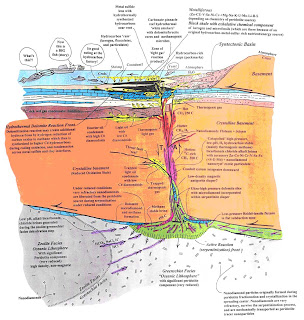
Figure 7. This illustration, by Stan Keith and Monte Swan (2004) shows the whole concept of why serpentinization is so important for life on Earth. The process has also been active on Mars, but has probably not lead to life there (because of the difficult atmospheric situation, where liquid water is not stable).
The Serpentosphere has enormous and novel implications for four major geologic problems that are of current interest to the geologic and social community:
1) the driving mechanism for plate tectonics,
2) the origin of life,
3) the origin of hydrocarbons, and
4)contributions to global climate.Because the Serpentosphere has been continuously generated since the beginning of geologic time it must be considered as one of the fundamental entities of our water-surfaced planet – the only water-planet we know of ...(Keith et al., 2008).
Stan Keith profile
So to me this serpentinization is very important, because you could have a circumstance where a body of ice is built up over suitable rock, and it would sit static for a long time like a fireplace full of wood where no source of ignition was provided. However if a quake or perhaps even a slight atmospheric warming (From a actual Volcano?) were to occur, and a trickle of melt water were to run into those rocks, heat can be generated from a chemical reaction, and that could further mix the rock and water and cause a run away reaction.
That could generate significant Methane, and temporarily alter the climate of Mars.
Figure 7. This illustration, by Stan Keith and Monte Swan (2004) shows the whole concept of why serpentinization is so important for life on Earth. The process has also been active on Mars, but has probably not lead to life there (because of the difficult atmospheric situation, where liquid water is not stable).
The Serpentosphere has enormous and novel implications for four major geologic problems that are of current interest to the geologic and social community:
1) the driving mechanism for plate tectonics,
2) the origin of life,
3) the origin of hydrocarbons, and
4)contributions to global climate.Because the Serpentosphere has been continuously generated since the beginning of geologic time it must be considered as one of the fundamental entities of our water-surfaced planet – the only water-planet we know of ...(Keith et al., 2008).
Stan Keith profile
4. Mud Volcanism
Mud volcanism is one of the strangest and least understood geological processes on Earth and Mars. A mixture of liquified minute clay particles, water (brine and pure H2O), gas (methane and carbon dioxide), and oil continuously wells up in these special volcanoes. It is only very rare that heat is associated with them, - normally they have ambient temperatures. The photo below shows a typical onshore mud volcano south of Baku, in Azerbaijan. The four components (mud, water, gas, and oil) are here present.
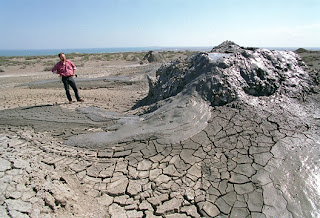
Figure 10. A so-called 'gryphon' on the large Dashgil mud volcano south of Baku (from Hovland et al., 1997). Liquid mud, gas, and oil is tranported naturally from an unknown depth below ground to the surface. The gryphons are associated with pure (fresh) water, as salty water (brine) does not transport mud to surface
The next image, is a conceptual presentation of the Dashgil mud volcano, where the above photo has been taken.
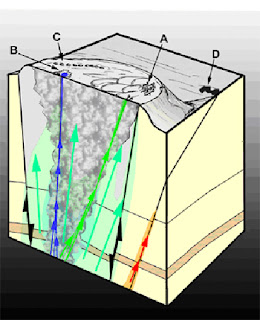
Figure 11. A conceptual block diagram of Dashgil mud volcano. The above photo was taken at 'A', i.e., at the gryphons, caused by fresh water (condensation water) flow to surface. 'B' shows a 'salse', which is a brine pool, caused by salt water flow to surface (blue arrows). 'C' is a line of sinter cones, demonstrating that there has been fire on the mud volcano at one instance (forming burned clay - sinter). 'D' is a pool of crude oil, showing that oil is also transported within the mud volcano, but is diverted outside the main conduit some depth below ground.
Mud volcanoes in the Gulf of mexico
There are even mud volcanoes on top of the fishing banks and natural sanctuaries "East and West Flower Garden Banks" in the northern Gulf of Mexico. Why are they there? To us, the reason is simple: These banks are formed on top of deep-rooted salt domes, that tap hydrothermal fluids at depth. Some of the surplus fluids rise through the internal central conduits of the salt domes and issue through their tops. This is where the mud volcanoes and underwater brine lakes occur. This is also where small amounts of hydrocarbons issue to the water column and fertilizes the local biosphere (i.e., the banks).
Look for the supporting evidence here:
Finally this is from a different set of people, a different article:
http://news.sciencemag.org/2011/04/scie … -volcanoes
So, perhaps this could hold evidence of underground life ejected to the surface at some time in the past.
It does not replace the materials you have presented. They are two different things, but it is interesting as well.
Finally, if Serpentization can occur on Mars, perhaps Fracking to cause it occur, could provide Methane on the cheep for terraforming Mars.
#8763 Re: Interplanetary transportation » Mission to Venus » 2014-12-29 14:10:05
Tom,
At the start I concluded that there would be no point to sending a personed mission to the atmosphere of Venus, unless you planned to inhabit it. It would be better to send automation.
If you do plan to inhabit the atmosphere of Venus, true, you have to have methods compatible with what will be encountered. However, if you have to make processed materials to expand your habitation, I see nothing wrong with altering the environment, if you can find a pressure point, and it fits with your economic/process model.
Small alterations such as removing Chlorine and Bromine from the upper atmosphere by adding Hydrogen to it (Or water which will add hydrogen), may be of a reasonable cost effort to justify. If an Ozone layer does develop as a consequence, it then reduces the Sulfuric Acid production in the atmosphere. It also as a consequence reduces the rigors imposed on your equipment by reducing U.V. and reducing the acid nature of the atmosphere.
Further tweeks such as containerizing as much water as possible into expanding habitats will also reduce the production of Sulfuric Acid.
Seeding the Sulfuric Acid clouds to cause them to rain out more (And be heated and decompose to water and Sulfur Trioxide), are contingent on the economic value of such an action. If you prefer water to Sulfuric Acid then you might want to make the effort.
No idea how much Venus is worth. Who owns it? "B.S.ers" according to them.
#8764 Re: Life on Mars » Where Should we Send our Rovers to Mars to Look for Early Life? » 2014-12-29 12:39:16
OK, signs of ancient life.
I would wonder how old these features are, how buried they are. That is if you are going to look for ancient life, it could have been buried and exhumed by processes over time.
One thing that I would be interested in is seeps in the walls of canyons. If ancient, then wind may have worn off the stains, but perhaps the cracks can be identified?
Those locations would be hard to access however being vertical.
I wonder if the study of permafrost springs in the permafrost regions of the high Arctic could reveal rules about where springs are likely to have occurred in these regions under certain climate conditions.
If you might have had a lake, it is possible that it was spring fed, in a location with such changes in altitude. As the lake might have dried up, then the springs might have been the last gasp of surface life.
Moving forward in time for a moment, I would have to speculate that under conditions where the equator were glaciated, where the atmospheric pressure was just a bit higher, it is not out of the question that snow pack could have melted and charged aquifers even in the last few million years.
For this reason, I would not even entirely rule out the existence of seeps even now, but they would evaporate as soon as the water emerged to the surface. (Unless briny).
But going back, I suppose the acid phase of water might very well have done in any life that might have existed in ancient times, except perhaps underground, if an aquifer was not too salty.
That dark patch does look interesting.
A spring on Mars would benefit from being covered with an ice covered lake, that is the most likely situation where the permafrost would thaw enough to permit a persistent artesian well-up. A transition from artesian water to lake water might cause chemicals to deposit, which might preserve evidence of life I suppose. Perhaps the life would have even used the contrasting water chemistry to drive it's metabolism.
#8765 Re: Interplanetary transportation » Mission to Venus » 2014-12-29 09:10:31
You are inconsistent.
Void: I've explained several times in the thread why rocket propulsion is a horrible idea through the lower Venus atmosphere, it's like trying to go through the Earths ocean in a rocket. And it is completely unnecessary when we could access the surface by lowering a cable from a floating platform (which is coincidentally how we get to the bottom of Earths Oceans most of the time). People need to stop being hung up on 'Flying' everywhere at high thrust simply because we left the Earth and are in 'Spaaaace'.
The phrase "Most of the time". Well, maybe there is a minority case for using a rotor rocket. And in any case finding out why it is a burden and not useful is valuable. And I was attempting to interact with another member.
Then you dismiss what I say with "Its terraforming, this is the wrong place." Then you go ahead and propose a terraforming scheme which will require an enormous amount of time, but you say that we have to adapt to Venus the way it is.
Just pointing it out.
#8766 Re: Interplanetary transportation » Mission to Venus » 2014-12-28 21:49:09
Quaoar wrote:
Impaler wrote:
rotor-rocket can fly in the atmosphere like a spaceplane with atmospheric engines, without the mass penalty of wings an engines (actually we have no jet engines able to burn fuel using CO2 as an oxidizer). Rotor blades with tip rockets are very light, can function in every kind of atmosphere and during ascent augment the rockets exhaust with atmospheric gasses, resulting less propellant consumption
Because of your post, I have been thinking about steam powered rotor rockets for transit between the clouds (Where habits might be possible), and the surface. Rotor down with a full tank of water (Which is also a consumable coolant), heat up your tank, and then rotor up with steam power. Not for humans I would think, but robots.
And on the surface nuclear powered robots for mining.
On the subject of mining, I wonder how hard it is to have super critical CO2 on the surface of Venus to extract Magnesium from the rocks?
And Magnesium being able to burn in CO2, of course that is the reason. I have read of Powdered Magnesium rockets, but I am sure they are hard to run. I think in one case they used a slurry of oil and Magnesium powder, but then tried to use Nitrogen? and Magnesium powder. (But I don't think it was a jet engine).
#8767 Re: Interplanetary transportation » Mission to Venus » 2014-12-28 21:30:15
Since this discussion appears to be a cross between terraforming, methods of dwelling in the atmosphere of Venus, and so justifying human presence and a mission to the atmosphere of Venus, I will post.
I have this information on a critical issue:
http://en.wikipedia.org/wiki/Sulfuric_acid
Extraterrestrial sulfuric acid
VenusSulfuric acid is produced in the upper atmosphere of Venus by the Sun's photochemical action on carbon dioxide, sulfur dioxide, and water vapor. Ultraviolet photons of wavelengths less than 169 nm can photodissociate carbon dioxide into carbon monoxide and atomic oxygen. Atomic oxygen is highly reactive. When it reacts with sulfur dioxide, a trace component of the Venusian atmosphere, the result is sulfur trioxide, which can combine with water vapor, another trace component of Venus's atmosphere, to yield sulfuric acid. In the upper, cooler portions of Venus's atmosphere, sulfuric acid exists as a liquid, and thick sulfuric acid clouds completely obscure the planet's surface when viewed from above. The main cloud layer extends from 45–70 km above the planet's surface, with thinner hazes extending as low as 30 km and as high as 90 km above the surface. The permanent Venusian clouds produce a concentrated acid rain, as the clouds in the atmosphere of Earth produce water rain.
The atmosphere exhibits a sulfuric acid cycle. As sulfuric acid rain droplets fall down through the hotter layers of the atmosphere's temperature gradient, they are heated up and release water vapor, becoming more and more concentrated. When they reach temperatures above 300 °C, sulfuric acid begins to decompose into sulfur trioxide and water, both in the gas phase. Sulfur trioxide is highly reactive and dissociates into sulfur dioxide and atomic oxygen, which oxidizes traces of carbon monoxide to form carbon dioxide. Sulfur dioxide and water vapor rise on convection currents from the mid-level atmospheric layers to higher altitudes, where they will be transformed again into sulfuric acid, and the cycle repeats.
So, I feel it would be great to disrupt the Sulfuric Acid production. An enhanced Ozone layer might help. To get rid of Chlorine, add Hydrogen or water vapor to the upper atmosphere. That will at least reduce the destruction of Ozone which is produced. If that can occur, then less Sulfuric Acid production.
If I understand what they have said, you can also create water for your habitat by heating Sulfuric Acid above 300 degrees C and adding Carbon Monoxide. That would yield the water you need for your habitat.
To further get rid of Sulfuric Acid, perhaps a cloud seeding effort could nucleate more of it to rain, and so drop it down to the hot layers below.
I am thinking that further isolating water from the atmosphere would be helpful. Some could be split, and the Hydrogen released to the upper atmosphere, to reduce Chlorine and Bromine, the rest should be put into enclosures.
If a useful Ozone layer were caused to happen, then transparent plastic envelopes might be of use. I am thinking of an interior atmosphere of Nitrogen, Oxygen, CO2, and saturated humidity.
Balloons floating within the balloon could be robots that spray nutrients onto the interior of the plastic which would be wet from the saturated humidity.
The robot balloons would perhaps float with Helium or maybe Hydrogen could be rendered safe enough if they are not so big as to make a damaging explosion.
As Algae matts grow on the interior of the balloon they will become too heavy to stick and will fall down to the bottom, where the organic matter could be collected for whatever value it may have.
So my objective would be to expand this process until hopefully there was a good Ozone layer, and far less water vapor clouds. Ideally none or almost none.
Then the atmosphere of Venus would be much more conducive to human habitation.
#8768 Re: Life on Mars » Where Should we Send our Rovers to Mars to Look for Early Life? » 2014-12-28 16:07:45
I will suggest a possibility.
With cycling temperatures, salt absorbing water from the atmosphere, I think sandstone, or soil for that matter, might create small amounts of brine under the surface at some locations some of the time. Freezing temperatures will separate a part more salty from a part less salty. So it will push the brine out of equilibrium. When the less salty part melts at the next day, it might be the most usable by life as a solution to absorb water from. I also think that the two salt solutions might also provide energy for the microbes.
http://en.wikipedia.org/wiki/Reversed_electrodialysis
I am guessing from the dates on the article above, that it has not worked out as a machine process, however the article below continues with it.
http://pubs.acs.org/doi/abs/10.1021/es5005413
I certainly might not know what I am talking about here, but it seems to me membranes and cells go together, and if there is an energy source, I can at least speculate on an organism harnessing it.
Mars offers solar, chemical, and perhaps this energy. To find life near the surface, brine does offer the best chances for a solvent, as far as I could speculate. It might also offer an energy source which does not require exposure to U.V light.
And if this is worthy of speculation, it also points to a method for life to be powered in Europa, and other underground seas.
Sandstone, may allow light into the near surface, so maybe is is a good choice for life that might use several energy sources, or a community of life that each uses one, solar, chemical, or salt differential.
Away from the equator, I would speculate that water ice deposited over salty soil might also offer a seasonal habitat.
I suppose it is a long shot, but I would think that a search might be done to see if any organism can utilize a difference in salt between two liquid layers. For instance I think many bodies of water have differential salt layers. An Antarctic Dry Valley lake has briny water at the bottom, and less salty at the top.
A river running into the great salt lake for instance might be a place to look. Tidal pools.
Of course, other Earth organisms might have suppressed the development of such organism by being more competitive and pushing them to extinction or preventing them from developing. But I would think that if science actually does not dismiss the idea, it would be worthwhile to look for such on Earth. A more precise analog might be in a high salt desert in Tibet, or other mountain ranges. Preferably where a day night cycle repeatedly freezes and thaws a salty soil.
Most salt water differentials would require the organism to move long distances to experience first the more salty and less salty. However a freeze/thaw of salty soil might provide a short term differential, where a single droplet of salty water was the habitat which each cycle is separated into differential fluids by freezing and thawing.
#8769 Re: Life support systems » Turning structures like Mount Sharp into Martian Cities. » 2014-12-23 12:25:31
Interesting idea, incorporating artists.
If there were enough room, perhaps data elsewhere. Primitive, but durable, possibly slow to degrade.
And then if you are going to hollow out sandstone, perhaps some of the material could be captured as sandstone blocks. Those could be used to support solar panels, pave roads, and make Roman Arch buildings outside? Maybe it could even be some of the materials to build a GW Johnson Mushroom Building?
Here are some references.
http://en.wikipedia.org/wiki/Sandstone#Cement
https://www.google.com/images?q=manufac … d=0CBQQsAQ
http://www.ehow.com/how_8473339_cut-san … locks.html
http://en.wikipedia.org/wiki/Sydney_sandstone
http://www.kls-sandstone.com.au/cutting.htm
And;
Utensils
https://www.google.com/images?hl=en&q=S … d=0CBYQsAQ
Abrasives:
https://www.google.com/images?q=Sandsto … &oq=&gs_l=
Nife Sharpeners:
https://www.google.com/images?q=Sandsto … &oq=&gs_l=
#8770 Re: Terraformation » Terraforming small icy moons and comets » 2014-12-22 11:31:39
I have just been on this topic, to test the idea that human like populations could be involved in interstellar travel. Antius added a more active concept, then just slow migration.
I guess I would not consider trying to move a large object (Dwarf), unless some completely unknown powering method was discovered. I don't think it likely.
The only modification I could add to what Antius has specified, is that when you were done with the Comet, you might have choices. You could split into pieces, and use one piece to impact a target planet. For instance a cold world with a Nitrogen atmosphere, to give it a temporary warm up.
Depart from the comet with your ships, slow them down, possibly have been able to target the said planet with the comet remnant. Land you ships on a temporarily warmed up planet. Release super greenhouse gasses.
#8771 Re: Not So Free Chat » Replacing the Nuclear triad with space based nukes in high orbit. » 2014-12-20 17:48:46
Tom,
I have to side with the others here. A Dr. Strangelove doomsday machine is a very bad plan. Anyway that could be done in the oceans. You could put robots there, have them hide down deep, and ask for instructions periodically. If no-body answers, then the nuke the world. That was considered, but for good logic I think dropped.
One of my hobbies is to study the human race. I am mostly letting that go dormant for now, but I can say that there is little to be done about the "Sino" rise, but to encourage them to be wise, (Without lectures). They are much different, but the age we came from is passing. You adapt, or get shoved out of the way.
Fortunately, to be of European descent and several other descents, means that some of us are adaptable very well for what is to come. But continue with your agenda, it confuses them but just don't forget that everybody is a looser if a nuclear war happens.
#8772 Re: Life support systems » Turning structures like Mount Sharp into Martian Cities. » 2014-12-20 17:40:20
Louis,
I want to make sure that I did not intend the "Screaming Child" thing to indicate you or any of your associates. I am really thinking of the human race as a whole, and much less people like you.
Please don't take insult.
#8773 Re: Not So Free Chat » Replacing the Nuclear triad with space based nukes in high orbit. » 2014-12-20 13:52:07
Quote Terraformer:
Well, the US has already made it clear that they're an existential threat to all humanity.
What? Show me.
#8774 Re: Life support systems » Turning structures like Mount Sharp into Martian Cities. » 2014-12-20 10:04:58
But I think there is no reason to close off other options at this point. Granted solar cells are the most proven option for Mars, but it will be some time before the first "BackPackers" go to Mars. When they do, I think it is very likely they will have solar cells or fission nuclear in their backpacks.
However, when they are in the forest, they may come upon options which could prove valuable. I think it is too soon to pour concrete on this. Measure twice, cut once.
Having specialized thinking is good to create a focus, but if that focus is off center for best options, then much might be lost.
I am most interested in contrasting options.
1) Lava Tubes
2) Sandstone
3) Salt Domes
4) Create structures manufactured (Although they have to be buried if they are for human habitation).
And then there is another option.
5) http://phys.org/news/2014-12-thermoelec … wable.html
For the adaptation, I resort to reservoirs of water. Although it will not be possible to completely eliminate salt, salt is hostile to manufactured items in most cases, so I propose
reservoirs of mostly fresh water where the typical top layer is ice, and above that a protective cover, perhaps soil/rock. Below that cold water perhaps 0 degC. In that containment, tanks of hot water with the energy producing ability of the article cited. To keep the cold layer and the hot tanks fluid, then solar concentrating mirrors, to create steam.
But this is a late development method, and will be most suited to high latitudes. So, first the backpackers (Which most of you are), and then targets of opportunity, then perhaps mastery of the planet (Maybe).
It is too early to exactly specify, in my opinion.
Fusion is likely the golden hope. If and when ever happening, then it opens two worlds that offer some mercy.
It is silly for us to pretend that we do not rely on Earth's kind nature to give us most of what we have. And to get that we butcher it without mercy. The hope is to become more that a screaming child, a brat that demands things. It is possible, but not assured that our blood lines will achieve respect.
So, sure, solar cells have merit, but what about Titan, and the beyond? No solar to speak of there. We are too soon to plan for what may be in 15 or 30 years. I will be well forgotten then, if not sooner.
Please note that I altered Fission to Fusion for the golden hope. Weekends make me only worse for coherance Whatever.
I just think you need to be careful to not be myopic before you have considered the whole long scale progression potentials.
#8775 Re: Interplanetary transportation » Mission to Venus » 2014-12-19 09:07:32
I'm really not qualified, but I started this so, an attempt must be made.
Could a retrieval device drop down by gliding, and under power, drop a basket and hover. The persons would have to get into the basket (In suits), and somehow survive a move to orbit. That is after in the basket, quickly get into an un-pressurized cab?
Granted that's sci-fi, but Venus does have an about 90% gravity field? So slightly favored by that.
I just posted the article however, I thought it would be of interest to those who want to colonize Venus, and also a break from the current carnage going on in other locations of this site.
In addition to the gravity favor, there are additionally favors of;
-Temperatures
-Pressures
-Radiation Protection
So, some of the rigors are relaxed relative to Mars or the Moon.
So, maybe a glide, hover, space shuttle while a burden is balanced out by the favors, and the mission is not quite so impossible.
And then as stated in the article, the solar energy situation is much more favorable, both for the interplanetary flight, and for life support when in the envelope of the atmosphere.
But if you want the truth, I would favor expendable robots working with an airship, and if sample return was desired, I think that could be arranged. Obtaining propellant from the atmosphere might be possible.
I would certainly think that should be done first.
And then if you have all your scientific information, there is no reason to expose humans to risk unless you plan to build floating cities.