You are not logged in.
- Topics: Active | Unanswered
Announcement
#651 Re: Terraformation » Plutoids and Rogue Planets, Titanformation process, a cold treasure? » 2025-10-01 07:42:03
I think I mostly agree with you Calliban, it was just an instance where Isaac Arthur pointed out that the additional speed needed to exit the suns gravity well was about that for a jet liner, so relatively small.
But in a sense these objects are already transiting the galaxy with our sun aren't they? These worlds will likely survive the red and white dwarf stages our star. And if our star loses about 1/2 of its mass then they will likely go rogue as their speed will exceed the gravity of the sun.
Somehow, though I don't think that anything like current humans will be around then. We are recent arrivals and not likely to be unchanged.
But humans like certain animals may learn to make paper as shelter in space before that.
None of these are my favorite animals but they do work with paper, quote:
Copilot Search Branding
Three animals, paper wasps, hornets, and yellowjackets, have independently invented the making of paper. Paper wasps use small particles of wood gnawed off from trees and wood posts as their raw material, mixing these fibers with their saliva.
Do you think that it may be possible to manufacture a paper/cardboard/? shell around a dwarf planet, beyond its hill sphere and hold it in place by some means? I am very uncertain about it.
https://en.wikipedia.org/wiki/Hill_sphere
Quote: 
OK, maybe that is not the thing to do.
Anyway you could make a giant moon out of Paper/Cardboard/Wood perhaps.
https://www.nasa.gov/solar-system/new-h … -on-pluto/
Quote:
Additionally, new compositional data from New Horizons’ Ralph instrument indicate that the center of Sputnik Planum is rich in nitrogen, carbon monoxide, and methane ices. “At Pluto’s temperatures of minus-390 degrees Fahrenheit, these ices can flow like a glacier,” said Bill McKinnon, of Washington University in St. Louis, deputy leader of the New Horizons Geology, Geophysics and Imaging team. In the southernmost region of the heart, adjacent to the dark equatorial region, it appears that ancient, heavily-cratered terrain (informally named “Cthulhu Regio”) has been invaded by much newer icy deposits.
https://commons.wikimedia.org/wiki/File … cture2.jpg
Image Quote: 

So, could the ices be removed and used to construct mega-structures in orbit of Pluto?
Not sure that diagram is accurate.
Perhaps giant wooden/paper/cardboard/water ice shells even in a solar orbit not in orbit of Pluto.
I am thinking of getting to the core materials.
Perhaps lasers from the interior of the solar system could provide the energy to do this.
Yes, this is a bit lame, but if you could make a paper shell, could you cause it to have a changed solar orbit by shining lasers on to one side of it? 
This would be unlike a solar moth which has to expel mass, it would be pushed by photons.
A method perhaps to draw paper objects inward in the solar system. Co-operation might be likely between the inner and outer solar system as the inner supplying the laser light from sunlight to the outer solar system, and the outer solar system supplying the wood/paper/cardboard shells.
The downside of relying on lasers from inside the orbit of Mercury for instance, is why would the people there send the laser power? But if they get payment in wood/paper/cardboard, perhaps they would like to do so.
Ending Pending 
Quote:
Copilot Search Branding
Wood is primarily composed of several substances, including:
Cellulose: 40-50% - The primary structural component providing strength and rigidity.
1
Hemicellulose: 20-30% - A polysaccharide that contributes flexibility.
1
Lignin: 15-30% - Provides rigidity and resistance against decay.
1
Extractives: 1-5% - Includes resins, oils, and tannins that affect color, odor, and durability.
1
Minerals: 0.1-1% - Inorganic components like calcium, potassium, and magnesium.
1These components contribute to wood's strength, durability, and resilience, making it suitable for various applications.
13 Sources
https://hobbydisiac.com/chemical-properties-of-wood/
Ending Pending
#652 Re: Terraformation » Plutoids and Rogue Planets, Titanformation process, a cold treasure? » 2025-09-30 12:21:41
Nice Calliban.
Issac Arthur has this latest gift for us: https://www.youtube.com/watch?v=GboWwqzAHEo
Quote:
New Dwarf Planet Discovered... A Minor Planet With a Major Future?
Isaac Arthur
823K subscribers
Dry rock resources could be sent out to these worlds, perhaps with lasers. To Makemake, this one and others.
Isaac Arthur suggests that this new Dwarf Planet could be nudged into being a rogue planet rather easily. So, then an ark traveling the galaxy.
It's only a paper moon: https://www.bing.com/videos/riverview/r … ORM=VAMGZC
Quote:
Ella Fitzgerald - It’s Only a Paper Moon
YouTube
Jazz Everyday!
934.7K views
So, although there are likly to be rocky inclusions, I suggest that for these dwarfs we could make "Paper moons".
Maybe cellulose moons?
https://en.wikipedia.org/wiki/Cellulose
Quote:
Cellulose is a complex carbohydrate made up of long chains of glucose units, forming the primary structural component of plant cell walls. It comprises about 33% of all vegetable matter and is the most abundant organic polymer on Earth. Cellulose is found in all plant foods and is used in various applications, including the production of adhesives, sponges, and as a dietary fiber. Its chemical formula is (C6H10O5)n, where "n" indicates the number of glucose units.
Wikipedia
+3
So, water ice, Methane, Ammonia, CO2 and so on. Could be glued with ice but maybe glued with glue.
Got down to a thin ice-covered ocean layer that allows mining the rocky core.
I also wonder about a laser relay.
That is is lasers could send light that far, overlapping, to say make a luminosity less than that of Earth, but that then being converted to electricity to drive lasers that shine onto Dwarf Planets further out.
Some of the waste heat could be used to keep the created ocean thawed.
And then again, we hope for both fusion and fission. There should be lots of heavy elements at the core of these worlds.
Ending Pending
#653 Re: Terraformation » Space Habitat Networks » 2025-09-30 09:47:59
Continuing from the previous post, the amount of air-filled void space is expanded: 
As the little world expands the box can be enlarged.
The box might have radiation protection especially in the direction from the sun.
While it may seem prudent to land all the resources for 1,000,000 humans onto Mars from Earth, could we consider manufacturing facilities on Deimos and Phobos, where many bulk items would be created, and those could be then transported down to Mars?
The speed of air braking would be reduced. Supplies from Earth/Moon could more come across with Electric Rockets.
Heat Shields might even be manufactured from the materials of Phobos and Deimos.
In the end you would have 3 worlds not just Mars, and if this can work then it would likely also work for worlds like Bennu and Ryugu.
Ending Pending
#654 Re: Terraformation » Space Habitat Networks » 2025-09-30 08:41:15
My interest in rubble asteroids, is expanding: https://en.wikipedia.org/wiki/Rubble_pile
Quote:
In astronomy, a rubble pile is a celestial body that consists of numerous pieces of debris that have coalesced under the influence of gravity. Rubble piles have low density because there are large cavities between the various chunks that make them up.
The asteroids Bennu and Ryugu have a measured bulk density which suggests that their internal structure is a rubble pile.[1][2] Many comets and most smaller minor planets (<10 km in diameter) are thought to be composed of coalesced rubble.[3][4]
Itokawa, Ryugu, and Bennu are listed. But the moons Deimos and Phobos are thought to be similar.
My suspicion of the nature of these is fine homogenous materials on the surface, and large chunks that might be diverse in nature in the middle.
The object will have a hill sphere, even Bennu as a spacecraft was orbited around it.
https://atlasof.space/bennu
Quote:
The OSIRIS-REx spacecraft
The OSIRIS-REx spacecraft orbited Bennu from December 2018 to May 2021, mapping its surface in detail and successfully collecting a sample from the Nightingale crater site before beginning its return journey to Earth. This mission was crucial in understanding the origins and evolution of the asteroid Bennu, which is a near-Earth asteroid with a dark, boulder-strewn surface. The spacecraft's orbiter provided valuable data on the asteroid's composition and history, contributing to our knowledge of the solar system's early history.
atlasof.space
But there should be a gravitational "Null" at the center of any world, I think:
https://physics.stackexchange.com/quest … nts-like-i
Quote:
Gravitational force is effectively zero
At the center of the Earth, the gravitational force is effectively zero due to the symmetrical distribution of mass, which results in equal gravitational pulls from all directions that cancel each other out. The gravitational force becomes undefined when the distance d equals zero, but this does not imply infinite gravity; rather, it indicates that gravitational force is null at the center. As one approaches the center, only the mass within the radius affects gravitational force, with exterior mass canceling out. The gravitational field is zero at the center, confirming that no net gravitational force acts on an object there.
Stack Exchange
So, I am expecting "Void" spaces in the area of the "Null" of a rubble world. (And no, I do not expect one at the center of the Earth).
The "Void" spaces may be filled with a fluidlike plasma or even some tenuous air molecules, and possibly even with condensates, more likely Ice and not Liquids.
The Suns solar wind flowing though the porosity, there may be quieted Helium and Hydrogen as fluids. Definitely not very dense, I expect.
The question is, where will fine particles settle? In the Null between big chunks, on the surface, or somewhere between the surface and the "Null"?

I suspect that this might be possible. Tides over time may cause the big chunks to settle inward, and that the fines being more mobile, to be strongest attracted to the sphere or maximum gravitation which will surround the null but be below the surface. I have shown it as "Red".
The above is a poor representation at best, but may be somewhat close to reality I suspect.
Depending on the size of a world of this type, Bennu vs. Phobos, results may be different.
But if this is at all true than it may be possible to burrow inside and inflate balloons, to fill and expand void spaces.
And it may be possible to do a shell around such a world, to help retain its surface materials from being splashed away by human activity.
So, I could suggest some modifications: 
In the case of Bennu, we know it has water, Carbon, and a bit of Nitrogen.
In the case of Demos, and Phobos, those might be available, but if not then Mars could supply them.
So, although Mars itself has importance, if these methods to work with rubble piles may prove true, then we have massive numbers of tiny worlds to work with in this manner.
Ending Pending
#655 Re: Science, Technology, and Astronomy » Genetics » 2025-09-29 19:52:31
I think that your words represent a set of valid measurements offtherock.
The question of smart must be answered by another human who may suggest that they are smart enough to measure another human being.
Now I am not wanting to suggest that I have all the mental assets that I wish I did, far from it. I am just happy if I discover that I have anything at all that may be of worth in that regard.
I grew up in a place where there were almost any ethnic group of Europe that you could imagine. And so called "Native Americans" as well.
At this point I don't particularly fault any of them for being bad, they do have some general differences, but they are all just trying to make something work. So, I want to make sure it is understood that I do not hate a particular religious group. At least as long as they are not involved in underhanded things. But I am at peace with all who I grew up with.
A story: A student kept harassing a teacher in a class, and said, how come people from my group have better grades than the other people?
The teacher resisted for quite some time, but upon becoming exasperated finally said "Because if I don't give you good grades, you parents will have me fired".
Well now then we may understand that intelligent might be defined by those who want to advertise their talents as the most important.
That is just a part of the puzzle though. There are so many things.
As for the Small Brains, they will tell you many things. The brains became more efficient. Tall people are more intelligent because they can have bigger brains. (Presumably their bigger brains are also claimed to be more efficient).
But the small brain has been associated with poor diets. That is agriculture, did not provide the same nutrients as Hunter Gatherer food, and was to some degree toxic. But it did allow hierarchy, and finally writing. Writing leads to libraries and evil librarians as well.
So, the super intelligent big brained Hunter Gatherers invented farming, and civilization and writing.
Then specialization occurred. A slow-moving hive mind of people rather than highly autonomous big, brained people. Specialists.
The priests could calculate the seasons and tell the surfs when to plant what. The surfs were experts at using s stick to plant crops.
The Pharoh banged his sister or mother and produced (Oops!). But being a deformed god-king, it was only appropriate that you should be able to grab anything you wanted. Perhaps not from the priests as much not directly.
So, if you are an inventor, and accumulate wealth from it pretty soon you are robbed and dead and perhaps the nobles are banging your women who have become low level servants.
So, yes stupid emerges from the most honored. And you better honor them or you are next.
The importance of wilderness is a template where nature will favor intelligence. Opportunities and problems to solve in order to survive gives you a large autonomous brain and if you can get yourself some leisure time, then you might reuse your large brain to think beyond just material needs.
There are other things to talk about in this regard, but the above is quite a lot.
Ending Pending
Oh there is one recent thing. Speculation that interbreeding with Neanderthals may have slowed down human evolution. Probably this is from the people with "Small Efficient Brains", and maybe they are tall with "Small Efficient Brains as well".
You see the problem is that they always have a need to be at the center of an ego they want to honor. It could never be that they the examiners may be examining things that may have been better in some ways then those who examine.
They seldom fail to do this.
Ending Pending
#656 Re: Science, Technology, and Astronomy » Genetics » 2025-09-29 03:21:44
Let's consider this to be an unpleasant medicine, but perhaps required at this point in the decay of our cultures: https://www.youtube.com/watch?v=S-ACTKA8NZQ Quote:
How Does the Female Brain Work? How Do Women Think and Reason?
PsycheDepth
Some of this I have figured out on my own. But don't get me wrong, I am not so much seeking a victory of some kind, I am old and just not interesting to those who may care and myself not so interested anyway. The idiotic conspiracy between governing powers and the female population is just a bit annoying.
I now understand fully that public school was designed to make me a useful victim. Thankfully in old age, I can understand that it no longer owns my soul.
A shame of our current situation is that I think that some of the ruling classes don't care if they run the system into the ground. And some foreign entities have cracked our code and are collaborating with those in our ruling classes who do not care if our culture is destroyed.
It is said that a crowd of idiots is an idiot, and a crowd of geniuses is also an idiot. So, the crowd of either gender is an idiot, I suspect as well. Not necessarily idiotic in the same ways, but idiotic. And then when the entire collection of humans becomes a reactive crowd you may get an uber idiot.
But I do agree that if females have what they seem to actually want, then only stone age attributes will be retained. If males have what they seem to actually want too many stone age attributes will be exchanged for a kindergarten reality. No need to be conscious, and no need to be robust.
Look upon the cultures of the world where in "Reality" one of the genders has the upper hand over many generations. I suspect that you will find excessive robustness or excessive gracile dominance. My idea is that there is a "Sweet Spot" that sometimes human cultures achieve. Without that failure is definitely an option.
I guess the less I say, the less I poison what is in the video.
So, I will stop.
Ending Pending
#657 Re: Terraformation » Space Habitat Networks » 2025-09-28 19:31:33
In post #7 Calliban provided very useful information, Quote:
Calliban
Member
From: Northern England, UK
Registered: 2019-08-18
Posts: 4,188
Bennu is technically easier to reach than the surface of Mars, or indeed, the moon. Its mass of 70 million tonnes, is sufficient for 20 Island One habitats and several hundred 10GWe solar power satellites. It is known to contain water, carbon, nitrogen and phosphorus, in concentrations much greater than we are likely to find anywhere on the moon. Whilst Mars is scientifically more interesting, Bennu offers better near term commercial prospects. The two goals are not mutually exclusive of course. But if I were in Musk's position, I would probably prioritise near earth asteroud settlement and mining, for the simple reason that they are more likely to offer a return on investment in a reasonable window of time. For space settlement to be sustainable, it needs to pay. The biggest hurdle that space colonisation faces is developing a business case for it.
It is very difficult for me to grasp just how much materials there are in an object like Bennu, so I will give some representation of what I think Calliban was indicating:
https://en.wikipedia.org/wiki/Bernal_sphere
Quote:
O'Neill versions
Island OneExample layout for an Island One-type Bernal sphere
In a series of studies held at Stanford University in 1975 and 1976 with the purpose of speculating on designs for future space colonies, Dr. Gerard K. O'Neill proposed Island One, a modified Bernal sphere with a diameter of only 500 m (1,600 ft) rotating at 1.9 RPM to produce a full Earth artificial gravity at the sphere's equator. The result would be an interior landscape that would resemble a large valley running all the way around the equator of the sphere. Island One would be capable of providing living and recreation space for a population of approximately 10,000 people, with a "Crystal Palace" habitat (consisting of several rings attached to the sphere at each pole) used for agriculture. Sunlight was to be provided to the interior of the sphere using external mirrors to direct it in through large windows near the poles. The form of a sphere was chosen for its optimum ability to contain air pressure and its optimum mass-efficiency at providing radiation shielding.[2]I
Image Quote: 
There are several likely means of propulsion.
Flyby's of planets such as Venus and Mars could eventually be involved.
But prior to that expulsion of mass by MagDrive, Neumann Drive or a Mass Driver system could move it from being a danger to Earth to an joining to another asteroid.
As a target for Starship centered expeditions, it would not require heat shields, and could provide Metha Lox propellants for the Starships to return to Earth/Moon or to proceed to another destination.
A list of near-Earth Asteroids, there are many of them: https://en.wikipedia.org/wiki/List_of_a … s_to_Earth
Even some stony asteroids may have some water: https://en.wikipedia.org/wiki/Asteroidal_water
Quote:
(25143) Itokawa
Water has been found in samples retrieved by the Hayabusa 1 mission. Despite being an S-type near-Earth asteroid, assumed dry, Itokawa is hypothesized to have been "a water-rich asteroid" before its disruption event. This remaining hydration is likely asteroidal, not terrestrial contamination. The water shows isotopic levels similar to carbonaceous chondrite water,[111] and the sample canister was sealed with double O-rings.[112][113
https://en.wikipedia.org/wiki/25143_Itokawa
Image Quote:  ]
]
Image Quote: 
Quote:
animated orbits of Itokawa (green) and Earth (blue) around the Sun.
So, I think the red is Mars. It looks like Itokawa almost touches the inner asteroid belt.
If Itokawa lacks things like Carbon, Bennu could provide it. And it is likely that the inner asteroid belt has more objects like Bennu.
So, you see dedication of 1000 Starships to asteroid projects may not be nearly as silly as a first look may indicate.
Ending Pending
#658 Re: Terraformation » Space Habitat Networks » 2025-09-28 14:28:28
Could Bennu be made into a spaceship over time? Not a fast mover though.
For instance, could you embed Starships into it's regolith?
At the beginning you could have microgravity inside of Bennu, and synthetic gravity stations nearby.
This has been considered: https://www.rochester.edu/newscenter/ci … Osadciw%29
Image Quote: 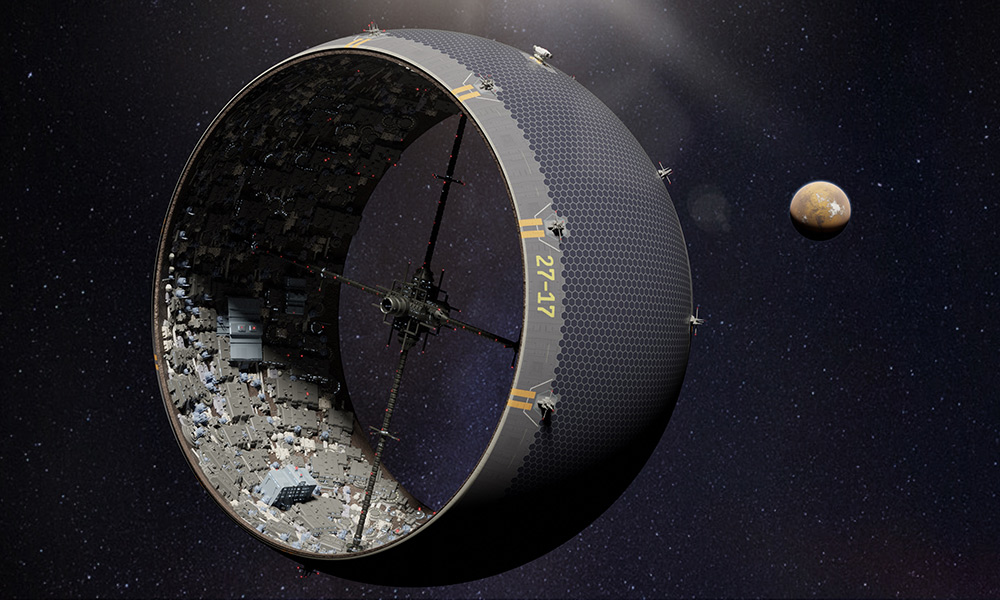
I am thinking girdles though: https://science.nasa.gov/solar-system/a … nnu/facts/
Quote:
Orbit and Rotation
Bennu makes one orbit around the Sun every 1.2 years. It makes one full rotation on its axis every 4.3 hours. Bennu makes a close approach to Earth every six years, coming within about 186,000 miles (299,000 kilometers) of our planet. Its orbital path is tilted about 5 degrees relative to Earth’s.The asteroid’s equator is tilted by about 175 degrees, so its north pole is pointing “down” relative to Earth’s north pole. By comparison, Earth’s tilt is 23 degrees, which accounts for the seasonal changes we see on our planet.
I think that means that the axis is relatively non-seasonal in nature. That the equator is relatively pointed to the plane of the solar system.
This is a simplistic plan, but is a starting point after just basic Starship Stations: 
So, both girdle and gravity might redirect the "Flab" of Bennu, to suit human needs. And over time this shape would evolve while the raw materials are consumed.
As a spaceship its path to take is to avoid undesirable collisions, with Earth and other objects, and perhaps to capture itself as a moon to a more major stony asteroid to begin to process.
I have read that their may be ~40 to 50 asteroids perhaps similar to Bennu. Ryugu is also one of them I presume.
I think that this could be beneficial to the human race, and might be a prelude to working with objects the size of Deimos and Phobos.
Ending Pending
#659 Re: Terraformation » Space Habitat Networks » 2025-09-28 09:58:12
We could try a lasso with a tether. A loop around the asteroid, can be helpful, particularly if there are large chunks that it might get looped around.
https://www.bing.com/search?q=The%20dim … orm=IPRV10
Dimensions Quote:
The dimensions of Bennu (101955 Bennu) are as follows:
Mean Diameter: Approximately 490 to 500 meters (1,610 to 1,640 feet).
3
Mass: Estimated at about 74 million tons.
1
Orbital Period: Approximately 436.6 days.
1
Rotation Period: Completes a rotation on its axis every 4.30 hours.
1Bennu is a carbonaceous asteroid in the Apollo group and is of significant interest due to its potential impact risk with Earth.
4 Sources
But there can be other tools.
A Starship with a Dipstick: So, if it had a dip stick, how far could it poke into Bennu? Radar and temperatures?
How about a "Mole on a Pole"? A battery powered mole might be poked in and might move about. Perhaps it would be on a tether so it could be pulled out.
Or perhaps a robotic fishy could be swishy.
Knowing the internal anatomy perhaps rock anchors could be deployed.
I may do a prolonged pause here for a bit.....Continued in next post;
#660 Re: Terraformation » Space Habitat Networks » 2025-09-27 16:38:46
To review again from post #9:
Here again is this resource: https://www.youtube.com/@Anthrofuturism
This one in particular is very good: https://www.youtube.com/watch?v=SOUHUxVU04sThe methods for the Moon may avoid Carbon, but for Bennu Carbon may be a very useful asset.
And they seem to have several other very interesting methods under consideration to take apart regolith into useful components.
Carbon is Easy, but Hydrogen apparently is accumulative, where the more regolith you treat very likely the more Hydrogen you will accumulate. And Helium 3 may be a bonus.
So, it we can master this game with small rubble asteroids, I feel we can expand though the small bodies of the solar system including the main belts and also the Trojan and Greeks.
This would be quite an accomplishment.
If SpaceX can get to building 1000 Starships a year and them maybe 10x or 100x that, we might have quite a different solar system with humans and their robots all over the place.
Ending Pending
#661 Re: Terraformation » Space Habitat Networks » 2025-09-27 14:23:38
So, things desired to work with rubble asteroids with water and Carbon are;
1) Hard Anchor point. (I hope Lasso methods may provide this).
2) Means to maintain human health near the asteroids long term, years. (I think a space station built of many Starships might do to start).
3) Means to collect asteroid materials into a centrifuge.
4) Means to process the collected materials, perhaps involving methods of pyrolysis.
Now, this is just a simple try: 
From the just prior post I hope to collect small rubble to the applicator: For Bennu, we might consider a honey applicator: https://en.wikipedia.org/wiki/Honey_dipper
Image Quote: 
If we imagine it on a robot arm, and then applied to the asteroid surface we might try magnetics and especially electrostatics to accumulate materials. Then the Applicator is put into the door and spun to shake the materials into the dual drum centrifuge.
I would like to consider if electrostatics might be able to be of assistance as in waste recycling: https://link.springer.com/chapter/10.10 … 62660-9_11
Quote:
Recycling of Waste into Useful Materials and Their Energy Applications
Chapter
First Online: 16 January 2025
pp 251–296
Cite this chapter
Quote:
Using electrostatics to recycle waste materials
Electrostatics play a crucial role in the recycling process by separating waste materials based on their electrical properties. This method is particularly effective for plastics, which can be sorted using electrostatic emitters that apply a high voltage to the waste materials. The separation process involves the application of electrostatic charge to the recyclable materials, allowing them to be collected according to their electrical properties. This technique is advantageous as it is relatively easy to implement compared to other recycling methods and helps in the proper disposal of waste materials, reducing environmental impact.
Springer
I believe that they use triboelectric forces somehow. I am not learned enough on that yet.
https://link.springer.com/article/10.10 … 24-00903-9
Quote:
using triboelectric energy to sort garbage
The integration of triboelectric nanogenerators (TENGs) into waste sorting processes offers a sustainable and efficient solution for managing waste. TENGs can be used to sort and recycle various types of waste, including plastic, electronic, medical, household, and biowaste. This technology allows for the direct utilization of waste materials, reducing the need for modification and minimizing the production of harmful gases. The electrical energy generated by TENGs can be used to power portable electronic devices, making it a versatile and environmentally friendly energy source.
Springer
I could hope that something like this may work: 
The hope is to get materials to stick to the then stick it into the door of the spinning drum assembly and then spin the Applicator to make the materials dislodge and then enter into the drums.
The drums filled up then a door closed, and the drum assembly deployed to a processing situation which might involve Carbon or Hydrogen Pyrolysis.
This is not at all a finished process, rather it is steps in a good direction, I hope.
We will hope to get fuels and eventually Oxygen from this and also to magnitize more of the Iron content to be helpful in extraction of Iron.
Ending Pending
#662 Re: Terraformation » Space Habitat Networks » 2025-09-27 06:32:47
Here again is this resource: https://www.youtube.com/@Anthrofuturism
This one in particular is very good: https://www.youtube.com/watch?v=SOUHUxVU04s
The methods for the Moon may avoid Carbon, but for Bennu Carbon may be a very useful asset.
You have mentioned the sort of fish jaws grabber and a ring to hold it on.
I have suggested a Lasso: https://en.wikipedia.org/wiki/Lasso
If an asteroid like Bennu has any big chunks inside of it might be possible to put a loop around a big one, and so get an anchor.
Mortar and Pistil is classic geometric Asymetrix symmetry: https://en.wikipedia.org/wiki/Mortar_and_pestle
Image Quote: 
Quite often there is an inni working with an outi.
For Bennu, we might consider a honey applicator: https://en.wikipedia.org/wiki/Honey_dipper
Image Quote:
This is an "Outie-Thingy". I hope to work with sticky forces to adhere powders and small stones to it in microgravity. Magnetics and Electrostatics might work. Also perhaps some other things like gecko feet.
I want an "Inni-Thingy" to spin to accept things from the "Outi-Thingy", The Outie-Thingy maybe sticky but if we spin in inside of a spinning bucket, we may accumulate materials into the centrifuge, where we might then further process the materials.
That is a good start.
If it has occurred to you that I am speaking in a manna adjacent to a concept of a male and female pairing, of course I am. That can be done scientifically.
Non-Science people have decided for you that Priests, Feminists, and Pornographers can determine what is and is not profane in that relm.
But all of them have a sex for power and money drive, and you should discipline all of them for intruding into your personal spaces and causing the human race to become unsuccessful in breeding. They have essentially bled the life force out of the human race so that they can rule, and extract money and power for the application of perversions.
Tell them that you are interested in science and what makes reality work properly. And do punish them if you can for perverting our world.
Ending Pending
#663 Re: Terraformation » Space Habitat Networks » 2025-09-26 14:51:24
Thanks Calliban.
I am very excited. If we could develop the tools to work with this material, then there may be so many other opportunities. We need proper tools.
And this may very well eventually fit into a reality where we seek establishment on Mars and Luna and other places.
You have offered tools with some prospect of profit. I have learned from such.
For the moment I am going to go just a bit frivolous, please excuse. Humor is often the laxative of the sphincter of wisdom. Or not. It depends how much freedom we have before the fuddy-duddies mess the progression up. In that case dumb is more likely than wise.
There is a wiki for plungers, my goodness I have to find a way to give them some support: https://en.wikipedia.org/wiki/Plunger
Image Quote: 
Now a rather simple tool, a plunger on a robotic arm, and impart to its plunger essence cling factors to make particles of a rubble asteroid hug to it.
We can try magnetics, static electrics, and what the lizards that walk on Walls do, Van ???
Anyway, then you can put the plunger into a centrifugal device and spin it until it's Klingons are spun off.
I think I already have better tools than that, but the point is we could get to a point where we could have a "drum" of Bennu Stuff that we coudl treat with pyrolysis. Several things could be achieved with this.
Anyway, if we get the tools to process fuzzball asteroids and can find a way to keep humans and robots functional multiyear beyond Earth, we might really burn rubber, so to speak.
Recently it has been said that the asteroid belt itself has many tiny asteroids.
https://eaps.mit.edu/news-impact/mit-as … main-belt/
Quote:
MIT astronomers find the smallest asteroids ever detected in the main belt
Illustration of the James Webb Space Telescope shining light on a population of small asteroids.
An artist’s illustration of NASA’s James Webb Space Telescope revealing, in the infrared, a population of small main-belt asteroids. Image credit: Ella Maru and Julien de WitJennifer Chu | MIT News • December 09, 2024
Categories: Planets, Research
What if some of them are like Bennu?
I have read that 40% of the inner belt is Carbonaceous.
https://en.wikipedia.org/wiki/C-type_asteroid
Quote:
whereas only 40% of asteroids at 2 au (300 million km; 190 million mi) from the Sun are C-type.[2] The proportion of C-types may actually be greater than this, since C-types are much darker (and hence less detectable) than most other asteroid types, except for D-types and others that lie mostly at the extreme outer edge of the asteroid
And similar methods may access the raw materials of Phobos and Deimos, even if they do not as much offer water and Carbon.
Ending Pending
#664 Re: Terraformation » Space Habitat Networks » 2025-09-25 09:48:19
So, if Bennu is 85,500,000 tons of mass, and 1% is water then 850,000 tons of water. (The water content may be greater than 1% though).
What about Carbon though?
https://www.nasa.gov/news-release/nasas … bon-water/
Quote:
5 min read
NASA’s Bennu Asteroid Sample Contains Carbon, Water
Quote:
4.5–4.7%
The asteroid Bennu is rich in carbon, with studies indicating that it contains 4.5–4.7% carbon by weight. This carbon content, along with the presence of water, suggests that Bennu may contain the building blocks of life on Earth.
NASA
+5
So, perhaps 3,847,500 tons of Carbon.
Carbon can be part of a fuel, or by itself even a solid fuel. And of course, CO can be a fuel. If you are in a solar orbit with Bennu, CO and O2 might be just fine to send a ship to Mars. Of course you would need proper propulsion methods for it.
And not I am not suggesting waiting for the before going to Mars, But later on it might be worthwhile, and Bennu might be worthwhile in itself.
Aluminum also could be a propellant but not as worthwhile as Hydrogen and Carbon of course.
We also have the possibility of electric propulsions such as mass drivers, MagDrive, and Neumann Drive.
And then there is Phobos and Deimos, which may have Carbon and maybe even hydrated minerals.
You might be able to refuel from them even if it is only Carbon and Oxygen.
Ending Pending
#665 Re: Terraformation » Space Habitat Networks » 2025-09-25 07:50:29
Isaac Arthur has given this: https://www.youtube.com/watch?v=-b71w0eTuck
Quote:
Orbital Foundries & Zero G Manufacturing - Building in Space
Isaac Arthur
823K subscribers
In the just prior post, the idea of retiring Starships to orbits or other worlds has been suggested.
Elsewhere I have considered a space station made of at least 4 Starships: 
Here I have suggested 12 Starships assembled to provide both microgravity and synthetic gravity: 
Spinning a drum like the pink ones may tend to cause gyroscopic instability, but the blue ones may stabilize it???
That is my impression. The blue is more like a torus, and the pink are more like a cylinder.
Some of my ideas are at least partly from other members.
Calliban at one point calculated the number of space habitats that could be made from Bennu.
What is the Mass of Bennu?
https://science.nasa.gov/solar-system/a … nnu/facts/
Quote:
Approximately 85.5 million tons
The mass of Bennu is approximately 85.5 million tons (77.6 million metric
So, that is a million times the dry mass of a Starship, (More or less, approximately).
What is the orbit of Bennu?
https://science.nasa.gov/solar-system/a … nnu/facts/
Quote:
The orbit of Bennu is characterized by the following details:
Bennu makes one orbit around the Sun approximately every 1.2 years (or 437 days).
2
Its orbital path is tilted about 5 degrees relative to Earth's orbit.
1
Bennu comes as close as 0.90 AU (about 84 million miles) and reaches as far as 1.36 AU from the Sun.
1
It makes a close approach to Earth every six years, coming within about 186,000 miles (299,000 kilometers) of our planet.
1These characteristics highlight Bennu's unique orbital dynamics in our solar system.
https://www.theweathernetwork.com/en/ne … roid-bennu
Image Quote: 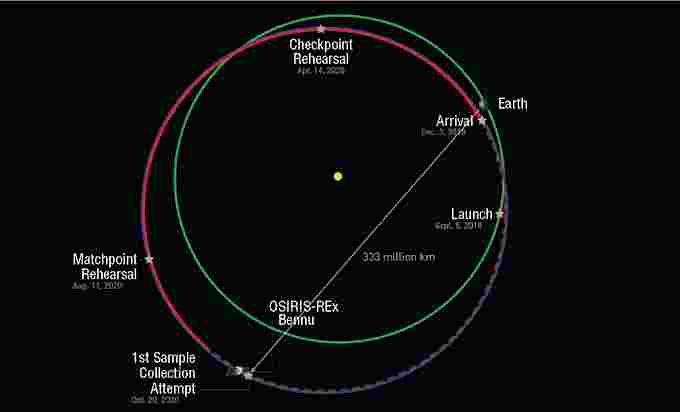
Composition: https://en.wikipedia.org/wiki/101955_Bennu
Quote:
Water
According to Dante Lauretta,[53] OSIRIS-REx Principal Investigator, "Bennu appears to be a very water-rich target, and water is the most interesting and perhaps the most lucrative commodity that you would mine from an asteroid".[54][55]Predicted beforehand,[56] Dante Lauretta (University of Arizona) reiterates that Bennu is water-rich- already detectable while OSIRIS-REx was still technically in approach.[57]
Preliminary spectroscopic surveys of the asteroid's surface by OSIRIS-REx confirmed magnetite and the meteorite-asteroid linkage,[58][59][60] dominated by phyllosilicates.[61][62][63] Phyllosilicates, among others, hold water.[64][65][66] Bennu's water spectra were detectable on approach,[59][67] reviewed by outside scientists,[68][44] then confirmed from orbit.[41][69][70][71]
OSIRIS-REx observations have resulted in a (self-styled) conservative estimate of about 7 x 10⁸ kg water in one form alone, neglecting additional forms. This is a water content of ~1 wt.%, and potentially much more. In turn this suggests transient pockets of water beneath Bennu's regolith. The surficial water may be lost from the collected samples. However, if the sample return capsule maintains low temperatures, the largest (centimeter-scale) fragments may contain measurable quantities of adsorbed water, and some fraction of Bennu's ammonium compounds.[71] A separate estimate, including other forms of water storage, is 6.2 wt%.[72]
NASA and university sample facilities are preparing to secure, study, and curate the sample, predicted to be rich in water and organic compounds.[73][74][75]
The German SAL (Sample Analysis Laboratory) is preparing to receive cosmochemical water from Ryugu, Bennu, and other airless bodies.[76]
Further information: Asteroidal water and 162173 Ryugu § Water
And there are Carbon and Metals also.
So, at some point could a refilling station be established and also a process to make more structure from the materials of Bennu?
Ryugu is even bigger, but may not have as much % of water.
Ending Pending
#666 Re: Terraformation » Space Habitat Networks » 2025-09-24 19:14:56
If you don't object Calliban I will put transplant this post to here, where I think it may have room to grow: https://newmars.com/forums/viewtopic.ph … 25#p234525
Quote:
If necessary (th) I will remove this post. But something related to space station building has just occurred to me, and I feel it is important.
I think that this video could relate to it: Depreciation / Amortization: https://www.bing.com/videos/riverview/r … &FORM=VIRE
Quote:Amortization explained
YouTube
The Finance Storyteller
153.4K viewsSpaceX has recently been flying the center core of Falcon Heavy as a Falcon 9. They do this for a while until using it in a Falcon Heavy. This gets some value out of it before it is used in an expended mode. So, the cost of the center core can be divided against several reuses, prior to its final use.
It has occurred to me that this could be done for Starship as well, the 2nd stage.
We usually say that Starship could be used as reusable, OR expendable.
But as I see it now, it should be used as reusable AND expendable.
If reusability can be achieved, (I think it will), then if you can calculate how many reuses are optimal, then finally you could run it as expendable to orbit and get the maximum value out of it.
Once dedicated to expendable, it would have its flaps and motor removed, and probably it's heat shield, and it would be launched with a current estimation of 250 tons of cargo. At that point, it and its cargo could be sold to a company like VAST, to for them to convert it to space station structure.
In reality down the line the probable cargo might get up to 300 to 400 tons, I am guessing.
The ship itself can then be refurbished with the cargo materials. By a company like VAST.
Ending Pending
The ships will face depreciation from wear and tear, but also by obsolescence, where for a time new ships are likely to have better performance than old style ships. So, that will depreciate their value over time and number of flights.
Ending Pending
So, I think that there could be a used ship market. These used ships might end up in clusters in orbit or even on the Moon or other worlds.
Ending Pending
#667 Re: Human missions » Haven Space Station due to launch 2026 » 2025-09-24 11:13:36
If necessary (th) I will remove this post. But something related to space station building has just occurred to me, and I feel it is important.
I think that this video could relate to it: Depreciation / Amortization: https://www.bing.com/videos/riverview/r … &FORM=VIRE
Quote:
Amortization explained
YouTube
The Finance Storyteller
153.4K views
SpaceX has recently been flying the center core of Falcon Heavy as a Falcon 9. They do this for a while until using it in a Falcon Heavy. This gets some value out of it before it is used in an expended mode. So, the cost of the center core can be divided against several reuses, prior to its final use.
It has occurred to me that this could be done for Starship as well, the 2nd stage.
We usually say that Starship could be used as reusable, OR expendable.
But as I see it now, it should be used as reusable AND expendable.
If reusability can be achieved, (I think it will), then if you can calculate how many reuses are optimal, then finally you could run it as expendable to orbit and get the maximum value out of it.
Once dedicated to expendable, it would have its flaps and motor removed, and probably it's heat shield, and it would be launched with a current estimation of 250 tons of cargo. At that point, it and its cargo could be sold to a company like VAST, to for them to convert it to space station structure.
In reality down the line the probable cargo might get up to 300 to 400 tons, I am guessing.
The ship itself can then be refurbished with the cargo materials. By a company like VAST.
Ending Pending
The ships will face depreciation from wear and tear, but also by obsolescence, where for a time new ships are likely to have better performance than old style ships. So, that will depreciate their value over time and number of flights.
Ending Pending
#668 Re: Interplanetary transportation » Multi-Ship Expeditions, Starboat & Starship, Other. » 2025-09-24 09:48:30
To condense the previous post down, it seems to me that the function of landing Cargo on the Moon and Humans on the Moon should be separated.
Either the contemplated or Stubby Starship could land on the Moon and stay there with cargo, or a combination of a Starship "Locomotive" and capsule could land with people.
SpaceX is planning to make 1000 ships a year??? So maybe not that out of the question.
In the case of a solar storm, which could be lethal, the "Locomotive" which is the propellant tanks and engines, could be pointed at the sun, with the capsule, being pointed away from the sun. This may be protective, particularly on the way out to the Moon, as some Oxygen and Methane will be retained for landing and lifting off from the Moon.
A "Locomotive" with enhanced capsule on it would be the least topple prone version I can think of particularly if it is the "Locomotive" of a "Stubby" Starship.
You would not land the human bearing device on the Moon, unless the Cargo ship had successfully landed without a topple.
Ending Pending
The "Locomotive" could also be used to land with robots to grab some geological samples and then go back to orbit as well. This would allow widespread research of the Moon.
Ending Pending
#669 Re: Interplanetary transportation » Multi-Ship Expeditions, Starboat & Starship, Other. » 2025-09-24 07:41:05
Perhaps in time some sort of legless landing method will be provided on other worlds.
Now, for my own amusement I want to play with the Lunar HLS.
This could be the existing plan for it or the Stuby substitute.
I will point out that NASA seems to be thinking short term as always, I am thinking longer term.
It seems almost strange to me that NASA decided to go with converting a Mars ship to work on the Moon. But that is good as I think prosperous results could become available from it.
Here, although legless landings could be considered eventually for now, I am going to suppose landing legs.
Pause............
I have said before that I am in favor of splitting Lunar HLS into the "Locomotive" and then the Cargo/Cabin section.
It is not logical to land a huge Lunar Starship, HLS on the Moon then launch it, and abandon it in orbit somewhere.
Logical would be to Land it and keep it on the Moon as potential shelter.
But how to get people up off of the Moon? Well, it you have a Standard or Stubbly Lunar HLS and land it for cargo carry and leave it there that is valuable, but does not get the humans back up to orbit.
But what if you took the "Locomotive" of one and plunked a capsule on to it? That is get rid of the fairings, of the Cargo/Cabin and plunk a capsule onto it. Orion or Dragon.
You may leave the Fairings for the Cargo/Cabin somewhere, maybe LEO to have further use.
Orion is heavy but deep space ready. Dragon is lighter but not alone deep space ready.
Two of the faults of Dragon are radiation protection and insufficient consumables. But if you have the Locomotive of a Starship with you, I feel that the radiation problem is quite improved. And you likely have room for more consumables.
Orion: https://www.space.com/5900-orion-apollo … nshot.html
Quote:
About 31,000 pounds (14,000 kg)
The Orion capsule is approximately 16.5 feet (5 meters) in diameter and 10.8 feet (3.3 meters) high. When empty, it weighs about 31,000 pounds (14,000 kg) and has a habitable volume of 692 cubic feet (11 cubic meters). It will be used for crewed missions beyond the Moon.
Space.com
+1
https://forum.nasaspaceflight.com/index … ic=53283.0
Quote:
Approximately 17,000 pounds
The Dragon capsule weighs approximately 17,000 pounds (about 7,700 kg) without cargo. The launch mass of Dragon 2, which includes cargo, is around 9,500 kilograms (approximately 20,900 pounds).
OK, there is some sloppy "Apple and Orange" factor here I bet, but it seem like for Dragon you could include an extra 14,000 pounds of consumables and radiation protection if needed.
Step #1, launch the Locomotive with Fairings to Orbit, possibly including a capsule on board.
Step #2, dispose of the Fairings or send the to salvage somewhere.
Step #3, fill the Locomotive with propellants. This should be a significantly reduced amount, I would hope.
Step #4, with humans on board launch to the Moon.
Step #5, land on the Moon directly, next to an already landed Lunar HLS.
Step #6, do to surface missions.
(Ideally): Step #7, refill on the Moon, possibly only LOX.
Step #7, Launch directly to Earth.
Step #8, Separate the Locomotive from the Capsule, and do a Capsule return to Earth.
* I would like a heat shield for the Locomotive so that it could airbrake several times into the Earths atmosphere to be reused, but in early missions it can be abandoned.
Ending Pending
Yes, you can associate this with a Lunar Space Station if you want to, but at additional cost of course.
I make note that Platinum Family Metals may not be at the poles (Or might be), so polar landings might not be the only interest.
With modern recycling water from the Lunar Poles is not as necessary as it might have been in the 70's. Time to update thinking???
Ending Pending
https://www.researchgate.net/figure/Art … _356285358
Image Quote:
Ending Pending
So, you now could make it "Stubby" as per Tim Dodd, and reduce the tank size, maybe even the number of Raptors.
https://www.bing.com/videos/riverview/r … dc0f2c8c61
Quote:
SpaceX's new Shorter & Better Starship Option to Go Back to the Moon REVEALED!
YouTube
Space Zone
78 views
Ending Pending
So, this is more of a set of questions, that might have some merit to consider.
If you wanted to bring some Platinum Family Metal samples back this might be a better way.
And if you want to transfer a small crew to and from a polar Moon base it might also be efficient.
Blue Origin's Blue Moon was a bit like this, without the capsule.
https://spacenews.com/blue-origin-unveils-lunar-lander/
Image Quote: 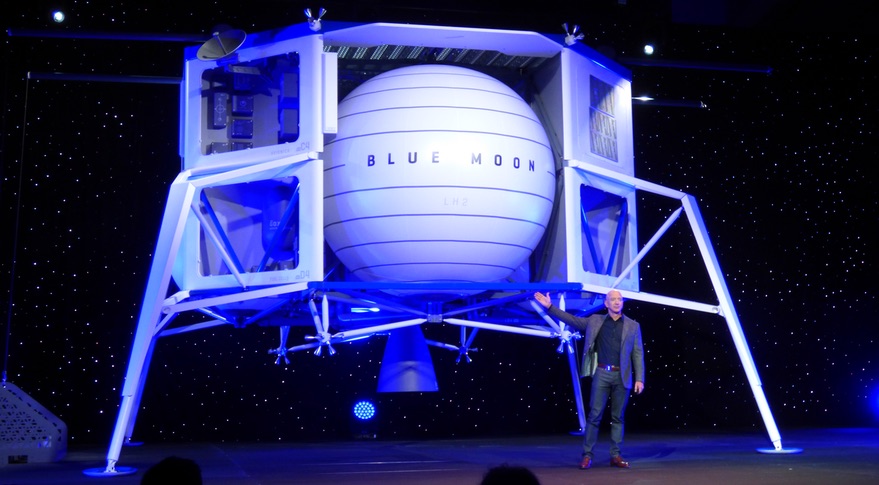
But of course, it would be Metha Lox of the Starship Raptor variety.
Ending Pending
#670 Re: Interplanetary transportation » Multi-Ship Expeditions, Starboat & Starship, Other. » 2025-09-23 07:35:11
I am not aware of who may be considering methods of landing on worlds with a greater partial vacuum by methods other than "Spaceship Stovepipe Vertical".
There has been some mention of horizontal landing experiments, China has been mentioned, and some whispers of consideration for a horizontal landing method for HLS on the Moon.
Of course I have previously suggested a angular landing option. This was presented as a method to land on an angled sort of belly flop into an appropriate frame.
I think because SpaceX has made Falcon 9 "Spaceship Stovepipe Vertical" possible where it was previously impossible, notions of other landing methods are of course not explored much at all.
It has occurred to me that it might be possible to land a ship onto the side of a hill that has proper characteristics, instead of a completely artificial pipe frame that I have previously suggested.
A "Spaceship Stovepipe Vertical" landing has the advantage that your main engines can be fully employed, but the disadvantage that the engine bay has to have legs added or your engines will be smashed. And the risk of uncontrolled topple is very undesired. And the fluids in the container, will not be likely to slosh in a useful way, but to be dead weight against the direction of travel that is being stopped upon impact to the surface of a world.

A 90 degree landing allows the use of the Main Tail Engines to work with mostly vertical descent motion. Unless you would land with extreme precision on tail end launch mounts previously placed on the surface of a world, then you need sufficiently substantial landing legs that can absorb the shock and avoid the potential for the stack to topple.
A 0 degree landing would take the Main Tail Engines mostly or entirely out of service, in that case you have to have auxiliary engines to land the ship. Although you might have some horizontal motion, you would primarily be again working with vertical motion. In this method because you don't have engine exhaust under every section of the ship you might have landing legs, or prepositioned cushions to help absorb the landing shock. If it is not done correctly the landing shock might break the ship into pieces.
An angular landing might have both horizontal and vertical motion involved. Also it might involve a "Tripping Impact".
A "Tripping Impact" might be imagined as a person running towards an inclined structure with airbags. If the ankles impact a airbag first, then a "Tripping" event will occur. But because airbags have been provided, a "Controlled Topple", can be implemented to reduce level of stress/damage.
Pause...........
So, Starship has the power to hover on it's raptors and even to "Crab" sideways a bit so you could "Trip" it into a "Controlled Topple", even without strong side thrusters. But on the Moon it may use the "OLM" engines??? for final landing???
https://arstechnica.com/space/2024/08/a … re/#page-2
Image Quote: 
So, either way it might be able to come in with some horizontal and vertical motion to get into a controlled trip situation.
I think this might resemble a jet landing on an Aircraft Carrier. Sometimes a net is used to help the landing of a aircraft with problems, I believe.
https://www.youtube.com/watch?v=4u5Ax35pcvw
Image Quote: 
So, it seems to me that the NAVY has a lot to offer for this.
Airbags, springs, and even pneumatic or rocket engines might buffer the impact.
So, could this work on other worlds, such as Mars? https://newmars.com/forums/viewtopic.ph … 44#p234444 Quote:
That cradle would promote a controlled tipping. Just for giggles lets say the cradle is 45 degrees, (But could be something else). The Cradle would have air bags, and landing braces.
And hooks are needed to keep the captured rocket from sliding down to ding the main engines on the tail. I have shown hooks in the above drawing.
So, all of this would be so that you could land a rocket without landing gear, onto "Landing Cradle".
So then you have to consider that on occasion you will get an explosion that will blow up your "Landing Cradle", so you have to not have excessive value invested into the "Landing Cradle", but make it just good enough.
Pause..........
In calculating what is good enough, you can consider the "Spring" features of the HLS, and also the effects of "Slosh".
Pause.........
Spring effects of the ship would be both linear and of the circumference of the ship. It exists probably but certainly had "Yield Limits". The ship has a small amount of self-protection but then methods of reception to the "Landing Cradle" need to give the remaining necessary protection.
But there is also "Slosh" of any liquids in the ship. This could be bad for the engines, but also could be helpful as then the whole ship does not stop all at once, but any liquid or object not well secured will slosh or bounce. Done correctly this could help to keep the ship from damage during the catch.
Well, that is what I have so far. I think it might be pretty good.
Obviously, this is not for the first landings but for resupply.
After a successful catch, then the options are to set the ship upright to 90 degrees for refill and relaunch or to pull it to horizontal 0 degrees to be converted into habitation.
Ending Pending
#671 Re: Not So Free Chat » Peter Zeihan again: and also other thinkers: » 2025-09-22 12:33:25
I have had a minimal training in Real Estate.
What we have to look out for is the establishment of claims of guardianship, encumbrances, and similar tricks to establish leverage to demand tribute.
I actually am very much a fan of the protection of potential Martian life. But I recognize what tricks the insincere may apply to this situation.
I do not want there to be another 50 years of space age dark ages, where the parasitic white collars drain to life forces of those dedicated to human advancement. There are certainly white collars that are workers, and extremely useful, but among them are the free riders.
To the free riders we are just the people that should be exploited to allow them to dwell with no accomplishments at the expense of the dedicated.
So, the situation is ambiguous. We are asked to be extremely moral while they rape us. Not a thing I care to tolerate.
Ending Pending
#672 Re: Not So Free Chat » Peter Zeihan again: and also other thinkers: » 2025-09-22 10:57:47
This is a strange place to put this, except that I want to untangle to possible trickery that may be employed on the basis of its materials. We will need to be prepared to adapt and also to work to inhibit the further enslavement of the human race, and particularly the USA.
https://www.youtube.com/watch?v=gcqFhzWVeW4 Quote:
What China Found on Mars Will Leave You Speechless - NASA Officials Are Alarmed
Top Master
I am impressed by the accomplishments of China.
But it is the nature of Fascists, Socialists, and Communists to regard the population as "Human Resources". This is somewhat less so in the west, and somewhat even better in the USA.
The speculation on life on Mars, is potential leverage for the various kinds of globalists to keep people in cages.
But don't get me wrong, I also appreciate that we do have a need to be concerned about possible life on a world.
Adaptation may require that we use the Moon and the Asteroid Belt resources, and that politically we may be walled off from Mars.
I think we can do a lot with the Moon and Asteroids, actually, but of course I wanted Mars as well, but we know that the white collars may seek to use this as yet another attempt to hold the actually productive population to satiate their selfish desires.
So, we have to make sure that they cannot do that. But we may be required to adapt.
Ending Pending
#673 Re: Interplanetary transportation » Multi-Ship Expeditions, Starboat & Starship, Other. » 2025-09-22 09:55:39
So, could this work on other worlds, such as Mars? https://newmars.com/forums/viewtopic.ph … 44#p234444 Quote:
That cradle would promote a controlled tipping. Just for giggles lets say the cradle is 45 degrees, (But could be something else). The Cradle would have air bags, and landing braces.
The Landing Cradle guides a partial topple. Cradle #1 is encountered first, and the #2, #3, #4, so four bumps.
When the ship slides down catching hooks lock it to the pipe frame.
I understand that likely for human arrivals, you will want landing legs, at least at first.
A tilted landing frame would have to be brought to Mars within a cargo hold, I would expect.
My notion of mass cargo transport after initial setup would be a Starship tuned to Mars, which might make multiple flights up and down, to receive cargo from interplanetary ships that do not land. This allows for Electric Rocket propulsion as the interplanetary propulsion method.
The wear on the heat shield of the ship would be reduced by coming in from Low Mars Orbit at a slower speed than for arrival from Earth.
The ships could position their metal wall portion towards the "Belly Flop" angled catch tower. The angle desired can be calculated for best effect, and indeed cushions and possibly air bags could absorb the pressure of the belly flop. This does not require as powerful of a nose engine as to allow for a horizontal landing.
Distributing the impact to the cushion devices, may allow for a lack of legs as dry mass, and may distribute the force of impact across the belly's larger surface area than the tail end of the ship.
The tanks themselves and the cargo walls, may even do some cushioning as well as they are inflated devices. There would be some spring-like nature to such tanks.
From the angled catch position, the ship can then be tipped upright to relaunch or with wheels or skids attached, be pulled down the ramp carefully to have a horizontal position.
Ending Pending
#674 Re: Interplanetary transportation » Multi-Ship Expeditions, Starboat & Starship, Other. » 2025-09-21 11:13:10
As an amendment to the just prior post, a plate of expanded metal dropped just prior to landing might be suitable to reduce the ejection of regolith in a landing process.
https://www.bing.com/shop?q=expanded+me … 853DB80039
Image Quote:
It might survive a drop from some few meters perhaps, and then the ship with angled landing frame might be able to land on it.
The metal would not be wasted, but recycled, and a proper landing pad made of regolith might replace it.
Ending Pending
#675 Re: Interplanetary transportation » Multi-Ship Expeditions, Starboat & Starship, Other. » 2025-09-21 10:17:57
This article talks about Vertical and Horizontal landing methods for HLS on the Moon: https://www.bing.com/videos/riverview/r … &FORM=VIRE Quote:
Elon Musk REVEALED Starship's 2 Moon Landing Options...Which One?
YouTube
Future Space
1 views
I think that in the future, smaller landers such as B.O. product, might be used for Humans.
But the Stubby HLS, would be wonderful to be deployable to the Moon.
The process of landing HLS on legs and then tipping it over to Horizontal has been considered.
If HLS is not to leave the Moon then you have a large propellant budget. Starship could hover (Unlike Falcon 9), and might ease itself horizontally into a tilted cradle already on the Moon.
That cradle would promote a controlled tipping. Just for giggles lets say the cradle is 45 degrees, (But could be something else). The Cradle would have air bags, and landing braces.

The Landing Cradle guides a partial topple. Cradle #1 is encountered first, and the #2, #3, #4, so four bumps.
When the ship slides down catching hooks lock it to the pipe frame.
https://www.bing.com/images/search?view … ajaxserp=0 Image Quote: 

So, initially the frame might be attached to a Stubby HLS, and landed with an intentional topple If it weighed only 50 tons, then a counterweight of 50 tons could be put on the other side of the rocket near the base.
Then after that you either remove the rocket from the frame to lay down horizontal, maybe attaching wheels to its tail end and using a wench after disabling the catch hooks, or you refill the ship, and it somehow launches. Maybe it is put vertical before launching.
Yes, I know that you are paranoid about flinging regolith into orbit, but initially there will be no other structures to harm. And you might somehow drop a plate to the surface of the Moon prior to this operation.
Anyway after you are set up you can create landing pads, and reuse the landing frame, as if the Stubby HLS goes to orbit, it will not take the landing frame with it. The landing frame is intended for repeated reuse.
This is just an initial on a napkin display of possible options.
Ending Pending