New Mars Forums
You are not logged in.
- Topics: Active | Unanswered
Announcement
#1 Yesterday 08:58:08
- Calliban
- Member
- From: Northern England, UK
- Registered: 2019-08-18
- Posts: 4,411
Electric Roads
I found this page discussing 'Electric Roads' on wiki and thought the topic deserved some discussion.
https://en.wikipedia.org/wiki/Electric_road
The idea is to transmit electric power to an electrically powered vehicle in motion. This is how trains are powered on electrified railways. An electric road extends that idea to road vehicles. This could be via induction coils within the road, or conductive transfer via overhead catenary or electrified rail in the road. The third rail idea appears to be the most cost effective, safe and practical overall.
Presumably, vehicles would still need batteries on minor roads and conductor rails would power cars on motorways and duel carriageways. But with conductor rails on main roads, batteries could be small, reducing their cost, weight and resource requirements. Voltage would need to be low to keep losses to ground within tolerable levels. That means that power levels in the 100's kW require high current - at least 1000 amps. Low voltage and high current requires some combination of regular transformer-rectifier units along the road, or very thick conductors - literally a rail embedded in the road. I wonder if existing equipment for subway electrification could be used for this purpose, lowering the voltage from 750v to maybe 110v? This would make the electric road safer from pedestrians and reduce the problem of leakage.
Last edited by Calliban (Yesterday 09:04:24)
"Plan and prepare for every possibility, and you will never act. It is nobler to have courage as we stumble into half the things we fear than to analyse every possible obstacle and begin nothing. Great things are achieved by embracing great dangers."
Offline
Like button can go here
#2 Yesterday 09:07:03
- Void
- Member
- Registered: 2011-12-29
- Posts: 9,932
Re: Electric Roads
I think that in particular locations that could be very desirable for Semi Trucks.
To bypass pinch points like the Panama Canal, or Suez Canal.
Warmer locations will have less ice concerns except perhaps at elevations.
That might be where such a technology might be nurtured and perhaps expanded from.
Ending
Be careful what you wish for.
Offline
Like button can go here
#3 Yesterday 11:28:17
- Calliban
- Member
- From: Northern England, UK
- Registered: 2019-08-18
- Posts: 4,411
Re: Electric Roads
The idea of electric roads is appealing, as it allows electricity to displace road fuels that most countries have to import. It also allows for higher energy efficiency overall whilst avoiding any of the issues with range anxiety that aee a problem for BEVs.
I will use the UK as an example, as that is the place I know best. In 2024, the UK consumed 23.2 million tonnes (28bn litres, 1E18J) of diesel and 11.5 million tonnes (15.232bn litres, 5.37E17J) of petrol. When burned in an IC engine, about 25% of the energy in diesel and 20% of the energy in petrol is converted into mechanical power that reaches the wheels of a vehicle. So the total mechanical energy involved in road transport is 357E15J (99.17TWh).
Electrical transmission efficiency via the grid is ~90% efficient. DC motors are 90% efficient. So hypothetically replacing all UK road transport fuel with electricity, would take an additional 122TWh of electrical energy. That is about 33% of existing UK electricity consumption. It amounts to the power output of 12 x 1200MWe electric nuclear reactors when factoring in a 5% downtime for refuelling. So a dozen nuclear reactors could replace all UK transport energy use. This immediately brings transport energy production inhouse, preventing it from being disrupted by wars on the other side of the world. It also eliminates CO2 emissions from road transport completely.
Last edited by Calliban (Yesterday 11:28:25)
"Plan and prepare for every possibility, and you will never act. It is nobler to have courage as we stumble into half the things we fear than to analyse every possible obstacle and begin nothing. Great things are achieved by embracing great dangers."
Offline
Like button can go here
#4 Yesterday 14:25:02
- Terraformer
- Member
- From: The Fortunate Isles
- Registered: 2007-08-27
- Posts: 4,018
- Website
Re: Electric Roads
More than that, even generating the power from fossil fuels will work out more efficient. Burning petrol in a suitable turbine is what 60%? And internal combustion, buiot as a generator, still 50%.
Use what is abundant and build to last
Offline
Like button can go here
#5 Yesterday 18:57:58
- Void
- Member
- Registered: 2011-12-29
- Posts: 9,932
Re: Electric Roads
This is out of sequence, but I am correcting a mistake where I put a post where it should not be:
Here might be an application even with the problem of ice and snow: https://science.nasa.gov/earth/earth-ob … c-sea-ice/
Image Quote:A path linking the north of the Hudson Bay to some point in Alaska might be of value. Very expensive, but maybe worth it. Perhaps a road and a natural gas/Hydrogen pipeline. Perhaps connecting to the Alaska railroad, and maybe a Boring tunnel connecting to the Siberian railroad. The Natural Gas or Hydrogen might be consumed in efficient processes to make electricity.
Ending
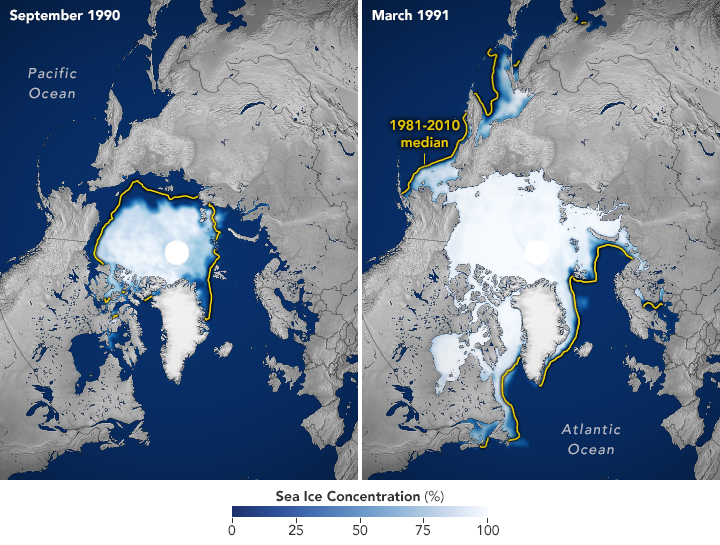
The Natural Gas or Hydrogen burned to provide electric power, will be more efficient at a power plant than an internal combustion engine could do. But my intention was also to have a path for Natural gas or Hydrogen overland between two or more sea ports. This then also for exchange as export or import. As for Electric Trucking, I admit that such a highway though tundra seems far fetched. But I wanted to explore it.
A seaport of Anchorage, also seeming to be far fetched, but a railroad does go partially interior already. May be the wrong gage.
Such a pathway would also join river traffic for the Yukon and McKenzie River systems, I expect. This may be a bit like what Russia did with the Siberian Railroad, where it joins several northern flowing river systems.
Query: "Is the North West Passage functional for summer ship traffic?"
Quote:
Copilot Search Branding
Like
Dislike
Functional Status of the Northwest Passage for Summer Shipping
Yes — the Northwest Passage is functional for limited summer ship traffic, but only for specialized Arctic-capable vessels during a short, ice‑affected navigation window, and not for regular commercial container shipping.Current operational reality
Recent data show that commercial transits are possible in summer, but they are rare and highly selective. From 2019 to 2024, six Royal Wagenborg Polar Class7 icebreaking bulk carriers completed NWP return voyages during a three‑month navigation season (August–October)
U.S. Naval Institute
U.S. Naval Institute
. These ships carry specialized cargo such as carbon anodes and pulp/timber, and the routes are chosen for their shallow draft and ice‑breaking capability
U.S. Naval Institute
U.S. Naval Institute
+1
.The Northwest Passage.info transit statistics for 2025 confirm that multiple vessels have successfully navigated the Passage this season
thenorthwestpassage.info
thenorthwestpassage.info
, but the number of transits remains small compared to other Arctic routes.Seasonal and environmental constraints
Ice conditions: Even in peak summer, the Passage is often ice‑covered. Ice is now mostly thinner first‑year ice, which can break more easily but is highly mobile and can block narrow “choke points”
Adventure Canada
Adventure Canada
.Navigation window: The ice‑free period is short — typically July to September for expeditions, and August–October for some commercial transits
U.S. Naval Institute
U.S. Naval Institute
+1
.Vessel requirements: Only Polar Class icebreakers or shallow‑draft Arctic bulk carriers with ice‑breaking propulsion (azipods) can reliably make the transit
U.S. Naval Institute
U.S. Naval Institute
+1
.Regulatory and logistical challenges: Canadian sovereignty rules, limited emergency infrastructure, insurance issues, and high operational costs make the route impractical for general cargo shipping
inlandocean.ca
inlandocean.ca
.Commercial viability
While the Passage is functionally open for specialized summer traffic, it is not yet a regular, high‑volume commercial route. Container shipping remains “years away” if ever achievable
inlandocean.ca
inlandocean.ca
. The route offers potential distance savings of up to 40% compared to the Panama Canal for certain Asia–North America trades
U.S. Naval Institute
U.S. Naval Institute
, but these benefits are offset by operational risks and costs.In summary: The Northwest Passage is operational for a limited set of Arctic‑capable vessels during the summer, but it is not a fully open, year‑round, or high‑volume commercial shipping lane. It remains a niche, high‑risk, high‑cost route with a short seasonal window.
It might occur to you that a transport system that begins in England, may transfer by various means to Europe>Russia/Siberia>Alasks>Canada.
I know that you have been hypnotized to hate on the Russians eternally, but you trying so hard to be Romanoid, are a hinderance to us in North America who are trying to harmonize Romanoid with Russianoid. You are going backwards and it is not going to work.
Now as for a road system on Tundra that might support large trucking, that is a massive ask.
Winter highways are probably the most sensible. But I would like to find a better way. You understand that this is a challenge. I will admit defeat when it is necessary.
A portage through "Nunavut" seems necessary if any of it were to work.
https://www.bing.com/images/search?view … 11&iss=VSI
Image Quote: 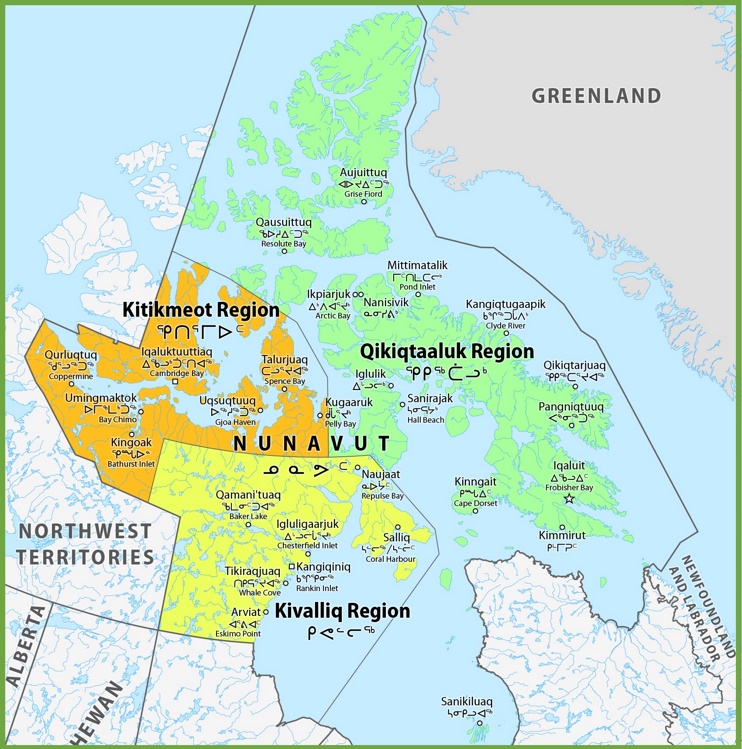

Seems as though the worst of the ice is in those islands.
Well, I have already messed up Callibans topic: https://www.bing.com/images/search?view … ajaxserp=0
Image Quote: 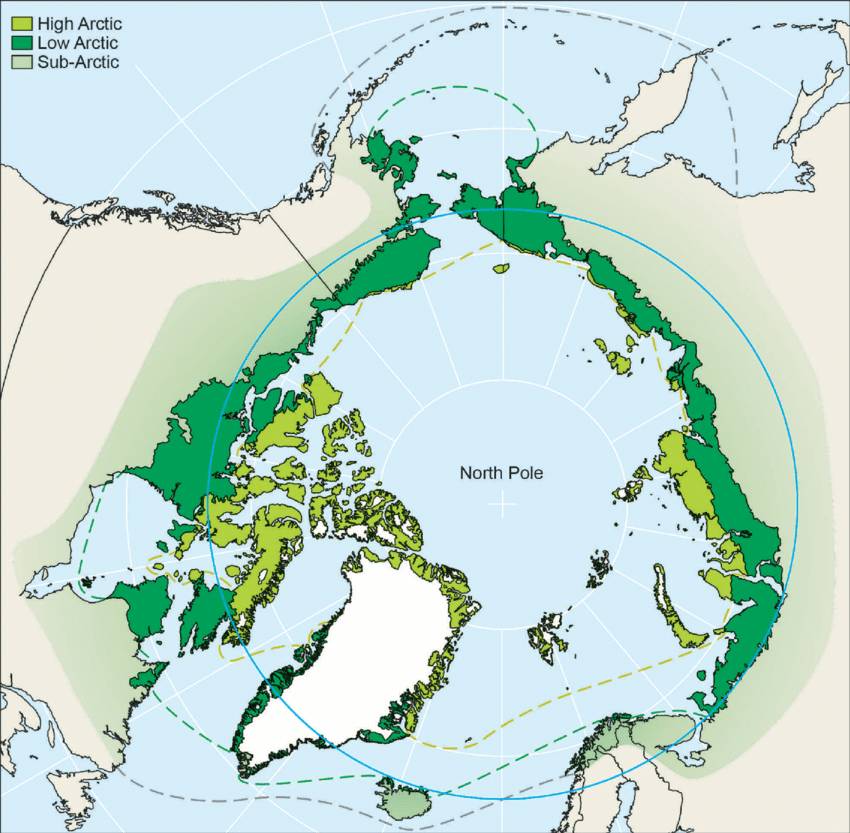

OK light green being the "High Arctic", is even more frozen than the North Slope.
Winter highways may be easier to sustain than on the Low Arctic Tundra.
My wish would be to keep them frozen even in the summer.
So, the Alaska pipeline can keep its tundra frozen, (But not at the surface) in the summertime.
Baffin Island has some year around ice bodies. So, it is very close to being glacial.
Perhaps a south facing wall to shield the sunlight from the road at least part of the day. And that wall might also be a radiator in the manner of the supports for the Alaskan Pipeline.
Perhaps such a wall on each side of the road.
Very expensive, but if you could keep the road surface frozen most or even all of the year, then a ice road at that latitude might work.
Worth it? Well maybe not yet with todays technology, but remember if the robots do provide deflation of the coast of hardware then maybe can do.
Such a road and the use of perhaps some Boring Company tunnels might work.
But of course a bypass or the Panama Canal or Suez Canal would be endlessly easier.
Ending
Last edited by Void (Yesterday 19:54:02)
Be careful what you wish for.
Offline
Like button can go here
#6 Today 13:44:11
- SpaceNut
- Administrator
- From: New Hampshire
- Registered: 2004-07-22
- Posts: 30,865
Re: Electric Roads
The electric road was disused by Louis as to drawing power from motion on the road.
Offline
Like button can go here