New Mars Forums
You are not logged in.
- Topics: Active | Unanswered
Announcement
Pages: 1
#1 2025-02-22 14:40:24
- Terraformer
- Member
- From: The Fortunate Isles
- Registered: 2007-08-27
- Posts: 4,015
- Website
Anchored ringworlds
I feel this requires its own topic. And since this subforum includes everything from "conventional" terraforming to shellworlds and asteroidal magnetospheres
An equatorial ringworld... now that would be something. Around a dwarf planet the shell would help to counter the centrifugal pressure. If we have 400km snowball with 1% Earth surface gravity, 1km overburden would counter 10 tonnes/m^2 of spinning ringworld. If its 10km wide, the ringworld has 12,500 square kilometres of range. Now that will serve us well. And we can go wider than 10km, and add further rings to the north and south.
Can we do this on some of the larger asteroids and comets and KBOs? If the body is 100km wide, we need to add 4x the overburden. Lets say 10km, to allow margin (and we're not using 10 tonnes/m^2 of soil, we dont need to go that far even for trees). 80km across, 5km wide, 1,250 km^2. 1g, because the whole point of doing this is to provide earthlike spaces for "wildlife". More rings bored north and south, a magnetosphere provided, human cities studded throughout. The core is still the vast majority of the mass, providing stability (I just remembered that Phobos -- or Deimos? -- in the Mars trilogy built a train centrifuge...).
Large expanses of 1g habitat that can really seem earthlike are... tricky and resource intensive. Obviously the dream is supramundane shells around Neptune and Uranus, supported by their atmospheres. But on a smaller scale, we have to build ringworlds and cylinders, and it would be nice to make big ones.
Use what is abundant and build to last
Offline
Like button can go here
#2 2025-02-22 14:51:40
- tahanson43206
- Moderator
- Registered: 2018-04-27
- Posts: 25,914
Re: Anchored ringworlds
This post is reserved for an index to posts that may be contributed by NewMars members over time.
It would help of members were to add a one-line summary to the post suitable for copying and pasting in this post.
Index:
(th)
Offline
Like button can go here
#3 2025-02-23 12:22:11
- Calliban
- Member
- From: Northern England, UK
- Registered: 2019-08-18
- Posts: 4,393
Re: Anchored ringworlds
A ringworld in free space needs to have enough tensile strength to withstand the outward centrifugal force resulting from rotation. That is a significant structural burden that implies a lot of cost.
If the ringworld is under 1+km of ice on a world with 1% Earth-g, then it can transfer load to the ice above it. It can do this by magnetic levitation, if the ceiling of the ice-cave torus has a conducting metal strip within it. This reduces the tensile force acting on the outer skin of the ringworld. This reduces structural mass and cost. It would also allow a ring habitat to built as a compressive structure from brittle materials. There are also the benefits of having something you dump waste heat into. These are all big cost savers.
Another benefit of building a hab on an icy world is employment. The inhabitants of the hab can mine the ices for things like ammonia and nitrogen, that can be sold throughout the solar system. Ice is also a good source of reaction mass if the inhabitants want to engage in interplanetary trade. Even with fusion powered engines, a ship still needs to throw something out the back to achieve thrust. So having a load of ice nearby is important if you want ships to be able to come and go.
Last edited by Calliban (2025-02-23 12:29:19)
"Plan and prepare for every possibility, and you will never act. It is nobler to have courage as we stumble into half the things we fear than to analyse every possible obstacle and begin nothing. Great things are achieved by embracing great dangers."
Offline
Like button can go here
#4 2025-02-23 12:57:34
- Terraformer
- Member
- From: The Fortunate Isles
- Registered: 2007-08-27
- Posts: 4,015
- Website
Re: Anchored ringworlds
You calculated this before, but I can't remember the figures -- if we are using the weight of ice to counter pressure, what is the minimum size body to withstand 10 Tonnes/m^2 in a central cavern? On asteroids and comets we can dig all the way down to the centre and put a cylinder habitat from pole to pole, though the parts closest to the surface would have to either spin slower or faster with a smaller radius, to maintain the required overburden of ice to make use of compression.
Still, a 100km long cylinder... that's more like it. Especially if the interior is landscaped as a spiral valley.
Use what is abundant and build to last
Offline
Like button can go here
#5 2025-02-23 13:44:30
- Calliban
- Member
- From: Northern England, UK
- Registered: 2019-08-18
- Posts: 4,393
Re: Anchored ringworlds
You can work out pressure at any radius from the centre of a body with constant density, using the formula contained in this link.
https://cseligman.com/text/planets/internalpressure.htm
Pr = (3/(8pi x G))*(gR^2)*(1-(r/R)^2)
Where R is the radius of the body, r is distance from the centre (i.e R minus depth), gR is surface gravity, G is Newtons universal gravity constant (6.67E-11).
The surface gravity of a spherical world is proportional to its radius and density. Pluto has a density of 1.853t/m3, a radius of 1188.3km and a surface gravity of 0.62m/s2. Using this as a reference, the surface gravity of any body would be given by:
gR = 0.62*(r/1188.3)*(rho/1.853)
Where r is measured in km and rho in tonnes/m3.
Lets solve the equation for a sphere of nearly pure ice, with a density 0.9t/m3 and a radius of 25km. What is the pressure in its centre?
First, we calculate surface gravity, gR. This comes to 0.006335N/kg. Which is about 1/1800 earth gravity. At the centre of the body, r=0 and the equation reduces to:
P0 = (3/(8pi x G))*(gR^2)
Solving for the body under consideration gives a core pressure of 71,829Pa, or about 0.72bar.
The link contains a graph showing how internal pressure decreases as one heads from the core to the surface. I have reproduced it below.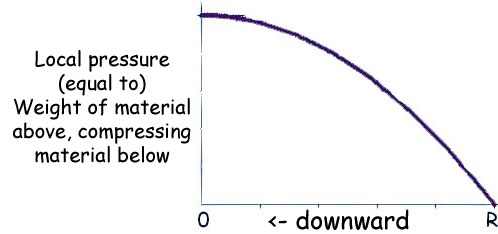
This illustrates that for r/R=0.2, there is virtually no reduction in pressure. This is because gravity close to the core is almost zero and the pressure gradient heading out from the core is small until one gets to r~0.4R.
Last edited by Calliban (2025-02-23 13:53:56)
"Plan and prepare for every possibility, and you will never act. It is nobler to have courage as we stumble into half the things we fear than to analyse every possible obstacle and begin nothing. Great things are achieved by embracing great dangers."
Offline
Like button can go here
#6 2025-02-25 05:01:11
- Calliban
- Member
- From: Northern England, UK
- Registered: 2019-08-18
- Posts: 4,393
Re: Anchored ringworlds
A geostationary ring built around a dwarf planet or asteroid, would be a useful tool for mining the object. It would allow material to be lifted out of the gravity well without need for propellant.
In fact, if we allow a tether to extend beyond geostationary, we can use the angular energy of the dwarf planet to power the tether. So lifting material out of the gravity well will not cost us any energy, until the dwarf planet's rotation starts to run down. On a fast rotating body, a tether could be a considerable source of power. We can use it to extract energy from the rotation of the body.
"Plan and prepare for every possibility, and you will never act. It is nobler to have courage as we stumble into half the things we fear than to analyse every possible obstacle and begin nothing. Great things are achieved by embracing great dangers."
Offline
Like button can go here
#7 2025-02-25 10:03:34
- Void
- Member
- Registered: 2011-12-29
- Posts: 9,887
Re: Anchored ringworlds
A good topic. Probably the next thing after Mars. Actually, it might divert settlers from Mars after a while, as it may offer a great deal to people.
I believe that this falls into the vision of Dr. Zubrin as I have read it. If we then simply say that our Moon is a wild card, then we might get most people to converge on a popular plan, I hope. Over time our Moon may rise in value to be part of a trade pattern it gets included into, or it may only then be a sort of a scientific object for study. Allow it to become what it will.
The method looks good for many worlds, but with Mars/Phobos/Deimos as a steppingstone, the Major Asteroids may become very attractive.
https://en.wikipedia.org/wiki/List_of_e … _asteroids
Image Quote: 
Ending Pending 
Last edited by Void (2025-02-25 10:11:57)
Be careful what you wish for.
Online
Like button can go here
#8 2025-02-25 21:45:49
- Void
- Member
- Registered: 2011-12-29
- Posts: 9,887
Re: Anchored ringworlds
In post #6, Calliban said:
Calliban
Member
From: Northern England, UK
Registered: 2019-08-18
Posts: 3,921
A geostationary ring built around a dwarf planet or asteroid, would be a useful tool for mining the object. It would allow material to be lifted out of the gravity well without need for propellant.In fact, if we allow a tether to extend beyond geostationary, we can use the angular energy of the dwarf planet to power the tether. So lifting material out of the gravity well will not cost us any energy, until the dwarf planet's rotation starts to run down. On a fast rotating body, a tether could be a considerable source of power. We can use it to extract energy from the rotation of the body.
A very nice idea. But now consider the "Relativistic Electron Beam".
I may not understand this technology, but I hope it can be used internal to our solar system. https://en.wikipedia.org/wiki/Relativis … ctron_beam
Quote:
Relativistic electron beams are streams of electrons moving at relativistic speeds. They are the lasing medium in free electron lasers to be used in atmospheric research conducted at entities such as the Pan-oceanic Environmental and Atmospheric Research Laboratory (PEARL) at the University of Hawaii and NASA. It has been suggested that relativistic electron beams could be used to heat and accelerate the reaction mass in electrical rocket engines that Dr. Robert W. Bussard called quiet electric-discharge engines (QEDs).[1]
So, after you fling a payload, can you beam heat and inertia to it? Could you do it in such a way that you not only assist propulsion to the payload released but could spin up the Anchored ringworlds spin by using the recoil. Then could you give modification to the path and speed of an incoming payload, and also use the recoil to spin up the Anchored ringworld?
I understand that unlike Photons which only carry inertia, Electrons do have mass.
Last edited by Void (2025-02-25 21:53:03)
Be careful what you wish for.
Online
Like button can go here
#9 2026-09-16 17:54:04
- Terraformer
- Member
- From: The Fortunate Isles
- Registered: 2007-08-27
- Posts: 4,015
- Website
Re: Anchored ringworlds
One design I haven't seen for space habitats is the spiral/scroll. If the cylinder is wide and the ceiling heights low enough, you can have multiple levels that are all one contiguous scroll. E.g. a 10km diameter cylinder with 50m ceilings could spiral round ten times with the innermost part having 90% of the gravity the outermost has. 300km long scroll. Make it 100km long embedded in a suitable iceteroid, and you have 30,000km2 of area, all one curled up sheet. Enough for wolves..?
Use what is abundant and build to last
Offline
Like button can go here
#10 Yesterday 18:05:46
- Calliban
- Member
- From: Northern England, UK
- Registered: 2019-08-18
- Posts: 4,393
Re: Anchored ringworlds
One design I haven't seen for space habitats is the spiral/scroll. If the cylinder is wide and the ceiling heights low enough, you can have multiple levels that are all one contiguous scroll. E.g. a 10km diameter cylinder with 50m ceilings could spiral round ten times with the innermost part having 90% of the gravity the outermost has. 300km long scroll. Make it 100km long embedded in a suitable iceteroid, and you have 30,000km2 of area, all one curled up sheet. Enough for wolves..?
That is an interesting idea. Most of the mass of space colonies is shielding, so a scroll is a more mass-efficient arrangement than a single shell full of open space. The main stumbling block is heat management. Rolling up land into a scroll means packing more heat generation into the same volume. But there are solutions for this. The interior of the colony will not be used to grow food. So we can reduce light levels without reducing human carrying capacity. Using LEDs, the lighting in the scroll can be better tailored to photosynthesis. So we don't need full solar intensity within the scroll. One way of removing waste heat would be to spray water into the scroll. The droplets would absorb heat from the air and ground. The water would then drain into lakes and ponds. The surface water can then be pumped through heat exchangers.
"Plan and prepare for every possibility, and you will never act. It is nobler to have courage as we stumble into half the things we fear than to analyse every possible obstacle and begin nothing. Great things are achieved by embracing great dangers."
Offline
Like button can go here
#11 Yesterday 18:30:31
- Calliban
- Member
- From: Northern England, UK
- Registered: 2019-08-18
- Posts: 4,393
Re: Anchored ringworlds
A scroll 1km in diameter, 1km long with decks 10m apart, would pack 77.75 square kilometres of floor area. Enough for a sizeable city of two-storey buildings.
https://whycalculator.com/roll-length-calculator/
"Plan and prepare for every possibility, and you will never act. It is nobler to have courage as we stumble into half the things we fear than to analyse every possible obstacle and begin nothing. Great things are achieved by embracing great dangers."
Offline
Like button can go here
#12 Yesterday 21:15:44
- Void
- Member
- Registered: 2011-12-29
- Posts: 9,887
Re: Anchored ringworlds
A scroll might be good as per radiation protection.
I have considered that if you had a chamber big enough 100,000 people might be radiation protection for each other if they rotated. Not that anyone would like to live that way.
But a Scroll might have only a thin layer of soil and the outer parts would be less protected and the inner more protected.
You might also have to open ends on the scroll to dump heat out.

Blue Arrows could signify water or air.
Ending Pending :-)
Last edited by Void (Yesterday 21:20:51)
Be careful what you wish for.
Online
Like button can go here
#13 Today 06:10:29
- Terraformer
- Member
- From: The Fortunate Isles
- Registered: 2007-08-27
- Posts: 4,015
- Website
Re: Anchored ringworlds
Heat also depends on what environment you're replicating. British temperate rainforest is far lower insolation than tropical. And only 38% of sunlight is photosynthetically active. I think for Northern Europe equivalence we could get away with 5 layers?
Use what is abundant and build to last
Offline
Like button can go here
#14 Today 11:51:57
- Void
- Member
- Registered: 2011-12-29
- Posts: 9,887
Re: Anchored ringworlds
Terraformer, I would prefer that Calliban correspond with you on this, but until then, I might do so as well.
I think that an item of importance for your scheme, is what g force will be acceptable for human health. If it is 1/3 g such as Mars, then the scheme has the advantage that people could self adjust to preference, within the situation of radiation exposure.
GCR is rather constant, but Solar Radiation is subject to storms.
A spot in Iran has a high radiation level, and yet humans seem to do OK with it.
Quote:
Copilot Search Branding
Like
Dislike
Ramsar, Iran — Highest Measured Natural Background Radiation
Yes — Ramsar, a city on the Caspian Sea in northern Iran, hosts the highest measured natural background radiation levels in the world for a populated area
INIS
INIS
+1
.Radiation levels and sources
Average annual dose: About 10.2 millisieverts (mSv) per year for the population, with peak recorded doses around 260 mSv/year in some spots
INIS
INIS
+1
.Comparison: This far exceeds the 20 mSv/year limit for radiation workers in Iran and is many times higher than global averages
Department of Physics, Stanford University
Department of Physics, Stanford University
.Cause: The high levels come from natural geological and hydrogeological factors — specifically, the presence of radium‑226, thorium, and potassium‑40 in local rocks and hot springs
INIS
INIS
+2
.These radioactive materials are brought to the surface through geothermal activity and are incorporated into local building materials and even the food supply
Department of Physics, Stanford University
Department of Physics, Stanford University
.Public health context
Ramsar’s residents have been studied for decades. No significant increase in cancer rates has been found compared to nearby areas, and some studies suggest radioadaptation — a possible biological response to chronic low‑level radiation
INIS
INIS
+1
.Chromosome aberration rates in local lymphocytes are no higher than in control areas
INIS
INIS
.Life expectancy in Ramsar is the same as in neighboring lower‑radiation areas
Department of Physics, Stanford University
Department of Physics, Stanford University
.While the linear no‑threshold (LNT) model predicts increased cancer risk with higher exposure, current epidemiological data do not support higher incidence in Ramsar
INIS
INIS
+1
.
Key points
Highest natural background radiation in a populated area — some beaches in the world have higher rad levels, but no one lives there
Nevada Technical Associates, Inc.
Nevada Technical Associates, Inc.
.The radiation is entirely natural, not from nuclear weapons or enrichment programs
Nevada Technical Associates, Inc.
Nevada Technical Associates, Inc.
.The area’s unique geology and hot springs make it a subject of ongoing scientific interest and public health debate
INIS
INIS
+1
.In summary: Ramsar, Iran, is indeed the location with the highest measured natural background radiation in a populated area, driven by local geology and hot springs, and current studies show no clear increase in cancer rates despite the extreme levels
INIS
INIS
+2
.
Presuming you were to have a spiral of some corrosion resistant metal, then you might put minimum soil on it to allow vegetation. As you walked down from the center to the outer end of the spiral, radiation levels would rise, but you could have a walking path(s) where the soil thickness were greater to provide greater protection for that spiral line or lines of such pathways.
I am speaking of this from the point of view that it would be desirable to minimize the amount of mass needed to provide good conditions for habitation.
With a spiral with thin soil or even metal bottomed ponds, the outer spirals protect the more inner ones per damaging radiation.
During quiet times of the sun a person might dare the less safe places but might increase time in more protected locations during higher risk time periods.
I wonder if "Land" might have gravity of 1/6 g, 1/3 g 1 g, and then maybe 1.1 g. A good way to find out about the human body.
I hope you will continue with your concept. It is nice to have something new.
Ending Pending :-)
Last edited by Void (Today 12:03:28)
Be careful what you wish for.
Online
Like button can go here
Pages: 1