New Mars Forums
You are not logged in.
- Topics: Active | Unanswered
Announcement
#2351 2026-08-01 14:14:55
- tahanson43206
- Moderator
- Registered: 2018-04-27
- Posts: 25,470
Re: Starship is Go...
GW Johnson wrote a paper on what it will take to return from Mars and attempt to slow down in the atmosphere.
https://www.dropbox.com/scl/fi/9y7wx2hf … 2x930&dl=0
The title is "A Look at Interplanetary Returns vs Cislunar Returns"
(th)
Offline
Like button can go here
#2352 2026-08-01 22:55:02
- RobertDyck
- Moderator
- From: Winnipeg, Canada
- Registered: 2002-08-20
- Posts: 8,504
- Website
Re: Starship is Go...
I appears that SpaceX is in the process of recovering the intact starship and is towing it to Australia. Musk released a statement yesterday to that effect.
Yea! When I saw it float. I thought that should be done. Engineers will get a much better read by getting their hands on it
Offline
Like button can go here
#2353 2026-08-01 23:05:56
- RobertDyck
- Moderator
- From: Winnipeg, Canada
- Registered: 2002-08-20
- Posts: 8,504
- Website
Re: Starship is Go...
For anyone considering a winged entry vehicle. I recommend a lifting body like Dream Chaser. Lighter weight than a fuselage and delta wing. Glide distance isn't as great, but enough. Shuttle was supposed to be a lifting body. But military wanted to launch spy satellites from Shuttle into polar orbit. NASA had made arrangements to land Shuttle at airports around the world, so it could reenter the atmosphere at any point and land safely. That worked for inclined orbits, but there were no airports at the poles able to land Shuttle. So they needed to extend glide distance far enough to reach one. Just don't launch your large reusable spacecraft into polar orbit.
Offline
Like button can go here
#2354 2026-08-02 04:42:48
- SpaceNut
- Administrator
- From: New Hampshire
- Registered: 2004-07-22
- Posts: 30,828
Re: Starship is Go...
The issue is the launch of everything in the same vehicle with cargo tonnage pushing the 1 time launching into a monster and then when you need to protect for that vehicle carrying crew it now goes into that one problem of getting rid of heat no matter where its going.
Winglets, fins and rear of the vehicle are not true glider to lift but are just for short steering or to correct rotation axis so that the body is aligned for the atmospheric braking on the bodies greater heat shielding surface.
Offline
Like button can go here
#2355 2026-08-02 17:23:44
Re: Starship is Go...
…
The quote from the former NASA scientists is more definitive in this article:
Experts warn current Starship heat shield tech is a “dead end” for rapid reuse.
NASA has not made substantial investments in thermal protection research for decades.
ERIC BERGER – JUL 27, 2026 2:34 PM |
https://arstechnica.com/space/2026/07/d … -to-crack/I think we should reexamine giving Starship wings that result in such an ultra low ballistic coefficient that no heat shield is required at all. We had that discussion here, GW:
GW, your and Dr. Akin’s separate analyses both suggesting 800°C peak temperature gives confidence it is valid. The problem is there is a discrepancy with an actual LEO reentry experiment at low ballistic coefficient. The experiment was called LOFTID and used an inflatable heat shield:
What was the ballistic coefficient of the LOFTID demonstrator and what was peak temperature?
The ballistic coefficient of the Low-Earth Orbit Flight Test of an Inflatable Decelerator (LOFTID) demonstrator was 24.7 kg/m², and the outer surface of its heatshield reached a peak temperature of approximately 1,500°C (2,700°F) during atmospheric reentry. [1, 2]
Key Flight Demonstration Metrics
NASA's LOFTID Mission successfully validated hypersonic inflatable aerodynamic decelerator (HIAD) tech with the following flight data: [1, 2, 3, 4]
* Entry Mass: 1,100 kg
*
* Aeroshell Diameter: 6 meters (fully inflated)
*
* Peak Heat Flux: ~40 W/cm²
*
* Peak Deceleration: 9.5 g
*
* Entry Velocity: 8 km/s (approx. Mach 30) [1, 2, 3, 4]
*
The vehicle's second-generation flexible thermal protection system (F-TPS) featured an exterior ceramic fiber cloth designed to survive environmental limits up to 1,600°C (2,900°F), comfortably protecting the structural inflatable rings from the peak heating experienced during the test. [1, 2]
If you would like to explore this topic further, I can provide more details on the layer composition of the flexible thermal protection system or compare LOFTID's metrics to previous suborbital tests like IRVE-3. Let me know what you would prefer! [, 2]
https://www.google.com/search?q=What+wa … emperature
The ballistic coefficient of ~25 kg/m² for a 6 m wide decelerator was in the range comparable to both yours and Dr. Akin’s. But the peak temperature was nearly twice as high at 1,500°C.
The shape was different in being a flattened cone, while yours and Dr. Akins was a portion of a sphere but I wouldn’t think the difference would be that big.
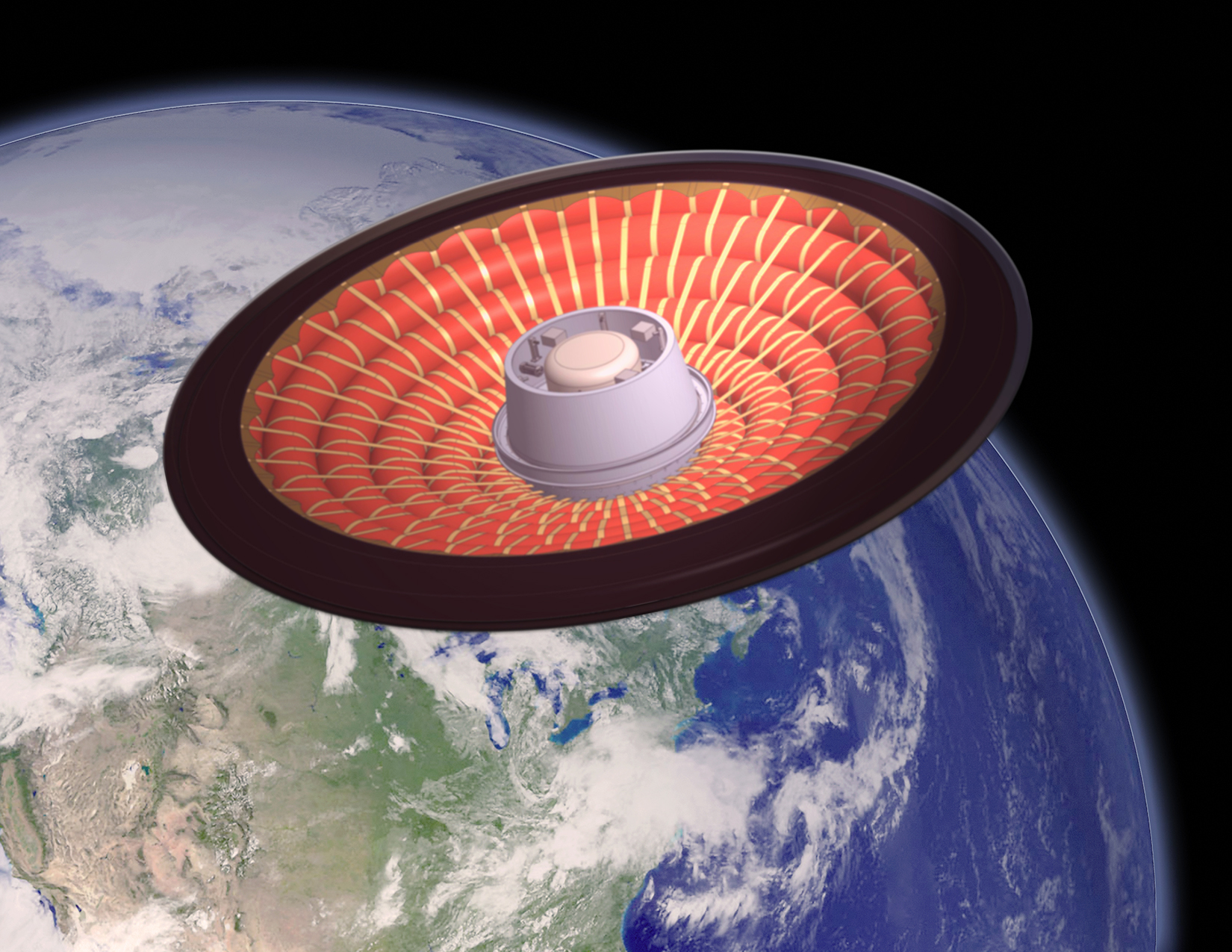
NASA Successfully Tests LOFTID Inflatable Heat Shield.
https://www.youtube.com/watch?v=9mM1JIPY4Mw
Bob Clark
Last edited by RGClark (2026-08-02 17:53:16)
Old Space rule of acquisition (with a nod to Star Trek - the Next Generation):
“Anything worth doing is worth doing for a billion dollars.”
Offline
Like button can go here
#2356 2026-08-04 10:04:23
- Oldfart1939
- Member
- Registered: 2016-11-26
- Posts: 2,516
Re: Starship is Go...
There is a new WhatAboutIt episode which is now available online at YouTube. Felix discusses the heat shield of S.40 issues in detail.
https://www.youtube.com/watch?v=zKAtEutivr4
Last edited by Oldfart1939 (2026-08-04 10:05:15)
Offline
Like button can go here
#2357 2026-08-04 13:10:14
- Void
- Member
- Registered: 2011-12-29
- Posts: 9,755
Re: Starship is Go...
Very nice OF.
I think something that is missed in the conversation is that unlike the Space Shuttle a failed heat shield does not kill Astronauts, as there will not be any on board for commercial flights, at least not for a long time.
And I took a look; it sounds like there have been burn-throughs of the Stainless Steel where tiles were deliberately left off. I am not 100% sure but it may be possible that they could still recover such a ship, at least by catching.
Burn through apparently is not a actual hole but strongly scorched Stainless Steel. I note that for the Space Shuttle that would be deadly if only an Aluminum Alloy was under the tiles.
Quote:
Copilot Search Branding
Like
Dislike
Yes — SpaceX has already flown Starship missions where the heat shield was intentionally removed or damaged, exposing the stainless steel to extreme reentry heat, and in some cases the steel was scorched or “burned through” in test scenarios.In October 2025, SpaceX conducted an uncrewed test flight with thousands of heat-shield tiles removed from critical sections of the upper stage, leaving parts of the vehicle’s stainless-steel structure bare and exposed to temperatures above 1,400°C during atmospheric reentry www.visaverge.com. This was a “deliberate high-fidelity failure study” to observe how local failures spread and whether the steel could withstand direct plasma heating. The mission was successful in other respects, but the exposed steel was visibly damaged.
Earlier, on Flight 10 in September 2025, SpaceX used metal test tiles and left gaps in the heat shield, creating bright orange streaks from oxidized test tiles and white patches where insulation replaced lost tiles Interesting Engineering. Post-flight photos showed scorched steel, dents, and burn marks on the body and flaps, with some flaps even glowing red-hot during descent Interesting Engineering. These were not full structural failures, but clear evidence of the steel being heated to extreme levels.
In interviews, engineers confirmed that in some missing-tile tests, a single-layer ablative insulation burned through to at least scorch the underlying steel, while a double-layer did not NASASpaceFlight.com. This means that in certain configurations, the stainless steel was indeed exposed to the point of visible damage, though not necessarily melted.
Summary:
Yes, Starship has had heat shield burns that exposed stainless steel to >1,400°C.
These were deliberate test flights to study thermal protection limits.
Damage included scorched steel, chipped tiles, and panel gaps in operational flights AOL+1.
In some test cases, single-layer insulation burned through to the steel NASASpaceFlight.com.
The steel has survived these tests, but the results are driving design changes to prevent burn-through in future flights.
So, such a ship landed or tower caught, might still allow many of the valuable parts to be reused such as Engines and electric motors and steering linkages, and Avionics.
Perhaps the Hull could not be trusted again to hold pressurized propellants.
Ending Pending 
I note that they said that a double layer of ablative heat shield might protect the Stainless Steel. This would be an interesting application for sending one-way ships to Mars with cargo, I think. Might have its own values.
Ending Pending
Last edited by Void (2026-08-04 18:41:52)
Be careful what you wish for.
Offline
Like button can go here
#2358 2026-08-05 12:46:45
- GW Johnson
- Member
- From: McGregor, Texas USA
- Registered: 2011-12-04
- Posts: 6,260
- Website
Re: Starship is Go...
For RG Clark re: post 2355 --
Bob, I worked out a model from the data in your posting about the LOFTID test, and got something fairly representative of their blunted cone shape and size and ballistic coefficient. And yes, the shape makes a difference: blunted cones are what has been used at Mars for decades to minimize plasma radiation heating, and those drag coefficients are near 1.7. Spherical radius-type blunt heat shields have been used at Earth where plasma radiation is not as severe, and have lower drag coefficients, nearer 1.4. For the same size and mass, that is a big difference in ballistic coefficient, and thus in peak heating, as well as how deep into the atmosphere it penetrates before slowing.
I got numbers more or less similar to those in the article you linked and quoted, except I got nearer only 6 gees at peak deceleration, and that article indicates something over 9 gees. I used an average 2 degrees below horizontal, they may have come in a bit steeper than that, although steeper does drive up heating, too.
The temperature I got for a re-radiating heat shield with no ablation is close to what they seem to say in the article. I must be somewhere in the ballpark with my little model. However, when I spread heating rates around the vehicle, I got surface temperatures seemingly too high for inflatable fabrics to survive. I think they said something about insulating the inflatables with ceramic fabrics. The problem with equilibrium temperature estimates is that they are extraordinarily affected by the thermal emissivity that you use.
My point: the picture a lot of people share, that you only need protection on the windward side, is false. Even the wake zone sees the same super-high effective plasma temperatures that the windward side sees right behind the bow shock. It's just that the effective heat transfer coefficients are drastically lower. That is why Apollo's (and Orion's) lateral sides also had ablative coatings. The higher speed drove that. Bare superalloy skins survived on Mercury and Gemini, but only because entry speeds were lower.
The inflatables at the lower speeds will need wake zone heat protection, because the inflatable materials have lower max service temperatures than superalloys. By far.
GW
Update 2026/08/07 ... GW Johnson asked that this be added to post #2358
This post is to display a link to a study done by GW Johnson about the inflatable heat shield concept tested by NASA.
https://www.dropbox.com/scl/fi/tzu7fwhd … tkpq7&dl=0
Attached is the pdf file for the latest version of my entry study for the LOFTID inflatable heat shield, that Bob Clark posted about. This version replaces anything I previously sent, being far more complete. If you decide to post it at all, it should go in my post #2358, in the "Starship is Go" thread, under "human missions".
Last edited by GW Johnson (2026-08-05 12:48:27)
GW Johnson
McGregor, Texas
"There is nothing as expensive as a dead crew, especially one dead from a bad management decision"
Offline
Like button can go here
#2359 2026-08-05 12:56:09
- GW Johnson
- Member
- From: McGregor, Texas USA
- Registered: 2011-12-04
- Posts: 6,260
- Website
Re: Starship is Go...
For void re posting 2357: you have to be very careful about risking a burn-through into a propellant tank, for 2 reasons, either of which could be fatal to the vehicle. (1) The pressurization level of the tank may be part-and-parcel of the strength of the tank to resist crushing by the wind-stream pressures. (2) The propellant feed to the engines' turbopumps, and indeed even the boiloff speed of the propellant inside the tank, depends upon maintaining the right amount of tank pressurization.
It would be into the cargo bay, the engine bay, or the aerosurfaces themselves, that they would have risked burn-throughs by leaving off a tile here or there. Those spaces are already unpressurized to begin with.
GW
GW Johnson
McGregor, Texas
"There is nothing as expensive as a dead crew, especially one dead from a bad management decision"
Offline
Like button can go here
#2360 2026-08-05 17:59:40
- SpaceNut
- Administrator
- From: New Hampshire
- Registered: 2004-07-22
- Posts: 30,828
Re: Starship is Go...
never forget what happen to the shuttle as caused by the blow through of an o-ring into the ET....
Offline
Like button can go here
#2361 2026-08-05 18:35:59
- GW Johnson
- Member
- From: McGregor, Texas USA
- Registered: 2011-12-04
- Posts: 6,260
- Website
Re: Starship is Go...
Harold:
No, I never forget. That was a bad joint design to begin with. I think we have beat that to death before. You DO NOT DO 2 O-RINGS in a solid joint! You do only 1! If it holds at 20-30 psia, it will hold at 2000-plus psi.
Ask me sometime about the Tarter-Terrier gas generator canister. Same stupid problem. Just embodied differently.
GW
GW Johnson
McGregor, Texas
"There is nothing as expensive as a dead crew, especially one dead from a bad management decision"
Offline
Like button can go here
#2362 Today 07:35:59
- GW Johnson
- Member
- From: McGregor, Texas USA
- Registered: 2011-12-04
- Posts: 6,260
- Website
Re: Starship is Go...
The consensus of opinions and Musk postings "out there" is that they may fly Flight 14 late this month (August). It would appear to be a full orbital mission, with an attempted tower ship-catch back at Starbase in south Texas, if the FAA approves the flight plan.
As I thought, they are not going to risk the tower with a booster-catch, this time around. They need a soft landing (or preferably two) of the booster before they risk that, and that means they must solve the "booster Raptor relight problem", whatever that really is.
I only suspect it may have something to do with the roughly 2000 F air caught in the engine bay and heat-soaking the engines, during booster entry at approximately Mach 5. It would potentially counter the cryogenic cooldown they seem to need, in order to light them. But I may be wrong about that. Just note that nobody has said anything in public about that problem. They may, or may not, understand it yet.
The ship will be flying over populated areas in Mexico and south Texas during its entry, descent, and landing after an orbital flight, which will be of great concern to the FAA in the flight plan approval process. Not to mention the interruption of a lot of airliner flights to and from Mexico. The post-hypersonics "swoosh" maneuver during descent is how they will attempt to fly around Brownsville, instead of over it, as they approach Starbase.
If Shotwell is successful at getting Musk to keep his loud mouth zipped about this flight, they may actually get this plan approved. We will soon see. He does have a demonstrated track record of pissing off the FAA, going all the way back to first very-sub-orbital ship-only flights. She knows that.
GW
Last edited by GW Johnson (Today 07:48:20)
GW Johnson
McGregor, Texas
"There is nothing as expensive as a dead crew, especially one dead from a bad management decision"
Offline
Like button can go here
#2363 Today 09:56:34
- Void
- Member
- Registered: 2011-12-29
- Posts: 9,755
Re: Starship is Go...
I do not dispute your concerns Dr. Johnson.
But they think that two layers of ablative may avoid that consequence, even if the tiles are lost.
We also may arrive at the situation where even if damage to the heat shield is discovered while the ship is in orbit, the heat shield may be patched in orbit.
And we are not yet in a trust relationship for any crew to be on board yet.
My understanding is that SpaceX is now planning on "Expendable", ships of greater power than the ones now being tested that will provide propellants for trips to the Moon. Maybe 5 or 6 of them per mission.
That is a lot of mass in orbit. If they can use the metals for propulsion and also convert some of that mass into Space Stations, the ability to repair a Starship in orbit may materialize over time.
If that ability existed in the Shuttle Era, a repair may have saved one of the two lost missions where crew died.
Or if a ship is deemed unfit, the crew could be evacuated to an orbital space station and a new ship sent up to get them.
So, the dangers to astronauts can be strongly reduces in such a case.
Ending Pending
This may annoy you: https://www.youtube.com/watch?v=SLSHWaJcZ00
Quote:
SpaceX Earnings Call: Elon Just Said Starship's Biggest Problem Is Solved...
What about it!?
What about it!?
So, they may have 5 Launch Pads to start, and it appears that they may make a massive number more of them in Lusianna.
https://www.nextbigfuture.com/2026/07/s … ility.html
Quote:
SpaceX Louisiana Launch Facility Should Become Primary for Starship Launch in 2028
July 17, 2026 by Brian Wang
I think the location next to the Mississippi River and intercostal canal may be a very big factor.
Ending Pending
Last edited by Void (Today 10:29:47)
Be careful what you wish for.
Offline
Like button can go here
#2364 Today 10:34:45
- GW Johnson
- Member
- From: McGregor, Texas USA
- Registered: 2011-12-04
- Posts: 6,260
- Website
Re: Starship is Go...
W have yet to see an accurate and complete definition of what the Starship heat shield really is. I am only guessing they are tired of outsiders second-guessing or reverse-engineering what they do.
The tiles are said to be "ceramic", whatever that really means. They are intended not to ablate, but to cool by re-radiation of heat from the hot surface. It does NOT mean the low-density, low-strength alumino-silicate tiles NASA used on the Space Shuttle, or that USAF uses on the X-37B. I think it probable they are a variant on the outer tough layer of the so-called "Tufroc" two-layer tiles used on the X-37B nose cap and wing leading edges. But I do not know, and SpaceX does not say.
The lower layer of Tufroc is weaker and will not stand as high a temperature, but does provide the low thermal conductivity to keep the backside tile temperature down to something an aluminum substructure can withstand, on the X-37B. Starship has a stainless steel substructure that can withstand much higher tile backside temperatures, which my best guess says that is why they only need a variant of that outer Tufroc layer.
The current Starship tiles do not go out as far around the circumference from the stagnation line, as they used to go. There is a smooth black coat or layer that appears to exit from under the tiles and then go out out as far as the older tiles went. SpaceX has said absolutely nothing about what that layer of material might be! I have heard no one else comment about it, either! But it is black, not the supposed white of the backup underlayer ablative coat, that leaves the white streaks when it ablates.
So none of us know very much at all about this iteration of the SpaceX heat shield design, other than it seems to work for shallow-angle Earth entries at about 8 km/s speeds at entry interface.
Long ago, NASA developed a sort of caulking gun that could put a goo in the hole left by a missing Space Shuttle tile. But, NASA management refused to fly it. It would be unlikely to have been able to patch the hole in Columbia's wing leading edge, without also flying some sort of ceramic or carbon fiber cloth. But Columbia's crew never had that chance, with no repair capabilities flown at all.
They were not even told that some NASA engineers feared there was damage to the wing, nor were they allowed to go and look for such damage. And those NASA management decisions are what killed that crew! Plans called for launching a second shuttle to go rescue a stranded crew, but nobody ordered those launch preparations, or told the Columbia crew to ration their life support supplies until the rescue could be launched. One bad decision after another!
Most of the problems and risks that any crew faces are managerial, not technical! I see that nothing has really changed at NASA (or they would not have flown a flawed heat shield on Artemis-2), and I rather doubt Musk's SpaceX believes in proper risk reduction for manned flight yet.
That may be pessimistic, but it is a realistic assessment!
GW
GW Johnson
McGregor, Texas
"There is nothing as expensive as a dead crew, especially one dead from a bad management decision"
Offline
Like button can go here