New Mars Forums
You are not logged in.
- Topics: Active | Unanswered
Announcement
#76 2026-07-08 10:58:48
- GW Johnson
- Member
- From: McGregor, Texas USA
- Registered: 2011-12-04
- Posts: 6,242
- Website
Re: OldFart1939 Postings and YouTube Video Presentation(s)
You have to understand, there are a lot of scientifically-illiterate people "out there". It goes along with all the other kinds of illiteracy that we all have seen. Such folk cannot tell lie from truth, and for many years the lie has been "fatal cosmic radiation".
Those liars are looking for a scientific-sounding reason not to go out into space, that's the motivation. They need one that is not "treatable", and it is extremely difficult-to-impossible to shield super-high-energy cosmic ray particles. That's precisely the kind of excuse "not to go" that they are looking for.
They ignore the fact that cosmic ray intensity is entirely non-fatal in its effect, leading only toward late-in-life cancers, and even then only when exposed to the very worst intensities! But the illiterate people they preach to, cannot absorb that kind of detail. And THAT is why the liars are still believed, even after all these years.
They usually also completely ignore the highly-variable solar flare/mass ejection radiation, which is very directional, very erratic in intensity, and very fatal at its larger intensities. Why do they ignore it? Because we already understand how to shield against it, those particles being far lower energy than cosmic ray particles. It's actually quite similar to nuclear fallout radiation, which we have known how to shield since about 1945.
The only "trick" has been figuring out how to do just enough shielding with something lighter than lead. Turns out 15 grams/sq.cm of "something" might be enough, and 20 grams/sq.cm of "something" is almost certainly enough, even for the worst events we have seen.
That "something" can be almost anything, and if it is low molecular weight compared to the common metals, there is very little secondary radiation produced by cosmic rays flying through it. It would make sense to use as your "something" materials you already must have with you anyway for other reasons, such as propellants, food (especially frozen food), water supplies, and wastewater treatment volumes.
There, I just told you why it is that the radiation naysayers are liars. Unfortunately, the truth is beyond an illiterate audience to understand. And THAT is why this lie-based argument has persisted for decades.
GW
Last edited by GW Johnson (2026-07-08 11:03:05)
GW Johnson
McGregor, Texas
"There is nothing as expensive as a dead crew, especially one dead from a bad management decision"
Offline
Like button can go here
#77 2026-07-08 13:56:49
- SpaceNut
- Administrator
- From: New Hampshire
- Registered: 2004-07-22
- Posts: 30,816
Re: OldFart1939 Postings and YouTube Video Presentation(s)
Beyond Earth’s protective atmosphere and magnetosphere, space radiation poses a primary hazard to human health. Without these shields, astronauts are constantly bombarded by energetic protons, Solar Particle Events (SPEs), and heavy, fast-moving Galactic Cosmic Rays (GCRs).The ionizing nature of this radiation dislodges electrons and shatters DNA strands as particles penetrate the body's tissues. While human cells have biological mechanisms to repair DNA, heavy cosmic particles can cause complex, double-strand breaks that lead to misrepair.
This accumulation of cellular damage drives severe, long-term health hazards:
Cancer: The mutated or improperly repaired cells can multiply, vastly increasing the lifetime risk of developing various forms of cancer.
Degenerative Diseases: Chronic cellular damage impairs the central nervous system, hindering neurogenesis and contributing to cognitive deficits, memory loss, and accelerated aging at the cellular level.
Acute Damage: Unshielded, extreme Solar Particle Events can overwhelm cellular repair systems, leading to radiation sickness (nausea, fatigue, blood cell depletion).
Tissue Effects: Damage to specific cells is strongly linked to early-onset cataracts, cardiovascular disease, and lowered immune system responses.To mitigate these risks, organizations like NASA study cellular responses on the International Space Station and test countermeasures, such as specialized water or polyethylene shielding, and pharmaceutical interventions.
The issue is that human DNA is damaged through exposure rate and type of which 1 type fits all is not what we can do once we leave earth.
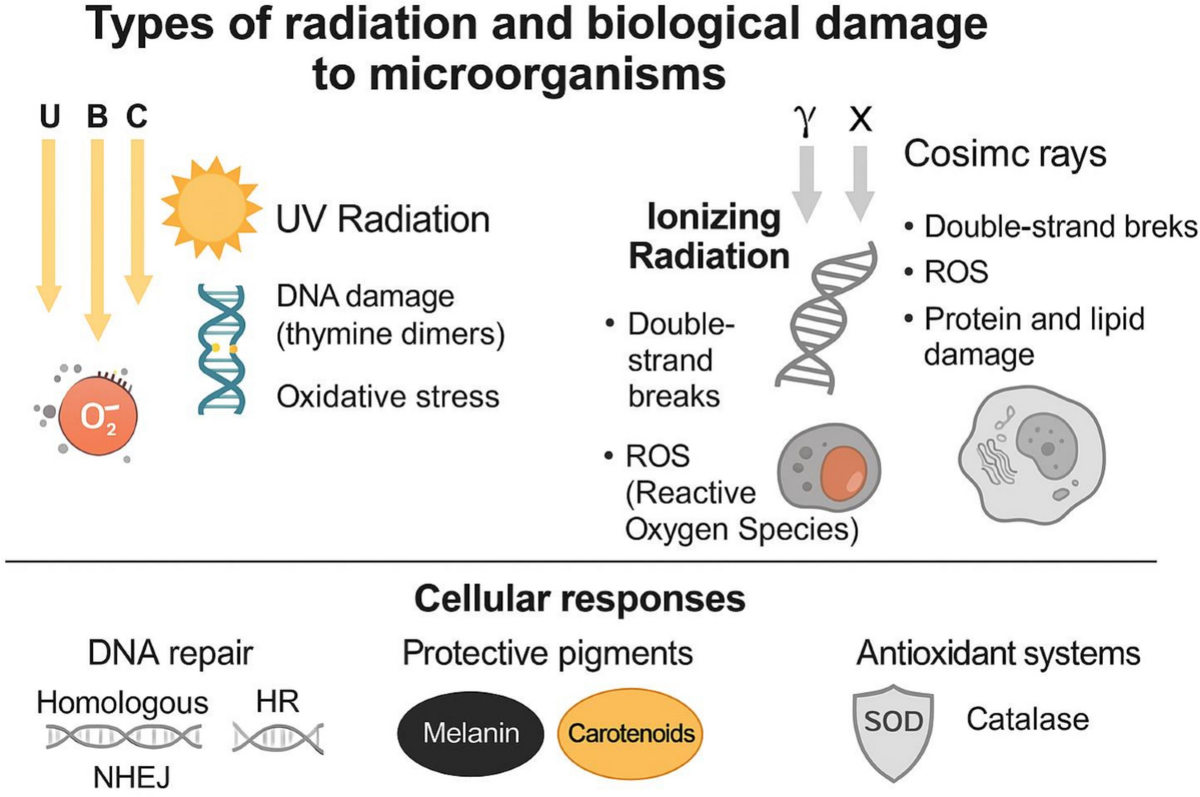
Beyond Earth orbit, spacecraft and astronauts face three primary types of space radiation:
Galactic Cosmic Rays (GCRs), Solar Particle Events (SPEs), and Trapped Radiation (like the Van Allen Belts), all of which lack the natural shielding of Earth's atmosphere and magnetosphere.
Galactic Cosmic Rays (GCRs): Sourced from outside our solar system, these originate from supernova explosions. They consist of highly penetrating, charged particles including high-energy protons (~87%), helium nuclei (~12%), and heavy, high-charge/energy (HZE) ions (~1%). These relativistic heavy ions cause deep, clustered DNA damage and are extremely difficult to shield against.Solar Particle
Events (SPEs): Emitted intermittently by the Sun during solar flares and coronal mass ejections (CMEs), these events consist mainly of high-energy protons. They result in sudden, intense radiation storms that can pose acute health risks.
Trapped Radiation: Also known as the Van Allen radiation belts, these are regions of energetic protons and electrons trapped by a planet's magnetic field. While not in deep interplanetary space, transitioning through these belts during outbound or inbound trajectories requires rapid transit to minimize radiation dose.
Offline
Like button can go here
#78 2026-07-09 09:04:54
- GW Johnson
- Member
- From: McGregor, Texas USA
- Registered: 2011-12-04
- Posts: 6,242
- Website
Re: OldFart1939 Postings and YouTube Video Presentation(s)
Spacenut:
Thanks for the google AI results. Nice to see it back me up. Although I gave numbers for cosmic ray exposures and for radiation sickness thresholds, just in the old US units that I knew and understood.
When I said solar particle events were erratic in intensity, that was based on an old graph I got off a NASA website many years ago. The highest-intensity events were rare, but measured in the 10's of thousands of REM accumulated in an hour. There was one such in 1972, between Apollo 16 and Apollo 17.
The weakest events were not the very most common, measuring in the hundreds of REM per hour. Most commonly doses outside the spacecraft were in the few hundred to low thousand REM/hour range. Apollo capsule hulls knocked that down by about a factor of 2. Which is not enough shielding for a 1000 REM/hr event, being a fatal dose even inside the capsule, in only 1 hour's exposure. Bear in mind these events usually last several hours to a day or so.
The Van Allen belts are particles similar to those of solar particle events, since most come from the sun and get trapped in Earth's magnetic field. These belts are intense enough to accumulate a lethal dose if you dawdle around transiting the Van Allen belts, but they are the same lower energy as solar flare particles, thus fairly easy to shield.
The figure of merit for such shielding I also got from that same old NASA website many years ago. It was the 15-20 grams of "something" per square centimeter of surface area. To protect against something like the 1972 event, 20 gram/sq.cm is more effective than 15, but you will get a dose over a short time interval. To meet the old exposure standards, you need enough shielding to hold that flare dose down to 25 REM accumulated in any given month. Accumulation = dose rate (REM/hr) times exposure time (hours).
GW
GW Johnson
McGregor, Texas
"There is nothing as expensive as a dead crew, especially one dead from a bad management decision"
Offline
Like button can go here
#79 2026-07-09 15:05:09
- SpaceNut
- Administrator
- From: New Hampshire
- Registered: 2004-07-22
- Posts: 30,816
Re: OldFart1939 Postings and YouTube Video Presentation(s)
AI responses tend to be in metric unless you ask it to convert the information
Its about the energy level as well for the what band we get hit with.
Hence the work I did in the large ships system.
Offline
Like button can go here