You are not logged in.
- Topics: Active | Unanswered
Announcement
#1 2012-06-13 19:47:16
- Void
- Member
- Registered: 2011-12-29
- Posts: 9,535
The use of filler mass in propulsion. Could it help?
I am putting this here, because I think that there could be some who would resent it if I put something so wild into the transportation sections.
I have been wondering if any good can come from injecting non combutsible or non traditional substances into a cluster of rocket plumes.
I would start with the worst case notion, that of injecting just plain moon dust, from our Moon, or Phobos or Demos.
I had thought about injecting it into a rocket engine but intution told me that that is a no no. 
I am thinking if you had a cluster of engines, at least 3, and you could inject a slury of dust and C02 for instance into the area between the exhaust plumes, could that serve any purpose?
Similarly of course is dry ice and water.
The thing Dust, Dry Ice and Water have in common is that they might be obtainable at far locations with less fuss, and they are rather storable. Turning dust into a slury for injection could be a problem.
I understand that for the solid rockets the space shuttle used, it was considered a good thing that it had soot and particles in the exhaust somehow it promoted thrust?
Ignorant wondering.
Of course it might be quite possible to obtain C02 and Reduced dust from an astoroid of certain types by subjecting the dust to concentrate solar heat. In that case the dust could actually be a fuel of sorts. (Think grain elivator explosions).
Last edited by Void (2012-06-13 19:52:55)
Is it possible that the root of political science claims is to produce white collar jobs for people who paid for an education and do not want a real job?
Offline
Like button can go here
#2 2012-07-18 09:33:03
- orionblade
- Banned
- From: Hampton Virginia
- Registered: 2003-01-14
- Posts: 60
Re: The use of filler mass in propulsion. Could it help?
Adding a noncombustible means you're sapping thermal energy from the exhaust stream. Injected after the nozzle throat, it may help to cool the nozzle and add to total mass flow, as water injection was used to increase mass flow rates on jet engines back in the 60's and 70's before high-bypass turbofans were developed.
Carbon black is added to solid rocket fuel to alter the burn rate and enhance combustion stability, as are a few other inert compounds, but you'll find these in concentrations well under the 1-2% mark by mass. Carbon black can make an otherwise infrared-transparent fuel grain opaque, so the whole thing doesn't soften, melt, and splort out the nozzle before it's supposed to be burned. Other modifiers keep the fuel grain from simply detonating as surface area increases and pressures go up in a core-burning grain, and there are other plasticisers that aren't the best for "fuel" that can keep the grain from cracking or aid in thermal gradient management. Keep in mind the color of the exhaust plume on the SRB's, too - damn near white.
Offline
Like button can go here
#3 2026-05-15 09:51:02
- tahanson43206
- Moderator
- Registered: 2018-04-27
- Posts: 24,820
Re: The use of filler mass in propulsion. Could it help?
This topic by Void showed up when I ran a search for topics with the word "mass" in the title.
Void asked what seems to me an interesting question.
The reply by orionblade in 2012 contains items that suggest knowledge of rocket propulsion techniques.
However, the topic has been idle since 2012.
It seems to me this topic could be developed as a learning opportunity.
It would take someone with deep knowledge and a generous spirit to prepare a set of posts that would cover the range of possible answers.
I ** do ** know that non-productive mass is routinely added to rocket propulsion systems. That mass is excess propellant that is accelerated along with the gas molecules that result from combustion, so the non-consumed molecules are delivered to the output stream along with the molecules that result from combustion. Details of how much such mass is intentionally used for this purpose would be interesting.
It seems to me that adding mass after it has left the expansion bell is not going to contribute much, because the mass past the expansion bell can never provide thrust to the vehicle. It might be a good way to dispose of unwanted material.
The way Void has worded this topic title is interesting. As I read it, perhaps the answer is "It Depends", or the answer might be "Yes".
I've decided to bring the topic back into view to see if anyone is willing to go to the trouble of creating an authoritative post.
It seems to me that at the heart of Void's question is how to take advantage of all the "filler" mass we humans will encounter as we travel away from Earth. Void himself has talked about many ways of accelerating "filler" mass, in numerous topics.
Void has mentioned mass accelerators frequently.
I'm pretty sure I recall Void talking about using rotation and release as another way to convert energy into force for propulsion.
But ** this ** topic is very narrowly defined... It is specifically about ** filler ** mass, so it cannot be about the kind of mass that is accelerated by a mass accelerators. By definition, ** that ** mass is NOT filler mass. It is propulsive mass, against which the space craft experts force in order to obtain an equal and opposite reaction.
I wonder if ion engines may inadvertently send "filler" mass out the exit along with the electrically charged particles that are accelerated by magnetic and electric fields.
There may well be a good reason why this topic has remained quiet for more than 14 years .... It may be very difficult to answer.
(th)
Offline
Like button can go here
#4 2026-06-03 14:56:18
- Calliban
- Member
- From: Northern England, UK
- Registered: 2019-08-18
- Posts: 4,324
Re: The use of filler mass in propulsion. Could it help?
Using inert material for reaction mass is a good idea. The mass driver has been proposed as an engine that could be mounted on a spacecraft and used to accelerate mass for propulsion. Another option that is potentially far more compact, is the arc jet.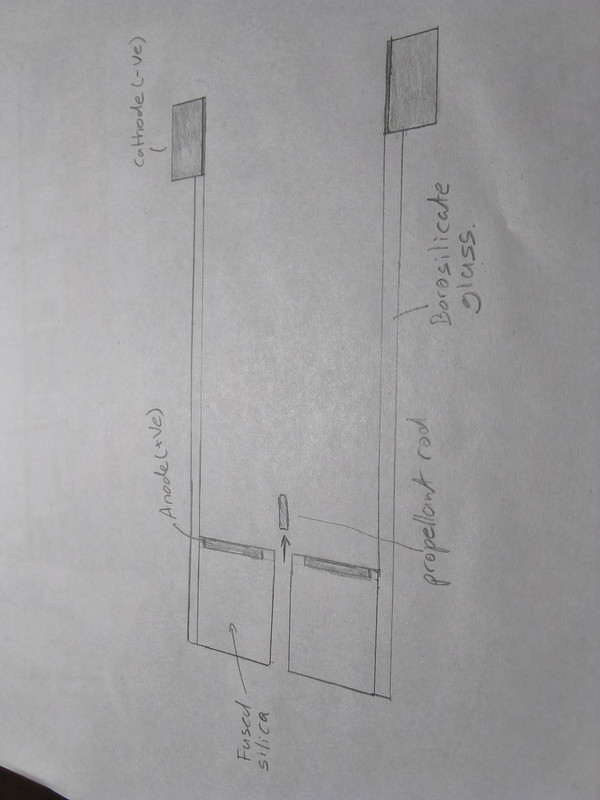
The image shows the concept. We take mixed silicates from, say, one of the Martian moons. This is compressed and sintered into thin rods and then chopped into short cylinders. Next, the cylinders are vacuum plated with a thin film of aluminium. The potential difference between the anode and cathode in the engine will be several tens of KV. The ceramic cylinders are fired through the tube passing through the fused silica block. The anode ring is mounted on the silica block.
As the cylinder enters the chamber between the anode and cathode, the potential difference between the two strips electrons from the aluminium coating and pulls them towards the anode. This heats the aluminium to tens of thousands of kelvin, turning it into a plasma that fills the enclosure. The high speed ejection of the aluminium, compresses the ceramic rod, shock heating it to thousands of kelvin. At this temperature, the material dissociates into plasma. The aluminium and silicate plasma are both electrically conductive at this point. An electric arc flows through the plasma. Electrons are drawn to the anode and positive plasma ions are drawn to the cathode at the nozzle, where they recombine with the electrons. The resultant neutral plasma is expelled at several km/s.
One problem with using silicates as propellant is that hot oxygen ions will tend to chemically attack the cathode. One way of dealing with this is to cover the cathode with a replaceable metallic liner. Maybe something cheap and abundant like iron.
Last edited by Calliban (2026-06-03 15:12:46)
"Plan and prepare for every possibility, and you will never act. It is nobler to have courage as we stumble into half the things we fear than to analyse every possible obstacle and begin nothing. Great things are achieved by embracing great dangers."
Offline
Like button can go here
#5 Yesterday 07:38:42
- Void
- Member
- Registered: 2011-12-29
- Posts: 9,535
Re: The use of filler mass in propulsion. Could it help?
I partially understand your work. It does offer the chance to dispose of garbage and get utility from it.
Oxygen can be included in some materials as fillers, but you have also acknowledged that Oxygen can be a problem for the device.
For whatever reason the British derived people appear to have been producing the Neumann Drive and Magdrive.
Their methods require only conductive materials.
My concern about what you are working on is some scrap materials may be Oxidized, and you may have a good thing.
Data Centers in Sun Synchronous orbits will wear and need servicing. It will not be a good thing to dump all this junk into the upper atmosphere. If the output of the device could be used in a clean manner, then that will be preferred.
I think that radiators and chassis parts may be reused and recycled indefinitely.
Solar panels, glass, ceramics, chips, may need a different processing pathway. Thay could be processed to exclude the Oxygen from these rubbish streams, to produce conductive materials. But your device may allow Oxygen to be a propellant included into the other materials.
The question will be does the output from your device dump into the Earth's atmosphere, or can it be pushed elsewhere, as fine particles that the solar wind and photons will push away outward into the solar system?
Another interesting use for your device might be propellants from Phobos and Deimos.
I wonder if a coating of Iron would be good enough? Iron would be the most easily extracted conductive metal. If it is not as conductive as Aluminum, perhaps that does not matter, as the point is to produce a I * E = P, so that the metal coating heats up and the whole "Slug" is vaporized into a plasma which is also conductive.
A propulsion system that can expel the slag slugs coated with metal might be convenient to refuel/refill from Phobos or Deimos or asteroids.
And as I have said, I think old solar panels and other junk might be used to refuel/refill it in Earth orbit.
If Elon Musk/SpaceX are right, then satellites will be produced on the Moon and exported by a Mass Driver System. As Solar Panels do wear out and other "Slag" type materials wear out then a stream of propellants would be expected that needs a disposal method, or a reuse method.
Words of encouragement!
Ending Pending
You also mentioned mass drivers. If materials from Phobos and Deimos could be dumped into the Mars atmosphere, it may be possible that that could warm Mars. This might be done while moving ships and cargo around.
https://ui.adsabs.harvard.edu/abs/2024S … A/abstract
Quote:
Feasibility of keeping Mars warm with nanoparticles
Ansari, Samaneh search by orcid ; Kite, Edwin S. search by orcid ; Ramirez, Ramses ; Steele, Liam J. search by orcid ; Mohseni, Hooman search by orcid
Abstract
One-third of Mars' surface has shallow-buried H 2 O, but it is currently too cold for use by life. Proposals to warm Mars using greenhouse gases require a large mass of ingredients that are rare on Mars' surface. However, we show here that artificial aerosols made from materials that are readily available at Mars—for example, conductive nanorods that are ~9 micrometers long—could warm Mars >5 × 10 3 time smore effectively than the best gases. Such nanoparticles forward-scatter sunlight and efficiently block upwelling thermal infrared. Like the natural dust of Mars, they are swept high into Mars' atmosphere, allowing delivery from the near-surface. For a 10-year particle lifetime, two climate models indicate that sustained release at 30 liters per second would globally warm Mars by ≳30 kelvin and start to melt the ice. Therefore, if nanoparticles can be made at scale on (or delivered to) Mars, then the barrier to warming of Mars appears to be less high than previously thought. Warming Mars with artificial aerosols appears to be feasible.
So, possibly your arc process might make those nanoparticles as a side effect, or the nanoparticles might be manufactured and ejected from a mass driver process to propel spaceships.
So, possibly a way to move cargos around and to terraform Mars as a side effect.
Ending Pending
Last edited by Void (Yesterday 08:06:50)
Is it possible that the root of political science claims is to produce white collar jobs for people who paid for an education and do not want a real job?
Offline
Like button can go here
#6 Yesterday 13:08:17
- Calliban
- Member
- From: Northern England, UK
- Registered: 2019-08-18
- Posts: 4,324
Re: The use of filler mass in propulsion. Could it help?
Almost any material could be used as propellant. The propellant does need some conductive material within it. But once it is heated beyond it's first ionisation temperature, any material is conductive, because it is a plasma with free charge carriers at that temperature. That includes any oxides that we could, for example, mine from the Martian moons. Metals would be preferable, but unless you have a convenient supply of them i.e. as waste, oxides will be the dominant materials available naturally. The problem is that oxides break down into a mixture of metal and oxygen ions.
"Plan and prepare for every possibility, and you will never act. It is nobler to have courage as we stumble into half the things we fear than to analyse every possible obstacle and begin nothing. Great things are achieved by embracing great dangers."
Offline
Like button can go here
#7 Yesterday 19:15:08
- Void
- Member
- Registered: 2011-12-29
- Posts: 9,535
Re: The use of filler mass in propulsion. Could it help?
There may be something useful in this: https://newmars.com/forums/viewtopic.php?id=11305 (Several interesting links).
https://newmars.com/forums/viewtopic.ph … 99#p238299 (Post #5 of particular interest).
Quote:
Posting again about "Salt Mining": https://www.youtube.com/watch?v=UMI_ITPgirI
Quote:Saltwater + Electricity Can Extract Precious Metals (SEM TECH Explained)
Rowow
Iron Chloride has a low vaporization temperature relative to Iron.
And post #2 can extract Iron: https://newmars.com/forums/viewtopic.ph … 37#p238037
Quote:
https://www.bing.com/videos/riverview/r … ORM=VAMGZC Quote:
A new way to make steel competitively at room temperature
YouTube
Rowow
1.8K views
So, the Iron might be extracted at a lower temperature. Then is that is all you want to extract, you could use simple heating to melt the tailings into your projectiles and then they could be coated with Iron, or Aluminum. Then you would also have Iron to repair the components that you think the Oxygen in plasma might damage.
It also occurs to me that if you expose Iron Oxide to Chlorine, Oxygen may be liberated as the Chlorine might displace it.
Well maybe you also might want to extract more than Iron.
Ending Pending
Last edited by Void (Yesterday 19:36:36)
Is it possible that the root of political science claims is to produce white collar jobs for people who paid for an education and do not want a real job?
Offline
Like button can go here