You are not logged in.
- Topics: Active | Unanswered
Announcement
#51 2025-12-10 16:02:51
- Calliban
- Member
- From: Northern England, UK
- Registered: 2019-08-18
- Posts: 4,324
Re: Misc. Home Projects
This design can be built Horizontal or vertical in form https://www.instructables.com/55-Gallon-Drum-Turbine/
This is the kind of machine that I would choose to build if I could repeat the process. A much simpler machine, easier to build, able to accept wind from any direction and although slightly less efficient, it has more starting torque than the horizontal axis machines. That is important, because the rope drive and any machinery attached to the clutch, will have considerable internal friction. So efficiency is about more than just aerodynamics.
Update: Today I attached the rope drive and the clutch. It seems to be working as intended. Aside from cosmetic changes and the balancing of the machine, it is now finished.
"Plan and prepare for every possibility, and you will never act. It is nobler to have courage as we stumble into half the things we fear than to analyse every possible obstacle and begin nothing. Great things are achieved by embracing great dangers."
Offline
Like button can go here
#52 2025-12-18 08:11:57
- Calliban
- Member
- From: Northern England, UK
- Registered: 2019-08-18
- Posts: 4,324
Re: Misc. Home Projects
The machine is now fully operational. I have built a tumbling machine that is connected to the clutch. It is quite windy at present and the machine is working well. I will check on the progress of the stones early next week.
"Plan and prepare for every possibility, and you will never act. It is nobler to have courage as we stumble into half the things we fear than to analyse every possible obstacle and begin nothing. Great things are achieved by embracing great dangers."
Offline
Like button can go here
#53 2025-12-19 10:16:17
- Calliban
- Member
- From: Northern England, UK
- Registered: 2019-08-18
- Posts: 4,324
Re: Misc. Home Projects
Some pics: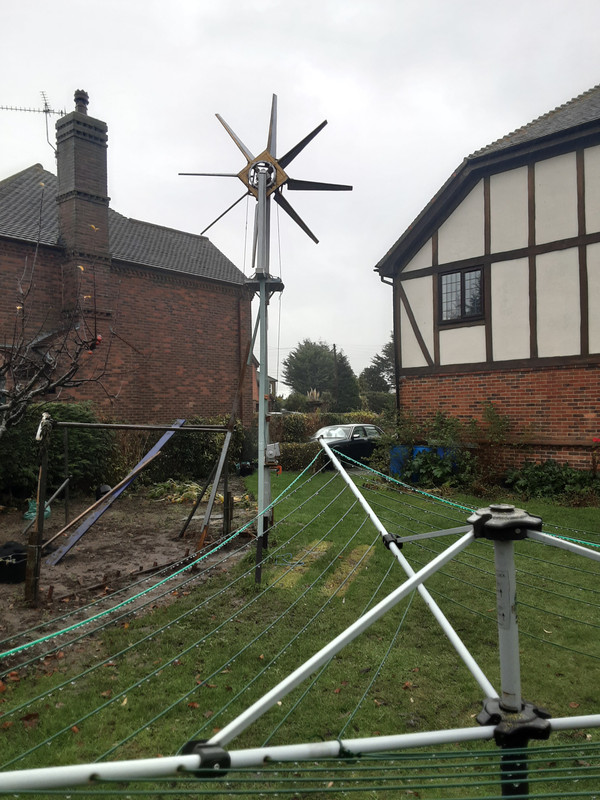
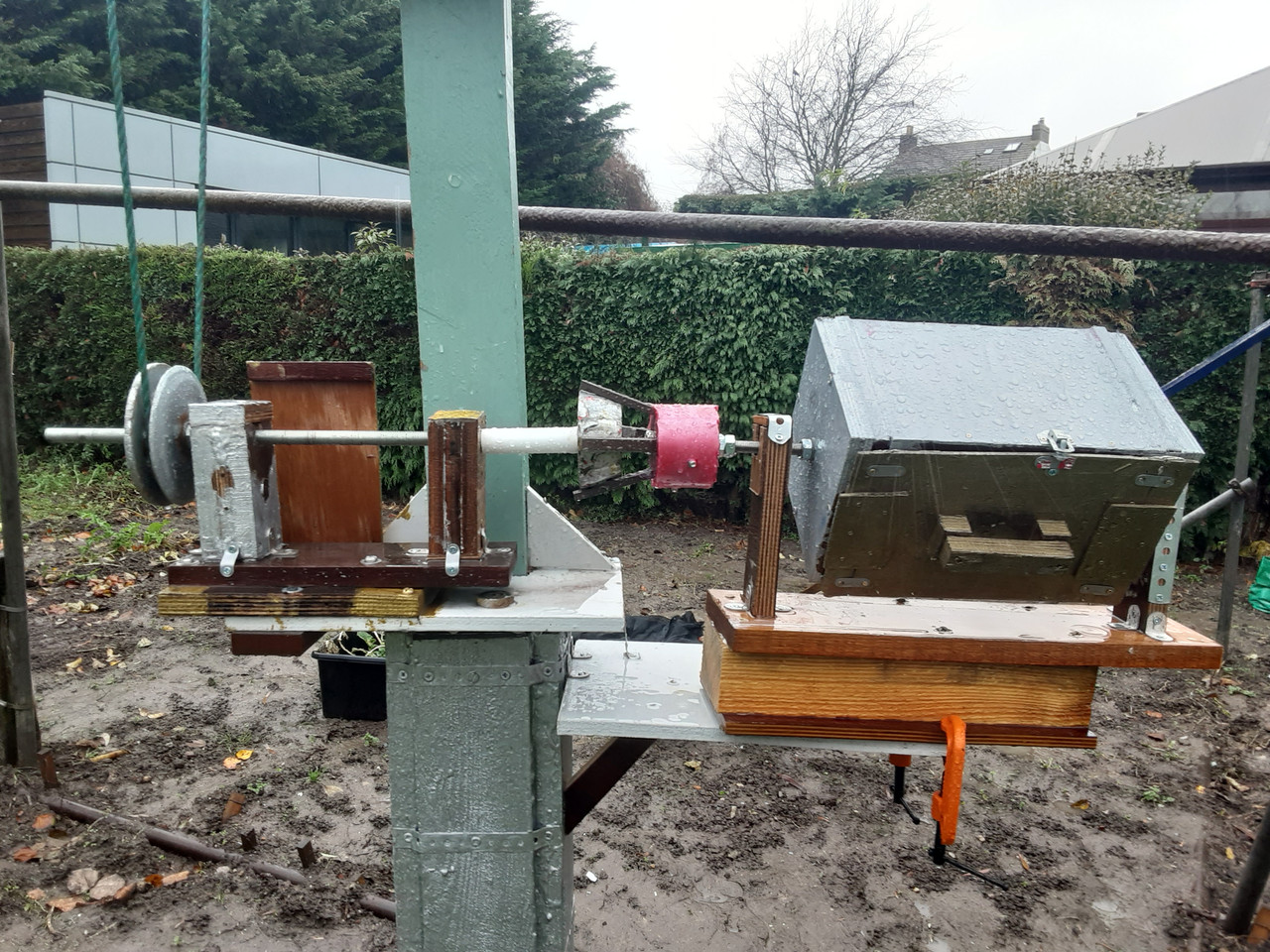
"Plan and prepare for every possibility, and you will never act. It is nobler to have courage as we stumble into half the things we fear than to analyse every possible obstacle and begin nothing. Great things are achieved by embracing great dangers."
Offline
Like button can go here
#54 2026-05-22 11:24:32
- Calliban
- Member
- From: Northern England, UK
- Registered: 2019-08-18
- Posts: 4,324
Re: Misc. Home Projects
After endless problems with the ropedrive, I decided to disconnect it. I have fitted boxes to contain the sampling pots directly on the ends of one set of blades. This means I don't need to climb too high to access the tumbling boxes.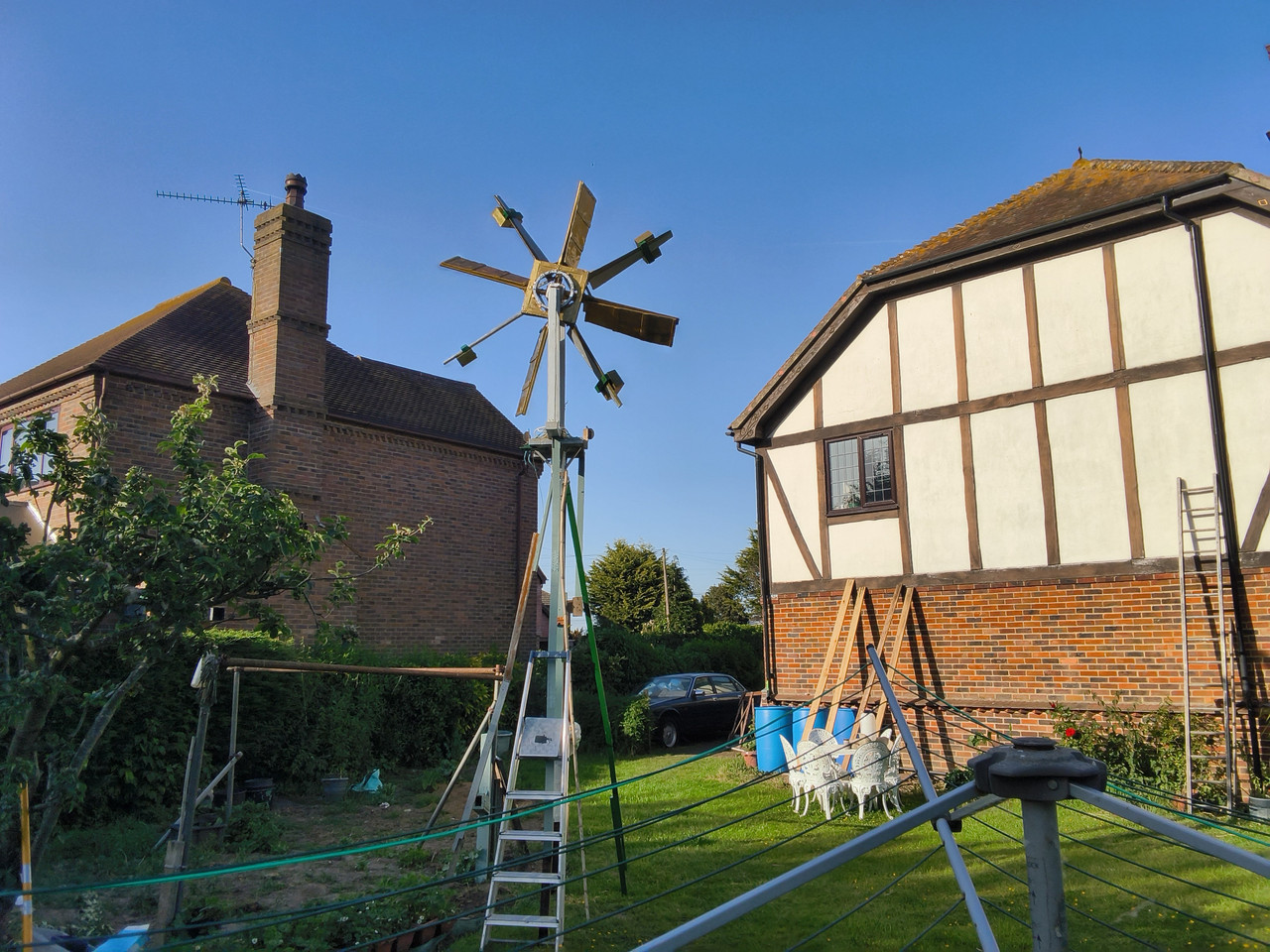
It works a treat! The only problem is that whilst this works OK for tumbling, it is no use for any other mechanical load.
"Plan and prepare for every possibility, and you will never act. It is nobler to have courage as we stumble into half the things we fear than to analyse every possible obstacle and begin nothing. Great things are achieved by embracing great dangers."
Offline
Like button can go here
#55 2026-06-02 02:34:12
- Calliban
- Member
- From: Northern England, UK
- Registered: 2019-08-18
- Posts: 4,324
Re: Misc. Home Projects
I have just finished building a stone cutting table saw.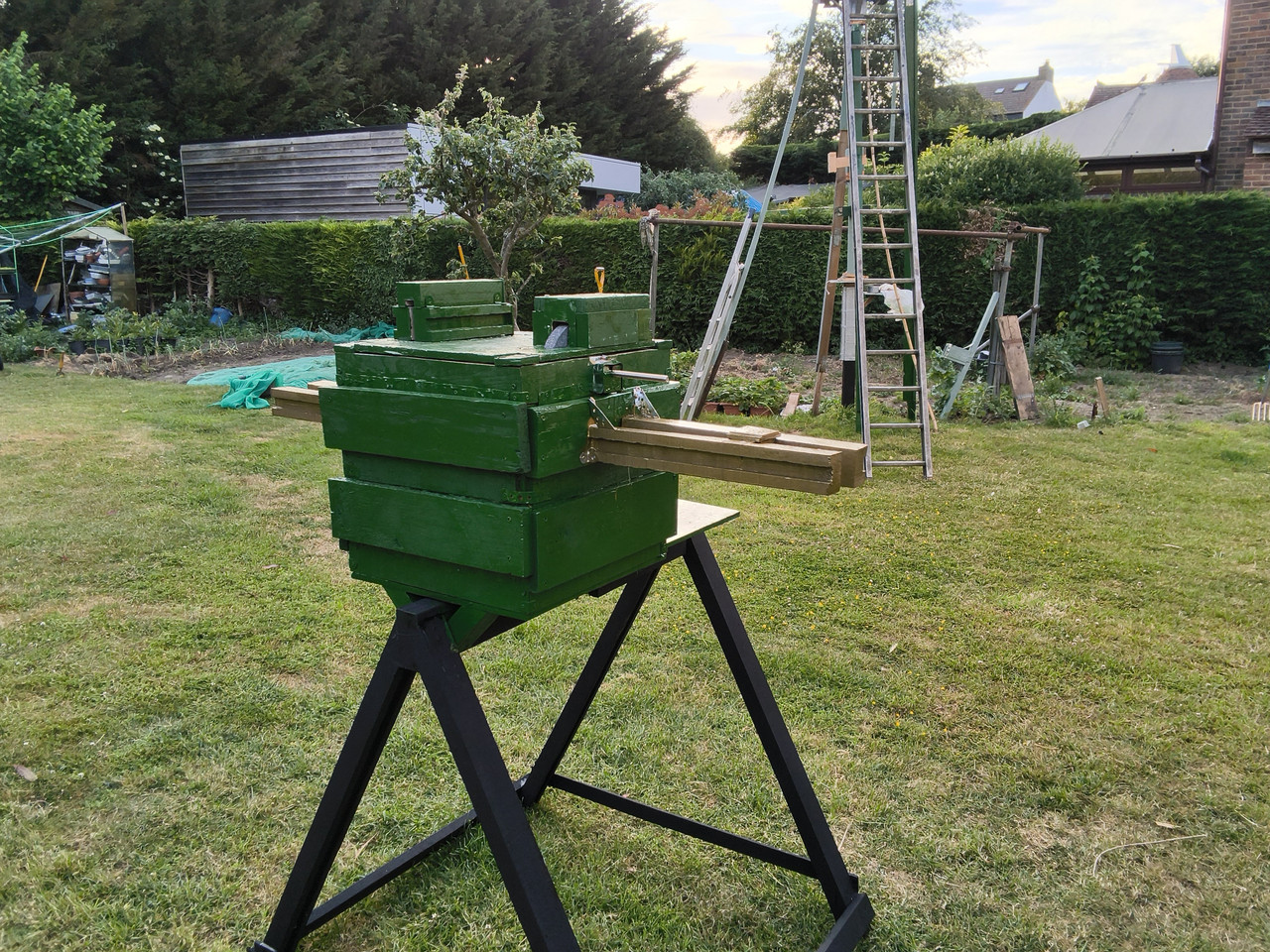
.jpg)
The cutting disc and grinding wheel are both mounted on 10mm threads that protrude out of the sides of the box. I am using a power drill to drive the machine, which will be mounted on the wooden arms that stick out the sides. But in the future, it could be driven by a DC motor powered directly from a solar panel. Or I could put a pulley onto each of the threads and use mechanical wind power to drive it. My existing windmill isn't up to the job, unfortunately. I am using it to polish stones instead. This is a lower power application that is more suited to highly intermittent energy.
Last edited by Calliban (2026-06-02 02:42:43)
"Plan and prepare for every possibility, and you will never act. It is nobler to have courage as we stumble into half the things we fear than to analyse every possible obstacle and begin nothing. Great things are achieved by embracing great dangers."
Offline
Like button can go here
#56 2026-06-02 15:05:45
- SpaceNut
- Administrator
- From: New Hampshire
- Registered: 2004-07-22
- Posts: 30,770
Re: Misc. Home Projects
Your latest is still a step above doing everything with electrical power. It is quite interesting the amount of torque that even a gradual wind can supply.
Offline
Like button can go here
#57 2026-06-03 06:42:46
- Calliban
- Member
- From: Northern England, UK
- Registered: 2019-08-18
- Posts: 4,324
Re: Misc. Home Projects
Thanks SpaceNut.
Overall, the mechanical wind power project has not worked very well. I have been able to use it to polish stones. But even in this limited application, it is slow compared to an electric tumbler and its work rate is highly dependant on weather conditions. Some lessons learned:
1. Given the limited power output from a machine of this size, a homemade windmill is only worth building if the majority of materials used to build it are free. Most of the material inputs to my machine were recycled wood and recycled aluminium from old drink cans (for the blades). The bearings, stainless steel thread, screws, epoxy glue and some fastenings were purchased components. Overall, the financial cost of the machine was ~$US500. The time input was huge.
2. From the outset, the machine was intended to generate mechanical rather than electrical power. Electrical generation would have improved the utility of the machine, but would have at least doubled it's cost. However, mechanical power transmission was not successful. Much of the problem was due to difficulty assembling the machine at height, which resulted in the pulley being mounted unevenly on the rotor. The rope frequently slipped off, making power transmission unreliable and requiring constant attention. The rope also suffered excessive wear. Metal rope did not work well either, as it did not grip the pulley properly and caused damage when it slipped off. The rope drive also added a lot of friction. This further reduced the operating window of the machine, as the turning force had to overcome static friction in order for rotation to start.
3. The siting of a small wind machine has a critical impact on its viability. For the machine to work well, it must have open space in front of it for at least a few hundred metres in the dominant wind direction. If your space is surrounded with trees or buildings that attenuate wind at the hub height, performance will be poor. This is a problem in the UK, because most homes are crowded together and only a minority have free space around them. So a wind machine will only be useful in a minority of situations.
4. Building a horizontal axis machine turned out to be a mistake. Without the ability to track the wind (which adds a lot of design complication) the machine is idle a large percentage of the time. When I started the project, my assumption was that facing the machine west south-west, was an acceptable design compromise, because on a time averaged basis, about 80% of annual wind energy comes from that direction. But that decision reduced the operating time of the machine. A vertical axis machine could have operated using wind from any direction. Although vertical axis would be slightly less efficient, the ability to harness wind from any direction without tracking, means that a machine of comparable swept area would generate similar power over the year. However, this power would be spread over more operating hours, which is valuable.
5. The machine was difficult to build and I had to modify the design several times. Modifying the machine meant working at height and on two occasions, I had to lift the rotor out of its cradle. Everything is more difficult when working at height. Designing a machine that allows the rotor to be easily lowered to ground level would make maintenance easier.
6. A vertical axis machine would have been simpler and easier to build. It would also have made mechanical power transmission easier. Instead of the unreliable rope drive, a bevel gear could have attached directly to the rotating shaft at ground level.
7. The machine now incorporates tumbling boxes at the end of (four of) the blades. This eliminates the need for power transmission and eliminates the friction imposed by the ropedrive. However, the machine cannot be used for any task now other than stone tumbling.
8. The machine proved to be under-powered and poorly sited for many of the tasks I wanted to use it for. I estimate that average power is ~300W. However, friction consumed a great deal of power and what remained was generally insufficient and too intermittently available to support other mechanical loads. The power available to a wind machine is proportional to swept area. Doubling the length of the blades would quadruple power output. But the cradle design did not allow that.
At some point in the future, I may try again. If I do, I will choose a different design to the one that I built. It was a pig to build and the results were far more limited than I had hoped.
Last edited by Calliban (2026-06-03 06:54:37)
"Plan and prepare for every possibility, and you will never act. It is nobler to have courage as we stumble into half the things we fear than to analyse every possible obstacle and begin nothing. Great things are achieved by embracing great dangers."
Offline
Like button can go here